Reading view

Palo Alto Networks and Google Cloud

Expand Strategic Collaboration to Secure the AI Enterprise

The transition from generative AI to agentic AI represents one of the most significant shifts in the history of enterprise technology. As organizations move from simple chatbots to autonomous agents that can execute business processes, the attack surface isn't just changing, it's exploding.

At Google Cloud Next 2026 in Las Vegas, Palo Alto Networks is proud to announce a series of groundbreaking integrations with Google Cloud. These innovations are designed to do more than just monitor the new AI-driven landscape; they are built to secure it by design. AI deployment is currently outpacing AI governance. By embedding our security platform into Google Cloud’s infrastructure, we are giving today’s enterprises the foundation to become the autonomous organizations of tomorrow.

Here is a look at the four major milestones of our partnership being unveiled this week.

Secure AI Agents with Google Cloud + Prisma AIRS

As autonomous AI agents become the new enterprise standard, security can no longer be an afterthought; it must be architectural. By integrating Prisma AIRS™ natively with Google Cloud Gemini Enterprise Agent Platform, we provide the proactive defenses required to govern complex agentic workflows. This integration ensures that as you scale your autonomous workforce, your security scales with it, providing comprehensive operational integrity without hindering the speed of innovation.

We are delivering capabilities across three critical pillars:

  • Protecting Agent-Specific Runtime Risks: In an agentic ecosystem, the primary risk is unauthorized or a destructive action taken by the AI agents themselves. Prisma AIRS secures the "agent-to-tool" interface, preventing poisoned context from triggering malicious scripts or destructive actions. The solution monitors agent execution in real-time, so agents cannot leak sensitive credentials or tool schemas, maintaining the boundary between agents and their access to enterprise data.
  • Securing the GenAI Application Surface: Modern AI applications and agents require a secure-by-design approach. Prisma AIRS AI Runtime Security™ provides prevention of more than 30 adversarial prompt injection and jailbreak techniques, as well as malicious code and URLs within LLM outputs. Prisma AIRS utilizes over 1,000 predefined patterns out of the box and ML-powered Enterprise DLP to stop sensitive data leakage.
  • Enforcing Enterprise AI Safety and Grounding: Trust in AI is built on the consistency and safety of its output. Prisma AIRS allows organizations to define safety policies in natural language and filter toxic content across eight distinct categories to protect brand reputation. Using contextual grounding, Prisma AIRS can prevent misleading outputs that contradict internal RAG data, keeping agents tied to real facts.

This integration ensures that as you scale your autonomous workforce, your security posture scales with it, providing operational integrity without hindering the speed of innovation.

Security-as-Code for Prisma AIRS Integration with Application Design Center (ADC)

The traditional bolt-on approach to security is no longer viable in a cloud-first world. Google Cloud’s Application Design Center (ADC) is revolutionizing how applications are built, using an intuitive canvas and natural language via Gemini Code Assist.

Palo Alto Networks is announcing that it will be published as a template within the Application Design Center, providing more capabilities to engineering teams:

  • Drag-and-Drop Security – Visually "snap" VM-Series firewalls and Prisma AIRS AI protections directly into network flows.
  • AI-Driven Architecture – Use natural language prompts to generate secure-by-default, multiregion architectures.
  • Simultaneous Deployment – Deploy entire application stacks and security services in a single, unified workflow, ensuring protection is present from the very first minute of deployment.

Zero-Day Protection at Scale with Advanced Malware Sandboxing for Google Cloud NGFW Enterprise

The battle against malware has shifted to the cloud. Modern attacks are faster, more evasive and capable of bypassing traditional defenses.

That is why we are excited to announce Advanced WildFire®, powered by Palo Alto Networks, natively integrated into Google Cloud NGFW Enterprise, delivering AI-driven malware prevention directly within Google Cloud environments.

This integration embeds inline sandboxing and real-time threat intelligence directly into Google Cloud’s distributed firewall to stop advanced and unknown threats before they impact workloads, enabling:

  • Secure Detonation – Suspicious files are safely executed in a controlled sandbox environment to uncover hidden and unknown threats.
  • Inline Traffic Inspection – Inbound and outbound traffic is analyzed in real time to prevent lateral movement of malicious payloads across cloud environments.
  • AI-Driven Threat Prevention – Leverages global threat intelligence by Palo Alto Networks to block zero-day threats before they compromise workloads.

With Advanced WildFire embedded directly into Google Cloud NGFW Enterprise, organizations can extend consistent protection across their cloud infrastructure while maintaining operational simplicity.

Cloud NGFW Enterprise Advanced Malware Sandboxing will be available in Public Preview soon.

Defining the Future with the Google Cloud Marketplace

Palo Alto Networks has joined the Google Cloud Marketplace Agent-as-a-Service as a launch partner to introduce the Prisma AIRS Model Security agent. Operating as an Agent-as-a-Service, this solution scans AI models for vulnerabilities and policy noncompliance before they reach production.

Available in the Agent Gallery inside Gemini Enterprise, this marketplace offering runs entirely within the customer’s own Google Cloud environment, providing both new and existing Prisma AIRS users a seamless and simple deployment experience inside Gemini Enterprise.

Securing AI Innovation at Scale

The collaboration between Palo Alto Networks and Google Cloud is built on a shared vision: Security should be an accelerator for innovation, not a bottleneck. As we look toward the future of the AI-powered enterprise, our commitment remains to provide the most robust, platform-driven security for every workload, every agent and every interaction.

Want to see these integrations in action? Contact your Palo Alto Networks representative to learn more about how we are securing the future of the cloud together. If you’re attending Google Cloud Next 2026, join us at these sponsored sessions:

The post Palo Alto Networks and Google Cloud appeared first on Palo Alto Networks Blog.

  •  

Scaling AI Agents with Confidence

The Google Cloud and Palo Alto Networks Partnership

As AI agents move into business-critical environments, they are transforming everything from security operations to internal workflows. However, scaling these AI applications introduces unprecedented hurdles for security executives, from detecting "shadow AI" and unsanctioned usage to governing complex nonhuman identities across multimodel environments.

To overcome these challenges, organizations need more than just tools; they need a layered architecture built on a foundation of platformization. The long-standing partnership between Palo Alto Networks and Google Cloud provides this essential framework, offering customers:

  • Integrated Security Ecosystems: Seamlessly manage the full agent lifecycle with visibility and observability across your entire AI infrastructure.
  • Jointly Engineered Solutions: Leverage over 80 co-engineered integrations designed to eliminate the tradeoff between a cloud-native experience and best-in-class security.
  • Proven Scale and Performance: Benefit from a partnership that has already delivered impactful, AI-driven solutions to protect joint customers from evolving threats.

Google Cloud Marketplace enables customers to discover, try, buy and use industry-leading applications that have been validated to run on Google Cloud. Palo Alto Networks has closed $2.4 billion in GCP bookings, helping address evolving customer needs, such as simplified procurement and seamless deployment.

Kevin Ichhpurani, President, Global Partner Ecosystem at Google Cloud:

We’re pleased to celebrate Palo Alto Networks as our Global Technology Partner of the Year… Palo Alto Networks has consistently delivered impactful, AI-driven security solutions that help Google Cloud customers better protect their organizations from evolving threats.

The extensive, long-standing collaboration between Palo Alto Networks and Google Cloud includes jointly engineered offerings, built on 80 solution integrations that help customers build, run and secure AI-enhanced cloud infrastructure and applications with end-to-end protection.

Palo Alto Networks Wins 2026 Global Technology Google Cloud Partner of the Year Award

At Google Cloud Next, Palo Alto Networks has been recognized with four 2026 Google Cloud Partner of the Year awards. By partnering with Google Cloud, we help customers securely leverage the power of the cloud and AI-driven growth with comprehensive cloud-native security offerings. Wins included the following:

  • Global Technology
  • Marketplace: Technology
  • Marketplace: Security
  • Security: Artificial Intelligence

These Partner of the Year Awards underscore our expanding partnership with Google Cloud. We share a mutual dedication to improve cloud, network security and AI observability, as well as the progress we’ve made in protecting our joint customers from today’s and tomorrow’s cyberthreats.

By combining our industry-leading security engineering with Google Cloud’s industry-leading cloud infrastructure and services, we’re providing advanced protection for every stage of a customer’s digital journey. We want customers to feel secure from the formative steps of lifting workloads into the cloud, to expanding digital innovation across platforms, to reaching new levels of business scale and velocity.

Protecting these journeys requires alignment and modernization of infrastructure (lift and shift), applications (refactoring) and user access models (zero trust). It requires an advanced AI drive security operations transformation across all IT domains, leveraging machine learning and sophisticated models to minimize human interventions and unguarded sides.

Our relationship with Google Cloud is based on a deep engineering relationship, yielding integrated solutions that help customers achieve better digital outcomes. Our partnership can help your organization eliminate tradeoffs between a cloud-native experience and best-in-class security. We have more than 80 co-engineered integrations, helping to improve and protect hybrid workers, cloud migrations and application modernization efforts.

We remain committed to our goals of outpacing cyberthreats, helping customers at every stage of their cloud journey, and creating a world where tomorrow is more secure than today.

Whether you’re just beginning your cloud journey or managing complex transformational projects, our jointly engineered, AI-driven solutions are designed to deliver seamless, scalable security. Explore the dynamic partnership between Palo Alto Networks and Google Cloud. Join us at Google Cloud Next '26 in Las Vegas from April 22-24 to discover how to secure your development lifecycle from code to cloud.

The post Scaling AI Agents with Confidence appeared first on Palo Alto Networks Blog.

  •  

Defender's Guide to the Frontier AI Impact on Cybersecurity

The release of the newest frontier AI models marks a turning point for cybersecurity. Palo Alto Networks has conducted early testing of the latest frontier AI models, including Anthropic’s Mythos model as part of Project Glasswing and OpenAI’s latest models as part of Trusted Access for Cyber program. The conclusion is clear: They are extraordinarily capable at finding vulnerabilities and generating corresponding exploits.

This generational improvement in coding ability directly translates to a significant advance in vulnerability discovery and exploit generation. These capabilities, however guardrailed, will not stay contained. Similar advances will appear across other major AI labs, Chinese models, and open source models. Attackers will find the seams in those guardrails. They will use advanced AI to discover zero-day vulnerabilities at scale, generate exploits in near real time, and develop autonomous attack agents unlike anything the industry has faced.

Within six months, advanced AI models with deep cybersecurity capabilities will become commonplace. Organizations that have not put appropriate safeguards in place will face an entirely new class of risk across their enterprise and critical infrastructure.

Frontier AI: A Quantum Leap in Code Fluency

As you have probably already seen, the latest unbounded models like Mythos represent roughly a 50% improvement in coding efficiency over Anthropic’s previous leading model. Palo Alto Networks has had early access to unbounded models and we’ve been able to leverage this vast improvement in coding to a quantum leap in scanning and offensive capability.

Hundreds of our best security engineers have been assessing these capabilities and developing best practices for using it effectively. The results revealed several core truths:

  • Vulnerability discovery at scale: Frontier AI is exceptionally effective at identifying vulnerabilities in code. In less than three weeks, it accomplished the equivalent of a full year’s worth of penetration testing effort.
  • Attack path determination: Perhaps more impressive than finding individual vulnerabilities, Frontier AI excels at vulnerability chaining, combining multiple lower-severity issues into critical-level exploit paths. For example, linking two medium-severity and one low-severity vulnerability into a single critical exploit.
  • Full-stack logic analysis: Frontier AI can analyze the full exposure surface of applications, including SaaS and public-facing platforms, identifying logic-based vulnerabilities that traditional tools miss.

Impacts on the Cyber Landscape

Attackers have been using LLMs for years, but based on our testing of frontier AI models, there are three key areas where they will have a significant impact on the cybersecurity landscape:

  1. The Vulnerability Deluge: Frontier AI models will dramatically accelerate the rate at which vulnerabilities are discovered, by defenders and attackers alike. This will be particularly acute in open source and critically, the flood of patches that follows will itself create risk. Every patch that is not applied immediately becomes a known, targetable vulnerability. Organizations will need to accelerate and automate their patching programs, rethink how they prioritize and apply patches, and ensure best-in-class protections are in place to mitigate vulnerability until they can be remediated.
  2. Rise of Inside-Out Attacks: Recent supply chain attacks on tools like LiteLLM and Trivy demonstrate a growing pattern where attacks land adversaries inside an organization’s infrastructure, bypassing multiple conventional attack steps and reducing the number of prevention opportunities available to defenders. The rapid deployment of AI infrastructure has made this problem more acute as the AI supply chain, including runtime environments, communication infrastructure, and model dependencies, is often insufficiently protected. While open source usage and patching practices must become significantly more robust, organizations will need structural containment of potential attacks through zero trust, identity modernization, outbound connection restrictions and lateral movement protections.
  3. Faster AI-Assisted Attack Cycles: I expect the most consequential shift with frontier AI models is the move from AI-assisted to AI-driven attacks. Attackers will build autonomous attack agents that dramatically compress attack cycle times. What once took days or weeks of skilled manual effort will soon be executed in minutes. This democratization of advanced attack capabilities means that defenders must match that speed with near-real-time detection and response, which is only possible with extensive AI and automation throughout security operations. Organizations whose Mean Time to Detection and Mean Time to Response are not measured in low single-digit minutes will be outpaced.

The Defenders Guide: Assessment, Protection, Platformization

The framework for defending against AI-driven threats is not completely new, but the standard for execution must be absolute. Organizations that are “mostly protected” are effectively unprotected. What follows is a phased approach – assessment, protection and platformization – that organizations should pursue in parallel to close gaps before attackers exploit them.

Assessment: Every organization should use the latest AI models to assess its entire code and application landscape and build a comprehensive asset and exposure inventory.

Key priorities:

  • Leverage AI models to identify vulnerabilities across your codebase, applications and infrastructure before attackers do.
  • Evaluate exposure with full context, including how vulnerabilities chain together to form critical exploit paths.
  • Audit your open source supply chain, including AI infrastructure, runtime environments and model dependencies.
  • Map your current sensor coverage. Detection, prevention and telemetry gaps represent critical blind spots.

Protect & Remediation: Remediating and reducing exposure is table-stakes. What in the past may have been difficult due to cross-organizational friction of finding and fixing at pace should now be accelerated with the c-suite attention of these new AI models. But this must go further and extend to comprehensive deployment of best-in-class attack prevention capabilities where the new standard is 100% coverage and optimization.

  • XDR everywhere, with emphasis on real-time ML-based detection and prevention of attacks; all hosts on prem and cloud included.
  • Agentic endpoint security to secure wide-scale adoption of vibe coding and AI security across the enterprise (e.g. Prisma AIRS and our recent acquisition of Koi is now a necessity for securing the agentic endpoint).
  • With an average of 85% of work now happening in the browser, secure enterprise browsers with real-time security become a must-have for attack prevention.
  • Zero trust and identity security are foundational to securing every user and every connection.

Real-Time Security Operations: With attack cycle times shrinking rapidly, the legacy approach to security operations simply doesn’t work. Disparate tools analyzing data in silos overlaid with manual processes must be replaced with AI and automation throughout. Cortex XSIAM, our AI-driven SOC platform, is what I consider to be the gold standard for how to take a next-generation approach to deliver MTTD and MTTR in single digit minutes.

  • Attack detections must be AI/ML driven to detect even frequently-changing and novel attacks at scale.
  • These AI detections must operate against a wide range of 1st party and 3rd party data sources – a best in class AI SOC must operate on ALL relevant data sources.
  • Automation both natively integrated and throughout the SOC lifecycle is necessary to achieve single digit MTTR; this automation will increasingly be agentic.
  • This must be delivered as a platform to remove the seams and gaps between point solutions.

We’re Here to Help

Achieving this level of resilience requires the right platforms and the right expertise.

To help you navigate this shift, we are introducing Unit 42 Frontier AI Defense. This new offering is designed to discover and remediate your current exposure before attackers do, strengthen controls that reduce exposure and contain impact and modernize operations so teams can detect and respond at machine speed.

This is the moment we’ve been preparing for. The threat has never been more sophisticated, but the path forward has never been clearer, and we’re here to partner with you on what comes next.

The post Defender's Guide to the Frontier AI Impact on Cybersecurity appeared first on Palo Alto Networks Blog.

  •  

Introducing Unit 42 Frontier AI Defense

Frontier AI models have given the security industry a preview of what comes next. As they become weaponized, attackers will automate the discovery and chaining of vulnerabilities in near real-time – compressing timelines, increasing scale and outpacing human-led defense.

Zero-day discovery at scale, immediate exploitation, defense-in-depth evasion, systemic supply chain exposure, autonomous attack execution.

Until now, defenders have had time to detect activity, investigate signals and contain threats before exposures were chained into full attacks. AI is quickly closing this window.

Defending against AI-driven threats means engineering a resilient architecture that limits how easily attackers can exploit discovered weaknesses, that contains the blast radius when they do, and enables faster response at scale. It also means using AI to accelerate the security program itself, from vulnerability discovery and code review to triage, remediation and incident response.

The transition should cover three areas. First, discover and remediate your current exposure before attackers do. Second, strengthen controls that reduce exposure and contain impact. Third, modernize operations so teams can detect and respond in real-time.

To help organizations make this shift, Palo Alto Networks is launching Unit 42® Frontier AI Defense.

Powered by the latest AI models, Unit 42 Frontier AI Defense helps organizations answer a critical question: Are your defenses ready for AI-powered attacks?

Unit 42 Frontier AI Defense combines three core components delivered by expert consultants, coupled with 6 months of complimentary access to Cortex® XDR, Cortex Xpanse® and Koi Agentic Security.

Frontier AI Exposure Analysis: Identify and validate the exposures most likely to be chained into real attacks before attackers weaponize them.

Actions

    • Use the latest frontier models, Unit 42 offensive security expertise, threat telemetry and Unit 42 Threat Intelligence to assess your environment.
    • Identify the vulnerabilities, misconfigurations and posture gaps most likely to be exploited across infrastructure, applications, code, identity and cloud.
    • Validate the attack paths most likely to matter in real-world attacks.

Outputs

    • A prioritized view of vulnerabilities and attack paths that matter most
    • Clear actions to fix the exposures that matter first

Autonomous Security Blueprint: Benchmark current capabilities and define the changes required for machine-speed defense.

Actions

    • Assess current-state capabilities across attack surface, identity, software supply chain, zero trust containment, as well as real-time detection and response.
    • Identify where AI-powered threats create the greatest exposure and where current controls are most likely to fail.
    • Define the technical and operational changes required to close those gaps.

Outputs

    • A clear blueprint for immediate action
    • A prioritized roadmap to reduce exposure, strengthen containment and modernize security for the AI era

Agentic Defense Transformation: Implement the prioritized architecture, control and operating changes needed to modernize defenses for AI-driven threats.

Actions

    • Implement the architectural, operational and control changes required to defend against AI-driven threats.
    • Modernize exposure management, harden the software supply chain, and advance zero trust architecture.
    • Build response capabilities that can keep pace with autonomous attacks.

Outputs

    • Accelerated implementation of the changes that matter most
    • A more modern security architecture, built to reduce exposure and improve containment

The Window Is Still Open, for Now

AI is the biggest security inflection point since enterprises moved to the cloud. Organizations that act now will be the ones that are ready. Those that wait will be forced to respond under maximum pressure on the worst possible day.

Frontier AI is changing what is possible for attackers. In the hands of defenders, it can become a decisive advantage.

Human-speed security is no longer enough. A modern security approach is required. Get started with Unit 42 Frontier AI Defense today.

*The complimentary offer is not available to public sector customers or current Cortex XDR, Cortex Xpanse or Koi customers.

The post Introducing Unit 42 Frontier AI Defense appeared first on Palo Alto Networks Blog.
  •  

Securing the UK’s Digital Future

Our Commitment to Data Autonomy and National Resilience

The United Kingdom has established itself as a leading global cyber power. Over the last decade, Palo Alto Networks has been proud to work alongside British institutions to protect the digital borders of a highly innovative economy. As UK organisations navigate an evolving threat landscape and adopt transformative technologies, like AI, the need for security partners who understand British operational realities has never been greater.

The Path to Digital Autonomy, Resilience and Control

Organisations today require more than a technology provider. They need a partner that understands the specific legal frameworks and strategic priorities of the British landscape. We are reaffirming our deep commitment to the UK, safeguarding British data as a core part of national resilience, even as both technology and cyber adversaries evolve.

The targeting of UK infrastructure is a daily operational reality. According to our Unit 42 2026 Global Incident Response Report, attackers are moving at unprecedented speed, with exfiltration speeds for the fastest attacks quadrupling in 2025. Identity weaknesses played a material role in almost 90% of Unit 42® investigations, as attackers increasingly exploit stolen credentials and fragmented identity systems to escalate privileges and move laterally. These threats span across all sectors, from NHS patient data to local government systems and energy networks.

UK organisations need partners who understand their unique requirements. While our broader European commitments provide a strong foundation, we recognise that the UK requires a dedicated focus across data protection, critical infrastructure security and public-private collaboration. This includes a deep-rooted local presence, aligning our operations with national standards of protection to support British ingenuity and ambition.

Control Over Your Data

Genuine data control requires two things: understanding exactly how and under which laws your information is handled and having the technical capabilities to enforce that control.

For UK customers, we provide the capability to host data within UK-based infrastructure, ensuring that critical data can be stored in regions that align with UK data protection requirements. Additionally, for applicable products and services, we offer Bring Your Own Encryption Keys (BYOK) capabilities, giving you direct control over the encryption protecting your data.

Our agreements are built to comply with UK GDPR requirements and include the necessary protections for any cross-border data transfers. But beyond contractual obligations, we operate on a fundamental principle: Your data serves only the purpose for which you’ve engaged us.

How we handle different data categories:

1. Customer and Personal Data Are Processed Only to Serve You

We process your Customer Data and Personal Data exclusively to deliver the services you have purchased. This includes the content of your communications and files uploaded for support. The purpose is singular: delivering the security and protection you’ve contracted us to provide.

2. Systems Data Is Used to Enhance Functionality and Collective Defence

To provide effective security, our products generate Systems Data, which includes technical logs, performance metrics and threat indicators. This information serves three main purposes: ensuring the day-to-day functionality of your services, enabling our teams to provide expert technical support and troubleshooting, and powering our global threat research capabilities.

When a new threat is detected against a specific UK sector, our entire network receives updated protection within minutes. This allows British organisations to benefit from global threat intelligence. We handle Systems Data in ways that preserve your operational privacy, ensuring the intelligence value comes from understanding threat patterns, not identifying individual organisations.

For detailed technical information on how we categorise and handle data, see our Customer Data, Personal Data and Systems Data whitepapers.

Transparency in Practice

We publish a biannual Transparency Report detailing all government and law enforcement data requests we receive. This isn’t simply about compliance. It’s about providing UK organisations with verifiable evidence of how we handle requests, enabling informed risk assessment and governance oversight. For more information, please visit the Privacy Section in our Trust Center.

Securing Critical National Infrastructure

The UK’s 13 sectors of Critical National Infrastructure represent the backbone of society. These sectors require security solutions built with an understanding of their unique threat models, from the specific requirements of an NHS trust to the challenges facing an energy provider.

We currently serve hundreds of UK public sector organisations across government, health and critical infrastructure sectors, which include the UK Government, UK Home Office and the Ministry of Justice.

Operational Resilience

For the UK’s most critical services, operational resilience is paramount. Our security platforms are designed for high availability and reliability, helping organisations maintain continuous protection even during disruptions.

Trust and Transparency

Palo Alto Networks is deeply integrated into the UK’s security ecosystem, ensuring our solutions exceed national benchmarks for resilience and transparency.

We hold Cyber Essentials Plus certification and align with the NCSC Cloud Security Principles, providing assurance to customers that we adhere to the highest security protocols to protect their most critical assets. As a Software Security Ambassador and a committed supporter of the NCSC Telecom Vendor Assessment, we are committed to enhancing the security of the UK’s telecommunications and software supply chains.

Beyond compliance, our Unit 42 team serves as an NCSC-assured Cyber Incident Response (CIR) Enhanced Level provider, offering specialised incident support to help UK organisations navigate and recover from the most complex incidents. For customers with specific requirements, particularly in defence and national security, we can provide support from personnel in countries with compatible security standards and legal frameworks. We are committed to the Telecommunications Security Act (TSA) Code of Practice, supporting the resilience of the UK’s public telecommunications networks.

Strengthening Local Expertise with National Impact

Our investment in the UK extends across our people, infrastructure and local expertise. Operating from our London hub, we remain deeply connected to the communities we serve and make a direct and indirect contribution to the UK economy. Our UK-based teams span engineering, threat research, professional services, policy and security strategy, and have a deep understanding of the UK market and the requirements of our customers. We also partner with NCSC CyberFirst and others on developing the next generation of cyber talent, and our Cyber Academy Program partners with universities and colleges all over the UK to train the next generation of cyber defenders.

A Partnership Built on Trust and Verifiable Commitments

The UK’s digital autonomy increasingly depends on its ability to secure both cyber infrastructure and the emerging AI economy. This requires partnerships that serve the UK’s long-term national interests, grounded in trusted institutions, local expertise and transparency that enables commitments to be verified, not simply asserted.

We recognise that the UK’s cyber landscape is shaped by its legal framework, strategic priorities and threat environment. From protecting critical infrastructure to enabling the secure adoption of AI, organisations across the UK need to trust their security partner to deliver on their commitments. Palo Alto Networks is committed to maintaining and increasing that trust through verifiable action, transparency, accountability and an enduring partnership.

To learn more about our comprehensive commitment to digital trust, privacy and security, visit the Palo Alto Networks Trust Center.

The post Securing the UK’s Digital Future appeared first on Palo Alto Networks Blog.

  •  

Announcing ADEM Universal Agent

Delivering Exceptional Branch Experience for Modern Distributed Enterprises

In modern enterprises, the "network perimeter" is a relic of the past. As organizations scale globally to support home offices, satellite branches and third-party clouds, the challenge has shifted. Now the onus is on optimizing the end-to-end digital experience. And to maintain that edge, enterprises must operate at machine speed, supported by agentic autonomous operations. They must make sure that every user, regardless of their location or underlying hardware, experiences uninterrupted performance, seamless security and peak user experience from “Day 0” to keep pace with the speed of business.

To meet this demand, we are proud to announce the general availability of the Autonomous Digital Experience Management Universal Agent, or ADEM Universal Agent, for Prisma® Access customers. This breakthrough marks a significant milestone in our mission to automate deployment and operations by unifying fragmented infrastructure and providing the flexibility to deploy, using infrastructure hardware of your choice.

Continued Data Gap Is a Roadblock for Agentic Operations

Organizations are shifting toward "best-of-breed" architectures to operate at machine speed, but they often lack the unified telemetry required for automated operations. Any tool built on top of this architecture to enhance the digital experience is only as effective as the data it consumes. Traditional monitoring tools often lack the precise data and contextual correlation needed to drive agentic resolution. In this siloed landscape, three critical gaps have emerged:

  • Data Entropy: Fragmented data is inconsistent and leads to unreliable automation. Without unified data, automated workflows become unreliable and risky to execute at scale.
  • Hardware Dependency: Traditional monitoring agents often require specific hardware platforms, which can severely limit deployment speed and the ability to adapt to diverse customer infrastructures.
  • Blind Spots: Data entropy and hardware dependency have resulted in data gaps, and therefore visibility gaps at the edge, and as a result, automated systems cannot pinpoint root causes, leaving IT teams trapped in manual troubleshooting.

To operate at machine speed, enterprises need more than visibility. They need a unified, high-fidelity data engine to create the foundation of fail-safe autonomous operations for a stellar digital experience.

The Universal Agent Contributes to a Unified Data Engine for Agentic Autonomy

The ADEM Universal Agent is a hardware-agnostic solution that can be deployed on any branch site connecting to Prisma Access. It can be hosted on virtual machines or Docker containers, regardless of the underlying infrastructure. ADEM Universal Agent transforms branch experiences by providing a unified data engine for agentic operations:

  • Deploy Anywhere and Monitor Everywhere
    The Universal Agent can be deployed at any branch site connected to Prisma Access, enabling IT teams to run synthetic tests from the branch regardless of underlying infrastructure hardware.
  • Bridge the Gap Between Vendor-Locked Silos and Machine-Speed Operations
    The Universal Agent aggregates disparate environment data into key metrics geared toward agentic operations, enabling IT teams to move beyond fragmented troubleshooting, toward unified, proactive governance of their entire IT footprint.
  • Accelerate Troubleshooting with Granular Path Analysis
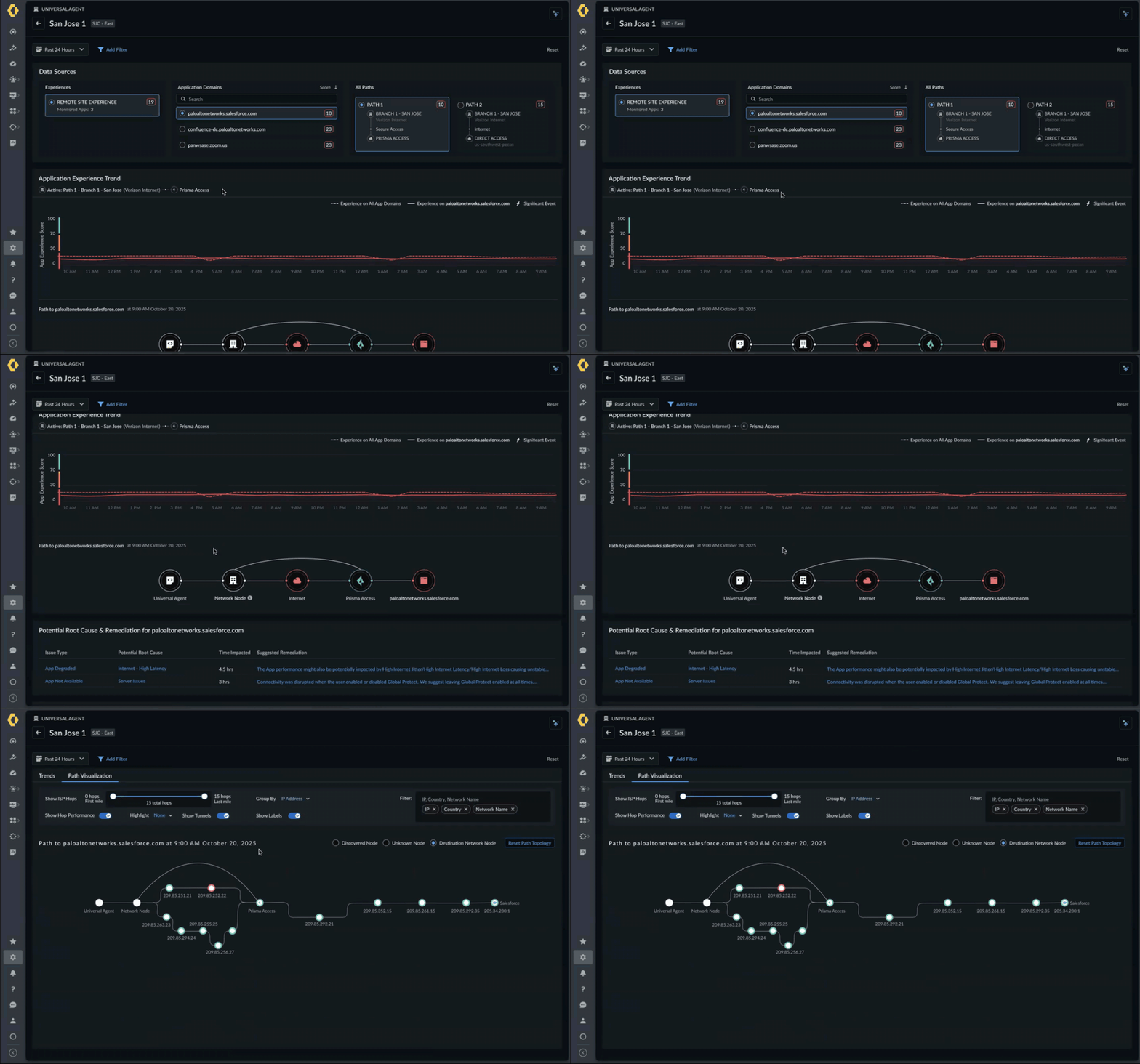
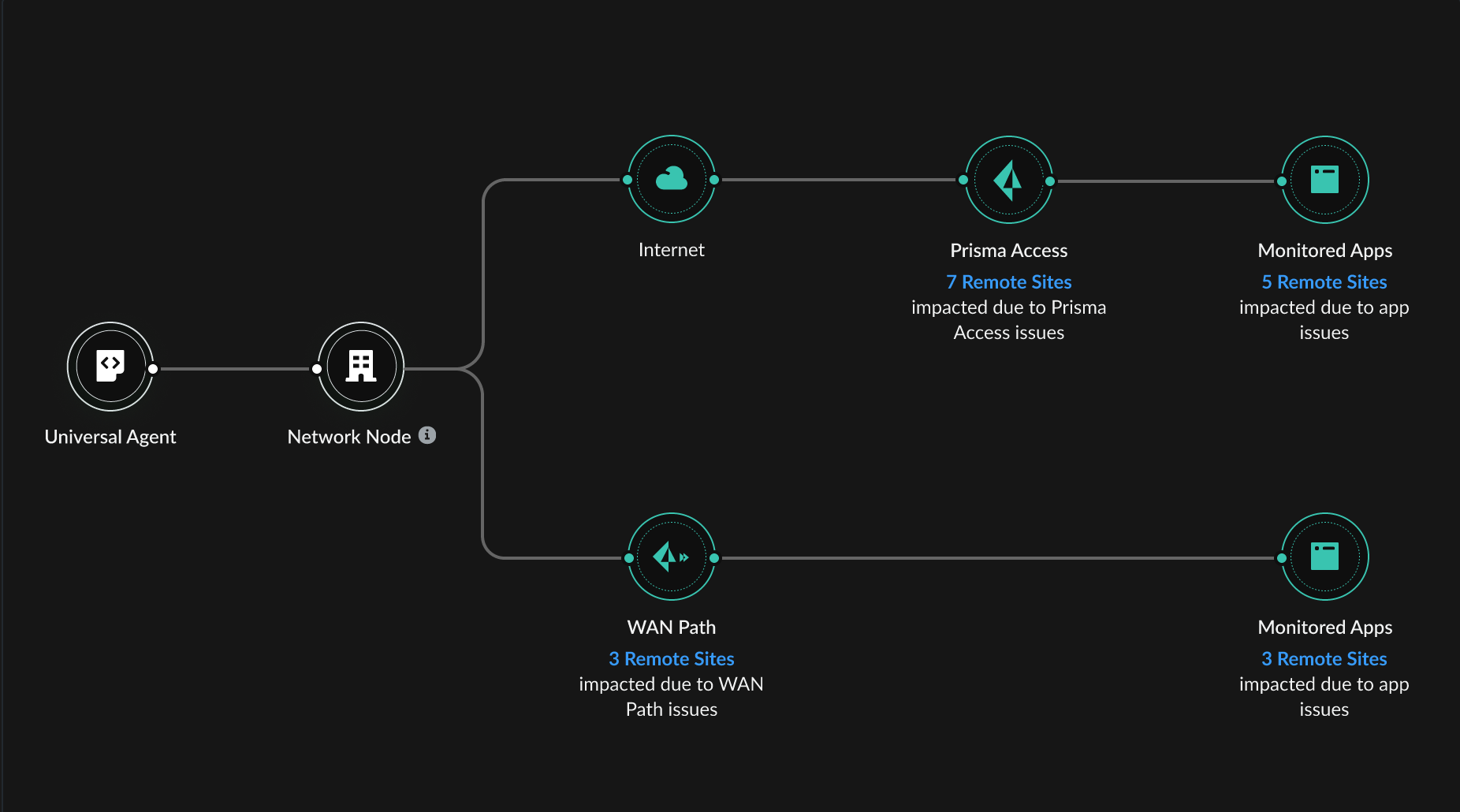
    When a user in a remote branch reports a slowdown, IT teams need more than a "red/green" status light. The Universal Agent provides a granular path analysis, delivering a hop-by-hop visualization with both overlay and underlay tunnel metrics, enabling them to quickly pinpoint bottlenecks.

Thus, by mapping the entire path from the Universal Agent to the target application, IT teams can pinpoint exactly where the friction lies.

  • Is it a local network issue?
  • An ISP (internet service provider) bottleneck?
  • A bottleneck at a handoff between providers?
  • Is the application's own network at fault?
Universal Agent example.
ADEM Universal Agent at a glance.

The Universal Agent Offers Inherent Security and Operational Simplicity

To help ensure that organizations can maintain peak performance and security amidst a constant stream of changes, the Universal Agent is built on a foundation of robust features:

  • Native Integration with Prisma Access for Accelerated Troubleshooting
    The Universal Agent is natively integrated with Prisma Access and automatically discovers the POP (Point of Presence) location and IP infrastructure where the branch site is connected to monitor overlay and underlay, hop-by-hop, ISP health, all the way to the application to deliver precise root-cause analysis.
From the Universal Agent to the network node.
Native integration with Prisma Access.
  • Simplified Deployment at Scale
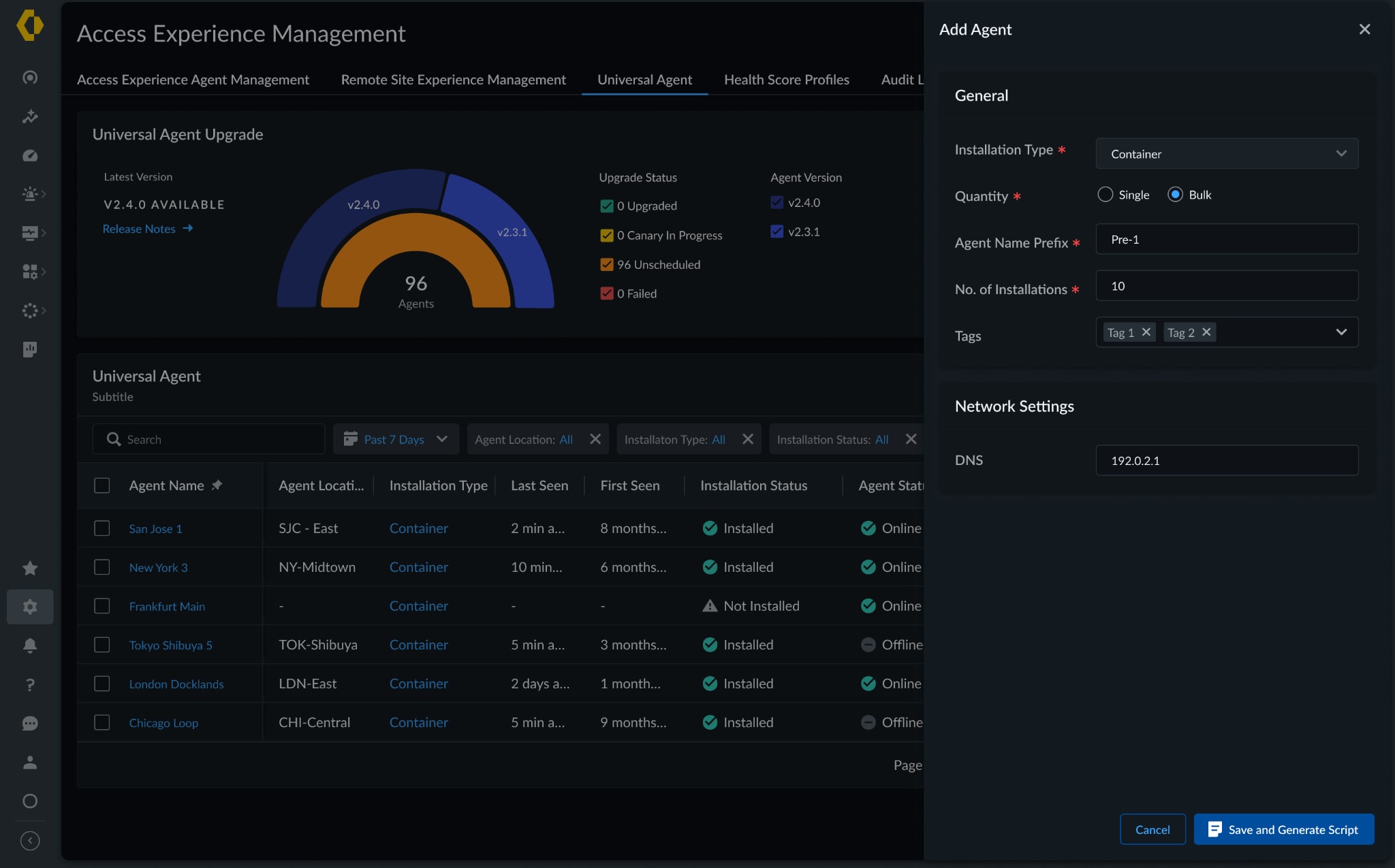
    IT teams can deploy and manage multiple agents at scale with just a few clicks from the Strata™ Cloud Manager Platform. Through our autonomous AI operations platform, we leverage enriched telemetry to watch the network and proactively manage it all from a unified platform.
Dashboard of Access Experience Management
Bulk deployment of Universal Agent with just a few clicks.
  • Comprehensive Full-Stack Visibility
    We utilize a single agent per branch site to deliver deep visibility into both overlay and underlay tunnel metrics. This granular path analysis allows IT teams to pinpoint network bottlenecks using hop-by-hop visualizations from the Universal Agent all the way to the target application.
Application Performance Metrics
Hop-by-hop visualization with overlay and underlay tunnel metrics.

The Universal Agent Optimizes End-to-End Digital Experience with Unified Operations

The launch of the ADEM Universal Agent represents a fundamental shift in how we architect the distributed enterprise, from moving beyond managing data gaps into agentic, machine-speed orchestration. Natively integrated with Prisma Access, the Universal Agent synthesizes disparate network data across multiple branch sites into a unified, vendor-agnostic ecosystem. By eliminating the 'noise' of traditional monitoring, it provides the deterministic precision and real-time context required to fuel agentic autonomous operations, enabling every automated action to be accurate, impactful and optimized for a flawless digital experience.

Ready to gain complete application experience from all branch sites and remote users? Watch our announcement video below to see the Universal Agent in action. Visit the ADEM webpage for more information or request a demo.

The post Announcing ADEM Universal Agent appeared first on Palo Alto Networks Blog.

  •  

PS Private Training: Turning Cyber Complexity into Operational Control

The World Economic Forum’s Global Cybersecurity Outlook 2025 concurred that cyber risk is increasingly driven by operational complexity rather than lack of technology. As security environments expand, many organizations struggle with hands‑on skill gaps, slow issue resolution, and training that does not reflect how their environments de-facto operate. The result: higher operational risk – even in well‑equipped organizations.  To address these challenges, Check Point Services offers PS Private Training (Custom ILT): a tailored, instructor‑led program designed to strengthen operational mastery in real environments. The service replaces one‑size‑fits‑all instruction with customized training, hands‑on labs, and field‑proven best practices delivered by active Professional Services consultants, enabling […]

The post PS Private Training: Turning Cyber Complexity into Operational Control appeared first on Check Point Blog.

  •  

Closing the Gap by Enhancing Visibility and Mitigating Risks

In the race to digitise public services, the UK’s digital estate has grown into a vast, borderless ecosystem that manual audits can no longer track. For UK Government departments, local authorities and NHS trusts, it is a sprawling, shifting landscape of cloud workloads, legacy infrastructure, shadow IT and third-party supplier connections.

This complexity creates blind spots that modern threats exploit. Recognising this vulnerability, the UK Government is moving toward a secure-by-design digital infrastructure, with the 2026 Government Cyber Action Plan (GCAP) setting a high bar for resilience. A central theme of the GCAP is the urgent need for the government to have better visibility of cyber security and resilience risk. Fundamentally, organisations cannot secure what they cannot see. As the GCAP explicitly states, the Government will use “data sources from across the government to truly understand government-wide and departmental cyber risks.”

The Challenge: Visibility in a “Landscape”

Many public sector organisations rely on a complex web of spreadsheets, data calls, legacy tools and manually curated lists to create an inventory of their internet-connected assets. But attackers do not look at an organisation's internal lists; they scan the internet for what they have forgotten to secure. Whether it is an unpatched server from a legacy project or a misconfigured database in a department, these "unknown unknowns" are the primary entry points for attackers.

The Strategic Mission: Empowering the Public Sector and Critical Industries

Palo Alto Networks Cortex Xpanse® is an active external attack surface management (EASM) solution that provides an outside-in view of organisations' entire digital footprint. It helps leaders meet national resilience goals:

  • Comprehensive, Continuous Visibility: Xpanse scans the global internet space continuously and identifies every asset associated with an organisation, without requiring software agents to be installed on your systems.
  • Accelerate Response: Leveraging automation, the solution streamlines response processes and enhances collaboration across dispersed teams from the sharing of findings to tracking actions and remediation.
  • Supply Chain Integrity: Inline with the new Cyber Security and Resilience Bill (bringing managed service providers and critical third parties into scope), Xpanse allows organisations to assess the internet-facing security posture of third-party partners and suppliers, ensuring a weak link elsewhere doesn't compromise the broader mission.
  • Alignment with GovAssure: Xpanse provides a consolidated risk profile and inventory for all internet-facing and cloud assets required for GovAssure assessments, turning a manual, months-long audit process into a continuous, data-driven cycle.
  • Investment prioritisation: Xpanse provides that much needed visibility to help executive committees and boards prioritise investment decisions on legacy IT and technical debt.

Aligning to National Cybersecurity Centre (NCSC) Guidance

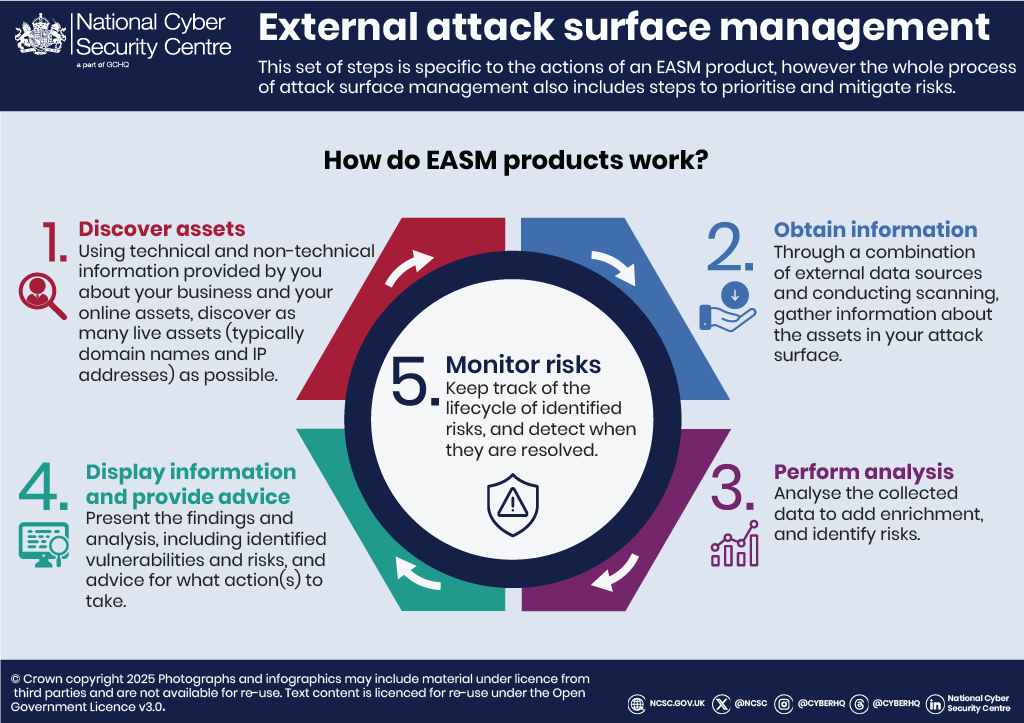
How external attack surface management products work.

Palo Alto Networks Cortex Xpanse aligns with the National Cyber Security Centre (NCSC) external attack surface management (EASM) buyer's guide by providing automated discovery, continuous monitoring and risk prioritisation of internet-facing assets. It replaces manual, point-in-time audits with a proactive, agentless solution. By automating the discovery of all internet-accessible assets (including shadow IT and unmanaged cloud operations) the platform fulfills the NCSC’s core requirement for continuous global monitoring and rapid attribution. This data-driven approach allows for the automated prioritisation of critical exposures, such as RDP, and integrates seamlessly with multiple third-party automation and visualisation tools, including Cortex XSOAR® and XSIAM, to accelerate remediation with national incident response standards.

In fact, with Palo Alto Networks deployment of Cortex Xpanse, we were able to achieve a 95% reduction in external vulnerability management spending across more than 700,000 cloud instances, while improving coverage and outcomes.

Palo Alto Networks Cortex Xpanse Capabilities
  • Discover Assets: Leveraging organisations' known asset inventory and other data points, Xpanse performs continual, automated discovery of all internet-accessible assets, effectively eliminating blind spots created by shadow IT and unmanaged cloud operations.
  • Obtain Information: Always-on, continuous monitoring of an organisation's entire attack surface through daily scans of the global IP address space, ensuring that newly exposed services are identified quickly and accurately.
  • Perform Analysis: Xpanse automates and prioritises alerts on all identified risks by severity, enabling organisations to optimise resolution and risk management, allowing teams to properly allocate resources and focus on the most critical risks to the organisation.
  • Display Information and Provide Advice: Leveraging a unified view of the internet facing and cloud-based estate, Xpanse provides specific resolver guidance for every identified issue, supporting and monitoring automated resolution through multiple native integrations.
  • Monitor Risk: Always on, discreet continual monitoring provides an independent real time status of the digital estate. Leveraging the threat intelligence capabilities of Palo Alto Networks, Xpanse is uniquely positioned to provide rapid coverage for newly discovered vulnerabilities, exploits or misconfigurations.

Securing the public sector requires a move from manual, point in time assessments to data-driven intelligence. Cortex Xpanse provides the foundations to remove blind spots, secure the supply chain and prevent unknown vulnerabilities in the face of sophisticated threats.

For further information and case studies, visit the links below, or schedule a demo.

  • Palo Alto Networks: Slash false positives, remediation time budget with Cortex attack surface management.
  • U.S. Pentagon: Palo Alto Networks Cortex Xpanse supercharge the Cyber Defences for the Department of Defense.
  • Accenture: Secure rapid growth with Cortex Xpanse.

The post Closing the Gap by Enhancing Visibility and Mitigating Risks appeared first on Palo Alto Networks Blog.
  •  

Anatomy of a Cyber World Global Report 2026

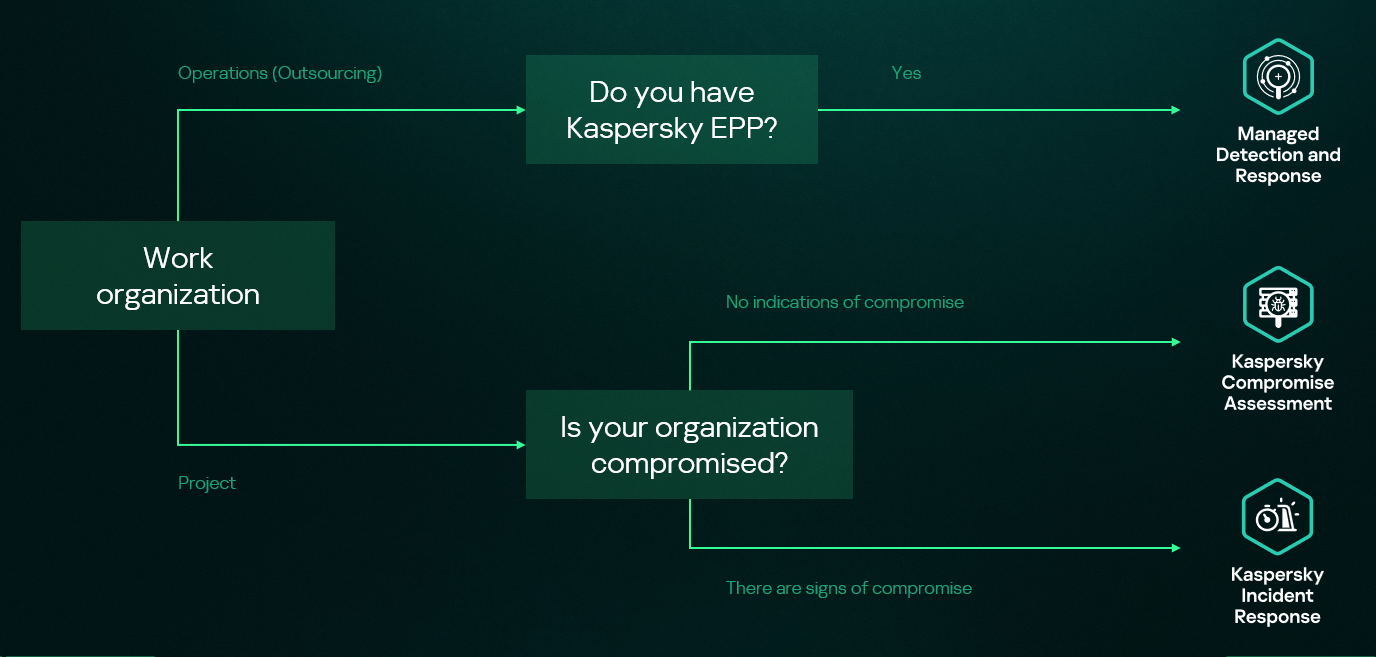
Kaspersky Security Services provide a comprehensive cybersecurity ecosystem, taking enterprise threat protection to another level. Services like Kaspersky Managed Detection and Response and Compromise Assessment allow for timely detection of threats and cyberattacks. SOC Consulting provides a practical approach ensuring the corporate infrastructure stays secured, while Incident Response is suited for timely remediation with a maximized recovery rate.

High-level overview of the MDR, IR and CA connection

High-level overview of the MDR, IR and CA connection

This new report brings together statistics across regions and industries from our Managed Detection and Response and Incident Response services, and for the first time, it also includes insights from our Compromise Assessment and SOC Consulting services — all to provide you with more comprehensive view of different aspects of corporate information security worldwide.

The scope of MDR and IR services

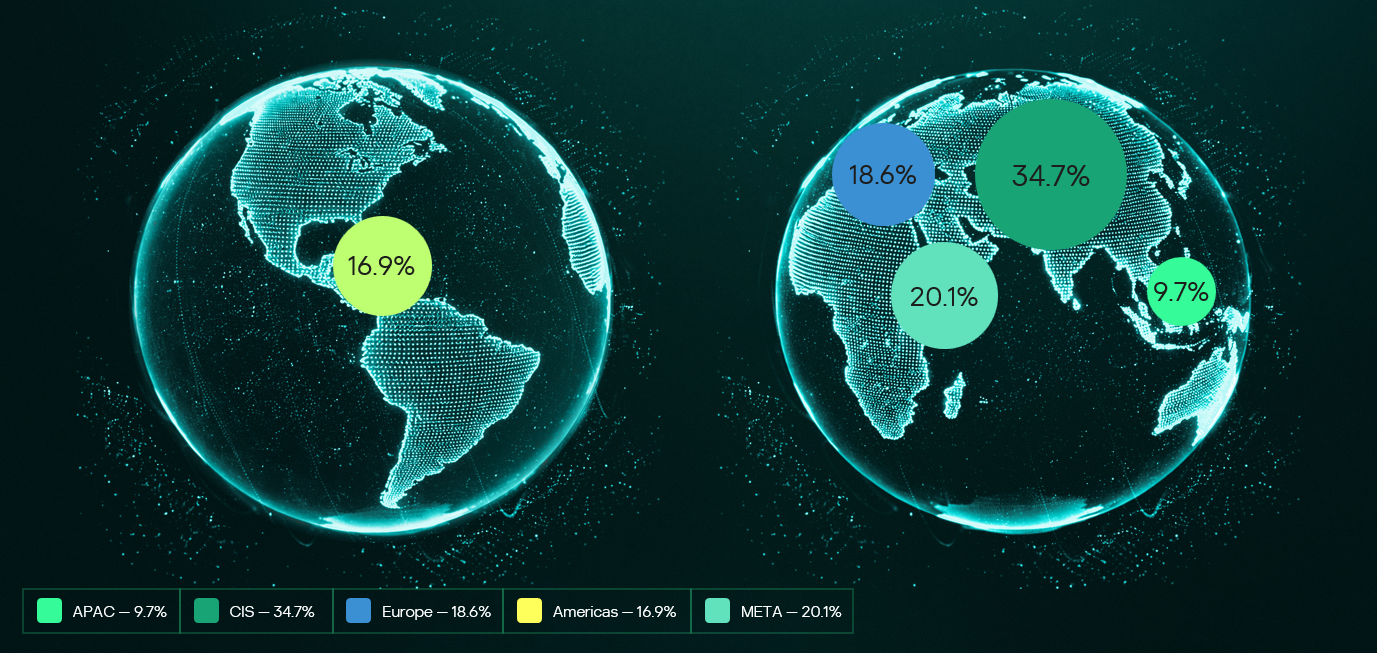
Provision of Kaspersky’s MDR and IR services follows a global approach. The majority of customers accounted for the CIS (34.7%), the Middle East (20.1%), and Europe (18.6%).

Distribution of customers by geographical region, 2025

Distribution of customers by geographical region, 2025

MDR telemetry

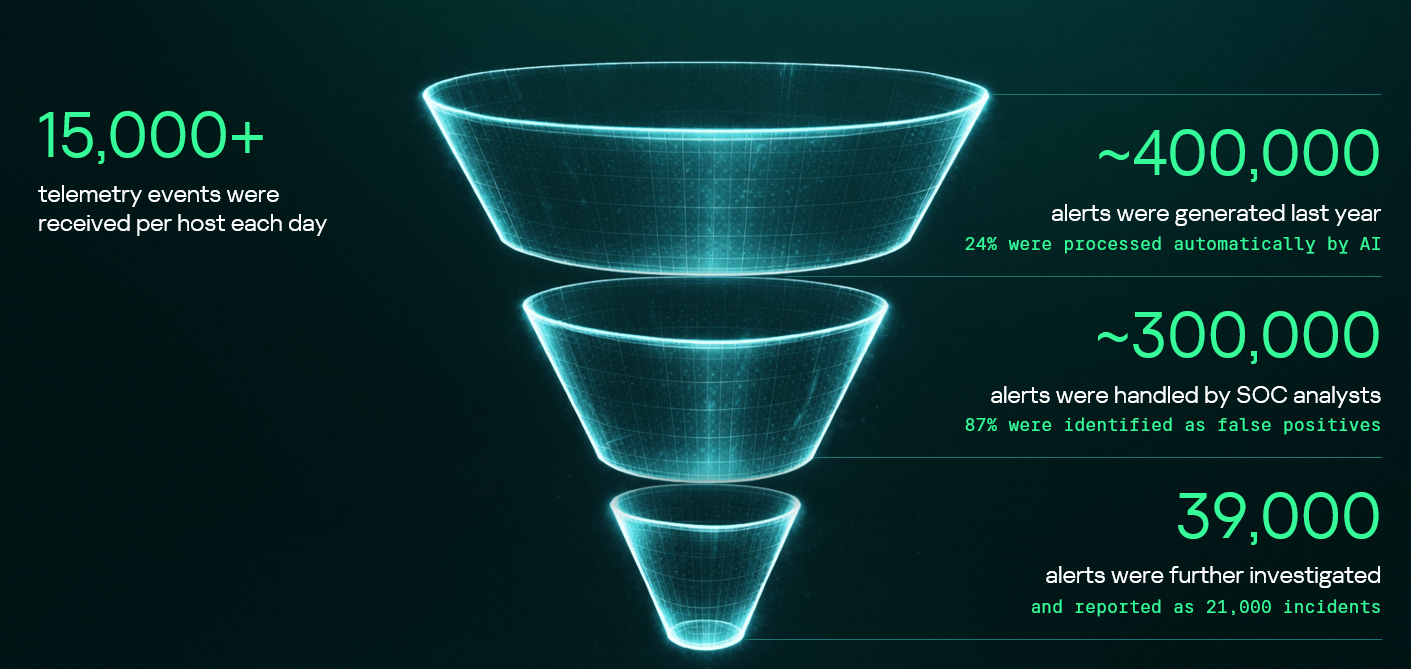
Following the previous year’s numbers, in 2025, the MDR infrastructure received and processed an average of 15,000 telemetry events per host every day, generating security alerts as a result. These alerts are first processed by AI-powered detection logic, after which Kaspersky SOC analysts handle them as required. Overall, a total of approximately 400,000 alerts were generated in 2025. After counting out false positives, 39,000 alerts were further investigated.

MDR telemetry statistics, 2025

MDR telemetry statistics, 2025

Incident statistics

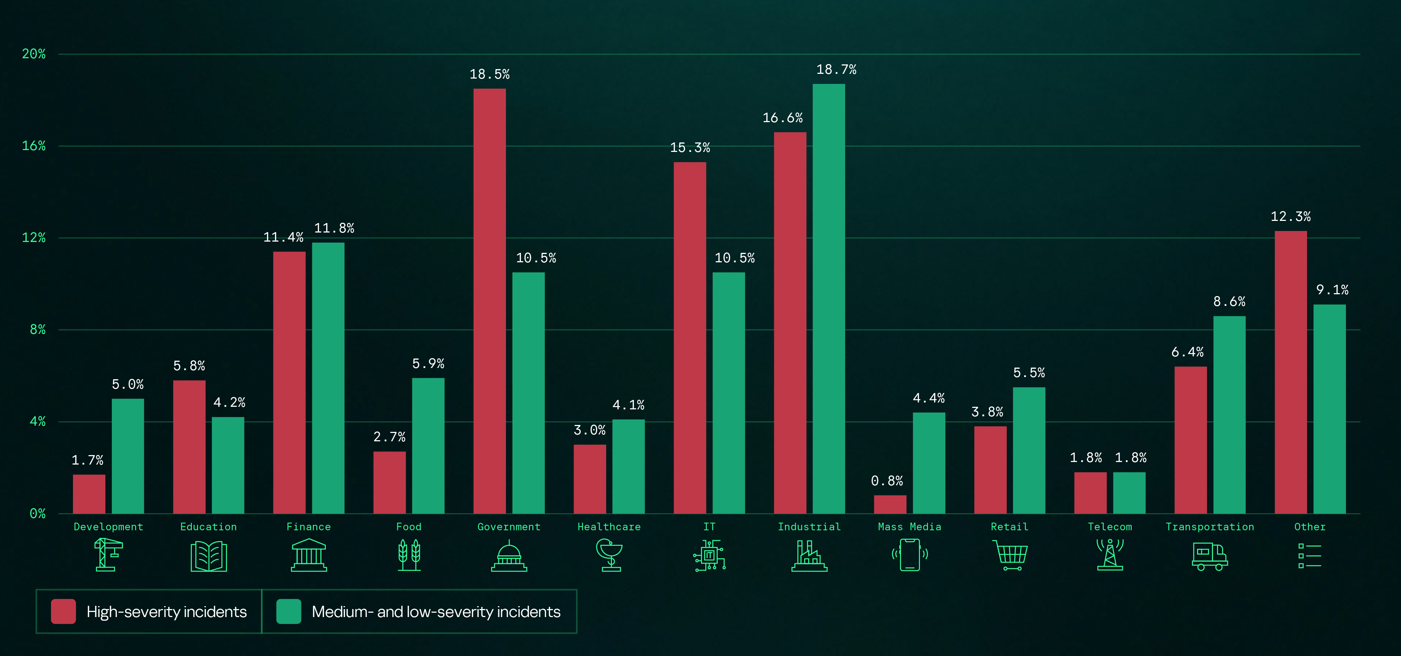
The distribution of remediation requests by industry has slightly changed as compared to previous years’ pattern. Government (18.5%) and industrial (16.6%) organizations are still the most targeted industries in regards to cyberattacks that require incident response activities. However, this year, the IT sector saw a growth in the number of IR requests, eventually being placed third in the overall industry distribution rankings and thus replacing financial organizations, which were targeted less often than in 2024. This is equally true for smaller-scale attacks that can be contained and remediated through automated means — the only difference is that medium- and low-severity incidents are more often experienced by financial organizations.

Distribution of all incidents by industry sector, 2025

Distribution of all incidents by industry sector, 2025

Key trends and statistics

This section presents key findings and trends in cyberattacks in 2025:

  • The number of high-severity incidents decreased, following a downward trend that we’ve been observing since 2021. The majority of those incidents account for APT attacks and red teaming exercises, which indicates two landscape trends. On the one hand, skilled adversaries make efforts to increase impact, while on the other, organizations spend more resources on probing their defense systems.
  • The most common vulnerabilities exploited in the wild were related to Microsoft products. Half of all identified CVEs led to remote code execution, notably without authentication in some cases.
  • Exploitation of public-facing applications, valid accounts, and trusted relationships remain the most popular initial vectors, and their overall share has increased, accounting to over 80% of all attacks in 2025. In particular, attacks through trusted relationships are evolving: their share has increased to 15.5% from 12.8% in 2024. They are also becoming more complex: for instance, we witnessed a case where adversaries had compromised more than two organizations in sequence to ultimately gain access to a third target.
  • Standard Windows utilities remain a popular LotL tool. Adversaries use those to minimize the risk of detection during delivery to a compromised system. The most popular LOLBins we observed in high-severity incidents were powershell.exe (14.4%), rundll32.exe (5.9%), and mshta.exe (3.8%). Among the most popular legitimate tools used in incidents we flag Mimikatz (14.3%), PowerShell (8.1%), PsExec (7.5%), and AnyDesk (7.5%).

The full 2026 Global Report provides additional information about cyberattacks, including real-world cases discovered by Kaspersky experts. We also describe SOC Consulting projects and Compromise Assessment requests. The report includes comprehensive analysis of initial attack vectors in correlation with the MITRE ATT&CK tactics and techniques and the full list of vulnerabilities that we detected during Incident Response engagements.

  •  

Anatomy of a Cyber World Global Report 2026

Kaspersky Security Services provide a comprehensive cybersecurity ecosystem, taking enterprise threat protection to another level. Services like Kaspersky Managed Detection and Response and Compromise Assessment allow for timely detection of threats and cyberattacks. SOC Consulting provides a practical approach ensuring the corporate infrastructure stays secured, while Incident Response is suited for timely remediation with a maximized recovery rate.

High-level overview of the MDR, IR and CA connection

High-level overview of the MDR, IR and CA connection

This new report brings together statistics across regions and industries from our Managed Detection and Response and Incident Response services, and for the first time, it also includes insights from our Compromise Assessment and SOC Consulting services — all to provide you with more comprehensive view of different aspects of corporate information security worldwide.

The scope of MDR and IR services

Provision of Kaspersky’s MDR and IR services follows a global approach. The majority of customers accounted for the CIS (34.7%), the Middle East (20.1%), and Europe (18.6%).

Distribution of customers by geographical region, 2025

Distribution of customers by geographical region, 2025

MDR telemetry

Following the previous year’s numbers, in 2025, the MDR infrastructure received and processed an average of 15,000 telemetry events per host every day, generating security alerts as a result. These alerts are first processed by AI-powered detection logic, after which Kaspersky SOC analysts handle them as required. Overall, a total of approximately 400,000 alerts were generated in 2025. After counting out false positives, 39,000 alerts were further investigated.

MDR telemetry statistics, 2025

MDR telemetry statistics, 2025

Incident statistics

The distribution of remediation requests by industry has slightly changed as compared to previous years’ pattern. Government (18.5%) and industrial (16.6%) organizations are still the most targeted industries in regards to cyberattacks that require incident response activities. However, this year, the IT sector saw a growth in the number of IR requests, eventually being placed third in the overall industry distribution rankings and thus replacing financial organizations, which were targeted less often than in 2024. This is equally true for smaller-scale attacks that can be contained and remediated through automated means — the only difference is that medium- and low-severity incidents are more often experienced by financial organizations.

Distribution of all incidents by industry sector, 2025

Distribution of all incidents by industry sector, 2025

Key trends and statistics

This section presents key findings and trends in cyberattacks in 2025:

  • The number of high-severity incidents decreased, following a downward trend that we’ve been observing since 2021. The majority of those incidents account for APT attacks and red teaming exercises, which indicates two landscape trends. On the one hand, skilled adversaries make efforts to increase impact, while on the other, organizations spend more resources on probing their defense systems.
  • The most common vulnerabilities exploited in the wild were related to Microsoft products. Half of all identified CVEs led to remote code execution, notably without authentication in some cases.
  • Exploitation of public-facing applications, valid accounts, and trusted relationships remain the most popular initial vectors, and their overall share has increased, accounting to over 80% of all attacks in 2025. In particular, attacks through trusted relationships are evolving: their share has increased to 15.5% from 12.8% in 2024. They are also becoming more complex: for instance, we witnessed a case where adversaries had compromised more than two organizations in sequence to ultimately gain access to a third target.
  • Standard Windows utilities remain a popular LotL tool. Adversaries use those to minimize the risk of detection during delivery to a compromised system. The most popular LOLBins we observed in high-severity incidents were powershell.exe (14.4%), rundll32.exe (5.9%), and mshta.exe (3.8%). Among the most popular legitimate tools used in incidents we flag Mimikatz (14.3%), PowerShell (8.1%), PsExec (7.5%), and AnyDesk (7.5%).

The full 2026 Global Report provides additional information about cyberattacks, including real-world cases discovered by Kaspersky experts. We also describe SOC Consulting projects and Compromise Assessment requests. The report includes comprehensive analysis of initial attack vectors in correlation with the MITRE ATT&CK tactics and techniques and the full list of vulnerabilities that we detected during Incident Response engagements.

  •  

Augmented Phishing: Social Engineering in the Age of AI

The rise of GenAI has pushed social engineering and phishing to new levels. What once required manual effort can now be generated in seconds, resulting in hyper-personalized messages, cloned executive voices, and even realistic video impersonations. Deepfake incidents have already moved from online curiosity to real business risk, driving financial loss and operational disruption in organizations worldwide.  On everyday collaboration platforms, verifying identity has become increasingly difficult. Real-time face and voice cloning remove many traditional warning signs, making scams harder to spot than ever. As the threat landscape shifts, organizations need modern defenses and smarter awareness programs designed for the realities of the AI era.  Check Point Services has recently expanded its training portfolio to help […]

The post Augmented Phishing: Social Engineering in the Age of AI appeared first on Check Point Blog.

  •  

Introducing CPR Act: A Unified Approach for a Full‑Lifecycle Security

Fragmented products and solutions sprawled across multiple environments create significant visibility gaps, which attackers look for to exploit. To close these gaps, Check Point Services has now introduced CPR Act, an expert‑led unit that covers the entire security lifecycle with continuous intelligence, coordinated action, and clear outcomes. This unified approach eliminates blind spots and ensures that every phase of security feeds into the next, creating a connected and predictable defense.  This elite team of experts brings top researchers, analysts, and responders together to provide organizations with a clear, research‑based insight to act decisively. It operates through four foundational pillars:  Intelligence: […]

The post Introducing CPR Act: A Unified Approach for a Full‑Lifecycle Security appeared first on Check Point Blog.

  •  

Local KTAE and the IDA Pro plugin | Kaspersky official blog

In a previous post, we walked through a practical example of how threat attribution helps in incident investigations. We also introduced the Kaspersky Threat Attribution Engine (KTAE) — our tool for making an educated guess about which specific APT group a malware sample belongs to. To demonstrate it, we used the Kaspersky Threat Intelligence Portal — a cloud-based tool that provides access to KTAE as part of our comprehensive Threat Analysis service, alongside a sandbox and a non-attributing similarity-search tool. The advantages of a cloud service are obvious: clients don’t need to invest in hardware, install anything, or manage any software. However, as real-world experience shows, the cloud version of an attribution tool isn’t for everyone…

First, some organizations are bound by regulatory restrictions that strictly forbid any data from leaving their internal perimeter. For the security analysts at these firms, uploading files to a third-party service is out of the question. Second, some companies employ hardcore threat hunters who need a more flexible toolkit — one that lets them work with their own proprietary research alongside Kaspersky’s threat intelligence. That’s why KTAE is available in two flavors: a cloud-based version and an on-prem deployment.

What are the on-prem KTAE advantages over the cloud version?

First off, the local version of KTAE ensures an investigation stays fully confidential. All the analysis takes place right in the organization’s internal network. The threat intelligence source is a database deployed inside the company perimeter; it is packed with the unique indicators and attribution data of every malicious sample known to our experts; and it also contains the characteristics pertaining to legitimate files to exclude false-positive detections. The database gets regular updates, but it operates one-way: no information ever leaves the client’s network.

Additionally, the on-prem version of KTAE gives experts the ability to add new threat groups to the database and link them to malware samples they discovered on their own. This means that subsequent attribution of new files will account for the data added by internal researchers. This allows experts to catalog their own unique malware clusters, work with them, and identify similarities.

Here’s another handy expert tool: our team has developed a free plugin for IDA Pro, a popular disassembler, for use with the local version of KTAE.

What’s the purpose of an attribution plugin for a disassembler?

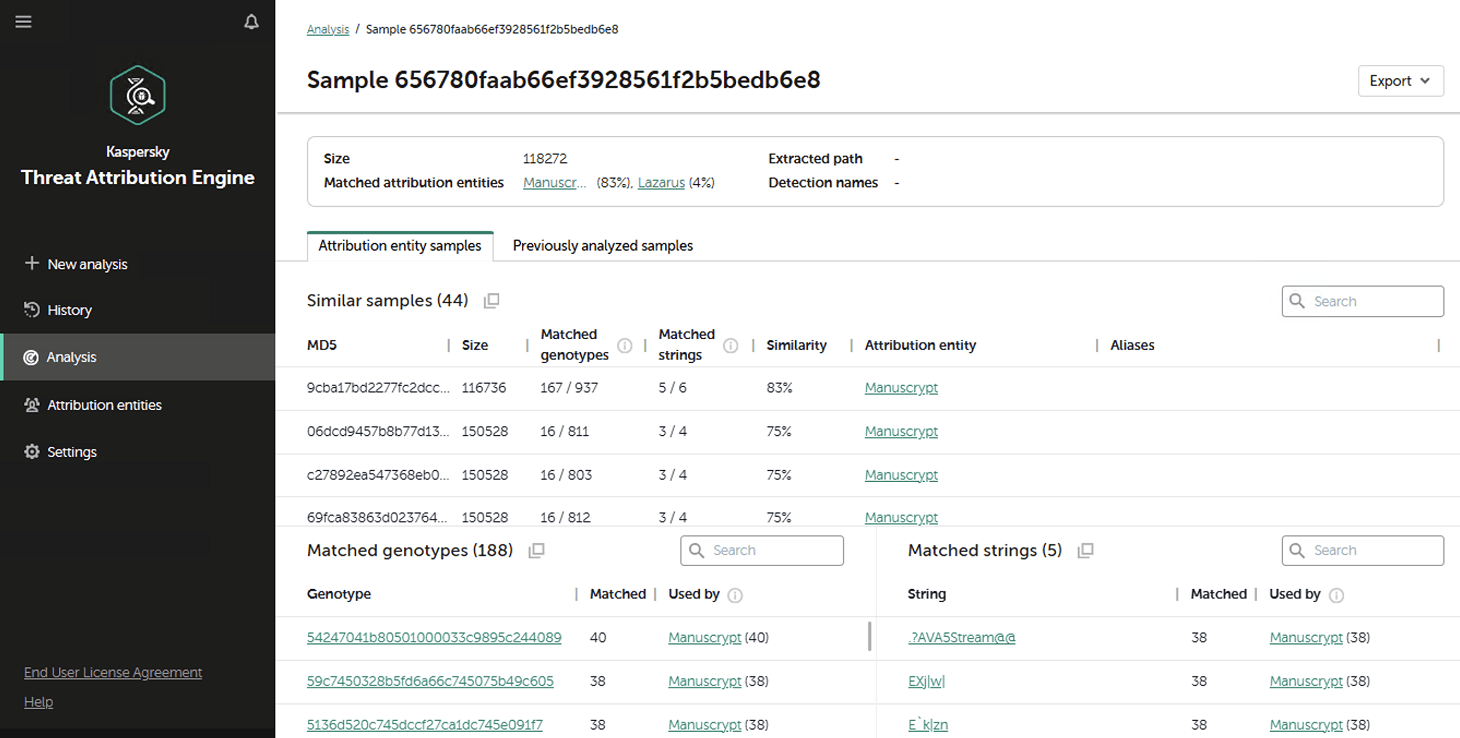
For a SOC analyst on alert triage, attributing a malicious file found in the infrastructure is straightforward: just upload it to KTAE (cloud or on-prem) and get a verdict, like Manuscrypt (83%). That’s sufficient for taking adequate countermeasures against that group’s known toolkit and assessing the overall situation. A threat hunter, however, might not want to take that verdict at face value. Alternatively, they might ask, “Which code fragments are unique across all the malware samples used by this group?” Here an attribution plugin for a disassembler comes in handy.


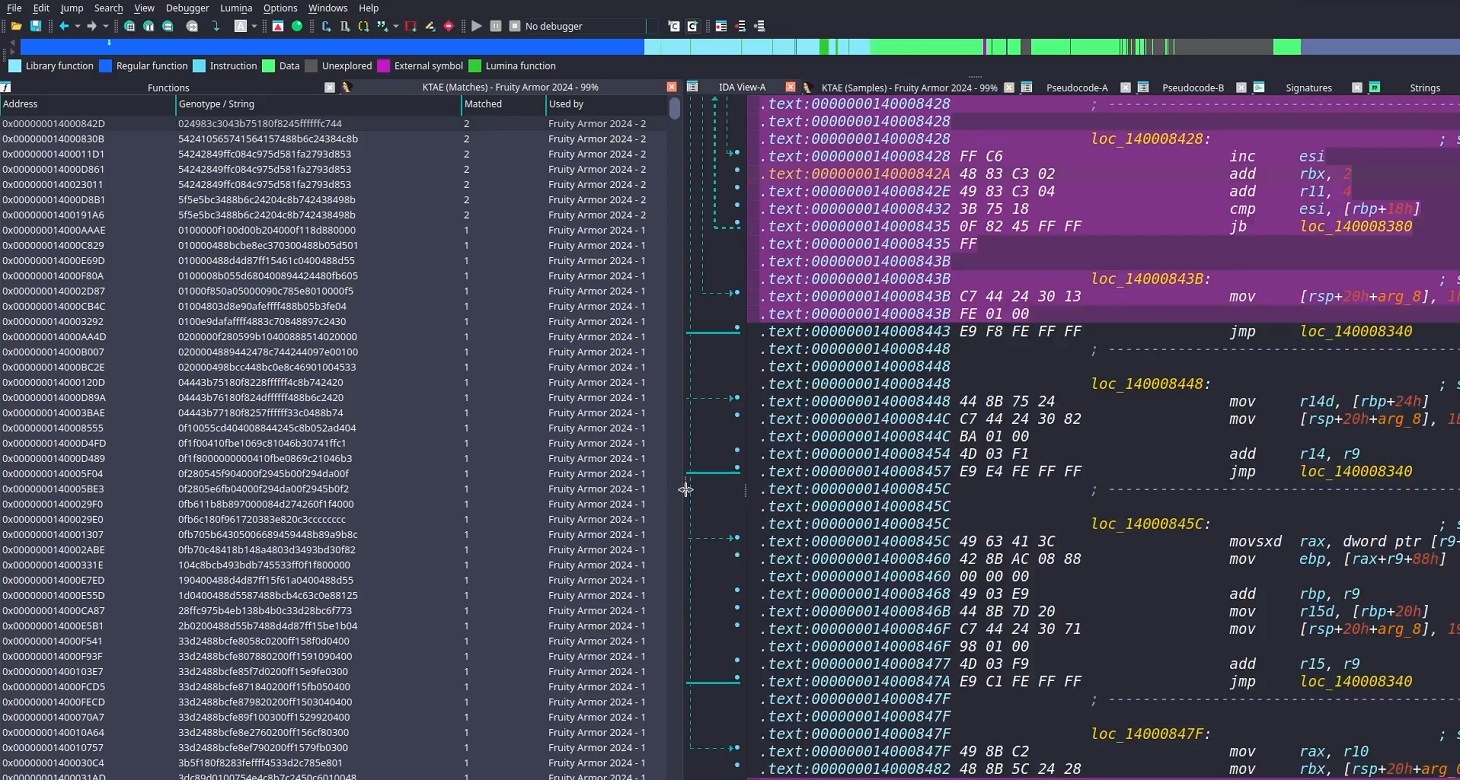
Inside the IDA Pro interface, the plugin highlights the specific disassembled code fragments that triggered the attribution algorithm. This doesn’t just allow for a more expert-level deep dive into new malware samples; it also lets Kaspersky researchers refine attribution rules on the fly. As a result, the algorithm — and KTAE itself — keeps evolving, making attribution more accurate with every run.

How to set up the plugin

The plugin is a script written in Python. To get it up and running you need IDA Pro. Unfortunately, it won’t work in IDA Free, since it lacks support for Python plugins. If you don’t have Python installed yet, you’d need to grab that, set up the dependencies (check the requirements file in our GitHub repository), and make sure IDA Pro environment variables are pointing to the Python libraries.

Next, you’d need to insert the URL for your local KTAE instance into the script body and provide your API token (which is available on a commercial basis) — just like it’s done in the example script described in the KTAE documentation.

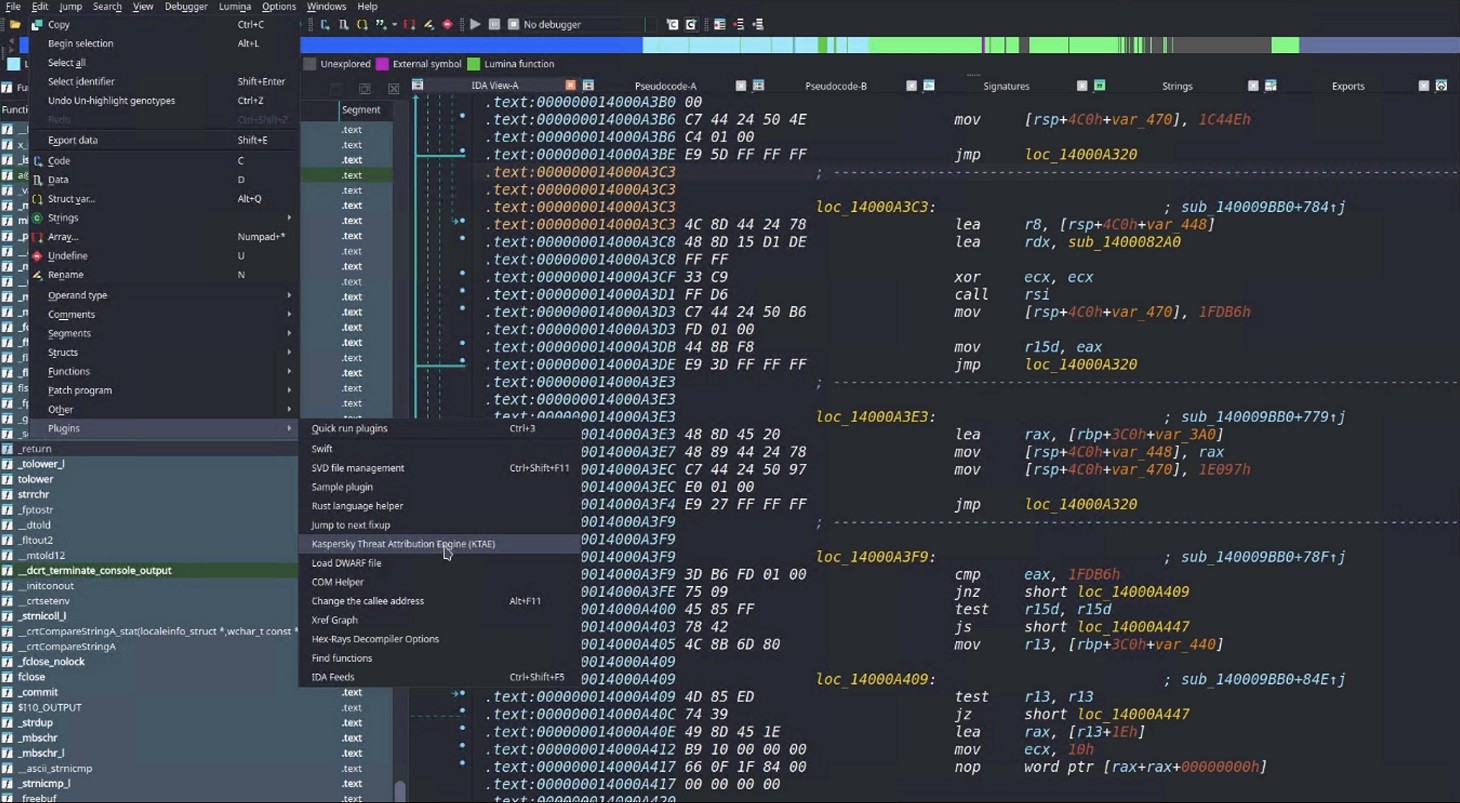
Then you can simply drop the script into your IDA Pro plugins folder and fire up the disassembler. If you’ve done it right, then, after loading and disassembling a sample, you’ll see the option to launch the Kaspersky Threat Attribution Engine (KTAE) plugin under EditPlugins:

How to use the plugin

When the plugin is installed, here’s what happens under the hood: the file currently loaded in IDA Pro is sent via API to the locally installed KTAE service, at the URL configured in the script. The service analyzes the file, and the analysis results are piped right back into IDA Pro.

On a local network, the script usually finishes its job in a matter of seconds (the duration depends on the connection to the KTAE server and the size of the analyzed file). Once the plugin wraps up, a researcher can start digging into the highlighted code fragments. A double-click leads straight to the relevant section in the assembly or binary code (Hex view) for analysis. These extra data points make it easy to spot shared code blocks and track changes in a malware toolkit.

By the way, this isn’t the only IDA Pro plugin the GReAT team has created to make life easier for threat hunters. We also offer another IDA plugin that significantly speeds up and streamlines the reverse-engineering process, and which, incidentally, was a winner in the IDA Plugin Contest 2024.

To learn more about the Kaspersky Threat Attribution Engine and how to deploy it, check out the official product documentation. And to arrange a demonstration or piloting project, please fill out the form on the Kaspersky website.

  •  

A Joint Vision for Simplified SASE Management at Scale

Palo Alto Networks, ServiceNow, and Bell Canada have come together in a strategic collaboration to build an innovative ServiceNow application that creates an automated bridge between world-class security operations and industry-leading service management.

Large enterprises need robust security at cloud speed, but operational complexity keeps getting in the way. ​​Here’s what that looks like in practice:

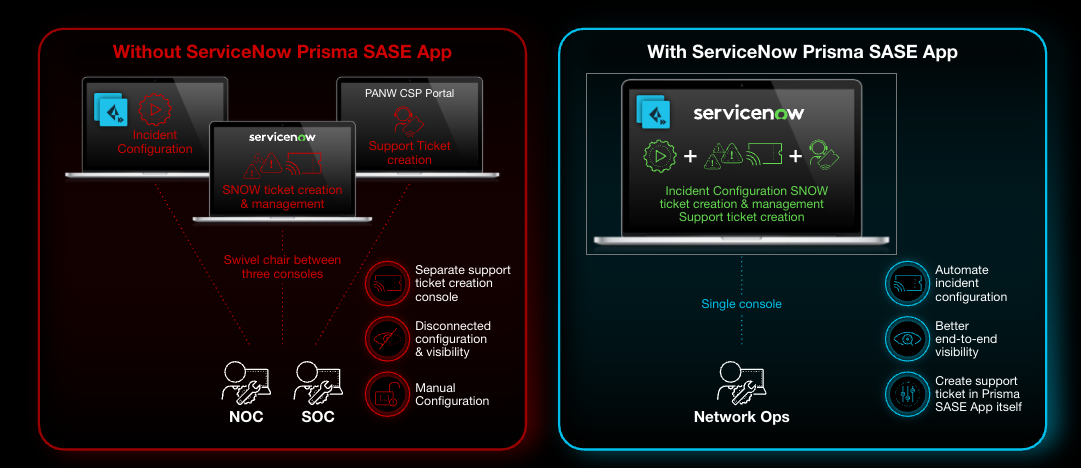
  • Operations teams juggle multiple dashboards. When an issue surfaces, they are bouncing between the Prisma® SASE (secure access service edge) console to identify the incident, ServiceNow to log the case, and a customer support portal to escalate the issue. Every handoff inflates MTTR (mean time to resolution) and introduces room for error.
  • Customers are stuck in a deployment purgatory. Manual infrastructure configuration, connector setup, and mobile user onboarding can stretch on for weeks or months. Every day spent wrestling with configuration files is a day that value isn’t delivered.
  • Multi-tenant management doesn’t scale. If operational overhead grows linearly with each new tenant, the business model ultimately caps itself.

Bell Canada, through its innovative and security-first approach in the Canadian market, is a lighthouse partner that helped pioneer this innovation through its deep engagement with ServiceNow and a strategic partnership with Palo Alto Networks. With a strong focus on delivering exceptional customer value, Bell helped drive the vision for a simplified, scalable approach to SASE management.

Driven by their commitment to service excellence and customer outcomes, Bell worked closely with Palo Alto Networks and ServiceNow on this solution, accelerating customer time to value and simplifying operational complexity. Bell was among the first to champion this vision, acting as a market thought leader and helping shape a new standard for integrated SASE and service management outcomes in Canada.

Large Enterprises and Managed Service Providers can accelerate time to value by automating the entire lifecycle of Prisma SASE, from deployment to ongoing incident response through a newly launched Prisma SASE app on the ServiceNow store. The Prisma SASE app can accelerate MSP service delivery and management, significantly shrinking time to value and thereby positively impacting both top-line revenue and bottom-line EBITDA.

The Prisma SASE Platform Is Accelerating Value through Unified Automation and Platformization

Time to value (TTV) is one of the most critical metrics for IT teams helping customers move forward. With the Prisma SASE app, customers can go from implementation to go-live in just hours. There’s no need to build custom API integrations or take on technical debt for Day 0 to Day N operations. The app automates infrastructure setup, including ZTNA connectors and mobile user workflows, so providers can get their SASE offerings to market faster.

Comparing ServiceNow with and without Prisma SASE App.
Optimizing Service Delivery through Unified Incident Lifecycle Management.

The joint solution eliminates swivel chair operations. Security and network administrators no longer need to toggle between the Prisma SASE console, ServiceNow and support portals. Incident ingestion and management now happen in one place. Incidents stay in sync, manual overhead drops, and mean time to resolution improves. For MSPs, there’s the added benefit: they can create Palo Alto Networks CSP (Customer Support Portal) tickets directly from the ServiceNow SASE app, making incident correlation and troubleshooting straightforward.

Drive Scalable Growth by Automating Cross-Instance Support with Service Exchange

ServiceNow’s Service Bridge is a major unlock for Managed Service Providers scaling their SASE offerings. It automates cross-instance support so critical security incidents and status updates flow between the MSP’s ServiceNow instance and the customer’s ServiceNow instance without manual sync work. This creates operational transparency and a better service experience for customers while MSPs can deliver faster without adding headcount or complexity.

Key Takeaways:

  • Rapid Time to Value: Shift from months of manual configuration to hours of automated deployment by leveraging out-of-the-box integrations that eliminate custom R&D and technical debt.
  • Unified Operational Excellence: Eliminate "swivel chair" management by unifying incident ingestion, ticket syncing and support portal escalation into a single ServiceNow interface, significantly reducing MTTR.
  • SASE at Scale: The Prisma SASE app provides a unified architecture that scales across tenants automatically, ensuring security keeps pace with business growth.

Take the Next Step

As you adopt SASE, take out the complexity of implementation with the Prisma SASE app.

  • Download the App: Visit the ServiceNow Store today and download the Prisma SASE app to start automating your deployment.
  • Meet Us at MWC: Are you heading to Barcelona for Mobile World Congress (MWC)? Come see these integrations in action. Stop by the Palo Alto Networks booth (Hall 4, Stand D55) for a live demo and to chat with our experts about simplifying your SASE implementation.
  • Contact our sales team for any additional questions.

The post A Joint Vision for Simplified SASE Management at Scale appeared first on Palo Alto Networks Blog.
  •  

Securing the Agentic Endpoint

Traditional Security Is Blind to the Agentic Endpoint

Modern endpoints are no longer defined only by executables. Increasingly, endpoint behavior is shaped by non-binary software, such as code packages, browser extensions, IDE plugins, scripts, local servers (including MCP), containers and model artifacts. They are installed directly by employees and developers without centralized oversight. Because these components are not classic binaries, they often fall outside the visibility and control of traditional endpoint security tooling.

AI agents compound this problem. They are legitimate tools that operate with the user’s credentials and permissions, enabling them to read, write, move data and take privileged actions across systems. When compromised or misused, agents become the “ultimate insider.” They can autonomously discover, invoke and even install additional components at machine speed, accelerating risk across an already expanding, largely unmanaged software layer.

Weaponizing Trusted Automation

This is not a future concern. The recent viral emergence of OpenClaw serves as a cautionary tale for the agentic era. Developed by a single individual in just one week, it rapidly secured millions of downloads while gaining broad permissions across users' emails, filesystems and shells. Within days, researchers identified 135,000 exposed instances and more than 800 malicious skills in its marketplace, underscoring how a single unvetted agent can create an immediate, global attack surface.

OpenClaw is not an outlier. Recent research highlights how quickly this risk is materializing:

  • Vibe Coding Threats: An AI extension in VS Code was found leaking code from 1.5 million developers. This tool could read any open file and send it back to the developer, collect mass files without user interaction, and track users with commercial analytics SDKs.
  • Malicious MCP Server: Koi documented the first malicious Model Context Protocol (MCP) server in the wild. When developers added a specific skill to tools like Claude Code or Cursor, it silently forwarded every email to the plugin creator. What’s more, this capability was added later, after developers had already started using it.

Compounding this risk is the fact that autonomous agent actions are often difficult to trace or reconstruct, leaving Security Operations Centers (SOCs) without the visibility they need when an incident occurs.

A New Category of Protection

Complete endpoint security for the rapidly expanding risk of agentic AI calls for a new category of protection: Agentic Endpoint Security. That’s why we announced our intent to acquire Koi, a pioneer in this space. Koi is designed to eliminate blind spots across the AI-native ecosystem and help organizations govern agentic tools safely.

Its technology rests on three core pillars:

  1. See All AI Software – Gain complete visibility into the AI tools, agents and non-binary software running in your environment.
  2. Understand Risks – Continuously analyze and understand the intent and risk level of all software and AI agents.
  3. Control the AI Ecosystem – Enforce policy in real-time to remediate issues and block risky behaviors.

Securing the Agentic Enterprise

We are convinced that Agentic Endpoint Security will soon become a standard requirement for enterprise security. Upon closing the proposed acquisition, we intend to integrate Koi’s capabilities across our platforms to help our customers secure the AI-native workspace.

The wave of AI agents approaching the enterprise cannot be held back. Instead, we must offer secure tools that enable companies to confidently embrace agentic innovation.

Forward-Looking Statements

This blog post contains forward-looking statements that involve risks, uncertainties, and assumptions, including, but not limited to, statements regarding the anticipated benefits and impact of the proposed acquisition of Koi on Palo Alto Networks, Koi and their customers. There are a significant number of factors that could cause actual results to differ materially from statements made in this blog post, including, but not limited to: the effect of the announcement of the proposed acquisition on the parties’ commercial relationships and workforce; the ability to satisfy the conditions to the closing of the acquisition, including the receipt of required regulatory approvals; the ability to consummate the proposed acquisition on a timely basis or at all; significant and/or unanticipated difficulties, liabilities or expenditures relating to proposed transaction, risks related to disruption of management time from ongoing business operations due to the proposed acquisition and the ongoing integration of other recent acquisitions; our ability to effectively operate Koi’s operations and business following the closing, integrate Koi’s business and products into our products following the closing, and realize the anticipated synergies in the transaction in a timely manner or at all; changes in the fair value of our contingent consideration liability associated with acquisitions; developments and changes in general market, political, economic and business conditions; failure of our platformization product offerings; risks associated with managing our growth; risks associated with new product, subscription and support offerings; shifts in priorities or delays in the development or release of new product or subscription or other offerings or the failure to timely develop and achieve market acceptance of new products and subscriptions, as well as existing products, subscriptions and support offerings; failure of our product offerings or business strategies in general; defects, errors, or vulnerabilities in our products, subscriptions or support offerings; our customers’ purchasing decisions and the length of sales cycles; our ability to attract and retain new customers; developments and changes in general market, political, economic, and business conditions; our competition; our ability to acquire and integrate other companies, products, or technologies in a successful manner; our debt repayment obligations; and our share repurchase program, which may not be fully consummated or enhance shareholder value, and any share repurchases which could affect the price of our common stock.

Additional risks and uncertainties that could affect our financial results are included under the captions "Risk Factors" and "Management's Discussion and Analysis of Financial Condition and Results of Operations" in our Quarterly Report on Form 10-Q filed with the SEC on November 20, 2025, which is available on our website at investors.paloaltonetworks.com and on the SEC's website at www.sec.gov. Additional information will also be set forth in other filings that we make with the SEC from time to time. All forward-looking statements in this blog post are based on information available to us as of the date hereof, and we do not assume any obligation to update the forward-looking statements provided to reflect events that occur or circumstances that exist after the date on which they were made.


The post Securing the Agentic Endpoint appeared first on Palo Alto Networks Blog.
  •  

Introducing Unit 42 Managed XSIAM 2.0

24/7 Managed SOC Built for Tomorrow's Threats

The window for defense has collapsed, and most SOCs weren’t built for the speed of today’s attacks. According to the 2026 Unit 42® Global Incident Response Report, some end-to-end attacks now unfold in under an hour. Attacks that used to take days or weeks now happen in minutes.

Most traditional SOC models are trapped in a cycle of alert overload, fragmented tools and limited engineering capacity that slow investigations and delay response. Traditional SIEM and MDR models were designed to react to alerts. They were not designed to continuously improve detections, correlations and response with threats that move at machine speed. Over time, that gap between attacker speed and defender capability keeps widening, and it’s exactly why we built Unit 42 Managed XSIAM 2.0 (MSIAM).

Today marks the availability of the next evolution of our managed SOC offering – one that reflects how modern security operations must run in today’s threat landscape. MSIAM 2.0 is built on Cortex XSIAM®, Palo Alto Networks SOC transformation platform, and operated by Unit 42 analysts, threat hunters, responders and SOC engineers who handle the most complex incidents in the world. With this solution, Unit 42 provides organizations with a 24/7 managed SOC that delivers continuous detection, investigation and full-cycle remediation across the entire attack surface while improving operations over time.

We don’t just manage alerts. Unit 42 continuously engineers detections, correlations and response playbooks within XSIAM, refining them as attacker behavior evolves. This ongoing engineering ensures defenses improve over time, driven by real-world incidents and frontline threat intelligence, not static rules that quickly fall behind.

Why Managed XSIAM 2.0 Is Different

Elite SOC on Day One

We want SOC teams up and running as fast as possible. Experts lead onboarding, data mapping and configuration, and then your managed SOC team takes responsibility for operating and optimizing XSIAM on a day-to-day basis. The result is a SOC that improves over time without adding operational burden.

Every Threat Exposed

Unit 42 goes beyond reactive monitoring with continuous, proactive threat hunting across the entire attack surface. When a new threat is found in the wild, we produce threat impact reports that show how those techniques apply to each customer’s environment. We then translate those insights into custom detections and automated response actions, while also monitoring and investigating the correlation rules your team creates. Both the global threat intelligence and your unique use cases are backed by our 24/7 analysis, closing gaps quickly and strengthening defenses over time.

We also now support both native and third-party EDR telemetry, so organizations can benefit from Unit 42 expertise and Cortex® AI-driven analytics, regardless of the security technologies they use today. This enables customers to receive the strongest possible managed defense now, while creating a natural, low-friction path toward deeper platform consolidation as their environment evolves.

Machine-Speed Response

When incidents escalate, we don’t just hand you a ticket; we take ownership. Collaborating with your team, we establish pre-authorized workflows to execute immediate responses across your entire environment, from endpoints and firewalls to identity and cloud. We pair the platform’s native speed with expert oversight. By validating threat context and business impact, every response action is precise and safe, giving you the confidence to unleash full-cycle remediation. This allows MSIAM 2.0 to move seamlessly from detection to resolution with both velocity and precision.

And we stand behind our solution with a Breach Response Guarantee. If a complex incident strikes, you have the world’s best responders in your corner with up to 250 hours of Unit 42 Incident Response included. This built-in coverage removes the administrative hurdles of crisis response, enabling our experts to immediately transition from monitoring to deep forensic investigation and complete eradication, so you can focus on recovery. 

Proven in the Real World with the Green Bay Packers

Working with Unit 42 and the Cortex XSIAM platform, the Green Bay Packers modernized their security across a complex hybrid environment, demonstrating what Unit 42's managed services deliver in real-world operations. By consolidating telemetry and accelerating investigation and response, they reduced response times from hours to minutes, investigated 54% more alerts and saved over 120 hours of analyst time without adding headcount.

These outcomes reflect the key benefits of MSIAM: Unit 42 experts working to apply frontline intelligence as new attacker behavior emerges, translating it into reporting and tailored detections that improve response where it matters most. When a machine-speed platform is operated by experts handling real incidents every day, defenses continuously strengthen as threats evolve.

The Future of the SOC

Unit 42 MSIAM 2.0 helps your SOC operate as it should by combining AI-driven analytics and automation with expert-led operations and engineering. This combination provides teams with the confidence that their defenses are always on, always improving and ready when it matters most. That’s the SOC that security leaders need today, and the one we’re building for tomorrow.

MSIAM is now delivered through two service tiers, Pro and Premium. Organizations can start where they are and grow at their own pace. Pro provides AI-driven managed SOC operations with continuous detection, investigation and response. Premium extends into full-lifecycle SOC engineering, with designated experts and customized detections, automation and tailored response playbooks as your security maturity grows.

To learn more about Managed XSIAM 2.0, join us at Symphony 2026, a Palo Alto Networks premier virtual SOC event, where Unit 42 and Cortex® experts will share frontline threat intelligence from the new 2026 Unit 42 Incident Response Report alongside real-world SOC transformation insights from organizations operating at machine speed.

The post Introducing Unit 42 Managed XSIAM 2.0 appeared first on Palo Alto Networks Blog.
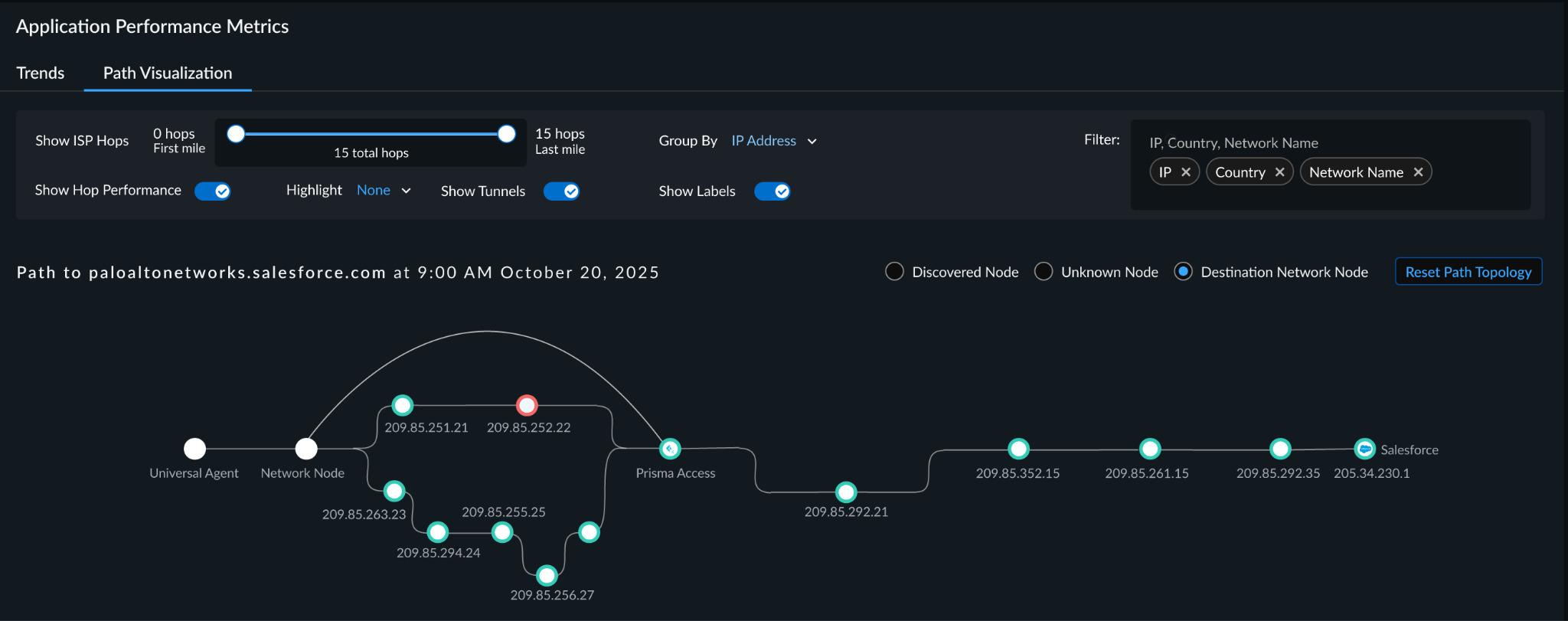
  •  

Securing Every Identity in the Age of AI

The enterprise security landscape has reached an inflection point. As organizations accelerate adoption of cloud, automation and artificial intelligence, identity has become the primary attack surface of the modern enterprise. Not because defenses have weakened, but because identities have multiplied and now operate continuously at machine speed, often with elevated access.

When attackers succeed today, it almost always starts with identity. Identity is now the number one attack vector. Eighty-seven percent of organizations experienced at least two successful, identity-centric breaches in the past 12 months. These breaches can lead to outages, regulatory exposure, financial loss and reputational damage.

This reality is why today marks such a pivotal moment. CyberArk is officially joining Palo Alto Networks. This step reflects a shared conviction that identity security is no longer a supporting function. To stay ahead of modern attackers, organizations need best-in-class identity security that is deeply integrated into their broader security strategy.

The Reality of the Modern Identity Attack Surface

For years, identity security focused on a relatively small population of human users, administrators and periodic access reviews. That model no longer matches reality.

Today’s enterprises depend on vast numbers of machine identities, including workloads, services, APIs and increasingly, autonomous AI agents. Machine identities now outnumber human identities by more than 80 to 1, while 75 percent of organizations acknowledge that their human identities are governed by outdated, overly permissive privileged models.

Attackers have adapted. Rather than breaking in through vulnerabilities, they increasingly log in using stolen credentials or by exploiting excessive, poorly governed access. Identity-based attacks have become the dominant breach vector because identity sprawl and standing privilege create opportunities that are difficult to detect with traditional tools.

Yet many identity programs remain fragmented. Access management, privileged access and governance often operate in silos, with delayed visibility and manual processes. Risk accumulates silently between reviews, leaving security teams reacting after the fact.

This is the problem CyberArk was built to solve.

Why Identity Security Must Be Continuous

Securing identities in this environment requires a fundamentally different approach. Identity risk changes constantly as new identities are created, permissions shift and systems scale dynamically. Controls must operate continuously, not episodically.

This means three things:

First, organizations need real-time visibility into who or what has access to critical systems across human, machine and AI identities.

Second, privilege must be applied dynamically. Access should be granted only when needed and removed automatically when it is no longer required. Standing privilege should be the exception, not the norm.

Third, governance must evolve from periodic compliance exercises to continuous enforcement that adapts as environments change.

This is the identity security vision that has guided CyberArk for decades and why joining Palo Alto Networks is such a natural next step.

Elevating Identity to a Core Platform

As part of Palo Alto Networks, CyberArk elevates identity security to a core platform pillar.

CyberArk’s Identity Security Platform is proven at enterprise scale and trusted to protect some of the world’s most critical environments. Our approach extends privileged access principles beyond a narrow set of administrators to every identity that matters.

By treating every identity as potentially privileged, organizations can dramatically reduce their attack surface. Excessive access is identified. Unnecessary privilege is removed. Attackers lose the ability to move laterally by using stolen credentials.

Elevating identity security to a platform level also enables tighter alignment with network security, cloud security and security operations. Identity becomes a powerful control plane that informs policy enforcement, detection and response across the enterprise, delivering a more complete and actionable view of risk.

Securing the AI-Driven Enterprise

This shift is especially critical as organizations deploy AI-driven systems and autonomous agents.

These systems often require persistent access to sensitive data and infrastructure, making them attractive targets for attackers and difficult to govern with legacy identity models. Most enterprises today lack effective identity security controls for machine and AI-driven systems, leaving these identities overprivileged and undergoverned.

Applying privileged access principles universally enables organizations to secure AI-driven environments without slowing innovation. Identity security becomes the trust layer that allows enterprises to scale AI responsibly, ensuring access is controlled, monitored and adjusted dynamically as systems evolve.

What This Means for Customers

For customers, elevating identity security to a core platform delivers tangible outcomes.

Organizations gain clearer insight into identity access and risk across human, machine and agentic identities. They gain stronger protection against credential-based attacks by limiting excessive privilege and reducing the paths that attackers rely on to move undetected. They also gain operational simplicity by replacing fragmented tools and manual governance with consistent, scalable controls.

Most importantly, customers gain confidence. Confidence to adopt cloud, automation and AI, knowing that identity risk is governed continuously. Confidence that security can keep pace with change rather than reacting after the fact.

Moving Forward

CyberArk’s Identity Security solutions will continue to be available as a standalone platform. Customers can rely on the solutions they trust today while benefiting from an accelerated roadmap focused on resilience, simplicity and improved security outcomes.

At the same time, integration is underway to bring CyberArk’s best-in-class identity security capabilities more deeply into the Palo Alto Networks security ecosystem. Our priority is to listen closely to customers, meet their immediate needs, and build the path forward together.

The AI era is redefining how enterprises operate and how attackers operate alongside them. Securing every identity, human, machine and AI agent is no longer optional. It is foundational.

By bringing CyberArk into Palo Alto Networks, we are taking a decisive step toward redefining identity security for the modern enterprise and helping our customers stay secure as they innovate at speed.

The post Securing Every Identity in the Age of AI appeared first on Palo Alto Networks Blog.

  •  

Patch Tuesday, February 2026 Edition

Microsoft today released updates to fix more than 50 security holes in its Windows operating systems and other software, including patches for a whopping six “zero-day” vulnerabilities that attackers are already exploiting in the wild.

Zero-day #1 this month is CVE-2026-21510, a security feature bypass vulnerability in Windows Shell wherein a single click on a malicious link can quietly bypass Windows protections and run attacker-controlled content without warning or consent dialogs. CVE-2026-21510 affects all currently supported versions of Windows.

The zero-day flaw CVE-2026-21513 is a security bypass bug targeting MSHTML, the proprietary engine of the default Web browser in Windows. CVE-2026-21514 is a related security feature bypass in Microsoft Word.

The zero-day CVE-2026-21533 allows local attackers to elevate their user privileges to “SYSTEM” level access in Windows Remote Desktop Services. CVE-2026-21519 is a zero-day elevation of privilege flaw in the Desktop Window Manager (DWM), a key component of Windows that organizes windows on a user’s screen. Microsoft fixed a different zero-day in DWM just last month.

The sixth zero-day is CVE-2026-21525, a potentially disruptive denial-of-service vulnerability in the Windows Remote Access Connection Manager, the service responsible for maintaining VPN connections to corporate networks.

Chris Goettl at Ivanti reminds us Microsoft has issued several out-of-band security updates since January’s Patch Tuesday. On January 17, Microsoft pushed a fix that resolved a credential prompt failure when attempting remote desktop or remote application connections. On January 26, Microsoft patched a zero-day security feature bypass vulnerability (CVE-2026-21509) in Microsoft Office.

Kev Breen at Immersive notes that this month’s Patch Tuesday includes several fixes for remote code execution vulnerabilities affecting GitHub Copilot and multiple integrated development environments (IDEs), including VS Code, Visual Studio, and JetBrains products. The relevant CVEs are CVE-2026-21516, CVE-2026-21523, and CVE-2026-21256.

Breen said the AI vulnerabilities Microsoft patched this month stem from a command injection flaw that can be triggered through prompt injection, or tricking the AI agent into doing something it shouldn’t — like executing malicious code or commands.

“Developers are high-value targets for threat actors, as they often have access to sensitive data such as API keys and secrets that function as keys to critical infrastructure, including privileged AWS or Azure API keys,” Breen said. “When organizations enable developers and automation pipelines to use LLMs and agentic AI, a malicious prompt can have significant impact. This does not mean organizations should stop using AI. It does mean developers should understand the risks, teams should clearly identify which systems and workflows have access to AI agents, and least-privilege principles should be applied to limit the blast radius if developer secrets are compromised.”

The SANS Internet Storm Center has a clickable breakdown of each individual fix this month from Microsoft, indexed by severity and CVSS score. Enterprise Windows admins involved in testing patches before rolling them out should keep an eye on askwoody.com, which often has the skinny on wonky updates. Please don’t neglect to back up your data if it has been a while since you’ve done that, and feel free to sound off in the comments if you experience problems installing any of these fixes.

  •  

From Solo to Squad: The Evolution of Cyber Security Training in the AI Era

Generative AI is transforming cyber defense. Technical expertise remains critical, but AI-driven threats demand more than individual skill – they require the collective intelligence of the organization’s SOC. To understand how businesses are adapting, Infinity Global Services analyzed training consumption trends from 2023 to 2025. The findings reveal a decisive shift from individual courses to team-based subscriptions, signaling a new approach to workforce development in the age of AI. The Data: A Shift in Mindset Infinity Global Services’ training data shows a clear change in procurement strategies. Individual course purchases have declined by 33%, while team-based subscription models have surged, […]

The post From Solo to Squad: The Evolution of Cyber Security Training in the AI Era appeared first on Check Point Blog.

  •  

The Power of Glean and Prisma AIRS Integration

Accelerating Secure AI Adoption

The rapid adoption of AI is transforming the enterprise, unlocking unprecedented productivity and accelerating workflows at a record pace. However, this velocity creates a new productivity paradox: The faster AI moves, the more it can expose the organization to entirely new categories of risk. Without specialized guardrails, unchecked AI can inadvertently bypass company policies, violate legal standards, or ignore ethical norms.

To bridge this gap, Glean, the Work AI platform, and Palo Alto Networks Prisma® AIRS™ have integrated to provide an essential security layer that empowers organizations to adopt generative AI with confidence, helping ensure that massive productivity gains never come at the cost of trust, security or compliance.

How Glean and Prisma AIRS work together.
Glean and Prisma AIRS stop AI attacks in runtime.
Display of how a prompt injection is blocked by a Work AI assistant.
Prompt injection threat blocked in real time.

Real-Time Defense Against the Modern AI Threat Surface

Generic filters often fail to catch the sophisticated nuances of AI-driven attacks. The integration of Glean and Prisma AIRS provides a purpose-built defense that acts in real time across three critical areas:

1. Neutralizing Prompt Injection

Prompt injections are malicious instructions designed to trick AI models into ignoring their safety protocols, potentially leading to the exposure of sensitive data or the execution of unauthorized actions.

For instance, an attacker could craft a prompt that causes the AI to leak its own system instructions leading to data loss. Glean and Prisma AIRS instantly detect these sophisticated manipulation attempts, blocking the request and notifying the user before the organization's integrity is compromised.

2. Safeguarding Against Harmful and Toxic Content

AI interactions must remain professional, ethical and safe.

By scanning both user prompts and AI-generated responses against organizational policy, Glean and Prisma AIRS automatically block requests that contain toxic, biased, or otherwise harmful content. This enables AI to remain a positive and productive asset for the entire workforce.

3. Preventing Malicious Code and Unsafe URLs

AI models can sometimes generate unsafe code snippets, get data from a poisoned source, or provide harmful links that lead to phishing sites or malware downloads.

For example, a developer might ask an AI assistant for a code library to process data, and the model could inadvertently suggest a malicious package that compromises the application. The Glean and Palo Alto Networks integration provides a crucial safety net, inspecting all generated content for malicious patterns and preventing employees from interacting with risky URLs, keeping the entire AI-driven development and research lifecycle secure.

Secure AI in Minutes with Out of the Box Integration

The true power of the Glean and Palo Alto Networks partnership lies in its simplicity. We’ve removed the friction of complex security configurations, enabling organizations to realize value immediately through a seamless, out of the box integration.

Onboarding is completed in three simple steps within the Glean admin console:

  1. Navigate to AI Security and select Palo Alto Networks AI Runtime Security™.
  2. Paste your Prisma AIRS Runtime Security API Key.
  3. Click Save.
Glean Admin Console for AI security.
Activate Prisma AIRS from the Glean admin console.

With these three clicks, the integration is live, providing an invisible but invincible layer of defense across your AI chats and agent interactions.

AI security showing rundown of policy violation status.
Glean admin panel showcasing all findings.

Partnering for a Secure AI Future

As enterprises scale their AI initiatives, specialized security becomes non-negotiable. Prisma AIRS provides the advanced, granular protection needed to catch threats that standard vendors can often miss, and its integration with Glean delivers that protection exactly where work happens.

Drive productivity, foster innovation, and secure your future with Glean and Palo Alto Networks.

Key Takeaways

  • Real-Time Threat Mitigation: Instantly block prompt injections, toxic content, and malicious code, transforming AI from a risk factor into a secure asset.
  • Frictionless Deployment: Achieve comprehensive AI security in minutes with a simple, three-click API integration within the Glean console.
  • Time to value: Scale AI adoption across the enterprise by ensuring every interaction complies with internal policies and global safety standards.

Ready to Deploy Secure AI? To explore how this integration can protect your organization, sign up for the Glean and Palo Alto Networks upcoming webinar.

The post The Power of Glean and Prisma AIRS Integration appeared first on Palo Alto Networks Blog.

  •  
❌