Reading view

Palo Alto Networks and Google Cloud

Expand Strategic Collaboration to Secure the AI Enterprise

The transition from generative AI to agentic AI represents one of the most significant shifts in the history of enterprise technology. As organizations move from simple chatbots to autonomous agents that can execute business processes, the attack surface isn't just changing, it's exploding.

At Google Cloud Next 2026 in Las Vegas, Palo Alto Networks is proud to announce a series of groundbreaking integrations with Google Cloud. These innovations are designed to do more than just monitor the new AI-driven landscape; they are built to secure it by design. AI deployment is currently outpacing AI governance. By embedding our security platform into Google Cloud’s infrastructure, we are giving today’s enterprises the foundation to become the autonomous organizations of tomorrow.

Here is a look at the four major milestones of our partnership being unveiled this week.

Secure AI Agents with Google Cloud + Prisma AIRS

As autonomous AI agents become the new enterprise standard, security can no longer be an afterthought; it must be architectural. By integrating Prisma AIRS™ natively with Google Cloud Gemini Enterprise Agent Platform, we provide the proactive defenses required to govern complex agentic workflows. This integration ensures that as you scale your autonomous workforce, your security scales with it, providing comprehensive operational integrity without hindering the speed of innovation.

We are delivering capabilities across three critical pillars:

  • Protecting Agent-Specific Runtime Risks: In an agentic ecosystem, the primary risk is unauthorized or a destructive action taken by the AI agents themselves. Prisma AIRS secures the "agent-to-tool" interface, preventing poisoned context from triggering malicious scripts or destructive actions. The solution monitors agent execution in real-time, so agents cannot leak sensitive credentials or tool schemas, maintaining the boundary between agents and their access to enterprise data.
  • Securing the GenAI Application Surface: Modern AI applications and agents require a secure-by-design approach. Prisma AIRS AI Runtime Security™ provides prevention of more than 30 adversarial prompt injection and jailbreak techniques, as well as malicious code and URLs within LLM outputs. Prisma AIRS utilizes over 1,000 predefined patterns out of the box and ML-powered Enterprise DLP to stop sensitive data leakage.
  • Enforcing Enterprise AI Safety and Grounding: Trust in AI is built on the consistency and safety of its output. Prisma AIRS allows organizations to define safety policies in natural language and filter toxic content across eight distinct categories to protect brand reputation. Using contextual grounding, Prisma AIRS can prevent misleading outputs that contradict internal RAG data, keeping agents tied to real facts.

This integration ensures that as you scale your autonomous workforce, your security posture scales with it, providing operational integrity without hindering the speed of innovation.

Security-as-Code for Prisma AIRS Integration with Application Design Center (ADC)

The traditional bolt-on approach to security is no longer viable in a cloud-first world. Google Cloud’s Application Design Center (ADC) is revolutionizing how applications are built, using an intuitive canvas and natural language via Gemini Code Assist.

Palo Alto Networks is announcing that it will be published as a template within the Application Design Center, providing more capabilities to engineering teams:

  • Drag-and-Drop Security – Visually "snap" VM-Series firewalls and Prisma AIRS AI protections directly into network flows.
  • AI-Driven Architecture – Use natural language prompts to generate secure-by-default, multiregion architectures.
  • Simultaneous Deployment – Deploy entire application stacks and security services in a single, unified workflow, ensuring protection is present from the very first minute of deployment.

Zero-Day Protection at Scale with Advanced Malware Sandboxing for Google Cloud NGFW Enterprise

The battle against malware has shifted to the cloud. Modern attacks are faster, more evasive and capable of bypassing traditional defenses.

That is why we are excited to announce Advanced WildFire®, powered by Palo Alto Networks, natively integrated into Google Cloud NGFW Enterprise, delivering AI-driven malware prevention directly within Google Cloud environments.

This integration embeds inline sandboxing and real-time threat intelligence directly into Google Cloud’s distributed firewall to stop advanced and unknown threats before they impact workloads, enabling:

  • Secure Detonation – Suspicious files are safely executed in a controlled sandbox environment to uncover hidden and unknown threats.
  • Inline Traffic Inspection – Inbound and outbound traffic is analyzed in real time to prevent lateral movement of malicious payloads across cloud environments.
  • AI-Driven Threat Prevention – Leverages global threat intelligence by Palo Alto Networks to block zero-day threats before they compromise workloads.

With Advanced WildFire embedded directly into Google Cloud NGFW Enterprise, organizations can extend consistent protection across their cloud infrastructure while maintaining operational simplicity.

Cloud NGFW Enterprise Advanced Malware Sandboxing will be available in Public Preview soon.

Defining the Future with the Google Cloud Marketplace

Palo Alto Networks has joined the Google Cloud Marketplace Agent-as-a-Service as a launch partner to introduce the Prisma AIRS Model Security agent. Operating as an Agent-as-a-Service, this solution scans AI models for vulnerabilities and policy noncompliance before they reach production.

Available in the Agent Gallery inside Gemini Enterprise, this marketplace offering runs entirely within the customer’s own Google Cloud environment, providing both new and existing Prisma AIRS users a seamless and simple deployment experience inside Gemini Enterprise.

Securing AI Innovation at Scale

The collaboration between Palo Alto Networks and Google Cloud is built on a shared vision: Security should be an accelerator for innovation, not a bottleneck. As we look toward the future of the AI-powered enterprise, our commitment remains to provide the most robust, platform-driven security for every workload, every agent and every interaction.

Want to see these integrations in action? Contact your Palo Alto Networks representative to learn more about how we are securing the future of the cloud together. If you’re attending Google Cloud Next 2026, join us at these sponsored sessions:

The post Palo Alto Networks and Google Cloud appeared first on Palo Alto Networks Blog.

  •  

Scaling AI Agents with Confidence

The Google Cloud and Palo Alto Networks Partnership

As AI agents move into business-critical environments, they are transforming everything from security operations to internal workflows. However, scaling these AI applications introduces unprecedented hurdles for security executives, from detecting "shadow AI" and unsanctioned usage to governing complex nonhuman identities across multimodel environments.

To overcome these challenges, organizations need more than just tools; they need a layered architecture built on a foundation of platformization. The long-standing partnership between Palo Alto Networks and Google Cloud provides this essential framework, offering customers:

  • Integrated Security Ecosystems: Seamlessly manage the full agent lifecycle with visibility and observability across your entire AI infrastructure.
  • Jointly Engineered Solutions: Leverage over 80 co-engineered integrations designed to eliminate the tradeoff between a cloud-native experience and best-in-class security.
  • Proven Scale and Performance: Benefit from a partnership that has already delivered impactful, AI-driven solutions to protect joint customers from evolving threats.

Google Cloud Marketplace enables customers to discover, try, buy and use industry-leading applications that have been validated to run on Google Cloud. Palo Alto Networks has closed $2.4 billion in GCP bookings, helping address evolving customer needs, such as simplified procurement and seamless deployment.

Kevin Ichhpurani, President, Global Partner Ecosystem at Google Cloud:

We’re pleased to celebrate Palo Alto Networks as our Global Technology Partner of the Year… Palo Alto Networks has consistently delivered impactful, AI-driven security solutions that help Google Cloud customers better protect their organizations from evolving threats.

The extensive, long-standing collaboration between Palo Alto Networks and Google Cloud includes jointly engineered offerings, built on 80 solution integrations that help customers build, run and secure AI-enhanced cloud infrastructure and applications with end-to-end protection.

Palo Alto Networks Wins 2026 Global Technology Google Cloud Partner of the Year Award

At Google Cloud Next, Palo Alto Networks has been recognized with four 2026 Google Cloud Partner of the Year awards. By partnering with Google Cloud, we help customers securely leverage the power of the cloud and AI-driven growth with comprehensive cloud-native security offerings. Wins included the following:

  • Global Technology
  • Marketplace: Technology
  • Marketplace: Security
  • Security: Artificial Intelligence

These Partner of the Year Awards underscore our expanding partnership with Google Cloud. We share a mutual dedication to improve cloud, network security and AI observability, as well as the progress we’ve made in protecting our joint customers from today’s and tomorrow’s cyberthreats.

By combining our industry-leading security engineering with Google Cloud’s industry-leading cloud infrastructure and services, we’re providing advanced protection for every stage of a customer’s digital journey. We want customers to feel secure from the formative steps of lifting workloads into the cloud, to expanding digital innovation across platforms, to reaching new levels of business scale and velocity.

Protecting these journeys requires alignment and modernization of infrastructure (lift and shift), applications (refactoring) and user access models (zero trust). It requires an advanced AI drive security operations transformation across all IT domains, leveraging machine learning and sophisticated models to minimize human interventions and unguarded sides.

Our relationship with Google Cloud is based on a deep engineering relationship, yielding integrated solutions that help customers achieve better digital outcomes. Our partnership can help your organization eliminate tradeoffs between a cloud-native experience and best-in-class security. We have more than 80 co-engineered integrations, helping to improve and protect hybrid workers, cloud migrations and application modernization efforts.

We remain committed to our goals of outpacing cyberthreats, helping customers at every stage of their cloud journey, and creating a world where tomorrow is more secure than today.

Whether you’re just beginning your cloud journey or managing complex transformational projects, our jointly engineered, AI-driven solutions are designed to deliver seamless, scalable security. Explore the dynamic partnership between Palo Alto Networks and Google Cloud. Join us at Google Cloud Next '26 in Las Vegas from April 22-24 to discover how to secure your development lifecycle from code to cloud.

The post Scaling AI Agents with Confidence appeared first on Palo Alto Networks Blog.

  •  

Palo Alto Networks Joins DNS-OARC as a Platinum Member

Palo Alto Networks recently joined the DNS-OARC community as a Platinum Member. Together, our organizations share a commitment to advancing collaboration in research and operational excellence across the global DNS ecosystem. DNS is critical to both internet infrastructure and security, and this collaboration facilitates the sharing of real-world insights among researchers and practitioners.

Our Contribution

We help organizations secure their digital environment with a comprehensive portfolio of cybersecurity solutions spanning Network, Cloud, Security Operations, AI and Identity. Trusted by more than 70,000 customers worldwide and informed by Unit 42® Threat Intelligence, their AI-driven platforms help organizations reduce complexity, modernize with confidence, and securely enable innovation.

As a Platinum Member, our subject matter experts will actively participate in the DNS-OARC community by engaging in discussions and contributing to research on evolving DNS threats and network challenges. The growing intersection of DNS and security makes access to intelligence and experience increasingly important. It strengthens the community’s ability to respond to emerging challenges and improves resilience across the internet.

Through our participation, our customers will gain stronger protection informed by community-driven intelligence and real-world operational insight. These learnings are continuously integrated into our threat intelligence and security capabilities. Our participation signals our support for DNS-OARC’s mission of fostering open dialogue and shared learning across the DNS ecosystem. This collaboration helps bridge DNS operations with broader security practices, improving coordination between operators, researchers and security practitioners.

Our Commitment to the DNS-OARC and Global Communities

Collaboration between our organizations strengthens the connection among DNS operations and modern security practices by bringing together operational insight and a global community dedicated to advancing the internet’s resilience.

For the DNS-OARC community, our commitment enhances knowledge sharing around evolving DNS threats, large-scale network operations and practical approaches to emerging challenges.

For organizations and customers, it reinforces a stronger alignment between DNS infrastructure and security, expands access to community-driven intelligence and supports more resilient, well-informed defenses.

Tong Zhao, Senior Manager of DNS Security Engineering, Palo Alto Networks:

We recognize the critical role of DNS-OARC in DNS operations and research. The teams from Palo Alto Networks believe that our DNS-OARC membership aligns perfectly with our goals. We are eager to participate in and contribute to the DNS community.

Our partnership with the DNC-OARC highlights the value of open collaboration in helping both the community and its participants stay ahead of an increasingly complex threat landscape. To learn more about how our expertise and insights support DNS-OARC’s mission to improve the security and stability of the internet’s DNS, visit DNS-OARC.

The post Palo Alto Networks Joins DNS-OARC as a Platinum Member appeared first on Palo Alto Networks Blog.

  •  

The AI Ecosystem Edge — Introducing Our Frontier AI Alliance

Acting swiftly with intent, together with Accenture, Deloitte, IBM, NTT DATA and PwC

With the imminent release of unbounded frontier models, the barrier to entry for sophisticated cyberattacks has vanished. Anthropic’s Mythos represents a 50% leap in coding capability over previous models. It’s a leap that, as Lee Klarich stated, translates into autonomous agents capable of both surfacing a massive surge of vulnerabilities and exploiting them faster than we’ve ever seen or imagined.

In this new era, business continuity requires more than just better tools; it requires a unified ecosystem of experts capable of orchestrating a defense that matches this new pace of attack.

As we drive the industry standard for addressing these emerging risks with our Unit 42® Frontier AI Defense, we’ve united an alliance of global transformation leaders, starting with Accenture, Deloitte, IBM, NTT DATA and PwC, and will continue to scale these alliances to ensure every enterprise has a rapid path to AI resilience.

Frontier AI Alliance: Palo Alto Networks, Accenture, Deloitte, IBM, NTT Data, pwc.

By combining the world’s most advanced AI security platform with deep industry expertise, we are delivering the security assessment and rapid protection needed to help customers stop emerging threats and keep their business resilient.

Rex Thexton,
Chief Technology Officer, Accenture Cybersecurity:

As AI-driven attacks accelerate to machine speed, organizations must rethink how they protect critical assets. Together with Palo Alto Networks, we're helping clients automate protection and reduce risk. By enabling an autonomous defense posture that detects and responds in minutes, we can empower organizations to scale their AI innovation with confidence.

Deborah Golden,
principal, Deloitte:

As AI-driven threats accelerate, our mission is to help clients move even faster. By combining Deloitte's implementation experience with Palo Alto Networks' AI blueprint, we are rapidly delivering more complete security coverage to clients with near-real-time responsiveness, turning potential vulnerabilities into a foundation for resilient innovation.

Mark Hughes,
Global Managing Partner of Cybersecurity Services, IBM Consulting:

In an environment where frontier models let attackers move faster than ever, organizations need defenses that can keep up. Joining the Frontier AI Alliance strengthens our commitment to helping organizations prepare for this new class of agentic, machine speed threats. IBM Autonomous Security plus Palo Alto Networks technologies bring together interoperable, vendor-agnostic digital workers that operate across an organization's full security stack, enabling security programs to act as a system rather than a collection of disconnected tools.

Sandip Gupta,
Head of Global Strategic Alliances, NTT DATA:

Frontier AI is reshaping the economics of cyber defense. As threat actors move faster and operate with greater automation, organizations need a more resilient and adaptive approach to protecting business continuity. Through the Frontier AI Alliance, NTT DATA is combining Palo Alto Networks' innovation with its global cybersecurity solutions and deep industry experience to help clients close critical security gaps, reduce complexity and strengthen resilience against AI-powered threats.

Morgan Adamski,
Principal and Cyber, Data, & Technology Risk Leader, PwC:

As AI-enabled cyber risk accelerates in both speed and scale, organizations cannot remediate issues fast enough through traditional approaches. Palo Alto Networks Unit 42 Frontier AI Defense combines Palo Alto Networks innovation in vulnerability discovery with PwC's expertise to prioritize what matters, accelerate remediation, and build governance and resilience frameworks that operate at machine speed.

01/05

By engaging directly with Palo Alto Networks, or working with our partners through the Frontier AI Alliance, our customers can move past the complexity of building an AI-ready defense from scratch and gain:

  • Accelerated Immunity: Go from a high-exposure state to a hardened posture using a prevalidated AI Defense Blueprint, delivering coverage in weeks, not years.
  • On-Demand Expertise: Our partners provide the specialized prompting and verification required to make the latest AI Frontier models work for the defender.
  • Operational Resilience: While Unit 42 provides the Frontier AI Exposure Analysis, our ecosystem partners provide the boots on the ground to remediate those findings and leverage our product portfolio to deliver AI-readiness to your enterprise.

The threat of Mythos-class models is imminent, but the path to resilience is clear. Whether you are looking for an immediate strategic assessment or a deep operational overhaul, the Frontier AI Alliance is ready to move at the speed of your business.

The post The AI Ecosystem Edge — Introducing Our Frontier AI Alliance appeared first on Palo Alto Networks Blog.
  •  

Defender's Guide to the Frontier AI Impact on Cybersecurity

The release of the newest frontier AI models marks a turning point for cybersecurity. Palo Alto Networks has conducted early testing of the latest frontier AI models, including Anthropic’s Mythos model as part of Project Glasswing and OpenAI’s latest models as part of Trusted Access for Cyber program. The conclusion is clear: They are extraordinarily capable at finding vulnerabilities and generating corresponding exploits.

This generational improvement in coding ability directly translates to a significant advance in vulnerability discovery and exploit generation. These capabilities, however guardrailed, will not stay contained. Similar advances will appear across other major AI labs, Chinese models, and open source models. Attackers will find the seams in those guardrails. They will use advanced AI to discover zero-day vulnerabilities at scale, generate exploits in near real time, and develop autonomous attack agents unlike anything the industry has faced.

Within six months, advanced AI models with deep cybersecurity capabilities will become commonplace. Organizations that have not put appropriate safeguards in place will face an entirely new class of risk across their enterprise and critical infrastructure.

Frontier AI: A Quantum Leap in Code Fluency

As you have probably already seen, the latest unbounded models like Mythos represent roughly a 50% improvement in coding efficiency over Anthropic’s previous leading model. Palo Alto Networks has had early access to unbounded models and we’ve been able to leverage this vast improvement in coding to a quantum leap in scanning and offensive capability.

Hundreds of our best security engineers have been assessing these capabilities and developing best practices for using it effectively. The results revealed several core truths:

  • Vulnerability discovery at scale: Frontier AI is exceptionally effective at identifying vulnerabilities in code. In less than three weeks, it accomplished the equivalent of a full year’s worth of penetration testing effort.
  • Attack path determination: Perhaps more impressive than finding individual vulnerabilities, Frontier AI excels at vulnerability chaining, combining multiple lower-severity issues into critical-level exploit paths. For example, linking two medium-severity and one low-severity vulnerability into a single critical exploit.
  • Full-stack logic analysis: Frontier AI can analyze the full exposure surface of applications, including SaaS and public-facing platforms, identifying logic-based vulnerabilities that traditional tools miss.

Impacts on the Cyber Landscape

Attackers have been using LLMs for years, but based on our testing of frontier AI models, there are three key areas where they will have a significant impact on the cybersecurity landscape:

  1. The Vulnerability Deluge: Frontier AI models will dramatically accelerate the rate at which vulnerabilities are discovered, by defenders and attackers alike. This will be particularly acute in open source and critically, the flood of patches that follows will itself create risk. Every patch that is not applied immediately becomes a known, targetable vulnerability. Organizations will need to accelerate and automate their patching programs, rethink how they prioritize and apply patches, and ensure best-in-class protections are in place to mitigate vulnerability until they can be remediated.
  2. Rise of Inside-Out Attacks: Recent supply chain attacks on tools like LiteLLM and Trivy demonstrate a growing pattern where attacks land adversaries inside an organization’s infrastructure, bypassing multiple conventional attack steps and reducing the number of prevention opportunities available to defenders. The rapid deployment of AI infrastructure has made this problem more acute as the AI supply chain, including runtime environments, communication infrastructure, and model dependencies, is often insufficiently protected. While open source usage and patching practices must become significantly more robust, organizations will need structural containment of potential attacks through zero trust, identity modernization, outbound connection restrictions and lateral movement protections.
  3. Faster AI-Assisted Attack Cycles: I expect the most consequential shift with frontier AI models is the move from AI-assisted to AI-driven attacks. Attackers will build autonomous attack agents that dramatically compress attack cycle times. What once took days or weeks of skilled manual effort will soon be executed in minutes. This democratization of advanced attack capabilities means that defenders must match that speed with near-real-time detection and response, which is only possible with extensive AI and automation throughout security operations. Organizations whose Mean Time to Detection and Mean Time to Response are not measured in low single-digit minutes will be outpaced.

The Defenders Guide: Assessment, Protection, Platformization

The framework for defending against AI-driven threats is not completely new, but the standard for execution must be absolute. Organizations that are “mostly protected” are effectively unprotected. What follows is a phased approach – assessment, protection and platformization – that organizations should pursue in parallel to close gaps before attackers exploit them.

Assessment: Every organization should use the latest AI models to assess its entire code and application landscape and build a comprehensive asset and exposure inventory.

Key priorities:

  • Leverage AI models to identify vulnerabilities across your codebase, applications and infrastructure before attackers do.
  • Evaluate exposure with full context, including how vulnerabilities chain together to form critical exploit paths.
  • Audit your open source supply chain, including AI infrastructure, runtime environments and model dependencies.
  • Map your current sensor coverage. Detection, prevention and telemetry gaps represent critical blind spots.

Protect & Remediation: Remediating and reducing exposure is table-stakes. What in the past may have been difficult due to cross-organizational friction of finding and fixing at pace should now be accelerated with the c-suite attention of these new AI models. But this must go further and extend to comprehensive deployment of best-in-class attack prevention capabilities where the new standard is 100% coverage and optimization.

  • XDR everywhere, with emphasis on real-time ML-based detection and prevention of attacks; all hosts on prem and cloud included.
  • Agentic endpoint security to secure wide-scale adoption of vibe coding and AI security across the enterprise (e.g. Prisma AIRS and our recent acquisition of Koi is now a necessity for securing the agentic endpoint).
  • With an average of 85% of work now happening in the browser, secure enterprise browsers with real-time security become a must-have for attack prevention.
  • Zero trust and identity security are foundational to securing every user and every connection.

Real-Time Security Operations: With attack cycle times shrinking rapidly, the legacy approach to security operations simply doesn’t work. Disparate tools analyzing data in silos overlaid with manual processes must be replaced with AI and automation throughout. Cortex XSIAM, our AI-driven SOC platform, is what I consider to be the gold standard for how to take a next-generation approach to deliver MTTD and MTTR in single digit minutes.

  • Attack detections must be AI/ML driven to detect even frequently-changing and novel attacks at scale.
  • These AI detections must operate against a wide range of 1st party and 3rd party data sources – a best in class AI SOC must operate on ALL relevant data sources.
  • Automation both natively integrated and throughout the SOC lifecycle is necessary to achieve single digit MTTR; this automation will increasingly be agentic.
  • This must be delivered as a platform to remove the seams and gaps between point solutions.

We’re Here to Help

Achieving this level of resilience requires the right platforms and the right expertise.

To help you navigate this shift, we are introducing Unit 42 Frontier AI Defense. This new offering is designed to discover and remediate your current exposure before attackers do, strengthen controls that reduce exposure and contain impact and modernize operations so teams can detect and respond at machine speed.

This is the moment we’ve been preparing for. The threat has never been more sophisticated, but the path forward has never been clearer, and we’re here to partner with you on what comes next.

The post Defender's Guide to the Frontier AI Impact on Cybersecurity appeared first on Palo Alto Networks Blog.

  •  

Introducing Unit 42 Frontier AI Defense

Frontier AI models have given the security industry a preview of what comes next. As they become weaponized, attackers will automate the discovery and chaining of vulnerabilities in near real-time – compressing timelines, increasing scale and outpacing human-led defense.

Zero-day discovery at scale, immediate exploitation, defense-in-depth evasion, systemic supply chain exposure, autonomous attack execution.

Until now, defenders have had time to detect activity, investigate signals and contain threats before exposures were chained into full attacks. AI is quickly closing this window.

Defending against AI-driven threats means engineering a resilient architecture that limits how easily attackers can exploit discovered weaknesses, that contains the blast radius when they do, and enables faster response at scale. It also means using AI to accelerate the security program itself, from vulnerability discovery and code review to triage, remediation and incident response.

The transition should cover three areas. First, discover and remediate your current exposure before attackers do. Second, strengthen controls that reduce exposure and contain impact. Third, modernize operations so teams can detect and respond in real-time.

To help organizations make this shift, Palo Alto Networks is launching Unit 42® Frontier AI Defense.

Powered by the latest AI models, Unit 42 Frontier AI Defense helps organizations answer a critical question: Are your defenses ready for AI-powered attacks?

Unit 42 Frontier AI Defense combines three core components delivered by expert consultants, coupled with 6 months of complimentary access to Cortex® XDR, Cortex Xpanse® and Koi Agentic Security.

Frontier AI Exposure Analysis: Identify and validate the exposures most likely to be chained into real attacks before attackers weaponize them.

Actions

    • Use the latest frontier models, Unit 42 offensive security expertise, threat telemetry and Unit 42 Threat Intelligence to assess your environment.
    • Identify the vulnerabilities, misconfigurations and posture gaps most likely to be exploited across infrastructure, applications, code, identity and cloud.
    • Validate the attack paths most likely to matter in real-world attacks.

Outputs

    • A prioritized view of vulnerabilities and attack paths that matter most
    • Clear actions to fix the exposures that matter first

Autonomous Security Blueprint: Benchmark current capabilities and define the changes required for machine-speed defense.

Actions

    • Assess current-state capabilities across attack surface, identity, software supply chain, zero trust containment, as well as real-time detection and response.
    • Identify where AI-powered threats create the greatest exposure and where current controls are most likely to fail.
    • Define the technical and operational changes required to close those gaps.

Outputs

    • A clear blueprint for immediate action
    • A prioritized roadmap to reduce exposure, strengthen containment and modernize security for the AI era

Agentic Defense Transformation: Implement the prioritized architecture, control and operating changes needed to modernize defenses for AI-driven threats.

Actions

    • Implement the architectural, operational and control changes required to defend against AI-driven threats.
    • Modernize exposure management, harden the software supply chain, and advance zero trust architecture.
    • Build response capabilities that can keep pace with autonomous attacks.

Outputs

    • Accelerated implementation of the changes that matter most
    • A more modern security architecture, built to reduce exposure and improve containment

The Window Is Still Open, for Now

AI is the biggest security inflection point since enterprises moved to the cloud. Organizations that act now will be the ones that are ready. Those that wait will be forced to respond under maximum pressure on the worst possible day.

Frontier AI is changing what is possible for attackers. In the hands of defenders, it can become a decisive advantage.

Human-speed security is no longer enough. A modern security approach is required. Get started with Unit 42 Frontier AI Defense today.

*The complimentary offer is not available to public sector customers or current Cortex XDR, Cortex Xpanse or Koi customers.

The post Introducing Unit 42 Frontier AI Defense appeared first on Palo Alto Networks Blog.
  •  

Securing the UK’s Digital Future

Our Commitment to Data Autonomy and National Resilience

The United Kingdom has established itself as a leading global cyber power. Over the last decade, Palo Alto Networks has been proud to work alongside British institutions to protect the digital borders of a highly innovative economy. As UK organisations navigate an evolving threat landscape and adopt transformative technologies, like AI, the need for security partners who understand British operational realities has never been greater.

The Path to Digital Autonomy, Resilience and Control

Organisations today require more than a technology provider. They need a partner that understands the specific legal frameworks and strategic priorities of the British landscape. We are reaffirming our deep commitment to the UK, safeguarding British data as a core part of national resilience, even as both technology and cyber adversaries evolve.

The targeting of UK infrastructure is a daily operational reality. According to our Unit 42 2026 Global Incident Response Report, attackers are moving at unprecedented speed, with exfiltration speeds for the fastest attacks quadrupling in 2025. Identity weaknesses played a material role in almost 90% of Unit 42® investigations, as attackers increasingly exploit stolen credentials and fragmented identity systems to escalate privileges and move laterally. These threats span across all sectors, from NHS patient data to local government systems and energy networks.

UK organisations need partners who understand their unique requirements. While our broader European commitments provide a strong foundation, we recognise that the UK requires a dedicated focus across data protection, critical infrastructure security and public-private collaboration. This includes a deep-rooted local presence, aligning our operations with national standards of protection to support British ingenuity and ambition.

Control Over Your Data

Genuine data control requires two things: understanding exactly how and under which laws your information is handled and having the technical capabilities to enforce that control.

For UK customers, we provide the capability to host data within UK-based infrastructure, ensuring that critical data can be stored in regions that align with UK data protection requirements. Additionally, for applicable products and services, we offer Bring Your Own Encryption Keys (BYOK) capabilities, giving you direct control over the encryption protecting your data.

Our agreements are built to comply with UK GDPR requirements and include the necessary protections for any cross-border data transfers. But beyond contractual obligations, we operate on a fundamental principle: Your data serves only the purpose for which you’ve engaged us.

How we handle different data categories:

1. Customer and Personal Data Are Processed Only to Serve You

We process your Customer Data and Personal Data exclusively to deliver the services you have purchased. This includes the content of your communications and files uploaded for support. The purpose is singular: delivering the security and protection you’ve contracted us to provide.

2. Systems Data Is Used to Enhance Functionality and Collective Defence

To provide effective security, our products generate Systems Data, which includes technical logs, performance metrics and threat indicators. This information serves three main purposes: ensuring the day-to-day functionality of your services, enabling our teams to provide expert technical support and troubleshooting, and powering our global threat research capabilities.

When a new threat is detected against a specific UK sector, our entire network receives updated protection within minutes. This allows British organisations to benefit from global threat intelligence. We handle Systems Data in ways that preserve your operational privacy, ensuring the intelligence value comes from understanding threat patterns, not identifying individual organisations.

For detailed technical information on how we categorise and handle data, see our Customer Data, Personal Data and Systems Data whitepapers.

Transparency in Practice

We publish a biannual Transparency Report detailing all government and law enforcement data requests we receive. This isn’t simply about compliance. It’s about providing UK organisations with verifiable evidence of how we handle requests, enabling informed risk assessment and governance oversight. For more information, please visit the Privacy Section in our Trust Center.

Securing Critical National Infrastructure

The UK’s 13 sectors of Critical National Infrastructure represent the backbone of society. These sectors require security solutions built with an understanding of their unique threat models, from the specific requirements of an NHS trust to the challenges facing an energy provider.

We currently serve hundreds of UK public sector organisations across government, health and critical infrastructure sectors, which include the UK Government, UK Home Office and the Ministry of Justice.

Operational Resilience

For the UK’s most critical services, operational resilience is paramount. Our security platforms are designed for high availability and reliability, helping organisations maintain continuous protection even during disruptions.

Trust and Transparency

Palo Alto Networks is deeply integrated into the UK’s security ecosystem, ensuring our solutions exceed national benchmarks for resilience and transparency.

We hold Cyber Essentials Plus certification and align with the NCSC Cloud Security Principles, providing assurance to customers that we adhere to the highest security protocols to protect their most critical assets. As a Software Security Ambassador and a committed supporter of the NCSC Telecom Vendor Assessment, we are committed to enhancing the security of the UK’s telecommunications and software supply chains.

Beyond compliance, our Unit 42 team serves as an NCSC-assured Cyber Incident Response (CIR) Enhanced Level provider, offering specialised incident support to help UK organisations navigate and recover from the most complex incidents. For customers with specific requirements, particularly in defence and national security, we can provide support from personnel in countries with compatible security standards and legal frameworks. We are committed to the Telecommunications Security Act (TSA) Code of Practice, supporting the resilience of the UK’s public telecommunications networks.

Strengthening Local Expertise with National Impact

Our investment in the UK extends across our people, infrastructure and local expertise. Operating from our London hub, we remain deeply connected to the communities we serve and make a direct and indirect contribution to the UK economy. Our UK-based teams span engineering, threat research, professional services, policy and security strategy, and have a deep understanding of the UK market and the requirements of our customers. We also partner with NCSC CyberFirst and others on developing the next generation of cyber talent, and our Cyber Academy Program partners with universities and colleges all over the UK to train the next generation of cyber defenders.

A Partnership Built on Trust and Verifiable Commitments

The UK’s digital autonomy increasingly depends on its ability to secure both cyber infrastructure and the emerging AI economy. This requires partnerships that serve the UK’s long-term national interests, grounded in trusted institutions, local expertise and transparency that enables commitments to be verified, not simply asserted.

We recognise that the UK’s cyber landscape is shaped by its legal framework, strategic priorities and threat environment. From protecting critical infrastructure to enabling the secure adoption of AI, organisations across the UK need to trust their security partner to deliver on their commitments. Palo Alto Networks is committed to maintaining and increasing that trust through verifiable action, transparency, accountability and an enduring partnership.

To learn more about our comprehensive commitment to digital trust, privacy and security, visit the Palo Alto Networks Trust Center.

The post Securing the UK’s Digital Future appeared first on Palo Alto Networks Blog.
  •  

Google Broke Its Promise to Me. Now ICE Has My Data.

In September 2024, Amandla Thomas-Johnson was a Ph.D. candidate studying in the U.S. on a student visa when he briefly attended a pro-Palestinian protest. In April 2025, Immigration and Customs Enforcement (ICE) sent Google an administrative subpoena requesting his data. The next month, Google gave Thomas-Johnson's information to ICE without giving him the chance to challenge the subpoena, breaking a nearly decade-long promise to notify users before handing their data to law enforcement. 

Google names a handful of exceptions to this promise (such as if Google receives a gag order from a court) that do not apply to Thomas-Johnson's case. While ICE “requested” that Google not notify Thomas-Johnson, the request was not enforceable or mandated by a court. Today, the Electronic Frontier Foundation sent complaints to the California and New York Attorneys General asking them to investigate Google for deceptive trade practices for breaking that promise. You can read about the complaints here. Below is Thomas-Johnson's account of his ordeal. 

Out of touch but not out of reach 

I thought my ordeal with U.S. immigration authorities was over a year ago, when I left the country, crossing into Canada at Niagara Falls.  

A photo of Amandla Thomas-Johnson

By that point, the Trump administration had effectively turned federal power against international students like me. After I attended a pro-Palestine protest at Cornell University—for all of five minutes—the administration’s rhetoric about cracking down on students protesting what we saw as genocide forced me into hiding for three months. Federal agents came to my home looking for me. A friend was detained at an airport in Tampa and interrogated about my whereabouts. 

I’m currently a Ph.D. student. Before that, I was a reporter. I’m a dual British and Trinadad and Tobago citizen. I have not been accused of any crime. 

I believed that once I left U.S. territory, I had also left the reach of its authorities. I was wrong. 

The email

Weeks later, in Geneva, Switzerland, I received what looked like a routine email from Google. It informed me that the company had already handed over my account data to the Department of Homeland Security. 

At first, I wasn’t alarmed. I had seen something similar before. An associate of mine, Momodou Taal, had received advance notice from Google and Facebook that his data had been requested. He was given advanced notice of the subpoenas, and law enforcement eventually withdrew them before the companies turned over his data. 

Google had already disclosed my data without telling me.

I assumed I would be given the same opportunity. But the language in my email was different. It was final: “Google has received and responded to legal process from a law enforcement authority compelling the release of information related to your Google Account.” 

Google had already disclosed my data without telling me. There was no opportunity to contest it. 

Google’s broken promise

To be clear, this should not have happened this way. Google promises that it will notify users before their data is handed over in response to legal processes, including administrative subpoenas. That notice is meant to provide a chance to challenge the request. In my case, that safeguard was bypassed. My data was handed over without warning—at the request of an administration targeting students engaged in protected political speech. 

Months later, my lawyer at the Electronic Frontier Foundation obtained the subpoena itself. On paper, the request focused largely on subscriber information: IP addresses, physical address, other identifiers, and session times and durations. 

But taken together, these fragments form something far more powerful—a detailed surveillance profile. IP logs can be used to approximate location. Physical addresses show where you sleep. Session times would show when you were communicating with friends or family. Even without message content, the picture that emerges is intimate and invasive.  

State power meets private data

What this experience has made clear is that anyone can be targeted by law enforcement. And with their massive stores of data, technology companies can facilitate those arbitrary investigations. Together, they can combine state power, corporate data, and algorithmic inference in ways that are difficult to see—and even harder to challenge. 

The consequences of what happened to me are not abstract. I left the United States. But I do not feel that I have left its reach. Being investigated by the federal government is intimidating. Questions run through your head. Am I now a marked individual? Will I face heightened scrutiny if I continue my reporting? Can I travel safely to see family in the Caribbean? 

Who, exactly, can I hold accountable?

Update: This post has been updated to include more information about Google's exceptions to their notification policy, none of which applied to the subpoena targeting Thomas-Johnson.

  •  

Another Court Rules Copyright Can’t Stop People From Reading and Speaking the Law

Another court has ruled that copyright can’t be used to keep our laws behind a paywall. The U.S. Court of Appeals for the Third Circuit upheld a lower court’s ruling that it is fair use to copy and disseminate building codes that have been incorporated into federal and state law, even though those codes are developed by private parties who claim copyright in them. The court followed the suggestions EFF and others presented in an amicus brief, and joined a growing list of courts that have placed public access to the law over private copyright holders’ desire for control.

UpCodes created a database of building codes—like the National Electrical Code—that includes codes incorporated by reference into law. ASTM, a private organization that coordinated the development of some of those codes, insists that it retains copyright in them even after they have been adopted into law, and therefore has the right to control how the public accesses and shares them. Fortunately, neither the Constitution nor the Copyright Act support that theory. Faced with similar claims, some courts, including the Fifth Circuit Court of Appeals, have held that the codes lose copyright protection when they are incorporated into law. Others, like the D.C. Circuit Court of Appeals in a case EFF defended on behalf of Public.Resource.Org, have held that, whether or not the legal status of the standards changes once they are incorporated into law, making them fully accessible and usable online is a lawful fair use.

In this case, the Third Circuit found that UpCodes’s copying of the codes was a fair use, in a decision closely following the D.C. Circuit’s reasoning. Fair use turns on four factors listed in the Copyright Act, and the court found that all four favored UpCodes to some degree.

On the first factor, the purpose and character of the use, the court found that UpCodes’s use was “transformative” because it had a separate and distinct purpose from ASTM—informing people about the law, rather than just best practices in the building industry. No matter that UpCodes was copying and disseminating entire safety codes verbatim—using the codes for a different purpose was enough. And UpCodes being a commercial venture didn’t change the outcome either, because UpCodes wasn’t charging for access to the codes.

On the second factor, the nature of the copyrighted work, the Third Circuit joined other appeals courts in finding that laws are facts, and stand at “the periphery of copyright’s core protection.” And this included codes that were “indirectly” incorporated—meaning that they were incorporated into other codes that were themselves incorporated into law.

The third factor looks at the amount and substantiality of the material used. The court said that UpCodes could not have accomplished its purpose—providing access to the current binding laws governing building construction—without copying entire codes, so the copying was justified. Importantly, the court noted that UpCodes was justified in copying optional parts of the codes as well as “mandatory” sections because both help people understand what the law is.

Finally, the fourth factor looks at potential harm to the market for the original work, balanced against the public interest in allowing the challenged use. The court rejected an argument frequently raised by copyright holders—that harm can be assumed any time materials are posted to the internet for all to access. Instead, the court held that when a use is transformative, a rightsholder has to bring evidence of harm, and that harm will be balanced against the public benefit. Because “enhanced public access to the law is a clear and significant public benefit,” and ASTM hadn’t shown significant evidence that UpCodes had meaningfully reduced ASTM’s revenues, the fourth factor was at least neutral. It didn’t matter to the court that ASTM offered to provide copies of legally binding standards to the public on request, because “the mere possibility of obtaining a free technical standard does not nullify the public benefits associated with enhanced access to law.”

This is a good result that will expand the public’s access to the laws that bind us—something that’s more important than ever given recent assaults on the rule of law. In the future, we hope that courts will recognize that codes and standards lose copyright when they are incorporated into law, so that people don’t have to spend years and legal fees litigating fair use just to exercise their rights.

  •  

Announcing ADEM Universal Agent

Delivering Exceptional Branch Experience for Modern Distributed Enterprises

In modern enterprises, the "network perimeter" is a relic of the past. As organizations scale globally to support home offices, satellite branches and third-party clouds, the challenge has shifted. Now the onus is on optimizing the end-to-end digital experience. And to maintain that edge, enterprises must operate at machine speed, supported by agentic autonomous operations. They must make sure that every user, regardless of their location or underlying hardware, experiences uninterrupted performance, seamless security and peak user experience from “Day 0” to keep pace with the speed of business.

To meet this demand, we are proud to announce the general availability of the Autonomous Digital Experience Management Universal Agent, or ADEM Universal Agent, for Prisma® Access customers. This breakthrough marks a significant milestone in our mission to automate deployment and operations by unifying fragmented infrastructure and providing the flexibility to deploy, using infrastructure hardware of your choice.

Continued Data Gap Is a Roadblock for Agentic Operations

Organizations are shifting toward "best-of-breed" architectures to operate at machine speed, but they often lack the unified telemetry required for automated operations. Any tool built on top of this architecture to enhance the digital experience is only as effective as the data it consumes. Traditional monitoring tools often lack the precise data and contextual correlation needed to drive agentic resolution. In this siloed landscape, three critical gaps have emerged:

  • Data Entropy: Fragmented data is inconsistent and leads to unreliable automation. Without unified data, automated workflows become unreliable and risky to execute at scale.
  • Hardware Dependency: Traditional monitoring agents often require specific hardware platforms, which can severely limit deployment speed and the ability to adapt to diverse customer infrastructures.
  • Blind Spots: Data entropy and hardware dependency have resulted in data gaps, and therefore visibility gaps at the edge, and as a result, automated systems cannot pinpoint root causes, leaving IT teams trapped in manual troubleshooting.

To operate at machine speed, enterprises need more than visibility. They need a unified, high-fidelity data engine to create the foundation of fail-safe autonomous operations for a stellar digital experience.

The Universal Agent Contributes to a Unified Data Engine for Agentic Autonomy

The ADEM Universal Agent is a hardware-agnostic solution that can be deployed on any branch site connecting to Prisma Access. It can be hosted on virtual machines or Docker containers, regardless of the underlying infrastructure. ADEM Universal Agent transforms branch experiences by providing a unified data engine for agentic operations:

  • Deploy Anywhere and Monitor Everywhere
    The Universal Agent can be deployed at any branch site connected to Prisma Access, enabling IT teams to run synthetic tests from the branch regardless of underlying infrastructure hardware.
  • Bridge the Gap Between Vendor-Locked Silos and Machine-Speed Operations
    The Universal Agent aggregates disparate environment data into key metrics geared toward agentic operations, enabling IT teams to move beyond fragmented troubleshooting, toward unified, proactive governance of their entire IT footprint.
  • Accelerate Troubleshooting with Granular Path Analysis
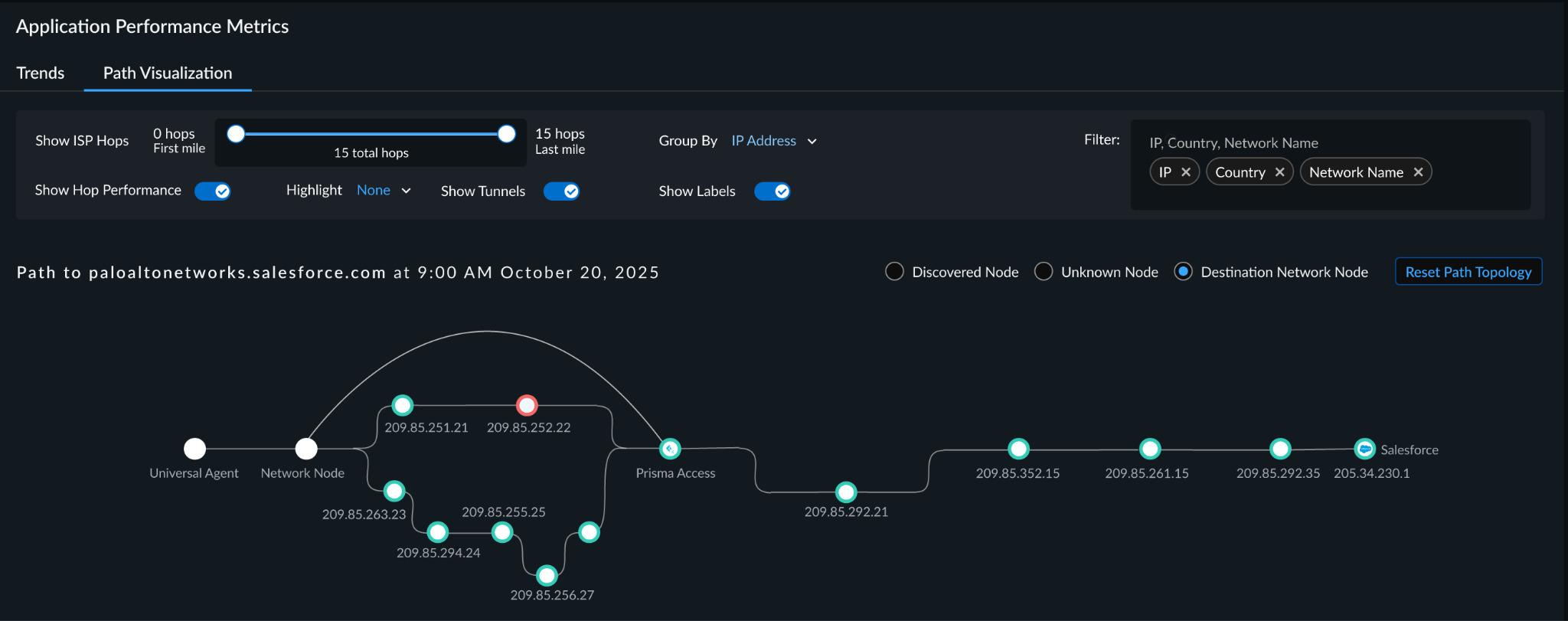
    When a user in a remote branch reports a slowdown, IT teams need more than a "red/green" status light. The Universal Agent provides a granular path analysis, delivering a hop-by-hop visualization with both overlay and underlay tunnel metrics, enabling them to quickly pinpoint bottlenecks.

Thus, by mapping the entire path from the Universal Agent to the target application, IT teams can pinpoint exactly where the friction lies.

  • Is it a local network issue?
  • An ISP (internet service provider) bottleneck?
  • A bottleneck at a handoff between providers?
  • Is the application's own network at fault?
Universal Agent example.
ADEM Universal Agent at a glance.

The Universal Agent Offers Inherent Security and Operational Simplicity

To help ensure that organizations can maintain peak performance and security amidst a constant stream of changes, the Universal Agent is built on a foundation of robust features:

  • Native Integration with Prisma Access for Accelerated Troubleshooting
    The Universal Agent is natively integrated with Prisma Access and automatically discovers the POP (Point of Presence) location and IP infrastructure where the branch site is connected to monitor overlay and underlay, hop-by-hop, ISP health, all the way to the application to deliver precise root-cause analysis.
From the Universal Agent to the network node.
Native integration with Prisma Access.
  • Simplified Deployment at Scale
    IT teams can deploy and manage multiple agents at scale with just a few clicks from the Strata™ Cloud Manager Platform. Through our autonomous AI operations platform, we leverage enriched telemetry to watch the network and proactively manage it all from a unified platform.
Dashboard of Access Experience Management
Bulk deployment of Universal Agent with just a few clicks.
  • Comprehensive Full-Stack Visibility
    We utilize a single agent per branch site to deliver deep visibility into both overlay and underlay tunnel metrics. This granular path analysis allows IT teams to pinpoint network bottlenecks using hop-by-hop visualizations from the Universal Agent all the way to the target application.
Application Performance Metrics
Hop-by-hop visualization with overlay and underlay tunnel metrics.

The Universal Agent Optimizes End-to-End Digital Experience with Unified Operations

The launch of the ADEM Universal Agent represents a fundamental shift in how we architect the distributed enterprise, from moving beyond managing data gaps into agentic, machine-speed orchestration. Natively integrated with Prisma Access, the Universal Agent synthesizes disparate network data across multiple branch sites into a unified, vendor-agnostic ecosystem. By eliminating the 'noise' of traditional monitoring, it provides the deterministic precision and real-time context required to fuel agentic autonomous operations, enabling every automated action to be accurate, impactful and optimized for a flawless digital experience.

Ready to gain complete application experience from all branch sites and remote users? Watch our announcement video below to see the Universal Agent in action. Visit the ADEM webpage for more information or request a demo.

The post Announcing ADEM Universal Agent appeared first on Palo Alto Networks Blog.

  •  

Palo Alto Networks at Nutanix .NEXT 2026

Securing the AI-Powered Hybrid Multicloud

At the core of every modern enterprise is a fundamental need: The ability to innovate across hybrid environments without sacrificing security. For over five years, Palo Alto Networks and Nutanix have partnered to meet this need, building a collaborative ecosystem where industry-leading infrastructure meets the world’s most comprehensive AI-powered security.

As we look toward the future of the enterprise at Nutanix .NEXT 2026, our focus remains on a shared vision for the "Secure Nutanix Cloud."

2026 Global Security Partner of the Year

We are deeply honored to be named the Nutanix 2026 Global Security Partner of the Year. This recognition reflects our commitment to delivering integrated, automated security that feels like a native part of the Nutanix experience. Together, we have helped thousands of joint customers move from reactive security to a proactive, zero trust posture that spans the data center, the edge and the public cloud.

The Existing Partnership Is the Foundation of Trust

Our partnership is built on the belief that security should be invisible, automated and inseparable from the infrastructure it protects. We’ve worked alongside Nutanix to enable enterprises to scale their hybrid multicloud, and their security posture scales with it. Current integrations provide zero trust protection across the Nutanix environment:

  • VM-Series Virtual Firewalls – Seamlessly integrated with Nutanix AHV and Flow Network Security, our virtual firewalls provide Layer 7 visibility and advanced threat prevention for east-west traffic. This integration leverages Nutanix Flow service chaining to automatically steer traffic through VM-Series firewalls for deep packet inspection without manual reconfiguration. It delivers full functional parity and operational continuity for Nutanix AHV environments, allowing security teams to maintain high-performance standards using familiar Panorama® management and persistent, tag-based policies that migrate with workloads across clusters.
  • Hybrid Cloud Security – We provide consistent security for Nutanix Cloud Clusters (NC2) on both AWS and Azure, enabling your policies to follow your workloads wherever they reside.
  • Automation & Orchestration – Leveraging the Panorama® plugin for Nutanix, teams can automate security provisioning and use Dynamic Address Groups to sync application attributes instantly.

New Integration Secures Nutanix Enterprise AI (NAI)

Building on this foundation, the highlight of this year’s show is our groundbreaking integration designed to accelerate Enterprise AI adoption. NAI provides a simplified, cloud-native stack that allows organizations to deploy and scale large language models (LLMs) across their choice of infrastructure with push-button simplicity. We are collaborating on a first-of-its-kind, end-to-end security solution for NAI.

This integration, launching soon, will bring AI Model Security and AI Red Teaming directly into the NAI, creating a seamless experience where security is built in, not bolted on. By allowing only Prisma AIRS™ validated models to reach production, we eliminate security friction at the start of the AI lifecycle. Every model will undergo rigorous scans for known vulnerabilities before deployment, providing a "clean room" environment for AI development. Providing a proactive test of AI defenses, Prisma AIRS AI Red Teaming will be available within NAI as an autonomous solution that integrates seamlessly into the development pipeline, utilizing a combination of a profiler and an attacker agent to perform contextual iterative simulations that mirror real-world attacker behavior. By providing detailed reports that map vulnerabilities directly to the OWASP Top 10 for LLMs and NIST AI RMF, it equips teams with the precise context needed to secure AI applications continuously and effectively.

By proactively identifying and neutralizing emerging threats, we will give organizations the confidence to deploy AI bravely, knowing their innovation is anchored in the world’s most robust security platform.

Powered by Prisma AIRS, this integration will bring a "security-first" approach to your AI deployments:

  • AI Model Security – Scans AI models during the download phase to block malicious code and hidden backdoors before they reach your environment.
  • AI Red Teaming – Provides continuous, autonomous vulnerability hunting on models, application and agent endpoints, testing your AI behavior against more than 750 real-world attack scenarios and contextual agentic risk assessment.
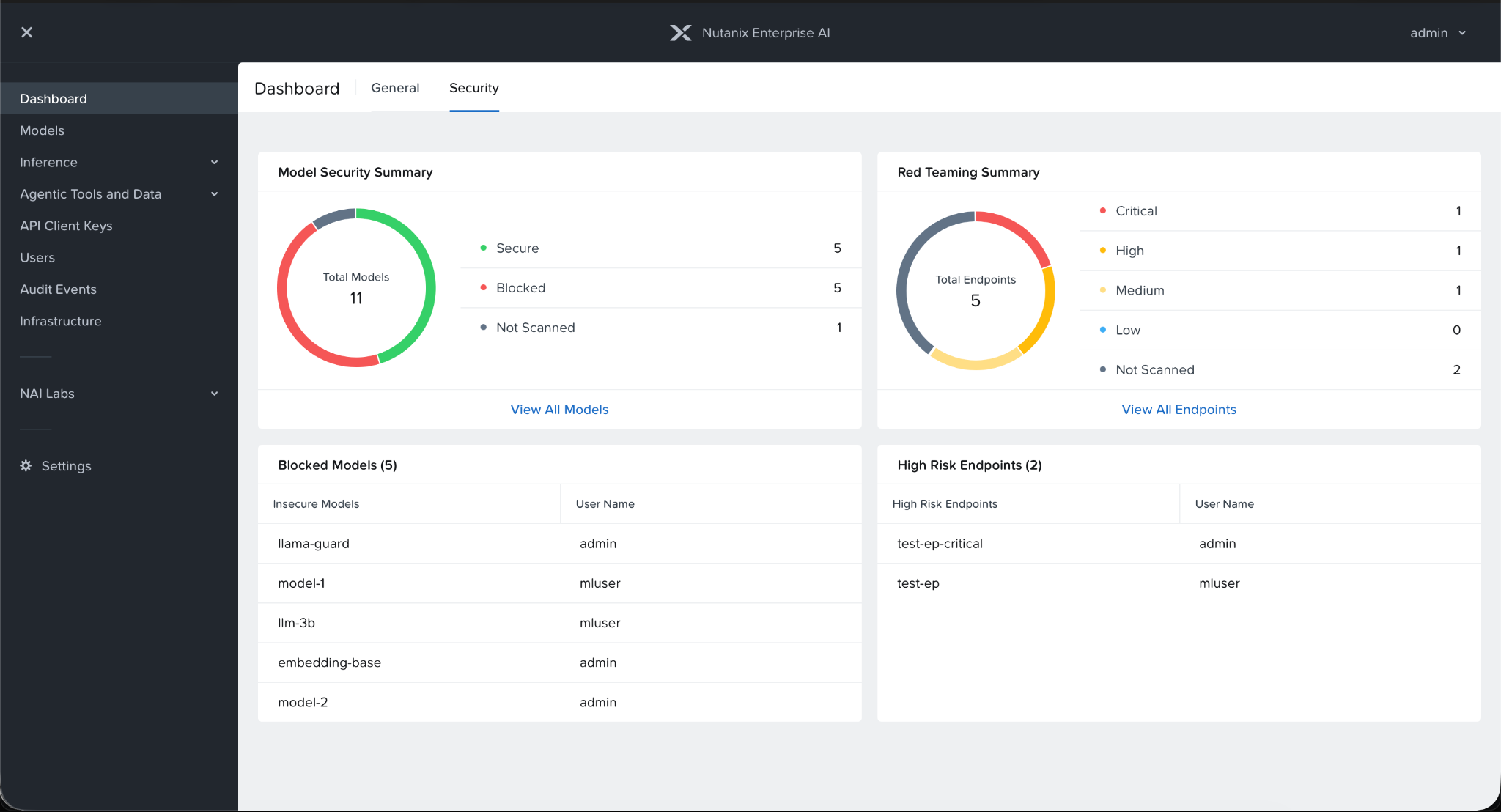
  • Unified Visibility – Provides a complete overview of your AI risk posture and scan summaries directly within your NAI dashboards.
Screenshot of Nutanix Enterprise AI dashboard.
Unified Security Dashboard with AI Model Security and AI Red Teaming

Benefits:

Seamless and Frictionless Deployment

We will prioritize a fast and frictionless deployment experience, ensuring that robust AI security does not come at the cost of development speed. By integrating these controls directly into the NAI workflow, organizations will be able to deploy and scale their AI initiatives with "push-button" simplicity, removing the traditional complexity and friction associated with securing large language models.

Proactive Protection Against Emerging Threats

Leveraging our deep expertise in threat prevention, this solution will proactively identify and block vulnerable or malicious models before they can impact the enterprise environment. By scanning models for hidden backdoors and malicious code during the initial download phase, we will stop threats at the perimeter, allowing only validated, secure models to ever reach your production environment.

A Comprehensive Enterprise Cloud AI Solution

This integration will deliver a comprehensive enterprise cloud AI solution, merging Nutanix’s industry-leading infrastructure with our next-generation security controls. The result will be a unified, cloud-native stack where security is built in rather than bolted on after the workload deployment, providing a secured deployment environment, which is consistent across the data center, the edge and public cloud.

Evolving Insights and Real-Time Remediation

The vulnerability insights from AI Red Teaming are coupled with remediation insights. The platform will provide a prioritized list of remediation steps that are tailor-made for the endpoint. This allows organizations to battle-test their inference endpoints before deploying them at scale.

Key Takeaways

  • A Proven, Award-Winning Partnership: Celebrating five years of collaboration, Palo Alto Networks has been named the Nutanix 2026 Global Security Partner of the Year, highlighting a shared commitment to delivering native, automated zero trust security for hybrid multicloud environments.
  • Seamless Zero Trust for Hybrid Workloads: Through deep integrations with VM-Series virtual firewalls and Nutanix Cloud Clusters (NC2), organizations can maintain consistent Layer 7 visibility and tag-based security policies that automatically follow workloads across on-premises data centers and public clouds.
  • Securing the AI Lifecycle with Prisma AIRS: The new integration with NAI, launching soon, will bring a security-first approach to AI adoption, utilizing Prisma AIRS to scan LLMs for vulnerabilities during download, and perform autonomous Red Teaming to neutralize emerging threats before they reach production.

Don’t Miss Our Speaking Session

Want to see the integration in action? Join our experts, Shrikant Brahmbhatt (Palo Alto Networks) and Ashwini Vasanth (Nutanix), on Tuesday April 7 3:30-4pm for an exclusive look at how we are securing the "Challenge of Hybrid AI." We’ll dive into the architecture that allows you to discover, assess and protect your entire AI ecosystem (apps, agents and models alike).

Visit Us at Booth #G2

Stop by the Palo Alto Networks booth (#G2) to meet our team of over 19,000 active threat researchers and see live demos of our joint solutions. Whether you are building the next generation of agentic AI or securing your virtual desktop infrastructure (VDI), we have the tools to help you innovate at machine speed.

Ready to secure your journey? Visit the Palo Alto Networks partner directory or learn more about Prisma AIRS.

Forward-Looking Statements

This blog contains forward-looking statements that involve risks, uncertainties and assumptions, including, without limitation, statements regarding the benefits, impact, or performance or potential benefits, impact or performance of our products and technologies or future products and technologies. These forward-looking statements are not guarantees of future performance, and there are a significant number of factors that could cause actual results to differ materially from statements made in this blog, including, without limitation: developments and changes in general market, political, economic, and business conditions; risks associated with managing our growth; risks associated with new products and subscription and support offerings; shifts in priorities or delays in the development or release of new offerings, or the failure to timely develop, release and achieve market acceptance of new products and subscriptions as well as existing products and subscription and support offerings; failure of our business strategies; rapidly evolving technological developments in the market for security products and subscription and support offerings; our customers’ purchasing decisions and the length of sales cycles; our competition; our ability to attract and retain new customers; and our ability to acquire and integrate other companies, products, or technologies. We identify certain important risks and uncertainties that could affect our results and performance in our most recent Annual Report on Form 10-K, our most recent Quarterly Report on Form 10-Q, and our other filings with the U.S. Securities and Exchange Commission from time-to-time, each of which are available on our website at investors.paloaltonetworks.com and on the SEC's website at www.sec.gov. All forward-looking statements in this blog are based on information available to us as of the date hereof, and we do not assume any obligation to update the forward-looking statements provided to reflect events that occur or circumstances that exist after the date on which they were made.

The post Palo Alto Networks at Nutanix .NEXT 2026 appeared first on Palo Alto Networks Blog.

  •  

Announcing Prisma AIRS Availability in Singapore Region

Forging Secure AI Threat Protection for Singapore

Singapore is currently undergoing a decisive transition toward an AI-enabled economy. National initiatives are focused on driving large-scale transformation through the National AI Missions and integrating advanced technologies, including generative AI and autonomous agents across key sectors. This rapid technological evolution, however, also introduces a sophisticated threat landscape characterized by AI-specific risks, like prompt injection, model manipulation and sensitive data leakage. As enterprises scale AI adoption, the need for robust, AI-native and locally hosted cybersecurity solutions becomes essential to ensure data residency, regulatory alignment and operational resilience.

Strategic Imperatives for an Emerging AI Security Landscape

Singapore’s highly integrated digital ecosystem presents both significant opportunities for leadership as well as distinct security challenges. As the nation executes its National AI Strategy 2.0, the focus has shifted from high-level experimentation to the pervasive deployment of AI across the economy. This evolution requires a security posture that is not only AI-native but locally grounded to satisfy the data residency expectations of a global financial and innovation hub.

Palo Alto Networks is pleased to announce a strategic investment designed to enhance Singapore’s cyber resilience – the establishment of our new cloud landing for Prisma® AIRS™. This launch demonstrates a commitment to providing organizations in the region with an AI-powered cybersecurity platform that aligns with the National AI Council’s whole-of-government mission. This initiative optimizes operational efficiency and facilitates the secure adoption of advanced digital transformation projects, allowing organizations to Deploy Bravely.

Comprehensive AI Security Platform

The new regional expansion in Singapore now hosts Prisma AIRS, our most comprehensive AI security platform, specifically engineered to deliver robust security across the entire AI lifecycle. This localized landing provides Singaporean organizations with domestic, high-performance access to critical AI security capabilities:

AI Model Security
Enable the safe adoption of third-party AI models by scanning them for vulnerabilities and secure your AI ecosystem against risks, such as model tampering, malicious scripts and deserialization attacks.

AI Red Teaming
Uncover potential exposure and lurking risks before bad actors do. Perform automated penetration tests on your AI apps and models using our Red Teaming agent that stress tests your AI deployments. Our agent learns and adapts like a real attacker.

AI Runtime Security™
Protect your LLM-powered AI apps, models and data against runtime threats, such as prompt injection, malicious code, toxic content, sensitive data leaks, resource overload, hallucinations and more.

AI Agent SSPM (SaaS Security Posture Management)
Secure AI agents (including those built on no-code/low-code platforms) against new agentic threats, such as identity impersonation, memory manipulation and tool misuse.

Commitment to Singapore's AI Future

Our new region expansion into Singapore signifies the long-term commitment of Palo Alto Networks to the nation’s digital transformation journey and its cybersecurity resilience. By bringing advanced, AI-native platforms closer to regional organizations, Palo Alto Networks helps enterprises achieve data residency and national data sovereignty needs, enhance performance and strengthen security posture. This localized presence simplifies operations and accelerates the safe adoption of generative AI and agentic workflows.

As Singapore continues its trajectory toward an AI-driven and secure future, Palo Alto Networks stands as a trusted partner, empowering organizations to innovate and thrive securely within an evolving threat landscape. The establishment of this new cloud landing reinforces the ongoing promise to deliver the best-in-class cybersecurity platforms that the country requires to lead on the global stage.

Please visit the regional cloud locations of Palo Alto Networks for more information.

The post Announcing Prisma AIRS Availability in Singapore Region appeared first on Palo Alto Networks Blog.

  •  

Certbot and Let's Encrypt Now Support IP Address Certificates

(Note: This post is also cross-posted on the Let's Encrypt blog)

As announced earlier this year, Let's Encrypt now issues IP address and six-day certificates to the general public. The Certbot team here at the Electronic Frontier Foundation has been working on two improvements to support these features: the --preferred-profile flag released last year in Certbot 4.0, and the --ip-address flag, new in Certbot 5.3. With these improvements together, you can now use Certbot to get those IP address certificates!

If you want to try getting an IP address certificate using Certbot, install version 5.4 or higher (for webroot support with IP addresses), and run this command:

sudo certbot certonly --staging \
--preferred-profile shortlived \
--webroot \
--webroot-path <filesystem path to webserver root> \
--ip-address <your ip address>

Two things of note:

  • This will request a non-trusted certificate from the Let's Encrypt staging server. Once you've got things working the way you want, run without the --staging flag to get a publicly trusted certificate.
  • This requests a certificate with Let's Encrypt's "shortlived" profile, which will be good for 6 days. This is a Let's Encrypt requirement for IP address certificates.

As of right now, Certbot only supports getting IP address certificates, not yet installing them in your web server. There's work to come on that front. In the meantime, edit your webserver configuration to load the newly issued certificate from /etc/letsencrypt/live/<ip address>/fullchain.pem and /etc/letsencrypt/live/<ip address>/privkey.pem.

The command line above uses Certbot's "webroot" mode, which places a challenge response file in a location where your already-running webserver can serve it. This is nice since you don't have to temporarily take down your server.

There are two other plugins that support IP address certificates today: --manual and --standalone. The manual plugin is like webroot, except Certbot pauses while you place the challenge response file manually (or runs a user-provided hook to place the file). The standalone plugin runs a simple web server that serves a challenge response. It has the advantage of being very easy to configure, but has the disadvantage that any running webserver on port 80 has to be temporarily taken down so Certbot can listen on that port. The nginx and apache plugins don't yet support IP addresses.

You should also be sure that Certbot is set up for automatic renewal. Most installation methods for Certbot set up automatic renewal for you. However, since the webserver-specific installers don't yet support IP address certificates, you'll have to set a --deploy-hook that tells your webserver to load the most up-to-date certificates from disk. You can provide this --deploy-hook through the certbot reconfigure command using the rest of the flags above.

We hope you enjoy using IP address certificates with Let's Encrypt and Certbot, and as always if you get stuck you can ask for help in the Let's Encrypt Community Forum.

  •  

How the National Cyber Strategy Secures Our Digital Way of Life

A Pivotal Moment for National Security

As the digital landscape undergoes profound shifts, the recently released National Cyber Strategy provides the essential foundation for enduring American leadership. By prioritizing the disruption of hostile actors, future-proofing networks, accelerating quantum readiness, and securing the AI frontier, the strategy provides the strategic clarity necessary to protect our digital way of life from sophisticated adversaries. Palo Alto Networks commends National Cyber Director Sean Cairncross for his leadership and looks forward to working with the administration to operationalize this strategy.

Each pillar of the strategy galvanizes meaningful action to advance our collective defense:

Shape Adversary Behavior (Pillar 1)

This signals a decisive shift toward the proactive disruption of malicious actors. The Trump Administration has made clear that the U.S. Government should impose real costs on adversaries to change their behavior. While the private sector is already executing discrete disruptions against malicious actors, coordination has historically been fragmented. The strategy identifies that increased collaboration with private sector entities, who possess unique insight into adversary behavior, can in turn enable more impactful deterrence.

Promote Common Sense Regulation (Pillar 2)

The strategy appropriately recognizes that complexity is the enemy of security. A focus on measurable improvements in cyber outcomes (versus check-the-box compliance exercises) collectively makes us all safer. While much attention is rightfully paid toward harmonizing incident reporting requirements, which Palo Alto Networks wholeheartedly supports, let’s not stop there. The federal government can lead by example by consolidating and streamlining federal government software compliance certifications. For example, there should be logical reciprocity between FedRAMP High and DoW IL-5 certifications.

Modernize and Secure Federal Government Networks (Pillar 3)

In addition to the necessary attention on AI-powered cyber defense, cloud security and zero trust network architecture, Palo Alto Networks applauds the discrete focus on quantum-safe security ahead of “Q-Day,” the point where quantum computing capabilities will compromise legacy public key encryption that has underpinned cybersecurity for decades. As Federal CISO Mike Duffy recently stated, "Modernization without considering PQC readiness or cryptographic agility is really creating technical debt in the future, something that we don’t want to see ever.”

To address this challenge, Palo Alto Networks provides a structured quantum-safe framework organized into four stages:

  • Continuous Discovery – Automating ecosystem ingestion to identify cryptographic dependencies.
  • Risk Assessment & Prioritization – Evaluating vulnerabilities to establish a data-driven remediation roadmap.
  • Comprehensive Remediation – Executing the transition to post-quantum algorithms across the architecture.
  • Governance & Crypto-Hygiene – Maintaining long-term visibility and management.

The bottom line is that 2035 is too late. Quantum readiness must accelerate today, and this strategy will set a critical North Star to drive the necessary urgency.

Secure Critical Infrastructure (Pillar 4)

Critical infrastructure resilience is central to our homeland security, economic security, public health and safety. Unfortunately, critical infrastructure entities are increasingly under assault from emboldened cyber adversaries.

In fact, Palo Alto Networks research shows some form of operational disruption in up to 86% of major cyber incidents. Our 2026 Global Incident Response Report underscores another sobering reality: These entities are under assault from all angles. In 87% of cyber incidents, attacks targeted multiple attack surfaces, which spanned the network, cloud, endpoints and identity.

Recognizing that you can’t secure what you can’t see, we need a national-level effort to identify, prioritize and harden the critical infrastructure that the American people depend upon. This strategy puts an important marker in the ground to revitalize those efforts.

Sustain Superiority in Critical and Emerging Technologies (Pillar 5)

Palo Alto Networks was pleased to see the strategy reinforces the core tenets of the AI Action Plan, emphasizing that "secure-by-design" principles for AI technologies are non-negotiable and that AI adoption and AI security can and must be inexorably linked.

Enterprises should be able to deploy AI confidently without fear of data leakage, model tampering or rogue AI agents. However, despite our research showing an 88% success rate of “jailbreaking” techniques against widely deployed AI models, only 6% of organizations currently have an AI security strategy. It’s time to flip this paradigm and put defenders back in the driver’s seat in this AI-first moment.

To support this emerging consensus around the importance of promoting AI security, we developed the Secure AI by Design Policy Roadmap. This framework provides a four-part construct to evaluate the evolving dimensions of threats to AI systems. Palo Alto Networks is also proud to make its comprehensive AI security suite, Prisma® AIRS™, available to all federal agencies at substantial discounts through GSA’s OneGov Initiative.

Build Talent and Capacity (Pillar 6)

Recognizing America’s cyber workforce as a “strategic asset,” the strategy calls for a pragmatic and accessible pipeline for developing talent. The explicit recognition that we should take advantage of existing avenues across government, industry and academia is important. For example, Palo Alto Networks is proud of the impact of its Cybersecurity Academy – that provides free, NIST Framework-aligned curricula covering essential domains, such as cybersecurity fundamentals, enterprise and network security, cloud security, security operations and the AI/cybersecurity nexus.

Resources like this, and those for other entities, can form the basis of a renewed focus on cyber talent development.

Turning Strategic Vision Into Action

Palo Alto Networks views itself as more than a cybersecurity vendor. We see ourselves as an integrated national security partner of the federal government at a moment when defending our digital way of life demands all of us working together. To that end, we are ready to do our part to turn strategic vision into action.

This strategy should be applauded. Let’s roll up our sleeves and get to work.

The post How the National Cyber Strategy Secures Our Digital Way of Life appeared first on Palo Alto Networks Blog.

  •  

The SOC Is Now Agentic — Introducing the Next Evolution of Cortex

See the agentic SOC come to life at Cortex® Symphony 2026, the ultimate SOC event.

Today, the Cortex® platform takes a massive step toward delivering the perfect union of human expertise and agentic AI across all of security operations. Our latest release embeds immersive, context-aware agentic AI across the platform, from code to cloud to SOC, delivering an agentic-first analyst experience for our customers.

With new Cortex AgentiX™ agents built to tackle more use cases and an expanded AI-ready data foundation, this release slashes response times and redefines what high-efficiency SOC operations look like.

Attack Velocity Has Fundamentally Changed

Not long ago, adversaries took days to move from initial access to impact. Today, they weaponize AI across the attack lifecycle to operate up to 4x faster than just one year ago, executing end-to-end attacks in as little as 72 minutes, according to Unit 42® research.

These attacks are making manual response obsolete. Teams need the next generation of AI technology that can analyze, decide and act in real time. Our latest innovations, fueled by unified, high-fidelity data, help give defenders the edge they need to outmaneuver modern attacks.

An AI-Ready Data Foundation for the Agentic SOC

Agentic AI depends on data that is fast, flexible and built for scale. Cortex Extended Data Lake™ (XDL) provides that data foundation for Cortex XSIAM and the broader Cortex platform, serving as a single source of truth for security operations. Built for AI and analytics, it ingests more than 15 PB of telemetry daily across 1,100+ integrations, and is designed to provide the comprehensive data required for effective detection, investigation, and response.

With the introduction of Cortex XDL 2.0, we are revolutionizing how organizations store, access and manage data, enabling new levels of flexibility and control.

Cortex XDL 2.0: The open Data Lake built for AI-driven insights.

New capabilities added with the Cortex XDL 2.0 release:

  • Cost-efficient data lake tier that can lower SOC costs with flexible long-term retention for compliance, forensics and investigations.
  • Federated search to query distributed data sources without incurring additional ingestion or storage costs.
  • Native Chronosphere Telemetry Pipeline integration to filter and route telemetry at the source
  • AI-driven parsing that automatically builds production-ready parsers from sample logs using generative AI, removing hours of manual effort and accelerating time to value.

Together, these capabilities power AI agents with critical security signals and give security teams the data they need, when and where they need it, while controlling costs.

Redefining How Analysts Work in the SOC

Cortex introduces an agentic-first analyst experience that embeds advanced AI directly into the analyst’s daily workflow. Designed to reduce investigation time, the elevated experience brings together automatically generated case summaries, visualized issue relationships, and a centralized Resolution Center within a unified case management workspace.


AI now spans the Cortex console, allowing context-aware agents to work in real time alongside analysts. Using the Cortex Agentic Assistant, teams can call on agents to plan and execute investigation workflows directly within their cases.

This release also doubles the number of AI agents who are purpose-built for SecOps and Cloud Security. Here are three of the newest additions.

  • The Case Investigation agent delivers context-aware assistance that analyzes case artifacts and complex signals to accelerate triage. It recommends next steps, highlights critical evidence, builds AI case summaries, and takes action with analyst oversight.
  • The Cloud Posture agent helps teams uncover, triage and resolve misconfigurations and posture risks across cloud environments. It streamlines analyst workflows by proactively prioritizing risk, enriching exposures and applying approved fixes.
  • The Automation Engineer agent tackles one of automation’s biggest pain points: Building and maintaining complex workflows. With simple natural language prompts, teams can generate working code and scripts for agents or playbooks.
Screenshot of PowerShell reverse shell activity with Mimikatz and Rubeus tools on EC2AMA...
The new Case Management Workspace provides full investigative context to streamline case analysis.

Our new agentic playbooks bring AI directly into automation workflows, embedding AI tasks that adapt in real time to help teams resolve incidents faster. They automate complex operations, analyze inputs with large language models (LLMs), and produce context-specific outputs.

Matt Bunch, Global CISO, Tyson Foods:

At Tyson Foods, protecting a complex global supply chain in an era of AI-driven threats requires us to move with the same machine speed as our adversaries. By consolidating onto the Palo Alto Networks Cortex platform, we’ve effectively closed the gap between detection and response. The impact has been transformative as we’ve increased our log visibility by 40% while reducing median time to respond by 50%. The agentic capabilities in the platform have allowed our teams to move from manual triage to high-level strategic defense, ensuring our global operations remain resilient and secure.

The Cortex Agentix Platform Has Arrived

The standalone Cortex Agentix platform brings the power of AI to everyone, delivering advanced orchestration and automation for the modern SOC. For Cortex XSOAR® customers, this marks the natural evolution of our market-leading SOAR platform, now enhanced with agentic intelligence to unlock meaningful productivity gains.

With more than 1,300 playbooks, 1,100 integrations, and built-in MCP support, Cortex Agentix combines over a decade of SOAR leadership with powerful AI capabilities to help security teams operate with greater speed, coordination and efficiency across the SOC.

Securing the Agentic Endpoint

As users increasingly run AI-powered code packages, browser extensions, plugins and more, they are opening the door to a new class of AI-driven threats at the endpoint. That is why we announced our intent to acquire Koi to help secure the emerging agentic endpoint. Once completed, the acquisition will strengthen our visibility and protection at the endpoint, extending our ironclad protection from the SOC to where AI code actually runs.

See the Agentic SOC Take Center Stage at Cortex Symphony 2026

To experience these innovations firsthand, join Lee Klarich, Chief Product and Technology Officer, and Gonen Fink, EVP of Products, alongside other industry leaders at Cortex Symphony 2026, the ultimate SOC event.


Forward-Looking Statements (unreleased feature only)

This blog contains forward-looking statements that involve risks, uncertainties and assumptions, including, without limitation, statements regarding the benefits, impact, or performance or potential benefits, impact or performance of our products and technologies or future products and technologies. Any unreleased services or features (and any services or features not generally available to customers) referenced in this or other press releases or public statements are not currently available (or are not yet generally available to customers) and may not be delivered when expected or at all. Customers who purchase Palo Alto Networks applications should make their purchase decisions based on services and features currently generally available.

The post The SOC Is Now Agentic — Introducing the Next Evolution of Cortex appeared first on Palo Alto Networks Blog.

  •  

A Joint Vision for Simplified SASE Management at Scale

Palo Alto Networks, ServiceNow, and Bell Canada have come together in a strategic collaboration to build an innovative ServiceNow application that creates an automated bridge between world-class security operations and industry-leading service management.

Large enterprises need robust security at cloud speed, but operational complexity keeps getting in the way. ​​Here’s what that looks like in practice:

  • Operations teams juggle multiple dashboards. When an issue surfaces, they are bouncing between the Prisma® SASE (secure access service edge) console to identify the incident, ServiceNow to log the case, and a customer support portal to escalate the issue. Every handoff inflates MTTR (mean time to resolution) and introduces room for error.
  • Customers are stuck in a deployment purgatory. Manual infrastructure configuration, connector setup, and mobile user onboarding can stretch on for weeks or months. Every day spent wrestling with configuration files is a day that value isn’t delivered.
  • Multi-tenant management doesn’t scale. If operational overhead grows linearly with each new tenant, the business model ultimately caps itself.

Bell Canada, through its innovative and security-first approach in the Canadian market, is a lighthouse partner that helped pioneer this innovation through its deep engagement with ServiceNow and a strategic partnership with Palo Alto Networks. With a strong focus on delivering exceptional customer value, Bell helped drive the vision for a simplified, scalable approach to SASE management.

Driven by their commitment to service excellence and customer outcomes, Bell worked closely with Palo Alto Networks and ServiceNow on this solution, accelerating customer time to value and simplifying operational complexity. Bell was among the first to champion this vision, acting as a market thought leader and helping shape a new standard for integrated SASE and service management outcomes in Canada.

Large Enterprises and Managed Service Providers can accelerate time to value by automating the entire lifecycle of Prisma SASE, from deployment to ongoing incident response through a newly launched Prisma SASE app on the ServiceNow store. The Prisma SASE app can accelerate MSP service delivery and management, significantly shrinking time to value and thereby positively impacting both top-line revenue and bottom-line EBITDA.

The Prisma SASE Platform Is Accelerating Value through Unified Automation and Platformization

Time to value (TTV) is one of the most critical metrics for IT teams helping customers move forward. With the Prisma SASE app, customers can go from implementation to go-live in just hours. There’s no need to build custom API integrations or take on technical debt for Day 0 to Day N operations. The app automates infrastructure setup, including ZTNA connectors and mobile user workflows, so providers can get their SASE offerings to market faster.

Comparing ServiceNow with and without Prisma SASE App.
Optimizing Service Delivery through Unified Incident Lifecycle Management.

The joint solution eliminates swivel chair operations. Security and network administrators no longer need to toggle between the Prisma SASE console, ServiceNow and support portals. Incident ingestion and management now happen in one place. Incidents stay in sync, manual overhead drops, and mean time to resolution improves. For MSPs, there’s the added benefit: they can create Palo Alto Networks CSP (Customer Support Portal) tickets directly from the ServiceNow SASE app, making incident correlation and troubleshooting straightforward.

Drive Scalable Growth by Automating Cross-Instance Support with Service Exchange

ServiceNow’s Service Bridge is a major unlock for Managed Service Providers scaling their SASE offerings. It automates cross-instance support so critical security incidents and status updates flow between the MSP’s ServiceNow instance and the customer’s ServiceNow instance without manual sync work. This creates operational transparency and a better service experience for customers while MSPs can deliver faster without adding headcount or complexity.

Key Takeaways:

  • Rapid Time to Value: Shift from months of manual configuration to hours of automated deployment by leveraging out-of-the-box integrations that eliminate custom R&D and technical debt.
  • Unified Operational Excellence: Eliminate "swivel chair" management by unifying incident ingestion, ticket syncing and support portal escalation into a single ServiceNow interface, significantly reducing MTTR.
  • SASE at Scale: The Prisma SASE app provides a unified architecture that scales across tenants automatically, ensuring security keeps pace with business growth.

Take the Next Step

As you adopt SASE, take out the complexity of implementation with the Prisma SASE app.

  • Download the App: Visit the ServiceNow Store today and download the Prisma SASE app to start automating your deployment.
  • Meet Us at MWC: Are you heading to Barcelona for Mobile World Congress (MWC)? Come see these integrations in action. Stop by the Palo Alto Networks booth (Hall 4, Stand D55) for a live demo and to chat with our experts about simplifying your SASE implementation.
  • Contact our sales team for any additional questions.

The post A Joint Vision for Simplified SASE Management at Scale appeared first on Palo Alto Networks Blog.
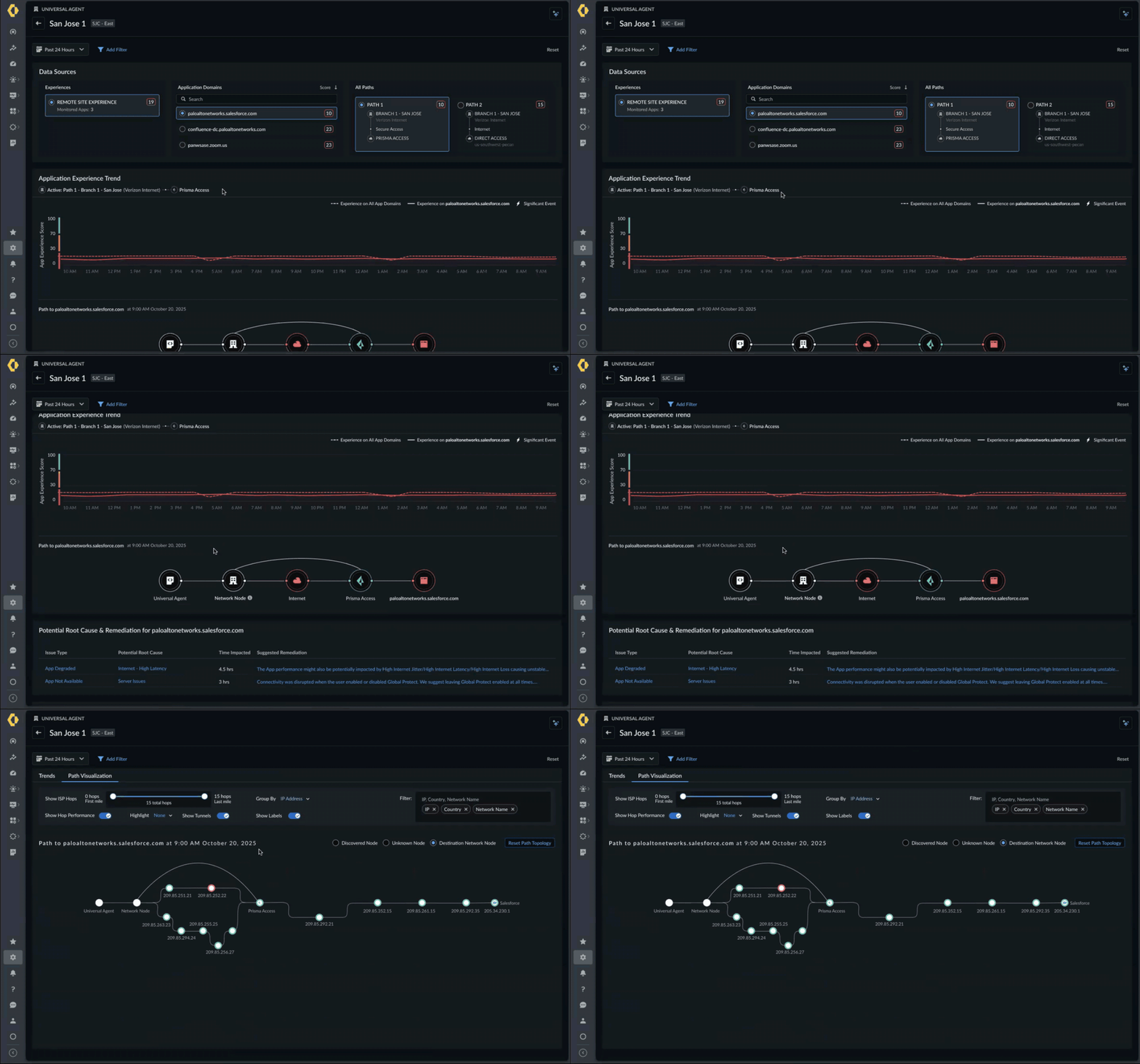
  •  

Securing the Agentic Endpoint

Traditional Security Is Blind to the Agentic Endpoint

Modern endpoints are no longer defined only by executables. Increasingly, endpoint behavior is shaped by non-binary software, such as code packages, browser extensions, IDE plugins, scripts, local servers (including MCP), containers and model artifacts. They are installed directly by employees and developers without centralized oversight. Because these components are not classic binaries, they often fall outside the visibility and control of traditional endpoint security tooling.

AI agents compound this problem. They are legitimate tools that operate with the user’s credentials and permissions, enabling them to read, write, move data and take privileged actions across systems. When compromised or misused, agents become the “ultimate insider.” They can autonomously discover, invoke and even install additional components at machine speed, accelerating risk across an already expanding, largely unmanaged software layer.

Weaponizing Trusted Automation

This is not a future concern. The recent viral emergence of OpenClaw serves as a cautionary tale for the agentic era. Developed by a single individual in just one week, it rapidly secured millions of downloads while gaining broad permissions across users' emails, filesystems and shells. Within days, researchers identified 135,000 exposed instances and more than 800 malicious skills in its marketplace, underscoring how a single unvetted agent can create an immediate, global attack surface.

OpenClaw is not an outlier. Recent research highlights how quickly this risk is materializing:

  • Vibe Coding Threats: An AI extension in VS Code was found leaking code from 1.5 million developers. This tool could read any open file and send it back to the developer, collect mass files without user interaction, and track users with commercial analytics SDKs.
  • Malicious MCP Server: Koi documented the first malicious Model Context Protocol (MCP) server in the wild. When developers added a specific skill to tools like Claude Code or Cursor, it silently forwarded every email to the plugin creator. What’s more, this capability was added later, after developers had already started using it.

Compounding this risk is the fact that autonomous agent actions are often difficult to trace or reconstruct, leaving Security Operations Centers (SOCs) without the visibility they need when an incident occurs.

A New Category of Protection

Complete endpoint security for the rapidly expanding risk of agentic AI calls for a new category of protection: Agentic Endpoint Security. That’s why we announced our intent to acquire Koi, a pioneer in this space. Koi is designed to eliminate blind spots across the AI-native ecosystem and help organizations govern agentic tools safely.

Its technology rests on three core pillars:

  1. See All AI Software – Gain complete visibility into the AI tools, agents and non-binary software running in your environment.
  2. Understand Risks – Continuously analyze and understand the intent and risk level of all software and AI agents.
  3. Control the AI Ecosystem – Enforce policy in real-time to remediate issues and block risky behaviors.

Securing the Agentic Enterprise

We are convinced that Agentic Endpoint Security will soon become a standard requirement for enterprise security. Upon closing the proposed acquisition, we intend to integrate Koi’s capabilities across our platforms to help our customers secure the AI-native workspace.

The wave of AI agents approaching the enterprise cannot be held back. Instead, we must offer secure tools that enable companies to confidently embrace agentic innovation.

Forward-Looking Statements

This blog post contains forward-looking statements that involve risks, uncertainties, and assumptions, including, but not limited to, statements regarding the anticipated benefits and impact of the proposed acquisition of Koi on Palo Alto Networks, Koi and their customers. There are a significant number of factors that could cause actual results to differ materially from statements made in this blog post, including, but not limited to: the effect of the announcement of the proposed acquisition on the parties’ commercial relationships and workforce; the ability to satisfy the conditions to the closing of the acquisition, including the receipt of required regulatory approvals; the ability to consummate the proposed acquisition on a timely basis or at all; significant and/or unanticipated difficulties, liabilities or expenditures relating to proposed transaction, risks related to disruption of management time from ongoing business operations due to the proposed acquisition and the ongoing integration of other recent acquisitions; our ability to effectively operate Koi’s operations and business following the closing, integrate Koi’s business and products into our products following the closing, and realize the anticipated synergies in the transaction in a timely manner or at all; changes in the fair value of our contingent consideration liability associated with acquisitions; developments and changes in general market, political, economic and business conditions; failure of our platformization product offerings; risks associated with managing our growth; risks associated with new product, subscription and support offerings; shifts in priorities or delays in the development or release of new product or subscription or other offerings or the failure to timely develop and achieve market acceptance of new products and subscriptions, as well as existing products, subscriptions and support offerings; failure of our product offerings or business strategies in general; defects, errors, or vulnerabilities in our products, subscriptions or support offerings; our customers’ purchasing decisions and the length of sales cycles; our ability to attract and retain new customers; developments and changes in general market, political, economic, and business conditions; our competition; our ability to acquire and integrate other companies, products, or technologies in a successful manner; our debt repayment obligations; and our share repurchase program, which may not be fully consummated or enhance shareholder value, and any share repurchases which could affect the price of our common stock.

Additional risks and uncertainties that could affect our financial results are included under the captions "Risk Factors" and "Management's Discussion and Analysis of Financial Condition and Results of Operations" in our Quarterly Report on Form 10-Q filed with the SEC on November 20, 2025, which is available on our website at investors.paloaltonetworks.com and on the SEC's website at www.sec.gov. Additional information will also be set forth in other filings that we make with the SEC from time to time. All forward-looking statements in this blog post are based on information available to us as of the date hereof, and we do not assume any obligation to update the forward-looking statements provided to reflect events that occur or circumstances that exist after the date on which they were made.


The post Securing the Agentic Endpoint appeared first on Palo Alto Networks Blog.
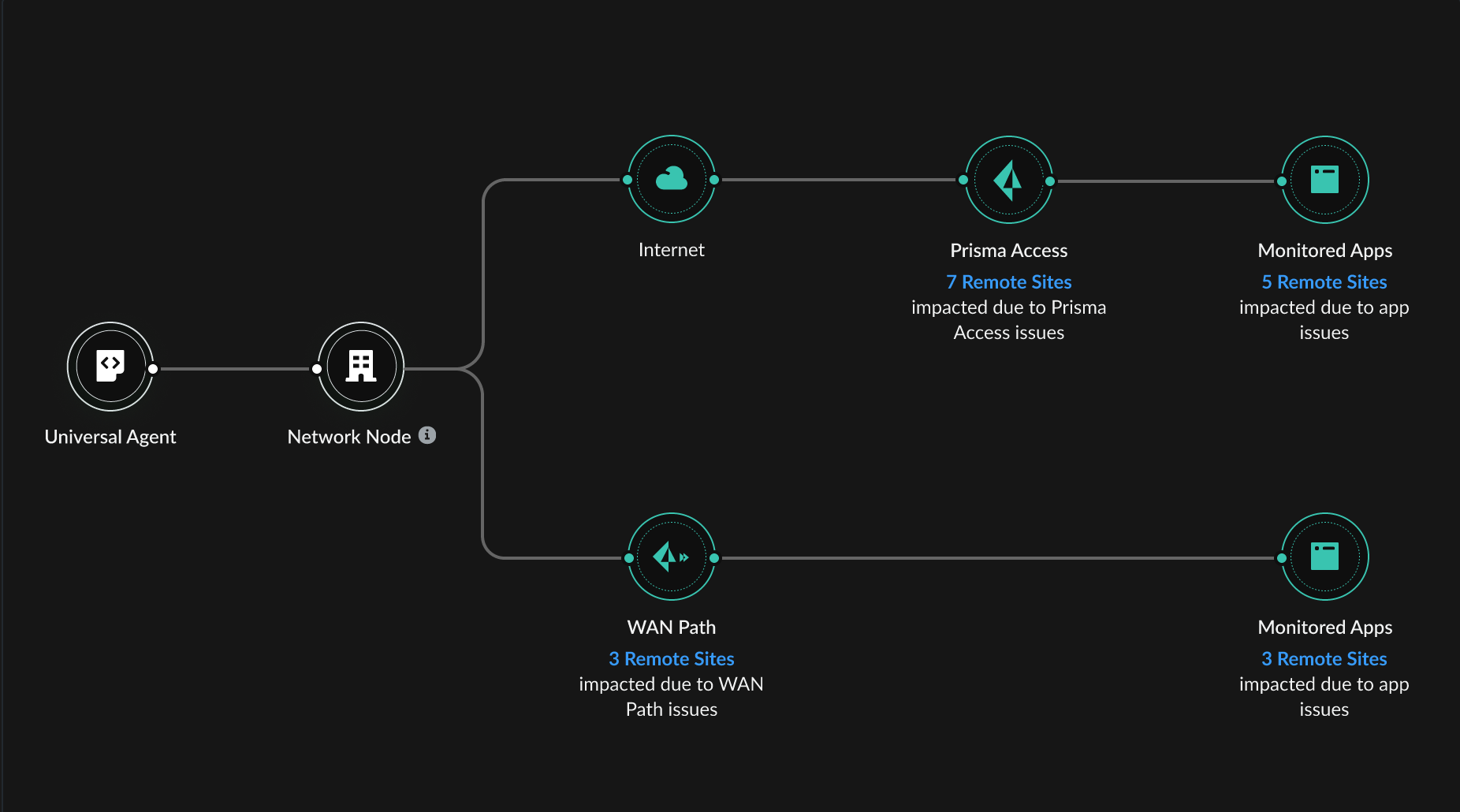
  •  

Introducing Unit 42 Managed XSIAM 2.0

24/7 Managed SOC Built for Tomorrow's Threats

The window for defense has collapsed, and most SOCs weren’t built for the speed of today’s attacks. According to the 2026 Unit 42® Global Incident Response Report, some end-to-end attacks now unfold in under an hour. Attacks that used to take days or weeks now happen in minutes.

Most traditional SOC models are trapped in a cycle of alert overload, fragmented tools and limited engineering capacity that slow investigations and delay response. Traditional SIEM and MDR models were designed to react to alerts. They were not designed to continuously improve detections, correlations and response with threats that move at machine speed. Over time, that gap between attacker speed and defender capability keeps widening, and it’s exactly why we built Unit 42 Managed XSIAM 2.0 (MSIAM).

Today marks the availability of the next evolution of our managed SOC offering – one that reflects how modern security operations must run in today’s threat landscape. MSIAM 2.0 is built on Cortex XSIAM®, Palo Alto Networks SOC transformation platform, and operated by Unit 42 analysts, threat hunters, responders and SOC engineers who handle the most complex incidents in the world. With this solution, Unit 42 provides organizations with a 24/7 managed SOC that delivers continuous detection, investigation and full-cycle remediation across the entire attack surface while improving operations over time.

We don’t just manage alerts. Unit 42 continuously engineers detections, correlations and response playbooks within XSIAM, refining them as attacker behavior evolves. This ongoing engineering ensures defenses improve over time, driven by real-world incidents and frontline threat intelligence, not static rules that quickly fall behind.

Why Managed XSIAM 2.0 Is Different

Elite SOC on Day One

We want SOC teams up and running as fast as possible. Experts lead onboarding, data mapping and configuration, and then your managed SOC team takes responsibility for operating and optimizing XSIAM on a day-to-day basis. The result is a SOC that improves over time without adding operational burden.

Every Threat Exposed

Unit 42 goes beyond reactive monitoring with continuous, proactive threat hunting across the entire attack surface. When a new threat is found in the wild, we produce threat impact reports that show how those techniques apply to each customer’s environment. We then translate those insights into custom detections and automated response actions, while also monitoring and investigating the correlation rules your team creates. Both the global threat intelligence and your unique use cases are backed by our 24/7 analysis, closing gaps quickly and strengthening defenses over time.

We also now support both native and third-party EDR telemetry, so organizations can benefit from Unit 42 expertise and Cortex® AI-driven analytics, regardless of the security technologies they use today. This enables customers to receive the strongest possible managed defense now, while creating a natural, low-friction path toward deeper platform consolidation as their environment evolves.

Machine-Speed Response

When incidents escalate, we don’t just hand you a ticket; we take ownership. Collaborating with your team, we establish pre-authorized workflows to execute immediate responses across your entire environment, from endpoints and firewalls to identity and cloud. We pair the platform’s native speed with expert oversight. By validating threat context and business impact, every response action is precise and safe, giving you the confidence to unleash full-cycle remediation. This allows MSIAM 2.0 to move seamlessly from detection to resolution with both velocity and precision.

And we stand behind our solution with a Breach Response Guarantee. If a complex incident strikes, you have the world’s best responders in your corner with up to 250 hours of Unit 42 Incident Response included. This built-in coverage removes the administrative hurdles of crisis response, enabling our experts to immediately transition from monitoring to deep forensic investigation and complete eradication, so you can focus on recovery. 

Proven in the Real World with the Green Bay Packers

Working with Unit 42 and the Cortex XSIAM platform, the Green Bay Packers modernized their security across a complex hybrid environment, demonstrating what Unit 42's managed services deliver in real-world operations. By consolidating telemetry and accelerating investigation and response, they reduced response times from hours to minutes, investigated 54% more alerts and saved over 120 hours of analyst time without adding headcount.

These outcomes reflect the key benefits of MSIAM: Unit 42 experts working to apply frontline intelligence as new attacker behavior emerges, translating it into reporting and tailored detections that improve response where it matters most. When a machine-speed platform is operated by experts handling real incidents every day, defenses continuously strengthen as threats evolve.

The Future of the SOC

Unit 42 MSIAM 2.0 helps your SOC operate as it should by combining AI-driven analytics and automation with expert-led operations and engineering. This combination provides teams with the confidence that their defenses are always on, always improving and ready when it matters most. That’s the SOC that security leaders need today, and the one we’re building for tomorrow.

MSIAM is now delivered through two service tiers, Pro and Premium. Organizations can start where they are and grow at their own pace. Pro provides AI-driven managed SOC operations with continuous detection, investigation and response. Premium extends into full-lifecycle SOC engineering, with designated experts and customized detections, automation and tailored response playbooks as your security maturity grows.

To learn more about Managed XSIAM 2.0, join us at Symphony 2026, a Palo Alto Networks premier virtual SOC event, where Unit 42 and Cortex® experts will share frontline threat intelligence from the new 2026 Unit 42 Incident Response Report alongside real-world SOC transformation insights from organizations operating at machine speed.

The post Introducing Unit 42 Managed XSIAM 2.0 appeared first on Palo Alto Networks Blog.
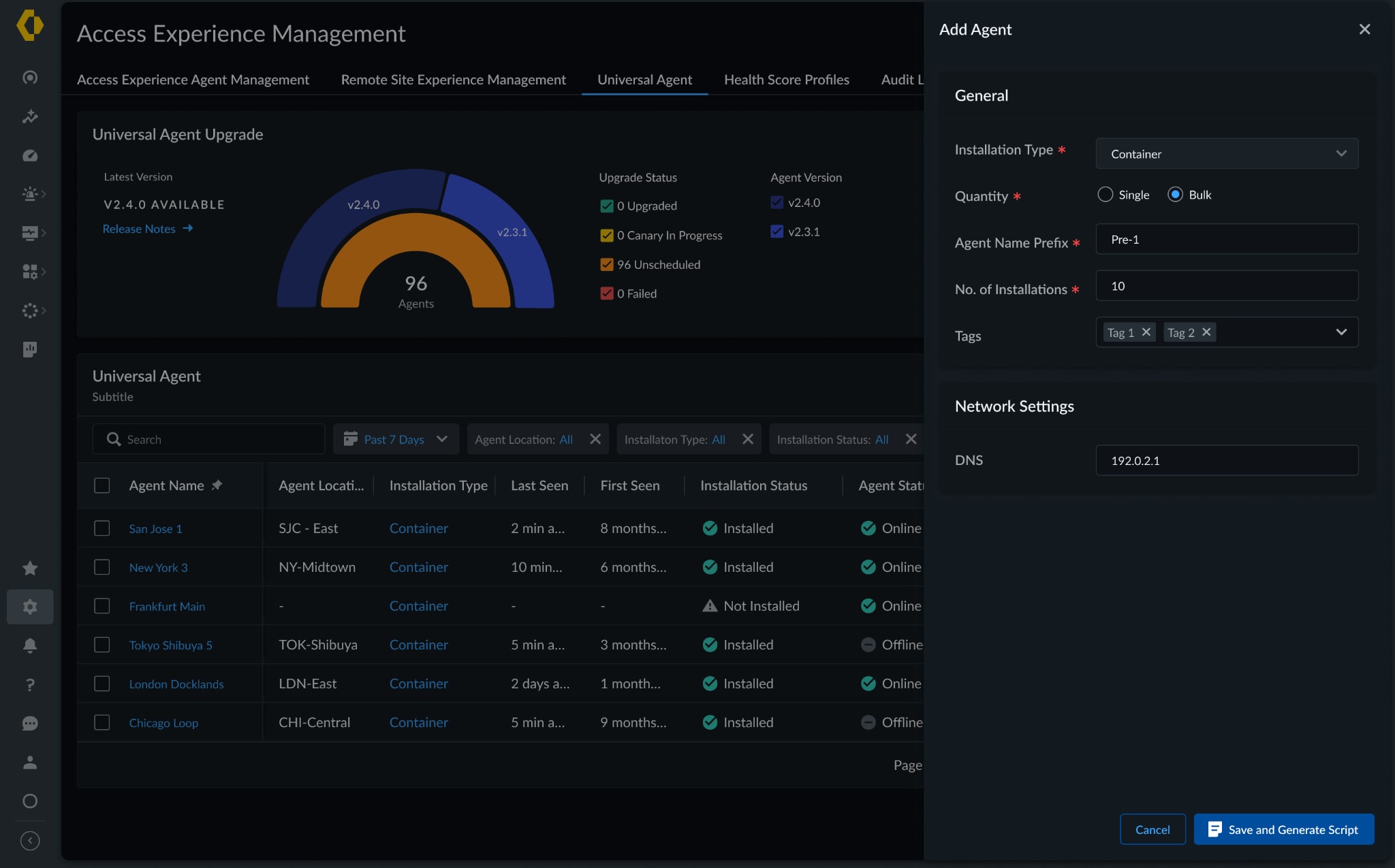
  •  
❌