The physics of cybersecurity are changing. So must the security operations center (SOC).
Cyberattackers are using agents to automate execution at unprecedented scale. What once required entire teams now requires a single operator and an agent framework.
That shift has exposed a hard truth: security cannot operate at AI speed when protection and operations are built as separate systems. Every handoff, integration, and boundary slows defenders down. Agents inherit that complexity.
For agentic security to work, the industry needs a different model. It needs a modern cyber stack with the breadth to see across the environment and the depth to investigate and act. Security operations and native protection must function as one system. This is the integrated security operations center (ISOC).
Today we are announcing ISOC in Microsoft Defender: a foundation built for agentic security that brings leading solutions for security information and event management (SIEM) and threat protection together. It gives people and agents a shared foundation to see, understand, and act across the environment, without the complexity of operating separate systems.
In July 2026, we introduced the end-to-end cyber stack alongside Project Perception, with the focus of delivering the right models, a harness, and specialized agents to help defenders perceive, reason, and act at machine speed. But we are innovating at every layer of the stack, because intelligence and orchestration alone are not enough. Agents depend on the rest of the stack working as one.
They need signals and sensors that provide visibility, context that turns those signals into understanding, and actuators that translate decisions into protection. With ISOC, these layers work in unison, so agents can move beyond isolated tasks and help operate an agentic SOC.
Signals and sensors give the system awareness.
Context turns those signals into understanding.
Actuators turn insights into protective action.
ISOC brings these capabilities together as a foundation, so humans and agents can operate as one system, each contributing what they do best. Agents provide the speed and scale to execute continuously, while people set priorities, apply judgment, and define the outcomes that matter. Together, they empower defenders to keep pace with AI-powered threat actors and achieve better security outcomes.
Integrated protection loop
With ISOC enabling signals, context, and controls to work as one, it breaks the pattern of linear security workflows. The result is an integrated protection loop that continuously turns what defenders learn into stronger pre-breach protection.
Attack disruption in Microsoft Defender shows what this makes possible. Rich telemetry and controls enable the system to detect, predict, and adapt to an attacker while the attack is still unfolding. It disrupts threats in progress and anticipates where attackers may move next. It’s a protection loop that uses exposure insights to strengthen protection in near real-time with threat intelligence focusing the loop on the threats that matter most.
ISOC brings together the capabilities needed to make this loop native, eliminating the burden of assembling, tuning, and maintaining it yourself. And as protection advances, new capabilities can become part of that loop. The result is stronger protection and a different way of working, where practitioners spend less time chasing individual signals and more time applying judgment, setting priorities, and driving security outcomes.
Designed for the practitioner
For too long, practitioners have had to compensate for the boundaries in their security architecture, stitching together signals, rebuilding context, and moving between tools just to get the information and controls needed to act.
ISOC changes their starting point. The capabilities practitioners need to investigate, hunt, automate, manage incidents, understand threats, and take action are brought together and available by default. Instead of organizing their work around the boundaries between tools, teams can organize around the security outcome they are trying to achieve.
And that foundation gets more powerful as autonomy grows. The integrated protection loop can take on more of the continuous work of detecting and defending against threats, while agents help practitioners investigate, reason, and act using the same context and controls already available to them.
There’s no separate agentic layer to assemble or new operating model to stitch together. Practitioners can multiply their expertise where they already work, shifting more of their time from operating the security stack to directing the defense.
The path forward
Security has always been a race between attackers and defenders. AI changes the speed, scale, and economics of that race. The next SOC will not be defined by how many AI features it has, but by whether people and agents can perceive, reason, and act across an environment as one system.
To learn more about Microsoft Security solutions, visit our website. Bookmark the Security blog to keep up with our expert coverage on security matters. Also, follow us on LinkedIn (Microsoft Security) and X (@MSFTSecurity) for the latest news and updates on cybersecurity.
Every benchmark tells a story. The most valuable ones tell us where to improve next.
For five consecutive quarters Microsoft has published email security benchmarking reports to provide greater transparency into real-world protection outcomes. The results have shown strong Microsoft Defender performance across pre-delivery and post-delivery scenarios, while revealing where threats and defenses continue to evolve.
This quarter’s benchmark examines how continuous measurement informs protection across prevention, detection, and adaptation, and how those insights are helping improve customer outcomes.
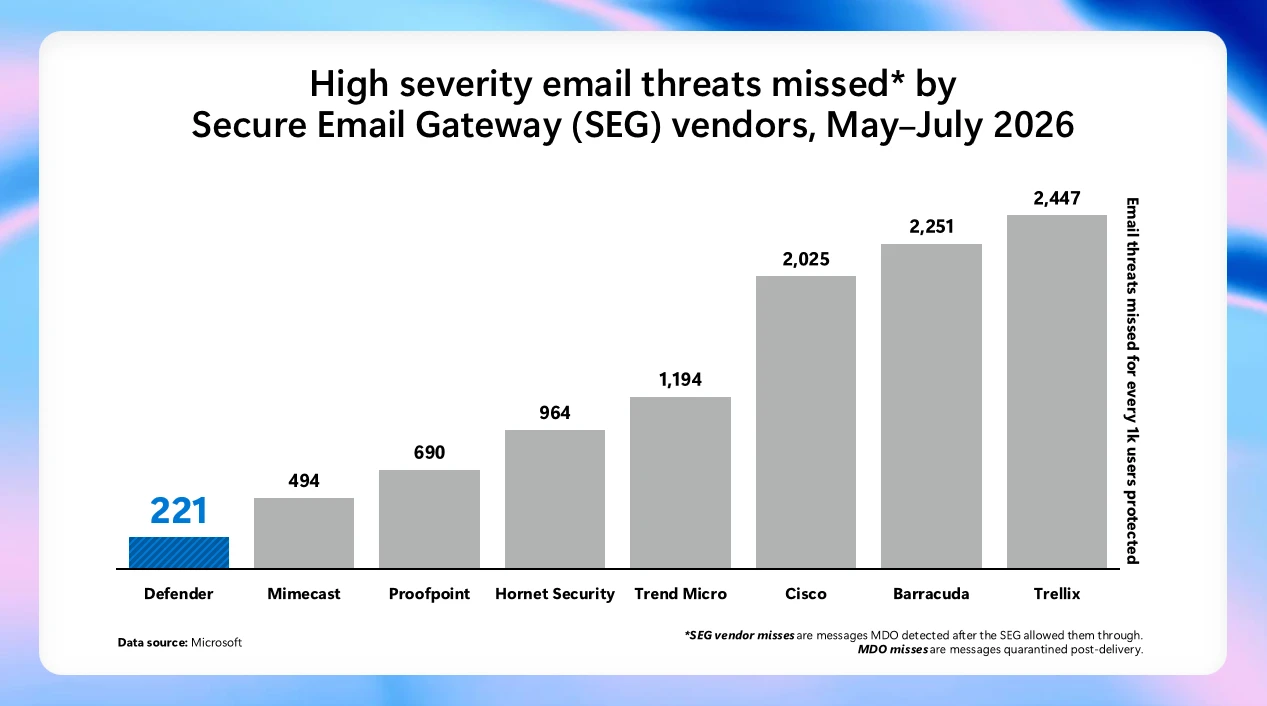
Defender again missed the fewest high-severity threats among the solutions evaluated, about 55% fewer than the next-closest secure email gateway (SEG) vendor.
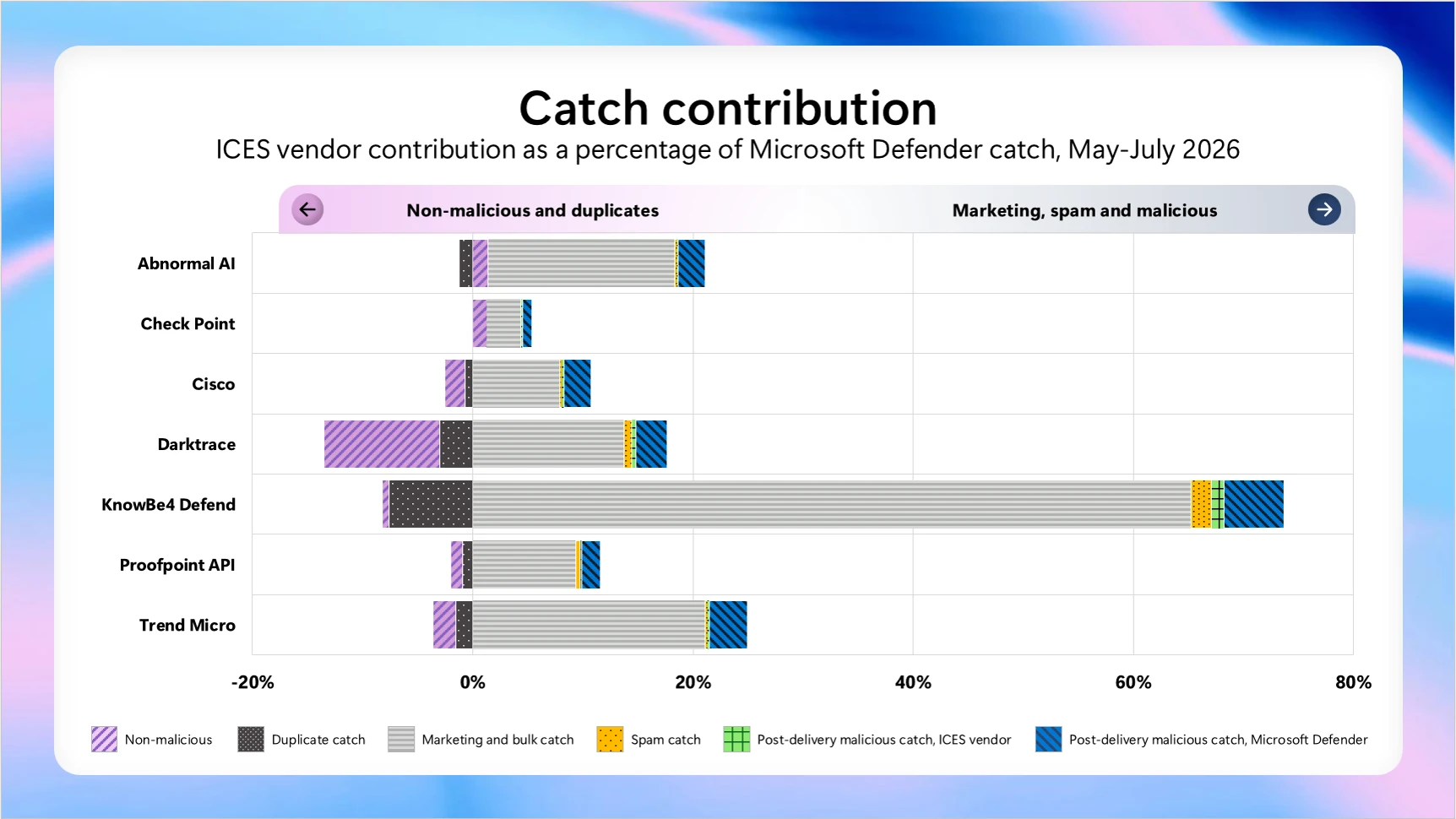
Layered security adds the most value in promotional and bulk filtering and works; gains for spam and malicious email remain comparatively modest.
Benchmarking results for SEG vendors
In the latest quarterly SEG comparison from May 2026 through July 2026, Defender missed 221 high-severity threats per 1,000 protected users, 55.4% fewer than the next-closest SEG vendor. The benchmark measures missed threats instead of the total number of malicious emails that were caught and filtered, because catch totals can reflect differences in threat volume and exposure across vendor environments. By normalizing missed threats per 1,000 users we are able to provide a more consistent side-by-side comparison.
Figure 1: High-severity email threats missed by SEG vendors (May 2026 through July 2026), measured as threats missed per 1,000 users protected. Data source: Microsoft Defender.
If you’ve read our previous blogs, you’ll see that missed threats have increased across multiple reporting periods, including for Microsoft. This aligns with broader trends we’re seeing as AI makes it easier for cyberattackers to gather public information, tailor messages, and create more convincing impersonation attempts. It reinforces the need for protection that continuously adapts.
Benchmarking results for ICES vendors
Effective email detection combines pre-delivery filtering with post-delivery detection and remediation. This benchmark helps customers evaluate where each layer contributes measurable value.
Similarly to previous quarters, integrated cloud email security (ICES) solutions continue adding the most value in promotional and bulk filtering. We saw an improvement in ICES vendor malicious catch at 0.30% versus 0.13% in the last quarter and spam catch going up to 0.52% versus 0.28% compared to last quarter.
Figure 2: ICES vendor catch contribution (May 2026 through July 2026). Data source: Microsoft Defender.
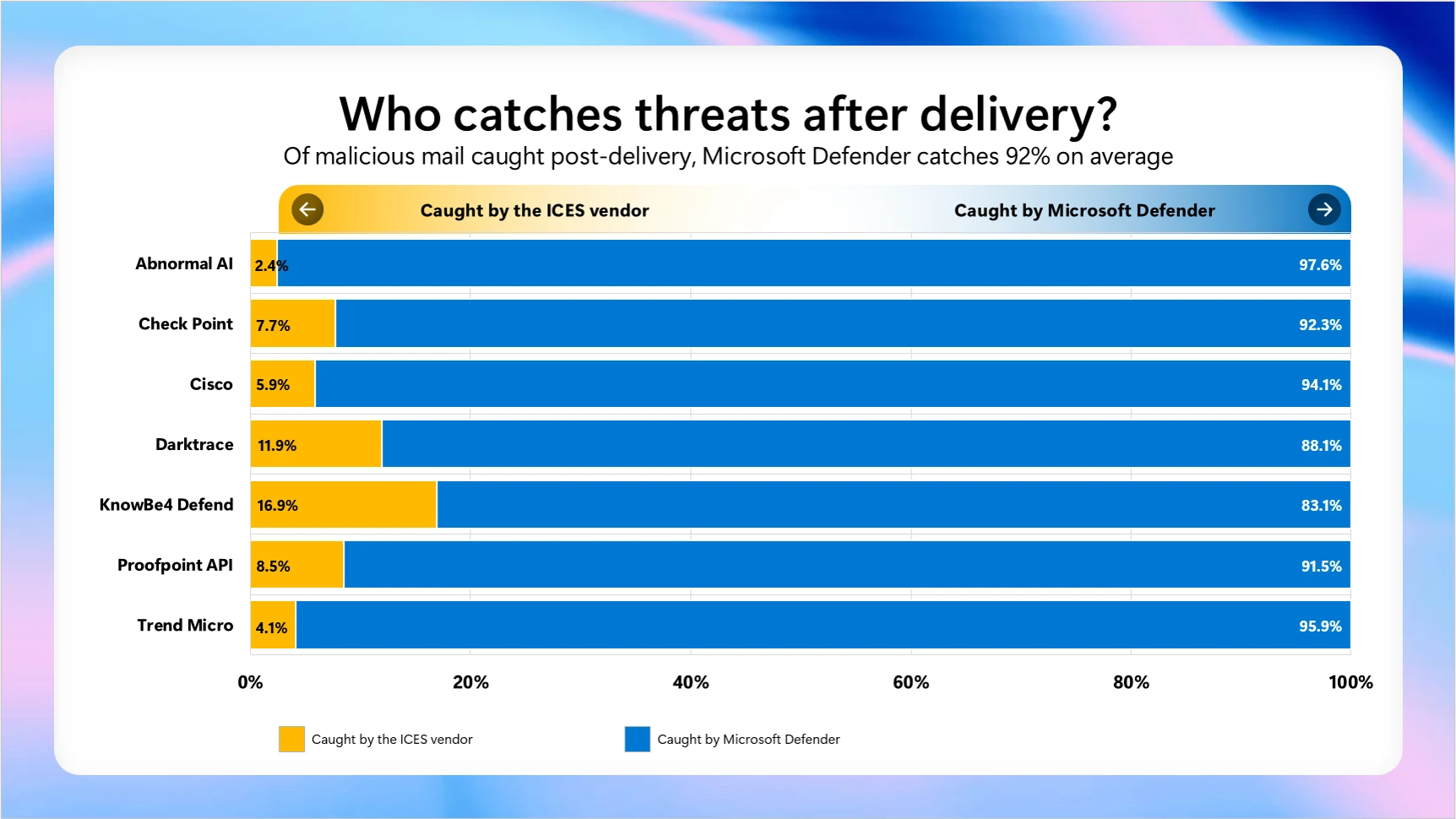
Defender caught 92% of post-delivery malicious messages on average during the benchmark period, highlighting how the combination of pre-delivery and post-delivery remediation delivers strong results for customers.
At the same time it’s key to understand that Defender doesn’t treat post-delivery remediation as a point-in-time action after the email was first delivered to the inbox. Even after a message reaches the inbox, new threat intelligence can reveal risks that were not apparent at the time of delivery. Defender continuously reevaluates delivered messages and remediates threats as new indicators, campaign intelligence, and threat signals emerge.
Figure 3: Post‑delivery malicious catch by Microsoft Defender (May 2026 through July 2026), shown across vendors and overall average. Data source: Microsoft Defender.
How our benchmarking is helping shape product innovation
The value of benchmarking is what happens after measurement. Insights from customer feedback, threat telemetry, and benchmarking have informed recent Microsoft Defender investments:
More control over promotional mail: Across multiple benchmarking periods, we observed that ICES solutions often delivered the greatest incremental benefit in filtering promotional and bulk email. The new Promotions folder in Outlook builds on these insights by helping users reduce inbox clutter while keeping legitimate marketing and bulk messages accessible.
Redesigned machine learning and AI model stack: By analyzing and incorporating natural language processing signals, including message topic, alongside other AI detection signals, Defender can improve detection accuracy. During a consecutive four-week period, Microsoft research observed a roughly two-thirds reduction in false negatives and a nearly one-fifth reduction in false positives for Defender customers.
Protection for people and AI: We built prompt injection protection to detect and isolate malicious AI instructions in email before delivery—helping protect not only people, but also Copilot, agents, and other AI systems that read and act on inbox content. This innovation demonstrates how we continue evolving our defenses to address the latest cyberattack techniques and stay ahead of emerging threats.
Looking ahead
Since July 2025, our goal has been to bring greater transparency to email security effectiveness. Today, we are using benchmarking to help customers understand how cyberthreats evolve, where defenses add value, and how protection improves over time.
Benchmarking is not simply about demonstrating effectiveness, it is about learning from real-world outcomes and translating those insights into stronger protection. As cyberattackers continue to innovate, we remain committed to sharing evidence, improving our technology, and helping customers stay ahead of emerging cyberthreats.
To explore the latest benchmarking data and learn more about how Defender and ICES partners work together, access the benchmarking site.
To learn more about Microsoft Security solutions, visit our website. Bookmark the Security blog to keep up with our expert coverage on security matters. Also, follow us on LinkedIn (Microsoft Security) and X (@MSFTSecurity) for the latest news and updates on cybersecurity.
Every wave of technology excitement creates a new opportunity for cyberattackers, and AI is no exception. Microsoft Threat Intelligence has published research showing a growing set of campaigns that impersonate popular AI platforms and tools, including ChatGPT, Microsoft Copilot, DeepSeek, and Claude.1 The goal is to make phishing, search-driven malware campaigns, and malvertising—which is malicious advertising that uses online ads to lure users to harmful sites, downloads, or redirect chains—more convincing. A ChatGPT-themed phishing campaign sent up to 100,000 emails in a single day, tricking users into updating their ChatGPT Plus payment information and stealing personal and credit card data. These campaigns do not represent a compromise of the AI services being referenced. They represent something more familiar—cyberattackers doing what they have always done: borrowing trust. Right now, AI brands can carry significant trust and curiosity, making them attractive themes for cyberattackers to exploit.
Understanding why this trend matters and what it means for security teams is critical to shaping a modern protection strategy. The tactics are the same ones cyberattackers have always refined: urgency, curiosity, and impersonation of something familiar to lower a user’s guard. What has changed is the wrapper. A message about a new model release, a policy update from a familiar AI assistant, or a plugin that promises to make the workday easier is today’s version of the fake invoice or the shipping notification. AI-themed lures deserve attention not because they are a passing trend tied to one product cycle, but because AI remains a genuine source of excitement and urgency for employees and consumers alike, and cyberattackers are exploiting the human instinct to explore what is new, useful, or urgent.
The attack pattern is evolving
Microsoft’s research team recently observed several AI brand campaigns including:
A ChatGPT-themed phishing kit built to harvest credit card data.
A Claude-themed campaign that harvested credentials and access tokens through adversary-in-the-middle (AiTM) techniques.
Malvertising for a fake AI Windows plugin that delivered the Vidar stealer.
Fraudulent DeepSeek installers distributed through GitHub.
In one case, an initial access broker tracked as Storm-3075 used AI-themed malvertising to distribute payloads for multiple downstream actors, a sign of how quickly this tactic is being commoditized across the criminal ecosystem.
Figure 1. Snippet of the top portion of the email impersonating ChatGPT and enticing users to click on the link.
What ties these campaigns together is not sophistication in the traditional sense. It is patience and precision in exploiting a moment. Threat actors are capitalizing on anticipated launches and emerging trends, layering multi-stage redirection chains and disposable infrastructure to slip past both users and defenses. That has real implications for security leaders: it means these incidents cannot be evaluated one surface at a time. A single AI-themed lure can begin as an email, become a malicious link, trigger a suspicious download, and end as an identity or endpoint compromise. Organizations that assess each of those as an isolated event are always a step behind. Organizations that connect them see the full shape of the cyberattack, often early enough to stop it.
Turning AI lures into dead ends with Microsoft Defender
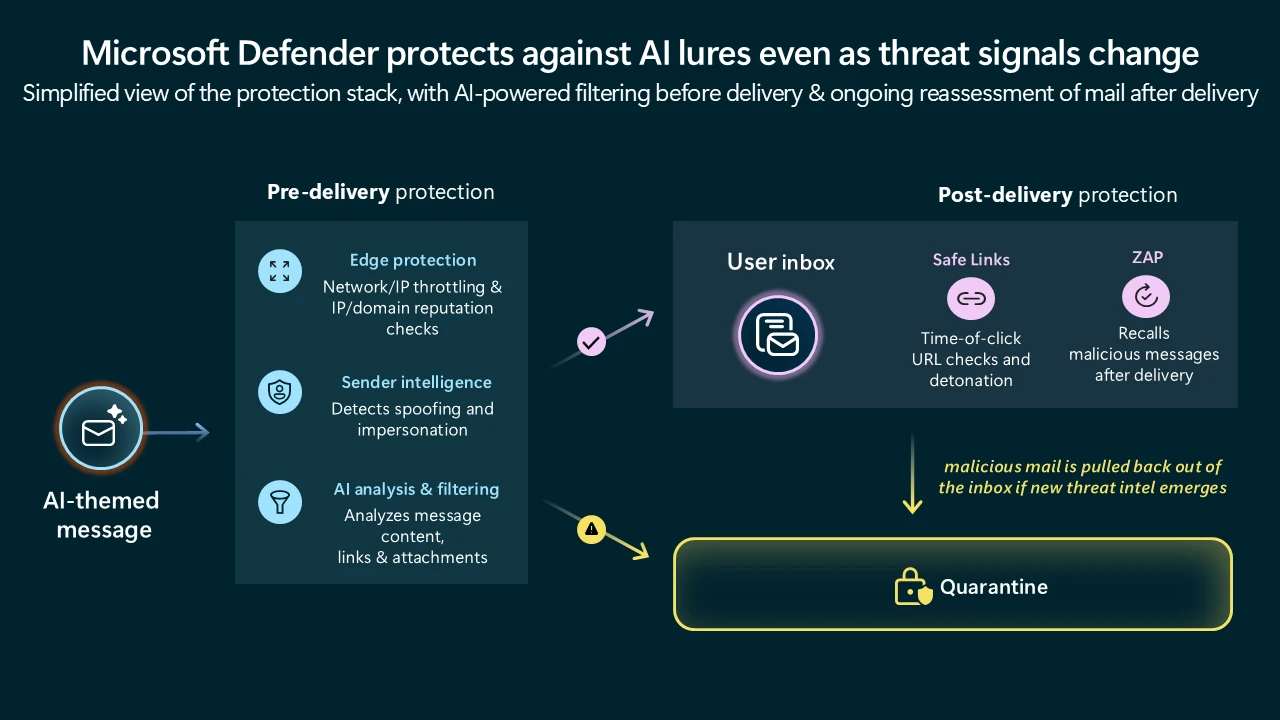
In practice, protection starts before the user ever engages with the lure. Microsoft Defender’s anti-phishing policies can help detect spoofing and impersonation attempts, including user and domain impersonation, first-contact messages, mailbox intelligence signals, and other suspicious sender characteristics. For an AI-themed lure, that might look like a fake “Copilot policy update,” a spoofed support notice, or a lookalike domain designed to make a credential collection page feel legitimate.
If the campaign relies on links, Defender’s Safe Links provides URL scanning and detonation during mail flow, plus time-of-click verification when a user selects a link in email, Microsoft Teams, or supported Microsoft 365 apps. That is important when cyberattackers use redirect chains, delayed activation, or links that appear benign at delivery but later resolve to phishing infrastructure, fake sign-in pages, or malicious downloads.
For campaigns that use fake installers, malicious downloads, or weaponized attachments, Safe Attachments adds another layer by detonating attachments in a virtual environment before delivery when policies are configured. For example, if a message promotes a “new AI plugin” but includes a harmful attachment, Safe Attachments can analyze the file for malware, ransomware, or phishing behavior before it reaches the user. If a cyberthreat is identified after delivery, Defender’s post-delivery filtering capabilities help remove malicious content from mailboxes and reduce the window of exposure.
Figure 2. Simplified Defender email detection stack with pre-delivery and post-delivery protections.
Protect against multi-stage attacks with attack disruption
But AI-powered attacks don’t stop at email. Their objective is to gain the highest level of access possible, using compromised accounts as a foothold to move across identities, devices, and data. When a cyberattack moves beyond the inbox, Defender helps connect the evidence. Signals from email and collaboration tools, endpoints, identities, and software as a service (SaaS) apps are correlated into an attack story so analysts can see whether the same lure led to a clicked link, a downloaded payload, risky sign-in behavior, or endpoint activity.
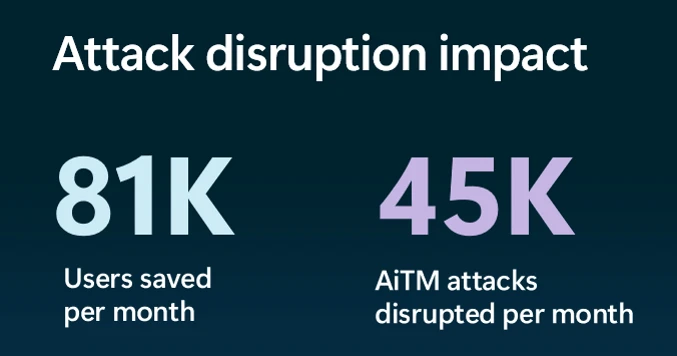
As cyberattackers expand beyond email to gain broader access across the environment, Defender moves from detection to disruption. For multi-stage, multi-domain attacks like business email compromise or AiTM, Defender’s powerful, built-in response capability, attack disruption, will contain the compromised asset during the attack to prevent further lateral movement while security teams investigate and remediate. Attack disruption contains more than 81,000 compromised user accounts monthly and is now disrupting more than 45,000 AiTM attacks each month.
Figure 3. Recent attack disruption statistics. (Source: Internal Microsoft Research, September 2026)
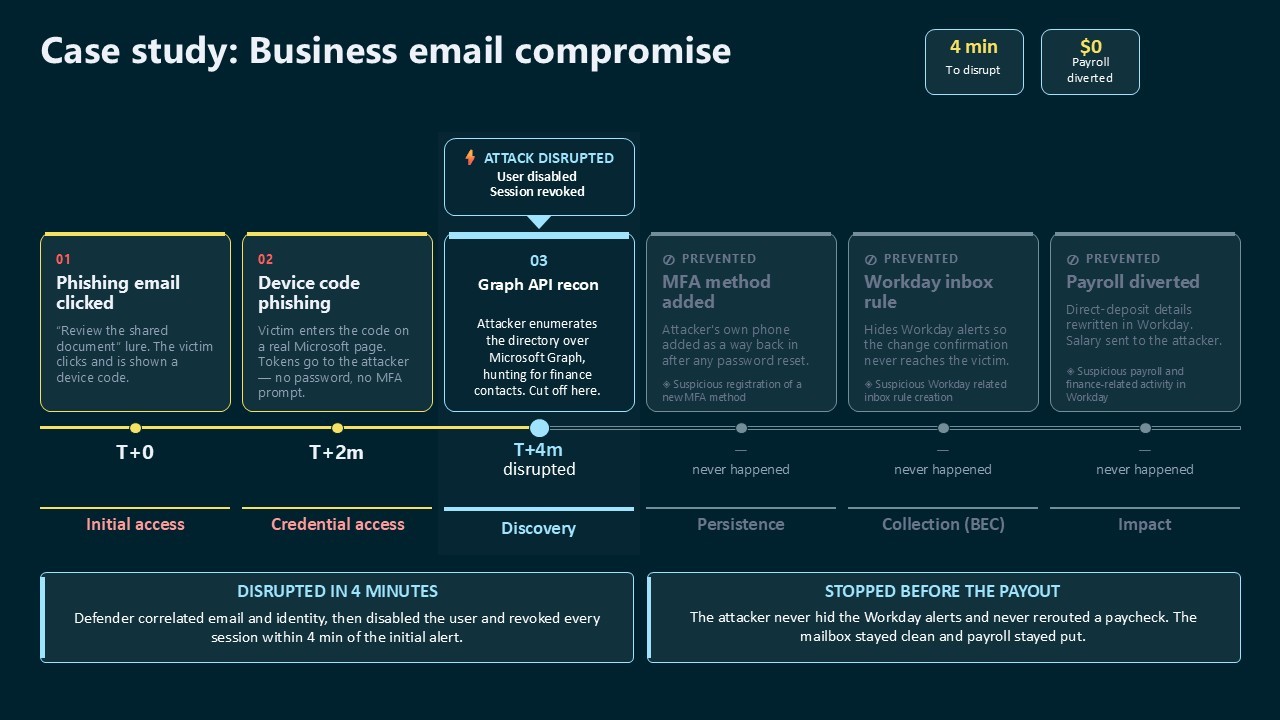
In a recent case study, Defender disrupted a business email compromise attack within four minutes of the initial activity (Figure 4). While response times may vary by scenario, this case shows the impact of attack disruption on a real cyberthreat. The cyberattacker used a convincing document-sharing lure to trick a user to start a legitimate Microsoft device code sign-in flow, which avoided traditional credential theft techniques. Defender recognized the resulting device code authentication and follow-on activity as suspicious, correlated signals across identity and email telemetry, and disrupted the attack within four minutes before the attacker could establish persistence, create inbox rules, or execute payroll fraud.
Figure 4. Business email compromise attack through OAuth device code phishing.
The takeaway
AI brands are the new bait, but the underlying lesson is bigger than any single campaign. As cyberattackers continue to exploit the momentum around AI, organizations should expect social engineering to become more targeted, more believable, and more difficult to evaluate in isolation.
The answer is not to treat every new lure as a brand-new category of risk. It is to build a protection model that makes trust harder to exploit across the full attack chain. Microsoft Defender helps organizations do that by connecting prevention, detection, investigation, and response across the attack path, so AI-themed lures are harder to deliver, harder to trust, and harder to turn into broader compromise.
To learn more about Microsoft Security solutions, visit our website. Bookmark the Security blog to keep up with our expert coverage on security matters. Also, follow us on LinkedIn (Microsoft Security) and X (@MSFTSecurity) for the latest news and updates on cybersecurity.
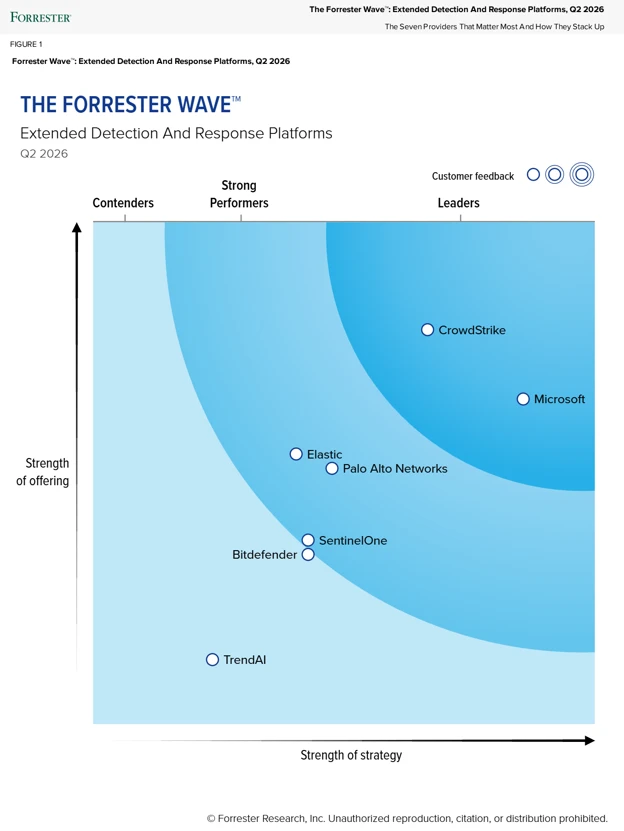
We are excited to share that Microsoft has been named a Leader in The Forrester Wave™: Extended Detection and Response Platforms, Q2 2026. Microsoft ranked the highest of any vendor evaluated in the Strategy category and is the only vendor to receive the highest score in Vision. Microsoft also received the highest possible scores across the current offering criteria of identity detection, cloud detection, SIEM replacement, Threat Intelligence, Threat hunting, Administrative controls, and Training.
In the report, Forrester writes that “Microsoft articulates a compelling vision to build a Frontier approach to security, bringing people and AI together while the platform continuously shields against and disrupts attacks.”
That recognition reflects how Microsoft sees the next phase of XDR evolution. As cyberattackers use AI to scale and accelerate their campaigns, defenders need more than correlated signals. They need a system that brings together data, people, and workflows so security can operate with the same speed and coordination.
At Microsoft, XDR is that foundation. It connects signals across identities, endpoints, email, software as a service (SaaS) apps, and cloud workloads into a shared layer of context bringing together the signals, workflows, and actions security runs on.
That foundation extends directly into how protection and operations are delivered. Microsoft Defender’s native capabilities continuously shield against attacks with built-in, system-level defenses, while embedded agents help triage alerts, hunt for threats, and deliver intelligence in the flow of work. The result is a shift from fragmented response to coordinated, system-level defense—where decisions, actions, and protection move together by default.
Attack disruption is one of the clearest expressions of that vision today. It uses cross-domain signals and AI to stop multi-stage cyberattacks like ransomware and adversary-in-the-middle attacks while they are active and unfolding.
Forrester specifically notes attack disruption in the report, “As well as its roadmap, it (Microsoft) has builtunique features, like automatic attack disruption, to help deliver on its vision.”
Threat intelligence is a brand-new evaluation criterion in this Wave and Microsoft earned the highest possible score. This reflects a broader shift: intelligence is no longer a bolt-on, but fundamental to how modern XDR platforms detect, prioritize, and disrupt cyberattacks.
Microsoft Threat Intelligence is built on a broad vantage point, analyzing 100 trillion signals each day. That intelligence is delivered directly into the analyst experience, which provides context on threat actors: their motivations and tactics appear inside incidents, alongside affected assets, and tied to response actions.
The intelligence is built into detections, attack disruption, hunting, and AI that helps analysts make sense of what they’re seeing. It’s also continuously informed by Microsoft’s global security research teams tracking nation-state actors, ransomware groups, and emerging cyberthreats, which brings frontline insight directly to defenders.
Innovation that reinforces continued leadership
We believe Microsoft’s ranking as a leader in this report is a reflection of the pace of innovation across the Defender portfolio over the past year. Highlights include:
Adaptive defense to contain active attacks: Attack disruption now expands autonomous protection to predict and shield against a threat actor’s next move during active cyberattacks. It acts just in time to defend against common attacker tactics such as group policy objects (GPOs), Safeboot, and identity compromise, with new controls that now include device isolation.
Native protection across cloud, identity, and SIEM: Microsoft delivers differentiated protection across cloud and identity by natively harnessing signals from Azure and Microsoft 365 coverage. Combined with Microsoft Sentinel’s powerful security information and event management (SIEM) and threat hunting capabilities, this foundation goes beyond detection, enabling disruption of attacks directly within the SOC for critical data sources including Amazon Web Services (AWS), Okta, and Proofpoint, fundamentally turning your SIEM into a threat protection solution.
Microsoft Security Copilot alert triage agent: Security Copilot agents in Defender help security operations center (SOC) teams investigate faster, automate response, and prioritize high-risk cyberthreats. Microsoft recently extended the Security Copilot alert triage agent to cloud and identity, extending assistive and autonomous AI to two of the most critical attack surfaces security teams defend every day. By helping analysts triage alerts faster, surface high-value context, and move more quickly from signal to action, these new capabilities strengthen the SOC where speed and precision matter most. That momentum reinforces that Microsoft received the highest possible scores in both identity detection and cloud detection.
Securing local AI agents: Microsoft recently announced endpoint security for local AI agents at Microsoft Build 2026. Defender helps security teams gain visibility into AI agents running on devices, assess exposure across identities and resources, block malicious activity in real time, and investigate agent activity through Advanced Hunting.
What this recognition means for our customers
Being named a Leader in The Forrester Wave™: Extended Detection and Response Platforms, Q2 2026 reinforces Microsoft’s commitment to helping defenders stay ahead of modern cyberattacks. We believe this recognition reflects the strength of our vision, the breadth of our protection across identities, endpoints, email, cloud, and applications, and our continued investment in bringing people and AI together in the SOC.
As the threat landscape continues to evolve, we remain focused on helping customers investigate faster, respond more effectively, and strengthen their security operations with an integrated platform built for today’s cyberattacks.
To learn more about Microsoft Security solutions, visit our website. Bookmark the Security blog to keep up with our expert coverage on security matters. Also, follow us on LinkedIn (Microsoft Security) and X (@MSFTSecurity) for the latest news and updates on cybersecurity.
Forrester does not endorse any company, product, brand, or service included in its research publications and does not advise any person to select the products or services of any company or brand based on the ratings included in such publications. Information is based on the best available resources. Opinions reflect judgment at the time and are subject to change. This report is part of a broader collection of Forrester resources, including interactive models, frameworks, tools, data, and access to analyst guidance. For more information, read about Forrester’s objectivity here .
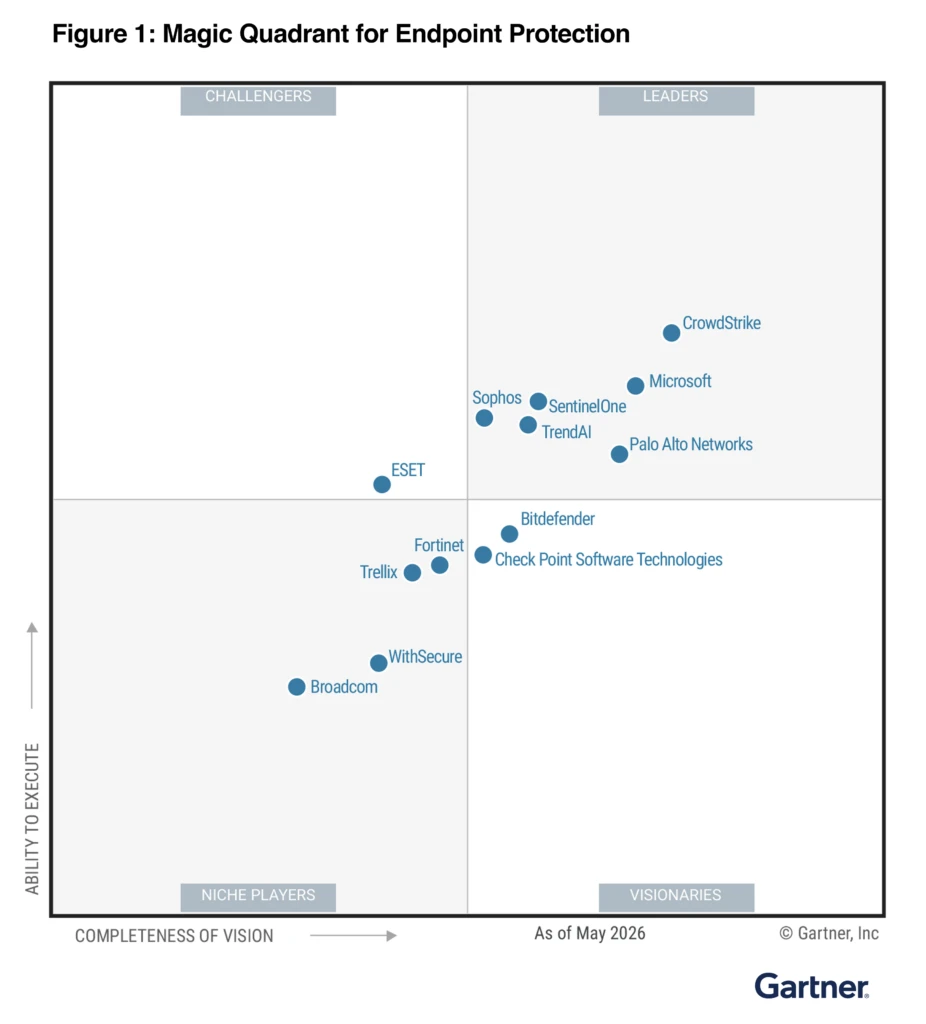
As threats become more coordinated and faster to execute, endpoint protection has become the proving ground for modern defense. For the seventh consecutive time, Microsoft has been named a Leader in the 2026 Gartner® Magic Quadrant™ for Endpoint Protection. We believe this reflects both the strength of our technology, and the trust customers place in Microsoft Defender.
Microsoft Defender delivers industry-leading Endpoint Detection and Response (EDR), powered by global threat intelligence and built for the scale and speed of today’s attacks. For many of our customers, Defender’s endpoint capabilities are the foundation for a coordinated system of defense that spans endpoints, identities, email, apps, cloud, and data.
Bringing these signals together changes what’s possible. It enables earlier detection, stronger prevention, and capabilities like predictive shielding that help stop attacks before they spread. This is the shift underway in security: from isolated tools to a connected system that can see across the environment, understand what’s changing, and take action in real time. It’s what makes the next generation of AI-driven, agentic security possible and helps defenders stay ahead of threats, not just respond to them.
Sustained innovation to stay ahead of changing threats
Over the past year, Microsoft has introduced key advancements to endpoint protection that have empowered defenders to stay ahead of evolving cyberthreats, including:
Proactive defense during attacks: Attack disruption now expands autonomous protection to predicting and blocking an adversary’s next move during active attacks. It acts just in time to harden against some of the most common attacker tactics, such as group policy objects (GPOs), Safeboot, and identity compromise, to stop lateral movement and defend dynamically.
Custom telemetry: With new custom data collection capabilities, Defender makes it easy for security teams to collect specialized data directly within the Defender portal. It allows organizations to extend their endpoint telemetry beyond the 200+ default signals to support tailored detections and advanced hunting scenarios, such as AMSI for hunting over script content and Kerberos for auth-based and network attacks.
Simplified onboarding: To help security teams onboard simply and securely, we’ve built new Defender deployment tools for Windows and Linux, which handle the entire process for you. Just download a single package and it will dynamically adapt to the operating system, take care of prerequisites, and install the latest version of Defender available as needed for older devices that don’t have it already built in. The Defender deployment tools eliminate friction, automate tricky steps, and provide predictability throughout the onboarding journey.
Sovereign-ready protection: Defender enables customers to meet data storage and privacy needs while operating under public, sovereign, hybrid, or disconnected models. Its multi‑tenant architecture enables organizations to balance centralized security visibility with localized control over their data, reflecting a shift from basic compliance to operational governance.
End-to-end security for local AI agents: Microsoft announced agentic endpoint security as a part of A365 to discover, govern, and block AI agents such as OpenClaw and previously unseen applications running locally on endpoints.
Innovations such as these represent the continued commitment to drive the next wave of innovation. Stay tuned for more exciting advancements at Microsoft Build on June 2nd.
If you’re not yet taking advantage of Microsoft’s leading endpoint security solution, visit Microsoft Defender for Endpoint and start a free trial today to evaluate our leading endpoint protection platform.
Are you a regular user of Microsoft Defender for Endpoint? Share your insights on Microsoft Defender for Endpoint and get rewarded with a $25 gift card on Gartner Peer Insights™.
To learn more about Microsoft Security solutions, visit our website. Bookmark the Security blog to keep up with our expert coverage on security matters. Also, follow us on LinkedIn (Microsoft Security) and X (@MSFTSecurity) for the latest news and updates on cybersecurity.
Gartner, Magic Quadrant for Endpoint Protection, Deepak Mishra, Evgeny Mirolyubov, Nikul Patel, 26 May 2026.
Gartner is a registered trademark and service mark and Magic Quadrant is a registered trademark of Gartner, Inc. and/or its affiliates in the U.S. and internationally and are used herein with permission. All rights reserved.
This graphic was published by Gartner, Inc. as part of a larger research document and should be evaluated in the context of the entire document. The Gartner document is available upon request from.
Gartner does not endorse any vendor, product or service depicted in its research publications, and does not advise technology users to select only those vendors with the highest ratings or other designation. Gartner research publications consist of the opinions of Gartner’s research organization and should not be construed as statements of fact. Gartner disclaims all warranties, expressed or implied, with respect to this research, including any warranties of merchantability or fitness for a particular purpose.
Security operations are entering a new phase. As attack techniques grow faster and more complex, the effectiveness of a SOC depends less on collecting more data and more on how well platforms can turn context into action at scale.
KuppingerCole Analysts’ 2026 Emerging AI Security Operations Center (SOC) reflects this shift clearly: the future of security automation is not defined by static rules or isolated workflows, but by intelligence‑driven automation that supports analyst decision‑making across the full security lifecycle. This evolution mirrors what many security leaders already experience day to day, that the limiting factor is no longer alert volume, but human capacity.
Microsoft is excited to be named an Overall Leader, and the Market Leader, in this report, as we see automation as a core component of the future of cybersecurity.
From playbook‑driven SOAR to intelligence‑led automation
Traditional security orchestration, automation, and response (SOAR) solutions were built to automate predictable, repeatable tasks: enrichment steps, ticket creation, notifications, and predefined containment actions. These capabilities remain valuable, but they were designed for an era when incidents followed more deterministic patterns.
This is a critical change. In many SOCs today, analysts still spend significant time:
Stitching together context across alerts and data sources.
Manually triaging incidents that turn out to be benign.
Following repetitive investigation and response steps.
The result is slower response times and analyst burnout—at exactly the moment attackers are moving faster and operating more quietly.
Automation built into the analyst experience
Microsoft has evolved the way these common challenges can be addressed, leveraging machine learning, large language models (LLMs), and agents, including releases such as:
Automatic attack disruption: An always-on capability that limits lateral attackers and reduces the overall impact of an attack, from associated costs to loss of productivity, leaving security operations teams in complete control of investigating, remediating, and bringing assets back online.
Phishing triage agent: An agent that runs sophisticated assessments—including semantic evaluation of email content, URL and file inspection, and intent detection—to determine whether a submission is a true phishing threat or a false alarm.
AI powered incident prioritization: A machine learning prioritization model to surface the incidents that matter most, assigning each incident a priority score from 0–100 and explaining the key factors behind the ranking.
Playbook generator: An experience that allows users to create python-code playbooks using natural language for flexible workflow automation.
These capabilities are just the beginning of how we are introducing agents and automation to help users move faster, freeing analysts to focus on higher‑value tasks like proactive hunting and threat analysis.
The next evolution: The agentic SOC
The KuppingerCole report reinforces a broader industry trend, that security platforms must do more than automate pre‑defined workflows. They must support adaptive, intelligence‑driven operations that can respond to novel and fast‑moving threats.
This is where Microsoft is making its next set of investments: agentic security operations.
With innovations such as the Microsoft Sentinel MCP (Model Context Protocol) Server, shared security data and graph context, and deep integration with Microsoft Security Copilot, Sentinel is evolving into a platform where AI agents can:
Reason across identity, endpoint, cloud, and network signals.
Summarize incidents and investigations in natural language.
Assist with decision‑making by correlating weak signals over time.
Take action—with human oversight—when confidence thresholds are met.
These agents are designed to work alongside analysts, augmenting expertise and dramatically accelerating time to response.
Why this matters for security teams
The direction highlighted by KuppingerCole, and reflected in Microsoft’s roadmap, isn’t about chasing AI for its own sake. It’s about addressing real SOC pain points:
Scale: Human‑only operations don’t scale with modern attack surfaces.
Consistency: Automated and agent‑assisted workflows reduce variance and errors.
Speed: Faster reasoning and response directly reduce attacker dwell time.
By combining automation, rich context, and intelligent agents, Microsoft Sentinel helps SOC teams move from reactive alert handling to proactive, intelligence‑led defense without forcing teams to re‑architect their operations overnight.
Looking ahead
Security automation is no longer a bolt‑on capability. As KuppingerCole’s research makes clear, it is becoming a foundational element of modern security operations. The evolution of SOAR reflects the reality of a shift from static playbooks to adaptive, context‑aware assistance that scales human expertise.
Microsoft is investing accordingly, advancing an AI‑first approach to security analytics that helps SOC teams operate with greater speed, confidence, and resilience as threats continue to evolve. Read the Emerging AI Security Operations Center (SOC) report to learn more.
To learn more about Microsoft Security solutions, visit our website. Bookmark the Security blog to keep up with our expert coverage on security matters. Also, follow us on LinkedIn (Microsoft Security) and X (@MSFTSecurity) for the latest news and updates on cybersecurity.
AI agents aren’t coming—they’re already in your environment. They show up in places you expect (like Microsoft Copilot, Microsoft Teams, and Microsoft 365) and even more places as technology evolves (a local autonomous personal AI assistant or a new software as a service (SaaS) agent connected to your sensitive data.)
The problem isn’t that agents exist. It’s that they proliferate fast, span apps, endpoints and cloud, and often operate outside the visibility and control of the teams accountable for risk. When an agent can invoke tools, access data, and interact with other agents, any “helpful” workflow can turn into data oversharing, tool misuse, or over-privileged actions in seconds. And as agents become even easier to create and deploy, your attack surface grows with them.
That’s why end-to-end observability matters: you can’t govern what you can’t see, and you can’t secure what you don’t understand—especially when the number of agents is a moving target.
Microsoft Agent 365 helps you take control of agent sprawl as your control plane to observe, govern, and secure agents and their interactions—including agents built with Microsoft AI and agents from our ecosystem partners—using the admin and security workflows your teams already run.
Additionally, we’re announcing the previews of new Agent 365 capabilities and integrations to help you scale agent adoption with the right controls in place.
Observability, governance, and security for agents operating independently—Agent 365 is expanding to cover agents that operate with their own credentials and permissions.
A secured, managed environment for agents to work in Windows 365 for Agents.
Coverage for a wide ecosystem of SaaS agents, including agents innovated by software development companies (SDCs).
Support for evaluation, adoption, and usage from Microsoft and ecosystem partners worldwide.
Manage agents with a single control plane, regardless of how or where they work
As organizations move from pilot to adoption, AI agents are being deployed across increasingly diverse use cases. Some act with delegated access, working on behalf of users; others operate with their own credentials and permissions, participating in team workflows or operating behind the scenes.
With Agent 365, you can observe, govern, and secure AI agents whether they act on behalf of users with delegated access—for example, an agent that helps employees organize their inbox—or agents that operate with their own access and scope of work—such as an agent autonomously triaging support tickets.
Supported by Agent 365
Agents working on behalf of users (delegated access) Generally available
Agents operating behind the scenes (own access) Generally available
Agents participating in team workflows (own access) Public Preview
Discover and manage local and cloud-hosted agents
Users are installing agents like OpenClaw and Claude Code on their devices and adopting SaaS agents built by developers on new and emerging platforms. Many of these local and cloud-hosted agents run unmanaged and outside of traditional governance, as they autonomously execute tasks, modify code, or access confidential information, creating a new wave of shadow AI.
To help organizations address accelerating agent sprawl and the rise of unmanaged agents, we’re introducing new capabilities as part of Agent 365, Microsoft Defender, and Intune so you can discover shadow agents, and apply appropriate controls, such as blocking unmanaged agents.
Discover and manage local agents
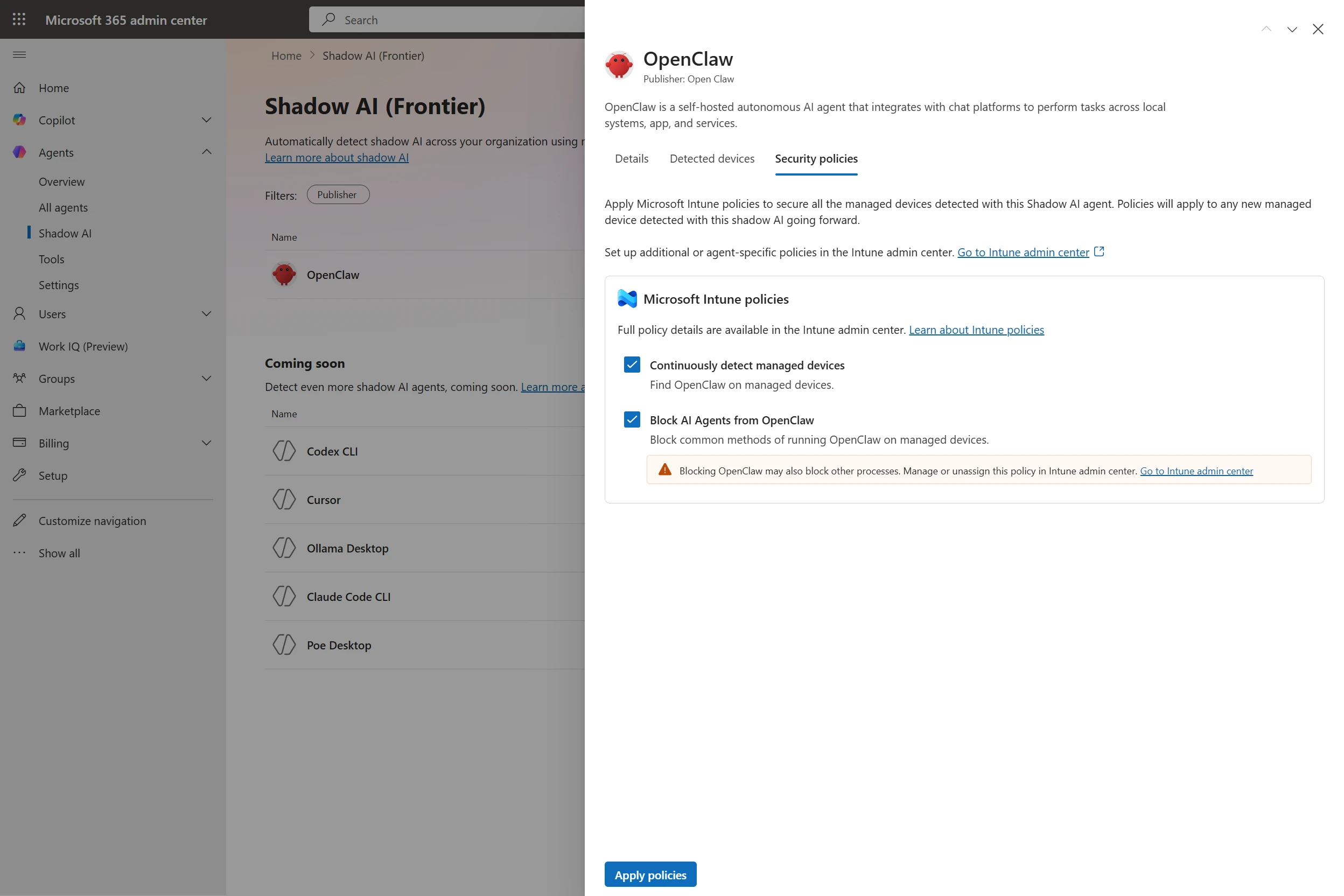
With Microsoft Defender and Intune, organizations will be able to discover and manage local AI agents running on Windows devices, starting with OpenClaw agents and expanding soon to other widely used agents like GitHub Copilot CLI and Claude Code. Customers enrolled in the Frontier program can see if OpenClaw agents are being used in the organization, which devices they are running on, and use Intune policies to block common ways that OpenClaw runs on the new Shadow AI page in Agent 365 in the Microsoft 365 admin center and in the Intune admin center. Through Agent 365 registry, the inventory of local agents will be available in Defender and Intune so IT, endpoint management, and security teams can get a consistent view of discovered local agents in their environment and take appropriate action.
In the Microsoft 365 admin center, an IT professional can apply Intune policies to continuously detect managed devices and block the common methods of running OpenClaw on them.
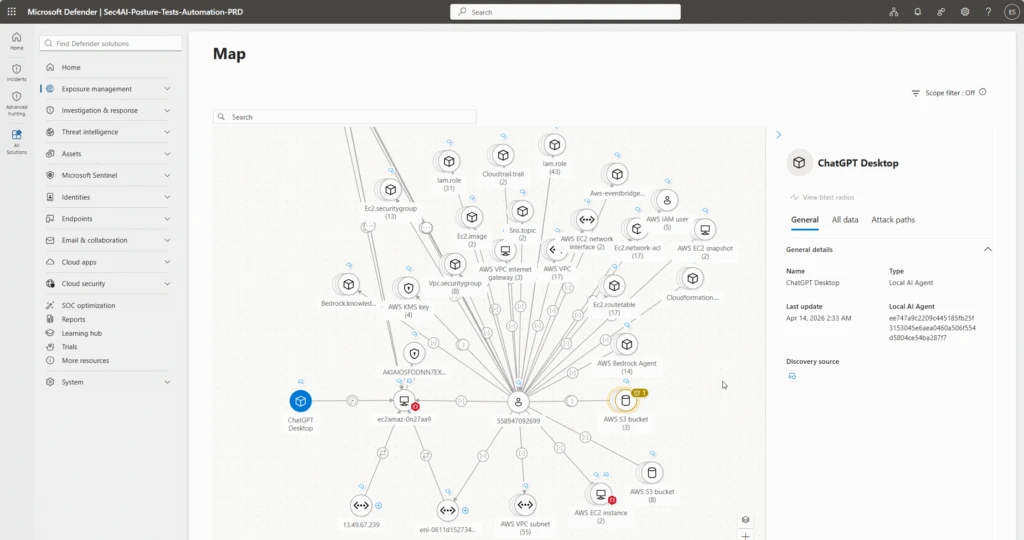
Starting in June 2026, Microsoft Defender will also provide asset context mapping for each agent including the devices they run on, MCP servers configured for those agents, the identities associated with them, and the cloud resources those identities can reach. This will give security teams the context needed to assess exposure and potential blast radius. They can then investigate agent activity, such as file access and network behavior, using familiar endpoint data, and use those insights to identify misconfigurations and even define custom detections.
Security teams can investigate local AI agent exposure in Microsoft Defender through a relationship map that shows where an agent runs, which MCP servers are configured for use, which identities are associated with it, and which cloud resources those identities can reach. Defender context such as resource criticality and sensitive-data exposure helps teams prioritize the agents and paths that matter most.
Beyond monitoring, organizations will be able to apply policy-based controls to set guardrails for what agents are allowed to do—helping protect both agents and organizations from compromise and misuse—with initial support delivered for OpenClaw through Intune. If a managed agent exhibits malicious behavior patterns, such as attempting to access or exfiltrate sensitive data, Defender will be able to block coding agentsin runtime and generate alerts with rich incident context to support investigation and response.
Context mapping capabilities, policy-based controls, plus runtime blocking and alerts will be available in Agent 365 through Intune and Defender public preview in June 2026.
Visibility across clouds and AI-builder platforms
As developers are rapidly building agents with Microsoft Foundry, AWS Bedrock, and Google Gemini Enterprise Agent Platform (formerly Google Vertex AI) and deploying cloud agents across multicloud and multi-platform environments, the agent sprawl challenge intensifies. To manage potential security risks or vulnerabilities before they become breaches, security and IT teams need visibility to which cloud agents are running, what models these agents are built on, and what resources they’re accessing.
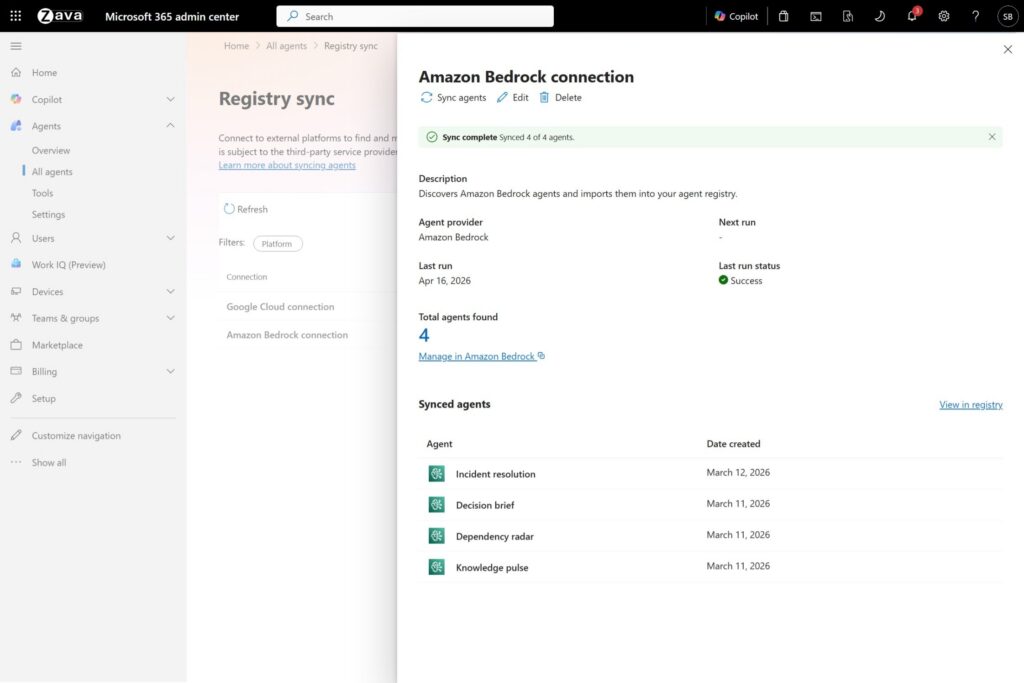
Today, we are excited to announce the public preview of Agent 365 registry sync with AWS Bedrock and Google Cloud connections, enabling IT teams to automatically discover, inventory, and, soon, perform basic lifecycle governance—for example, start, stop, delete agents—across these platforms.
Now in public preview, Microsoft 365 admins can connect and sync the Agent 365 registry with Amazon Bedrock and Google Cloud for cross-platform observability and governance.
Manage a wide ecosystem of SaaS agents
Agent 365 works with prebuilt agents in Microsoft 365 Copilot and Teams, agents built with Microsoft Copilot Studio or Microsoft Foundry for your organization, and agents built by software development companies partnered with Microsoft.
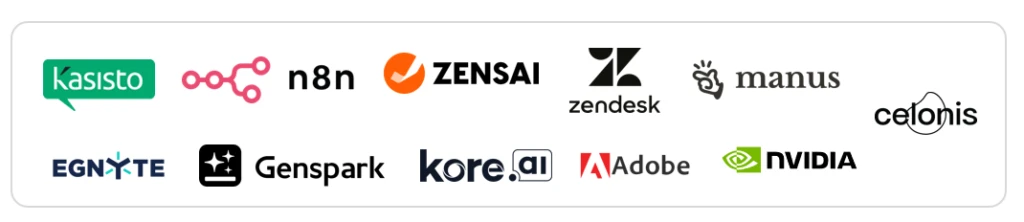
Delivering on our promise of control plane for the broad agent ecosystem, we’re excited to announce ecosystem partner agents fully configured to be managed by Agent 365, including Genspark, Zensai, Egnyte, and Zendesk, and agents built on agent factories, including Kasisto, Kore, and n8n. Organizations can observe, govern, and secure these agents in the Agent 365 control plane, with no integration work by IT or security teams.
Agent 365 software development company launch partners
Agent 365 Software Development Company Launch Partners have built agents fully enabled to be managed by Agent 365.
Enterprises can easily build AI agents today, but scaling them with trust and governance is where most initiatives stall. With Kore.ai deeply integrated into Microsoft Agent 365, identity, security, and governance are built in from the start—empowering enterprises to move from pilots to AI at scale with confidence.
—– Raj Koneru, Chief Executive Officer of Kore.ai
The Agent 365 developer and ecosystem partners play a critical role in extending agents into line-of-business systems, building vertical and scenario-specific integrations, modernizing legacy automation into agent workflows, extending Copilot experiences with custom agents, and helping customers operationalize agent ecosystems at scale. These Agent 365 enabled agents are then observable, governable, and securable in the Agent 365 control plane, accelerating adoption for your organization.
While Agent 365 provides the control plane to observe, govern, and secure agent activity across the enterprise, Windows 365 for Agents—now available in public preview (in the United States only)—provides a secured, managed environment where agents can carry out that work. It introduces a new class of Cloud PCs purpose-built for agentic workloads and managed in Intune, allowing agents to run in policy-controlled environments, interact with applications, and operate with the same identity, security, and management controls already used for employees.
Now, with Agent 365, you can also observe and secure agents running on Windows 365 for Agents in Microsoft 365 admin center, understanding which agents are connected to the cloud-powered compute. Together, they enable organizations to move from visibility and governance of agents to confidently running them in production environments.
Secure agents against internet threats with network controls
AI agents can operate much faster than human users. Without proper guardrails, they can connect to risky web destinations, interact with unsanctioned AI services, handle sensitive files unsafely, or be manipulated through malicious prompt-based attacks. These risks are harder to manage when security teams lack consistent visibility and controls for agent traffic to internet, SaaS, and AI services.
To give security teams a consistent way to inspect agent traffic at the network layer, in general availability today, Agent 365 extends Microsoft Entra network controls to Microsoft Copilot Studio agents and agents running on user endpoint devices, including local agents such as OpenClaw. These controls can help identify unsanctioned AI usage, restrict connections to only approved web destinations, filter risky file movement, and help block malicious prompt-based attacks before they lead to harmful actions.
Confidently scale and govern AI agents while maintaining security and control
Agent 365 extends even further beyond Microsoft platforms to discover, observe, govern, and secure local, SaaS, and cloud agents across your agentic AI ecosystem. Each of today’s announcements build upon Agent 365 capabilities we shared in March 2026 as well as detailed feedback of customers using the Frontier program, developers integrating with the platform, and partners testing Agent 365 capabilities.
With Agent 365, we can scale and govern AI agents with confidence, while maintaining enterprise grade security and control. Agent 365 enables organizations to move beyond experimentation, driving tangible business value and innovation through trusted AI adoption. By providing a robust and integrated platform, Agent 365 empowers teams to confidently embrace AI and accelerate transformation across the enterprise.
—Yuji Shono, Head of the Global AI Office, NTT DATA Group Corporation, a global infrastructure, networking, and IT services provider.
As organizations begin to adopt Agent 365 at scale, we’ve collaborated with strategic partners to create targeted services to help customers onboard, tackle governance challenges and realize the platform’s full value.
Featured Agent 365 launch partners, including Accenture, Bechtle, Capgemini, Insight, KPMG, Protiviti and Slalom, collaborated with Microsoft engineering teams to develop services for planning, adopting, and managing your agent control plane implementation.
Partner services offered today include expertise and guidance for:
Inventory and ownership: What agents exist, who owns them, and where they run.
Least privilege: Right-sizing permissions and enforcing access guardrails without slowing delivery.
Compliance and data protection: Preventing oversharing and producing audit-ready evidence.
Threats and multi-platform estates: Understanding attack paths and governing across vendors and clouds.
Ongoing operations: Lifecycle management, monitoring, and continuous governance hygiene.
These valuable services are typically scoped as workshops and assessments (diagnose and roadmap), governance and enablement (stand up the control plane and guardrails), managed services (run and improve continuously), advisory and readiness (operating model and adoption readiness), and security and integration (harden posture and integrate third-party agents.)
Agent 365 is now available in Microsoft 365 E7 or standalone at USD15 per user per month. Each Agent 365 license covers an individual who manages or sponsors agents, or uses agents to do work on their behalf, ensuring all agent activity is consistently governed across the organization in a way that’s predictable for scaled growth.
Every major shift in cyberattacker behavior over the past decade has followed a meaningful shift in how defenders operate. When security operation centers (SOCs) deployed endpoint detection and response (EDR)—and later extended detection and response (XDR)—security teams raised the bar, pushing cyberattackers beyond phishing, commodity malware, and perimeter‑based attacks and into cloud infrastructure built for scale and speed.
That pattern continued as defenders embraced automation and AI to manage expanding digital estates. SOCs were often early scale adopters—using machine learning to reduce noise, improve visibility, and respond faster across growing environments. Cyberattackers became more targeted and multistage, moving deliberately across identities, endpoints, cloud resources, and email, where detection was hardest. Success increasingly depended on moving fast enough to act before analysts could connect the dots. Even with this progress, security operations (SecOps) still feel asymmetrical: threat actors only need to be right once, while defenders are judged by every miss. If defense depends on human intervention to begin, defense will always feel asymmetrical.
To change the outcome, SOCs must change how defense itself works. This is the agentic SOC: where security delivers adaptive, autonomous defense, freeing defenders for strategic, high‑impact work. In this series, we’ll break down what that shift requires, what early experimentation has taught us, and where organizations can start today. Read more about how some organizations moving toward the agentic SOC and access a foundational roadmap for this transformation in our new whitepaper, The agentic SOC: Your teammate for tomorrow, today.
What we mean by “the agentic SOC”
At its core, the agentic SOC is an operating model that shifts security from reacting to incidents to anticipating how cyberattackers move—and actively reshaping the environment to cut off their paths.
It brings together a platform that can increasingly defend itself through built-in autonomous defense, with AI agents working alongside humans to accelerate investigation, prioritization, and action—so teams spend less time on execution and more time on judgment, risk, and the decisions that matter.
How does that change day-to-day work? Imagine a credential theft attempt. Built-in defenses automatically lock the affected account and isolate the compromised device within seconds—before lateral movement can begin. At the same time, an AI agent initiates an investigation, hunting for related activity across identity, endpoint, email, and cloud signals, and correlating everything into a single view.
When an analyst opens their queue, the “noise” of overwhelming alerts is already gone. Evidence has been pre-assembled. Likely next steps are suggested. The analyst can start right away by answering higher impact questions: Is this part of a broader campaign? Should this authentication method be hardened? Are there related techniques this cyberattacker commonly uses that the environment is still exposed to?
In today’s SOC, we see that sequence often takes hours—and the proactive improvement is very limited, if it ever happens; there’s simply not enough time. In an agentic SOC, it happens in minutes, and teams can spend the time they’ve gained on deeper investigation, systemic hardening, and reducing the likelihood of repeat cyberattacks.
A layered model for the agentic SOC
This model works because an agentic SOC is built on two distinct, but interdependent layers. The first is an underlying threat protection platform that has fundamentally evolved how cyberattacks are defended against and disrupted. High confidence cyberthreats are handled automatically through deterministic, policy-bound controls built directly into the platform. Known attack patterns are blocked in real time—without deliberation or creativity—shielding the environment from machine-speed cyberthreats before scarce human attention or token intensive reasoning is required. This disruption layer is not optional; it is the prerequisite that makes an agentic SOC safe, scalable, and sustainable.
The second layer operates at the operational level, where agents take on tough analysis and correlation work to dramatically increase the leverage of security teams and shift focus from uncovering insight to acting on it. These agents reason over evidence, coordinate investigations, orchestrate response across domains, and learn continuously from outcomes. Over time, they help identify recurring attack paths, surface gaps in posture, and recommend changes that make the environment harder to exploit—not just faster to respond.
Together, they transform the SOC from a reactive workflow engine into a resilient system.
What’s real now, and why there’s reason for optimism
The optimism around our view of the agentic SOC comes from operational discipline and proven, real-world impact. Autonomous attack disruption has been operating at scale for years.
Attacks like ransomware are disrupted in an average of three minutes, and tens of thousands of attacks are contained every month by isolating compromised users and devices before lateral movement can take hold. This all done with a 99.99% confidence rating, so SOC teams can trust in its efficacy.
Building on that proven foundation, newer capabilities like predictive shielding extend autonomous defense further—anticipating how cyberattacks are likely to progress and proactively restricting high-risk paths or assets during an intrusion.
Together, these system-level protections show that platforms can safely intervene earlier in the cyberattack chain without introducing unnecessary disruption.
Agentic capabilities are also being similarly scoped. Internally, we’ve been testing task agents for triage and investigations under our expert supervision of our defenders. In live environments, these agents automate 75% of phishing and malware investigations. We’ve also tested agents on more complex analytical tasks, such as assessing exposure to specific vulnerabilities—work that once required a full day of engineering effort and can now be completed in less than an hour by an agent.
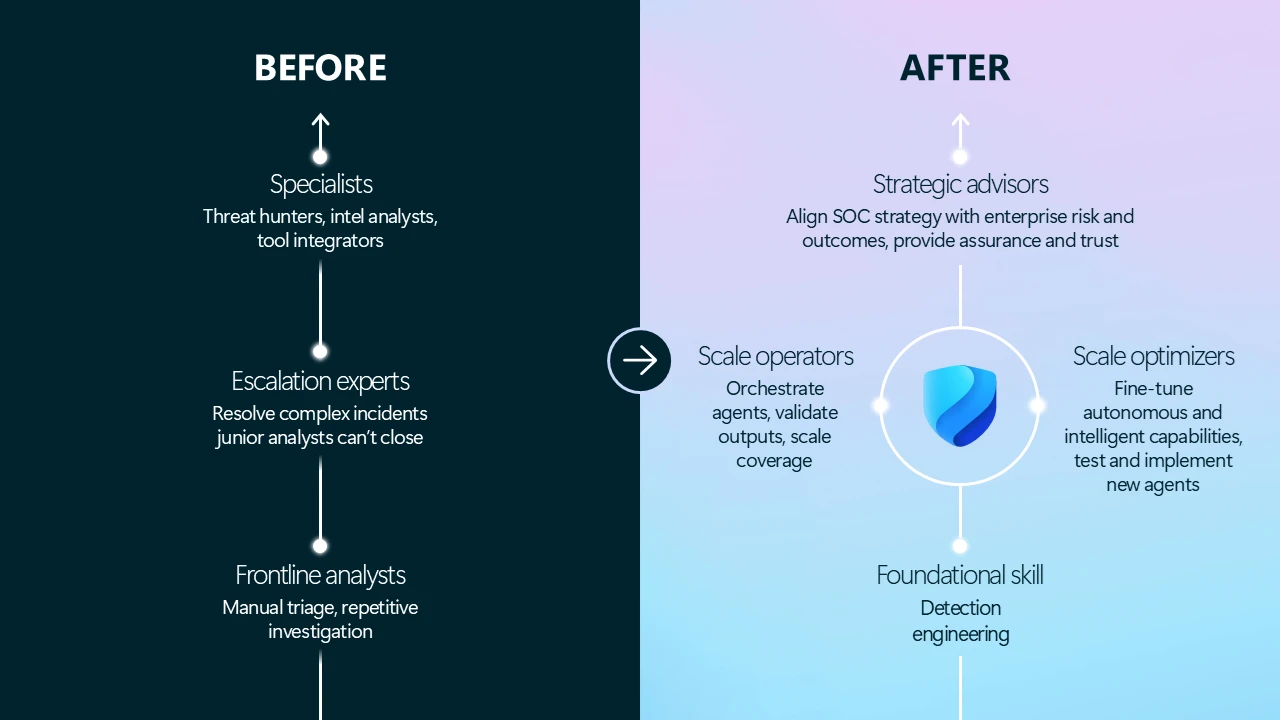
In an agentic SOC, the center of gravity will change for roles like an analyst. Fewer analysts are pulled into firefighting; more time is spent investigating how the organization is being targeted and what steps can be taken to reduce exposure. Within this new operating model, security teams will be freed to evolve the team structure and their day-to-day responsibilities.
Agentic systems increase demand for oversight, tuning, and governance. Detection and response engineering becomes more central, as teams design policies, confidence thresholds, and escalation paths. New roles emerge around supervising outcomes and refining system behavior over time.
Expertise becomes more valuable, not less. Judgment, context, and institutional knowledge are no longer consumed by repetitive tasks—they shape how the SOC operates at scale. And skilled practitioners closer to strategy, quality, and accountability.
To make this shift tangible, here’s how key roles are evolving:
Analysts: from triaging alerts to supervising outcomes. Analysts validate agent‑led investigations, determine when deeper inquiry is needed, focus on ambiguous cases, and guide system learning over time.
Detection engineers: from writing rules to teaching the system what matters. Engineers decide which signals are trustworthy, add the right context, and set confidence thresholds so detections can be acted on automatically—without human review every time.
Threat hunters: from manual queries to hypothesis-driven exploration. Hunters use AI to surface anomalies and focus on creative investigation and adversary simulation.
SOC leadership: from managing queues to orchestrating autonomy. Leaders define automation policies, oversee governance, and align AI actions with business risk.
Each shift reflects a broader truth: in the agentic SOC, people don’t do less—they do more of what matters.
The agentic SOC journey
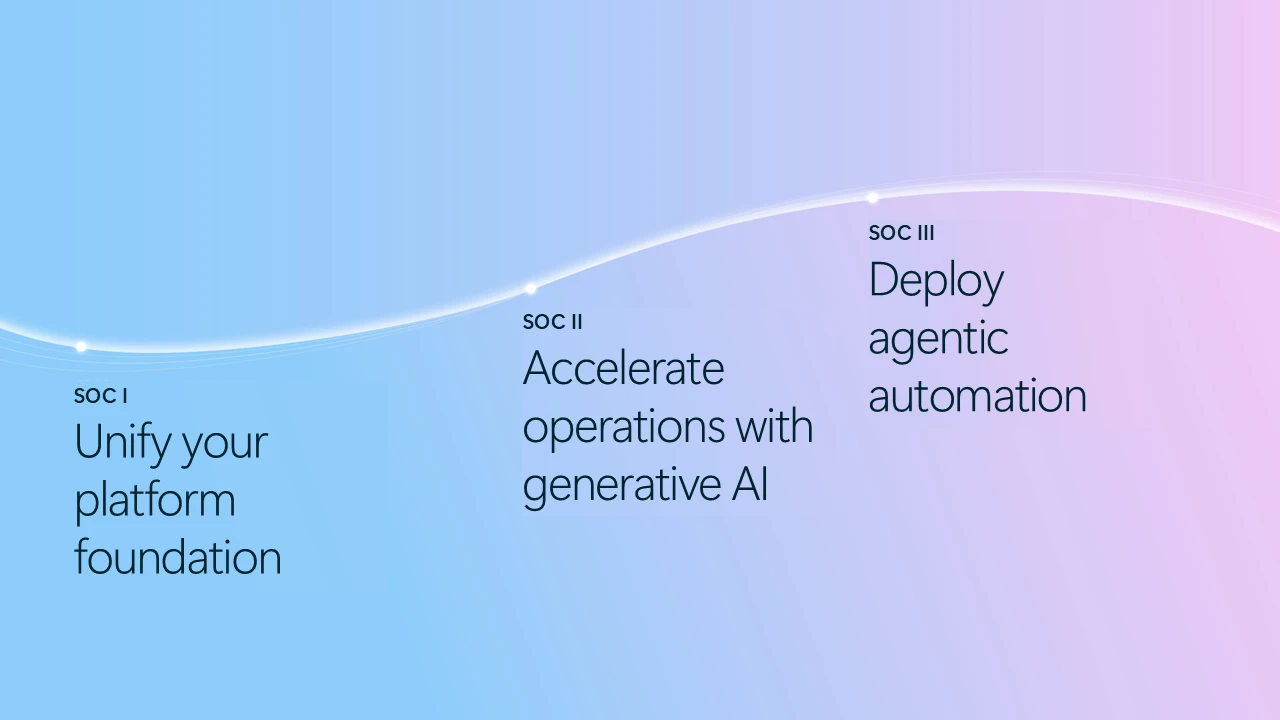
This is a significant change in how security teams operate, and it doesn’t happen overnight. Based on our own experience, we’ve outlined a maturity model that shows how organizations can progress toward an agentic SOC over time.
Organizations begin by establishing a trusted foundation that unifies security tooling, enables the deployment of autonomous defense and begins unifying security signal in earnest. From there, they introduce agents to take on bounded, high-volume work under human supervision, learning where automation adds leverage and where judgment still matters most. Over time, as confidence, governance, and operational discipline mature, agents expand from assisting individual workflows to coordinating broader security outcomes. At every stage, progress is measured not by how much work is automated, but by how effectively human expertise is amplified.
SOC 1—Unify your platform foundation
The shift begins with a unified security platform that enables autonomous defense. Deterministic, policy-bound protections stop high confidence cyberthreats automatically—removing urgency, reducing blast radius, and eliminating the constant context switching that slows human response. By integrating signals across identity, endpoints, and cloud, defenders gain a shared view of cyberattacks instead of stitching evidence together across tools. This foundation is what makes cross-domain action possible—and separates experimental automation from production-ready operations.
SOC 2—Accelerate operations with generative AI and task agents
With urgency reduced, generative AI changes how work flows through the SOC. Instead of pushing alerts forward, AI assembles context, synthesizes signals across domains, and produces coherent investigations. Repetitive, high-volume tasks like triage, correlation, and basic investigation are absorbed by the system, allowing analysts to focus on higher impact decisions. This stage establishes new operational patterns where humans and AI work together—accelerating response while preserving judgment and accountability.
SOC 3—Deploy agentic automation
As trust grows, agents move from assistance to action. Specialized agents autonomously orchestrate specific tasks—containing compromised identities, isolating devices, or remediating reported phishing—while humans shift into supervisory roles. Over time, agents help identify patterns, anticipate attack paths, and optimize defenses across the environment. Security teams spend less time managing queues and more time shaping posture, risk, and outcomes. These shifts compound across all three stages.
What comes next for the SOC evolution?
We believe the strongest agentic SOC models will begin with autonomous defense—deterministic, policy‑bound actions that safely stop what is already known to be dangerous at machine speed. That foundation removes urgency, noise, and latency from security operations.
Additionally, agents and humans work differently. Agents assemble context, coordinate remediation, and optimize how the SOC operates. Humans provide intent, judgment, and accountability—turning time saved into smarter, more strategic security outcomes.
This is the first of a series of posts that will explore what makes the agentic SOC model real: the platform foundations required to defend autonomously, the governance and trust mechanisms that keep autonomy safe, and the adoption journey organizations take to get there. Some organizations are already rebuilding their businesses around AI, a new class of Frontier Firms. Read more about how they’re making their move toward the agentic SOC and access a foundational roadmap for this transformation in our new whitepaper, The agentic SOC: Your teammate for tomorrow, today.
To learn more about Microsoft Security solutions, visit our website. Bookmark the Security blog to keep up with our expert coverage on security matters. Also, follow us on LinkedIn (Microsoft Security) and X (@MSFTSecurity) for the latest news and updates on cybersecurity.
Security operations are entering a pivotal moment: the operating model that grew around network logs and phishing emails is now buckling under tool sprawl, manual triage, and threat actors that outpace defender capacity. New research from Microsoft and Omdia shows just how heavy the burden can be—security operations centers (SOCs) juggle double-digit consoles, teams manually ingest data several times a week, and nearly half of all alerts go uninvestigated. The result is a growing gap between cyberattacker speed and defender capacity. Read State of the SOC—Unify Now or Pay Laterto learn how hidden operational pressures impact resilience—compelling evidence to why unification, automation, and AI-powered workflows are quickly becoming non-negotiables for modern SOC performance.
The forces pushing modern SOC operations to a breaking point
The report surfaces five specific operational pressures shaping the modern SOC—spanning fragmentation, manual toil, signal overload, business-level risk exposure, and detection bias. Separately, each data point is striking. But taken together, they reveal a more consequential reality: analysts spend their time stitching context across consoles and working through endless queues, while real cyberattacks move in parallel. When investigations stall and alerts go untriaged, missed signals don’t just hurt metrics—they create the conditions for preventable compromises. Let’s take a closer look at each of the five issues:
1. Fragmentation
Fragmented tools and disconnected data force analysts to pivot across an average of 10.9 consoles1 and manually reconstruct context, slowing investigations and increasing the likelihood of missed signals. These gaps compound when only about 59% of tools push data to the security information and event management (SIEM), leaving most SOCs manually ingesting data and operating with incomplete visibility.
Manual, repetitive data work consumes an outsized share of analyst capacity, with 66% of SOCs losing 20% of their week to aggregation and correlation—an operational drain that delays investigations, suppresses threat hunting, and weakens the SOC’s ability to reduce real risk.
3. Security signal overload
Surging alert volumes bury analysts in noise with an estimated 46% of alerts proving false positives and 42% going uninvestigated, overwhelming capacity, driving fatigue, and increasing the likelihood real cyberthreats slip through unnoticed.
4. Operational gaps
Operational gaps are directly translating into business disrupting incidents, with 91% of security leaders reporting serious events and more than half experiencing five or more in the past year—exposing organizations to financial loss, downtime, and reputational damage.
5. Detection bias
Detection bias keeps SOCs focused on tuning alerts for familiar cyberthreats—52% of positive alerts map to known vulnerabilities—leaving dangerous blind spots for emerging tactics, techniques, and procedures (TTPs). This reactive posture slows proactive threat hunting and weakens readiness for novel attacks even as 75% of security leaders worry the SOC is losing pace with new cyberthreats.
Read the fullreport for the deeper story, including chief information security officer (CISO)-level takeaways, expanded data, and the complete analysis behind each operational pressure, as well as insights that can help security professionals strengthen their strategy and improve real world SOC outcomes.
What CISOs can do now to strengthen resilience
Security leaders have a clear path to easing today’s operational strain: unify the environment, automate what slows teams down, and elevate identity and endpoint as a single control plane. The shift is already underway as forward-leaning organizations focus on high-impact wins—automating routine lookups, reducing noise, streamlining triage, and eliminating the fragmentation and manual toil that drain analyst capacity. Identity remains the most critical failure point, and leaders increasingly view unified identity to endpoint protection as foundational to reducing exposure and restoring defender agility. And as environments unify, the strength of the underlying graph and data lake becomes essential for connecting signals at scale and accelerating every defender workflow.
As AI matures, leaders are also looking for governable, customizable approaches—not black box automation. They want AI agents they can shape to their environment, integrate deeply with their SIEM, and extend across cloud, identity, and on-premises signals. This mindset reflects a broader operational shift: modern key performance indicators (KPIs) will improve only when tools, workflows, and investigations are unified, and automation frees analysts for higher value work.
The report details a roadmap for CISOs that emphasizes unifying signals, embedding AI into core workflows, and strengthening identity as the primary control point for reducing risk. It shows how leaders can turn operational friction into strategic momentum by consolidating tools, automating routine investigation steps, elevating analysts to higher value work, and preparing their SOCs for a future defined by integrated visibility, adaptive defenses, and AI-assisted decision making.
Chart your path forward
The pressures facing today’s SOCs are real, but the path forward is increasingly clear. As this report shows, organizations that take these steps aren’t just reducing operational friction—they’re building a stronger foundation for rapid detection, decisive response, and long-term readiness. Read State of the SOC—Unify Now or Pay Later for deeper guidance, expanded findings, and a phased roadmap that can help security professionals chart the next era of their SOC evolution.
To learn more about Microsoft Security solutions, visit our website. Bookmark the Security blog to keep up with our expert coverage on security matters. Also, follow us on LinkedIn (Microsoft Security) and X (@MSFTSecurity) for the latest news and updates on cybersecurity.
1The study, commissioned by Microsoft, was conducted by Omdia from June 25, 2025, to July 23, 2025. Survey respondents (N=300) included security professionals responsible for SOC operations at mid-market and enterprise organizations (more than 750 employees) across the United States, United Kingdom, and Australia and New Zealand. All statistics included in this post are from the study.

 Login