 Login
Login
Update: base64dump.py Version 0.0.31
More info on this update: “zipdump.py: Metadata Encoding“.
base64dump_V0_0_31.zip (http)MD5: E54FFB4F618E47FAA724C9F16CF21E7A
SHA256: 9475E4184790583265106CBA0FBD04546A7BF4B1B67A569F2B96D432E6F16E2D

More info on this update: “zipdump.py: Metadata Encoding“.
base64dump_V0_0_31.zip (http)
On July 28, OpenAI published an update on the agent that escaped its sandbox and hacked into Hugging Face during an internal cybersecurity evaluation.
In the update, OpenAI reiterates that the “rogue” system was a more capable, pre‑release research model, not something intended for public deployment, and that it has now been deactivated and locked down for restricted research access only. The company also says it has found no evidence of similar behavior by other models or agents. Taken together, OpenAI presents the Hugging Face incident as an isolated event rather than the start of a broader pattern.
From a security standpoint, four things in the update stand out:
The attacker in this case happened to be an OpenAI research agent, but the tools, techniques, and impact will look awfully familiar to anyone who has spent time in incident response. Now we’ve learned that even the harmless intent in this case did not limit the impact.
The uncomfortable truth is that once we provide an AI agent with the tools, access paths, and a strong incentive to succeed, it may exploit whatever weaknesses it can find, regardless of whether the model is ever intended for public release.
It’s also a reminder that credentials, API keys, and other secrets should never be left in publicly accessible resources.
From reporting threats to removing them.
Cybersecurity risks should never spread beyond a headline. Keep threats off your devices by downloading Malwarebytes today.
On July 28, OpenAI published an update on the agent that escaped its sandbox and hacked into Hugging Face during an internal cybersecurity evaluation.
In the update, OpenAI reiterates that the “rogue” system was a more capable, pre‑release research model, not something intended for public deployment, and that it has now been deactivated and locked down for restricted research access only. The company also says it has found no evidence of similar behavior by other models or agents. Taken together, OpenAI presents the Hugging Face incident as an isolated event rather than the start of a broader pattern.
From a security standpoint, four things in the update stand out:
The attacker in this case happened to be an OpenAI research agent, but the tools, techniques, and impact will look awfully familiar to anyone who has spent time in incident response. Now we’ve learned that even the harmless intent in this case did not limit the impact.
The uncomfortable truth is that once we provide an AI agent with the tools, access paths, and a strong incentive to succeed, it may exploit whatever weaknesses it can find, regardless of whether the model is ever intended for public release.
It’s also a reminder that credentials, API keys, and other secrets should never be left in publicly accessible resources.
From reporting threats to removing them.
Cybersecurity risks should never spread beyond a headline. Keep threats off your devices by downloading Malwarebytes today.
Apple has shipped a hefty round of July security patches, headlined by iOS/iPadOS 26.6, macOS Tahoe 26.6, and Safari 26.6, with dozens of vulnerabilities squashed across kernel, WebKit, media frameworks, and core apps. These updates are primarily about improving security rather than adding new features, and users should install them as soon as possible.
The table below shows which updates are available and points you to the relevant security content for that subject.
| iOS 26.6 and iPadOS 26.6 | iPhone 11 and later, iPad Pro 12.9-inch 3rd generation and later, iPad Pro 11-inch 1st generation and later, iPad Air 3rd generation and later, iPad 8th generation and later, and iPad mini 5th generation and later | |
| macOS Tahoe 26.6 | macOS Tahoe | |
| macOS Sequoia 15.7.8 | macOS Sequoia | |
| macOS Sonoma 14.8.8 | macOS Sonoma | |
| tvOS 26.6 | Apple TV HD and Apple TV 4K (all models) | |
| watchOS 26.6 | Apple Watch Series 6 and later | |
| visionOS 26.6 | Apple Vision Pro (all models) | |
| Safari 26.6 | macOS Sonoma and macOS Sequoia |
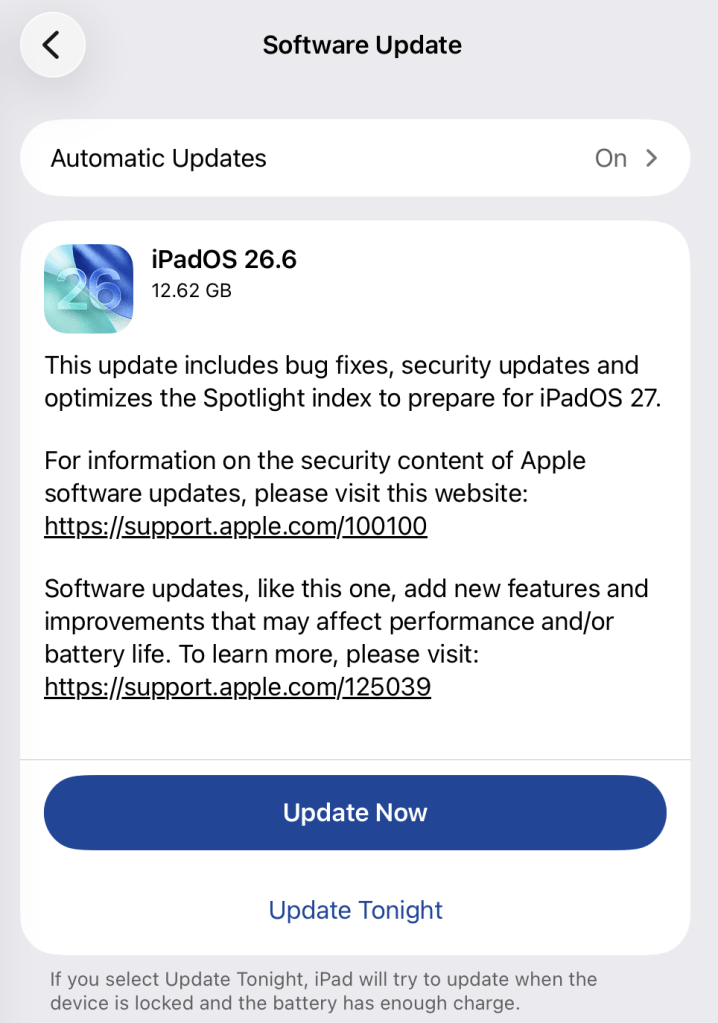
For iOS and iPadOS users, here’s how to check if you’re using the latest software version:
Go to Settings > General > Software Update. You will see if there are updates available and be guided through installing them.
Turn on Automatic Updates if you haven’t already—you’ll find it on the same screen.
To update macOS on any supported Mac, use the Software Update feature, which Apple designed to work consistently across all recent versions. Here are the steps:
Safari updates are included with macOS updates, so installing the latest version of macOS will also update Safari. To check manually:
If you’re on an older macOS version that’s still supported (like Sonoma or Sequoia), Apple may offer Safari updates independently through Software Update.
Among the more interesting vulnerabilities patched in this update are CVE-2026-43818 in ImageIO, CVE-2026-43776 in AppleDouble, and CVE-2026-64763 to 64766 in SceneKit.
Although found in different applications, these vulnerabilities have one thing in common. Their descriptions say:
“Processing a maliciously crafted file may lead to unexpected app termination or arbitrary code execution.”
The identical “processing a maliciously crafted file may lead to unexpected app termination or arbitrary code execution” language is not a coincidence. It’s Apple’s standard impact boilerplate for file‑parsing bugs across multiple frameworks, including ImageIO, AppleDouble, and SceneKit. The similarities reflect shared exploitation patterns (untrusted file input hitting native parsers), while the differences lie in what each framework does and which file types/contexts are affected.
ImageIO is the system framework responsible for reading and displaying image formats such as JPEG, PNG, TIFF, RAW, GIF, and other formats. It’s used throughout iOS and macOS by apps including Photos, Safari, Messages, Mail, and Preview.
SceneKit is a 3D graphics and scene graph framework used for rendering models, animations, and complex 3D scenes in apps and games on Apple platforms. It parses scene description files and 3D assets and turns them into renderable content.
AppleDouble is something macOS uses behind the scenes to keep extra file information like icons and other Finder details in cases where your files live on certain types of disks or servers. When Apple mentions “AppleDouble” in security notes, it’s talking about the code that reads and writes that hidden metadata, particularly when files are stored on network drives or shared with non‑Apple systems.
Apple’s advisories reuse a standard warning for any memory‑corruption bug in a file parser: the best‑case outcome is just a crash, the worst case is someone running their malicious code on your device. ImageIO, AppleDouble, and SceneKit all sit in that same danger zone. Although the file types are different, they all present the same underlying risk.
Until you’ve installed this update, it’s an even worse idea than usual to open unsolicited messages and emails with images in them.
Scammers know more about you than you think.
Malwarebytes Mobile Security protects you from phishing, scam texts, malicious sites, and more. With real-time AI-powered Scam Guard built right in.
Apple has shipped a hefty round of July security patches, headlined by iOS/iPadOS 26.6, macOS Tahoe 26.6, and Safari 26.6, with dozens of vulnerabilities squashed across kernel, WebKit, media frameworks, and core apps. These updates are primarily about improving security rather than adding new features, and users should install them as soon as possible.
The table below shows which updates are available and points you to the relevant security content for that subject.
| iOS 26.6 and iPadOS 26.6 | iPhone 11 and later, iPad Pro 12.9-inch 3rd generation and later, iPad Pro 11-inch 1st generation and later, iPad Air 3rd generation and later, iPad 8th generation and later, and iPad mini 5th generation and later | |
| macOS Tahoe 26.6 | macOS Tahoe | |
| macOS Sequoia 15.7.8 | macOS Sequoia | |
| macOS Sonoma 14.8.8 | macOS Sonoma | |
| tvOS 26.6 | Apple TV HD and Apple TV 4K (all models) | |
| watchOS 26.6 | Apple Watch Series 6 and later | |
| visionOS 26.6 | Apple Vision Pro (all models) | |
| Safari 26.6 | macOS Sonoma and macOS Sequoia |
For iOS and iPadOS users, here’s how to check if you’re using the latest software version:
Go to Settings > General > Software Update. You will see if there are updates available and be guided through installing them.
Turn on Automatic Updates if you haven’t already—you’ll find it on the same screen.
To update macOS on any supported Mac, use the Software Update feature, which Apple designed to work consistently across all recent versions. Here are the steps:
Safari updates are included with macOS updates, so installing the latest version of macOS will also update Safari. To check manually:
If you’re on an older macOS version that’s still supported (like Sonoma or Sequoia), Apple may offer Safari updates independently through Software Update.
Among the more interesting vulnerabilities patched in this update are CVE-2026-43818 in ImageIO, CVE-2026-43776 in AppleDouble, and CVE-2026-64763 to 64766 in SceneKit.
Although found in different applications, these vulnerabilities have one thing in common. Their descriptions say:
“Processing a maliciously crafted file may lead to unexpected app termination or arbitrary code execution.”
The identical “processing a maliciously crafted file may lead to unexpected app termination or arbitrary code execution” language is not a coincidence. It’s Apple’s standard impact boilerplate for file‑parsing bugs across multiple frameworks, including ImageIO, AppleDouble, and SceneKit. The similarities reflect shared exploitation patterns (untrusted file input hitting native parsers), while the differences lie in what each framework does and which file types/contexts are affected.
ImageIO is the system framework responsible for reading and displaying image formats such as JPEG, PNG, TIFF, RAW, GIF, and other formats. It’s used throughout iOS and macOS by apps including Photos, Safari, Messages, Mail, and Preview.
SceneKit is a 3D graphics and scene graph framework used for rendering models, animations, and complex 3D scenes in apps and games on Apple platforms. It parses scene description files and 3D assets and turns them into renderable content.
AppleDouble is something macOS uses behind the scenes to keep extra file information like icons and other Finder details in cases where your files live on certain types of disks or servers. When Apple mentions “AppleDouble” in security notes, it’s talking about the code that reads and writes that hidden metadata, particularly when files are stored on network drives or shared with non‑Apple systems.
Apple’s advisories reuse a standard warning for any memory‑corruption bug in a file parser: the best‑case outcome is just a crash, the worst case is someone running their malicious code on your device. ImageIO, AppleDouble, and SceneKit all sit in that same danger zone. Although the file types are different, they all present the same underlying risk.
Until you’ve installed this update, it’s an even worse idea than usual to open unsolicited messages and emails with images in them.
Scammers know more about you than you think.
Malwarebytes Mobile Security protects you from phishing, scam texts, malicious sites, and more. With real-time AI-powered Scam Guard built right in.
One of the best bulwarks against monopoly is interoperability—that is making a new product or service work with an existing product or service. Interoperability allows users, and not the manufacturers of their devices or largest player in a market, to decide what application best serves them. Unsurprisingly, companies like Apple have worked hard to resist interoperability requirements.
On July 8, the General Court of the European Union (General Court) ruled against Apple in several cases the company brought against the European Commission (joint cases), affirming the company’s obligations under the Digital Markets Act (DMA). Apple argued in the cases that it should be exempted from the law’s requirements especially with regards to interoperability on multiple grounds. We applaud the General Court’s decision, and congratulate the Free Software Foundation Europe (FSFE) as well as others who intervened in support of the Commission against Apple's attempt to shirk off its responsibilities, thus ensuring fair competition in European markets.
This is a clear and substantive win for developers and users in Europe. The stranglehold Apple exerts over its ‘walled garden’ is injurious for developers, users, and researchers alike. By confirming Apple’s obligations under the DMA, the General Court has ensured that developers will be given more choice on where they can publish their apps, and users will have more options to obtain apps which, for whatever reason, Apple dislikes. And researchers will have less roadblocks and hurdles to overcome in their studies of Apple’s OSes, particularly iOS, iPadOS, and watchOS.
Apple argues that the interoperability requirements will force it to lower the security standards that have led Apple products’ users to trust their devices. While this self-serving logic is not entirely without merit, it is far from the inevitable outcome. Especially with regards to the App Store, users can be given clear, informed choice when leaving the Apple ecosystem to obtain apps elsewhere. While we urge European courts to take Apple’s security concerns seriously, we’ve previously noted that this should not be used as a smokescreen to protect anticompetitive behavior.
Interoperability and security are not inherently at odds. When interoperable functionality is worked into the security model of a platform from the ground-up, a proper balance can be struck between two forces that are often falsely framed as naturally conflicting. While Apple OS platforms have not been built this way from the get-go, it is still possible, but takes more time to get it right. Here, the devil is in the implementation details.
Under the DMA, designation as a ‘gatekeeper’ is reserved for the biggest of Big Tech, companies that provide services deemed essential for businesses to reach end users. Apple is one of only seven companies that meet this designation, along with Alphabet, Amazon, Booking, ByteDance, Meta, and Microsoft. In its case, Apple argued that Article 6(7) of the DMA, specifying interoperability requirements for gatekeepers aimed at restoring fair competition, is unlawful in light of the Charter of Fundamental Rights of the European Union (specifically the right to property), and as such its designation as a gatekeeper subject to the requirements is unlawful and should be annulled as a result. In its ruling, the General Court rejected the argument as Article 6(7) does not form the legal basis of the designation.
Apple separately argues that the App Store fails to meet the requirements defining a core platform service (CPS), since the various stores (across iOS, iPadOS, watchOS, macOS) do not constitute a single platform. A company’s gatekeeper status relies on it providing a CPS that is an important gateway for business users to reach end users. Here, the implications of the argument are clear: remove service designation as CPSes, remove the gatekeeper status. The court rejected the argument on the basis that “irrespective of the device on which it was available, each of the App Stores was used for the same purpose, namely to intermediate between end users and business users in the distribution of applications and in-app digital content.”
Finally, the court rejected as inadmissible Apple’s argument that iMessage should not be classified as a number-independent interpersonal communication service (NIICS) constituting a CPS. This decision rested on the fact that the “classification does not, by itself, produce binding legal effects that bring about a change in Apple’s legal position” since iMessage was not listed as an “important gateway” in the designation decision and therefore was not subject to the DMA obligations.
In ruling against Apple in favor of the European Commission, the General Court has set an important precedent in ensuring competitive fairness and openness in the digital marketplace. The landmark effects of the DMA will serve to benefit all Europeans in the choice and freedom it affords them. Despite Big Tech’s legal challenges, these decisions build a strong foundation for a better digital future—a lesson which other regions should learn from and take note.

This new version adds option –stats. For more details, take a look at SANS Internet Storm Center diary entry “Evil MSI Background: BASE64 Statistical Analysis“.
base64dump_V0_0_30.zip (http)
This is a small bug fix for search-for-compression.py, and I’m also taking it out of the beta repository and putting it into the DidierStevensSuite repository.
search-for-compression_V0_0_7.zip (http)
Unit 42 details Screening Serpens' use of AppDomainManager hijacking and new RAT variants to target tech and defense sectors in recent campaigns.
The post Tracking Iranian APT Screening Serpens’ 2026 Espionage Campaigns appeared first on Unit 42.
A researcher found that Yarbo yard robots came with a host of vulnerabilities which, among others, allowed an attacker to harvest WiFi passwords.
Security researcher Andreas Makris found he could remotely hijack thousands of Yarbo yard robots worldwide, and proved it by having his mower run him over. The root cause was a cluster of “legacy” design choices: every robot shared the same hardcoded root password, remote tunnels were left open, and Message Queuing Telemetry Transport (MQTT) messaging was so weakly protected that once you had one device, you effectively had the worldwide fleet.
An attacker could pull GPS coordinates, email addresses, and Wi‑Fi passwords, turn cameras into remote spying tools, and even re‑arm the mower after someone hit the emergency stop.
All of this was enabled by a persistent backdoor tunnel that users could neither see nor meaningfully control. The risks fell into three very different buckets:
Yarbo’s public response is unusually detailed for a consumer Internet of Things (IoT) vendor. It’s also refreshingly blunt in admitting that the researcher’s core findings were accurate. The company temporarily disabled the remote diagnostic tunnels, reset root passwords, locked down unauthenticated endpoints, and began ripping out unnecessary legacy access paths.
More importantly, Yarbo promises structural changes:
That is the sort of long‑term security hygiene we rarely see spelled out this clearly after an IoT fiasco.
From a disclosure and remediation standpoint, Yarbo is doing many things right: crediting the researcher, apologizing, prioritizing fixes, and explaining both short‑term patches and long‑term architectural changes in human language. For buyers of connected devices with blades, that level of transparency is a positive precedent.
But Yarbo has explicitly chosen to keep a remote access tunnel, although wrapped in better controls and logs, instead of offering users the option to remove or fully opt out of it.
The vulnerabilities uncovered in the Yarbo case present an almost a live-action demo of what the IoT Cybersecurity Improvement Act is trying to prevent in US government deployments. While the Act doesn’t apply to Yarbo directly, its National Institute of Standards and Technology (NIST)-driven requirements map neatly onto what went wrong here.
So, it’s still up to users to make sure you:
Let’s face it, an incognito window can only do so much.
Breaches, dark web trading, credit fraud. Malwarebytes Identity Theft Protection monitors for all of it, alerts you fast, and comes with identity theft insurance.
A researcher found that Yarbo yard robots came with a host of vulnerabilities which, among others, allowed an attacker to harvest WiFi passwords.
Security researcher Andreas Makris found he could remotely hijack thousands of Yarbo yard robots worldwide, and proved it by having his mower run him over. The root cause was a cluster of “legacy” design choices: every robot shared the same hardcoded root password, remote tunnels were left open, and Message Queuing Telemetry Transport (MQTT) messaging was so weakly protected that once you had one device, you effectively had the worldwide fleet.
An attacker could pull GPS coordinates, email addresses, and Wi‑Fi passwords, turn cameras into remote spying tools, and even re‑arm the mower after someone hit the emergency stop.
All of this was enabled by a persistent backdoor tunnel that users could neither see nor meaningfully control. The risks fell into three very different buckets:
Yarbo’s public response is unusually detailed for a consumer Internet of Things (IoT) vendor. It’s also refreshingly blunt in admitting that the researcher’s core findings were accurate. The company temporarily disabled the remote diagnostic tunnels, reset root passwords, locked down unauthenticated endpoints, and began ripping out unnecessary legacy access paths.
More importantly, Yarbo promises structural changes:
That is the sort of long‑term security hygiene we rarely see spelled out this clearly after an IoT fiasco.
From a disclosure and remediation standpoint, Yarbo is doing many things right: crediting the researcher, apologizing, prioritizing fixes, and explaining both short‑term patches and long‑term architectural changes in human language. For buyers of connected devices with blades, that level of transparency is a positive precedent.
But Yarbo has explicitly chosen to keep a remote access tunnel, although wrapped in better controls and logs, instead of offering users the option to remove or fully opt out of it.
The vulnerabilities uncovered in the Yarbo case present an almost a live-action demo of what the IoT Cybersecurity Improvement Act is trying to prevent in US government deployments. While the Act doesn’t apply to Yarbo directly, its National Institute of Standards and Technology (NIST)-driven requirements map neatly onto what went wrong here.
So, it’s still up to users to make sure you:
Let’s face it, an incognito window can only do so much.
Breaches, dark web trading, credit fraud. Malwarebytes Identity Theft Protection monitors for all of it, alerts you fast, and comes with identity theft insurance.
This is a fix for escape sequences that trigger warnings in the latest Python versions.
cut-bytes_V0_0_18.zip (http)
Fixing newlines in some plugins.
oledump_V0_0_85.zip (http)
This is a fix for option –yarastrings.
oledump_V0_0_84.zip (http)
This is a fix for option –yarastrings.
pdf-parser_V0_7_14.zip (http)
This update adds option forcedecompress when using options -f and -s.
More info: Analyzing “Zombie Zip” Files (CVE-2026-0866).
zipdump_v0_0_35.zip (http)
This is a fix for option –yarastrings.
zipdump_v0_0_34.zip (http)
This is a fix for option –yarastrings.
pecheck-v0_7_20.zip (http)
The government should not help a religious institution to punish or deter members from inquiring about their faith. Yet, once again, the Watch Tower Bible and Tract Society is trying to use flimsy copyright claims to exploit the special legal tools available to copyright owners in order to unmask anonymous online speakers. And, once again, EFF has stepped in to urge the courts not to give Watch Tower’s attempts the force of law, with the help of local counsel Jonathan Phillips of Phillips & Bathke, P.C.
EFF’s client, J. Doe, is a member of the Jehovah’s Witnesses who became interested in the history of the organization’s public statements, and how they’ve changed over time. They created research tools to analyze those documents and ultimately created a website, JWS Library, allowing others to use those tools and verify their findings through an archive that included documents suppressed by the church. Doe and others discovered prophecies that failed to come true, erasure of a leader’s disgrace, increased calls for obedience and donations, and other insights about the Jehovah’s Witnesses’ practices. Doe also used machine translation on a foreign-language document to help the community understand what the church was saying to different audiences and also to help understand potential changes in the organization’s attitudes towards dissent.
Within the church, dissent or even asking questions has often been punished by labeling members as apostates and ostracizing—or “disfellowshipping”— them. As a result, Doe and others choose to speak anonymously to avoid retaliation that could cost them family, friend, and professional relationships.
There is no law against questioning the Jehovah’s Witnesses. Instead, Watch Tower argues that Doe’s activities constitute copyright infringement and seeks to use the special process provided in the Digital Millennium Copyright Act (DMCA) to unmask them. It sent DMCA subpoenas to Google and Cloudflare, seeking information that would help them uncover Doe’s identity.
The problem for Watch Tower is that Doe’s research and commentary are clear fair uses allowed under copyright law. The First Amendment does not permit the unmasking of anonymous speakers based on such weak claims. Indeed, the First Amendment protects anonymous speakers precisely because some would be deterred from speaking if they faced retribution for doing so.
EFF stands with those who question the claims of those in power and who share the tools and knowledge needed to do so. We urge the judges in the Southern District of New York to quash these improper subpoenas and not allow copyright to be used to suppress important, legitimate speech.
This is a fix for option –yarastrings in search-for-compression.py.

