❌

Reading view

Hackers put porn on public billboards and claim it was “far too easy”

While digital billboards are supposed to grab your attention, recent reports from Egypt, Malaysia, and Brazil described them doing so with explicit footage.

The cyberattacks were claimed by a group called Leakers$, which said it exploited software used to send content to LED displays.

The group said it did not hack into individual billboards to show the pornographic footage, but that it accessed the software used to send the content.

For example, on October 29, explicit footage appeared on a large billboard overlooking one of Egypt’s busiest highways. Videos circulating online showed the attackers’ aliases and a Telegram channel address overlaid on the footage. Some motorists stopped to record it.

Egyptian authorities said the billboard’s operator suffered a website compromise, resulting in unauthorized footage appearing in several countries simultaneously. Similar events were reported in Malaysia and Brazil. The attackers also claimed access to systems in Iraq and China, but those claims are less firmly corroborated.

Speaking to The Cairo Report, a representative of Leakers$ claimed the group found thousands of exposed systems during roughly two hours of automated scanning. The representative described a vulnerability in content-transmission software and weaknesses accessible through the systems’ own web pages and interfaces.

That is the group’s account, but if it is accurate, it helps explain the apparent ease and reach of the attack:

  • Internet exposure makes targets discoverable. Attackers can scan for reachable management systems rather than physically approach individual screens.
  • Repeated software weaknesses can scale. Finding a flaw in software used across multiple installations can create opportunities far beyond one billboard.
  • Content-management access is the prize. Someone who gains control of the system that publishes advertisements may be able to replace legitimate content without touching the display itself.

This is another example of how convenient remote management can expose systems to attack. Recent attacks on refrigerated systems in European supermarkets demonstrated a similar risk. The cooling systems are internet-connected, so mechanics can remotely diagnose and fix problems.

What should be done

The risk of food waste or dangerous traffic situations should be a warning to review what organizations need to do to prevent their systems from being hacked and abused.

Regarding digital billboards, the Out of Home Advertising Association of America’s security guidelines tell operators not to rely on manufacturers’ default passwords or reuse passwords across displays. They also recommend restricting access to management services, using multifactor authentication, and protecting remote connections with a VPN.

But the practical response is less about protecting a giant television and more about securing a remotely managed computer system:

  • Restrict management access rather than leaving it open to the public internet.
  • Replace default and reused passwords and enable multifactor authentication.
  • Keep signage software, controllers, and networking equipment updated.
  • Check who has access, including suppliers, and how that access is protected.
  • Monitor systems and rehearse a way to stop unauthorized access quickly.

These same basic rules can be applied to smart household appliances.


What do cybercriminals know about you?

Use Malwarebytes’ free Digital Footprint scan to see whether your personal information has been exposed online.

  •  

Deepfake porn sites are going offline (re-air) (Lock and Code S07E12)

This week on the Lock and Code podcast…

If you weren’t taking deepfakes seriously before, it’s too late now to ignore them.

According to new research from Malwarebytes, one in three people who use AI every day said it’s okay to generate pornography of people without their consent.

Nearly 10 years ago, “deepfake” technology provided hobbyists and film editors with artificial intelligence (AI) tools to swap the face of one person onto the body of another. In its infancy, this technology brought silly film experiments like swapping Tom Cruise in Mission Impossible with Keanu Reeves. Today, this same technology produces something far more harmful—fake nude images of teenagers.

On the Lock and Code podcast today with host David Ruiz, we are re-visiting an interview from 2024, in which we spoke with a lawyer named David Chiu about his lawsuit against 16 deepfake nude generation websites.

The websites named in that lawsuit often needed just one image of a person to generate fake pornography. And while nearly everyone has at least one image of themselves online, even if they had hundreds, the path towards deletion is somewhat understood—start by deactivating and deleting popular social media accounts. But for teenagers today, raised mostly online, and who share images directly with friends and boyfriends and girlfriends and exes, it’s likely impossible to remove every visual trace of themselves. Also, they shouldn’t have to face this problem alone.

The Lock and Code podcast frequently discusses structural problems that require individual management. You have to skirt corporate data collection. You have to find the automated license plate readers in your hometown. You have to review every single message you get with a certain antagonism, to guard yourself against scams.

So, it’s rare to encounter a solution that benefits more than one person.

Chiu serves as the City Attorney for San Francisco, which means his department can file a lawsuit on behalf of not just the people of San Francisco, but also California, and that’s what his team did in going after the deepfake websites.

Since then, Chiu’s department has shut down 10 deepfake nude websites, and it received a settlement agreement from a company called Briver LLC to no longer operate any website that creates nonconsensual deepfake pornography.

And, as California goes, so goes the nation.

In May of last year, the Take It Down Act became effective as law in the United States, which criminalizes “revenge porn” and AI-generated nonconsensual intimate imagery. The law is not perfect but so far it is being used as intended. Last month, two men in the US were among the first to be charged with violating the Take It Down act for allegedly creating deepfake nudes that, according to the AP, “included both celebrities as well as private women, including recent high school graduates.”

Today, we revisit our conversation with San Francisco City Attorney David Chiu about the important fight against deepfake porn and the clear threat that his department found against the public.

“At least one of these websites specifically promotes the non-consensual nature of this. So, and I’ll just quote, ‘Imagine wasting time taking her out on dates when you can just use website X to get her nudes.'”

Tune in today to listen to the full conversation.

Show notes and credits:

Intro Music: “Spellbound” by Kevin MacLeod (incompetech.com)
Licensed under Creative Commons: By Attribution 4.0 License
http://creativecommons.org/licenses/by/4.0/
Outro Music: “Good God” by Wowa (unminus.com)


Listen up—Malwarebytes doesn’t just talk cybersecurity, we provide it.

Protect yourself from online attacks that threaten your identity, your files, your system, and your financial well-being with our exclusive offer for Malwarebytes Premium Security for Lock and Code listeners.

  •  

Argamal RAT: attackers distributing a remote access Trojan through hentai games | Kaspersky official blog

In April 2026, we discovered a new campaign targeting users of hentai games. Attackers are embedding a remote access Trojan named Argamal into game installers. While concealing its presence, it can remotely control the computer and steal files and personal data.

Here’s how to avoid falling victim to this new Trojan — and how to safely and anonymously enjoy spicy content with (or without) anime girls.

How computers get infected with Argamal

Most of the infected games are distributed through adult game and torrent sites. In some cases, they are posted for download on file-sharing services and linked on gaming websites.

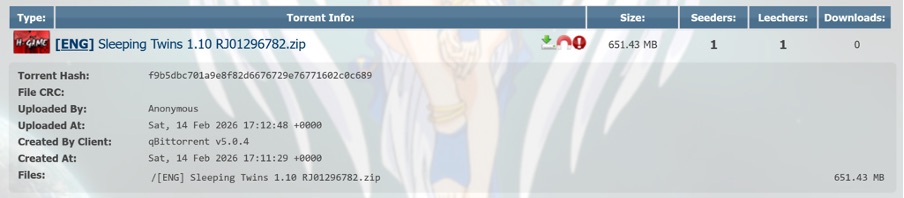
Trojanized hentai game Sleeping Twins hosted on AniRena

Example of a trojanized game hosted on the AniRena torrent tracker

Interestingly, instead of finding a dummy file inside the archive — as is often the case — the user gets the actual game built on popular engines like RenPy or RPG Maker. Infected pirated versions usually turn out to be scams: games fail to launch, folders are full of files with bizarre extensions, making it rather easy to put two and two together. Here, however, the user gets the actual gameplay they expected. Meanwhile, the Trojan lets itself in and keeps a completely low profile.

Malicious website featuring a library of trojanized hentai games

Example of a trojanized game hosted on the AniRena torrent tracker

Tucked right alongside the legitimate files in the archive is a DLL that the game relies on to run, but it’s been rigged: as soon as the user launches the game, the infected DLL automatically loads into memory. There are no outward signs of infection: neither an installer popping up in the background, nor a scary window or prompt asking you to disable your antivirus.

Argamal takes things real slow: instead of immediately rushing to steal files and passwords or throwing a digital rager on your computer, the Trojan first checks whether it’s running in a virtual machine or sandbox, and then goes into standby mode.

During this time, the malware writes hidden parameters to the system, conceals the paths to its DLLs, and delays its own execution. Three days later, the computer connects to GitHub, downloads an encrypted file, decrypts it, and turns it into a working Trojan module.

To ensure persistence, the attackers register the malware under the WindowsColorSystem Calibration Loader system task, a built-in Windows feature that triggers at every user logon to load monitor color profiles. Before shutting down, the malware deletes temporary files and covers its tracks to make it even harder to detect.

What makes Argamal dangerous?

Argamal is a remote access Trojan (RAT), which means attackers can use it to remotely control the victim’s computer. Here’s just a short list of what it may entail:

  • Executing arbitrary commands on the computer
  • Downloading and running files
  • Checking if an antivirus is installed on the PC (by the way, our security solution detects and neutralizes Argamal before it can harm you)
  • Searching for and exfiltrating sensitive data from files and system settings
  • Taking screenshots and streaming video from the device
  • Sending data to the attackers’ server
  • Monitoring user activity
  • Shutting down or restarting the device

Essentially, the infected computer turns into a remotely controlled machine. The owner may keep calmly going about their day, completely unaware that their device has been compromised. Yet the consequences of such an infection can be devastating.

For example, a single password stolen from a text note can lead to multiple compromised accounts at once if the victim reuses the same credentials across different sites. That’s why we recommend storing strong and unique passwords in an encrypted vault of a password manager rather than in plain text files.

Beyond hijacking accounts, the Trojan lets attackers literally spy on the user — reading their chats, digging into secret files, studying their sexual preferences… The cybercriminals can then use this highly sensitive information for subsequent attacks, blackmail, and extortion. We’ve covered what to do if you find yourself being targeted by extortionists in a previous post.

Another common scenario involves quietly stealing or substituting financial data — for instance, intercepting credentials from banking apps or replacing crypto-wallet addresses in the clipboard, which sends all your money straight to the attackers’ accounts.

In short, there’s a whole laundry list of ways attackers can exploit a victim’s device and data.

Argamal, yamete kudasai! How to protect yourself from similar threats

If you’ve decided to become the proud owner of “Waifu Simulator Ultra Definitive Edition”, stay on your guard:

  • Use security software that runs in real time and catches sophisticated malware. Despite the attackers’ best efforts to make the Trojan invisible, Kaspersky Premium instantly detects and removes Argamal from users’ devices.
  • Avoid downloading adult apps, installation files, and spicy content from untrusted sources. Clicking a “free XXX game, no signup needed” is a surefire way to invite malware onto your device. That said, even official platforms like Google Play and the App Store unfortunately let infected apps slip through the cracks at times. To stop worrying about accidentally downloading a Trojan or an infostealer, use Kaspersky Premium on all your devices.
  • Don’t share more data than you absolutely have to. If an adult game or website insists you sign up, enter personal data, or link third-party accounts instead of just checking your birth date, that’s a huge red flag. Sites rarely collect sensitive data for no reason. In the best-case scenario, it ends up with marketers and ad trackers. In the worst-case, it falls into the hands of bad actors who will use it for blackmail, phishing, or breaking into your other accounts.
  • Don’t click ad banners on adult websites. Even the most popular platforms like Pornhub occasionally host ads laced with malware. If you find it hard to hold back, use a security solution that will block malware downloads and prevent redirects to suspicious sites.

  •  
❌