Reading view

Shifting from Data Hoarding to Active Defense: Navigating the New Era of OMB M-26-14

The release of OMB Memo M-26-14 ("Ensuring Effective and Efficient Agency Logging and Network Visibility to Defend Against Evolving Cyber Threats") marks a historic turning point in federal cybersecurity. By officially rescinding the M-21-31 directive, the White House has delivered a clear message to federal IT leaders: the era of compliance-driven data hoarding is officially over.

While the previous framework was a well-intentioned response to the SolarWinds breach, its mandate to collect and retain vast oceans of unstructured logging data created unintended, unsustainable operational burdens. For the past several years, federal agencies have faced skyrocketing cloud storage bills and overwhelmed Security Operations Centers (SOCs). Crucially, they have been left with vast quantities of cold data that lacked clear operational utility.

As OMB noted, retaining endless data without operational focus is neither cost-effective nor operationally feasible. With M-26-14, the federal government is pivoting to a smarter, sleeker, and far more decisive strategy: a risk-based, prioritized logging framework driven by AI and machine-speed defense.

The Core Shifts: What Federal Leaders Must Understand

M-26-14 strips away administrative "red tape" to focus on how modern cybersecurity risks have evolved. Nation-state threat actors are actively leveraging advanced automation and Artificial Intelligence (AI) to orchestrate attacks at unprecedented speeds. They move laterally across agencies in minutes, hiding behind legitimate corporate credentials.

To beat machine-speed threats, your data layer must operate at machine-scale. The new memo reorganizes federal visibility around two foundational pillars:

1. Continuous Event Monitoring — Owning the Present

Continuous Event Monitoring demands that logging infrastructure shift from a passive archiving tool to a live-streaming asset. Agencies are now required to monitor network and asset activity in real time, rapidly flag anomalous behavior via behavioral analytics, and initiate immediate mitigation actions directly through their SOCs.

2. Threat Hunting, Investigation, Response, and Forensics — Dominating the Post-Compromise

When a compromise is suspected, agencies can no longer spend days running slow database queries or pulling disconnected csv files. M-26-14 mandates that agencies keep 6 months of logs "hot and searchable" and 1 year fully "retrievable." This allows defenders to immediately stitch together cross-domain attack patterns, perform rapid root-cause forensics, and share threat intelligence seamlessly with CISA and the FBI.

3. Expanding the Blast Radius: Entering IoT and OT

Perhaps the most significant structural change is the explicit inclusion of Internet of Things (IoT) and Operational Technology (OT) systems. Adversaries do not respect the boundary between your corporate IT network and your physical infrastructure. Under M-26-14, your logging and threat-hunting capabilities must aggressively cover the entire enterprise—from public cloud workloads to the physical facility controls and critical infrastructure grids running on an agency's behalf.

The Clock is Ticking: The Aggressive Maturity Deadlines

Agencies cannot afford a passive approach. The timeline established by OMB M-26-14 moves quickly:

  • T+90 Days: CISA will publish the new Logging Reference Architecture (LRA) codifying hybrid/centralized deployments, Zero Trust Maturity Model (ZTMM) integration, and AI-driven monitoring guidelines.
  • LRA +90 Days: Agencies must submit their comprehensive Agency Logging Plans.
  • LRA +120 Days: Achieve Basic Level 1 Maturity.
  • LRA +180 Days: Achieve Intermediate Level 2 Maturity.
  • LRA +320 Days: Achieve Advanced Level 3 Maturity (Advanced/Optimal Effectiveness).

Activating OMB M-26-14 with Palo Alto Networks Cortex

Trying to retrofit a legacy SIEM architecture to meet the advanced or optimal effectiveness tiers of M-26-14 is an engineering and budgetary dead end. Legacy SIEMs scale costs linearly with ingestion and rely on static, human-written correlation rules that fail against AI-fueled threats.

The FedRAMP Certified Palo Alto Networks Cortex platform—anchored by Cortex XSIAM (Extended Security Intelligence and Automation Management)—was engineered from the ground up to solve the exact problems this new memo addresses.

From Disconnected Columns to Cross-Domain "Stitching"

Legacy logging stores data in isolated silos. An analyst trying to track an adversary has to manually look at an identity log, cross-reference it with a network firewall alert, and match it to an endpoint execution.

Cortex XSIAM features a revolutionary Analytics Engine that automatically stitches multi-vendor logs across cloud, network, endpoint, and identity at the moment of ingestion. It transforms raw text into a single, cohesive, context-rich story, instantly aligning incidents with the MITRE ATT&CK framework.  Cortex XSIAM doesn’t just ingest data, it understands the data which enables stitching of multiple data elements into a single, multi-context construct which accelerates analysis via AI and machine learning.

Replacing Static Rules with Cloud-Scale AI

Adversaries use AI to evade signature detection. Cortex XSIAM fights fire with fire, applying out-of-the-box, unsupervised machine learning models to baseline normal behavioral patterns across your entire federal enterprise. When an anomalous lateral movement, data exfiltration attempt, or credential abuse event occurs, XSIAM flags the threat instantly—without requiring your team to spend weeks writing custom correlation code.

Accelerating Continuous Event Monitoring (CEM) and Threat Hunting, Investigation, Response and Forensics (THIRF)

There is more to CEM than just monitoring network activity.  Activity on endpoints, within your identity management solution(s) and in the cloud are just as important.  Understanding the data, knowing which log records are related to each other across multiple log sources, which events are relevant and the context they provide is required.  

Understanding these events and their contextual relationships is fundamental to providing THIRF in an efficient manner.  Cortex XSIAM provides over 2,900 machine learning models out of the box, models that are trained on the data in your environment so they detect anomalous activity based on what is “normal” in your environment, not trained on generic data from other customers or a lab.  These models can identify threats based on data stitched together from multiple sources to provide a more complete context yielding more accurate and consistent results while decreasing time to value.

Securing the Unmanageable: Agentless IoT/OT Defense

You cannot install an EDR logging agent on a smart building HVAC system or an industrial programmable logic controller (PLC). Palo Alto Networks utilizes non-disruptive, passive network analysis to continuously discover, profile, and generate high-fidelity security logs for IoT and OT infrastructure. These logs stream directly into XSIAM, eliminating critical federal blind spots and protecting your High Value Assets (HVAs) from cross-boundary pivot attacks.

Solving the Storage Conundrum Safely

Keeping six months of high-velocity event logs fully "hot and searchable" under a traditional database indexing model creates a crushing financial burden. Cortex XSIAM fundamentally resets the Total Cost of Ownership (TCO) equation by leveraging an index-free, cloud-native data lake architecture that decouples storage costs from analytical performance. By eliminating legacy ingestion taxes and infrastructure overhead, federal defenders can search petabytes of data in seconds—effortlessly meeting the 6-month searchable and 1-year retrievable thresholds. Furthermore, integrated data masking rules strip away sensitive PII or low-value data noise before it hits the SOC, ensuring agencies only pay for operationally vital intelligence.


The Bottom Line for Federal Leaders

OMB M-26-14 is a massive step forward for federal cybersecurity. It frees CISOs from the operational gridlock of untargeted data archiving and empowers them to build faster, modern, and highly responsive security operations.

Meeting the strict 120-to-320-day maturity milestones requires moving past the tools of the last decade. By partnering with Palo Alto Networks and deploying the Cortex suite, federal agencies can seamlessly transition into a risk-aligned, AI-driven SOC. They can confidently check the box on OMB compliance while achieving what the directive actually intends: protecting the resilience and integrity of the federal mission at machine speed.

Palo Alto Networks’ Cortex XSIAM is FedRAMP certified at both the moderate and high levels.

Want to learn more about how to structure your upcoming Agency Logging Plan to meet CISA's upcoming Logging Reference Architecture? 

Contact the Palo Alto Networks Federal Team today to schedule an architectural deep-dive.

The post Shifting from Data Hoarding to Active Defense: Navigating the New Era of OMB M-26-14 appeared first on Palo Alto Networks Blog.

  •  

Palo Alto Networks at Nutanix .NEXT 2026

Securing the AI-Powered Hybrid Multicloud

At the core of every modern enterprise is a fundamental need: The ability to innovate across hybrid environments without sacrificing security. For over five years, Palo Alto Networks and Nutanix have partnered to meet this need, building a collaborative ecosystem where industry-leading infrastructure meets the world’s most comprehensive AI-powered security.

As we look toward the future of the enterprise at Nutanix .NEXT 2026, our focus remains on a shared vision for the "Secure Nutanix Cloud."

2026 Global Security Partner of the Year

We are deeply honored to be named the Nutanix 2026 Global Security Partner of the Year. This recognition reflects our commitment to delivering integrated, automated security that feels like a native part of the Nutanix experience. Together, we have helped thousands of joint customers move from reactive security to a proactive, zero trust posture that spans the data center, the edge and the public cloud.

The Existing Partnership Is the Foundation of Trust

Our partnership is built on the belief that security should be invisible, automated and inseparable from the infrastructure it protects. We’ve worked alongside Nutanix to enable enterprises to scale their hybrid multicloud, and their security posture scales with it. Current integrations provide zero trust protection across the Nutanix environment:

  • VM-Series Virtual Firewalls – Seamlessly integrated with Nutanix AHV and Flow Network Security, our virtual firewalls provide Layer 7 visibility and advanced threat prevention for east-west traffic. This integration leverages Nutanix Flow service chaining to automatically steer traffic through VM-Series firewalls for deep packet inspection without manual reconfiguration. It delivers full functional parity and operational continuity for Nutanix AHV environments, allowing security teams to maintain high-performance standards using familiar Panorama® management and persistent, tag-based policies that migrate with workloads across clusters.
  • Hybrid Cloud Security – We provide consistent security for Nutanix Cloud Clusters (NC2) on both AWS and Azure, enabling your policies to follow your workloads wherever they reside.
  • Automation & Orchestration – Leveraging the Panorama® plugin for Nutanix, teams can automate security provisioning and use Dynamic Address Groups to sync application attributes instantly.

New Integration Secures Nutanix Enterprise AI (NAI)

Building on this foundation, the highlight of this year’s show is our groundbreaking integration designed to accelerate Enterprise AI adoption. NAI provides a simplified, cloud-native stack that allows organizations to deploy and scale large language models (LLMs) across their choice of infrastructure with push-button simplicity. We are collaborating on a first-of-its-kind, end-to-end security solution for NAI.

This integration, launching soon, will bring AI Model Security and AI Red Teaming directly into the NAI, creating a seamless experience where security is built in, not bolted on. By allowing only Prisma AIRS™ validated models to reach production, we eliminate security friction at the start of the AI lifecycle. Every model will undergo rigorous scans for known vulnerabilities before deployment, providing a "clean room" environment for AI development. Providing a proactive test of AI defenses, Prisma AIRS AI Red Teaming will be available within NAI as an autonomous solution that integrates seamlessly into the development pipeline, utilizing a combination of a profiler and an attacker agent to perform contextual iterative simulations that mirror real-world attacker behavior. By providing detailed reports that map vulnerabilities directly to the OWASP Top 10 for LLMs and NIST AI RMF, it equips teams with the precise context needed to secure AI applications continuously and effectively.

By proactively identifying and neutralizing emerging threats, we will give organizations the confidence to deploy AI bravely, knowing their innovation is anchored in the world’s most robust security platform.

Powered by Prisma AIRS, this integration will bring a "security-first" approach to your AI deployments:

  • AI Model Security – Scans AI models during the download phase to block malicious code and hidden backdoors before they reach your environment.
  • AI Red Teaming – Provides continuous, autonomous vulnerability hunting on models, application and agent endpoints, testing your AI behavior against more than 750 real-world attack scenarios and contextual agentic risk assessment.
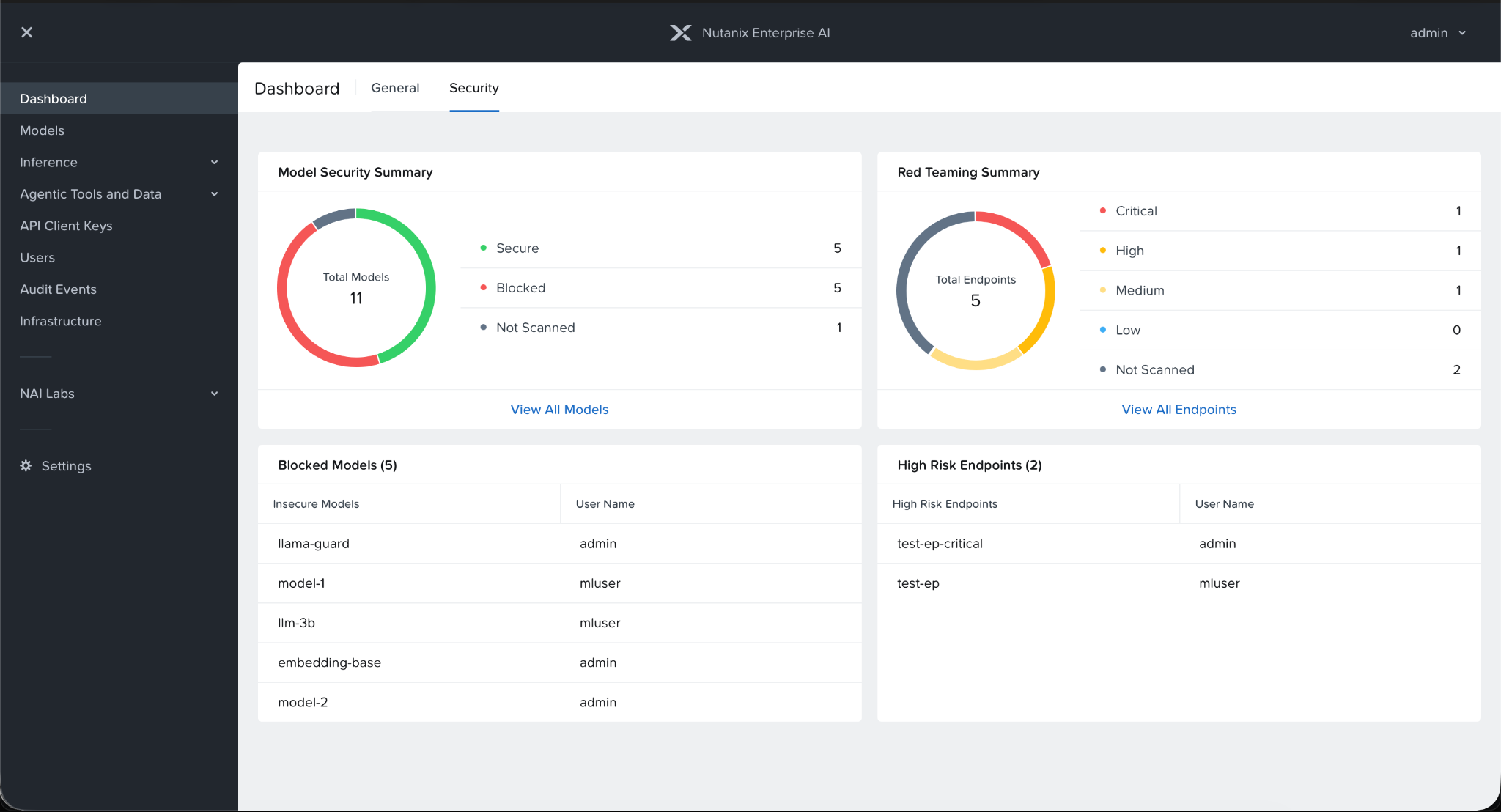
  • Unified Visibility – Provides a complete overview of your AI risk posture and scan summaries directly within your NAI dashboards.
Screenshot of Nutanix Enterprise AI dashboard.
Unified Security Dashboard with AI Model Security and AI Red Teaming

Benefits:

Seamless and Frictionless Deployment

We will prioritize a fast and frictionless deployment experience, ensuring that robust AI security does not come at the cost of development speed. By integrating these controls directly into the NAI workflow, organizations will be able to deploy and scale their AI initiatives with "push-button" simplicity, removing the traditional complexity and friction associated with securing large language models.

Proactive Protection Against Emerging Threats

Leveraging our deep expertise in threat prevention, this solution will proactively identify and block vulnerable or malicious models before they can impact the enterprise environment. By scanning models for hidden backdoors and malicious code during the initial download phase, we will stop threats at the perimeter, allowing only validated, secure models to ever reach your production environment.

A Comprehensive Enterprise Cloud AI Solution

This integration will deliver a comprehensive enterprise cloud AI solution, merging Nutanix’s industry-leading infrastructure with our next-generation security controls. The result will be a unified, cloud-native stack where security is built in rather than bolted on after the workload deployment, providing a secured deployment environment, which is consistent across the data center, the edge and public cloud.

Evolving Insights and Real-Time Remediation

The vulnerability insights from AI Red Teaming are coupled with remediation insights. The platform will provide a prioritized list of remediation steps that are tailor-made for the endpoint. This allows organizations to battle-test their inference endpoints before deploying them at scale.

Key Takeaways

  • A Proven, Award-Winning Partnership: Celebrating five years of collaboration, Palo Alto Networks has been named the Nutanix 2026 Global Security Partner of the Year, highlighting a shared commitment to delivering native, automated zero trust security for hybrid multicloud environments.
  • Seamless Zero Trust for Hybrid Workloads: Through deep integrations with VM-Series virtual firewalls and Nutanix Cloud Clusters (NC2), organizations can maintain consistent Layer 7 visibility and tag-based security policies that automatically follow workloads across on-premises data centers and public clouds.
  • Securing the AI Lifecycle with Prisma AIRS: The new integration with NAI, launching soon, will bring a security-first approach to AI adoption, utilizing Prisma AIRS to scan LLMs for vulnerabilities during download, and perform autonomous Red Teaming to neutralize emerging threats before they reach production.

Don’t Miss Our Speaking Session

Want to see the integration in action? Join our experts, Shrikant Brahmbhatt (Palo Alto Networks) and Ashwini Vasanth (Nutanix), on Tuesday April 7 3:30-4pm for an exclusive look at how we are securing the "Challenge of Hybrid AI." We’ll dive into the architecture that allows you to discover, assess and protect your entire AI ecosystem (apps, agents and models alike).

Visit Us at Booth #G2

Stop by the Palo Alto Networks booth (#G2) to meet our team of over 19,000 active threat researchers and see live demos of our joint solutions. Whether you are building the next generation of agentic AI or securing your virtual desktop infrastructure (VDI), we have the tools to help you innovate at machine speed.

Ready to secure your journey? Visit the Palo Alto Networks partner directory or learn more about Prisma AIRS.

Forward-Looking Statements

This blog contains forward-looking statements that involve risks, uncertainties and assumptions, including, without limitation, statements regarding the benefits, impact, or performance or potential benefits, impact or performance of our products and technologies or future products and technologies. These forward-looking statements are not guarantees of future performance, and there are a significant number of factors that could cause actual results to differ materially from statements made in this blog, including, without limitation: developments and changes in general market, political, economic, and business conditions; risks associated with managing our growth; risks associated with new products and subscription and support offerings; shifts in priorities or delays in the development or release of new offerings, or the failure to timely develop, release and achieve market acceptance of new products and subscriptions as well as existing products and subscription and support offerings; failure of our business strategies; rapidly evolving technological developments in the market for security products and subscription and support offerings; our customers’ purchasing decisions and the length of sales cycles; our competition; our ability to attract and retain new customers; and our ability to acquire and integrate other companies, products, or technologies. We identify certain important risks and uncertainties that could affect our results and performance in our most recent Annual Report on Form 10-K, our most recent Quarterly Report on Form 10-Q, and our other filings with the U.S. Securities and Exchange Commission from time-to-time, each of which are available on our website at investors.paloaltonetworks.com and on the SEC's website at www.sec.gov. All forward-looking statements in this blog are based on information available to us as of the date hereof, and we do not assume any obligation to update the forward-looking statements provided to reflect events that occur or circumstances that exist after the date on which they were made.

The post Palo Alto Networks at Nutanix .NEXT 2026 appeared first on Palo Alto Networks Blog.

  •  

Empowering the RAF Association with Next-Generation Cyber Resilience

Palo Alto Networks is proud to enter a strategic partnership with the RAF Association.

For over 90 years, the Royal Air Forces Association (RAFA) has championed a simple yet profound belief: No member of the RAF community should ever be left without the help they need. Serving personnel, veterans and their families, the RAF Association provides crucial welfare support, responding to increasingly complex needs in an era of operational changes and challenges, including persistent global deployment.

Delivering on their mission today requires not only compassion and expertise but also resilient digital foundations. To strengthen and future-proof its operations, RAFA has entered into a strategic partnership with Palo Alto Networks. Together, we are modernising the Association's cyber security posture through a secure-by-design, zero trust architecture to enhance organisational resilience, secure sensitive beneficiary data, and improve operational agility. This helps ensure they can focus on their mission of support, not security management.

As Nick Bunting OBE, Secretary General at the RAF Association, puts it:

Cybersecurity is essential to safeguarding the trust people place in our organisation. This transformation will give us greater protection for our data and systems, ensuring that our services remain dependable and that our organisation is secure, resilient and ready for the future. Strong digital security is not just a technical requirement, it is a fundamental part of how we uphold our duty of care to every individual who relies on us.

RAFA and Palo Alto Networks team.
RAF Association & Palo Alto Networks Team (left to right): Gareth Turner, Tom Brookes, Nick Bunting OBE, Phil Sherwin, Ali Redfern, Darren Bisbey, Alistair Wildman

Securing the Mission

The RAF Association operates in a distributed environment comprising headquarters’ functions, remote caseworkers, and more than 20 RAFAKidz nursery sites, supported by a growing portfolio of cloud-based services. In this context, cybersecurity is not simply an IT concern. It is a safeguarding imperative.

Disruption to systems or a compromise of sensitive beneficiary data could directly impact RAFA’s ability to deliver services and maintain the trust of the communities it supports. By consolidating fragmented legacy tools into a unified platform, this partnership ensures the Association’s digital evolution aligns security controls with GDPR obligations and safeguarding requirements.

Digital Resilience with a Unified Platform for Visibility and Control

To support RAFA's lean IT operational model, this transformation will move them away from fragmented legacy tools toward a unified platform approach. The deployment of Prisma® SASE (secure access service edge) and Cortex XDR® will provide RAFA with consistent visibility and control across users, devices, applications and data, regardless of location. This consolidation replaces complexity with clarity, allowing the organisation to inspect traffic for threats in real-time. Security policies are now enforced continuously, threats are detected and contained faster, and access to critical systems is governed by zero trust principles without compromising the user experience.

As Phil Sherwin, Chief Information Officer, at the RAF Association states:

Our data is one of our most valuable assets and the protection of that data, as we continue to provide life-changing support to members of the RAF community, is our most important priority. This partnership will move us into the next generation of security tools that adopt zero trust principles and is a crucial step on our journey to providing a layered approach to data protection.

One of the most critical aspects of this modernisation is supporting RAFA’s diverse workforce, particularly within the RAFAKidz nursery sites. These environments rely on nondesk-based staff using iPads and mobile devices to get their critical work done.

Using zero touch provisioning and the Prisma Browser™, we are enabling secure, seamless connectivity for unmanaged devices. This ensures that nursery staff can access necessary SaaS applications safely without complex login hurdles or manual configuration, improving their agility and allowing them to focus on caring for children rather than troubleshooting technology.

Creating Operational Advantage by Scaling Operations with AI and Automation

As a charity, RAFA has a responsibility to ensure resources are used efficiently. A critical goal of this partnership is to improve productivity and allow the organisation to scale its services without increasing the IT burden.

By adopting Strata™ Cloud Manager with AIOps (artificial intelligence for IT operations), RAFA is shifting from reactive security operations to proactive, automated management. Machine learning helps identify configuration risks and performance issues before they affect users, while standardized policies enable the secure, consistent onboarding of new sites. This shift is projected to significantly reduce operational overhead, enabling RAFA to scale its support network cost-effectively. This shift is projected to reduce operational overhead by 40–50%.

A Resilient Future

This partnership is about more than deploying technology. It is about ensuring RAFA remains resilient, trusted and capable of supporting the RAF community for decades to come.

As Darren Bisbey, Head of Group Information Security for the RAF Association, puts it:

We live in an era where digital threats are accelerating in both scale and sophistication, creating unprecedented challenges for organisations. Our partnership with Palo Alto is a statement of intent, reflecting our unwavering commitment to building the most secure environments possible for our data.

At Palo Alto Networks, we are honored to support RAFA in this journey, providing the digital armour and operational advantage necessary to protect those who serve and have served.

As Alistair Wildman, Palo Alto Networks CEO for Northern Europe states:

For over 90 years, RAFA has been a lifeline for the RAF community; it is our privilege to ensure that legacy endures in a digital-first world. By embracing a unified, AI-driven platform, RAFA is moving beyond complex, fragmented security to a posture that is Secure by Design. This partnership allows them to navigate today’s threat landscape with confidence, ensuring their resources remain focused where they belong: on the families who need them.


Key Takeaways

  1. Digital Resilience – Strategic Shift to Zero Trust Architecture: RAFA is modernizing its cybersecurity posture by implementing a comprehensive zero trust architecture. This transition involves moving from fragmented legacy tools to a unified platform approach, deploying Prisma® SASE and Cortex XDR for 360-degree visibility and complete control over access and traffic.
  2. Interoperability – Secure, Seamless Access for Diverse Workforce: The partnership ensures operational agility by simplifying security for nondesk-based staff, particularly at the RAFAKidz nursery sites. Solutions like Zero-Touch Provisioning and the Prisma Access Browser enable secure, seamless connectivity for unmanaged devices, allowing nursery staff to focus on their critical work without complex login or configuration issues.
  3. Creating Operational Advantage – Efficiency and Scalability through AI and Automation: RAFA is leveraging technology to scale services efficiently and reduce operational overhead. By using Strata Cloud Manager with AIOps (Artificial Intelligence for IT Operations), the organization can shift to proactive management and automating remediation, which is projected to reduce operational overhead by 40–50%.

The post Empowering the RAF Association with Next-Generation Cyber Resilience appeared first on Palo Alto Networks Blog.

  •  

Redefining Workspace: Prisma Browser Secures Leadership in Frost Radar

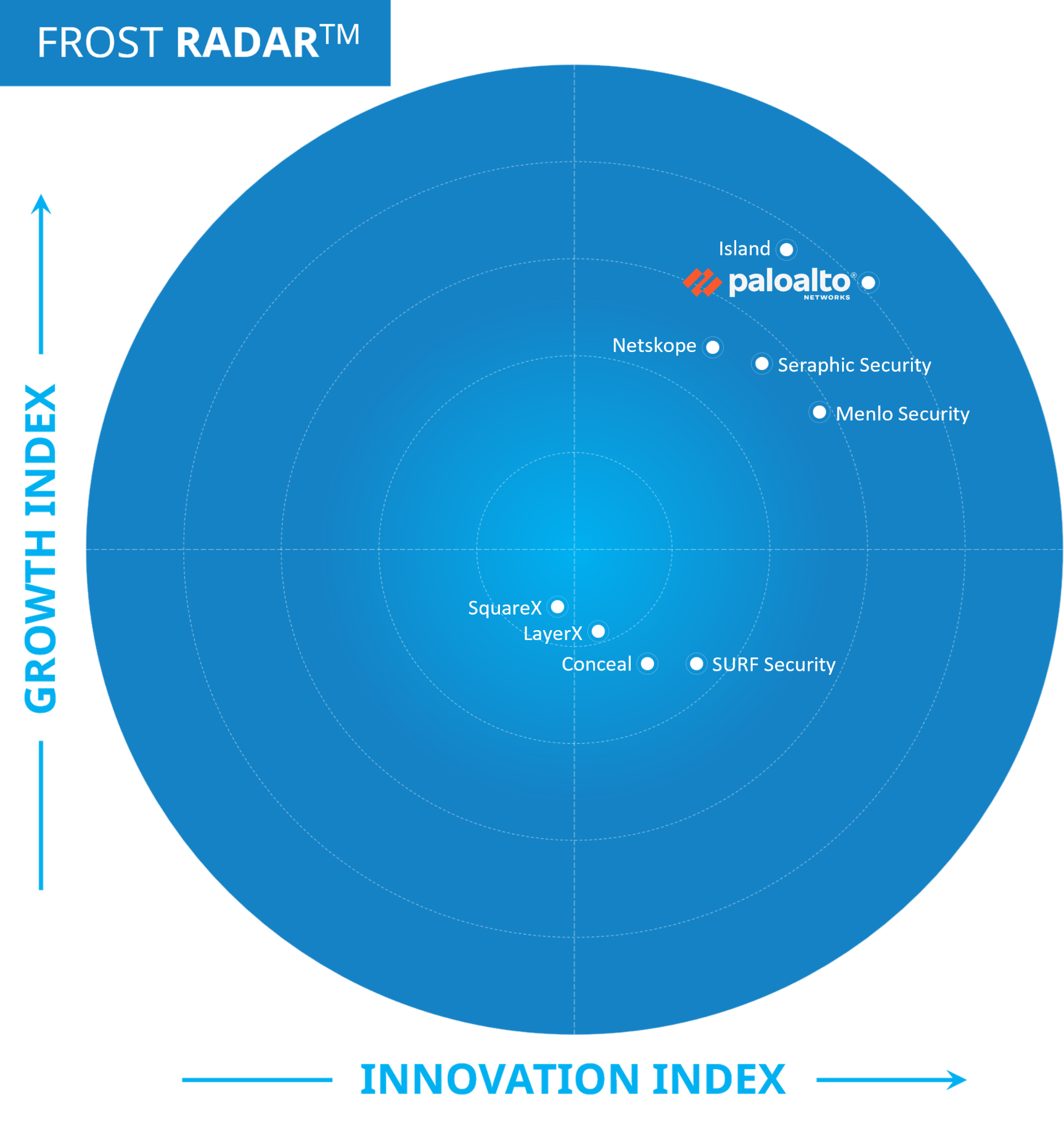
We are proud to announce that Frost & Sullivan has recognized Palo Alto Networks Prisma® Browser™ as the best-positioned market leader in the Frost Radar™: Zero Trust Browser Security (ZTBS), 2025 report, securing the premier position for innovation and a leadership position on growth.

This recognition comes at a pivotal moment. For the modern enterprise, the browser is no longer just an application; it is your new OS. With 85% of the work happening in browsers, it has become the focal point where revenue is generated and sensitive data is accessed. However, this shift has transformed your primary workspace into the primary attack vector, with 95% of organizations having reported a security incident originating in the browser, placing it on the frontline against sophisticated AI® threats and critical vulnerabilities. The risk of evasive, AI-driven phishing attempts is compounded by the widespread use of managed and unmanaged devices, creating blind spots that allow sensitive data to be exfiltrated faster than ever.

To combat this, enterprises need a browser that doesn't just display the web but actively defends it with its users, apps, data and devices. This is a necessity that drives our latest industry recognition.

Proven Leadership Validated by the Market

Frost Radar growth index and innovation index.

Prisma Browser’s recognition as the best-positioned leader, securing the premier position for innovation and a leadership position on growth, is a testament to our commitment to deliver best-in-class security that is both easy to deploy and that IT and users love to use. By integrating Palo Alto Networks Precision AI® technology, Cloud-Delivered Security Services (CDSS) and Enterprise DLP, we ensure our customers benefit from the power of our security engines. And because they are natively integrated in the browser, we are mitigating threats hiding in encrypted traffic, blind spot web channels, AI-powered spear phishing and other evasive web threats that legacy security tools simply cannot identify.

Prisma Browser’s Innovation Advantage

Our leadership is driven by continuous strategic innovation in the secure browser space. Prisma Browser delivers critical "last-mile" protection through the native integration of CDSS, including Advanced WildFire® for zero-day malware analysis and Advanced URL Filtering instantly at the point of user interaction. Building on this foundation, our latest innovations extend secure work to all applications, including those beyond SSO, providing full visibility and last-mile protection for unmanaged applications, such as GenAI apps, closing gaps left by incomplete identity coverage. We further solidify this best-in-class security through additional cutting-edge innovations: Advanced Web Protection for real-time evasive threat protection, Advanced Browser Protection for zero-day browser exploitation defense, and Advanced Extension Security for runtime extension security.

At the core of this defense is Precision AI, our proprietary engine that combines machine learning, deep learning and generative AI to automate detection, prevention and remediation with industry-leading accuracy. Unlike standard security tools that rely on static signatures, Prisma Browser, powered by Precision AI, inspects live, fully rendered content. It detects evasive phishing attempts (such as AI-generated cloaking) and malicious reassembly attacks that legacy tools miss, effectively fighting AI with AI. Fueled by intelligence from over 70 thousand customers, Prisma Browser delivers unmatched threat detection, identifying and blocking up to 8.95 million new and unique attacks every single day.

The Frost Report says this about Palo Alto Networks Innovation:

Key differentiating capabilities include last-mile data leakage protection with browser-level visibility; AI-powered web attack detection and prevention with full page runtime visibility; detection and disabling of malicious extensions using behavioral monitoring; an advanced AI-powered DLP engine; in-browser anti-exploit protection; and a rich library of AI applications and agents.

Crucially, Enterprise DLP capabilities are embedded directly into the rendering engine, granting granular control over sensitive data that traditional network-level tools effectively miss. This helps ensure that data on both managed and unmanaged devices remains secure against exfiltration via clipboard restrictions, screenshot blocking, real-time redaction and more, without disrupting the user experience.

Prisma Browser’s Growth Advantage

Central to the widespread adoption of Prisma Browser is our proven ability to secure the managed workforce at scale without disrupting daily workflows. One of our key differentiators is our 100% license portability, which allows organizations to deploy Prisma Browser across their entire fleet of devices, whether as full browsers, extensions, mobile solutions and firewall connectors with complete flexibility. This frictionless deployment model enables IT teams to instantly layer enterprise-grade security and unified policies onto the same native browser UX employees already know and use.

For CISOs and CIOs focused on streamlining operations, Prisma Browser is also offered as a fully integrated solution within the Prisma® SASE platform, enabling unified policies across all Palo Alto Networks solutions.

Looking Ahead

While we are proud of our position on the Frost Radar: Zero Trust Browser Security (ZTBS) report, we are just getting started. By accelerating initiatives in GenAI security, complete web protection, modern data protection and VDI reduction, we are redefining the browser. We don't just want the browser to be where you work; we are transforming it from the primary attack vector into one of the organization's most robust lines of defense and the single point where they can identify AI driven attacks and fight AI with AI.

Read the full Frost Radar: Zero Trust Browser Security (ZTBS), 2025 report to explore the details behind our market leadership. Then, schedule a demo to witness how Prisma Browser transforms your primary workspace into your strongest line of defense.

The post Redefining Workspace: Prisma Browser Secures Leadership in Frost Radar appeared first on Palo Alto Networks Blog.

  •  
❌