Reading view

The NO FAKES Act Could Silence Satire, Commentary, And News

The NO FAKES Act is supposed to target harmful AI-generated impersonations. But in reality, it will make it easier to suppress commentary, satire, and other lawful speech. That's why EFF has signed a letter urging the Senate Judiciary Committee not to advance the bill in its current form.

Take action

Tell Congress to Say No to NO FAKES

In the letter, EFF joins a coalition of civil society groups in pointing out that the bill would import many of the worst features of the DMCA notice-and-takedown system into an even broader range of online expression. Faced with a “heckler’s veto” over legal speech, platforms will have incentives to remove content first and ask questions later. 

The bill offers no protection for a platform’s judgment about an often difficult question—whether a particular piece of content is satire, parody, commentary, or news. Any platform that guesses wrong faces penalties of up to $750,000 per work. 

NO FAKES could also undermine the rights of the people it is supposed to protect. The new federal “likeness” right could be licensed or transferred to others, so individuals will lose control over the use of their own face and voice. That’s not theoretical—workers in the entertainment industry are routinely asked to sign broad contracts about the future use of their likenesses.

As the letter notes: 

A background actor who signs a release on set or an ordinary person who clicks through a platform's terms of service could end up with the right to their own face and voice in someone else's hands, for years, with federal enforcement behind it. 

EFF and the other signatories urge Congress to examine existing legal remedies and pursue narrowly tailored solutions to genuine harms. The last thing we need is a sweeping new intellectual property right that threatens free expression. 

In addition to EFF, the letter is signed by the Center for Democracy & Technology, the American Civil Liberties Union, Fight for the Future, Foundation for Individual Rights and Expression, the Organization for Transformative Works, Public Knowledge, the R Street Institute, The Future of Free Speech, and the Woodhull Freedom Foundation. Read the full letter here. 

Take action

Tell Congress to Say No to NO FAKES

  •  

Congress Just Rushed Through a Disastrous Copyright Office Overhaul

In a voice vote earlier this week, the House of Representatives passed H.R. 6028, the “Legislative Branch Agencies Clarification Act.” The legislation is presented as a technical reorganization of some government agencies, but it’s much more than that. 

H.R. 6028 would fundamentally change the U.S. Copyright Office, and not in a good way. The bill removes the Library of Congress’ current supervisory role over the Copyright Office, transfers several powers directly to the Register of Copyrights, and makes the Register a presidential appointee, confirmed by the Senate. 

These changes would make an office that’s already hugely influential in copyright and tech policy much more political. EFF first explained why that’s a terrible idea when it came up nearly a decade ago. This bill, like the older one, weakens the few public-interest checks and balances that do exist.  We hope the Senate promptly rejects this bill. 

The Copyright Office Doesn’t Need More Politics—Or More Power

The Copyright Office's main responsibilities are administrative and advisory. It registers copyrights, maintains records, grows the Library of Congress’s collections, and provides expertise to Congress on copyright law. But over the past two decades, the Office has also become increasingly influential in copyright policy debates that affect free expression, libraries, educators, competition—and everyday internet users. Unfortunately, it has not been a neutral advocate. The office’s recent report on the role of AI severely bungled the issue of fair use, prioritizing private licensing market “solutions” over user rights. 

Going further back, the Copyright Office supported one of the most infamous anti-internet proposals of all time—the Stop Online Piracy Act (SOPA), a disastrous internet censorship proposal that sparked one of the largest online protests in history. The Office has repeatedly advanced positions that favored large entertainment-industry interests over the public interest.

The Office also plays a major role in the Digital Millennium Copyright Act (DMCA) Section 1201 rulemaking process, which determines when the public may lawfully bypass digital locks for activities such as security research, repair, preservation, or accessibility. EFF has used this process repeatedly to mitigate some of the worst harms of the DMCA. H.R. 6028 would move rulemaking authority over 1201 from the Librarian of Congress to the Register of Copyrights, further consolidating power within the Copyright Office itself.

The bill also makes the Register of Copyrights a presidential appointee confirmed by the Senate. Each administration will be pressured to pick nominees aligned with their own policy preferences, and the powerful copyright owning industries will invest even more heavily in lobbying to get their way, and influence the selection. This position should be focused on administrative ability and actual expertise, not lobbying and politics. 

The Copyright Office Should Stay Connected To The Library of Congress

H.R. 6028 would do more than change who appoints the Register of Copyrights. It would sever the Copyright Office from Library of Congress supervision and transfer many Librarian powers directly to the Register. 

The supervisory relationship exists for good reason, as the nation’s libraries have pointed out for years. The Library, while far from perfect, at least has the mission of preserving and providing access to knowledge. That should be an important public-interest counterweight in copyright debates. Congress has not explained how weakening the ties between the Library and the Copyright Office would serve the public better, or even seriously inquired about it. 

This Bill Was Rushed Through

Back in March, EFF joined Public Knowledge, the Center for Democracy and Technology, library organizations and tech groups, urging Congress not to fast-track this legislation. We told them changes to the Copyright Office will have major consequences for the “speech rights, educational opportunities, and creative freedoms of all Americans.” 

Yet Congress moved forward without any hearings on the bill, and without meaningful examination. H.R. 6028 creates a years-long separation of the Copyright Office from the Library of Congress, transfers significant legal authority, and restructures the appointment process for the nation’s top copyright official. Changes like that deserve hearings, debate, and public scrutiny. H.R. 6028 got none of that. 

The Senate Should Stop This Bill

Copyright law exists to serve the public and “promote the progress” of science and learning. The institutions that administer copyright law should do the same. 

H.R. 6028 would move the Copyright Office further away from that goal. Congress should be strengthening public-interest oversight of copyright policymaking, not looking for ways to concentrate more authority in a single presidentially appointed official. 

The Senate should reject H.R. 6028. The Copyright Office should serve the public—not presidential administrations, and not industry lobbyists. 

  •  

Enshittification Merch That Actually Fights Enshittification 

Enshittification isn't just a sweary word to describe the accelerating decay of the online platforms, apps, and services that we rely on.  

It's a framework for understanding the structural incentives that make tech companies enemies of their own users over time—the surveillance business model, the erosion of privacy, the monopoly power that eliminates alternatives, the regulatory capture that prevents accountability.  

SUPPORT EFF

GET LimITED EDITION MERCH + FIGHT ENSHITTIFICATION

These are some of EFF's core fights and have been for over 35 years. EFF sues. EFF advocates. EFF codes. And EFF wins. EFF is the most profound and powerful disenshittifying force on the planet Earth, and I’ve been proud to fight alongside them for nearly 25 of those years.  

One of the lessons you learn in battles with very long timelines against very powerful actors is that these battles are deeply serious, and because of that they must also be fun. “Enshittification” took off as a shorthand in part because of the minor license to vulgarity it confers. It's slightly crass for a reason: getting people to engage with the abstract issues of tech policy can be hard at the best of times. No one knows this better than my colleagues at EFF, who consistently surprise me with their ability to make complex, technical concepts concrete, memorable, and sometimes even joyful. 

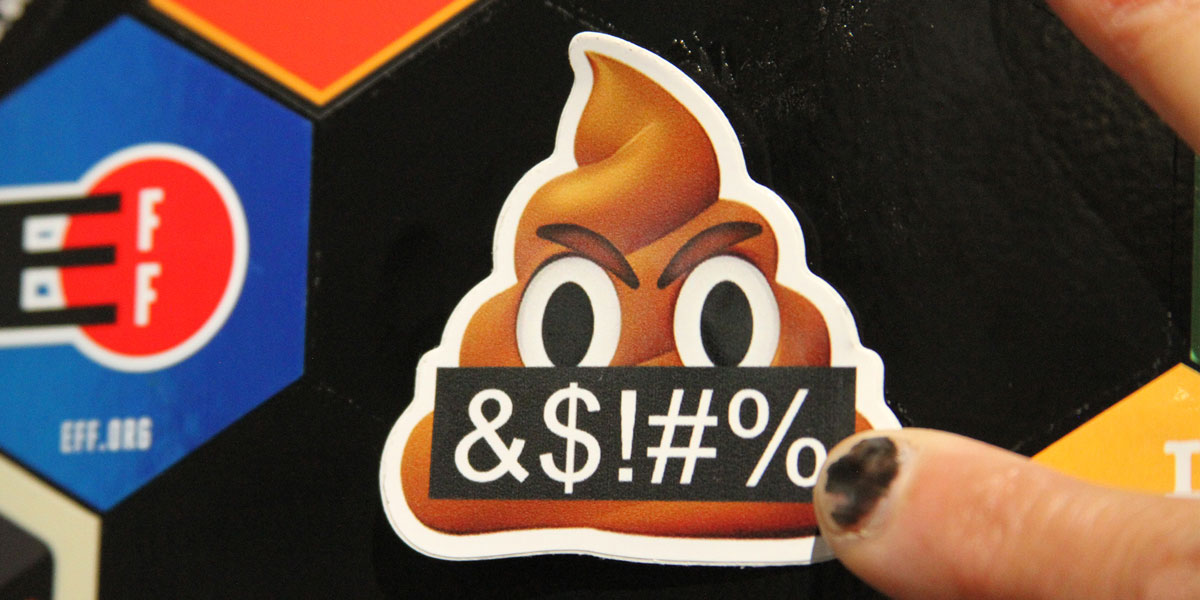
Words matter, but so do visuals. For the cover of the U.S. edition of my book, Enshittification, designer Devin Washburn of No Ideas studio created an iconic variation of the "pile of poo" emoji, with angry eyebrows and a grawlix-scrawled censor bar over its mouth. It instantly became the symbol of enshittification I’d been looking for. 

A digital illustration of an angry poop emoji holding a black sign reading "&!#%", set against a blue and gray background tiled with oversized "& !#%" characters.

I liked it so much I ordered a couple hundred enamel pins and a couple thousand vinyl stickers and handed them out to people I met on my 33-city book tour. Even when giving them away, I was inundated with requests to buy more of them.  

I've since bought out Devin's rights to the image and released it under a Creative Commons Attribution 4.0 license—free for anyone to use, remix, or build on, including commercially, with attribution. The high-resolution files are on Wikimedia CommonsFlickr, and the Internet Archive (including a PSD with an ink-density adjustment layer). It belongs to the commons now. 

But I made sure EFF had first crack at the design for their “official merch,” and they've done right by it. There are two items available now in the EFF shop, and all proceeds go directly to EFF's work defending digital rights. I’ve spent years admiring EFF’s merch and consistent, creative visual identity, so it fills me with pride to see this more-than-a-mere-poop-emoji in their shop.  

A recognizable visual shorthand is a genuine organizing tool. When someone sees the enshittification emoji, they know what the conversation is about. When you wear the pin or slap the sticker on your laptop, you're signaling that you understand what's happening to the internet, and that you know we can do better.  

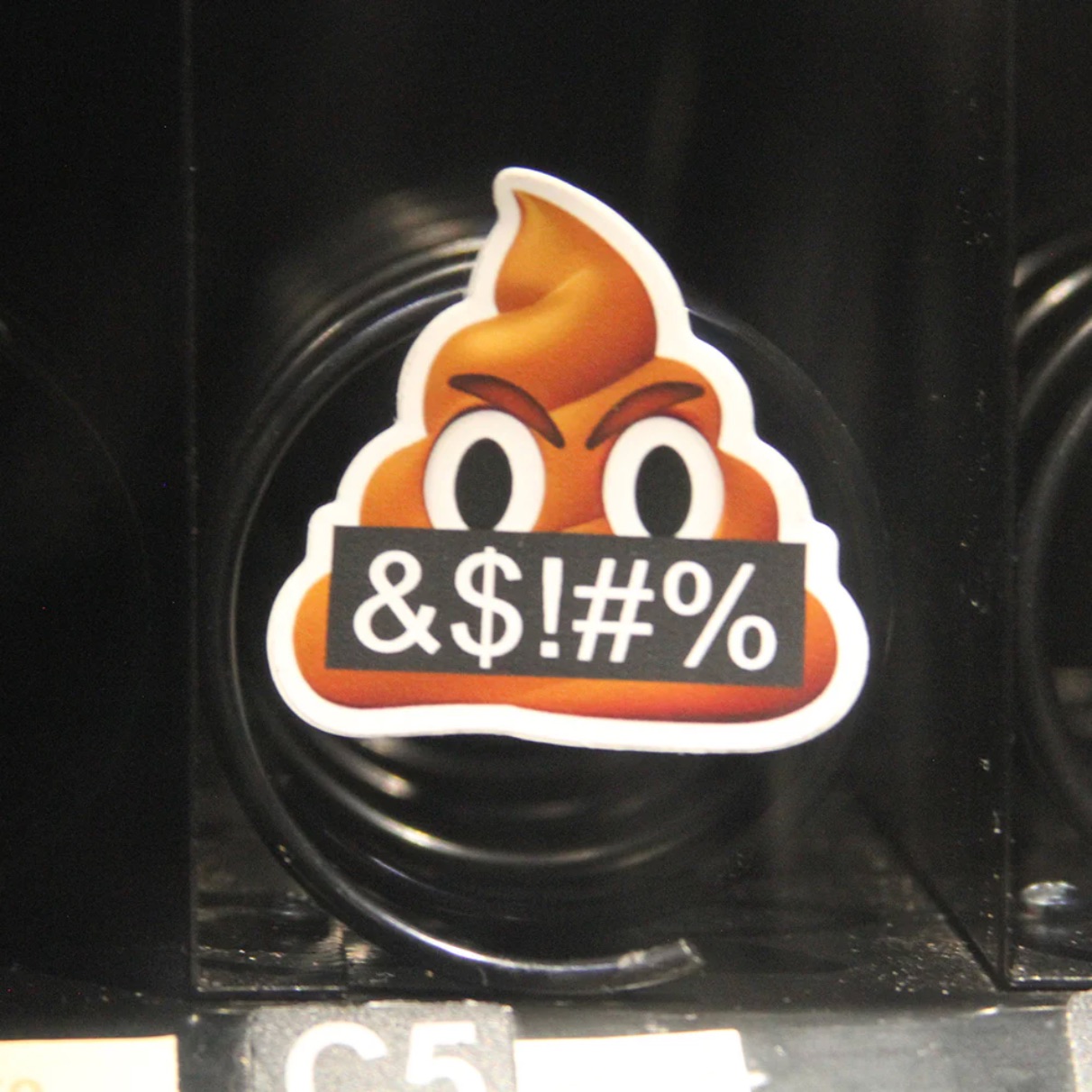
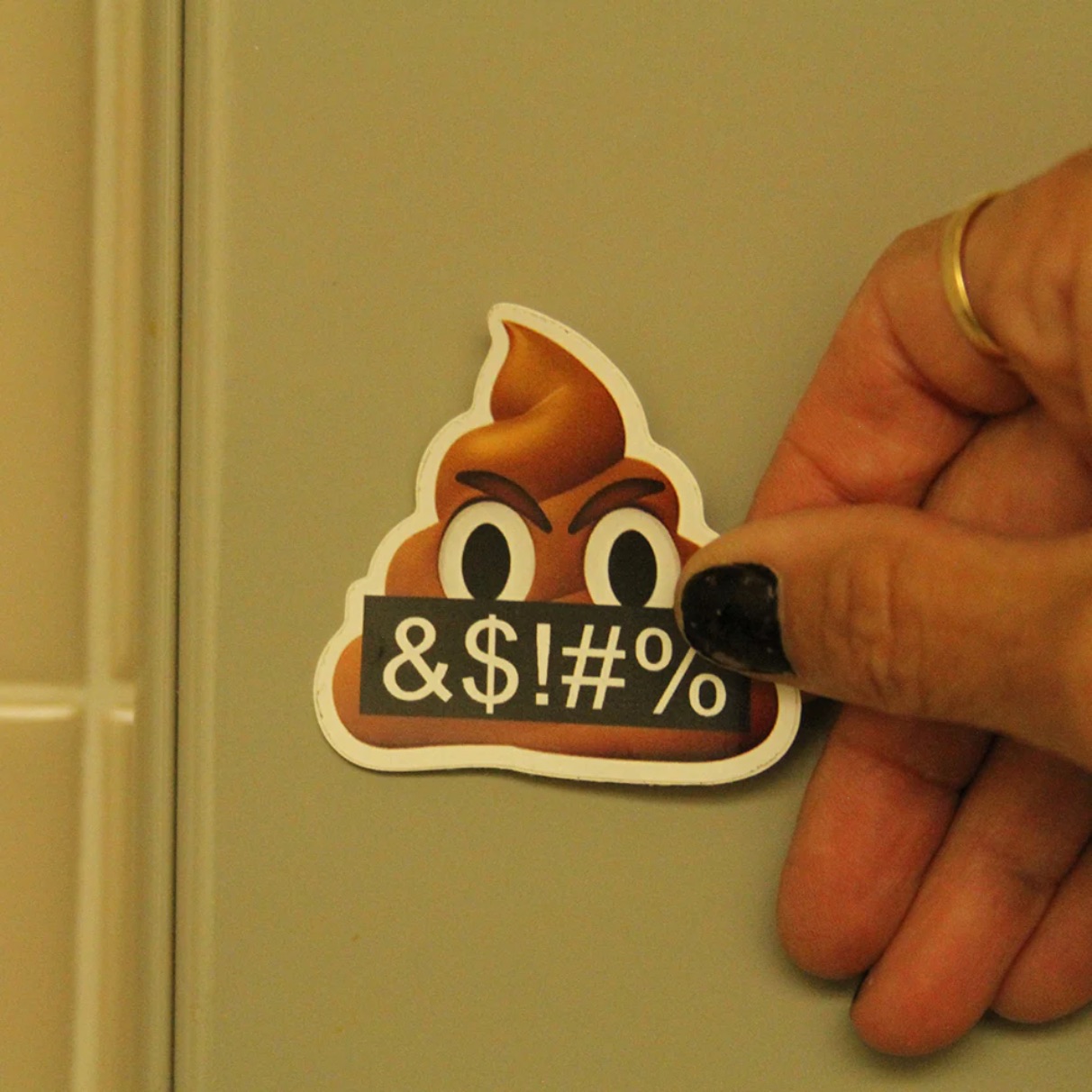
You can get a $5 sticker:

An angry poop emoji sticker affixed to the coiled spring mechanism inside a vending machine. The sticker depicts a scowling poop emoji holding a black sign reading "&$!#%".

A hand with black nail polish and a gold ring holds an angry poop emoji sticker against a white door. The sticker shows a scowling poop emoji holding a black sign reading "&$!#%".

Or a $10 pin:

A close-up of an enamel pin on the lapel of a tan jacket. The pin depicts an angry poop emoji holding a black banner reading "&$!#%".

An enamel pin clipped to the nose bridge of black-framed sunglasses resting on a wooden surface. The pin depicts a scowling poop emoji holding a black banner reading "&$!#%". 

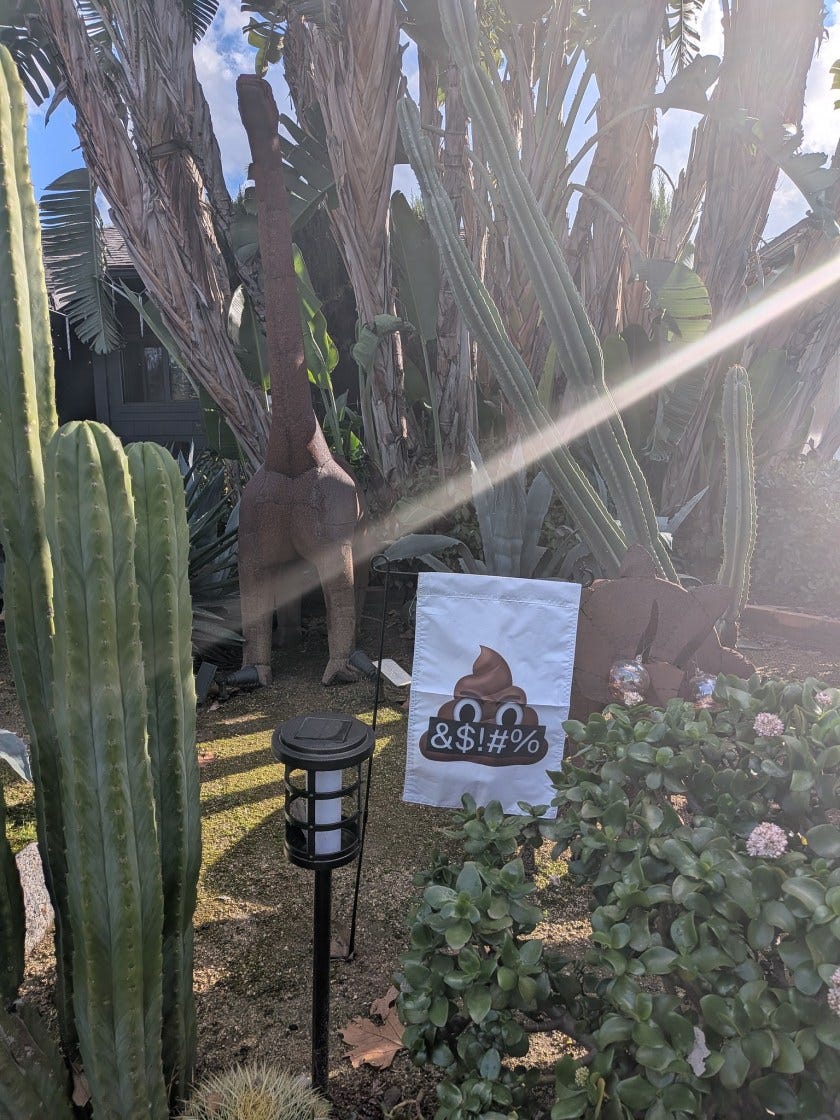
 Because the design is CC-licensed, you don't have to buy one. You can make your own merch, your own swag, your own illustrations. I made a lawn flag for my front garden.

A  small white garden flag on a metal stake, planted among cacti and succulents in a sunny yard. The flag depicts an angry poop emoji holding a sign reading "&$!#%". 

But if you do want to buy a sticker or pin, you can do so while supporting the most profound and powerful disenshittifying force on the planet Earth—the Electronic Frontier Foundation.

SUPPORT EFF

GET LimITED EDITION MERCH + FIGHT ENSHITTIFICATION


  •  

Tell Congress: Just Say No to NO FAKES

The Senate Judiciary Committee is set to consider and vote on the Nurture Originals, Foster Art, and Keep Entertainment Safe Act (NO FAKES). Instead of targeting the real privacy harms posed by AI-generated replicas, this law would create another layer of internet censorship on top of the already existing legal and voluntary takedown systems. Congress should reject NO FAKES.

Take action

Tell Congress to Say No to NO FAKES

As currently written, NO FAKES proposes to tackle the problems of misleading AI-generated replicas by creating a broad property right in someone's look, voice, and general style. However, there are all kinds of First Amendment-protected expression that would be swept under the NO FAKES regime—think about parody, news, criticism.

NO FAKES also does a laughable job of protecting artists from use of their image in misleading ways. It doesn’t create a privacy right, but rather a property right that can easily be signed away—as major studios and record labels are almost certain to require in their contracts with artists. As a result, NO FAKES actually creates a new avenue for the exploitation of artists by companies instead of protection from misleading replicas. 

The bill also makes it trivially easy for protected speech to be censored. It is a supercharged version of the already flawed copyright takedown regime. It would essentially require platforms to institute filters that don't just look for exact matches of copyrighted material, as current filters do, but anything that might be a digital replica. Even though the latest version of this bill adds some forms of redress for bad faith takedowns, those provisions lack the teeth required to deter a malicious actor. 

NO FAKES targets speech, tools, and innovation instead of focusing on the real concern posed by these replicas: privacy. This bill was a bad idea when it was introduced, and got even worse when it was amended last year. Tell Congress to just say no to NO FAKES.

Take action

Tell Congress to Say No to NO FAKES

  •  

California’s AB 412 Still Demands Developers Do The Impossible

California lawmakers are again considering A.B. 412, a bill that would require AI developers to identify and disclose copyrighted works used to train generative AI systems.

The problem this year is the same as last year: it’s practically impossible to comply with this law. The bill demands information that often does not exist, and cannot realistically be obtained. 

EFF submitted an opposition letter to the California Senate Privacy Committee explaining why we continue to believe A.B. 412 is simply unworkable. To the extent developers do follow this law, it will have the effect of locking in the power of the largest companies in AI. 

A Burden That Can’t Be Met

A.B. 412 sounds simple: just have AI developers create and keep a list of all the registered copyrighted works they use in AI training. 

That may seem straightforward. In practice, it’s anything but. 

There is no machine-readable “list” of copyrighted works at the U.S. Copyright Office. And many copyright holders can get a copyright without even depositing a publicly viewable sample of the work—for example, software companies may register copyright on proprietary code without revealing it to the public. 

And on the open internet, copyright information is often incomplete, unavailable, or impossible to verify. One image may be registered with the copyright office, while the next is licensed under a free Creative Commons license (like the images that EFF creates), and the next is public domain. A message forum user might post an original story, photograph, or poem without any indication of ownership or registration status. 

The bill effectively asks developers to continuously cross-reference massive batches of online data against a copyright system that simply wasn’t designed to do so. If California passes A.B. 412, its impact will go far beyond the large AI companies we read about in the headlines. 

Not Just Big Tech

Supporters often frame this bill as a way to help creative workers have some leverage against Big Tech, but the bill reaches much further than the big AI companies. 

Its definition of “developer” extends to anyone who makes a generative AI model available to Californians. That includes indie developers tinkering with an existing model, open-source initiatives, nonprofits, and other non-commercial efforts. Recent amendments added exemptions for universities and government entities, which is important, but that still leaves out a vast swathe of non-commercial tech work that’s done by people without full-time jobs in government or academia. 

Large companies will hire compliance teams and lawyers to navigate these requirements. Smaller organizations and independent developers usually can’t. The result will be fewer opportunities for startups and new entrants. Faced with this massive compliance burden, some won’t even try. 

Courts Are Already Deciding These Questions

The bill is premised on the idea that copyright owners currently don’t have good remedies if they’re mistreated by AI companies. That simply isn’t true. And the growing wave of federal court filings in this space prove it. Content companies that want to sue tech companies, large or small, have no problem doing so. Those courts are still working through important questions about fair use and transformative use. Some courts have already concluded that many AI training activities qualify as fair use. Others continue to evaluate the issue.

California lawmakers should not rush to impose new state regulation while those questions remain unresolved. This is why copyright is governed at the federal level: both creators and fair users benefit from a single set of nationwide rules. 

At this point, the bill remains a solution in search of a problem. Rights holders already have powerful tools to protect their interests under existing federal law. What this bill adds isn’t clarity or transparency, but a costly and essentially impossible compliance burden that will discourage small developers and researchers. 

California has been able to support both artistic creativity and tech innovation for decades now.  But A.B. 412 does not strike the right balance. 

If you are a California resident and interested in speaking out about this bill, you can find and contact your representatives through this website

  •  

A Bridge to Somewhere: How to Link Your Mastodon, Bluesky, or Other Federated Accounts

One of the central promises of open social media services is interoperability—the idea that wherever you personally decide to post doesn’t require others to be there just to follow what you have to say. Think of it like a radio broadcast: you want to reach people and don't care where they are or what device they're using. For example, in theory, a Bluesky user can follow someone on Mastodon or Threads without having to create a Mastodon or Threads account. But these systems are still a work in progress, and you might need to tweak a few things to get it working correctly.

Right now, broadcasting your message across social platforms can be a funky experience at best, deliberately broken up by oligopolists. The idea of the open web was baked into the internet via protocols like HTML and RSS that made it easy for anyone to visit a website or follow most blogs. The fact social media isn’t similarly open reflects an intentional choice to privatize the internet. 

Bridging and managing your posts so they’re viewable outside a singular source is part of the broader philosophy of POSSE, short for Post Own Site Syndicate Elsewhere (sometimes its Post Own Site, Share Everywhere). Instead of managing several accounts across different services, you post once to one primary site (which might be your personal website, or just one social media account), then set it up so it automatically publishes everywhere else. This way, it doesn’t matter where you or your audience is, and they're not walled off by account registration requirements. 

We’ll come back around to POSSE at the end of this post, but for now, let’s assume you just want your current main open social media account to actually have a chance to reach the most people it can. 

Why Post to the Open Social Web

Because the Fediverse and ATmosphere use different protocols, we need to use a third-party tool so accounts can communicate with each other. For that, we’ll need a bridge. As the name suggests, a bridge can connect one social media account to another, so you can post once and spread your message across several places. This isn’t just some niche concept: major blogging platforms like Wordpress and Ghost integrate posting to the Fediverse.

Bridging is an important facet of POSSE, but also something more people should consider, even if they don’t run their own websites. For example, if you don’t want to create a Threads account just to interact with your one friend who uses that platform, you shouldn’t have to. The good news is, you don’t. There are several bridging services, like Fedisky, RSS Parrot, and pinhole, but Bridgy Fed is currently the simplest to use, so we’ll focus on that. 

How to Post to Bluesky from Mastodon

From your Mastodon account (or other Fediverse account, for simplicity’s sake we’ll stick to Mastodon throughout), search for the username @bsky.brid.gy@bsky.brid.gy and follow that account. Once you do, the account will follow you back and you’ll be bridged and people can find you from their Bluesky account. You should also get a DM with your bridged username. If you don’t see the @bsky.brid.gy@bsky.brid.gy user when you search, your Mastodon instance may be blocking the bridging tool. 

Threads users who have enabled Fediverse sharing will be able to find you with your standard Mastodon username (ie, @your_user_name@mastodon.social), but if they haven’t enabled sharing, they will not be able to see your account. While this search is still a beta feature, you might find it easier to share the full URL, which would look like this: https://www.threads.net/fediverse_profile/@your_user_name@mastodon.social

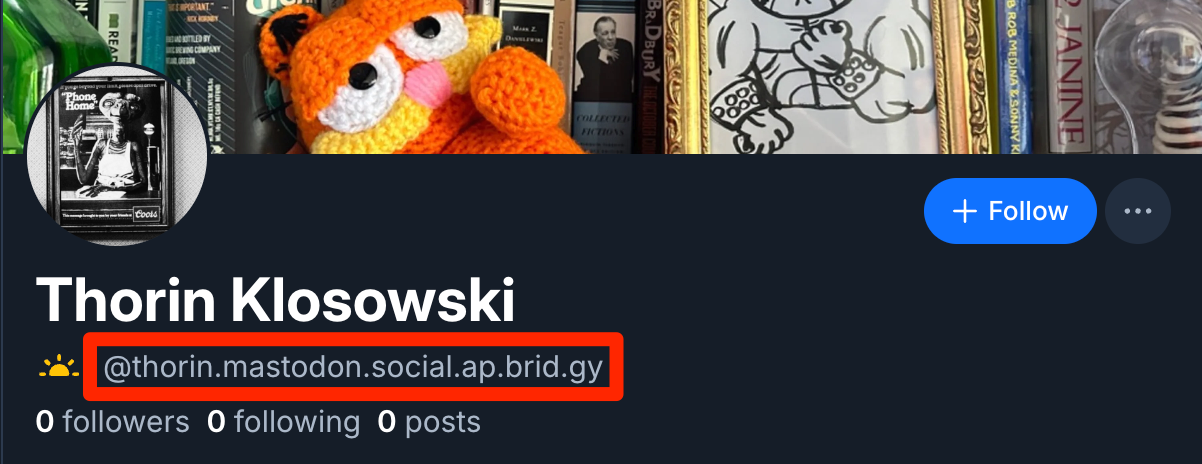
People on Bluesky can find you by: Either searching for your Mastodon username, or if that doesn’t work, @your_user_name.instance.ap.brid.gy. For example, if your username is @eff@mastodon.social, it would appear as @eff.mastodon.social.ap.brid.gy.

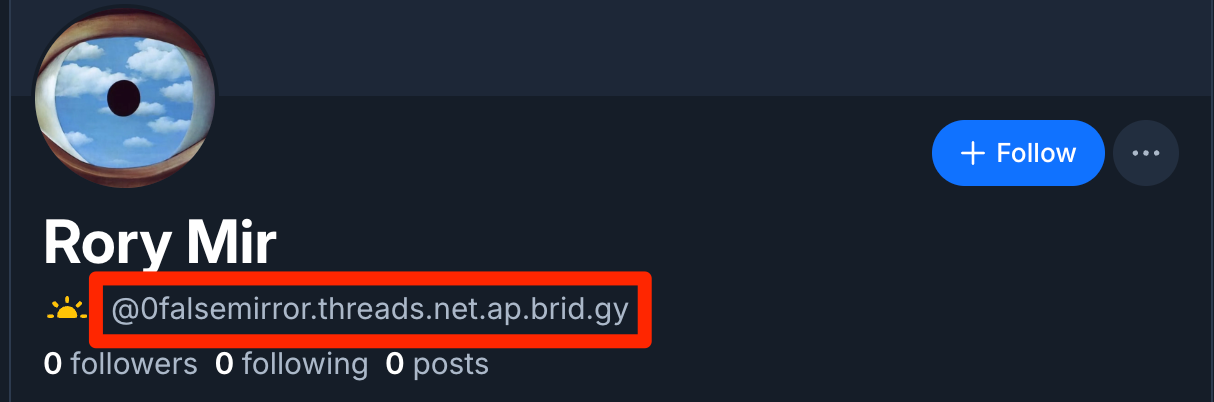
an example of a mastodon user profile viewed from threads

An example of a Mastodon username from the Bluesky web client.

How to Post to Mastodon and Bluesky from Threads

Yes, Threads is technically on the Fediverse, and you can bridge your Threads account to Mastodon or Bluesky (unless you’re in Europe, where the feature is disabled), but it’s a different process than on Bluesky and Mastodon.

  • Open Settings > Account > Fediverse Sharing and set the option to “On.” This will make your posts visible to Mastodon (or other Fediverse) users, and vice versa. 
  • Once the Fediverse sharing is enabled, you’ll likely need to wait a week, then you can bridge to Bluesky. Search for and follow the @bsky.brid.gy@bsky.brid.gy account (it may take some digging to find it, but if that doesn’t work you can try visiting the profile page directly

People on Mastodon (or other Fediverse accounts) and Bluesky can find you by: Mastodon users can find you at, @your_threads_username@threads.net while Bluesky users will find you at, @your_threads_username.threads.net.ap.brid.gy (seriously, that will be the username). Note that some Mastodon instances may block Threads users entirely.

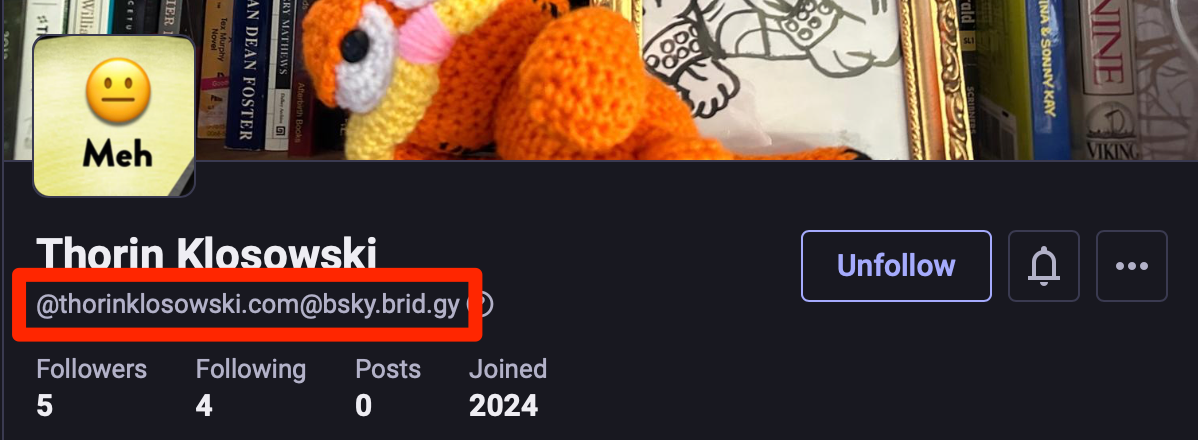
an example of a threads post viewed from mastodon

An example of a Threads username from the Mastodon web client.

an example of a threads user profile viewed from bluesky

An example of a Threads username from the Bluesky web client.

How to Post to Mastodon and Threads from Bluesky

From your Bluesky (or other ATProto) account, search for the username, “@ap.brid.gy” and follow that account. Once you do, the account will follow you back and you’ll be bridged, so people can follow you from Mastodon or other Fediverse accounts. You should also get a DM with your bridged username.

People on Mastodon (or other Fediverse account) and Threads can find you by: Your username will appear as @your_bluesky_username@bsky.brid.gy. For example, if your Bluesky username is @eff@bsky.social, it would appear as @eff.bksy.social@bsky.brid.gy.

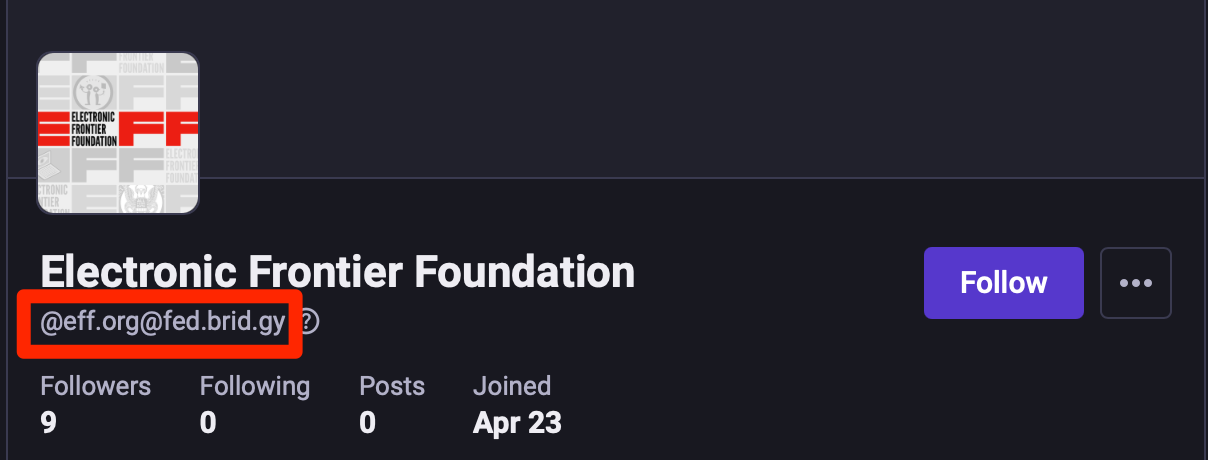
an example of a bluesky user profile viewed from mastofon

An example of a Bluesky username from the Mastodon web client.

How to Post Everywhere from Your Own Website

You can bridge more than social media accounts. If you have your own website, you can bridge that too (as long as it supports microformats and webmention, or an Atom or RSS feed. If you have a blog, there’s a good chance you’re already good to go). When you do so, the bridged account will either post the full text (or image) of whatever you post to your personal site, or a link to that content,  depending on how your website is set up. You’ll also probably want to log into your Bridgy user page so you can manage the account. 

Where people can find your bridged account: Usually, a user can just search for your website’s URL on their decentralized social network of choice, or enter it on the Bridgy Fed page. But if that doesn’t work, they can try @yourdomain.com@web.brid.gy from Mastodon or @yourdomain.com.web.brid.gy from Bluesky.

an example of a website profile viewed from mastodon

An example of a bridged website username in the Mastodon web client.

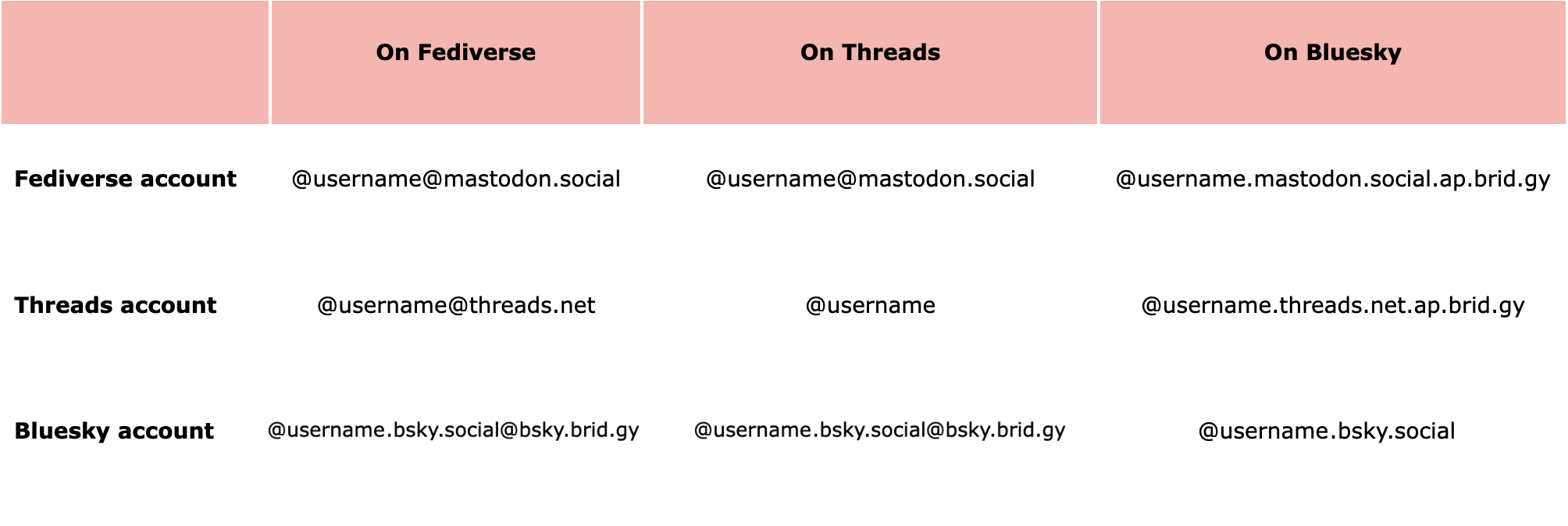
How Your Account Username Looks on Each Platform

   Examples of how each social media username looks on other platforms

You’re Bound to Run Into Some Quirks

  • Sometimes messages take a little while to crossover between networks, and sometimes they don't crossover at all.
  • You can’t log into a bridged account like a regular account, but Bridgy Fed does provide some tools to see incoming notifications and recent activity in case they’re not coming through properly.
  • ActivityPub and ATProto don’t have the same feature set, so you will have certain capabilities for one account you might not have in another. For example, you can edit posts on Mastodon, but not on Bluesky. If you edit a post that’s bridged from Mastodon to Bluesky, the Bluesky post will not be updated. 
  • Replies can sometimes get lost, especially if the person (or people) replying to you doesn’t have sharing turned on.
  • Ownership of accounts can get weird. For example, if you post to your own website and use a tool like Wordpress or Ghost for federation (more info below), you don’t necessarily get access to a “normal” social media account, with a standard login and password.
  • And more! This is still a work in progress that has some technical quirks, but it’s improving all the time, and it’s best to keep telling yourself that troubleshooting is part of the fun.

Other Cool Stuff You Can Do

As mentioned up top, there’s a lot more you can do, and an increasing number of tools are making this process simpler. Bridgy Fed is one way to post to more places from a single account, but it’s far from the only way to do so. Here are just a few examples.

  • Micro.blog is a paid service where you can blog from your own domain name, then post automatically to Mastodon, Bluesky, Threads, Tumblr, Nostr, LinkedIn, Medium, Pixelfed, and Flickr.
  • Ghost is a blogging and newsletter platform that offers direct integration with the Fediverse, as well as support for Bluesky. Wordpress offers the option to join the Fediverse through a community plugin. Other newsletter platforms, like Buttondown, also have plans for federation. 
  • Surf.social is a landing page and social media utility where you can show off all your various accounts (Federated or not). From the reader point of view, you can follow one publications numerous types of posts in one place. For example, 404 Media’s Surf.social feed includes its YouTube feed, podcast feed, and its journalist’s social media posts.
  • If you think these new handles are a bit ugly, you can use a custom domain for Bluesky or fediverse account from your website. 

Of course, there are plenty of other tools, blogging platforms, and other utilities out there to help facilitate posting and bridging accounts, with new ones coming along every day. 

With proper support, time, and effort, eventually we will all be able to seamlessly interact across platforms, take our follows and followers to other services when a platform no longer suits our needs, and interact with a variety of web content regardless of what platform hosts it. Until then, we still need to do some DIY work, support the services we want to succeed, and push for more platforms and services to support federated protocols.

Correction: an earlier version of this blog was missing the full Bluesky username in the account username chart.

  •  

The Open Social Web Needs Section 230 to Survive

If you want to overthrow Big Tech, you’ll need Section 230. The paradigm shift being built with the Open Social Web can put communities back in control of social media infrastructure, and finally end our dependency on enshitified corporate giants. But while these incumbents can overcome multimillion-dollar lawsuits, the small host revolution could be picked off one by one without the protections offered by 230.

The internet as we know it is built on Section 230, a law from the 90s that generally says internet users are legally responsible for their own speech — not the services hosting their speech. The purpose of 230 was to enable diverse forums for speech online, which defined the early internet. These scattered online communities have since been largely captured by a handful of multi-billion dollar companies that found profit in controlling your voice online. While critics are rightly concerned about this new corporate influence and surveillance, some look to diminishing Section 230 as the nuclear option to regain control. 

The thing is, that would be a huge gift to Big Tech, and detrimental to our best shot at actually undermining corporate and state control of speech online. 

Dethroning Big Tech

We’re fed up with legacy social media trapping us in walled gardens, where the world's biggest companies like Google and Meta call the shots. Our communities, and our voices, are being held hostage as billionaires’ platforms surveil, betray, and censor us. We’re not alone in this frustration, and fortunately, people are collaborating globally to build another way forward: the Open Social Web. 

This new infrastructure puts the public’s interest first by reclaiming the principles of interoperability and decentralization from the early internet. In short, it puts protocols over platforms and lets people own their connections with others. Whether you choose a Fediverse app like Mastodon or an ATmosphere app like Bluesky, your audience and community stay within reach. It’s a vision of social media akin to our lives offline: you decide who to be in touch with and how, and no central authority can threaten to snuff out those connections. It’s social media for humans, not advertisers and authoritarians.

Behind that vision is a beautiful mess of protocols bringing open social media to life. Each protocol is a unique language for applications, determining how and where messages are sent. While this means there is great variety to these projects, it also means everyone who spins up a server, develops an app, or otherwise hosts others’ speech has skin in the game when it comes to defending Section 230.

What exactly is Section 230?

Section 230 protects freedom of expression online by protecting US intermediaries that make the internet work. Passed in 1996 to preserve new bubbling communities online, 230 enshrined important protections for free expression and the ability to block or filter speech you don’t want on your site. One portion is credited as the “26 words that created the internet”:

“No provider or user of an interactive computer service shall be treated as the publisher or speaker of any information provided by another information content provider.” 

In other words, this bipartisan law recognizes that speech online relies on intermediaries — services that deliver messages between users — and holding them potentially liable for any message they deliver would only stifle that speech. Intuitively, when harmful speech occurs, the speaker should be the one held accountable. The effect is that most civil suits against users and services based on others' speech can quickly be dismissed, avoiding the most expensive parts of civil litigation. 

Section 230 was never a license to host anything online, however. It does not protect companies that create illegal or harmful content. Nor does Section 230 protect companies from intellectual property claims

What Section 230 has enabled is the freedom and flexibility for online communities to self-organize. Without the specter of one bad actor exposing the host(s) to serious legal threats, intermediaries can moderate how they see fit or even defer to volunteers within these communities.

Why the Open Social Web Needs Section 230

The superpower of decentralized systems like the Fediverse is the ability for thousands of small hosts to each shoulder some of the burdens of hosting. No single site can assert itself as a necessary intermediary for everyone; instead, all must collaborate to ensure messages reach the intended audience. The result is something superior to any one design or mandate. It is an ecosystem that is greater than the sum of its parts, resilient to disruptions, and enables free experimentation with different approaches to community governance.

The open social web’s kryptonite though, is the liability participants can face as intermediaries. A greater potential for liability comes with more interference from powerful interests in the form of legal threats, more monetary costs, and less space for nuance in moderation. And in practice, participants may simply stop hosting to avoid those risks. The end result is only the biggest and most resourced options can survive.

This isn’t just about the hosts in the Open Social Web, like Mastodon instances or Bluesky PDSes. In the U.S., Section 230’s protections extend to internet users when they distribute another person’s speech. For example, Section 230 protects a user who forwards an email with a defamatory statement. On the open social web, that means when you pass along a message to others through sharing, boosting, and quoting, you’re not liable for the other user’s speech. The alternative would be a web where one misclick could open you up to a defamation lawsuit.

Section 230 also applies to the infrastructure stack, too, like Internet service providers, content delivery networks, and domain or hosting providers. Protections even extend to the new experimental infrastructures of decentralized mesh networks.

Beyond the existential risks to the feasibility of indie decentralized projects in the United States, weakening 230 protections would also make services worse. Being able to customize your social media experience from highly-curated to totally laissez-faire in the open social web is only possible when the law allows space for private experiments in moderation approaches. The algorithmically driven firehose forced on users by antiquated social media giants is driven by the financial interests of advertisers, and would only be more tightly controlled in a post-230 world.

Defending 230

Laws aimed at changing 230 protections put decentralized projects like the open social web in a uniquely precarious position. That is why we urge lawmakers to take careful consideration of these impacts. It is also why the proponents and builders of a better web must be vigilant defenders of the legal tools that make their work possible. 

The open social web embodies what we are protecting with Section 230. It’s our best chance at building a truly democratic public interest internet, where communities are in control.

  •  

Check Point WAF Leads Application Security-Validated by Frost & Sullivan

Check Point has been honored Frost & Sullivan’s 2026 Technology Innovation Leadership recognition in WAF and API security, positioning us as a Company to Action shaping the future of cybersecurity. This recognition reflects a major shift in how application security must operate today. Application Security Has Fundamentally Changed Applications are no longer just web apps they now run on APIs, microservices, and AI-driven services, rapidly expanding across hybrid and multi-cloud environments. Each release introduces new components, increasing the attack surface. At the same time, accelerated DevSecOps cycles are making both web and AI applications harder to secure, while threats continue […]

The post Check Point WAF Leads Application Security-Validated by Frost & Sullivan appeared first on Check Point Blog.

  •  

Copyright and DMCA Best Practices for Fediverse Operators

People building the future of the social web — interoperable and decentralized — need to protect themselves against copyright liability. Like anyone who creates and operates platforms for user-uploaded content, the hosts of the decentralized social web can take preventive measures to reduce their legal exposure when a user posts material that violates someone’s copyright.

This post gives an overview of the steps to take. It’s meant for operators of Mastodon and other ActivityPub servers, Bluesky hosts, RSS mirrors, and other decentralized social media protocols, and developers of apps for those protocols — but it will apply to other hosts as well. This isn’t legal advice, and can’t substitute for a consultation with a lawyer about your specific circumstances. It focuses on U.S. law — the law may impose different requirements elsewhere. Still, we hope it helps you get started with confidence.

Why should I care? Copyright’s Sword of Damocles

In some circumstances, the operator of a platform that handles user content can be legally responsible for content that infringes copyright. That can happen when the platform operator is directly involved in copying or distributing the copyrighted material, when they promote or knowingly assist the infringement, or when they benefit financially from infringement while being in a position to supervise it. But these judge-made rules are often difficult and uncertain to apply in practice — and the penalties for being found on the wrong side of the law can be severe. Copyright’s “statutory damages” regime allows for massive, unpredictable financial liability. That’s why it’s important to limit your risk.

For Server Operators: Limiting Risk with the DMCA Safe Harbors

If you run a social network server, the safe harbor provisions of the Digital Millennium Copyright Act (DMCA) are an important way to limit your liability risk. The DMCA shields server operators from nearly all forms of copyright liability that can result from “storage at the direction of a user” — in other words, hosting user-uploaded content. But to qualify for this protection, there are steps a server operator has to take.

1. Designate A Contact To Receive Copyright Infringement Notices

First, you’ll need to provide contact information for someone who can receive infringement notices (a “designated agent”). That information needs to be posted in at least two places: on your server in a place visible to users (such as a “DMCA” page or post, or as part of your Terms of Service), and in the U.S. Copyright Office’s “Designated Agent Directory.” To post that information to the directory, you have to create an account at https://www.copyright.gov/dmca-directory/ and pay a small fee. The directory listings expire after three years, and once expired, your safe harbor protection goes away, so it’s important to keep that listing current.

2. Respond Promptly to Notices and Counter-notices

When you receive infringement notices, it’s important to respond to them promptly. Notices are supposed to identify the copyright holder, the copyrighted work they claim was infringed, and the post they claim is infringing. By deleting or disabling access to the posted material, you protect yourself from liability with respect to that material.

The theory behind Section 512 is that hosts don’t have to be in a position of deciding whether a post infringes someone’s copyright — it’s up to the poster, the rights holder, and potentially a court to decide that. A host who takes down posts whenever they receive an infringement notice is well-protected. But it’s equally important to recognize that hosts aren’t required to take down content in response to every notice. Infringement notices are frequently wrong, misguided, or abusive, or simply incomplete. Hosts who want to stand up for their users’ speech can choose to disregard infringement notices that seem suspect. While this risks losing the automatic protection of the safe harbor in each instance, it can still be done safely with careful preparation, ideally using a plan crafted with help from a lawyer. Bear in mind that people sending false notices, including by failing to consider whether a post is a fair use before asking a host to take it down, can be liable for damages under the DMCA.

The DMCA also allows the person who posted the material to send a “counter-notification” asserting that they really did have the right to post and that there’s no copyright infringement. Responding to counter-notifications is a good way for a host to demonstrate that they look out for their users. When a host receives a counter-notification, they should forward it on to the person who sent the original takedown notice and let them know that the post will be restored in 10 business days. Then, after that waiting period has elapsed, the host can restore the posted material. Just like with infringement notices, a host isn’t required to honor a counter-notification that appears to be fraudulent, but there’s no penalty for honoring it anyway.

3. Have A Repeat Infringer Policy

The next requirement is to have a policy of terminating the accounts of “subscribers and account holders” who are “repeat infringers” in “appropriate circumstances,” and to carry out that policy. Yes, that’s a vague requirement. It doesn’t require a “three strikes” policy or any other sports analogy. It just needs to be reasonable. Be sure your policy is spelled out in your website terms or “DMCA” page.

4. Don’t Ignore Known Infringement

Hosts need to take down user posts whenever the host actually knows that the post is infringing. In other words, a host isn’t protected if they ignore takedown notices based on technicalities in the notices, or if they learn about the infringement some other way. But hosts don’t need to actively look for infringement on their servers — only to act when someone notifies them.

5. Don’t Encourage Infringement

Finally, make sure that nothing you post or advertise actively encourages copyright infringement. For example, don’t post examples of users uploading copyrighted music or video without permission, or insinuate that your server is a good place for infringing content.

There are some other technicalities in the DMCA that can affect the safe harbor, which is why it’s always a good idea to consult with a lawyer. But following these steps will help protect you when you run a social media server — or any other kind of user-uploaded content platform.

  •  

Stop New York's Attack on 3D Printing

New York's proposed 2026-2027 budget currently includes provisions that will require all 3D printers sold in the state to run print-blocking censorware—software that surveils every print for forbidden designs. This policy would also create felony charges for possessing or sharing certain design files. The vote on the state budget could happen as early as next week, so New Yorkers need to act fast and demand that their Assemblymembers and Senators strip this provision from the budget.

Take action

Tell Your Representative to Stand with Creators

State legislators across the US are rushing to regulate 3D-printed firearms under the syllogism something must be done; there, I've done something.” The most reckless of these proposals is a mandate for manufacturers to implement print blocking on all 3D printers. We, and other experts, have already pointed out that this algorithmic print blocking is simply unfeasible and will only serve to stifle competition, free expression, and privacy. While most detrimental to the creative communities lawfully using these printers, every New Yorker will be impacted by this blow to innovation.

This policy is unfortunately buried in Part C of the New York State’s proposed budget for the 2026-2027 fiscal year (S.9005 / A.10005), which is urgently moving toward a vote after facing extensive delays. It’s also bundled with a policy that would allow felony charges to be brought against researchers and journalists for sharing design files restricted by the state.  The worst of these impacts won’t be known until after it is negotiated behind closed doors, with no safeguards for creative expression or privacy.

Researchers and Journalists Could Face Felony Charges

Part C Subpart A of the budget includes two particularly concerning provisions: §2.10 and 2.11. These threaten Class E felony charges for distributing or possessing 3D-printer files that would produce firearm parts with a 3D printer or CNC machine. 

Under these provisions merely sharing a print file with any of them could result in criminal charges

The first provision, 2.10, makes it a felony to sell or distribute files that can produce major firearm components to someone who is not a federally and NY-licensed gunsmith. Under 2.11, it’s also a felony to possess these files if you intend to illegally print a firearm or share them with someone you believe is not permitted to own or smith a firearm.

A journalist reporting on 3D-printed guns. A researcher studying printable firearms. An artist incorporating parts into a new work commenting on gun culture. Under these provisions merely sharing a print file with any of them could result in criminal charges, even if no one involved intends to assemble a firearm.

Criminalizing information doesn’t work. Someone intent on illegally printing a firearm is already subject to charges for that act. Adding felony liability for simply possessing a file or design piles on additional charges while doing nothing to stop printing. New charges for someone distributing these files won’t make them inaccessible to lawbreakers, but they will have a chilling effect on legitimate and entirely legal work. 

Unsurprisingly, a similar law was proposed and subsequently scrapped in Colorado due to First Amendment concerns. We recommend New York do the same.

Take action

Tell Your Representative to Stand with Creators

Mandated Surveillance, Less Access

Part C Subpart B would require every 3D printer and CNC machine sold in New York to include algorithms that scan your design files and block prints the system identifies as producing firearm components. Furthermore, all sales and deliveries of these machines must be made face-to-face. 

Unlike other bills we have seen, there are no exceptions to this mandate. These restrictions apply to sales to researchers, commercial manufacturers, and—oddly enough—federally and state-licensed gunsmiths.

Applying these restrictions to CNC machine sellers is particularly absurd. These cousins of 3D printers, which make 3D objects by removing materials, are often tens of thousands of dollars and used by commercial manufacturers. Automotive, aerospace, medical manufacturers, and many others industries will be subject to the in-person sales, surveillance risk, and all the other problems with these print-blocking algorithms introduce.

Industries will be subject to the in-person sales, surveillance risk, and all the other problems

Even limiting the focus to individual buyers—hobbyists and artists who use these machines at home—this restriction to face-to-face sales comes with its own issues. Beyond unnecessarily complicating the use of printers in the state, this barrier to access will hit rural New Yorkers the hardest. People in rural or remote locations can stand to benefit from the saved time and costs of printing useful parts at home. With this restriction, they will need to drive to one of the few retailers who actually sell this equipment and settle for the models they stock. 

That is, if sellers continue to stock these printers despite the risk. Subpart B §§ 2.3 and 2.5 open sellers up to liability, including anyone on the second-hand market, for selling out-of-date printers. Meanwhile, buyers hoping to illegally print firearms can simply build their own printer with widely available equipment.

The Law Won’t Work as Advertised 

Here’s what makes Subpart B of the New York budget particularly reckless: the technology it mandates is not capable of doing what it is supposed to. 

There is very little detail provided about requirements for the mandated algorithms. What the bill does outline boils down to this: the algorithms must evaluate print files to determine whether they would produce a firearm or illegal firearm parts, and if so, block the print. In an attempt to enable this, New York state would also create and maintain a library of forbidden files with tightly restricted access. 

We’ve already gone over why this idea simply won’t work. Design files are trivially easy to modify, split into segments, or otherwise alter to evade pattern detection. Even if printers fully rendered and analyzed the print with cloud-based AI, any number of design or post-print tricks can be used to dodge detection. Meanwhile, such fuzzy AI interpretation will rapidly increase the percentage of lawful prints censored. 

Firearms aren’t a highly specific design like paper currency; these proposed algorithms are futilely attempting to block an infinite number of designs capable of—or that can be made capable of—the few simple mechanical functions that make up a firearm. 

This group has no peer review requirements, so it could easily be loaded with profiteers or incumbent manufacturers

As we’ve said before: the internet always routes around censorship. Anyone determined to print a prohibited object has straightforward workarounds. The people who get surveilled and blocked are the people trying to follow the law.

The bill aims to enforce this impossible mandate by creating a working group to define the actual technical requirements of enforcement—but only after the law passes. This group has no peer review requirements, so it could easily be loaded with profiteers or incumbent manufacturers who are already lining up to participate. These incumbents stand to profit from shutting out new competitors and locking in users to their devices, and sellers into their platform, subjecting both to the type of enshittification seen with Digital Rights Management (DRM) software. There are also no safeguards in the law to prevent the most surveillance-heavy approaches to print scanning, or to stop this censorship infrastructure from being further weaponized against lawful speech.

On the other hand, unbiased experts in open-source manufacturing in the working group can at best pause the clock by showing such algorithms are unfeasible. That is, until a new snake oil company comes along to restart it. 

New York Won't Be the Last Stop 

New York is one of the largest consumer markets in the country. When it mandates a feature in hardware, manufacturers hardly ever build a New York-only version. They build the New York version and sell it globally. A print-blocking mandate adopted in New York will become the national standard in practice.

New Yorkers deserve more than this rush job buried in a budget bill. This is an unfeasible tech solution, built without the consumer protections that would be required of any serious policy proposal, and creates new costs and inconveniences amidst a protracted annual budget process. It also threatens First Amendment protections. This policy will take shape without consumer guardrails, behind closed doors, and risks the worst outcomes for grassroots innovation and creativity enabled by these machines. Worse still, these practices can become the norm across other states and among 3D-printer manufacturers worldwide. 

Your representatives could vote on this ill-conceived measure in the next week.  If you're a New Yorker, email your legislators now, and tell them to strip this measure from the budget today. 

Take action

Tell Your Representative to Stand with Creators

  •  

World Quantum Day 2026: The Harvest Has Already Begun, Are You Prepared?

On World Quantum Day, much of the conversation celebrates breakthroughs in medicine, materials, and computing. But for cyber security leaders, quantum computing represents a fundamental disruption to the cryptographic foundations that secure our digital world. Q-Day is closer than you think What was once considered a distant, theoretical risk is rapidly becoming reality. Advances in quantum computing, including improved algorithms and reduced qubit requirements, are accelerating timelines. What the industry once viewed as a 2040s challenge is now approaching within years. In late 2025, Gartner elevated Post-Quantum Cryptography (PQC) migration to a board-level priority, urging action ahead of a 2030 […]

The post World Quantum Day 2026: The Harvest Has Already Begun, Are You Prepared? appeared first on Check Point Blog.

  •  

The Dangers of California’s Legislation to Censor 3D Printing

California’s bill, A.B. 2047, will not only mandate censorware — software which exists to bluntly block your speech as a user — on all 3D printers; it will also criminalize the use of open-source alternatives. Repeating the mistakes of Digital Rights Management (DRM) technologies won’t make anyone safer. What it will do is hurt innovation in the state and risk a slew of new consumer harms, ranging from surveillance to platform lock-in. California must stand with creators and reject this legislation before it’s too late.

3D printing might evoke images of props from blockbuster films, rapid prototyping, medical research, or even affordable repair parts. Yet for a growing number of legislators, the perceived threat of “ghost guns” is a reason to impose restrictions on all 3D printers. Despite 3D printing of guns already being rare and banned under existing law, California may outright criminalize any user having control over their own device. 

This bill is a gift for the biggest 3D printer manufacturers looking to adopt HP’s approach to 2D printing: criminalize altering your printer’s code, lock users into your own ecosystem, and let enshittification run its course. Even worse, algorithmic print blocking will never work for its intended purpose, but it will threaten consumer choice, free expression, and privacy.

A misstep here can have serious repercussions across the whole 3D printing industry, lead the way for more bad bills, and leave California with an expensive and ineffective bureaucratic mess.

What’s in the California Proposal?

Compared to the Washington and New York laws proposed this year, California’s is the most troubling. It criminalizes open source, reduces consumer choice, and creates a bureaucratic burden.

Criminalizing Open Source and User Control

A.B. 2047 goes further than any other legislation on algorithmic print-blocking by making it a misdemeanor for the owners of these devices to disable, deactivate, or otherwise circumvent these mandated algorithms. Not only does this effectively criminalize use of any third-party, open-source 3D printer firmware, but it also enables print-blocking algorithms to parallel anti-consumer behaviors seen with DRM.

Manufacturers will be able to lock users into first-party tools, parts, and “consumables” (analogous to how 2D printer ink works). They will also be able to mandate purchases through first-party stores, imposing a heavy platform tax. Additionally, manufacturers could force regular upgrade cycles through planned obsolescence by ceasing updates to a printer’s print-blocking system, thereby taking devices out of compliance and making them illegal for consumers to resell. In short, a wide range of anti-consumer practices can be enforced, potentially resulting in criminal charges.

Independent of these deliberate harms manufacturers may inflict, DRM has shown that criminalizing code leads to more barriers to repair, more consumer waste, and far more cybersecurity risks by criminalizing research.

Less Consumer Choice

The bill favors incumbent manufacturers over newer competitors and over the interests of consumers.

Less-established manufacturers will need to dedicate considerable time and resources to implementing the ineffective solutions discussed above, navigating state approval, and potentially paying licensing fees to third-party developers of sham print-blocking software. While these burdens may be absorbed by the biggest producers of this equipment, it considerably raises the barrier to entry on a technology that can otherwise be individually built from scratch with common equipment. The result is clear: fewer options for consumers and more leverage for the biggest producers. 

Retailers will feel this pinch, but the second-hand market will feel it most acutely. Resale is an important property right for people to recoup costs and serves as an important check on inflating prices. But under this bill, such resale risks misdemeanor penalties. 

The bill locks users into a walled garden; it demands manufacturers ensure 3D printers cannot be used with third-party software tools. By creating barriers to the use of popular and need-specific alternatives, this legislation will limit the utility and accessibility of these devices across a broad spectrum of lawful uses.

Bureaucratic Burden 

A.B. 2047’s title 21.1 §3723.633-637 creates a print-blocking bureaucracy, leaning heavily on the California Department of Justice (DOJ). Initially, the DOJ must outline the technical standards for detecting and blocking firearm parts, and later certify print-blocking algorithms and maintain lists of compliant 3D printers. If a printer or software doesn’t make it through this red tape, it will be illegal to sell in the state.

The bill also requires the department to establish a database of banned blueprints that must be blocked by these algorithms. This database and printer list must be continually maintained as new printer models are released and workarounds are discovered, requiring effort from both the DOJ and printer manufacturers. 

For all the cost and burden of creating and maintaining such a database, those efforts will inevitably be outpaced by rapid iterations and workarounds by people breaking existing firearms laws.

Not just California

Once implemented, this infrastructure will be difficult to rein in, causing unintended consequences. The database meant for firearm parts can easily expand to copyright or political speech. Scans meant to be ephemeral can be collected and surveilled. This is cause for concern for everyone, as these levers of control will extend beyond the borders of the Golden State.

While California is at the forefront of print blocking, the impacts will be felt far outside of its borders. Once printer companies have the legal cover to build out anti-competitive and privacy-invasive tools, they will likely be rolled out globally. After all, it is not cost-effective to maintain two forks of software, two inventories of printers, and two distribution channels. Once California has created the infrastructure to censor prints, what else will it be used for?

As we covered in “Print Blocking Won’t Work” these print-blocking efforts are not only doomed to fail, but will render all 3D printer users vulnerable to surveillance either by forcing them into a cloud scanning solution for “on-device” results, or by chaining them to first-party software which must connect to the cloud to regularly update its print blocking system.

This law demands an unfeasible technological solution for something that is already illegal. Not only is this bad legislation with few safeguards, it risks the worst outcomes for grassroots innovation and creativity—both within the state and across the global 3D printing community.

California should reject this legislation before it’s too late, and advocates everywhere should keep an eye out for similar legislation in their states. What happens in California won't just stay in California.

  •  

A Baseless Copyright Claim Against a Web Host—and Why It Failed

Copyright law is supposed to encourage creativity. Too often, it’s used to extract payouts from others.

Higbee & Associates, a law firm known for sending copyright demand letters to website owners, targeted May First Movement Technology, accusing it of infringing a photograph owned by Agence France-Presse (AFP). The claim was baseless. May First didn’t post the photo. It didn’t even own the website where the photo appeared.

May First is a nonprofit membership organization that provides web hosting and technical infrastructure to social justice groups around the world. The allegedly infringing image was posted years ago by one of May First’s members, a human rights group based in Mexico. When May First learned about the copyright complaint, it ensured that the group removed the image.

That should have been the end of it. Instead, the firm demanded payment.

So EFF stepped in as May First’s counsel and explained why AFP and Higbee had no valid claim. After receiving our response, Higbee backed down.

This outcome is a reminder that targets of copyright demands often have strong defenses—especially when someone else posted the material.

Hosting Content Isn’t the Same as Publishing It

Copyright law treats those who create or control content differently from those who simply provide the tools or infrastructure for others to communicate.

In this case, May First provided hosting services but didn’t post the photo. Courts have long recognized that service providers aren’t direct infringers when they merely store material at the direction of users. In those cases, service providers lack “volitional conduct”—the intentional act of copying or distributing the work.

Copyright law also recognizes that intermediaries can’t realistically police everything users upload. That’s why legal protections like the Digital Millennium Copyright Act safe harbors exist. Even outside those safe harbors, courts still shield service providers from liability when they promptly respond to notices.

May First did exactly what the law expects: it notified its member, and the image came down.

A Claim That Should Have Been Withdrawn Much Sooner

The troubling part of this story isn’t just that a demand was sent. It’s that Higbee and AFP continued to demand money and threaten litigation after May First explained that it was merely a hosting provider and had the image removed.

In other words, the claim was built on shaky legal ground from the start. Once May First explained its role, Higbee should have withdrawn its demand. Individuals and small nonprofits shouldn’t need lawyers just to stop aggressive copyright shakedowns.

Statutory Damages Fuel Copyright Abuse

This isn’t an isolated case—it’s a predictable result of copyright law’s statutory damages regime.

Statutory damages can reach $150,000 per work, regardless of actual harm. That enormous leverage incentivizes firms like Higbee to send mass demand letters seeking quick settlements. Even meritless claims can generate revenue when recipients are too afraid, confused, or resource-constrained to fight back.

This hits community organizations, independent publishers, and small service providers that don’t have in-house legal teams especially hard. Faced with the threat of ruinous statutory damages, many just pay what is demanded.

That’s not how copyright law should work.

Know Your Rights

If you receive a copyright demand based on material someone else posted, don’t assume you’re liable.

You may have defenses based on:

  • Your role as a hosting or service provider
  • Lack of volitional conduct
  • Prompt removal of the material after notice
  • The statute of limitations
  • The copyright owner’s failure to timely register the work
  • The absence of actual damages

Every situation is different, but the key point is this: a demand letter is not the same as a valid legal claim.

Standing Up to Copyright Trolls

May First stood its ground, and Higbee abandoned its demand after we explained the law.

But the bigger problem remains. Copyright’s statutory damages framework enables aggressive enforcement tactics that targets the wrong parties, and chills lawful online activity.

Until lawmakers fix these structural incentives, organizations and individuals will keep facing pressure to pay up—even when they’ve done nothing wrong.

If you get one of these demand letters, remember: you may have more rights than it suggests.

  •  

Print Blocking Won't Work - Permission to Print Part 2

This is the second post in a series on 3D print blocking, for the first entry check out: Print Blocking is Anti-Consumer - Permission to Print Part 1

Legislators across the U.S. are proposing laws to force “print blockers” on 3D printers sold in their states. This mandated censorware is doomed to fail for its intended purpose, but will still manage to hurt the professional and hobbyist communities relying on these tools.

3D printers are commonly used to repair belongings, decorate homes, print figurines, and so much more. It’s not just hobbyists; 3D printers are also used professionally for parts prototyping and fixturing, small-batch manufacturing, and workspace organization. In rare cases, they’ve also been used to print parts needed for firearm assembly.

Many states have already banned manufacturing firearms using computer controlled machine tools, which are called Computer Numerical Control or CNC machines,” and 3D printers without a license. Recently proposed laws seek to impose technical limitations onto 3D printers (and in some cases, CNC machines) in the hope of enforcing this prohibition.

This is a terrible idea; these mandates will be onerous to implement and will lock printer users into vendor software, impose one-time and ongoing costs on both printer vendors and users, and lay the foundation for a 3D-print censorship platform to be used in other jurisdictions. We dive more into these issues in the first part of this series.

On a pragmatic level, however, these state mandates are just wishful thinking. Below, we dive into how 3D printing works, why these laws won’t deter the printing of firearms, and how regular lawful use will be caught in the proposed dragnet.

How 3D Printers Work

To understand the impact of this proposed legislation, we need to know a bit about how 3D printers work. The most common printers work similarly to a computer-controlled hot glue gun on a motion platform; they follow basic commands to maintain temperature, extrude (push) plastic through a nozzle, and move a platform. These motions together build up layers to make a final “print.” Modern 3D printers often offer more features like Wi-Fi connectivity or camera monitoring, but fundamentally they are very simple machines.

The basic instructions used by most 3D printers are called Geometric Code, or G-Code, which specify very basic motions such as “move from position A to position B while extruding plastic.” The list of commands that will eventually print up a part are transferred to the printer in a text file thousands-to-millions of lines long. The printer dutifully follows these instructions with no overall idea of what it is printing.

While it is possible to write G-Code by hand for either a CNC machine or a 3D printer, the vast majority is generated by computer aided manufacturing (CAM) software, often called a “slicer” in 3D printing since it divides a 3D model into many 2D slices then generates motion instructions. 

This same general process applies to CNC machines which use G-Code instructions to guide a metal removal tool. CNC machines have been included in previous prohibitions on firearm manufacturing and file distribution and are also targeted in some of these bills.

There are other types of 3D printers such as those that print concrete, resin, metal, chocolate and other materials using slightly different methods. All of these would be subject to the proposed requirements regardless of how unlikely doing harm with a gun made out of chocolate would be. 

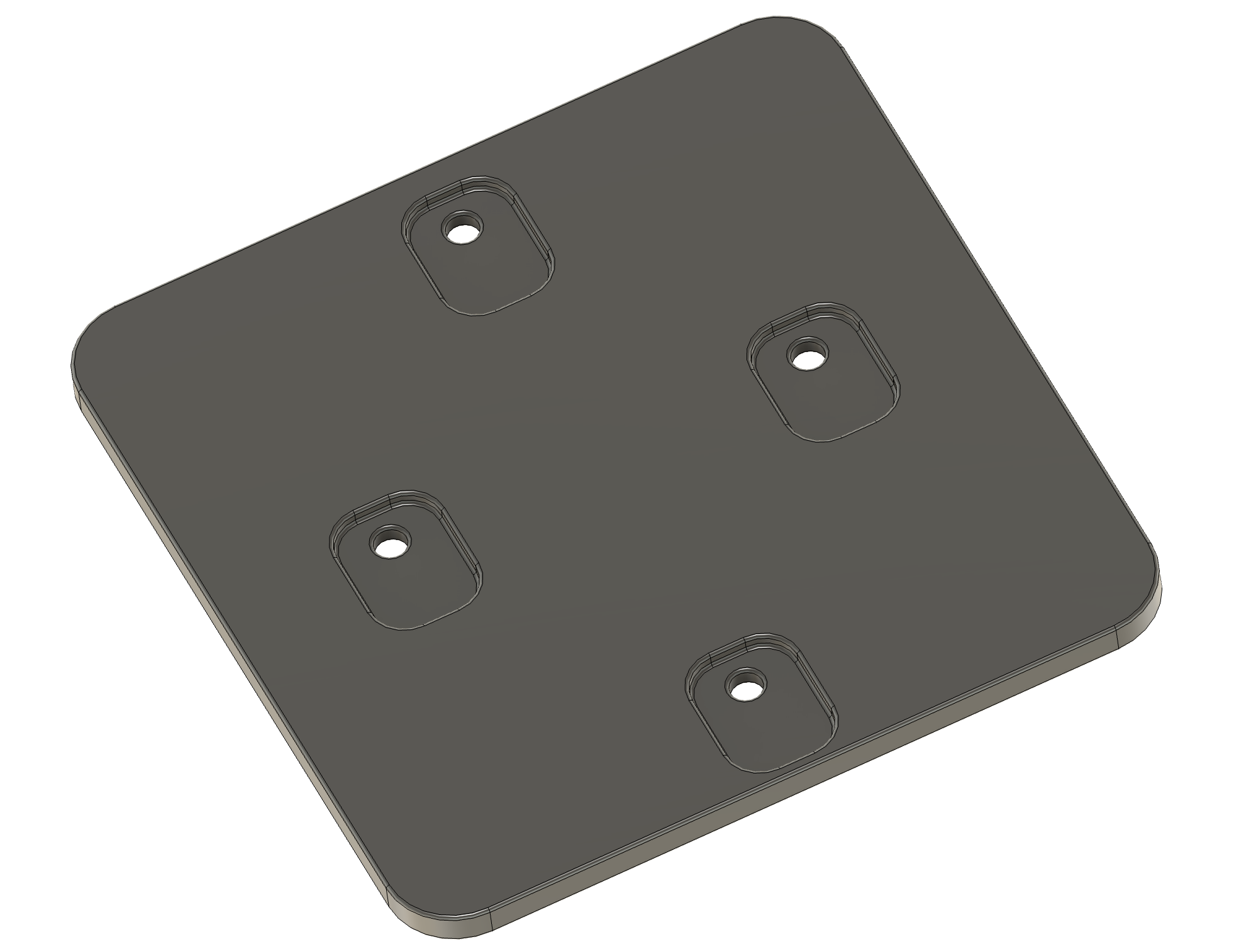
Simple rectangular model with recesses and through holes.

Simple rectangular 3D model for test fit

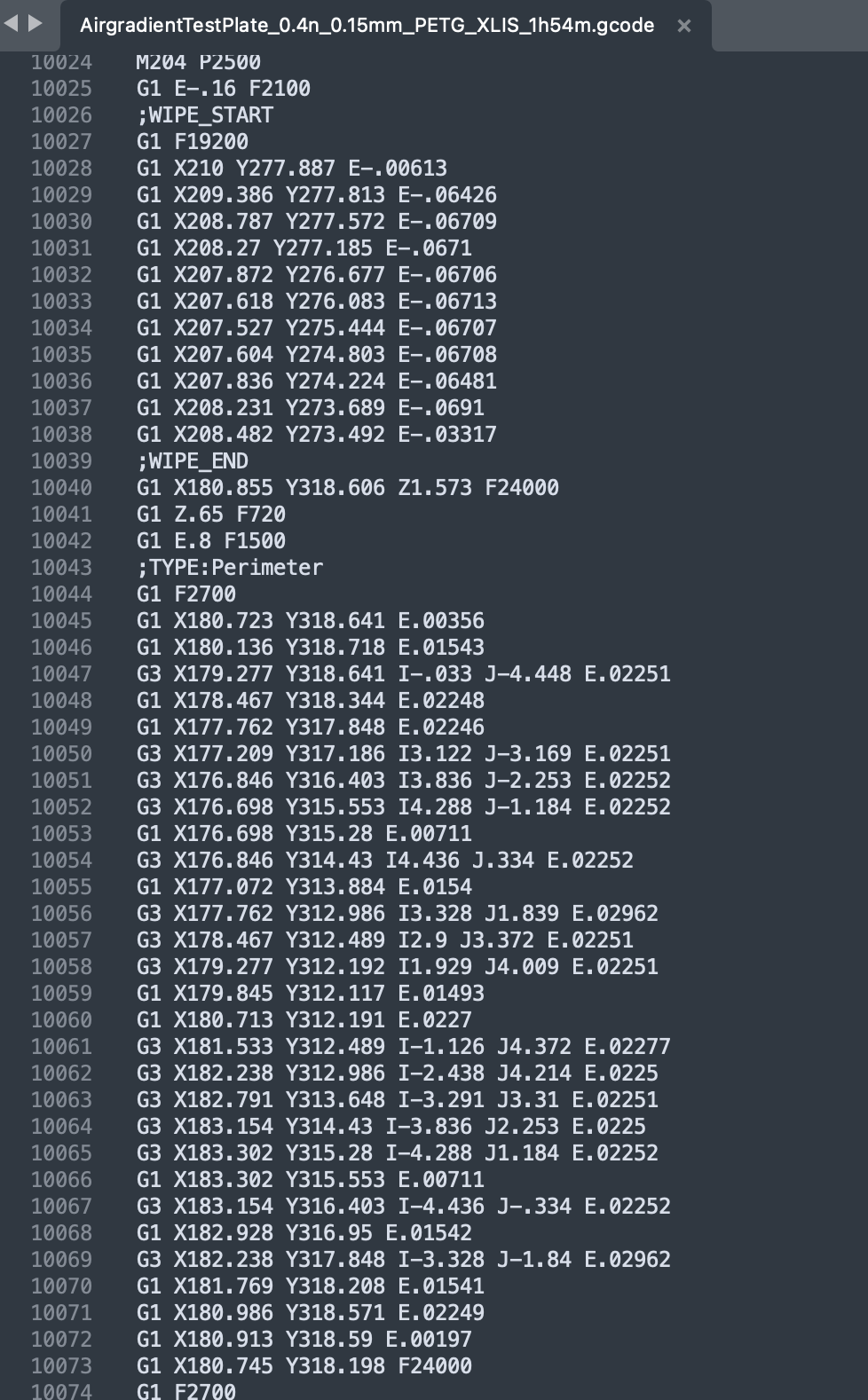
Line 10024-10074 of g-code produced when slicing the 3D model.

Part of a 173490 line long G-Code file produced by slicer for simple rectangular model.

Part of a 173,490 line long G-Code file for a simple rectangular part.

How is Firearm Detection Supposed to Work?

Under these proposed laws, manufacturers of consumer 3D printers must ensure their printers only work with their software, and implement firearm detection algorithms on either the printer itself or in a slicer software. These algorithms must detect firearm files using a maintained database of existing models. Vendors of printers must then verify that printers are on the allow-list maintained by the state before they can offer them for sale.

Owners of printers will be guilty of a crime if they circumvent these intrusive scanning procedures or load alternative software, which they might do because their printer manufacturer ends support. Owners of existing noncompliant 3D printers in regulated states will be unable to resell their printers on the secondary market legally.

What Will Actually Happen?

While the proposed laws allow for scanning to happen on either the printer itself or in the slicer software, the reality is more complicated. 

The computers inside many 3D printers have very limited computational and storage ability; it will be impossible for the printer’s computer to render the G-Code into a 3D model to compare with the database of prohibited files. Thus the only way to achieve this through the machine would be to upload all printer files to a cloud comparison tool, creating new delays, errors, and unacceptable invasions of privacy.

Many vendors will instead choose to permanently link their printers to a specific slicer that implements firearm detection. This requires cryptographic signing of G-Code to ensure only authorized prints are completed, and will lock 3D printer owners into the slicer chosen by their printer vendor.

Regardless of the specifics of their implementation, these algorithms will interfere with 3D printers' ability to print other parts without actually stopping manufacture of guns. It takes very little skill for a user to make slight design tweaks to either a model or G-Code to evade detection. One can also design incomplete or heavily adorned models which can be made functional with some post-print alterations. While this would be pioneered by skilled users—like the ones who designed today’s 3D printed guns—once the design and instructions are out there anyone able to print a gun today will be able to follow suit.  

Firearm part identification features also impose costs onto 3D printer manufacturers, and hence their end consumers. 3D printer manufacturers must develop or license these costly algorithms and continuously maintain and update both the algorithm and the database of firearm models. Older printers that cannot comply will not be able to be resold in states where they are banned, creating additional E-waste.

While those wishing to create guns will still be able to do so, people printing other functional parts will likely be caught up in these algorithms, particularly for things like film props, kids’ toys, or decorative models, which often closely resemble real firearms or firearm components.

What Are The Impacts of These Changes?

Technological restrictions on manufacturing tools’ abilities are harmful for many reasons. EFF is particularly concerned with this regulation locking a 3D printer to proprietary vendor software. Vendors will be able to use this mandate to support only in-house materials, locking users into future purchases. Vendor slicer software is often based on out-of-date, open source software, and forcing users to use that software deprives them of new features or even use of their printer altogether if the vendor goes out of business. At worst, some of these bill will make it a misdemeanor to fix those problems and gain full control of your printer.

File-scanning frameworks required by this regulation will lay the foundation for future privacy and freedom intrusions. This requirement could be co-opted to scan prints for copyright violations and be abused similar to DMCA takedowns, or to suppress models considered obscene by a patchwork of definitions. What if you were unable to print a repair part because the vendor asserted the model was in violation of their trademark? What if your print was considered obscene?

Regardless of your position on current prohibitions on firearms, we should all fight back against this effort to force technological restrictions on 3D printers, and legislators must similarly abandon the idea. These laws impose real costs and potential harms among lawful users, lay the groundwork for future censorship, and simply won’t deter firearm printing. 

  •  

Print Blocking is Anti-Consumer - Permission to Print Part 1

This is the first post in a series on 3D print blocking, for the next entry check out Print Blocking Won't Work - Permission to Print Part 2

When legislators give companies an excuse to write untouchable code, it’s a disaster for everyone. This time, 3D printers are being targeted across a growing number of states. Even if you’ve never used one, you’ve benefited from the open commons these devices have created—which is now under threat.

This isn’t the first time we’ve gone to bat for 3D printing. These devices come in many forms and can construct nearly any shape with a variety of materials. This has made them absolutely crucial for anything from life-saving medical equipment, to little Iron Man helmets for cats, to everyday repairs. For decades these devices have been a proven engine for innovation, while democratizing a sliver of manufacturing for hobbyists, artists, and researchers around the world.

For us all to continue benefiting from this grassroots creativity, we need to guard against the type of corporate centralization that has undermined so much of the promise of the digital era.  Unfortunately some state legislators are looking to repeat old mistakes by demanding printer vendors install an enshittification switch.

In the U.S, three states have recently proposed that commercial 3D-printer manufacturers must ensure their printers only work with their software, and are responsible for checking each print for forbidden shapes—for now, any shape vendors consider too gun-like. The 2D equivalent of these “print-blocking” algorithms would be demanding HP prevent you from printing any harmful messages or recipes. Worse still, some bills can introduce criminal penalties for anyone who bypasses this censorware, or for anyone simply reselling their old printer without these restrictions. 

If this sounds like Digital Rights Management (DRM) to you, you’ve been paying attention. This is exactly the sort of regulation that creates a headache and privacy risk for law-abiding users, is a gift for would-be monopolists, and can be totally bypassed by the lawbreakers actually being targeted by the proposals.

Ghosting Innovation

“Print blocking” is currently coming for an unpopular target: ghost guns. These are privately made firearms (PMFs) that are typically harder to trace and can bypass other gun regulations. Contrary to what the proposed regulations suggest, these guns are often not printed at home, but purchased online as mass-produced build-it-yourself kits and accessories.

Scaling production with consumer 3D printers  is expensive, error-prone, and relatively slow.  Successfully making a working firearm with just a printer still requires some technical know-how, even as 3D printers improve beyond some of these limitations. That said, many have concerns about unlicensed firearm production and sales. Which is exactly why these practices are already illegal in many states, including all of the states proposing print blocking. 

Mandating algorithmic print-blocking software on 3D printers and CNC machines is just wishful thinking. People illegally printing ghost guns and accessories today will have no qualms with undetectably breaking another law to bypass censoring algorithms. That’s if they even need to—the cat and mouse game of detecting gun-like prints might be doomed from the start, as we dive into in this companion post.

Meanwhile, the overwhelming majority of 3D-printer users do not print guns. Punishing innovators, researchers, and hobbyists because of a handful of outlaws is bad enough, but this proposal does it by also subjecting everyone to the anticompetitive and anticonsumer whims of device manufacturers.

Can’t make the DRM thing work

We’ve been railing against Digital Rights Management (DRM) since the DMCA made it a federal crime to bypass code restricting your use of copyrighted content. The DRM distinction has since been weaponized by manufacturers to gain greater leverage over their customers and enforce anti-competitive practices

The same enshittification playbook applies to algorithmic print blockers. 

Restricting devices to manufacturer-provided software is an old tactic from the DRM playbook, and is one that puts you in a precarious spot where you need to bend to the whims of the manufacturer.  Only Windows 11 supported? You need a new PC. Tools are cloud-based? You need a solid connection. The company shutters? You now own an expensive paperweight—which used to make paperweights.

It also means useful open source alternatives which fit your needs better than the main vendor’s tools are off the table. The 3D-printer community got a taste of this recently, as manufacturer Bambu Labs pushed out restrictive firmware updates complicating the use of open source software like OrcaSlicer. The community blowback forced some accommodations for these alternatives to remain viable. Under the worst of these laws, such accommodations, and other workarounds, would be outlawed with criminal penalties.

People are right to be worried about vendor lock-in, beyond needing the right tool for the job. Making you reliant on their service allows companies to gradually sour the deal. Sometimes this happens visibly, with rising subscription fees, new paywalls, or planned obsolescence. It can also be more covert, like collecting and selling more of your data, or cutting costs by neglecting security and bug fixes.

With expensive hardware on the line, they can get away with anything that won’t make you pay through the nose to switch brands.

Indirectly, this sort of print-blocking mandate is a gift to incumbent businesses making these printers. It raises the upfront and ongoing costs associated with smaller companies selling a 3D printer, including those producing new or specialized machines. The result is fewer and more generic options from a shrinking number of major incumbents for any customer not interested in building their own 3D printer.

Reaching the Melting Point

It’s already clear these bills will be bad for anyone who currently uses a 3D printer, and having alternative software criminalized is particularly devastating for open source contributors. These impacts to manufacturers and consumers culminate into a major blow to the entire ecosystem of innovation we have benefited from for decades. 

But this is just the beginning. 

Once the infrastructure for print blocking is in place, it can be broadened. This isn’t a block of a very specific and static design, like how some copiers block reproductions of currency. Banning a category of design based on its function is a moving target, requiring a constantly expanding blacklist. Nothing in this legislation restricts those updates to firearm-related designs. Rather, if we let proposals like this pass, we open the door to the database of forbidden shapes for other powerful interests.

Intellectual property is a clear expansion risk. This could look like Nintendo blocking a Pikachu toy, John Deere blocking a replacement part, or even patent trolls forcing the hand of hardware companies. Repressive regimes, here or abroad, could likewise block the printing of "extreme" and “obscene” symbols, or tools of resistance like popular anti-ICE community whistles

Finally, even the most sympathetic targets of algorithmic censorship will result in false positives—blocking 3D-printer users’ lawful expression. This is something proven again and again in online moderation. Whether by mistake or by design, a platform that has you locked in has little incentive to offer remedies to this censorship. And these new incentives for companies to surveil each print can also impose a substantial chilling effect on what the user chooses to create.

While 3D printers aren’t in most households, this form of regulation would set a dangerous precedent. Government mandating on-device censors which are maintained by corporate algorithms is bad. It won’t work. It consolidates corporate power. It criminalizes and blocks the grassroots innovation and empowerment which has defined the 3D-printer community. We need to roundly reject these onerous restraints on creation. 

  •  

Supreme Court Agrees With EFF: ISPs Don't Have To Be Copyright Enforcers

If your ISP can be liable for huge amounts of money for not terminating your access to the internet because of accusations that you—or someone in your household or college network—has committed copyright infringement, that is dangerous. We live in a world where high speed internet access is a necessity for participation in everyday life. That’s why liability for ISPs for their customers’ actions should not be expanded.

Last fall, EFF filed an amicus brief urging the U.S. Supreme Court to reject an expansive theory of secondary copyright liability that threatened to impose massive damages on internet service providers and other technology companies simply for offering widely used services. Yesterday, the Court agreed.

In Cox v. Sony, the Court reversed a Fourth Circuit decision that had upheld a billion-dollar verdict against internet provider Cox Communications. Writing for the majority, Justice Thomas explained that contributory liability is limited to two situations: when a defendant actively induces infringement, or when it provides a product or service that it knows is tailored for infringement.

This framework closely tracks the approach EFF urged in our amicus brief. As we explained, courts should look to patent law for guidance in defining the boundaries of secondary copyright liability. Patent law recognizes liability where a defendant actively induces infringement, or distributes a product knowing that it lacks substantial non-infringing uses. The Court’s opinion adopts that same basic structure.

EFF also emphasized the broader public interest at stake in preserving these limits. Expansive theories of secondary liability do not just affect large internet providers. They can chill innovation, threaten smaller technology companies, and undermine the development of general-purpose tools that millions of people rely on for lawful speech, creativity, education, and access to information. When liability turns on generalized knowledge that some users may infringe, service providers face pressure to over-police user activity or withdraw useful services altogether.

The Court also made clear that mere knowledge that some customers use a service to infringe is not enough. Copyright holders must show that the provider intended its service to be used for infringement. That intent can be established only through active inducement or by showing that the service is specifically designed for unlawful uses—not simply because the service provider failed to take affirmative steps to prevent infringement.

Applying this standard, the Court held that Cox could not be liable. There was no evidence that Cox encouraged or promoted infringement. The record instead showed that Cox implemented warning systems, suspended service, and in some cases terminated accounts in an effort to discourage unlawful activity.

Nor was Cox’s internet access service tailored to infringement. The Court emphasized that general-purpose internet connectivity is capable of substantial lawful uses. Treating the provision of such services as contributory infringement would improperly expand secondary liability beyond the limits recognized in prior Supreme Court decisions.

The Court also rejected the Fourth Circuit’s broader rule that supplying a service with knowledge it may be used to infringe is itself sufficient for liability. That theory conflicts with decades of precedent warning against imposing copyright liability based solely on knowledge or a failure to take additional preventive steps.

EFF is pleased with yesterday’s opinion. We will continue to advocate for the public’s ability to build, use, and innovate with new technologies.

Link to our amicus brief: 
https://www.eff.org/document/us-s-ct-cox-v-sony-eff-et-al-amicus-brief

Link to the opinion:
https://www.supremecourt.gov/opinions/25pdf/24-171_bq7d.pdf

  •  

Check Point Accelerates the Rollout of Secure AI Data Centers with NVIDIA DSX Air

Check Point is proud to integrate with NVIDIA DSX Air’s testing environment, enabling organizations to pre-validate their security aware AI data center designs before ever deploying their first piece of hardware in production to build and run their own AI.  Testing AI Factory deployments end-to-end is challenging and can require complex multi-vendor orchestration. From compute to networking, orchestration, and security, ensuring integrations, configurations and automations perform as expected can become resource-intensive with so many factors at play.   Now, organizations can perform large-scale cyber security validation testing before deploying AI Factories, using the NVIDIA DSX Air cloud-based simulation and validation platform.  Why are Organizations Building Their […]

The post Check Point Accelerates the Rollout of Secure AI Data Centers with NVIDIA DSX Air appeared first on Check Point Blog.

  •  

Blocking the Internet Archive Won’t Stop AI, But It Will Erase the Web’s Historical Record

Imagine a newspaper publisher announcing it will no longer allow libraries to keep copies of its paper. 

That’s effectively what’s begun happening online in the last few months. The Internet Archive—the world’s largest digital library—has preserved newspapers since it went online in the mid-1990s. The Archive’s mission is to preserve the web and make it accessible to the public. To that end, the organization operates the Wayback Machine, which now contains more than one trillion archived web pages and is used daily by journalists, researchers, and courts.

But in recent months The New York Times began blocking the Archive from crawling its website, using technical measures that go beyond the web’s traditional robots.txt rules. That risks cutting off a record that historians and journalists have relied on for decades. Other newspapers, including The Guardian, seem to be following suit. 

For nearly three decades, historians, journalists, and the public have relied on the Internet Archive to preserve news sites as they appeared online. Those archived pages are often the only reliable record of how stories were originally published. In many cases, articles get edited, changed, or removed—sometimes openly, sometimes not. The Internet Archive often becomes the only source for seeing those changes. When major publishers block the Archive’s crawlers, that historical record starts to disappear.

The Times says the move is driven by concerns about AI companies scraping news content. Publishers seek control over how their work is used, and several—including the Times—are now suing AI companies over whether training models on copyrighted material violates the law. There’s a strong case that such training is fair use

Whatever the outcome of those lawsuits, blocking nonprofit archivists is the wrong response. Organizations like the Internet Archive are not building commercial AI systems. They are preserving a record of our history. Turning off that preservation in an effort to control AI access could essentially torch decades of historical documentation over a fight that libraries like the Archive didn’t start, and didn’t ask for. 

If publishers shut the Archive out, they aren’t just limiting bots. They’re erasing the historical record. 

Archiving and Search Are Legal 

Making material searchable is a well-established fair use. Courts have long recognized it’s often impossible to build a searchable index without making copies of the underlying material. That’s why when Google copied entire books in order to make a searchable database, courts rightly recognized it as a clear fair use. The copying served a transformative purpose: enabling discovery, research, and new insights about creative works. 

The Internet Archive operates on the same principle. Just as physical libraries preserve newspapers for future readers, the Archive preserves the web’s historical record. Researchers and journalists rely on it every day. According to Archive staff, Wikipedia alone links to more than 2.6 million news articles preserved at the Archive, spanning 249 languages. And that’s only one example. Countless bloggers, researchers, and reporters depend on the Archive as a stable, authoritative record of what was published online.

The same legal principles that protect search engines must also protect archives and libraries. Even if courts place limits on AI training, the law protecting search and web archiving is already well established.

The Internet Archive has preserved the web’s historical record for nearly thirty years. If major publishers begin blocking that mission, future researchers may find that huge portions of that historical record have simply vanished. There are real disputes over AI training that must be resolved in courts. But sacrificing the public record to fight those battles would be a profound, and possibly irreversible, mistake. 

  •  

EFF to Court: Don’t Make Embedding Illegal

Who should be directly liable for online infringement – the entity that serves it up or a user who embeds a link to it? For almost two decades, most U.S. courts have held that the former is responsible, applying a rule called the server test. Under the server test, whomever controls the server that hosts a copyrighted work—and therefore determines who has access to what and how—can be directly liable if that content turns out to be infringing. Anyone else who merely links to it can be secondarily liable in some circumstances (for example, if that third party promotes the infringement), but isn’t on the hook under most circumstances.

The test just makes sense. In the analog world, a person is free to tell others where they may view a third party’s display of a copyrighted work, without being directly liable for infringement if that display turns out to be unlawful. The server test is the straightforward application of the same principle in the online context. A user that links to a picture, video, or article isn’t in charge of transmitting that content to the world, nor are they in a good position to know whether that content violates copyright. In fact, the user doesn’t even control what’s located on the other end of the link—the person that controls the server can change what’s on it at any time, such as swapping in different images, re-editing a video or rewriting an article.

But a news publisher, Emmerich Newspapers, wants the Fifth Circuit to reject the server test, arguing that the entity that embeds links to the content is responsible for “displaying” it and, therefore, can be directly liable if the content turns out to be infringing. If they are right, the common act of embedding is a legally fraught activity and a trap for the unwary.

The Court should decline, or risk destabilizing fundamental, and useful, online activities. As we explain in an amicus brief filed with several public interest and trade organizations, linking and embedding are not unusual, nefarious, or misleading practices. Rather, the ability to embed external content and code is a crucial design feature of internet architecture, responsible for many of the internet’s most useful functions. Millions of websites—including EFF’s—embed external content or code for everything from selecting fonts and streaming music to providing services like customer support and legal compliance. The server test provides legal certainty for internet users by assigning primary responsibility to the person with the best ability to prevent infringement. Emmerich’s approach, by contrast, invites legal chaos.

Emmerich also claims that altering a URL violates the Digital Millennium Copyright Act’s prohibition on changing or deleting copyright management information. If they are correct, using a link shortener could put users at risks of statutory penalties—an outcome Congress surely did not intend.

Both of these theories would make common internet activities legally risky and undermine copyright’s Constitutional purpose: to promote the creation of and access to knowledge. The district court recognized as much and we hope the appeals court agrees.

  •  

Securing Your AI Transformation: How Check Point Is Helping Security Teams Keep Control in an AI-First World

AI is moving faster than most security teams can keep up with. As AI reshapes how work gets done, and how attacks are carried out, Check Point believes organizations need to rewire security for the AI era: not by adding more tools, but by rethinking how security is designed and operated when both attackers and defenders use AI. First, security leaders must revalidate their security foundations. AI-driven attacks are faster and more adaptive, so core controls across networks, endpoints, email, SASE, and cloud must be strengthened to keep pace with the proliferation of AI-powered threats. Second, organizations must enable secure […]

The post Securing Your AI Transformation: How Check Point Is Helping Security Teams Keep Control in an AI-First World appeared first on Check Point Blog.

  •  
❌