❌

Reading view

AWS becomes first CSP to complete the Cloud High profile assessment with 172 services and features in scope

We continue to expand the scope of our assurance programs at Amazon Web Services (AWS) and are pleased to announce the successful completion of our first ever Cloud High (PBHH) security assessment with 172 assessed services and features. Completion of this assessment, effective September 18, 2026, makes AWS the first cloud service provider (CSP) in Canada to meet this high security bar and provide assurance to our valued customers. This assessment also reaffirms our commitment to helping public and commercial customers achieve and maintain the highest-grade security standard for workloads with increased sensitivity.

What is the Cloud High assessment and why is it important?

The Cloud High security profile (that is, PBHH) seeks to enhance the integrity and availability of customer organizational workloads that are considered to have an increased level of sensitivity. These are systems that the Government of Canada (GC) and its service providers use to support delivery of services at a national scale or that are determined to be significant for handling sensitive information. The profile is based on the Security and privacy controls and assurance activities catalogue (ITSP.10.033). The Cloud High (PBHH) profile includes all controls and enhancements contained within the Cloud Medium profile (PBMM), with additional controls and enhancements to address higher integrity and availability requirements. The Cloud Medium and Cloud High profiles establish baseline security requirements for cloud services. These services support GC workloads and information processing up to the Protected B level.

As of September 18, 2026, there are a total of 172 AWS services and features that were assessed by the Canadian Centre for Cyber Security (CCCS) under Cloud High security assessment. The assessment covers services and features that are available in both the Canada (Central) and Canada West (Calgary) AWS Regions.

How can you access the assessment?

The summary assessment is available through AWS Artifact. You can also learn more about the Cloud High and Medium assessment on the AWS CCCS assessment compliance webpage.

AWS strives to continually bring services into scope of its compliance programs to help you meet your architectural and regulatory needs. Please reach out to your AWS account team if you have questions or feedback about the Cloud High and Medium assessments.

To learn more about our compliance and security programs, refer to AWS Compliance Programs. As always, we value your feedback and questions; reach out to the AWS Compliance team through the Contact Us page.

Naranjan Goklani

Naranjan is AWS Compliance, Security Assurance and Privacy (CAPS) Lead for Canada. He has experience leading audits, attestations, certifications, and assessments across the Americas. Naranjan has more than 16 years of experience in technology risk management, customer security assurance, and technology audits. He previously worked in the Big 4 accounting firms and supported clients from the financial services, technology, retail, and utilities industries.

  •  

Amazon Threat Intelligence identifies PHP2Shell exploitation prior to public disclosure in MadPot

Amazon Threat Intelligence identified a PHP2Shell exploitation attempt dating to Oct. 17, 2026, in MadPot telemetry, four days before public disclosure of CVE-2026-109618 and CVE-2026-109619. The exploit attempt originated from an IP address associated with a commercial anonymization network. While the vulnerability was under embargo, the targeting of a honeypot from an anonymized IP address suggests the activity was conducted by a threat actor, though it remains unclear how the actor acquired exploit information prior to disclosure.

The PHP embargo window was set to be lifted on 2026-10-21 1400 UTC. On the day of the release, Amazon Threat Intelligence identified multiple proof of concept exploits for the vulnerability, with the earliest around 2026-10-21 0200 UTC. Subsequently, from 2026-10-21 0200 UTC to 2026-10-21 0800 UTC, Amazon Threat Intelligence identified additional exploitation attempts of PHP2Shell targeting MadPot from additional anonymized infrastructure. The actual payloads and choices in anonymization infrastructure varied, suggesting these were multiple actors. Technical analysis is ongoing, and it’s unclear if any of these attempts would have succeeded in real-world systems.

The actual release of the embargo window was 2026-10-21 1400 UTC. Once the embargo was lifted and the patch was released, additional proof-of-concept exploits appeared within hours, and we saw them used against our sensors almost immediately. PHP2Shell is now seeing broad exploitation attempts in the wild.

Two lessons from this event apply well beyond this one vulnerability:

  1. An embargo protects defenders only until someone else finds the same bug. Coordinated disclosure is still the right model. But defenders should not assume the public disclosure date is the earliest date of exploitation. With PHP2Shell, compromise may predate the advisory.
  2. The time from patch to working exploit is shrinking for structural reasons. In the past, most exploitation we observed came after a public proof of concept was released. A small number of capable actors built exploits, and everyone else waited for them. That dependency is weakening. AI-assisted analysis makes it cheaper to turn a patch diff or advisory into a working exploit. As a result, more actors can act within hours or even minutes once technical details of a vulnerability are disclosed.

For security leaders, this changes several working assumptions:

  1. For critical vulnerabilities in internet-facing systems, measure patch and mitigation timelines in hours. A 7-day or 30-day SLA assumes a delay that no longer exists.
  2. Start investigations from the earliest known exploitation, not from the disclosure date. For PHP2Shell, investigate from at least starting on October 17th.
  3. Invest in detections that don’t rely on a signature for a specific CVE. The first exploitation will often come before those signatures exist.

How AWS helps protect customers

AWS deploys multiple layers of protection to help safeguard customers. Our internal threat intelligence system automatically detected and restricted malicious scanning attempts targeting this vulnerability. We analyze over 200 billion events per minute and integrate threat intelligence from our MadPot honeypot network to identify and block known exploitation attempts in real time. Our honeypot system provides us with early detection of exploitation attempts, enabling rapid response and threat analysis.

Immediate recommended actions

  1. Upgrade immediately to the fixed PHP versions. Upgrading is the only complete remediation for both CVE-2026-109618 and CVE-2026-109619. There are no configuration-only workarounds that fully address both issues.
  2. Consider blocking multi-part file uploads in PHP deployments that cannot be patched immediately, but determine how this would affect your application prior to deploying.
  3. Look for POST requests with the PHP_SESSION_UPLOAD_PROGRESS string in form uploads.
  4. Review web server logs for suspicious activity.
  5. Check for unexpected process execution or file modification on web application servers.

Indicators of Compromise (IOCs)

IP Address

Observed Date

103.216.220.92

10/17/2026

31.223.184.166

10/21/2026

37.19.200.5

10/21/2026

134.209.159.64

10/21/2026

103.114.163.188

10/21/2026

95.217.98.37

10/21/2026

The identified IP addresses include shared anonymization infrastructure and are not exclusive to this threat activity. Organizations should investigate any observations involving these addresses as opposed to blocking.

See how to use AWS Web Application Firewall to help reduce your exposure while you patch in our blog post Using AWS WAF to apply mitigations for PHP2Shell RCE vulnerabilities (CVE-2026-109618 and CVE-2026-109619).

If you have questions, start a new thread on AWS re:Post or reach out to AWS Support.


CJ Moses

CJ Moses

CJ Moses is the CISO of Amazon Integrated Security. In his role, CJ leads security engineering and operations across Amazon. His mission is to enable Amazon businesses by making the benefits of security the path of least resistance. CJ joined Amazon in December 2007, holding various roles including Consumer CISO, and most recently AWS CISO, before becoming CISO of Amazon Integrated Security September of 2023.

Prior to joining Amazon, CJ led the technical analysis of computer and network intrusion efforts at the Federal Bureau of Investigation’s Cyber Division. CJ also served as a Special Agent with the Air Force Office of Special Investigations (AFOSI). CJ led several computer intrusion investigations seen as foundational to the security industry today.

CJ holds degrees in Computer Science and Criminal Justice, and is an active SRO GT America GT2 race car driver.

  •  

AWS Continuum sets a new standard in autonomous code security

As AI models become more capable, they uncover more security vulnerabilities and identify increasingly sophisticated paths to exploit them, raising the bar for how quickly defenders must respond. Security teams now face more potential vulnerabilities than their existing processes were designed to handle — each requiring investigation, reproduction, and a repair that must be tested to confirm it closes the vulnerability without breaking expected behavior.

AWS Continuum for code vulnerabilities accelerates this work with autonomous security at machine speed. To measure Continuum against a concrete public standard, we chose CyberGym-E2E, which asks an agent to find a vulnerability in a real codebase, demonstrate it with a working proof of concept, and repair it without breaking behavior covered by the project’s tests. Continuum passed 819 of 920 tasks within the benchmark’s 90-minute limit, achieving an 89.0% end-to-end success rate. This establishes a new standard 23.1 percentage points up from the previous public high of 65.9%.

Measuring the full vulnerability lifecycle

Many security benchmarks test a single task in isolation. Detection benchmarks test whether a system can identify suspicious code, while patching benchmarks begin with a known flaw and ask for a fix. CyberGym, the predecessor to CyberGym-E2E, also begins with a known vulnerability and focuses on exploit generation. By contrast, CyberGym-E2E evaluates the full vulnerability lifecycle, requiring a system to identify and demonstrate a vulnerability before producing a tested repair. This broader scope more closely reflects the work facing security teams.

Each CyberGym-E2E task places an agent in a container with a vulnerable revision of a real open-source project and the tools needed to build and test it. An agent can inspect and modify the source, but receives no vulnerability description, proof of concept, crash log, or original patch. External network access is blocked, and protected benchmark files cannot be modified. Within 90 minutes, the agent must submit an input demonstrating a vulnerability and a source-code patch. The full benchmark contains 920 tasks based on historical OSS-Fuzz vulnerabilities across 139 open-source projects. The median project contains more than 600,000 lines of code.

The benchmark evaluates each submission in four cumulative stages:

  1. S1 checks whether the agent produced an input that crashes the vulnerable program.
  2. S2 checks whether the agent’s patch prevents that crash.
  3. S3 checks whether the patched project still passes its functionality tests.
  4. S4 checks whether the patch also fixes the specific historical vulnerability selected by the benchmark.

CyberGym-E2E defines S3 as its main measure of end-to-end success. S4 is diagnostic because a repository may contain several valid vulnerabilities: an agent can find and repair a real flaw that differs from the benchmark’s selected target.

Continuum sets a new standard

Continuum for code vulnerabilities reached a new standard for every stage of CyberGym-E2E. The table below compares its performance with the previous best public results.

Stage

What it measures

Continuum

Previous public high

Difference

S1

Finds and reproduces a vulnerability

92.5%

67.9%

+24.6%

S2

Repairs its generated crash

89.6%

66.2%

+23.4%

S3

Preserves tested functionality

89.0%

65.9%

+23.1%

S4

Also repairs the benchmark’s selected vulnerability

37.8%

26.2%

+11.6%

On S3, the benchmark’s main measure of end-to-end success, Continuum passed 819 of 920 tasks. Its 89.0% success rate exceeds the previous public high of 65.9% by 23.1 percentage points. The result reflects both the capability of the underlying frontier models and Continuum’s design as a multi-agent security system. The next section examines how that system adds value beyond the models alone.

The official 89.0% result applies CyberGym-E2E’s 90-minute limit. When tasks were allowed to continue beyond that limit, Continuum’s end-to-end pass rate reached 93.7%, indicating higher potential coverage when longer-running analyses can complete.

We conducted the evaluation under CyberGym-E2E’s network-isolation and submission-review requirements. External retrieval was blocked during execution, and post-run trajectory review confirmed that successful results came from vulnerability analysis rather than retrieval of public historical fixes.

Harness design for end-to-end security

Continuum for code vulnerabilities is a multi-agent system organized around the main phases of the code vulnerability lifecycle: discovery, validation, and remediation. Each phase uses specialized agents adapted to the evidence and decisions it requires. The system carries evidence forward so that each phase builds on the work completed before it.

During discovery, Continuum analyzes the repository and develops candidate vulnerability findings. Its agents identify code paths that warrant deeper investigation and record the source evidence supporting each candidate.

During validation, specialized agents attempt to turn a candidate finding into a demonstrated security issue. They construct a proof of concept, run it against the vulnerable program, and determine whether the observed behavior supports the finding. This converts a potential code-level weakness into executable evidence.

During remediation, agents trace the vulnerability to its root cause and produce a patch. Continuum then verifies that the patch prevents the demonstrated failure and that the project’s functionality tests continue to pass. The repair is therefore evaluated against the same evidence used to establish the vulnerability.

Together, these phases create a connected record from suspicious code to a demonstrated vulnerability and tested repair. The architecture allows Continuum to adapt its tools, instructions, checks, and models to each phase while maintaining a consistent standard of evidence. It also supports a multi-model approach that can leverage complementary strengths and incorporate new models as they become available.

In customer environments, Continuum can also combine code-level evidence with available deployment context, including service exposure, network paths, permissions, and configuration. This context helps distinguish vulnerabilities with limited production impact from exposures that demand immediate action. CyberGym-E2E evaluates the code-level process but does not provide deployment context, placing this broader prioritization capability outside the benchmark’s scope.

Beyond CyberGym-E2E

CyberGym-E2E advances security evaluation by turning a complex, multi-stage process into a large public benchmark with reproducible tasks and outcomes that can be verified by running code. The CyberGym-E2E authors’ careful work on task construction, scoring, and submission standards gives the field a concrete foundation for measuring end-to-end progress.

To keep evaluation consistent and reproducible across 920 tasks, CyberGym-E2E focuses on memory-safety vulnerabilities in C and C++ projects. Sanitizer-detected crashes provide objective evidence of a defect, while subsequent checks determine whether a repair blocks the proof of concept and preserves functionality covered by the project’s tests. This design necessarily leaves many languages and vulnerability classes outside the benchmark’s current scope, including many of the most common and impactful bug classes observed in production systems. Evaluating these areas will require different task environments and equally rigorous forms of validation.

Our view of end-to-end security also extends beyond producing a tested code-level repair. In production systems, deployment context such as service exposure, network paths, permissions, and configuration often determines whether a vulnerability presents limited risk or demands immediate action. Future evaluations should test whether autonomous systems can reason about this context and prioritize findings according to their effect on the safety of the deployed system.

CyberGym-E2E’s value extends beyond the dataset itself. It makes the case that end-to-end security is worth defining and measuring as a task in its own right. That involves hard design choices about scope, evidence, and what counts as success, and CyberGym-E2E gives the field a concrete starting point for working through those choices. This system-level view complements our work on the Deception Benchmark, which evaluates a narrower but related capability: how reliably individual frontier models distinguish real vulnerabilities from safe code. Together, they examine security performance at both the model and system levels.

To learn how AWS Continuum for code vulnerabilities helps teams discover, validate, prioritize, and remediate vulnerabilities at machine speed, visit the AWS Continuum product page.


Alexander Greaves

Alexander Greaves-Tunnell

Alec is a scientist working on the design and evaluation of AWS Continuum for code vulnerabilities. At AWS, he has led projects across search, security, and observability that bring the AI state-of-the-art to complex application domains beyond the expertise of existing models. His academic background is in statistics.

Neha Rungta

Neha Rungta

Neha is a scientist and builder who has spent her career making machines reason about complex systems at scale. Her work spans automated reasoning, formal verification, security, and AI, shaping systems including Cedar, IAM Access Analyzer, and Continuum. Today, she is forging the next generation of machine reasoning, combining LLMs, formal methods, and agentic systems.

  •  

AWS European Sovereign Cloud: Demonstrating an independent operation

On Saturday, October 24, 2026, we will conduct an exercise demonstrating that the AWS European Sovereign Cloud can operate without depending on any infrastructure outside of the European Union (EU).

For several hours, the AWS European Sovereign Cloud will operate without a connection to the AWS Global Network backbone. The backbone is the private network that moves authorized AWS operational data between AWS locations without using the public internet. During the exercise, this traffic will securely reroute over the public internet.

The exercise will not affect service availability within the AWS European Sovereign Cloud, other AWS Regions, or private connectivity through AWS Direct Connect. Customers may experience brief connectivity disruptions as traffic moves onto a separate network route at the beginning or the end of the exercise, after which normal connectivity resumes.

The operational team, composed entirely of EU residents within the EU, will execute the exercise using only the hardware and software resources of the AWS European Sovereign Cloud. The AWS European Sovereign Cloud Managing Directors called for this exercise to showcase its operational independence.

An independent cloud for Europe

The AWS European Sovereign Cloud is a new, independent cloud for Europe. Located in Brandenburg, Germany, its data centers are physically and logically separate from other AWS Regions, with a local in-EU copy of the source code. All customer content and customer-created metadata stay in the EU. It has no critical dependencies on non-EU infrastructure and is operated exclusively by EU residents.

In standard operations, the AWS European Sovereign Cloud uses two global systems. The first is the AWS Global Network backbone. The second is a dedicated system that the local EU team controls and supervises to securely manage limited, controlled transfers of operational AWS data.

Neither is operation-critical, and neither affects the sovereignty assurance of the AWS European Sovereign Cloud. The AWS European Sovereign Cloud can operate independently at any time without a connection to these global systems, and on October 24 that’s what the team will demonstrate.

Built to meet regulatory standards

This exercise will produce verifiable technical and operational evidence that the AWS European Sovereign Cloud can operate independently within the EU. The exercise is designed to be consistent with the objectives of the European Commission’s EU Cloud Sovereignty Framework (CSF) and the criteria of the C3A framework from Germany’s Federal Office for Information Security (BSI). These frameworks set out objectives and criteria for assessing whether cloud services can be provided independently and autonomously.

We designed the AWS European Sovereign Cloud for regulated customers and the public sector across the EU. The AWS European Sovereign Cloud: Sovereign Reference Framework (ESC-SRF) gives our customers and partners a comprehensive set of evidence points, maps to controls, artifacts, and other elements regulators and compliance authorities need to accelerate their adoption of the AWS European Sovereign Cloud. The results of this exercise will provide additional evidence for their compliance and assurance packages.

Standalone and fully secure

The AWS European Sovereign Cloud runs connected to the AWS Global Network backbone because it delivers superior performance, capacity, reliability, security, and cost savings to customers. That includes always-on encryption and distributed denial of service (DDoS) defenses; and the backbone can’t decrypt or see the encrypted data that AWS European Sovereign Cloud customers send and receive. While the backbone delivers these benefits day-to-day, the AWS European Sovereign Cloud can continue to operate independently, with the appropriate security controls in place.

During the exercise, instead of using the AWS Global Network backbone, the AWS European Sovereign Cloud will exclusively use its dedicated internet connectivity from European internet service providers. This will provide connectivity to the worldwide internet.

Whenever traffic moves between internet links, there’s a small window of limited disruption called convergence, a short time when other non-AWS networks change their routing information to reflect the change. This could happen at the beginning of the exercise, when traffic moves to dedicated AWS European Sovereign Cloud internet providers, and at the end of the exercise, when traffic moves back to the AWS Global Network backbone.

Customer data stays in the EU

AWS has committed to not moving AWS European Sovereign Cloud customer content and customer-created metadata outside of the EU. Only certain data, which is neither customer content nor customer-created metadata, such as AWS operational data, leaves the EU. We use a dedicated system to securely manage these limited, controlled transfers under the control and supervision of the local EU team. We’re rigorous about what the system transfers. It accepts vetted source code mirroring and software updates, and transfers out very limited and approved routine information. During the exercise, the AWS European Sovereign Cloud team will disable the system entirely, confirming that the AWS European Sovereign Cloud continues to operate independently without it.

Learn more

AWS will share an update after the exercise with regulators and customers. To learn more about the AWS European Sovereign Cloud’s design and digital sovereignty controls, visit aws.eu. If you have questions about this exercise or would like to discuss how it may impact your workloads, reach out to AWS Support or contact your AWS Account team.

Stephane Israel

Stéphane Israël

Stéphane is the leader and Managing Director of the AWS European Sovereign Cloud. He is responsible for the management and operations of the AWS European Sovereign Cloud, including infrastructure, technology, and services, in addition to broader digital sovereignty efforts at AWS. Prior to AWS, he was the CEO of Arianespace, where he oversaw numerous successful space missions, including the launch of the James Webb Space Telescope.

  •  

ICYMI: August 2026 @AWS Security

Read all about the latest AWS security features, compliance updates, and hands-on resources in our monthly digest posts. You’ll find expert blog posts, new service capabilities, code samples, and workshops.

AWS Security Blog posts

August brought 20 AWS Security Blog posts organized across seven categories. Identity and access management led the month with five posts covering self-service rate limits for Amazon Cognito, a decade of AWS Managed Microsoft AD, a redesigned sign-in experience, console Private Access for isolated VPCs, and automated IAM Identity Center governance. Data protection followed with four posts on AWS KMS data key caching, ACME protocol support in AWS Certificate Manager, Amazon S3 over-permissioned access remediation, and the upcoming deprecation of email-based domain validation. AI security continued to grow with four posts on custom authentication in Amazon Bedrock AgentCore Gateway, user authorization propagation in AI agents, and extending Bedrock Guardrails to tool interactions. Threat detection, governance and networking.

Identity

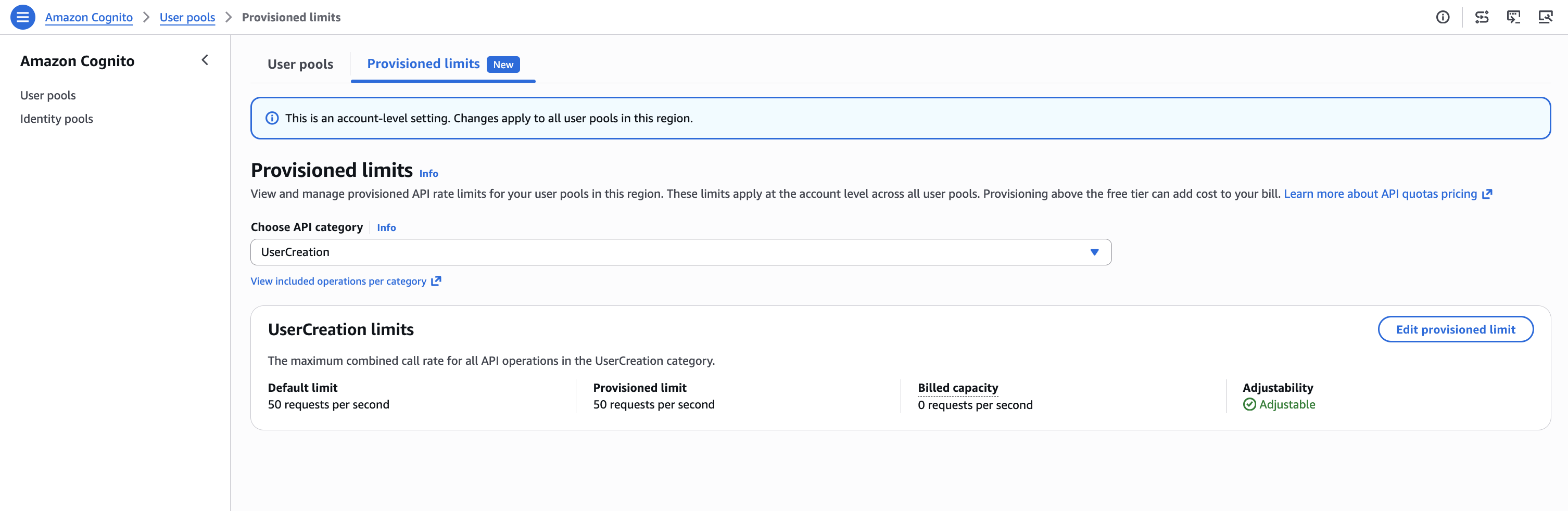
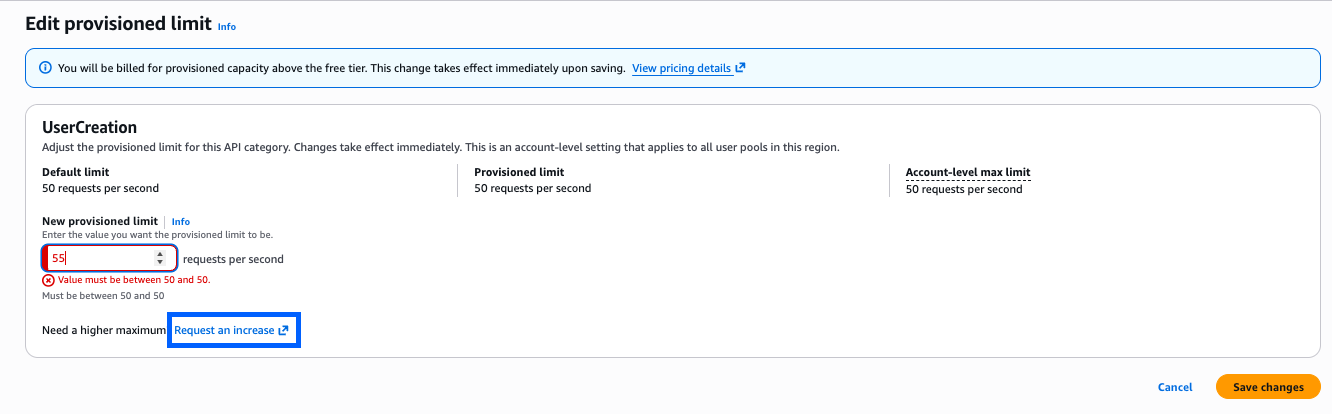
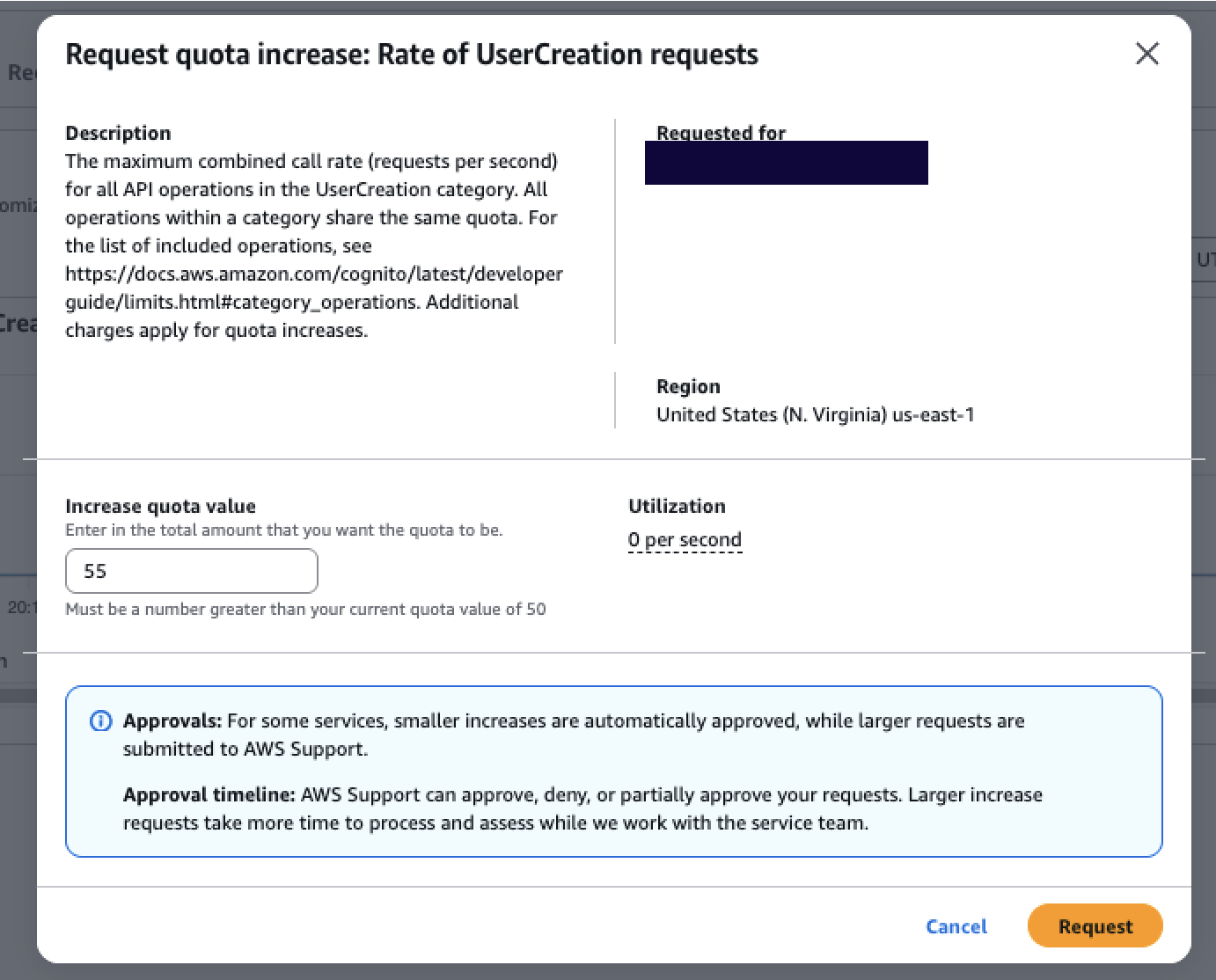
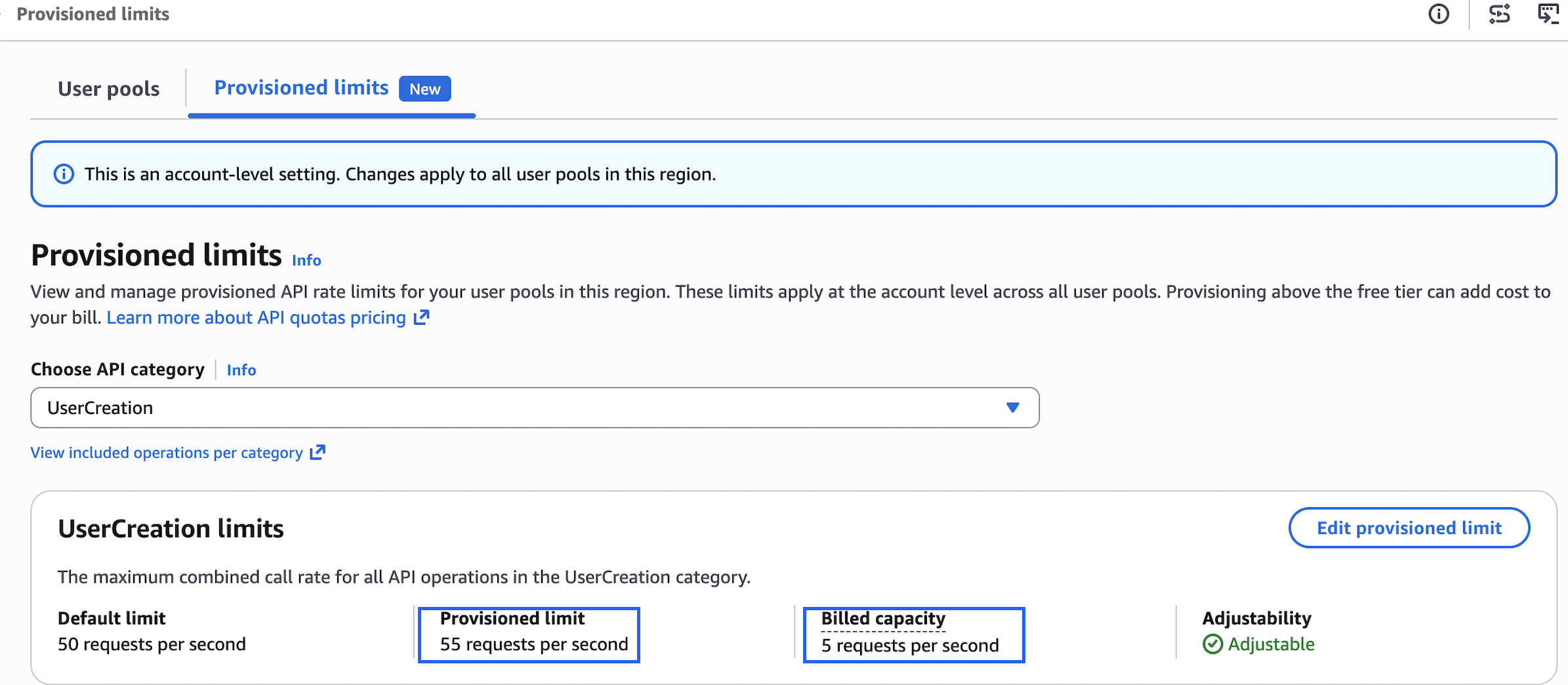
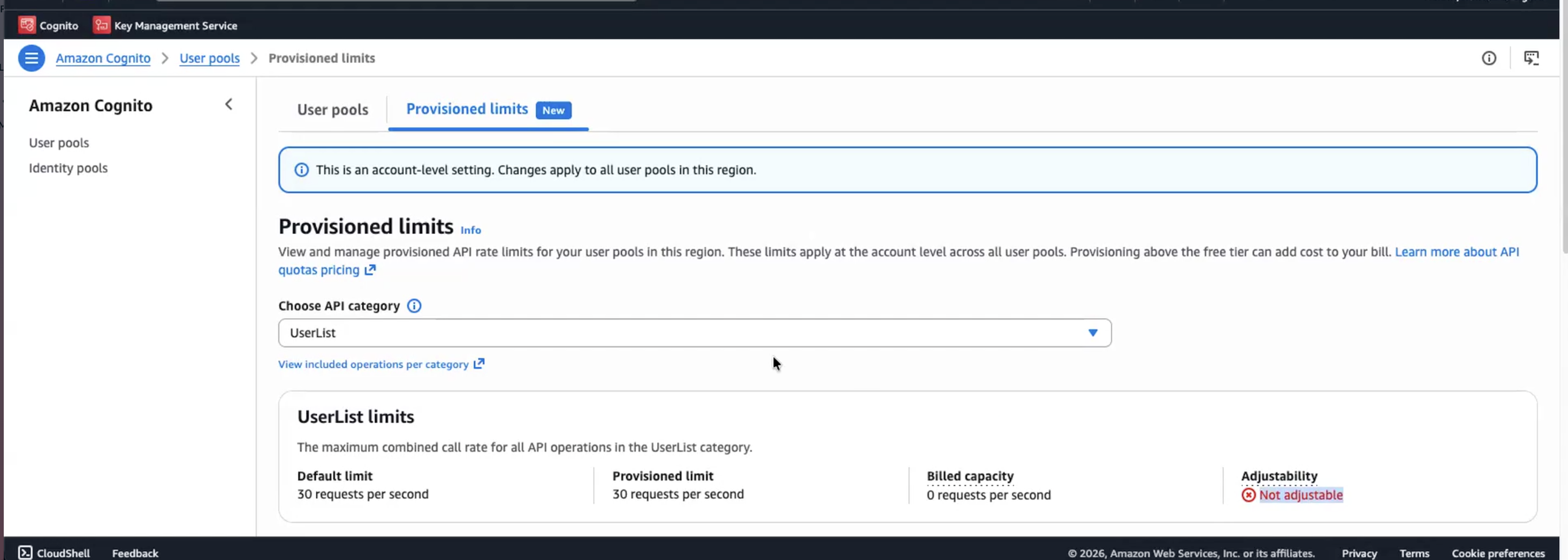
From 2 weeks to 2 minutes: Amazon Cognito launches provisioned limits for self-service rate limit management
Authors: Kiran Dongara, Howie Li | Published: August 5, 2026
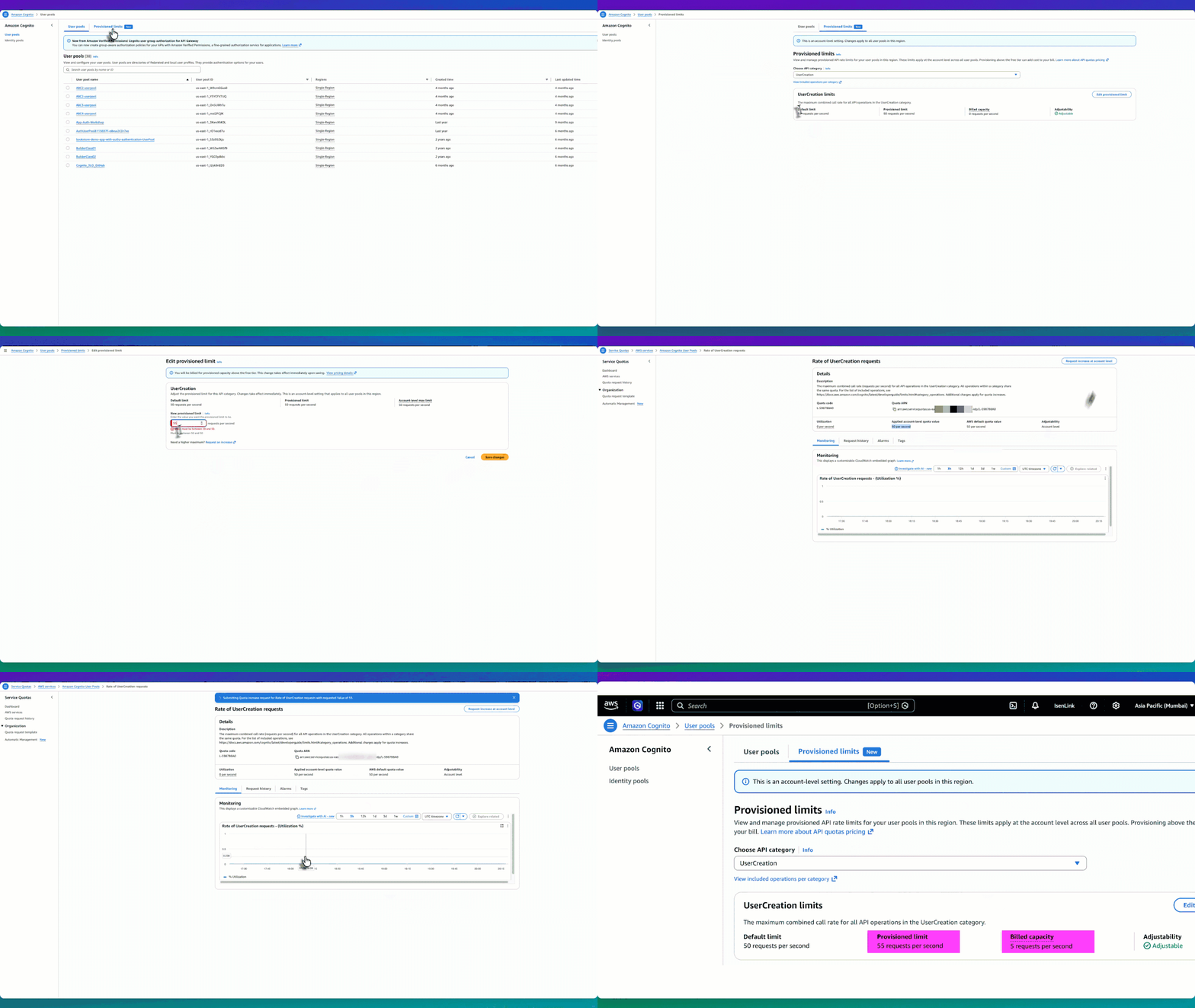
Learn to use Amazon Cognito provisioned limits for on-demand authentication rate limit adjustments, replacing the previous 10–14 day support ticket process with self-service capacity scaling in minutes.

A decade of enterprise identity in the cloud with AWS Managed Microsoft AD
Authors: Vladimir Provorov, Tekena Orugbani, Rodney Underkoffler | Published: August 7, 2026
AWS Managed Microsoft AD celebrates 10 years of fully managed Active Directory in the cloud, now offering Standard, Enterprise, and Hybrid editions with multi-Region replication and 20+ AWS service integrations.

Updates to your AWS sign-in experience
Authors: Vaibhav Chowla, Ella Segura | Published: August 17, 2026
AWS is gradually rolling out a redesigned sign-in page with a unified email entry point, social identity provider options, and an updated session selection experience for managing multiple active sessions.

Extend your data perimeter to the AWS Management Console with Private Access
Authors: Madhur Kulkarni, Abhijit Barde, Sujay Ghosh, Mateusz Jaworski | Published: August 28, 2026
AWS Management Console Private Access now supports VPCs without internet connectivity, routing all console traffic – authentication, static assets, and service API calls – through AWS PrivateLink endpoints to strengthen your data perimeter.

Automate IAM Identity Center governance with continuous discovery and reporting
Author: Jonathan Nguyen | Published: August 31, 2026
Learn to deploy automated discovery and reporting for AWS IAM Identity Center applications and assignments across your organization, with event-driven monitoring that validates naming conventions and enables near real-time enforcement of governance policies.

Data Protection

Caching KMS data keys in multi-thread environments: per-tenant encryption for event-driven systems at scale
Authors: Maria Gutovsky, Hemmy Yona | Published: August 6, 2026
Learn to solve the cache stampede problem in multi-tenant envelope encryption using the AWS-recommended hierarchical keyring pattern or a custom Caffeine-based caching approach to reduce AWS KMS costs.

Automate certificates with ACME support in AWS Certificate Manager
Authors: Anthony Harvey, Chandan Kundapur | Published: August 6, 2026
Learn to use ACME protocol support in AWS Certificate Manager to automate public certificate issuance and renewal using standard clients like Certbot and cert-manager, with enterprise controls for domain scoping and centralized visibility.

Securing your Amazon S3 buckets: identifying and remediating over-permissioned access
Authors: Hetal Kolekar, Fernando Chiera di Vasco Freitas, Manonmayi Vedam | Published: August 7, 2026
Learn to detect and fix over-permissioned Amazon S3 buckets across multi-account environments using AWS Lambda, AWS Config, and AWS Security Hub, with automation for continuous monitoring.

AWS Certificate Manager will discontinue email validation to prove domain validation for certificates
Authors: Adam Aboudi, Poojil Tripathi | Published: August 13, 2026
ACM will discontinue email-validated public certificates by September 30, 2027, aligning with CA/B Forum standards – learn the timeline and how to migrate to DNS validation in place.

AI Security

Implement custom authentication for tools integration using request Lambda interceptor in AgentCore Gateway
Authors: Nishant Mainro, Ram Ramani | Published: August 18, 2026
Learn to use a request Lambda interceptor in Amazon Bedrock AgentCore Gateway to bridge legacy authentication mechanisms like Basic Auth, isolating credentials from AI agents using AWS Secrets Manager.

Propagate user authorization context in AI agents with Amazon Bedrock AgentCore
Authors: Anshu Bathla, Prafful Gupta, Rohit Verma | Published: August 19, 2026
Learn to enforce least-privilege access in AI agents by propagating user identity through Amazon Bedrock AgentCore to Amazon DynamoDB, Knowledge Bases, and Salesforce, without embedding authorization logic in agent code.

Extend Amazon Bedrock Guardrails to tool interactions using the Strands Agents SDK
Authors: Stephan Traub | Published: August 27, 2026
Learn to extend Amazon Bedrock Guardrails beyond the model boundary to tool calls, external data, and MCP server interactions using three validation checkpoints built with Strands Agents SDK lifecycle hooks.

Threat detection and incident response

Security Hub Extended adds supply chain security as its tenth category
Author: Michael Fuller | Published: August 18, 2026
AWS Security Hub Extended now includes supply chain security with Chainguard and Socket as curated partners, helping you verify open source dependencies and block malicious packages through a single AWS billing relationship.

Detecting multi-stage attacks on AWS: a guide to cross-service signal correlation
Authors: Nisha Kashyap | Published: August 26, 2026
Learn to correlate signals across AWS CloudTrail, VPC Flow Logs, and Route 53 Resolver logs to detect multi-stage attacks by layering your business context, data classification, access norms, and change windows – on top of Amazon GuardDuty Extended Threat Detection.

AWS partners with Anthropic and OpenAI to bring AWS Continuum into developer workflows
Author: Chet Kapoor | Published: August 5, 2026
AWS Continuum for code vulnerabilities now integrates with Anthropic Claude Code, OpenAI Codex, and Kiro, enabling developers to discover, prioritize, validate, and remediate vulnerabilities within their coding environments.

We invited a direct competitor into Security Hub Extended. Here’s why.
Authors: Michael Fuller | Published: August 31, 2026
AWS Security Hub Extended now includes Upwind, a runtime-first cloud security company, offering eBPF-based workload protection with pay-as-you-go pricing through a single AWS bill, reinforcing customer choice even where capabilities overlap with AWS offerings.

Infrastructure security

AWS Network Firewall now supports rule hit count
Authors: Preetkumar Shah, Amit Gaur, Cheriyan Mundapuzha, Santosh Shanbhag, Srivalsan Mannoor Sudhagar | Published: August 20, 2026
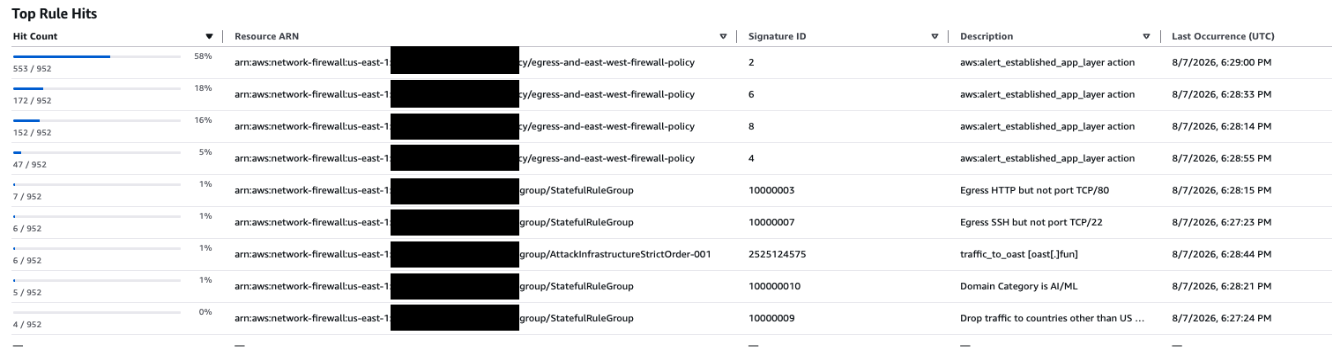
AWS Network Firewall now tracks how often stateful rules match traffic, helping you identify unused rules, validate security controls for compliance, and accelerate incident response at no additional cost.

Governance and compliance

Landing Zone Accelerator independent assessment report for C5:2020 now available on AWS Artifact
Authors: Kevin Donohue, Michael Wahlers | Published: August 11, 2026
An independent assessment by Schellman evaluates how Landing Zone Accelerator on AWS aligns to C5:2020 requirements, implementing 325 security controls to accelerate your compliance journey.

Fast track ISM-ready cloud environments and IRAP assessments with Landing Zone Accelerator on AWS
Authors: Kevin Donohue, Dave Connell, Dan Friebe | Published: August 25, 2026
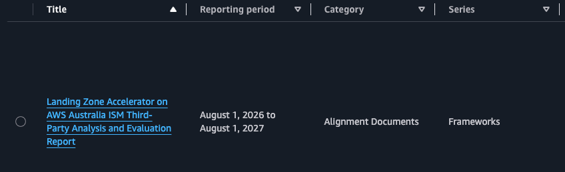
A new independent assessment by gwi.digital evaluates Landing Zone Accelerator against 1,081 ISM controls, achieving 91% coverage of addressable scope to help Australian customers accelerate IRAP assessment readiness.

How Moeve scales AWS governance with automated AWS Organization Service Control Policies
Authors: Gonzalo Guerrero, Jonatan De Martín, Rayco Martinez | Published: August 26, 2026
Learn how Moeve manages 150 SCPs across 300+ accounts in three AWS Organizations using a governance-as-code model; policies live in Git, deploy through GitHub Actions pipelines, and attach dynamically based on account metadata during onboarding, with Amazon EventBridge and AWS Lambda providing real-time observability of every organizational change.

August Security Bulletins

In August 2026, AWS published 23 security bulletins addressing vulnerabilities across open-source SDKs, MCP servers, developer tools, and the OpenSearch ecosystem. A dominant theme was the AI agent tool surface: prompt-injection consent bypasses in Strands Agents Tools enabled command and code execution, an insecure direct object reference exposed cross-tenant agent memory, and credential disclosure and authorization flaws affected the Amazon MQ, DocumentDB, and AWS Transform MCP servers and the Bedrock AgentCore harness. Remote code execution recurred throughout, from prototype pollution and Java deserialization in OpenSearch to path-traversal-to-root in amazon-ssm-agent, Zip Slip in awsdac, and an uncontrolled search path in the Kiro IDE and CLI on Windows.

Other notable issues include disabled SSH host key verification in the AWS CLI, memory-safety flaws in the AWS SDK for C++, privilege escalation in the FreeRTOS-Kernel, and memory-amplification denial of service in Amazon ion-java. OpenSearch accounted for a large share of the month, spanning authorization, input validation, SSRF, stored XSS, and denial of service, while Athena Federated Query connectors exposed Secrets Manager secrets. A common thread: insufficient authorization and input validation at the boundary between AI agents and the systems they reach. All patches are available, upgrade promptly. For more information, see AWS Security Bulletins.

AWS Samples

In August 2026, we published 17 new code samples organized into five categories: governance and compliance (7), AI security (3), data protection and privacy (3), identity and access management (2), and infrastructure security (2). This month’s collection reflects the rapid growth of agentic AI workloads: most samples focus on governing, auditing, and securing AI agents built on Amazon Bedrock AgentCore, from platform-level governance and telemetry to fraud investigation and biosecurity screening.

Governance and compliance

Agentic Governance Platform

Learn to deploy an AWS-native control plane for governing AI agents across your enterprise with centralized registry, Microsoft Entra ID single sign-on, Cedar tool policies, multi-vendor agent inventory, and Langfuse observability, all self-hosted on Amazon Bedrock AgentCore.

Enterprise Agentic AI Platform Accelerator

Learn to deploy a secure, governed foundation for production AI agents on Amazon Bedrock AgentCore with modular CDK stacks covering identity, gateway, memory, runtime, and observability; supporting Strands Agents, LangGraph, and Claude Agent SDK with opt-in security controls.

Video Compliance Agent

Learn to deploy an end-to-end pipeline that automatically verifies video content against broadcast compliance guidelines such as Ofcom; extracting frames, audio transcripts, and OCR text shot by shot, then using Amazon Bedrock to flag potential violations and produce a structured per-shot compliance report.

Intelligent Security for Healthcare APIs

Learn to add behavioral anomaly detection, automated data sensitivity classification, and HIPAA compliance reporting to your FHIR API using Amazon Bedrock; running asynchronously so clinical workflows are never blocked, with Amazon Comprehend Medical and Bedrock Guardrails anonymizing PHI throughout the monitoring path.

Governed Agentic Companion

Learn to deploy a governed, orchestrator-driven multi-agent builder companion on Amazon Bedrock AgentCore, reachable from Kiro, Claude Code, or any MCP client; the kit enforces 13 codified tenets through an always-on governance gate with no off switch, routing each request to a specialist while blocking deploys, secret leaks, and ungrounded answers by construction.

Audit the Agent

Learn to deploy a serverless daily executive audit pipeline for AWS AI agents (AWS DevOps Agent, AWS Security Agent) using AWS Step Functions and AWS Lambda; the report answers five questions: what the agent accessed, who authorized it, what it cost, its risk posture across five trust dimensions, and whether you should be concerned, all sourced deterministically from AWS CloudTrail, CUR, and IAM with AI-generated summaries bounded by layered guardrails.

AI Security

Telemetry Enablement for AgentCore CloudFormation

Learn to deploy a single AWS CloudFormation stack that enables Amazon CloudWatch logs and X-Ray traces for every Amazon Bedrock AgentCore resource type – Runtime, Gateway, Memory, Browser, CodeInterpreter, and WorkloadIdentity – using native and custom telemetry rules.

Bedrock Guardrails to OCSF on CloudWatch

Learn to transform Amazon Bedrock Guardrails intervention events into OCSF Detection Finding records and land them in the Amazon CloudWatch unified data store; enabling you to query guardrail violations alongside AWS CloudTrail, Amazon VPC Flow Logs, and other sources with Amazon Athena or CloudWatch Logs Insights.

Bedrock Readiness Agent

Learn to deploy a read-only assessment agent built with the Strands Agents SDK that evaluates your Amazon Bedrock environment across six dimensions: IAM governance, data retention, quota headroom, model selection fitness, cost projection, and operational observability; generating severity-rated findings with AWS CloudFormation and Terraform remediation templates you can apply directly.

Infrastructure security

DDoS Guardian

Learn to install an agent skill that reviews an AWS WAF web ACL as a system: evaluation order, rule interactions, and L7 DDoS posture; then delivers a severity-ranked HTML report with ready-to-apply remediation. Offline, read-only, no AWS resources modified.

Biosecurity Screening Policy on Amazon Bedrock AgentCore Gateway

Learn to use Policy in Amazon Bedrock AgentCore to deterministically screen AI agent tool requests for biosecurity risks, combining Cedar policies with three independent screening layers: MMseqs2 sequence alignment, ESMC-600M embedding similarity, and Foldseek structural homology; enabling defense-in-depth controls that block high-risk protein sequences before they reach downstream tools.

MCP Fraud Investigation Agent

Learn to deploy an end-to-end AI-powered e-commerce fraud investigation agent built with the Strands SDK on Amazon Bedrock AgentCore, connecting through an AgentCore Gateway over MCP to query transaction history, customer profiles, login activity, support cases, and fraud playbooks; a React dashboard on AWS Amplifystreams the agent’s reasoning token by token as it works each case.

Identity

IAM Account Access Manager with ABAC

Learn to implement workforce access using IAM account access manager and attribute-based access control, where one IAM role per project shares a single policy document and access decisions are made by comparing role tags against resource tags at request time; onboarding a new project requires only tagging and entitlement configuration with no policy authoring.

Operationalizing Least Privilege: Automate IAM Remediation through Your CI/CD Pipeline

Learn to automate remediation of unused IAM permissions using AWS IAM Access Analyzer, AWS CloudTrail, and Amazon Bedrock for AI-generated AWS CDK code; the solution attributes each role to its origin (IaC or manual), then creates pull requests for IaC-managed roles or issues for manually created roles in GitLab or GitHub, with configurable exclusion rules and policy diffs for human review.

Data Protection

Data Residency Chatbot with Amazon Bedrock AgentCore

Learn to deploy a data-residency-compliant natural-language chatbot on Amazon Bedrock AgentCore where all data and AI inference stay within a single AWS Region; the solution uses a Strands agent that answers plain-English questions from Aurora PostgreSQL through governed, whitelist-validated read-only tools exposed via an AgentCore Gateway, with a residency guard that rejects any cross-region inference profile, demonstrated with a rooftop-solar subsidy program and adaptable to any sector or geography.

LLM-based PII Detection

Learn to detect personally identifiable information in conversational text using Amazon Bedrock; the solution prompts any Converse-compatible model to return PII spans with category, value, and character offsets, handles long inputs via word-boundary chunking, recovers near-miss labels, and supports custom categories, few-shot examples, and pluggable backends beyond Bedrock.

Agentic Data Classification and Redaction

Learn to build a conversational AI research assistant that automatically classifies documents for MNPI, PII, and security sensitivity, then enforces per-user redaction at query time using Amazon Bedrock AgentCore, Guardrails, and Amazon OpenSearch Serverless vector search.

Conclusion

August 2026 provides comprehensive guidance and runnable code for governing agentic AI workloads at enterprise scale, from orchestrator-driven governance gates and biosecurity screening policies to daily executive audit pipelines and OCSF-normalized guardrail telemetry. The posts and samples provide patterns for console Private Access in isolated VPCs, attribute-based access control with IAM account access manager, automated least-privilege remediation through CI/CD, and cross-service signal correlation for multi-stage threat detection. Each resource includes deployment steps or runnable code so you can validate in your own environment before adopting. Subscribe to the AWS Security Blog RSS feed to receive updates as they publish, and revisit this digest monthly for a consolidated view of what changed and what to act on.

If you have feedback about this post, submit comments in the Comments section below.


Rodolfo Brenes

Rodolfo Brenes

Rodolfo is a Principal Solutions Architect focused on Cloud Governance and Compliance. With over 18 years of experience, he currently leads a technical field community in AWS helping customers scale and improve their security and governance frameworks. Besides work, Rodolfo enjoys video games, playing with his four cats, and won’t say no to a good outdoor adventure.

Anna Brinkmann

Anna has 18 years of experience in the technical content space and has spent the last 6 years managing the AWS Security Blog. Outside of work, she enjoys spending time with her family.

  •  

Supporting ASD’s multi-factor authentication campaign: Why MFA matters more than ever

The Australian Signals Directorate (ASD) has this month issued a clear call to action through its Multi-factor authentication: Switch it on campaign, urging businesses, organisations, and individuals to enable multi-factor authentication (MFA) across their online accounts. At AWS, we strongly support this message.

As threat actors continue to target credentials through phishing, credential stuffing, and social engineering, passwords alone are no longer enough. MFA is one of the most effective security controls available. It’s a cornerstone of ASD’s Essential Eight maturity model and a recognized component of major cybersecurity frameworks worldwide. ASD’s campaign reinforces what the security community has long advocated: switching on MFA is one of the simplest and most impactful steps any organization or individual can take to protect themselves online, and we encourage all to heed ASD’s call.

How AWS enforces MFA across every account type

At AWS, we’ve put this principle into practice at scale. In June 2025, AWS Identity and Access Management (IAM) achieved comprehensive MFA enforcement for root users across all account types, a significant milestone and the first of its kind among major cloud providers. This was the culmination of a deliberate, phased security journey: beginning with requiring MFA for AWS Organizations management account root users in May 2024, expanding to standalone account root users in June 2024, introducing centralized root access management in November 2024, and completing enforcement across all account types including member accounts. MFA prevents over 99 percent of password-related attacks and is available to all AWS customers at no additional cost, with support for FIDO2 passkeys and FIDO-certified security keys for phishing-resistant authentication. This milestone reflects our ongoing commitment to secure-by-design principles, setting a high bar for our customers’ default security posture and demonstrating that organizations of any scale can, and should, make MFA the standard rather than the exception.

ASD’s Multi-factor authentication: Switch it on campaign banner

Extending MFA beyond your AWS environment

A compromised email account can be used to reset AWS passwords. A breached source control system can expose infrastructure-as-code secrets. Enable MFA on your email, collaboration tools, source control, and other services that support it. Visit the ASD Multi-factor authentication campaign page for broader guidance.

Getting started with MFA on AWS

AWS enforces MFA automatically for root users. To extend that same protection to your IAM users—the identities your team members and applications use daily—you can configure MFA individually through the AWS Management Console for IAM. To learn more, see Security best practices in IAM. For phishing-resistant authentication with FIDO2 passkeys, see Passkeys and security keys in IAM.

If you have questions or feedback about MFA on AWS, leave a comment below or reach out on AWS re:Post. If you haven’t already, heed ASD’s call and switch on MFA across every account you own.

This post was written in support of ASD’s Multi-factor authentication: Switch it on campaign. For more AWS security content, visit the AWS Security Blog.

If you have feedback about this post, submit comments in the Comments section below.


Grace Zhang

Grace Zhang

Grace is the Regulatory and Security Compliance Lead for Australia and New Zealand (ANZ), based in Sydney. She supports security assurance and compliance initiatives across the ANZ region, helping customers navigate regulatory requirements and build confidence in the security of the AWS Cloud.

  •  

AWS Security Reference Architecture: A deep dive into PCI DSS compliance

Amazon Web Services (AWS) is excited to announce the publication of the AWS Security Reference Architecture (AWS SRA) Payment Card Industry (PCI) Data Security Standard (DSS) Deep Dive. This new guide extends the core AWS SRA to provide prescriptive, architecture-level guidance for organizations that store, process, or transmit cardholder data on AWS.

Organizations subject to PCI DSS have long asked for a comprehensive reference that bridges the gap between general AWS security best practices and the specific technical and organizational controls required to achieve and maintain PCI DSS compliance. This guide answers that need by showing how AWS SRA patterns address PCI DSS intent from account scoping and network segmentation to encryption, logging, and access control.

What is the AWS SRA PCI DSS Deep Dive?

The AWS SRA is a holistic, prescriptive security architecture guide that describes how AWS security services fit together across a multi-account AWS environment. It’s built around a modular, three-tier web architecture and is intentionally designed to be adapted as needed. Not every workload needs every service, but the AWS SRA provides the full range of options and their architectural relationships.

This PCI DSS deep dive doesn’t replace the AWS SRA, it extends it:

  • Mapping AWS SRA account types to PCI DSS scoping boundaries showing which accounts are in scope, connected-to or security-impacting, or out-of-scope in a typical payment architecture.
  • Layering PCI-specific controls onto existing AWS SRA service configurations. For example, additional logging granularity, encryption requirements, or network restrictions that go beyond the AWS SRA baseline.

The architectural patterns and controls described in this guide apply equally to merchants and service providers.

Who should use the guide

The guide is intended for:

  • Security architects designing or extending an AWS multi-account landing zone for workloads under PCI DSS scope.
  • Compliance engineers mapping AWS controls to PCI DSS requirements during assessment.
  • Cloud platform teams building shared security services that must accommodate a cardholder data environment (CDE).
  • Qualified Security Assessors (QSAs) and Internal Security Assessors (ISAs) who want to understand how AWS SRA patterns address PCI DSS intent.

Key AWS SRA design principles for PCI DSS

The guide applies six foundational AWS SRA design principles that are particularly relevant to PCI DSS compliance:

  • Implement a strong identity foundation: Enforce least privilege, separation of duties, and centralized identity management. Eliminate reliance on long-term static credentials.
  • Enable traceability: Monitor, alert, and audit actions in real time. Integrate log and metric collection with automated investigation and response systems.
  • Apply security at all layers: Defense-in-depth with preventive and detective controls at edge, virtual private cloud (VPC), load balancing, compute, OS, application, and code layers.
  • Protect data in transit and at rest: Classify data by sensitivity and apply encryption, tokenization, and access control mechanisms.
  • Keep people away from data: Reduce or eliminate direct access to cardholder data through automation and tooling.
  • Prepare for security events: Establish incident management processes, run simulations, and implement automated detection and recovery.

How to use the guide

The AWS SRA PCI DSS deep dive can be consumed in two ways:

  • As a narrative: Read the guide from beginning to end, starting with the PCI DSS primer, through the architecture and account scoping model, to the detailed requirement mappings. This approach gives you a complete understanding of how AWS SRA and PCI DSS intersect.
  • As a reference: Navigate directly to specific PCI DSS requirements or AWS SRA account types relevant to your current project. The guide includes architecture diagrams, requirement mapping tables, and service-specific configurations that you can use independently.

The guide includes downloadable architecture diagrams and detailed control mapping tables that complement the narrative content, making it straightforward to reference during security reviews and PCI DSS assessments.

Next steps

Security is a journey, not a destination. Review the AWS SRA PCI DSS Deep Dive guide and begin mapping its patterns to your own cardholder data environment and then validate existing environments against SRA best practices using SRA verify.

If you need assistance, contact AWS Professional Services, your AWS account team, or the AWS Partner Network, who can work with you to translate the reference architecture into a customized AWS environment that you can then operate.

If you have feedback about this post, submit comments in the Comments section below. If you need assistance architecting or implementing a PCI DSS-compliant AWS environment, contact the AWS Security Assurance Services team.


Author

Avik Mukherjee

Avik is a Senior Security Solutions Architect with more than a decade of experience in IT governance, security, risk, and compliance across retail, financial, and technology industries. He’s one of the original authors of the AWS Security Reference Architecture and leads the effort to extend the AWS SRA to compliance frameworks.

Akanksha Chaturvedi

Akanksha is a Senior Security Assurance Consultant with over 10 years of specialized experience in risk-based security assessments and regulatory compliance across highly regulated industries. She is an expert practitioner in HIPAA, PCI-DSS, GDPR, FedRAMP, and IRAP frameworks, with demonstrated success in architecting and deploying enterprise security programs from conception through full implementation.

Nimesh Ravas

Nimesh Ravasa

Nimesh is a Senior Assurance Consultant at AWS who focuses on security assurance and compliance for cloud-centered architectures. He brings extensive experience in PCI DSS assessments and security architecture reviews, helping organizations build and maintain compliant environments on AWS. He is passionate about translating complex compliance requirements into actionable technical guidance.

Omner Barajas

Omner Barajas

Omner is a Senior Security Solutions Architect at AWS with deep expertise in designing secure, scalable architectures for regulated industries. He specializes in network security, identity management, and security automation, and works with customers across financial services and payments to implement defense-in-depth strategies aligned with industry standards.

Viktor Mu

Viktor Mu

Viktor is a Senior Assurance Consultant at AWS with a strong background in information security governance, risk, and compliance. He specializes in helping organizations achieve and maintain PCI DSS compliance in complex cloud environments, with particular expertise in scoping, segmentation, and continuous compliance monitoring.

  •  

OSPAR 2026 report now available with 167 services in scope

We’re pleased to confirm the successful completion of our annual Amazon Web Services (AWS) Outsourced Service Provider’s Audit Report (OSPAR) assessment on July 29, 2026, in line with the OSPAR version 2.0 framework.

The Association of Banks in Singapore (ABS) established the Guidelines on Control Objectives and Procedures for Outsourced Service Providers (ABS Guidelines) to set out baseline control criteria for outsourced service providers (OSPs) operating in Singapore. These guidelines cover key areas such as cyber hygiene, technology risk management, business continuity, data security, cryptography, and software application development and management, drawing on regulatory direction from the Monetary Authority of Singapore (MAS).

This year’s certification cycle broadens the scope with five additional services, covering the 167 AWS services within the AWS Asia Pacific (Singapore) Region. The newly added services are:

This latest certification reinforces our commitment to the security standards expected of cloud providers within Singapore’s financial services industry. For customers, OSPAR offers a way to ease due diligence efforts typically associated with compliance reviews.

You can download the latest OSPAR report from AWS Artifact, a self-service portal for on-demand access to AWS compliance reports. Sign in to AWS Artifact in the AWS Management Console, or learn more at Getting Started with AWS Artifact. The list of services in scope for OSPAR is available in the report and is also available at AWS Services in Scope by Compliance Program.

We remain committed to expanding the OSPAR program’s scope over time, guided by customer architectural and regulatory needs. For any questions regarding the OSPAR report, reach out to your AWS account team.

If you have feedback about this post, submit comments in the Comments section below.

James Chang

James Chang

James is part of the Global Security Assurance team and has taken on major audit programs across the Asia Pacific Japan (APJ) region, including Japan’s ISMAP certification. He has also delivered APJ regulatory assessments and customer assurance engagements.

Ignatius Lee

Ignatius Lee

Ignatius is a Security Assurance professional based in Singapore, covering audits across the Asia Pacific Japan (APJ) region. Since joining Security Assurance in early 2025, he has contributed to key audit programs across the region, including Hong Kong, Singapore, Australia, Japan, Indonesia, and Korea.

Joseph Goh

Joseph Goh

Joseph is the APJ ASEAN Lead at AWS, based in Singapore. He leads security audits, certifications, and compliance programs across the Asia Pacific region. Joseph is passionate about delivering programs that build trust with customers and providing them assurance on cloud security.

  •  

Agentic security: Detection and response at machine speed

After talking with enterprise security leaders over the past year, one thing has become clear: the rise of autonomous AI agents is the most significant shift in security posture since the move to cloud. Organizations across every industry are adopting AI agents that authenticate on behalf of users, execute multistep workflows, and make decisions across infrastructure, often without waiting for human approval. Security operations need to keep pace.

At Amazon Web Services (AWS), we believe security should evolve ahead of AI adoption, not behind it. That belief drove our team to collaborate with the SANS Institute on a new chapter in the 2026 Cloud Security Exchange eBook, where we lay out a practical framework for securing agentic workloads at enterprise scale.

The challenge: Threats now move at machine speed

Traditional security was built for deterministic systems with predictable inputs and outputs. Agentic workloads break those assumptions. The same prompt can produce a compliant response on one request and a policy-violating response on the next. Agents adapt their behavior over time as they interact with users, data, and tools and operate with genuine autonomy: connecting to APIs, chaining actions together, and making independent decisions.

These properties mean that security controls designed for one-time assessments no longer suffice. Detection and response need to operate continuously and at machine speed.

What makes this urgent is the gap between adoption velocity and security maturity. Although 80% of organizations have adopted AI, only 10% govern it. Agents are being built by an expanding population of developers—including those using low-code tools—creating governance challenges that existing security programs must be extended to address.

Extending what already works

The good news, agentic security isn’t a blank slate. It builds on the same principles security teams already apply: identity governance, least privilege, defense in depth, and backup and recovery. What changes is how those principles are implemented when workloads are autonomous and probabilistic. In our eBook chapter, we cover four foundational areas:

  • Agent identity and governance: Every agent needs its own identity with temporary, scoped credentials rather than persistent, broad access. This extends zero trust principles to AI agents, where every request is authenticated and authorized independently, and every action has a traceable authorization chain. When a single agent combines access to sensitive data, the ability to communicate externally, and exposure to untrusted content, the risk profile changes significantly. Design patterns that prevent any single component from combining all three reduce that risk substantially.
  • Evolving detection for agentic workloads: Static, rule-based detection designed for human activity patterns can’t keep up with agent behavior. Organizations need continuous behavioral monitoring, living baselines that adapt as agents evolve, and instrumented observation that surfaces anomalies in real time. Amazon GuardDuty delivers this today, analyzing security signals continuously to detect threats as they emerge.
  • Response that balances speed with precision: When threats move at machine speed, response must be automated and tiered: some agent behaviors should be contained immediately, others require human judgment. The response framework we outline distinguishes between actions that can be automated safely and those that need escalation.
  • From single agents to multiagent ecosystems: Agents are already composing into teams, delegating subtasks, negotiating access, and coordinating across organizational boundaries. Each stage of this evolution inherits every security requirement that came before it, meaning organizations securing today’s basic chat agents are already laying the foundation for tomorrow’s multiagent ecosystems.

Security as an enabler of agentic AI adoption

The security leaders I speak with aren’t asking whether to adopt AI agents. They’re asking how to adopt them responsibly, at speed, and without slowing down the business.

AWS approaches this challenge by building security into the platform at every layer. Agentic AI built on AWS inherits nearly two decades of experience securing mission-critical workloads. Amazon GuardDuty, Amazon Inspector, and AWS Security Hub work together to provide continuous threat detection, vulnerability management, and unified security operations, all adapting to the unique characteristics of agentic workloads.

This isn’t about building new security from scratch. It’s about extending the security foundations your teams already trust into an environment where AI operates with increasing autonomy.

Read the full framework

Our chapter in the 2026 Cloud Security Exchange eBook goes deeper on each of these areas, with specific architectural patterns, implementation guidance, and frameworks for security teams at every stage of agentic AI maturity, whether you’re evaluating, piloting, or operating at scale.

Read the 2026 Cloud Security Exchange eBook: Agentic Security: Detection and Response at Machine Speed

You can learn more about AWS security services at AWS Cloud Security, or explore our AI Security Framework for a comprehensive view of how AWS secures AI workloads with the right controls, at the right layers, at the right phases.

If you have feedback about this post, submit comments in the Comments section below.


Gee Rittenhouse

Gee Rittenhouse

Gee is the Vice President of Agentic Security at AWS. He holds a PhD from MIT and brings extensive leadership experience across enterprise security and cloud. He previously served as CEO of Skyhigh Security and Senior Vice President and General Manager of Cisco’s Security Business Group, where he was responsible for Cisco’s worldwide cybersecurity business.

  •  

We invited a direct competitor into Security Hub Extended. Here’s why.

When customers keep pointing you to a solution that overlaps with parts of your own offering, you have a choice to make. This post is about the choice we made with Upwind, and why we’d make it again.

AWS Security Hub Extended exists because customers told us what was working for them in enterprise security and asked us to simplify adoption and integration. Upwind was one of the solutions customers kept naming, so we brought them in. Upwind didn’t only agree to participate, they committed fully to integration. They brought their full solution portfolio into Extended with aggressive pay-as-you-go pricing from day one. They got their field organization fully aligned on joint deal flow and have driven more customer activity and closed deals through Security Hub Extended than any other partner in the program.

Giving customers choice, even when it overlaps

Multiple best-of-breed options in cloud security—including one that overlaps with our own capabilities—are straightforward when you start with what customers need. Some will choose Security Hub Essentials for cloud security posture management and vulnerability scanning. Some will choose Upwind for runtime-first protection. Some will run both and get stronger outcomes from the combination. The customer decides, not us. That principle applies to every partner in Security Hub Extended. We listen to what’s working, and we simplify adoption through the same AWS relationship customers already have.

“Our customers run on AWS, and Security Hub is where their security operations live,” said Amiram Shachar, Co-Founder and CEO of Upwind. “Being inside Security Hub means customers get Upwind’s cloud workload protection with the same billing, the same support path, and the same operational model they already know. We’re here because it’s a better outcome for the customers we share.”

Who is Upwind?

Upwind is a cloud security company trusted by Siemens, Peloton, Roku, Wix, Nextdoor, and Nubank. Fast Company named them one of the Most Innovative Companies of 2026.

What makes them different is runtime. Most cloud security solutions scan configurations periodically and report what could be a risk based on static posture. Upwind deploys an eBPF-based sensor directly in the Linux kernel that sees what workloads are doing in real time, including process behavior, network connections, API calls, and container interactions. All observed continuously. That means Upwind can tell you not only what could theoretically be exploited, but what is actively at risk right now. That distinction cuts alert noise dramatically and lets security teams focus on what genuinely matters.

Better together. Not only with AWS, but with each other

Now extend that to the rest of your security stack. If you’re already running other Security Hub Extended solutions, they work together without you building the integrations.

A customer running Chainguard for supply chain security, Upwind for runtime protection, and Splunk for security operations gets a connected experience. Chainguard helps ensure clean, malware-resistant dependencies at build time. Upwind validates workload behavior at runtime and enriches those findings with real-time context. Everything flows into Splunk through Security Hub for unified triage. One experience, one bill, no custom integration work. The security team sees the full lifecycle from build to production without stitching tools together.

That same pattern applies with 7AI, where AI-driven automation can triage and investigate Upwind’s runtime events alongside endpoint, identity, and network signals, all without manual pipeline work.

This is the multi-way partnership that Security Hub Extended was designed to enable. These solutions aren’t only easier to buy together, they’re building toward each other. The findings flow into Security Hub in OCSF (Open Cybersecurity Schema Framework), get correlated and prioritized together, and route to the downstream tools your team already uses. Your security stack gets stronger as a whole, not only solution by solution.

How it works commercially

This isn’t a paper partnership. We’re closing multi-million dollar deals together through Security Hub Extended. Upwind has engaged faster than any other partner in the program, bringing their own customer opportunities and joining AWS-originated deals to close them jointly. One enterprise customer recently replaced their incumbent CNAPP with Upwind through a Security Hub Extended Private Offer. The deciding factors were runtime visibility that their previous solution couldn’t deliver and a single predictable commercial model that replaced complex per-module pricing across multiple vendors. The commercial model has momentum, and it’s because Upwind invested not only in signing an agreement but in the engineering and go-to-market work that makes joint success real.

Upwind is available through Security Hub Extended with pay-as-you-go pricing, one AWS bill, and no required long-term commitment. For enterprises that prefer committed-pricing agreements, Security Hub Extended Private Offers are also available with deeper discounts and the ability to aggregate spend across partners. You choose the path that fits how you buy. If you’re already running Security Hub for posture management and vulnerability scanning, adding Upwind gives you runtime visibility alongside what you already see. No new tooling to stand up, no new workflow to learn. It shows up in your existing prioritized view of risk.

What Upwind is building next

Upwind continues to expand. AI workload protection that monitors model behavior and agent tool calls at runtime. Windows Server VM coverage across AWS, Azure, and GCP. Deeper integration with the Security Hub correlation engine so runtime context enriches attack-path intelligence automatically. The partnership deepens as both sides invest.

“We believe runtime context and AWS-native signals together produce stronger outcomes than either alone,” said Amiram Shachar, Co-Founder and CEO of Upwind. “As Security Hub deepens its correlation and Upwind extends its runtime fabric, customers who use both will have a view of risk that no single solution can replicate. That’s the future we’re building toward together.”

What this means for you

Security Hub Extended exists to give you access to the solutions your peers are already succeeding with through the AWS relationship you already have. Upwind is what that philosophy looks like when applied to a category where AWS has an existing offering. We listened to customers, saw what was working for them, and made it available with the same commercial model as everything else.

Enable Upwind through the AWS Security Hub console. Pay-as-you-go. No commitment required. If you want to understand what consolidation looks like with Security Hub Extended, talk to your AWS account team.

We’re just getting started, but the momentum is real.

If you have feedback about this post, submit comments in the Comments section below.


Michael Fuller

Michael has been with AWS for 16 years and led product for AWS Security Services for 11 years. Michael has 29 years in the industry and held several roles in product management, business development, and software development for IBM, Cisco, and Amazon. Michael has a Bachelor’s of Science in Computer Engineering from the University of Arizona and an MBA from the University of Washington.

  •  

ICYMI: July 2026 @AWS Security

If you found time for a bit of vacation this summer, you might be in catch-up mode. Here’s a list to help: all the expert blog posts, new service capabilities, code samples, and workshops, in case you missed it, from July 2026.

AWS Security Blog post

This month’s AWS Security Blog posts covered AI agent security, supply chain protection, network firewall automation, DDoS mitigation, and compliance readiness. Read on for guidance on securing AI coding agents, implementing dependency cooldowns, choosing the right key management solution, and preparing for HIPAA Technical Safeguard requirements.

AI Security

Enforce least-privilege authorization in multi-agent AI chains using Cedar
Authors: Dhananjay Karanjkar | Published: July 6, 2026
Learn to implement a three-layer Cedar policy model with OAuth 2.0 authentication to prevent authorization scope expansion across multi-agent delegation chains using Amazon Verified Permissions.

Enforce zero data retention on Amazon Bedrock with Bedrock Projects and service control policies
Author: Rob Higareda | Published: July 7, 2026
Learn to use Amazon Bedrock Projects and SCPs to centrally enforce zero data retention policies, preventing accounts from enabling data sharing with third-party model providers across your organization.

Designing for the inevitable: System prompt leakage and mitigations in generative AI applications
Author: Manideep Konakandla | Published: July 8, 2026
Learn to implement defense-in-depth mitigations for system prompt leakage using Amazon Bedrock Guardrails prompt attack filters, canary tokens, semantic similarity detection, and sandwich instruction patterns.

Balancing speed and safety: A control framework for AI coding agents
Authors: Daniel Begimher, Danny Cortegaca | Published: July 30, 2026
Learn to implement an application security control framework for AI coding agents, with author-time controls that shape what agents produce and build-time controls that verify what reaches production.

Data Protection

How to use the AWS Workload Credentials Provider for cross-account secret retrieval and prefetching secrets
Authors: Derik Wang, Paras Dhawan | Published: July 1, 2026
Learn to configure the AWS Workload Credentials Provider for cross-account secret retrieval using IAM role chaining and prefetching secrets at startup to reduce cold-start latency.

The CISO’s guide to post-quantum mandates and migrations
Author: Rushir Patel | Published: July 8, 2026
A strategic playbook for CISOs navigating post-quantum cryptography migration, covering regulatory timelines, dependency classification, cryptographic telemetry, and building crypto-agile organizations.

AWS KMS or AWS CloudHSM: Choose the right key management solution
Author: Derek Tumulak | Published: July 28, 2026
Learn how to choose between AWS KMS and AWS CloudHSM based on integration needs, cost, and whether you require traditional HSM interfaces or legacy algorithms.

Secure your npm and pip package updates in Amazon Linux
Author: Norbert Manthey | Published: July 29, 2026
Learn to implement a one-line dependency cooldown for npm and pip that skips packages published in the last 24 hours, protecting against supply chain events while still allowing urgent security patches.

Infrastructure security

Secure Amazon container workloads using container attribute-based rules in AWS Network Firewall
Authors: Amit Gaur, Amish Shah, Preetkumar Shah, Akash Kumar Sinha | Published: July 1, 2026
Learn to define AWS Network Firewall rules for Amazon EKS and Amazon ECS workloads using native container attributes like namespaces, pod names, and labels instead of ephemeral IP addresses.

Authenticate legitimate AI agent traffic with AWS WAF Bot Control
Authors: Harith Gaddamanugu, Kaustubh Phatak | Published: July 14, 2026
Learn to use Web Bot Authentication (WBA) in AWS WAF Bot Control to cryptographically verify legitimate AI agent traffic using HTTP message signatures and ed25519 keys.

Accelerating AWS Network Firewall troubleshooting with AWS DevOps Agent
Author: Salman Ahmed | Published: July 24, 2026
Learn to use AWS DevOps Agent to automate root cause analysis for AWS Network Firewall connectivity issues, including domain deny lists, stateless rule priority misconfigurations, and asymmetric cross-AZ routing drops.

AWS Shield Advanced is embracing the AWS WAF Anti-DDoS managed rule group: What changes and how to prepare
Authors: Eitav Arditti, Andrew Chen, Justin Kurpius | Published: July 27, 2026
AWS Shield Advanced is adopting the AWS WAF Anti-DDoS managed rule group as its default application-layer DDoS protection, with a phased migration from July 2026 through January 2027.

Threat detection and incident response

Introducing the Amazon GuardDuty investigation agent: on-demand AI-powered threat assessment
Author: Allan Holmes | Published: July 20, 2026
Learn to use the new Amazon GuardDuty investigation agent (public preview) to automate threat correlation and receive structured assessments with risk levels, confidence scores, MITRE ATT&CK mappings, and actionable recommendations.

Amazon identifies North Korean hacker group behind open-source supply chain attacks
Author: CJ Moses | Published: July 29, 2026
Learn how Amazon Threat Intelligence linked the compromises of axios, debug, chalk, and typo-crypto NPM packages to a single DPRK-linked threat actor, and how attacker tradecraft is evolving with generative AI.

Extend Amazon Inspector SBOM Generator with plugins
Authors: Michael Long, Anthony Verleysen, Charlie Bacon | Published: July 30, 2026
Learn to write custom Lua plugins for the Amazon Inspector SBOM Generator to inventory package ecosystems that aren’t supported out of the box, without modifying source code or waiting for an official release.

Security Hub adds AI workload protection and multicloud support for Microsoft Azure
Author: Michael Fuller | Published: July 14, 2026
AWS Security Hub now monitors Microsoft Azure resources for misconfigurations and vulnerabilities, adds GuardDuty AI Protection for Amazon Bedrock and Amazon SageMaker AI, and introduces an AI inventory for organization-wide visibility.

Governance and compliance

AWS designated as a critical third party to the UK financial sector
Author: Michael Jefferson | Published: July 10, 2026
AWS has been designated as a critical third party to the UK financial sector by HM Treasury, establishing direct regulatory oversight by the Bank of England, PRA, and FCA.

New compliance guidance available: HITRUST i1 on AWS
Authors: Abdul Javid, Shreya Singh | Published: July 13, 2026
AWS published new implementation guidance for HITRUST i1 certification, covering 11 technical control domains with AWS-specific controls for healthcare organizations seeking i1 assessment readiness.

HIPAA Security Rule on AWS – Technical Safeguards Implementation and Readiness Guidance
Authors: Abdul Javid, Hector Rodriguez, Kapil Temghare, Shreya Singh | Published: July 31, 2026
New guidance helping covered entities and business associates implement and evidence compliance with HIPAA Security Rule Technical Safeguards (§164.312) on AWS, including 2025 NPRM proposed changes.

Identity

Introducing OAuth support for AWS MCP Server
Authors: Vaibhav Chowla, Jaimin Bhatt, Ankur Joshi | Published: July 9, 2026
AWS MCP Server now supports OAuth 2.1 authorization through AWS Sign-In, enabling agents like Claude Code,Kiro, and Gemini CLI to connect using existing IAM credentials with browser-based authentication.

July Security Bulletins

In July 2026, AWS published 21 security bulletins (2026-049 through 2026-069) addressing vulnerabilities across open-source SDKs, MCP servers, and developer tools. Key themes include credential disclosure and SSRF, affecting HealthLake, HealthOmics, and API MCP servers, plus Strands Agents tools that could inadvertently expose secrets to unauthorized endpoints. Command and code injection impacted aws-cdk-lib, jsii-diff, Bedrock AgentCore SDK, and Amplify Codegen UI. The smithy-rs framework received three patches for denial-of-service via uncontrolled recursion and Slowloris issues.

Other notable issues include insecure file permissions in the AWS CLI, deserialization remote code execution in the Advanced JDBC Wrapper, SQL injection in mcp-gateway-registry, TLS 1.3 flaws in s2n-tls, and stored XSS in AWS Ops Wheel. A common thread: insufficient input validation in tools interacting with AI agents, reflecting the expanded surface area of LLM-integrated workflows. All patches are available, upgrade promptly. For more information, see AWS Security Bulletins.

AWS Samples

This month brings 14 new AWS samples spanning AI security, identity, data protection, governance, threat detection, and security posture management. From deploying governed AI agent platforms on Amazon Bedrock AgentCore to building data-residency-compliant chatbots and DevSecOps baselines for Kiro, these repositories help you implement security and governance best practices across your AWS environment.

AI Security

Lark MCP on AgentCore
Learn to deploy a hosted remote MCP service on Amazon Bedrock AgentCore that lets AI agents operate Feishu/Lark through 450+ tools, with per-user identity isolation and smart multi-step orchestration via 20+ domain Skills.

Lark CLI MCP Wrapper on AgentCore Runtime and Identity
Learn to securely wrap a CLI tool as an MCP server on AgentCore Runtime using a sidecar credential-isolation pattern, where the CLI process never holds real tokens and all secrets are resolved through AgentCore Identity’s Token Vault.

LiteLLM Bedrock Gateway on EKS
Learn to deploy a production-grade LiteLLM proxy on Amazon EKS as a unified OpenAI/Anthropic-compatible gateway to Amazon Bedrock, with four progressive layers covering network isolation, cross-region inference profiles, and cross-account delegation.

Enterprise Agentic AI Platform Accelerator on AgentCore
Learn to deploy a secure, governed foundation for production AI agents on Amazon Bedrock AgentCore with CDK stacks covering identity, gateway, memory, runtime, and observability; supporting multiple agent frameworks (Strands, LangGraph, Claude SDK) and opt-in security controls including VPC isolation, KMS encryption, Cedar policies, and Bedrock Guardrails.

FlowAMP: AI Agent Governance on AWS
Learn to deploy a single-pane-of-glass agent management platform on Amazon Bedrock AgentCore that discovers, monitors, scores, controls, and cost-accounts AI agents across an AWS Organization with agentic discovery, compliance scanning (NIST AI RMF, ISO 27001, SOC 2), Responsible-AI scoring, FinOps via Cost Explorer, and Cedar-based policy enforcement.

Kiro SecOps Baseline
Learn to deploy a DevSecOps security baseline for Kiro as a single Go CLI that installs global guardrails (permissions.yaml, steering, skills, a security-review agent) and per-project workspace hooks (fail-closed guard, PR/pipeline review gates, scanner configs for gitleaks, trivy, and checkov) with enterprise fleet distribution via MDM and Administration scope.

Identity

OAuth 2.0 Token Exchange with Amazon Cognito
Learn to implement RFC 8693 OAuth 2.0 Token Exchange using Amazon Cognitowith a true delegation pattern, enabling services to act on behalf of users while maintaining distinct service identities and least-privilege access in microservices architectures.

Lark Identity on AgentCore — Gateway Interceptor
Learn to implement enterprise identity pass-through on Amazon Bedrock AgentCore using a Gateway Request Interceptor that forwards the user’s identity and injects per-user credentials to downstream MCP tools, so the agent never holds a token and tools act only as the authenticated user against Lark.

Data Protection

Automated PII Detection Pipeline with Amazon Macie
Learn to build an event-driven pipeline that automatically detects PII in Amazon S3 objects using Amazon Macie, AWS Step Functions, and custom data identifiers, with CSV/JSON reporting and SNSalerting for high-severity findings.

Data-Residency Chatbot with Amazon Bedrock AgentCore
Learn to build a data-residency-compliant natural-language chatbot on Amazon Bedrock AgentCore that keeps all data and AI inference within a single AWS Region, using governed text-to-SQL with whitelist-validated queries, Aurora PostgreSQL in private subnets, and AgentCore Gateway for secure tool access.

Governance and compliance

Video Compliance Agent
Learn to build an end-to-end automated video compliance verification pipeline using Amazon Bedrock, ECS Fargate, and AWS Step Functions that processes videos shot-by-shot, extracting frames, audio transcripts, and OCR text, then flags potential broadcast guideline violations with structured per-shot reports.

Contract Compliance Search with Amazon OpenSearch
Learn to build a contract compliance search system that combines semantic search with semantic highlighting using Amazon OpenSearchService, Amazon Titan V2 embeddings, and a SageMaker-hosted highlighting model to surface relevant clauses across contract documents.

Threat detection and incident response

Multicloud Security Posture Assessment
Learn to deploy a centralized security assessment solution that scans AWS, Azure, Google Cloud Platform, and Oracle Cloud Infrastructure environments from a single AWS deployment using Prowler, with AWS CloudFormation templates for each provider and unified reporting in HTML, CSV, and JSON-OCSF formats.

Centralize AWS Security Agent Findings
Learn to deploy a AWS CloudFormation stack that automatically exports AWS Security Agentpenetration test findings to Amazon S3 and queries them centrally with Amazon Athena, using Amazon EventBridge, Step Functions, and a AWS Glue catalog for tracking findings over time.

Sentinel Harness — Production SecOps Agents as Configuration
Learn to build production security-operations agents as pure configuration on Amazon Bedrock AgentCore Harness, declaring model, prompt, tools, skills, memory, and limits in YAML while AWS runs the agent loop with human-in-the-loop gates, detection-engineering tools, adversary emulation, and a self-improvement closed loop.

AWS Labs

This month brings 1 new AWS Labs repository focused on data protection, helping organizations build automated PII detection and redaction pipelines with AI-powered processing across documents and audio files.

Data Protection

PII Anonymizer
Learn to build an automated PII detection and redaction pipeline using AWS Step Functions, Amazon Bedrock, Amazon Textract, and Amazon Transcribe; supporting PDFs, Word, Excel, images, and audio files with synthetic replacement or blackout modes, concurrency control, and customer-managed KMS encryption.

Conclusion

July 2026 provides guidance and examples for securing AI agent architectures at scale, from governed text-to-SQL with data residency controls and agent management platforms to DevSecOps baselines for AI coding tools. The posts and samples provide patterns for least-privilege authorization in multi-agent chains using Cedar, post-quantum migration planning, container-aware network firewall rules, and multicloud security posture management. Each resource includes deployment steps or runnable code so you can validate in your own environment before adopting. Subscribe to the AWS Security Blog RSS feed to receive updates as they publish, and revisit this digest monthly for a consolidated view of what changed and what to act on.

If you have feedback about this post, submit comments in the Comments section below.


Rodolfo Brenes

Rodolfo Brenes

Rodolfo is a Principal Solutions Architect focused on Cloud Governance and Compliance. With over 18 years of experience, he currently leads a technical field community in AWS helping customers scale and improve their security and governance frameworks. Besides work, Rodolfo enjoys video games, playing with his four cats, and won’t say no to a good outdoor adventure.

Anna Brinkmann

Anna has 18 years of experience in the technical content space and has spent the last 6 years managing the AWS Security Blog. Outside of work, she enjoys spending time with her family.

  •  

Fast Track ISM-ready cloud environments and IRAP Assessments with Landing Zone Accelerator on AWS

This post announces the availability of a new independent assessment report available on AWS Artifact analyzing how Landing Zone Accelerator on AWS (LZA) can automatically deploy multi-account environments in Amazon Web Services (AWS) with Australian Government Information Security Manual (ISM) security controls coverage at scale. The report includes findings from an independent third-party analysis conducted by AWS Partner gwi.digital. In addition to the report, we talk about ISM compliance applicability to LZA and a new testing mechanism for measuring configuration drift, which together can provide Australian customers with a documented and validated foundation to accelerate IRAP assessment readiness.

Background

Australian organizations in public sector, defense, and critical infrastructure agencies must build cloud environments that meet (ISM requirements. The ISM defines 1,081 security control requirements across 22 guideline chapters. Demonstrating compliance is central to achieving an IRAP assessment outcome, but assessments typically require months of preparation, evidence gathering, and testing.

In October 2025, we introduced the LZA Universal Configuration and LZA Compliance Workbook. LZA provisions a multi-account security architecture that automates the deployment of nearly 200 security controls based on AWS Well-Architected pillars and AWS security best practices. The LZA Compliance Workbook, available on AWS Artifact, documents how the Universal Configuration (UC) maps to technical security requirements from 17 global compliance frameworks, with more being added. LZA is an ideal solution for customers with security and compliance obligations—both existing and anticipated—because the guardrails it deploys are applied automatically to new accounts as environments grow.

What’s in the report

To see how LZA can help customers in Australia we teamed up with AWS Partner gwi.digital to run LZA as a customer would. gwi.digital is a consultancy partner specializing in cybersecurity and governance, risk, and compliance (GRC) and has deep experience in IRAP assessments and the ISM framework. The team conducted an independent analysis and evaluation of LZA UC against 1,081 ISM controls. The assessment was conducted in a greenfield AWS environment hosted in the ap-southeast-2 (Sydney) AWS Region, positioned within Phase 2 of the ASD Cloud Security Assessment and Authorization Framework and focused on cloud consumers building on already-authorized AWS services. It builds on existing AWS IRAP foundations: Underlying AWS services were most recently independently assessed at the PROTECTED level by CyberCX last year. While this report does not constitute an official IRAP authorization, certification, or accreditation, it provides a professional evaluation of evidence based on what LZA delivers out of the box (and what it does not), so organizations can make informed decisions.

What the assessment found

Of the 1,081 ISM controls, 256 are within the addressable scope of LZA and include the technical infrastructure controls that a solution like LZA can meaningfully address. Of those 256, LZA achieves Full or Partial coverage for 234 (91%). The remaining 825 controls are outside the scope of LZA: physical security, personnel, organizational governance, and classification-level exclusions. A key contribution for the assessment was analysis of the shared responsibility model that goes beyond the traditional AWS/customer binary. It considers a three-tier view—AWS (provided), LZA (enabled), and Customer (responsibility)—and further categorizes the 825 out-of-scope controls into subcategories so customers can quickly determine which controls require their attention compared to which are already addressed at the infrastructure level. By combining automated deployment, ISM-specific compliance mappings, independent validation, and continuous evidence generation, Australian customers can reduce IRAP assessment timelines while achieving more reliable compliance outcomes.

Note: Results are based on the configuration as-provisioned based on the LZA version and during the time of this assessment. Results may vary depending on customer implementation and configuration choices.

Continuous validation with CATS

Confirming controls are implemented and operating effectively across your environment is complex and often lacks complete coverage. To simplify testing your LZA deployment, we developed the Controls Acceptance Testing Suite (CATS). CATS is an automated compliance validation engine that runs purpose-built tests against the security configuration baseline deployed by LZA UC. For the ISM assessment, CATS executed over 3,600 individual tests across six AWS accounts, evaluating account structure, identity and access, network configuration, logging, encryption, and backup. For Australian customers, CATS enables:

  • Automated evidence generation: Machine-readable results may replace weeks of manual evidence collection
  • ISM-enriched reporting: gwi-digital developed a conversion script that maps CATS output to ISM control references, enabling auditors to interpret results from an ISM perspective
  • OSCAL export: Results in Open Security Controls Assessment Language (OSCAL) format for interoperability with assessment tools
  • Continuous drift detection: Repeatable execution identifies when configurations deviate from the validated baseline between assessment cycles

Note: CATS availability is limited and currently accessible only through AWS Professional Services as a private beta solution and may be subject to change. Availability, features, and pricing are subject to change without notice. Contact your AWS account representative or reach out to a member of the LZA team for questions about CATS, or to provide feedback on the LZA ISM report.

ISM-optimized configuration

Through the assessment, gwi-digital identified configuration adjustments that elevate specific control ratings from Partial to Full, with minimal effort; for example, increasing the default password length from 14 to 15 characters or adjusting log retention to align with Australian Federal Disposal Authority standards. These recommendations have been communicated to the LZA UC team for inclusion in a future ISM-specific guidance section in LZA GitHub documentation.

Getting started

In addition to the LZA ISM report, you can also find the LZA Compliance Workbook available on AWS Artifact. It maps related ISM requirement identifiers to security implementation statements, giving you a starting point from which you can customize and enhance your compliance documentation for your unique use cases after deploying LZA.

  1. Sign in to your AWS account and then download the LZA Australia ISM Third-Party Analysis and Evaluation Report and LZA Compliance Workbook from AWS Artifact.
    Figure 1: LZA report and workbook in AWS Artifact

    Figure 1: LZA report and workbook in AWS Artifact

  2. Visit the LZA Universal Configuration GitHub repository to review and download the latest configuration baseline.
  3. Use the LZA Implementation Guide to see use cases, review pre-deployment considerations and then follow deployment steps.
  4. Set-up a security compliance chat agent. Consider creating a knowledge base with Amazon Bedrock using the LZA Compliance Workbook, LZA Implementation Guide, web crawlers to the LZA GitHub, and your custom resources to set up your own chat agent.

If you have questions, contact a gwi.digitalexpert, AWS LZA team member, or your AWS account representative.

Conclusion

The combination of ISM mappings in the LZA Compliance Workbook, the gwi-digital analysis report, and CATS evidence gives Australian customers a head start on IRAP assessments.

  • Weeks saved on scoping: Pre-determined control applicability significantly reduces upfront scoping effort
  • Documentation ready: Implementation statements and control requirement alignment reduce the documentation burden
  • Independent assurance: A third-party report that customers and their assessors can reference directly
  • Continuous evidence: CATS generates repeatable security evidence between assessment cycles, replacing periodic manual audits with ongoing assurance

Acknowledgements

The Landing Zone Accelerator team would like to thank Baden Hughes, Henrik Melkonyan, Iain Lindsay-German, and Ian Roderick from gwi.digital for their professionalism and expertise in performing an incredibly thorough assessment, helping us to make LZA better for customers, and for their contributions to this blog post.

If you have feedback about this post, submit comments in the Comments section below.


Kevin Donohue

Kevin Donohue

Kevin is a Senior Security Compliance Engineer at AWS, where he builds solutions and resources to help AWS customers achieve their security and compliance goals. Prior to joining the Landing Zone Accelerator team in AWS Professional Services in 2024, Kevin began his tenure with AWS Security in 2019 specializing in FedRAMP compliance and the shared responsibility model.

Dan Friebe

Dan Friebe

Dan is a Senior Solutions Architect at AWS, helping customers design and build secure cloud solutions. With over a decade of AWS experience and 16+ years supporting public sector missions, he has spent 8 years delivering solutions for customers and enabling partners to deliver at scale. He’s passionate about removing friction between compliance and innovation, helping customers move faster without compromising security.

Dave Connell

Dave Connell

Dave Connell is a Senior Software Development Engineer within AWS Professional Services. He has spent the last 7 years building software to secure and scale AWS usage, enabling builders to delight customers and deliver business value through excellent software in the cloud. Dave is passionate about enabling delivery of predictable, safe and valuable customer outcomes by empowering the builder.

  •  

AWS Network Firewall now supports rule hit count

As firewall rule sets grow in complexity, security teams face a common challenge: manual log analysis is used to determine which rules are actively matching traffic and which are consuming capacity without being triggered. This lack of visibility creates operational and compliance gaps. Organizations with governance policies that require removal of dormant rules after a defined period have no mechanism to identify them. Teams responsible for compliance frameworks such as Payment Card Industry (PCI) 4.0 and Digital Operational Resilience Act (DORA) can’t provide evidence that specific controls are actively functioning. Central teams managing firewalls on behalf of multiple business units have no way to determine which rules are unused or need updating.

In this post, you learn how a new AWS Network Firewall capability—rule hit count—addresses these challenges by providing traffic match data for stateful rules across both custom and managed rule groups. With this data, you can identify and remove unused rules, accelerate incident response, and validate security control effectiveness for compliance.

How it works

Rule hit counts track how often each stateful rule matches network traffic. The hit counter increments only when a rule match results in an alert log being created. This means any rule with an alert, drop, or reject action will increment the hit counter, because these actions generate alert logs. However, rules configured with a pass action don’t generate alert logs by default, meaning they won’t appear in the rule hit count metric.

To gain visibility into traffic matching pass rules, you can include the alert keyword within the pass rule. This generates an alert log while still permitting the traffic to its intended destination. The following Suricata rule demonstrates this approach:

pass tls $HOME_NET any -> $EXTERNAL_NET 443 (msg:"Pass and Log HTTPS traffic"; alert; sid:1000001; rev:1;)

This rule passes HTTPS traffic to its destination while also generating an alert log, making sure the rule appears in the hit count metric.

The rule hit count feature adds the following metadata to each alert log. Metadata is included by default and doesn’t require additional configuration:

“aws_metadata": { “resource_arn": “arn:aws:network-firewall:us-east-1:123456789012:stateful-rulegroup/StatefulRuleGroup” }

The following example shows a complete alert log with this metadata included:

{ 

    "firewall_name": "egress-and-east-west-firewall", 

    "availability_zone": "us-east-1a", 

    "event_timestamp": "1786112515", 

    "event": { 

        "tx_guessed": true, 

        "aws_category": "", 

        "tx_id": 0, 

        "app_proto": "http", 

        "ip_v": 4, 

        "src_ip": "10.2.1.205", 

        "src_port": 46240, 

        "event_type": "alert", 

        "alert": { 

            "severity": 3, 

            "signature_id": 10000003, 

            "rev": 0, 

            "signature": "Egress HTTP but not port TCP/80", 

            "action": "blocked", 

            "category": "" 

        }, 

        "ts_progress": "request_complete", 

        "flow_id": 927132830538451, 

        "dest_ip": "3.226.253.175", 

        "proto": "TCP", 

        "verdict": { 

            "action": "drop" 

        }, 

        "http": { 

            "hostname": "3.226.253.175", 

            "http_port": 4444, 

            "url": "/", 

            "http_user_agent": "curl/8.17.0", 

            "http_method": "GET", 

            "protocol": "HTTP/1.1", 

            "length": 0 

        }, 

        "tc_progress": "response_started", 

        "dest_port": 4444, 

        "pkt_src": "geneve encapsulation", 

        "aws_metadata": { 

            "resource_arn": "arn:aws:network-firewall:us-east-1:123456789012:stateful-rulegroup/StatefulRuleGroup" 

        }, 

        "timestamp": "2026-08-07T14:21:55.611810+0000", 

        "direction": "to_server" 

    } 

} 

The alert log data in the preceding example is the source for rule hit count metrics. Network Firewall pushes these alert logs to your Amazon CloudWatch Logs or Amazon Simple Storage Service (Amazon S3). To identify the specific rule that generated an alert, you can search using the combination of the sid (signature ID) and resource_arn fields. The firewall monitoring dashboard uses these fields to generate hit counts for each rule, so you can review rule activity directly on the dashboard without querying logs.

You can also access and analyze this data by querying those logs directly using CloudWatch Logs Insights for logs stored in CloudWatch, or Amazon Athena for logs stored in Amazon S3.

Getting started

Network Firewall rule hit count is enabled by default, so you don’t need to perform any additional configuration to start tracking rule hits on your firewall policies. This means that as soon as you deploy your firewall rules, you can begin to monitor which rules are being triggered, helping you gain visibility into your traffic patterns and identify potential security concerns.

Prerequisites

This walkthrough requires an existing network firewall configured to inspect traffic from your Amazon Virtual Private Cloud (Amazon VPC). If you don’t have one set up yet, follow the Getting started with AWS Network Firewall guide.

Additionally, ensure the following:

  1. Alert log delivery must be configured: The firewall must have alert logging enabled. Note that rule hit count metadata is captured regardless of log destination; however, the native dashboard feature requires logs to be sent to CloudWatch Logs or Amazon S3.
  2. Firewall monitoring must be enabled: To see the dashboard widget shown in figure 1, you must enable detailed monitoring through the firewall’s logging configuration or the Monitoring tab in the AWS Management Console for AWS Network Firewall. However, if you have a custom dashboard solution, the metadata required for rule hit count analysis is automatically included in the firewall logs regardless of whether detailed monitoring is enabled—so you can build your own visualizations using the log data directly.
  3. Pass rules must include the alert keyword to appear in hit count metrics: Rules configured with a pass action don’t generate alert logs by default. To track pass rule activity in the hit count metric, include the alert keyword in your pass rules, as demonstrated in the How it works section of this post.

The Top Rule Hits dashboard shows aggregated hit counts per firewall across all Availability Zones within the AWS Region where that firewall is deployed. To view rule hit count metrics, open the Network Firewall console and select your firewall. Navigate to the Monitoring and observability section. Under Top analysis, you will see the Top Rule Hits metric. Select a lookback period to view rule activity within that timeframe.

Figure 1: Rule hit count from the dashboard

Figure 1: Rule hit count from the dashboard

Figure 1 shows the Top Rule Hits panel from the AWS Network Firewall console, displaying the most frequently triggered stateful rules. It includes columns for Hit Count (with bar chart and fraction), percentage of total hits, Resource ARN, Signature ID, Description (the msg field from the Suricata rule), and Last Occurrence (UTC).

Signature IDs 2, 4, 6, and 8 are system-generated signatures corresponding to the firewall policy’s strict order default actions. Because these signatures originate from the policy rather than a rule group, the resource_arn field displays the firewall policy Amazon Resource Name (ARN) instead of a rule group ARN. They appear in the Top Rule Hits when the policy has default actions such as Drop established, Alert established, or their application-layer variants configured. These signatures fire on established connection packets that don’t match any explicit rule, enforcing the policy’s default deny posture.

The following examples demonstrate how rule hit counts help you address common operational challenges.

  • Identifying unused rules: Figure 1 shows all rule signature IDs and their descriptions (the msg field from the Suricata rule) that actively matched traffic during the selected lookback period. Any rule in your firewall policy whose signature ID doesn’t appear in this metric hasn’t matched any traffic during the specified timeframe. These rules are either stale or not ordered correctly within your rule group.
  • Accelerating incident response: Figure 1 shows signature ID 2525124575 (traffic_to_oast [oast[.]fun]) with six hits and a last occurrence of August 7, 2026, at 6:28:44 PM UTC. This rule is detecting traffic to an out-of-band application security testing (OAST) domain, which could indicate an attacker attempting to exfiltrate data or validate a vulnerability in your environment. By filtering the top rule hits metric to the timeframe of a suspected incident, your team can quickly identify this type of suspicious activity and scope the impact without manually parsing thousands of log entries.
  • Validating a newly added rule: Figure 1 shows signature ID 100000010 (Domain Category is AI/ML) with five hits and a last occurrence of August 7, 2026, at 6:28:21 PM UTC. After adding this rule to monitor or restrict traffic to AI/ML related domains, the hit count confirms the rule is actively matching traffic as intended. Similarly, signature ID 100000009 (Drop traffic to countries other than US) shows four hits, validating that the geofencing rule is functioning and blocking outbound connections to destinations outside the United States. These hit counts provide security teams with concrete evidence that newly deployed controls are working.

Pricing

Rule hit counts are included with Network Firewall at no additional cost. However, standard charges apply for storing and querying log data. If you configure log delivery to CloudWatch Logs, CloudWatch pricing applies. If you store logs in Amazon S3 and query them with Athena, standard Amazon S3 storage and Athena query charges apply. For complete pricing details, see AWS Network Firewall pricing.

Considerations

Keep the following in mind when you use rule hit counts:

  • To manage costs, review your log utilization and configure log filtering or retention policies.
  • Rule hit counts apply to stateful rules. Stateless rules don’t support hit count tracking at this time.
  • Rule hit counts are available in all AWS Regions where AWS Network Firewall is supported, except Middle East (UAE) and Middle East (Bahrain).

Conclusion

In this post, you learned how rule hit counts in AWS Network Firewall give you visibility into your firewall rule utilization and effectiveness. By tracking how frequently each rule matches traffic, you can identify unused or redundant rules, optimize rule ordering, validate security controls for compliance, and respond faster during security investigations. For more information, see AWS Network Firewall.

If you have feedback about this post, submit comments in the Comments section below.


Preetkumar Shah

Preetkumar Shah

Preetkumar is a Technical Account Manager at AWS, based in Atlanta, GA. He specializes in helping customers design and operate secure, scalable network architectures in the cloud. At AWS, he works with SMB customers and collaborates closely with service teams to proactively resolve complex challenges and ensure customers get the most from their AWS environment. Outside of work, his interests include spending time with family and going on trails.

Amit Gaur

Amit Gaur

Amit, a Cloud Infrastructure Architect at AWS, brings his passion for technology and knowledge-sharing to the networking community. Specializing in network architecture design, he helps customers build highly scalable and resilient environments on AWS. Through technical guidance and architectural expertise, Amit enables customers to accelerate their cloud adoption journey while making sure their systems are built for scale and reliability.

Santosh Shanbhag

Santosh is a seasoned product leader, specializing in security, data protection, and compliance. At AWS, he focuses on securing workloads through Network and Application Security services, including AWS Network Firewall and active threat defense.

Srivalsan Mannoor Sudhagar

Srivalsan is a Sr. Cloud Infrastructure Architect at Amazon Web Services Professional Services who brings expertise in Cloud Infrastructure and MLOps solutions. He is passionate about networking, container technologies and loves to innovate to help solve customer problems. He enjoys architecting solutions and providing technical guidance to help customers and partners achieve their technical and business objectives.

Cheriyan Mundapuzha

Cheriyan Mundapuzha

Cheriyan, a Cloud Infrastructure Architect at AWS, brings his infrastructure experience to some of the most complex migration challenges in the enterprise space. Through published architectural patterns, hands-on technical leadership, and mentorship of fellow professionals, he enables customers to accelerate their modernization journey while ensuring their systems are built for resilience and operational excellence.

  •  

Landing Zone Accelerator Independent Assessment Report for C5:2020 now available on AWS Artifact

Organizations operating in Germany and across Europe increasingly need to demonstrate cloud security compliance under the Cloud Computing Compliance Criteria Catalogue (C5:2020), published by Germany’s Federal Office for Information Security (BSI). Last year, we introduced Landing Zone Accelerator on AWS support for digital sovereignty and today we’re announcing the availability of a new independent assessment report available on AWS Artifact which evaluates how the Landing Zone Accelerator (LZA) on AWS solution provides enhanced coverage for C5:2020 requirements by implementing nearly 200 native security controls. LZA is available using a standard multi-account configuration or as a container-based deployment option in the AWS European Sovereign Cloud, enabling customers with data residency requirements to use the same security configuration baseline.

How this accelerates your compliance journey

Security and compliance are a shared responsibility. LZA takes on part of this responsibility by defining a security architecture baseline and automatically provisioning your AWS environment that scales as your organization grows. Where AWS already provides C5 Type 2 attestation reports for “security of the cloud”, the LZA assessment report offers an independent opinion of how the security baseline LZA provisions aligns with C5:2020 criteria for “security in the cloud”. Instead of starting from scratch, you can deploy with LZA, evaluate the scope of coverage from the report, and use the LZA Compliance Workbook to build on and customize for your organization’s unique use case. These resources can help you reduce time in architecture design, evidence collection, and preparation for C5:2020 assessments. The free LZA Compliance Workbook available on AWS Artifact and open source Universal Configuration GitHub repository are also excellent sources to add to a knowledge base, enabling you to create a security compliance chat agent with Bedrock to assist your governance or assurance teams.

What’s in the report

AWS Partner Schellman, an independent third-party assessor, evaluated the LZA Universal Configuration architecture and security control baseline, which maps to C5:2020 controls in the LZA Compliance Workbook, to determine how the LZA infrastructure aligns to C5:2020 technical requirements. The report concluded that LZA can help implement 325 security controls in aggregate, aligning to technical requirements from eight C5:2020 control areas. It also describes the LZA architecture design, security best practices, and scoping considerations for C5:2020 assessments. This is the first installation of the independent C5 report for LZA, which will be updated in 2027 to evaluate coverage for the pending C5:2026 revision.

In addition to the LZA C5:2020 report, you can also find the LZA Compliance Workbook available on AWS Artifact. It maps C5:2020 requirement identifiers to security implementation statements, giving you a starting point from which you can customize and enhance your compliance documentation for your unique workloads or operational practices after deploying LZA.

Getting started with LZA for C5

  1. Sign in to your AWS account first and then download the LZA C5:2020 Independent Assessment Report and LZA Compliance Workbook from AWS Artifact.
  2. Visit the LZA Universal Configuration GitHub repository to review and download the latest configuration baseline. Also, see guidance for European Sovereign Cloud LZA deployments.
  3. The LZA Implementation Guide walks you through deployment steps, use cases, and pre-deployment considerations.

To learn more, submit a question to a LZA team member or contact your AWS account representative.

If you have feedback about this post, submit comments in the Comments section below.


Kevin Donohue

Kevin Donohue

Kevin is a Senior Security Compliance Engineer at AWS, where he builds solutions and resources to help AWS customers achieve their security and compliance goals. Prior to joining the Landing Zone Accelerator team in AWS Professional Services in 2024, Kevin began his tenure with AWS Security in 2019 specializing in FedRAMP compliance and the shared responsibility model.

Michael Wahlers

Michael Wahlers

Michael is a Principal Solutions Architect and Public Sector Specialist working across Germany, Austria, and Switzerland. With passionate enthusiasm, he supports public institutions with innovative digital solutions. His expertise ensures seamless service delivery, making him a valuable asset in shaping the digital future of the public sector. He also enjoys exploring complex distributed systems and incorporating local contexts into his work.

  •  

Summer 2026 SOC 1 report is now available with 185 services in scope

Amazon Web Services (AWS) is pleased to announce that the Summer 2026 System and Organization Controls (SOC) 1 report is now available. The reports cover 185 services over the 12-month period from July 1, 2025–June 30, 2026, giving customers a full year of assurance. These reports demonstrate our continuous commitment to adhering to the heightened expectations of cloud service providers.

Customers can download the Summer 2026 SOC 1 report through AWS Artifact, a self-service portal for on-demand access to AWS compliance reports. Sign in to AWS Artifact in the AWS Management Console, or learn more at Getting Started with AWS Artifact.

AWS strives to continuously bring services into the scope of its compliance programs to help customers meet their architectural and regulatory needs. You can view the current list of services in scope on our Services in Scope page. As an AWS customer, you can reach out to your AWS account team if you have any questions or feedback about SOC compliance.

To learn more about AWS compliance and security programs, see AWS Compliance Programs.


Baj Bajwa

Baj Bajwa

Baj is a Security Assurance Manager at AWS, where he leads the Global Third-Party Assurance product portfolio within the Compliance and Security Assurance (CSA) organization. He has over 15 years of experience in information security, compliance, and risk management, and holds a master’s degree in cybersecurity. Baj maintains CISSP, CISA, PMP, CCSK, GISF, and ICAgile certifications.

Tushar Jain

Tushar Jain
Tushar is a Compliance Program Manager at AWS where he leads multiple security and privacy initiatives Tushar holds a Master of Business Administration from Indian Institute of Management Shillong, India and a Bachelor of Technology in electronics and telecommunication engineering from Marathwada University, India. He has over 14 years of experience in information security and holds CISM, CCSK and CSXF certifications.

Michael Murphy

Michael Murphy
Michael is a Compliance Program Manager at AWS where he leads multiple security and privacy initiatives. Michael has over 14 years of experience in information security and holds a master’s degree and a bachelor’s degree in computer engineering from Stevens Institute of Technology. He also holds CISSP, CRISC, CISA, and CISM certifications.

Jeff Cheung

Jeff Cheung
Jeff is a Compliance Program Manager at AWS where he leads multiple security and privacy initiatives across business lines. Jeff has Bachelors degrees in Information Systems, and Economics from SUNY Stony Brook, and has over 20 years of experience in information security and assurance. Jeff has held professional certifications such as CISA, CISM, and PCI-QSA.

Logan Moore

Logan Moore
Logan is a Compliance Program Manager at AWS where he leads multiple security and compliance initiatives. Logan has over 10 years of experience in information security and holds a Bachelor’s Degree in Information Systems Management from Virginia Polytechnic Institute and State University.

Noah Miller

Noah Miller
Noah is a Compliance Program Manager at AWS and leads multiple security and privacy initiatives. Noah has 7 years of experience in information security. He has a master’s degree in Cybersecurity Risk Management and a bachelor’s degree in Informatics from Indiana University.

Will Black Will Black
Will is a Compliance Program Manager at Amazon Web Services where he leads multiple security and compliance initiatives. Will has 10 years of experience in compliance and security assurance and holds a degree in Management Information Systems from Temple University. Additionally, he is a PCI Internal Security Assessor (ISA) for AWS and holds the CCSK and ISO 27001 Lead Implementer certifications.
Ziv Wand Ziv Wand
Ziv is a Compliance Program Manager at AWS and leads multiple security and privacy initiatives. Ziv has over 6 years of experience in information security assurance, external IT security audits, security control design and implementation, and audit readiness. He holds a Bachelor of Science in Management Information Systems from Binghamton University.
Shalini Mishra Shalini Mishra
Shalini is a Compliance Program Manager at AWS. She has over 5 years of experience leading end-to-end compliance programs across ISO, SOC, and cloud security frameworks, with deep expertise in third-party risk management and enterprise governance. Shalini holds a Master of Science degree in Information Systems and a CRISC certification.
Patrick Broussard

Patrick Broussard
Patrick is a Security Assurance Analyst at AWS, where he assists with multiple security and privacy initiatives, with expertise in physical security and infrastructure management. He has over 3 years of experience in information security assurance and infrastructure security control operation, and holds a Bachelors of Science from Virginia Polytechnic Institute and State University.

Jimmy Chang

Jimmy Chang
Jimmy is a Security Assurance Analyst at AWS, where he assists with multiple security and privacy initiatives, with expertise in application security and secure software development life cycle. He has over 4 years of experience in information security and holds CISSP and CCSK certifications, and holds a Master of Information Systems Management from Carnegie Mellon University.

Faraz Haq

Faraz Haq
Faraz is a Compliance Program Manager at AWS leading various compliance and security assurance initiatives. Faraz has over 10 years of experience in information security and compliance. He holds Bachelor of Science Degrees in Accounting and Finance from Oakland University.

  •  

AWS successfully completed its 2025-26 NHS DSPT assessment

Amazon Web Services (AWS) is pleased to announce its successful completion of the 2025-26 NHS Data Security and Protection Toolkit (NHS DSPT) assessment audit and achieving a status of Standards Exceeded.

The NHS DSPT is an assessment that allows organizations to measure their performance against the National Data Guardian’s 10 data security standards. All organizations that access NHS patient data and systems are expected to use the toolkit to demonstrate their compliance with safe data security standards. NHS DSPT covers standards regarding Personal Confidential Data, Continuity Planning, IT Protection, and more. AWS undergoes the assessment to provide customers with assurance that we are practicing good data security.

The AWS NHS DSPT assessment status is valid until June 30, 2027, and a certificate that confirms our compliance is available on the NHS England website and in AWS Artifact. AWS Artifact is a self-service portal for on-demand access to AWS compliance reports. Sign in to AWS Artifact in the AWS Management Console, or learn more at Getting Started with AWS Artifact.

Security and compliance is a shared responsibility between AWS and the customer. When customers move their computer systems and data to the cloud, security responsibilities are shared between the customer and the cloud service provider. For more information, see the AWS Shared Security Responsibility Model.

To learn more about our compliance and security programs, see AWS Compliance Programs.

As an AWS customer, you can reach out to your AWS account team if you have any questions or feedback.

If you have feedback about this post, submit comments in the Comments section below.


Tari Dongo

Tariro Dongo

Tari is a Security Assurance Program Manager at AWS, based in London. She is responsible for third-party and customer audits, attestations, certifications, and assessments across EMEA. Tari has worked in security assurance and technology risk in the big four and financial services industry for over 15 years.

  •  

AWS completes the 2026 Police-Assured Secure Facilities (PASF) audit in Europe (London)

We’re excited to announce that our Europe (London) AWS Region has renewed its accreditation for United Kingdom (UK) Police-Assured Secure Facilities (PASF) for Official-Sensitive data. Since 2017, the Amazon Web Services (AWS) Europe (London) Region has been accredited under the PASF program. This demonstrates our continuous commitment to adhere to the heightened expectations of customers with UK law enforcement workloads. Our UK law enforcement customers who require PASF can continue to run their applications in the PASF-accredited Europe (London) Region in confidence.

The PASF is a long-established assurance process, used by UK law enforcement, as a method for assuring the security of facilities such as data centers or other locations that house critical business applications that process or hold police data. PASF consists of a control set of security requirements, an on-site inspection, and an audit interview with representatives of the facility.

The Police Digital Service (PDS) confirmed the accreditation renewal for AWS on May 28, 2026. A confirmation letter can be found on AWS Artifact. The UK police force and law enforcement organizations can also obtain confirmation of the compliance status of AWS through the Police Digital Service.

To learn more about our compliance and security programs, see AWS Compliance Programs.

As an AWS customer, you can reach out to your AWS account team if you have any questions or feedback.

If you have feedback about this post, submit comments in the Comments section below.


Tari Dongo

Tariro Dongo

Tari is a Security Assurance Program Manager at AWS, based in London. She is responsible for third-party and customer audits, attestations, certifications, and assessments across EMEA. Tari has worked in security assurance and technology risk in the big four and financial services industry for over 15 years.

  •  

2026 AWS CyberVadis report now available for due diligence on third-party suppliers

We’re excited to announce that Amazon Web Services (AWS) has completed theCyberVadis assessment of its security posture with the highest score (Mature) in all assessed areas. This demonstrates our continued commitment to meet the heightened expectations for cloud service providers. Customers can now use the 2026 AWS CyberVadis report and scorecard to reduce their supplier due-diligence burden.

With the increasing adoption of cloud products and services across multiple sectors and industries, AWS is a critical component of customers’ third-party environments. Regulated customers, such as those in the financial services sector, are held to high standards by regulators and auditors when it comes to exercising effective due diligence on third parties.

Many customers use third-party risk management services such as CyberVadis to better manage risks from their evolving third-party environments and drive operational efficiencies. In support of these efforts, AWS has completed its annual CyberVadis security posture assessment, conducted by CyberVadis security analysts.

CyberVadis is a comprehensive third-party risk assessment process that combines the speed and scalability of automation with the certainty of analyst validation. CyberVadis assessments employ a dynamic and comprehensive approach to third-party risk assessment, replacing outdated static spreadsheets and the need for annual AWS assessment access requests. This cloud-based solution provides advanced capabilities by integrating AWS responses with analytics and sophisticated risk models to deliver an in-depth view of the security posture of AWS.

CyberVadis’s risk assessment methodology evaluates 20 topics covering the entire cybersecurity life cycle across four phases: Identify, Protect, Detect, and React. These topics include Data Privacy, Access Management, and Infrastructure Security. The assessment criteria are based on international information security standards, including ISO 2700x, NIST Cybersecurity Framework, Cybersecurity for ICS, PCI DSS, NIS2 and GDPR.

Customers can use CyberVadis results to map the assessment of AWS to commonly used industry frameworks and standards to instantly gain visibility into controls coverage.

AWS customers can download the complete 2026 AWS Assessment Report directly through CyberVadis’s portal using their own account, or through AWS Artifact.

To learn more about our other compliance and security programs, see AWS Compliance Programs.

As an AWS customer, you can reach out to your AWS account team if you have any questions or feedback.

If you have feedback about this post, submit comments in the Comments section below.


Tari Dongo

Tariro Dongo

Tari is a Security Assurance Program Manager at AWS, based in London. She is responsible for third-party and customer audits, attestations, certifications, and assessments across EMEA. Tari has worked in security assurance and technology risk in the big four and financial services industry for over 15 years.

  •  

AWS partners with Anthropic and OpenAI to bring AWS Continuum into developer workflows

Customers have access to models that are continuously getting better with each new generation bringing larger context windows, stronger reasoning, and lower token costs. Getting the strongest AI-powered security will come from tools that combine the most relevant models with deep knowledge of a customer’s specific environment.

AWS Continuum for code vulnerabilities (Preview) is built to be that tool to help secure your code at machine speed. Today, we’re announcing our work with Anthropic and OpenAI that extends AWS Continuum directly into the developer workflows where code is being written: Anthropic Claude Code, OpenAI Codex, and Kiro. Developers can use these integrations to discover vulnerabilities, contextually prioritize, validate, and remediate, within their existing workflows.

Models are getting smarter

AI models are advancing rapidly. Each generation brings new capabilities, and different models excel at different tasks. The latest frontier models can now identify vulnerabilities and reason through multi-step attack paths that would take a human security team weeks to trace manually.

This is a genuine breakthrough in detection, but it creates a new challenge for your security teams: more findings, more complexity, and the need to determine which ones matter most in your environment and how to address them. The next challenge customers face is building the correct harness and orchestration to turn these models into a single interface that goes from detection through remediation. This is what we set out to do when creating Continuum, which brings together many different models and uses the model that’s most effective for each part of the process.

We also partner with the Frontier Model Forum, an industry consortium developing shared safety standards, evaluation methods, and benchmarking to ensure we can evaluate these models effectively together. We’re also working with model providers on shared security performance benchmarking to make sure we’re using the best model for each task within Continuum and our other AWS security products.

The harness

An AI harness is the orchestration layer that wraps around a model to connect it to tools, guardrails, memory, and workflows, so it delivers outcomes. Think of the model as the engine and the harness as everything around it. You need both to have a high-performance car.

Harnesses are becoming increasingly complex. Teams are stitching together multiple models, agents that call agents, and dynamic workflows, and are dealing with constant change driven by innovations in models, agent frameworks, and tool integrations.

As a result of that complexity, customers are implementing shadow infrastructure to manage integration layers across models and tools. Every time the landscape shifts, security and governance controls potentially break, forcing teams to go back to revisit them and make updates.

These challenges extend beyond the model. They arise in the orchestration required to connect different models and developer environments with tools, context, controls, and workflows across a customer’s environment. At AWS, we see managing that complexity as heavy lifting that AWS should solve. We treat the harness as infrastructure and with the same rigor we apply to identity, discovery, policy enforcement, observability, and compliance of the core infrastructure at AWS.

Enter Continuum

AWS Continuum for code vulnerabilities discovers vulnerabilities, prioritizes them within the context of a customer’s business, validates them in a sandbox, and provides remediation at machine speed. Under the hood, Continuum is an agent-team loop architecture. A sophisticated harness that orchestrates all of it: selecting the right model, connecting to a customer environment, and delivering secure code that’s been validated in context. You never need to think about how the orchestration works, or what changed in the latest release.

Anthropic and OpenAI collaborations

We are working with Anthropic and OpenAI to bring Continuum into the developer workflows where code is being written.

How it will work:

Within Claude Code, Codex, and Kiro coding environments, on-demand vulnerability scans identify potential issues and send findings to Continuum. Continuum prioritizes them within the context of the customer’s AWS environment (configurations, AWS Identity and Access Management (IAM) policies, network topology, and exposure surfaces) and validates them in a sandbox. It then returns prioritized, contextual intelligence back to the coding assistant, which adjusts its recommendations accordingly.

This collapses what was traditionally a multi-step, multi-team process (write, scan, triage, prioritize, fix, rescan) into a single outcome: the code suggestion itself. Two modes, one outcome:

  • For existing code: Use Continuum for code vulnerabilities from AWS to discover, prioritize, validate, and remediate across your environment.
  • For greenfield code: Use the Continuum plugin within Codex, Claude Code, or Kiro to get security-validated suggestions in your development environment.

Early design partners are already seeing results.

“AWS Continuum connects source code with enterprise knowledge, allowing teams to accurately pinpoint security vulnerabilities and verify that flagged issues are truly meaningful. This shortens what really matters: timeline to fix serious vulnerabilities.” – Mike Johnson, CISO, Rivian

Next

  • AWS Continuum for code vulnerabilities is available in preview through AWS. Sign up to request access at AWS Continuum.
  • Continuum integrated into Claude Code, Codex, and Kiro workflows are coming soon.

If you have feedback about this post, submit comments in the Comments section below.


Chet Kapoor

Chet Kapoor

Chet is Vice President of Search, Security, and Observability at Amazon Web Services. With more than two decades in enterprise technology, he has led companies through some of the industry’s most consequential platform shifts — from APIs and open source to cloud and AI — building and scaling businesses through periods of rapid growth, transformation, acquisition, and IPO. He brings a builder’s mindset, deep operational experience, and a strong customer orientation to helping organizations adopt emerging technologies securely and at scale.

  •  

From 2 weeks to 2 minutes: Amazon Cognito launches Provisioned limits for self-service rate limit management

Imagine preparing for your biggest sales event of the year, and you want to ensure your customer identity management service can handle the elevated traffic for carrying out application activities. For security teams, business leaders, and technologists managing identity infrastructure at scale, this scenario has been all too familiar. Whether you’re a CISO evaluating security controls, a CFO managing cloud costs, traditional support ticket processes for adjusting Amazon Cognito rate limits meant waiting 10–14 days for capacity increases, requiring teams to plan weeks in advance or rush to escalate.

Today, we’re announcing provisioned limits for Amazon Cognito, a capability that transforms how you manage authentication rate limits. This introduces a feature in the AWS Management Console for Amazon Cognito for on-demand capacity adjustments, working alongside the existing account-level maximum limits in AWS Service Quotas. Together, they give you self-service control over your authentication infrastructure so you can scale up for Black Friday (or similar sales events), scale down after tax season, and optimize costs with unprecedented precision. What once took up to 2 weeks now happens in minutes.

In this post, you’ll learn how provisioned limits work, the relationship between account-level maximums and provisioned capacity, the cost implications and optimization strategies, and step-by-step implementation guidance. This capability fundamentally changes how you approach authentication capacity planning.

Manual processes that can’t keep pace

Identity management services open the front door to your application. When users can’t sign in, everything else stops. Amazon Cognito offers extremely flexible limit management: customers can request adjustments as granular as 1 request per second (RPS) for as short as 1 day. As customer demand for faster, self-service adjustments grew, we identified opportunities to address the following challenges:

  • Support tickets required for each rate limit change
  • 10–14 day approval timelines for standard review and processing
  • Advance planning needed weeks ahead of anticipated traffic spikes

For businesses with seasonal traffic, like tax preparation services that see 90% of annual authentication volume in March and April, or ecommerce platforms preparing for Black Friday, these factors meant teams had to plan capacity decisions well in advance with limited ability to adjust in the moment.

Provisioned limits and account-level max limits

Starting July 6, 2026, Amazon Cognito introduced provisioned limits in the Amazon Cognito console. At the account level (per AWS Region, per account), you’ll find a Provisioned limits tab next to the User Pools tab. This gives you direct control over your authentication rate limits through two complementary mechanisms:

  • Provisioned limits (Amazon Cognito console) – Adjust your provisioned capacity up or down on-demand. Changes take effect immediately. You’re billed for the capacity you provision above the default limit, regardless of how much you use.
  • Account-level max limit (Service Quotas console) – Set your account’s ceiling, the maximum RPS your account is allowed to provision. Raising this ceiling doesn’t incur additional charges. Approximately 90% of requests are automatically approved within minutes. For larger limit increases (depending on the API category and Region), manual approval through AWS Support might still be required.

The following experience shows the end-to-end workflow of adjusting your provisioned limits and requesting a higher account-level max.

Figure 1: Provisioned limit experience workflow

Figure 1: Provisioned limit experience workflow

How they work together

Let’s use the UserCreation API as an example. The default limit is 50 RPS, and initially the provisioned limit is also 50 RPS—meaning billed capacity is 0 (no additional charge). The applied account-level max limit is also 50 RPS. So you have three values: default (50), provisioned limit (50), and account-level max (50).

  1. Start by going to the Amazon Cognito console and choosing User pools from the navigation pane.

    Figure 2: UserCreation with default values

    Figure 2: UserCreation with default values

  2. Choose Edit provisioned limit, to go to the Edit provisioned limit page with an input field for New provisioned limit. However, because the account-level max limit is 50 RPS, you can’t set the provisioned limit above 50. For example, if you want to provision 55 RPS, the console won’t allow it because 55 exceeds the current account max of 50.

    Figure 3: Editing the provisioned limit constraint constraint to more than the account-level max

    Figure 3: Editing the provisioned limit constraint constraint to more than the account-level max

  3. To set a higher limit, choose Request an increase. This takes you to the Service Quotas console, where you can choose Request increase at account level to request a higher account-level max, for example, 55 RPS. Most requests are automatically approved within minutes. At any time, you can check the status of the request using the Request history tab.

    Figure 4: Service Quotas page where the account-level max increase is requested and auto-approved

    Figure 4: Service Quotas page where the account-level max increase is requested and auto-approved

  4. After receiving approval, return to the Amazon Cognito console to edit your provisioned limit up to 55 RPS. Your billed capacity becomes 5 RPS (55 minus the 50 default).

    Figure 5: Provisioned after increasing the provisioned limit to 55 RPS, with billed capacity of 5 RPS.

    Figure 5: Provisioned after increasing the provisioned limit to 55 RPS, with billed capacity of 5 RPS.

This two-part model gives you precise control over both cost and capacity. Raising the account-level max in Service Quotas doesn’t incur additional charges—it only sets your ceiling. You are billed for what you provision in the Amazon Cognito console above the default, so you benefit from right-sizing your provisioned capacity to match expected demand. Raise your account max ahead of time to prepare for future scaling needs without incurring any cost. When the time comes, increase your provisioned limit to what you need, and scale back down after the event. You stop being charged for the extra capacity as soon as you reduce the provisioned limit. This applies equally to seasonal spikes, planned load tests, or unexpected viral growth—all self-service, all within minutes.

How the provisioned limits experience works

The provisioned limits experience introduces three key concepts that work together:

  • Default limit – The baseline rate included at no additional cost (for example, 50 RPS for UserCreation).
  • Provisioned limit – The capacity you actively request and reserve in the Amazon Cognito console. Because this capacity is reserved specifically for your account, it’s the chargeable dimension. You’re billed for any provisioned capacity above the default, regardless of how much you consume. For example, if the default is 50 RPS and you provision 80 RPS, you’re billed for 30 RPS even if your actual usage is only 60 RPS. If your provisioned capacity is 50 RPS (the default), your billed capacity is 0.
  • Applied account-level max limit – The ceiling managed through Service Quotas. This determines how high you can set your provisioned limit. Raising this ceiling doesn’t incur charges, it only unlocks the ability to provision higher capacity. Importantly, the Provisioned limits page displays each API category with its adjustability status. For example, UserCreation is marked Adjustable (shown earlier in Figure 5) and can be modified. However, UserList is marked Not adjustable, meaning the account-level max limit can’t be adjusted for that category. You can still see its default and provisioned limit on the page, but you can’t modify them. For adjustable categories, you will see the default limit, current provisioned limit, and billed capacity at a glance.
Figure 6: Provisioned limits overview with non-adjustable API categories.

Figure 6: Provisioned limits overview with non-adjustable API categories.

Multi-tenant SaaS considerations

For software as a service (SaaS) providers managing multiple tenants with varying throughput requirements, the UpdateProvisionedLimit API enables programmatic management of provisioned capacity. Teams using dedicated user pools per tenant, for example, can integrate this into their infrastructure-as-code pipelines to adjust provisioned limits per tenant tier. With provisioned limits, SaaS vendors can tier their capacity management per tenant, for example, provisioning higher capacity for enterprise-tier tenants and lower capacity for free-tier tenants, and adjust each tenant’s provisioned capacity independently through the API based on their service tier and demand patterns.

Conclusion

With provisioned limits, whether you’re preparing for peak shopping season, tax filing deadlines, or any other scaling event, you can now adjust provisioned limits to respond to your organization’s needs on demand. The separation between the account-level max (in Service Quotas) and the provisioned limit (in the Amazon Cognito console) gives you full control to plan ahead, respond to demand changes in minutes, and optimize costs on your own terms.

Get started

The provisioned limits experience for Amazon Cognito user pools launched on July 6, 2026, and is available across all AWS Regions where Amazon Cognito is supported. To get started:

  1. Review your current authentication traffic patterns using Amazon CloudWatch metrics to understand your baseline
  2. Set up CloudWatch alarms at 70% and 85% of your current rate limits
  3. Ensure your team has appropriate AWS Identity and Access Management ( IAM) permissions for both Service Quotas and the Provisioned limits tab in the Amazon Cognito console
  4. Raise your account-level max in Service Quotas based on your demand expectations
  5. Use the Amazon Cognito console Provisioned limits tab to adjust capacity up or down as needed

Resources:

Need help? Contact your AWS account team or visit AWS Support for assistance with planning your rate limit strategy.

If you have feedback about this post, submit comments in the Comments section below.


Kiran Dongara

Kiran is an Enterprise Solutions Architect at AWS, primarily supporting Retail, Restaurant, and CPG customers. His primary focus is application identity within the IAM domain. His expertise includes deep technical understanding across technical and industry domains, which he integrates to design scalable and efficient architectures using best practices. When not working, Kiran prioritizes family time, nature walks, and cycling.

Howie Li

Howie Li

Howie Li is a Product Manager at Amazon Web Services, where he strives to make authentication straightforward by default. Outside of work, Howie enjoys exploring cultures and food through travels and making new ice cream flavors inspired by them.

  •  
❌