Reading view

AI assistant in Kaspersky Container Security

Modern software development relies on containers and the use of third-party software modules. On the one hand, this greatly facilitates the creation of new software, but on the other, it gives attackers additional opportunities to compromise the development environment. News about attacks on the supply chain through the distribution of malware via various repositories appears with alarming regularity. Therefore, tools that allow the scanning of images have long been an essential part of secure software development.

Our portfolio has long included a solution for protecting container environments. It allows the scanning of images at different stages of development for malware, known vulnerabilities, configuration errors, the presence of confidential data in the code, and so on. However, in order to make an informed decision about the state of security of a particular image, the operator of the cybersecurity solution may need some more context. Of course, it’s possible to gather this context independently, but if a thorough investigation is conducted manually each time, development may be delayed for an unpredictable period of time. Therefore, our experts decided to add the ability to look at the image from a fresh perspective; of course, not with a human eye — AI is indispensable nowadays.

OpenAI API

Our Kaspersky Container Security solution (a key component of Kaspersky Cloud Workload Security) now supports an application programming interface for connecting external large language models. So, if a company has deployed a local LLM (or has a subscription to connect a third-party model) that supports the OpenAI API, it’s possible to connect the LLM to our solution. This gives a cybersecurity expert the opportunity to get both additional context about uploaded images and an independent risk assessment by means of a full-fledged AI assistant capable of quickly gathering the necessary information.

The AI provides a description that clearly explains what the image is for, what application it contains, what it does specifically, and so on. Additionally, the assistant conducts its own independent analysis of the risks of using this image and highlights measures to minimize these risks (if any are found). We’re confident that this will speed up decision-making and incident investigations and, overall, increase the security of the development process.

What else is new in Cloud Workload Security?

In addition to adding API to connect the AI assistant, our developers have made a number of other changes to the products included in the Kaspersky Cloud Workload Security offering. First, they now support single sign-on (SSO) and a multi-domain Active Directory, which makes it easier to deploy solutions in cloud and hybrid environments. In addition, Kaspersky Cloud Workload Security now scans images more efficiently and supports advanced security policy capabilities. You can learn more about the product on its official page.

  •  

Who is the Kimwolf Botmaster “Dort”?

In early January 2026, KrebsOnSecurity revealed how a security researcher disclosed a vulnerability that was used to build Kimwolf, the world’s largest and most disruptive botnet. Since then, the person in control of Kimwolf — who goes by the handle “Dort” — has coordinated a barrage of distributed denial-of-service (DDoS), doxing and email flooding attacks against the researcher and this author, and more recently caused a SWAT team to be sent to the researcher’s home. This post examines what is knowable about Dort based on public information.

A public “dox” created in 2020 asserted Dort was a teenager from Canada (DOB August 2003) who used the aliases “CPacket” and “M1ce.” A search on the username CPacket at the open source intelligence platform OSINT Industries finds a GitHub account under the names Dort and CPacket that was created in 2017 using the email address jay.miner232@gmail.com.
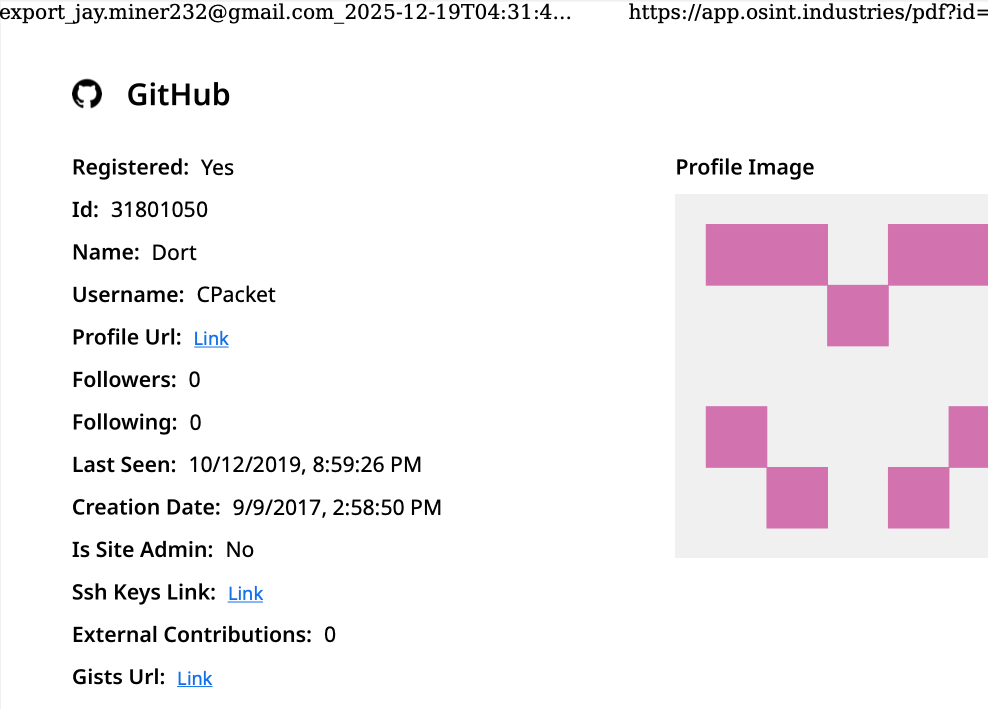
Image: osint.industries.

The cyber intelligence firm Intel 471 says jay.miner232@gmail.com was used between 2015 and 2019 to create accounts at multiple cybercrime forums, including Nulled (username “Uubuntuu”) and Cracked (user “Dorted”); Intel 471 reports that both of these accounts were created from the same Internet address at Rogers Canada (99.241.112.24).

Dort was an extremely active player in the Microsoft game Minecraft who gained notoriety for their “Dortware” software that helped players cheat. But somewhere along the way, Dort graduated from hacking Minecraft games to enabling far more serious crimes.

Dort also used the nickname DortDev, an identity that was active in March 2022 on the chat server for the prolific cybercrime group known as LAPSUS$. Dort peddled a service for registering temporary email addresses, as well as “Dortsolver,” code that could bypass various CAPTCHA services designed to prevent automated account abuse. Both of these offerings were advertised in 2022 on SIM Land, a Telegram channel dedicated to SIM-swapping and account takeover activity.

The cyber intelligence firm Flashpoint indexed 2022 posts on SIM Land by Dort that show this person developed the disposable email and CAPTCHA bypass services with the help of another hacker who went by the handle “Qoft.”

“I legit just work with Jacob,” Qoft said in 2022 in reply to another user, referring to their exclusive business partner Dort. In the same conversation, Qoft bragged that the two had stolen more than $250,000 worth of Microsoft Xbox Game Pass accounts by developing a program that mass-created Game Pass identities using stolen payment card data.

Who is the Jacob that Qoft referred to as their business partner? The breach tracking service Constella Intelligence finds the password used by jay.miner232@gmail.com was reused by just one other email address: jacobbutler803@gmail.com. Recall that the 2020 dox of Dort said their date of birth was August 2003 (8/03).

Searching this email address at DomainTools.com reveals it was used in 2015 to register several Minecraft-themed domains, all assigned to a Jacob Butler in Ottawa, Canada and to the Ottawa phone number 613-909-9727.

Constella Intelligence finds jacobbutler803@gmail.com was used to register an account on the hacker forum Nulled in 2016, as well as the account name “M1CE” on Minecraft. Pivoting off the password used by their Nulled account shows it was shared by the email addresses j.a.y.m.iner232@gmail.com and jbutl3@ocdsb.ca, the latter being an address at a domain for the Ottawa-Carelton District School Board.

Data indexed by the breach tracking service Spycloud suggests that at one point Jacob Butler shared a computer with his mother and a sibling, which might explain why their email accounts were connected to the password “jacobsplugs.” Neither Jacob nor any of the other Butler household members responded to requests for comment.

The open source intelligence service Epieos finds jacobbutler803@gmail.com created the GitHub account “MemeClient.” Meanwhile, Flashpoint indexed a deleted anonymous Pastebin.com post from 2017 declaring that MemeClient was the creation of a user named CPacket — one of Dort’s early monikers.

Why is Dort so mad? On January 2, KrebsOnSecurity published The Kimwolf Botnet is Stalking Your Local Network, which explored research into the botnet by Benjamin Brundage, founder of the proxy tracking service Synthient. Brundage figured out that the Kimwolf botmasters were exploiting a little-known weakness in residential proxy services to infect poorly-defended devices — like TV boxes and digital photo frames — plugged into the internal, private networks of proxy endpoints.

By the time that story went live, most of the vulnerable proxy providers had been notified by Brundage and had fixed the weaknesses in their systems. That vulnerability remediation process massively slowed Kimwolf’s ability to spread, and within hours of the story’s publication Dort created a Discord server in my name that began publishing personal information about and violent threats against Brundage, Yours Truly, and others.

Dort and friends incriminating themselves by planning swatting attacks in a public Discord server.

Last week, Dort and friends used that same Discord server (then named “Krebs’s Koinbase Kallers”) to threaten a swatting attack against Brundage, again posting his home address and personal information. Brundage told KrebsOnSecurity that local police officers subsequently visited his home in response to a swatting hoax which occurred around the same time that another member of the server posted a door emoji and taunted Brundage further.

Dort, using the alias “Meow,” taunts Synthient founder Ben Brundage with a picture of a door.

Someone on the server then linked to a cringeworthy (and NSFW) new Soundcloud diss track recorded by the user DortDev that included a stickied message from Dort saying, “Ur dead nigga. u better watch ur fucking back. sleep with one eye open. bitch.”

“It’s a pretty hefty penny for a new front door,” the diss track intoned. “If his head doesn’t get blown off by SWAT officers. What’s it like not having a front door?”

With any luck, Dort will soon be able to tell us all exactly what it’s like.

Update, 10:29 a.m.: Jacob Butler responded to requests for comment, speaking with KrebsOnSecurity briefly via telephone. Butler said he didn’t notice earlier requests for comment because he hasn’t really been online since 2021, after his home was swatted multiple times. He acknowledged making and distributing a Minecraft cheat long ago, but said he hasn’t played the game in years and was not involved in Dortsolver or any other activity attributed to the Dort nickname after 2021.

“It was a really old cheat and I don’t remember the name of it,” Butler said of his Minecraft modification. “I’m very stressed, man. I don’t know if people are going to swat me again or what. After that, I pretty much walked away from everything, logged off and said fuck that. I don’t go online anymore. I don’t know why people would still be going after me, to be completely honest.”

When asked what he does for a living, Butler said he mostly stays home and helps his mom around the house because he struggles with autism and social interaction. He maintains that someone must have compromised one or more of his old accounts and is impersonating him online as Dort.

“Someone is actually probably impersonating me, and now I’m really worried,” Butler said. “This is making me relive everything.”

But there are issues with Butler’s timeline. For example, Jacob’s voice in our phone conversation was remarkably similar to the Jacob/Dort whose voice can be heard in this Sept. 2022 Clash of Code competition between Dort and another coder (Dort lost). At around 6 minutes and 10 seconds into the recording, Dort launches into a cursing tirade that mirrors the stream of profanity in the diss rap that Dortdev posted threatening Brundage. Dort can be heard again at around 16 minutes; at around 26:00, Dort threatens to swat his opponent.

Butler said the voice of Dort is not his, exactly, but rather that of an impersonator who had likely cloned his voice.

“I would like to clarify that was absolutely not me,” Butler said. “There must be someone using a voice changer. Or something of the sorts. Because people were cloning my voice before and sending audio clips of ‘me’ saying outrageous stuff.”

  •  

Understanding the DarkCloud Infostealer

Blogs

Blog

Understanding the DarkCloud Infostealer

In this post, we analyze DarkCloud, a commercially available infostealer written in Visual Basic 6.0, examine its encryption and evasion techniques, and assess how this low-cost malware can provide threat actors with enterprise-wide access through harvested credentials.

SHARE THIS:
Default Author Image
February 25, 2026

Infostealers continue to dominate the initial access landscape in 2026, lowering the barrier to breach through scalable credential theft. DarkCloud illustrates how low-cost, commercialized malware is reshaping the initial access landscape.

First observed in 2022 and attributed to a developer known as “Darkcloud Coder” (formerly “BluCoder” on Telegram), DarkCloud is openly sold through Telegram and a clearnet storefront with subscription tiers starting at just US$30. Despite being marketed as “surveillance software,” its technical focus is unmistakable: high-volume credential harvesting and structured data exfiltration across browsers, email clients, financial data, and contact networks.

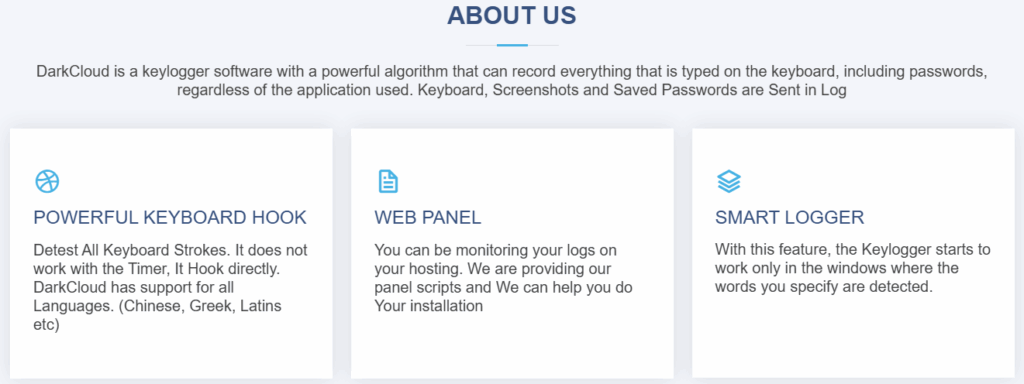
A screenshot from DarkCloud’s clearnet site calling itself “surveillance software.” (Source: DarkCloud clearnet site)

At the technical level, DarkCloud is written in Visual Basic 6.0 and compiled into a native C/C++ application. This legacy language choice is unusual in modern malware development — and likely deliberate. By leveraging outdated but still supported runtime components, DarkCloud appears to benefit from lower detection rates while maintaining full credential theft functionality.

Despite its relatively low cost, DarkCloud should not be dismissed as unsophisticated. Flashpoint assesses it as a potent entry-level threat that can provide adversaries with the keys to an entire corporate network through harvested credentials.

The Commercialization of DarkCloud

DarkCloud describes itself as a keylogger despite the original advertisement on XSS describing it as an infostealer. (Source: DarkCloud)

DarkCloud represents a mature example of commodity malware-as-a-service.

It is openly sold through Telegram and a clearnet website, where it is misleadingly labeled as a keylogger. While it does include keylogging capabilities, this is only a minor component of a much broader infostealing toolkit.

Its real value proposition is credential harvesting across browsers, email clients, file transfer applications, VPN software, and more.

This dual positioning — public-facing “surveillance software” and underground stealer — provides plausible deniability while enabling large-scale credential operations.

Why Visual Basic 6.0 Matters

One of the most notable aspects of DarkCloud is its use of Visual Basic 6.0.

The payload is written in VB6 and compiled into a native C/C++ application. Microsoft no longer supports VB6 in its modern development environment, and VB6 applications rely on legacy components such as MSVBVM60.DLL for execution.

Flashpoint assesses this legacy language choice is deliberate, both for its simplicity and its potential to evade modern detection models.

In testing, Flashpoint analysts generated equivalent payloads in C/C++ and VB6. The VB6 variant produced significantly fewer detections in VirusTotal scans.

The implication is clear: older languages are not necessarily obsolete in adversary tradecraft. In some cases, they may be strategically advantageous.

Encryption and String Obfuscation

DarkCloud employs a layered string encryption scheme that complicates static and dynamic analysis.

Most internal strings are encrypted and decrypted at runtime using Visual Basic’s Rnd() pseudo-random number generator, combined with a custom seed-generation algorithm.

The process involves:

  • Hex-encoded encrypted strings
  • Base64-encoded keys
  • Seed calculation through a custom algorithm
  • Resetting the VB pseudo-random number generator to a known state
  • Iterative Rnd() calls to reconstruct plaintext strings

By resetting the PRNG with a known value before applying the calculated seed, the malware ensures deterministic output during decryption.

This approach does not rely on novel cryptography, but rather on abusing legacy language behavior to frustrate reverse engineering.

Credential Theft at Scale

DarkCloud’s primary objective is credential collection.

It targets:

Email clients:

  • Outlook
  • eM Client
  • FoxMail
  • Thunderbird
  • 163Mail
  • MailMaster

File transfer applications:

  • FileZilla
  • WinSCP
  • CoreFTP

Browsers:

  • Google Chrome
  • Microsoft Edge
  • Mozilla Firefox
  • Brave
  • Opera
  • Yandex
  • Vivaldi
  • (and many additional Chromium- and Firefox-based browsers)

Other applications:

  • Pidgin
  • NordVPN

When extracting browser data, DarkCloud steals:

  • Login credentials
  • Cookies
  • Credit card information

Email applications are additionally scraped for contact lists. This is likely intended to seed future phishing campaigns.

DarkCloud stores collected data locally in two directories under %APPDATA%\Microsoft\Windows\Templates. One directory (“DBS”) stores copied database files, while another (“_”) stores parsed data in unencrypted text format.

This local staging enables continuous exfiltration while maintaining structured log output.

Exfiltration Methods: Flexibility for Threat Actors

DarkCloud supports four exfiltration methods:

  • SMTP
  • FTP
  • Telegram
  • HTTP

SMTP and FTP require hardcoded credentials within each binary. Email subjects include the victim machine’s hostname and username, and stolen data is transmitted as attachments.

HTTP exfiltration appears less frequently used, though the capability is present.

This flexibility allows operators to tailor deployments depending on infrastructure preferences and operational security requirements.

From BluStealer to DarkCloud

Flashpoint analysts identified notable similarities between DarkCloud’s regular expressions for credit card parsing and those found in a publicly documented project known as “A310LoggerStealer,” also referred to as BluStealer.

The regex patterns appear in identical order and format.

Combined with the developer’s prior alias “BluCoder,” Flashpoint assesses that A310LoggerStealer likely represents an earlier iteration of what became DarkCloud.

This evolution reflects a common pattern in commodity malware development: incremental refinement rather than radical innovation.

A Potent Entry-Level Threat

Despite its relatively low cost, DarkCloud should not be dismissed as unsophisticated.

Its marketing as surveillance software attempts to normalize its presence while providing plausible deniability for buyers. Technically, however, its focus is clear: large-scale credential harvesting across browsers, email clients, financial data, and contact networks.

Flashpoint assesses DarkCloud as a potent entry-level threat that can provide adversaries with the keys to an entire corporate network through harvested credentials.

In a landscape where identity is the new perimeter, even a US$30 subscription can be operationally devastating.

Defending Against Commodity Infostealers

Commodity infostealers like DarkCloud may be commercially accessible, but defending against them requires enterprise-grade vigilance.

Organizations should:

  • Treat phishing-delivered ZIP/RAR attachments as high-risk initial access vectors
  • Monitor for abnormal data exfiltration over SMTP, FTP, and Telegram
  • Audit credential reuse across browser and email applications
  • Prioritize credential rotation and incident response playbooks following suspected compromise

Infostealers like DarkCloud are not breakthrough malware families. They do not rely on zero-days or advanced exploits.

Instead, they exploit scale, accessibility, and identity exposure.

To understand how credential harvesting campaigns are evolving and to embed real-time intelligence into your detection workflows, request a demo today and see how Flashpoint intelligence strengthens your defense posture.

Begin your free trial today.

The post Understanding the DarkCloud Infostealer appeared first on Flashpoint.

  •  
❌