Russian state has tolerated parallel probiv market for its convenience but now Ukrainian spies are exploiting it
Russia is scrambling to rein in the country’s sprawling illicit market for leaked personal data, a shadowy ecosystem long exploited by investigative journalists, police and criminal groups.
For more than a decade, Russia’s so-called probiv market – a term derived from the verb “to pierce” or “to punch into a search bar” – has operated as a parallel information economy built on a network of corrupt officials, traffic police, bank employees and low-level security staff willing to sell access to restricted government or corporate databases.
Kensington and Westminster councils investigating whether data has been compromised as Hammersmith and Fulham also reports hack
Three London councils have reported a cyber-attack, prompting the rollout of emergency plans and the involvement of the National Crime Agency (NCA) as they investigate whether any data has been compromised.
The Royal Borough of Kensington and Chelsea (RBKC), and Westminster city council, which share some IT infrastructure, said a number of systems had been affected across both authorities, including phone lines. The councils shut down several computerised systems as a precaution to limit further possible damage.
It’s become the playbook for big Australian companies that have customer data stolen in a cyber-attack: call in the lawyers and get a court to block anyone from accessing it.
Hackers stole personal information of 6.6m people but outsourcing firm did not shut device targeted for 58 hours
The outsourcing company Capita has been fined £14m for data protection failings after hackers stole the personal information of 6.6 million people, including staff details and those of its clients’ customers.
John Edwards, the UK information commissioner who levied the fine, said the March 2023 data theft from the group and companies it supported, including 325 pension providers, caused anxiety and stress for those affected.
Barristers report going unpaid and cases being turned away amid fears firms will desert legal aid work altogether
Lawyers have warned that a cyber-attack on the Legal Aid Agency has pushed the sector into chaos, with barristers going unpaid, cases being turned away and fears a growing number of firms could desert legal aid work altogether.
In May, the legal aid agency announced that the personal data of hundreds of thousands of legal aid applicants in England and Wales dating back to 2010 had been accessed and downloaded in a significant cyber-attack.
Lead brand of French luxury group LVMH reassures customers financial data such as bank details were not taken
Louis Vuitton has said the data of some UK customers has been stolen, as it became the latest retailer targeted by cyber hackers.
The retailer, the leading brand of the French luxury group LVMH, said an unauthorised third party had accessed its UK operation’s systems and obtained information such as names, contact details and purchase history.
Arrest warrants issued for ringleaders after investigation by police in Europe and North America
European and North American cybercrime investigators say they have dismantled the heart of a malware operation directed by Russian criminals after a global operation involving British, Canadian, Danish, Dutch, French, German and US police.
International arrest warrants have been issued for 20 suspects, most of them living in Russia, by European investigators while indictments were unsealed in the US against 16 individuals.
Your Facebook or Instagram account can be your link to friends, a profile for your work or a key to other services, so losing access can be very worrying. Here’s what to do if the worst happens.
If you have access to the phone number or email account associated with your Facebook or Instagram account, try to reset your password by clicking on the “Forgot password?” link on the main Facebook or Instagram login screen. Follow the instructions in the email or text message you receive.
If you no longer have access to the email account linked to your Facebook account, use a device with which you have previously logged into Facebook and go to facebook.com/login/identify. Enter any email address or phone number you might have associated with your account, or find your username which is the string of characters after Facebook.com/ on your page. Click on “No longer have access to these?”, “Forgotten account?” or “Recover” and follow the instructions to prove your identity and reset your password.
If your account was hacked, visit facebook.com/hacked or instagram.com/hacked/ on a device you have previously used to log in and follow the instructions. Visit the help with a hacked accountpage for Facebook or Instagram.
Turn on two-step verification in the “password and security” section of the Accounts Centre. Use an authentication app or security key for this, not SMS codes. Save your recovery codes somewhere safe in case you lose access to your two-step authentication method.
Turn on “unrecognised login” alerts in the “password and security” section of the Accounts Centre, which will alert you to any suspicious login activity.
Remove any suspicious “friends” from your account – these could be fake accounts or scammers.
If you are eligible, turn on “advanced protection for Facebook” in the “password and security” section of the Accounts Centre.
British defence firms have reportedly warned staff not to connect their phones to Chinese-made EVs
Mobile phones and desktop computers are longstanding targets for cyber spies – but how vulnerable are electric cars?
On Monday the i newspaper claimed that British defence firms working for the UK government have warned staff against connecting or pairing their phones with Chinese-made electric cars, due to fears that Beijing could extract sensitive data from the devices.
In traditional cybersecurity, the emphasis is often on technical defenses against attacks. However, understanding the psychological aspects of phishing is equally important to understand the exploitation of human vulnerability.
Phishing attacks are becoming more sophisticated than ever in 2025, leveraging cutting-edge technology to deceive individuals and organizations. Here are the new and most prevalent trends to consider when defending against the number one cyber attack vector.
Qakbot Takedown: A Brief Victory in the Fight Against Resilient Malware
Prior botnet takedowns like Emotet and TrickBot have shown that sophisticated malware operations, like Qakbot, can often rebuild infrastructure and return from disruptions in new forms
Qakbot, familiarly Qbot, has been a major cyber threat since 2007, infecting victims’ computers to steal financial information and distribute additional malware payloads like ransomware. As a result of the takedown, more than 700,000 infected devices worldwide were identified and cleaned of the malware. The DOJ also announced the seizure of $8.6M in cryptocurrency in illicit profits.
While there is no doubt that the Qakbot takedown is a major win in the fight against cybercrime, it may only provide short-term relief in the fight against a notoriously resilient cybercriminal ecosystem.
‘Swiss Army knife’
A Swiss Army knife of cybercrime tools, Qakbot was a complex malware that opened remote access to victims’ systems, stole credentials and financial information, and downloaded additional malware payloads. Its modular architecture enabled frequent updates to add new capabilities over its 15+ years of operation.
“The collaborative endeavors of these authoritative bodies exemplify the power of a comprehensive, multi-agency approach, designed to maximize its impact..”
Ian Gray, VP Of Intelligence
Qakbot has been a versatile workhorse for cybercriminals. Its banking trojan functionality has been used to pilfer payment information and intercept financial transactions. As a loader, it distributed ransomware such as ProLock to extort victims.
Qakbot has also powered large-scale spam email campaigns and brute force attacks. Its worm-like spreading kept it entrenched in infected networks. By providing the backdoor access and distribution channel for other malware, Qakbot played a key supporting role in the cybercrime ecosystem. Botnets like Emotet and TrickBot operated similarly, loading additional threats onto compromised systems. These jack-of-all-trades botnets have proven lucrative for their criminal operators.
A history of temporary relief
Prior botnet takedowns like Emotet and TrickBot have shown that sophisticated malware operations can often rebuild infrastructure and return from disruptions in new forms.
In the case of Emotet, the botnet came back online in 2022 using new techniques after its infrastructure was dismantled in 2021. TrickBot also persisted despite takedown attempts and remains an active threat. This resiliency highlights the challenges law enforcement faces in permanently eliminating cyber threats.
While takedowns temporarily degrade capabilities, dedicated cybercriminal groups adapt to avoid further disruption. New malware families also inevitably emerge to fill the gaps left by larger takedowns. For example, BazarLoader and ZLoader rose to prominence as loader malware after the Emotet takedown.
Yet despite their disruptions, resilient botnets often return and new ones emerge. After prior actions against Emotet and TrickBot, the lingering demand in underground markets brought them back in adapted new forms. Bots remain attractive tools for cybercriminals thanks to their versatility, automation, and money generating potential.
While Qakbot’s infrastructure was disrupted, its operators may attempt to rebuild or evolve their techniques. Sustained pressure on botnet financial flows, developer communities, and other aspects of the cybercrime supply chain is needed to deter future attacks. For now, the coordinated Qakbot takedown bought time and degraded the capabilities of a dominant cybercrime player.
The fight against cybercrime must be persistent and comprehensive
The Qakbot takedown was effectively coordinated among global governments, including France, Germany, Latvia, Romania, the Netherlands, the UK, and the US, as well as the private sector. The collaborative endeavors of these authoritative bodies exemplify the power of a comprehensive, multi-agency approach, designed to maximize its impact.
Law enforcement and the private sector should to continue coordinating takedowns while also focusing on detecting new malware variants early, disrupting communication channels, and following the money trails of criminal enterprises.
Cyber hygiene and threat awareness across organizations must also improve to reduce vulnerability to malware infections, including loaders and trojans that distribute threats like Qakbot. Technical controls like endpoint detection, network monitoring, and patching are also key.
Ultimately, defeating cybercrime requires comprehensive strategy across law enforcement operations, cybersecurity practices, and international collaboration. The Qakbot takedown represents meaningful progress, but the world must remain vigilant against an adaptable threat landscape.
Get Flashpoint on your side
Flashpoint Ignite enables organizations to proactively identify and mitigate cyber and physical risk that could imperil people, places, and assets. To unlock the power of great threat intelligence, get started with a free Flashpoint trial.
How to Combat Check Fraud: Leveraging Intelligence to Prevent Financial Loss
Criminals increasingly steal checks and sell them on illicit online marketplaces, where check fraud-related services are common. Intelligence is helping the financial sector fight back
Checks are one of the most vulnerable legacy payment methods. Check fraud can actively affect the bottom lines (and reputations) of banks, financial services organizations, government entities, and many other organizations that utilize checks. According to the Financial Crimes Enforcement Network (FinCEN), fraud—including check fraud—is “the largest source of illicit proceeds in the US” as well as “one of the most significant money laundering threats to the United States.”
Targeting the mail
Criminals target the US mail system to steal a variety of checks. In fact, there is a nationwide surge in check fraud schemes targeting the US mail and shipping system, as threat actors continue to steal, alter, and sell checks through illicit means and channels.
This includes personal checks and tax refund checks to government or government assistance-related checks (Social Security payments, e.g.). Business checks are also a primary target because they are often written for larger amounts and may take longer for the victim to identify fraudulent activity.
In 2022 alone, US banks filed 680,000 check fraud-related suspicious activity reports (SARs). This represents a nearly two-fold increase from 2021 (which itself represents a 23 percent YoY increase from 2020). This surge in check fraud has been exacerbated by Covid-19 Economic Impact Payments (EIPs) under the CARES Act, which presented threat actors with a new avenue to attempt to commit fraud.
Related Reading
This Is What Covid Fraud Looks Like: Targeting Government Relief Funding
In order to mitigate and ultimately prevent check-fraud-related risks, it’s crucial for financial intelligence and fraud teams to understand what threat actors seek, how they work, and where they operate.
This begins, as we detail below, with intelligence into the communities, forums, and marketplaces where check fraud occurs as well as the tools that enable deep understandings, timely insights, and measurable action.
Below is an intelligence narrative, in three acts, that tells the story of how transactions involving some of the above examples could play out.
Act I: Obtain
Threat actors are known to remove mail from individuals’ mailboxes and parcel lockers using blue box “arrow” master keys. These arrow keys are often stolen from USPS employees, which has led to numerous incidents of harassment, threats, and even violence. Generally, arrow keys are sold within illicit community chats and/or the deep and dark web, often fetching upwards of $3,000 per key.
In general, when it comes to check fraud, threat actors may sell or seek:
Mailbox keys
Stolen checks
Check alteration services (physical and digital)
Synthetic identity provisioning
Drop account sharing
Counterfeit check creation
Writing a check with insufficient funds behind it
Insider access
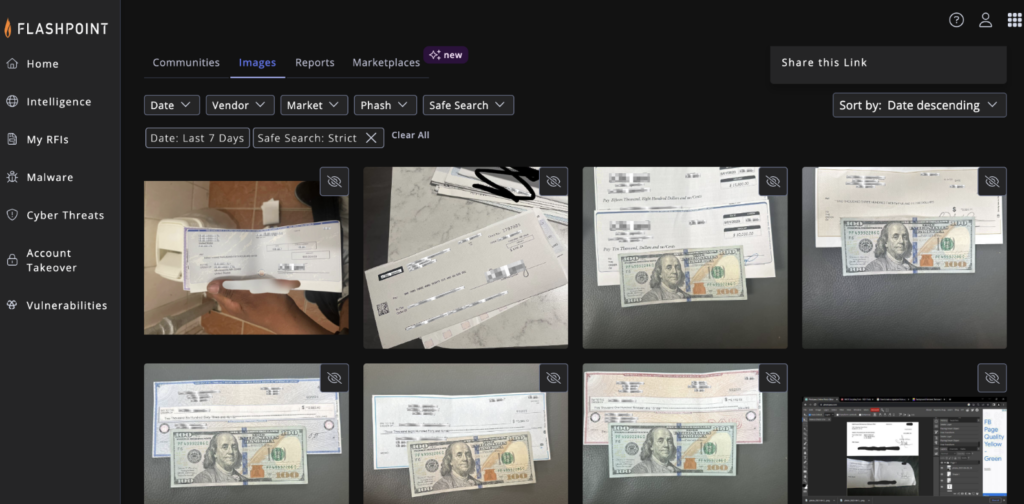
A screenshot of Flashpoint’s Ignite platform, showing the results of an OCR-driven search for stolen checks.
Act II: Alter
Check alteration comes in two forms: “washing” and “cooking.”
Washing refers to the process of altering a check by chemically removing ink and replacing the newly empty spaces with a different value, recipient name, or another fraud-enabling alteration.
Cooking involves digitally scanning the check and altering text or values through digital means.
Act III: Monetize
Threat actors will deposit the fraudulent check and rapidly withdraw the funds from an ATM, or sell a stolen or altered check on an illicit marketplace or chat group, and then receive payment, often via cryptocurrency.
Four key elements of actionable check fraud intelligence
Financial institutions should rely on four essential intelligence-led technologies, tools, or capabilities to effectively combat check fraud.
1) Visibility and access to illicit communities and channels
To prevent check fraud, organizations should focus on a few key places. Financially motivated threat actors operate and share information on messaging apps like Telegram and other open-source channels, as well as illicit marketplaces on the deep and dark web. Therefore, it is imperative for financial intelligence and fraud teams to have access to the most relevant check fraud-related threats across the internet.
Keep in mind, however, that accessing these communities is not always straightforward and, if done frivolously, can compromise an investigation.
2) Timeliness and curated alerting
Intelligence is often only as good as it is relevant. Flashpoint enables security and intelligence practitioners to bubble the most important, mission-critical intelligence through our real-time alerting capability, which allows users to receive notifications for keywords and phrases that relate to their mission, such as check fraud-related lingo and activity.
Essential Reading
The Flashpoint Guide to Card Fraud for the Financial Services Sector
In addition to real-time alerts, analysts can rely on curated alerting and saved searches to track topics of long-term interest. Flashpoint Ignite enables analysts to research particular accounts and their recent activity and matches transactions to their respective ATM slips and institution address. This helps to ensure the accuracy of the information found within these communities and marketplaces before raising any alarms, as many scammers post false content.
This approach is particularly valuable as check fraudsters often share crucial information such as preferred methodologies, social media handles, and geolocations that can aid in identifying malicious activities. In addition, by closely observing newly emerging trends, such as the evolution of pandemic relief fraud to refund fraud to check fraud, analysts can proactively develop robust preventative measures to mitigate risks before these tactics become widespread.
3) Actionable OCR and Video Search
In order to provide “material proof,” cyber threat actors will often tout and post an image of a check in a chat application or marketplace in hopes of increasing the likelihood of a successful transaction. Optical Character Recognition (OCR) technology can capture important information about check fraud attempts, since actors often share images of the fraudulent check or subsequent monetization transactions. OCR alerts are customizable with the financial institution’s name and common phrases used on checks to enhance accuracy.
Images of fraudulent checks provide valuable insights into the fraud attempt, including the check’s unique identifier, the account holder’s name, the bank’s name and address, and the endorsement signature. By analyzing these details, financial institutions and law enforcement agencies can identify patterns and leads that can help them track down the perpetrators and prevent future fraudulent activity.
Related Resource
The Risk-Reducing Power of Flashpoint Video Search
Moreover, ATM withdrawal slips can offer critical information about the transaction, such as the location of the ATM, the time of the deposit, and the type of account used. This data is useful when taking appropriate measures to prevent similar attempts and protect customers’ assets. With the help of advanced technologies like Flashpoint’s OCR, institutions can quickly extract and analyze this information to generate real-time alerts and take prompt action to prevent monetary losses.
An essential investigative component, Flashpoint’s industry-first video search technology, like its OCR capability, enables fraud and cyber threat intelligence (CTI) teams to surface logos, text, explicit content, and other critical intelligence to enhance investigations.
Combat check fraud with Flashpoint
Flashpoint delivers the intelligence that enables financial institutions to combat check fraud at scale. With timely, actionable, and accurate intelligence, financial institutions can mitigate and prevent financial loss, protect customer assets, and track down perpetrators. Get a free trial today to learn how:
A financial services customer detected more than $4M in illicitly marketed assets, including checks and compromised accounts, using Flashpoint’s OCR capabilities.
A customer received 125 actionable alerts in a single month equated to over $15M in potentially averted losses.
An automated alert enabled a customer to identify a threat actor’s specific operations, saving them over $5M.

 Login
Login






































 Table Of Contents