Other noteworthy stories that might have slipped under the radar: Jaguar Land Rover sales crash, hundreds of gen-AI data policy violations, and Chinese cyberattacks against Taiwan intensified.
Kensington and Westminster councils investigating whether data has been compromised as Hammersmith and Fulham also reports hack
Three London councils have reported a cyber-attack, prompting the rollout of emergency plans and the involvement of the National Crime Agency (NCA) as they investigate whether any data has been compromised.
The Royal Borough of Kensington and Chelsea (RBKC), and Westminster city council, which share some IT infrastructure, said a number of systems had been affected across both authorities, including phone lines. The councils shut down several computerised systems as a precaution to limit further possible damage.
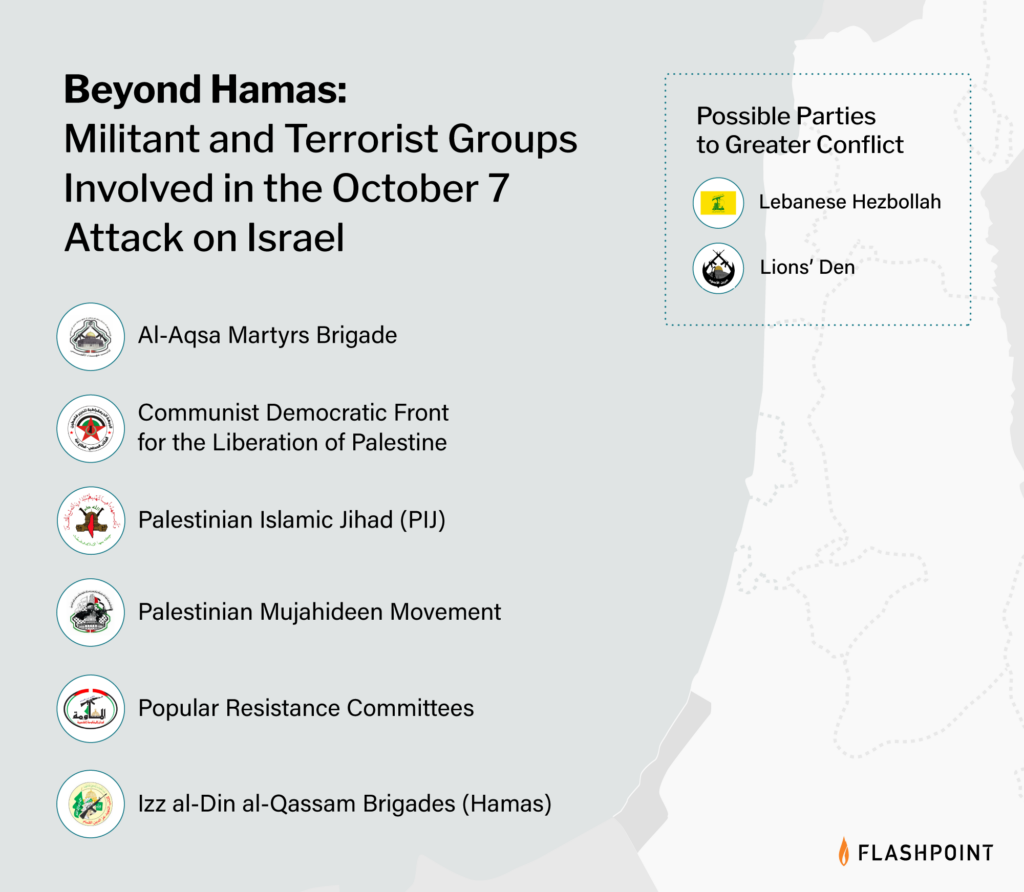
In the midst of the Israel-Hamas War, which erupted with a surprising and devastating attack on October 7, 2023 that resulted in the deaths of more than 1,300 Israelis, it is becoming increasingly apparent that the dynamics of this complex conflict extend beyond the actions of Hamas alone. While Hamas took the lead in launching the initial assault, there is evidence, outlined in this article, that numerous other militant and terrorist groups worked in concert with Hamas, which continues to shape the trajectory of the ongoing conflict.
Based on frontline reportage, open-source intelligence, including social media and message platforms, and Flashpoint collections surrounding the events on October 7, we explore the roles and actions of additional militant and terrorist factions, shedding light on their collective impact in the evolving Israel-Hamas War.
We will update this article as the situation in Israel, Gaza, and the Middle East develops.
Militant and Terrorist Groups Involved in October 7 Attack on Israel
Izz al-Din al-Qassam Brigades (كتائب الشهيد عز الدين القسام)
Operation Al-Aqsa Tufan (Flood) involved coordinated attacks from the Gaza Strip into bordering areas in Israel on October 7, coinciding with a major Jewish holiday and marking the beginning of the 2023 Israel–Hamas war. The attack included a rocket barrage of thousands of missiles, vehicle-transported incursions into Israeli territory, kidnappings, including at a music festival, and significant civilian casualties. It has been described as one of the bloodiest days in Israel’s history and the deadliest for Jews since the Holocaust. Founded in the late 1980s, Izz al-Din al-Qassam Brigades is the militant wing of the terrorist organization Hamas. It has been designated as a terrorist organization by several countries, including the United States, Israel, and the European Union.
Palestinian Islamic Jihad (الجهاد الإسلامي الفلسطيني)
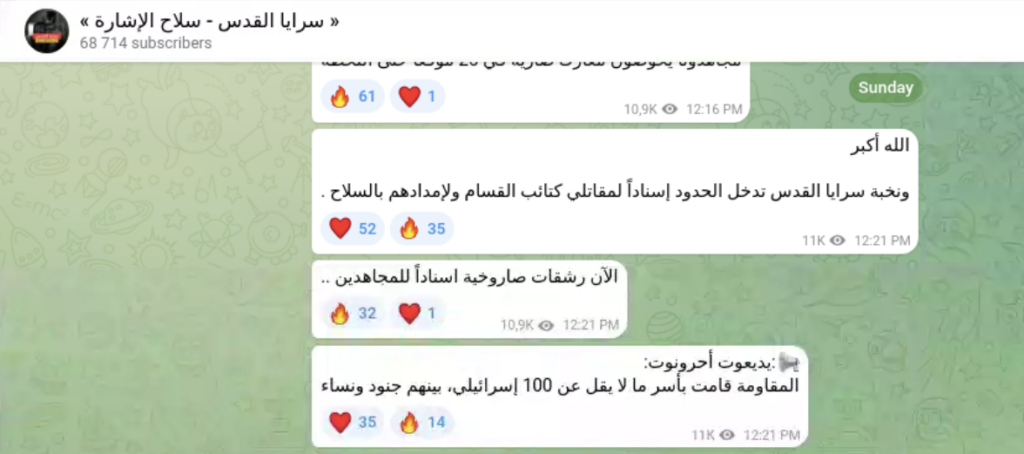
As we previously reported, Hamas and PIJ communicate often with followers via Telegram. On the day after the October 7 attacks, PIJ, in one of its main channels, posted that “the elite of Al-Quds Brigades is entering the border to support al-Qassam Brigades fighters (Hamas) and supply them with weapons.” It has also been reported that PIJ took part in the October 7 attacks alongside Hamas.
On October 17, a rocket hit the Al Ahli Arab Hospital in Gaza, killing hundreds of Palestinian civilians. In a statement, Israeli Defense Forces said that “[Palestinian] Islamic Jihad is responsible for the failed rocket launch which hit the hospital in Gaza.” PIJ has denied the allegation in a statement, reportedly calling it “false and baseless.”
Palestinian Islamic Jihad (PIJ) is a Palestinian terrorist organization that is designated by several countries, including the United States, Israel, and the European Union. It was founded in the late 1970s with the goal of establishing an Islamic Palestinian state and has carried out attacks against Israel.
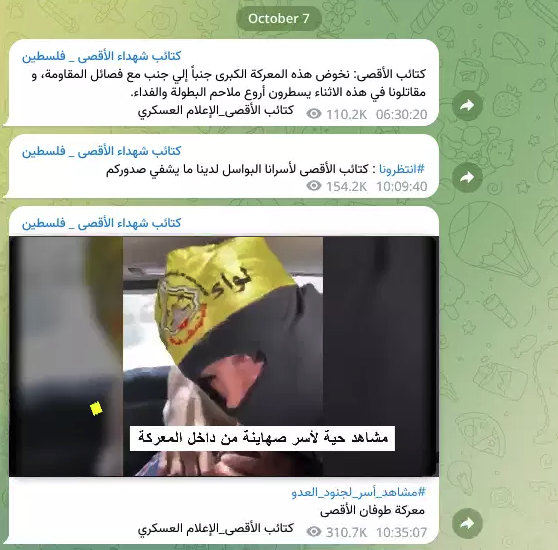
Al-Aqsa Martyrs Brigade (كتائب شهداء الأقصى)
The Al-Aqsa Martyrs Brigade is a Palestinian militant organization affiliated with Fatah, a major Palestinian political party, that has carried out attacks and other activities against Israel. One of the key players in Palestinian politics today, Al-Aqsa Martyrs brigade was founded in the late 1950s and has historically been associated with the Palestine Liberation Organization (PLO). The group was designated a Foreign Terrorist Organization by the US Department of State in 2002.
Above: Screengrab from October 7 showing a video of a man wearing a headband with the Al-Aqsa Martyrs Brigade emblem. The video, posted in an official Al-Aqsa Martys Brigade Telegram channel, shows the man speaking alongside a gravely injured Israeli soldier. The message hashtag translates to “#Scenes_of_enemy_soldiers_capture” (Image: Flashpoint)
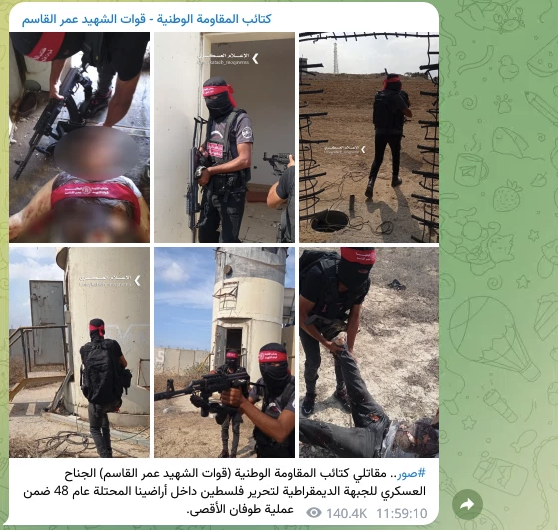
Democratic Front for the Liberation of Palestine (الجبهة الديمقراطية لتحرير فلسطين)
The Democratic Front for the Liberation of Palestine (DFLP) is a Palestinian political and militant organization founded in 1969, known for its left-wing and Marxist ideologies. It has historically aimed for the liberation of Palestine and the establishment of an independent Palestinian state through both militaristic and political means. While a member of the Palestine Liberation Organization (PLO), it has not been as prominent as other Palestinian factions like Fatah or Hamas in recent years.
Above: Pictures posted by an official Democratic Front for the Liberation of Palestine showing armed militants reportedly inside Israeli territory on October 7. (Image: Flashpoint)
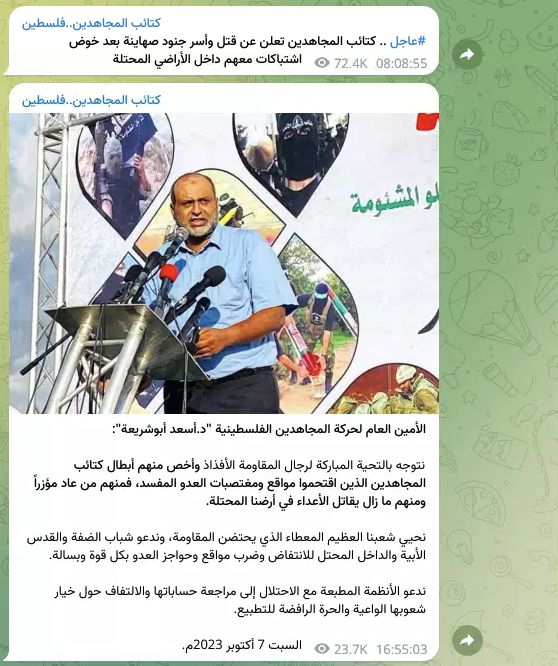
Palestinian Mujahideen Movement (حركة المجاهدين الفلسطينيين)
The Palestinian Mujahideen Movement is a Palestinian militant organization that emerged in the early 1970s with the goal of resisting Israeli occupation and achieving Palestinian self-determination through various armed activities and operations against Israeli forces. However, it is not as widely recognized or prominent as Palestinian terrorist groups like Hamas or the Palestinian Islamic Jihad (PIJ).
Above: Screengrab of an official Palestinian Mujahideen Movement channel showing an image of Dr. Asaad Abu Sharia, the General of the Palestinian Mujahideen Movement, congratulating the “heroes…who stormed the positions and settlements of [Israel].”
We have shared this Telegram message in lieu of the many messages shared in the same channel the day prior, October 7, that showed graphically violent images of what appears to be soldiers in IDF uniforms. (Image: Flashpoint)
Popular Resistance Committees (لجان المقاومة الشعبية)
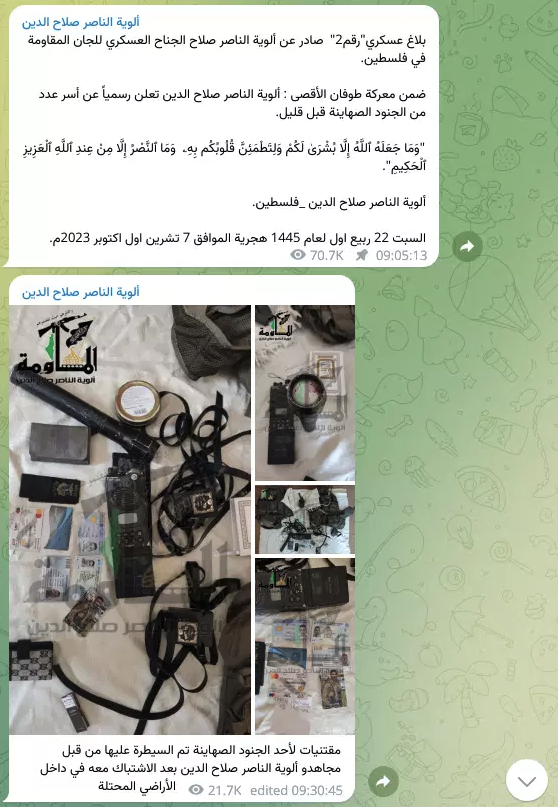
The Popular Resistance Committees (PRC), whose military wing is referred to as Al-Nasser Salah al-Deen Brigades (ألوية الناصر صلاح الدين), are a coalition of various Palestinian factions and armed groups in the Gaza Strip. They were formed in the early 2000s during the Second Intifada, a period of intense Palestinian-Israeli conflict. The PRC includes members from different political and militant backgrounds and has carried out attacks against Israel. While not as prominent as terrorist organizations like Hamas or the Palestinian Islamic Jihad (PIJ), the PRC has played a role in the ongoing Israeli-Palestinian conflict, as evidenced by the events of October 7, 2023.
Above: Screengrab of communications within the official Al-Nasser Salah al-Din Brigades Telegram channel from October 7, alongside photos of allegedly confiscated military equipment and IDs belonging to captured Israeli soldiers. (Image: Flashpoint)
Those who could join the fight
Lebanese Hezbollah (حزب الله اللبناني)
Though not directly involved in the October 7 attacks, Lebanese Hezbollah and Israel have exchanged assaults in connection with the ongoing Israel-Hamas War since October 8.
Also known as Hezbollah, Lebanese Hezbollah is a Shiite Islamist political and militant organization based in Lebanon. It was founded in the early 1980s with support from Iran, following the Israeli invasion of Lebanon. Hezbollah’s primary goal is to resist Israel and promote Shiite interests in Lebanon and the wider region. The group was designated a Foreign Terrorist Organization by the US Department of State in 1997, the same year as Hamas and PIJ.
Lions’ Den (عرين الأسود)
Saraya al-Quds Military spokesman Abu Hamza has calledfor Lions’ Den and Jenin Brigade, another Palestinian militant group, to join the fight.
The Lions’ Den is a Palestinian militant group in the Israeli-occupied West Bank, formed in August 2022. Comprising members from various Palestinian militant and terrorist organizations, including Hamas and Palestinian Islamic Jihad, along with disaffected Fatah members, it resonates with some young Palestinians frustrated by the Israeli occupation, settlements, settler violence, and the perceived ineffectiveness of the Palestinian Authority. They have engaged in various West Bank attacks, funded in part by Hamas.
These profiles represent the most meaningful actors on the digital and physical frontlines of the Israel-Hamas War at the moment. Flashpoint has seen an expansion of participants as the conflict unfolds and expands into new physical and digital theaters. We will therefore update this article as the situation continues to develop.
Telegram, with its 700 million-plus-strong user base, has evolved into a pivotal communication hub for Hamas and Palestinian Islamic Jihad (PIJ). Its robust privacy and encryption protocols safeguard communications while also providing a covert operational space for militant groups and cybercriminals. The platform’s role in open-source intelligence (OSINT) is vital, offering real-time insights into unfolding global events, such as the ongoing military conflict between Hamas and Israel, and becoming an essential tool for intelligence professionals navigating the multifaceted landscape of contemporary warfare. Organizations with regional interests should perceive Telegram as a crucial asset in understanding their risk apertures and navigating through conflict complexities.
In the context of recent global conflicts, including the Russia-Ukraine war and the Hamas-Israel conflict, platforms like Telegram have demonstrated their significance by providing real-time updates, documenting potential war crimes, and offering a platform for anti-war narratives amidst governmental censorship. Both scenarios underscore Telegram’s evolving role in modern warfare, influencing narratives and strategies, and providing a digital battlefield for organizations and intelligence professionals to navigate and anticipate conflict dynamics.
This digital battlefield, while shaping the narratives and strategies in contemporary conflicts, abruptly collided with reality on October 7, when the virtual orchestrations of Hamas transformed into a tangible, devastating surprise attack on Israel.
Hamas militants launched an unexpected, devastating attack on Israel on October 7, resulting in hundreds of casualties and numerous hostages. Over 2,000 rockets were fired into Israel, causing significant casualties and prompting Prime Minister Benjamin Netanyahu to declare war on Hamas, mobilizing the military and reserves. The assault, occurring on the fiftieth anniversary of the 1973 Egypt and Syria attack and during the Jewish holiday, Shemini Atzeret, took Israel by surprise.
Reports state that the attack resulted in hundreds dead and more than 500 injuries, the kidnappings of Israeli soldiers, and vehicle takeovers, while Hezbollah celebrated the assault. The US Embassy in Jerusalem issued an alert and initiated shelter-in-place protocols for its personnel. Militants breached the Gaza-Israel barrier using various methods, and Hamas commander Mohammed Deif urged Palestinians and Arabs to join the operation, raising fears of a wider conflict.
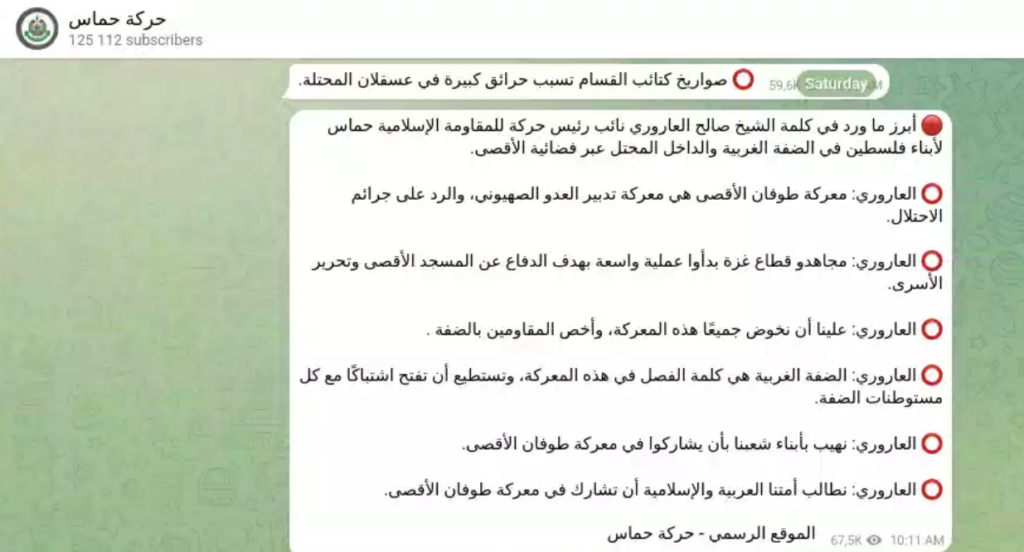
At around 5:30 a.m. UTC, Hamas posted in one of its main Telegram channels, that the Commander-in-Chief of Al-Qassam Brigades announced the beginning of Hamas’s Al-Aqsa Tufan (Flood) and the firing of over 5,000 rockets aimed at Israel. Shortly thereafter, reports show that air raid sirens sounded in Jerusalem around 6:30 a.m. local time, signaling an attack and instructing citizens to take cover.
Hamas Telegram post announcing the start of Al-Aqsa Tufan (Image: Flashpoint)
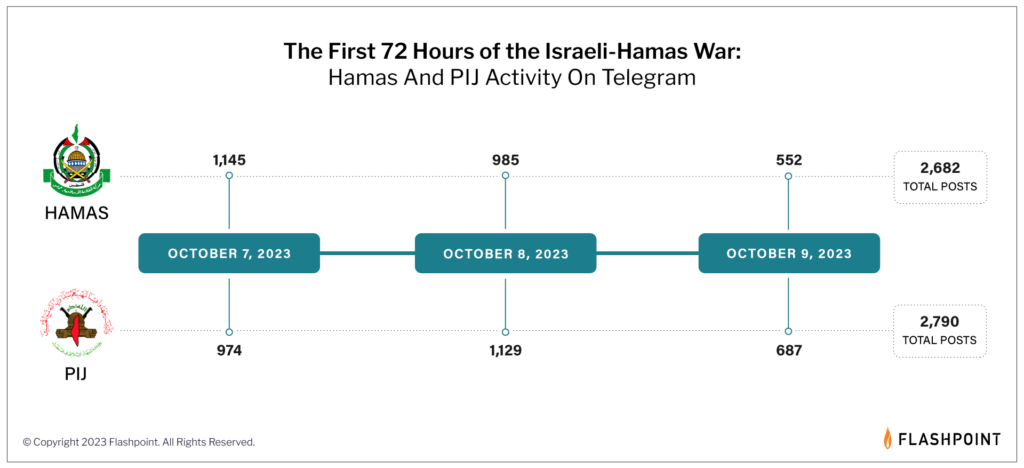
This message represents one of 1,145 messages sent over Hamas’s main Telegram channel on October 7. For context, the day prior, 373 messages were sent over the same channels, showing more than a 3X spike in chatter from October 6.
October 8: Violence escalates
The conflict intensifies with continued assaults and counter-assaults from both Israel and Hamas. The death toll rises sharply on both sides, and the situation garners international attention and condemnation. Hamas issues a threat to execute Israeli hostages, prompting further international outrage. The U.S. confirms that several American citizens have been killed in the attacks and expresses its unwavering support for Israel. Various nations and international leaders continue to condemn the violence and express solidarity with Israel.
On October 8, Palestinian Islamic Jihad posted that “the elite of Al-Quds Brigades is entering the border to support Al-Qassam Brigades fighters and supply them with weapons.” (Image: Flashpoint)
On Sunday, 1,129 posts were sent between PIJ and its followers on Telegram, with messages such as above sharing updates of the assault.
October 9: Broadening battlefields
The conflict takes a new turn as rockets are fired from Lebanon toward Israel, prompting Israeli forces to retaliate against Lebanese territories. The U.S. updates the number of American citizens killed in the attacks and acknowledges that Americans are among those taken hostage by Hamas. Israeli Defense Minister Yoav Gallant orders a “complete siege” on Gaza and promises a robust and unrestrained response to the ongoing attacks, vowing to eliminate any threats against Israel.
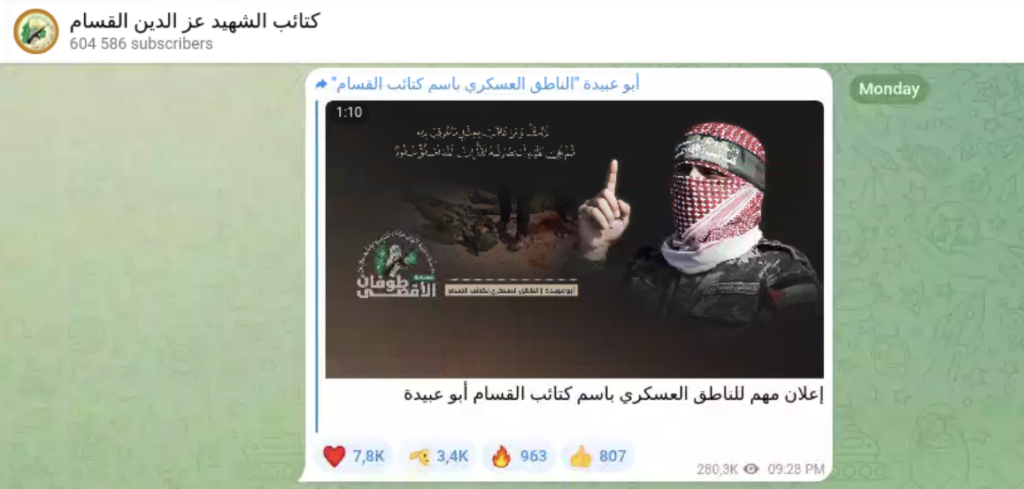
Telegram post from a major Hamas channel linking to a video of Abu Obaida, the spokesperson for the al-Qassam Brigades, in which he signals further violence to Israelis, particularly hostages (Image: Flashpoint).
Throughout Monday, Telegram activity from Hamas and PIJ fell by almost half compared to the day prior. Within the first 72 hours of the Israeli-Hamas War, Flashpoint observed a total of 5,472 Telegram posts shared by both Hamas and PIJ across their main channels.
Days of Chaos: How OSINT Helps Us Understand the Putin-Prigozhin Schism
Social media and messaging platforms like Telegram continue to play a key role in understanding events, rumors, and ideas as they unfold in the Russia-Ukraine war
The once-cordial relationship between Vladimir Putin and Yevgeny Prigozhin, commonly known as “Putin’s chef,” has soured completely, marking one of the most compelling storylines in Russia’s now 16-month-long invasion of Ukraine. This particular conflict, however, played out in Russia on June 23 and lasted a scintillating ~36 hours, ending in a schism whose implications continue to reverberate across the world, especially in Russia.
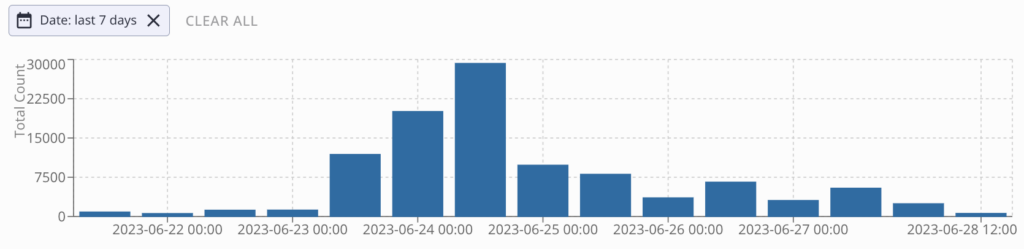
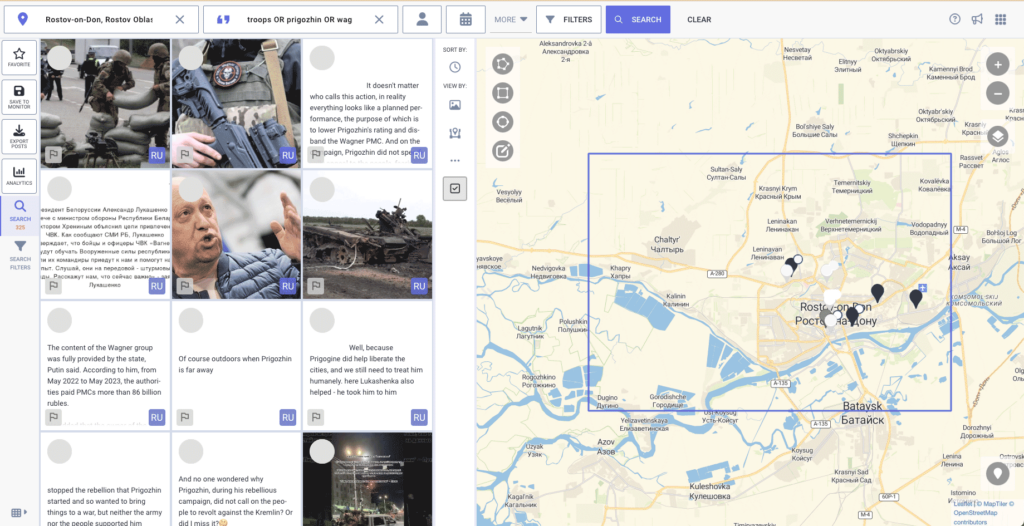
Mentions count in Flashpoint collections for variations on searches for Prigozhin and the Wagner Group. (Image: Flashpoint)
Social media and messaging platforms like Telegram continues to play a key role in helping individuals and organizations alike understand events, rumors, and ideas as they unfolded, often in real time. As we describe in this article, and as we highlighted in our popular report on the role of open-source intelligence (OSINT) in the Russia-Ukraine War, organizations are rightfully viewing OSINT as a key element of their intelligence and security operations and leveraging it to understand organizational risk as it relates to the cyber, physical, and informational battlefields of this war.
Let’s zoom in on two crucial days—June 23 and June 24—of the conflict between Putin and Prigozhin and examine the importance of OSINT in understanding the events, then and now.
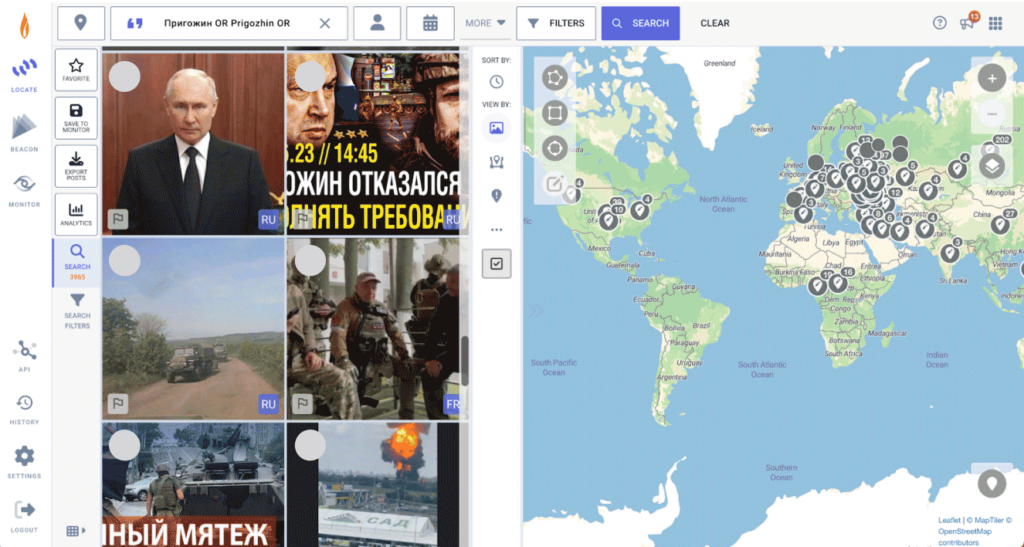
Flashpoint’s physical security intelligence platform showing results for a global search seeking mentions of Prigozhin across OSINT-related collections.
June 23: Wagner Accuses MOD of Missile Strike, Potential Military Coup Brews
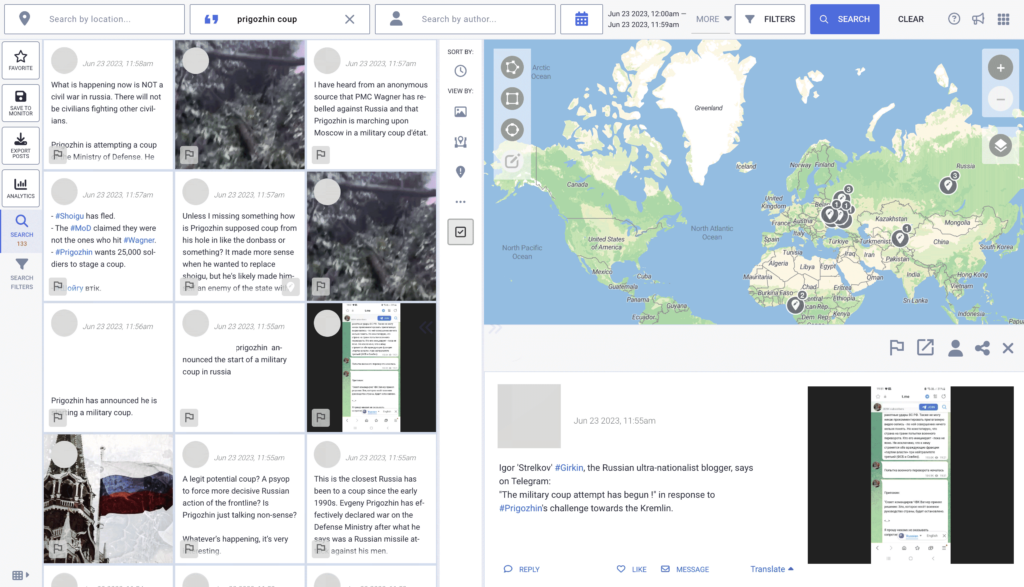
On June 23, Yevgeny Prigozhin, the founder of the paramilitary company Wagner Group, accused Russia’s Ministry of Defence (MOD) and its leader, Sergei Shoigu, of conducting a missile strike on his mercenaries. Prigozhin claimed that the strike resulted in numerous fatalities. He characterized the MOD as “evil” and called for those responsible to be held accountable. It was unclear whether this move should be classified as a coup, insurrection, mutiny, or hardline bargaining tactic at the time.
In retaliation, Prigozhin has appeared to openly advocate for armed resistance against the MOD, adding fuel to an already tense stand-off. Prigozhin warned that “the next move will be ours,” and that those who are responsible for the deaths of the Wagner troops killed today, as well as the deaths of many tens of thousands of Russian soldiers, will be “punished” and “justice” will be “returned,” both to Russia’s armed forces and all of Russia. The MOD has rejected these accusations, claiming that they “do not correspond to reality” and labeling them as an “informational provocation.”
"All the video frames distributed on social networks on behalf of Yevgeny #Prigozhin about the alleged 'strike by the Russian Defense Ministry on the rear camps of the PMC Wagner” do not correspond to reality and are an informational provocation. pic.twitter.com/pBIPdFEdLc
The current events, particularly the Wagner Group turning on Putin, can be traced back to the devastating fighting at Bakhmut, where the Wagner Group suffered heavy losses. This battle resulted in significant costs and losses for Russia.
June 24: Prigozhin’s March To Moscow
On June 24, Prigozhin announced that Wagner Group, the private military company (PMC) he leads, would cease its march on Moscow, ending what has been widely regarded as an armed insurrection and potential coup attempt targeting Russia’s military and government leadership.
In an interesting twist, Belarusian President Lukashenko stepped in, providing a means for Wagner to continue operating in a “legal” manner. This intervention prompted the move of Wagner Group and Prigozhin to Belarus. This is particularly noteworthy as PMCs are technically illegal under Article 359 of the 1996 Russian Criminal Code. As a result of the negotiations, the sides agreed that a “bloodbath” on Russian territory should be averted and de-escalatory steps should be taken. Prigozhin agreed that Wagner would halt its advance on Moscow, which Prigozhin claims Wagner got within 200 kilometers of, and turn back to “go in the opposite direction to [their] field camps.” In return, Wagner personnel would be granted “security guarantees.”
Related Blog
Timeline of Russia’s Invasion of Ukraine: Cyber and Physical Warfare
Prigozhin claims that Wagner had not spilled “a single drop of blood of our fighters” since the start of their march on Russia the day prior. However, Prigozhin claims that Russia’s military had attempted to fire at the PMC during their march, reportedly downing at least one and potentially multiple Russian military helicopters. There are also reports of a fire at a fuel depot in Voronezh, which may have been hit by a Russian helicopter.
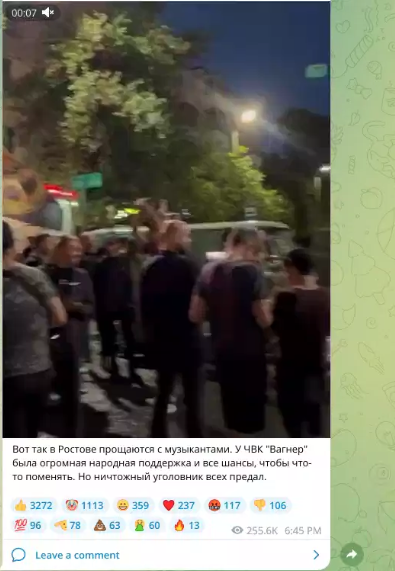
Screengrab of a video posted on a pro-Wagner Telegram channel showing Wagner supporters in Rostov as they demonstrate support to departing Wagner troops. (Image: Telegram)
Wagner troops seized control of multiple military and administrative buildings in the Russian city of Rostov-on-Don early on Saturday morning and had since reportedly reached Voronezh, which lies 500 kilometers north of the city and on the way to Moscow. On June 24, Russian media reported that Wagner was preparing to leave Rostov-on-Don.
Since then, the Kremlin has said that Prigozhin would not have to face charges in Russia, but he has been dubbed a “traitor” by Putin. As of this publishing, Prigozhin is allegedly in Belarus, according to the country’s President, Lukashenko, who brokered the deal on Prigozhin behalf.
Concluding thoughts
In today’s dynamic geopolitical climate, staying ahead of the curve necessitates more than just monitoring mainstream media. Open-source intelligence collections have emerged as a game-changing tool for keeping abreast of the latest events in Ukraine and Russia, which can help various organizations and sectors sift through vast amounts of information, quickly filter out the noise, and deliver the most salient insights in real-time. The recent events in Russia showcase the value of this intelligence resource in offering a multifaceted perspective on ground realities.
Get Flashpoint on your side
Flashpoint’s suite of actionable intelligence solutions enables organizations to proactively identify and mitigate cyber and physical risk that could imperil people, places, and assets. To unlock the power of great threat intelligence, get started with a free Flashpoint trial.
What Is Open Source Intelligence: The Importance of OSINT in Your Organization’s Threat Landscape
In order to gain the upper hand, security strategies must include a diverse means of gathering intelligence, both for a predictive and reactive approach. Open-source intelligence has become crucial to completing this picture
A modern security professional’s job is becoming more and more complex, and it’s no surprise considering the influx of unexpected places where threats are beginning to surface. In order to gain the upper hand, your security strategy must include a diverse means of gathering intelligence, both for a predictive and reactive approach. In an era where content is being created at an exponential rate – 90% of the world’s data was created in the last 2 years alone – the future of security must be intelligence-led.
A major source of intelligence that cannot be overlooked is the vast amount of publicly available information (PAI) being produced by consumers, hackers, newsmakers, and bloggers every single day. Globally, almost every person and organization is communicating across multiple platforms and networks, as well as handling personal and corporate needs virtually – such as shopping, travel planning, and data management. Finding like-minded communities and audiences online is the goal; however, wherever you have people congregating, especially if there is potential for monetary gain, the risk of nefarious behavior rises. This has created an increased need for open-source intelligence (OSINT) and OSINT platforms.
What is OSINT?
Open-source intelligence, or OSINT, refers to the process of gathering information from public, legal data sources to serve a specific function. Some open sources might include social media, blogs, news, and the dark web.
The concept of OSINT very basically works like this:
Public information exists → data is gathered → information is analyzed for intelligence.
The purpose of seeking information from public data varies on the type of insights you wish to gather. Many industries and professionals look to open sources to uncover workplace security threats, protect executives, prevent loss, manage assets, gauge brand sentiment, and monitor conversations for creating marketing strategies. Intelligence professionals use certain types of OSINT and OSINT platforms for investigations, prosecution, evidence gathering, and events monitoring.
What is finished intelligence?
Finished intelligence, or ‘cooked’ data, is raw data that has undergone processing to gain context and become actionable. The collection, processing, and analysis of raw data are foundational steps along the threat intelligence lifecycle.
In other words, raw data is unaltered from its original source. This could look like a network’s traffic data logs, dark web discussions, or even public social media posts.
Finished intelligence would look like a report summarizing the context interpreted from relevant raw data points and suggested security responses.
Finished intelligence services allow organizations to skip the raw data collection and analysis steps, which are time-consuming and require skilled analysts. Those steps are instead supported by automation and machine learning capabilities, and/or third-party analyst teams.
The main goal of finished intelligence is to operationalize the process so organizations can respond faster to active threats and invest less time and resources in gathering and contextualizing large volumes of raw data. The result is a finished intelligence report that the client can immediately act on. While expensive, finished intelligence solutions can be ideal for private sector organizations seeking a “comprehensive” security solution.
What can OSINT tools do?
OSINT tools can identify and separate entities within a data set (parsing), and organize and display those entities by category to glean meaning and avoid redundancies (normalizing). OSINT tools can also index raw data so that it’s quickly and easily searchable and filtered for relevancy.
Access to publicly available online data is often free, but the true value lies in what can be analyzed and extracted from the data. Organizations using OSINT for security and intelligence require the ability to detect key information quickly and efficiently. They can do so by using robust OSINT tools.
The vast amount of online data is overwhelming to sift through, and with the complex ways today’s online threat actors conduct themselves, the vulnerabilities to organizations are becoming more elusive. Open-source data, when gathered, enriched, and monitored effectively, can be extremely valuable for predicting, analyzing, and reviewing incidents at every stage of their occurrence. But where to begin?
Where you look for information depends on what you want to find. Running a Google search is a simple form of OSINT, but when you are responsible for the safety and security of a particular person, place, or asset, you need to be casting a keen eye over multiple sources. Criminal behavior tends to be hidden, and it is unlikely a surface web search will take you there.
What threats can OSINT help with?
The emergence of intelligence-led security is a direct result of the varied and growing range of on-the-ground threats that are being plotted, planned, discussed, and executed online. As our physical and digital realities are becoming more and more interlaced, individuals and organizations are creating more informational weaknesses and thereby more opportunities for an ever-widening range of attacks and other threats to occur.
OSINT tools can be invaluable for handling internal processes such as:
Brand protection
Workplace and facilities safety issues
Real-time event monitoring
Executive protection and force protection
Natural disasters and incident response
OSINT for enterprise security
Global enterprises are operating in the age of digital transformation. This has plenty of benefits for companies, helping improve customer experience, productivity, and resource management. But along with these benefits, wider technology adoption also means increasing opportunities for compromise.
This stands true for almost any industry with an online presence—including finance, retail, and transportation, which make up some of the world’s most cyber-targeted industries. Digital transformation also affects physical security and cyber-enabled threats as criminals adopt anonymized online communication channels. What do these risks look like?
Cyber threats
Data breaches targeting corporate and customer information
OSINT tools support enterprise security teams in identifying and responding to these risks. Social media networks provide real-time updates from on-the-ground threats near executives and other physical assets like offices, employees, and corporate events. Paste sites, forums, and marketplaces across the deep and dark web often publish the earliest indicators of data breaches and executive-targeted doxxing. Anonymized discussions on these covert sites help security teams identify fraud, insider threats, and cyber-attack strategies directly from the source.
Combined with other risk management feeds and tools, OSINT platforms provide security teams with more context and earlier risk indicators so they can respond faster and avoid blind spots.
But many organizations face challenges in responding to risk quickly and effectively, especially as more enterprise teams—from marketing to IT and compliance—require OSINT.
According to a 2021 report by Forrester Research, 42% of corporate decision-makers are currently improvising when it comes to risk management. Almost 70% claim that risk information is siloed across their departments and only 29% are confident in their risk management technologies.
What do security teams need from OSINT platforms to address information gaps?
Broad data coverage
There are thousands of different online sources out there, from social media platforms to the deep and dark web, where relevant risk data is hiding. Many risk management tools focus only on one data source type—such as social media or the dark web—to help security teams find relevant risk information. A more ideal solution combines a variety of these sources within one platform so teams don’t have to juggle more tools than are necessary. This can just lead to information gaps and slower responses.
Simplicity and usability
Not everyone who needs access to online risk data has a technical background. OSINT solutions should be accessible to anyone in an organization without the click-heavy processes and complex interfaces that are typical of IT-based risk management software. Personnel should be able to easily and quickly separate the most pertinent data and view it in a digestible format.
Speed-to-information
OSINT tools that prioritize real-time data allow security teams to get critical insights faster. This gives organizations a much better chance of avoiding or mitigating threats from all angles.
Collaboration features
For risks where cross-department visibility is necessary, OSINT solutions should offer permission settings and collaboration features that allow teams to view each other’s activities or tackle a security threat together when there is overlap.
Integrations
Many global organizations already have a suite of risk management tools. OSINT solutions should be able to easily integrate with third-party solutions, whether they include a UI or funnel data directly into existing systems.
OSINT for national security: What national security initiatives does OSINT support?
Counter-terrorism and counter extremism
Foreign jihadist groups like the Islamic State and Al-Qaeda are no longer solely responsible for the threat of terrorism and extremism. Domestic extremist movements based on conspiracy theories, right-wing ideology, and discriminatory worldviews now also pose serious national security threats. Public online spaces are leveraged similarly for both extremist types, playing a huge role in spreading propaganda, recruitment, financing, and sometimes planning. This data helps governments understand how extremist groups operate so they can then predict public safety risks and protect citizens and assets from domestic and global terrorism.
Addressing misinformation and disinformation
National security threats have expanded to include online influence campaigns, which can compromise democratic processes and lead to real-world security risks. Disinformation (which is engineered to deliberately deceive) and misinformation (false information that is not necessarily spread with malicious intent) is widely prevalent online. Monitoring online spaces is crucial for tracking disinformation campaigns so governments can mitigate their impact and keep the public safer and more informed.
Cybersecurity
Breaching government data is financially and politically lucrative for lone-wolf attackers, organized hacking groups, and nation-state actors. Sophisticated technologies are available to a greater diversity of adversaries than ever before. Persistent online threats include breaches and cyber espionage targeting classified data, network attacks disrupting critical infrastructure, and botnets enabling malware attacks and information warfare. Paste sites, discussion forums, and marketplaces on the deep and dark web often provide early indicators of breaches, malware, and attack techniques. Combining this open-source data with other cybersecurity feeds helps intelligence teams more confidently predict, mitigate, and investigate cyber compromise.
Transportation security
National transportation networks, including airports, seaports, and highways, make up a country’s critical infrastructure. When this infrastructure is compromised, governments and security teams need to stay prepared and alerted to prevent damage to assets, data, and human life. Online data plays a crucial role in providing the intelligence required for informed transportation security planning and incident response. For intelligence teams, social media networks and deep and dark web content can:
Provide the earliest alerts for location-based threats near airports, seaports, and other transportation hubs
Inform security teams about tactics used to bypass security systems or commit attacks, particularly at airports
Monitor for threats directly targeted at the security/public sector organizations themselves
Stay alert to vulnerable data that could compromise a transportation network’s digital or physical security
Addressing national and global crises
When a national crisis occurs, governments must make timely, informed decisions to protect their data, assets, and citizens. As we’ve seen with the COVID-19 pandemic, adversaries co-opt real-world events in their strategies. Whether it’s a natural disaster, public health crisis, or terrorist attack, intelligence teams need to know how and where the crisis is occurring and how to allocate response resources. Online spaces are often the earliest sources of information to provide this context—for example, social media users often post public updates and images from the scene of a crisis. Aligning this data with other feeds can help provide a faster and more informed response.
Intelligence professionals require specialized software to collect this information and generate actionable intelligence. Commercial OSINT tools help intelligence teams gather open-source data more efficiently and align with a team’s unique requirements. Because intelligence teams often work with their own interfaces and tooling, they often require direct access to raw data that can be plugged into their existing systems.
How do OSINT platforms address data overload?
The intelligence community is increasingly challenged by growing volumes of online data available for collection, processing, analysis, and triage. The western world is also facing a data analyst shortage coupled with a growing demand for military AI. As a result, data scientists in the public sector tend to handle more complex tasks, developing tooling and data sets to support lower-level analysts on intuitive platforms.
Intelligence teams are also challenged by a lack of access to some emerging online sources. For example, fringe networks (like alt-tech platforms, deep and dark web imageboards and paste sites, etc.) do not offer their own API or are unavailable through commercial API providers. To gather data from these sources, analysts are often required to create dummy accounts, make group requests, and navigate networks manually. This requires a significant amount of HUMINT resources that could be allocated to other areas of the intelligence cycle.
To address these challenges, OSINT tools must:
Improve data coverage by providing access to relevant sources, including fringe web spaces, that are not commonly available through commercial, off-the-shelf vendors.
Leverage machine learning capabilities. AI is a major priority for governments, helping analysts process and contextualize intelligence more efficiently.
Be intuitive and user-friendly for lower-level intelligence analysts, providing more efficient workflows and better speed-to-information.
Types of OSINT tools
There are many types of OSINT tools on the market, both free and paid. The truth is, no single OSINT tool is 100% effective as a standalone solution. Rather, combining a variety of solutions is the best practice. Remember that the best OSINT tools will have a geographical element, providing a digital window to view data by location. The tools you choose will depend on the specific needs of your organization. Here are some types of OSINT tools to consider:
Social media monitoring
Our OSINT Platform allows organizations to use online information to gain situational awareness on the ground. Security teams utilize predictive intelligence and real-time crisis management, as well as brand monitoring and post-incident review.
Deep and dark web monitoring
The Flashpoint product suite includes targeted, automated collection systems that capture information from the deep and dark web, enabling your security and intelligence teams to identify and prioritize relevant threats and leverage their intelligence to act quickly.
Email hacks
Have I Been Pwned? is a free online resource to check if your email address has been put at risk due to a data breach.
Twitter monitoring
TweetDeck allows you to view multiple timelines in one user view. TweetDeck allows a user to create specific filters such as specific activity and geographical locations.
Internet archives
Wayback Machine is an internet archive tool, like a library, of historical data. This tool allows the user to search the history of archived websites, metadata, text contents, and TV news captions.
Link analysis
Maltego is a graphical link analysis tool that accelerates and simplifies complex investigations by allowing users to build visualizations and connections between disparate data sets.
Conclusion
Business is happening online, and today’s security strategies need to be informed by the masses of social data being created every day. Gathering, filtering, and analyzing this information requires the advanced capabilities of OSINT platforms.
Both amateur and professional criminals are using sophisticated strategies and seemingly innocuous networks to conduct illicit business. More and more media networks are being infiltrated and used outside their intended purposes. Evolving threats require predictive and intelligence-led security strategies. Security teams must gather intelligence from every corner that they can. Open source threat intelligence software is essential for any enterprise using public data sources to inform their decision-making.
Not only can OSINT help protect against hidden intentional attacks such as information leaks, theft, and fraud, but it also has the ability to gain real-time and location-based situational awareness to help protect people at work, at events, institutions, or even the shopping mall. The right OSINT toolkit will give your security and intelligence teams the upper hand.
BB King//* The state of Ohio recently validated a webapp pentest finding that sometimes goes overlooked. It relates to the details of administrative functions, how they can be abused, and […]

 Login
Login





 Table Of Contents