Reading view

Cyber and Physical Risks Targeting the 2026 Winter Olympics

Blogs

Blog

Cyber and Physical Risks Targeting the 2026 Winter Olympics

In this post we analyze the multi-vector threat landscape of the 2026 Winter Olympics, examining how the Games’ dispersed geographic footprint and high digital complexity create unique potential for cyber sabotage and physical disruptions.


SHARE THIS:
Default Author Image
February 5, 2026

The Milano-Cortina 2026 Winter Olympics represent a historic milestone as the first Games co-hosted by two major cities. However, the event’s expansive geographic footprint—covering 22,000 square kilometers across northern Italy—presents a complex security environment. From the metropolitan centers of Milan to the alpine peaks of Cortina d’Ampezzo, security forces are contending with a multi-vector threat landscape.

Kinetic and Physical Security Challenges

The geographically dispersed nature of the Milano-Cortina 2026 Winter Games also creates unique physical security challenges. Because venues are spread across thousands of square kilometers of the Alps, securing transit corridors and ensuring rapid emergency response across different Italian regions—including Lombardy, Veneto, and Trentino—is an incredible logistical hurdle. New tunnels, increased train services, and extended bus routes have been welcomed but create new potential targets for physical disruption by threat actors or protestors.

Terrorist and Extremist Threats

Flashpoint has not identified any terrorist or extremist threats to the Winter Olympic Games. However, lone threat actors in support of international terrorist organizations or domestic violence extremists remain a persistent threat due to the large number of attendees expected and the media attention that this event will attract.

Authorities in northern Italy are investigating a series of sabotage attacks on the national railway network that coincided with the opening of the 2026 Winter Olympic Games. The coordinated incidents—which included arson at a track switch, severed electrical cables, and the discovery of a rudimentary explosive device—caused delays of over two hours and temporarily disabled the vital transport hub of Bologna.

Protests

Flashpoint analysts identified several protests targeting the 2026 Winter Olympics:

  • US Presence and ICE Backlash: Hundreds of demonstrators have participated in protests in central Milan to demand that US ICE agents withdraw from security roles at the upcoming Winter Olympics.
  • Anti-Olympic and Environmental Activism: The most organized opposition comes from the Unsustainable Olympics Committee. They have already staged marches in Milan and Cortina, with more planned for February.
  • Pro-Palestinian Groups: Organizations such as BDS Italia are actively campaigning to boycott the games, demanding that Israel not be permitted to participate. Other pro-Palestinian groups have attempted to disrupt the Torch Relay in several cities and are expected to hold flash mob-style demonstrations in Milan’s Piazza del Duomo during the Opening Ceremony.
  • Labor Strikes: Italy frequently experiences transport strikes, which often fall on Fridays. Because the Opening Ceremony is on Friday, February 6, unions are leveraging this for maximum impact. An International Day of Protest has been coordinated by port and dock workers across the Mediterranean for February 6.

On February 7, a massive protest of approximately 10,000 people near the Olympic Village in Milan descended into violence as a peaceful march against the Winter Games ended in clashes with Italian police. While the majority of demonstrators initially focused on the environmental destruction caused by Olympic infrastructure, a smaller group of masked protestors engaged security forces with flares, stones, and firecrackers.

Cyber Threats Facing the 2026 Winter Olympics

The Milano-Cortina 2026 Winter Olympics will be among the most digitally complex global events, making it a prime target for cyberattacks. The greatest risks stem from familiar tactics such as phishing, spoofed websites, and business email compromise, which exploit human trust rather than technical flaws. With billions of viewers and a vast network of cloud services, vendors, and connected systems, the games create an expansive attack surface under intense operational pressure.

Italy blocked a series of cyberattacks targeting its foreign ministry offices, including one in Washington, as well as Winter Olympics websites and hotels in Cortina d’Ampezzo, with officials attributing the attempts to Russian sources. Foreign Minister Antonio Tajani confirmed the attacks were prevented just days before the Games’ official opening, which began with curling matches on February 4. 

Past Olympic Games show a clear pattern of heightened cyber activity, including phishing campaigns, distributed denial-of-service (DDoS) attacks, ransomware, and online scams targeting both organizers and the public. A mix of cybercriminals, advanced persistent threats, and hacktivists is expected to exploit the event for financial gain, espionage, or publicity. Experts emphasize that improving security awareness, verifying digital interactions, and strengthening supply chain defenses are critical, as the most damaging incidents often arise from ordinary threats amplified by scale and urgency.

Staying Safe at the 2026 Winter Games

The security success of Milano-Cortina 2026 relies on the integration of real-time intelligence, advanced technological safeguards, and public vigilance. As the Games proceed, the intersection of cyber-sabotage and physical protest remains the most likely source of operational disruption.

To stay safe at this year’s Games, participants should:

  1. Download Official Apps: Install the Milano Cortina 2026 Ground Transportation App and the Atm Milano app for real-time updates on transit, road closures, and “guaranteed” travel windows during strikes.
  2. Plan Around Friday Strikes: Be aware that transport strikes (Feb 6, 13, and 20) typically guarantee services only between 6:00 AM – 9:00 AM and 6:00 PM – 9:00 PM. Plan your venue transfers accordingly.
  3. Secure Your Digital Footprint: Avoid public Wi-Fi at major venues. Use a VPN and ensure Multi-Factor Authentication (MFA) is active on all your ticketing and banking accounts.
  4. Stay Clear of Protests: While most demonstrations are expected to be peaceful, they can cause sudden police cordons and transit delays.
  5. Respect the Drone Ban: Unauthorized drones are strictly prohibited over Milan and venue clusters. Leave yours at home to avoid heavy fines or interception by security units.

Stay Safe Using Flashpoint

While there are no current indications of imminent threats of extreme violence targeting the Milano-Cortina 2026 Winter Olympics, the event’s vast geographic footprint and digital complexity demand constant vigilance. Securing an event that spans 22,000 square kilometers requires more than just a physical presence; it necessitates a multi-faceted approach that bridges the gap between digital and kinetic risks.

To effectively navigate the intersection of cyber-sabotage, civil unrest, and logistical challenges, organizations and attendees must adopt a comprehensive strategy that integrates real-time intelligence with proactive security measures. Download Flashpoint’s Physical Safety Event Checklist to learn more.

Request a demo today.

The post Cyber and Physical Risks Targeting the 2026 Winter Olympics appeared first on Flashpoint.

  •  

Flashpoint’s Threat Intelligence Capability Assessment

Blogs

Blog

Flashpoint’s Threat Intelligence Capability Assessment

In this post we introduce a new free assessment designed to pinpoint intelligence gaps, top strategic priorities for progress, and prioritized practical actions to drive real impact.

SHARE THIS:
Default Author Image
February 5, 2026

Many organizations today have some form of threat intelligence. Far fewer have a threat intelligence function that is structured, measurable, and trusted across the business. Experienced security professionals know that volume does not equal value—having more feeds, more alerts, or more dashboards doesn’t automatically translate into better intelligence. In reality, teams need clear visibility into the source of their intelligence data, how it aligns to their most important risks, and whether it’s actually influencing decisions.

Without this baseline, organizations struggle to answer fundamental questions: 

  • Are we collecting intelligence that reflects our real risk exposure?
  • Are we missing upstream threats—or over-prioritizing noise?
  • Is our intelligence tailored to our environment, or largely generic?
  • Is it reaching the right teams at the right moment to drive action?

These blind spots create friction across security operations—and make it difficult to improve with confidence.

How is Your Intelligence Working Across Your Environment?

That’s why Flashpoint created the Threat Intelligence Capability Assessment out of a simple observation: the most successful intelligence functions aren’t defined by the size of their budget or the number of feeds they ingest. They are defined by how intelligence flows across the full threat intelligence lifecycle:

  1. Requirements & Tasking: How clear are your intelligence priorities, and how directly are they tied to real business risk?
  2. Collection & Discovery: Is your visibility broad, deep, and flexible enough to keep pace with changing threats?
  3. Analysis & Prioritization: How effectively are signals, context, and impact being connected to inform decisions?
  4. Dissemination & Action: Is intelligence reaching the teams and leaders who need it, when they need it?
  5. Feedback & Retasking: How consistently are priorities reviewed, refined, and adjusted based on outcomes?

By examining each stage independently, our assessment reveals where intelligence accelerates decisions and where it quietly breaks down.

Why This Assessment is Different

Most maturity assessments focus on inputs: tooling, headcount, or abstract maturity labels.

Flashpoint’s Threat Intelligence Capability Assessment takes a different approach. It evaluates how intelligence actually functions across the full intelligence lifecycle— from requirements and tasking through feedback and retasking—and what that means in practice for day-to-day operations.

Rather than stopping at a score, the assessment helps organizations:

  1. Understand what their stage means in real operational terms
  2. Identify constraints and patterns that may be limiting impact
  3. Focus on top strategic priorities for progress
  4. Take immediate, practical actions to strengthen intelligence workflows
  5. Apply a 90-day planning framework to turn insight into execution

Critically, The Threat Intelligence Capability Assessment is grounded in operational reality, not vendor theory, and is designed to be applied by function, recognizing that intelligence maturity is rarely uniform across an organization.

“As cyber threats grow in scale, complexity, and impact, organizations need a clear understanding of how effectively intelligence supports their ability to detect high-priority risks and respond with speed. This assessment helps teams move beyond a score to understand what’s holding them back, where to focus next, and how to turn intelligence into action.”

Josh Lefkowitz, CEO and co-founder of Flashpoint

Where Do You Stand?

This assessment isn’t about simply measuring where you are today—it’s about identifying holding you back, and where targeted improvements can deliver the greatest return.  

After taking Flashpoint’s quick 5 minute assessment, security leaders can evaluate each component of their intelligence program—such as SOCs (Security Operations Center), vulnerability teams, fraud teams, and physical security—and benchmark them to surface potential gaps and needed improvements.
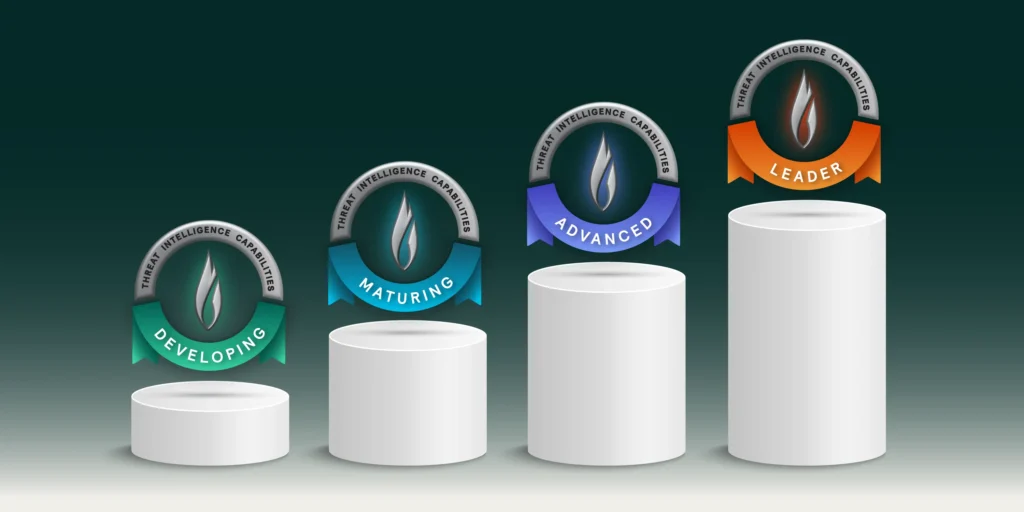
Whether your program is at the developing, maturing, advanced, or leader stage, the goal is the same: to move from intelligence as a supporting activity to intelligence as a driver of proactive operations.

  • Developing: The early stages of building a dedicated intelligence function. Work is largely reactive—driven primarily by escalations or stakeholder questions—and may be reliant on open sources, vendor feeds, internal alerts, or ad-hoc investigations.
  • Maturing: Processes have moved beyond reactive workflows and are beginning to operate with a consistent structure. There are documented priority intelligence requirements and teams are intentionally building depth across sources, workflows, and reporting.
  • Advanced: In this stage, intelligence functions shape how your organization understands, prioritizes, and responds to threats. Requirements are well-defined, visibility spans multiple layers of the threat ecosystem, and analysts apply structured tradecraft that produces actionable intelligence.
  • Leader: Intelligence functions are a core component of organizational risk strategy. Outputs are trusted and used across the business to inform high-stakes decisions, shape long-range planning, and provide early warning across cyber, fraud, physical, brand, and geopolitical domains.

A Practical Roadmap, Not a Judgment

No matter which stage you are currently in, advancing an intelligence function requires deeper visibility into relevant ecosystems, stronger analytic rigor, and the ability to act on intelligence at the moment it matters. To move the needle, organizations need clear requirements, direct visibility into where threats originate, structured tradecraft, and intelligence that drives decisions.

Flashpoint helps teams accelerate progress with the data, expertise, and workflows that strengthen intelligence programs at every stage—without requiring a new operational model. Take the assessment now to see where your intelligence program stands. Or, learn more about how Flashpoint helps intelligence teams progress faster, reduce fragmentation, and sustain momentum toward intelligence-led operations, delivered through the Flashpoint Ignite Platform.

Request a demo today.

The post Flashpoint’s Threat Intelligence Capability Assessment appeared first on Flashpoint.

  •  

Protecting the Big Game: A Threat Assessment for Super Bowl LX

Blogs

Blog

Protecting the Big Game: A Threat Assessment for Super Bowl LX

This threat assessment analyzes potential physical and cyber threats to Super Bowl LX.

SHARE THIS:
Default Author Image
February 4, 2026
Superbowl LIX Threat Assessment | Flashpoint Blog
Table Of Contents

Each year, the Super Bowl draws one of the largest live audiences of any global sporting event, with tens of thousands of spectators attending in person and more than 100 million viewers expected to watch worldwide. Super Bowl LX, taking place on February 8, 2026 at Levi’s Stadium, will feature the Seattle Seahawks and the New England Patriots, with Bad Bunny headlining the halftime show and Green Day performing during the opening ceremony.

Beyond the game itself, the Super Bowl represents one of the most influential commercial and media stages in the world, with major brands investing in some of the most expensive advertising time of the year. The scale, visibility, and economic significance of the event make it an attractive target for threat actors seeking attention, disruption, or financial gain, underscoring the need for heightened security awareness.

Cybersecurity Considerations

At this time, Flashpoint has not observed any specific cyber threats targeting Super Bowl LX. Despite the absence of overt threats, it remains possible that threat actors may attempt to obtain personal information—including financial and credit card details—through scams, malware, phishing campaigns, or other opportunistic cyber activity.

High-profile events such as the Super Bowl have historically been leveraged as bait for cyber campaigns targeting fans and attendees rather than league infrastructure. In October 2024, the online store of the Green Bay Packers was hacked, exposing customers’ financial details. Previous incidents also include the February 2022 “BlackByte” ransomware attack that targeted the San Francisco 49ers in the lead-up to Super Bowl LVI.

Although Flashpoint has not identified any credible calls for large-scale cyber campaigns against Super Bowl LX at this time, analysts assess that cyber activity—if it occurs—is more likely to focus on fraud, impersonation, and social engineering directed at ticket holders, travelers, and high-profile attendees.

Online Sentiment

Flashpoint is currently monitoring online sentiment ahead of Super Bowl LX. At the time of publishing, analysts have identified pockets of increasingly negative online chatter related primarily to allegations of federal immigration enforcement activity in and around the event, as well as broader political and social tensions surrounding the Super Bowl.

Online discussions include calls for protests and boycotts tied to perceived Immigration and Customs Enforcement (ICE) involvement, as well as controversy surrounding halftime and opening ceremony performers. While sentiment toward the game itself and associated events remains largely positive, Flashpoint continues to monitor for escalation in rhetoric that could translate into real-world activity.

Potential Physical Threats

Protests and Boycotts

Flashpoint analysts have identified online chatter promoting protests in the Bay Area in response to allegations that Immigration and Customs Enforcement (ICE) agents will conduct enforcement operations in and around Super Bowl LX. A planned protest is scheduled to take place near Levi’s Stadium on February 8, 2026, during game-day hours.

At this time, Flashpoint has not identified any calls for violence or physical confrontation associated with these actions. However, analysts cannot rule out the possibility that demonstrations could expand or relocate, potentially causing localized disruptions near the venue or surrounding infrastructure if protesters gain access to restricted areas.

In addition, Flashpoint has identified online calls to boycott the Super Bowl tied to both the alleged ICE presence and controversy surrounding the event’s halftime and opening ceremony performers. Flashpoint has not identified any chatter indicating that players, NFL personnel, or affiliated organizations plan to boycott or disrupt the game or related events.

Terrorist and Extremist Threats

Flashpoint has not identified any direct or credible threats to Super Bowl LX or its attendees from violent extremists or terrorist groups at this time. However, as with any high-profile sporting event, lone actors inspired by international terrorist organizations or domestic violent extremist ideologies remain a persistent risk due to the scale of attendance and global media attention.

Super Bowl LX is designated as a SEAR-1 event, necessitating extensive interagency coordination and heightened security measures. Law enforcement presence is expected to be significant, with layered security protocols, strict access control points, and comprehensive screening procedures in place throughout Levi’s Stadium and surrounding areas. Contingency planning for crowd management, emergency response, and evacuation scenarios is ongoing.

Mitigation Strategies and Executive Protection

Given the absence of specific, identified threats, mitigation strategies for key personnel attending Super Bowl LX focus on general best practices. Security teams tasked with executive protection should remove sensitive personal information from online sources, monitor open-source and social media channels, and establish targeted alerts for potential threats or emerging protest activity.

Physical security teams and protected individuals should also familiarize themselves with venue layouts, emergency exits, nearby medical facilities, and law enforcement presence, and remain alert to changes in crowd dynamics or protest activity in the vicinity of the event.

The nearest medical facilities are:

  • O’Connor Hospital (Santa Clara Valley Healthcare)
  • Kaiser Permanente Santa Clara Medical Center
  • Santa Clara Valley Medical Center
  • Valley Health Center Sunnyvale

Several of these facilities offer 24/7 emergency services and are located within a short driving distance of the stadium.

The primary law enforcement facility near the venue is:

  • Santa Clara Police Department

As a SEAR-1 event, extensive coordination is expected among local, state, and federal law enforcement agencies throughout the Bay Area.

    Stay Safe Using Flashpoint

    Although there are no indications of any credible, immediate threats to Super Bowl LX or attendees at this time, it is imperative to be vigilant and prepared. Protecting key personnel in today’s threat environment requires a multi-faceted approach. To effectively bridge the gap between online and offline threats, organizations must adopt a comprehensive strategy that incorporates open source intelligence (OSINT) and physical security measures. Download Flashpoint’s Physical Safety Event Checklist to learn more.

    Request a demo today.

    •  
    ❌