Navigating 2026’s Converged Threats: Insights from Flashpoint’s Global Threat Intelligence Report
In this post, we preview the critical findings of the 2026 Global Threat Intelligence Report, highlighting how the collapse of traditional security silos and the rise of autonomous, machine-speed attacks are forcing a total reimagining of modern defense.
The cybersecurity landscape has reached a point of total convergence, where the silos that once separated malware, identity, and infrastructure have collapsed into a single, high-velocity threat engine. Simultaneously, the threat landscape is shifting from human-led attacks to machine-speed operations as a result of agentic AI, which acts as a force multiplier for the modern adversary.
Flashpoint’s 2026 Global Threat Intelligence Report
Our report uncovers several staggering metrics that illustrate the industrialization of modern cybercrime:
AI-related illicit activity skyrocketed by 1,500% in a single month at the end of 2025.
3.3 billion compromised credentials and cloud tokens have turned identity into the primary exploit vector.
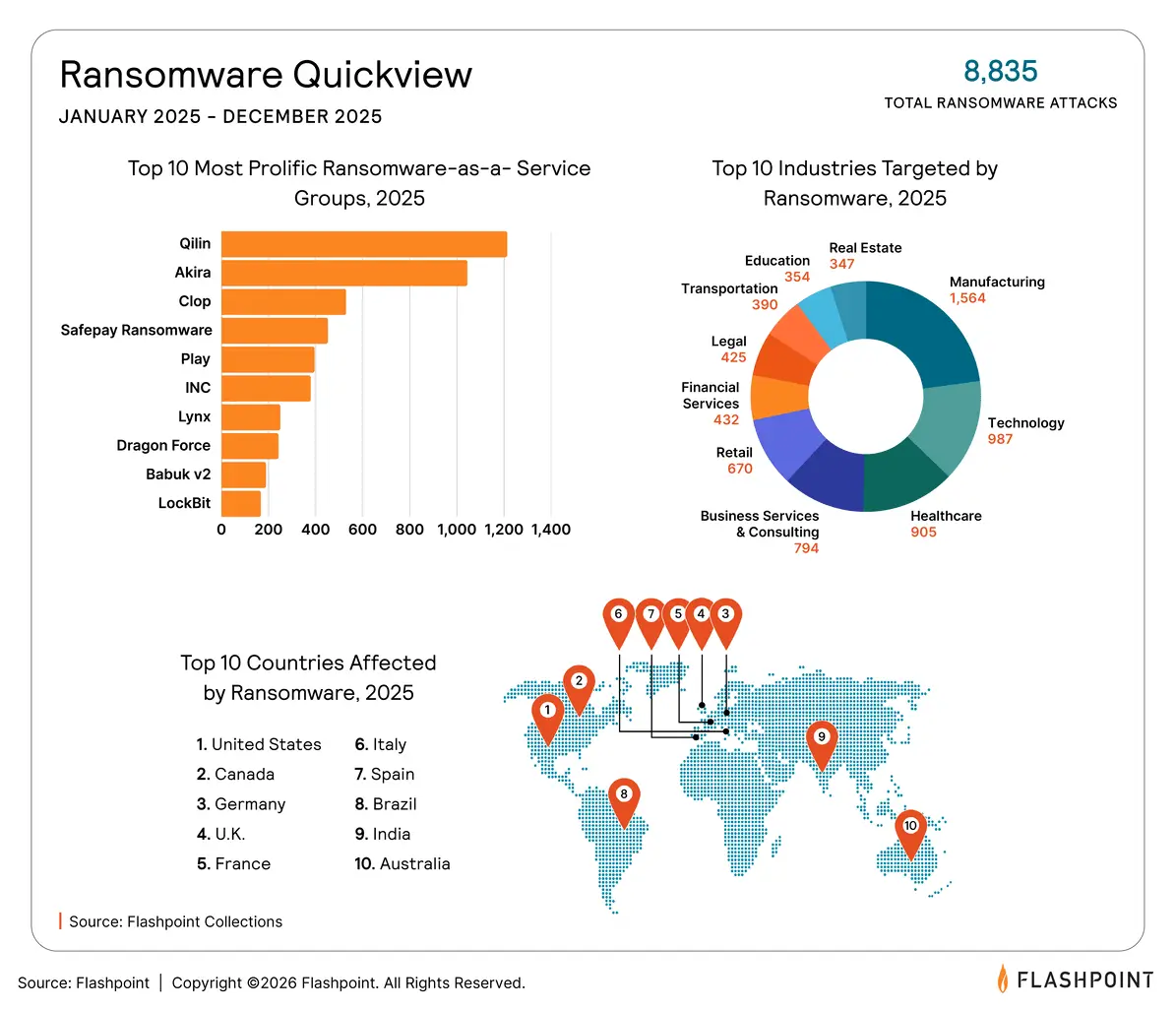
From January 2025 to December 2025, ransomware incidents rose by 53%, as attackers pivot from technical encryption to “pure-play” identity extortion.
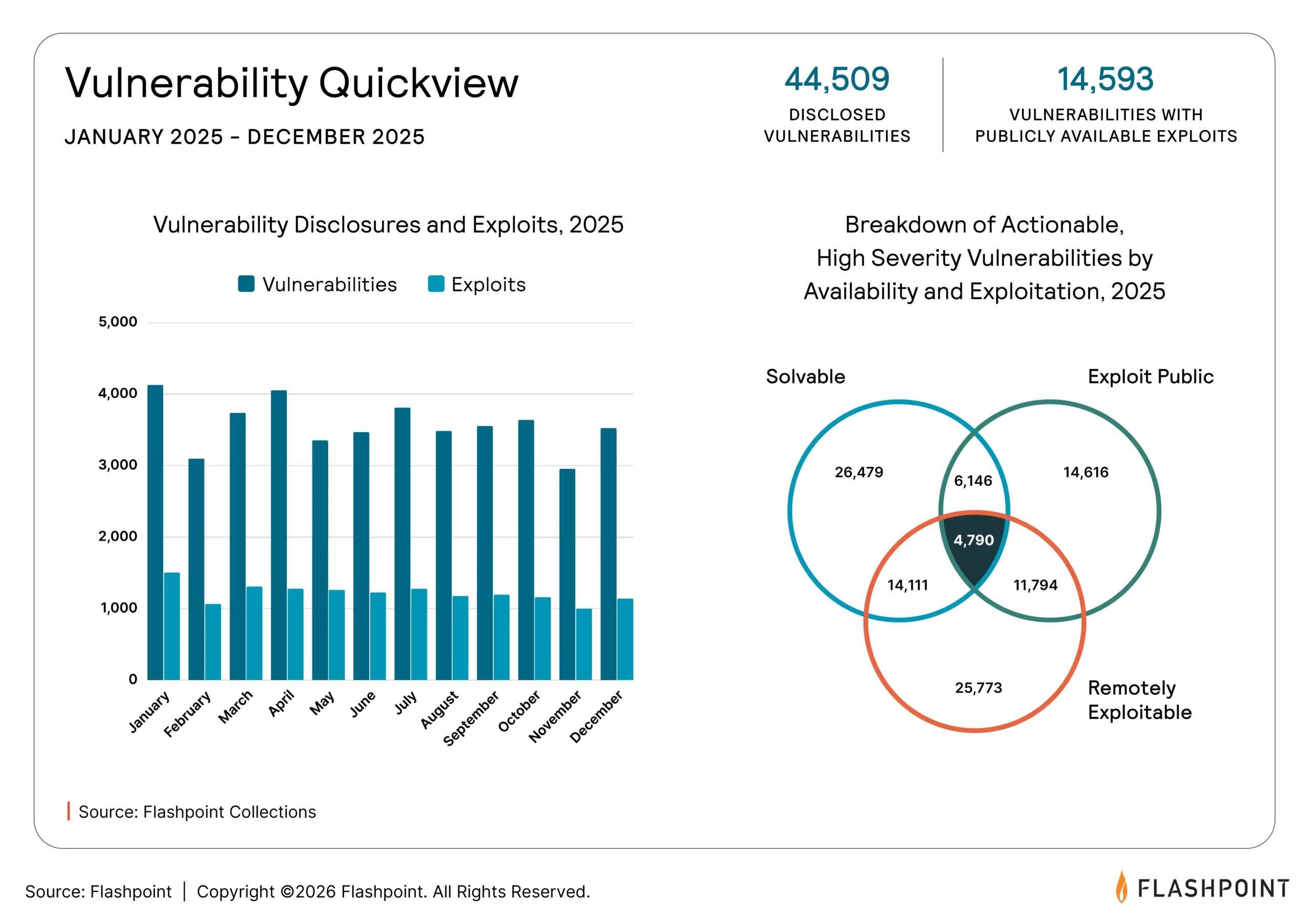
Vulnerability disclosures surged by 12% from January 2025 to December 2025, with the window between discovery and mass exploitation effectively vanishing.
These findings are derived from Flashpoint’s Primary Source Collection (PSC), a specialized operating model that collects intelligence directly from original sources, driven by an organization’s unique Priority Intelligence Requirements (PIR). The 2026 Global Threat Intelligence Report leverages this ground-truth data to provide a strategic framework for the year ahead. Download to gain:
A Clear Understanding of the New Convergence Between Identity and AI Discover how threat actors are preparing to transition from generative tools to sophisticated agentic frameworks. Learn how 3.3 billion compromised credentials are being weaponized via automated orchestration to bypass legacy defenses and exploit the connective tissue of modern corporate APIs.
Intelligence on the “Franchise Model” of Global Extortion Gain deep insight into the professionalized operations of today’s most prolific threat actors. From the industrial efficiency of RaaS groups like RansomHub and Clop to the market dominance of the next generation of infostealer malware, we break down the economics driving today’s cybercrime ecosystem.
A Blueprint for Proactive Defense and Risk Mitigation Leverage the latest trends, in-depth analysis, and data-driven insights driven by Primary Source Collection to bolster your security posture by identifying and proactively defending against rising attack vectors.
“As attackers automate exploitation of identity, vulnerabilities, and ransomware, defenders who rely on fragmented visibility will fall behind. To keep pace, organizations must ground their decisions in primary-source intelligence that is drawn from adversarial environments, so that decision-makers can get ahead of this accelerating threat cycle.”
Josh Lefkowitz, CEO & Co-Founder at Flashpoint
The Top Threats at a Glance
Our latest report identifies four driving themes shaping the 2026 threat landscape:
2026 Is the Era of Agentic-Based Cyberattacks
Flashpoint identified a 1,500% rise in AI-related illicit discussions between November and December 2025, signaling a rapid transition from criminal curiosity to the active development of malicious frameworks. Built on data pulled from criminal environments and shaped by fraud use cases, these systems scrape data, adjust messaging for specific targets, rotate infrastructure, and learn from failed attempts without the need for constant human involvement.
“2026 is the era of agentic-based cyberattacks. We’ve seen a 1,500% increase in AI-related illicit discussions in a single month, signaling increased interest in developing malicious frameworks. The discussions evolve into vibe-coded, AI-supported phishing lures, malware, and cybercrime venues. When iteration becomes cheap through automation, attackers can afford to fail repeatedly until they find a successful foothold.”
Ian Gray, Vice President of Cyber Threat Intelligence Operations at Flashpoint
Identity Is the New Exploit
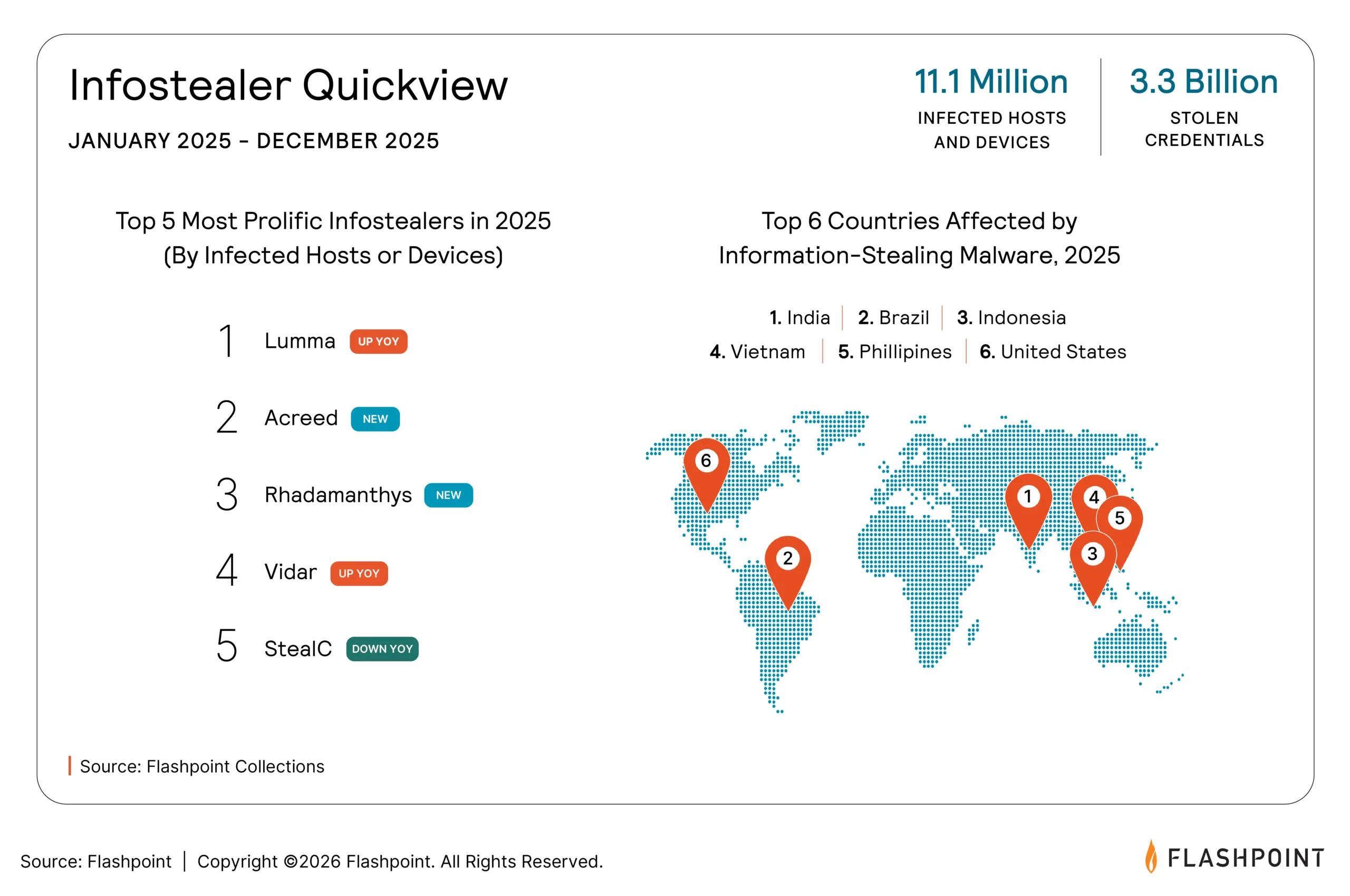
Flashpoint observed over 11.1 million machines infected with infostealers in 2025, fueling a massive inventory of 3.3 billion stolen credentials and cloud tokens. The fundamental mechanics of cybercrime have shifted from breaking in to logging in, as attackers leverage stolen session cookies to behave like legitimate users.
The Patching Window Is Rapidly Closing
Vulnerability disclosures surged by 12% in 2025, with 1 in 3 (33%) vulnerabilities having publicly available exploit code. The strategic gap between discovery and weaponization is increasingly vanishing, as evidenced by mass exploitation of zero-day vulnerabilities in as little as 24 hours after discovery.
Ransomware Is Hacking the Person, Not the Code
As technical defenses against encryption harden, ransomware groups are pivoting to the path of least resistance: human trust. This approach has led to a 53% increase in ransomware, with RaaS groups being responsible for over 87% of all ransomware attacks.
Build Resilience in a Converged Landscape
The findings in the 2026 Global Threat Intelligence Report make one thing clear: incremental improvements to legacy security models are no longer sufficient. As adversaries transition to machine-speed operations, the strategic advantage shifts to organizations that can maintain visibility into the adversarial environments where these attacks are born.
Protecting organizations and communities requires an intelligence-first approach. Download Flashpoint’s 2026 Global Threat Intelligence Report to gain clarity and the data-driven insights needed to safeguard critical assets.
In this post, we analyze DarkCloud, a commercially available infostealer written in Visual Basic 6.0, examine its encryption and evasion techniques, and assess how this low-cost malware can provide threat actors with enterprise-wide access through harvested credentials.
Infostealers continue to dominate the initial access landscape in 2026, lowering the barrier to breach through scalable credential theft. DarkCloud illustrates how low-cost, commercialized malware is reshaping the initial access landscape.
First observed in 2022 and attributed to a developer known as “Darkcloud Coder” (formerly “BluCoder” on Telegram), DarkCloud is openly sold through Telegram and a clearnet storefront with subscription tiers starting at just US$30. Despite being marketed as “surveillance software,” its technical focus is unmistakable: high-volume credential harvesting and structured data exfiltration across browsers, email clients, financial data, and contact networks.
A screenshot from DarkCloud’s clearnet site calling itself “surveillance software.” (Source: DarkCloud clearnet site)
At the technical level, DarkCloud is written in Visual Basic 6.0 and compiled into a native C/C++ application. This legacy language choice is unusual in modern malware development — and likely deliberate. By leveraging outdated but still supported runtime components, DarkCloud appears to benefit from lower detection rates while maintaining full credential theft functionality.
Despite its relatively low cost, DarkCloud should not be dismissed as unsophisticated. Flashpoint assesses it as a potent entry-level threat that can provide adversaries with the keys to an entire corporate network through harvested credentials.
The Commercialization of DarkCloud
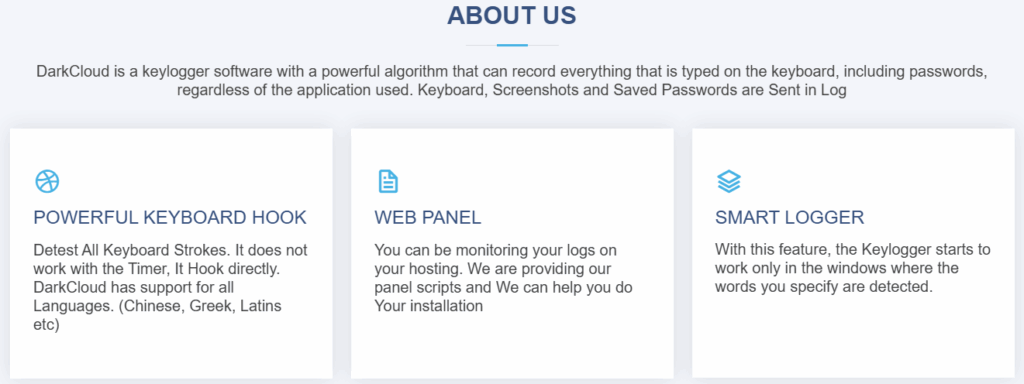
DarkCloud describes itself as a keylogger despite the original advertisement on XSS describing it as an infostealer. (Source: DarkCloud)
DarkCloud represents a mature example of commodity malware-as-a-service.
It is openly sold through Telegram and a clearnet website, where it is misleadingly labeled as a keylogger. While it does include keylogging capabilities, this is only a minor component of a much broader infostealing toolkit.
Its real value proposition is credential harvesting across browsers, email clients, file transfer applications, VPN software, and more.
This dual positioning — public-facing “surveillance software” and underground stealer — provides plausible deniability while enabling large-scale credential operations.
Why Visual Basic 6.0 Matters
One of the most notable aspects of DarkCloud is its use of Visual Basic 6.0.
The payload is written in VB6 and compiled into a native C/C++ application. Microsoft no longer supports VB6 in its modern development environment, and VB6 applications rely on legacy components such as MSVBVM60.DLL for execution.
Flashpoint assesses this legacy language choice is deliberate, both for its simplicity and its potential to evade modern detection models.
In testing, Flashpoint analysts generated equivalent payloads in C/C++ and VB6. The VB6 variant produced significantly fewer detections in VirusTotal scans.
The implication is clear: older languages are not necessarily obsolete in adversary tradecraft. In some cases, they may be strategically advantageous.
Encryption and String Obfuscation
DarkCloud employs a layered string encryption scheme that complicates static and dynamic analysis.
Most internal strings are encrypted and decrypted at runtime using Visual Basic’s Rnd() pseudo-random number generator, combined with a custom seed-generation algorithm.
The process involves:
Hex-encoded encrypted strings
Base64-encoded keys
Seed calculation through a custom algorithm
Resetting the VB pseudo-random number generator to a known state
Iterative Rnd() calls to reconstruct plaintext strings
By resetting the PRNG with a known value before applying the calculated seed, the malware ensures deterministic output during decryption.
This approach does not rely on novel cryptography, but rather on abusing legacy language behavior to frustrate reverse engineering.
Credential Theft at Scale
DarkCloud’s primary objective is credential collection.
It targets:
Email clients:
Outlook
eM Client
FoxMail
Thunderbird
163Mail
MailMaster
File transfer applications:
FileZilla
WinSCP
CoreFTP
Browsers:
Google Chrome
Microsoft Edge
Mozilla Firefox
Brave
Opera
Yandex
Vivaldi
(and many additional Chromium- and Firefox-based browsers)
Other applications:
Pidgin
NordVPN
When extracting browser data, DarkCloud steals:
Login credentials
Cookies
Credit card information
Email applications are additionally scraped for contact lists. This is likely intended to seed future phishing campaigns.
DarkCloud stores collected data locally in two directories under %APPDATA%\Microsoft\Windows\Templates. One directory (“DBS”) stores copied database files, while another (“_”) stores parsed data in unencrypted text format.
This local staging enables continuous exfiltration while maintaining structured log output.
Exfiltration Methods: Flexibility for Threat Actors
DarkCloud supports four exfiltration methods:
SMTP
FTP
Telegram
HTTP
SMTP and FTP require hardcoded credentials within each binary. Email subjects include the victim machine’s hostname and username, and stolen data is transmitted as attachments.
HTTP exfiltration appears less frequently used, though the capability is present.
This flexibility allows operators to tailor deployments depending on infrastructure preferences and operational security requirements.
From BluStealer to DarkCloud
Flashpoint analysts identified notable similarities between DarkCloud’s regular expressions for credit card parsing and those found in a publicly documented project known as “A310LoggerStealer,” also referred to as BluStealer.
The regex patterns appear in identical order and format.
Combined with the developer’s prior alias “BluCoder,” Flashpoint assesses that A310LoggerStealer likely represents an earlier iteration of what became DarkCloud.
This evolution reflects a common pattern in commodity malware development: incremental refinement rather than radical innovation.
A Potent Entry-Level Threat
Despite its relatively low cost, DarkCloud should not be dismissed as unsophisticated.
Its marketing as surveillance software attempts to normalize its presence while providing plausible deniability for buyers. Technically, however, its focus is clear: large-scale credential harvesting across browsers, email clients, financial data, and contact networks.
Flashpoint assesses DarkCloud as a potent entry-level threat that can provide adversaries with the keys to an entire corporate network through harvested credentials.
In a landscape where identity is the new perimeter, even a US$30 subscription can be operationally devastating.
Defending Against Commodity Infostealers
Commodity infostealers like DarkCloud may be commercially accessible, but defending against them requires enterprise-grade vigilance.
Organizations should:
Treat phishing-delivered ZIP/RAR attachments as high-risk initial access vectors
Monitor for abnormal data exfiltration over SMTP, FTP, and Telegram
Audit credential reuse across browser and email applications
Prioritize credential rotation and incident response playbooks following suspected compromise
Infostealers like DarkCloud are not breakthrough malware families. They do not rely on zero-days or advanced exploits.
Instead, they exploit scale, accessibility, and identity exposure.
To understand how credential harvesting campaigns are evolving and to embed real-time intelligence into your detection workflows, request a demo today and see how Flashpoint intelligence strengthens your defense posture.
As part of our commitment to sharing interesting hunts, we are launching these 'Flash Hunting Findings' to highlight active threats. Our latest investigation tracks an operation active between January 11 and January 15, 2026, which uses consistent ZIP file structures and a unique behash ("4acaac53c8340a8c236c91e68244e6cb") for identification. The campaign relies on a trusted executable to trick the operating system into loading a malicious payload, leading to the execution of secondary-stage infostealers.
Findings
The primary samples identified are ZIP files that mostly reference the MalwareBytes company and software using the filename malwarebytes-windows-github-io-X.X.X.zip. A notable feature for identification is that all of them share the same behash.
behash:"4acaac53c8340a8c236c91e68244e6cb"
The initial instance of these samples was identified on January 11, 2026, with the most recent occurrence recorded on January 14.
All of these ZIP archives share a nearly identical internal structure, containing the same set of files across the different versions identified. Of particular importance is the DLL file, which serves as the initial malicious payload, and a specific TXT file found in each archive. This text file has been observed on VirusTotal under two distinct filenames: gitconfig.com.txt and Agreement_About.txt.
The content of the TXT file holds no significant importance for the intrusion itself, as it merely contains a single string consisting of a GitHub URL.
However, this TXT is particularly valuable for pivoting and infrastructure mapping. By examining its "execution parents," analysts can identify additional ZIP archives that are likely linked to the same malicious campaign. These related files can be efficiently retrieved for further investigation using the following VirusTotal API v3 endpoint:
The primary payload of this campaign is contained within a malicious DLL named CoreMessaging.dll. Threat actors are utilizing a technique known as DLL Sideloading to execute this code. This involves placing the malicious DLL in the same directory as a legitimate, trusted executable (EXE) also found within the distributed ZIP file. When an analyst or user runs the legitimate EXE, the operating system is tricked into loading the malicious CoreMessaging.dll.
The identified DLLs exhibit distinctive metadata characteristics that are highly effective for pivoting and uncovering additional variants within the same campaign. Security analysts can utilize specific hunting queries to track down other malicious DLLs belonging to this activity. For instance, analysts can search for samples sharing the following unique signature strings found in the file metadata:
Furthermore, the exported functions within these DLLs contains unusual alphanumeric strings. These exports serve as reliable indicators for identifying related malicious components across different stages of the campaign:
Finally, another observation for behavioral analysis can be found in the relations tab of the ZIP files. These files document the full infection chain observed during sandbox execution, where the sandbox extracts the ZIP, runs the legitimate EXE, and subsequently triggers the loading of the malicious DLL. Within the Payload Files section, additional payloads are visible. These represent secondary stages dropped during the initial DLL execution, which act as the final malware samples. These final payloads are primarily identified as infostealers, designed to exfiltrate sensitive data.
Analysis of all the ZIP files behavioral relations reveals a recurring payload file consistently flagged as an infostealer. This malicious component is identified by various YARA rules, including those specifically designed to detect signatures associated with stealing cryptocurrency wallet browser extension IDs among others.
To identify and pivot through the various secondary-stage payloads dropped during this campaign, analysts can utilize a specific behash identifier. These files represent the final infection stage and are primarily designed to exfiltrate credentials and crypto-wallet information. The following behash provides a reliable pivot point for uncovering additional variants.
behash:5ddb604194329c1f182d7ba74f6f5946
IOCs
We have created a public VirusTotal Collection to share all the IOCs in an easy and free way. Below you can find the main IOCs related to the ZIP files and DLLs too.
import "pe"

rule win_dll_sideload_eosinophil_infostealer_jan26
{
  meta:
    author = "VirusTotal"
    description = "Detects malicious DLLs (CoreMessaging.dll) from an infostealer campaign impersonating Malwarebytes, Logitech, and others via DLL sideloading."
    reference = "https://blog.virustotal.com/2026/01/malicious-infostealer-january-26.html"
    date = "2026-01-16"
    behash = "4acaac53c8340a8c236c91e68244e6cb"
    target_entity = "file"
    hash = "606baa263e87d32a64a9b191fc7e96ca066708b2f003bde35391908d3311a463"
  condition:
    (uint16(0) == 0x5A4D and uint32(uint32(0x3C)) == 0x00004550 and pe.is_dll()) and
    pe.exports("15Mmm95ml1RbfjH1VUyelYFCf") and pe.exports("2dlSKEtPzvo1mHDN4FYgv")
}
The Infostealer Gateway: Uncovering the Latest Methods in Defense Evasion
In this post, we analyze the evolving bypass tactics threat actors are using to neutralize traditional security perimeters and fuel the global surge in infostealer infections.
Infostealer-driven credential theft in 2025 has surged, with Flashpoint observing a staggering 800% increase since the start of the year. With over 1.8 billion corporate and personal accounts compromised, the threat landscape finds itself in a paradox: while technical defenses have never been more advanced, the human attack surface has never been more vulnerable.
Information-stealing malware has become the most scalable entry point for enterprise breaches, but to truly defend against them, organizations must look beyond the malware itself. As teams move into 2026 security planning, it is critical to understand the deceptive initial access vectors—the latest tactics Flashpoint is seeing in the wild—that threat actors are using to manipulate users and bypass modern security perimeters.
Here are the latest methods threat actors are leveraging to facilitate infections:
1. Neutralizing Mark of the Web (MotW) via Drag-and-Drop Lures
Mark of the Web (MotW) is a critical Windows defense feature that tags files downloaded from the internet as “untrusted” by adding a hidden NTFS Alternate Data Stream (ADS) to the file. This tag triggers “Protected View” in Microsoft Office programs and prompts Windows SmartScreen warnings when a user attempts to execute an unknown file.
Flashpoint has observed a new social engineering method to bypass these protections through a simple drag-and-drop lure. Instead of asking a user to open a suspicious attachment directly, which would trigger an immediate MotW warning, threat actors are instead instructing the victim to drag the malicious image or file from a document onto their desktop to view it. This manual interaction is highly effective for two reasons:
Contextual Evasion: By dragging the file out of the document and onto the desktop, the file is executed outside the scope of the Protected View sandbox.
Metadata Stripping: In many instances, the act of dragging and dropping an embedded object from a parent document can cause the operating system to treat the newly created file as a local creation, rather than an internet download. This effectively strips the MotW tag and allows malicious code to run without any security alerts.
2. Executing Payloads via Vulnerabilities and Trusted Processes
Flashpoint analysts uncovered an illicit thread detailing a proof of concept for a client-side remote code execution (RCE) in the Google Web Designer for Windows, which was first discovered by security researcher Bálint Magyar.
Google Web Designer is an application used for creating dynamic ads for the Google Ads platform. Leveraging this vulnerability, attackers would be able to perform remote code execution through an internal API using CSS injection by targeting a configuration file related to ads documents.
Within this thread, threat actors were specifically interested in the execution of the payload using the chrome.exe process. This is because using chrome.exe to fetch and execute a file is likely to bypass several security restrictions as Chrome is already a trusted process. By utilizing specific command-line arguments, such as the –headless flag, threat actors showed how to force a browser to initiate a remote connection in the background without spawning a visible window. This can be used in conjunction with other malicious scripts to silently download additional payloads onto a victim’s systems.
3. Targeting Alternative Softwares as a Path of Least Resistance
As widely-used software becomes more hardened and secure, threat actors are instead pivoting to targeting lesser-known alternatives. These tools often lack robust macro-protections. By targeting vulnerabilities in secondary PDF viewers or Office alternatives, attackers are seeking to trick users into making remote server connections that would otherwise be flagged as suspicious.
Understanding the Identity Attack Surface
Social engineering is one of the driving factors behind the infostealer lifecycle. Once an initial access vector is successful, the malware immediately begins harvesting the logs that fuel today’s identity-based digital attacks.
As detailed in The Proactive Defender’s Guide to Infostealers, the end goal is not just a password. Instead, attackers are prioritizing session cookies, which allow them to perform session hijacking. By importing these stolen cookies into anti-detect browsers, they bypass Multi-Factor Authentication and step directly into corporate environments, appearing as a legitimate, authenticated user.
Understanding how threat actors weaponize stolen data is the first step toward a proactive defense. For a deep dive into the most prolific stealer strains and strategies for managing the identity attack surface, download The Proactive Defender’s Guide to Infostealers today.
Beyond the Malware: Inside the Digital Empire of a North Korean Threat Actor
In this post Flashpoint reveals how an infostealer infection on a North Korean threat actor’s machine exposed their digital operational security failures and reliance on AI. Leveraging Flashpoint intelligence, we pivot from a single persona to a network of fake identities and companies targeting the Web3 and crypto industry.
Last week, Hudson Rock published a blog on “Trevor Greer,” a persona tied to a North Korean IT Worker. Flashpoint shared additional insights with our clients back in July, and we’re now making those findings public.
Trevor Greer, a North Korean operative, was identified via an infostealer infection on their own machine. Information-stealing malware, also known as Infostealers or stealers, are malware designed to scrape passwords and cookies from unsuspecting victims. Stealers (like LummaC2 or RedLine) are typically used by cybercriminals to steal login credentials from everyday users to sell on the Dark Web. It is rare to see them infect the machines of a state-sponsored advanced persistent threat group (APT).
However, when adversaries unknowingly infect themselves, they can expose valuable insights into the inner workings of their campaigns. Leveraging Flashpoint intelligence sourced from the leaked logs of “Trevor Greer,” our analysts uncovered a myriad of fake identities and companies used by DPRK APTs.
Finding Trevor Greer
Flashpoint analysts have been tracking the Trevor Greer email address since December 2024 in relation to the “Contagious Interview” campaign, in which threat actors operated as LinkedIn recruiters to target Web3 developers, resulting in the deployment of multiple stealers compromising developer Web3 wallets. Flashpoint also identified the specific persona’s involvement in a campaign in which North Korean threat actors posed as IT freelance workers and applied for jobs at legitimate companies before compromising the organizations internally.
ByBit Compromise
The ByBit compromise in late February 2025 further fueled Flashpoint’s investigations into the Trevor Greer email address. Bybit, a cryptocurrency exchange, suffered a critical incident resulting in North Korean actors extorting US $1.5 billion worth of cryptocurrency. In the aftermath, Silent Push researchers identified the persona “Trevor Greer” associated with the email address trevorgreer9312@gmail[.]com, which registered the domain “Bybit-assessment[.]com” prior to the Bybit compromise.
A later report claimed that the domain “getstockprice[.]com” was involved in the compromise. Despite these domain discrepancies, both investigations attributed the attack to North Korean advanced persistent threat (APT) nexus groups.
Tracing the Infection
Using Flashpoint’s vast intelligence collections, we performed a full investigation of compromised virtual private servers (VPS), revealing the actor’s potential involvement in several other operations, including remote IT work, several self-made blockchain and cryptocurrency exchange companies, and a potential crypto scam dating back to 2022.
Flashpoint analysts also discovered that the Trevor Greer email address was linked to domains infected with information-stealing malware.
What the Logs Revealed
Analysts extracted information about the associated infected host from Trevor Greer, revealing possible tradecraft and tools used. Analysts further identified specific indicators of compromise (IOCs) used in the campaigns mentioned above, as well as email addresses used by the actor for remote work.
The data painted a vivid picture of how these threat actors operate:
Preparation for “Contagious Interviews”
The browser history revealed the actor logging into Willo, a legitimate video interview platform. This suggests the actor was conducting reconnaissance to clone the site for the “Contagious Interview” campaign, where they lured Web3 developers into fake job interviews to deploy malware.
Reliance on AI Tools
The logs exposed the actor’s reliance on AI to bridge the language gap. The operator frequently accessed ChatGPT and Quillbot, likely using them to write convincing emails, build resumes, and generate code for their malware.
Pivoting: One Node to a Network
By analyzing the “Trevor Greer” logs, we were able to pivot to other personas and campaigns involved in the operation.
Fake Employment: The logs contained credentials for freelance platforms, such as Upwork and Freelancer, associated with other aliases, including “Kenneth Debolt” and “Fabian Klein.” This confirmed the actor was part of a broader scheme to infiltrate Western companies as remote IT workers.
Fake Companies: The data linked the actor to fake corporate entities, such as Block Bounce (blockbounce[.]xyz), a sham crypto trading firm set up to appear legitimate to potential victims.
Developer Personas: The infection data linked the actor to the GitHub account svillalobosdev, which had been active in open source projects to build credibility before the attack.
Legitimate Platforms & Tools: Analysts observed the actor using job boards such as Dice and HRapply[.]com, freelance platforms such as Upwork and Freelancer, and direct applications through company Workday sites. To improve their resume, the actor used resumeworded[.]com or cakeresume[.]com. For conversing, the threat actor likely relies on a mix of both GPT and Quilbot, as found in infected host logins, to ensure they sound human. During interviews, analysts determined that they potentially used Speechify.
Deep & Dark Web Resources: The actor also likely purchased Social Security numbers (SSNs) from SSNDOB24[.]com, a site for acquiring Social Security data.
Disrupt Threat Actors Using Flashpoint
The “Trevor Greer” case study illustrates a critical shift in modern threat intelligence. We are no longer limited to analyzing the malware adversaries deploy; sometimes, we can analyze the adversaries themselves.
Using their own tools against them, Flashpoint transformed a faceless state-sponsored entity into a tangible user with bad habits, sloppy OPSEC, and a trail of digital breadcrumbs. Behind every sophisticated APT campaign is a human operator, and sometimes, they click the wrong link too.
Request a demo today to delve deeper into the tactics, techniques, and procedures of advanced persistent threats and learn how Flashpoint’s intelligence strengthens your defenses.
From Endpoint Compromise to Enterprise Breach: Mapping the Infostealer Attack Chain
In Flashpoint’s latest webinar, we map the global infostealer attack chain step-by-step, from initial infection to enterprise-level account takeover. We analyze how the commodification of stolen identities works and demonstrate how Flashpoint intelligence provides the critical visibility necessary to disrupt this cycle.
Compromised digital identities have become one of the most valuable currencies in the cybercriminal ecosystem. The rise of information-stealing malware has created an industrial-scale supply chain for stolen credentials, session cookies, and browser fingerprints, directly fueling account takeover (ATO) campaigns that penetrate even the most mature security environments.
Flashpoint recently hosted an on-demand webinar, “From Compromise to Breach: How Infostealers Power Identity Attacks,” where our experts dissected this developing threat landscape. We exposed the exact sequence of events, providing defenders with the actionable intelligence required to disrupt the chain at multiple points. For the full technical breakdown, check out the full on-demand webinar.
Here are the main key takeaways you need to know:
Stage 1: Initial Infection and Data Harvest (The Compromise)
A full scale compromise often begins with a single event, typically a phishing lure, a malicious download, or a compromised cracked software installer. Once executed, the infostealer goes to work, quickly and stealthily, to build a “log” that grants post-MFA (multi-factor authentication) access.
Scouring now-compromised endpoints, the stealer searches for and compiles data such as:
Credentials: Saved logins, credit card details, and passwords for applications and websites.
Session Cookies/Tokens: These are the keys that allow an attacker to bypass login prompts entirely, appearing as an already-authenticated user.
Browser Fingerprints and System Metadata: Geolocation, IP address, and system language used to evade security tools by accurately mimicking the victim’s legitimate environment.
Stage 2: Commodification and the ATO Supply Chain (The Market)
Once a log is harvested, it enters the Infostealer-as-a-Service ecosystem, a critical industrialized stage of the attack chain. Here, threat actors can rent or purchase access to millions of fresh logs, effectively outsourcing the initial compromise phase and enabling mass identity exploitation for a minimal investment.
Check out the on-demand webinar for a full technical breakdown of this dark web economy and how the commodification of stealer logs drastically reduces the barrier to entry for follow-on attacks.
Stage 3: Post-MFA Account Takeover (The Breach)
This is the ultimate pivot point, where a simple endpoint infection escalates into an enterprise breach. Unlike the brute-forcing and phishing attacks of the past, attackers leverage the stolen session tokens and browser fingerprints.
Stolen log buyers leverage obfuscation tools such as anti-detect browsers. These tools ensure the attacker can seamlessly utilize the stolen cookies and digital fingerprints to appear identical to the original victim.
They inject valid, unexpired session tokens into their browser, which allows attackers to hijack the victim’s active session. This allows them to avoid fraud and anomaly detection systems, providing them access into corporate VPNs, cloud environments, and internal applications without ever needing to see a login prompt. From here, attackers can move laterally, exfiltrate sensitive data, or deploy ransomware.
Disrupting the Attack Chain Using Flashpoint’s Actionable Intelligence
Defense against this threat requires not only an understanding of the attack chain, but also comprehensive Cyber Threat Intelligence (CTI) to identify and mitigate risks at every stage:
Disruption Point in the Attack Chain
How Flashpoint Empowers Proactive Defense
Stage 1: Initial Infection/Log Creation
Gain immediate alerting on the sale of your organization’s compromised assets on the Dark Web before attackers can leverage stolen data.
Stage 2: Commodification/ATO Setup
Expose the illicit platforms and forums where threat actors discuss, buy, and sell stolen logs, allowing you to track the tooling and TTPs.
Stage 3: Post-MFA ATO/Breach
Identify and remediate the vulnerabilities within browsers or enterprise software that are most actively being targeted by infostealers.
The speed of infostealer-powered attacks demands an intelligence-driven response. Our recent webinar demonstrated how Flashpoint intelligence can empower your security teams to quickly identify and validate stolen logs, protecting your organization from compromise to breach. Watch the on-demand webinar to learn more, or request a demo today.
Flashpoint’s Top 5 Predictions for the 2026 Threat Landscape
Flashpoint’s forward-looking threat insights for security and executive teams, provides the strategic foresight needed to prepare for the convergence of AI, identity, and physical security threats in 2026.
As the global threat landscape accelerates its transformation, 2026 marks an inflection point requiring defensive strategies to fundamentally shift. The volatility observed in 2025 has paved the way for an era soon to be defined by AI-weaponized autonomy, information-stealing malware, systemic instability of public vulnerability systems, and the complete convergence of digital and physical risk.
Flashpoint offers a unique window into these complexities, providing organizations with the foresight needed to navigate what lies ahead. Drawing from Flashpoint’s leading intelligence and primary source collections, we highlight five key trends shaping the 2026 threat landscape. These insights aim to help organizations not only understand what’s next but also build the resilience needed to withstand and adapt to emerging challenges.
Prediction 1: Agentic AI Threats Will Weaponize Autonomy, Forcing a New Defensive Standard
2026 will see continued evolution of AI threats, with future attacks centering on autonomy and integration. Across the deep and dark web, Flashpoint is observing threat actors move past experimentation and into operational use of illegal AI.
As attackers train custom fraud-tuned LLMs (Large Language Models) and multilingual phishing tools directly on illicit data, these AI models will become more capable. The criminal intent shaping their misuse will also become more sophisticated. Additionally, 2026 will see a greater marketplace for paid jailbreaking communities and synthetic media kits for KYC (Know Your Customer) bypass.
These advancements are enabling criminals to move beyond simple tools and engage in scaled, autonomous fraud operations, leading to two major shifts:
Agentic AI is becoming the true flashpoint: Threat actors will be using agentic systems to automate reconnaissance, generate synthetic identities, and iterate on fraud playbooks in near real-time. In this SaaS ecosystem, AI will help attackers leverage subscription tiers and customer feedback loops at scale.
The attack surface will shift to focus on AI Integrations: Organizations are increasingly plugging LLMs into live data streams, internal tools, identity systems, and autonomous agents. This practice often lacks the same security vetting, access controls, and monitoring applied to other enterprise systems. As such, attackers will heavily target these integrations, such as APIs, plugins, and system connections, rather than the models themselves.
“The ubiquity of automation has dramatically increased attack tempo, leaving many security teams behind the curve. While automation can replace repetitive tasks across the enterprise, organizations must not make the critical mistake of substituting human judgement for AI at the intelligence level.
This is paramount because a critical threat in 2026 is Agentic AI autonomy weaponized against soft targets—API integrations and identity systems. The only winning defense will be human-led and AI-scaled, prioritizing purposeful use to keep organizations ahead of this exponential risk.”
Josh Lefkowitz, CEO at Flashpoint
These evolving AI threats will force a fundamental shift in defensive strategies. Defenders will have to shift to deploying systems around AI rather than trust them on their own.
Prediction 2: Identity Compromise via Infostealers Will Become the Foundation of Every Attack
Infostealers will become the entry point, the data broker, the reconnaissance layer, and the fuel for everything that comes after a cyberattack. This shift is already in motion and is accelerating rapidly: in just the first half of 2025, infostealers were responsible for 1.8 billion stolen credentials, an 800% spike from the start of the year. However, 2026 will redefine the malware’s role, making its most valuable output being access, rather than disruption.
Infostealers will become the upstream event that powers the rest of the attack chain. Identity and session data will be increasingly targeted, since it gives attackers immediate access into victim environments. Ransomware, fraud, data theft, and extortion will simply be downstream ways to monetize.
This upstream approach defines the new reality of the attack chain, which is already operational. Nearly every major stealer strain Flashpoint observes now exfiltrates the following:
An organization’s attack surface is no longer just composed of their own networks. It is the entire digital identity of their employees and partners. This new reality requires security teams to take a new approach. Instead of attempting to block attacks, they must proactively detect compromised credentials before they are weaponized. This will be the difference between reacting to a data breach and preventing one.
“The infostealer economy has fully industrialized the attack chain, making initial compromise a low-cost commodity. Multiple security incidents in 2025 tie back to credentials found in infostealer logs. This reality has underscored the critical importance of digital trust—specifically, verifying who can access what resources. For 2026, identity is the perimeter to watch, and security teams must proactively hunt for compromised credentials before they’re weaponized.”
Ian Gray, Vice President of Intelligence at Flashpoint
Prediction 3: CVE Volatility Will Force Redundancy in Vulnerability Intelligence
The temporary funding crisis at CVE in April 2025 and the subsequent CISA stopgap extension through March 2026 exposed the systemic fragility of a centralized vulnerability intelligence model. With the future of the CVE/NVD system hanging in the balance, 2026 will be defined by the urgent need for redundancy and diversification in vulnerability intelligence.
In today’s vulnerability intelligence ecosystem, nearly every organization’s vulnerability management framework relies on CVE and NVD—including its “alternatives” such as the EUVD (European Union Vulnerability Database). The CVE system has grown into a critical global cybersecurity utility, relied upon by nearly all vulnerability scanners, SIEM platforms, patch management tools, threat intelligence feeds, and compliance reports. A complete shutdown of CVE would result in a widespread loss of institutional infrastructure.
The next generation of security needs to be built on practices that are resilient, diversified, and intelligence-driven. It should be focused on providing insights that can be used to take action such as threat actor behavior, likelihood of exploitation in the wild, relevance to ransomware campaigns, and business context. Security teams will need to leverage a comprehensive source of vulnerability intelligence such as Flashpoint’s VulnDB that provides full coverage for CVE, while also cataloging more than 100,000 vulnerabilities missed by CVE and NVD.
Prediction 4: Executive Protection Will Remain a Critical Challenge as Cyber-Physical Threats Converge
The continued blurring of lines between cyber, physical, and geopolitical threats will elevate the risk to organizational leadership, turning executive protection into a holistic intelligence function in 2026. The rise of information warfare combined with physical world convergence means the threat to key personnel is no longer purely digital.
In the aftermath of the tragic December 2024 assassination of United Healthcare’s CEO, Flashpoint has seen the continued circulation and glorification of “wanted-style posters” of executives in extremist communities. Additionally, Flashpoint has seen nation-state actors participate, using espionage and influence to target high-value individuals. Organizations must adopt an integrated approach that connects insights from threat actor chatter and a wealth of other OSINT sources. This fusion of intelligence is essential for applying frameworks to ensure the safety of leadership and key personnel.
Prediction 5: Extortion Shifts to Identity-Based Supply Chain Risk
2025 was marked by several large-scale extortion campaigns, demonstrating how the threat landscape is rapidly evolving. Ransomware operations have shifted into a straight extortion play. Flashpoint has observed a surge in new entrants to the ransomware market, accompanied by a decline in the quality and decorum of ransomware groups.
Furthermore, vishing campaigns attributed to “Scattered Spider” have highlighted weaknesses in identity, trust, and verification. Campaigns from “Scattered LAPSUS$ Hunters” have also exposed vulnerabilities in third-party integrations. These attacks culminated in extortion, showcasing that modern attacks will target trusted users and trusted applications for initial access, and will forgo ransomware in place of data access.
As this shift continues into 2026, threat actors will increasingly focus their efforts on exploiting human behavior and identity systems. Instead of attempting to spend resources on breaking network perimeters, attackers will instead socially engineer employees to gain access to corporate systems at scale. This change in TTPs will undoubtedly greatly increase supply chain risk, especially for third parties.
Charting a Path Through an Evolving Threat Landscape with Flashpoint Intelligence
These five predictions highlight the transformative trends shaping the future of cybersecurity and threat intelligence. Staying ahead of these challenges demands more than just reactive measures—it requires actionable intelligence, strategic foresight, and cross-sector collaboration. By embracing these principles and investing in proactive security strategies, organizations can not only mitigate risks but also seize opportunities to enhance their resilience.
As the threat landscape continues to rapidly evolve, staying informed and prepared are critical components of risk mitigation. With the right tools, insights, and partnerships, security teams can navigate the complexities ahead and safeguard what matters most.
2021-06-17: updated with information from Twitter user ARC
In this post, we'll look at a campaign, that targeted multiple 3D or digital artists using NFT, with malware named RedLine. This malware is a so called "infostealer" or "information stealer" that is capable of extracting sensitive data from your machine (such as wallet information, credentials, and so on). As a side-note; NFTs, or non-fungible tokens, are digital tokens tied to assets that can be bought, sold and traded.
This blog post is divided into four parts:
Introduction: provides an overview of what happened
Analysis: analysis of the attack and the malware used
Detection: how to detect and remove the malware (skip to Detection if you just want to clean this up)
Prevention: how to prevent this from happening again
Conclusion: a brief conclusion and additional thoughts
Introduction
From at least last Thursday, 10th of June 2021, multiple users report on Twitter that they got hacked after being approached to create new digital art. These users, accomplished digital artists and publishing their work on NFT marketplaces, were approached either via Instagram, Twitter DM (message) or directly via email. The attacker has masqueraded themselves behind multiple personas, often claiming to be from South Korea. A few of the users that reported the attack:
— 🌈 ArielBeckerArt.eth #SquidGang 🦑 (@arielbeckerart) June 10, 2021
fvckrender:
Be really careful out there I was dumb enough to not overlook this and open their SCR file and got my metamask swiped from à to Z all my tokens gone. They tried to access other app but my 2fa blocked them to. I’m an idiot don’t me an idiot like me and secure your shit. pic.twitter.com/gAins00taH
Really terrible day. My Metamask got hacked and now my @withFND account is compromised. Opened a scam project proposal with a .scr file and a Microsoft Word icon. Anyone experience this before? Trying to figure out what to do
There are many, many more examples - however, we won't list them here. Of note is Ariel's tweet, where you can note the presence of a file named "Rizin_Fight_Federation_Presentation.scr". I'll circle back to that in the next section, Analysis.
Analysis
After scouring the internet for a while, I was unable to discover any of the files mentioned by the artists that reported the attack, that is until I stumbled upon Cloudy Night's tweet - their screenshot included a link to a website "skylumpro.com".
As expected, this is not the legitimate website, but rather a clever copycat of the real Skylum product website (to note, the real website is: https://skylum.com/luminar-ai-b). After clicking the "Download Now" button, a file named "SkylumLuminar (NFT Beta).rar" is downloaded, which you need to unzip with the password "NFT", as we can observe from Cloudy Night's tweet.
The unzipped content looks as follows:
One of the first things you may notice is the large filesize of the so called beta version. As you've seen from before in Ariel's tweet, the filesize was 745MB, while this file is a whopping 791MB!
But why is this file so large and why does it matter?
The attacker has appended their original file with a large chunk of overlay data; to put it simply - a bunch of extra data that does nothing.
The attacker has increased the filesize this much to try and evade antivirus software and scanning tools; for example, a well-known service to scan suspicious files, VirusTotal, only accepts files up to 650MB, while some antivirus scanners may not even scan a file this large.
While you could upload the original RAR file; the attacker has password-protected it and VirusTotal will be unable to scan it properly. You could re-package it, but the file itself may not be scanned.
Having said all that, after removing the excessive overlay, a much more reasonable filesize is obtained: 175KB. This new file's properties are:
Of note is the creation or compilation time: this is the date and time the file has originally been created. While this can be spoofed, I do not believe it is the case here. This time matches with when the attack appeared. It is however highly likely more files, such as the one in Ariel's tweet, do the round.
This file will then execute a new file; which is the RedLine infostealer malware. This file has the following properties:
Note the creation time is different: set in 2042 - this is obviously faked by the attacker to reveal when exactly it has been created. However, with the above data, we can assume it was created in the last 5 days or so.
As mentioned before, once you execute the SkylumLuminarNFTBetaVersion.exe file, you will be infected with the RedLine infostealer malware. ProofPoint has reported on this malware first in March 2020: New Redline Password Stealer Malware. This malware has many capabilities, including, but not limited to:
Steal username and password from browsers;
Collect extensive system information;
Execute commands, such as downloading and uploading other files, opening links and so on;
Steal cryptowallet information - both from Chrome extensions as well as typical wallet.dat files. The extensions targeted are:
YoroiWallet
Tronlink
NiftyWallet
Metamask (refer also to Nicole's tweet)
MathWallet
Coinbase
BinanceChain
BraveWallet
GuardaWallet
EqualWallet
JaxxxLiberty
BitAppWallet
Steal data from other software, such as:
Steam;
Telegram;
FTP clients such as FileZilla.
The screenshot below displays part of RedLine's functionalities:
RedLine will first gather some basic information about your machine, such as the machine name, external IP address, your geography and so on. It gathers external information by querying one of the following IP lookup services:
https://api.ipify.org
https://icanhazip.com
https://wtfismyip.com/text
http://bot.whatismyipaddress.com/
http://checkip.dyndns.org
Note these services are not malicious, they are simply being used by the attacker to gather more information. Interestingly enough, RedLine will use SOAP HTTP (POST) requests to its command and control server (the server or machine controlled by the attacker where your data will end up) using the following IP:
185.215.113.60;
On port 59472;
This IP resides in the Seychelles.
Another domain and IP observed is (from ARC's tweet above, the files in that archive were almost 600MB):
xtfoarinat.xyz;
On IP 92.38.163.189;
This IP also has sinaryaror.xyz resolve to it, another RedLine command and control server.
One may also observe connections to tempuri.org. This is a default placeholder for web services, and is not atypical when using SOAP over HTTP. Tempuri is not malicious.
Finally, after receiving all this data, the attacker can start logging into your accounts, attempt to steal your tokens, impersonate you and so on. The attacker can also install other malware if they wish, such as ransomware.
What now? Detection
Good news:
The variant discussed in this blog does not appear to persist: in other words, after a reboot, its process will not be active anymore, at least for the variant discussed in this blog post.
Bad news:
Everything else - unfortunately, RedLine works pretty fast and a few minutes are enough to exfiltrate all your data and for the attacker to fully compromise all your accounts.
Luckily for us, RedLine stealer should be detected by most commercial and free antivirus software products on the market. A few recommendations to get rid of the RedLine variant discussed in this blog post - note this may not fully cover the variant you encountered:
Contact your NFT provider, cryptowallet provider and so on as soon as possible via telephone call or another computer and inform them of what happened; ask for a temporary block of your account or to at least temporarily block any funds from now on. >>> It is very important you do this first! <<<
If you can, change yourcredentials from another machine; such as your phone, your partner's laptop, ... Note it's recommended to change your credentials at least for your email accounts and for your wallets - focus on the most important accounts first! If you do not have this possibility, continue with the steps below.
Open Task Manager, go to the Details tab and search for any process with the following names:
SkylumLuminarNFTBetaVersion.exe; Flamingly.exe; FieldTemplateFactory.exe; PaintingPromoProject; Alternatively, the name of the file you executed.
Now, kill the process by right-clicking on it > select End Process (or End Task).
If you have a firewall or proxy, block the IPs 185.215.113.60 and 92.38.163.189.
Run a scan with your currently installed antivirus and a scan with an alternative product, for example, Malwarebytes (has a free version);
While this might not have much impact at this point, it will give you an additional layer of protection from other threats;
Delete all the files you have previously downloaded if they still exist on your system; if you'd like me to analyse them, you may send me a copy first;
If the above scans have turned up:
Clean: have you executed the file?
If not, you are not infected.
If you did, and the scanners turn up with nothing, it's possible your current antivirus product has blocked the attack.
You might also want to Refresh your PC to have peace of mind.
Not clean (there were detections): let the above product (e.g. Malwarebytes or Eset) clean them up and reboot your computer.
Finally, reset all (or the rest of) your credentials. Do this only when you know your machine is clean! Alternatively, reset your credentials from another machine as indicated earlier.
It's important to follow these steps as soon as possible to prevent any damages.
Prevention
You've come this far, or perhaps you simply skipped to this part - arguably the most important one: toprevent this attack from happening in the first place. So how can this be achieved?
First and foremost: ensure you are using Windows 8.1 or later. Older Operating Systems, such as Windows 7, are no longer supported by Microsoft and have additional vulnerabilities attackers may exploit;
Install an antivirus and enable the Windows Firewall. It does not matter if the antivirus is free or not; paid versions do offer more features, but a free version will do just as much.
Starting from Windows 10, Windows Defender should protect adequately from attacks such as the one described in this blog post. Other free alternatives are Kaspersky's free cloud antivirus and Malwarebytes.
When you get any file, scan it with your antivirus first! (typically done by right-clicking on the file or folder)
When in doubt, upload the file to VirusTotal. Note however the tactics used here: if there's a really large file, it
may not be able to be scanned properly - this can be an indication of
malicious intent!
Set UAC (User Account Control) to the maximum level: Always Notify - this will stop some additional attacks (you will get more prompts; if you do, take a pause and verify what's on the screen should indeed be executed). Here's how to do that: https://www.digitalcitizen.life/how-change-user-account-control-uac-levels/
Enable file extensions: some extensions, such as .scr, historically a screensaver file; are in fact executables - which could contain malicious code, as was the case in Ariel's tweet. Do not open or run these files. This will also protect you against the "double extensions" trick. A file named commission.jpg.exe will now be visible as such - if file extensions are disabled, you would see commission.jpg - see the difference? Here's how you can enable file extensions: https://www.howtogeek.com/205086/beginner-how-to-make-windows-show-file-extensions/
Create unique passwords where possible; if feasible; use a password manager;
Enable MFA (or 2FA if MFA is not available) on all your sensitive accounts; this will add an additional layer which is typically very hard for the attacker to guess or crack. Google "your service/ account + MFA" for specific instructions;
If you receive a new commission or request to create art, stop and think first - ask yourself these questions:
Is this coming from a reputable account or from a totally new account?
If reputable, can I verify their claim or request somehow?
If from a new account: be extra wary!
If from an account with very low followers/following: be extra wary!
How will they pay me?
Are they using a verified cryptowallet, or trying to set me up for something shady?
Do they have any reviews on their (public) profile, if any?
What are they asking of me exactly?
Are they indeed sending just images, or is there an executable file or "special software" I am supposed to download/open?
Where are their links or attachments leading to?
Are these leading to another service, e.g. imgur.com, or something different altogether?
I have downloaded the file(s), but I do not trust the source;
Delete it or ask for more information;
Block the sender if you are suspect and report their account, delete any files;
You can double-check by scanning the files with your antivirus, or uploading it to VirusTotal. The same nuance as above applies however.
You can also Google any information they send through to further verify their claims.
Finally and where possible;
Use a hardware instead of software wallet;
Secure your seed phrase; store it offline, for example, on an external drive or use pen and paper;
Verify the security settings in your wallet or crypto provider: perform a check of which other security features you can enable, and enable them.
Manifold, a company that creates blockchain products for NFT communities, has also written an excellent post-mortem of this attack which includes additional advice - I highly recommend you to read it: https://manifoldxyz.substack.com/p/the-fvckrender-hack-post-mortem
Conclusion and afterthoughts
It's not the first time a highly targeted or specific attack occurs on communities that use crypto in some form or another, for example, at the end of 2019, Monero's download site and binaries were compromised for a brief time.
If you have been targeted by this attack, and you have been compromised, follow the advice in this blog as soon as possible to clean it up and to prevent any future attack.
This attack was quite specific and targeted - there is really no need to feel bad if you have been affected, as it can happen to anyone. Explain to your crypto provider what happened, and they should be able to help you out.
I'd like to thank all the vigilant users on Twitter out there for creating awareness, and I hope this blog has provided further insight. If you were affected, and you'd like me to analyse any suspicious file, or would just like to comment, use the comment section below or contact me on Twitter. Refer to my About me page for even more contact details.

 Login
Login

 Table Of Contents