❌

Reading view

Critical PHP Security Update: Two RCE Flaws (CVE-2026-109618, CVE-2026-109619)
Critical PHP Security Update: Two RCE Flaws (CVE-2026-109618, CVE-2026-109619)

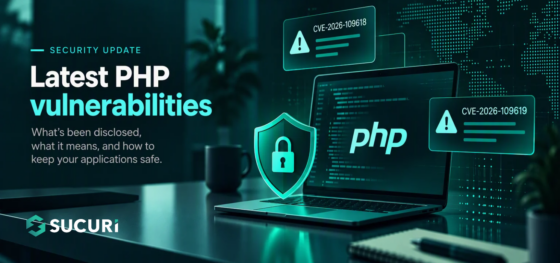
Two critical PHP vulnerabilities (CVE-2026-109618 and CVE-2026-109619) can allow unauthenticated attackers to execute code on affected web servers. Both carry a CVSS v4.0 score of 9.2, and exploitation attempts are already being observed in the wild.

PHP has released the following fixed versions:

PHP branch
Fixed version

PHP 8.5
8.5.12

PHP 8.4
8.4.27

PHP 8.3
8.3.36

PHP 8.2
8.2.35

If you manage your own server or VPS, install the appropriate update immediately.
Continue reading Critical PHP Security Update: Two RCE Flaws (CVE-2026-109618, CVE-2026-109619) at Sucuri Blog.

  •  

500 Internal Server Error: What It Means and How to Fix It

500 Internal Server Error: What It Means and How to Fix It

You load your own site, and instead of your homepage you get a blank page with a line of text reading 500 Internal Server Error. No explanation, no stack trace, nothing to act on. For visitors, it looks like the site is simply gone, and for you it usually means the admin area is down too, so the one tool you’d normally reach for is unavailable.

The frustrating part is that a 500 is deliberately vague.

Continue reading 500 Internal Server Error: What It Means and How to Fix It at Sucuri Blog.

  •  

PCI Compliance Isn’t a Checkbox: How to Secure Ecommerce Checkouts Before Attackers Arrive

PCI Compliance Isn’t a Checkbox: How to Secure Ecommerce Checkouts Before Attackers Arrive

A working checkout page is often the moment a business starts to feel real. The products are live, the cart is functional, payments are flowing, and orders are landing in your inbox. That is also when security shifts from a background concern to a real-world risk.

Once your website starts accepting credit card payments, it becomes part of a payment environment attackers actively look for.

That does not mean every small ecommerce store needs an enterprise security team.

Continue reading PCI Compliance Isn’t a Checkbox: How to Secure Ecommerce Checkouts Before Attackers Arrive at Sucuri Blog.

  •  

Web Shells: Types, Mitigation & Removal

Web Shells: Types, Mitigation & Removal

Web shells are malicious scripts that give attackers persistent access to compromised web servers, enabling them to execute commands and control the server remotely. These scripts exploit vulnerabilities like SQL injection, remote file inclusion (RFI), and cross-site scripting (XSS) to gain entry.

Once deployed, web shells allow attackers to manipulate the server, leading to data theft, website defacement, or serving as a launchpad for further attacks. They are especially dangerous because they are also a post-compromise access mechanism (backdoor) rather than a standalone infection.

Continue reading Web Shells: Types, Mitigation & Removal at Sucuri Blog.

  •  
❌