Reading view

Bridging Cybersecurity and AI

Modernizing Vulnerability Sharing for a New Class of Threats

In cybersecurity, vulnerability information sharing frameworks have long assumed that conventional threats exploit flaws in software or systems, and they can be resolved with patches or configuration updates. AI and machine learning (ML) models upend that premise as adversarial attacks, like poisoning and evasion, target the unique way AI models process information. Consequently, the risks for AI systems include tactics like model poisoning (from evasion attacks) in datasets and training, which are not conventional software vulnerabilities. These new vulnerabilities fall outside the scope of traditional cybersecurity taxonomies like the Common Vulnerabilities and Exposures (CVE) Program.

There is a need to bridge the gap between the existing cybersecurity vulnerability sharing structure and burgeoning efforts to catalog security risks to AI systems. Provisions in the White House AI Action Plan, which Palo Alto Networks supports, call for the creation of an AI Information Sharing and Analysis Center (AI-ISAC), reinforcing the importance of addressing that disconnect. This integration is essential, as leveraging the existing, widely adopted cybersecurity infrastructure will be the fastest path to ensuring these new standards are accepted and operationalized.

Established Construct for Vulnerability Management and Disclosure

The global cybersecurity community relies on a mature infrastructure for sharing standardized vulnerability intelligence. Central to this ecosystem is the CVE List, established in 1999 as the authoritative catalog of cybersecurity vulnerabilities. Through CVE IDs and a network of CVE Numbering Authorities (CNAs), this framework enables consistent vulnerability documentation and disclosure.

Similarly, the Common Vulnerability Scoring System (CVSS) provides standardized severity assessments, allowing security teams to prioritize responses. Together with resources like the National Vulnerability Database (NVD) and CISA’s KEV Catalog catalog, these tools form the backbone of global vulnerability management, information sharing and coordinated disclosure.

Why AI Breaks the Traditional Model

While this infrastructure has served the cybersecurity community effectively for over two decades, it was designed around traditional threat models that AI systems substantially upend. Attacks on AI systems represent a critical departure from traditional cybersecurity threats as they operate insidiously, subtly corrupting core reasoning processes, causing persistent, systemic failures, some of which only become evident over time. Most traditional cybersecurity tools are not equipped to recognize those breakdowns because they assume deterministic behavior and rules-based logic. AI systems defy those assumptions because AI is probabilistic, not deterministic. Consequently, attacks on AI models may remain hidden for extended periods.

Unlike traditional cybersecurity threats that target code, adversarial AI attacks target the underlying data and algorithms that govern how AI systems learn, reason and make decisions. Consider the following predominant adversarial attack methodologies on machine learning:

  • Poisoning attacks inject malicious data into training datasets, corrupting the model's learning process and creating deliberate vulnerabilities or degraded performance.
  • Inference-related attacks exploit model outputs to extract sensitive information or learn about its training data. This includes model inversion, which reconstructs sensitive data from the model's outputs, as well as membership inference, which identifies whether specific data points were used in training.

The expansion of existing security frameworks and programs is necessary to cover the enumeration, disclosure and downstream management of security risks to AI systems.

Advancing AI Security Through the AI Action Plan

In July, the Administration unveiled the AI Action Plan, an innovation-first framework balancing AI advancement with security imperatives. The Plan prioritizes Secure-by-Design AI technologies and applications, strengthened critical infrastructure cybersecurity and protection of commercial and government AI innovations.

Notably, it recommends establishing an AI Information Sharing and Analysis Center (AI-ISAC) to facilitate threat intelligence sharing across U.S. critical infrastructure sectors and encourages sharing known AI vulnerabilities, “tak[ing] advantage of existing cyber vulnerability sharing mechanisms.” These provisions affirm that AI security underpins American leadership in the field and, where possible, should be built upon existing frameworks.

Redefining Boundaries for AI Threats

To position the CVE Program for the AI-driven future, Palo Alto Networks is engaging directly with industry and program stakeholders to chart the path forward. Traditionally, the CVE Program serves as an ecosystem-wide central warning system. It provides a unified source of truths for security risks. A security risk catalog and identification system are needed for AI systems, as they currently fall outside the traditional scope of the CVE Program that has focused exclusively on vulnerabilities rather than on malicious components. The historical aperture of the current CVE Program excludes harmful artifacts, such as backdoored AI models or poisoned datasets, which represent fundamentally different attack vectors, in turn creating security blind spots.

Securing AI’s Promise

The United States leads in AI innovation and must equally lead in securing it. As momentum builds behind the AI Action Plan and the establishment of the AI-ISAC, we have a critical window to shape information sharing frameworks of the future. The goal is to ensure that cybersecurity and AI security infrastructure advance in unison with the technology itself. Integrating new AI vulnerability standards into trusted frameworks like the CVE Program aligns with industry focus and needs. Through proactive, coordinated action, we can unlock AI’s full promise while safeguarding the models that are embedded in the critical systems on which our nation depends.

The post Bridging Cybersecurity and AI appeared first on Palo Alto Networks Blog.

  •  

Partnering with Precision in 2026

If 2025 proved anything, it’s that no one wins alone in cybersecurity. AI-driven threats accelerated, and environments grew more complex while enterprises pushed hard for simplicity, integrated protection and security outcomes that deliver measurable results and meaningful value.

In response, we saw our partners around the globe lean into integration, treat AI as a built-in advantage and use the strength of our ecosystem as a force multiplier. The result: What could have been a disruptive year instead became one defined by growth and learning across our partner community.

Now, those lessons are guiding how Palo Alto Networks plans to partner with even greater precision in 2026. We remain a channel-first company that’s all-in on our ecosystem and united with our partners in a shared purpose to protect our customers’ digital future. But we also intend to double down in several areas in the year ahead, and we’re asking our partners to join us in doing the same.

1. Simplifying Security Through Integration

One message from customers that came through loud and clear in 2025 is that complexity is the enemy of resilience. Many enterprises are grappling with tool sprawl – multiple consoles, disconnected policies and overlapping investments that slow down their teams when speed and agility matter most.

The partners who delivered some of the most transformative results for organizations this year were those who chose integration over complexity and collaboration over siloed tools. With a laser focus on simplifying security, they were able to help customers:

  • Consolidate fragmented point tools onto a unified security platform.
  • Align visibility across the network, cloud and security operations center (SOC), so teams can respond faster.
  • Build architectures with zero trust and AI-powered detection at the core.

We saw this simplifying-security trend through integration across our ecosystem. Partners unified cloud security and detection workflows through Cortex® Cloud™ and Cortex. Teams modernized network architectures with tighter integration across our platform. We expect this activity to only accelerate in the coming year as our cloud security offerings continue to evolve.

When we innovate together, customers gain stronger defenses and a faster time-to-value. That’s why Palo Alto Networks has invested so heavily in platformization. When you connect our capabilities across network security, cloud security and security operations (wrapping them with your consulting, delivery and managed services) customers can experience something fundamentally better. With fewer gaps and clearer signals, they can build a security posture that’s built for the speed of modern threats.

In 2026, deep integration will remain a cornerstone of how we partner with precision. We’ll continue aligning our portfolio, programs and joint engagement model, so you can build offerings that reduce complexity for customers and create stronger differentiation for your business.

2. Making AI a Built-in Advantage

At Palo Alto Networks, our approach to AI in cybersecurity is straightforward. We believe AI must be embedded, not bolted on. It has to live in the data, analytics and workflows your teams rely on every day. That’s the thinking behind Precision AI®, and it’s why we built AI capabilities into our platform’s core.

Partners who treated AI as a platform capability rather than a standalone tool delivered some of the strongest outcomes for customers in 2025. They were able to meet customers’ needs and deliver business outcomes in a single, unified approach. They helped organizations:

  • Detect and respond to threats faster with AI-assisted analytics.
  • Use automation to streamline change, investigation and response workflows.
  • Tie AI to tangible outcomes, such as reduced risk, higher productivity and a better user experience.

In 2026, we’ll double down on AI across the platform and invest in the tools, content and enablement you need to bring those capabilities to life. Our focus is on making it easier for you to build AI-powered services that are repeatable and aligned to the outcomes customers expect.

Upcoming program changes reflect that intent. We’ll promote next-generation security as a growth engine and invest in ways that strengthen partner profitability across consulting services, resale, quality delivery, technical support and managed security services.

3. Ensuring Our Ecosystem Can Be a Growth Engine for Everyone

As AI raised the bar for both attackers and defenders in 2025, the partners who leaned into platformization and outcome-driven services were the ones who helped customers stay ahead of the curve. Those successes are now shaping how we strengthen and scale the partner ecosystem in 2026.

Our ecosystem isn’t just a route to market; it’s intended to be an economic engine for everyone involved. This year, many partners grew their business by building practices around our platform and aligning their services with where customers needed the most support: strategy, implementation, optimization, ongoing operations. We saw especially strong momentum from partners’ expansions:

  • Consulting and advisory services around zero trust and AI-driven transformation.
  • Resale opportunities centered on platform consolidation and next-generation security.
  • Quality delivery and technical support that keep deployments reliable and current.
  • Managed security services that give customers 24/7 protection and expert oversight.

These achievements reflect the value exchange at the heart of our ecosystem. Palo Alto Networks invests in platformization, AI and enablement, while our partners bring delivery expertise, regional insight and service innovation. Together, we create outcomes neither of us could deliver alone.

In 2026, we plan to build on that momentum and drive even greater partner profitability. Program evolutions will focus on growth across the full lifecycle, from initial design and implementation to long-term operation and optimization. We’re also expanding collaboration with our technology alliances to build new joint offerings and solution plays that the ecosystem can take to market together.

When we combine our platform, your expertise and the capabilities of our Alliance partners, then customers gain more paths to adopt next-generation security with confidence, and you gain more opportunities to develop differentiated, high-value practices.

Keeping Customers at the Center

At the heart of every partner collaboration is the customer, of course. Everything we build, integrate and advance together starts and ends with protecting them. This year, ecosystem alignment delivered measurable impact for our customers across industries. When partners lead with integrated solutions anchored in our platform, organizations saw visible improvements:

  • Faster deployment of secure solutions.
  • Reduced complexity with unified visibility.
  • Greater confidence in defending against today’s AI-driven threats.

We saw this firsthand in joint wins across cloud security transformations, zero trust modernization and AI-assisted threat detection. When our ecosystem moves together, customers can move faster, operate more securely and achieve meaningful outcomes. Customer success is the foundation of everything we do as a partner-led organization, and it will remain our North Star in 2026.

Partnering with Precision in 2026 and Beyond

What we learned and achieved together in 2025 points us toward a clear focus for 2026 to advance ecosystem-led innovation, so we can deliver outcomes that matter most to our customers.

With that mission in mind, we will focus on the following four priorities:

  • Deeper Integration – Expanding API partnerships and strengthening interoperability across the platform.
  • Co-Innovation – Enabling partners to build solutions tailored to industry needs and use cases.
  • Empowered Enablement – Investing in learning, automation and AI capabilities that fuel differentiated, profitable services.
  • Simplified Engagement – Streamlining programs and tools, so that partnering with us is faster and more rewarding.

These priorities highlight the real strength of our ecosystem: How platformization, AI and partner expertise come together to enable what we could not build alone.

Finally, to our partners and customers, thank you. Your trust, collaboration and commitment push us to innovate boldly and continuously. As we enter the new year, I’m excited about what we’ll build together. When we align our AI-powered platform, our partner programs and your expertise in delivery, services and managed security, we can deliver something far greater than a set of solutions.

We’re a powerful team that’s not just defending against what’s next; we’re defining the future of cybersecurity. And together, we’re unstoppable.

Partners, join us in shaping the next chapter of secure, AI-powered innovations. Connect with your Channel Business Manager to align on 2026 opportunities, upcoming program updates and ways we can elevate customer outcomes together. Visit the partner portal to learn more.


Key Takeaways

  • Integration beats complexity.
    Unifying technology, data and expertise drove the strongest outcomes in 2025, helping partners reduce risk and accelerate time-to-value for customers.
  • AI is a built-in advantage.
    By tapping into AI embedded across our cybersecurity platform, partners can address security and business outcomes simultaneously and deliver repeatable, profitable, AI-powered services.
  • The partner ecosystem is a growth engine, and together, we’re unstoppable.
    Our 2026 priorities focus on deeper integration, coinnovation, empowered enablement and simplified engagement that drive partner profitability and stronger customer outcomes.

The post Partnering with Precision in 2026 appeared first on Palo Alto Networks Blog.

  •  

Untangling Hybrid Cloud Security

From Fragmented Fences to Cohesive Control

The attack surface for today’s enterprises is incredibly heterogeneous and dynamic. Applications and data are in constant motion, spanning public clouds, private data centers and edge locations. Users connect from anywhere.

For security leaders, this environment has led to an explosion in not only operational complexity, but in many cases, uncertainty. ​​Together, Nutanix and Palo Alto Networks enable security to finally match the speed and scale of these dynamic hybrid cloud environments.

The security ecosystem has become vast and complex. Point solutions accumulate to address specific gaps, yet each adds another interface, another policy language and another integration to manage. However well intentioned, this sprawl can lead directly to fractured visibility, overlapping tools and operational fatigue.

Elevate Perimeter Protection to Defense-in-Depth

Enterprises today face unprecedented security complexity as hybrid and multicloud environments become the new normal. Currently, 94% of enterprises use some form of cloud service, while 89% report having a multicloud strategy in place. This distributed reality means security is paramount: while managing cloud spending is the number one operational challenge (82% overall), security remains a major concern, affecting 79% of all organizations.

Hybrid cloud adoption offers agility, but it also introduces distinct security challenges that strain traditional approaches. Adversaries have taken notice. Hybrid and multicloud environments are prime targets because they connect sensitive data, privileged accounts and critical systems across public, and on-premises infrastructure. Perimeter-based security models, built for static networks and centralized data centers, cannot keep pace in a world where apps and data continuously move between platforms.

Defense-in-depth has become essential for addressing the inherent dynamism of today’s environments. Network visibility is required to monitor and contain east-west traffic and lateral movement of threats inside cloud environments. Identity controls must verify every user, device and interaction across a distributed workforce. Data protection must follow sensitive information as it traverses multiple clouds, data centers and edge locations.

Yet managing these protections as distinct layers is no longer viable. Each cloud provider introduces its own native security controls. Each additional tool adds another interface and another policy set to maintain. Defense-in-depth only achieves its purpose when its layers are fully unified, providing consistent control enforcement from the edge to the core, comprehensive visibility across traffic, and essential data protections for all workloads, wherever they reside.

Freedom of Choice Without Fragmentation

Hybrid environments span public clouds, private infrastructure, SaaS ecosystems and legacy on-premises systems. No single vendor can realistically cover that entire landscape, and forcing security into a single closed ecosystem risks creating gaps where those environments meet.

The answer lies in an open ecosystem approach that allows organizations to assemble best-of-breed capabilities rather than being locked into a single provider’s stack.

This flexibility empowers security teams to adapt to the unique requirements of each environment while still operating through a unified security model. Policies can be applied consistently, intelligence can be shared across layers, and protections can move in step with workloads, regardless of platform. In short, this model can effectively support freedom of choice while relieving the operational burden of managing hybrid and multicloud security.

A Unified Security Layer Across Every Environment

Open ecosystems solve the problem of choice. What remains is the challenge of bringing those best-of-breed capabilities together into a solution that is coherent and scalable.

To transform defense-in-depth from a conceptual framework into a practical system aligned to the realities of hybrid and multicloud deployments, this unified layer should be built on core capabilities:

  • Inline visibility for east-west traffic within virtualized and cloud environments, enabled by deploying next-generation firewalls directly inside virtual private networks:
    This approach inspects workload-to-workload traffic, identifies anomalous behavior and stops lateral movement before it spreads.
  • Consistent policy enforcement across public cloud, private data centers and edge locations through a centralized management plane:
    A single set of policies should be authored once and pushed everywhere, assuring a consistent security posture across all clouds and environments.
  • Abstraction of security intent from network coordinates through tag-driven automation, an approach that allows security policies to be expressed in terms of workload attributes (rather than IPs or locations):
    These protections follow workloads automatically as they move. Through integration with orchestration pipelines, this approach aligns controls with rapid application rollouts in CI/CD workflows, all without manual reconfiguration.

With these core capabilities, security can finally catch up to the fluidity promised by hybrid cloud operating models.

Explore how Palo Alto Networks and Nutanix, work together to make this unified vision a reality, including joint offerings, like Palo Alto Networks secured Nutanix clusters with VM-Series Firewalls for AWS® and Microsoft® Azure.

The post Untangling Hybrid Cloud Security appeared first on Palo Alto Networks Blog.

  •  

Redefining Workspace: Prisma Browser Secures Leadership in Frost Radar

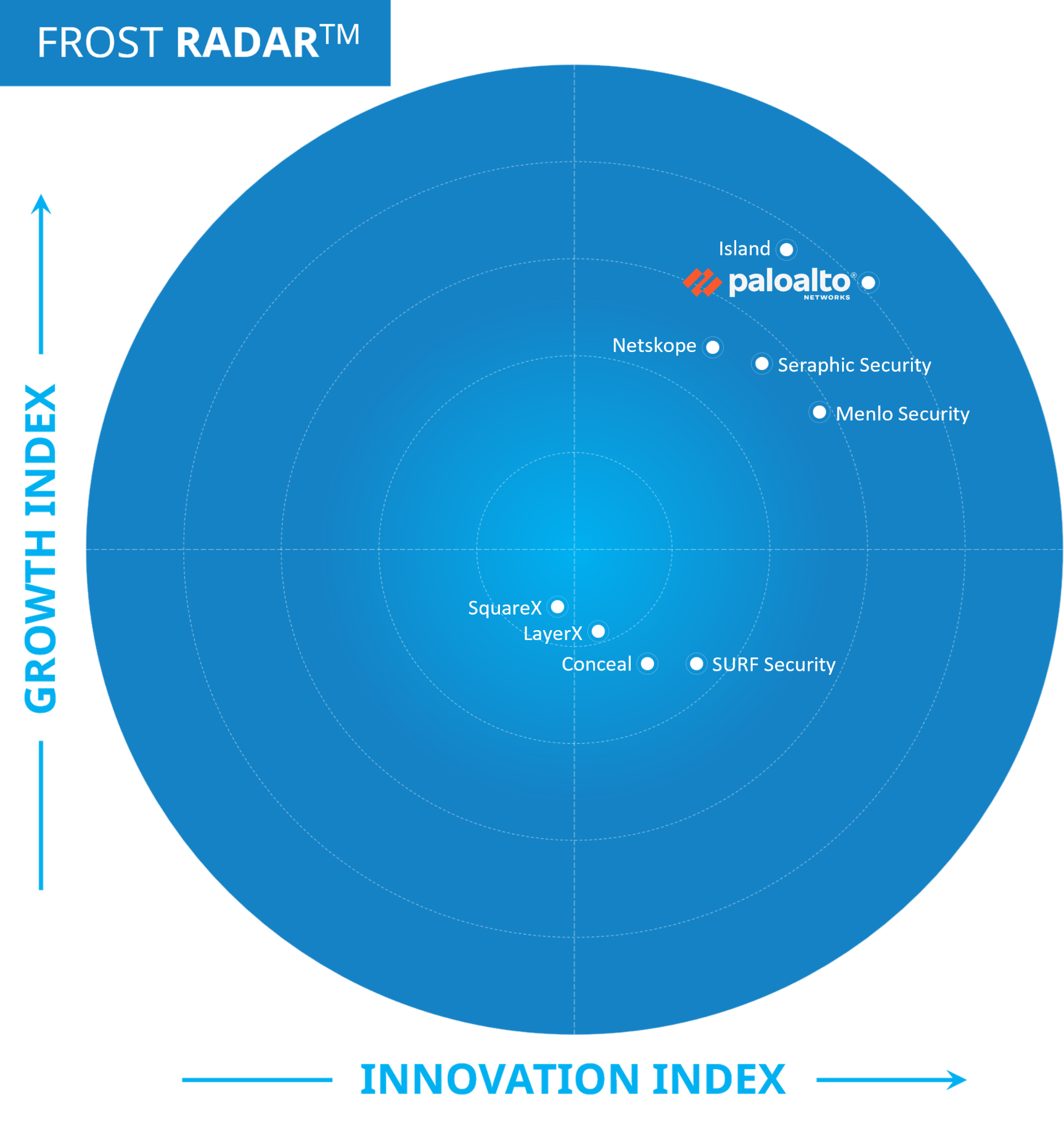
We are proud to announce that Frost & Sullivan has recognized Palo Alto Networks Prisma® Browser™ as the best-positioned market leader in the Frost Radar™: Zero Trust Browser Security (ZTBS), 2025 report, securing the premier position for innovation and a leadership position on growth.

This recognition comes at a pivotal moment. For the modern enterprise, the browser is no longer just an application; it is your new OS. With 85% of the work happening in browsers, it has become the focal point where revenue is generated and sensitive data is accessed. However, this shift has transformed your primary workspace into the primary attack vector, with 95% of organizations having reported a security incident originating in the browser, placing it on the frontline against sophisticated AI® threats and critical vulnerabilities. The risk of evasive, AI-driven phishing attempts is compounded by the widespread use of managed and unmanaged devices, creating blind spots that allow sensitive data to be exfiltrated faster than ever.

To combat this, enterprises need a browser that doesn't just display the web but actively defends it with its users, apps, data and devices. This is a necessity that drives our latest industry recognition.

Proven Leadership Validated by the Market

Frost Radar growth index and innovation index.

Prisma Browser’s recognition as the best-positioned leader, securing the premier position for innovation and a leadership position on growth, is a testament to our commitment to deliver best-in-class security that is both easy to deploy and that IT and users love to use. By integrating Palo Alto Networks Precision AI® technology, Cloud-Delivered Security Services (CDSS) and Enterprise DLP, we ensure our customers benefit from the power of our security engines. And because they are natively integrated in the browser, we are mitigating threats hiding in encrypted traffic, blind spot web channels, AI-powered spear phishing and other evasive web threats that legacy security tools simply cannot identify.

Prisma Browser’s Innovation Advantage

Our leadership is driven by continuous strategic innovation in the secure browser space. Prisma Browser delivers critical "last-mile" protection through the native integration of CDSS, including Advanced WildFire® for zero-day malware analysis and Advanced URL Filtering instantly at the point of user interaction. Building on this foundation, our latest innovations extend secure work to all applications, including those beyond SSO, providing full visibility and last-mile protection for unmanaged applications, such as GenAI apps, closing gaps left by incomplete identity coverage. We further solidify this best-in-class security through additional cutting-edge innovations: Advanced Web Protection for real-time evasive threat protection, Advanced Browser Protection for zero-day browser exploitation defense, and Advanced Extension Security for runtime extension security.

At the core of this defense is Precision AI, our proprietary engine that combines machine learning, deep learning and generative AI to automate detection, prevention and remediation with industry-leading accuracy. Unlike standard security tools that rely on static signatures, Prisma Browser, powered by Precision AI, inspects live, fully rendered content. It detects evasive phishing attempts (such as AI-generated cloaking) and malicious reassembly attacks that legacy tools miss, effectively fighting AI with AI. Fueled by intelligence from over 70 thousand customers, Prisma Browser delivers unmatched threat detection, identifying and blocking up to 8.95 million new and unique attacks every single day.

The Frost Report says this about Palo Alto Networks Innovation:

Key differentiating capabilities include last-mile data leakage protection with browser-level visibility; AI-powered web attack detection and prevention with full page runtime visibility; detection and disabling of malicious extensions using behavioral monitoring; an advanced AI-powered DLP engine; in-browser anti-exploit protection; and a rich library of AI applications and agents.

Crucially, Enterprise DLP capabilities are embedded directly into the rendering engine, granting granular control over sensitive data that traditional network-level tools effectively miss. This helps ensure that data on both managed and unmanaged devices remains secure against exfiltration via clipboard restrictions, screenshot blocking, real-time redaction and more, without disrupting the user experience.

Prisma Browser’s Growth Advantage

Central to the widespread adoption of Prisma Browser is our proven ability to secure the managed workforce at scale without disrupting daily workflows. One of our key differentiators is our 100% license portability, which allows organizations to deploy Prisma Browser across their entire fleet of devices, whether as full browsers, extensions, mobile solutions and firewall connectors with complete flexibility. This frictionless deployment model enables IT teams to instantly layer enterprise-grade security and unified policies onto the same native browser UX employees already know and use.

For CISOs and CIOs focused on streamlining operations, Prisma Browser is also offered as a fully integrated solution within the Prisma® SASE platform, enabling unified policies across all Palo Alto Networks solutions.

Looking Ahead

While we are proud of our position on the Frost Radar: Zero Trust Browser Security (ZTBS) report, we are just getting started. By accelerating initiatives in GenAI security, complete web protection, modern data protection and VDI reduction, we are redefining the browser. We don't just want the browser to be where you work; we are transforming it from the primary attack vector into one of the organization's most robust lines of defense and the single point where they can identify AI driven attacks and fight AI with AI.

Read the full Frost Radar: Zero Trust Browser Security (ZTBS), 2025 report to explore the details behind our market leadership. Then, schedule a demo to witness how Prisma Browser transforms your primary workspace into your strongest line of defense.

The post Redefining Workspace: Prisma Browser Secures Leadership in Frost Radar appeared first on Palo Alto Networks Blog.

  •  

Winning the AI Race Starts with the Right Security Platform

Every CIO and CISO we speak with describes the same paradox: AI is now central to their transformation agenda, yet the fastest way to derail that agenda is to lose control of AI. As generative AI, agentic systems and embedded AI features spread across the enterprise, leaders are no longer asking if they need AI security; they’re asking what kind of AI security strategy will actually scale.

Gartner® has published two recent reports that validate this reality and outline the strategic direction enterprises must take to secure their AI:

Why AI Security Is a Platform Game

Point products can plug individual gaps, but they can’t keep up with the speed, complexity and interconnected nature of AI adoption. And more importantly, they struggle to deliver the trust, consistency or scale AI transformation requires.

Many organizations are already experiencing AI adoption outpacing traditional security tools. Security teams are under pressure on three fronts:

  • Risk – Shadow AI, unmanaged agents and custom LLMs create new pathways for data loss, intellectual property exposure and model misuse.
  • Cost – Each new AI use case brings yet another tool, driving up license, integration and operations costs.
  • Complexity – Fragmented controls across network, data, identity and application stacks create blind spots exactly where AI is moving fastest.

From a CIO or CISO’s perspective, this isn’t just a technical concern but the fault line beneath their entire AI agenda. CIOs are under pressure to deliver productivity gains, cost efficiencies and new AI-powered capabilities faster than ever before.

CISOs, on the other hand, see a parallel reality: custom-built AI applications that may be insecure by default, agents that can act unpredictably, and a constant risk that company secrets or customer data could leak into third-party GenAI tools.

If AI moves forward without security, the enterprise is exposed. If AI slows down because security can’t keep up, the business misses its transformation goals. This is why AI security isn’t a feature; it’s the determining factor in whether AI becomes a competitive advantage or a strategic setback.

Gartner recommends the path forward as “an integrated modular AI security platform (AISP) with a common UI, data model, content inspection engine and consistent policy enforcement.”

Gartner further recommends prioritizing investments in two phases.

Phase 1

Start with AI usage control to secure the consumption of third-party AI services.

Phase 2

Expand into AI application protection to securely develop and run AI applications.

Phase 1: Securing Generative AI Usage Is the “Right Now” Challenge

Before enterprises can secure how AI is developed, they must first understand how it is already being used across the organization. The earliest risks often emerge not from the AI-enabled apps built in-house, but from the external generative AI tools and copilots employees adopt, and often without the IT teams’ knowledge.

That’s why we think the report identifies AI usage control as phase one and why we recommend IT leaders start with these immediate questions to assess their organization’s AI usage.

  • Where is AI actually being used in my organization?
  • Which tools, copilots and agents are in play, and on what data?
  • How do I enable productivity without losing control?

Phase 2: Securing AI Development Early Into the AI Lifecycle

Once public generative AI use is understood, the harder challenge emerges: Securing the AI apps and tools that your organization creates for itself. As models, agents and pipelines move into production, the questions shift from visibility to integrity, safety and scale.

Key questions that organizations must answer in phase two include:

  • What AI applications, models and agents are my teams building, and where do they live?
  • How do I manage the integrity, safety and compliance of AI apps before they reach production?
  • How do I protect models and AI applications from prompt injection, misuse or agentic threats?
  • How do I scale AI innovation without creating security bottlenecks for developers?

Palo Alto Networks Delivers the AI Security Platform

Although organizations can separate the work around securing AI usage and AI development, they are not two separate problems. The same organization that needs visibility into employees using public GenAI apps also needs to protect the AI applications and agents they’ve built as they move into production. A platform approach is what allows shared policies, shared guardrails and shared context across both sides of the AI usage and development equation.

That is exactly the philosophy behind our Secure AI by Design approach:

  • Secure how GenAI is used with Prisma® Browser™ and Prisma SASE to discover AI tools in use, govern access and prevent sensitive data from flowing into public models, all while keeping users productive with GenAI and enterprise copilots.
  • Secure how AI is built with capabilities of Prisma AIRS™, such as model and agent security, AI security posture management, runtime protection, automated testing with AI Red Teaming, as well as coverage for agentic protocols, like MCP, securing custom AI applications, agents and pipelines.

Gartner identifies Palo Alto Networks as “the company to beat” in their newly released report as of December 8, 2025: “AI Vendor Race: Palo Alto Networks Is the Company to Beat in AI Security Platforms.”

We believe we are the AI Security Platform to beat because:

  • Palo Alto Networks product portfolio across network, edge, cloud and data provides a strong foundation for AI usage visibility and control.
  • The acquisition of Protect AI integrated industry-leading AI talent and products resulting in the recently announced Prisma AIRS 2.0, which delivers comprehensive end-to-end AI security, seamlessly connecting deep AI agent and model inspection in development with real-time agent defense at production runtime. The platform, continuously validated by autonomous AI red teaming, secures all interactions between AI models, agents, data and users. This gives enterprises the confidence to discover, assess and protect their entire AI ecosystem, accelerating secure innovation.
  • Complementing the platform, Unit 42®’s deep expertise and Huntr’s bug bounty program, provide security thought leadership that directly improves product effectiveness and threat intelligence. These programs help us continuously uncover new attack patterns, misconfigurations and supply chain risks unique to AI systems, as well as feed those insights directly back into the product roadmap.
  • Our large installed base and distribution channels create a flywheel for AI security platform adoption and learning from our customers and partners.

We also believe that underneath the technical requirements is a deeper truth: CIOs and CISOs want to move fast on AI, but they only feel safe doing so with a partner who has the scale, signal and staying power. This is where our breadth, research depth and ecosystem matter.

Leading Responsibly Means Listening, Innovating and Evolving

Being early is an advantage, but staying ahead requires humility and continuous learning. Leading means seeing what comes next, and Gartner’s insights accelerate our own roadmap as we continue to evolve.

  • Simplifying the Experience: We are integrating capabilities across Prisma AIRS, Prisma SASE and Prisma Browser to make AI security easier to adopt, operate and scale through Strata™ Cloud Manager as the single entry point.
  • Going Deeper into the AI Engineering Pipeline: We recognize that securing AI must start early in the developing environment and ML pipeline, not just at runtime. Our integrations with AI development tools and code repositories will continue to expand.
  • Keeping Pace with a Fast-Moving Market: We are investing in open standards, partnerships and research, so our customers don’t have to chase every point solution that appears. Palo Alto Networks is also a contributing member to OWASP Standards and Threat analysis to help create an industry standard on AI security.
  • Working Along Native AI Controls: Cloud providers and AI platforms are adding their own security features. We aim to complement, not replace, those controls, providing unified visibility, advanced protection and consistent policies across a fragmented AI landscape.

For us, being “the company to beat” is not a finish line. It’s a responsibility to listen carefully to customers, adapt as AI evolves, and keep delivering practical, integrated outcomes rather than isolated features.

If you are a GM, CIO, CISO or AI leader trying to make sense of a rapidly crowding AI security landscape, we believe “GMs: Win the AI Security Battle With an AI Security Platform”​​ is essential reading.

In the end, the real race isn’t about features; it’s about who helps enterprises accelerate transformation safely, reduce risk and compete better with AI they can trust.


Disclaimer: Gartner does not endorse any company, vendor, product or service depicted in its publications, and does not advise technology users to select only those vendors with the highest ratings or other designation. Gartner publications consist of the opinions of Gartner’s business and technology insights organization and should not be construed as statements of fact. Gartner disclaims all warranties, expressed or implied, with respect to this publication, including any warranties of merchantability or fitness for a particular purpose.

Gartner, AI Vendor Race: Palo Alto Networks is the Company to Beat in AI Security Platforms, By Mark Wah, Neil MacDonald, Marissa Schmidt, Dennis Xu, Evan Zeng, 8 December 2025. 

Gartner, GMs: Win the AI Security Battle With an AI Security Platform, By Neil MacDonald, Tarun Rohilla, 6 October 2025.

GARTNER is a registered trademark and service mark of Gartner, Inc. and/or its affiliates in the U.S. and internationally and is used herein with permission. All rights reserved.

The post Winning the AI Race Starts with the Right Security Platform appeared first on Palo Alto Networks Blog.

  •  

Crossing the Autonomy Threshold

What It Means and How to Counter Autonomous Offensive Cyber Agents

For years, we've anticipated this day. With the release of Anthropic's landmark report (detailing the disruption of a cyberespionage operation orchestrated by AI agents with minimal human intervention), the reality of autonomous offensive cyber agents has moved from speculation to an active, machine-speed threat. The report covers their internal identification and analysis of artifacts from the GTG-1002 campaign, which was conducted against over 30 different enterprise targets. This event is independently being tracked in the AI Incident Database as incident 1263. To have a successful defense in the age of AI, we need an immediate shift from human-led, reactive security to a proactive, machine-driven security paradigm.

The GTG-1002 campaign is the first open report of an AI agent, powered by Claude Code, targeting multiple enterprise environments. Using Claude Code as the primary orchestration framework, the agent was effective in all key phases of the attack:

  • Mapping attack surfaces without human guidance.
  • Exploit vulnerabilities using custom code generation.
  • Moving laterally by autonomously harvesting and testing credentials.
  • Conducting an intelligence analysis to identify and prioritize high-value data, rather than just exfiltrating raw dumps.

It was a watershed moment for several key reasons:

  • Stealth Traffic analysis of the inputs and outputs to Claude Code were the initial indicators of this attack, however, the attack was only observable in aggregate.
  • Self-Configuration The agent autonomously adapted its attack strategy to achieve actions on an objective.
  • Machine-Speed – The agent both orchestrated AND executed the campaign across all attack vectors.
  • Autonomous Context and Persistence Using structured markdown files, the execution agent maintained a persistent state of the attack, providing context and autonomous continuity between distributed sub-actions and attack phases.

This campaign, executed at “multiple operations per second,” marks the end of the necessity for the "human-in-the-loop” attacker and the arrival of the "human-on-the-loop" supervisor. Transitions between attack phases were controlled by the human to validate sufficient completion of the current phase before progressing. It was a thin layer of supervisory human control. With the whiplash pace of AI, defenders should anticipate the necessity of any human control to fade.

In the reported attack campaign, “commodity tools” were leveraged by the threat actor, which at first glance, may not seem particularly novel. However, the autonomous orchestration of these tools across multiple attack phases by Claude Code, using Model Context Protocol (MCP) servers, represents a sophisticated technical advancement in offensive agents. Critically, this method improved more than just the speed of the attack, it also introduced the concept of autonomy with negligible human supervision, supporting dynamic and contextual reasoning in attack path planning across multiple target systems (even beyond typical human analyses, particularly for non-intuitive/interpretable event logging). Custom tools can bring very targeted actions within the same or similar offensive agent architectures, and defenders should be ready for this inevitable evolution.

We Need Agents to Fight Agents

With the debut of real-world offensive agent operations, it is now crystal clear: Defenders cannot combat autonomous, offensive AI with manual, static human driven security operations. Defenses must blend machine-speed responses with on-the-fly adaptability to maintain effectiveness against the self-optimizing campaigns now being observed. The pivot to autonomous agent-driven security operations will require transforming many elements of the traditional security operations lifecycle. All stages from preparation to response processes need to be resilient and robust to changes in adversary speed, stealth, evasion, orchestration frameworks and indicators of compromise.

Meeting the Challenges of Machine-Speed Defense Head-On

A new defense paradigm must be adopted to effectively combat AI attacks that are both orchestrated AND executed beyond human reaction time. To transform security operations and outpace AI-driven threats, organizations need to employ the following core principles:

  • Precision of AI for Cybersecurity: Operating at machine speed requires precision and accuracy. Security systems must be capable of ingesting the right data, at the right time, and understanding the system context to detect and block threats in real-time, thwarting AI-generated attacks without generating erroneous alerts. Producing false positives is problematic at human speeds, and the problem compounds at machine speed.
  • Proactive Cybersecurity for AI Systems: We must safeguard AI systems with real-time security solutions, preventing the models and applications from being directly or indirectly co-opted for malicious use. This demands a deep and continuous understanding of how AI agents might be abused via their application interfaces, permissions, provenance, identity and wider interactions across organizations.
  • Transform Visibility into Observability: Visibility only encompasses a direct presence or absence. Observability is the combination of visibility plus some degree of cognitive and contextual reasoning. The visibility of a traffic sign does not guarantee a driver will observe and respond to it. The GTG-1002 attack evaded detection by splitting and distributing small, seemingly benign fragments of the full campaign across numerous sessions. The requests were visible, but the scope of the malicious campaign was not observed from the isolated requests. To identify and help stop such techniques, defenses need distributed observability, which can only be achieved from context-aware agents that understand the nature and impact of disparate events and can disrupt such attacks when they are identified.
  • Agentic Security Operations: As an industry, we must also acknowledge the difference between autonomous and automated systems. The industry has been integrating elements of automation for years. Scripting, decision trees and playbooks are mechanisms for speeding up the response in specific context, but do not necessarily generalize or work across different phases. If the attacker is using an agentic system for 90% of the attack lifecycle, security operations centers (SOCs) must also implement an agentic system for 90% of their triage, investigation, remediation and threat hunting workflows. This must be the rule, rather than the exception. By combining observability with dynamic AI agents capable of coordinated decision making and task execution, SOCs can deliver proactive autonomous protection at scale.

The Future Is Now. Are You Ready?

The GTG-1002 campaign is a clear signal that offensive AI agents are being used in the wild. The adoption of AI agents by threat actors will accelerate and demand a decisive transformation of defensive security operations to include agent orchestration tools customized to respond to the uniqueness of offensive AI agents.

At Palo Alto Networks, our platformization strategy was built precisely for this moment. This interconnectivity between tools and systems transforms visibility into observability necessary for AI agent orchestration.

In light of GTG-1002, there is an unequivocal need for the security community to accelerate the pivot from automated to autonomous security operations. AI agents can quickly find and exploit vulnerabilities, moving stealthily across the attack chain. We must shift from human-led, reactive defense to fast, proactive machine-driven security to ensure cyber resilience in the age of AI.

Are you ready? Learn about securing AI agents and how to create a trustworthy AI ecosystem.


Key Takeaways

  • Autonomous Orchestration and Execution: The GTG-1002 campaign was a watershed event because the AI agent, powered by Claude Code, autonomously orchestrated and executed all key phases of the attack, from mapping surfaces and exploiting vulnerabilities to moving laterally and conducting intelligence analysis at machine speed.
  • Shift to Machine-Driven Security Paradigm: The emergence of autonomous offensive cyber agents, as demonstrated by the GTG-1002 campaign, demands an immediate pivot from human-led, reactive security to a proactive, machine-driven security defense model.
  • Distributed Observability is Essential to Agentic Defenses: To counter new attack techniques like GTG-1002, which evade detection by splitting the campaign into small, distributed, and seemingly benign fragments, defenses must adopt distributed observability to connect disparate events using context-aware agents.

Further Reading:

The post Crossing the Autonomy Threshold appeared first on Palo Alto Networks Blog.

  •  
❌