Reading view

Cybercrime at Machine Speed: Key Takeaways from Flashpoint’s 2026 Midyear Threat Intelligence Briefing

Blogs

Blog

Cybercrime at Machine Speed: Key Takeaways from Flashpoint’s 2026 Midyear Threat Intelligence Briefing

Threat actors are no longer just using automation to execute tasks, they are leveraging prepackaged, safeguard-free AI, weaponizing stolen session data, and directly targeting defenders’ security stacks.


SHARE THIS:
Default Author Image
September 1, 2026

In our latest webinar, Flashpoint Vice President of Intelligence, Ian Gray, briefed security leaders on the evolving threat environment, providing critical insights from the Flashpoint Global Threat Intelligence Report (GTIR): 2026 Midyear Edition.

The threat landscape has developed at a striking pace with Flashpoint tracking over 22 million illicit AI discussions, 7.4 million compromised hosts yielding 1.7 billion stolen credentials, and over 21,600 disclosed vulnerabilities in just six months. Beyond these staggering numbers, the on-demand session detailed something even more alarming: a fundamental shift in adversary operational tradecraft.

Here are the five critical shifts every cyber threat intelligence (CTI), Vulnerability Management, and SOC team needs to know.

The Death of Signal: Threat Actors are Shifting to “Private AI”

The public discussion surrounding criminal artificial intelligence (AI) has reached a critical inflection point. Early in the AI boom, Flashpoint observed threat actors collaboratively experiment across underground forums, jailbreaking commercial frontier models or advertising surface-level tools like WormGPT and DarkGPT.

Today, adversaries are shifting from public forums to running fine-tuned, open-source models locally on private servers, which greatly hampers traditional signature-based detection. Flashpoint analysts are now seeing attackers generate unique, highly tailored malware variants, flawless phishing lures, and custom exploit scripts at extremely low costs—completely offline and shielded from public monitoring.

A few months ago, a lot of this was collaborative… public outsourcing. Now what we’re seeing is scarier: pre-packaged cybercrime models run locally on private infrastructure. Malicious code, exploit scripts, and targeted phishing are all being generated inside closed environments.

Ian Gray, VP of Intelligence, Flashpoint

Weaponizing the Defender’s Own Tooling

Another eye-opening tactical insight shared during the session was how threat actors are repurposing defender infrastructure for automated initial access and extortion. In the webinar, we pointed to recent campaigns where adversaries specifically targeted misconfigurations and zero-day vulnerabilities inside open-source vulnerability scanners, secrets-detection tools, Kubernetes clusters, and Infrastructure-as-Code(IaC) environments.

What this means for defenders is that the attack surface is no longer bounded by traditional enterprise network boundaries: it extends directly into CI/CD pipelines, security orchestration tooling, and third-party SaaS integrations. Security teams are finding themselves in a race against attackers who use automated scanning scripts to weaponize vulnerabilities in the security tools themselves.

The Global Infostealer Threat and Identity-First Attacks

Flashpoint tracked 7.4 million hosts compromised by infostealers in H1 2026—a 27% increase period-over-period—harvesting 1.7 billion credentials and identity information.

While the top infostealer strains remain familiar, law enforcement operations have created vacuums that competitors rapidly fill.

map visualization

Threat actors are leveraging drive-by downloads, watering holes, and pirated software packages to plant stealers. Once a machine is compromised, the logs capture corporate SSO credentials, active browser cookies, VPN keys, and SaaS session tokens. This enables adversaries to simply log in without having to leverage complex technical exploits.

The Structural Failure of CVE/NVD and the Importance of KEV

The Common Vulnerabilities and Exposures (CVE) and National Vulnerability Database (NVD) have failed to keep pace with the velocity of AI-assisted vulnerability discovery. As such, vulnerability management teams are facing significant operational delays.

MetricFlashpoint GTIR Midyear H1 2026 DataOperational Impact
Total Disclosures21,667Remediation volume exceeds defender bandwidth.
Exploit Availability19% (4,015 CVEs)Functional code is ready before patches are deployed.
Public Catalog LagGrowing Backlog (NVD/KEV)Delay in official scoring leaves teams blind to active risk.

Therefore, waiting for NVD enrichment before prioritizing a patch is a dangerous strategy. To compensate, security teams require Vulnerability Intelligence (VI) that provides primary-source confirmation of weaponization, exploit availability, and actionable mitigation guidance long before public databases update.

Ransomware Evolution: From Encryption to Cloud Extortion

Ransomware-as-a-Service (RaaS) activity surged by 45% period-over-period, reaching 6,256 verified victim postings on data leak sites. However, total on-chain payout revenue dropped by 8% to $820 million, with victim pay-rates hitting a record low of 28%.

Faced with declining payouts and resilient enterprise backups, extortion syndicates are adapting. Rather than relying exclusively on technical file-encrypting malware, groups are executing pure data extortion campaigns—frequently targeting cloud platforms or extracting data through third-party vendor access.

Protect Your Organization Using Flashpoint

Defending against machine-speed attacks requires moving beyond reactive, post-incident telemetry. Flashpoint arms security, CTI, and vulnerability management teams with the primary-source intelligence required to preempt adversary operations:

  • Unrivaled Deep & Dark Web Visibility: Flashpoint’s Primary Source Collection actively monitors closed criminal communities, illicit Telegram channels, and private forums, giving you early warning when threat actors build custom AI toolkits or trade credentials targeting your organization.
  • Comprehensive Vulnerability Intelligence (VI): Flashpoint tracks zero-days and vulnerability disclosures independently, delivering immediate exploit availability data and threat-informed prioritization so you patch what actually matters.
  • Continuous Compromised Credential Monitoring: Instantly surface exposed enterprise credentials, active session tokens, and stealer logs tied to your domain or third-party supply chain before they lead to an account takeover (ATO).

Request a demo, or watch the full on-demand webinar to explore the data shaping today’s risk landscape.

See Flashpoint in Action

The post Cybercrime at Machine Speed: Key Takeaways from Flashpoint’s 2026 Midyear Threat Intelligence Briefing appeared first on Flashpoint.

  •  

The Evolution of Hacktivism in Hybrid Warfare: Modern Tactics and Real-World Impact

Blogs

Blog

The Evolution of Hacktivism in Hybrid Warfare: Modern Tactics and Real-World Impact

In this post we examine how modern hacktivism has evolved into a tool of global hybrid warfare, analyzing crowdsourced attack tactics, media-driven propaganda, and real-world impacts across Ukraine, the Middle East, European Union, and NATO nations.

SHARE THIS:
Default Author Image
August 26, 2026

Hacktivism used to be perceived as digital graffiti, with lone-wolf threat actors defacing government websites or temporarily crashing banking portals to make a political point. However, Flashpoint is tracking a fundamental shift in how these groups operate.

Modern hacktivism is evolving into a disciplined component of global hybrid warfare, capable of bridging digital disruptions with tangible real-world impact. Today, these operations blur the line between volunteer activism and coordinated state interest, leveraging crowdsourced infrastructure to disrupt critical utilities, manipulate media narratives, and target public infrastructure on a global scale. Unpacking these modern hacktivist collectives reveals what their tactics look like in practice and their far-reaching consequences across dozens of nations.

What is Hacktivism?

Hacktivism is the use of cyberattacks to promote or advance a particular political or social cause, leveraging a wide range of tactics such as website defacement, distributed denial-of-service (DDoS) attacks, and data breaches. Modern hacktivist collectives serve as the loud, high-visibility arm of cyber conflict—frequently aligning with state geopolitical interests, as seen most prominently in recent pro-Russian operations and Iranian-aligned cyber campaigns.

These pro-Russian hacktivist groups, such as NoName057 and Killnet, alongside pro-Iranian collectives and proxy ecosystems like Handala Hack, often react to the news cycle and target countries designated by state media or ideological narratives as enemies. As such, modern hacktivist campaigns are opportunistic and tied to global events—from the escalation in the Middle East following military operations like Operation Epic Fury, to the Milan-Cortina Winter Olympics and new aid packages to Ukraine. These groups’ justification narratives typically mirror state messaging.

Modern Tactics: Gamifying Cyber Warfare

In tracking modern hacktivist groups, Flashpoint analysts identified a new method these groups are utilizing to convert ordinary devices into tools for hybrid warfare—the gamification of cyberattacks. Flashpoint has observed groups like NoName057 turning DDoS attacks into community-based “patriotic online games,” such as their “DDoSia Project,” with participants earning military-style ranks and cryptocurrency rewards for overloading the websites of government institutions, banks, and various infrastructure across various countries.

This model has enabled the scaling of operations by utilizing a large, low-skilled participant base rather than having to rely on sophisticated technical tradecraft. The model’s decentralized structure and ideological appeal continue to pose a significant challenge for international law enforcement.

The Propaganda Engine: Media Amplification and Validation

Beyond technical disruptions, publicity is the primary currency of modern hacktivism. Hacktivist groups demonstrate a consistent pattern of media-seeking behavior and self-promotion, likely intended to amplify their perceived impact and reinforce notoriety within the broader cyber threat landscape. Many of these groups repeatedly repost media coverage and news articles referencing themselves.

This serves as a curated self-promotion mechanism, allowing the group to selectively showcase external validation of its operations, including coverage from mainstream and security-focused outlets, to its followers. This behavior aligns with a broader trend observed with especially pro-Russian hacktivist collectives, in which media visibility is treated as a measure of operational success independent of verified technical impact. It also serves as a deliberate tactic for engagement and recruitment that reinforces “patriotic” branding and sustains participant morale and visibility.

Beyond Propaganda: Aligning Cyber Disruption with Military Objectives

In some cases, the digital targeting of hacktivist collectives is more aligned with kinetic objectives, rather than public perception or propaganda initiatives. This is especially true for Iranian-aligned hacktivists and proxy groups who are more deeply intertwined with military operations in the Middle East. These groups have expanded their operations from website disruptions into claims of large-scale data wipers, extortion, and cyberattacks targeting key infrastructure across the Gulf.

The Far Reach of Modern Hacktivism

Major geopolitical flashpoints in the Middle East have triggered waves of hacktivist activity that has spread across North America, with threat actors targeting supply chains, financial infrastructure, and operational technology and control systems.

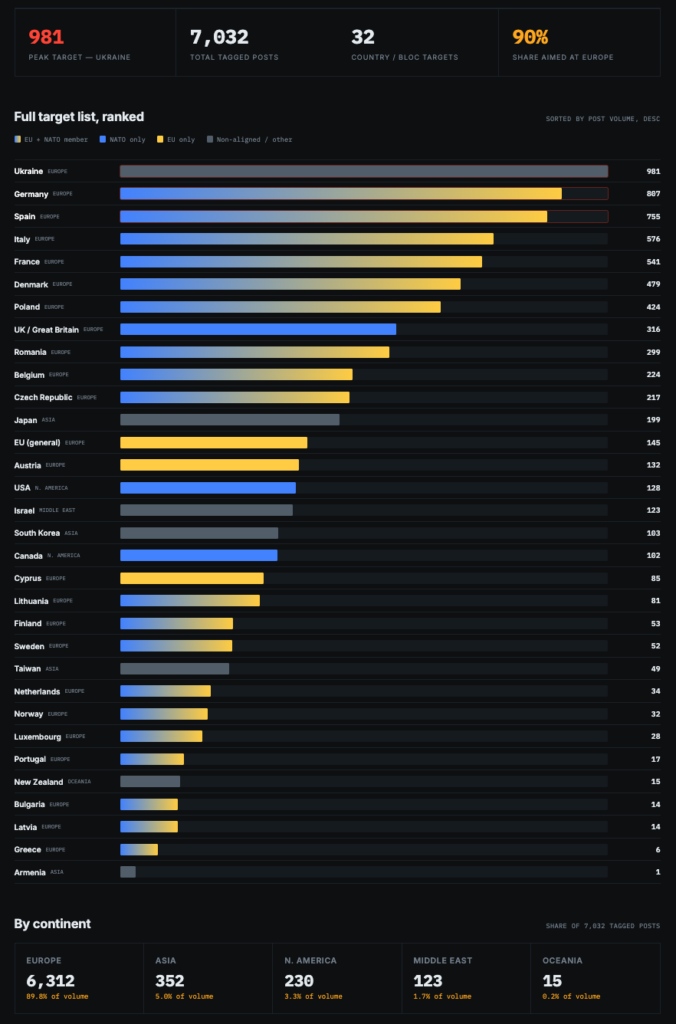
Simultaneously, pro-Russian hacktivist groups, particularly NoName057, have been extremely prolific within the last year—carrying out two major illicit campaigns heavily targeting Ukraine, which then spilled over to more than 30 nations globally. The following breakdown contains statistics and targeting dynamics of pro-Russian hacktivist groups observed between July 2025 and 2026:

Country-level targeting derived from Flashpoint intelligence. (Source: Flashpoint, graphic generated by Claude)

The Continuous Campaign Against Ukraine

Ukraine has been the primary target for pro-Russian hacktivist groups who seek to damage Ukrainian infrastructure and morale. Anti-Ukrainian content is constantly distributed through dedicated per-language channels, making it the most linguistically developed target spanning six languages. Involved channels each post near-identical translated content within minutes to hours of the Russian original, down to the same image file with identical SHA1 hashes, which suggests a sustained propaganda distribution operation.

This has resulted in alleged data breaches impacting Ukrainian General Staff, military enlistment offices, medical, and morgue databases to push a casualty-count narrative. It also has resulted in the defacement or disruption of websites of regional capitals and administrative centers, energy plants, water and power-adjacent infrastructure, and many more.

Spilling Over: Impact Across EU and NATO Allies

However, Ukraine is not the sole casualty of modern hacktivism. Recent pro-Russian hacktivist campaigns have spread to other EU nations and NATO members. Germany, the United Kingdom, and Spain have been observed to be priority targets, with threat actors targeting public transportation, federal and security agencies, municipal government and utilities, financial markets, and other infrastructure. In some cases, hacktivist campaigns manifest in the real-world, with physical sticker drives on municipal streets, alongside doxxing operations releasing alleged personal data and automated scans hijacking exposed CCTV camera systems across Europe.

Physical sticker campaigns (NoName057) in Spain identified by Flashpoint

Defend Against the New Wave of Hacktivism Using Flashpoint

As hacktivist operations continue to blur the boundary between digital disruption and real-world interference, organizations can no longer view DDoS attacks or low-level intrusions as simple background noise. Protecting critical assets requires proactive visibility into threat actor networks, early detection of targeting narratives, and primary source threat intelligence.

Request a demo today to see how Flashpoint provides actionable intelligence to help security teams, government agencies, and infrastructure providers identify, monitor, and mitigate emerging hacktivist campaigns before they impact operations.

See Flashpoint in Action

The post The Evolution of Hacktivism in Hybrid Warfare: Modern Tactics and Real-World Impact appeared first on Flashpoint.

  •  

Insider Threat Report: Dark Web Recruitment & Access Trends

Blogs

Blog

Insider Threat Report: Dark Web Recruitment & Access Trends

Flashpoint’s monthly analysis of insider threat recruitment, illicit access advertising, and threat actor activity targeting enterprise environments.

SHARE THIS:
Default Author Image
August 20, 2026

Unknowingly, a member of key personnel is living two separate lives. On the clock, they are a highly-trusted systems administrator, but in their personal time, they moonlight on the deep and dark web, advertising their trust and access to the highest bidder. One day, they get a simple offer: $15,000 in the crypto of their choice to approve a single push notification at 2 AM. They accept. By morning, the attacker walks away  with active domain admin credentials without the need for malware or cracking firewalls.

This is just one example of how insider threats lead to modern enterprise breaches. This year, Flashpoint uncovered 7,282 unique insider threat posts, with an average of 34 unique posts being posted daily. As perimeter security, EDR coverage, and other security tools mature, threat actors are finding it faster—and cheaper—to target the human element and simply buy an insider’s credentials or pay an employee to open the front door.

In a threat landscape where identity is becoming the primary attack surface, monitoring illicit marketplaces and recruitment efforts is critical. This new monthly report leverages Flashpoint’s Primary Source Collection (PSC) to analyze insider threat tactics, tracking active recruitment and advertising on dark web forums and encrypted networks.

The Insider Threat Landscape: July 2026

In July 2026, Flashpoint analysts identified a total of 12,653 insider posts. These communications include both threat actors attempting to recruit insiders in target organizations, as well as insiders advertising their services on illicit forums and marketplaces.

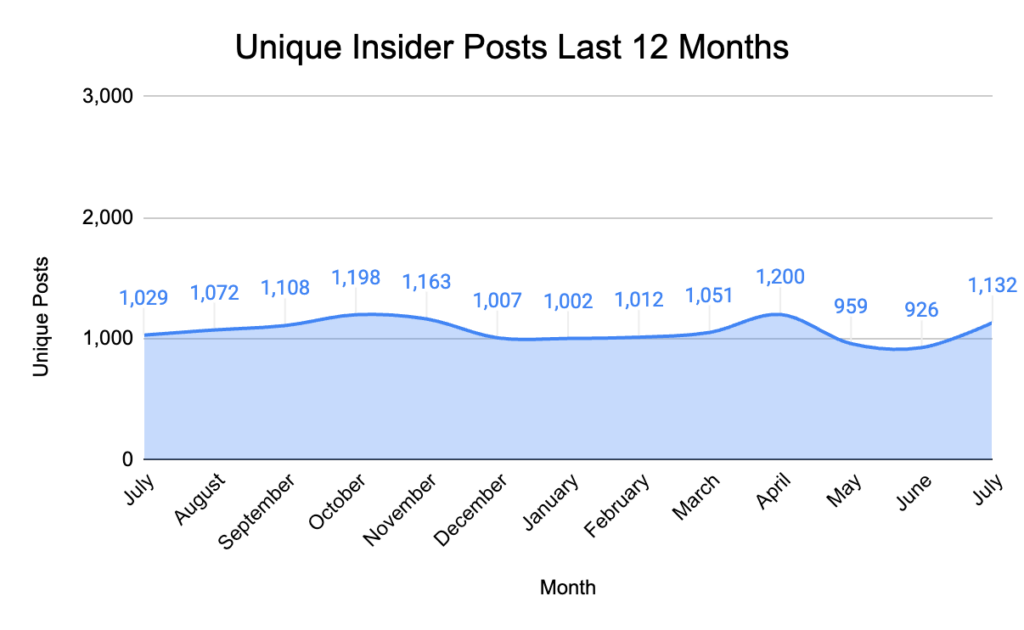
Of these total communications, Flashpoint observed 1,132 unique posts in July 2026.

Flashpoint chart showing unique insider posts in the last 12 months from July 2026

Where Insider Threat Activity is Concentrated

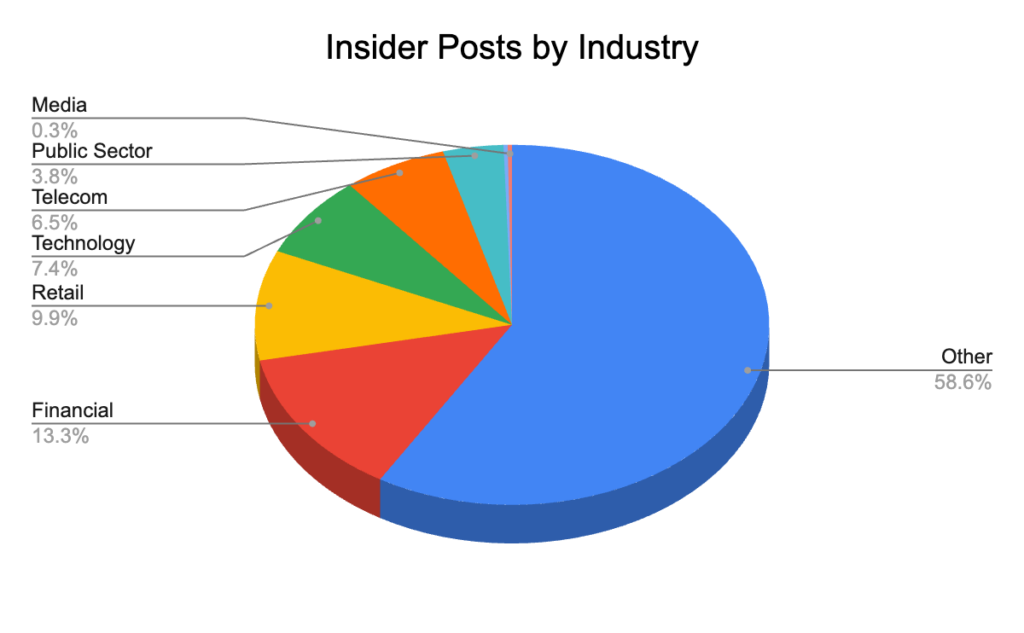
Historically, the Telecommunications, Retail, and Financial industries are most adversely affected by insider threat activity. However, July 2026 findings noticeably deviate from this trend. Flashpoint found 58.6% of total insider threat posts affected “Other” industries—suggesting adversaries are diversifying their target base. Threat actors may be attempting to recruit within supply chain partners, logistic hubs, manufacturing platforms, and specialized service providers to find alternative entry points into target networks.

Flashpoint chart showing insider posts by industry

The following table shows a breakdown of unique insider posts by industry in July 2026:

IndustryPosts
Other663
Financial150
Retail112
Technology84
Telecom74
Public Sector43
Healthcare3
Media3
Total1,132

Insider Threats: Recruiting vs. Advertising

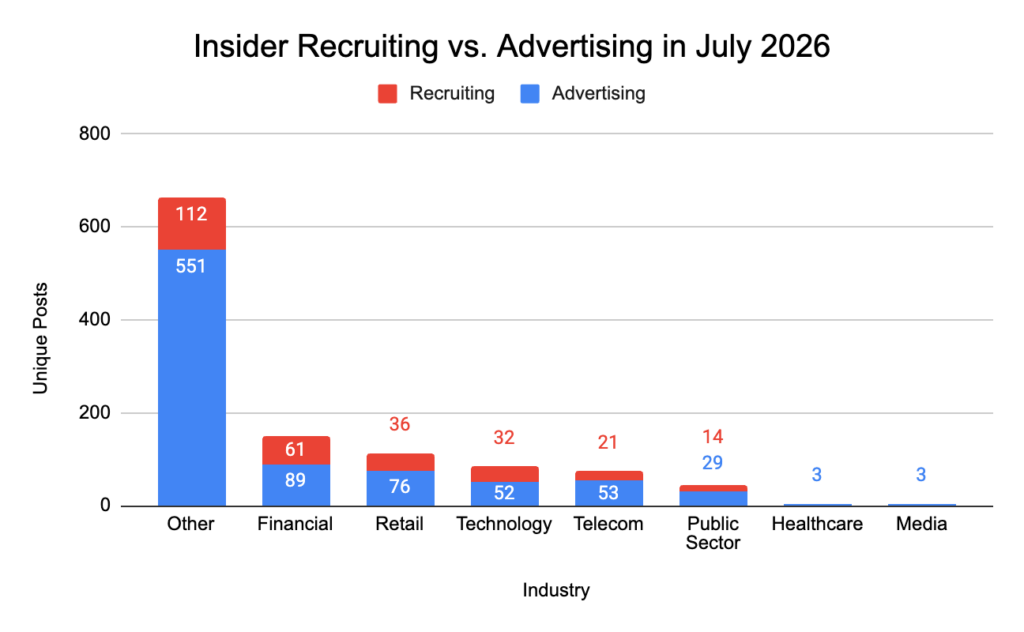
Active insider threats work in two ways: an insider is “recruited” by a malicious outside party, or a malicious insider “advertises” their access and skills to an interested threat actor. Regardless, by leveraging this connection, insiders assist adversaries by exfiltrating valuable data, installing malware, sabotaging IT systems, or performing SIM swaps.

In July 2026, Flashpoint found that over 75% of unique threat actor posts came from insiders advertising their access to malicious third parties. This indicates a highly motivated internal threat landscape where disgruntled employees actively seek out buyers for corporate data and network entry points.

Flashpoint chart showing recruiting vs advertising in insider threat activity

Protect Against Insider Threats Using Flashpoint

Insider threats are inherently difficult to detect using internal security controls alone because the malicious activity relies on valid credentials and legitimate access privileges. Relying solely on internal logs means security teams often only detect an insider threat after data exfiltration or system sabotage has already occurred.

Flashpoint protects organizations against insider threats through our Primary Source Collection (PSC) and specialized intelligence platforms:

  • External Threat Intelligence & Early Warning: Flashpoint monitors deep and dark web forums, invite-only threat communities, and encrypted chat platforms to identify employee solicitations, stolen corporate domain mentions, and active recruitment attempts before an intrusion develops.
  • Identity Protection & Infostealer Tracking: By tracking illicit marketplaces and infostealer activity, Flashpoint identifies compromised corporate credentials and active session tokens, preventing threat actors from utilizing purchased access.
  • User & Entity Behavior Context: Flashpoint’s intelligence equips SOC, Security Operations, and Risk Management teams with adversary TTPs, enabling security operations to look for anomalous data downloads, off-hours access, or unauthorized software installation.

To learn more about how Flashpoint can help protect your enterprise from insider risk and monitor illicit underground communities, Request a Demo Today.

Frequently Asked Questions (FAQs)

What is the Flashpoint Insider Threat Report?

The Flashpoint Insider Threat Report is a monthly intelligence brief that analyzes trends, volume, targeted industries, and tactics surrounding insider threat recruitment and illicit access advertising on the deep web, dark web, and encrypted chat channels.

How does Flashpoint collect insider threat data?

Flashpoint collects data using its Primary Source Collection (PSC) engine, which actively monitors thousands of dark web forums, illicit marketplaces, and underground chat networks where threat actors and malicious insiders communicate.

What is the difference between insider recruitment and insider advertising?

Insider recruitment occurs when an external cybercriminal attempts to entice a corporate employee into assisting with a cyberattack. Insider advertising occurs when an employee or contractor proactively lists their legitimate access or services for sale on illicit marketplaces.

See Flashpoint in Action

The post Insider Threat Report: Dark Web Recruitment & Access Trends appeared first on Flashpoint.

  •  

Navigating AI-Driven Cyber Threats: Insights from Flashpoint’s 2026 GTIR Midyear Edition

Blogs

Blog

Navigating AI-Driven Cyber Threats: Insights from Flashpoint’s 2026 GTIR Midyear Edition

In this post, we preview the critical findings of Flashpoint’s Global Threat Intelligence Report: 2026 Midyear Edition.

SHARE THIS:
Default Author Image
August 13, 2026

In the first half of 2026, the global threat landscape reached a clear operational inflection point: threat operations have fundamentally transitioned from human-led campaigns to machine-speed, AI-driven exploitation. As threat actors gain commoditized access to open-source AI technologies and actively deploy automated, safeguard-free tooling locally on private infrastructure, organizations face an accelerating hybrid risk environment.

Flashpoint’s Global Threat Intelligence Report: 2026 Midyear Edition

The Flashpoint Global Threat Intelligence Report: 2026 Midyear Edition anchors security leaders—from threat intelligence, vulnerability management, to executive leadership—in the data required to navigate this evolving threat landscape. Covering the period from January 1 to June 30, 2026, the report delivers timely insights backed by Flashpoint’s proprietary primary-source collection from over 3.9 petabytes of continuously monitored illicit sources.

Our midyear findings reveal several key metrics that highlight the speed and scale of the H1 2026 threat landscape:

  • 22M+ threat actor posts discussed, shared, or advertised artificial intelligence toolkits for criminal deployment.
  • 1.7B credentials and identity data points extracted across more than 7.4M unique compromised hosts globally.
  • Nearly one-in-five (19%) of all vulnerability disclosures dropped with ready-made, functional exploit code.
  • 45% period-over-period surge in Ransomware-as-a-Service (RaaS), with total victim volume reaching 6,256 even as victim payout rates dropped to a historic low of 28%.

Download the Flashpoint Global Threat Intelligence Report: 2026 Midyear Edition to gain:

  1. A Clear Understanding of the Convergence Between AI and Cyber Threats
    From generating flawless phishing campaigns to automating vulnerability scanning and code obfuscation, discover how adversaries are optimizing for speed and cost-efficiency — utilizing AI as a force multiplier in their various illicit campaigns.
  2. A Comprehensive Top-Down View of the Evolving Threat Landscape
    Gain full visibility of the threat landscape with Flashpoint’s primary-source collections and real-time threat intelligence.
  3. Strategies for Proactive Defense and Risk Mitigation
    Move your organization beyond reactive incident response by leveraging Flashpoint’s comprehensive threat intelligence. Gain the foresight needed to strengthen defenses and optimize your security posture.

AI is compressing the time between opportunity and exploitation. Capabilities that once took significant expertise, coordination, and time to develop are becoming faster to build, easier to scale, and harder to detect. Security teams are facing an adversary ecosystem that can use AI to iterate at unprecedented speed — the only way to keep pace is with primary-source intelligence that surfaces adversary behavior before attacks unfold.

Josh Lefkowitz, Flashpoint Co-Founder & CEO

The Four Driving Themes Shaping the 2026 Threat Landscape

Artificial Intelligence (AI) Threats

During the first half of 2026, Flashpoint captured over 22M illicit posts discussing or advertising AI for criminal-related activities. By stripping ethical safeguards, custom malicious LLMs allow unsophisticated threat actors to automate complex phases of the attack lifecycle, including target profiling, malware evasion script creation, and zero-day exploit generation.

chart visualization

Information-Stealing Malware Threats

Infostealer malware harvested 1.7 billion credentials across 7.4 million compromised systems in H1 2026 alone, turning digital identity into the main entry point for enterprise intrusions.

chart visualization

Vulnerability Intelligence and Patching Management

19% (4,015) of all H1 2026 vulnerability disclosures arrived with ready-made exploit code. Adversaries deploy automated replication scripts almost immediately upon disclosure, eliminating manual remediation windows.

interactive diagram visualization

Ransomware Operations, Multi-Extortion Cartels, and Financial Risk

Despite a 45% surge in victim volume (6,256 overall), total on-chain revenue fell by 8% to $820M. Improved enterprise backups and incident response have driven payout rates down to 28%, prompting syndicates to demand larger sums from paying victims.

chart visualization

Proactive Security in 2026 and Beyond

The data shows that traditional enterprise security organizations are struggling to keep pace with modern threat cycles that are accelerated by illicit uses of AI. This continued convergence of AI engines and initial access vectors have further compressed attack timelines, making it nearly impossible for security teams to defend against them—especially if they are limited by traditional approaches to threat intelligence.

Equipping your team with primary-source threat intelligence is critical for protecting critical assets in 2026. Download the Flashpoint Global Threat Intelligence Report: 2026 Midyear Edition to gain the visibility and strategic clarity required to defend your organization.

See Flashpoint in Action

The post Navigating AI-Driven Cyber Threats: Insights from Flashpoint’s 2026 GTIR Midyear Edition appeared first on Flashpoint.

  •  

Data Center Physical Security: Mitigating FPV Drone Threats

Blogs

Blog

Data Center Physical Security: Mitigating FPV Drone Threats

In this post, we explore how shifting online sentiment and low-cost First-Person View (FPV) technology are creating an unprecedented airborne threat vector for critical data center infrastructure.

SHARE THIS:
Default Author Image
August 10, 2026

Data centers have become a driving force in the modern digital economy—powering cloud services, global enterprise operations, and the explosive growth of artificial intelligence (AI). However, due to growing negative public discourse, data centers are facing a new physical threat vector: low-cost, payload-capable drones.

According to Flashpoint research, shifting public sentiment surrounding AI development, combined with the extreme accessibility of First-Person View (FPV) drone technology, is creating an unprecedented hybrid threat to physical critical infrastructure.

Here is what you need to know about this emerging threat landscape and what it means for physical security teams protecting critical assets.

Growing Online Sentiment and Anti-AI Hostility

Organizations tasked with protecting critical data infrastructure need to understand that this growing threat is not developing in a vacuum. Across both clearnet and Deep and Dark Web (DDW) forums, online discussions regarding data center expansion have intensified, with a significant portion bordering on hostility. Key drivers of negative sentiment include:

  • Environmental & Local Concerns: Debates over massive energy consumption, water usage, noise, and localized quality-of-life impacts.
  • Backlash against AI: Discontent directed at tech companies driving the rapid deployment of AI infrastructure.
  • Perceived Regulatory Inaction: Frustration among activists who feel local and state governments are failing to halt or regulate new construction.

While much of the current online chatter currently revolves around organized protests and aspirational threats, Flashpoint analysts note a troubling uptick in rhetoric targeting corporate tech executives and data center infrastructure.

The Evolving Data Center Threat Landscape

Data centers across the United States are seeing a rapid increase in physical and operational threats. Vandalism and property destruction have become common topics in illicit online spaces when discussing data centers and their impact on everyday life. Flashpoint research highlights two primary force multipliers driving this threat:

DIY Drones & Low Barriers to Entry

Historically, kinetic airborne strikes required specialized equipment and advanced training. Today, that barrier to entry has virtually collapsed. Rapid improvements in drone manufacturing have made payload-capable aircraft extraordinarily accessible. In today’s market, an individual can purchase an off-the-shelf system or assemble a customized drone for under $1,000 USD.

Inspiration for these tactics is also readily available; widespread footage of FPV drones operating in conflict zones like Ukraine has demonstrated to online audiences how easily and effectively low-cost aircrafts can be weaponized. Threat actors view this as a high-yield investment, especially given the capability to deploy multiple drones in quick succession.

Protests as Cover for Physical Operations

Organized protests to stop data center development remain prevalent, and large crowds can easily overwhelm contracted security personnel, diminishing the effectiveness of a response to an aerial threat. A malicious actor could use a protest at a data center as cover to cause physical damage to the facility while security resources are spread thin. For example, on July 19, 2026, activists threw balloons filled with acetic acid at a data center construction site in Amsterdam. In its aftermath, Flashpoint analysts captured individuals online discussing the use of drones to deliver similar payloads.

Regulatory and Defense Measure Challenges

Current federal regulations limit the ability to effectively deter or stop an incoming drone threat because the US Federal Aviation Administration (FAA) classifies drones as aircraft. Therefore, organizations specializing in the physical security of data centers will likely need to increase their operational capabilities and advise companies on potential hardening to deter attacks.

Traditional foot patrols and monitoring perimeter access control points will be insufficient in mitigating overhead threats. The majority of data centers are currently not equipped with the specialized Counter-Unmanned Aircraft Systems (C-UAS) equipment, specialized training, or legal authorization needed to respond effectively to airborne incursions.

Protect Critical Infrastructure Using Flashpoint

Defending against aerial incursions requires moving from reactive security to proactive, intelligence-led physical protection. Physical security teams cannot afford to rely solely on ground-level surveillance when threat actors are leveraging open-source hardware and coordinating online.

Flashpoint Physical Security Intelligence (PSI) equips security teams and executive protection units with real-time visibility into emerging physical threats before they reach your perimeter:

  • Early Warning Indicator Tracking: Monitor chatter across mainstream social platforms, fringe networks, and illicit DDW forums to identify probe attempts or the targeting of specific data center facilities and executives.
  • Geospatial Threat Mapping: Overlay real-time intelligence onto physical assets using customizable geofencing to detect active incidents, protest activity, and drone-related discussions near sensitive sites.
  • Actionable Counter-UAS Insights: Receive finished intelligence and analyst support to benchmark threat actor TTPs (Tactics, Techniques, and Procedures), enabling your organization to harden physical structures and justify operational investments.

To learn more about how Flashpoint helps safeguard critical infrastructure, executives, and high-value assets against physical and cyber threats, request a demo today.

See Flashpoint in Action

The post Data Center Physical Security: Mitigating FPV Drone Threats appeared first on Flashpoint.

  •  

Beyond Cyber: How CTI Teams Are Solving Converged Threat Use Cases

Blogs

Blog

Beyond Cyber: How CTI Teams Are Solving Converged Threat Use Cases

In this post we explain how cyber threat intelligence teams are being expected to take on physical risk, how tradecraft overlaps, and how Flashpoint bridges the gap.

SHARE THIS:
Default Author Image
August 6, 2026

For years, the mandate of Cyber Threat Intelligence (CTI) teams has been narrow and well understood: track cyber threat actors, monitor for indicators of compromise, and defend the network. However, that mandate is widening. In today’s interconnected threat landscape, more CTI teams are being tasked with physical security, geopolitical and protective intelligence. Whether that is monitoring and securing executive travel, a facility, or an event, data shows that this new informal expansion is becoming an industry-wide shift.

What the Data Says About Cyber-Physical Security Convergence

The SANS 2026 CTI Survey affirms that CTI programs are being asked to cover more ground, including physical and geographical risk, without a proportional increase in headcount. Survey findings additionally emphasize that the risks CTI teams navigate increasingly span cyber, physical, and geopolitical domains simultaneously, rather than staying contained to the network.

Industry research confirms this shift from every angle:

  • ASIS International: The security standards body developed formal Enterprise Security Risk Management (ESRM) guidance specifically to address how organizations struggle to unify physical and cyber risk into a single program with shared visibility.
  • 2026 Physical Security Trends: Market analysis consistently identifies cyber-physical convergence and unified security operations as mainstream mandates rather than fringe concepts.
  • International Security Journal: Analysis highlights a fundamental shift from reactive to proactive security, driven by the reality that digital and physical systems are now so closely linked that a compromise on one side rarely stays contained.

Taken together, the picture is consistent across independent sources: intelligence teams are being pulled toward physical and human risk, and most organizations are still early in closing the gap between that mission and the tooling built to support it.

Why Physical Security is a Natural Extension

It might seem like a jump from tracking ransomware to monitoring executive travel risk, but the underlying methodology is similar. Both rely on:

  1. Situational awareness: Understanding the context around an event, whether digital or physical.
  2. Data aggregation: Bringing together disparate sources into a coherent picture.
  3. Predictive analysis: Identifying indicators of risk before they become incidents.


CTI analysts are already well positioned to bridge this gap. When an executive’s safety or a physical location’s security is at risk, the earliest warning signs are frequently digital via social media sentiment, localized chatter, and open-source discussions. Treating physical security as an adjacent mission means pointing skills a team already has at a new question, rather than starting net-new.

The Strategic Advantage: Breaking Down Operational Silos

Bringing these missions together has a practical benefit beyond the workload—it prevents security silos where digital and physical intelligence teams operate in isolation. When the same team that monitors cyber threats also informs physical security decisions, the organization achieves a more complete view of risk, reducing the chance that threats fall between the gaps of two disconnected functions.

Extending CTI to Physical Security with Flashpoint

Facing this convergence head-on doesn’t require a new platform, a new vendor evaluation, or creating a new discipline. Organizations leveraging Flashpoint Ignite already have the foundation needed to seamlessly extend their visibility into physical and geopolitical threat landscapes.

Using both Flashpoint Cyber Threat Intelligence (CTI) and Flashpoint Physical Security Intelligence (PSI), security teams can answer two essential questions: “what is this threat actor doing” and “what is happening right now around this specific person or place.” Both draw on much of the same underlying data and OSINT tradecraft, so extending into physical security only requires a change in Intelligence Requirements, not mastery of new systems or tools.

With Flashpoint PSI, organizations gain real-time access to mainstream sources where conversations about fast-moving events tend to surface first, plus a geospatial layer that maps that activity to a specific place. Analysts can also draw boundaries around geographic locations to monitor mentions of an executive within that area, or observe a venue on event day, seeing relevant activity as it surfaces. All of this can be accomplished using plain language, removing the need to learn secondary query syntax or lengthy manual processes to get started.

Navigating the Future of Converged Intelligence

The distinction between cyber and physical intelligence will likely keep blurring and Flashpoint is helping security teams on the ground level integrate these two functions. CTI teams that take on physical security as part of their mission shouldn’t be expected to abandon their core discipline. Instead, they should be given the workflows to apply it to a wider set of questions, using tools built to extend rather than replace the way they already work.

See how Flashpoint supports converged cyber and physical missions from a single platform. Request a demo to see what this could look like for your team.

See Flashpoint in Action

The post Beyond Cyber: How CTI Teams Are Solving Converged Threat Use Cases appeared first on Flashpoint.

  •  

Flashpoint EASM: Industry-Leading Vulnerability Intelligence, Mapped to Your Internet-Facing Assets

Blogs

Blog

Flashpoint EASM: Industry-Leading Vulnerability Intelligence, Mapped to Your Internet-Facing Assets

Catch exposures before threat actors do. Here is how Flashpoint’s new module works and the top questions answered from our live demo.

SHARE THIS:
Default Author Image
August 3, 2026

Security teams don’t lose ground because they lack tools. They lose ground because they can’t see everything an attacker can.

This is the challenge we addressed in our latest Demo Day webinar introducing Flashpoint External Attack Surface Management (EASM), a new module inside our Ignite platform that gives security teams a continuous, attacker’s-eye view of their external attack surface, mapped directly to our proprietary vulnerability intelligence.

The Problem: Too Much Noise, Not Enough Context

Most security teams are dealing with three compounding problems:

  1. Disconnected Data: Vulnerability data lives isolated from actual infrastructure. Knowing a CVE exists doesn’t tell you whether it affects your active environment.
  2. Alert Fatigue: CVSS-only prioritization treats every “critical” score as an emergency, even when an asset isn’t internet-facing or exploitable.
  3. Accelerated Threat Cycles: AI is speeding up how quickly threat actors discover and exploit vulnerabilities, making manual tracking impossible.

Layer on top of that the reality that most teams still track their perimeter with spreadsheets or a static CMDB, and you get a widening gap between what security teams think they own and what is actually exposed. This gap has a name: shadow IT.

Shadow IT Is a Growing Blind Spot

Shadow IT covers the domains, subdomains, and cloud instances that get spun up to get work done, without IT’s knowledge or approval. It’s not a fringe issue. According to Gartner, by next year, 75% of employees will be acquiring, modifying, or creating technology outside their IT department’s visibility, up from 41% just a few years ago.

These unmanaged assets sit outside inventory and outside the reach of any scanner that only looks at what’s already known. That makes them exactly the kind of infrastructure an attacker finds first, and exactly the blind spot Flashpoint EASM is built to close.

What is Flashpoint EASM?

Flashpoint EASM gives security teams a continuous, attacker’s-eye view of their external attack surface and maps that view directly to Flashpoint’s vulnerability intelligence. Instead of your team asking “are we affected by this?”, every time a new vulnerability is disclosed, EASM answers that question continuously, often before the answer is obvious anywhere else.

Flashpoint EASM is built on three capabilities that work together:

Continuous Asset Discovery

Flashpoint EASM continuously discovers and monitors internet-facing assets: domains, subdomains, and IPs. New discoveries flow into a dedicated triage inbox, so security teams can quickly accept and focus on what’s actually relevant instead of drowning in noise.

Vulnerability Mapping

Every discovered exposure is mapped to Flashpoint’s proprietary vulnerability intelligence, including our pre-NVD findings, KEV (Known Exploited Vulnerabilities) status, ransomware likelihood, and exploit maturity. This provides organizations with immediate context into the vulnerabilities that pose the most risk.

Customizable Alerting

Using EASM, security teams get alerted to the exact moment a new asset or vulnerability is detected. This alert is fully customizable by severity and is available inside one unified workflow via Flashpoint Ignite.

Discover, map, and alert. This loop gives organizations an intelligence-led view of their perimeter, so they can proactively outpace threat actors instead of being forced to react.

How Flashpoint EASM Works

In our live demo, Flashpoint walked through the EASM workflow, which can be found under “Assets and Identifiers” in the Ignite Platform.

Here’s how it works:

Step 1: Submit Seed Keywords

Onboarding starts with keywords, meaning domain and IP address assets your organization actually owns. Any already set up asset is automatically surfaced in Flashpoint Ignite—such as through our compromised credential monitoring—ensuring no duplicated setup work.

Step 2: Triage Discovered Assets

Once keywords are approved, EASM iterates on them to surface additional related infrastructure, domains and IPs alike, along with a discovery graph showing exactly how each asset was found. That traceability makes it easy to judge relevance at a glance.

Every discovered asset lands in one of three statuses:

  • Owned: Assets in your tech stack. EASM continues discovering related infrastructure from these and links vulnerabilities to them.
  • External: Assets relevant to you, but where you don’t need further discovery, just vulnerability linkage.
  • Discarded: Assets you don’t need, removed from the triage feed entirely.

Step 3: Review the Vulnerable Assets Overview

In the main dashboard, the Vulnerable Assets page, security professionals can view total asset count, number of exposures, unique vulnerabilities affecting them, and total potentially vulnerable assets—in addition to criticality breakdowns for both domains and IPs.

From there, security teams can drill into:

  1. Unique vulnerabilities, filterable by CVE or severity
  2. Domains with vulnerabilities, showing exposure counts by severity and the last exposure date
  3. Individual asset detail pages, showing products, versions, vendors, and ports, with vulnerabilities linked directly to the specific product version affected

Diving deeper into a surfaced vulnerability provides technical descriptions, solution information, and other affected products. Additionally, Flashpoint’s vulnerability database includes over 105,000 pre-NVD vulnerabilities, giving vulnerability management teams actionable indicators well before they show up in public sources.

Step 4: Set Up Alerting

Flashpoint EASM gives teams full control over signal versus noise. Whether that means getting notified the moment a critical vulnerability is disclosed, or reviewing a daily summary of your own schedule, EASM offers two alert types:

  • Asset discovery alerts, either per-asset or as a daily rollup
  • Vulnerability alerts, filterable by criticality (critical, high, medium, low), with the option for in-app only or in-app plus email, and available as a daily rollup

Why Flashpoint EASM Matters

  1. Flashpoint EASM isn’t just another scanning tool. The intelligence underneath it is the differentiator: discovery tells you what’s out there, Flashpoint provides the much-needed context to tell you what’s dangerous right now.
  2. The intelligence includes coverage that can’t readily be found elsewhere: Flashpoint’s independently researched data includes pre-NVD findings, improved KEV coverage, ransomware risk scoring, and exploit maturity.
  3. It closes a blind spot teams have quietly lived with: EASM closes shadow IT gaps and surfaces assets sitting outside inventory entirely.

Flashpoint External Attack Surface Management gives security teams a continuous, intelligence-led view of everything a threat actor sees, so organizations can find and fix exposures before they’re exploited. To see it in action in a personalized walkthrough of your own environment, reach out to schedule a demo.

EASM Frequently Asked Questions (FAQs): What Security Teams Want to Know

What makes Flashpoint EASM different from other EASM solutions?

Most EASM tools stop at raw discovery, telling you an asset exists without telling you whether it matters. Flashpoint EASM pairs continuous asset discovery with a triage inbox to cut noise, then maps every asset directly to Flashpoint’s proprietary vulnerability intelligence, all natively inside Ignite alongside CTI and Vulnerability Intelligence. That combination means prioritization is based on real attacker activity, not just an asset inventory, giving remediation teams the exact context they need to proactively address risk.

What makes Flashpoint’s vulnerability intelligence unique?

Flashpoint’s database covers 400,000+ vulnerabilities, including 105,000+ not found in NVD or CVE, often surfaced up to two weeks earlier than public sources. Every entry is enriched with threat-informed context like EPSS scores, ransomware likelihood, exploit maturity, and MITRE ATT&CK mapping, then reviewed by human analysts, not just automated feeds. The result is prioritization based on real-world exploitation risk rather than CVSS alone.

Can existing monitored assets be imported into Flashpoint EASM?
Yes. EASM integrates closely with Flashpoint’s existing assets module, so assets already set up (for example, for compromised credential monitoring) surface automatically during onboarding.

Is there a limit on discovered assets, beyond the 30-keyword cap?
No. The 30-keyword limit only applies to initial seed keywords, to keep that starting set relevant. Once assets are marked owned or external, there’s no cap on ongoing discovery.

How does continuous polling compare to traditional scanning?
Traditional scanners give you a point-in-time snapshot. EASM continuously discovers assets and vulnerabilities, giving you a moving view of your exposure, essentially the same view an attacker would have in real time.

Does EASM identify compound risk, where multiple weaknesses increase exploitability together?
The Vulnerable Assets view surfaces how many vulnerabilities are tied to a given asset, so teams can quickly spot assets carrying disproportionate risk and prioritize accordingly.

Does EASM overlap with SBOM alerting?
Not exactly. SBOM alerting monitors vulnerabilities in assets you already know about. EASM is focused on discovering the assets you don’t know about yet. Most mature security programs benefit from running both in tandem.

See Flashpoint in Action

The post Flashpoint EASM: Industry-Leading Vulnerability Intelligence, Mapped to Your Internet-Facing Assets appeared first on Flashpoint.

  •  
❌