Reading view

N-Day Vulnerability Trends: The Shrinking Window of Exposure and the Rise of “Turn-Key” Exploitation

Blogs

Blog

N-Day Vulnerability Trends: The Shrinking Window of Exposure and the Rise of “Turn-Key” Exploitation

In this post we explore the data-driven shrinkage of the Time to Exploit (TTE) window from 745 days to just 44, and examine why N-day vulnerabilities have become the “turn-key” weapon of choice for modern threat actors.


SHARE THIS:
Default Author Image
February 11, 2026

The race between defenders and threat actors has entered a new, more volatile phase: the rapidly accelerating exploitation of N-day vulnerabilities. Different from zero-days, N-day vulnerabilities are known security flaws that have been publicly disclosed but remain unpatched or unmitigated on an organization’s systems.

Historically, enterprises operated under the assumption of a “patching grace period,” the designated window of time allowed for a vendor to test and deploy a fix before a system is considered non-compliant or at high risk. However, this window is effectively collapsing, with Flashpoint finding that N-days now represent over 80% of all Known Exploited Vulnerabilities (KEVs) tracked over the past four years.

The Collapse of the Time to Exploit (TTE) Window

The most sobering trend for security operations (SecOps) and exposure management teams is the dramatic reduction in Time to Exploit (TTE). In 2020, the average TTE, the time between a vulnerability’s disclosure and its first observed exploitation, was 745 days. By 2025, Flashpoint found that this window has now plummeted to an average of just 44 days.

202520242023202220212020
Average TTE44115296405518745

This contraction represents a strategic shift in adversary tempo. Attackers are no longer waiting for complex, bespoke exploits; they are moving at breakneck speeds to weaponize public disclosures.

N-Days Provide a “Turn-Key” Exploit Advantage

Adversaries have gained a significant advantage through the rapid weaponization of researcher-published Proof-of-Concept (PoC) code. When a fully functional exploit is released alongside a vulnerability disclosure, it becomes a “turn-key” solution for attackers. By combining these ready-made exploits with internet-wide scanning tools like Shodan or FOFA, even unsophisticated threat actors can conduct mass exploitation across large segments of the internet in hours.

A prime example of this path of least resistance approach was observed in the leaked internal chat logs of the BlackBasta ransomware group. Analysis revealed that of the 65 CVEs discussed by the group, 54 were already known KEVs. Rather than spending resources on original zero-day research, threat actors are simply leveraging known, yet unpatched and exploitable vulnerabilities for their campaigns.

Defensive Software is a Primary Target for N-Days

The very software designed to protect enterprise firewalls, VPN gateways, and edge networking devices is consistently the most targeted category for both N-day and zero-day exploitation.

Because cybersecurity devices must be internet-facing to function, they provide a constant, unauthenticated attack surface. In 2025 alone, Flashpoint observed 37 N-days and 52 zero-days specifically targeting security and perimeter software. The requirement for these systems to remain open to external traffic means they will continue to be disproportionately targeted by advanced persistent threat (APT) groups and cybercriminals alike.

Attributing N-Day Attacks

While tracking the “how” of an attack is critical, tracking who is responsible remains a fragmented challenge for the industry. Attribution is often hampered by naming fatigue, where different vendors assign their own designated unique monikers to the same actor. For instance, the widely known threat actor group Lazarus has over 40 distinct designations across the industry, including “Diamond Sleet,” “NICKEL ACADEMY,” and “Guardians of Peace”.

Despite these naming complexities, global activity patterns remain clear. China remains the most active nation-state actor in the vulnerability exploitation space, consistently outpacing Russia, Iran, and North Korea in both the volume and scope of their campaigns.

Obstacles for Enterprise Security: Asset Blindness and the CVE Dependency Trap

Why are organizations struggling to keep pace? The primary factor isn’t a lack of effort, but a lack of visibility.

1. The Asset Inventory Gap

The single greatest breakthrough an enterprise can achieve is not a new AI tool, but a complete asset inventory. Most large organizations are lucky to have an accurate inventory of even 25% of their total assets. Without knowing what you own, vulnerability scans can take days or weeks to return results that the adversary is already using to probe your network.

2. The CVE Blindspot

Most traditional security tools are CVE-dependent. However, thousands of vulnerabilities are disclosed every year that never receive an official CVE ID. These “missing” vulnerabilities represent a massive blindspot for standard scanners. Intelligence-led exposure management requires looking beyond the CVE ecosystem into proprietary databases like Flashpoint’s VulnDB™, which tracks over 105,000 vulnerabilities that public sources miss.

Move Towards Intelligence-Led Exposure Management Using Flashpoint

To survive in an era where weaponization can happen in under 24 hours, organizations must shift from reactive patching to a threat-informed and proactive security approach. This means:

  • Prioritizing by Exploitability and Threat Actor Activity: Focus on vulnerabilities that are remotely exploitable and have known public exploits, rather than just high CVSS scores.
  • Adopting an Asset-Inventory Approach: Moving away from slow, periodic scans in favor of continuous asset mapping that allows for immediate triage.
  • Operationalizing Intelligence: Embedding real-time threat data directly into SOC and IR workflows to reduce the “mean time to action”.

The goal of exposure management is to look at your organization through the adversary’s lens. By understanding which N-days threat actors are actually discussing and weaponizing in the wild, defenders can finally start to close the window of exposure before a potential compromise can occur.

Flashpoint’s vulnerability threat intelligence can help your organization go from reactive to proactive. Request a demo today and gain access to quality vulnerability intelligence that enables intelligence-led exposure management.

Request a demo today.

The post N-Day Vulnerability Trends: The Shrinking Window of Exposure and the Rise of “Turn-Key” Exploitation appeared first on Flashpoint.

  •  

Flashpoint Weekly Vulnerability Insights and Prioritization Report

Blogs

Blog

Flashpoint Weekly Vulnerability Insights and Prioritization Report

Week of December 20 – December 26, 2025

Anticipate, contextualize, and prioritize vulnerabilities to effectively address threats to your organization.

SHARE THIS:
Default Author Image
December 31, 2025

Flashpoint’s VulnDB™ documents over 400,000 vulnerabilities and has over 6,000 entries in Flashpoint’s KEV database, making it a critical resource as vulnerability exploitation rises. However, if your organization is relying solely on CVE data, you may be missing critical vulnerability metadata and insights that hinder timely remediation. That’s why we created this weekly series—where we surface and analyze the most high priority vulnerabilities security teams need to know about.

Key Vulnerabilities:
Week of December 20 – December 26, 2025

Foundational Prioritization

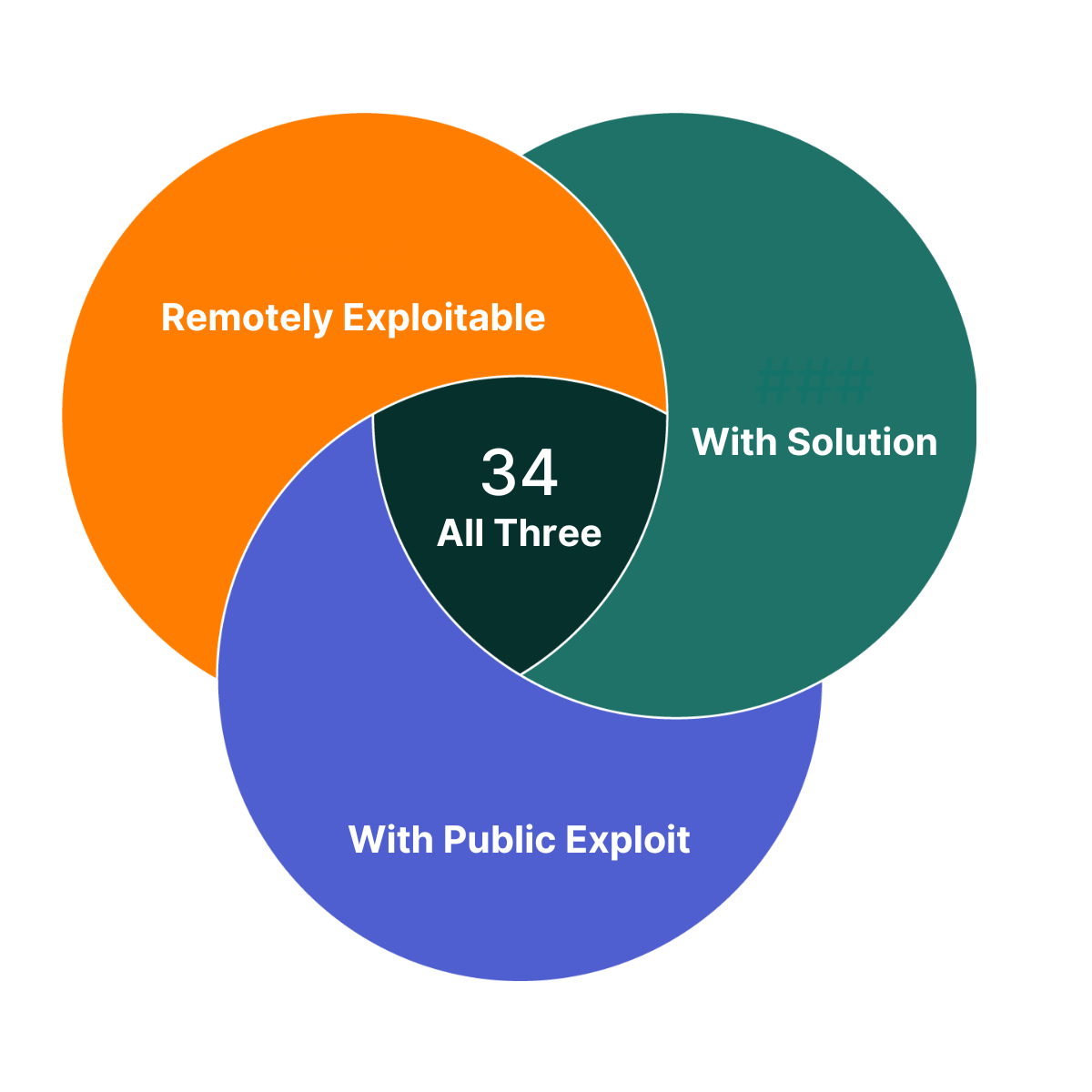
Of the vulnerabilities Flashpoint published this week, there are 34 that you can take immediate action on. They each have a solution, a public exploit exists, and are remotely exploitable. As such, these vulnerabilities are a great place to begin your prioritization efforts.

Diving Deeper – Urgent Vulnerabilities

Of the vulnerabilities Flashpoint published last week, four are highlighted in this week’s Vulnerability Insights and Prioritization Report because they contain one or more of the following criteria:

  • Are in widely used products and are potentially enterprise-affecting
  • Are exploited in the wild or have exploits available
  • Allow full system compromise
  • Can be exploited via the network alone or in combination with other vulnerabilities
  • Have a solution to take action on

In addition, all of these vulnerabilities are easily discoverable and therefore should be investigated and fixed immediately.

To proactively address these vulnerabilities and ensure comprehensive coverage beyond publicly available sources on an ongoing basis, organizations can leverage Flashpoint Vulnerability Intelligence. Flashpoint provides comprehensive coverage encompassing IT, OT, IoT, CoTs, and open-source libraries and dependencies. It catalogs over 100,000 vulnerabilities that are not included in the NVD or lack a CVE ID, ensuring thorough coverage beyond publicly available sources. The vulnerabilities that are not covered by the NVD do not yet have CVE ID assigned and will be noted with a VulnDB ID.

CVE IDTitleCVSS Scores (v2, v3, v4)Exploit StatusExploit ConsequenceRansomware Likelihood ScoreSocial Risk ScoreSolution Availability
CVE-2025-33222NVIDIA Isaac Launchable Unspecified Hardcoded Credentials5.0
9.8
9.3
PrivateCredential DisclosureHighLowYes
CVE-2025-33223NVIDIA Isaac Launchable Unspecified Improper Execution Privileges Remote Code Execution10.0
9.8
9.3
PrivateRemote Code ExecutionHighLowYes
CVE-2025-68613n8n Package for Node.js packages/workflow/src/expression-evaluator-proxy.ts Workflow Expression Evaluation Remote Code Execution9.0
9.9
9.4
PublicRemote Code ExecutionHighHighYes
CVE-2025-14847MongoDB transport/message_compressor_zlib.cpp ZlibMessageCompressor::decompressData() Function Zlib Compressed Protocol Header Handling Remote Uninitialized Memory Disclosure (Mongobleed)10.0
9.8
9.3
PublicUninitialized Memory DisclosureHighHighYes
Scores as of: December 30, 2025

NOTES: The severity of a given vulnerability score can change whenever new information becomes available. Flashpoint maintains its vulnerability database with the most recent and relevant information available. Login to view more vulnerability metadata and for the most up-to-date information.

CVSS scores: Our analysts calculate, and if needed, adjust NVD’s original CVSS scores based on new information being available.

Social Risk Score: Flashpoint estimates how much attention a vulnerability receives on social media. Increased mentions and discussions elevate the Social Risk Score, indicating a higher likelihood of exploitation. The score considers factors like post volume and authors, and decreases as the vulnerability’s relevance diminishes.

Ransomware Likelihood: This score is a rating that estimates the similarity between a vulnerability and those known to be used in ransomware attacks. As we learn more information about a vulnerability (e.g. exploitation method, technology affected) and uncover additional vulnerabilities used in ransomware attacks, this rating can change.

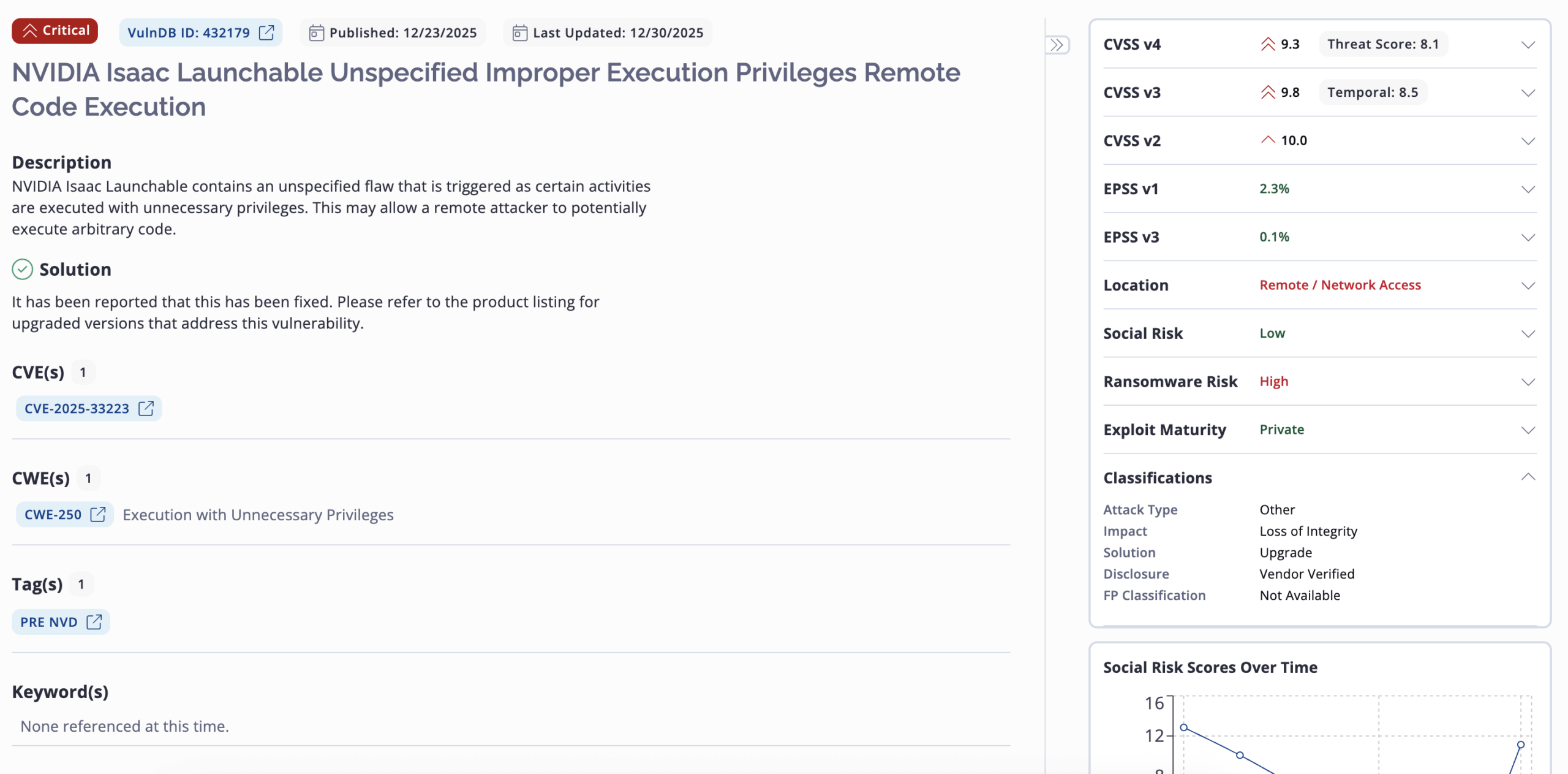
Flashpoint Ignite lays all of these components out. Below is an example of what this vulnerability record for CVE-2025-33223 looks like.


This record provides additional metadata like affected product versions, MITRE ATT&CK mapping, analyst notes, solution description, classifications, vulnerability timeline and exposure metrics, exploit references and more.

Analyst Comments on the Notable Vulnerabilities

Below, Flashpoint analysts describe the five vulnerabilities highlighted above as vulnerabilities that should be of focus for remediation if your organization is exposed.

CVE-2025-33222

NVIDIA Isaac Launchable contains a flaw that is triggered by the use of unspecified hardcoded credentials. This may allow a remote attacker to trivially gain privileged access to the program.

CVE-2025-33223

NVIDIA Isaac Launchable contains an unspecified flaw that is triggered as certain activities are executed with unnecessary privileges. This may allow a remote attacker to potentially execute arbitrary code.

CVE-2025-68613

n8n Package for Node.js contains a flaw in packages/workflow/src/expression-evaluator-proxy.ts that is triggered as workflow expressions are evaluated in an improperly isolated execution context. This may allow an authenticated, remote attacker to execute arbitrary code with the privileges of the n8n process.

CVE-2025-14847

MongoDB contains a flaw in the ZlibMessageCompressor::decompressData() function in mongo/transport/message_compressor_zlib.cpp that is triggered when handling mismatched length fields in Zlib compressed protocol headers. This may allow a remote attacker to disclose uninitialized memory contents on the heap.

Previously Highlighted Vulnerabilities

CVE/VulnDB IDFlashpoint Published Date
CVE-2025-21218Week of January 15, 2025
CVE-2024-57811Week of January 15, 2025
CVE-2024-55591Week of January 15, 2025
CVE-2025-23006Week of January 22, 2025
CVE-2025-20156Week of January 22, 2025
CVE-2024-50664Week of January 22, 2025
CVE-2025-24085Week of January 29, 2025
CVE-2024-40890Week of January 29, 2025
CVE-2024-40891Week of January 29, 2025
VulnDB ID: 389414Week of January 29, 2025
CVE-2025-25181Week of February 5, 2025
CVE-2024-40890Week of February 5, 2025
CVE-2024-40891Week of February 5, 2025
CVE-2024-8266Week of February 12, 2025
CVE-2025-0108Week of February 12, 2025
CVE-2025-24472Week of February 12, 2025
CVE-2025-21355Week of February 24, 2025
CVE-2025-26613Week of February 24, 2025
CVE-2024-13789Week of February 24, 2025
CVE-2025-1539Week of February 24, 2025
CVE-2025-27364Week of March 3, 2025
CVE-2025-27140Week of March 3, 2025
CVE-2025-27135Week of March 3, 2025
CVE-2024-8420Week of March 3, 2025
CVE-2024-56196Week of March 10, 2025
CVE-2025-27554Week of March 10, 2025
CVE-2025-22224Week of March 10, 2025
CVE-2025-1393Week of March 10, 2025
CVE-2025-24201Week of March 17, 2025
CVE-2025-27363Week of March 17, 2025
CVE-2025-2000Week of March 17, 2025
CVE-2025-27636
CVE-2025-29891
Week of March 17, 2025
CVE-2025-1496
Week of March 24, 2025
CVE-2025-27781Week of March 24, 2025
CVE-2025-29913Week of March 24, 2025
CVE-2025-2746Week of March 24, 2025
CVE-2025-29927Week of March 24, 2025
CVE-2025-1974 CVE-2025-2787Week of March 31, 2025
CVE-2025-30259Week of March 31, 2025
CVE-2025-2783Week of March 31, 2025
CVE-2025-30216Week of March 31, 2025
CVE-2025-22457Week of April 2, 2025
CVE-2025-2071Week of April 2, 2025
CVE-2025-30356Week of April 2, 2025
CVE-2025-3015Week of April 2, 2025
CVE-2025-31129Week of April 2, 2025
CVE-2025-3248Week of April 7, 2025
CVE-2025-27797Week of April 7, 2025
CVE-2025-27690Week of April 7, 2025
CVE-2025-32375Week of April 7, 2025
VulnDB ID: 398725Week of April 7, 2025
CVE-2025-32433Week of April 12, 2025
CVE-2025-1980Week of April 12, 2025
CVE-2025-32068Week of April 12, 2025
CVE-2025-31201Week of April 12, 2025
CVE-2025-3495Week of April 12, 2025
CVE-2025-31324Week of April 17, 2025
CVE-2025-42599Week of April 17, 2025
CVE-2025-32445Week of April 17, 2025
VulnDB ID: 400516Week of April 17, 2025
CVE-2025-22372Week of April 17, 2025
CVE-2025-32432Week of April 29, 2025
CVE-2025-24522Week of April 29, 2025
CVE-2025-46348Week of April 29, 2025
CVE-2025-43858Week of April 29, 2025
CVE-2025-32444Week of April 29, 2025
CVE-2025-20188Week of May 3, 2025
CVE-2025-29972Week of May 3, 2025
CVE-2025-32819Week of May 3, 2025
CVE-2025-27007Week of May 3, 2025
VulnDB ID: 402907Week of May 3, 2025
VulnDB ID: 405228Week of May 17, 2025
CVE-2025-47277Week of May 17, 2025
CVE-2025-34027Week of May 17, 2025
CVE-2025-47646Week of May 17, 2025
VulnDB ID: 405269Week of May 17, 2025
VulnDB ID: 406046Week of May 19, 2025
CVE-2025-48926Week of May 19, 2025
CVE-2025-47282Week of May 19, 2025
CVE-2025-48054Week of May 19, 2025
CVE-2025-41651Week of May 19, 2025
CVE-2025-20289Week of June 3, 2025
CVE-2025-5597Week of June 3, 2025
CVE-2025-20674Week of June 3, 2025
CVE-2025-5622Week of June 3, 2025
CVE-2025-5419Week of June 3, 2025
CVE-2025-33053Week of June 7, 2025
CVE-2025-5353Week of June 7, 2025
CVE-2025-22455Week of June 7, 2025
CVE-2025-43200Week of June 7, 2025
CVE-2025-27819Week of June 7, 2025
CVE-2025-49132Week of June 13, 2025
CVE-2025-49136Week of June 13, 2025
CVE-2025-50201Week of June 13, 2025
CVE-2025-49125Week of June 13, 2025
CVE-2025-24288Week of June 13, 2025
CVE-2025-6543Week of June 21, 2025
CVE-2025-3699Week of June 21, 2025
CVE-2025-34046Week of June 21, 2025
CVE-2025-34036Week of June 21, 2025
CVE-2025-34044Week of June 21, 2025
CVE-2025-7503Week of July 12, 2025
CVE-2025-6558Week of July 12, 2025
VulnDB ID: 411705Week of July 12, 2025
VulnDB ID: 411704Week of July 12, 2025
CVE-2025-6222Week of July 12, 2025
CVE-2025-54309Week of July 18, 2025
CVE-2025-53771Week of July 18, 2025
CVE-2025-53770Week of July 18, 2025
CVE-2025-54122Week of July 18, 2025
CVE-2025-52166Week of July 18, 2025
CVE-2025-53942Week of July 25, 2025
CVE-2025-46811Week of July 25, 2025
CVE-2025-52452Week of July 25, 2025
CVE-2025-41680Week of July 25, 2025
CVE-2025-34143Week of July 25, 2025
CVE-2025-50454Week of August 1, 2025
CVE-2025-8875Week of August 1, 2025
CVE-2025-8876Week of August 1, 2025
CVE-2025-55150Week of August 1, 2025
CVE-2025-25256Week of August 1, 2025
CVE-2025-43300Week of August 16, 2025
CVE-2025-34153Week of August 16, 2025
CVE-2025-48148Week of August 16, 2025
VulnDB ID: 416058Week of August 16, 2025
CVE-2025-32992Week of August 16, 2025
CVE-2025-7775Week of August 24, 2025
CVE-2025-8424Week of August 24, 2025
CVE-2025-34159Week of August 24, 2025
CVE-2025-57819Week of August 24, 2025
CVE-2025-7426Week of August 24, 2025
CVE-2025-58367Week of September 1, 2025
CVE-2025-58159Week of September 1, 2025
CVE-2025-58048Week of September 1, 2025
CVE-2025-39247Week of September 1, 2025
CVE-2025-8857Week of September 1, 2025
CVE-2025-58321Week of September 8, 2025
CVE-2025-58366Week of September 8, 2025
CVE-2025-58371Week of September 8, 2025
CVE-2025-55728Week of September 8, 2025
CVE-2025-55190Week of September 8, 2025
VulnDB ID: 419253Week of September 13, 2025
CVE-2025-10035Week of September 13, 2025
CVE-2025-59346Week of September 13, 2025
CVE-2025-55727Week of September 13, 2025
CVE-2025-10159Week of September 13, 2025
CVE-2025-20363Week of September 20, 2025
CVE-2025-20333Week of September 20, 2025
CVE-2022-4980Week of September 20, 2025
VulnDB ID: 420451Week of September 20, 2025
CVE-2025-9900Week of September 20, 2025
CVE-2025-52906Week of September 27, 2025
CVE-2025-51495Week of September 27, 2025
CVE-2025-27224Week of September 27, 2025
CVE-2025-27223Week of September 27, 2025
CVE-2025-54875Week of September 27, 2025
CVE-2025-41244Week of September 27, 2025
CVE-2025-61928Week of October 6, 2025
CVE-2025-61882Week of October 6, 2025
CVE-2025-49844Week of October 6 2025
CVE-2025-57870Week of October 6, 2025
CVE-2025-34224Week of October 6, 2025
CVE-2025-34222Week of October 6, 2025
CVE-2025-40765Week of October 11, 2025
CVE-2025-59230Week of October 11, 2025
CVE-2025-24990Week of October 11, 2025
CVE-2025-61884Week of October 11, 2025
CVE-2025-41430Week of October 11, 2025
VulnDB ID: 424051Week of October 18, 2025
CVE-2025-62645Week of October 18, 2025
CVE-2025-61932Week of October 18, 2025
CVE-2025-59503Week of October 18, 2025
CVE-2025-43995Week of October 18, 2025
CVE-2025-62168Week of October 18, 2025
VulnDB ID: 425182Week of October 25, 2025
CVE-2025-62713Week of October 25, 2025
CVE-2025-54964Week of October 25, 2025
CVE-2024-58274Week of October 25, 2025
CVE-2025-41723Week of October 25, 2025
CVE-2025-20354Week of November 1, 2025
CVE-2025-11953Week of November 1, 2025
CVE-2025-60854Week of November 1, 2025
CVE-2025-64095Week of November 1, 2025
CVE-2025-11833Week of November 1, 2025
CVE-2025-64446Week of November 8, 2025
CVE-2025-36250Week of November 8, 2025
CVE-2025-64400Week of November 8, 2025
CVE-2025-12686Week of November 8, 2025
CVE-2025-59118Week of November 8, 2025
VulnDB ID: 426231Week of November 8, 2025
VulnDB ID: 427979Week of November 22, 2025
CVE-2025-55796Week of November 22, 2025
CVE-2025-64428Week of November 22, 2025
CVE-2025-62703Week of November 22, 2025
VulnDB ID: 428193Week of November 22, 2025
CVE-2025-65018Week of November 22, 2025
CVE-2025-54347Week of November 22, 2025
CVE-2025-55182Week of November 29, 2025
CVE-2024-14007Week of November 29, 2025
CVE-2025-66399Week of November 29, 2025
CVE-2022-35420Week of November 29, 2025
CVE-2025-66516Week of November 29, 2025
CVE-2025-59366Week of November 29, 2025
CVE-2025-14174Week of December 6, 2026
CVE-2025-43529Week of December 6, 2026
CVE-2025-8110Week of December 6, 2026
CVE-2025-59719Week of December 6, 2026
CVE-2025-59718Week of December 6, 2026
CVE-2025-14087Week of December 6, 2026
CVE-2025-62221Week of December 6, 2026

Transform Vulnerability Management with Flashpoint

Request a demo today to see how Flashpoint can transform your vulnerability intelligencevulnerability management, and exposure identification program.

Request a demo today.

  •  

Digital Supply Chain Risk: Critical Vulnerability Affecting React Allows for Unauthorized Remote Code Execution

Blogs

Blog

Digital Supply Chain Risk: Critical Vulnerability Affecting React Allows for Unauthorized Remote Code Execution

CVE-2025-55182 (VulnDB ID: 428930), is a severe, unauthenticated RCE impacting a major component of React and its ecosystem, putting global applications at immediate, high-fidelity risk.

SHARE THIS:
Default Author Image
December 4, 2025

The React team disclosed a critical vulnerability impacting three products in the React Server Components (RSC) that allows for unauthenticated remote code execution. 

Flashpoint’s vulnerability research team assesses significant enterprise and supply chain risk given React’s ubiquity: the impacted JavaScript library underpins modern UIs, with 168,640 dependents and more than 51 million weekly downloads.

How CVE-2025-55182 Works

CVE-2025-55182 (VulnDB ID: 428930) impacts all React versions since 19.0.0, meaning that this issue has been potentially exploitable since November 14, 2024. This vulnerability stems from how React handles payloads sent to React Server Function endpoints and deserializes them.

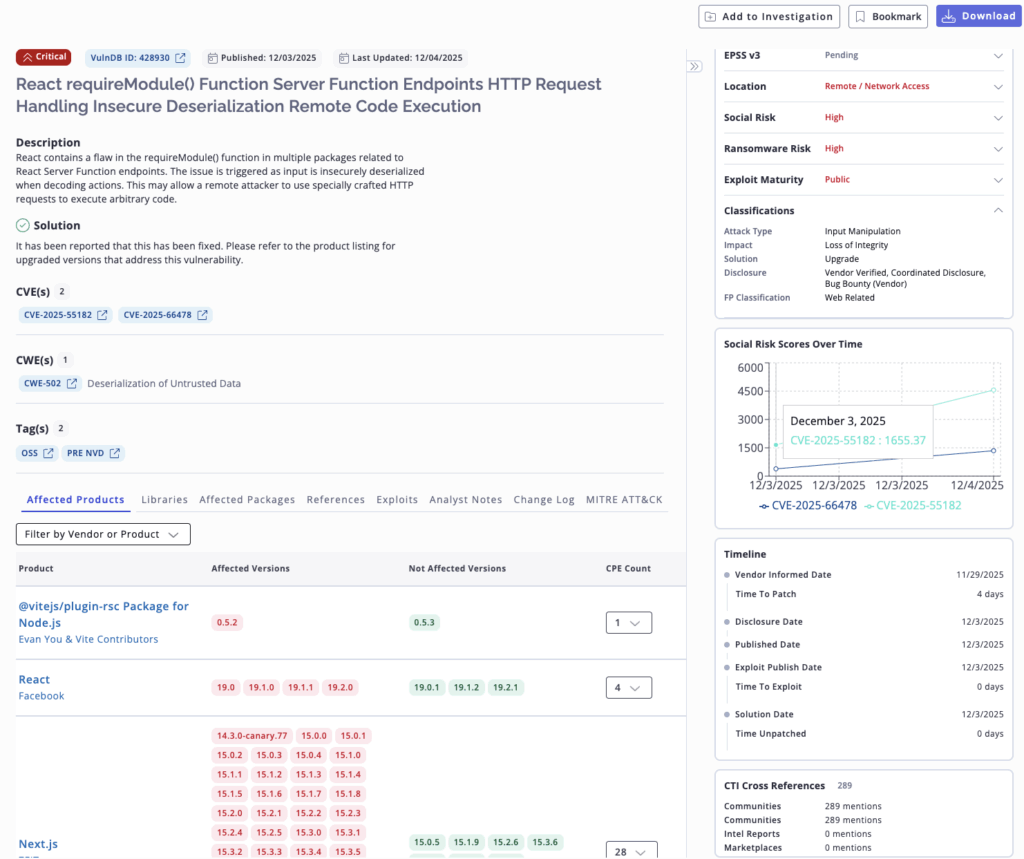
Flashpoint’s VulnDB entry for CVE-2025-55182

Depending on the implementation of this library, a remote, unauthenticated threat actor could send a crafted payload that would be deserialized in a way that causes remote code execution. This would lead to a total compromise of the system hosting the application, allowing for malware such as infostealers, ransomware, or cryptojackers (cryptocurrency mining) to be downloaded.

A working exploit for CVE-2025-55182 has already been published that is effective against some installations. In addition, Amazon has reported that two threat actors, attributed to Chinese Advanced Persistent Threat Groups (APTs), have begun to exploit this vulnerability. Those groups are:

  • Earth Lamia (STAC6451, REF0657, CL-STA-0048)
  • Jackpot Panda (iSoon, DRAGNET PANDA, Anxun Information, deepclif, Poison Carp, Houndstooth Typhoon)

Understanding the Impact and Scope of CVE-2025-55182

It is critical that security teams fully understand the potential downstream scope and impact so that they can fully focus on mitigation, rather than time-consuming research. While the vendor has provided a full disclosure, there are several important caveats to understand about CVE-2025-55182:

  1. Applications not implementing any React Server Function endpoints may still be vulnerable as long as it supports React Server Components.
  2. If an application’s React code does not use a server, it is not affected by this vulnerability.
  3. Applications that do not use a framework, bundler, or bundler plugins that support React Server Components are unaffected by this vulnerability.

Additionally, several React frameworks and bundlers have been discovered to leverage vulnerable React packages in various ways. The following frameworks and bundlers are known to be affected:

  • next
  • react-router
  • waku
  • @parcel/rsc
  • @vitejs/plugin-rsc
  • rwsdk

NPMJS.com currently shows that the react-dom package, which is effectively part of React, has 168,640 dependents. This means that an incredible number of enterprise applications are likely to be affected. Nearly every commercial application is built on hundreds, sometimes thousands of components and dependencies. Furthermore, applications coded via Vibe and similar technology are also likely to leverage React: potentially amplifying the downstream risk this vulnerability poses.

How to Mitigate CVE-2025-55182

For mitigation, the React library has released versions 19.0.1, 19.1.2, and 19.2.1 that resolve the issue. Flashpoint advises organizations to upgrade their respective libraries urgently. Security teams leveraging dynamic SBOMs (Software Bill of Materials) can drastically increase risk mapping and triage for deployed React versions.

CloudFlare has upgraded their web-application firewall (WAF) to protect against CVE-2025-55182. It is available for both free and paid plans but requires that React application traffic is proxied through the CloudFlare WAF.

To avoid confusion, security teams should ignore CVE-2025-66478. It has been rejected for being a duplicate of the preferred CVE-2025-55182.

Mitigate Critical Vulnerabilities Using Flashpoint

Flashpoint strongly recommends security teams treat this vulnerability with utmost urgency. Our vulnerability research team will continue to monitor this vulnerability and its downstream impacts. All updates will be provided via Flashpoint’s VulnDB

Request a demo today and gain access to quality vulnerability intelligence that helps address critical threats in a timely manner.

Request a demo today.

The post Digital Supply Chain Risk: Critical Vulnerability Affecting React Allows for Unauthorized Remote Code Execution appeared first on Flashpoint.
  •  
❌