Reading view

Demystifying The Com and Nihilistic Violent Extremism: What You Need To Know

Blogs

Blog

Demystifying The Com and Nihilistic Violent Extremism: What You Need To Know

In our latest webinar, we explore the rise of Nihilistic Violent Extremism and unpack the digital-to-physical threat landscape of The Com.


SHARE THIS:
Default Author Image
July 28, 2026

Most threat intelligence frameworks were built around clear, recognizable motives—advanced persistent threats seeking intelligence, financially motivated ransomware syndicates, or ideological extremists pursuing political or religious goals. However, security practitioners and physical security teams are facing a vastly different and highly volatile new vector on the threat landscape: Nihilistic Violent Extremism (NVE).

Operating across surface web platforms, niche gaming servers, and encrypted messaging channels, NVE actors seamlessly blend traditional cybercrime, physical violence, real-world property destruction, and severe digital extortion. 

In a recent Flashpoint webinar, our analysts took a deep dive into this complex digital threat, fully breaking down the inner mechanics of NVE, its warning indicators, and how cross-functional security teams can proactively monitor and mitigate these dangerous digital-to-physical threats.

Here are the core takeaways from our on-demand webinar that organizations need to understand.

What is Nihilistic Violent Extremism (NVE)?

Nihilistic Violent Extremism (NVE) defines criminal conduct driven by a deep misanthropy and a desire to trigger societal collapse through random acts of chaos, psychological cruelty, and violence. While casual observers might dismiss these activities as extreme “internet trolling” or adolescent angst, Flashpoint recognizes NVE as a digitized, accelerated evolution of long-standing extremist and occult philosophies.

NVE draws heavily from the Order of Nine Angles (O9A), a paramilitary philosophy originally established in the United Kingdom. Unlike traditional movements seeking political control, O9A advocates for the total destruction of modern civilization to force a return to social darwinism.

How NVE Transitioned from Ideological Literature to Gamified Online Terror

The transition of reclusive occult literature into digital networks followed a deliberate path of gamification. Threat actors stripped away the theological texts, replacing them with fast-paced, highly visual media designed to engage younger audiences on gaming platforms and encrypted messaging apps.

These repackaged materials were then adopted by the various groups within The Com, such as 764 and other scavenger cults. By wrapping graphic violence and extremist symbology in internet humor, these groups lower a recruit’s psychological defenses, accelerating their desensitization and drawing them rapidly into higher-harm activities.

Key Tactics, Techniques, and Procedures (TTPs) of NVE

NVE networks represent a primary example of digital-to-physical convergence, where virtual harassment directly manifests as physical security risks. For NVE actors, violence that remains private is considered wasted effort—because their focus is on generating public fear, breaking taboos, and winning peer status polls, publicity is an operational requirement.

Recorded acts of violence serve as the primary currency across all three pillars of “The Com”. To build status, gain access to private channels, or enforce extortion, threat actors rely on a distinct set of operational tactics to create a societal environment of fear and discord, elaborated on in our expert webinar.

The Demographic Realities and Accessibility of NVE Groups

A critical takeaway from the webinar was the demographic profile and accessibility of NVE networks, with participants—both perpetrators and victims—being overwhelmingly young, typically ranging from ages 11 to 22, with a high concentration of juveniles. Additionally, because extreme coercion and abuse are normalized in these spaces, victims are frequently pressured into becoming enforcers against others as a condition to cease their own victimization.

Because of this young demographic, most NVE actors do not rely solely on Tor hidden services. Instead, they recruit, coordinate, and broadcast activities across mainstream social media, open messaging apps, and popular online gaming platforms.

Protect Against NVE Risk Using Flashpoint

Tracking a highly decentralized threat ecosystem where groups form, rename, and dissolve within hours requires specialized, multi-disciplinary intelligence capabilities. Flashpoint provides enterprise security teams, physical safety leads, and CTI analysts with the visibility required to identify and mitigate NVE activity.

To explore the complete webinar discussion, which includes deeper analyst breakdowns of threat actor activity, behavioral indicators, and enterprise mitigation strategies, watch the on-demand recording today.

See Flashpoint in Action

The post Demystifying The Com and Nihilistic Violent Extremism: What You Need To Know appeared first on Flashpoint.


  •  

Understanding Illicit Ecosystems: Weaponizing Mainstream Apps and Social Infrastructure

Blogs

Blog

Understanding Illicit Ecosystems: Weaponizing Mainstream Apps and Social Infrastructure

As part of our ongoing series, we focus on the shared infrastructure that fuels threat actors; the intersection of mainstream social media, open-source messaging platforms, and gaming communities.

SHARE THIS:

Threat actors and their illicit communities do not exist in a vacuum. To scale their operations, coordinate financial fraud, deploy malware, and recruit new talent, threat actors must interface with the broader digital world. This means leveraging everyday, public digital spaces to facilitate illicit activity, effectively hiding in plain sight.

The Clearnet Threat Landscape: Hiding in Plain Sight

When conceptualizing the cybercriminal underground, it is easy to focus exclusively on Tor-based onion sites or restricted-access dark web forums and marketplaces. However, a massive portion of modern illicit activity thrives on the clearnet. Threat actors heavily utilize commercial social media and public messaging networks to coordinate fraud, deploy malware, and run public relations campaigns for their operations.

At first glance, conducting illicit operations on highly monitored, mainstream platforms seems counterintuitive. However, the massive, continuous volume of legitimate traffic on the clearnet provides a form of operational security. By blending into the noise, threat actors can maintain a highly accessible digital presence. This visibility is crucial for their business models: it allows them to maintain a low barrier to entry for potential recruits and targets who know exactly what markers to look for, or who are systematically funneled into these spaces.

How Threat Actors Weaponize Consumer Platforms

The misuse of mainstream communication tools has changed how threat actors interact. Rather than waiting for users to seek out the dark web, cybercriminals are actively meeting their targets or co-conspirators on platforms designed for daily socialization.

Discord

Originally built to connect gaming communities, Discord’s rapid growth and robust infrastructure have inadvertently made it a target for malicious activity. Cybercriminals treat the platform as a multi-functional tool for both technical infrastructure, social engineering, and radicalization.

On a technical level, advanced persistent threats (APTs) and other threat actors exploit Discord’s content delivery network (CDN) to host and distribute malware. Because traffic to Discord domains is generally trusted by corporate networks, threat actors can potentially use it to deliver payloads—such as infostealers and remote access trojans (RATs)—bypassing standard security perimeters.

Beyond hosting malware, extremist groups across various ideological spectrums often target the platform’s demographic, which skews heavily towards younger tech-savvy users. This group provides an impressionable pool of adolescents who may be susceptible to grooming, indoctrination, and recruitment into illicit operations.

Case Study: The Targeting and Recruitment Mechanics of “The Com”

While monitoring The Com, Flashpoint analysts have observed the systematic use of platforms like Discord, Roblox, and Minecraft to run predatory extortion pipelines. The mechanics of this ecosystem takes place through a multi-phase methodology:

  1. Platform Scouting: Recruiters patrol servers on popular youth-centric gaming platforms, such as Discord, Roblox, and Minecraft. They look for minors showing signs of social isolation, depression, disordered eating, or a desire to belong.
  2. Building Trust and “Love Bombing”: Initial engagements are seemingly harmless. However, trust is built quickly to establish a sense of indebtedness. Recruiters offer gifts such as in-game perks/currency, premium subscriptions, or other digital items. In some cases, a romantic facade is used to establish a connection. In either scenario, “love bombing” creates an immediate feeling of psychological obligation in the target.
  3. Platform Migration: Once rapport is established, the recruiter moves the target away from the game and into an encrypted app or private Discord server, following a public-to-private strategy. By moving the interaction away from the original platform’s safety controls, the recruiter can isolate the target in a more controlled environment.

Once isolated, perpetrators coerce victims into sending sensitive imagery or CSAM. This material is immediately compiled and weaponized as leverage for blackmail via doxxing. This creates a severe psychological trap in which the victim feels compelled to partake in escalating illegal activity to keep their previous actions hidden. This drives the victim to transition from a victim into an aggressor to escape their own abuse.

Telegram

While many social media and messaging platforms can serve as an initial funnel for engagement, Telegram has been known to be used from time to time as an operational hub for the broader illicit ecosystem. Since the arrest of Pavel Durov, Telegram has begun working more closely with law enforcement, leading to several key arrests and major disruptions due to their cooperation. 

The platform occupies a unique space in threat intelligence and open source intelligence (OSINT). While the vast majority of its user base is entirely benign, its minimal moderation policy and robust channel architecture have made it vital to public and private intelligence gathering.

Telegram functions as an open marketplace and real-time coordination center for a vast spectrum of threat actors. Flashpoint has observed it being used by:

  1. State-sponsored APT groups and hacktivists
  2. Geopolitical actors and mercenary groups distributing battlefield intelligence and propaganda
  3. Cybercriminal syndicates coordinating financial fraud schemes, check fraud, and the sale of compromised data.

Furthermore, threat actors routinely use other public-facing platforms like X (formerly Twitter) alongside Telegram to amplify their impact. They leverage the broad reach of social media to broadcast proof of their compromises, hype up ransomware leaks, and exert public pressure on corporate victims during extortion cycles. Concurrently, Telegram often acts as the backend repository where the stolen data is hosted, discussed, and monetized.

Monitor the Clearnet Using Flashpoint

The evolution of illicit ecosystems demonstrates that the lines between the dark web and the clearnet have intersected. Whether analyzing the activities of extremist and threat actor groups or tracking the predatory pipelines of The Com, defenders must look beyond traditional intelligence sources.

Because malicious actors rely heavily on consumer messaging apps and social platforms to coordinate attacks, leak data, and target people, monitoring these public-to-private pipelines is an essential component of threat intelligence. Uncovering these physical and cyber threats requires best-in-class threat intelligence and OSINT investigations capable of parsing the massive noise of the clearnet to find the signals of illicit coordination.

Request a demo to see how Flashpoint empowers security teams to monitor these decentralized threat landscapes to proactively protect their critical assets.

Check out the rest of our “Understanding Illicit Ecosystems” series:
Understanding Illicit Ecosystems: The Hybrid Threat of “The Com”
Understanding Illicit Ecosystems: XSS and the Current State of the Russian-Speaking Underground

See Flashpoint in Action

The post Understanding Illicit Ecosystems: Weaponizing Mainstream Apps and Social Infrastructure appeared first on Flashpoint.

  •  

Understanding Illicit Ecosystems: The Hybrid Threat of “The Com”

Blogs

Blog

Understanding Illicit Ecosystems: The Hybrid Threat of “The Com”

In this post, we dive into the decentralized architecture of “The Com,” exposing its hybrid ecosystem of hacking, extortion, and real-life violence—and how it fuels a ruthless pipeline of cyber-fraud cycles and adolescent exploitation.

SHARE THIS:
Default Author Image
May 26, 2026

What is “The Com”?

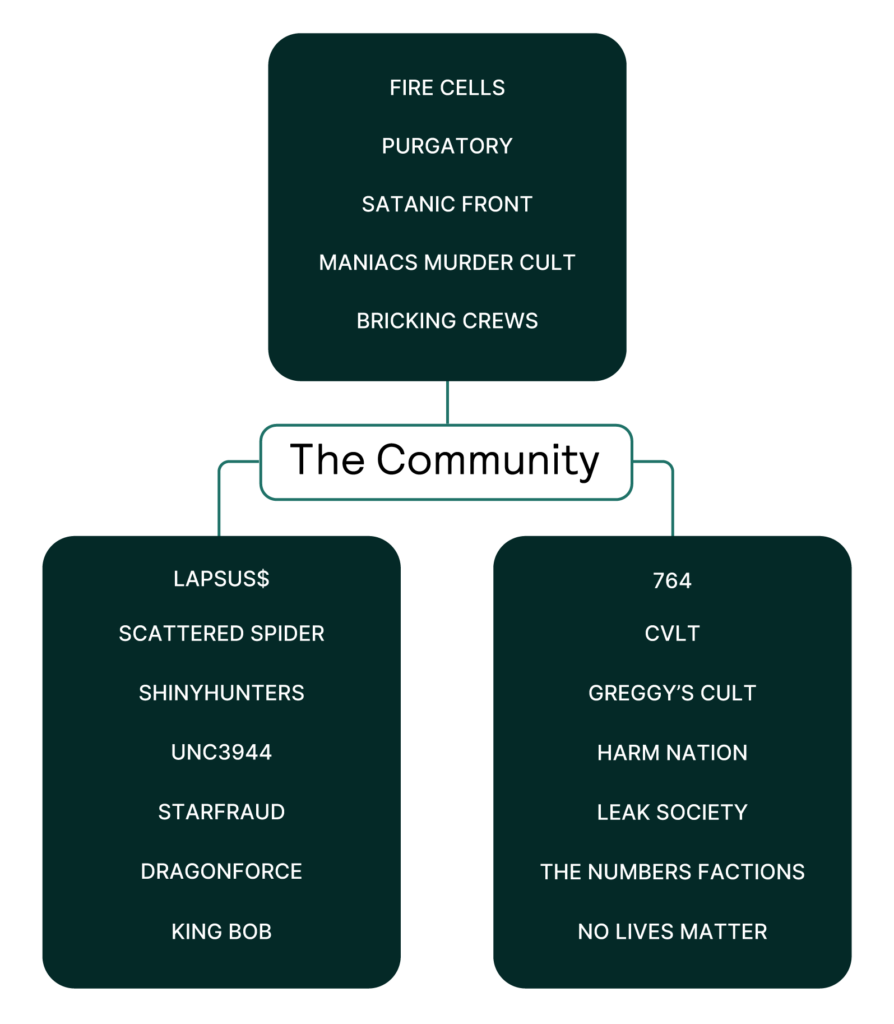
The Community, more widely known as “The Com” is a sophisticated hybrid threat ecosystem in which cybercrime serves as the venture capital for domestic terrorism. Existing since the early 2010s, it operates in the “edgesphere”, a grey area where mainstream social media overlaps with underground criminal networks, blending nihilistic violent extremism (NVE) with high-level financial fraud. In The Com, cybercrime against Fortune 500 companies is the primary revenue stream used by members to fund a domestic terror network that aims to radicalize youth and encourage real-world violence.

However, The Com poses more than just financial risk, it is a self-serving victim-to-perpetrator pipeline. It uses stolen capital to recruit adolescents, who they view as a disposable workforce, turning them from a victim to a perpetrator. Despite being a decentralized web of individuals rather than a traditional threat actor organization, The Com has managed to grow by hiding in the gaps between corporate security, parental oversight, and law enforcement.

How The Com is Structured

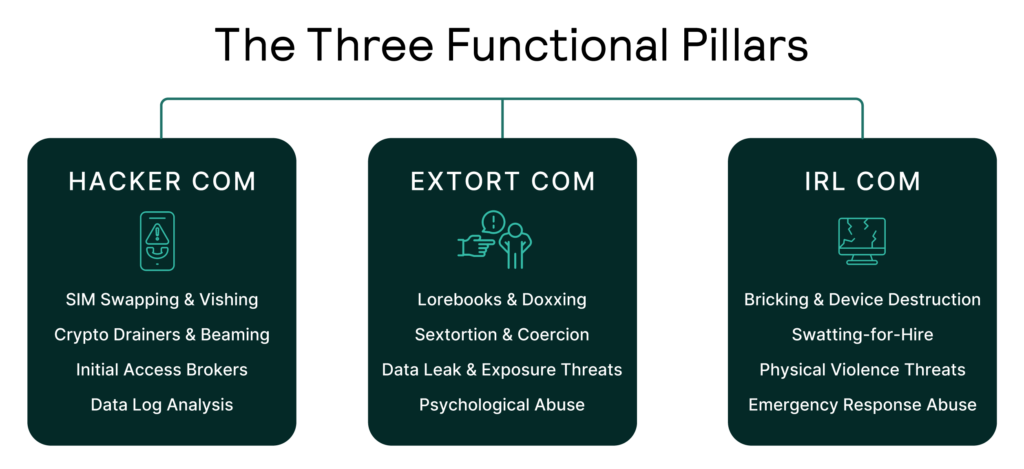
The Com is often mischaracterized as a single, formal organization. In reality, its ecosystem is unstructured and lacks a shared culture or leadership. However, the various factions within the ecosystem are extremely organized, supporting three broad categories of criminal activity: cybercrime, exploitation of minors, and real-world physical violence.

Federal investigations have shown that The Com includes a mix of adults and minors, men and women. While the exact number of members is difficult to determine, Flashpoint estimates that the broader ecosystem of The Com is in the thousands. While being a global threat, its most active core members are concentrated in Western English-speaking countries: the United Kingdom, the United States, and Canada.

Understanding the Key Pillars of The Com

While The Com is a decentralized ecosystem, its internal structure is defined by a high degree of operational alignment. Individual crews and networks within each pillar exhibit a shared psychology and standardized tradecraft that ensures their criminal activities remain effective and repeatable.

However, Flashpoint notes that members of these pillars do not operate alone. Their interaction with members of other pillars (extortion and real-world violence) amplifies the intended threat.

HACKER Com: The Economic Engine of The Com

Hacker Com acts as the ecosystem’s economic engine and primary technical arm. Its primary function is to hack major corporations and commit financial fraud to fund the broader community’s activities and lifestyle.
Seeing themselves as the elite technical tier of The Com, Hacker Com members are motivated primarily by financial gain and the thrill of outsmarting corporate security infrastructures. Notable crews within this pillar include Scattered Spider, LAPSUS$, ShinyHunters, and DragonForce.

TTPs Used by HACKER Com

The following tactics, tools, and procedures (TTPs) have been observed by HACKER COM groups:

Social Engineering (Vishing)

Hacker Com members capitalize on TTPs that target human vulnerabilities instead of relying solely on software and other exploits. Vishing is a signature move of the Scattered Spider crew, whose native English-speaking members call corporate IT helpdesks impersonating employees of that company. 

Analysts note these threat actors are likely Gen Z who socially engineer older support staff by mimicking the impatient attitudes and vernacular of young tech executives, essentially hacking the generation gap. They leverage this form of social engineering to convince support staff to reset passwords or even re-enroll new multifactor authentication (MFA) devices, which grants them access to the victims’ networks.

Supply Chain Targeting

Crews in this pillar have also successfully breached major targets by attacking their trusted vendors. For instance, Lapsus$ compromised Okta by targeting its third-party contractor, Sykes, while Scattered Spider has repeatedly targeted Okta’s identity services to pivot into their clients’ networks.

Living-off-the-land (LOTL)

Once inside a network, threat actors avoid detection by using legitimate, preexisting software and other remote admin tools such as AnyDesk, Ngrok, and Teleport to maintain persistence and move laterally. They often gamify this access, mocking victims for allowing them to simply “log in” using standard admin tools rather than having to hack their way in via complex exploits. They treat the ease of access as a testament to the victim’s incompetence.

SIM Swapping

A SIM swap attack is a foundational TTP used by financially motivated actors that involves social engineering mobile carriers to hijack a target’s phone number, usually resulting in the takeover of high-value cryptocurrency accounts.

EXTORT Com: The Ideological Engine of The Com

The Extort Com pillar functions as a machine designed for psychological control, coercion, and sexual exploitation of minors. Its goals intersect squarely with NVE ideologies, resulting in a marketplace and production center for CSAM and extreme violence, where members often trade these materials as a form of social currency.

Targets are migrated from public channels, which include social media and video games such as Roblox and Minecraft, to private ones maintained by The Com. Once moved, the dynamic shifts from recruitment to active exploitation, which is done to ensure the victim’s compliance.

IRL Com: The Enforcement Engine of The COM

The “In Real Life” (IRL) pillar serves as the physical enforcement arm of the ecosystem, effectively bridging the gap between virtual threats and reality. Sometimes referred to by law enforcement as “IRL Terror,” members often turn online animosity and disputes into real-world harm against people and their property.

Protect Against Converging Threats Using Flashpoint

The evolution of The Com represents a fundamental shift in the global threat landscape. It is not enough to view cybercrime as a purely financial risk or domestic extremism as a purely ideological one, the two have merged into a self-sustaining engine where stolen corporate capital fuels the radicalization and exploitation of the next generation.

As The Com continues to professionalize its tradecraft and expand its reach, the boundary between our digital and physical worlds will only continue to thin. To protect against this decentralized threat, organizations will require a mutli-layered defense strategy that is powered by intelligence that is sourced at the heart of these groups. Request a demo to learn more.

Request a demo today.

The post Understanding Illicit Ecosystems: The Hybrid Threat of “The Com” appeared first on Flashpoint.

  •  
❌