Reading view

AI Threat Report: How Artificial Intelligence Is Used Across Illicit Communities

Blogs

Blog

AI Threat Report: How Artificial Intelligence Is Used Across Illicit Communities

A monthly analysis of how artificial intelligence is used in illicit communities, based on Flashpoint proprietary intelligence and direct visibility into real threat actor environments.

SHARE THIS:

A finance employee joins a video call with their CFO and several colleagues. The request is routine. The faces match. The voices sound authentic. Minutes later, $25 million is transferred—only to be discovered later that every participant on the call, except one, was AI-generated.

Techniques behind incidents like this—synthetic video, voice cloning, scripted interactions—are now being discussed openly in the same environments where threat actors exchange tools and methods. In April 2026 alone, Flashpoint analysts identified 2,328,958 posts discussing artificial intelligence in the context of illicit activity.

This volume reflects a larger shift: artificial intelligence is now deeply embedded across cybercrime ecosystems, influencing fraud, impersonation, social engineering, and access operations at scale. It shows up in how content is generated, how identities are replicated, and how workflows are executed and refined over time.

That’s why we created the monthly AI Threat Report to examine how threat actors are using artificial intelligence in real-world illicit environments. Drawing on Flashpoint proprietary intelligence and direct visibility into primary source communities across forums, marketplaces, and chat services, the report analyzes the tactics, tools, and operational patterns shaping malicious AI use. Analysis of April’s activity shows a focus on prompt-sharing, jailbreak methods, and alternative models that support fewer safeguards or moderation controls.

AI Activity Volume and What It Represents

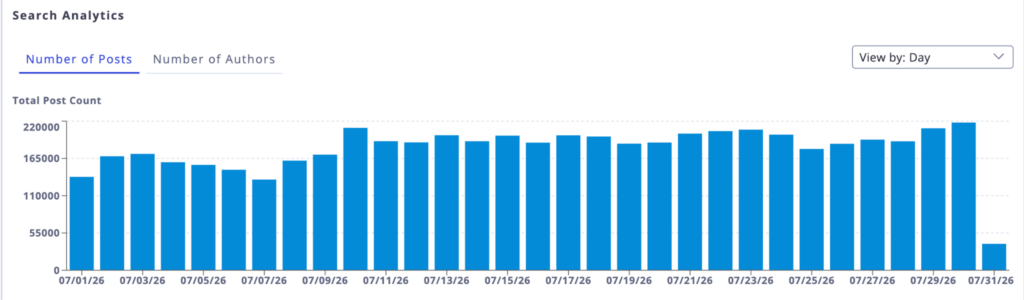
In April 2026, Flashpoint analysts identified 2,328,958 posts discussing artificial intelligence in the context of illicit activity across forums, marketplaces, and chat services.

Mentions of AI in conjunction with illicit advertisements and discussions in April 2026. (Source: Flashpoint)

The underlying activity was concentrated around a familiar set of use cases and workflows:

  • identity verification bypass
  • fraud enablement and scripting
  • impersonation through synthetic media
  • prompt-sharing and jailbreak workflows

However, the emphasis within those discussions shifted in several places in April.

  • Posts tied to custom malicious LLM development appeared less frequently than discussions centered on usability: how to bypass safeguards, generate more reliable outputs, or move activity onto platforms perceived as less restrictive. 
  • References to alternative models and prompt collections appeared more often throughout the month, alongside requests for jailbreak methods and phishing-oriented outputs.

This activity points to a more mature stage of adoption. The focus is less on building entirely new tooling and more on improving reliability, portability, and ease of use within workflows that already exist.

That pattern shows up repeatedly across monitored sources. Users exchange prompts, repost working methods, and refine outputs through direct feedback. In many cases, the same underlying techniques continue circulating with only minor changes between platforms or communities.Looking across April activity helps identify which methods continue to generate demand, where threat actors are adapting around platform restrictions, and which workflows remain active across multiple environments.

Where AI Activity Is Concentrated

AI-related activity in April remained concentrated on a small number of platforms, though the distribution shifted noticeably compared to March.

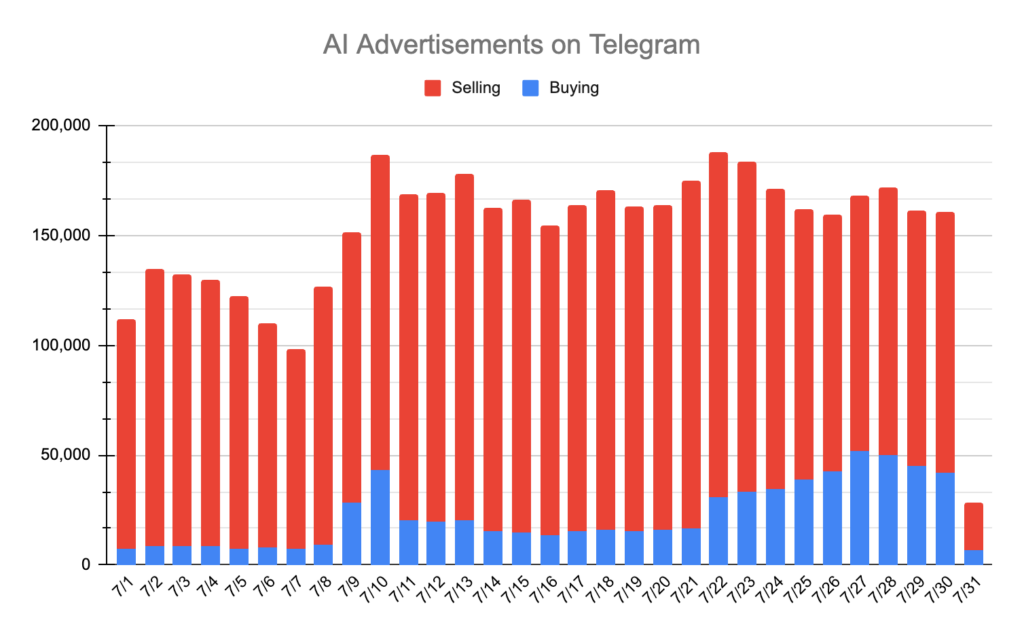
Telegram accounted for the majority of observed activity, with 1,395,075 posts tied to AI services and discussions. Reddit, GitHub Gist, Pastebin, Discord, and smaller forums accounted for significantly lower volumes.

Posts selling AI services (in red) and posts seeking to purchase AI services (in blue) on Telegram in April 2026. (Source: Flashpoint)

The lower Telegram volume does not indicate reduced interest in AI-enabled activity. The platform continues to function as a primary distribution layer for prompts, jailbreak methods, fraud tooling, and service advertisements.

Across April, the same prompts, offers, and workflows appeared repeatedly across channels, often reposted with only minor adjustments. Sellers updated listings based on user feedback, while buyers requested revisions tied to specific outputs or platforms.

Other platforms served more targeted roles:

  • GitHub Gist and paste sites hosted scripts or supporting material
  • forums supported reputation building and longer technical discussions
  • Discord communities centered around specific models, prompt collections, or jailbreak workflows

The activity remains connected across environments. Methods introduced in one community frequently reappear elsewhere, particularly when they produce reliable outputs or help users work around moderation controls.Tracking how these discussions move between sources helps identify which workflows continue to gain traction and which techniques are becoming more broadly operationalized.

AI-Enabled Fraud and Identity Verification Bypass

Across April, Flashpoint analysts observed 63,763 posts advertising or discussing KYC bypass methods using artificial intelligence, including deepfake-enabled verification workflows.

The methods were active across Telegram channels dedicated to identity verification bypass services.

Posts continued to advertise:

  • synthetic video generation designed to mimic live verification behavior
  • voice cloning and scripted interaction prompts
  • bundled “KYC bypass kits” tailored to onboarding and verification workflows

Some offerings included guidance on how to adapt responses for specific platforms or verification requirements. Others promoted combinations of synthetic video, matching fake documentation, and AI-generated scripts designed to support impersonation attempts from start to finish.

The broader workflow remains consistent. AI supports how identities are replicated, how verification checks are navigated, and how fraud operations are scaled across different services.

This activity connects directly to the wider access ecosystem already observed across illicit communities. Stolen credentials, session tokens, phishing infrastructure, and AI-enabled impersonation methods increasingly operate alongside one another within the same workflows.

Across April, posts tied to these methods continued to show active refinement through user feedback, reposting, and platform-specific variations.

For security teams, this activity remains relevant at the control layer. Verification systems, onboarding workflows, and account recovery processes continue to be tested in the same environments where these methods are exchanged and improved.

Malicious LLM Usage and Prompt-Based Workflows

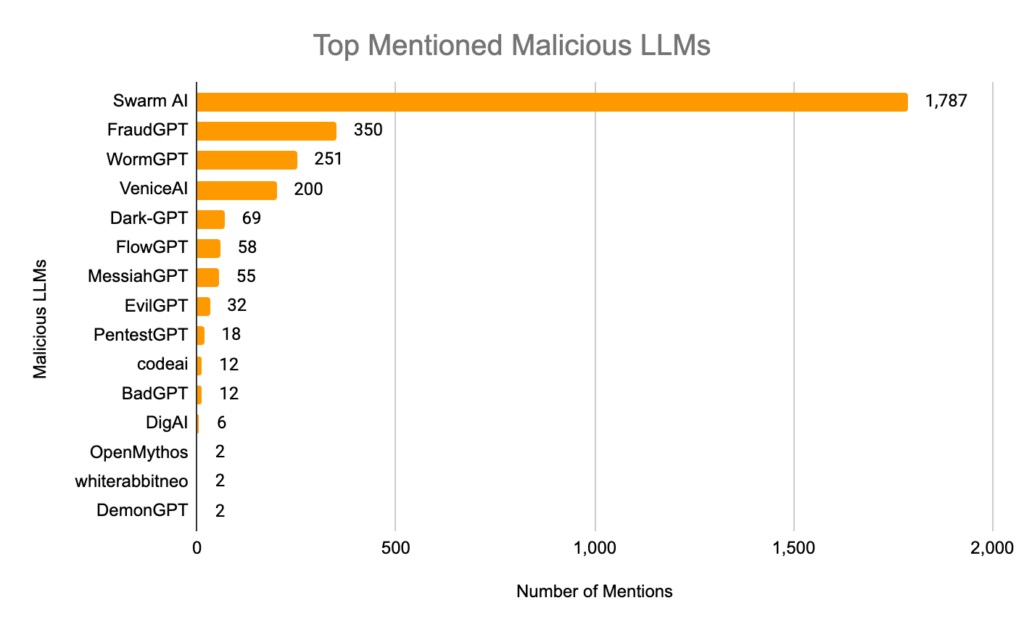
Across April, discussions tied to malicious or unrestricted LLM usage focused heavily on jailbreak methods, prompt-sharing workflows, and access to alternative models perceived as less restricted than mainstream platforms.

The top observed malicious LLMs mentioned within Flashpoint Collections in April 2026. (Source: Flashpoint)

Flashpoint analysts observed a significant increase in discussions related to VeniceAI, driven in part by newly created Reddit and Discord communities dedicated to the platform. The increase highlights continued interest in models that users believe operate with fewer safeguards or moderation controls than services like ChatGPT or Gemini.

The activity centers on usability and output reliability.

Posts reference:

  • jailbreak prompts designed to bypass safeguards
  • phishing and fraud-oriented prompt collections
  • step-by-step instructions for generating specific outputs
  • requests for prompts tailored to impersonation or social engineering workflows

Many of these prompts are shared in collections that include updates, revisions, or support channels. Users exchange feedback when prompts stop working, outputs degrade, or platforms introduce new restrictions. Updated versions frequently follow within short timeframes.

This type of activity reinforces how prompt engineering has developed into its own service layer across illicit communities. The focus is not limited to the underlying model itself, but to the ability to generate repeatable outputs that can be applied directly within fraud, phishing, or impersonation workflows.

Across April, the same prompt structures and jailbreak methods appeared repeatedly across multiple sources, often with only small adjustments tied to platform or target.

The emphasis remains on accessibility, portability, and ease of use rather than custom model development.

Operational Patterns and What Holds Across Sources

Across April, the same behaviors continued to appear across different environments with only minor variation.

Prompt libraries, jailbreak methods, phishing workflows, and identity verification bypass techniques circulated across Telegram channels, forums, Discord communities, and paste sites. The wording changed slightly between platforms, though the underlying structure and outputs remained consistent.

This reuse is visible in how content moves between sources. A jailbreak prompt shared in one channel appears elsewhere with revised wording or additional instructions. A phishing workflow posted to a forum is copied into a paste site and redistributed through Telegram. Users request modifications, test outputs, and repost updated versions when restrictions change or methods stop working.

That cycle appeared repeatedly throughout April.

The activity also showed strong feedback loops tied to usability. Discussions focused heavily on which prompts generated reliable outputs, which models produced fewer restrictions, and which workflows required the least adjustment before use.

Across monitored sources, the same operational priorities appeared consistently:

  • reliability of outputs
  • ease of reuse
  • ability to bypass safeguards
  • compatibility with existing fraud and impersonation workflows

Looking across April activity reinforces how AI-enabled methods continue to mature through repetition, iteration, and distribution across connected communities.

What Security Teams Should Take Away

The activity tracked in this report shows how artificial intelligence is being used in environments where techniques are developed, tested, and shared before they surface elsewhere.

Across these communities, methods tied to fraud, impersonation, and access are reused, adjusted, and circulated in forms that others can apply directly. That process does not require significant change to move from discussion into use.

For security teams, the priority is maintaining visibility into how these methods are evolving and where they are being applied. That visibility supports earlier detection, more focused response, and a clearer understanding of which techniques are actively in circulation.

Monitoring these sources provides that context. It connects observed activity to the methods behind it and helps teams track how those methods develop over time.

If you want to see how this activity maps to your environment, request a demo.

Request a demo today.

The post AI Threat Report: How Artificial Intelligence Is Used Across Illicit Communities appeared first on Flashpoint.

  •  

Flashpoint’s Top 5 Predictions for the 2026 Threat Landscape

Blogs

Blog

Flashpoint’s Top 5 Predictions for the 2026 Threat Landscape

Flashpoint’s forward-looking threat insights for security and executive teams, provides the strategic foresight needed to prepare for the convergence of AI, identity, and physical security threats in 2026.

SHARE THIS:
Default Author Image
December 2, 2025

As the global threat landscape accelerates its transformation, 2026 marks an inflection point requiring defensive strategies to fundamentally shift. The volatility observed in 2025 has paved the way for an era soon to be defined by AI-weaponized autonomy, information-stealing malware, systemic instability of public vulnerability systems, and the complete convergence of digital and physical risk.

Flashpoint offers a unique window into these complexities, providing organizations with the foresight needed to navigate what lies ahead. Drawing from Flashpoint’s leading intelligence and primary source collections, we highlight five key trends shaping the 2026 threat landscape. These insights aim to help organizations not only understand what’s next but also build the resilience needed to withstand and adapt to emerging challenges.

Prediction 1: Agentic AI Threats Will Weaponize Autonomy, Forcing a New Defensive Standard

2026 will see continued evolution of AI threats, with future attacks centering on autonomy and integration. Across the deep and dark web, Flashpoint is observing threat actors move past experimentation and into operational use of illegal AI. 

As attackers train custom fraud-tuned LLMs (Large Language Models) and multilingual phishing tools directly on illicit data, these AI models will become more capable. The criminal intent shaping their misuse will also become more sophisticated. Additionally, 2026 will see a greater marketplace for paid jailbreaking communities and synthetic media kits for KYC (Know Your Customer) bypass.

These advancements are enabling criminals to move beyond simple tools and engage in scaled, autonomous fraud operations, leading to two major shifts:

  1. Agentic AI is becoming the true flashpoint: Threat actors will be using agentic systems to automate reconnaissance, generate synthetic identities, and iterate on fraud playbooks in near real-time. In this SaaS ecosystem, AI will help attackers leverage subscription tiers and customer feedback loops at scale.
  2. The attack surface will shift to focus on AI Integrations: Organizations are increasingly plugging LLMs into live data streams, internal tools, identity systems, and autonomous agents. This practice often lacks the same security vetting, access controls, and monitoring applied to other enterprise systems. As such, attackers will heavily target these integrations, such as APIs, plugins, and system connections, rather than the models themselves.

The ubiquity of automation has dramatically increased attack tempo, leaving many security teams behind the curve. While automation can replace repetitive tasks across the enterprise, organizations must not make the critical mistake of substituting human judgement for AI at the intelligence level.

This is paramount because a critical threat in 2026 is Agentic AI autonomy weaponized against soft targets—API integrations and identity systems. The only winning defense will be human-led and AI-scaled, prioritizing purposeful use to keep organizations ahead of this exponential risk.

Josh Lefkowitz, CEO at Flashpoint

These evolving AI threats will force a fundamental shift in defensive strategies. Defenders will have to shift to deploying systems around AI rather than trust them on their own.

Prediction 2: Identity Compromise via Infostealers Will Become the Foundation of Every Attack

Infostealers will become the entry point, the data broker, the reconnaissance layer, and the fuel for everything that comes after a cyberattack. This shift is already in motion and is accelerating rapidly: in just the first half of 2025, infostealers were responsible for 1.8 billion stolen credentials, an 800% spike from the start of the year. However, 2026 will redefine the malware’s role, making its most valuable output being access, rather than disruption.

Infostealers will become the upstream event that powers the rest of the attack chain. Identity and session data will be increasingly targeted, since it gives attackers immediate access into victim environments. Ransomware, fraud, data theft, and extortion will simply be downstream ways to monetize.

This upstream approach defines the new reality of the attack chain, which is already operational. Nearly every major stealer strain Flashpoint observes now exfiltrates the following:

  • Autofill PII (personable identifiable information)
  • Saved addresses
  • Phone numbers
  • Internal URLs
  • Browsing history
  • Cloud app tokens

An organization’s attack surface is no longer just composed of their own networks. It is the entire digital identity of their employees and partners. This new reality requires security teams to take a new approach. Instead of attempting to block attacks, they must proactively detect compromised credentials before they are weaponized. This will be the difference between reacting to a data breach and preventing one.

The infostealer economy has fully industrialized the attack chain, making initial compromise a low-cost commodity. Multiple security incidents in 2025 tie back to credentials found in infostealer logs. This reality has underscored the critical importance of digital trust—specifically, verifying who can access what resources. For 2026, identity is the perimeter to watch, and security teams must proactively hunt for compromised credentials before they’re weaponized.

Ian Gray, Vice President of Intelligence at Flashpoint

Prediction 3: CVE Volatility Will Force Redundancy in Vulnerability Intelligence

The temporary funding crisis at CVE in April 2025 and the subsequent CISA stopgap extension through March 2026 exposed the systemic fragility of a centralized vulnerability intelligence model. With the future of the CVE/NVD system hanging in the balance, 2026 will be defined by the urgent need for redundancy and diversification in vulnerability intelligence.

In today’s vulnerability intelligence ecosystem, nearly every organization’s vulnerability management framework relies on CVE and NVD—including its “alternatives” such as the EUVD (European Union Vulnerability Database). The CVE system has grown into a critical global cybersecurity utility, relied upon by nearly all vulnerability scanners, SIEM platforms, patch management tools, threat intelligence feeds, and compliance reports. A complete shutdown of CVE would result in a widespread loss of institutional infrastructure.

The next generation of security needs to be built on practices that are resilient, diversified, and intelligence-driven. It should be focused on providing insights that can be used to take action such as threat actor behavior, likelihood of exploitation in the wild, relevance to ransomware campaigns, and business context. Security teams will need to leverage a comprehensive source of vulnerability intelligence such as Flashpoint’s VulnDB that provides full coverage for CVE, while also cataloging more than 100,000 vulnerabilities missed by CVE and NVD.

Prediction 4: Executive Protection Will Remain a Critical Challenge as Cyber-Physical Threats Converge

The continued blurring of lines between cyber, physical, and geopolitical threats will elevate the risk to organizational leadership, turning executive protection into a holistic intelligence function in 2026. The rise of information warfare combined with physical world convergence means the threat to key personnel is no longer purely digital.

In the aftermath of the tragic December 2024 assassination of United Healthcare’s CEO, Flashpoint has seen the continued circulation and glorification of “wanted-style posters” of executives in extremist communities. Additionally, Flashpoint has seen nation-state actors participate, using espionage and influence to target high-value individuals.
Organizations must adopt an integrated approach that connects insights from threat actor chatter and a wealth of other OSINT sources. This fusion of intelligence is essential for applying frameworks to ensure the safety of leadership and key personnel.

Prediction 5: Extortion Shifts to Identity-Based Supply Chain Risk

2025 was marked by several large-scale extortion campaigns, demonstrating how the threat landscape is rapidly evolving. Ransomware operations have shifted into a straight extortion play. Flashpoint has observed a surge in new entrants to the ransomware market, accompanied by a decline in the quality and decorum of ransomware groups.

Furthermore, vishing campaigns attributed to “Scattered Spider” have highlighted weaknesses in identity, trust, and verification. Campaigns from “Scattered LAPSUS$ Hunters” have also exposed vulnerabilities in third-party integrations. These attacks culminated in extortion, showcasing that modern attacks will target trusted users and trusted applications for initial access, and will forgo ransomware in place of data access.

As this shift continues into 2026, threat actors will increasingly focus their efforts on exploiting human behavior and identity systems. Instead of attempting to spend resources on breaking network perimeters, attackers will instead socially engineer employees to gain access to corporate systems at scale. This change in TTPs will undoubtedly greatly increase supply chain risk, especially for third parties.

Charting a Path Through an Evolving Threat Landscape with Flashpoint Intelligence

These five predictions highlight the transformative trends shaping the future of cybersecurity and threat intelligence. Staying ahead of these challenges demands more than just reactive measures—it requires actionable intelligence, strategic foresight, and cross-sector collaboration. By embracing these principles and investing in proactive security strategies, organizations can not only mitigate risks but also seize opportunities to enhance their resilience.

As the threat landscape continues to rapidly evolve, staying informed and prepared are critical components of risk mitigation. With the right tools, insights, and partnerships, security teams can navigate the complexities ahead and safeguard what matters most.

Request a demo.

The post Flashpoint’s Top 5 Predictions for the 2026 Threat Landscape appeared first on Flashpoint.

  •  
❌