Unknowingly, a member of key personnel is living two separate lives. On the clock, they are a highly-trusted systems administrator, but in their personal time, they moonlight on the deep and dark web, advertising their trust and access to the highest bidder. One day, they get a simple offer: $15,000 in the crypto of their choice to approve a single push notification at 2 AM. They accept. By morning, the attacker walks away with active domain admin credentials without the need for malware or cracking firewalls.
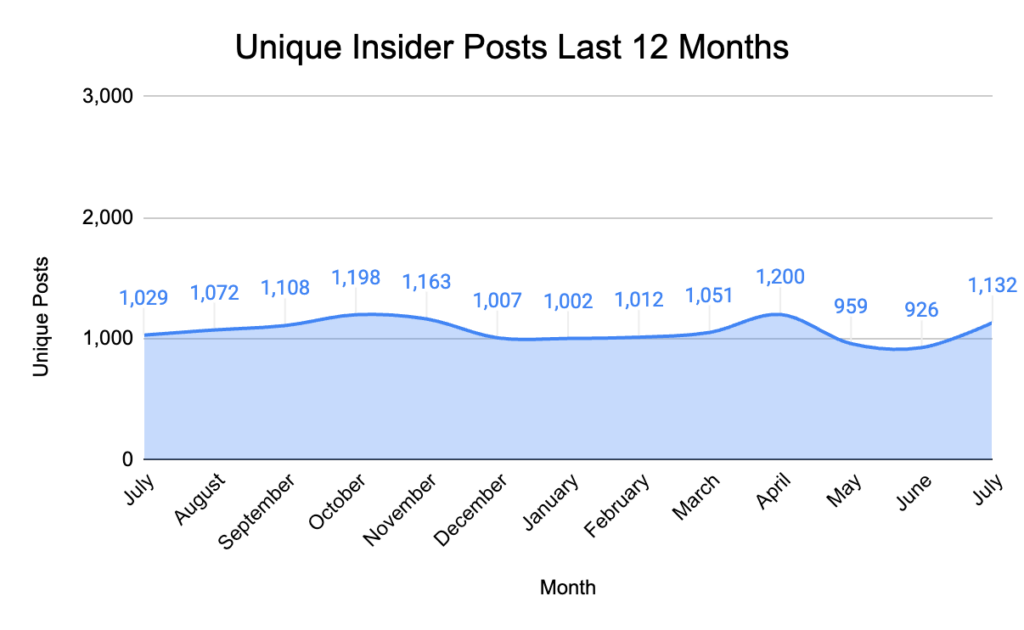
This is just one example of how insider threats lead to modern enterprise breaches. This year, Flashpoint uncovered 7,282 unique insider threat posts, with an average of 34 unique posts being posted daily. As perimeter security, EDR coverage, and other security tools mature, threat actors are finding it faster—and cheaper—to target the human element and simply buy an insider’s credentials or pay an employee to open the front door.
In a threat landscape where identity is becoming the primary attack surface, monitoring illicit marketplaces and recruitment efforts is critical. This new monthly report leverages Flashpoint’s Primary Source Collection (PSC) to analyze insider threat tactics, tracking active recruitment and advertising on dark web forums and encrypted networks.
The Insider Threat Landscape: July 2026
In July 2026, Flashpoint analysts identified a total of 12,653 insider posts. These communications include both threat actors attempting to recruit insiders in target organizations, as well as insiders advertising their services on illicit forums and marketplaces.
Of these total communications, Flashpoint observed 1,132 unique posts in July 2026.
Where Insider Threat Activity is Concentrated
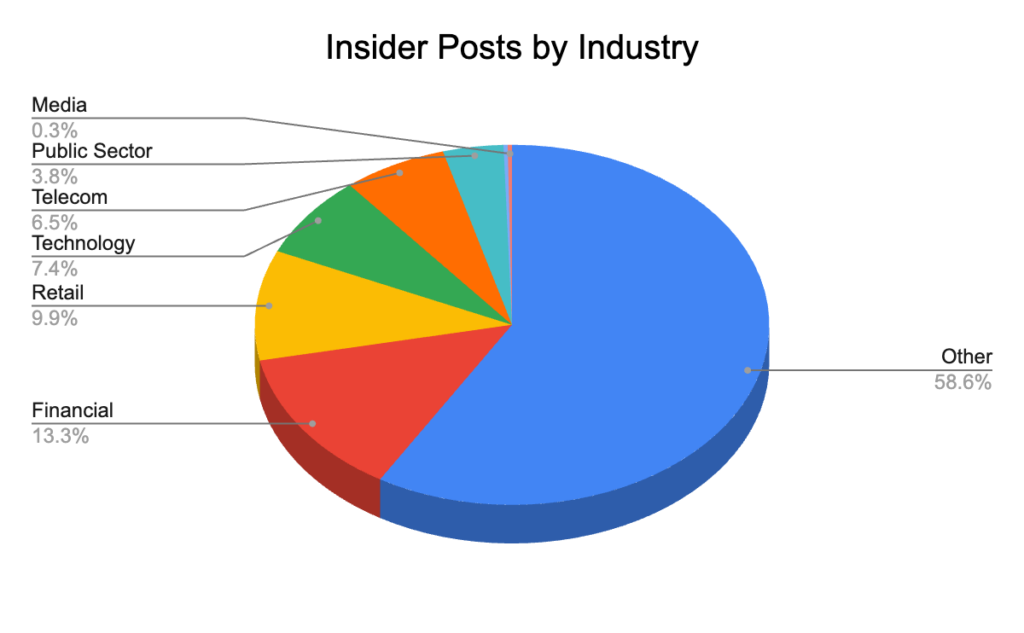
Historically, the Telecommunications, Retail, and Financial industries are most adversely affected by insider threat activity. However, July 2026 findings noticeably deviate from this trend. Flashpoint found 58.6% of total insider threat posts affected “Other” industries—suggesting adversaries are diversifying their target base. Threat actors may be attempting to recruit within supply chain partners, logistic hubs, manufacturing platforms, and specialized service providers to find alternative entry points into target networks.
The following table shows a breakdown of unique insider posts by industry in July 2026:
Industry
Posts
Other
663
Financial
150
Retail
112
Technology
84
Telecom
74
Public Sector
43
Healthcare
3
Media
3
Total
1,132
Insider Threats: Recruiting vs. Advertising
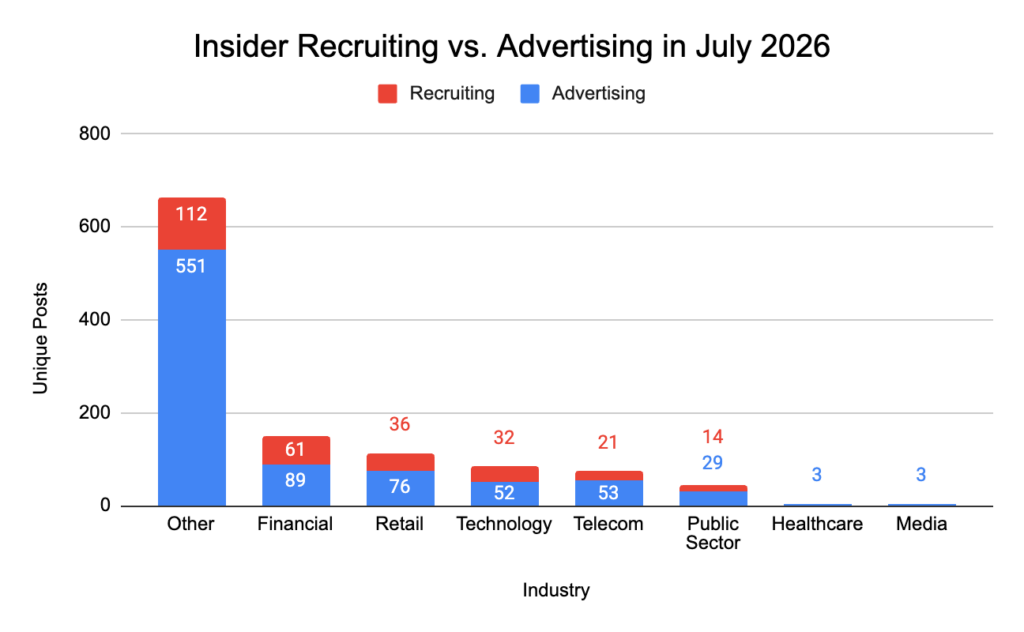
Active insider threats work in two ways: an insider is “recruited” by a malicious outside party, or a malicious insider “advertises” their access and skills to an interested threat actor. Regardless, by leveraging this connection, insiders assist adversaries by exfiltrating valuable data, installing malware, sabotaging IT systems, or performing SIM swaps.
In July 2026, Flashpoint found that over 75% of unique threat actor posts came from insiders advertising their access to malicious third parties. This indicates a highly motivated internal threat landscape where disgruntled employees actively seek out buyers for corporate data and network entry points.
Protect Against Insider Threats Using Flashpoint
Insider threats are inherently difficult to detect using internal security controls alone because the malicious activity relies on valid credentials and legitimate access privileges. Relying solely on internal logs means security teams often only detect an insider threat after data exfiltration or system sabotage has already occurred.
Flashpoint protects organizations against insider threats through our Primary Source Collection (PSC) and specialized intelligence platforms:
External Threat Intelligence & Early Warning: Flashpoint monitors deep and dark web forums, invite-only threat communities, and encrypted chat platforms to identify employee solicitations, stolen corporate domain mentions, and active recruitment attempts before an intrusion develops.
Identity Protection & Infostealer Tracking: By tracking illicit marketplaces and infostealer activity, Flashpoint identifies compromised corporate credentials and active session tokens, preventing threat actors from utilizing purchased access.
User & Entity Behavior Context: Flashpoint’s intelligence equips SOC, Security Operations, and Risk Management teams with adversary TTPs, enabling security operations to look for anomalous data downloads, off-hours access, or unauthorized software installation.
To learn more about how Flashpoint can help protect your enterprise from insider risk and monitor illicit underground communities,Request a Demo Today.
Frequently Asked Questions (FAQs)
What is the Flashpoint Insider Threat Report?
The Flashpoint Insider Threat Report is a monthly intelligence brief that analyzes trends, volume, targeted industries, and tactics surrounding insider threat recruitment and illicit access advertising on the deep web, dark web, and encrypted chat channels.
How does Flashpoint collect insider threat data?
Flashpoint collects data using its Primary Source Collection (PSC) engine, which actively monitors thousands of dark web forums, illicit marketplaces, and underground chat networks where threat actors and malicious insiders communicate.
What is the difference between insider recruitment and insider advertising?
Insider recruitment occurs when an external cybercriminal attempts to entice a corporate employee into assisting with a cyberattack. Insider advertising occurs when an employee or contractor proactively lists their legitimate access or services for sale on illicit marketplaces.
Twenty years ago, a British mathematician named Clive Humby popularized a phrase that came to describe data’s relationship with the entire global economy: “Data is the new oil.”
Pithy as the phrase sounds, it is undeniably true.
Data steers decisions at businesses of every size. Data created entirely new industries built around its capture. And, for a select number of companies, data has produced billions—if not trillions—of dollars in value.
So how is it that, on the dark web, your stolen identity can be purchased for just 95 cents?
That’s what a Malwarebytes researcher found last month after spending 48 hours inside the dark web to investigate cybercrime. Across a variety of forums and directories, he found subscription plans for malware that steals information once implanted on a device. He found guides for deploying social engineering scams. He found people selling their services to build fake websites that trick people into handing over their usernames and passwords. And he found one of the dark web’s most traded commodities—personal data, packaged together about individual people, to help a cybercriminal commit identity fraud.
These packages are called “fullz.” For victims in the United States, a fullz contains a full name, Social Security Number, date of birth, address, and other personal details. That is enough, on its own, for a cybercriminal to potentially open a bogus line of credit, file a fake tax return, access financial accounts, or obtain medical services under someone else’s name.
As we wrote on Malwarebytes Labs:
“For less than the cost of a cup of coffee, a cybercriminal can buy enough information to devastate someone’s financial life.”
It’s the kind of risk that could scare anyone, especially considering the scale behind it. In just the first six months of 2026, Malwarebytes found more than 7,500 compromised data sets on the dark web containing more than 8.4 billion records.
And yet, even today, cybersecurity professionals still get asked why anyone should bother protecting their data.
The public, understandably, are exhausted. With data breaches happening every week—if not every day—cybersecurity can start to feel pointless. With young people unable to build financial security, they start believing that they have nothing worth stealing. And with Big Tech already collecting our every movement, behavior, click, and concern, people understandably feel powerless to fight any kind of data abuse, be it corporate or criminal.
So today’s episode approaches the question from a different direction. This isn’t about why you should protect yourself—plenty of company websites will tell you that, and most of them rely on fear. This is about why hackers want your data in the first place.
Today, on the Lock and Code podcast, host David Ruiz explains how cybercriminals turn a single repeated password into account takeover, how a screenshot of your house from Google Maps became a tool in extortion emails, and why the most benign information about you—an address, an age, one public photo—is often the most useful data a stranger can buy.
Understanding Illicit Ecosystems: How Dark Web Forums Structure Cybercrime
As part of our ongoing series, we analyze how dark web forums operate, breaking down Flashpoint’s tiered classification system and examining how specialized, hybrid platforms function together as an interconnected cybercrime supply chain.
When a high-profile data breach hits headlines, the default assumption is often to view the dark web as a single, centralized marketplace where any illicit service or tool can be bought. While many illicit forums aspire to be seen as a “one-stop shop,” the reality is that the underground economy relies on an interconnected network of specialized hubs that each align with distinct phases of the cybercrime lifecycle.
To understand how cybercrime thrives, it is vital to learn how these online spaces survive and how they play their parts in graduating threat actors from entry-level novices to sophisticated adversaries.
Navigating the Cybercrime Ecosystem: Entry Barriers and Forum Tiering
An illicit community’s survival hinges on its operational value and culture, which is ultimately created by its supporters. In a low-trust environment filled with cybercriminals, hidden law enforcement, and security researchers, these digital spaces are inherently defensive. To protect their communities from competitors’ attacks, surveillance, and eventual takedowns, forums implement rigorous gatekeeping mechanisms.
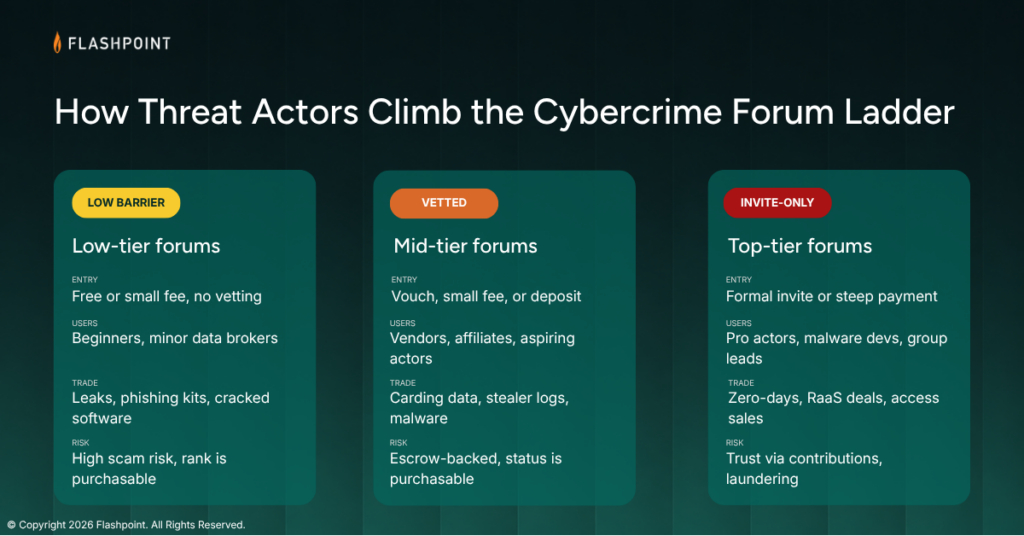
As such, Flashpoint organizes the cybercrime ecosystem into a tiered structure, separating them into low, mid, or top-tier forums, defined by several key factors such as:
Entry Barriers: The financial or reputational requirements for a user to join the community, indicating the forum’s exclusivity.
Technical Expertise: The collective technical skills and proficiency of the forum’s members.
Trade Quality: The quality and value of illicit goods and services exchanged, such as advanced hacking tools or high-value data leaks.
Operational Security (OP SEC): The extent to which the community upholds strict security protocols and practices.
By analyzing these vectors, the ecosystem naturally separates into three distinct operational tiers.
Low-Tier Forums
These communities are easily accessible, often requiring a small fee or completely free registration with little to no vetting. They host less sophisticated users, beginner hackers, and minor data brokers seeking free material. Because the technical barrier is low, these spaces primarily share low-cost, high-volume data, including large data leaks, generic phishing guides, unchecked stolen accounts, and cracked software.
Consequently, these environments face a persistently high risk of scams and poor quality data. Within low-tier forums, reputation is often built by sharing free data or purchasing a rank or upgrade which is viewable by other users.
Mid-Tier Forums
Moderately accessible via both Tor and the clearnet, entry into these spaces typically require a vouch from an existing member, a minimal registration fee, or an initial deposit. These platforms concentrate on large-scale fraudulent activity and the exchange of various datasets—including bulk carding data, stolen credentials, stealer logs, phishing kits, botnets, and various malware.
The user base includes a mix of vendors, experienced threat actors, affiliates of larger groups, and aspiring cybercriminals looking for training. To protect users from internal fraud, these forums heavily prioritize integrated escrow services and reputation systems, which can be improved by purchasing an internal high-tier status.
Top-Tier Forums
These are highly exclusive platforms dedicated to high-value, highly technical, and targeted criminal operations. New applicants face a stringent vetting process, typically demanding either a formal invitation or a substantial registration payment. This exclusive layer hosts highly skilled, professional threat actors, malware developers, and key decision-makers within major illicit groups.
This is the ecosystem where adversaries build trust through valuable technical contributions or community reputation points and execute complex money laundering schemes, trade zero-day exploits, facilitate ransomware-as-a-service (RaaS) partnerships, and conduct large-scale initial access broker sales.
What Are the Different Types of Dark Web Forums?
Once a community establishes its tier, it usually functions as a specialized hub linked to a specific stage in the overall cybercrime lifecycle. They do this to cultivate talent and expertise, which naturally bridges communities together, creating a supply chain where different forums handle distinct operational and structural needs.
General Information and Community Boards
Modeled after surface-web sites like Reddit, these platforms serve as social and informational hubs. Discussions prioritize coordination, reputation management, and the propagation of best practices regarding OPSEC. Users share news about cybercriminal arrests, look for advice on how to remain anonymous, report potential exit-scams, and provide detailed reviews of specific vendors, particularly those selling illicit drugs.
Financial Theft and Carding Forums
These semi-structured environments blend marketplaces with social networks, utilizing a professionalized supply chain for selling stolen cards, dumps, and fullz. To reduce internal fraud, they rely heavily on reputation-building tools like verified seller statuses and integrated refund systems for invalid data. To ensure operational longevity, they are typically hosted on bulletproof infrastructure located in states that do not comply with international takedown requests, such as the Russian Federation.
Data Leak Forums
Depositories for stolen databases where raw breach information is structured into a tradeable commodity. Leaks are listed by victim name and sector, allowing actors to quickly find credentials or corporate records to repurpose for credential stuffing, extortion, or identity fraud.
Cracking and Hacking Tutorials (Knowledge Bases)
Existing entirely for knowledge exchange and offensive techniques, threat actors share methods, tutorials, fraudulent schemes, and bypass techniques, often encouraging educational sharing through competitions.
High-Skill Exploit and Access Forums
Top-tier platforms hosting the “upper echelons” of the community, such as initial access brokers, exploit developers, and malware creators. They rely heavily on strict arbitration systems, mandatory vendor deposits, and escrow mechanisms to safely conduct high-impact transactions and corporate intrusions.
Low-Barrier Retail Forum
High-traffic segments trading mass-market digital goods like cracked subscription accounts, premium software, and online gaming assets. Characterized by an exceedingly low barrier to entry and a relatively young user base seeking quick profit without the capability for advanced, complex operations.
Map the Illicit Pipeline Using Flashpoint
What makes the cybercriminal ecosystem truly cohesive is that the lines between these various types of forums and communities constantly blur. Most illicit communities are hybrid and transitional, intentionally or naturally blending categories to cater to each other’s needs and boost monetization.
Hybrid forums frequently connect the how-to tutorials with actual stolen data and network access, effectively creating a structural pipeline for threat actor progression. Platforms like BreachForums combine the attention-grabbing aspect of a data leak site with a structured marketplace for selling logs and other sensitive data. This type of hybridization allows a threat actor to progress from a beginner reading tutorials to an active criminal deploying stolen data.
Monitoring these fluid structures and transitions is the only way to understand how threat actors develop, and how the interconnected cybercrime landscape shifts over time. Therefore, it is essential for security teams to look beyond cyber threats as isolated, and recognize the multi-platform strategies these actors employ. Request a demo to gain visibility into these threat actor communities and proactively defend your organization from across the entire cybercrime supply chain.
Check out the rest of our “Understanding Illicit Ecosystems” series:
With International Anti-Ransomware Day taking place on May 12, Kaspersky presents its annual report on the evolving global and regional ransomware cyberthreat landscape.
Ransomware remains one of the most persistent and adaptive cyberthreats. In 2026:
New families continue to emerge, adopting post-quantum cryptography ciphers.
As ransom payments drop, some groups implement encryptionless extortion attacks.
In a constantly changing ecosystem of threat actors, initial access brokers maintain a relevant role in this market, showing increased focus on access to RDWeb as the preferred method of remote access.
Ransomware attacks decline but remain a major threat
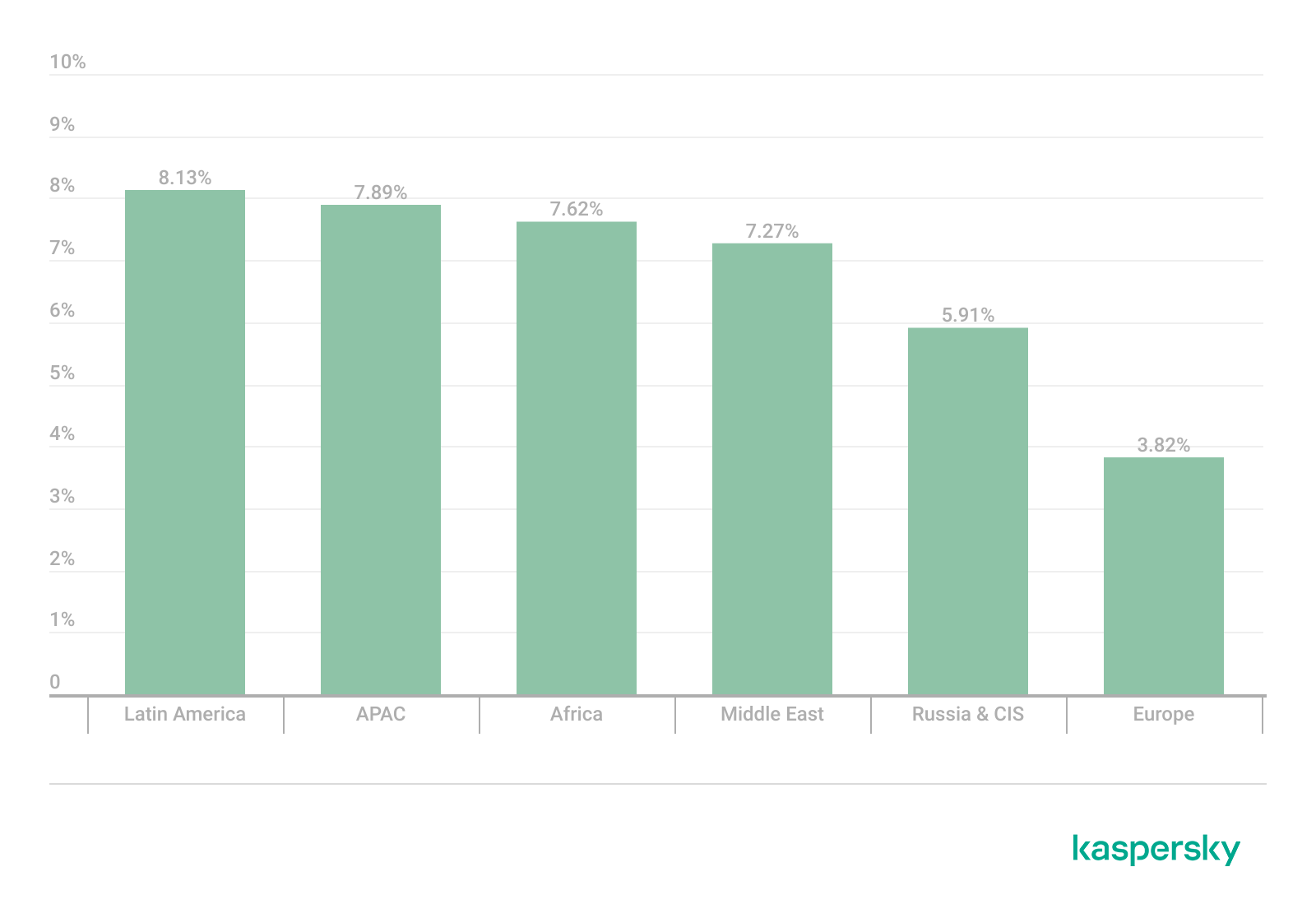
According to Kaspersky Security Network, the share of organizations affected by ransomware decreased in 2025 across all regions compared to 2024.
Percentage of organizations affected by ransomware attacks by region, 2025 (download)
Despite the formal decrease, organizations across all sectors continue to face a high likelihood of attack, as ransomware operators refine their tactics and scale their operations with increasing efficiency. Kaspersky and VDC Research have found that in the manufacturing sector alone, ransomware attacks may have caused over $18 billion in losses in the first three quarters of the year.
The continued rise of EDR killers and defense evasion tooling
In 2026, ransomware operators increasingly prioritize neutralizing endpoint defenses before executing their payloads. Tools commonly referred to as “EDR killers” have become a standard component of attack playbooks. This reflects a continuing trend toward more deliberate and methodical intrusions.
Attackers attempt to terminate security processes and disable monitoring agents, often by exploiting trusted components such as signed drivers. This technique is called Bring Your Own Vulnerable Driver (BYOVD) and allows adversaries to blend into legitimate system activity while gradually degrading defensive visibility.
Thus, evasion is no longer an opportunistic step but a planned and repeatable phase of the attack lifecycle. As a result, organizations are increasingly challenged not just to detect ransomware but also to maintain control in environments where security controls themselves are actively targeted.
The appearance of new families adopting post-quantum cryptography
We predicted that quantum-resistant ransomware would appear in 2025. Looking back at the previous year, we see that advanced ransomware groups indeed started using post-quantum cryptography as quantum computing evolved. The encryption techniques used by this quantum-proof ransomware could be used to resist decryption attempts from both classical and quantum computers, making it nearly impossible for victims to decrypt their data without having to pay a ransom.
One example is the appearance of the PE32 ransomware family (link in Russian); it leverages the cutting-edge ML-KEM (Module-Lattice-Based Key-Encapsulation Mechanism) standard to secure its AES keys. This specific cryptographic framework was recently selected by NIST as the primary standard for post-quantum defense.
Within the PE32 ransomware architecture, this is realized through the Kyber1024 algorithm, a robust mechanism providing Level 5 security, roughly equivalent in strength to AES-256. Its primary function is the secure generation and transmission of shared secrets between parties, specifically engineered to withstand future quantum computing attacks. This shift toward post-quantum readiness is part of a broader industry trend; for instance, TLS 1.3 and QUIC protocols have already adopted the X25519Kyber768 hybrid model, which fuses classical encryption with quantum-resistant security.
The shift to encryptionless extortion
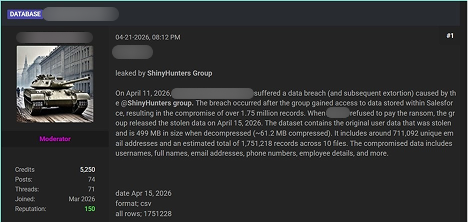
In 2025, the share of ransoms paid dropped to 28%. As a response to this, one of the developments in the 2026 landscape is the growing prevalence of extortion incidents in which no file encryption takes place at all. Instead, attackers leave out the “ware” in “ransomware” and focus on extracting sensitive data and leveraging the threat of public disclosure as their primary means of extortion. ShinyHunters is an excellent example of such a group, using a data leak site to publicize its victims.
By avoiding encryption, attackers may aim at reducing the likelihood of immediate detection, shortening the duration of the attack, and eliminating dependencies on stable encryption routines. Often, this model is used alongside traditional tactics in so-called double extortion schemes, but an increasing number of campaigns rely exclusively on data theft.
For victims, this shift fundamentally changes the nature of the risk. While backups remain effective against encryption-based disruption, they provide no protection against data exposure, regulatory consequences, and reputational damage. Ransomware is therefore evolving from a business continuity issue into a broader data security and compliance challenge.
Industrialization of initial access (Access-as-a-Service)
The ransomware ecosystem continues to evolve toward a highly industrialized and specialized model, with initial access remaining as one of its most critical components. In 2026, many ransomware operators keep relying on IABs (initial access brokers), a network of intermediaries who supply pre-compromised access to corporate environments, aiming to no longer perform full intrusions themselves.
This “access-as-a-service” model is fueled by credential theft operations, and the widespread availability of compromised accounts harvested through infostealers and phishing campaigns.
The primary access vectors offered for sale have not changed: RDP, VPN, and RDWeb are still the top access vectors. Consequently, remote access infrastructure remains the primary attack surface for initial access sales. In response to the measures against public exposure of RDP access points to the internet, attackers are now targeting RDWeb portals, which are frequently vulnerable and occasionally inadequately safeguarded.
The result is a threat landscape where unauthorized access is increasingly commoditized, and the barrier to launching ransomware attacks declines. This means that preventing initial compromise is only part of the challenge; equal emphasis must be placed on detecting misuse of legitimate credentials and limiting lateral movement within already-breached environments.
Ransomware developments on the dark web
Telegram channels and underground forums increasingly function as platforms for the distribution and sale of compromised datasets and access credentials including those that were obtained as a result of ransomware attacks.
Advertisements posted on these resources typically include the nature of the access, a description of the exfiltrated or compromised data, price terms, and contact information for prospective buyers. In addition, some malicious actors mention their collaboration with other ransomware groups. Lesser-known gangs can use this name-dropping to promote themselves
Multiple threat actors not related to ransomware groups distribute datasets downloaded from ransomware blogs on underground forums and Telegram. By re-publishing download links and files, they spread compromised data as well as information on the ransomware attack within the community.
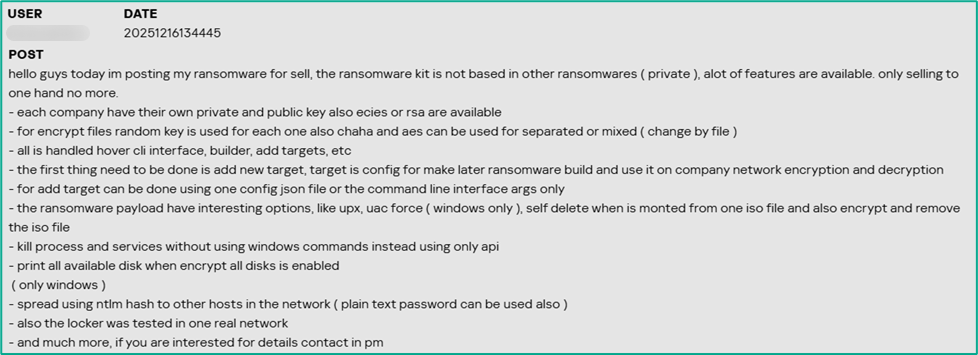
The ransomware itself is also sold or offered for subscription on the dark web platforms. The sellers underscore the uniqueness of their malware, as well as its encryption and defense evasion features.
Law enforcement actions
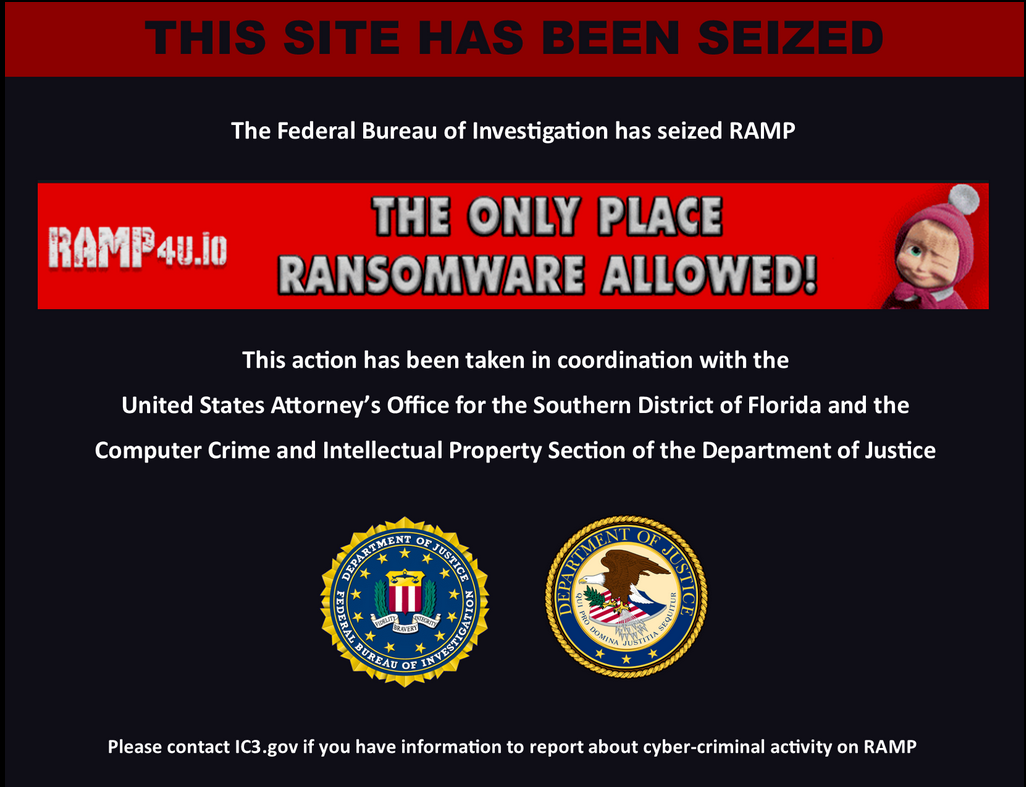
Law enforcement agencies are actively shutting down dark web platforms and ransomware data leak sites. A major underground forum, RAMP, which also functioned as a platform for threat actors to advertise their ransomware services and publish service‑related updates, was seized by authorities in January 2026. Another underground forum, LeakBase, where malicious actors distributed exfiltrated and compromised data, was seized in March 2026. In 2025, law enforcement agencies seized well-known forums like Nulled, Cracked, and XSS. Also in 2025, the DLSs of BlackSuit and 8Base ransomware groups were seized. These takedowns cause inconvenience to ransomware coordination, specifically for initial access brokers and affiliates, though similar forums are expected to fill the void over time.
Top ransomware groups in 2025
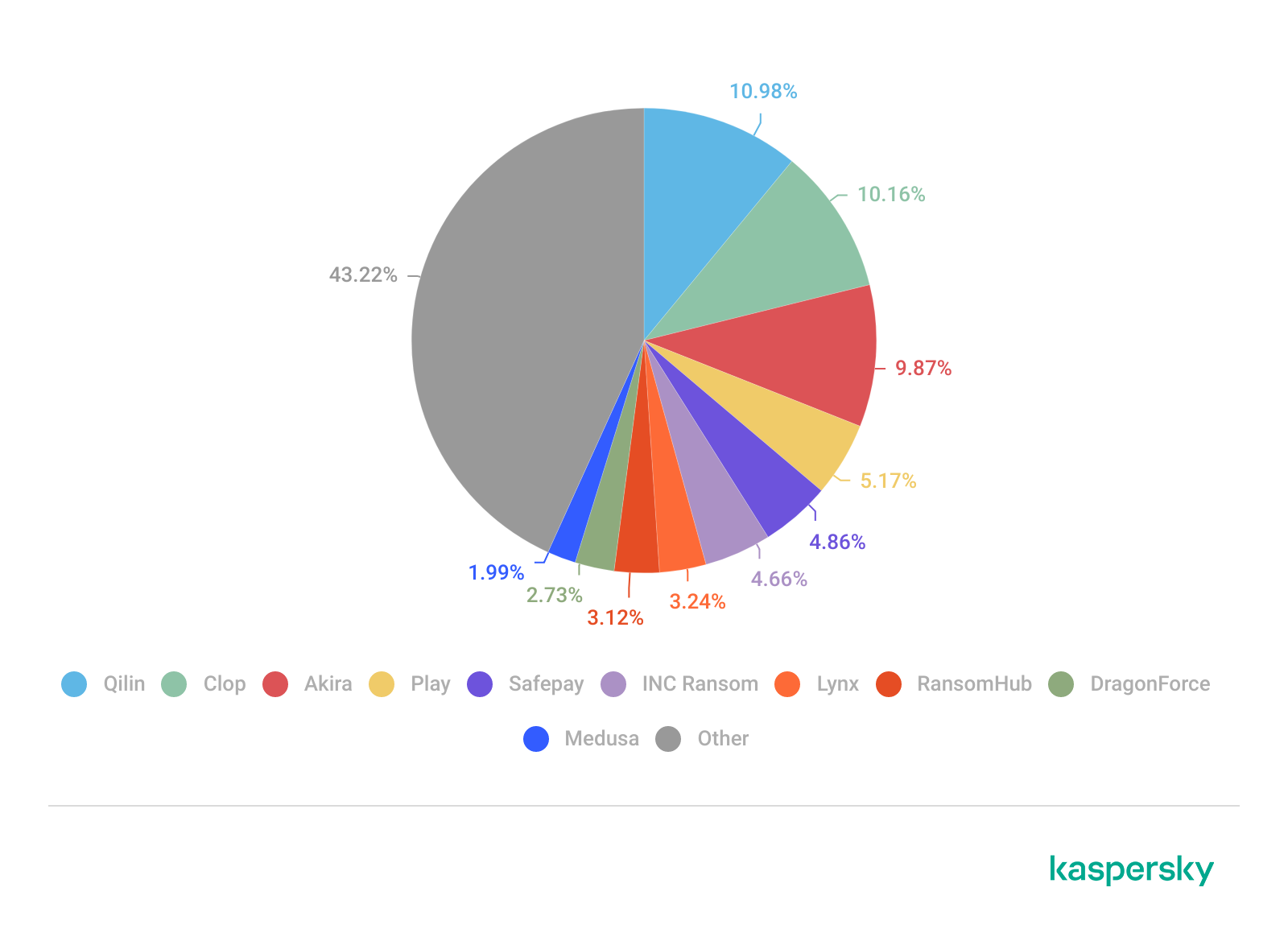
RansomHub’s sudden dormancy in 2025 marked a shift, and Qilin became the dominant player from Q2 onward. According to Kaspersky research, Qilin was the most active group executing targeted attacks in 2025.
Each group’s share of victims according to its data leak site (DLS) as a percentage of all reported victims of all groups during the period under review (download)
Qilin stands out as one of the fastest-growig and dominant RaaS platforms. Its combination of high-volume operations and structured affiliate model positions it as a central player in the current ecosystem.
Clop, the second most active group in 2025, is distinguished through its large-scale, supply-chain-style attacks, exploiting widely used file transfer and enterprise software to compromise hundreds of victims simultaneously. This one-to-many approach sets it apart from more traditional, single-target campaigns.
Third place is occupied by Akira, which remains notable for its consistency and operational stability, maintaining a steady stream of victims without major disruption. Its ability to sustain activity over time makes it one of the most reliable indicators of baseline ransomware threat levels.
Although no longer active, RansomHub stands out for its rapid rise and equally rapid disappearance in 2025, highlighting the volatility of the RaaS market. Its shutdown created a vacuum that significantly reshaped affiliate distribution across other groups.
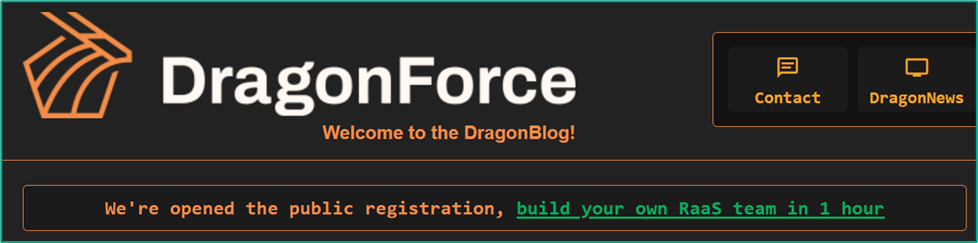
DragonForce is also notable – not just for its own operations, but for its broader influence within the ransomware ecosystem, including reported involvement in infrastructure conflicts and possible links to the disruption of competing groups. Thus, the group claims that RansomHub “has moved to their infrastructure.” This positions it as more than just an operator and potentially an ecosystem-level actor.
New actors in 2026
While emerging actors generally operate on a smaller scale, they provide insight into the continuous churn and low barrier to entry within the ransomware ecosystem.
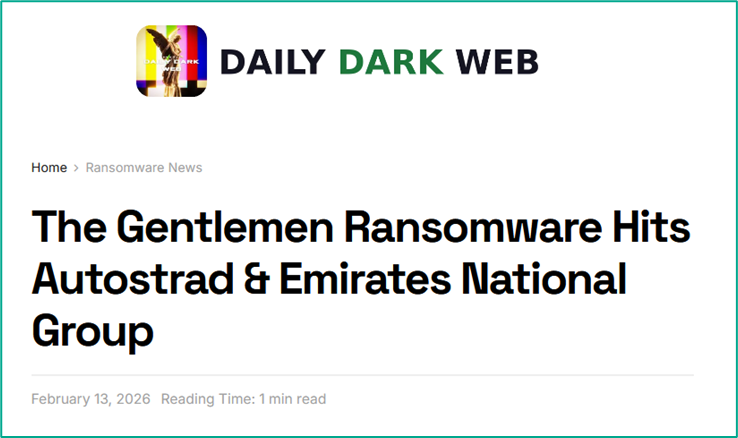
The Gentlemen group caught our attention in early 2026, as they managed to attack a significant number of victims over a short time. This actor is also notable for reflecting a broader shift toward professionalization and controlled operations within the ransomware ecosystem. Unlike many emerging groups that rely on opportunistic attacks and inconsistent leak activity, The Gentlemen demonstrate a more deliberate approach: structured intrusion workflows, selective targeting, and measured communication with victims. This signals a move away from chaotic, high-noise campaigns toward predictable, business-like execution models that are easier to scale and harder to disrupt. Their TTPs include the massive exploitation of hardware very common on big corporations, such as FortiOS/FortiProxy, SonicWall VPN, and Cisco ASA appliances. The group might be comprised of professional cybercriminals who left other prominent groups.
The group is also notable for its emphasis on data-centric extortion strategies, often prioritizing exfiltration and leverage over purely disruptive encryption. This aligns with one of the defining trends of 2026: ransomware evolving into a form of data breach monetization rather than just system denial. By focusing on controlled pressure and reputational risk instead of immediate operational damage, The Gentlemen exemplify how attackers are adapting to lower ransom payment rates and improved backup practices among victims.
Some other groups to take note of in 2026:
Devman appears to be an emerging actor with limited but growing activity, likely leveraging existing tooling rather than developing custom capabilities.
MintEye hasn’t been very active yet, with just five known victims, suggesting opportunistic campaigns without a consistent operational tempo.
DireWolf is associated with small-scale, targeted attacks, though its overall footprint remains relatively limited compared to larger RaaS groups.
NightSpire demonstrates characteristics of an amateur group, such as mistakes during its operations, uncommon communication channels with the victims, and sometimes giving them insufficient time to pay up. Although they both encrypt and leak data, they prioritize publication rather than encryption.
Vect shows low-volume activity. It is yet unclear whether they use a completely new codebase or are rather a rebrand of an existing group.
Tengu is a less prominent actor, with limited public reporting and no clear distinguishing tactics beyond standard extortion models.
Kazu appears to be created by ransomware operators previously engaged with multiple other groups. As of now, they don’t stand out for scale or technique.
Although there is little to say about these groups at the time of writing this report, each of them may be equally likely to disappear from the threat landscape or grow into a prominent threat. That’s why it’s important to track them from their early days. Moreover, collectively, these groups illustrate how dynamic the ransomware landscape is, with new entrants constantly replenishing it.
Conclusion and protection recommendations
Despite the growing effort by law enforcement agencies across the globe to seize and disrupt dark web platforms and threat actor infrastructures, ransomware operations remain stable, with new groups quickly taking the place of those who went silent. In 2026, we see a shift towards encryptionless extortion, with data leaks increasingly becoming the main threat to target organizations. At the same time, data encryption is also upgrading to the next level with the emergence of post-quantum ransomware.
To resist the evolving threat, Kaspersky recommends organizations:
Prioritize proactive prevention through patching and vulnerability management. Many ransomware attacks exploit unpatched systems, so organizations should implement automated patch management tools to ensure timely updates for operating systems, software, and drivers. For Windows environments, enabling Microsoft’s Vulnerable Driver Blocklist is critical to thwarting BYOVD attacks. Regularly scan for vulnerabilities and prioritize high-severity flaws, especially in widely used software.
Strengthen remote access: RDP and RDWeb connections should never be directly exposed to the internet, only through VPN or ZTNA (Zero Trust Network Access). It’s highly recommended to adopt multi-factor authentication on everything; the architecture may require continuous authentication for access, as one valid credential captured is enough to cause a breach. Monitoring the underground for stolen employee credentials is essential. Audit open ports across the entire attack surface. The adoption of the “Principle of Least Privilege” (PoLP), where users, systems, or processes are granted only the minimum access rights, such as read, write, or execute permissions, necessary to perform their specific job functions, is highly recommended.
Strengthen endpoint and network security with advanced detection and segmentation. Deploy robust endpoint detection and response solutions such as Kaspersky NEXT EDR to monitor for suspicious activity like driver loading or process termination. Network segmentation is equally important. Limit lateral movement by isolating critical systems and using firewalls to restrict traffic. Complete and immediate offboarding for employees is necessary as well as periodic permission reviews, with automatic revocation of unused access. Sessions with complete logging for privileged accounts are more than necessary. Monitoring the traffic divergence to new sites or even to legitimate endpoints can help the defenders to spot a new insider threat.
Invest in backups, training, and incident response planning. Maintain offline or immutable backups that are tested regularly to ensure rapid recovery without paying a ransom. Backups should cover critical data and systems and be stored in air-gapped environments to resist encryption or deletion. User education is essential to combatting phishing, which remains one of the top attack vectors. Conduct simulated phishing exercises and train employees to recognize AI-crafted emails. Kaspersky Global Emergency Response Team (GERT) can help develop and test an incident response plan to minimize potential downtime and costs.
The recommendation to avoid paying a ransom remains robust, especially given the risk of unavailable keys due to dismantled infrastructure, affiliate chaos, or malicious intent. By investing in backups, incident response, and preventive measures like patching and training, organizations can avoid funding criminals and mitigate the impact.
Kaspersky also offers free decryptors for certain ransomware families. If you get hit by ransomware, check to see if there’s a decryptor available for the ransomware family used against you.
Tax season is also peak season for identity theft. Criminals use stolen personal data to file fake tax returns and claim refunds before the real taxpayer does. Here’s how the fraud works, and how to protect yourself.
What is Stolen Identity Refund Fraud (SIRF)?
Stolen Identity Refund Fraud (SIRF) is a type of tax fraud where criminals steal someone’s personal information—such as a Social Security number and date of birth—and use it to file a fake tax return in that person’s name in order to claim a tax refund.
The fraudsters usually submit the false return early in the tax season before the real taxpayer files, so the refund is issued to them instead of the legitimate person.
The money is often sent to bank accounts, debit cards, or addresses controlled by the criminals. Victims usually discover the fraud only when their real tax return is rejected or when the tax authority, like the US Internal Revenue Service (IRS), reports that a refund has already been issued in their name.
How is it even possible?
As Americans scramble to meet the annual tax filing deadline, a hidden ecosystem on the Dark Web kicks into overdrive, transforming tax season into a lucrative period of the year for international cybercriminals. Shahak Shalev, Global Head of Scam and AI Research at Malwarebytes, said:
“People are expecting messages about taxes, refunds, and filings, which makes phishing emails and fake IRS alerts much easier to believe. At the same time, the personal data needed to commit tax fraud is shockingly cheap on the dark web. It’s no surprise scammers treat tax season like an annual opportunity.”
Behind the sudden influx of fraudulent refund claims lies a highly organized criminal supply chain deeply rooted in Russian-language underground forums. These specialized platforms act as the primary enablers of tax fraud.
Rather than harvesting data from scratch, fraudsters can simply purchase massive datasets of stolen Personally Identifiable Information (PII), complete with ready-to-use W-2 and 1040 forms. For more sophisticated operations, Initial Access Brokers (IABs) auction off direct network access to compromised Certified Public Accountants (CPAs) and accounting firms.
Beyond raw data and access, this underground economy provides a full suite of “fraud-as-a-service” tools—including on-demand services to forge supporting financial documents and dedicated instructional hubs featuring step-by-step tutorials.
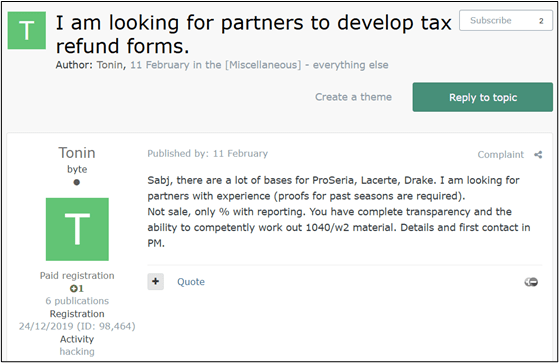
A threat actor looking for partners for US tax refund fraud (based on data from accounting software)
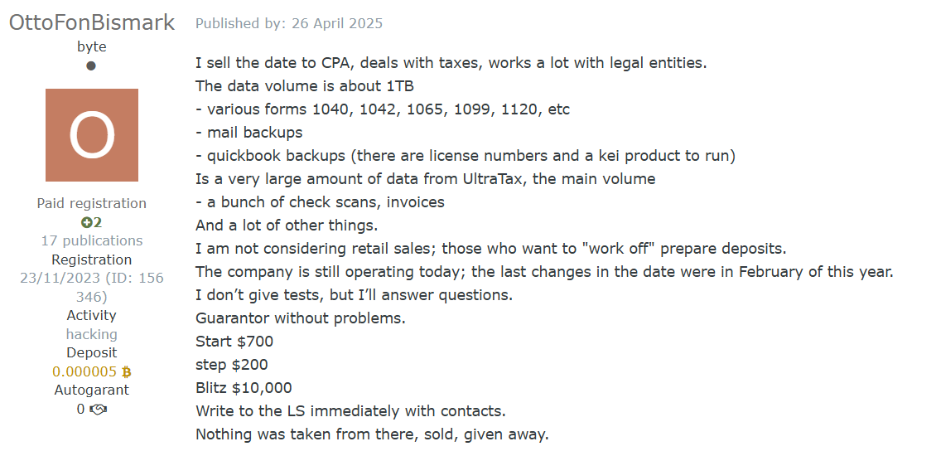
The threat actor is selling access to a CPA company with accounting software databases
A threat actor looking for partners for US tax refund fraud
The black market of PII
At the epicenter of this illicit commerce is one of the premier Russian-language underground forums, which serves as the definitive marketplace for fraudsters to buy and offload tax-related PII. The commoditization of this data is staggering in its efficiency, operating much like a traditional e-commerce platform.
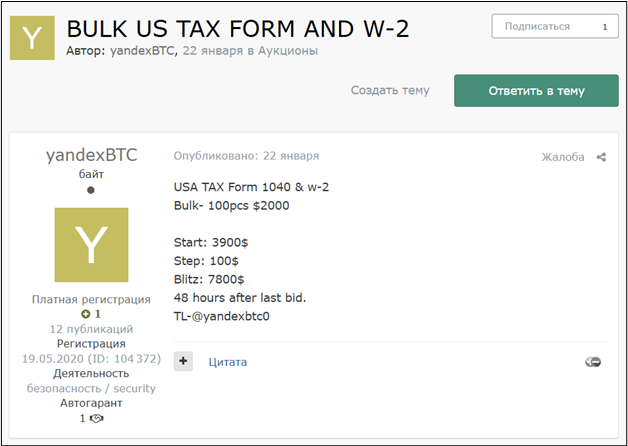
Our research team has captured several compelling samples of this trading activity, highlighting a clear pricing tier based on the freshness of the data and the target demographic. In one recently observed listing, a threat actor advertised a bulk package of 100 complete tax forms for $2,000—effectively pricing a fully documented stolen identity at just $20.
A threat actor offering US tax forms and W-2s for sale
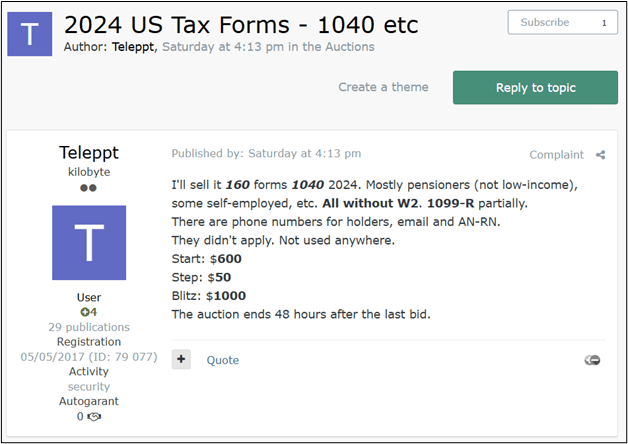
A threat actor offering discounted 1040 forms, PII, and bank data for sale
Conversely, older data dumps from the 2024 tax year are heavily discounted to clear inventory; highly sensitive records specifically belonging to wealthy retirees and pensioners from that period are currently being traded for less than $4 per identity.
Access for sale
This staggering volume of tax-related data must originate from somewhere, and threat actors have identified the ultimate jackpot: US companies that handle tax preparation and accounting procedures.
From an attacker’s perspective, it is infinitely more efficient to breach a dedicated business that serves as a centralized vault for this sensitive information than to cast a wide net trying to trick individual citizens into handing over their personal details.
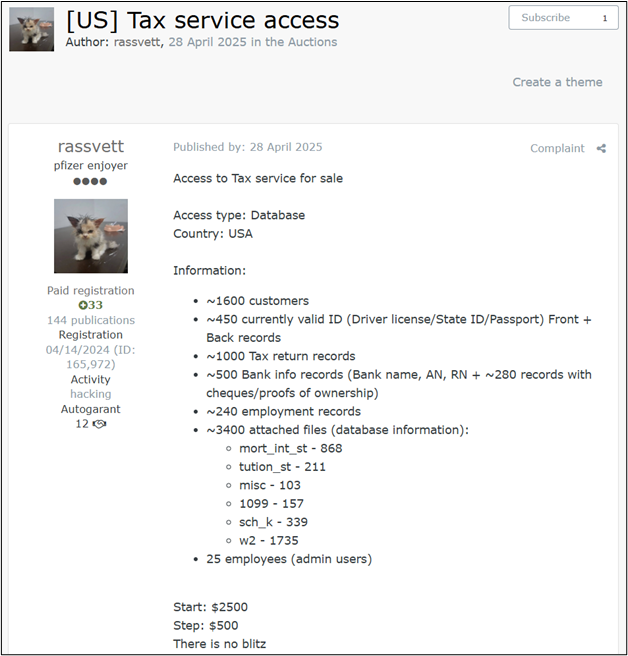
Our research team recently intercepted a prime example of this strategy in action, identifying a Dark Web listing for compromised network access to a US-based tax service firm. The victimized organization is a small business; a typical target of criminals looking for easy access for exploitable information.
Exploiting these systemic weaknesses, the threat actor was able to quietly infiltrate the company’s internal infrastructure and is now auctioning off direct access to a database containing the complete, highly sensitive PII of over 1,600 clients.
A threat actor auctioning off access to a database of PII of more than 1,600 customers
Additional data for sale
Even when threat actors encounter roadblocks during the fraud process—such as a missing piece of PII or a highly specific financial document required for verification—the cybercrime underground offers a comprehensive suite of on-demand services to seamlessly solve these issues.
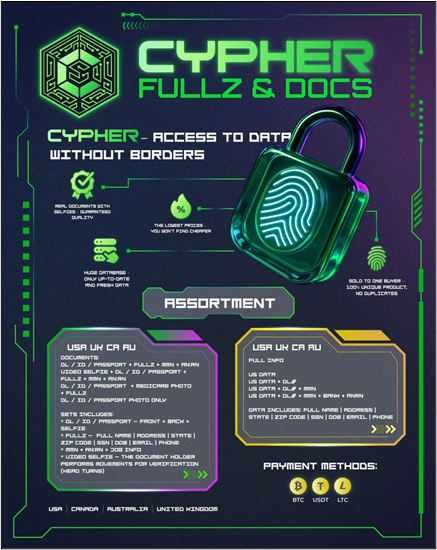
Our research team has tracked a dedicated black market known as “Cypher – Fullz and Docs,” which specializes in selling complete, ready-to-use sets of stolen US identities (commonly referred to in the underground as “fullz”) for as little as $0.75 per set.
Advertising stolen data on the dark web
Another ad for “fullz” – full identities
However, having the basic data is sometimes not enough to bypass required checks.
When additional paperwork is required to legitimize a fraudulent claim, threat actors simply turn to specialized forgery services like “Fakelab.” For a nominal fee ranging between $20 and $40, Fakelab operates as an illicit digital design studio, meticulously forging any tax-related document an attacker might need, from customized W-2s to realistic bank statement, ensuring the scam can proceed without a hitch.
Advert for documents, including medical and tax forms
Price list for data
Tutorials and guidance
The culmination of the tax fraud lifecycle—and often the most precarious phase for the attacker—is the cashout. To successfully finalize the scam and extract the stolen funds, fraudsters require a robust financial infrastructure, typically relying on compromised “drop” bank accounts and supplementary financial tools designed to launder the money and obscure their tracks.
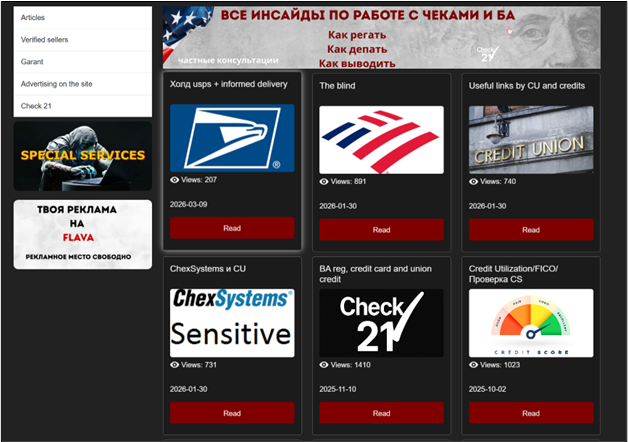
Unsurprisingly, the Dark Web ecosystem provides not just the tools but the detailed education necessary to execute this critical phase. Our research team identified a dedicated underground resource known as “Flava,” which serves as a centralized instructional hub. This platform is brimming with comprehensive, step-by-step tutorials specifically detailing how to orchestrate these complex cashout schemes targeting US citizens and residents.
A Russian-language marketplace related to financial fraud techniques.
How to stay safe
Stolen Identity Refund Fraud is a reminder that identity theft doesn’t just lead fraudulent purchases. It can impact something as fundamental as filing your taxes.
Cybercriminals take advantage of underground marketplaces that sell stolen personal data, compromised business access, and tools designed to support fraud. It makes it easier for criminals to file fake tax returns quickly and at scale.
For taxpayers, the best defense is limiting the amount of personal data available to criminals, filing your taxes early, and paying attention to any warning signs that someone may be trying to use your identity.
Tax fraud often depends on criminals getting access to your personal information first. The less data they have, the harder it is for them to impersonate you. Here are some steps that can help reduce your risk:
File your taxes early. Submitting your legitimate tax return early makes it much harder for criminals to file one in your name first.
Protect your Social Security number. Avoid sharing your Social Security number unless it’s absolutely necessary.
Watch out for phishing emails and texts. Scammers often pose as the IRS, banks, or tax services to trick people into revealing personal data.
Use strong, unique passwords. If criminals gain access to your email or financial accounts, they may be able to collect the information needed to impersonate you.
Monitor your accounts and credit reports. Unexpected tax notices, rejected returns, or unfamiliar financial activity can all be warning signs of identity theft.
Consider an IRS Identity Protection PIN (IP PIN). An IP PIN adds an extra verification step when filing your tax return, helping prevent criminals from filing in your name.
Note: These dark web screenshots have been roughly translated from Russian.
What do cybercriminals know about you?
Use Malwarebytes’ free Digital Footprint scan to see whether your personal information has been exposed online.
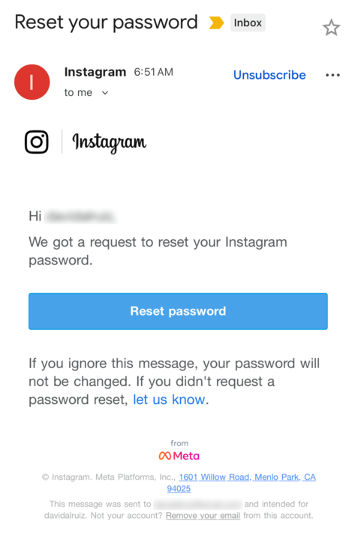
Last week, many Instagram users began receiving unsolicited emails from the platform that warned about a password reset request.
The message said:
“Hi {username}, We got a request to reset your Instagram password. If you ignore this message, your password will not be changed. If you didn’t request a password reset, let us know.”
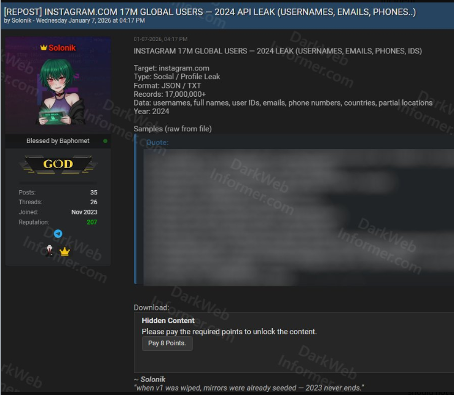
Around the same time that users began receiving these emails, a cybercriminal using the handle “Solonik” offered data that alleged contains information about 17 million Instagram users for sale on a Dark Web forum.
These 17 million or so records include:
Usernames
Full names
User IDs
Email addresses
Phone numbers
Countries
Partial locations
Please note that there are no passwords listed in the data.
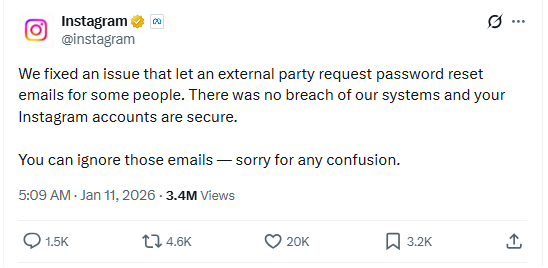
Despite the timing of the two events, Instagram denied this weekend that these events are related. On the platform X, the company stated they fixed an issue that allowed an external party to request password reset emails for “some people.”
So, what’s happening?
Regarding the data found on the dark web last week, Shahak Shalev, global head of scam and AI research at Malwarebytes, shared that “there are some indications that the Instagram data dump includes data from other, older, alleged Instagram breaches, and is a sort of compilation.” As Shalev’s team investigates the data, he also said that the earliest password reset requests reported by users came days before the data was first posted on the dark web, which might mean that “the data may have been circulating in more private groups before being made public.”
However, another possibility, Shalev said, is that “another vulnerability/data leak was happening as some bad actor tried spraying for [Instagram] accounts. Instagram’s announcement seems to reference that spraying. Besides the suspicious timing, there’s no clear connection between the two at this time.”
But, importantly, scammers will not care whether these incidents are related or not. They will try to take advantage of the situation by sending out fake emails.
“We felt it was important to alert people about the data availability so that everyone could reset their passwords, directly from the app, and be on alert for other phishing communications,” Shalev said.
If and when we find out more, we’ll keep you posted, so stay tuned.
Should you want to err on the safe side and decide to change your password, make sure to do so in the app and not click any links in the email, to avoid the risk that you have received a fake email. Or you might end up providing scammers with your password.
Another thing to keep in mind is that these are Meta-data. Which means some users may have reused or linked them to their Facebook or WhatsApp accounts. So, as a precaution, you can check recent logins and active sessions on Instagram, WhatsApp, and Facebook, and log out from any devices or locations you do not recognize.
If you want to find out whether your data was included in an Instagram data breach, or any other for that matter, try our free Digital Footprint scan.
Join us for this one-hour Black Hills Information Security webcast with Joseph - Security Analyst, as he shares with you what he's discovered and learned about the Dark Web, so you never ever ever have to go there for yourself.
David Fletcher// The following blog post is meant to expand upon the findings commonly identified in BHIS reports. The “Server Supports Weak Transport Layer Security (SSL/TLS)” is almost universal across […]
Lawrence Hoffman // So, LastPass is one of my favorite applications, and it’s making me more nervous every day. I haven’t lost faith yet, though it was lots more convenient […]

 Login
Login

 Table Of Contents