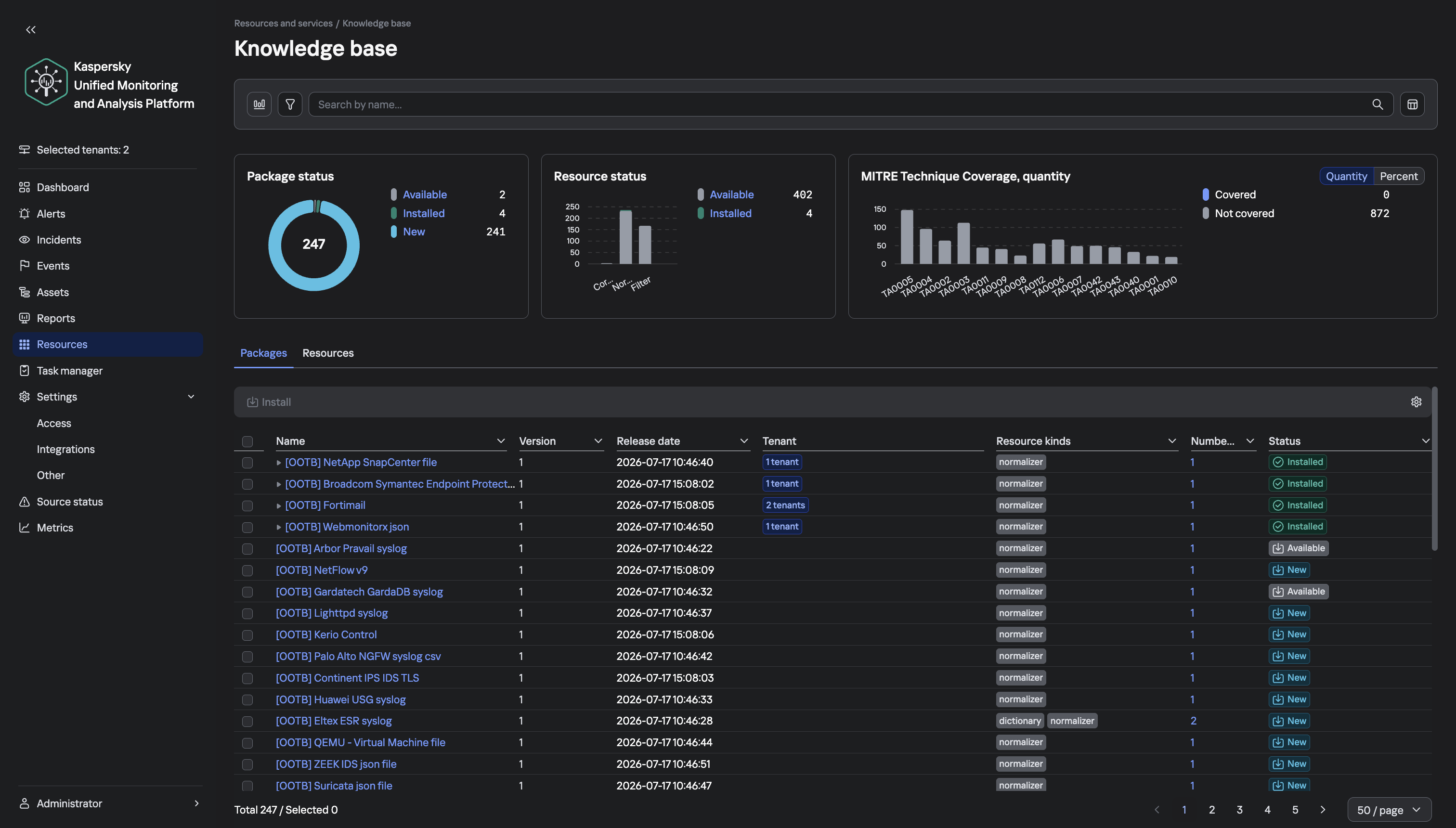
In describing SIEM features, vendors almost invariably focus on numbers: how many correlation rules come out of the box, how many were added over the past year, and how many MITRE ATT&CK techniques they cover. Admittedly, these numbers matter. They do help gauge how effective a system is, and we share them from time to time too. But correlation rules aren’t a magic amulet, and having more of them doesn’t make a SIEM more effective. In fact, the total number of available rules says more about the variety of use cases the system supports. The question a hands-on SIEM analyst cares about first of all is different: which of these rules will actually work and be useful at my company? The answer is far from always obvious, and the reason isn’t even rule quality.
How correlation rules work
A rule first and foremost describes the logic: what to match against what, in what order, and within what time window. It also specifies particular event types from particular sources. For example, a rule for Active Directory group creation waits for events from the Windows Security log; a rule for suspicious network activity — DNS queries; a rule for process manipulation — triggers on events from endpoint telemetry. In other words, whether a rule works depends on whether the SIEM receives the right data in the first place.
The Active Directory rule above would be completely pointless at a company that avoids Windows on principle. It would load without errors, show up in the interface, and technically “exist” — but it would never fire. The reason is simple: the events it was built for never reach the system.
That dictates the only correct order of steps when setting up an SIEM. Don’t start out from the list of rules and then work your way toward your infrastructure. Go the other way around: first pin down which event sources are actually connected and feeding data into the SIEM, and only then see which rules will work on that data. Doing it the other way around leads to one of two outcomes: unmet expectations (hundreds of rules, almost no detections), or a laborious rule-by-rule manual slog, where the analyst opens every rule’s description, checks its event requirements, and decides whether the rule is worth using.
What the MITRE ATT&CK coverage percentage means
MITRE ATT&CK coverage is much the same story: it’s often used without a second thought as a yardstick for product effectiveness. The catch is that these are numbers in a vacuum, with no real-world conditions behind them. Coverage only makes sense for a specific set of working rules. And as we saw above, that set of rules depends on the set of event sources. That’s why the same SIEM will show different MITRE ATT&CK coverage at two different companies. Where Windows logs, endpoint telemetry, an email gateway, and network equipment are all connected, coverage will be noticeably broader than at a company with fewer sources.
Here’s the right way to read this metric: it’s not a score for the SIEM content, but a map of what your SIEM can see with its current telemetry. A tactic with low coverage is a signal that detecting it requires data you don’t have yet. Framed this way, it becomes a clear argument for a management conversation. Not “we need one more event source”, but “this part of the matrix is currently invisible to us, and here’s what it takes to close the gap”.
What’s worth checking in your SIEM
To get the most out of a SIEM, it’s worth asking yourself a few questions — not just when deploying the system, but regularly:
Is every connected event source being handled by rules? Infrastructure changes constantly: new systems appear and new integrations get connected. Every change like this is a reason to check again whether there are now rules you should enable.
Do I know exactly which events are required for which rules? Sometimes a rule doesn’t fire not because a whole event source is missing, but because a single event type isn’t being collected: the audit policy simply isn’t set up to capture it. Fix that oversight as soon as possible.
Do I understand my coverage in terms of MITRE ATT&CK? The point isn’t to produce good-looking reports. It’s to prioritize which event sources to add next: which ones will give the biggest gain in visibility?
But how can you answer these questions without spending ages digging into every rule description? We have a solution.
How we can help
To help analysts find their way around the detection logic of our solution more easily, we’ve added a knowledge base section with the complete set of Kaspersky SIEM rules. In essence, it’s a tool that holds data from the official documentation for the SOC Package rule set, and makes it easy to work with that data. It has three sections:
Library. A table of all correlation rules that you can sort and filter per any column: category, MITRE tactic and technique, event source, and event type. Search works across all fields, including descriptions. Double-clicking a rule opens a card with detailed information about it.
Builder. A tool for assembling a rule set that suits the event sources you already have. The analyst just checks the boxes for the sources the company has, and gets a list of matching rules, brief statistics, and the event types that need to be set up for collection. The tool also generates a regular expression that you can paste into the search bar of the Kaspersky SIEM web interface to link all the matching rules to the correlator in a single step, with no manual picking.
MITRE. A view of the ATT&CK matrix where tactics expand into techniques and sub-techniques. Each matrix item has a card with the description from the MITRE website, and SOC Package coverage details. Covered and uncovered items are color-coded, and charts show coverage per tactic.
One more point worth stressing: the content in our SIEM is updated constantly, so it makes sense to check your setup against it not only at deployment, but after every notable change in your infrastructure. To follow the development of the Kaspersky Unified Monitoring and Analysis Platform, visit the official product page.
We're all petrified about missing a critical event or misclassifying an alert, but when we're talking about incident response (IR), there are often hundreds if not thousands of alerts to parse through. It's easy to get caught up with one alert because it feels "too hot" or maybe not spend enough time looking into something that initially seems "too cold."
According to global research, the market share of highly automated, driverless vehicles is growing rapidly. Analysts estimate that the next 10 to 15 years will mark a major shift from pilot projects to the mass adoption of autonomous transport. The momentum is building worldwide: Europe has already rolled out over 35 autonomous vehicle pilots, while the U.S. and China log more than 450 000 and 250 000 commercial trips per week, respectively. However, the report notes several roadblocks slowing down this progress. One such hurdle is the uncertainty surrounding legal liability and regulation, including in the areas of safety and security. The allocation of responsibility among suppliers, manufacturers, enterprise clients, and end users remains a major point of discussion.
Each market stakeholder sees the issue of ensuring the safety of autonomous vehicles differently. For automakers, it means taking responsibility for how a vehicle behaves on the road and for vetting their suppliers. For the suppliers themselves, it means designing security mechanisms directly into their solution architecture from day one and guaranteeing their adequacy. For insurance companies, it means completely overhauling their risk models to account for not just accidents, but also potential software glitches and cyberattacks. Ultimately, everyone agrees on one fundamental point: security must be a foundational feature of the vehicle — not an optional add-on.
Ensuring vehicle security in the modern era
For years, discussions around automotive safety focused strictly on functional safety. In other words, the goal was to ensure that vehicle systems operated correctly, and that risks associated with potential failures were fully mitigated or reduced to an acceptable level. The ISO 26262 standard “Road vehicles — Functional safety” helps address this very challenge, and serves as the baseline for the automotive industry.
However, the modern connected vehicle is a complex cyberphysical system that stores and processes massive amounts of data, including sensitive information. And this leads to the emergence of new basic needs. To draw an analogy with two levels of Maslow’s hierarchy of needs, a modern vehicle must:
Satisfy the need for “esteem” — meaning it must securely and reliably store user profile data, such as account credentials, biometric data, payment details, and more.
Satisfy the user’s cognitive needs — meaning it must provide secure internet connectivity, transmit vehicle telemetry, and send reminders for scheduled or emergency maintenance.
All of this means equipping vehicles with a wide array of interfaces — telematics, Bluetooth, Wi-Fi, cellular connectivity, OTA updates, and V2X — which opens the door to remote attacks. Therefore, it becomes necessary to ensure not only the functional security, but also the information security of the vehicle. As a result, specialized industry standards that help address automotive cybersecurity challenges have emerged in most countries. The key international standards are ISO/SAE 21434 “Road vehicles — Cybersecurity engineering”, UNECE R155, and UNECE R156.
China’s regulations are evolving too. In 2024, the country published the national standard GB 44495-2024 “Technical Requirements for Vehicle Cybersecurity”, which went into effect on January 1, 2026. The document introduces mandatory cybersecurity requirements for vehicles, including communications protection, security event management, threat monitoring, and secure vehicle interaction with external infrastructure.
Understanding and applying these standards is becoming absolutely critical. Research shows that cybersecurity risks are escalating daily, and their impact on functional safety can sometimes trigger far more dangerous incidents than an internal system failure. What happens if an attacker gains access to a self-driving truck’s remote-control system, or manages to reflash a critical electronic control unit during an unauthorized diagnostic session?
One of the key components for mitigating these scenarios is a security gateway, which isolates the vehicle’s architecture into different domains based on criticality, while providing secure routing, filtering, and traffic control. Developing this type of software solution is precisely what our team focuses on as we build the Kaspersky Automotive Secure Gateway based on KasperskyOS.
Why Kaspersky Automotive Secure Gateway?
The primary purpose of Kaspersky Automotive Secure Gateway (KASG) is to secure the vehicle’s CAN domain, since the CAN bus is used to transmit a vast number of critical control commands. This impacts nearly 80% of the electronic control units inside the car, which handle engine management, braking, body electronics, and more. Because of this, we utilize the Safety-Aware Cybersecurity approach — a unified architecture that accounts for both functional safety and cybersecurity requirements.
For example, standard End-to-End Protection (E2E) mechanisms are typically used to mitigate risks associated with dropped, out-of-order, or corrupted CAN messages. However, these mechanisms were not originally designed to counter targeted cyberattacks. If an attacker manages to construct a malicious frame that conforms to the required E2E format, the system may accept it as valid.
This introduces a new factor: it’s critical not only to verify that a message was delivered without errors, but also to ensure that it was actually generated by a trusted electronic control unit (ECU), and was not altered in transit. This is particularly vital for transmitting control commands — such as those sent to the vehicle’s braking system — or for implementing keyless entry (NFC) systems.
To address that challenge, Secure Onboard Communication (SecOC) mechanisms are integrated into the vehicle’s architecture. They use cryptographic methods to verify message authenticity and integrity, protecting the system against message spoofing and replay attacks. KASG successfully implements these mechanisms, which, in addition to message verification, perform the crucial function of centralized key management. This allows encryption keys to be distributed and updated from a single point within the vehicle, reducing both the cost and the processing load on the ECUs involved in SecOC-backed data exchange.
Automotive IDS
However, in complex systems, it’s no longer enough to apply security mechanisms only to individual messages or separate network segments. It’s essential to provide vehicle-wide monitoring and control, tracking behavioral anomalies, unusual cross-domain interactions, and unauthorized tampering attempts. In the IT domain, this is known as an Intrusion Detection System (IDS). These systems have been successfully adopted by the automotive industry as well.
At the same time, it’s important to realize that for a modern vehicle, an IDS is not a single magic point of data collection and analysis; the vehicle requires a distributed monitoring system. Monitoring is carried out at various architectural levels: within domains, at the individual controller level, and at network boundaries.
The security gateway becomes a critical monitoring point because all cross-domain interaction passes through. Additionally, the gateway provides visibility into data exchange across different segments of the vehicle network. Its job is to detect deviations from normal behavior and generate security events.
When it comes to the CAN domain monitoring implemented in KASG, the IDS looks at the following criteria for traffic analysis:
Alignment of CAN message parameters (CAN ID, DLC) with their descriptions in the DBC specification.
Frequency and periodicity of CAN messages.
Allowable ranges for CAN signals.
In practice, however, an important limitation becomes clear: even with an onboard IDS, more context is required to determine the exact characteristics of an attack. Furthermore, when operating highly automated vehicles — where fleet-wide monitoring is essential — such isolated analysis becomes inherently insufficient.
Connecting a vehicle to an SIEM
Multi-object monitoring, data correlation, and data analysis can be efficiently handled externally — specifically in SIEM (Security Information and Event Management) systems, which are traditionally used in corporate and industrial cybersecurity operations centers. Therefore, utilizing a SIEM system fleet-wide is a logical step that makes it possible to:
Collect security events from multiple vehicles.
Correlate events over time and across contexts.
Detect advanced and distributed attacks.
Provide incident auditing and investigation.
Respond to individual incidents and manage cyber-risks fleet-wide.
When integrating with external SIEM systems, several critical tasks must be addressed: ensuring a secure connection, tuning the security event transmission process, and establishing baseline rules for event processing and correlation. We are actively working through all of these challenges using our own SIEM system — Kaspersky Unified Monitoring and Analysis Platform — as a blueprint.
There are still many issues ahead that need to be resolved. This article covered only a fraction of the approaches currently used in KASG to ensure vehicle safety and security. Yet even this small part demonstrates that automotive security cannot be achieved by solving a single problem or applying a single mechanism. Achieving it requires an approach that enables methodical architecture development — balancing diverse requirements for vehicle functionality, security, and reliability.
How Ripley's Fight for Survival Became My Blueprint for SOC Transformation
I'll admit it. I wasn't planning to rewatch science fiction horror films when I sat down to write about modern cybersecurity challenges. But there I was, staring at yet another draft about SOC modernization when our content team threw out a wild idea: What if we explained threat actors through the lens of a Science Fiction movie like Alien?
Yo, Hicks. I think we got something here!
Against my better judgment, I queued up the original 1979 film. Somewhere between the chest-burster scene and Ripley's desperate attempt to purge the Nostromo's systems, it hit me: This crew had every problem a modern security operations center faces daily.
Stay with me here.
The Unknown Threat Aboard Your Ship
In the original Alien, the crew of the Nostromo responds to what they think is a distress signal. Spoiler alert: It's not. By the time they realize they've brought something deadly aboard, it's already loose in the ship's ventilation system, moving freely through areas they can't monitor.
Sound familiar? That's exactly how modern breaches unfold. Threat actors don't announce themselves with flashing lights and alarm bells. They exploit a vulnerability, establish a foothold, and move laterally through your environment while remaining undetected. According torecent Unit 42® research, the mean time to exfiltrate has dropped from nine days in 2021 to just two days in 2023. Some incidents now occur in under 30 minutes. The xenomorph's (the alien’s) rapid lifecycle has nothing on modern ransomware operators.
The Nostromo crew's problem wasn't just the alien. It was that their ship's systems couldn't tell them where the threat actually was. Their motion trackers picked up movement, but couldn't distinguish between crew members, the cat or the xenomorph. Legacy SIEM systems have the same problem, generating thousands of alerts without the context to determine which ones represent actual threats.
"I Can't Lie About Your Chances, But You Have My Sympathies"
One of the most chilling moments in Alien comes when Ash, the science officer, reveals he's actually a synthetic programmed by the company to prioritize retrieving the alien specimen over crew survival. "I can't lie to you about your chances, but... you have my sympathies."
This is what alert fatigue feels like in a modern SOC.
Like the Nostromo crew discovering their systems were working against them, security analysts often find their tools generate more noise than signal. Traditional SIEMs bombard teams with redundant alerts while real threats slip through undetected. Analysts spend their days triaging false positives instead of hunting actual threats. Basically, they’re sorting through motion tracker pings while the xenomorph stalks the corridors.
The Company Knew (And Your Attack Surface Knows Too)
From Aliens (the 1986 sequel), we learn that the Weyland-Yutani Corporation knew about the xenomorph threat all along. They had information about LV-426, but that intelligence never reached the colonists who needed it. The result? An entire colony was lost because critical threat intelligence wasn't properly shared and acted upon.
This is the attack surface management problem in a nutshell.
You can't protect what you can't see. Like the colonial marines arriving at LV-426 with incomplete intelligence, security teams often lack comprehensive visibility across their cloud environments, hybrid infrastructures and sprawling IoT deployments.
Modern attack surface management addresses this:
Providing continuous assessment of your external attack surface.
Identifying abandoned, rogue or misconfigured assets before attackers find them.
Monitoring for vulnerable systems proactively.
Unifying visibility across network, endpoint, cloud and identity.
Think of it as having the schematics and sensor data Ripley desperately needed – a complete picture of where threats could hide and how they might move through your environment.
The Power Loader Moment: Amplifying Human Response with Automation
In the climactic scene of Aliens, Ripley straps into a power loader exosuit to fight the alien queen. She's still human, still making the decisions, but now she's augmented with technology that amplifies her capabilities and response speed.
This is exactly what AI-driven security operations should do.
Legacy SIEM is like facing the xenomorph queen with your bare hands. Modern AI-driven platforms are the power loader, they don't replace the human operator, but they dramatically amplify what that human can accomplish.
Platforms like Cortex XSIAM® can process over 1 million events per second while reducing the number of incidents requiring human investigation to single digits per day. The technology handles the heavy lifting:
Automated data integration and normalization across all security tools
Machine learning models that detect anomalies in user behavior
Intelligent alert correlation that groups related events into single incidents
Automated response workflows that contain threats in minutes, not hours
Organizations using AI-driven SOC platforms report automating up to 98% of Tier 1 operations. Your analysts still make the critical decisions, they're just equipped with vastly better tools to execute those decisions at machine speed.
The Danger of Fragmented Systems
Throughout the Alien franchise, crew members are constantly struggling with fragmented information. The motion tracker shows movement, but not identity. The door controls are on a different system than life support. Communications are spotty. When seconds count, they're wasting precious time switching between systems and trying to piece together incomplete information.
This is the daily reality in most security operations centers.
The same attack generates alerts in multiple interfaces: your SIEM, EDR console, cloud security platform, identity provider. It’s like seeing the xenomorph's tail in one system, hearing its hiss in another, and detecting acid blood in a third, but never getting the full picture until it's too late.
The engineering challenge isn't just buying better sensors. It's creating a unified data foundation where security-relevant information is collected, stored and normalized together. When all your security data lives in a single data lake, AI models can recognize patterns that would never surface in siloed systems. It’s like understanding that the motion tracker ping, the door malfunctioning and the broken steam pipe are all connected to the same threat.
What this unified approach enables:
Cross-data analytics that correlate threats across different data sources.
Complete context of an attack from initial entry to lateral movement.
Automated response that addresses root causes, not just symptoms.
Seamless collaboration between SOC analysts, threat hunters and incident responders.
"Nuke It From Orbit! It's the Only Way to Be Sure"
In Aliens, the solution to an overwhelming infestation is drastic: orbital bombardment. While we don't recommend that approach for cybersecurity (your compliance team will object), there's a lesson here about the importance of decisive, automated response.
When the colonial marines discover the scope of the xenomorph infestation, their problem isn't just detection, it's that their response capabilities can't match the threat's speed and scale. By the time they've cleared one corridor, the aliens have flanked them through the ceiling.
Modern threats move at similar speeds. Attackers can pivot from initial compromise to data exfiltration faster than human analysts can investigate and coordinate responses across multiple tools. This is where automation becomes essential, not as a replacement for human judgment, but as the mechanism that executes decisions at the speed threats actually move.
The key is having the right response capabilities:
Fast enough to outpace attacker movement.
Comprehensive enough to address root causes.
Automated enough to execute without human bottlenecks.
Intelligent enough to avoid collateral damage.
You don't need to nuke your network from orbit. You need response automation that contains threats before they spread.
The Survivor (And Why Human Expertise Still Matters)
Ellen Ripley survives the Alien franchise through a combination of factors: technical competence, situational awareness, decisive action and refusal to give up. But here's what's critical. She's effective not because she's superhuman, but because she's highly trained, learns from experience, and adapts her approach as threats evolve.
The same principles apply to security operations.
AI and automation dramatically improve efficiency and response times, but skilled security professionals remain essential. The goal isn't to replace analysts. It's to free them from repetitive tasks so they can focus on what humans do best: creative problem-solving, threat hunting, strategic thinking.
The cybersecurity labor shortage continues to grow, and analysts experience burnout from manual processes that consume time better spent on high-value activities. Modern platforms address this by automating routine work while augmenting human decision-making. Instead of spending hours manually correlating events and switching between consoles, analysts receive high-fidelity incidents with complete context.
Ripley didn't survive because she had the best equipment (though the power loader helped). She survived because she understood the threat, adapted her tactics, and made smart decisions under pressure. Your security team needs the same combination: World-class tools that amplify their capabilities and free them to do the strategic thinking that actually stops sophisticated threats.
What Ripley Would Do With Modern SecOps
Imagine what the Nostromo crew could have done if they had access to modern security operations technology:
Detected the alien's presence immediately through behavioral analytics instead of relying on motion trackers.
Tracked its movement through integrated sensor data across the entire ship.
Automatically sealed compartments and adjusted life support to contain the threat.
Had complete visibility into every system, eliminating hiding spots and blind spots.
Your organization shouldn't face threats with 1970s technology while attackers use 2025 capabilities. The evolution from traditional log management to AI-driven security operations isn't just about buying new tools. It's about fundamentally transforming how your security team operates, moving from reactive alert management to proactive threat hunting, from fragmented tools to unified platforms, from manual response to intelligent automation.
The xenomorph was a perfect organism: efficient, deadly, focused solely on survival and reproduction. Modern threat actors are similarly evolved, using AI and automation to attack at machine speed. Your defenses need to match that evolution.
In Space, No One Can Hear You Scream, But Your SOC Platform Can
Modern security operations require more than collecting logs and hoping someone notices the anomalies. You need unified visibility, AI-driven analytics and automated response capabilities that can keep pace with threats that move at the speed of code.
Whether you're drowning in alerts, struggling with tool sprawl, or trying to defend against attackers moving faster than human reaction times, there's a better way forward. And unlike the Nostromo crew, you don't have to face it alone with outdated equipment and fragmented systems.
Just comprehensive security, delivered at the speed of AI.
Because in cybersecurity, everyone can hear you scream when your SIEM fails. The question is whether your security operations platform can stop the threat before it gets that far.
Stop Drowning in Alerts (AKA: Your SIEM Shouldn't Feel Like a Motion Tracker): Legacy Security Information and Event Management (SIEM) systems generate thousands of alerts without the necessary context. The modern approach requires moving past redundant alerts to a system that can accurately distinguish between noise and actual threats, a necessity driven by the rapidly decreasing time attackers take to exfiltrate data.
Get the Full Ship Schematics (Because You Can't Fight What You Can't See): Many organizations lack comprehensive visibility across their environments (cloud, hybrid, IoT). A unified approach, which includes continuous attack surface management and a single data foundation, is essential to connect disparate alerts and gain a complete picture of an attack across all security tools.
Give Your Analysts a Power Loader (Not a Pink Slip): AI-driven security operations (SecOps) platforms do not replace human analysts but dramatically amplify their capabilities and response speed, enabling automated data integration, intelligent alert correlation and rapid response workflows to contain threats at "machine speed" before human bottlenecks are reached.
A SIEM is a complex system offering broad and flexible threat detection capabilities. Due to its complexity, its effectiveness heavily depends on how it is configured and what data sources are connected to it. A one-time SIEM setup during implementation is not enough: both the organization’s infrastructure and attackers’ techniques evolve over time. To operate effectively, the SIEM system must reflect the current state of affairs.
We provide customers with services to assess SIEM effectiveness, helping to identify issues and offering options for system optimization. In this article, we examine typical SIEM operational pitfalls and how to address them. For each case, we also include methods for independent verification.
This material is based on an assessment of Kaspersky SIEM effectiveness; therefore, all specific examples, commands, and field names are taken from that solution. However, the assessment methodology, issues we identified, and ways to enhance system effectiveness can easily be extrapolated to any other SIEM.
Methodology for assessing SIEM effectiveness
The primary audience for the effectiveness assessment report comprises the SIEM support and operation teams within an organization. The main goal is to analyze how well the usage of SIEM aligns with its objectives. Consequently, the scope of checks can vary depending on the stated goals. A standard assessment is conducted across the following areas:
Composition and scope of connected data sources
Coverage of data sources
Data flows from existing sources
Correctness of data normalization
Detection logic operability
Detection logic accuracy
Detection logic coverage
Use of contextual data
SIEM technical integration into SOC processes
SOC analysts’ handling of alerts in the SIEM
Forwarding of alerts, security event data, and incident information to other systems
Deployment architecture and documentation
At the same time, these areas are examined not only in isolation but also in terms of their potential influence on one another. Here are a couple of examples illustrating this interdependence:
Issues with detection logic due to incorrect data normalization. A correlation rule with the condition deviceCustomString1 not contains <string> triggers a large number of alerts. The detection logic itself is correct: the specific event and the specific field it targets should not generate a large volume of data matching the condition. Our review revealed the issue was in the data ingested by the SIEM, where incorrect encoding caused the string targeted by the rule to be transformed into a different one. Consequently, all events matched the condition and generated alerts.
When analyzing coverage for a specific source type, we discovered that the SIEM was only monitoring 5% of all such sources deployed in the infrastructure. However, extending that coverage would increase system load and storage requirements. Therefore, besides connecting additional sources, it would be necessary to scale resources for specific modules (storage, collectors, or the correlator).
The effectiveness assessment consists of several stages:
Collect and analyze documentation, if available. This allows assessing SIEM objectives, implementation settings (ideally, the deployment settings at the time of the assessment), associated processes, and so on.
Interview system engineers, analysts, and administrators. This allows assessing current tasks and the most pressing issues, as well as determining exactly how the SIEM is being operated. Interviews are typically broken down into two phases: an introductory interview, conducted at project start to gather general information, and a follow-up interview, conducted mid-project to discuss questions arising from the analysis of previously collected data.
Gather information within the SIEM and then analyze it. This is the most extensive part of the assessment, during which Kaspersky experts are granted read-only access to the system or a part of it to collect factual data on its configuration, detection logic, data flows, and so on.
The assessment produces a list of recommendations. Some of these can be implemented almost immediately, while others require more comprehensive changes driven by process optimization or a transition to a more structured approach to system use.
Issues arising from SIEM operations
The problems we identify during a SIEM effectiveness assessment can be divided into three groups:
Performance issues, meaning operational errors in various system components. These problems are typically resolved by technical support, but to prevent them, it is worth periodically checking system health status.
Efficiency issues – when the system functions normally but seemingly adds little value or is not used to its full potential. This is usually due to the customer using the system capabilities in a limited way, incorrectly, or not as intended by the developer.
Detection issues – when the SIEM is operational and continuously evolving according to defined processes and approaches, but alerts are mostly false positives, and the system misses incidents. For the most part, these problems are related to the approach taken in developing detection logic.
Key observations from the assessment
Event source inventory
When building the inventory of event sources for a SIEM, we follow the principle of layered monitoring: the system should have information about all detectable stages of an attack. This principle enables the detection of attacks even if individual malicious actions have gone unnoticed, and allows for retrospective reconstruction of the full attack chain, starting from the attackers’ point of entry.
Problem: During effectiveness assessments, we frequently find that the inventory of connected source types is not updated when the infrastructure changes. In some cases, it has not been updated since the initial SIEM deployment, which limits incident detection capabilities. Consequently, certain types of sources remain completely invisible to the system.
We have also encountered non-standard cases of incomplete source inventory. For example, an infrastructure contains hosts running both Windows and Linux, but monitoring is configured for only one family of operating systems.
How to detect: To identify the problems described above, determine the list of source types connected to the SIEM and compare it against what actually exists in the infrastructure. Identifying the presence of specific systems in the infrastructure requires an audit. However, this task is one of the most critical for many areas of cybersecurity, and we recommend running it on a periodic basis.
We have compiled a reference sheet of system types commonly found in most organizations. Depending on the organization type, infrastructure, and threat model, we may rearrange priorities. However, a good starting point is as follows:
High Priority – sources associated with:
Remote access provision
External services accessible from the internet
External perimeter
Endpoint operating systems
Information security tools
Medium Priority – sources associated with:
Remote access management within the perimeter
Internal network communication
Infrastructure availability
Virtualization and cloud solutions
Low Priority – sources associated with:
Business applications
Internal IT services
Applications used by various specialized teams (HR, Development, PR, IT, and so on)
Monitoring data flow from sources
Regardless of how good the detection logic is, it cannot function without telemetry from the data sources.
Problem: The SIEM core is not receiving events from specific sources or collectors. Based on all assessments conducted, the average proportion of collectors that are configured with sources but are not transmitting events is 38%. Correlation rules may exist for these sources, but they will, of course, never trigger. It is also important to remember that a single collector can serve hundreds of sources (such as workstations), so the loss of data flow from even one collector can mean losing monitoring visibility for a significant portion of the infrastructure.
How to detect: The process of locating sources that are not transmitting data can be broken down into two components.
Checking collector health. Find the status of collectors (see the support website for the steps to do this in Kaspersky SIEM) and identify those with a status of Offline, Stopped, Disabled, and so on.
Checking the event flow. In Kaspersky SIEM, this can be done by gathering statistics using the following query (counting the number of events received from each collector over a specific time period):
SELECT count(ID), CollectorID, CollectorName FROM `events` GROUP BY CollectorID, CollectorName ORDER BY count(ID)
It is essential to specify an optimal time range for collecting these statistics. Too large a range can increase the load on the SIEM, while too small a range may provide inaccurate information for a one-time check – especially for sources that transmit telemetry relatively infrequently, say, once a week. Therefore, it is advisable to choose a smaller time window, such as 2–4 days, but run several queries for different periods in the past.
Additionally, for a more comprehensive approach, it is recommended to use built-in functionality or custom logic implemented via correlation rules and lists to monitor event flow. This will help automate the process of detecting problems with sources.
Event source coverage
Problem: The system is not receiving events from all sources of a particular type that exist in the infrastructure. For example, the company uses workstations and servers running Windows. During SIEM deployment, workstations are immediately connected for monitoring, while the server segment is postponed for one reason or another. As a result, the SIEM receives events from Windows systems, the flow is normalized, and correlation rules work, but an incident in the unmonitored server segment would go unnoticed.
How to detect: Below are query variations that can be used to search for unconnected sources.
SELECT count(distinct, DeviceAddress), DeviceVendor, DeviceProduct FROM events GROUP BY DeviceVendor, DeviceProduct ORDER BY count(ID)
SELECT count(distinct, DeviceHostName), DeviceVendor, DeviceProduct FROM events GROUP BY DeviceVendor, DeviceProduct ORDER BY count(ID)
We have split the query into two variations because, depending on the source and the DNS integration settings, some events may contain either a DeviceAddress or DeviceHostName field.
These queries will help determine the number of unique data sources sending logs of a specific type. This count must be compared against the actual number of sources of that type, obtained from the system owners.
Retaining raw data
Raw data can be useful for developing custom normalizers or for storing events not used in correlation that might be needed during incident investigation. However, careless use of this setting can cause significantly more harm than good.
Problem: Enabling the Keep raw event option effectively doubles the event size in the database, as it stores two copies: the original and the normalized version. This is particularly critical for high-volume collectors receiving events from sources like NetFlow, DNS, firewalls, and others. It is worth noting that this option is typically used for testing a normalizer but is often forgotten and left enabled after its configuration is complete.
How to detect: This option is applied at the normalizer level. Therefore, it is necessary to review all active normalizers and determine whether retaining raw data is required for their operation.
Normalization
As with the absence of events from sources, normalization issues lead to detection logic failing, as this logic relies on finding specific information in a specific event field.
Problem: Several issues related to normalization can be identified:
The event flow is not being normalized at all.
Events are only partially normalized – this is particularly relevant for custom, non-out-of-the-box normalizers.
The normalizer being used only parses headers, such as syslog_headers, placing the entire event body into a single field, this field most often being Message.
An outdated default normalizer is being used.
How to detect: Identifying normalization issues is more challenging than spotting source problems due to the high volume of telemetry and variety of parsers. Here are several approaches to narrowing the search:
First, check which normalizers supplied with the SIEM the organization uses and whether their versions are up to date. In our assessments, we frequently encounter auditd events being normalized by the outdated normalizer, Linux audit and iptables syslog v2 for Kaspersky SIEM. The new normalizer completely reworks and optimizes the normalization schema for events from this source.
Execute the query:
SELECT count(ID), DeviceProduct, DeviceVendor, CollectorName FROM `events` GROUP BY DeviceProduct, DeviceVendor, CollectorName ORDER BY count(ID)
This query gathers statistics on events from each collector, broken down by the DeviceVendor and DeviceProduct fields. While these fields are not mandatory, they are present in almost any normalization schema. Therefore, their complete absence or empty values may indicate normalization issues. We recommend including these fields when developing custom normalizers.
To simplify the identification of normalization problems when developing custom normalizers, you can implement the following mechanism. For each successfully normalized event, add a Name field, populated from a constant or the event itself. For a final catch-all normalizer that processes all unparsed events, set the constant value: Name = unparsed event. This will later allow you to identify non-normalized events through a simple search on this field.
Detection logic coverage
Collected events alone are, in most cases, only useful for investigating an incident that has already been identified. For a SIEM to operate to its full potential, it requires detection logic to be developed to uncover probable security incidents.
Problem: The mean correlation rule coverage of sources, determined across all our assessments, is 43%. While this figure is only a ballpark figure – as different source types provide different information – to calculate it, we defined “coverage” as the presence of at least one correlation rule for a source. This means that for more than half of the connected sources, the SIEM is not actively detecting. Meanwhile, effort and SIEM resources are spent on connecting, maintaining, and configuring these sources. In some cases, this is formally justified, for instance, if logs are only needed for regulatory compliance. However, this is an exception rather than the rule.
We do not recommend solving this problem by simply not connecting sources to the SIEM. On the contrary, sources should be connected, but this should be done concurrently with the development of corresponding detection logic. Otherwise, it can be forgotten or postponed indefinitely, while the source pointlessly consumes system resources.
How to detect: This brings us back to auditing, a process that can be greatly aided by creating and maintaining a register of developed detection logic. Given that not every detection logic rule explicitly states the source type from which it expects telemetry, its description should be added to this register during the development phase.
If descriptions of the correlation rules are not available, you can refer to the following:
The name of the detection logic. With a standardized approach to naming correlation rules, the name can indicate the associated source or at least provide a brief description of what it detects.
The use of fields within the rules, such as DeviceVendor, DeviceProduct (another argument for including these fields in the normalizer), Name, DeviceAction, DeviceEventCategory, DeviceEventClassID, and others. These can help identify the actual source.
Excessive alerts generated by the detection logic
One criterion for correlation rules effectiveness is a low false positive rate.
Problem: Detection logic generates an abnormally high number of alerts that are physically impossible to process, regardless of the size of the SOC team.
How to detect: First and foremost, detection logic should be tested during development and refined to achieve an acceptable false positive rate. However, even a well-tuned correlation rule can start producing excessive alerts due to changes in the event flow or connected infrastructure. To identify these rules, we recommend periodically running the following query:
SELECT count(ID), Name FROM `events` WHERE Type = 3 GROUP BY Name ORDER BY count(ID)
In Kaspersky SIEM, a value of 3 in the Type field indicates a correlation event.
Subsequently, for each identified rule with an anomalous alert count, verify the correctness of the logic it uses and the integrity of the event stream on which it triggered.
Depending on the issue you identify, the solution may involve modifying the detection logic, adding exceptions (for example, it is often the case that 99% of the spam originates from just 1–5 specific objects, such as an IP address, a command parameter, or a URL), or adjusting event collection and normalization.
Lack of integration with indicators of compromise
SIEM integrations with other systems are generally a critical part of both event processing and alert enrichment. In at least one specific case, their presence directly impacts detection performance: integration with technical Threat Intelligence data or IoCs (indicators of compromise).
A SIEM allows conveniently checking objects against various reputation databases or blocklists. Furthermore, there are numerous sources of this data that are ready to integrate natively with a SIEM or require minimal effort to incorporate.
Problem: There is no integration with TI data.
How to detect: Generally, IoCs are integrated into a SIEM at the system configuration level during deployment or subsequent optimization. The use of TI within a SIEM can be implemented at various levels:
At the data source level. Some sources, such as NGFWs, add this information to events involving relevant objects.
At the SIEM native functionality level. For example, Kaspersky SIEM integrates with CyberTrace indicators, which add object reputation information at the moment of processing an event from a source.
At the detection logic level. Information about IoCs is stored in various active lists, and correlation rules match objects against these to enrich the event.
Furthermore, TI data does not appear in a SIEM out of thin air. It is either provided by external suppliers (commercially or in an open format) or is part of the built-in functionality of the security tools in use. For instance, various NGFW systems can additionally check the reputation of external IP addresses or domains that users are accessing. Therefore, the first step is to determine whether you are receiving information about indicators of compromise and in what form (whether external providers’ feeds have been integrated and/or the deployed security tools have this capability). It is worth noting that receiving TI data only at the security tool level does not always cover all types of IoCs.
If data is being received in some form, the next step is to verify that the SIEM is utilizing it. For TI-related events coming from security tools, the SIEM needs a correlation rule developed to generate alerts. Thus, checking integration in this case involves determining the capabilities of the security tools, searching for the corresponding events in the SIEM, and identifying whether there is detection logic associated with these events. If events from the security tools are absent, the source audit configuration should be assessed to see if the telemetry type in question is being forwarded to the SIEM at all. If normalization is the issue, you should assess parsing accuracy and reconfigure the normalizer.
If TI data comes from external providers, determine how it is processed within the organization. Is there a centralized system for aggregating and managing threat data (such as CyberTrace), or is the information stored in, say, CSV files?
In the former case (there is a threat data aggregation and management system) you must check if it is integrated with the SIEM. For Kaspersky SIEM and CyberTrace, this integration is handled through the SIEM interface. Following this, SIEM event flows are directed to the threat data aggregation and management system, where matches are identified and alerts are generated, and then both are sent back to the SIEM. Therefore, checking the integration involves ensuring that all collectors receiving events that may contain IoCs are forwarding those events to the threat data aggregation and management system. We also recommend checking if the SIEM has a correlation rule that generates an alert based on matching detected objects with IoCs.
In the latter case (threat information is stored in files), you must confirm that the SIEM has a collector and normalizer configured to load this data into the system as events. Also, verify that logic is configured for storing this data within the SIEM for use in correlation. This is typically done with the help of lists that contain the obtained IoCs. Finally, check if a correlation rule exists that compares the event flow against these IoC lists.
As the examples illustrate, integration with TI in standard scenarios ultimately boils down to developing a final correlation rule that triggers an alert upon detecting a match with known IoCs. Given the variety of integration methods, creating and providing a universal out-of-the-box rule is difficult. Therefore, in most cases, to ensure IoCs are connected to the SIEM, you need to determine if the company has developed that rule (the existence of the rule) and if it has been correctly configured. If no correlation rule exists in the system, we recommend creating one based on the TI integration methods implemented in your infrastructure. If a rule does exist, its functionality must be verified: if there are no alerts from it, analyze its trigger conditions against the event data visible in the SIEM and adjust it accordingly.
The SIEM is not kept up to date
For a SIEM to run effectively, it must contain current data about the infrastructure it monitors and the threats it’s meant to detect. Both elements change over time: new systems and software, users, security policies, and processes are introduced into the infrastructure, while attackers develop new techniques and tools. It is safe to assume that a perfectly configured and deployed SIEM system will no longer be able to fully see the altered infrastructure or the new threats after five years of running without additional configuration. Therefore, practically all components – event collection, detection, additional integrations for contextual information, and exclusions – must be maintained and kept up to date.
Furthermore, it is important to acknowledge that it is impossible to cover 100% of all threats. Continuous research into attacks, development of detection methods, and configuration of corresponding rules are a necessity. The SOC itself also evolves. As it reaches certain maturity levels, new growth opportunities open up for the team, requiring the utilization of new capabilities.
Problem: The SIEM has not evolved since its initial deployment.
How to detect: Compare the original statement of work or other deployment documentation against the current state of the system. If there have been no changes, or only minimal ones, it is highly likely that your SIEM has areas for growth and optimization. Any infrastructure is dynamic and requires continuous adaptation.
Other issues with SIEM implementation and operation
In this article, we have outlined the primary problems we identify during SIEM effectiveness assessments, but this list is not exhaustive. We also frequently encounter:
Mismatch between license capacity and actual SIEM load. The problem is almost always the absence of events from sources, rather than an incorrect initial assessment of the organization’s needs.
Lack of user rights management within the system (for example, every user is assigned the administrator role).
Poor organization of customizable SIEM resources (rules, normalizers, filters, and so on). Examples include chaotic naming conventions, non-optimal grouping, and obsolete or test content intermixed with active content. We have encountered confusing resource names like [dev] test_Add user to admin group_final2.
Use of out-of-the-box resources without adaptation to the organization’s infrastructure. To maximize a SIEM’s value, it is essential at a minimum to populate exception lists and specify infrastructure parameters: lists of administrators and critical services and hosts.
Disabled native integrations with external systems, such as LDAP, DNS, and GeoIP.
Generally, most issues with SIEM effectiveness stem from the natural degradation (accumulation of errors) of the processes implemented within the system. Therefore, in most cases, maintaining effectiveness involves structuring these processes, monitoring the quality of SIEM engagement at all stages (source onboarding, correlation rule development, normalization, and so on), and conducting regular reviews of all system components and resources.
Conclusion
A SIEM is a powerful tool for monitoring and detecting threats, capable of identifying attacks at various stages across nearly any point in an organization’s infrastructure. However, if improperly configured and operated, it can become ineffective or even useless while still consuming significant resources. Therefore, it is crucial to periodically audit the SIEM’s components, settings, detection rules, and data sources.
If a SOC is overloaded or otherwise unable to independently identify operational issues with its SIEM, we offer Kaspersky SIEM platform users a service to assess its operation. Following the assessment, we provide a list of recommendations to address the issues we identify. That being said, it is important to clarify that these are not strict, prescriptive instructions, but rather highlight areas that warrant attention and analysis to improve the product’s performance, enhance threat detection accuracy, and enable more efficient SIEM utilization.
Recently in the SOC, we were notified by a partner that they had a potential business email compromise, or BEC. We commonly catch these by identifying suspicious email forwarding rules, […]
Click on the timecodes to jump to that part of the video (on YouTube) Slides for this webcast can be found here: https://www.blackhillsinfosec.com/wp-content/uploads/2020/09/SLIDES_HowtoPrepareBeforeCompromise.pdf 00:40 Intro, background information, how to deal with […]

 Login