Reading view

The Evolution of Hacktivism in Hybrid Warfare: Modern Tactics and Real-World Impact

Blogs

Blog

The Evolution of Hacktivism in Hybrid Warfare: Modern Tactics and Real-World Impact

In this post we examine how modern hacktivism has evolved into a tool of global hybrid warfare, analyzing crowdsourced attack tactics, media-driven propaganda, and real-world impacts across Ukraine, the Middle East, European Union, and NATO nations.


SHARE THIS:
Default Author Image
August 26, 2026

Hacktivism used to be perceived as digital graffiti, with lone-wolf threat actors defacing government websites or temporarily crashing banking portals to make a political point. However, Flashpoint is tracking a fundamental shift in how these groups operate.

Modern hacktivism is evolving into a disciplined component of global hybrid warfare, capable of bridging digital disruptions with tangible real-world impact. Today, these operations blur the line between volunteer activism and coordinated state interest, leveraging crowdsourced infrastructure to disrupt critical utilities, manipulate media narratives, and target public infrastructure on a global scale. Unpacking these modern hacktivist collectives reveals what their tactics look like in practice and their far-reaching consequences across dozens of nations.

What is Hacktivism?

Hacktivism is the use of cyberattacks to promote or advance a particular political or social cause, leveraging a wide range of tactics such as website defacement, distributed denial-of-service (DDoS) attacks, and data breaches. Modern hacktivist collectives serve as the loud, high-visibility arm of cyber conflict—frequently aligning with state geopolitical interests, as seen most prominently in recent pro-Russian operations and Iranian-aligned cyber campaigns.

These pro-Russian hacktivist groups, such as NoName057 and Killnet, alongside pro-Iranian collectives and proxy ecosystems like Handala Hack, often react to the news cycle and target countries designated by state media or ideological narratives as enemies. As such, modern hacktivist campaigns are opportunistic and tied to global events—from the escalation in the Middle East following military operations like Operation Epic Fury, to the Milan-Cortina Winter Olympics and new aid packages to Ukraine. These groups’ justification narratives typically mirror state messaging.

Modern Tactics: Gamifying Cyber Warfare

In tracking modern hacktivist groups, Flashpoint analysts identified a new method these groups are utilizing to convert ordinary devices into tools for hybrid warfare—the gamification of cyberattacks. Flashpoint has observed groups like NoName057 turning DDoS attacks into community-based “patriotic online games,” such as their “DDoSia Project,” with participants earning military-style ranks and cryptocurrency rewards for overloading the websites of government institutions, banks, and various infrastructure across various countries.

This model has enabled the scaling of operations by utilizing a large, low-skilled participant base rather than having to rely on sophisticated technical tradecraft. The model’s decentralized structure and ideological appeal continue to pose a significant challenge for international law enforcement.

The Propaganda Engine: Media Amplification and Validation

Beyond technical disruptions, publicity is the primary currency of modern hacktivism. Hacktivist groups demonstrate a consistent pattern of media-seeking behavior and self-promotion, likely intended to amplify their perceived impact and reinforce notoriety within the broader cyber threat landscape. Many of these groups repeatedly repost media coverage and news articles referencing themselves.

This serves as a curated self-promotion mechanism, allowing the group to selectively showcase external validation of its operations, including coverage from mainstream and security-focused outlets, to its followers. This behavior aligns with a broader trend observed with especially pro-Russian hacktivist collectives, in which media visibility is treated as a measure of operational success independent of verified technical impact. It also serves as a deliberate tactic for engagement and recruitment that reinforces “patriotic” branding and sustains participant morale and visibility.

Beyond Propaganda: Aligning Cyber Disruption with Military Objectives

In some cases, the digital targeting of hacktivist collectives is more aligned with kinetic objectives, rather than public perception or propaganda initiatives. This is especially true for Iranian-aligned hacktivists and proxy groups who are more deeply intertwined with military operations in the Middle East. These groups have expanded their operations from website disruptions into claims of large-scale data wipers, extortion, and cyberattacks targeting key infrastructure across the Gulf.

The Far Reach of Modern Hacktivism

Major geopolitical flashpoints in the Middle East have triggered waves of hacktivist activity that has spread across North America, with threat actors targeting supply chains, financial infrastructure, and operational technology and control systems.

Simultaneously, pro-Russian hacktivist groups, particularly NoName057, have been extremely prolific within the last year—carrying out two major illicit campaigns heavily targeting Ukraine, which then spilled over to more than 30 nations globally. The following breakdown contains statistics and targeting dynamics of pro-Russian hacktivist groups observed between July 2025 and 2026:
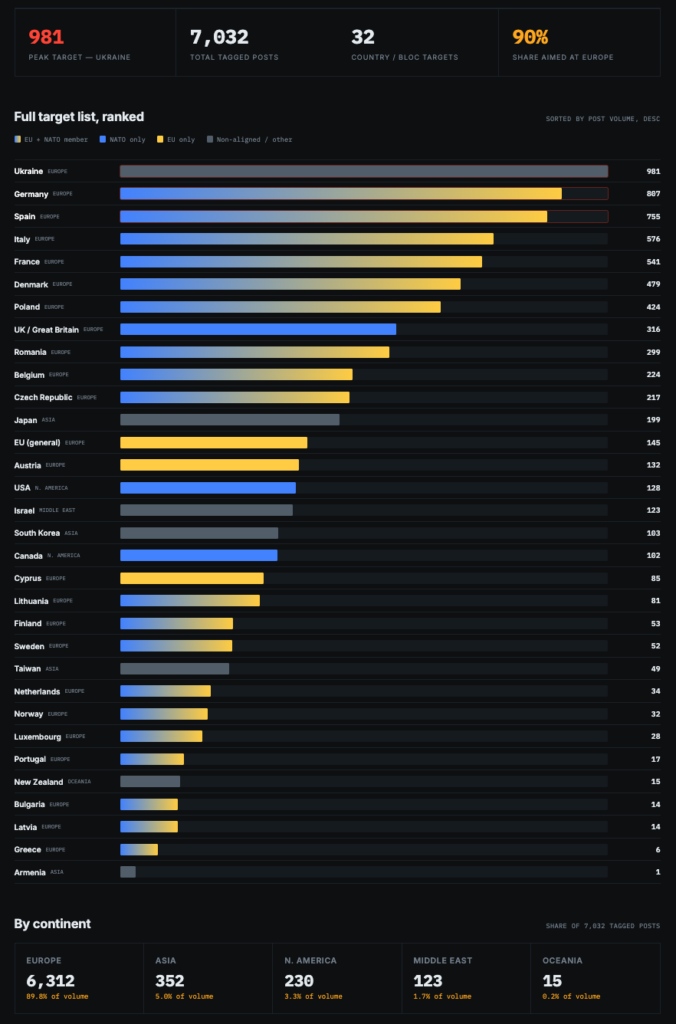
Country-level targeting derived from Flashpoint intelligence. (Source: Flashpoint, graphic generated by Claude)

The Continuous Campaign Against Ukraine

Ukraine has been the primary target for pro-Russian hacktivist groups who seek to damage Ukrainian infrastructure and morale. Anti-Ukrainian content is constantly distributed through dedicated per-language channels, making it the most linguistically developed target spanning six languages. Involved channels each post near-identical translated content within minutes to hours of the Russian original, down to the same image file with identical SHA1 hashes, which suggests a sustained propaganda distribution operation.

This has resulted in alleged data breaches impacting Ukrainian General Staff, military enlistment offices, medical, and morgue databases to push a casualty-count narrative. It also has resulted in the defacement or disruption of websites of regional capitals and administrative centers, energy plants, water and power-adjacent infrastructure, and many more.

Spilling Over: Impact Across EU and NATO Allies

However, Ukraine is not the sole casualty of modern hacktivism. Recent pro-Russian hacktivist campaigns have spread to other EU nations and NATO members. Germany, the United Kingdom, and Spain have been observed to be priority targets, with threat actors targeting public transportation, federal and security agencies, municipal government and utilities, financial markets, and other infrastructure. In some cases, hacktivist campaigns manifest in the real-world, with physical sticker drives on municipal streets, alongside doxxing operations releasing alleged personal data and automated scans hijacking exposed CCTV camera systems across Europe.
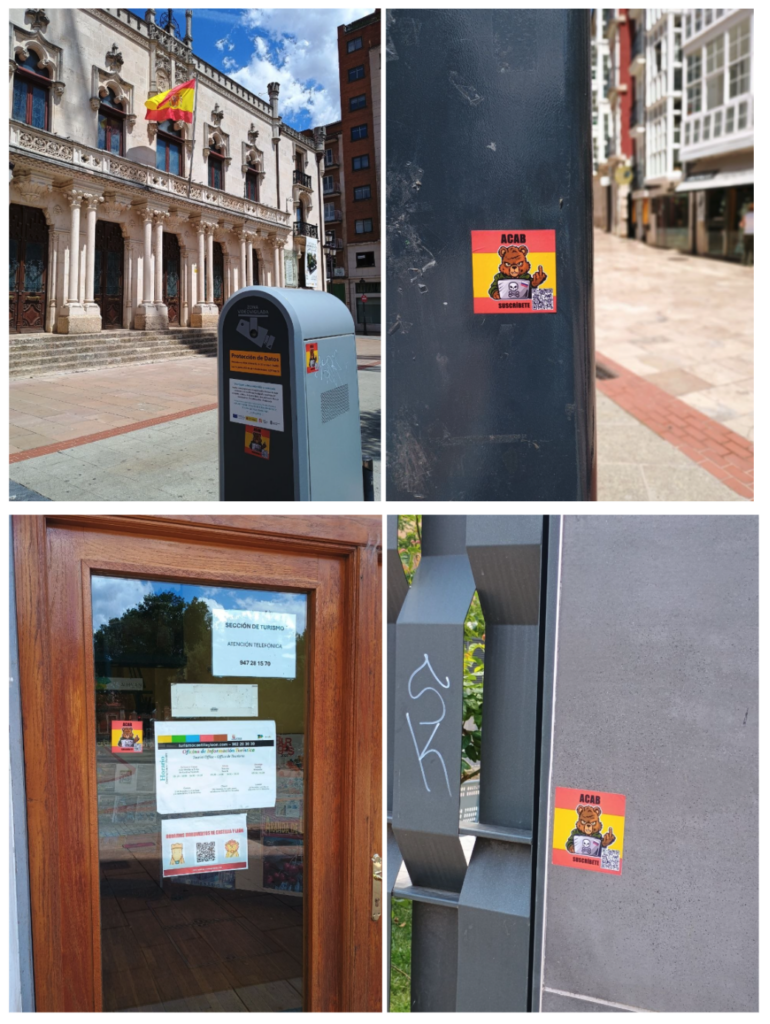
Physical sticker campaigns (NoName057) in Spain identified by Flashpoint

Defend Against the New Wave of Hacktivism Using Flashpoint

As hacktivist operations continue to blur the boundary between digital disruption and real-world interference, organizations can no longer view DDoS attacks or low-level intrusions as simple background noise. Protecting critical assets requires proactive visibility into threat actor networks, early detection of targeting narratives, and primary source threat intelligence.

Request a demo today to see how Flashpoint provides actionable intelligence to help security teams, government agencies, and infrastructure providers identify, monitor, and mitigate emerging hacktivist campaigns before they impact operations.

See Flashpoint in Action

The post The Evolution of Hacktivism in Hybrid Warfare: Modern Tactics and Real-World Impact appeared first on Flashpoint.

  •  

Malicious TV boxes: how a cheap “SuperBox” turns your home into a proxy node for cybercriminals | Kaspersky official blog

Netflix, Apple TV+, Disney+, Hulu, Amazon Prime, YouTube Premium… The average law-abiding family today pays for five to 10 subscriptions just to watch their shows of choice, with the monthly bill easily crossing the hundred-dollar mark. It’s no surprise, then, that social media and online marketplaces are seeing a surge in demand for the “magic boxes” that popped up at the end of 2025: Android-powered TV boxes that promise to unlock thousands of channels and every streaming service subscription-free for a one-time purchase.

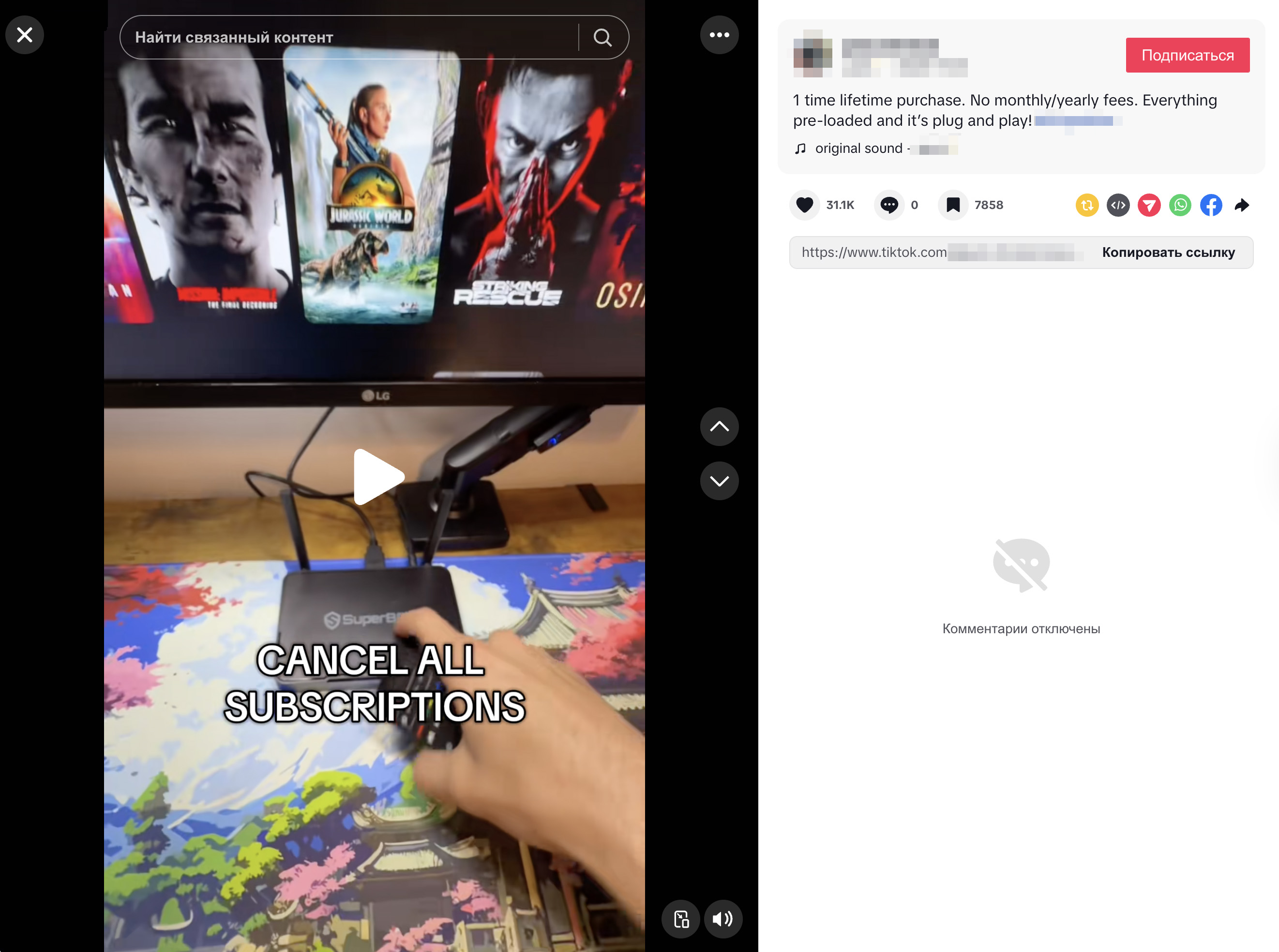
Ads for these devices are flooding TikTok and Instagram: smiling influencers unbox the SuperBoxes, plug them into a TV, and browse endlessly through channels. It looks like the ultimate life hack against subscription fatigue, right? In reality, it’s one of the easiest ways to invite a botnet into your home network.

Screenshot of a TikTok video showing a SuperBox in action

A promotional video on TikTok explaining how great it is when the cheese is free you can just go ahead and cancel all your subscriptions

What’s wrong with these cheap TV boxes?

Stories about malicious TV boxes have surfaced before, but right now, their marketing has reached a truly alarming scale.

At the end of 2025, analysts examined several models of the popular SuperBox device available from major retail stores and online marketplaces. The findings were deeply concerning: immediately upon powering up, the devices began pinging the servers of the Chinese messaging app Tencent QQ, as well as the Grass proxy service — effectively renting out the owner’s internet bandwidth to third parties.

Inside the firmware, researchers discovered applications completely uncharacteristic of a media player: a network scanner, a traffic analyzer, and tools for DNS hijacking. Consequently, the device not only streams pirated content but also scans the local network for other targets (including industrial SCADA interfaces), and stands ready to participate in DDoS attacks. The SuperBoxes were also found to contain folders with the telltale name “secondstage”, a textbook indication of multi-stage malware.

More recently, in April 2026, the Darknet Diaries podcast featured an interview with a security researcher known by the alias D3ada55, who shared plenty of intriguing details about these boxes — including the fact that they were still openly sold on major platforms like Amazon, Walmart, and Best Buy.

The infection chronicles: BADBOX to Keenadu

The SuperBox case is far from the only instance where Android devices have been turned into botnet nodes — or sold infected right out of the box. Here’s a look at the most recent cases:

  • BADBOX 2.0. In July 2025, Google filed a lawsuit against the operators of a botnet that compromised over 10 million Android devices — mostly cheap TV boxes, tablets, and projectors lacking Google Play Protect certification. As we reported earlier, BADBOX 2.0 specifically targets TV boxes, operating simultaneously as a proxy network and an ad fraud engine.
  • Kimwolf. In December 2025, the QiAnXin XLab team uncovered a DDoS botnet that had hijacked around 1.8 million Android devices. The infected hardware included generic models from off-brand manufacturers sporting high-profile names like TV BOX, SuperBox, XBOX, SmartTV, and others. The infection footprint was massive, with compromised devices shipped worldwide. Among the hardest-hit countries were Brazil, India, the U.S., Argentina, South Africa, the Philippines, and Mexico.
  • Keenadu. Our experts discovered this malware lurking in the firmware of brand-new devices back November 2025, though it didn’t gain widespread attention until after we published a study about it in February 2026. Keenadu masquerades as legitimate system components, embedding itself even into facial-recognition unlock apps, potentially granting attackers access to biometrics, banking data, and personal messages.

All of these stories share the same origin: the Triada Trojan, first documented by our researchers back in 2016 and dubbed at the time “one of the most advanced mobile Trojans”. Over the past decade it has evolved from a standard piece of malware into a modular backdoor baked directly into firmware during manufacturing.

How the infection scheme works

Manufacturers of cheap TV boxes cut corners on absolutely everything: Google Play Protect certification, firmware audits, and security updates. Many of these devices run on the Android Open Source Project without any security guarantees whatsoever. Somewhere along the supply chain — whether at the factory, through a middleman, or at a distributor — a backdoor gets injected into the firmware image. Our experts suspect that the manufacturer itself might not even be aware of the compromise.

The sheer scale of the infection turns millions of identical boxes into the perfect foundation for a botnet: every compromised device represents a unique IP address that can be rented out to anyone. Botnet operators like Kimwolf monetize this not only through distributed DDoS attacks but also by reselling the bandwidth of infected smart TVs and streaming boxes.

What this means for you

An infected TV box sits right in your living room, connected to your home Wi-Fi. That means it can see smartphones running banking apps, network-attached storage (NAS) units holding family archives, IP cameras, smart locks, work laptops, and any other the devices connected to your Wi-Fi network.

With this kind of beachhead inside your home network, an attacker can intercept unencrypted traffic, spoof DNS requests, scan ports, and hunt for vulnerabilities on neighboring devices. On top of that, they can use your IP address for fraudulent activity. As a result, in the best-case scenario, your IP will end up blacklisted, and legitimate services will start blocking you for suspicious activity; in the worst-case scenario, law enforcement could come knocking on your door.

How to spot a potentially dangerous gadget

You should be on alert if a device:

  • Is sold under a no-name brand like T95, X96Q, MX10, TV BOX, SuperBox, or some such
  • Promises free lifetime access to paid premium services for a one-time fee
  • Requires you to disable Google Play Protect, or install third-party APK files during the initial setup
  • Lacks Play Protect certification entirely
  • Is promoted through aggressive spam campaigns on social media

How to avoid hosting a botnet node

  • Buy certified TV boxes that feature Google Play Protect, or purchase devices directly from reputable telecom operators and internet service providers.
  • Isolate all smart home devices. Set up a separate Wi-Fi network on your home router for TV boxes, cameras, smart speakers, robot vacuums, and similar gear, while keeping smartphones, NAS units, and computers on the main network. This prevents malware from spreading to your critical gadgets.
  • Regularly update the firmware on all your devices, and don’t forget about your router — it’s another vulnerable link in the chain.
  • Remove any applications from your Android TV box that you didn’t install yourself, especially alternative app stores, Wi-Fi “boosters”, and “system cleaners”.
  • Monitor your traffic. Modern routers and Kaspersky Premium can display which devices are connecting to where. Frequent connections from a media player to servers in China are a major security red flag.
  • Install Kaspersky Premiumon all your devices — it protects against Trojans, and blocks the phishing pages often used to distribute infected APK files.
  • Don’t disable Google Play Protect, and avoid installing APKs from shady sources — this is the primary infection vector that bypasses the official app store.
  • If in doubt, return the TV box. A cheap streaming device isn’t worth risking your biometrics, banking data, or the reputation of your IP address.

Want to know how else to protect your smart home devices? Read more in our related posts:

  •  

Do You Know If Your DNS Server Can Be Used For DDoS Attacks?

Melissa Bruno // So you have an Internet-facing DNS server. Maybe you decided to set one up at home for fun, or your company has one that works with other […]

The post Do You Know If Your DNS Server Can Be Used For DDoS Attacks? appeared first on Black Hills Information Security, Inc..

  •  
❌