Login
Login

Flock Cameras Are Being Used for Stalking
16 June 2026 at 13:03
There are over a dozen cases around the country where police officers are using the Flock surveillance camera system to obsessively and illegally stalk people.

There are over a dozen cases around the country where police officers are using the Flock surveillance camera system to obsessively and illegally stalk people.
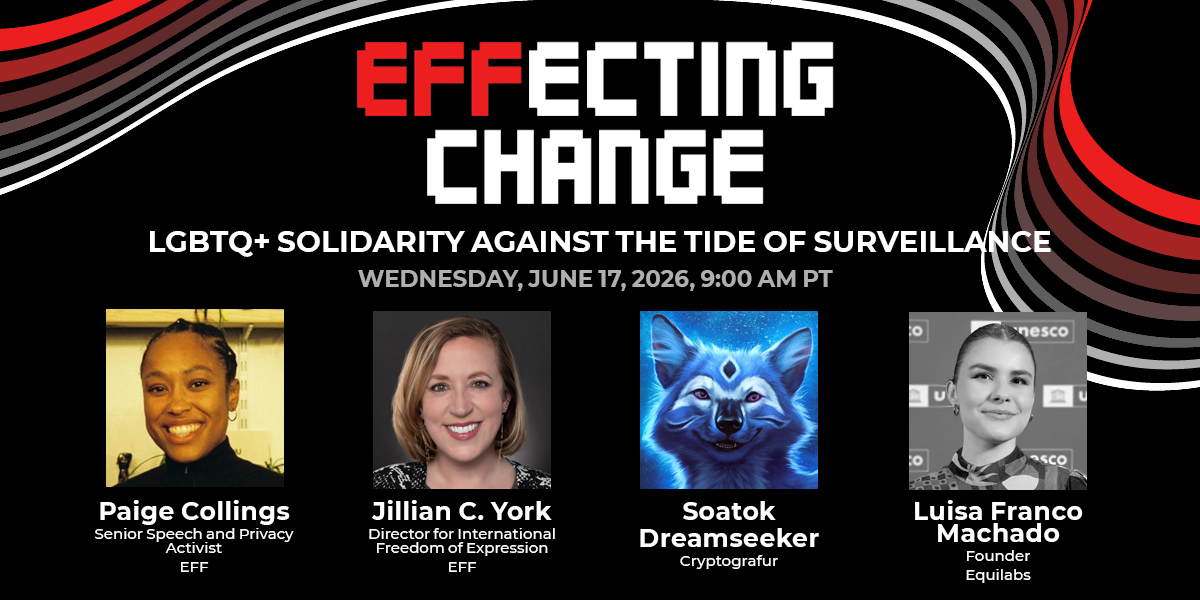
LGBTQ+ communities are facing an escalating wave of censorship and targeted surveillance, but we can push back through mutual solidarity. Join us live to learn how safer virtual spaces get built, how platform policies and government pressure are reshaping the digital landscape, and what platform accountability actually looks like. Our panel will share ideas for direct action and concrete strategies you can bring back to your community. Whether you’re an activist, an ally, or just paying attention, this conversation is for you. Join the livestream online followed by live Q&A.

This event is LIVE and FREE!
Paige Collings
As a lawyer, digital policy activist and community organizer, Paige works to dismantle systems of oppression and advance collective liberation. Her work focuses on highlighting how state surveillance and corporate restrictions stifle marginalized communities and perpetuate historic injustices and harm. She has worked with activists across the globe to facilitate systemic change by speaking truth to power and creating spaces for alternative imaginations; and her writing on digital justice has been featured in Wired, Politico, Teen Vogue, the Daily Beast and more.
Jillian C. York
Jillian is EFF's Director for International Freedom of Expression, based in London. Her work examines state and corporate censorship and its impact on culture and human rights, with a focus on historically marginalized communities. At EFF, she organizes coalitions, writes about and researches topics related to freedom of expression, leads the Speaking Freely interview series, and contributes to various other areas of the organization's work. Jillian is the author of Silicon Values: The Future of Free Speech Under Surveillance Capitalism (Verso, 2021), a contributor to several academic volumes, and has written for MIT Technology Review, The Guardian, and WIRED, among others. She is also a visiting professor at the College of Europe Natolin in Warsaw, and a regular speaker at global events.
Soatok Dreamseeker
Soatok Dreamseeker is a gay furry security engineer. He blogs about applied cryptography on his blog, Dhole Moments, and is developing key transparency to enable end-to-end encryption on the Fediverse. His puns are 100% whole groan.
Luísa Franco Machado
Luísa Franco Machado is an award-winning international expert in digital rights and data justice. She has also been a technical advisor in data governance and AI ethics for governments, NGOs, and international organizations worldwide, including the UN, OECD.AI, GIZ, and others. Luísa has carried on policy research at the London School of Economics and Political Science (LSE) and Sciences Po Paris on the intersection between technology and socio-economic development. In 2022, the United Nations recognized them as a global Young Leader for the Sustainable Development Goals (SDGs) among more than 6,500 advocates. In 2025 she was featured in Apolitical's Government AI 100 list as a rising star.

A proposed FCC rule would kill burner phones: phones whose accounts are not attached to a particular person.
The FCC plans to do this by legally forcing the country’s telecoms to store a wealth of personal information about essentially all phone customers, including a government issued identification number and their physical address, alarming privacy advocates and civil rights activists who compare the measures to those from authoritarian countries where it can be difficult to buy a mobile phone plan without giving up your identity.
The proposed change would drastically shake up how people obtain phone plans in the U.S., and have all sorts of privacy and cybersecurity knock-on effects. The FCC is proposing the data collection partly as a way to combat scammers, with telecoms being required to collect other information on business and foreign customers like the intended use case of their bulk phone plan purchase and their IP address. But the changes would mean telecoms collect data on all new and renewing customers, and the FCC provides a long list of other things that the collected data could help authorities with.
Corporations harvest and monetize ever-growing amounts of our personal data, such as our browsing history and physical location. One bitter fruit of this poisonous tree is known as “surveillance pricing”: corporations offer the same product to two different people at two different prices, based on scrutiny of these people’s respective personal data.
Surveillance pricing is bad for privacy, equity, and price transparency. So EFF supports a California bill, S.B. 2564, which would ban this creepy practice.
In 2025, the Federal Trade Commission (FTC) published a report about the practices of six companies that provide surveillance pricing services to hundreds of other companies, including grocery stores and apparel retailers. The report found that surveillance pricing draws upon customers’ browsing history, physical location, and shopping transaction history. Customers’ data can come from the vendor itself, from its surveillance pricing service provider, or from third-party data brokers. Customers are sorted into groups based on their personal data, as is done for targeted ads. As a result of surveillance pricing, a business might offer two customers different prices for the same product, based for example on whether they are a new parent, or whether they live near a business’s competitor.
As former FTC Chair Lina Khan explained:
Initial staff findings show that retailers frequently use people’s personal information to set targeted, tailored prices for goods and services – from a person’s location and demographics, down to their mouse movements on a webpage.
Unfortunately, the current FTC chair closed the FTC’s portal for public comments regarding surveillance pricing. Fortunately, the California Attorney General has initiated its own investigation of this practice.
Researchers have identified many examples of surveillance pricing:
This practice is harmful in many ways. First, surveillance pricing invades our privacy. Vendors offer us a price only after scrutinizing our personal data about what we’ve clicked online and where we’ve travelled offline. Moreover, surveillance pricing incentivizes all businesses to harvest as much of our personal data as possible. Some businesses will use it for their own surveillance pricing. Other businesses, which might not themselves use it this way, will sell it to data brokers, which in turn will sell it to others for use in surveillance pricing.
Second, surveillance pricing can disparately burden people of color and other vulnerable groups. For example, as described above, surveillance pricing led to Asian people paying more for test prep services, older people paying more for dating services, and people living in non-white neighborhoods paying more for a ride home.
Third, surveillance pricing is opaque. Many people don’t even know when they’ve been subjected to it. Those that do often cannot determine the unknown reasons for the price they’re offered. As a result, consumer advocates will be less able to publish meaningful price comparisons to help consumers make choices. And regulators will be less able to identify unlawful pricing practices.
Thus, EFF and many other groups object to surveillance pricing.
Its defenders sometimes argue that surveillance pricing benefits consumers because it can lead to lower prices. But while some consumers some of the time might get lower prices because of surveillance of their personal data, other consumers will get higher prices, as shown by the examples above. Some recent studies indicate there will be losers and winners based on factors like whether a consumer is willing or able to switch products. Who loses or wins also will turn on the accuracy of the underlying data – yet surveillance pricing is often based on false information.
In any event, both losers and winners of this price discrimination are harmed by surveillance. Privacy is a human right, not a property to be bought and sold on a market. For this reason, EFF has long opposed pay-for-privacy schemes, in which a company charges a higher price to a customer who refuses to submit to processing of their personal data. Thus, even if surveillance pricing sometimes leads to lower prices (and again, it often will not), we oppose it as just another way that corporations try to make customers pay for their privacy.
The key term of California’s S.B. 2564 is short and sweet: “a retailer shall not engage in surveillance pricing.”
The banned practice is defined as: “[i] a customized price for a good for a specific consumer or group of consumers, [ii] based, in whole or in part, on personally identifiable information collected through electronic surveillance,” including if that information is “acquired from a third party.” In other words, “surveillance pricing” is a customized price based on personal information.
The bill has two enforcement methods. First, state and local government may bring enforcement actions, and seek all manner of remedies including monetary penalties. Second, individual consumers may bring their own enforcements lawsuits, and seek the remedies of an injunction and attorney fees. We are pleased the bill provides this private right of action, which is the most important method of enforcement (we’d be even more pleased if the private remedies included liquidated damages).
The bill has three exemptions where surveillance pricing is allowed:
The bill’s author is California Assembly Member Chris Ward. Its co-sponsors are Consumer Reports and TechEquity. Its supporters include Consumer Federation, EPIC, Kapor Center Advocacy, Oakland Privacy, Privacy Rights Clearinghouse, labor unions, and other groups. The bill has advanced through the California Assembly and has arrived for consideration in the California Senate.
Surveillance pricing is just one part of a much larger problem: corporations maximizing their profits by invading our privacy. The all-too-common business model is to systematically harvest, collate, and store as much of our personal data as possible, and then monetize it through use and sale.
EFF’s general approach to this problem is a strong regulatory framework that we call “privacy first.” For example, laws should require businesses to “minimize” their data processing, meaning they must not collect, store, use, or disclose our data unless doing so is strictly necessary to give us what we asked for. Likewise, laws should require businesses to get our voluntary and informed opt-in consent before processing our data, buttressed by legal bans on coercive pay-for-privacy schemes and manipulative “dark patterns.”
A.B. 2564 is just a specific application of the minimization rule. Nobody who uses a web browser or a mobile app expects that, as a result, their clicks and footsteps will be funneled into personal dossiers, and later used by downstream businesses to offer a higher or lower price.
A.B. 2564 is also a specific application of the “no pay-for-privacy” rule. At its best, surveillance pricing is a corporate offer of a lower price in exchange for a consumer’s submission to surveillance of their personal data. This scheme encourages all people to surrender their privacy in exchange for a lower price. This is especially coercive for people with lower incomes, and thus carries the risk of creating a society of privacy “haves” and “have nots.” And swept into this supposed “bargain” is the potential for higher surveillance-based prices based on false information or erroneous inferences.
Surveillance pricing is very similar to online behavioral advertising, a business practice that EFF urges governments to ban. Both practices incentivize all businesses to collect as much of our personal data as possible, in order to later monetize it. Both practices lead some businesses to collate and store our data into dossiers about us for later use. Both practices use these surveillance-based dossiers to manipulate and limit our economic choices, by altering the advertisements and prices we see online. In the words of the FTC report discussed above: “Existing and common techniques used for targeted advertising can also be used for other forms of targeting prices.”
Absent a specific ban on surveillance pricing, as in A.B. 2564, it would be very difficult to protect the public from the many harms it causes. Corporate price-setting is increasingly opaque, making it difficult for consumers and regulators to determine whether a particular company set a particular price for a particular consumer based on their data, and if so, the particular data that it used. As a result, it would be very difficult in this context to enforce general laws requiring minimization or consent. Moreover, many such laws exempt how a business processes the data it directly collected from its own customers; for example, the California Consumer Privacy Act’s limits on “cross-context behavioral advertising” do not apply to how a business uses personal data it collected on its own website. Yet many practitioners of surveillance pricing (like Tindr) rely on such data.
Finally, there is little to no risk that A.B. 2564 will have unintended consequences that hurt internet users’ speech or technological innovation. The bill does not address any particular type of technology. It does not limit any collection, retention, or disclosure of personal data. It limits only one very narrow and easily defined use of data: use to set a customized price. And it has three broad exemptions.
In sum, EFF is proud to join with other groups in support of California’s A.B. 2564. You can read our support letter here.
Last June during Pride, we launched a new initiative—LGBT Q&A—where we answered your most pressing queer-related digital rights questions on EFF’s Instagram and TikTok accounts. No question was too big or too small! You asked us things like what pictures to use on dating apps; how to remove your name from internet searches; why homophobic content doesn't get removed after you report it; and how to stay safe at Pride marches.
And this year, we’re doing it all again.
Both online and offline, LGBTQ+ individuals and the fight for queer liberation are under threat; and the need for guidance and protection from prying eyes and oppressive structures is increasingly pertinent. This is particularly true for those of us who face consequences when intimate details around gender or sexual identities are revealed without consent.
But we know that it can feel overwhelming to even start thinking about how you can protect yourself online in the face of these issues. That's why this Pride, we’re answering all your digital rights questions.
How to submit your questions?
As always, we will not engage with comments that discriminate against marginalized groups, including the LGBTQ+ community.
We’re here to help build an online space where you get to decide what aspects of yourself you share with others, how you present to the world, and what things you keep private. Join us to make the internet private, safe, and full of pride.
Meta’s smart glasses are once again at the center of a privacy debate due to face recognition.
WIRED reports that Meta had quietly embedded unreleased face-recognition code, internally called “NameTag,” into its Meta AI companion app, which powers the company’s smart glasses. The code was not active, but its presence in an app installed on more than 50 million devices raised immediate concerns about how quickly using smart glasses could slide into biometric surveillance.
Face recognition in glasses, even if disabled or unreleased, is especially sensitive because it can identify people at a distance, in real time, and without their consent. Many organizations have warned that this technology could be misused by stalkers, abusers, and others who want to identify people in public without drawing attention.
Gizmodo reports on a proposed Pennsylvania bill that would require smart glasses and similar wearable recording devices to include a visible indicator light when they are capturing audio or video. The bill would also prohibit users from disabling that indicator, a move clearly aimed at reducing covert recording in public spaces.
Most smart glasses already include such an indicator, but reporters noted that some users have been paying others to have them removed or disabled. The proposal is interesting because it tries to solve a hardware-level trust problem with a visible signal. But a visible light only helps if it is both mandatory and difficult to bypass, and history suggests that any visible privacy safeguard becomes a target for tampering when the incentives are high enough.
These two stories are really about the same issue: smart glasses are normalizing the use of always-on cameras, microphones, and AI features in a form that is much easier to conceal than a phone. That creates an unwanted privacy problem for people around the wearer.
Smart glasses are supposed to make computing more seamless. Instead, they are becoming a test case for what happens when cameras, microphones, AI, and biometric features are squeezed into everyday wearables before the privacy rules catch up.
From our point of view, smart glasses sit at the intersection of consumer privacy, surveillance tech, and potential abuse. The risk is not just that a device records audio or video. AI-enabled wearables can process what they see, deduce identities, and potentially store biometric data in ways that ordinary users and bystanders can’t easily detect.
We’d rather err on the side of caution and use an app that can detect when smart glasses are nearby. Unfortunately, it only detects some devices, and we don’t yet know how well it will perform if smart glasses become more common.
As noted by 404 Media, the app is an imperfect, tech-based response to a social and legal problem: it can misfire, it can’t tell you who is being recorded, and it risks giving a false sense of safety. The developer frames it not as a solution but as a small, user-controlled countermeasure in an environment where surveillance devices are becoming less visible and more AI-enabled.
If facial recognition features ever become common in smart glasses, much of their effectiveness will depend on how much information about you is already available online. There are a few steps you can take today to reduce your visibility in facial recognition systems and people-search databases.
A major factor is limiting who can see the photographs you post on social media and other online platforms. But there is more you can do:
The major, most accurate reverse face search engines, Pimeyes and Facecheck.id, offer opt-out and removal processes that can help reduce your visibility in search results:
Most people don’t realize how much information can be found from a name alone. People-search sites often aggregate home addresses, phone numbers, ages, and relatives from public records and commercial databases.
The New York Times has compiled a useful guide to many of the major people-search sites, along with instructions for opting out and removing your information.
If you’re in the US, you can also use Malwarebytes Personal Data Remover to help find and remove personal information that data broker sites have collected about you.
Meta’s smart glasses are once again at the center of a privacy debate due to face recognition.
WIRED reports that Meta had quietly embedded unreleased face-recognition code, internally called “NameTag,” into its Meta AI companion app, which powers the company’s smart glasses. The code was not active, but its presence in an app installed on more than 50 million devices raised immediate concerns about how quickly using smart glasses could slide into biometric surveillance.
Face recognition in glasses, even if disabled or unreleased, is especially sensitive because it can identify people at a distance, in real time, and without their consent. Many organizations have warned that this technology could be misused by stalkers, abusers, and others who want to identify people in public without drawing attention.
Gizmodo reports on a proposed Pennsylvania bill that would require smart glasses and similar wearable recording devices to include a visible indicator light when they are capturing audio or video. The bill would also prohibit users from disabling that indicator, a move clearly aimed at reducing covert recording in public spaces.
Most smart glasses already include such an indicator, but reporters noted that some users have been paying others to have them removed or disabled. The proposal is interesting because it tries to solve a hardware-level trust problem with a visible signal. But a visible light only helps if it is both mandatory and difficult to bypass, and history suggests that any visible privacy safeguard becomes a target for tampering when the incentives are high enough.
These two stories are really about the same issue: smart glasses are normalizing the use of always-on cameras, microphones, and AI features in a form that is much easier to conceal than a phone. That creates an unwanted privacy problem for people around the wearer.
Smart glasses are supposed to make computing more seamless. Instead, they are becoming a test case for what happens when cameras, microphones, AI, and biometric features are squeezed into everyday wearables before the privacy rules catch up.
From our point of view, smart glasses sit at the intersection of consumer privacy, surveillance tech, and potential abuse. The risk is not just that a device records audio or video. AI-enabled wearables can process what they see, deduce identities, and potentially store biometric data in ways that ordinary users and bystanders can’t easily detect.
We’d rather err on the side of caution and use an app that can detect when smart glasses are nearby. Unfortunately, it only detects some devices, and we don’t yet know how well it will perform if smart glasses become more common.
As noted by 404 Media, the app is an imperfect, tech-based response to a social and legal problem: it can misfire, it can’t tell you who is being recorded, and it risks giving a false sense of safety. The developer frames it not as a solution but as a small, user-controlled countermeasure in an environment where surveillance devices are becoming less visible and more AI-enabled.
If facial recognition features ever become common in smart glasses, much of their effectiveness will depend on how much information about you is already available online. There are a few steps you can take today to reduce your visibility in facial recognition systems and people-search databases.
A major factor is limiting who can see the photographs you post on social media and other online platforms. But there is more you can do:
The major, most accurate reverse face search engines, Pimeyes and Facecheck.id, offer opt-out and removal processes that can help reduce your visibility in search results:
Most people don’t realize how much information can be found from a name alone. People-search sites often aggregate home addresses, phone numbers, ages, and relatives from public records and commercial databases.
The New York Times has compiled a useful guide to many of the major people-search sites, along with instructions for opting out and removing your information.
If you’re in the US, you can also use Malwarebytes Personal Data Remover to help find and remove personal information that data broker sites have collected about you.