Normal view

The NO FAKES Act Could Silence Satire, Commentary, And News

17 June 2026 at 22:33

The NO FAKES Act is supposed to target harmful AI-generated impersonations. But in reality, it will make it easier to suppress commentary, satire, and other lawful speech. That's why EFF has signed a letter urging the Senate Judiciary Committee not to advance the bill in its current form.

Take action

Tell Congress to Say No to NO FAKES

In the letter, EFF joins a coalition of civil society groups in pointing out that the bill would import many of the worst features of the DMCA notice-and-takedown system into an even broader range of online expression. Faced with a “heckler’s veto” over legal speech, platforms will have incentives to remove content first and ask questions later. 

The bill offers no protection for a platform’s judgment about an often difficult question—whether a particular piece of content is satire, parody, commentary, or news. Any platform that guesses wrong faces penalties of up to $750,000 per work. 

NO FAKES could also undermine the rights of the people it is supposed to protect. The new federal “likeness” right could be licensed or transferred to others, so individuals will lose control over the use of their own face and voice. That’s not theoretical—workers in the entertainment industry are routinely asked to sign broad contracts about the future use of their likenesses.

As the letter notes: 

A background actor who signs a release on set or an ordinary person who clicks through a platform's terms of service could end up with the right to their own face and voice in someone else's hands, for years, with federal enforcement behind it. 

EFF and the other signatories urge Congress to examine existing legal remedies and pursue narrowly tailored solutions to genuine harms. The last thing we need is a sweeping new intellectual property right that threatens free expression. 

In addition to EFF, the letter is signed by the Center for Democracy & Technology, the American Civil Liberties Union, Fight for the Future, Foundation for Individual Rights and Expression, the Organization for Transformative Works, Public Knowledge, the R Street Institute, The Future of Free Speech, and the Woodhull Freedom Foundation. Read the full letter here. 

Take action

Tell Congress to Say No to NO FAKES

Congress Just Rushed Through a Disastrous Copyright Office Overhaul

11 June 2026 at 00:54

In a voice vote earlier this week, the House of Representatives passed H.R. 6028, the “Legislative Branch Agencies Clarification Act.” The legislation is presented as a technical reorganization of some government agencies, but it’s much more than that. 

H.R. 6028 would fundamentally change the U.S. Copyright Office, and not in a good way. The bill removes the Library of Congress’ current supervisory role over the Copyright Office, transfers several powers directly to the Register of Copyrights, and makes the Register a presidential appointee, confirmed by the Senate. 

These changes would make an office that’s already hugely influential in copyright and tech policy much more political. EFF first explained why that’s a terrible idea when it came up nearly a decade ago. This bill, like the older one, weakens the few public-interest checks and balances that do exist.  We hope the Senate promptly rejects this bill. 

The Copyright Office Doesn’t Need More Politics—Or More Power

The Copyright Office's main responsibilities are administrative and advisory. It registers copyrights, maintains records, grows the Library of Congress’s collections, and provides expertise to Congress on copyright law. But over the past two decades, the Office has also become increasingly influential in copyright policy debates that affect free expression, libraries, educators, competition—and everyday internet users. Unfortunately, it has not been a neutral advocate. The office’s recent report on the role of AI severely bungled the issue of fair use, prioritizing private licensing market “solutions” over user rights. 

Going further back, the Copyright Office supported one of the most infamous anti-internet proposals of all time—the Stop Online Piracy Act (SOPA), a disastrous internet censorship proposal that sparked one of the largest online protests in history. The Office has repeatedly advanced positions that favored large entertainment-industry interests over the public interest.

The Office also plays a major role in the Digital Millennium Copyright Act (DMCA) Section 1201 rulemaking process, which determines when the public may lawfully bypass digital locks for activities such as security research, repair, preservation, or accessibility. EFF has used this process repeatedly to mitigate some of the worst harms of the DMCA. H.R. 6028 would move rulemaking authority over 1201 from the Librarian of Congress to the Register of Copyrights, further consolidating power within the Copyright Office itself.

The bill also makes the Register of Copyrights a presidential appointee confirmed by the Senate. Each administration will be pressured to pick nominees aligned with their own policy preferences, and the powerful copyright owning industries will invest even more heavily in lobbying to get their way, and influence the selection. This position should be focused on administrative ability and actual expertise, not lobbying and politics. 

The Copyright Office Should Stay Connected To The Library of Congress

H.R. 6028 would do more than change who appoints the Register of Copyrights. It would sever the Copyright Office from Library of Congress supervision and transfer many Librarian powers directly to the Register. 

The supervisory relationship exists for good reason, as the nation’s libraries have pointed out for years. The Library, while far from perfect, at least has the mission of preserving and providing access to knowledge. That should be an important public-interest counterweight in copyright debates. Congress has not explained how weakening the ties between the Library and the Copyright Office would serve the public better, or even seriously inquired about it. 

This Bill Was Rushed Through

Back in March, EFF joined Public Knowledge, the Center for Democracy and Technology, library organizations and tech groups, urging Congress not to fast-track this legislation. We told them changes to the Copyright Office will have major consequences for the “speech rights, educational opportunities, and creative freedoms of all Americans.” 

Yet Congress moved forward without any hearings on the bill, and without meaningful examination. H.R. 6028 creates a years-long separation of the Copyright Office from the Library of Congress, transfers significant legal authority, and restructures the appointment process for the nation’s top copyright official. Changes like that deserve hearings, debate, and public scrutiny. H.R. 6028 got none of that. 

The Senate Should Stop This Bill

Copyright law exists to serve the public and “promote the progress” of science and learning. The institutions that administer copyright law should do the same. 

H.R. 6028 would move the Copyright Office further away from that goal. Congress should be strengthening public-interest oversight of copyright policymaking, not looking for ways to concentrate more authority in a single presidentially appointed official. 

The Senate should reject H.R. 6028. The Copyright Office should serve the public—not presidential administrations, and not industry lobbyists. 

Enshittification Merch That Actually Fights Enshittification 

10 June 2026 at 19:34

Enshittification isn't just a sweary word to describe the accelerating decay of the online platforms, apps, and services that we rely on.  

It's a framework for understanding the structural incentives that make tech companies enemies of their own users over time—the surveillance business model, the erosion of privacy, the monopoly power that eliminates alternatives, the regulatory capture that prevents accountability.  

SUPPORT EFF

GET LimITED EDITION MERCH + FIGHT ENSHITTIFICATION

These are some of EFF's core fights and have been for over 35 years. EFF sues. EFF advocates. EFF codes. And EFF wins. EFF is the most profound and powerful disenshittifying force on the planet Earth, and I’ve been proud to fight alongside them for nearly 25 of those years.  

One of the lessons you learn in battles with very long timelines against very powerful actors is that these battles are deeply serious, and because of that they must also be fun. “Enshittification” took off as a shorthand in part because of the minor license to vulgarity it confers. It's slightly crass for a reason: getting people to engage with the abstract issues of tech policy can be hard at the best of times. No one knows this better than my colleagues at EFF, who consistently surprise me with their ability to make complex, technical concepts concrete, memorable, and sometimes even joyful. 

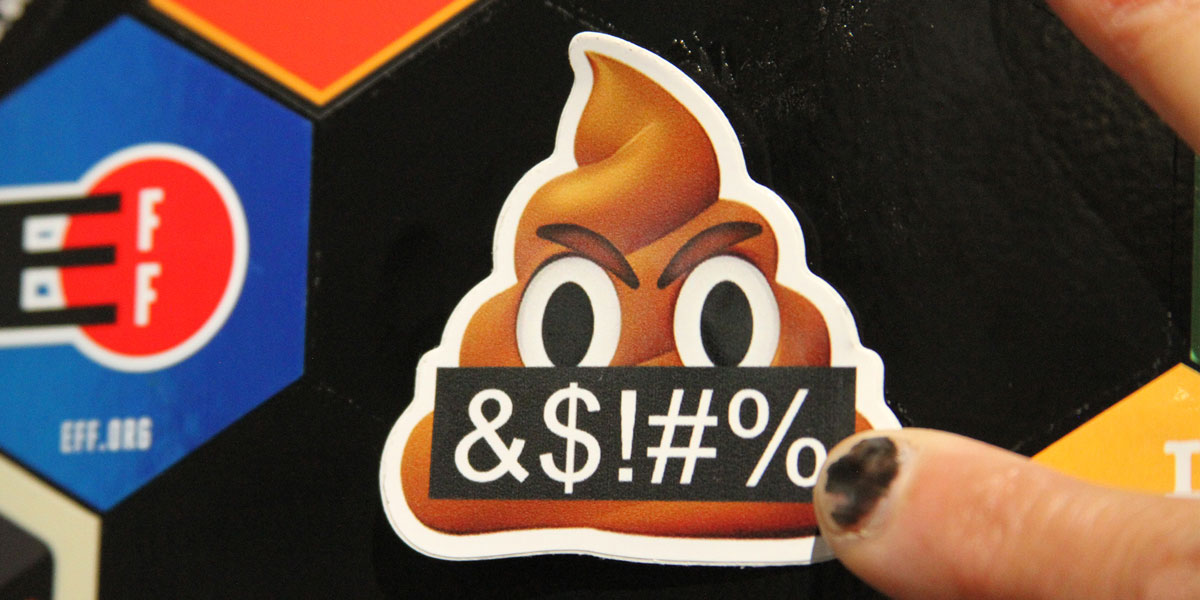
Words matter, but so do visuals. For the cover of the U.S. edition of my book, Enshittification, designer Devin Washburn of No Ideas studio created an iconic variation of the "pile of poo" emoji, with angry eyebrows and a grawlix-scrawled censor bar over its mouth. It instantly became the symbol of enshittification I’d been looking for. 

A digital illustration of an angry poop emoji holding a black sign reading "&!#%", set against a blue and gray background tiled with oversized "& !#%" characters.

I liked it so much I ordered a couple hundred enamel pins and a couple thousand vinyl stickers and handed them out to people I met on my 33-city book tour. Even when giving them away, I was inundated with requests to buy more of them.  

I've since bought out Devin's rights to the image and released it under a Creative Commons Attribution 4.0 license—free for anyone to use, remix, or build on, including commercially, with attribution. The high-resolution files are on Wikimedia CommonsFlickr, and the Internet Archive (including a PSD with an ink-density adjustment layer). It belongs to the commons now. 

But I made sure EFF had first crack at the design for their “official merch,” and they've done right by it. There are two items available now in the EFF shop, and all proceeds go directly to EFF's work defending digital rights. I’ve spent years admiring EFF’s merch and consistent, creative visual identity, so it fills me with pride to see this more-than-a-mere-poop-emoji in their shop.  

A recognizable visual shorthand is a genuine organizing tool. When someone sees the enshittification emoji, they know what the conversation is about. When you wear the pin or slap the sticker on your laptop, you're signaling that you understand what's happening to the internet, and that you know we can do better.  

You can get a $5 sticker:

An angry poop emoji sticker affixed to the coiled spring mechanism inside a vending machine. The sticker depicts a scowling poop emoji holding a black sign reading "&$!#%".

A hand with black nail polish and a gold ring holds an angry poop emoji sticker against a white door. The sticker shows a scowling poop emoji holding a black sign reading "&$!#%".

Or a $10 pin:

A close-up of an enamel pin on the lapel of a tan jacket. The pin depicts an angry poop emoji holding a black banner reading "&$!#%".

An enamel pin clipped to the nose bridge of black-framed sunglasses resting on a wooden surface. The pin depicts a scowling poop emoji holding a black banner reading "&$!#%". 

 Because the design is CC-licensed, you don't have to buy one. You can make your own merch, your own swag, your own illustrations. I made a lawn flag for my front garden.

A  small white garden flag on a metal stake, planted among cacti and succulents in a sunny yard. The flag depicts an angry poop emoji holding a sign reading "&$!#%". 

But if you do want to buy a sticker or pin, you can do so while supporting the most profound and powerful disenshittifying force on the planet Earth—the Electronic Frontier Foundation.

SUPPORT EFF

GET LimITED EDITION MERCH + FIGHT ENSHITTIFICATION


Tell Congress: Just Say No to NO FAKES

9 June 2026 at 23:00

The Senate Judiciary Committee is set to consider and vote on the Nurture Originals, Foster Art, and Keep Entertainment Safe Act (NO FAKES). Instead of targeting the real privacy harms posed by AI-generated replicas, this law would create another layer of internet censorship on top of the already existing legal and voluntary takedown systems. Congress should reject NO FAKES.

Take action

Tell Congress to Say No to NO FAKES

As currently written, NO FAKES proposes to tackle the problems of misleading AI-generated replicas by creating a broad property right in someone's look, voice, and general style. However, there are all kinds of First Amendment-protected expression that would be swept under the NO FAKES regime—think about parody, news, criticism.

NO FAKES also does a laughable job of protecting artists from use of their image in misleading ways. It doesn’t create a privacy right, but rather a property right that can easily be signed away—as major studios and record labels are almost certain to require in their contracts with artists. As a result, NO FAKES actually creates a new avenue for the exploitation of artists by companies instead of protection from misleading replicas. 

The bill also makes it trivially easy for protected speech to be censored. It is a supercharged version of the already flawed copyright takedown regime. It would essentially require platforms to institute filters that don't just look for exact matches of copyrighted material, as current filters do, but anything that might be a digital replica. Even though the latest version of this bill adds some forms of redress for bad faith takedowns, those provisions lack the teeth required to deter a malicious actor. 

NO FAKES targets speech, tools, and innovation instead of focusing on the real concern posed by these replicas: privacy. This bill was a bad idea when it was introduced, and got even worse when it was amended last year. Tell Congress to just say no to NO FAKES.

Take action

Tell Congress to Say No to NO FAKES

❌