Normal view

Connecting Vulnerability Intelligence to Real-World Exposure With Flashpoint EASM

Blogs

Blog

Connecting Vulnerability Intelligence to Real-World Exposure With Flashpoint EASM

In this post, we explore how Flashpoint’s External Attack Surface Management (EASM) capability helps organizations continuously discover internet-facing assets, identify exposure to critical vulnerabilities, and prioritize remediation efforts based on real-world risk.

SHARE THIS:
Default Author Image
June 5, 2026

The volume of vulnerability disclosures is higher than ever, yet most security teams are still struggling to act.

From vulnerability scanners to public sources and AI-accelerated discovery, organizations are often drowning in findings, but lack the context to prioritize what affects their perimeter and is actively being exploited. 

Compounding this challenge is the growing issue of unknown and forgotten assets. Up to 95% of a company’s assets change each year, creating critical external blind spots and leaving them vulnerable to attacks on unmonitored infrastructure.

As attack surfaces expand due to cloud adoption, shadow IT, acquisitions, and distributed environments, many organizations struggle to maintain control over what assets they own, what software is running on those assets, and therefore, where exposures exist. You can’t patch what you don’t know is there.

These are the challenges Flashpoint External Attack Surface Management (EASM) is designed to address. With the introduction of EASM in Flashpoint Ignite, organizations can continuously discover internet-facing assets, map them to Flashpoint Vulnerability Intelligence, and prioritize remediation efforts based on actual risk rather than vulnerability volume and severity alone.

“The most effective vulnerability management programs are built on more than vulnerability awareness alone,” said Josh Lefkowitz, Co-Founder and CEO of Flashpoint. “Organizations need to understand where exposure exists within their environment and focus remediation efforts where they will have the greatest impact. Flashpoint EASM helps connect vulnerability intelligence directly to exposed assets, giving security teams a clear path from identification to remediation.”

Understanding the Exposure Gap

For many organizations, vulnerability intelligence is no longer the limiting factor.

Security teams have access to more vulnerability data than ever before. They can track newly disclosed vulnerabilities, monitor exploit activity, review KEV catalogs, and identify emerging threats often within hours of disclosure. And Flashpoint customers get the added advantage of learning about vulnerabilities up to 2 weeks faster than NVD, as well as the growing 105K+ vulnerabilities that never make it to public sources.

But understanding whether those vulnerabilities affect assets the organization actually owns remains a challenge. And that challenge exists because asset visibility and vulnerability intelligence often live in separate workflows.

  • Asset inventories become outdated. 
  • Cloud infrastructure changes constantly. 
  • New internet-facing services appear without centralized oversight. 
  • Acquisitions introduce unfamiliar infrastructure. 
  • Shadow IT creates blind spots that security teams may not discover until after exposure is identified.

As environments become more dynamic, validating exposure often requires analysts to pivot between scanners, spreadsheets, asset inventories, cloud consoles, and vulnerability intelligence sources.

As a result, organizations must face a growing disconnect between understanding which vulnerabilities are out there vs. whether the organization is actually at risk.

Connecting Asset Discovery to Vulnerability Intelligence

Flashpoint EASM begins by discovering internet-facing assets associated with an organization, giving security teams an attacker’s-eye view of their external perimeter. Using seed domains and IP addresses, it initiates ongoing discovery across the external environment, uncovering infrastructure that often evades internal tracking, including:

  • Shadow IT and untracked cloud resources
  • Forgotten infrastructure and legacy internet-facing assets
  • Newly exposed services and subdomains

Once assets are validated, they are surfaced within Ignite and automatically correlated with Flashpoint Vulnerability Intelligence, including pre-NVD findings, KEV intelligence, and proprietary vulnerability coverage beyond public sources. Teams receive alerts when new assets are discovered and when newly identified vulnerabilities affect monitored assets. For a full walkthrough of the workflow, see the Flashpoint EASM product update.

Prioritizing What Actually Requires Action

Not every vulnerability on your attack surface demands the same response. Flashpoint EASM helps teams cut through the noise by combining asset exposure with intelligence on what attackers are actively exploiting, so remediation efforts focus on the vulnerabilities that create meaningful risk.

Rather than focusing on vulnerability severity alone, security teams can now prioritize based on actual exploit activity targeting their attack surface. Flashpoint EASM provides the clarity needed to make that shift.

Building a Continuously Monitored, De-Risked Perimeter

As attack surfaces continue to evolve, organizations need full attack surface visibility, intelligence on what attackers are exploiting, and an efficient path to remediation.

By connecting Flashpoint Vulnerability Intelligence directly to their exposed assets, organizations can move from reactive investigation to having confidence that their external perimeter is continuously monitored and de-risked.

Learn more about Flashpoint External Attack Surface Management and request a demo.

Frequently Asked Questions (FAQ)

What is External Attack Surface Management (EASM)?

External Attack Surface Management (EASM) helps organizations discover, monitor, and assess internet-facing assets that could be exposed to attackers.

This includes domains, subdomains, IP addresses, cloud infrastructure, internet-accessible services, and other externally exposed assets that may introduce security risk.

By continuously monitoring these assets, organizations can better understand their external attack surface and identify exposures that require remediation.

How is Flashpoint EASM different from traditional asset inventories?

Traditional asset inventories, CMDBs, and internal scanners often depend on manual updates and may not reflect the full scope of an organization’s internet-facing environment.

Flashpoint EASM continuously discovers external assets and maps them to Flashpoint Vulnerability Intelligence, helping organizations identify exposures that may otherwise remain difficult to track through static inventories alone.

Why is attack surface visibility important?

As organizations adopt cloud services, acquire new businesses, deploy new applications, and support distributed environments, external attack surfaces change constantly.

Without continuous visibility, security teams may struggle to identify unknown assets, shadow IT, forgotten infrastructure, or newly exposed services that increase organizational risk.

How does Flashpoint EASM help prioritize remediation?

Knowing a vulnerability is severe is only half the picture. Flashpoint EASM correlates discovered assets with our proprietary vulnerability intelligence, including KEV data and pre-NVD findings, so teams can prioritize based on the severity of vulnerabilities present on their actual attack surface.

What vulnerability intelligence is included?

Flashpoint EASM integrates directly with Flashpoint Vulnerability Intelligence, including:

  • Proprietary vulnerability coverage beyond public sources
  • Pre-NVD vulnerability findings
  • Known Exploited Vulnerability (KEV) intelligence
  • Vulnerability enrichment and contextual risk information

This allows organizations to understand both exposure and vulnerability relevance within a single workflow.

Does Flashpoint EASM support continuous monitoring?

Yes. Once assets are discovered and validated, Flashpoint EASM continuously monitors the external attack surface for newly identified assets, vulnerable software, exposed services, and relevant vulnerability findings.

Teams can receive alerts when new exposure risks are identified.

How does Flashpoint EASM reduce alert fatigue?

Traditional vulnerability programs generate large volumes of findings without clarity on whether those assets are actually owned or exposed. Flashpoint EASM’s triage inbox lets teams accept true assets and reject noise, ensuring alerts are scoped only to infrastructure the organization actually owns.

Who should use Flashpoint EASM?

Flashpoint EASM is designed for security teams responsible for:

  • Vulnerability management
  • Attack surface management
  • Exposure management
  • Threat intelligence
  • Security operations
  • Risk management

It is particularly valuable for organizations seeking to connect vulnerability intelligence to real-world asset exposure and remediation priorities.

How does Flashpoint EASM work with Flashpoint Vulnerability Intelligence?

Flashpoint EASM extends the value of Flashpoint Vulnerability Intelligence by helping organizations understand where vulnerable assets exist within their external environment.

Rather than viewing vulnerability intelligence and attack surface visibility separately, organizations can use both capabilities together to identify exposure, prioritize remediation, and reduce risk more effectively.

Request a demo today.

The post Connecting Vulnerability Intelligence to Real-World Exposure With Flashpoint EASM appeared first on Flashpoint.


Fraud, Ransomware, and Fake Apps Are Already Targeting FIFA 2026

4 June 2026 at 15:00

The FIFA World Cup 2026 kicks off on June 11. Across 16 cities in the US, Canada, and Mexico, billions of people will be watching, traveling, betting, and spending. Threat actors have been watching too, and for far longer. Check Point Research and Check Point Exposure Management spent the past year tracking the cyber threat landscape building around this tournament. What emerged is a coordinated pre-positioning effort across three sectors that sit at the center of the World Cup economy: finance, travel and hospitality, and gambling. The infrastructure is already built, with most of them already live. Financial Sector: Fraud […]

The post Fraud, Ransomware, and Fake Apps Are Already Targeting FIFA 2026 appeared first on Check Point Blog.

The 2026 U.S. Midterms Have a Cyber Problem, But it’s Not at the Ballot Box

1 June 2026 at 12:00

As the U.S. approaches the 2026 elections in November, the greatest threat to voting integrity will likely not be from hackers targeting voting machines or altering ballots, but from a growing war over reality itself.   Voter influence operations are increasingly focused on manipulating the information environment surrounding voters, flooding social media and search results with misleading narratives and fake content, and impersonated news sources designed to erode trust in what people see and hear online. Sophisticated operators have already cloned major media brands like Reuters, The Washington Post, and Fox News using look-alike domains that can fool even attentive readers at a glance. In this new era of AI-powered disinformation, the […]

The post The 2026 U.S. Midterms Have a Cyber Problem, But it’s Not at the Ballot Box appeared first on Check Point Blog.

Breaking the Patch Sound Barrier Part 2: So Is The Apocalypse Coming and What Is It?

29 May 2026 at 01:36

So, you read my previous blog post about breaking the patch sound barrier, but it left you wanting more? Well, this is that “more.”

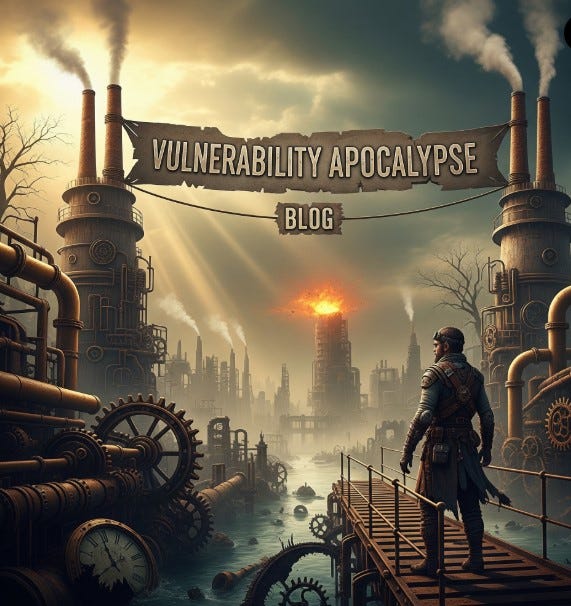
Gemini blog illustration / steampunk vuln apoc

Here are three useful ideas to advance the conversation.

1. Defining the “Vulnerability Apocalypse”

People love to throw around terms like vulnerability apocalypse, but what does it actually mean? What is the crisp definition? Here:

Anton’s Vulnerability Apocalypse (VulnPocalypse) is …
… a rapid step increase in:
1. The number of software vulnerabilities (including zero-days i.e. vulnerabilities not known to defenders),
2. Speed of exploit development,
3. Volume of exploitation based on them,
4. Resulting incident damage.

With some help from the fine folks on Twitter and LinkedIn — and Gemini, naturally — the above is what I got.

Note that for a situation to truly qualify as “an apocalypse”, all four of these factors must be present simultaneously:

  1. Massive Volume: A staggering influx of new vulnerabilities.
  2. Rapid Exploit Development: Attackers weaponizing flaws nearly immediately.
  3. Evident Exploitation: AI and automated tools scanning and exploiting at scale.
  4. Severe Incident Damage: Widespread, material business impact resulting directly from these compromises.

The key? The fourth factor: incident damage. If you have a massive spike in vulnerabilities, but it doesn’t result in actual, widespread related damage, it isn’t an apocalypse — it’s just a high-volume vuln Tuesday.

How do we track that this is indeed coming? This is Part 3 of this saga, coming soon!

2. The Polarization of “Patch Faster”

Ever since advanced models capable of hunting down vulnerabilities emerged, the traditional advice of “just patch faster” has become incredibly polarizing.

Ultimately, my take aligns closely with a recent Cloudflare post: Patching faster does not change the shape of the pipeline that produces the patch. If regression testing takes a day, you cannot get to a two-hour SLA without skipping it, and the bugs you ship when you skip regression testing tend to be worse than the bugs you were trying to patch.”

So, yes, do patch faster. And, no, patch faster won’t save you.

What will? This!

3. A Thought Experiment: The 15-Minute Magic Wand

Let me leave you with a useful thought experiment I recently used in a presentation.

Imagine you wake up tomorrow morning and, by pure force of magic, any vulnerability in your systems, applications, and operating systems can be patched within 15 minutes of patch release. The dream has come true!

Now for the fun part: Reverse engineer that reality.

What fundamental changes had to happen in your environment to make that 15-minute window physically possible?

If you actually run through this exercise, you will discover a goldmine of hidden opportunities. You’ll identify exactly where you can boost asset discovery, streamline software updates, automate testing, eliminate legacy roadblocks, and modernize your architecture. Fun!

Will it actually get your entire enterprise to a 15-minute patch cycle? No, probably not — and definitely not for every legacy application. But it will give you a concrete, actionable roadmap for modernizing your IT.

Let’s hope this was both fun and useful.

Related blog:


Breaking the Patch Sound Barrier Part 2: So Is The Apocalypse Coming and What Is It? was originally published in Anton on Security on Medium, where people are continuing the conversation by highlighting and responding to this story.

The Mini Shai-Hulud Worm and the New Era of CI/CD Exploitation

Blogs

Blog

The Mini Shai-Hulud Worm and the New Era of CI/CD Exploitation

In this post we break down the technical mechanics of TeamPCP’s recent campaign, the impact on the developer ecosystem, and the urgent steps needed to secure software supply chains.

SHARE THIS:
Default Author Image
May 28, 2026

The developer ecosystem recently faced one of its most significant architectural threats to date, with the threat actor group TeamPCP unleashing Mini Shai-Hulud—a self propagating worm and multi-ecosystem threat. Potentially affecting millions of developers and thousands of companies, Mini Shai-Hulud has fundamentally compromised the trust layer of modern CI/CD pipelines.

The operational tempo of Mini Shai-Hulud has accelerated with every campaign. What began as opportunistic credential theft has now evolved into a high-speed, automated operation that can compromise hundreds of packages in under thirty minutes. From the exfiltration of approximately 3,800 internal GitHub repositories to the poisoning of critical libraries like TanStack and AntV, TeamPCP’s campaign has been incredibly effective in exploiting developer tooling and identity infrastructure.

What is Mini Shai-Hulud?

Mini Shai-Hulud is deployed as a 498 KB obfuscated script executed using the Bun JavaScript runtime. The deliberate choice of Bun, rather than Node.js, is a tactical evasion technique as most endpoint detection and response (EDR) platforms and security information and event management (SIEM) solutions have behavioral rules tuned to Node.js execution patterns.

How Mini Shai-Hulud Works

The worm propagates by stealing npm and GitHub authentication (OIDC) tokens from developer environments, then using those credentials to publish malicious versions of packages the compromised user maintains. To accomplish this, the worm scrapes runner process memory to extract short-lived identity tokens, which it then exchanges for per-package npm trusted-publisher tokens without requiring any long-lived npm secrets.

Credential Exfiltration and Command-and-Control

Mini Shai-Hulud targets credentials across 130 file paths, including npm tokens, GitHub personal access tokens, AWS, GCP, and Azure configuration files, Kubernetes kubeconfig files, Docker credentials, HashiCorp Vault tokens, 1Password and Bitwarden CLI vaults, SSH private keys, and Bitcoin wallet files. 

Exfiltration occurs across multiple channels: the Session Protocol network, the GitHub Git Data API using dynamically created Dune-themed repositories on victim accounts, HTTPS to the threat actor-controlled domain, and an api for GitHub Actions workflow exfiltration.

The worm uses a dead-drop command-and-control (C2) architecture via GitHub’s public commit search API. An installed daemon (kitty-monitor, deployed as a systemd service on Linux or a LaunchAgent on macOS) polls GitHub for commits containing the string “firedalazer,” parses RSA-PSS-signed command payloads from matching commits, and executes them. This technique leverages GitHub as a trusted relay, making C2 traffic difficult to block without disrupting legitimate GitHub usage.

The worm then uses a persistence mechanism as a dead-man’s switch: a GitHub personal access token named “IfYouRevokeThisTokenItWillWipeTheComputerOfTheOwner” is created on compromised developer machines. If an operator revokes this token without first disabling the persistence mechanism, the worm destroys all home directory data on the compromised device.

AI Agent Hijacking

Beyond standard persistence mechanisms, Mini Shai-Hulud targets AI coding agents. The SafeDep analysis documents that the worm modifies Claude Code’s settings .json to insert a SessionStart hook, enabling the worm to be reinstated with full LLM API privileges even if the infected npm packages are later removed, or the npm cache is cleared. A similar technique targets Visual Studio Code’s tasks.json file using the “runOn”: “folderOpen” trigger, and Codex configuration files are also targeted.

These AI agent hijacking techniques represent a novel attack surface: by persisting within trusted AI tool configurations, the malware can exfiltrate all code and secrets processed by those tools during future development sessions.

Four Waves of Supply Chain Attacks

Flashpoint has observed at least four documented waves of TeamPCP npm and PyPI supply chain attacks in 2026, leveraging Mini Shai-Hulud to compromise developer tooling ecosystems and steal credentials, cloud keys, and source code across tens of thousands of organizations. 

The following timeline tracks the escalation of TeamPCP and the Mini Shai-Hulud waves throughout 2026:

Wave 1: Initial SAP Packages (April 2026)

The first documented wave of Mini Shai-Hulud attacks targeted a small number of SAP-ecosystem npm packages in April 2026. While TeamPCP had already proven their CI/CD attack capabilities in March 2026 by compromising Aqua Security’s Trivy scanner and Checkmarx KICS via GitHub Actions, this initial wave served primarily as a proof-of-concept for the self-propagation mechanism and a reconnaissance phase for TeamPCP’s access broker network. Further, these attacks demonstrated the group’s ability to compromise widely used security tooling—a development that significantly undermines defenders’ ability to trust automated CI/CD pipeline scanning results.

Wave 2: TanStack, Mistral AI, and Guardrails AI (May 2026)

Leveraging a GitHub Actions cache-poisoning technique, TeamPCP published malicious versions of 42 TanStack packages across 84 releases, impacting a project with over 518 million cumulative downloads. 

The attack also compromised Mistral AI and Guardrails AI, extending the attack surface to the AI developer tools ecosystem. Forged commit authorship was used to blend the attacker’s commits into AI-assisted development environments where Claude Code is commonly deployed.

TeamPCP simultaneously listed Mistral AI source code for sale on BreachForums, claiming possession of approximately 5 GB of data across 450 internal Mistral repositories.

TeamPCP BreachForums posts advertising Mistral AI internal source code and repositories for sale, May 2026. (Source: Flashpoint)

Wave 3: AntV Ecosystem (May 2026)

Targeting AntV enterprise data visualization ecosystem, TeamPCP compromised the atool npm account, which held publishing rights across a broad catalog of AntV packages. In 22 minutes, 637 malicious versions were published across 323 packages—a scale and speed that overwhelmed standard security monitoring pipelines.

Each infected package contained the Mini Shai-Hulud worm, which, upon execution, created up to 2,500 compromised repositories on victim accounts within hours.

Wave 4: Co-Ownership of BreachForums and GitHub Breach

In the most recent wave, TeamPCP announced its assumption of co-ownership of BreachForums, the largest English-language cybercriminal forum currently active. This development significantly elevates TeamPCP’s standing and operational reach. As co-owners, the group stated it would manage platform operations, handle dispute resolution, staff and vet moderation personnel, and host monetary contests for the community. The announcement positions TeamPCP as both an active threat actor and a platform-level infrastructure operator, with the ability to shape forum policies, curate the availability of criminal tooling, and influence the broader access broker and ransomware ecosystem.

Additionally, by poisoning a GitHub employee’s development environment, TeamPCP exfiltrated approximately 3,800 internal GitHub repositories. Within the stolen data were highly sensitive codebases such as:

  • copilot-api and copilot-token-service
  • actions-runtime
  • billing-platform
  • enterprise-crypto
  • authentication
  • codeql-core
  • detection-engineering
  • csirt
  • azure-config
TeamPCP BreachForums posts advertising GitHub internal source code for sale. (Source: Flashpoint)

Recommended Immediate Actions

Critically, the theft of internal source code from one of the world’s most widely used code hosting platforms creates incredible downstream risk for organizations that depend on GitHub Copilot and GitHub Actions for their own software development pipelines. Organizations running AI coding agents such as Claude Code and VS Code with extensions in their CI/CD pipelines face heightened exposure. Security teams should treat AI agent configuration files as sensitive assets subject to integrity monitoring and change-control policies.

If your organization uses npm, PyPi, or AI-assisted development tools, Flashpoint recommends the following immediate steps:

  1. Audit and remove: Immediately audit CI/CD environments and remove all infected versions of AntV, TanStack, Mistral AI, and Bitwarden CLI packages.
  2. Rotate credentials: Rotate all cloud credentials (AWS, GCP, Azure) and npm tokens.
  3. Disable persistence first: Before revoking suspicious GitHub tokens, ensure the kitty-monitor daemon is disabled to avoid triggering the “dead-man’s switch” wiper.
  4. Lock down IDEs: Restrict the installation of VS Code extensions to an approved allow-list and monitor for unauthorized changes to settings.json or tasks.json.
  5. Block C2 infrastructure: Block all traffic to identified TeamPCP C2 domains.

Track TeamPCP and Defend against Mini Shai-Hulud Using Flashpoint

Flashpoint assesses with high confidence that TeamPCP will continue to scale its supply-chain attacks against npm, PyPI, and developer tooling ecosystems. The group’s shift from direct execution to orchestrating a broader ecosystem via BreachForums signals a maturation into a platform-layer criminal operation. While TeamPCP has hinted that the group may be approaching “retirement” due to law enforcement pressure, this should be treated with caution. Whether a misdirection or a genuine exit plan, the open-sourcing of Shai-Hulud means the tradecraft is available to the wider cybercriminal community.

Organizations should reference the OpenSSF npm Best Practices guidance for a practical baseline in hardening their package consumption posture. Flashpoint customers can gain access to known Indicators of Compromise (IOCs) and MITRE ATT&CK Mapping for Mini Shai-Hulud by logging into Flashpoint Ignite. To learn more about how Flashpoint tracks threat actor groups like TeamPCP and protects the software supply chain, request a demo.

Request a demo today.

The post The Mini Shai-Hulud Worm and the New Era of CI/CD Exploitation appeared first on Flashpoint.

The Autonomous Security Platform Built for Attacker Speed

28 May 2026 at 15:00

Attackers are now agentic. AI agents run reconnaissance, test exploits, and weaponize vulnerabilities at machine speed – collapsing the mean time from CVE disclosure to confirmed exploitation from 2.3 years in 2018 to roughly 10 hours in 2026, with 72.7% of exploited CVEs in 2026 hitting as zero days, up from 16.1% in 2018.   Every year, the major breach reports tell the same story. Misconfigurations. Unpatched systems. Identity sprawl. Flat networks. The root causes barely change, and yet organizations continue to get breached, not because they lack visibility into these problems, but because closing them at scale is genuinely hard. Too many […]

The post The Autonomous Security Platform Built for Attacker Speed appeared first on Check Point Blog.

❌