Operation FlutterBridge is a malvertising campaign targeting macOS users. It distributed the new backdoor FlutterShell, built using the Flutter framework.
The 2026 World Cup presents major cyber risks from ransomware groups, state-aligned actors, and other groups targeting critical infrastructure. Learn more here.
The Iranian, IRGC affiliated, threat actor Nimbus Manticore resurfaced during Operation Epic Fury, the US military campaign against Iran launched on February 28, 2026, demonstrating newly adopted techniques and enhanced capabilities.
The campaign leveraged malicious lures impersonating organizations in the aviation and software sectors across the United States, Europe and the Middle East.
For the first time, we observed the use of SEO poisoning as an additional malware delivery method.
The operation introduced a previously undocumented backdoor, named MiniFast, which appears to incorporate AI-assisted development practices, enabling the threat actor to rapidly develop and adapt tooling while maintaining high operational availability during the war.
The actor also used a Zoom installer’s execution flow and abused it to stage a time-sensitive infection chain for malware deployment while blending into legitimate system activity.
Introduction
During the recent geopolitical tensions in the Middle East, we reported on multiple Iran-nexus threat actors advancing Iran’s strategic objectives through cyber operations. These activities included targeting internet-connected cameras, conducting destructive attacks against US and Israeli entities, and exfiltrating data from cloud environments to support broader kinetic and intelligence-gathering efforts.
Nimbus Manticore (also tracked as UNC1549) is an IRGC-affiliated threat actor who primarily targets the defense, aviation and telecommunication sectors through career-themed phishing campaigns. Nimbus Manticore stands out compared to other Iranian-linked groups due to its complex malware toolset.
In 2025, we documented the MiniJunk malware framework used by Nimbus Manticore to target high-profile organizations across Western Europe and the Middle East.
In the recent campaign, the actor adopted several new techniques, including AppDomain (application domain) hijacking, AI-assisted malware development, and SEO poisoning.
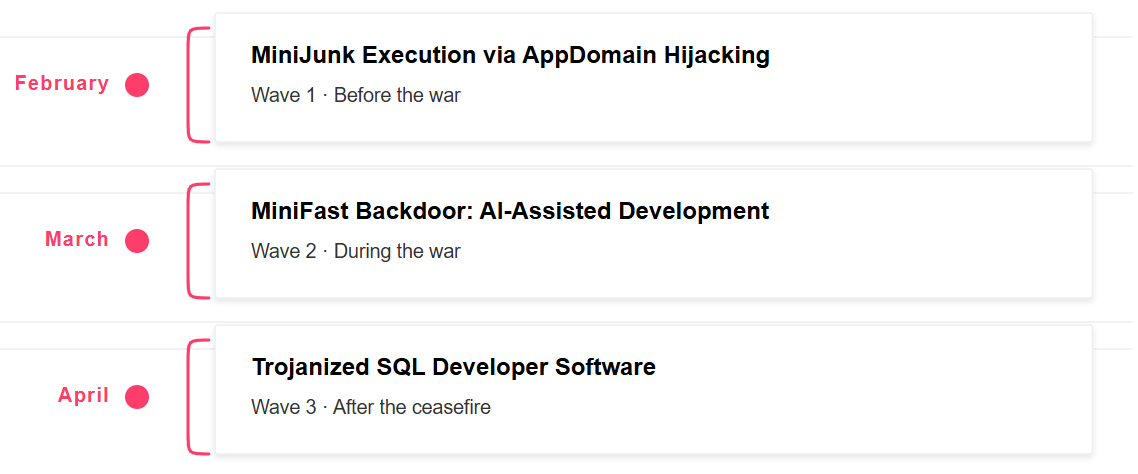
In this article, we focus on three waves of the threat actor’s activity in the last few months, as well as discuss their latest techniques.
Figure 1 – 2026 campaign timeline during the ongoing military campaign.
Campaign 1: Rising Tension
In February 2026, amid rising tensions between the US, Israel and Iran and weeks of military buildup, we monitored new Nimbus Manticore phishing activity worldwide. In this campaign, the threat actor introduced a modified infection chain by abusing AppDomain Hijacking for execution instead of relying on the usual DLL sideloading techniques.
AppDomain Hijacking is a technique that abuses legitimate .NET applications to load a malicious DLL at launch time. This is achieved by placing a Trojanized XML .config file in the same directory as the target application. The configuration file, named after the abused binary with the .config suffix, specifies an attacker-controlled AppDomainManager class that points to a malicious DLL. When the application starts, the .NET runtime loads the DLL, enabling malicious code execution within the context of the trusted process.
Figure 2 – Config file pointing the appDomainManager class to the attacker-controlled DLL.
The phishing lure is consistent with previous Nimbus Manticore campaigns, targeting employees in selected organizations (primarily software and aviation sectors) with fake career opportunities. Targeted organizations in Saudi Arabia and Australia were directed to download a compressed ZIP archive stored on the OnlyOffice platform.
Figure 3 – ZIP file hosted on Onlyoffice.
The downloaded ZIP file contains these files:
Setup.exe – Benign Microsoft-signed binary.
Setup.exe.config – AppDomain Hijacking configuration file pointing to uevmonitor.dll.
uevmonitor.dll – A first stage Dropper.
Interop.TaskScheduler.dll – a benign DLL.
Figure 4 – Zip file masquerading as an Accenture job opportunity.
After the setup.exe binary is executed, the first-stage loader (uevmonitor.dll) is loaded. This component is responsible for extracting and deploying the next-stage payload, which is stored in encrypted form within the loader itself.
The extracted files are written into C:\Users\<USER>\AppData\Local\Packages\ and include a legitimate executable used for DLL sideloading alongside a malicious DLL identified as a new version of the MiniJunk backdoor.
The first-stage loader uevmonitor.dll shares multiple behaviors similar to older MiniJunk loader variants. These include validating that it is loaded specifically by the Setup.exe process and displaying a fake error message stating "Couldn't connect to survey server" to appear as a legitimate application failure and reduce user suspicion.
During Operation Epic Fury, we continued to observe activity from the threat actor. Despite the challenging environment, Nimbus Manticore demonstrated a strong ability to rapidly adapt, maintain infrastructure, and develop new tooling. We assess that this capability was likely supported, at least in part, by LLM-based tools and AI-assisted development techniques.
In addition to career-themed phishing lures masquerading as a US-based airline, the threat actor also used a Trojanized Zoom installer, which we assess was part of a phishing campaign using fake meeting invitations. In addition, the Trojanized Zoom installer demonstrated in-depth research into the original application’s installation and execution flow, enabling it to be seamlessly integrated into the infection chain.
Similar to previous campaigns, the threat actor continued leveraging AppDomain Hijacking, not just for the initial execution stage but also during the deployment and execution of the final backdoor. For the final payload, the threat actor introduced a new backdoor that we named MiniFast, replacing the previously used MiniJunk malware family.
Many of the files used throughout the campaign had valid digital signatures via SSL.com, continuing the abuse of trusted signing infrastructure we previously documented in our 2025 report. We identified the use of at least two certificates during the current activity, including:
Gray Matter Software S.R.L.
Kirubel Kerie Negeya
Infection Chain
The infection chain begins with the victim downloading a compressed archive named Zoominstall64.zip, which contains the following files:
Setup.exe.config – AppDomain Hijacking configuration file pointing to InitInstall.dll.
InitInstall.dll – First-stage loader.
Zoom_cm.exe – Original Zoom installer.
UpdateConfig.xml – AppDomain Hijacking configuration file pointing to Updater.dll.
Updater.dll – Second-stage loader.
UpdateChecker.dll – Final backdoor payload (MiniFast).
First-Stage Deployment
After Setup.exe is launched by the user, the first-stage loader (InitInstall.dll) is executed through AppDomain Hijacking using the accompanying .config file.
The loader itself is lightly obfuscated. Most readable strings are decrypted at runtime using a simple combination of ROT13 encoding and reversed-string transformations. Aside from the string obfuscation layer, the codebase contains meaningful function names and relatively well-structured logic. Execution begins with the malware displaying a fake installation progress window intended to mimic legitimate software installation activity. At the same time, the loader launches the legitimate Zoom installer (Zoom_cm.exe) to make the execution flow appear to the victim as a normal software installation.
Persistence through Task hijacking
After launching the installer, the malware enters a loop that lasts approximately one minute, continuously monitoring the system for the creation of a scheduled task matching this format:
ZoomUpdateTaskUser-<current user SID>
This scheduled task is usually created by the legitimate Zoom installer during installation.
When the task is created, the malware hijacks and modifies it to execute the second-stage component instead. By abusing an existing Zoom scheduled task rather than creating a new suspicious persistence mechanism, the malware attempts to blend into legitimate system activity and reduce detection opportunities.
Second-Stage Deployment
The next-stage files are copied into C:\Users\<USER>\AppData\Local\Zoom\bin\update. This directory contains four files copied from the original archive, including the benign Microsoft-signed binary from the first stage, now renamed to Update.exe. The malware again abuses AppDomain Hijacking to load the second-stage loader (Updater.dll) through the trusted Update.exe process.
Similar to the first stage, the second-stage loader uses the same runtime string decryption routine based on ROT13 and reversed strings.
At the beginning of its execution, the loader performs a simple anti-analysis validation intended to evade sandbox environments and automated dynamic analysis systems. The malware only continues execution if:
The hosting process name is update.exe
The parent process is svchost.exe
This execution-chain validation ensures that the DLL is loaded by the malware’s intended loader component and that execution originates from the scheduled-task persistence mechanism instead of launched directly through explorer.exe etc.
The primary purpose of the second-stage loader is to dynamically load the final MiniFast payload (UpdateChecker.dll), locate its exported function named CheckForUpdates, and execute it.
Adoption of AI
This campaign also provides multiple indications that the threat actor leveraged AI-assisted development during the malware creation. We see evidence for this in both the initial access loaders and within the MiniFast backdoor itself.
Several coding patterns and implementation details strongly suggest the use of AI-generated or AI-assisted code during development, including:
Excessive error handling and defensive programming logic, even around simple API calls such as GetUserName.
Repetitive function and method naming patterns containing descriptive or verbose identifiers.
Multiple detailed error-reporting strings and debug-style status messages embedded throughout the codebase.
Modular code organization despite the malware’s overall simplicity.
These characteristics are increasingly prevalent in malware development as threat actors leverage AI-assisted tools to accelerate development, improve code structure, and rapidly utilize new capabilities.
Campaign 3: Post Ceasfire – “SQL developer” Campaign
In April, we observed a new infection method, a fake website impersonating a download page for SQL Developer, a graphical tool used for working with databases. Users who attempted to download the software from the fake site instead received a weaponized installer that delivered the MiniFast backdoor.
Figure 6 – Screenshot of the getsqldeveloper[.]com site.
This malware delivery method differs from Nimbus Manticore’s usual infection chains which typically rely on career-themed phishing lures. In this campaign, the actor abuses search engine optimization techniques by registering dozens of domains that link to the bogus domain, getsqldeveloper[.]com. This is likely an attempt to increase the site’s visibility through link-based reputation signals.
At the time of our analysis, the malicious domain ranked high in the results returned by multiple search engines, such as Bing and DuckDuckGo, for the query “sql developer.” This increased the likelihood that users searching for legitimate SQL Developer downloads would encounter the site.
The pages also rely on keyword stuffing, repeatedly using search-oriented phrases such as “Download SQL Developer” and “SQL Developer Free,” likely to improve ranking for users searching for SQL Developer-related downloads.
MiniFast Technical Analysis
MiniFast is a 64-bit Windows PE DLL that exposes a single export named CheckForUpdates which acts as the main entry point. The DLL operates as a fully featured backdoor designed for long-term persistence and remote command execution. Analysis of multiple samples indicates the malware is undergoing active development, with the threat actor continuously modifying and improving the implant across versions.
Figure 7 – Export function CheckForUpdates structure.
Similar to the previous stage, the backdoor again appears to be executing under the expected process chain by verifying that the hosting process is named update.exe and that its parent process is svchost.exe
The implant communicates with its C2 (command and control) infrastructure using an API-style architecture with JSON-formatted data exchanges. To blend into legitimate network traffic, the malware impersonates a Chrome browser using the following hardcoded User-Agent string: Mozilla/5.0 (Windows NT 10.0; Win64; x64) AppleWebKit/537.36 (KHTML, like Gecko) Chrome/146.0.0.0 Safari/537.36
The backdoor implements several structured HTTP endpoints throughout the infection lifecycle:
URI
Method
Purpose
/rg
POST
Initial handshake
/agent/init
POST
Initial victim registration
/agent/poll?token=
GET
Task retrieval
/agent/result
POST
Command execution result upload
/upload/
PUT
File exfiltration
/files/
GET
File download from the C2
Before entering its tasking loop, the malware performs basic host reconnaissance by collecting information such as the username, hostname, and domain info, and then submits the collected data as a unique clientId to the /rg endpoint using a POST request.
If the server responds with HTTP status code 200, the backdoor skips parsing the response body and continues executing normally. However, when the server responds with status code 400, the malware parses the returned JSON object and extracts a socketId, which acts as the session identifier for all future communications.
In addition, the server response may include updated values for pollInterval and jitterTime, allowing the operator to dynamically adjust the timing between subsequent communications with the C2 infrastructure.
Next, the backdoor continues to register the infected host by again sending the machine information, this time to the /agent/init in the following format:
Only after it receives an HTTP status code 200 from the C2 server does the backdoor proceed to fetch commands for execution using a GET request to /agent/poll?token=<socketId>.
Here, the communication between the implant and the C2 server is not in a JSON format and is performed using Base64-encoded serialized task structures, where each response contains one or more encoded tasks that are later decoded and processed by the backdoor.
Each task is then Base64-decoded into a secondary structure, containing the opcode and associated arguments:
struct TaskRecord {
    uint8_t  opcode;
    uint8_t  pad[7];                // alignment
    custom_str_struct arg_main;     // at offset +0x08: main command argument
    custom_str_struct arg_aux;      // at offset +0x28: secondary arg (if needed)
    custom_str_struct taskId;       // at offset +0x48: unique task identifier
}
The opcode determines which capability is executed, while the remaining fields contain command arguments and task tracking identifiers. The malware implements a structured opcode-based command handler that provides operators with extensive control over infected systems.
Figure 8 – MiniFast Command switch.
The supported command set:
Opcode
Capability
Arguments
Description
0x02
List Directory
path
Lists files and folders inside a specified directory.
0x03
Move / Rename
source, destination
Moves or renames files and directories on the victim machine.
0x04
Execute Command
command
Executes shell commands using cmd.exe /c and returns captured output.
0x05
Enumerate Processes
None
Enumerates running processes and returns process names alongside their PIDs.
0x06
Delete File / Directory
path
Deletes files or directories depending on the target type.
0x07
Download File
fileUuid, destinationPath
Downloads a file from the C2 server to the local machine.
0x08
Upload File
path
Uploads local files from the infected machine to the C2 server.
0x09
Enumerate Drives
None
Lists available logical drives on the infected machine.
0x0A
Kill Process
pid
Terminates a process using its PID.
0x0B
Load DLL
dllPath, exportName
Dynamically loads a DLL and invokes a specified exported function.
0x0C
Create Directory
path
Creates a new directory on the victim machine.
0x0D
Create ZIP Archive
sourcePath, zipPath
Creates a ZIP archive from files or directories.
0xB0
Request UAC Elevation
pathOrCommand
Attempts to relaunch a process with elevated privileges using runas.
0xB1
Install Persistence
binaryPath
Creates or updates a scheduled task named WindowsSecurityUpdate.
0xF0
Set Poll Interval
milliseconds
Updates the beacon polling interval.
0xF1
Idle Command Acknowledge
None
Acknowledges an idle-time command without modifying behavior.
0xF2
Set Jitter
milliseconds
Updates the jitter value applied to beacon intervals.
Default
Unknown Opcode
Any
Returns an error for unsupported commands.
After executing a task, the implant serializes the execution result into a dedicated response structure which is Base64-encoded and submitted back to the C2 server through the /agent/result endpoint. The encoded result object contains the task identifier, execution status, and command output:
Nimbus Manticore consistently focuses on Europe, the Middle East and Africa, particularly Israel and the United Arab Emirates. However, in contrast to our previous research, the actor’s recent operations demonstrate an expansion toward aviation-sector targets in the United States.
As observed in prior campaigns, there appears to be a strong correlation between the phishing lure and the targeted sector. For example, fraudulent hiring portals impersonating aviation companies were used to target employees and organizations operating within that industry. In the current campaign, impersonate US domestic airlines suggest a deliberate focus on US-based targets.
Our findings indicate targeting extends across several strategic sectors, including aviation and software development. These sectors align with the IRGC’s broader intelligence collection priorities.
Figure 9 – Geographic Distribution of victims around the world.
Conclusion
Nimbus Manticore is one of the most sophisticated Iranian-aligned threat actors with a long-standing focus on the defense, telecommunications, and aviation sectors. The ongoing conflict in the Middle East, combined with the operational demands of wartime activity, appears to have significantly accelerated their malware evolution.
As an IRGC-affiliated entity operating under heightened geopolitical conditions, Nimbus Manticore demonstrated a rapid adoption cycle for new techniques, tooling, and operational methodologies. The actor’s activity during Operation Epic Fury highlights their increasing adaptability, particularly through the integration of AI-assisted malware development, novel infection vectors, and advanced stealth mechanisms.

 Login
Login