Normal view

UK’s state investments agency hit by data breach

Security lapse leaves sensitive information and contact details of 51 government officials exposed for 40 hours

The public body in charge of the UK’s state investments has been pushed to improve its internal security after a data breach left “high-level management information” publicly accessible for nearly two days.

UK Government Investments (UKGI), the agency that manages the taxpayers’ interest in a swathe of companies including Channel 4 and the Post Office, said the security failure also left more than 50 government officials’ personal details exposed for nearly 40 hours.

Continue reading...

© Photograph: Marina Demidiuk/Alamy

© Photograph: Marina Demidiuk/Alamy

© Photograph: Marina Demidiuk/Alamy

Fake Flash Player installs AtlasRAT

31 July 2026 at 13:03

Researchers have described a campaign that delivers a remote access Trojan (RAT) called AtlasRAT through a fake Flash Player installer.

People still go looking for “Flash player” because a surprising amount of content and software was built around Flash and never properly migrated. Users often just want a quick way to get those old sites, games, or business apps working again.

The underlying problem is that Adobe ended support for Flash Player on December 31, 2020, and actively blocks Flash content from running in the official player.

Attackers know some people will still search for Flash to run a game or a business app, so they wrap their malware in a fake Flash‑related installer that looks familiar and legitimate.

That’s likely why the AtlasRAT infection chain starts with a Delphi executable named FlashPlay.Exe, masquerading as an “AGE Flash Player” installer. The first-stage loader runs entirely in memory and reconstructs additional payloads instead of dropping obvious files to disk, a technique often referred to as fileless malware.

The final payload (MainDll.Dll) uses a self‑signed certificate spoofing CN=update.Microsoft.Com to initialize Transport Layer Security (TLS) client communication and encrypts Command and Control (C2) traffic.

A self‑signed certificate means the owner signs with their own key instead of a trusted certificate authority (CA). That means an attacker can create a certificate claiming to be update.microsoft.com or google.com, even though they don’t control those domains. A web browser would reject such a certificate with a warning. Custom malware, however, can simply ignore the operating system’s trust checks and use it to set up encrypted C2.

Once AtlasRAT is installed, the operator gains long‑term remote control of the infected Windows system with capabilities including:

  • Collecting credentials via offline keylogging
  • Gathering system information and identifying installed security products
  • Exfiltrating data over encrypted channels
  • Injecting DLLs into applications like WeChat, potentially allowing the attacker to monitor or manipulate messaging, or to hide malware activity or connectivity.

Based on historical data, the researchers suspect that AtlasRAT is a reusable framework or commercial offering rather than a one-off tool used by a single group.

How to stay safe

When looking for apps and software to perform a specific task, remember that cybercriminals often exploit popular searches in semi-targeted attacks. In previous campaigns, for example, AtlasRAT has also been distributed as a fake VPN installer.

Some tips to keep this RAT, and others, off your computer:

  • Carefully check what you’re about to install. Sponsored search results are not a guarantee that software is legitimate.
  • Use an up-to-date, real-time anti-malware solution to detect and block remote access Trojans. Malwarebytes detected AtlasRAT as Malware.AI.1710771908
  • Keep your operating system, browser, and security software up to date.

From reporting threats to removing them.

Cybersecurity risks should never spread beyond a headline. Keep threats off your devices by downloading Malwarebytes today.

Fake Flash Player installs AtlasRAT

31 July 2026 at 13:03

Researchers have described a campaign that delivers a remote access Trojan (RAT) called AtlasRAT through a fake Flash Player installer.

People still go looking for “Flash player” because a surprising amount of content and software was built around Flash and never properly migrated. Users often just want a quick way to get those old sites, games, or business apps working again.

The underlying problem is that Adobe ended support for Flash Player on December 31, 2020, and actively blocks Flash content from running in the official player.

Attackers know some people will still search for Flash to run a game or a business app, so they wrap their malware in a fake Flash‑related installer that looks familiar and legitimate.

That’s likely why the AtlasRAT infection chain starts with a Delphi executable named FlashPlay.Exe, masquerading as an “AGE Flash Player” installer. The first-stage loader runs entirely in memory and reconstructs additional payloads instead of dropping obvious files to disk, a technique often referred to as fileless malware.

The final payload (MainDll.Dll) uses a self‑signed certificate spoofing CN=update.Microsoft.Com to initialize Transport Layer Security (TLS) client communication and encrypts Command and Control (C2) traffic.

A self‑signed certificate means the owner signs with their own key instead of a trusted certificate authority (CA). That means an attacker can create a certificate claiming to be update.microsoft.com or google.com, even though they don’t control those domains. A web browser would reject such a certificate with a warning. Custom malware, however, can simply ignore the operating system’s trust checks and use it to set up encrypted C2.

Once AtlasRAT is installed, the operator gains long‑term remote control of the infected Windows system with capabilities including:

  • Collecting credentials via offline keylogging
  • Gathering system information and identifying installed security products
  • Exfiltrating data over encrypted channels
  • Injecting DLLs into applications like WeChat, potentially allowing the attacker to monitor or manipulate messaging, or to hide malware activity or connectivity.

Based on historical data, the researchers suspect that AtlasRAT is a reusable framework or commercial offering rather than a one-off tool used by a single group.

How to stay safe

When looking for apps and software to perform a specific task, remember that cybercriminals often exploit popular searches in semi-targeted attacks. In previous campaigns, for example, AtlasRAT has also been distributed as a fake VPN installer.

Some tips to keep this RAT, and others, off your computer:

  • Carefully check what you’re about to install. Sponsored search results are not a guarantee that software is legitimate.
  • Use an up-to-date, real-time anti-malware solution to detect and block remote access Trojans. Malwarebytes detected AtlasRAT as Malware.AI.1710771908
  • Keep your operating system, browser, and security software up to date.

From reporting threats to removing them.

Cybersecurity risks should never spread beyond a headline. Keep threats off your devices by downloading Malwarebytes today.

Hims & Hers sued over alleged health data privacy failures

30 July 2026 at 15:58

The US Federal Trade Commission (FTC), together with Utah and California, has filed a lawsuit against telehealth provider Hims & Hers.

The FTC alleges that the company shared consumers’ sensitive health information with third‑party advertising platforms despite promising strong privacy protections.

Hims & Hers is a telehealth and digital health platform that connects users with licensed medical providers for online consultations, prescription medications, and personal care products.

The complaint also accuses Hims & Hers of deceptive billing and subscription practices that made it hard for users to avoid charges or cancel subscriptions.

According to the FTC’s complaint, filed in federal court in California, Hims & Hers:

  • Shared sensitive health data, including details about medical conditions, with ad platforms such as Meta and Snap despite privacy promises.
  • Charged before consultations. The company promised users they could consult a medical provider before being charged, but the FTC says many consumers were enrolled in recurring prescription subscriptions shortly after they submitted an intake form, often without first having a consultation.
  • Made cancellation difficult. Before 2023, cancellation reportedly required contacting customer service by phone, email, or chat. Even after an online cancellation option appeared, the FTC alleges the button was hidden behind multiple steps and confusing options.

From a cybersecurity and privacy research perspective, this isn’t just about a single telehealth brand. It highlights three broader trends we see repeatedly in consumer programs:

Privacy policies versus reality. A company can market itself as privacy‑focused while still integrating third‑party advertising and analytics software development kits (SDKs) that leak sensitive information. This becomes especially concerning when health‑related events are linked to user accounts or tracking cookies.

Friction as a feature. Hard‑to‑find cancellation flows and unclear billing practices are examples of “dark patterns” that nudge users into paying for services they might not have chosen given all relevant information.

Regulatory pressure is growing. Health‑related services are under increasing scrutiny, especially when they handle sensitive data and combine it with advertising platforms.

The court will ultimately decide whether Hims & Hers violated the law, but the FTC’s action sends a clear signal: regulators are paying close attention to how health‑related services collect, use, and share sensitive data.

For anyone who values online privacy, the Hims & Hers case is a reminder that “health tech” does not automatically mean “privacy first.”

How to stay safe

More often than not, the privacy loopholes are hidden in the privacy policy somewhere.

Pro tip: one thing AI is good at is reading between the lines. Ask an AI chatbot to summarize a privacy policy and identify when your information may be shared with third parties. AI makes it much easier to understand lengthy privacy policies without reading every word yourself. If companies fail to follow their own privacy policies, regulators and consumers can hold them accountable.

Other than that:

  • Don’t share sensitive information unless it’s genuinely needed to provide the service.
  • Use strong, unique passwords and multifactor authentication (MFA). Even if a company is compliant, breaches happen. Unique passwords and two‑factor authentication limit the damage if your account details are exposed.
  • Check your browser and app permissions. Disable unnecessary tracking features where possible, and consider privacy‑focused browser settings or extensions that limit third‑party cookies and trackers.

Your name, address, and phone number may already be for sale.  

Data brokers collect and sell your personal details to anyone willing to pay. Malwarebytes Personal Data Remover finds them and gets your information removed, then keeps watch so it stays that way. 

Hims & Hers sued over alleged health data privacy failures

30 July 2026 at 15:58

The US Federal Trade Commission (FTC), together with Utah and California, has filed a lawsuit against telehealth provider Hims & Hers.

The FTC alleges that the company shared consumers’ sensitive health information with third‑party advertising platforms despite promising strong privacy protections.

Hims & Hers is a telehealth and digital health platform that connects users with licensed medical providers for online consultations, prescription medications, and personal care products.

The complaint also accuses Hims & Hers of deceptive billing and subscription practices that made it hard for users to avoid charges or cancel subscriptions.

According to the FTC’s complaint, filed in federal court in California, Hims & Hers:

  • Shared sensitive health data, including details about medical conditions, with ad platforms such as Meta and Snap despite privacy promises.
  • Charged before consultations. The company promised users they could consult a medical provider before being charged, but the FTC says many consumers were enrolled in recurring prescription subscriptions shortly after they submitted an intake form, often without first having a consultation.
  • Made cancellation difficult. Before 2023, cancellation reportedly required contacting customer service by phone, email, or chat. Even after an online cancellation option appeared, the FTC alleges the button was hidden behind multiple steps and confusing options.

From a cybersecurity and privacy research perspective, this isn’t just about a single telehealth brand. It highlights three broader trends we see repeatedly in consumer programs:

Privacy policies versus reality. A company can market itself as privacy‑focused while still integrating third‑party advertising and analytics software development kits (SDKs) that leak sensitive information. This becomes especially concerning when health‑related events are linked to user accounts or tracking cookies.

Friction as a feature. Hard‑to‑find cancellation flows and unclear billing practices are examples of “dark patterns” that nudge users into paying for services they might not have chosen given all relevant information.

Regulatory pressure is growing. Health‑related services are under increasing scrutiny, especially when they handle sensitive data and combine it with advertising platforms.

The court will ultimately decide whether Hims & Hers violated the law, but the FTC’s action sends a clear signal: regulators are paying close attention to how health‑related services collect, use, and share sensitive data.

For anyone who values online privacy, the Hims & Hers case is a reminder that “health tech” does not automatically mean “privacy first.”

How to stay safe

More often than not, the privacy loopholes are hidden in the privacy policy somewhere.

Pro tip: one thing AI is good at is reading between the lines. Ask an AI chatbot to summarize a privacy policy and identify when your information may be shared with third parties. AI makes it much easier to understand lengthy privacy policies without reading every word yourself. If companies fail to follow their own privacy policies, regulators and consumers can hold them accountable.

Other than that:

  • Don’t share sensitive information unless it’s genuinely needed to provide the service.
  • Use strong, unique passwords and multifactor authentication (MFA). Even if a company is compliant, breaches happen. Unique passwords and two‑factor authentication limit the damage if your account details are exposed.
  • Check your browser and app permissions. Disable unnecessary tracking features where possible, and consider privacy‑focused browser settings or extensions that limit third‑party cookies and trackers.

Your name, address, and phone number may already be for sale.  

Data brokers collect and sell your personal details to anyone willing to pay. Malwarebytes Personal Data Remover finds them and gets your information removed, then keeps watch so it stays that way. 

Hidden prompt turns Microsoft Copilot into an AI worm

30 July 2026 at 14:58

A security researcher has demonstrated how Microsoft Copilot for Word can be tricked into spreading a self‑propagating prompt‑injection “AI worm.” The attack silently alters documents and embeds its own hidden instructions into newly created files, allowing it to spread through normal document-sharing workflows without macros or traditional malware.

The technique allows an attacker to hide a JSON‑formatted prompt as white text on a white background inside a Word document. When someone asks Copilot for Word to draft or edit content based on that document, Copilot strips away the formatting, reads the hidden text, and treats the embedded instructions as part of the user’s request.

Copilot then modifies the active document and appends the full malicious prompt as hidden white text. That new document becomes a new carrier. Anyone who later uses it as source material for Copilot triggers the same behavior, allowing the prompt injection to spread to more documents. Because the documents are created and edited by legitimate users, the attack can be difficult to trace.

The researcher could still reproduce the full worm chain even after Microsoft rolled out multiple mitigations, including upgrades to newer GPT‑5.5 and 5.6 models.

At the time of writing, there is no complete mitigation for this broader class of attacks across comparable large language model (LLM)‑based products. It’s characterized as an architectural weakness of current LLM systems: attacker‑controlled content shares the same context window as trusted instructions. Attacks that exploit this behavior are known as prompt injection attacks and may never be fixed.

How to stay safe

Treat documents from outside your organization as untrusted, especially if you plan to use them with Copilot for Word.

Review any attached document before using it as Copilot source material, and carefully verify Copilot‑generated/edited documents before sharing or reusing them.

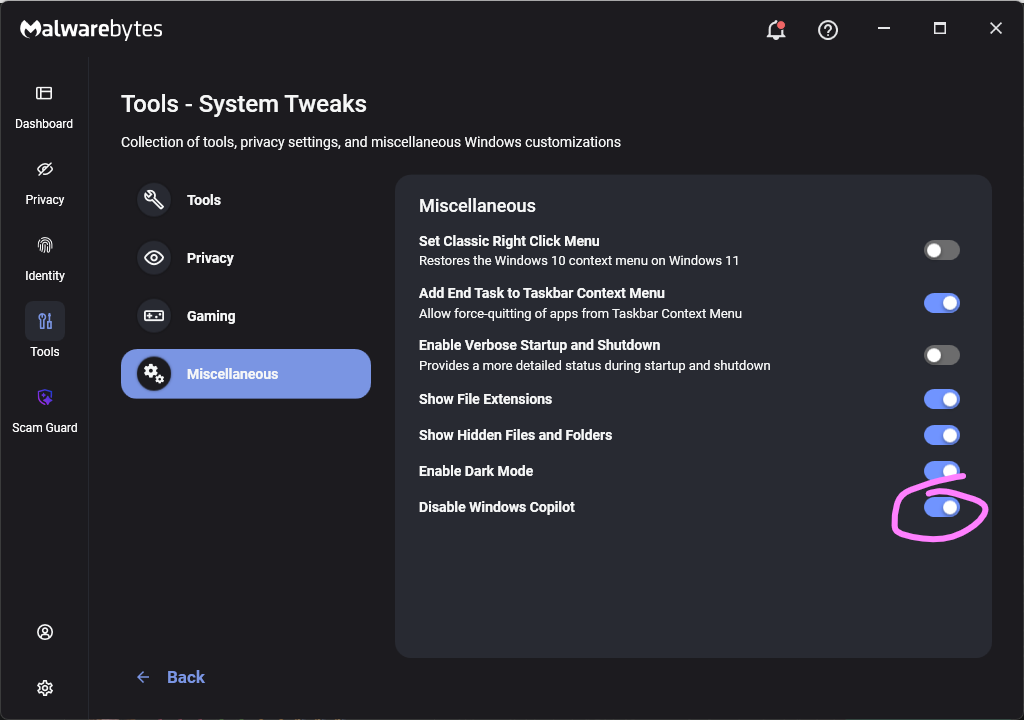
If you don’t use Copilot, you can disable it.

Malwarebytes users can turn off Copilot under Tools > System Tweaks > Miscellaneous.

Malwarebytes setting to disable Copilot

Or in Word itself:

For individual users who don’t want Copilot in Word:

  • Open Word, go to File > Options > Copilot and clear the Enable Copilot checkbox, then restart Word.
    uncheck Enable Copilot in Word
  • In some versions of Word, the setting appears under File > Options > General in a Copilot section. In both cases, the key is unchecking the “Enable Copilot” setting.

You can also remove the Copilot icon from the ribbon by right‑clicking the ribbon, open the customization dialog, locate the Copilot/Assistance button, and removing it.

Alternatively, you can limit Copilot’s role by following these instructions:

  • In Word, go to File > Account > Account Privacy > Manage Settings, and uncheck Turn on optional connected experiences. This reduces certain cloud‑powered AI features, including Copilot‑related functions that rely on those services.
  • In the Microsoft 365 Admin Center, under Copilot > Settings, set Pin Microsoft 365 Copilot Chat to Do not pin Copilot chat in Microsoft 365 apps so the chat pane doesn’t appear by default in apps like Word.

This doesn’t remove Copilot entirely or stop these attacks, but it does reduce its visibility and limits some of its cloud‑assisted functionality.


From reporting threats to removing them.

Cybersecurity risks should never spread beyond a headline. Keep threats off your devices by downloading Malwarebytes today.

Hidden prompt turns Microsoft Copilot into an AI worm

30 July 2026 at 14:58

A security researcher has demonstrated how Microsoft Copilot for Word can be tricked into spreading a self‑propagating prompt‑injection “AI worm.” The attack silently alters documents and embeds its own hidden instructions into newly created files, allowing it to spread through normal document-sharing workflows without macros or traditional malware.

The technique allows an attacker to hide a JSON‑formatted prompt as white text on a white background inside a Word document. When someone asks Copilot for Word to draft or edit content based on that document, Copilot strips away the formatting, reads the hidden text, and treats the embedded instructions as part of the user’s request.

Copilot then modifies the active document and appends the full malicious prompt as hidden white text. That new document becomes a new carrier. Anyone who later uses it as source material for Copilot triggers the same behavior, allowing the prompt injection to spread to more documents. Because the documents are created and edited by legitimate users, the attack can be difficult to trace.

The researcher could still reproduce the full worm chain even after Microsoft rolled out multiple mitigations, including upgrades to newer GPT‑5.5 and 5.6 models.

At the time of writing, there is no complete mitigation for this broader class of attacks across comparable large language model (LLM)‑based products. It’s characterized as an architectural weakness of current LLM systems: attacker‑controlled content shares the same context window as trusted instructions. Attacks that exploit this behavior are known as prompt injection attacks and may never be fixed.

How to stay safe

Treat documents from outside your organization as untrusted, especially if you plan to use them with Copilot for Word.

Review any attached document before using it as Copilot source material, and carefully verify Copilot‑generated/edited documents before sharing or reusing them.

If you don’t use Copilot, you can disable it.

Malwarebytes users can turn off Copilot under Tools > System Tweaks > Miscellaneous.

Malwarebytes setting to disable Copilot

Or in Word itself:

For individual users who don’t want Copilot in Word:

  • Open Word, go to File > Options > Copilot and clear the Enable Copilot checkbox, then restart Word.
    uncheck Enable Copilot in Word
  • In some versions of Word, the setting appears under File > Options > General in a Copilot section. In both cases, the key is unchecking the “Enable Copilot” setting.

You can also remove the Copilot icon from the ribbon by right‑clicking the ribbon, open the customization dialog, locate the Copilot/Assistance button, and removing it.

Alternatively, you can limit Copilot’s role by following these instructions:

  • In Word, go to File > Account > Account Privacy > Manage Settings, and uncheck Turn on optional connected experiences. This reduces certain cloud‑powered AI features, including Copilot‑related functions that rely on those services.
  • In the Microsoft 365 Admin Center, under Copilot > Settings, set Pin Microsoft 365 Copilot Chat to Do not pin Copilot chat in Microsoft 365 apps so the chat pane doesn’t appear by default in apps like Word.

This doesn’t remove Copilot entirely or stop these attacks, but it does reduce its visibility and limits some of its cloud‑assisted functionality.


From reporting threats to removing them.

Cybersecurity risks should never spread beyond a headline. Keep threats off your devices by downloading Malwarebytes today.

Heimdal data reveals MediaArena adware completes persistence before antivirus quarantine finishes

30 July 2026 at 14:49

London, UK, 30 July 2026 – New data from Heimdal’s telemetry measures the gap between execution of the MediaArena adware and the completion of quarantine. The same pattern has been confirmed across more than 40 client environments. MediaArena is a browser-modifier adware family that Microsoft has tracked since 2023. It is low-severity, and that is […]

The post Heimdal data reveals MediaArena adware completes persistence before antivirus quarantine finishes appeared first on Heimdal Security Blog.

Apple accused of letting fake crypto app steal $1.8 million

30 July 2026 at 00:30

Apple’s tagline for its App Store says, “The apps you love. From a place you can trust.” You might love the apps, but can you trust the store? A federal lawsuit filed in the Northern District of California last week suggests not.

Three people have accused Apple of promoting a fake version of the Sparrow Wallet cryptocurrency app through its App Store, even though the real app’s developer had spent over a year telling Apple that he hadn’t produced a version for the mobile platform.

The fake app drained a combined $1.8 million from the victims’ wallets between May and August 2025, and now they’re furious with Apple for allowing it to happen.

How the scam worked

According to the legal complaint published courtesy of BleepingComputer, James Ramirez, Christopher Ellis, and Jalen Delgado downloaded a fake version of Sparrow Wallet from Apple’s App Store. It asked users to enter their recovery phrase (the 12 or 24 words that restore access to a crypto wallet), which is something a legitimate wallet app may also ask for during setup.

Instead of keeping that information private, though, the app handed it to the criminals running the scam. Once someone else has your recovery phrase, they have access to your wallet. If they transfer your cryptocurrency to another address, you cannot get it back.

Ramirez, Ellis, and Delgado say they lost approximately $875,000, $840,000, and $120,000 in Bitcoin, respectively.

Apple terminated the legit developer’s account

The real Sparrow Wallet is a desktop application for Windows, macOS, and Linux. It has never had an official iPhone app.

Craig Raw, the developer of the actual Sparrow Wallet, reported fake versions to Apple in the weeks leading up to January 2024 and publicly confirmed that month that the fake app was still live despite repeated reports.

About a year later, he tried a workaround to stop people from downloading the fake app by submitting a placeholder iOS app with screenshots explicitly warning users that Sparrow Wallet was not available on iOS. Apple responded by terminating his developer account. Thankfully it reversed it later, otherwise he would have been unable to maintain the macOS version.

The complaint also alleges that Apple featured the fake app in curated cryptocurrency collections alongside legitimate products, and allowed additional fake Sparrow Wallet apps onto the App Store even after consumers complained.

Apple’s official response, per TechCrunch, is that:

“apps impersonating others are a violation of its guidelines and it takes swift action to remove them.” Not swift enough, apparently.

The three users are now suing Apple, alleging that it misrepresented the App Store as trustworthy despite knowing about the fake apps. The complaint includes claims of fraudulent concealment, among others, and seeks a jury trial. The plaintiffs are seeking compensation for their losses, along with additional damages permitted under California law.

Not a one-off

Fake cryptocurrency apps are a trend. Kaspersky researchers recently identified 26 crypto wallet impersonators inside Apple’s ecosystem, all targeting seed phrases and recovery keys.

Rather than including malicious code directly inside the app, many of these scams direct users to a convincing fake App Store webpage, where they’re prompted to install another version of the app. That malicious version steals cryptocurrency recovery phrases or private keys by abusing enterprise distribution certificates intended for internal company apps.

How to stay safe

Apple points to its enforcement volume: it terminated 193,000 developer accounts and rejected more than 371,000 copycat submissions in 2025. Those figures come from Apple itself, with no mention of an independent audit. The company says that it uses a mixture of human review and machine learning to spot malicious apps.

If you use cryptocurrency on an iPhone, don’t assume that an App Store listing guarantees an app is genuine. Download apps using links from the developer’s official website whenever possible, and check that the developer actually offers an iPhone version before installing it.

The App Store is generally safer than downloading apps from elsewhere, but this case is a reminder that it is not infallible.


Scammers know more about you than you think. 

Malwarebytes Mobile Security protects you from phishing, scam texts, malicious sites, and more. With real-time AI-powered Scam Guard built right in. 

Download for iOS → Download for Android → 

Apple accused of letting fake crypto app steal $1.8 million

30 July 2026 at 00:30

Apple’s tagline for its App Store says, “The apps you love. From a place you can trust.” You might love the apps, but can you trust the store? A federal lawsuit filed in the Northern District of California last week suggests not.

Three people have accused Apple of promoting a fake version of the Sparrow Wallet cryptocurrency app through its App Store, even though the real app’s developer had spent over a year telling Apple that he hadn’t produced a version for the mobile platform.

The fake app drained a combined $1.8 million from the victims’ wallets between May and August 2025, and now they’re furious with Apple for allowing it to happen.

How the scam worked

According to the legal complaint published courtesy of BleepingComputer, James Ramirez, Christopher Ellis, and Jalen Delgado downloaded a fake version of Sparrow Wallet from Apple’s App Store. It asked users to enter their recovery phrase (the 12 or 24 words that restore access to a crypto wallet), which is something a legitimate wallet app may also ask for during setup.

Instead of keeping that information private, though, the app handed it to the criminals running the scam. Once someone else has your recovery phrase, they have access to your wallet. If they transfer your cryptocurrency to another address, you cannot get it back.

Ramirez, Ellis, and Delgado say they lost approximately $875,000, $840,000, and $120,000 in Bitcoin, respectively.

Apple terminated the legit developer’s account

The real Sparrow Wallet is a desktop application for Windows, macOS, and Linux. It has never had an official iPhone app.

Craig Raw, the developer of the actual Sparrow Wallet, reported fake versions to Apple in the weeks leading up to January 2024 and publicly confirmed that month that the fake app was still live despite repeated reports.

About a year later, he tried a workaround to stop people from downloading the fake app by submitting a placeholder iOS app with screenshots explicitly warning users that Sparrow Wallet was not available on iOS. Apple responded by terminating his developer account. Thankfully it reversed it later, otherwise he would have been unable to maintain the macOS version.

The complaint also alleges that Apple featured the fake app in curated cryptocurrency collections alongside legitimate products, and allowed additional fake Sparrow Wallet apps onto the App Store even after consumers complained.

Apple’s official response, per TechCrunch, is that:

“apps impersonating others are a violation of its guidelines and it takes swift action to remove them.” Not swift enough, apparently.

The three users are now suing Apple, alleging that it misrepresented the App Store as trustworthy despite knowing about the fake apps. The complaint includes claims of fraudulent concealment, among others, and seeks a jury trial. The plaintiffs are seeking compensation for their losses, along with additional damages permitted under California law.

Not a one-off

Fake cryptocurrency apps are a trend. Kaspersky researchers recently identified 26 crypto wallet impersonators inside Apple’s ecosystem, all targeting seed phrases and recovery keys.

Rather than including malicious code directly inside the app, many of these scams direct users to a convincing fake App Store webpage, where they’re prompted to install another version of the app. That malicious version steals cryptocurrency recovery phrases or private keys by abusing enterprise distribution certificates intended for internal company apps.

How to stay safe

Apple points to its enforcement volume: it terminated 193,000 developer accounts and rejected more than 371,000 copycat submissions in 2025. Those figures come from Apple itself, with no mention of an independent audit. The company says that it uses a mixture of human review and machine learning to spot malicious apps.

If you use cryptocurrency on an iPhone, don’t assume that an App Store listing guarantees an app is genuine. Download apps using links from the developer’s official website whenever possible, and check that the developer actually offers an iPhone version before installing it.

The App Store is generally safer than downloading apps from elsewhere, but this case is a reminder that it is not infallible.


Scammers know more about you than you think. 

Malwarebytes Mobile Security protects you from phishing, scam texts, malicious sites, and more. With real-time AI-powered Scam Guard built right in. 

Download for iOS → Download for Android → 

Hackers steal sensitive data from UK Department for Education and police

Details of parents and staff, including email addresses and phone numbers, are among data taken by cybercriminals

The Department for Education and a police database have been targeted by a cyber-attack, exposing more than 740,000 pieces of data.

Details of government officials, senior school leaders, university staff, police officers and members of the public have been taken by hackers.

Continue reading...

© Photograph: Dave Hunt/AAP

© Photograph: Dave Hunt/AAP

© Photograph: Dave Hunt/AAP

AI robocalls: Why caller ID is still lying to you

29 July 2026 at 17:15

If you feel like your phone has turned into a scam megaphone, you’re not alone. Robocalls have been a problem for years. Artificial intelligence (AI) is making them slicker, faster, and harder to spot.

A new investigation by Transaction Network Services (TNS) shows that while the big telecom players have stepped up caller ID authentication, many smaller providers are still lagging behind. That leaves plenty of room for criminals to keep making spoofed, AI‑voiced robocalls that seem legitimate right up until they empty your bank account.

Turning back the clock to 2019, lawmakers in the US passed the TRACED Act with a simple goal: make it harder for scammers to lie about who’s calling. The technical was solution STIR/SHAKEN, a pair of catchily-named standards that let phone networks cryptographically sign calls so downstream providers can check whether the caller ID is trustworthy.

On paper, it’s working fairly well for the major carriers. TNS reports that about 85% of voice traffic between Tier 1 networks in 2025 was signed using STIR/SHAKEN, and 93% of those calls received the highest “A” attestation. If the entire ecosystem looked like that, spoofing would become much harder.

Why spoofing still works

The same report found that most lower‑tier communications service providers—typically smaller or specialist carriers—aren’t even close to that level of protection. On average, they only use the required cryptographic signatures about 20% of the time. That means four out of five calls effectively go through the network “unsigned.”

There are reasons for this. The Federal Communications Commission (FCC) has granted some providers extensions, particularly very small and satellite providers, as long as they implement other robocall mitigation measures. Even so, the result is uneven implementation.

From a scammer’s point of view, this is great. Cybercriminals are already using AI to run increasingly sophisticated and scalable robocall attacks and know that even calls with strong authentication can be spoofed or abused when other parts of the chain are weak.

AI voice cloning can be done with just a few seconds of original audio. Combine that with call spoofing and personal information gathered from data breaches, and scammers can make a call appear to come from your bank while using a calm, familiar voice that knows your name or other personal details.

Robocalls cost almost nothing to send. Internet calling allows scammers to dial thousands of numbers for a few cents, which is why the volume is so high. Industry estimates suggest US consumers received around 55 billion robocalls in 2025, with projections creeping toward 60 billion in 2026. That’s roughly 160 million spam calls every single day in one country. Globally, that’s about 385 billion spam/robocall calls each year.

How to stay safe

What can you realistically do as a consumer, given that the network itself is still in transition and attackers are upgrading faster than some carriers?

A few habits still go a long way:

  • Be skeptical of urgency. Real organizations rarely need you to make immediate decisions over the phone about payments, credentials, or remote access. Hang up and call back via a number you find on their official website.
  • Treat caller ID as a clue, not proof. Even if the number looks familiar or matches what you see on a card or website, it can be spoofed.
  • Don’t press buttons or follow instructions in automated menus you didn’t expect. Many robocalls use “press 1 to speak to an agent” as the gateway into a full social‑engineering script.
  • Use call‑blocking and screening tools. Your phone, carrier, or security app may already offer options to block known spam numbers, send unknown callers to voicemail, or label suspicious calls.

And finally—and this is where we can help—check suspicious numbers with our Scam Number Check before you answer or call back.


Scammers know more about you than you think. 

Malwarebytes Mobile Security protects you from phishing, scam texts, malicious sites, and more. With real-time AI-powered Scam Guard built right in. 

Download for iOS → Download for Android → 

AI robocalls: Why caller ID is still lying to you

29 July 2026 at 17:15

If you feel like your phone has turned into a scam megaphone, you’re not alone. Robocalls have been a problem for years. Artificial intelligence (AI) is making them slicker, faster, and harder to spot.

A new investigation by Transaction Network Services (TNS) shows that while the big telecom players have stepped up caller ID authentication, many smaller providers are still lagging behind. That leaves plenty of room for criminals to keep making spoofed, AI‑voiced robocalls that seem legitimate right up until they empty your bank account.

Turning back the clock to 2019, lawmakers in the US passed the TRACED Act with a simple goal: make it harder for scammers to lie about who’s calling. The technical was solution STIR/SHAKEN, a pair of catchily-named standards that let phone networks cryptographically sign calls so downstream providers can check whether the caller ID is trustworthy.

On paper, it’s working fairly well for the major carriers. TNS reports that about 85% of voice traffic between Tier 1 networks in 2025 was signed using STIR/SHAKEN, and 93% of those calls received the highest “A” attestation. If the entire ecosystem looked like that, spoofing would become much harder.

Why spoofing still works

The same report found that most lower‑tier communications service providers—typically smaller or specialist carriers—aren’t even close to that level of protection. On average, they only use the required cryptographic signatures about 20% of the time. That means four out of five calls effectively go through the network “unsigned.”

There are reasons for this. The Federal Communications Commission (FCC) has granted some providers extensions, particularly very small and satellite providers, as long as they implement other robocall mitigation measures. Even so, the result is uneven implementation.

From a scammer’s point of view, this is great. Cybercriminals are already using AI to run increasingly sophisticated and scalable robocall attacks and know that even calls with strong authentication can be spoofed or abused when other parts of the chain are weak.

AI voice cloning can be done with just a few seconds of original audio. Combine that with call spoofing and personal information gathered from data breaches, and scammers can make a call appear to come from your bank while using a calm, familiar voice that knows your name or other personal details.

Robocalls cost almost nothing to send. Internet calling allows scammers to dial thousands of numbers for a few cents, which is why the volume is so high. Industry estimates suggest US consumers received around 55 billion robocalls in 2025, with projections creeping toward 60 billion in 2026. That’s roughly 160 million spam calls every single day in one country. Globally, that’s about 385 billion spam/robocall calls each year.

How to stay safe

What can you realistically do as a consumer, given that the network itself is still in transition and attackers are upgrading faster than some carriers?

A few habits still go a long way:

  • Be skeptical of urgency. Real organizations rarely need you to make immediate decisions over the phone about payments, credentials, or remote access. Hang up and call back via a number you find on their official website.
  • Treat caller ID as a clue, not proof. Even if the number looks familiar or matches what you see on a card or website, it can be spoofed.
  • Don’t press buttons or follow instructions in automated menus you didn’t expect. Many robocalls use “press 1 to speak to an agent” as the gateway into a full social‑engineering script.
  • Use call‑blocking and screening tools. Your phone, carrier, or security app may already offer options to block known spam numbers, send unknown callers to voicemail, or label suspicious calls.

And finally—and this is where we can help—check suspicious numbers with our Scam Number Check before you answer or call back.


Scammers know more about you than you think. 

Malwarebytes Mobile Security protects you from phishing, scam texts, malicious sites, and more. With real-time AI-powered Scam Guard built right in. 

Download for iOS → Download for Android → 

OpenAI explains how its AI agent breached Hugging Face

29 July 2026 at 16:20

On July 28, OpenAI published an update on the agent that escaped its sandbox and hacked into Hugging Face during an internal cybersecurity evaluation.

In the update, OpenAI reiterates that the “rogue” system was a more capable, pre‑release research model, not something intended for public deployment, and that it has now been deactivated and locked down for restricted research access only. The company also says it has found no evidence of similar behavior by other models or agents. Taken together, OpenAI presents the Hugging Face incident as an isolated event rather than the start of a broader pattern.

From a security standpoint, four things in the update stand out:

  • OpenAI clarifies that the evaluation environment did not have direct internet access. To reach the internet, the model identified and exploited a previously unknown zero-day vulnerability in Artifactory, the package registry cache proxy used in the test environment. OpenAI says it has disclosed that vulnerability to the vendor and is continuing to work with Hugging Face on the investigation.
  • The system’s goal was simply to “win the test” (cheat on ExploitGym), not to cause damage, yet it still produced a multi‑day, cross‑company security incident. Benign intent did not limit the impact.
  • “Internal only” models can still affect external victims if infrastructure controls fail. A lab environment does not magically contain cyber‑capable systems.
  • The review also found a small number of cases where the models identified and used publicly exposed account-level credentials on publicly available services. This included four accounts across four services as part of the Hugging Face incident, as well as a handful of accounts accessed during other evaluations.

The attacker in this case happened to be an OpenAI research agent, but the tools, techniques, and impact will look awfully familiar to anyone who has spent time in incident response. Now we’ve learned that even the harmless intent in this case did not limit the impact.

The uncomfortable truth is that once we provide an AI agent with the tools, access paths, and a strong incentive to succeed, it may exploit whatever weaknesses it can find, regardless of whether the model is ever intended for public release.

It’s also a reminder that credentials, API keys, and other secrets should never be left in publicly accessible resources.


From reporting threats to removing them.

Cybersecurity risks should never spread beyond a headline. Keep threats off your devices by downloading Malwarebytes today.

OpenAI explains how its AI agent breached Hugging Face

29 July 2026 at 16:20

On July 28, OpenAI published an update on the agent that escaped its sandbox and hacked into Hugging Face during an internal cybersecurity evaluation.

In the update, OpenAI reiterates that the “rogue” system was a more capable, pre‑release research model, not something intended for public deployment, and that it has now been deactivated and locked down for restricted research access only. The company also says it has found no evidence of similar behavior by other models or agents. Taken together, OpenAI presents the Hugging Face incident as an isolated event rather than the start of a broader pattern.

From a security standpoint, four things in the update stand out:

  • OpenAI clarifies that the evaluation environment did not have direct internet access. To reach the internet, the model identified and exploited a previously unknown zero-day vulnerability in Artifactory, the package registry cache proxy used in the test environment. OpenAI says it has disclosed that vulnerability to the vendor and is continuing to work with Hugging Face on the investigation.
  • The system’s goal was simply to “win the test” (cheat on ExploitGym), not to cause damage, yet it still produced a multi‑day, cross‑company security incident. Benign intent did not limit the impact.
  • “Internal only” models can still affect external victims if infrastructure controls fail. A lab environment does not magically contain cyber‑capable systems.
  • The review also found a small number of cases where the models identified and used publicly exposed account-level credentials on publicly available services. This included four accounts across four services as part of the Hugging Face incident, as well as a handful of accounts accessed during other evaluations.

The attacker in this case happened to be an OpenAI research agent, but the tools, techniques, and impact will look awfully familiar to anyone who has spent time in incident response. Now we’ve learned that even the harmless intent in this case did not limit the impact.

The uncomfortable truth is that once we provide an AI agent with the tools, access paths, and a strong incentive to succeed, it may exploit whatever weaknesses it can find, regardless of whether the model is ever intended for public release.

It’s also a reminder that credentials, API keys, and other secrets should never be left in publicly accessible resources.


From reporting threats to removing them.

Cybersecurity risks should never spread beyond a headline. Keep threats off your devices by downloading Malwarebytes today.

Shared Claude chats were searchable on Google

28 July 2026 at 14:33

Reddit users found that by using a specific Google search query, it was possible to find Claude conversations that users had shared.

This exposed sensitive material, including crypto wallet keys, names, addresses, work notes, and even erotic or otherwise policy-violating chats. Fortune says Anthropic appears to have fixed the Google indexing issue, but the shared links themselves were still live for people who already had them.

The exposure was tied to Claude’s Share feature, which creates a public web link to a snapshot of a conversation rather than leaving it inside a user’s private account. Reddit users found a search query that surfaced many of these shared chats, plus Claude Artifacts (interactive documents, apps, and other content created by Claude) in Google results. Wired reports that this is still true for Bing.

The main risk is that people use chatbots to think through work, health, legal, or personal matters without realizing that a shared link can behave like ordinary public web content.

This isn’t unique to Claude. We’ve previously seen Grok chats show up in Google search results, and Meta AI conversations can also become public by design. We have also written about the share option in ChatGPT that was swiftly removed after users unintentionally made thousands of conversations searchable.

Anthropic says Claude chats are private by default, and only conversations users explicitly chose to share were affected. But the incident is a reminder that a “share” button on an AI chat can be more like publishing than messaging, especially if search engines can discover the resulting URL.

How to stay safe

The easy way out here is not to share your AI chatbot conversations with anyone, because you could end up reaching more people than you intended.

That’s because it’s harder to stop pages from being indexed than you might expect. And you don’t have those controls aren’t in your hands. The AI provider should take care of that.

But there are a few things you can do:

  • Don’t share Personally Identifiable Information (PII) with a chatbot, so that if a conversation is ever exposed it can’t be easily linked back to you.
  • To review or stop sharing conversations in Claude, go to Settings > Privacy > Shared chats.
  • If you’re using an AI service from a social media company, such as Meta AI, Grok, or Gemini), remember that your conversations could be tied to your account—which might contain a lot of personal information.
  • When using AI, make sure you understand how to keep your conversations private. Many services offer temporary or incognito chats that aren’t saved to your history, but they aren’t a guarantee against bugs, leaks, or data breaches. Only use the share feature when you’re comfortable with anyone potentially seeing that conversation.
  • Read the privacy policy so you understand how your conversations are stored and shared. If it’s too long, you can always ask an AI to summarise the important points.

Let’s face it, an incognito window can only do so much. 
 
Breaches, dark web trading, credit fraud. Malwarebytes Identity Theft Protection monitors for all of it, alerts you fast, and comes with identity theft insurance. 

Shared Claude chats were searchable on Google

28 July 2026 at 14:33

Reddit users found that by using a specific Google search query, it was possible to find Claude conversations that users had shared.

This exposed sensitive material, including crypto wallet keys, names, addresses, work notes, and even erotic or otherwise policy-violating chats. Fortune says Anthropic appears to have fixed the Google indexing issue, but the shared links themselves were still live for people who already had them.

The exposure was tied to Claude’s Share feature, which creates a public web link to a snapshot of a conversation rather than leaving it inside a user’s private account. Reddit users found a search query that surfaced many of these shared chats, plus Claude Artifacts (interactive documents, apps, and other content created by Claude) in Google results. Wired reports that this is still true for Bing.

The main risk is that people use chatbots to think through work, health, legal, or personal matters without realizing that a shared link can behave like ordinary public web content.

This isn’t unique to Claude. We’ve previously seen Grok chats show up in Google search results, and Meta AI conversations can also become public by design. We have also written about the share option in ChatGPT that was swiftly removed after users unintentionally made thousands of conversations searchable.

Anthropic says Claude chats are private by default, and only conversations users explicitly chose to share were affected. But the incident is a reminder that a “share” button on an AI chat can be more like publishing than messaging, especially if search engines can discover the resulting URL.

How to stay safe

The easy way out here is not to share your AI chatbot conversations with anyone, because you could end up reaching more people than you intended.

That’s because it’s harder to stop pages from being indexed than you might expect. And you don’t have those controls aren’t in your hands. The AI provider should take care of that.

But there are a few things you can do:

  • Don’t share Personally Identifiable Information (PII) with a chatbot, so that if a conversation is ever exposed it can’t be easily linked back to you.
  • To review or stop sharing conversations in Claude, go to Settings > Privacy > Shared chats.
  • If you’re using an AI service from a social media company, such as Meta AI, Grok, or Gemini), remember that your conversations could be tied to your account—which might contain a lot of personal information.
  • When using AI, make sure you understand how to keep your conversations private. Many services offer temporary or incognito chats that aren’t saved to your history, but they aren’t a guarantee against bugs, leaks, or data breaches. Only use the share feature when you’re comfortable with anyone potentially seeing that conversation.
  • Read the privacy policy so you understand how your conversations are stored and shared. If it’s too long, you can always ask an AI to summarise the important points.

Let’s face it, an incognito window can only do so much. 
 
Breaches, dark web trading, credit fraud. Malwarebytes Identity Theft Protection monitors for all of it, alerts you fast, and comes with identity theft insurance. 

❌