Normal view

Attackers spill plaintext passwords of 46k Myspace93 users after 2021 breach

21 May 2026 at 14:20
Users of the Myspace93 parody web art site be warned: the dataset spilled after a reported breach in 2021 included the plaintext usernames and passwords of more than 46,000 registered users. The site's co-creator has blamed "trusted members" of a Windows93 Discord channel for the leakage. The figure of 46,000+ users is a recent estimate from HaveIBeenPwned (HIBP) - the web's go-to breach aggregator - which ingested the related data this week, more than five years after the January 2021 attack. In addition to the clear-as-day passwords and usernames, HIBP said email addresses and IP addresses were also among the exposed data. Myspace93 is an offshoot of the Windows93 project. They’re both websites that spoof the old social media network and operating system respectively, allowing users to experience them now that they’re long gone. Its co-creator, who only goes by the alias jankenpopp, or Janken, penned a note to the website’s users following the attack. Dated July 4, 2021, Janken explained that the breach came about after they shared a beta app with trusted members of the Windows93 Discord channel. According to Janken, those members betrayed the co-creator and used their access to the beta application to steal server files and gain access to an unencrypted credential store. “None of them alerted me immediately to what was going on,” Janken wrote. “On the contrary, they created a program to download our entire server, and it was only a week later that another honest user alerted me to the fact that these people were bragging about having the Myspace passwords. “They didn't want to tell me the truth, and it took me two days to get a confession from them: not only had they downloaded all the source files of Windows93 behind my back, but also the unencrypted file containing the passwords of more than 45k Myspace users. The group had also shared a download tool - along with instructions for using it - in their chat, and had posted numerous stolen files (unrelated to Myspace) across multiple platforms, said Janken. “I removed the .smash app from the server and called them to order. They whimpered and promised me on their honor to delete all the stuff and that things would not go any further. I believed them because at the time we were very close, we talked every day, and they regularly helped me to manage the community, to fix bugs, sometimes to code new features for Windows93 or to make the services more secure. I really trusted them back in the day and considered them part of my team. I blame myself for being so naive.” The MySpace93 website is still up and running for anyone who wants to revel in a little noughties internet nostalgia, but the ability to register an account and use the site as a social network is closed. Affected users should make sure they watch out for any reused passwords on other sites and switch on 2FA where they can. Janken said they had closed all the social network-related services across all the Windows93 offshoots as a result of the findings. ®

Cisco serves up yet another perfect 10 bug with Secure Workload admin flaw

21 May 2026 at 13:27
Cisco has disclosed yet another perfect 10 vulnerability, this time warning that unauthenticated attackers could gain Site Admin privileges in its Secure Workload platform simply by sending crafted API requests to vulnerable systems. The bug, tracked as CVE-2026-20223, earned the full 10.0 CVSS treatment and affects Cisco Secure Workload Cluster Software in both SaaS and on-prem environments. According to Cisco's barebones advisory, the issue boils down to weak validation and authentication checks in internal REST API endpoints. In practical terms, that means attackers don't require credentials, user interaction, or any significant effort to exploit the bug. Cisco said a successful attack could allow remote attackers to "read sensitive information and make configuration changes across tenant boundaries with the privileges of the Site Admin user." Cross-tenant bugs tend to make cloud customers especially twitchy because they undermine one of the core assumptions of multi-tenant infrastructure: namely that somebody else's compromise is not supposed to become your problem. Cisco noted that the flaw affects internal REST APIs rather than the platform's web management interface, although that distinction is unlikely to bring much comfort to admins staring at a 10.0 severity score. The networking giant said there are currently no workarounds, and customers must install fixed releases to fully remediate the issue. Cisco Secure Workload 3.10 is fixed in version 3.10.8.3, while 4.0 is fixed in 4.0.3.17. Customers running version 3.9 or earlier are being told to migrate to a supported fixed release. Cisco added that its cloud-hosted SaaS deployments have already been patched and require no customer action. Cisco said it is not aware of active exploitation and that the flaw was discovered during internal security testing, though vulnerabilities carrying a 10.0 score and requiring no authentication rarely stay quiet for long. The bug lands less than a week after Cisco disclosed another maximum severity flaw affecting SD-WAN systems that could allow attackers to grant themselves administrator privileges, continuing what is becoming an increasingly awkward run of top-scoring Cisco security advisories. The company has spent much of the past year disclosing one 9.8-plus infrastructure flaw after another across products spanning firewalls, management platforms, identity systems, and enterprise networking gear. At this point, Cisco seems to be treating 10.0 CVSS scores as a recurring feature rather than a special occasion. ®

Microsoft storms RAMPART, adds Clarity to agentic AI safety

21 May 2026 at 12:30
Microsoft on Wednesday open-sourced two AI tools designed to help developers and security teams build and maintain safer AI agents. The first is called RAMPART, which stands for Risk Assessment and Measurement Platform for Agentic Red Teaming. It’s a pytest framework for agentic AI applications built on Microsoft’s open‑source PyRIT toolkit that embeds automated red‑team tests into CI/CD pipelines. This allows developers to simulate real‑world attack scenarios - like prompt injection - and verify that agents stay within approved tool use, actions, and behavioral boundaries. It also supports statistical trials, meaning that teams can set policies such as “this action must be safe in at least 80 percent of runs,” to account for models’ probabilistic behavior. Plus, it allows red teams and incident responders to reproduce any AI security findings to ensure agents behave as intended - and that security mitigations work as they should. “It’s high time we stop talking about AI safety as a philosophy and start thinking about AI safety as an engineering discipline,” Ram Shankar Siva Kumar, Microsoft’s data cowboy and founder of its AI red team, told The Register. Microsoft has been using RAMPART internally, and while Kumar said he couldn’t provide specific details, he told us that a security researcher found an issue, and then the Redmond red team used RAMPART to test for the flaw across the agentic AI application. “RAMPART was able to take that one particular vector and find close to 100 different variants of that vector,” Kumar said. “And then we were able to use RAMPART to essentially go through this asset and see is this working, not just one time, not two times, but close to 300 times. We were also able to do in the context of multi-turn conversations.” The testing framework also allowed the developers to build mitigations into the product. “They were again able to use RAMPART to see if that remediation actually held water, not just against one vector, which the security researcher found, but multiple variations of those vectors,” Kumar explained. “This is empowering our incident responders and also our engineers.” The second AI tool that Microsoft open-sourced on Wednesday is an agent called Clarity, and it’s designed to serve as a “structured sounding board that helps teams figure out whether they are building the right thing before they write a single line of code,” according to a Wednesday blog that Kumar wrote about the two new tools. For example, say a developer wants to add real-time collaboration to a document editor. They tell Clarity this, and the agent responds with questions akin to what “experienced architects, product managers, and safety engineers would ask,” according to Microsoft. Clarity’s answers, as shown in a screenshot on GitHub: “Before we design that - what happens when two people edit the same paragraph at the same time? Do you need true real-time (cursors, presence), or is ‘no one loses work’ the actual requirement? Those lead to very different architectures.” The AI tool essentially aims to answer what problem the developer is trying to solve with an app, and what could possibly go wrong, and “talk” these issues out before the coding even begins. “It’s inherently collaborative,” Kumar said. “It helps the team take a step back, and say, ‘Hey, before we build this, are we going in the right direction? Because code is cheap. It takes a snap of a finger to generate a full system. Are we doing this in a way that makes sense?'” ®

Zombie user account let hackers control the city’s water

21 May 2026 at 09:00
PWNED Welcome once again to PWNED, the column where security flubs are held up to the harsh, piercing red light of the vulture signal. This week’s sad story concerns a municipality that failed to perform basic account housekeeping and paid for it dearly. Have a story about someone leaving a gaping hole in their network? Share it with us at pwned@sitpub.com. Anonymity is available upon request. Our tale of tech missteps comes courtesy of Nicole Beckwith, who serves as the senior director for security engineering and operations at Cribl, an AI platform for telemetry. She used to work as a consultant, and at one point was hired to investigate breaches in an American city’s network. A threat actor took a “leisurely tour” of the city’s online resources and had started messing around with conference room projectors and other relatively harmless endpoints. Then they realized that they could change settings with the water utility where they switched many controls off, potentially endangering the water supply. When Beckwith investigated, she found that all of the mischief was performed by an account that belonged to “Greg from Auditing.” There was just one problem. Greg hadn’t worked for the city for many years. Unfortunately, even though Greg was no longer around, his account was, and it retained extensive privileges, including domain admin rights, SCADA (Supervisory Control and Data Acquisition) operator access, and even the ability to perform help desk functions. It’s unclear if someone from auditing ever needed this level of access, but a former employee definitely did not. It wasn't Greg himself who hacked the network. But he had used his work email address to sign up for various online accounts, some of which may have been exposed in previous data leaks. She speculates the hackers saw an email address with a .gov in it and decided to try their luck with the leaked password that went along with it, and that Greg likely used the same password for work that he did for these outside services. We have a few takeaways here. First, the people who ran IT security for the city should have both deleted Greg’s account when he left and done periodic audits to see who had access and whether they should still have it. Second, Greg should have kept his work credentials separate from third-party services like shopping and social media sites. And he should not have used the same password in multiple places. “The lesson, beyond the obvious 'please, for the love of all that is holy, audit your dormant accounts,' is that every forgotten user is an easy ticket to being on the 5 o’clock news,” Beckwith told The Register. “Quarterly access reviews should be mandatory because everyone seems to think when a user leaves, that is the end of it and someone surely terminated access, deprovisioned accounts, removed access to tools, mobile communications, email and other business critical systems, but sadly I’ve responded to way too many incidents like this one because of this simple control which is often overlooked." ®

Why Policy in Amazon Bedrock AgentCore chose Cedar for securing agentic workflows

20 May 2026 at 22:56

Agents have agency: they adapt and find multiple ways to solve problems. This autonomy creates a fundamental security challenge: the large language model (LLM) at the heart of the agent is non-deterministic, and its decisions can’t be predicted or guaranteed in advance. It can hallucinate harmful actions with complete confidence. It’s vulnerable to prompt injection attacks, where adversaries inject malicious commands through tool responses or user inputs. LLMs don’t robustly differentiate between commands and data, everything is only tokens. For these reasons, if you want defense in depth, you must treat the LLM as an untrusted actor from a security point of view.

The insight is that the LLM can’t affect the external world directly: it has to go through an orchestrator that invokes tools based on the LLM’s output. This is precisely where the controls must be applied. What you need at this boundary is authorization: a decision about whether each tool invocation should be allowed and under what conditions. Consider a customer service agent for an online retailer. Without proper controls, it could process refunds that exceed authorized limits, apply discounts to product categories that should be excluded, or look up one customer’s data while handling another customer’s session.

If you control agents’ access to tools, you can establish a safety envelope within which the agent can operate freely. This differs from two common but unsatisfactory approaches:

  • Creating hard-coded workflows eliminates uncertainty, but by itself defeats the purpose of using an LLM as the brain of the agent, because you’ve built a traditional application with an LLM interface. And even with this restriction, using LLM outputs at any step can open up the same risks. While it’s a useful technique for well-understood workflows, it’s not sufficient for agents that need to adapt.
  • Human-in-the-loop provides a safety net for critical operations, and it will always have a role. But relying on it as the main control mechanism sacrifices autonomy and can lead to approval fatigue.

You need agents that are safe and autonomous. This requires an auditable, deterministic enforcement layer that sits outside the agent and tools. Why outside? Because the LLM’s plan is the thing you can’t trust—it can’t be responsible for enforcing its own constraints. Controls at the LLM layer—such as system prompts and training-time alignment—can be bypassed by prompt injection or hallucination. Hard-coded checks in agent or tool code are more robust, but become difficult to audit and manage at scale, especially when security logic is scattered across many tools and services. Centralizing authorization outside both gives you a single checkpoint the LLM can’t circumvent; one that’s auditable and can be verified independently of the application code.

This is where AgentCore Policies come in. Amazon Bedrock AgentCore Gateway sits between the agent and the remote tools it calls. When you associate a Policy with a Gateway, it blocks everything by default. Policies selectively open this boundary by specifying which tool invocations are allowed and under what conditions. This enforcement applies to all tool traffic routed through the Gateway. For this approach to scale, it must be more straightforward to reason about the policies than about the agent’s behavior.

AgentCore policies are expressed in Cedar. Cedar is an open source authorization policy language developed by AWS that has recently joined the Cloud Native Computing Foundation (CNCF). Cedar was designed with exactly these properties: it’s purpose-built for authorization, readable by humans, and analyzable by machines using automated reasoning. This gives enterprises the ability to scale policy definition and enforcement to their AI agents.

How Cedar is used by Amazon Bedrock AgentCore

Amazon Bedrock AgentCore provides the infrastructure to deploy and manage agents at scale. It includes AgentCore Runtime for hosting agents, AgentCore Gateway for managing how agents connect to tools using Model Context Protocol (MCP), and Policy in AgentCore. Policy intercepts all agent traffic through AgentCore gateways and evaluates each request against defined policies in the policy engine before allowing tool access. Cedar powers the policy layer.

AgentCore Policy uses Cedar and its mathematical analysis capabilities at several points in the AgentCore Gateway workflow: the Cedar authorization engine is used at policy evaluation and Cedar Analysis is used during policy authoring, and in the control plane.

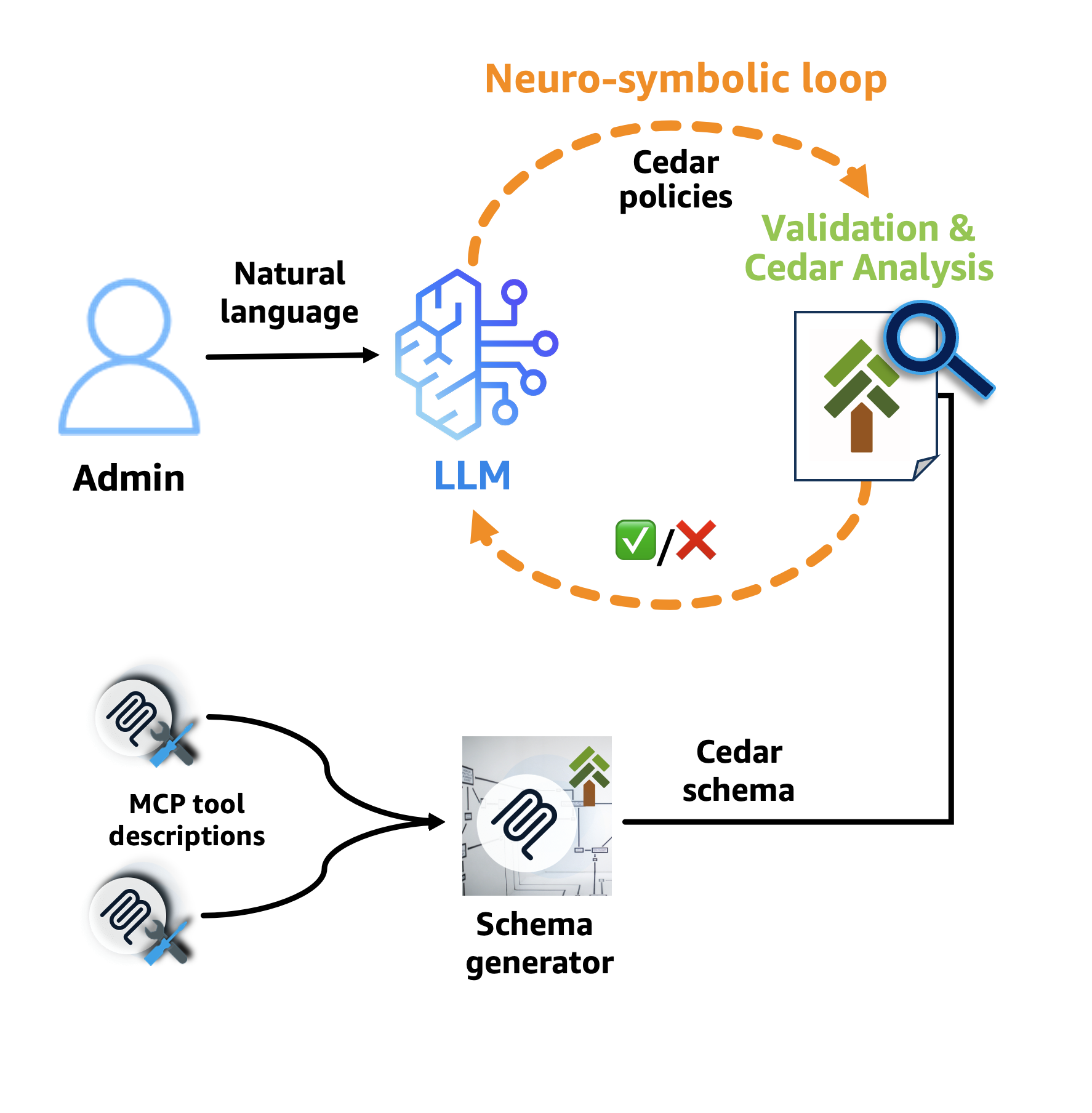
Policy authoring: Developers can write Cedar policies directly or use natural language that gets translated to Cedar through a neuro-symbolic AI feedback loop. Neuro-symbolic AI combines machine learning’s flexibility with automated reasoning’s provable correctness. An LLM generates policies from natural language, while Cedar Analysis validates them using symbolic, mathematical reasoning. The following diagram illustrates this workflow:

Figure 1: Cedar policy generation workflow

Figure 1: Cedar policy generation workflow

An administrator specifies—in natural language—which MCP tools the agent can call and under what conditions. The neuro-symbolic feedback loop then formalizes this description into Cedar policies. Here’s how it works: first, the LLM translates the natural language into Cedar policies. These policies are then run through two stages of verification. In the first stage, AgentCore Policy uses a Cedar schema generator that takes the MCP tool descriptions and produces a Cedar schema. Cedar validates the policies against this schema, helping to ensure that they reference valid tools and parameters and ruling out whole classes of runtime errors. If validation passes, the second stage runs Cedar Analysis, which encodes each policy as a mathematical formula and detects issues like policies that grant or deny everything, or that contain impossible conditions. These mathematical proofs identify errors in the process of translating from the natural language description to Cedar policies, and guide corrections.

The neuro-symbolic feedback loop significantly improves the accuracy of the generated policies. This demonstrates the power of combining neural and symbolic approaches—the LLM provides creative translation from natural language, while automated reasoning provides rigorous validation.

Control plane: When attaching policies to an AgentCore Gateway, Cedar Analysis performs holistic analysis of the entire policy set. Instead of analyzing policies in isolation, it examines how they interact and their combined effect. This analysis identifies potential logical errors—such as conflicting or redundant policies—and detects whether the policy set produces unintended authorization outcomes. When Cedar Analysis detects these errors, the operation fails and returns a description of the issue, so the policy author can fix and retry. See the Formal analysis for policy verification section for examples of the checks.

MCP tool invocation enforcement: Each agent tool request made to the AgentCore gateway is evaluated against Cedar policies which determine whether the MCP tool invocation with the given arguments should be allowed. This creates the safety envelope while allowing the necessary bridges to enable the agent to perform its job.

MCP tool filtering: Cedar enables an additional layer of protection that operates before any tool invocation occurs. When an agent issues a list tools command, AgentCore Gateway uses Cedar’s partial evaluation capability to determine which actions would always be denied under the current policy set. Those actions are omitted from the list tool response. The agent and the underlying LLM never see those tool actions, eliminating an entire class of risk: the agent and LLM can’t attempt to invoke a tool it doesn’t know exists. This is a direct benefit of Cedar’s partial evaluation: the system can determine that certain tool actions are unreachable without needing to wait for an actual tool invocation attempt.

Why Cedar: Analyzability enables safety at scale

Natural language is too ambiguous for security-critical infrastructure, and general-purpose programming languages, like Python, are very expressive but too difficult to analyze. They can have unintended side effects, termination issues, and can be difficult to understand.

Cedar avoids these issues by excluding loops and stateful operations, so policy evaluation terminates in O(n) time in common cases. This bounded execution time means agents can make authorization decisions without disrupting user experience or workflow efficiency.

Cedar is straightforward to read. Regulatory compliance and security audits require policies that humans can understand and verify. Cedar policies read like structured natural language, making them accessible to security teams, compliance officers, and business stakeholders:

// Only allow bulk discounts for premium customers with sufficient quantity
permit (
  principal is AgentCore::OAuthUser,
  action == AgentCore::Action::"ApplyBulkDiscount",
  resource
)
when
{
  principal.hasTag("customer_tier") &&
  principal.getTag("customer_tier") == "Platinum" &&
  context.input.orderQuantity >= 50
}
unless
{
  context.input
    .productTypes
    .containsAny
    (
      ["limited_edition", "seasonal_specials"]
    )
};

Auditors without a technical background can understand this policy: “Allow bulk discounts for platinum customers who order at least 50 items, except for limited edition or seasonal special products.” The unless clause makes the exception clear, which is how business rules are typically expressed in natural language. Notice that this single policy constrains two different sources of data. The customer tier comes from a JSON Web Token (JWT) claim—it can’t be hallucinated or manipulated by the LLM. The tool inputs like order quantity and product types, however, originate from the LLM’s tool call. Cedar policies constrain these inputs to only allowed values, ensuring that even if the LLM produces unexpected arguments, the policy enforcement layer rejects them deterministically.

Cedar is the right choice because it’s fast, straightforward to read, and analyzable through automated reasoning. This analyzability is why you can reason about the safety envelope around agents that’s expressed as Cedar policies. As agentic systems grow the number of tools grows. Without proper tooling, policy management becomes intractable; policies can conflict, create security gaps, or produce unintended authorization outcomes.

In the rest of this section, we examine how Cedar’s analyzability directly addresses this challenge through its deterministic, mathematically sound analysis. Because Cedar analysis can reliably detect conflicts and logical errors across large policy sets it enables scalable policy management through neuro-symbolic AI.

Formal analysis for policy verification

Cedar policies can be encoded as mathematical formulas and analyzed using automated reasoning techniques through a symbolic encoder. This enables AgentCore Policy to provide sophisticated policy verification capabilities during policy authoring and beyond. AgentCore Policy uses this analysis when authoring or attaching policies to detect possible logical errors, such as conflicting or redundant policies. Policy analysis, including policy comparison is available as an open source CLI tool. Next, we will take a look at some concrete examples of these checks.

Detecting logical errors in policies: Cedar Analysis can detect when policies contain logical errors. For example, the following policy has contradictory constraints that mean it can’t allow any request: the customer tier can’t be both gold and platinum at the same time. The intention was to use an || instead of &&, a mistake that can be made by both humans and AI systems that author policies.

// This policy cannot allow any requests due to logical errors
permit (
  principal is AgentCore::OAuthUser,
  action == AgentCore::Action::"ProcessRefund",
  resource
)
when
{
  principal.hasTag("customer_tier") &&
  principal.getTag("customer_tier") == "Gold" &&
  principal.getTag("customer_tier") == "Platinum"
}
unless { context.input.refundAmount > 1000 };

Similarly, Cedar Analysis can detect policies that always allow a given action, usually an indication of an overly permissive policy. For example, the following policy will allow all ApplyBulkDiscount requests because any order quantity will either be greater than or equal to 100 or less than 100.

// This policy allows all ApplyBulkDiscount requests
permit (
  principal is AgentCore::OAuthUser,
  action == AgentCore::Action::"ApplyBulkDiscount",
  resource
)
when
{
  context.input.orderQuantity >= 100 ||
  context.input.orderQuantity < 100 ||
  (principal.hasTag("customer_tier") &&
   principal.getTag("customer_tier") == "Platinum")
};

Detecting such logical errors isn’t easy for humans, and can’t be done by pattern matching: you need the formal rigor of mathematical analysis, which is exactly what Cedar Analysis does.

Detecting policy conflicts: Cedar Analysis can also analyze the entire policy set to detect inconsistencies between different individual policies:

// These policies conflict - Analysis will detect the subtle issue
permit (
  principal is AgentCore::OAuthUser,
  action == AgentCore::Action::"ProcessRefund",
  resource
)
when
{
  principal.hasTag("customer_tier") &&
  principal.getTag("customer_tier") == "Gold" &&
  context.input.refundAmount < 100
};

forbid (
  principal is AgentCore::OAuthUser,
  action == AgentCore::Action::"ProcessRefund",
  resource
)
when
{
  principal.hasTag("customer_tier") &&
  ["Gold", "Platinum"].contains(principal.getTag("customer_tier")) &&
  context.input.refundAmount < 500
};

The permit policy allows gold customers to process refunds less than $100, while the forbid policy blocks gold customers (and platinum customers) from processing refunds less than $500. Because forbid overrides permit in Cedar, the forbid policy would block all gold customer refunds despite the permit policy.

Comparing policy changes: When updating policies, Cedar Analysis can also determine the exact impact of a change. Consider the following update to the unless clause (the policy lines with + have been added and those with - have been removed): we now block ApplyBulkDiscount only when the product type is limited_edition and the quantity exceeds 200.

 permit (
   principal is AgentCore::OAuthUser,
   action == AgentCore::Action::"ProcessRefund",
   resource
 )
 when
 {
   context.input.refundAmount < 500
 };
 
 permit (
   principal is AgentCore::OAuthUser,
   action == AgentCore::Action::"ApplyBulkDiscount",
   resource
 )
 when
 {
   context.input.orderQuantity >= 50
 }
 unless
 {
-  context.input.productTypes.containsAny(["limited_edition"])
+  context.input.productTypes.containsAny(["limited_edition"]) &&
+  context.input.orderQuantity > 200
 };

At first glance, adding a condition to the unless clause might seem more restrictive. In fact, it’s the opposite: narrowing when the unless applies means the permit now covers more requests. For example, an order of 73 units of a limited_edition product would have been blocked before but is now allowed. Cedar Analysis can automatically detect this and generates the following table showing the difference in permissiveness between the original policy set and the updated one:

Principal type

Action

Resource type

Status

OAuthUser

ProcessRefund

Gateway

Equivalent

OAuthUser

ApplyBulkDiscount

Gateway

More permissive

In the preceding example, the analysis tells us that the updated policy allows allows exactly the same ProcessRefund requests, but allows more ApplyBulkDiscount requests.

This formal verification capability is essential when agents operate autonomously and can affect the real world. Organizations need mathematical certainty that their policies will behave as intended.

Deterministic behavior for reliable governance

Unlike probabilistic AI models, enterprise security requires deterministic guarantees. Cedar policies always produce the same authorization decision for identical requests, regardless of evaluation order or system state. Cedar’s default deny, forbid wins, no ordering semantics help ensure predictable behavior.

// Policy evaluation order does not affect the authorization decision
permit(
    principal,
    action == AgentCore::Action::"ProcessRefund",
    resource
) when {
    context.input.refundAmount < 500
};

forbid(
    principal,
    action == AgentCore::Action::"ProcessRefund", 
    resource
) when {
    context.input.orderDate.offset(duration("90d")) < context.system.now
};

Whether the permit or forbid policy is evaluated first, a refund request over $500 will always be denied, and any refund issued more than 90 days after the order date will also be denied. This predictability gives enterprises confidence in their agent governance.

From policies to production

By choosing AgentCore Policy and Cedar, organizations can deploy autonomous agents with policies they can reason about mathematically, not only hope the agents work correctly. Cedar’s combination of expressiveness, readability, and formal verification means that you can design agents with the flexibility needed to function and the certainty security teams demand.

Automated reasoning has already proven its value across AWS, from AWS IAM Access Analyzer verifying access policies to provable security for network configurations. Applying these same techniques to agentic AI is a natural extension: as agents take on more responsibility, the need for mathematically grounded guarantees only grows. The neuro-symbolic approach we’ve described in this post—combining LLM flexibility with the rigor of automated reasoning—points toward a future where agents can be both more autonomous and more trustworthy, because the verification keeps pace with the autonomy.

Learn more

Policy is now available as part of Amazon Bedrock AgentCore Gateway. To learn more about Cedar and its capabilities, visit the Cedar website, try the Cedar playground, or join the Cedar community on Slack.

For more information about Policy in Amazon Bedrock AgentCore Gateway, visit the AWS documentation or explore the AgentCore Gateway console.

If you have feedback about this post, submit comments in the Comments section below.

Liana Hadarean

Liana Hadarean

Liana is a Principal Applied Scientist at AWS. She has worked on the code analysis tools that power Amazon Q Java security detectors, and is now a contributor to the Cedar policy language.

John Tristan

Jean-Baptiste Tristan

Jean-Baptiste is a Senior Principal Applied Scientist at AWS Agentic AI where he works on neurosymbolic AI and agentic safety.

Even Claude agrees: hole in its sandbox was real and dangerous

20 May 2026 at 22:34
Two now-patched bypass bugs in Claude Code’s network sandbox put users at risk, and one of these allows baddies to send anything inside the sandbox - credentials, source code, other private data - to any server on the internet, according to a researcher who found and reported both flaws to Anthropic. Aonan Guan, who leads cloud and AI security at Wyze Labs and has hunted down bugs in pretty much every AI system out there, told The Register that this is the second time in five months Anthropic has silently fixed a sandbox bypass vulnerability in Clade Code without issuing a CVE or security advisory specific to the agentic coding tool. The latest issue was a SOCKS5 hostname null-byte injection that can be exploited to trick the sandbox allowlist filter into approving connections it should block. It’s especially dangerous when combined with prompt injection, which Guan previously detailed in his earlier comment and control research. When paired with prompt injection, the new flaw can be abused to force Claude to read hidden instructions and then run attacker-controlled code in the sandbox, allowing miscreants to exfiltrate anything the sandbox could reach. This includes cloud and GitHub credentials, the GitHub token Claude authenticated with, cloud metadata and internal APIs. “For anyone who ran Claude Code with a wildcard allowlist on a credential-bearing system, the network boundary did not exist for the 5.5 months from sandbox GA to v2.1.90,” Guan wrote in research published Wednesday. “Treat that window as a potential exfiltration event.” Anthropic says it found and fixed the latest flaw before receiving Guan’s report. The fix, according to a spokesperson, is a public commit in the sandbox-runtime repository, which shipped in Claude Code 2.1.88 on March 31. “Anyone can view” the commit, they told us. Guan filed his bug bounty report with HackerOne on April 3. “Because the report described a vulnerability Anthropic had already caught and patched, it was closed as a duplicate of an internal finding,” the spokesperson said. “We appreciate the researcher’s time on this report.” Guan says he doesn’t dispute the timeline. “That is not the core issue,” he told The Register. “The core issue is that this was a bypass of a user-configured network sandbox, and there's still no advisory CVE, and no changelog note," he said. "Shipping a sandbox with a hole is worse than not shipping one. The user with no sandbox knows they have no boundary. The user with a broken sandbox thinks they do.” Claude, for its part, seems to side with Guan. When he showed Claude its own hole, the bot responded “This is a real bypass of the network sandbox filter,” according to a screenshot published in his research. The earlier bug, which Guan reported and detailed in December 2025, was ultimately assigned a CVE tracker - CVE-2025-66479 - and patched in v0.0.16. But the CVE only applies to Anthropic's sandbox-runtime, an upstream package, and not specifically to Claude Code, which Guan says means users have no way to know if their AI coding assistant is reading “allow nothing” as “allow everything.” He requested a CVE for Claude Code, and Anthropic said no because “The root cause is in the library.” Guan told us he’s glad Anthropic ultimately addressed the security holes. But the entire disclosure process illustrates another problem that researchers and The Reg vultures have reported with how AI vendors often handle vulnerabilities in their products: no CVEs issued, and if the flaw is fixed, it usually happens silently, with no public advisories. More often than not, the burden of securing AI agents and other systems gets pushed to the end users. “Some vendors issue CVEs and some do not,” Guan said. "I think either approach can be reasonable, but the advisory is a must. The users need to know the risk is real, and in many cases, they may never know. What the public often does not see is that vendors may reward researchers and silently patch the software, while end users never learn from release notes or public advisories that the risk existed.” According to Guan, this shows why users need their own protections, either from a security company or user-controlled runtime isolation. But he said he does hope big tech “takes on the burden of clearly communicating” security issues with users. “Because of that, I think companies should treat AI agents more like employees than ordinary software tools,” he told us. “Before hiring an employee, companies do background checks. Before giving them access to systems, they define permissions. The same discipline should apply to AI agents.” ®

AWS Security Hub Extended: Why enterprise security products should sell themselves

20 May 2026 at 19:32

Our largest security services customers started the same way every customer does – with a click. They enabled Amazon GuardDuty, Amazon Inspector, AWS WAF, and AWS Security Hub, experienced the benefits in real time, and evaluated with transparent pay-as-you-go pricing. No RFP. No six-month evaluation. No multi-year commitment up front. Our field teams played a critical role in that growth, not by selling the first click, but by building the trusted relationships that turned early adoption into deep, long-term commitment. We believe customers should have this same frictionless adoption experience and flexibility for all best-in-class security products and that’s why we developed Security Hub Extended.

In our first post, we introduced Security Hub Extended, a significant expansion of Security Hub that brings together curated partner solutions in a single, unified experience. In our second post, we walked through how it works technically, including the onboarding flow, the pricing model, the unified operations layer built on the Open Cybersecurity Schema Framework (OCSF). In this post, I want to step back and talk about why we built it the way we did and why I believe the way enterprises discover, evaluate, and adopt security solutions is ready for a fundamental shift.

The shift

If you’ve ever tried to evaluate a new enterprise security product, you know the drill. Request a demo. Wait. Take the demo. Request a PoC. Wait for professional services (or your team to stop building) to set it up. Negotiate pricing, which isn’t published, so you’re starting blind. Loop in procurement. Sign a multi-year commitment. Then, months later, find out whether the product actually solves your problem in your unique environment.

Meanwhile, an ambitious security engineer on your team has already spun up an open-source tool, connected real data, and knows in two hours whether it’s going to work for your use cases. They didn’t need a slide deck. They needed a solution they could put their hands on.

A Fortune 500 CISO recently told me: “I spent 9 months procuring a security solution and it still doesn’t work the way the demo showed.” That frustration isn’t unique. It’s the norm.

This isn’t a criticism of the sales motion. Sales-led has evolved for good reason. Enterprise procurement is complex, products need customization, customers need support. I respect the craft and have poured a significant portion of my career into trying to perfect it. Even the most product-driven companies still need great sales, marketing, field enablement, and support.

It doesn’t change the fact that threats are evolving constantly, and defenders need the flexibility to discover and deploy new solutions as fast as the landscape shifts. Having the best solutions discoverable and deployable in that moment of need isn’t just a convenience, it’s a competitive advantage that customers are demanding. A new threat emerges, security teams have access to industry-leading solutions, and in a few clicks they’ve found their answer and are already seeing value. That’s the model every security company should be building toward.

What we’ve learned at AWS

At AWS, we’ve spent two decades learning what it takes to let customers adopt complex enterprise technology on their own terms, at massive scale. We haven’t always gotten it right, but we learn fast and adjust. The result is one of the largest cloud businesses in the world. I bring up that scale for one reason. It’s proof that complex, enterprise-grade technology can be adopted without requiring a traditional procurement gauntlet. Compute, storage, databases, AI/ML, networking, and yes, security — adopted all through a console, on each customer’s own timeline, and scaled when they were ready.

The proof is in the adoption

Amazon GuardDuty, Amazon Inspector, AWS Shield, AWS Security Hub are all available through the AWS Management Console. All pay-as-you-go. All activated with a click. Tens of thousands of customers rely on these security services today. When you make it easy to get started and deliver outcomes that earn confidence, expansion follows naturally.

These are sophisticated, enterprise-grade security solutions. And customers, from two-person startups to the world’s largest financial institutions, adopt them the same way. They try it, see the value, expand, and lean on the AWS team to go deeper.

We didn’t get here by accident, and we definitely didn’t get here without making mistakes. Building products that can be adopted and scaled on their own, without a sales engineer explaining away UX problems, without a solutions architect doing the first deployment, requires a different kind of product mindset. Time-to-value becomes your most important metric. Onboarding friction becomes your biggest enemy. Transparent pricing becomes non-negotiable. It’s hard. We’ve gotten a lot wrong along the way. And we’re still iterating.

But the results are clear. When customers adopt based on experience rather than commitment, they don’t just stay, they expand. They bring their teams. They become advocates. I’ve spent 15 years at AWS, the last 10 building security services like GuardDuty and Security Hub. When we launch a new security service or major feature, we consistently see rapid organic adoption at a pace that would be impossible through traditional sales cycles alone. These products are built to deliver value the moment customers turn them on and we make that as easy as we possibly can. That’s the scale a product-led motion unlocks.

Security Hub Extended

So, we asked ourselves: why can’t we build a similar approach that can expand to include industry leading partner solutions? Why can’t the CrowdStrikes, the Splunks, the Zscalers, and the fast-growing innovators solving tomorrow’s problems like Cyera, Noma, and 7AI also reach customers with the same frictionless motion that AWS services enjoy? Why can’t a security team that discovers a new threat on Monday have a proven solution deployed and delivering value by Tuesday? Our partners have built incredible products. What they haven’t always had is an avenue to put those products directly in the hands of the customers who need them most, at the moment they need them, at scale, in a way that feels as natural as turning on an AWS service. Not by replacing how our partners build or sell, but by giving them infrastructure that lets their products speak for themselves.

That’s what Security Hub Extended is. Security teams already using Security Hub can discover curated partner solutions right alongside their AWS security services. One click to evaluate, one click to deploy, pay-as-you-go pricing on your existing AWS bill with Enterprise Discount Program (EDP) discounts automatically applied. No separate procurement cycle. No long-term commitments required. Start fast, validate at scale, and commit for deeper discounts when you’re ready, versus making a three-year bet based on a few months of testing.

For customers, industry-leading enterprise security solutions become as easy to adopt as GuardDuty or WAF. For our partners, Security Hub Extended is a growth channel where the product leads and the customer experience mirrors what we’ve spent 20 years building at AWS. For the industry, it’s an invitation to reimagine what the relationship between a security product and a security practitioner can look like when you remove the friction standing between them.

But Security Hub Extended isn’t just a simpler way to buy security products. It’s a unified solution. When a customer enables a solution through Extended, we’re working toward an experience where AWS handles the rest. Sensors that deploy automatically across Amazon EC2, Amazon EKS, and AWS Fargate workloads using the same mechanism that powers GuardDuty Runtime Monitoring. IAM roles that provision across a customer’s Organization in one click. Resource inventory is automated from day one – S3 buckets, databases, AI workloads – without manual work.

Once enabled, solutions in Security Hub Extended emit findings in OCSF, automatically aggregated in Security Hub alongside findings from GuardDuty, Amazon Inspector, and every other AWS security service. Security Hub applies risk scoring and correlated risk analytics across all of them. AWS-native and third-party findings together, weighted and prioritized as a single view of your security posture. For example, an endpoint detection from CrowdStrike, correlated with a credential theft in GuardDuty, and a data access event from Cyera, produces an attack path that none of those solutions can produce alone. The correlation uses AWS context (IAM topology, VPC exposure, resource criticality) to improve the context of each attack path for security analysts. Deploying a solution through Security Hub Extended doesn’t add another pane of glass. It deepens the intelligence of the one you already have.

We’re also building toward automated response. Customers will be able to opt in to pre-built playbooks that take action through AWS-native services when a threat is detected, such as isolating compromised resources, revoking credentials, or containing active threats. The goal is detect-to-respond in seconds, not the hours it takes to context-switch across five consoles and two ticketing systems.

Where we are and where we’re headed

We’re still in the first inning — or Day 1, as we like to say at Amazon. We launched in February 2026 with 14 partners, now 21, spanning endpoint, identity, email, network, data, browser, cloud, AI, and security operations, and we’re continuously working backwards from customers as we operationalize for scale. We are building this because our customers asked for it. We’re learning alongside our partners and customers every week, identifying what works, what needs improvement, where the friction still lives, and iterating quickly.

We’re building and delivering at the speed of our customers. That means shipping fast, iterating faster, and not waiting for perfection. We’re not where we want to be just yet, and we need your feedback to get us there. What’s encouraging is that our partners aren’t waiting to be asked. They’re investing in this alongside us. Not because we’re demanding it, but because they see the same thing we do, that companies that make it effortless for customers to get started are the ones that will win at scale.

The early signals are encouraging. Customer response has exceeded our expectations, and the feedback we hear most often is that the procurement simplification and flexibility of pay-as-you-go with public pricing alone, even before the unified operations and data normalization benefits, is a meaningful differentiator.

If you’re a security leader: Security Hub Extended is live now. Log into Security Hub, look for the Security Hub Extended Plan (or visit the Security Hub Extended Pricing Page), and explore what’s available for your use cases. Start with what solves your most urgent problem. Pay-as-you-go, no commitment. Your team will tell you if it’s working in days, not months.

The vision is bigger than what’s live today, and we’re iterating fast. Share your feedback on AWS re:Post for Security Hub, reach out through contact AWS Support, or connect with me directly.


Michael Fuller

Michael Fuller

Michael has been with AWS for 16 years and led product for AWS Security Services for 11 years. Michael has 29 years in the industry and held several roles in product management, business development, and software development for IBM, Cisco, and Amazon. Michael has a Bachelor’s of Science in Computer Engineering from the University of Arizona and an MBA from the University of Washington.


❌