Normal view

The Promptware Kill Chain

16 February 2026 at 13:04

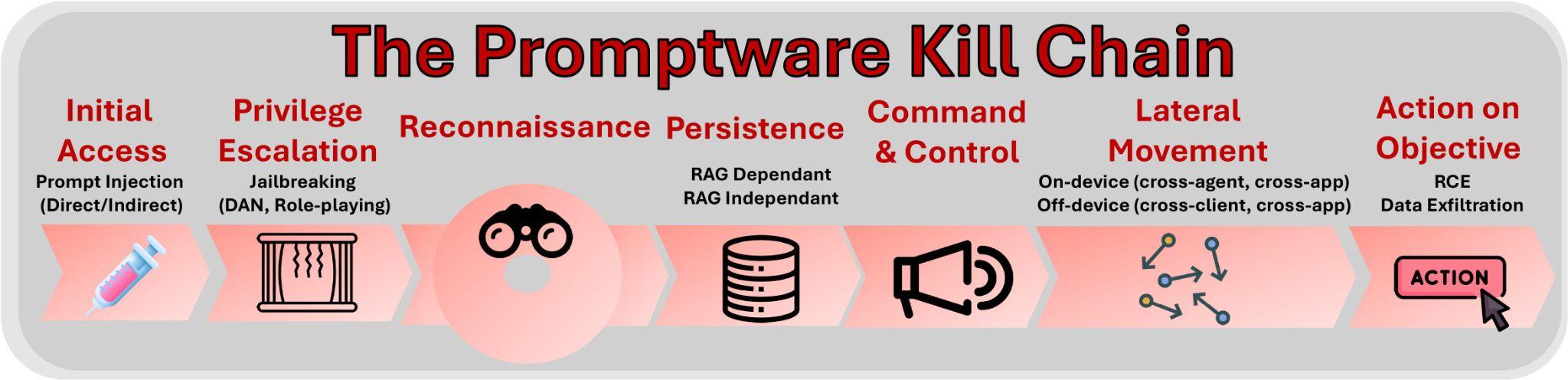
The promptware kill chain: initial access, privilege escalation, reconnaissance, persistence, command & control, lateral movement, action on objective

Attacks against modern generative artificial intelligence (AI) large language models (LLMs) pose a real threat. Yet discussions around these attacks and their potential defenses are dangerously myopic. The dominant narrative focuses on “prompt injection,” a set of techniques to embed instructions into inputs to LLM intended to perform malicious activity. This term suggests a simple, singular vulnerability. This framing obscures a more complex and dangerous reality. Attacks on LLM-based systems have evolved into a distinct class of malware execution mechanisms, which we term “promptware.” In a new paper, we, the authors, propose a structured seven-step “promptware kill chain” to provide policymakers and security practitioners with the necessary vocabulary and framework to address the escalating AI threat landscape.

In our model, the promptware kill chain begins with Initial Access. This is where the malicious payload enters the AI system. This can happen directly, where an attacker types a malicious prompt into the LLM application, or, far more insidiously, through “indirect prompt injection.” In the indirect attack, the adversary embeds malicious instructions in content that the LLM retrieves (obtains in inference time), such as a web page, an email, or a shared document. As LLMs become multimodal (capable of processing various input types beyond text), this vector expands even further; malicious instructions can now be hidden inside an image or audio file, waiting to be processed by a vision-language model.

The fundamental issue lies in the architecture of LLMs themselves. Unlike traditional computing systems that strictly separate executable code from user data, LLMs process all input—whether it is a system command, a user’s email, or a retrieved document—as a single, undifferentiated sequence of tokens. There is no architectural boundary to enforce a distinction between trusted instructions and untrusted data. Consequently, a malicious instruction embedded in a seemingly harmless document is processed with the same authority as a system command.

But prompt injection is only the Initial Access step in a sophisticated, multistage operation that mirrors traditional malware campaigns such as Stuxnet or NotPetya.

Once the malicious instructions are inside material incorporated into the AI’s learning, the attack transitions to Privilege Escalation, often referred to as “jailbreaking.” In this phase, the attacker circumvents the safety training and policy guardrails that vendors such as OpenAI or Google have built into their models. Through techniques analogous to social engineering—convincing the model to adopt a persona that ignores rules—to sophisticated adversarial suffixes in the prompt or data, the promptware tricks the model into performing actions it would normally refuse. This is akin to an attacker escalating from a standard user account to administrator privileges in a traditional cyberattack; it unlocks the full capability of the underlying model for malicious use.

Following privilege escalation comes Reconnaissance. Here, the attack manipulates the LLM to reveal information about its assets, connected services, and capabilities. This allows the attack to advance autonomously down the kill chain without alerting the victim. Unlike reconnaissance in classical malware, which is performed typically before the initial access, promptware reconnaissance occurs after the initial access and jailbreaking components have already succeeded. Its effectiveness relies entirely on the victim model’s ability to reason over its context, and inadvertently turns that reasoning to the attacker’s advantage.

Fourth: the Persistence phase. A transient attack that disappears after one interaction with the LLM application is a nuisance; a persistent one compromises the LLM application for good. Through a variety of mechanisms, promptware embeds itself into the long-term memory of an AI agent or poisons the databases the agent relies on. For instance, a worm could infect a user’s email archive so that every time the AI summarizes past emails, the malicious code is re-executed.

The Command-and-Control (C2) stage relies on the established persistence and dynamic fetching of commands by the LLM application in inference time from the internet. While not strictly required to advance the kill chain, this stage enables the promptware to evolve from a static threat with fixed goals and scheme determined at injection time into a controllable trojan whose behavior can be modified by an attacker.

The sixth stage, Lateral Movement, is where the attack spreads from the initial victim to other users, devices, or systems. In the rush to give AI agents access to our emails, calendars, and enterprise platforms, we create highways for malware propagation. In a “self-replicating” attack, an infected email assistant is tricked into forwarding the malicious payload to all contacts, spreading the infection like a computer virus. In other cases, an attack might pivot from a calendar invite to controlling smart home devices or exfiltrating data from a connected web browser. The interconnectedness that makes these agents useful is precisely what makes them vulnerable to a cascading failure.

Finally, the kill chain concludes with Actions on Objective. The goal of promptware is not just to make a chatbot say something offensive; it is often to achieve tangible malicious outcomes through data exfiltration, financial fraud, or even physical world impact. There are examples of AI agents being manipulated into selling cars for a single dollar or transferring cryptocurrency to an attacker’s wallet. Most alarmingly, agents with coding capabilities can be tricked into executing arbitrary code, granting the attacker total control over the AI’s underlying system. The outcome of this stage determines the type of malware executed by promptware, including infostealer, spyware, and cryptostealer, among others.

The kill chain was already demonstrated. For example, in the research “Invitation Is All You Need,” attackers achieved initial access by embedding a malicious prompt in the title of a Google Calendar invitation. The prompt then leveraged an advanced technique known as delayed tool invocation to coerce the LLM into executing the injected instructions. Because the prompt was embedded in a Google Calendar artifact, it persisted in the long-term memory of the user’s workspace. Lateral movement occurred when the prompt instructed the Google Assistant to launch the Zoom application, and the final objective involved covertly livestreaming video of the unsuspecting user who had merely asked about their upcoming meetings. C2 and reconnaissance weren’t demonstrated in this attack.

Similarly, the “Here Comes the AI Worm” research demonstrated another end-to-end realization of the kill chain. In this case, initial access was achieved via a prompt injected into an email sent to the victim. The prompt employed a role-playing technique to compel the LLM to follow the attacker’s instructions. Since the prompt was embedded in an email, it likewise persisted in the long-term memory of the user’s workspace. The injected prompt instructed the LLM to replicate itself and exfiltrate sensitive user data, leading to off-device lateral movement when the email assistant was later asked to draft new emails. These emails, containing sensitive information, were subsequently sent by the user to additional recipients, resulting in the infection of new clients and a sublinear propagation of the attack. C2 and reconnaissance weren’t demonstrated in this attack.

The promptware kill chain gives us a framework for understanding these and similar attacks; the paper characterizes dozens of them. Prompt injection isn’t something we can fix in current LLM technology. Instead, we need an in-depth defensive strategy that assumes initial access will occur and focuses on breaking the chain at subsequent steps, including by limiting privilege escalation, constraining reconnaissance, preventing persistence, disrupting C2, and restricting the actions an agent is permitted to take. By understanding promptware as a complex, multistage malware campaign, we can shift from reactive patching to systematic risk management, securing the critical systems we are so eager to build.

This essay was written with Oleg Brodt, Elad Feldman and Ben Nassi, and originally appeared in Lawfare.
Upcoming Speaking Engagements

14 February 2026 at 18:04

This is a current list of where and when I am scheduled to speak:

  • I’m speaking at Ontario Tech University in Oshawa, Ontario, Canada, at 2 PM ET on Thursday, February 26, 2026.
  • I’m speaking at the Personal AI Summit in Los Angeles, California, USA, on Thursday, March 5, 2026.
  • I’m speaking at Tech Live: Cybersecurity in New York City, USA, on Wednesday, March 11, 2026.
  • I’m giving the Ross Anderson Lecture at the University of Cambridge’s Churchill College at 5:30 PM GMT on Thursday, March 19, 2026.
  • I’m speaking at RSAC 2026 in San Francisco, California, USA, on Wednesday, March 25, 2026.

The list is maintained on this page.

3D Printer Surveillance

12 February 2026 at 13:01

New York is contemplating a bill that adds surveillance to 3D printers:

New York’s 2026­2027 executive budget bill (S.9005 / A.10005) includes language that should alarm every maker, educator, and small manufacturer in the state. Buried in Part C is a provision requiring all 3D printers sold or delivered in New York to include “blocking technology.” This is defined as software or firmware that scans every print file through a “firearms blueprint detection algorithm” and refuses to print anything it flags as a potential firearm or firearm component.

I get the policy goals here, but the solution just won’t work. It’s the same problem as DRM: trying to prevent general-purpose computers from doing specific things. Cory Doctorow wrote about it in 2018 and—more generally—spoke about it in 2011.

Rewiring Democracy Ebook is on Sale

11 February 2026 at 15:48

I just noticed that the ebook version of Rewiring Democracy is on sale for $5 on Amazon, Apple Books, Barnes & Noble, Books A Million, Google Play, Kobo, and presumably everywhere else in the US. I have no idea how long this will last.

Also, Amazon has a coupon that brings the hardcover price down to $20. You’ll see the discount at checkout.

Prompt Injection Via Road Signs

11 February 2026 at 13:03

Interesting research: “CHAI: Command Hijacking Against Embodied AI.”

Abstract: Embodied Artificial Intelligence (AI) promises to handle edge cases in robotic vehicle systems where data is scarce by using common-sense reasoning grounded in perception and action to generalize beyond training distributions and adapt to novel real-world situations. These capabilities, however, also create new security risks. In this paper, we introduce CHAI (Command Hijacking against embodied AI), a new class of prompt-based attacks that exploit the multimodal language interpretation abilities of Large Visual-Language Models (LVLMs). CHAI embeds deceptive natural language instructions, such as misleading signs, in visual input, systematically searches the token space, builds a dictionary of prompts, and guides an attacker model to generate Visual Attack Prompts. We evaluate CHAI on four LVLM agents; drone emergency landing, autonomous driving, and aerial object tracking, and on a real robotic vehicle. Our experiments show that CHAI consistently outperforms state-of-the-art attacks. By exploiting the semantic and multimodal reasoning strengths of next-generation embodied AI systems, CHAI underscores the urgent need for defenses that extend beyond traditional adversarial robustness.

News article.

AI-Generated Text and the Detection Arms Race

10 February 2026 at 13:03

In 2023, the science fiction literary magazine Clarkesworld stopped accepting new submissions because so many were generated by artificial intelligence. Near as the editors could tell, many submitters pasted the magazine’s detailed story guidelines into an AI and sent in the results. And they weren’t alone. Other fiction magazines have also reported a high number of AI-generated submissions.

This is only one example of a ubiquitous trend. A legacy system relied on the difficulty of writing and cognition to limit volume. Generative AI overwhelms the system because the humans on the receiving end can’t keep up.

This is happening everywhere. Newspapers are being inundated by AI-generated letters to the editor, as are academic journals. Lawmakers are inundated with AI-generated constituent comments. Courts around the world are flooded with AI-generated filings, particularly by people representing themselves. AI conferences are flooded with AI-generated research papers. Social media is flooded with AI posts. In music, open source software, education, investigative journalism and hiring, it’s the same story.

Like Clarkesworld’s initial response, some of these institutions shut down their submissions processes. Others have met the offensive of AI inputs with some defensive response, often involving a counteracting use of AI. Academic peer reviewers increasingly use AI to evaluate papers that may have been generated by AI. Social media platforms turn to AI moderators. Court systems use AI to triage and process litigation volumes supercharged by AI. Employers turn to AI tools to review candidate applications. Educators use AI not just to grade papers and administer exams, but as a feedback tool for students.

These are all arms races: rapid, adversarial iteration to apply a common technology to opposing purposes. Many of these arms races have clearly deleterious effects. Society suffers if the courts are clogged with frivolous, AI-manufactured cases. There is also harm if the established measures of academic performance – publications and citations – accrue to those researchers most willing to fraudulently submit AI-written letters and papers rather than to those whose ideas have the most impact. The fear is that, in the end, fraudulent behavior enabled by AI will undermine systems and institutions that society relies on.

Upsides of AI

Yet some of these AI arms races have surprising hidden upsides, and the hope is that at least some institutions will be able to change in ways that make them stronger.

Science seems likely to become stronger thanks to AI, yet it faces a problem when the AI makes mistakes. Consider the example of nonsensical, AI-generated phrasing filtering into scientific papers.

A scientist using an AI to assist in writing an academic paper can be a good thing, if used carefully and with disclosure. AI is increasingly a primary tool in scientific research: for reviewing literature, programming and for coding and analyzing data. And for many, it has become a crucial support for expression and scientific communication. Pre-AI, better-funded researchers could hire humans to help them write their academic papers. For many authors whose primary language is not English, hiring this kind of assistance has been an expensive necessity. AI provides it to everyone.

In fiction, fraudulently submitted AI-generated works cause harm, both to the human authors now subject to increased competition and to those readers who may feel defrauded after unknowingly reading the work of a machine. But some outlets may welcome AI-assisted submissions with appropriate disclosure and under particular guidelines, and leverage AI to evaluate them against criteria like originality, fit and quality.

Others may refuse AI-generated work, but this will come at a cost. It’s unlikely that any human editor or technology can sustain an ability to differentiate human from machine writing. Instead, outlets that wish to exclusively publish humans will need to limit submissions to a set of authors they trust to not use AI. If these policies are transparent, readers can pick the format they prefer and read happily from either or both types of outlets.

We also don’t see any problem if a job seeker uses AI to polish their resumes or write better cover letters: The wealthy and privileged have long had access to human assistance for those things. But it crosses the line when AIs are used to lie about identity and experience, or to cheat on job interviews.

Similarly, a democracy requires that its citizens be able to express their opinions to their representatives, or to each other through a medium like the newspaper. The rich and powerful have long been able to hire writers to turn their ideas into persuasive prose, and AIs providing that assistance to more people is a good thing, in our view. Here, AI mistakes and bias can be harmful. Citizens may be using AI for more than just a time-saving shortcut; it may be augmenting their knowledge and capabilities, generating statements about historical, legal or policy factors they can’t reasonably be expected to independently check.

Fraud booster

What we don’t want is for lobbyists to use AIs in astroturf campaigns, writing multiple letters and passing them off as individual opinions. This, too, is an older problem that AIs are making worse.

What differentiates the positive from the negative here is not any inherent aspect of the technology, it’s the power dynamic. The same technology that reduces the effort required for a citizen to share their lived experience with their legislator also enables corporate interests to misrepresent the public at scale. The former is a power-equalizing application of AI that enhances participatory democracy; the latter is a power-concentrating application that threatens it.

In general, we believe writing and cognitive assistance, long available to the rich and powerful, should be available to everyone. The problem comes when AIs make fraud easier. Any response needs to balance embracing that newfound democratization of access with preventing fraud.

There’s no way to turn this technology off. Highly capable AIs are widely available and can run on a laptop. Ethical guidelines and clear professional boundaries can help – for those acting in good faith. But there won’t ever be a way to totally stop academic writers, job seekers or citizens from using these tools, either as legitimate assistance or to commit fraud. This means more comments, more letters, more applications, more submissions.

The problem is that whoever is on the receiving end of this AI-fueled deluge can’t deal with the increased volume. What can help is developing assistive AI tools that benefit institutions and society, while also limiting fraud. And that may mean embracing the use of AI assistance in these adversarial systems, even though the defensive AI will never achieve supremacy.

Balancing harms with benefits

The science fiction community has been wrestling with AI since 2023. Clarkesworld eventually reopened submissions, claiming that it has an adequate way of separating human- and AI-written stories. No one knows how long, or how well, that will continue to work.

The arms race continues. There is no simple way to tell whether the potential benefits of AI will outweigh the harms, now or in the future. But as a society, we can influence the balance of harms it wreaks and opportunities it presents as we muddle our way through the changing technological landscape.

This essay was written with Nathan E. Sanders, and originally appeared in The Conversation.

EDITED TO ADD: This essay has been translated into Spanish.

LLMs are Getting a Lot Better and Faster at Finding and Exploiting Zero-Days

9 February 2026 at 13:04

This is amazing:

Opus 4.6 is notably better at finding high-severity vulnerabilities than previous models and a sign of how quickly things are moving. Security teams have been automating vulnerability discovery for years, investing heavily in fuzzing infrastructure and custom harnesses to find bugs at scale. But what stood out in early testing is how quickly Opus 4.6 found vulnerabilities out of the box without task-specific tooling, custom scaffolding, or specialized prompting. Even more interesting is how it found them. Fuzzers work by throwing massive amounts of random inputs at code to see what breaks. Opus 4.6 reads and reasons about code the way a human researcher would­—looking at past fixes to find similar bugs that weren’t addressed, spotting patterns that tend to cause problems, or understanding a piece of logic well enough to know exactly what input would break it. When we pointed Opus 4.6 at some of the most well-tested codebases (projects that have had fuzzers running against them for years, accumulating millions of hours of CPU time), Opus 4.6 found high-severity vulnerabilities, some that had gone undetected for decades.

The details of how Claude Opus 4.6 found these zero-days is the interesting part—read the whole blog post.

News article.

I Am in the Epstein Files

6 February 2026 at 21:43

Once. Someone named “Vincenzo lozzo” wrote to Epstein in email, in 2016: “I wouldn’t pay too much attention to this, Schneier has a long tradition of dramatizing and misunderstanding things.” The topic of the email is DDoS attacks, and it is unclear what I am dramatizing and misunderstanding.

Rabbi Schneier is also mentioned, also incidentally, also once. As far as either of us know, we are not related.

EDITED TO ADD (2/7): There is more context on the Justice.gov website version.

iPhone Lockdown Mode Protects Washington Post Reporter

6 February 2026 at 13:00

404Media is reporting that the FBI could not access a reporter’s iPhone because it had Lockdown Mode enabled:

The court record shows what devices and data the FBI was able to ultimately access, and which devices it could not, after raiding the home of the reporter, Hannah Natanson, in January as part of an investigation into leaks of classified information. It also provides rare insight into the apparent effectiveness of Lockdown Mode, or at least how effective it might be before the FBI may try other techniques to access the device.

“Because the iPhone was in Lockdown mode, CART could not extract that device,” the court record reads, referring to the FBI’s Computer Analysis Response Team, a unit focused on performing forensic analyses of seized devices. The document is written by the government, and is opposing the return of Natanson’s devices.

The FBI raided Natanson’s home as part of its investigation into government contractor Aurelio Perez-Lugones, who is charged with, among other things, retention of national defense information. The government believes Perez-Lugones was a source of Natanson’s, and provided her with various pieces of classified information. While executing a search warrant for his mobile phone, investigators reviewed Signal messages between Pere-Lugones and the reporter, the Department of Justice previously said.

Backdoor in Notepad++

5 February 2026 at 13:00

Hackers associated with the Chinese government used a Trojaned version of Notepad++ to deliver malware to selected users.

Notepad++ said that officials with the unnamed provider hosting the update infrastructure consulted with incident responders and found that it remained compromised until September 2. Even then, the attackers maintained credentials to the internal services until December 2, a capability that allowed them to continue redirecting selected update traffic to malicious servers. The threat actor “specifically targeted Notepad++ domain with the goal of exploiting insufficient update verification controls that existed in older versions of Notepad++.” Event logs indicate that the hackers tried to re-exploit one of the weaknesses after it was fixed but that the attempt failed.

Make sure you’re running at least version 8.9.1.

US Declassifies Information on JUMPSEAT Spy Satellites

4 February 2026 at 13:02

The US National Reconnaissance Office has declassified information about a fleet of spy satellites operating between 1971 and 2006.

I’m actually impressed to see a declassification only two decades after decommission.

Five Predictions for Cyber Security Trends in 2026 

4 February 2026 at 10:17

During a recent Threat Watch Live session, Adam Pilton challenged Morten Kjaersgaard, Heimdal’s Chairman and Founder, to predict three cyber security trends for 2026.  Adam added his own predictions, drawing from this experience as a former cybercrime detective. Spoiler: Both Morten and Adam agreed that 2026 will bring a sharper focus on compliance.   Here’s what they predict.  SMBs catch a break if they’ve done compliance right  Hackers recently discovered there’s no use in targeting […]

The post Five Predictions for Cyber Security Trends in 2026  appeared first on Heimdal Security Blog.

Microsoft is Giving the FBI BitLocker Keys

3 February 2026 at 13:05

Microsoft gives the FBI the ability to decrypt BitLocker in response to court orders: about twenty times per year.

It’s possible for users to store those keys on a device they own, but Microsoft also recommends BitLocker users store their keys on its servers for convenience. While that means someone can access their data if they forget their password, or if repeated failed attempts to login lock the device, it also makes them vulnerable to law enforcement subpoenas and warrants.

Friday Squid Blogging: New Squid Species Discovered

30 January 2026 at 23:05

A new species of squid. pretends to be a plant:

Scientists have filmed a never-before-seen species of deep-sea squid burying itself upside down in the seafloor—a behavior never documented in cephalopods. They captured the bizarre scene while studying the depths of the Clarion-Clipperton Zone (CCZ), an abyssal plain in the Pacific Ocean targeted for deep-sea mining.

The team described the encounter in a study published Nov. 25 in the journal Ecology, writing that the animal appears to be an undescribed species of whiplash squid. At a depth of roughly 13,450 feet (4,100 meters), the squid had buried almost its entire body in sediment and was hanging upside down, with its siphon and two long tentacles held rigid above the seafloor.

“The fact that this is a squid and it’s covering itself in mud—it’s novel for squid and the fact that it is upside down,” lead author Alejandra Mejía-Saenz, a deep-sea ecologist at the Scottish Association for Marine Science, told Live Science. “We had never seen anything like that in any cephalopods…. It was very novel and very puzzling.”

As usual, you can also use this squid post to talk about the security stories in the news that I haven’t covered.

Blog moderation policy.

Explore scaling options for AWS Directory Service for Microsoft Active Directory

30 January 2026 at 20:51

You can use AWS Directory Service for Microsoft Active Directory as your primary Active Directory Forest for hosting your users’ identities. Your IT teams can continue using existing skills and applications while your organization benefits from the enhanced security, reliability, and scalability of AWS managed services. You can also run AWS Managed Microsoft AD as a resource forest. In this configuration, AWS Managed Microsoft AD serves supported AWS services while users’ identities remain under exclusive control of your organization on a self-managed Active Directory. As your organization grows and scales, so will your AWS Managed Microsoft AD deployments.

In this post, you’ll learn how to use Amazon CloudWatch dashboards to monitor key performance metrics of your AWS Managed Microsoft AD deployment to track and analyze a directory’s performance over time. You can then use that information to determine when and how best to scale directory services for optimal performance.

Scaling your Active Directory

When you deploy AWS Managed Microsoft AD, the service initially creates two domain controller instances in two separate subnets of the same virtual private cloud (VPC). This architecture economically provides resiliency and high availability with a minimal set of resources. This initial configuration enables every feature that AWS Managed Microsoft AD offers. As your organization grows, its workflows will become larger and more complex, requiring that you scale your directories accordingly. AWS Managed Microsoft AD simplifies and makes the scaling process secure with minimal administrative effort. When it’s time to scale a directory, AWS Managed Microsoft AD offers two options: scale-up or scale-out.

Understanding scale-up and scale-out

Scale-up—also called upgrading your AWS Managed Microsoft AD—means changing the edition of an AWS Managed Microsoft AD from Standard to Enterprise. Enterprise Edition delivers larger domain controller instances, with higher compute capacity and larger storage for Active Directory objects. When a directory scales up, it retains the same number of domain controller instances that it previously had with larger quotas. Instances are replaced one at a time to minimize disruptions to production workflows.

A few features offered by the service are a better fit for the size and compute power of Enterprise Edition AWS Managed Microsoft AD and so are only available in Enterprise Edition. Consider scaling-up your directory if you encounter any of the following scenarios:

  • You plan to replicate your directory across multiple AWS Regions. Multi-Region replication is only available in Enterprise Edition.
  • The number of Active Directory objects in the directory will exceed the recommended threshold of 30,000 objects for Standard Edition. Enterprise Edition can accommodate up to 500,000 directory objects.
  • You plan to share your directory with more than 25 other AWS accounts. The default directory sharing quota is 25 accounts for Standard Edition and 500 for Enterprise Edition.

Important: Scaling up a directory from Standard to Enterprise is a one-way operation that cannot be reverted and operates at a higher hourly price.

Scale-out means deploying additional domain controllers for your AWS Managed Microsoft AD. You can scale out both Standard or Enterprise directories and can scale out different Regions independently. You don’t need to scale every Region to the same number of domain controller instances. When scale-out takes place, additional domain controller instances with the same compute resources and storage capacity as existing ones are launched in the same subnets.

Because some operations cannot be reverted, it’s important to understand the impact of each scaling operation. It’s preferable to scale out the number of domain controllers first, because you can revert that change if necessary. Consider scaling up first only if you need a feature that’s only available in Enterprise Edition.

Making an informed decision using CloudWatch

Since December 2021, AWS Managed Microsoft AD helps optimize scaling decisions with directory metrics in Amazon CloudWatch. Amazon CloudWatch metrics are a time-ordered set of data-points about performance indicators of a system that you can use to monitor and analyze performance over time. Metrics are stored as a time-series set and each data point has an associated timestamp. By using CloudWatch, you can create alarms based on metrics and visualize and analyze metrics to derive new insights.

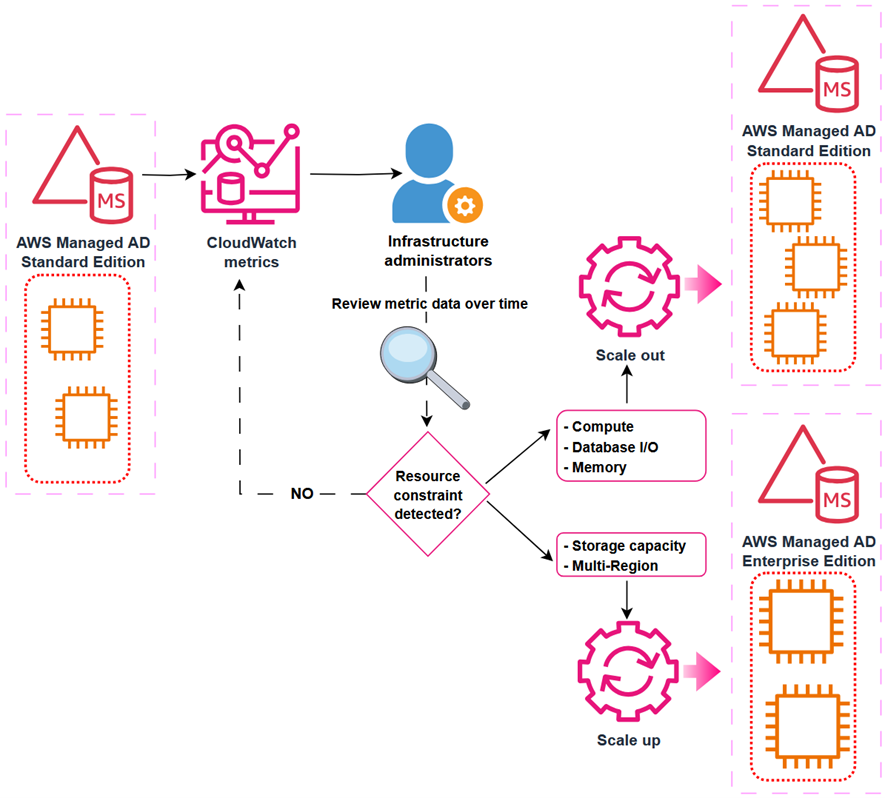
To understand the performance of a directory over time, define the key performance metrics based on your workload when you create the directory. Record the initial values of those metrics to create a performance baseline. Periodically revisit and compare data points for the same metrics to understand trends and use of resources over time. Based on the information provided by the performance baseline and periodic follow-ups, you can decide when to scale your directory and what scaling method to use. This process is depicted in Figure 1.

Figure 1: Decision-making process for scaling an Active Directory implementation

Figure 1: Decision-making process for scaling an Active Directory implementation

Depending on the characteristics of your workload, you might face different resource constraints in your directory system. From an infrastructure perspective, the more commonly demanded resources are:

  • Network Interface: Current Bandwidth
  • Processor: % Processor Time
  • LogicalDisk: % Free Space

From an Active Directory perspective, consider metrics such as:

  • NTDS: LDAP Searches/sec
  • NTDS: ATQ Estimated Queue Delay

The following table is an example decision matrix based on which resource is constrained.

Constrained resource Recommended action
% Processor Time Scale out
I/O Database Reads Average Latency Scale out
Committed Bytes in Use Scale out
% Free Space Scale up

For example, you can create a CloudWatch alarm that will trigger when Processor: % Processor Time is over 80% for more than 5 minutes. If this alarm triggers often, it could be a signal that domain controller instances are struggling to service the regular volume of user authentication requests. In such a scenario, you might consider scaling-out an additional domain controller to guarantee the service’s SLA. Conversely, if the LogicalDisk: % Free Space drops below 10% and trends downwards, you might consider scaling-up to Enterprise Edition, because it provides a larger capacity for directory objects.

To facilitate tracking and analyzing performance of AWS Managed Microsoft AD over time, you can use Amazon CloudWatch to create a custom dashboard including relevant metrics.

Prerequisites

Before you get started, make sure that you have the following prerequisites in place:

Create a CloudWatch dashboard

With the prerequisites in place, you’re ready to create a CloudWatch dashboard to track directory service metrics. For more information, see Getting started with CloudWatch automatic dashboards.

To create a dashboard:

  1. Open the AWS Management Console for CloudWatch.
  2. In the navigation pane, choose Dashboards, and then choose Create dashboard.
  3. In the Create new dashboard dialog box, enter a name for the dashboard and then choose Create dashboard.
  4. When the Add widget window appears:
    1. Under Data sources types, select CloudWatch.
    2. Under Data type, select Metrics.
    3. Under Widget type, select Line.
    4. Choose Next.
  5. In the Add metric graph window, choose DirectoryService and then select Processor as the Metric category and % Processor Time under Metric name. Select each instance of the metric, represented as the Domain Controller IP, for one Directory ID.
  6. Choose Create widget.

    Note: if there are multiple directories in the same Region, all instances (domain controllers IPs) will be available for selection. To help ensure effective monitoring and alarms, create a separate dashboard for each directory.

  7. Choose the plus sign (+) at the top of the window to add more widgets. Repeat steps 1–6 to add additional widgets for other relevant metrics. In this example the metric categories and names added are:
    • Processor: % Processor Time
    • LogicalDisk: % Free Space
    • Memory: Committed Bytes in Use
    • Database: I/O Database Reads Average Latency
    • Network Interface: Current Bandwidth
    • DNS: Recursive Queries/Sec
  8. After adding the desired metrics, choose Save.
Figure 2: CloudWatch dashboard showing directory services metrics

Figure 2: CloudWatch dashboard showing directory services metrics

(Optional) Create an alarm in CloudWatch

Now that you have a dashboard where you can view metrics, consider setting up CloudWatch alarms to alert you when a metric reaches or goes beyond a specified threshold. For more information, see Create a CloudWatch alarm based on a static threshold and Adding an alarm to a CloudWatch dashboard.

The following are recommended thresholds to monitor when determining the need to scale an AWS Managed Microsoft AD. These are general recommendations based on standard use cases. You might have to adjust these thresholds to make the best scaling decisions for your organization.

  • Processor: % Processor Time: Monitor CPU utilization to understand computational demands on your domain controllers. Set CloudWatch alarms at 80% for a period of 5 minutes. Sustained high values indicate potential sizing issues that might require scaling out your directory.
  • LogicalDisk: % Free Space: Maintain at least 25% free space on volumes containing Active Directory data for optimal performance. Set CloudWatch alarms to trigger when free space drops below 20%. Low disk space can severely impact directory operations and require implementing cleanup procedures or scaling up the directory.
  • Network Interface: Current Bandwidth: Average network utilization should be kept below 50% of available bandwidth during peak operations for optimal directory responsiveness. Set CloudWatch alarms at 70% utilization to allow room for spikes in activity. Consistently high values suggest network constraints that might require scaling out your directory.
  • Memory: Committed Bytes in Use: Monitor memory commitment levels to help ensure that your domain controllers have sufficient memory resources for Active Directory operations. This metric tracks the amount of virtual memory that has been committed, indicating the total memory load on your domain controllers. Set CloudWatch alarms at 80% of the commit limit. Sustained high values can lead to excessive paging, significantly degrading directory performance and potentially causing authentication delays.
  • Database: I/O Database Reads Average Latency: Maintain average read latencies below 25 milliseconds. Set CloudWatch alarms at a threshold of 50 milliseconds. If read latencies are consistently elevated, consider scaling-out your directory.
  • DNS: Recursive Queries/sec: Given the tight integration of Active Directory with DNS, monitor this metric for stability and predictable patterns. Use CloudWatch anomaly detection rather than fixed thresholds to identify unexpected behaviors that could indicate DNS configuration issues or potential security concerns.

Post-scaling considerations

Different resources across your architecture might contain references to the IP addresses of the AWS Managed Microsoft AD. After a scale-out operation that deploys additional domain controller instances on a directory, update existing references to maintain full functionality of workloads. References for the directory’s IP addresses can be found (but might not be limited to) the following services:

To maintain the full functionality of your workloads after a directory scaling operation, update the following:

  • Firewall rules that allow traffic to and from the IP addresses of domain controller instances
  • Route53 Resolver endpoint rules and DNS conditional forwarders that forward queries to the directory instances
  • CloudWatch dashboards that display metric data about the directory to include dimensions for the new IP addresses

Clean up resources

In this post, you created components that generate costs. Clean up these resources when no longer required to avoid additional charges.

  • Remove added domain controller’s IP addresses from firewall rules, resolver endpoint rules and DNS conditional forwarders.
  • Delete the custom CloudWatch dashboards you don’t plan to keep.
  • Scale back existing directories to the previous number of domain controller instances.

Conclusion

In this post, you learned how to monitor directory performance metrics using Amazon CloudWatch. By combining performance baselines, monitoring, and planning, you can make informed decisions about when and how to scale a directory safely and efficiently. By scaling directories in a timely manner, you can optimize efficiency and reduce the risk of outages by having a right-sized directory service to support your organization’s workloads.

Scale out your directory when your Active Directory-aware workflows have grown over time and the solution requires additional domain controller instances to maintain the service SLA. Scale up your directory when you require a feature that’s only available in Enterprise Edition AWS Managed Microsoft AD, such as multi-Region replication or additional storage to accommodate Active Directory objects. By using the flexible scaling capabilities and independent Regional expansion, you can optimize costs while maintaining appropriate service levels.

To learn more about AWS Managed Microsoft AD optimization and monitoring with Amazon CloudWatch, see:

Nahuel Benavidez Nahuel Benavidez
Nahuel is a Sr. CSE in AWS, specializing in AWS Directory Service, Microsoft Technologies, and SQL Server. He enjoys teaming with customers to discover exciting ways to explore AWS services. Nahuel loves to spoil his niece and goddaughters above all else. Also, Dungeons and Dragons (before it was popular), CrossFit, hiking, trekking and, sharing a pint with friends but “just one.”

AIs Are Getting Better at Finding and Exploiting Security Vulnerabilities

30 January 2026 at 16:35

From an Anthropic blog post:

In a recent evaluation of AI models’ cyber capabilities, current Claude models can now succeed at multistage attacks on networks with dozens of hosts using only standard, open-source tools, instead of the custom tools needed by previous generations. This illustrates how barriers to the use of AI in relatively autonomous cyber workflows are rapidly coming down, and highlights the importance of security fundamentals like promptly patching known vulnerabilities.

[…]

A notable development during the testing of Claude Sonnet 4.5 is that the model can now succeed on a minority of the networks without the custom cyber toolkit needed by previous generations. In particular, Sonnet 4.5 can now exfiltrate all of the (simulated) personal information in a high-fidelity simulation of the Equifax data breach—one of the costliest cyber attacks in history­­using only a Bash shell on a widely-available Kali Linux host (standard, open-source tools for penetration testing; not a custom toolkit). Sonnet 4.5 accomplishes this by instantly recognizing a publicized CVE and writing code to exploit it without needing to look it up or iterate on it. Recalling that the original Equifax breach happened by exploiting a publicized CVE that had not yet been patched, the prospect of highly competent and fast AI agents leveraging this approach underscores the pressing need for security best practices like prompt updates and patches.

AI models are getting better at this faster than I expected. This will be a major power shift in cybersecurity.

The Constitutionality of Geofence Warrants

27 January 2026 at 13:01

The US Supreme Court is considering the constitutionality of geofence warrants.

The case centers on the trial of Okello Chatrie, a Virginia man who pleaded guilty to a 2019 robbery outside of Richmond and was sentenced to almost 12 years in prison for stealing $195,000 at gunpoint.

Police probing the crime found security camera footage showing a man on a cell phone near the credit union that was robbed and asked Google to produce anonymized location data near the robbery site so they could determine who committed the crime. They did so, providing police with subscriber data for three people, one of whom was Chatrie. Police then searched Chatrie’s home and allegedly surfaced a gun, almost $100,000 in cash and incriminating notes.

Chatrie’s appeal challenges the constitutionality of geofence warrants, arguing that they violate individuals’ Fourth Amendment rights protecting against unreasonable searches.

❌