โŒ

Normal view

The Strategic Imperative for OT/IT Convergence

30 December 2025 at 14:00

The intersection and evolution of operational technology (OT) and information technology (IT), as well as the cybersecurity risks associated with both are becoming increasingly critical business challenges for organisations of all sizes, across all geographies.

As digital transformation expands into OT environments, convergence with IT systems is inevitable. This convergence may generate exciting business opportunities, such as creating new sources of income and improving business outcomes, but it also presents new cybersecurity risks and complexities, for which many industry leaders are not prepared.

Why Is OT/IT Convergence So Complex?

There are many overlapping forces driving the OT and IT worlds together, creating a hairball of complexity from varying sources:

  • People: OT and IT communities are historically different in many ways (technological, operational, regulatory and culturally) and have different priorities and focuses.
  • Technology: The age of technology in OT environments means that legacy equipment and machinery are often incompatible with the latest IT software, increasing their vulnerability to cyberthreats.
  • Mindsets: Historically, โ€˜secure by designโ€™ has not been a focus in OT. System uptime and employee safety have traditionally been prioritised over cybersecurity in OT environments, unlike IT where cybersecurity is ingrained.

Understanding the Risk and Impact

OT/IT cybersecurity is a strategic issue, not just a technical requirement, and it must be designed into systems as early as possible. The consequences of not acting from the start far outweigh any advantages gained by disregarding the issue.

This is particularly true for critical infrastructure, such as water purification systems, power grids, air traffic control systems, communications networks and battlefield command-and-control systems, all of which are open to potential cybersecurity risk. Always assume that your adversaries are willing to exploit your Achilles heel when it comes to securing OT/IT systems.

Key Attention Areas in OT/IT Convergence

All senior business leaders should consider the following areas with OT/IT convergence and cybersecurity:

  1. Mindset: Industry leaders need the right mindset to balance cybersecurity best practices with a seemingly endless number of new devices and data sources caused by OT/IT convergence.
  2. Technology: Technologies, such as artificial intelligence, machine learning and cloud computing, represent both opportunities and threats in the world of OT/IT cybersecurity. Modern technology systems must be built with tomorrowโ€™s security risks in mind.
  3. Compliance: The NIS Directive and its follow-on NIS2 Directive outline the responsibility for organisations to take reasonable steps toward a solid cybersecurity posture. This applies to the increasingly digital OT world because of the classification of many OT systems as a critical infrastructure.
  4. Teams: Organisations need to recognise and confront the cultural silo separating OT and IT teams in order to reduce complexity, promote collaboration and achieve a reliable, frictionless state of OT/IT cybersecurity.
  5. The cloud, data and device proliferation: When digital OT systems are infected, the attacks easily and quickly move laterally over a mesh of intersecting networks, carrying โ€˜digital germsโ€™ with them. The risk here is high, particularly with the huge proliferation of devices and data from converged workloads in the cloud.
  6. The future: There is a growing urgency from business stakeholders to make OT systems more digitally driven to ensure agility and efficiency. Boards that are now prioritising OT/IT cybersecurity are making a strong statement about the business implications to this strategy.

Next Steps

To help you understand and prepare for the cybersecurity risks inherent at the intersection of OT and IT, we have captured insights and recommendations from forward-thinking industry experts in a new guide: Executive Edge: Peer Insights - Complexity at the intersection of IT and OT.

This Peer Insights guide for C-suite executives explores how to streamline security, reduce complexity, and anticipate threats across the IT/OT environment, ultimately helping you drive change within your organisation.

Download the Peer Insights guide.

The post The Strategic Imperative for OT/IT Convergence appeared first on Palo Alto Networks Blog.

Breach of 120 000 IP cameras in South Korea: security tips | Kaspersky official blog

11 December 2025 at 16:15

South Korean law enforcement has arrested four suspects linked to the breach of approximately 120ย 000 IP cameras installed in private homes and commercial spaces โ€” including karaoke lounges, pilates studios, and a gynecology clinic. Two of the hackers sold sexually explicit footage from the cameras through a foreign adult website. In this post, we explain what IP cameras are, and where their vulnerabilities lie. We also dive into the details of the South Korea incident and share practical advice on how to avoid becoming a target for attackers hunting for intimate video content.

How do IP cameras work?

An IP camera is a video camera connected to the internet via the Internet Protocol (IP), which lets you view its feed remotely on a smartphone or computer. Unlike traditional CCTV surveillance systems, these cameras donโ€™t require a local surveillance hub โ€” like you see in the movies โ€” or even a dedicated computer to be plugged into. An IP camera streams video directly in real time to any device that connects to it over the internet. Most of todayโ€™s IP camera manufacturers also offer optional cloud storage plans, letting you access recorded footage from anywhere in the world.

In recent years, IP cameras have surged in popularity to become ubiquitous, serving a wide range of purposes โ€” from monitoring kids and pets at home to securing warehouses, offices, short-term rental apartments (often illegally), and small businesses. Basic models can be picked up online for as little as US$25โ€“40.

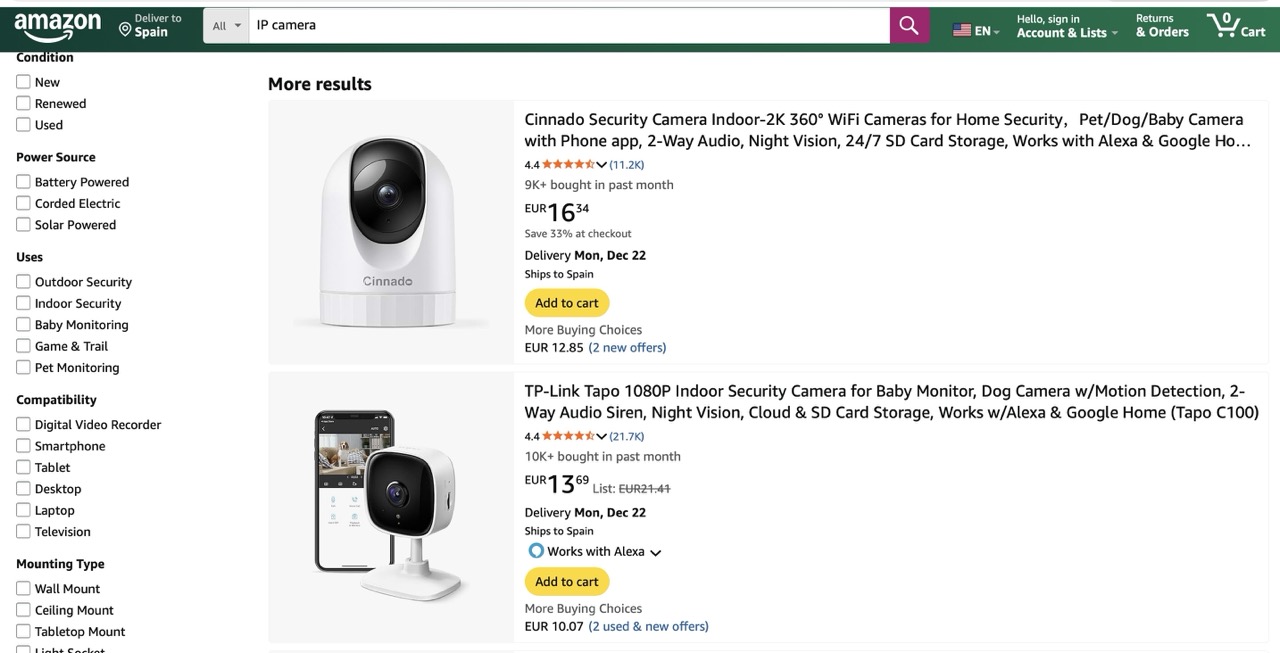
A typical budget-friendly IP camera offered for sale

You can find a Full HD IP camera on an online marketplace for under US$25 โ€” affordable prices have made them incredibly popular for both home and small business use

One of the defining features of IP cameras is that theyโ€™re originally designed for remote access. The camera connects to the internet and silently accepts incoming connections โ€” ready to stream video to anyone who knows its address and has the password. And this leads to two common problems with these devices.

  1. Default passwords. IP camera owners often keep the simple default usernames and passwords that come preconfigured on the device.
  2. Vulnerabilities in outdated software. Software updates for cameras often require manual intervention: you need to log in to the administration interface, check for an update, and install it yourself. Many users simply skip this altogether. Worse, updates might not even exist โ€” many camera vendors ignore security and drop support right after the sale.

What happened in South Korea?

Letโ€™s rewind to what unfolded this fall in South Korea. Law-enforcement authorities reported a breach of roughly 120ย 000 IP cameras, and the arrest of four suspects in connection with the attacks. Hereโ€™s what we know about each of them.

  • Suspect 1, unemployed, hacked approximately 63ย 000 IP cameras, producing and later selling 545 sexually explicit videos for a total of 35 million South Korean won, or just under US$24ย 000.
  • Suspect 2, an office worker, compromised around 70ย 000 IP cameras and sold 648 illicit sexual videos for 18 million won (about US$12ย 000).
  • Suspect 3, self-employed, hacked 15ย 000 IP cameras and created illegal content, including footage involving minors. So far, thereโ€™s no information suggesting this individual sold any material.
  • Suspect 4, an office worker, appears to have breached only 136 IP cameras, and isnโ€™t accused of producing or selling illegal content.

The astute reader may have noticed the numbers donโ€™t quite add up โ€” the figures above totaling well over 120ย 000. South Korean law enforcement hasnโ€™t provided a clear explanation for this discrepancy. Journalists speculate that some of the devices may have been compromised by multiple attackers.

The investigation has revealed that only two of the accused actually sold the sexual content theyโ€™d stolen. However, the scale of their operation is staggering. Last year, the website hosting voyeurism and sexual exploitation content โ€” which both perpetrators used to sell their videos โ€” received 62% of its uploads from just these two individuals. In essence, this video enthusiast duo supplied the majority of the platformโ€™s illegal content. Itโ€™s also been reported that three buyers of these videos were detained.

South Korean investigators were able to identify 58 specific locations of the hacked cameras. Theyโ€™ve notified the victims and provided guidance on changing the passwords to secure their IP cameras. This suggests โ€” although the investigators havenโ€™t disclosed any details about the method of compromise โ€” that the attackers used brute-forcing to crack the camerasโ€™ simple passwords.

Another possibility is that the camera owners, as is often the case, simply never changed the default usernames and passwords. These default credentials are frequently widely known, so itโ€™s entirely plausible that to gain access the attackers only needed to know the cameraโ€™s IP address and try a handful of common username and password combinations.

How to avoid becoming a victim of voyeur hackers

The takeaways from this whole South Korean dorama drama are straight from our playbook:

  • Always replace the factory-set credentials with your own logins and passwords.
  • Never use weak or common passwords โ€” even for seemingly harmless accounts or gadgets. You donโ€™t have to work at the Louvre to be a target. You never know which credentials attackers will try to crack, or where that initial breach might lead them.
  • Always set unique passwords. If you reuse passwords, a single data leak from one service can put all your other accounts at risk.

These rules are universal: they apply just as much to your social media and banking accounts as they do to your robot vacuums, IP cameras, and every other smart device in your home.

To keep all those unique passwords organized without losing your mind, we strongly recommend a reliable password manager. Kaspersky Password Managerย can both store all your credentials securely and generate truly random, complex, and uncrackable passwords for you. With it, you can be confident that no one will guess the passwords to your accounts or devices. Plus, it helps you generate one-time codes for two-factor authentication, save and autofill passkeys, and sync your sensitive data โ€” not just logins and passwords, but also bank card details, documents, and even private photos โ€” in encrypted form across all your devices.

Wondering if a hidden camera is filming you? Read more in our posts:

Internet of Things Exploration: 2016 Ford Flex

By: BHIS
31 August 2017 at 15:43

David Fletcher// My wife and I recently purchased a 2016 Ford Flex to replace an aging version of the same make and model that met an untimely fate. During the [โ€ฆ]

The post Internet of Things Exploration: 2016 Ford Flex appeared first on Black Hills Information Security, Inc..

Creating the Next Generation of Interns

By: BHIS
5 October 2016 at 16:28

Chevy Swanson // I got my start in InfoSec through a few competitions during my time in high school. My team and I were fortunate to have aย supportive school and [โ€ฆ]

The post Creating the Next Generation of Interns appeared first on Black Hills Information Security, Inc..

โŒ