Ireland's Data Protection Commission (DPC), the country's data protection authority, has opened a formal investigation into X over the use of the platform's Grok artificial intelligence tool to generate non-consensual sexual images of real people, including children. [...]
Enterprise customers face an unprecedented security landscape where sophisticated cyber threats use artificial intelligence to identify vulnerabilities, automate attacks, and evade detection at machine speed. Traditional perimeter-based security models are insufficient when adversaries can analyze millions of attack vectors in seconds and exploit zero-day vulnerabilities before patches are available.
The distributed nature of serverless architectures compounds this challenge—while microservices offer agility and scalability, they significantly expand the attack surface where each API endpoint, function invocation, and data store becomes a potential entry point, and a single misconfigured component can provide attackers the foothold needed for lateral movement. Organizations must simultaneously navigate complex regulatory environments where compliance frameworks like GDPR, HIPAA, PCI-DSS, and SOC 2 demand robust security controls and comprehensive audit trails, while the velocity of software development creates tension between security and innovation, requiring architectures that are both comprehensive and automated to enable secure deployment without sacrificing speed.
The challenge is multifaceted:
Expanded attack surface: Multiple entry points across distributed services requiring protection against distributed denial of service (DDoS) attacks, injection vulnerabilities, and unauthorized access
Identity and access complexity: Managing authentication and authorization across numerous microservices and service-to-service communications
Data protection requirements: Encrypting sensitive data in transit and at rest while securely storing and rotating credentials without compromising performance
Compliance and data protection: Meeting regulatory requirements through comprehensive audit trails and continuous monitoring in distributed environments
Network isolation challenges: Implementing controlled communication paths without exposing resources to the public internet
AI-powered threats: Defending against attackers who use AI to automate reconnaissance, adapt attacks in real-time, and identify vulnerabilities at machine speed
The solution lies in defense-in-depth—a layered security approach where multiple independent controls work together to protect your application.
This article demonstrates how to implement a comprehensive AI-powered defense-in-depth security architecture for serverless microservices on Amazon Web Services (AWS). By layering security controls at each tier of your application, this architecture creates a resilient system where no single point of failure compromises your entire infrastructure, designed so that if one layer is compromised, additional controls help limit the impact and contain the incident while incorporating AI and machine learning services throughout to help organizations address and respond to AI-powered threats with AI-powered defenses.
Architecture overview: A journey through security layers
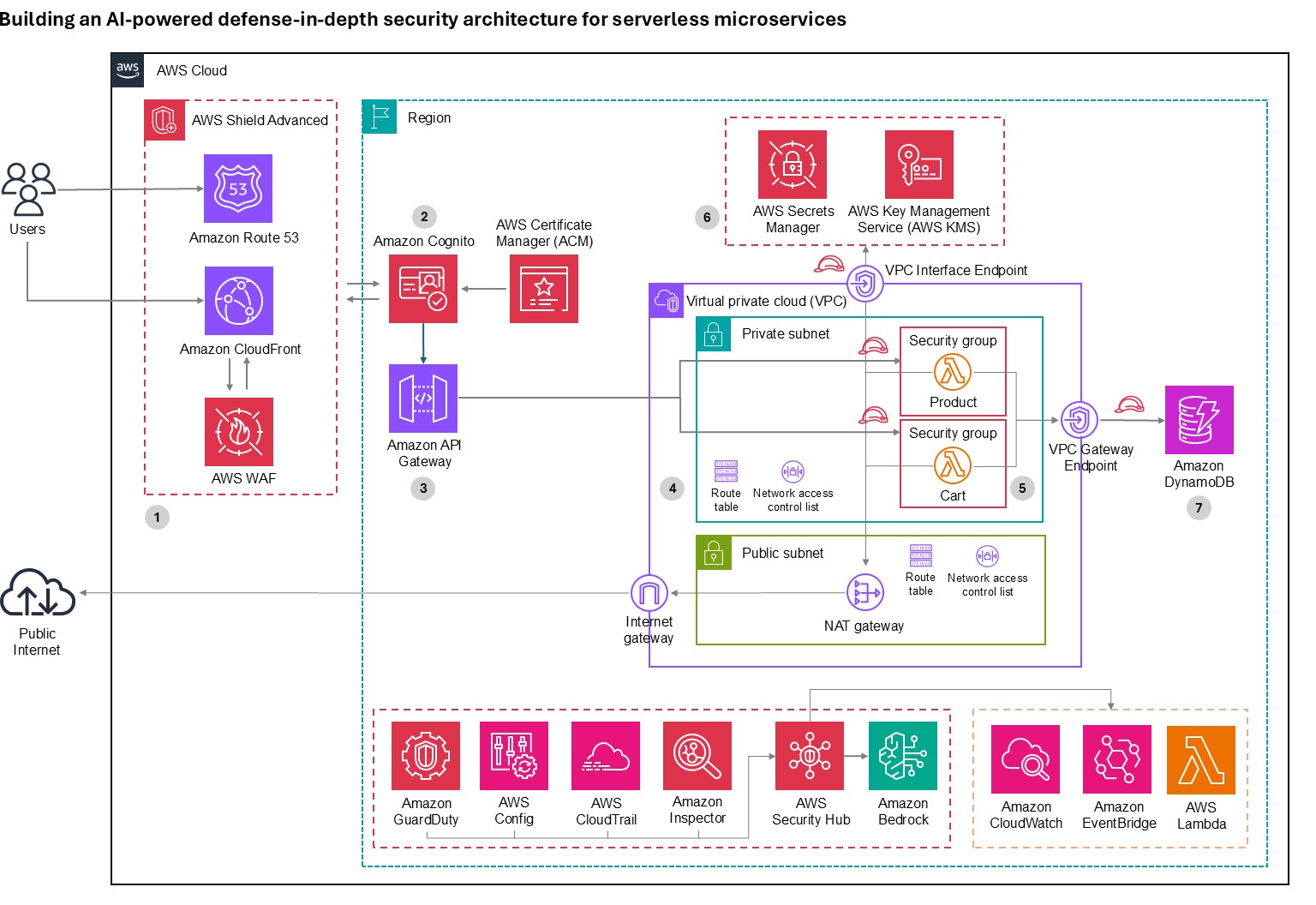
Let’s trace a user request from the public internet through our secured serverless architecture, examining each security layer and the AWS services that protect it. This implementation deploys security controls at seven distinct layers with continuous monitoring and AI-powered threat detection throughout, where each layer provides specific capabilities that work together to create a comprehensive defense-in-depth strategy:
Layer 1 blocks malicious traffic before it reaches your application
Layer 2 verifies user identity and enforces access policies
Layer 3 encrypts communications and manages API access
Layer 4 isolates resources in private networks
Layer 5 secures compute execution environments
Layer 6 protects credentials and sensitive configuration
Layer 7 encrypts data at rest and controls data access
Continuous monitoring detects threats across layers using AI-powered analysis
Figure 1: Architecture diagram
Layer 1: Edge protection
Before requests reach your application, they traverse the public internet where attackers launch volumetric DDoS attacks, SQL injection, cross-site scripting (XSS), and other web exploits. AWS observed and mitigated thousands of distributed denial of service (DDoS) attacks in 2024, with one exceeding 2.3 terabits per second.
DDos protection: AWS Shield provides managed DDoS protection for applications running on AWS and is enabled for customers at no cost. AWS Shield Advanced offers enhanced detection, continuous access to the AWS DDoS Response Team (DRT), cost protection during attacks, and advanced diagnostics for enterprise applications.
Layer 7 protection: AWS WAFprotects against Layer 7 attacks through managed rule groups from AWS and AWS Marketplace sellers that cover OWASP Top 10 vulnerabilities including SQL injection, XSS, and remote file inclusion. Rate-based rules automatically block IPs that exceed request thresholds, protecting against application-layer DDoS and brute force attacks. Geo-blocking capabilities restrict access based on geographic location, while Bot Control uses machine learning to identify and block malicious bots while allowing legitimate traffic.
AI for security: Amazon GuardDuty uses generative AI to enhance native security services, implementing AI capabilities to improve threat detection, investigation, and response through automated analysis.
AI-powered enhancement: Organizations can build autonomous AI security agents using Amazon Bedrock to analyze AWS WAF logs, reason through attack data, and automate incident response. These agents detect novel attack patterns that signature-based systems miss, generate natural language summaries of security incidents, automatically recommend AWS WAF rule updates based on emerging threats, correlate attack indicators across distributed services to identify coordinated campaigns, and trigger appropriate remediation actions based on threat context. This helps enable more proactive threat detection and response capabilities, reducing mean time to detection and response.
Layer 2: Verifying identity
After requests pass edge protection, you must verify user identity and determine resource access. Traditional username/password authentication is vulnerable to credential stuffing, phishing, and brute force attacks, requiring robust identity management that supports multiple authentication methods and adaptive security responding to risk signals in real time.
Amazon Cognito provides comprehensive identity and access management for web and mobile applications through two components:
User pools offer a fully managed user directory handling registration, sign-in, multi-factor authentication (MFA), password policies, social identity provider integration, SAML and OpenID Connect federation for enterprise identity providers, and advanced security features including adaptive authentication and compromised credential detection.
Identity pools grant temporary, limited-privilege AWS credentials to users for secure direct access to AWS services without exposing long-term credentials.
Amazon Cognito adaptive authentication uses machine learning to detect suspicious sign-in attempts by analyzing device fingerprinting, IP address reputation, geographic location anomalies, and sign-in velocity patterns, then allows sign-in, requires additional MFA verification, or blocks attempts based on risk assessment. Compromised credential detection automatically checks credentials against databases of compromised passwords and blocks sign-ins using known compromised credentials. MFA supports both SMS-based and time-based one-time password (TOTP) methods, significantly reducing account takeover risk.
For advanced behavioral analysis, organizations can use Amazon Bedrock to analyze patterns across extended timeframes, detecting account takeover attempts through geographic anomalies, device fingerprint changes, access pattern deviations, and time-of-day anomalies.
Layer 3: The application front door
An API gateway serves as your application’s entry point. It must handle request routing, throttling, API key management, encryption and it needs to integrate seamlessly with your authentication layer and provide detailed logging for security auditing while maintaining high performance and low latency.
Amazon API Gateway is a fully managed service for creating, publishing, and securing APIs at scale, providing critical security capabilities including SSL/TLS encryption withAWS Certificate Manager (ACM) to automatically handle certificate provisioning, renewal, and deployment. Request throttling and quota management protects backend services through configurable burst and rate limits with usage quotas per API key or client to prevent abuse, while API key management controls access from partner systems and third-party integrations. Request/response validation uses JSON Schema to validate data before reaching AWS Lambda functions, preventing malformed requests from consuming compute resources while seamless integration with Amazon Cognito validates JSON Web Tokens (JWTs) and enforces authentication requirements before requests reach application logic.
GuardDuty provides AI-powered intelligent threat detection by analyzing API invocation patterns and identifying suspicious activity including credential exfiltration using machine learning. For advanced analysis, Amazon Bedrock analyzes API Gateway metrics and Amazon CloudWatch logs to identify unusual HTTP 4XX error spikes (for example, 403 Forbidden) that might indicate scanning or probing attempts, geographic distribution anomalies, endpoint access pattern deviations, time-series anomalies in request volume, or suspicious user agent patterns.
Layer 4: Network isolation
Application logic and data must be isolated from direct internet access. Network segmentation is designed to limit lateral movement if a security incident occurs, helping to prevent compromised components from easily accessing sensitive resources.
Amazon Virtual Private Cloud (Amazon VPC) provides isolated network environments implementing a multi-tier architecture with public subnets for NAT gateways and application load balancers with internet gateway routes, private subnets for Lambda functions and application components accessing the internet through NAT Gateways for outbound connections, and data subnets with the most restrictive access controls. Lambda functions run in private subnets to prevent direct internet access, VPC flow logs capture network traffic for security analysis, security groups provide stateful firewalls following least privilege principles, Network ACLs add stateless subnet-level firewalls with explicit deny rules, and VPC endpoints enable private connectivity to Amazon DynamoDB, AWS Secrets Manager, and Amazon S3 without traffic leaving the AWS network.
GuardDuty provides AI-powered network threat detection by continuously monitoring VPC Flow Logs, CloudTrail logs, and DNS logs using machine learning to identify unusual network patterns, unauthorized access attempts, compromised instances, and reconnaissance activity, now including generative AI capabilities for automated analysis and natural language security queries.
Layer 5: Compute security
Lambda functions executing your application code and often requiring access to sensitive resources and credentials must be protected against code injection, unauthorized invocations, and privilege escalation. Additionally, functions must be monitored for unusual behavior that might indicate compromise.
Lambda provides built-in security features including:
Resource-based policies that control which services and accounts can invoke functions to prevent unauthorized invocations
Environment variable encryption using AWS Key Management Services (AWS KMS) for variables at rest while sensitive data should use Secrets Manager function isolation designed so that each execution runs in isolated environments preventing cross-invocation data access
VPC integration enabling functions to benefit from network isolation and security group controls
Runtime security with automatically patched and updated managed runtimes
Code signing with AWS Signer digitally signing deployment packages for code integrity and cryptographic verification against unauthorized modifications
AI-powered code security: Amazon CodeGuru Security combines machine learning and automated reasoning to identify vulnerabilities including OWASP Top 10 and CWE Top 25 issues, log injection, secrets, and insecure AWS API usage. Using deep semantic analysis trained on millions of lines of Amazon code, it employs rule mining and supervised ML models combining logistic regression and neural networks for high true-positive rates.
Vulnerability management: Amazon Inspector provides automated vulnerability management, continuously scanning Lambda functions for software vulnerabilities and network exposure, using machine learning to prioritize findings and provide detailed remediation guidance.
Layer 6: Protecting credentials
Applications require access to sensitive credentials including database passwords, API keys, and encryption keys. Hardcoding secrets in code or storing them in environment variables creates security vulnerabilities, requiring secure storage, regular rotation, authorized-only access, and comprehensive auditing for compliance.
Secrets Manager protects access to applications, services, and IT resources without managing hardware security modules (HSMs). It provides centralized secret storage for database credentials, API keys, and OAuth tokens in an encrypted repository using AWS KMS encryption at rest.
Automatic secret rotation configures rotation for database credentials, automatically updating both the secret store and target database without application downtime.
Fine-grained access control uses IAM policies to control which users and services access specific secrets, implementing least-privilege access.
Audit trails log secret access in AWS CloudTrail for compliance and security investigations. VPC endpoint support is designed so that secret retrieval traffic doesn’t leave the AWS network.
Lambda integration enables functions to retrieve secrets programmatically at runtime, designed so that secrets aren’t stored in code or configuration files and can be rotated without redeployment.
GuardDuty provides AI-powered monitoring, detecting anomalous behavior patterns that could indicate credential compromise or unauthorized access.
Layer 7: Data protection
The data layer stores sensitive business information and customer data requiring protection both at rest and in transit. Data must be encrypted, access tightly controlled, and operations audited, while maintaining resilience against availability attacks and high performance.
Amazon DynamoDB is a fully managed NoSQL database providing built-in security features including:
Encryption at rest (using AWS-owned, AWS managed, or customer managed KMS keys)
Encryption in transit (TLS 1.2 or higher)
Fine-grained access control through IAM policies with item-level and attribute-level permissions
VPC endpoints for private connectivity
Point-in-Time Recovery for continuous backups
Streams for audit trails
Backup and disaster recovery capabilities
Global Tables for multi-AWS Region, multi-active replication designed to provide high availability and low-latency global access
GuarDuty and Amazon Bedrock provide AI-powered data protection:
GuardDuty monitors DynamoDB API activity through CloudTrail logs using machine learning to detect anomalous data access patterns including unusual query volumes, access from unexpected geographic locations, and data exfiltration attempts.
Amazon Bedrock analyzes DynamoDB Streams and CloudTrail logs to identify suspicious access patterns, correlate anomalies across multiple tables and time periods, generate natural language summaries of data access incidents for security teams, and recommend access control policy adjustments based on actual usage patterns versus configured permissions. This helps transform data protection from reactive monitoring to proactive threat hunting that can detect compromised credentials and insider threats.
Continuous monitoring
Even with comprehensive security controls at every layer, continuous monitoring is essential to detect threats that bypass defenses. Security requires ongoing real-time visibility, intelligent threat detection, and rapid response capabilities rather than one-time implementation.
GuardDuty protects your AWS accounts, workloads, and data with intelligent threat detection.
CloudWatch provides comprehensive monitoring and observability, collecting metrics, monitoring log files, setting alarms, and automatically reacting to AWS resource changes.
CloudTrail provides governance, compliance, and operational auditing by logging all API calls in your AWS account, creating comprehensive audit trails for security analysis and compliance reporting.
AI-powered enhancement with Amazon Bedrock provides automated threat analysis; generating natural language summaries of GuardDuty findings and CloudWatch logs, pattern recognition identifying coordinated attacks across multiple security signals, incident response recommendations based on your architecture and compliance requirements, security posture assessment with improvement recommendations, and automated response through Lambda and Amazon EventBridge that isolates compromised resources, revokes suspicious credentials, or notifies security teams through Amazon SNS when threats are detected.
Conclusion
Securing serverless microservices presents significant challenges, but as demonstrated, using AWS services alongside AI-powered capabilities creates a resilient defense-in-depth architecture that protects against current and emerging threats while proving that security and agility are not mutually exclusive.
Security is an ongoing process—continuously monitor your environment, regularly review security controls, stay informed about emerging threats and best practices, and treat security as a fundamental architectural principle rather than an afterthought.
If you have feedback about this blog post, submit them in the Comments section below. If you have questions about using this solution, start a thread in the EventBridge, GuardDuty, or Security Hub forums, or contact AWS Support.
Eurail B.V., the operator that provides access to 250,000 kilometers of European railways, confirmed that data stolen in a breach earlier this year is being offered for sale on the dark web. [...]
Dutch authorities arrested a 40-year-old man after he downloaded confidential documents that had been mistakenly shared by the police and refused to delete them unless he received "something in return." [...]
With the massive adoption of the OpenClaw agentic AI assistant, information-stealing malware has been spotted stealing files associated with the framework that contain API keys, authentication tokens, and other secrets. [...]
Password-based authentication is increasingly risky as organizations adopt passkeys to strengthen security and meet ISO/IEC 27001 requirements. Passwork explains how to align passwordless adoption with Annex A controls, risk assessments, and secure implementation practices. [...]
CISA ordered U.S. government agencies on Friday to secure their BeyondTrust Remote Support instances against an actively exploited vulnerability within three days. [...]
Google has released emergency updates to fix a high-severity Chrome vulnerability exploited in zero-day attacks, marking the first such security flaw patched since the start of the year. [...]
ShinyHunters, a well-known data extortion group, claims to have stolen more than 600,000 Canada Goose customer records containing personal and payment-related data. Canada Goose told BleepingComputer the dataset appears to relate to past customer transactions and that it has not found evidence of a breach of its own systems. [...]
Threat actors are now abusing DNS queries as part of ClickFix social engineering attacks to deliver malware, making this the first known use of DNS as a channel in these campaigns. [...]
CTM360 reports 4,000+ malicious Google Groups and 3,500+ Google-hosted URLs used to spread the Lumma Stealer infostealing malware and a trojanized "Ninja Browser." The report details how attackers abuse trusted Google services to steal credentials and maintain persistence across Windows and Linux systems. [...]
Threat actors are abusing Pastebin comments to distribute a new ClickFix-style attack that tricks cryptocurrency users into executing malicious JavaScript in their browser, allowing attackers to hijack Bitcoin swap transactions and redirect funds to attacker-controlled wallets. [...]
Threat intelligence observations show that a single threat actor is responsible for most of the active exploitation of two critical vulnerabilities in Ivanti Endpoint Manager Mobile (EPMM), tracked as CVE-2026-1281 and CVE-2026-1340. [...]
Threat actors are sending physical letters pretending to be from Trezor and Ledger, makers of cryptocurrency hardware wallets, to trick users into submitting recovery phrases in crypto theft attacks. [...]
As malware evades detection by hiding inside password-protect zip files, new Threat Emulation capabilities enable inspecting and blocking malicious ZIP files without requiring their password. As cyber defenses evolve, so do attacker tactics. One of the most persistent evasion techniques in the wild involves embedding malware inside password-protected ZIP files, making it difficult for traditional security tools to inspect their content. The Challenge: Breaking the Password Delivery Chain Attackers have adapted. Their new strategy? Splitting the delivery path: The malicious ZIP file is sent via email. The password arrives through an out-of-band channel, often SMS or messaging apps. This multi-channel […]
This article is based on a conversation with Nikesh Arora on the 100th episode of the Threat Vector podcast.
David Moulton interviews Nikesh Arora on the Threat Vector podcast.
"Most technologists think about technology, not about cybersecurity," Nikesh Arora says. "Cybersecurity is kind of like insurance. Let's go make great things happen, and let's make sure on the way we purchase insurance."
Coming from the CEO of the world's largest cybersecurity company, it's the quiet part said out loud, and it explains why AI deployment is racing ahead while security scrambles to keep up.
Earlier this year, Arora spoke with a CIO entirely focused on AI deployment challenges: building viable products, training models, measuring customer impact. Security never came up once. "If you're still going through the motion, trying to understand, ‘Can I actually make this thing work?’ You're not worried about security," Arora notes. The logic is brutal but consistent: Why secure something that might not even function?
Why the gap between innovation and security keeps widening.
How to read inflection points before they're obvious.
What separates organizations that prepare from those that scramble.
The Gap That Keeps Growing
The disconnect isn't new. It's the same psychology that makes airport security feel like overhead – necessary friction that slows down what should be seamless. But with AI, the gap is widening at an unprecedented pace.
Consider the infrastructure buildup happening right now. Nvidia has become a $4 trillion company selling chips that can't stay in stock. Hundreds of billions of dollars are flowing into AI-computer infrastructure. Cloud providers are buying out entire methane gas companies to power their data centers.
Yet organizations are treating AI security as something to bolt on later. That same CIO told Arora: "We worked on some stuff ourselves, and we're just jerry-rigging some things to make sure this happens securely."
Arora's response:
Jerry rig, production, and security don't work together as three terms.
Reading Signals Before They're Obvious
Arora has watched enough technology cycles to recognize the pattern. "You start seeing signs early, and then you look around, you don't see enough impact. You say, okay, maybe this is going to be just a passing shower. But you don't realize that over time this thing's getting more and more momentum."
The signs around AI are adding up:
Individual behavior has shifted.
Arora went from never talking to ChatGPT or Gemini to conducting 10-15 conversations daily. During a recent Tokyo trip, he used Gemini as his primary navigation tool, asking it to rank sumo wrestling shows for his kids rather than "trying to go read 14 websites and figure out what makes sense."
The spend is massive and accelerating.
Not just chips, entire energy infrastructures are being rebuilt to support AI compute needs.
Consumer and enterprise adoption are both surging.
From coding assistants to business analysis, use cases are expanding faster than security models can adapt.
"This thing's going to change our life fundamentally," Arora tells Moulton. "We're not seeing it at scale in our customers just yet. That doesn't mean we can sit back and wait."
Arora understands the risks involved in being late to new technology.
You have to not just anticipate where the trend is going. You have to prepare your organization and the resources to get there. Otherwise, the risk is that Silicon Valley will go fund those people who are thinking purely about the new world... and one of them's going to hit. Then you'll be two years behind with no organization, no resources deployed against it.
The Bets That Paid Off
When Arora joined Palo Alto Networks seven and a half years ago, he wrote two words on a piece of paper: cloud and AI. The company was a firewall business. Those two inflection points would require fundamental transformation, and, just as with AI now, being late was not an option.
If you don't get the network transformation right, 80% of our business will falter.
That insight drove a strategic bet on moving from point products to platform thinking, consolidating security tools rather than adding to the sprawl.
The platform approach wasn't about vendor consolidation for its own sake. It was about correlation. Unit 42® data shows that 70% of incidents now span three or more attack surfaces. When attacks move across endpoints, networks, cloud services and applications simultaneously, fragmented security creates gaps that attackers exploit ruthlessly.
Today we have coverage for 80 plus percent of the industry, which means our customers can come talk to us about a myriad of problems, and we can actually cross-correlate across all the different things we do.
With AI deployments touching every part of the technology stack, that cross-correlation becomes essential. Data flows between training environments and production systems. Models access APIs across cloud and on premises infrastructure. Applications consume AI services from multiple providers. Security that can't see and correlate across that entire landscape will miss the threats that matter most.
First Principles Over Tradition
What drives Arora's ability to spot inflection points isn't just pattern recognition, it's his refusal to accept how things have always been done.
His pet peeve: "Somebody said, well, this is how we've traditionally done it." The response reveals his approach: "You use the word traditional. I use the historical context saying, yeah, sure, they used to dig fields with picks and shovels, and now they use tractors."
This thinking drove Palo Alto Networks to reimagine SOC performance. The industry accepted four days as the normal time to detect and remediate security incidents. Arora called that unacceptable. "We need to get it to be real time."
The result was a fundamentally different architecture that analyzes data as it arrives rather than waiting for problems to appear, enabling 1-minute detection and response instead of four days.
Traditionally, SOCs would analyze the problem when the problem appeared. We said forget it. We're going to analyze everything to see if there's a problem. That architecture fundamentally transformed what we do compared to everybody else in the market.
The same first-principles approach needs to apply to AI security. Organizations can't simply extend existing security models and hope they work.
What Comes Next
With ransomware attacks now completing in as little as 25 minutes (100 times faster than just three years ago, according to Unit 42 research) reactive security simply can't keep pace. Organizations need security that thinks and responds at machine speed, built into AI deployments from day one.
"AI has become the biggest inflection point in current technology," Arora observes. Organizations are too busy deploying to worry about security. That's human nature. But it's also the moment when security teams need to stay in lockstep.
The question isn't whether to secure AI, it's whether security will be designed in or bolted on. The former takes strategic thinking now. The latter takes crisis management later.
Our job at Palo Alto and our industry is to make sure as they go build these experimental ideas into real production capability that we're staying in lockstep with them and saying, ‘Oh, by the way, here's something that can secure what you just built in a way that is not gonna get you into trouble.’
Listen to the full conversation between Nikesh Arora and David Moulton, senior director of thought leadership for Cortex® and Unit 42, on the 100th episode of Threat Vector.

 Login
Login