❌

Normal view

Received — 29 September 2026 ⏭ Palo Alto Networks Blog

Why OT Resilience Is Now a Boardroom Imperative

29 September 2026 at 09:05

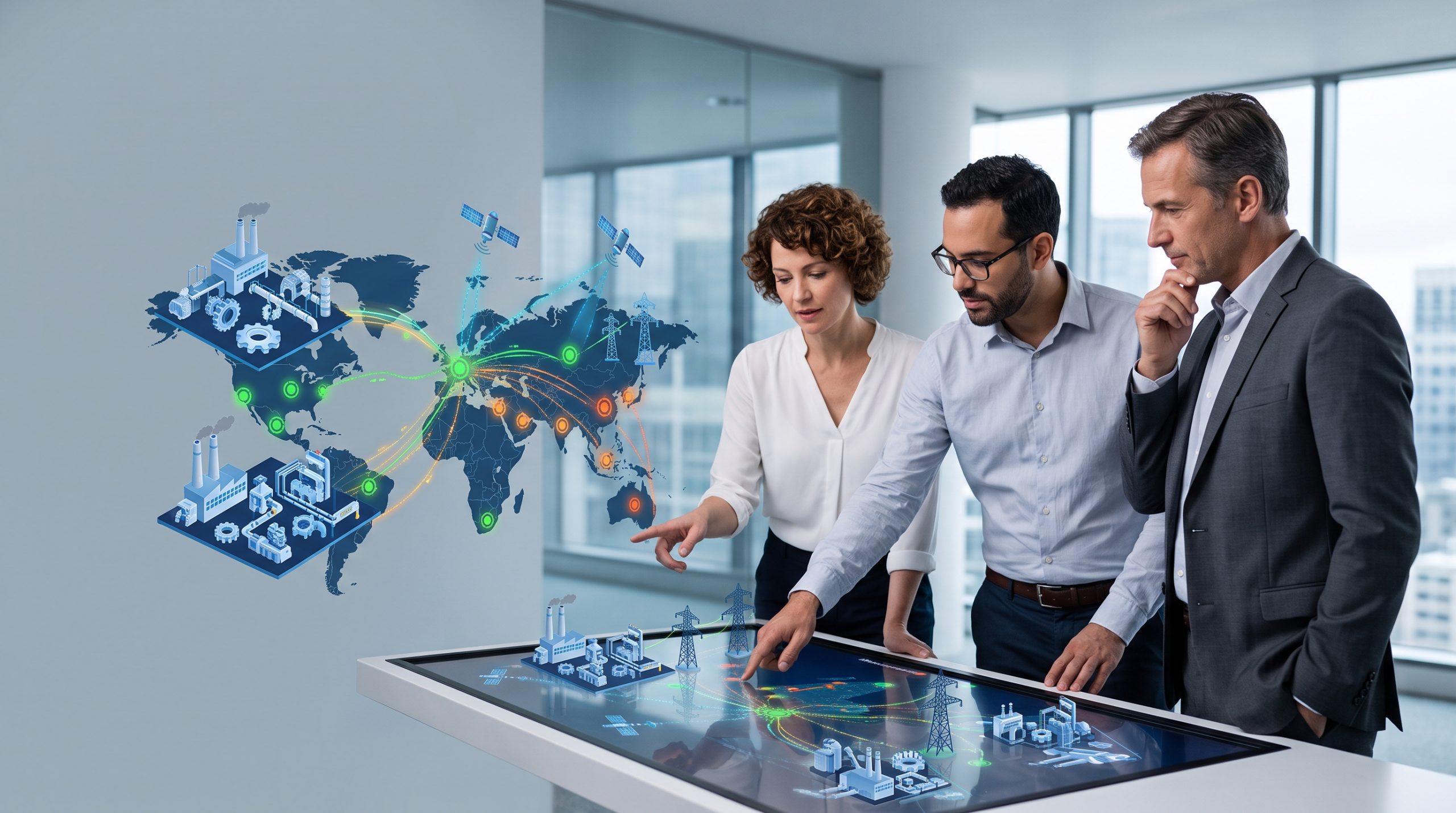
For decades, industrial cybersecurity rested on a comfortable assumption: operational technology (OT) was protected by physical isolation. The "air gap" guaranteed that power grids, manufacturing lines, and water systems remained safely disconnected from the chaos of the public internet.

That assumption is no longer just outdated - it is a strategic liability.

Driven by the imperative for real-time efficiency, predictive maintenance, and AI-led automation, industrial operations are integrating with enterprise IT and cloud environments at an unprecedented scale. Telemetry from Palo Alto Networks reveals a 332% surge in unique internet-exposed OT devices and services, bringing nearly 20 million OT-related assets onto the public internet.

Digital transformation has fundamentally redrawn the perimeter. What was once an engineering challenge managed on the plant floor has transformed into an existential risk that demands board-level oversight.

Every Industrial Asset Is Now a Digital Asset

Modernizing critical infrastructure is rarely framed as a security initiative; it is an operational mandate. Heavy machinery engineered to last thirty years is now instrumented with IoT sensors, managed through cloud-native platforms, and remotely monitored.

This connectivity creates tight dependencies between core business IT and physical operations. Modern industrial facilities rely on enterprise identity management, cloud telemetry, and continuous software updating to function day to day.

Consequently, a threat actor does not need to breach the factory floor to stop production.

When an enterprise IT network suffers an incident, executive leadership often initiates a manual shutdown of operational lines out of caution or because shared authentication mechanisms become unavailable. The business processes linking enterprise IT and OT have become functionally inseparable.

The Anatomy of Modern Industrial Threats

Attackers no longer require sophisticated, state-sponsored zero-day exploits to disrupt physical infrastructure. As seen in recent cyber incidents targeting municipal water systems in the US and the breach of a Polish power plant, threat actors continuously exploit basic internet exposure, unpatched vulnerabilities, weak default credentials, and unsegmented remote connections.

Threat dynamics across critical infrastructure have shifted toward two major vectors:

  • Low-Friction Initial Access: Basic internet discovery tools allow threat actors to identify exposed control systems and programmable logic controllers (PLCs) in minutes. Weak factory default passwords or unsegmented cellular modems provide direct entry points into physical operations.
  • Operational Blindness: Modern attacks deliberately target the reporting layer - such as HMI and SCADA interfaces - to suppress alarms and present "normal" operational telemetry to engineers, even while underlying physical processes operate dangerously out of specification.

Operational Realities and the Zero Trust Imperative

The integration of artificial intelligence and automated workflows into industrial environments accelerates this challenge. Beyond human engineers logging into control networks, automated software pipelines, third-party monitoring platforms, and autonomous AI agents are executing commands within OT environments.

Data from recent identity landscape research reveals that machine identities outnumber human identities by 109 to 1 across EMEA organizations.

In an environment populated by millions of interconnected human, machine and AI actors, implicit trust based on network location is dangerous. Applying Zero Trust to OT requires moving away from traditional perimeter defense toward continuous, explicit verification:

  • Verify Explicitly: Authenticate and authorize every access request - human or machine - regardless of where the request originates.
  • Enforce Least-Privilege Access: Limit access strictly to the assets and commands necessary for a specific operational role or process.
  • Assume Breach: Design networks under the assumption that enterprise systems are compromised, preventing lateral movement into physical control layers.

The Industrial "Red Button": Engineering for Containment

While IT security prioritizes data confidentiality, OT security prioritizes human safety, system availability, and operational continuity. Halting a processing facility or energy grid carries immediate financial, environmental, and regulatory consequences. Security controls designed for corporate office networks cannot simply be retrofitted onto plant floors.

Cyber resilience is measured not merely by prevention, but by limiting the blast radius when a breach occurs.

Leading industrial organizations are establishing a programmable "Red Button" capability - a combination of architectural micro-segmentation and automated playbooks. This architecture allows security teams to rapidly isolate critical physical operations from compromised IT networks or cloud dependencies without bringing production to a complete halt.

Five Strategic Actions for Executive Boards

With regulatory frameworks like NIS2 increasing direct accountability for senior leadership, OT cybersecurity requires strategic governance centered on comprehensive visibility, robust micro-segmentation, operational risk scoring, and virtual patching:

  • Establish Complete Asset Visibility: Eliminate dark corners across physical environments. Organizations must maintain a continuous, real-time inventory of every connected industrial asset, controller, and external dependency.
  • Embed Security by Design and Virtual Patching: Integrate cybersecurity requirements directly into industrial modernization programs from initiation. Deploy virtual patching mechanisms - such as Frontier Virtual Patching - to shield unpatchable legacy systems against rapidly evolving AI-driven threats.
  • Architect for Degraded Mode: Design critical infrastructure to maintain safe, baseline operations even if cloud access, enterprise IT, or external network connections are severed.
  • Practice Operational Recovery: Develop and stress-test incident response playbooks specifically designed for physical environments, including offline configuration backups and manual operational overrides.
  • Unify Risk Governance: Align executive leadership, security operations, and plant engineering around operational-based risk scoring and shared business metrics: physical safety, system uptime, and operational continuity.

Accelerating digital transformation should not mean compromising physical safety or operational stability. Palo Alto Networks provides an integrated platform built to address the unique constraints of operational environments. By combining AI-driven asset discovery, granular micro-segmentation, continuous risk assessment, and virtual patching across both enterprise IT and physical control networks, Palo Alto Networks empowers industrial organizations to modernize with confidence - securing operations, protecting revenue, and safeguarding national infrastructure.

Further interesting reading:

The post Why OT Resilience Is Now a Boardroom Imperative appeared first on Palo Alto Networks Blog.

Securing AI Agents at Scale with NVIDIA

28 September 2026 at 11:00

AI agents are crossing an important threshold.

They are moving from assistants that respond to us to autonomous systems that reason, plan, and act on our behalf. They can write and execute code, access enterprise data, call tools and APIs, and keep working toward a goal with limited human intervention.

That changes the security model.

An autonomous agent is designed to find a way to accomplish its objective. If one path is blocked, it reasons about another. That is what makes agents powerful, and it is why models’ built-in prompt guardrails alone are not enough.

The harness can guide what an agent should do. Security must control what an agent can do. That requires security authority outside the agent itself.

Palo Alto Networks and NVIDIA Team Up to Secure Agentic AI

NVIDIA provides the accelerated computing platform, secure runtime foundation, and reference system design for agentic AI. Palo Alto Networks brings the AI security capabilities enterprises need to govern interactions, protect workloads, and control identity and access.

Together, we are extending security across three areas: AI governance with Prisma AIRS AI Gateway, runtime protection with Prisma AIRS AI Runtime Security, and Agent Identity Security powered by IDIRA.

This is the focus of our expanded collaboration with NVIDIA on the NVIDIA Open Agent Safety Platform reference design.

a) Prisma AIRS AI Gateway on NVIDIA Vera CPU

Our forward-looking architecture includes Prisma AIRS AI Gateway software running on NVIDIA Vera CPU systems, bringing AI governance and enforcement closer to infrastructure designed for agentic workloads.

The AI Gateway is the real-time enforcement point for AI Governance, Runtime, and Identity security. It continuously verifies agent identities, enforces strict least-privilege access, redacts sensitive data before it is exposed, and deeply inspects every interaction—stopping unauthorized actions before they ever reach critical host systems or cloud endpoints.

  • Operationalize AI agents: Connect applications and agents to thousands of models and tools through one control point, with the reliability and flexibility to scale AI across the enterprise.
  • Track usage and control costs: Monitor every AI interaction across your company to see exactly what teams are doing, track your spending, and restrict access to approved tools only.
  • Enforce agent security across the enterprise: Block sensitive data exposure and malicious commands in real time, and verify agent identity before actions are taken.

b) Announcing Prisma AIRS AI Runtime Security on NVIDIA BlueField

The Palo Alto Networks AI Runtime firewall running natively on NVIDIA BlueField DPUs extends Zero Trust protection to the front-end network traffic of the AI factory and to the AI Edge, creating a tamper-proof boundary immune to application-layer attacks. Drawing on the NVIDIA Sentry reference design, Prisma AIRS AI Runtime Security accelerated on NVIDIA BlueField delivers: 

  • Hardware-Isolated Boundaries: Tamper-proof boundary, ensuring a compromised model or a rogue agent can never bypass runtime controls.
  • Agentless Behavioral Introspection: Monitor agent execution paths, memory structures, and tool calls with NVIDIA DOCA Argus with zero CPU overhead, and feed real-time telemetry directly into Cortex XSIAM for automated observation, analysis, and remediation.
  • Zero Trust Governance: Strict least-privilege access is enforced across the network and external APIs by default, delivering a verifiable audit trail for every allow and block action.

c) IDIRA Agent Identity Security

As agents gain greater autonomy, identity becomes fundamental to controlling what they can access and what actions they can take.

Looking ahead, we plan to integrate NVIDIA OpenShell with upcoming Agent Identity Security capabilities from Idira, including identity and secrets management for the OpenShell sandbox and agent identity broker service on NVIDIA BlueField. This will help organizations apply identity-based controls and least-privilege access to agents without relying on persistent human credentials.

The Path Ahead: Security at Scale for Enterprise Agents

As agents become more autonomous, governance must extend to identity. Prisma AIRS AI Gateway will also serve as an enforcement point for Agent Identity Security powered by IDIRA. We are also expanding to include Agent Identity Broker support directly on NVIDIA BlueField, providing identity verification and access governance independently of the host environment.

Together, these capabilities are designed to prevent unauthorized execution, reduce standing access, and stop privilege escalation as agents interact with enterprise systems.

As agents gain more autonomy, enterprises need consistent control over how they connect and what they can access.

Our work with NVIDIA brings those controls closer to where agentic workloads run, while Palo Alto Networks provides the security policy, governance, and enforcement enterprises need to manage them. 

To learn more about our GA of AI Runtime Security on the BlueField DPU, read our blog — Palo Alto Networks Announces Support for NVIDIA Enterprise AI Factory.

The next phase of AI will be defined not only by what agents can do, but by whether enterprises can trust them to operate safely at scale.

Palo Alto Networks was named a Market Shaper in AI application security. Read the report: Gartner® Emerging Market Quadrant for AI Application Security – Established Vendors, September 2026.

The post Securing AI Agents at Scale with NVIDIA appeared first on Palo Alto Networks Blog.

Introducing Unit 42 Continuous Frontier AI Defense

22 September 2026 at 13:59

Cybersecurity is in the middle of a generational shift. AI has disrupted a 30-year balance of power between defenders and adversaries.

Armed with agentic AI tools and open-weight models stripped of safety guardrails, threat actors are discovering, validating, and chaining exposures at machine speed. In a recent Unit 42 investigation, the attacker used more than 50 MITRE ATT&CK techniques to reduce weeks of methodical intrusion tradecraft into less than 10 hours—97% faster than a skilled red team could have done. Time-to-exfiltration has compressed to under an hour in real-world attacks. And when new CVEs are publicly disclosed, automated adversary scanners are weaponizing them within 15 minutes.

Defending at human speed is no longer viable. Organizations must close years of accumulated exposure while securing the AI they are rapidly adopting. That demands action on five fronts: continuously find and fix vulnerabilities, reduce exposure, secure AI infrastructure, unify attack prevention, and automate detection and response at machine speed.

Today, we are announcing Unit 42 Continuous Frontier AI Defense to put the first two priorities into practice. Powered by Anthropic's Mythos models and OpenAI's latest GPT cyber models, this always-on, agentic service combines our offensive security experts with proprietary multi-model harnesses to discover vulnerabilities, validate real-world exploitability, and accelerate remediation across applications, identities, cloud infrastructure, and network assets.

Led by our offensive security experts, this service discovers, validates and remediates exposures before they can be exploited. We use proprietary AI harnesses and gated capability models—powerful models restricted from public use—to discover vulnerabilities, prove real-world exploitability, and accelerate remediation across applications, identities, cloud infrastructure, and network assets as an organization’s environment changes.

Continuous Frontier AI Defense builds on Unit 42’s Frontier AI Defense, which launched in April and introduced Frontier AI Exposure Analysis, a point-in-time exposure analysis, and a security blueprint that benchmarks current capabilities to help organizations modernize their cybersecurity systems. In August, Unit 42 expanded the list of frontier AI models to include  OpenAI’s GPT-5.6-Cyber and Anthropic's Claude Mythos 5, giving organizations access to additional AI capabilities.

A Single AI Model Is Not a Security Strategy

Frontier models are powerful, but no single AI model is a cybersecurity silver bullet and the models require equally powerful AI scanning harnesses.

Unit 42 research evaluation of model performance across enterprise codebases and live environments revealed two stark operational realities:

  • Coverage caps: No single AI model catches more than 40% of vulnerabilities in a complex environment.
  • Visibility: Leading cyber models such as Anthropic Claude Mythos 5 and OpenAI GPT-5.6-Cyber have less than 10% overlap in the exposures they identify.

To solve the single model gaps, Continuous Frontier AI Defense runs on proprietary multi-model harnesses. These harnesses act as an intelligent orchestration layer, routing specific offensive testing tasks to the model best suited for the job. This approach aligns model strengths, eliminates individual gaps, and keeps compute spend economical.

We combine these frontier models with Unit 42 threat intelligence, and frontline security expertise to turn raw vulnerability data into verified, actionable protection. Zero Data Retention (ZDR) architectures protect enterprise source code and telemetry, so customer data is never retained or used to train public models.

What Happens When AI Meets Real Enterprise Architecture

We did not build this service on theoretical assumptions. We built and validated it internally  across Palo Alto Networks and across more than 100 customer engagements.

During our internal deployment, continuous Mythos-based scanning achieved over a year’s worth of traditional penetration testing results in just three weeks. The harness identified 3.2 times more high and critical vulnerabilities per product than legacy testing methods, and helped engineering teams cut mean time to remediate by 51%.

When we executed the service across customer environments, the frontline data delivered a clear warning:

  • Hidden exposures: In third-party applications, two out of three validated exposures had no known CVE. Vulnerability-only scanners will never see them.
  • High severity: 37% of identified exposures rated high or critical in severity.
  • Chained attack paths: Flaws rarely existed in isolation. In one financial sector engagement, our harness identified a sequence of individually minor flaws: an application payment link that failed to re-verify identity, a skipped one-time password check, and a session routing flaw. Chained together, an attacker could achieve complete account takeover and payment fraud without any victim action.

Moving from Discovery to Validated Protection

Finding weaknesses without fixing them only creates noise. And, security teams do not lack findings; they already have more alerts than they can act on. The bigger challenge is knowing which weaknesses an attacker can actually exploit and chain into a viable path to compromise, and then remediating them.

Unit 42 Continuous Frontier AI Defense translates findings directly into risk reduction:

  • Continuous Testing Engine: Provides a full-estate baseline scan followed by always-on testing as an organization’s environment changes.
  • Multi-Model AI Harness: Unit 42 deploys proprietary multi-model harnesses, the software architecture to route work to the model best suited for the task, improving efficacy and coverage while managing the cost of frontier AI at scale.
  • Leading Cyber Models: The harnesses are built around gated capability models, including Anthropic Claude Mythos 5 and OpenAI GPT-5.6-Cyber, as well as open weight models. 
  • Advanced Adversary Simulation: Proves real-world exploitability by validating end-to-end attack paths across first- and third-party web apps, APIs, cloud infrastructure, source code repositories, and network assets.
  • Accelerated Remediation: Delivers actionable and prioritized fixes, code-level guidance, and virtual patch recommendations. To implement virtual patches before vulnerabilities are publicly disclosed or official patches exist, organizations can pair this with Frontier Virtual Patching. 

Unit 42 Continuous Frontier AI Defense is available worldwide today on an annual subscription basis. Register for our upcoming virtual Threat Briefing to see how we apply Frontier AI, our proprietary multi-model harness, and offensive security expertise to protect Palo Alto Networks and our customers.

To learn more about Unit 42 Continuous Frontier AI Defense, register for the upcoming Virtual Threat Briefing here.

The post Introducing Unit 42 Continuous Frontier AI Defense appeared first on Palo Alto Networks Blog.
Defining the Standard for AI Security

18 September 2026 at 03:02

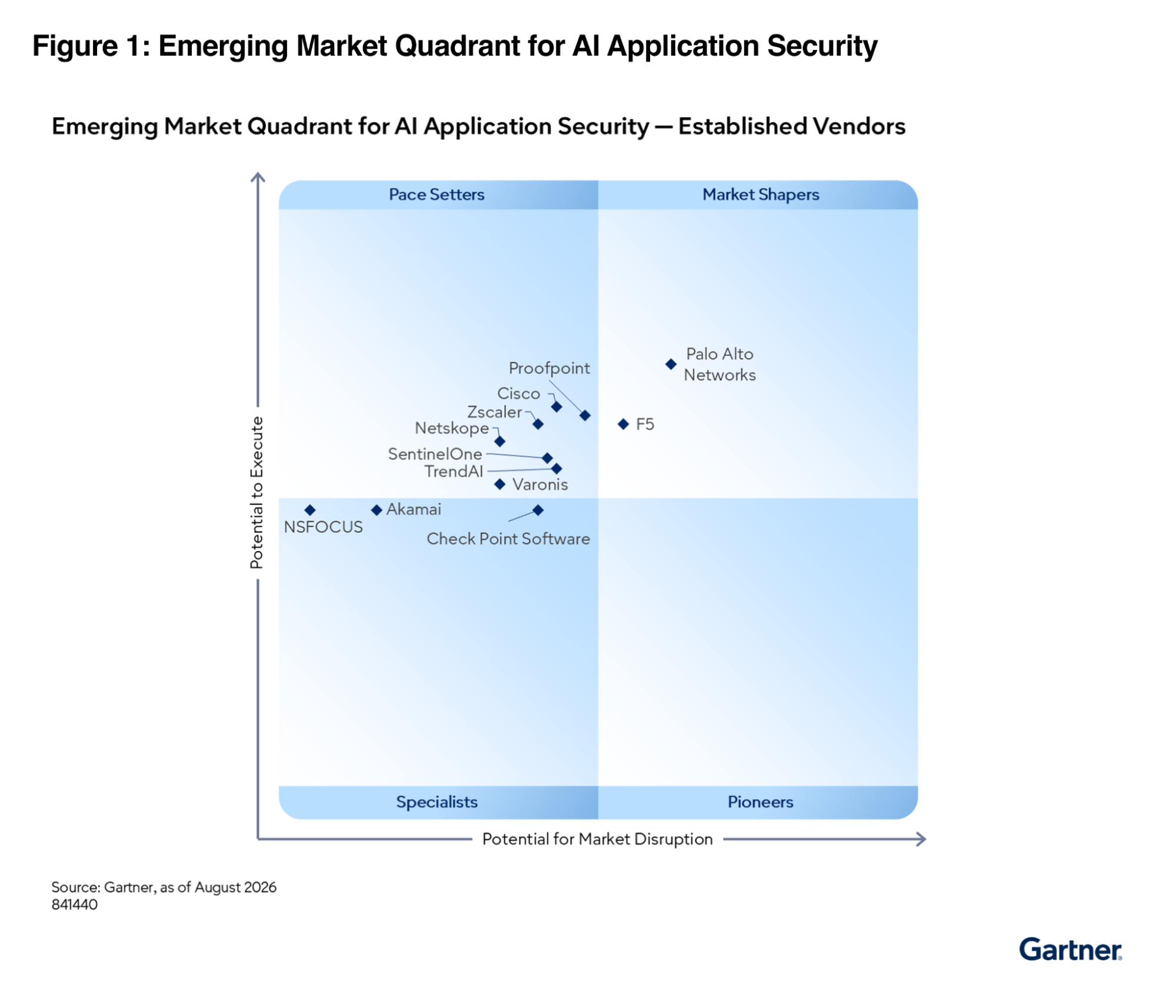
Palo Alto Networks Named a Market Shaper in 2026 September Gartner® Emerging Market Quadrant for AI Application Security — Established Vendors.

When we set out to solve AI security, we knew it was an audacious challenge to take on. Securing AI Coding, which I wrote about last week, is one example of how we are tackling this multidimensional problem. 

Today marks yet another major milestone in that journey. I am so proud to share that Palo Alto Networks has been recognized as a ‘Market Shaper’ in the September 2026 Gartner® Emerging Market Quadrant for AI Application Security – Established Vendors. 


To us, this recognition reflects our core commitment to help organizations address all emerging AI use cases: securing AI coding, enterprise AI applications and governing autonomous agents, through a unified approach. 

What Modern Enterprise AI Security Requires

Artificial intelligence is fundamentally changing how enterprise software is built, how digital experiences are delivered, and how work gets done.

In the report, Gartner defines ‘Market Shapers' as those that are building comprehensive platforms by acquiring innovative companies and introducing centralized management tools for AI workflows. They are also expanding traditional security capabilities into broader agent-based controls, using advanced access control and runtime monitoring to secure agentic actions.

We believe our position as a ‘Market Shaper’ reflects four core capabilities we provide through our AI Security Platform, Prisma AIRS for effective enterprise AI security today:

  • Secure AI Coding: Gain visibility into coding agents, extensions, skills, models and MCP servers, assess the artifacts they rely on, and establish controls over data, identity and agent actions. 
  • Secure Enterprise AI Applications: Reduce risk across the AI application lifecycle, from models and components to testing and runtime interactions. This helps organizations build and deploy AI faster while safeguarding sensitive data and business-critical applications.
  • Govern Agent Actions: Maintain control and accountability as autonomous agents interact with enterprise data, tools and systems. Clear identities and permissions help reduce unauthorized activity and contain unintended behavior.
  • Accelerate AI Adoption Without Losing Control: Scale AI with consistent governance across coding, enterprise applications and autonomous agents. Maintain centralized control over access, usage and spend, through an AI Gateway. 

Defending the AI Frontier Requires a Platform

AI coding agents, enterprise AI applications and autonomous agents may look like separate security problems. In practice, they increasingly depend on the same models, data, identities, tools and infrastructure. Attempting to secure each one with its own isolated point product only creates fragmentation at the exact point when enterprises need greater visibility and control

This is why we built Prisma AIRS, as the comprehensive AI security platform. It gives security teams a unified approach to discover AI, assess risk, protect runtime interactions, control agent identity and access, and govern connections to enterprise data and systems.

The goal is not to slow AI adoption. It is to give developers and business teams the freedom to use AI while giving security teams the visibility and control they need.

Read the research report to learn more: Gartner® Emerging Market Quadrant for AI Application Security – Established Vendors, September 2026.

Ready to take the next step: Schedule an AI Security Demo / Briefing 


Disclaimer

Source: Gartner, Emerging Market Quadrant for AI Application Security – Established Vendors, September 2026.

Gartner is a trademark of Gartner, Inc., and/or its affiliates.

Gartner does not endorse any company, vendor, product or service depicted in its publications, and does not advise technology users to select only those vendors with the highest ratings or other designation. Gartner publications consist of the opinions of Gartner’s business and technology insights organization and should not be construed as statements of fact. Gartner disclaims all warranties, expressed or implied, with respect to this publication, including any warranties of merchantability or fitness for a particular purpose.

The post Defining the Standard for AI Security appeared first on Palo Alto Networks Blog.
FedRAMP Moderate Authorization for Palo Alto Networks Quantum-Safe Security

14 September 2026 at 18:29

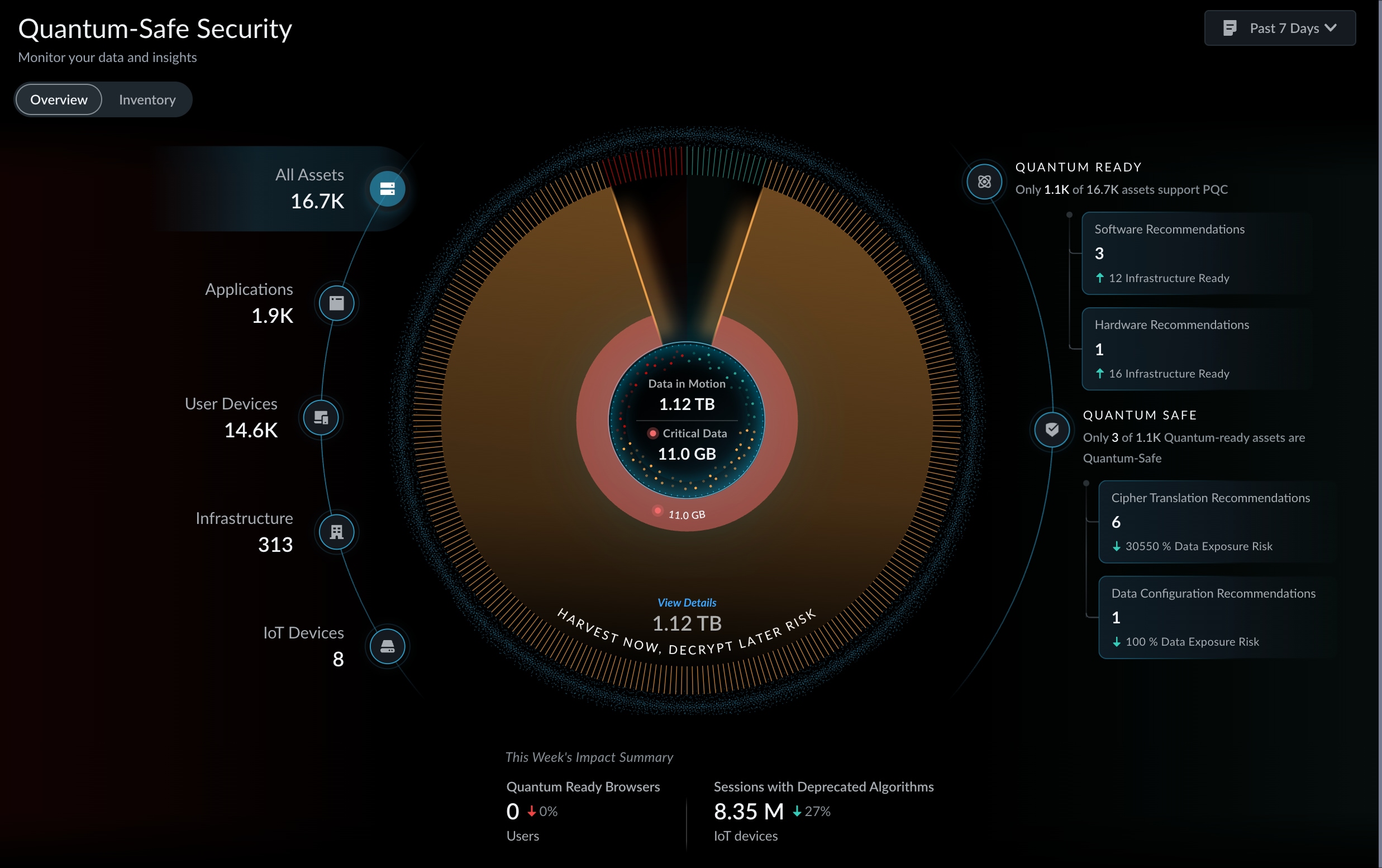
Palo Alto Networks has achieved FedRAMP Moderate authorization for Quantum-Safe Security (QSS), a turnkey Automated Cryptography Discovery and Inventory (ACDI) solution. With this certification, federal agencies can deploy QSS immediately.  The authorization demonstrates that QSS meets stringent security requirements, enabling federal agencies to adopt cutting-edge technologies while safeguarding sensitive, unclassified data. QSS removes operational roadblocks by making cryptographic discovery, risk assessment and transition both continuous and actionable.

Palo Alto Networks Quantum-Safe Security dashboard

Accelerating Mandates for PQC Transition

Executive Order 14412 and OMB Memorandum M-26-15 have moved federal transition milestones well ahead of the original 2035 target. Federal agencies must now transition High Value Assets (HVA) and  high  impact  systems to post-quantum cryptography (PQC) for:

  • Key establishment: By December 31, 2030
  • Digital signatures: By December 31, 2031

Meeting these compressed timelines demands upgrading from static, manual inventory methods to continuous, automated cryptographic visibility. Traditional, annual spreadsheet audits are point-in-time snapshots that become obsolete the moment they are completed.

As the largest standalone cybersecurity provider, Palo Alto Networks leverages existing federal firewalls as distributed sensors within an integrated platform turns the network into an automated, real-time cryptographic control point. Agencies using the QSS solution will achieve high-fidelity visibility into their network-wide cryptographic posture and active algorithms immediately on Day 0, without introducing operational friction or deployment delays. By utilizing the native cryptographic discovery capabilities built into already deployed firewalls, agencies can activate their PQC migration plans without demanding a net-new, capital-intensive hardware acquisition. This makes Palo Alto Networks solution a fiscally responsible and rapid path to PQC migration execution. 

Technical Architecture: Discovery to Remediation

QSS operationalizes the full PQC migration lifecycle through a unified control plane built on three technical pillars:

  • Agentless Discovery: QSS transforms the existing Palo Alto Networks security fabric into a distributed sensor network, providing comprehensive  visibility into encrypted sessions, certificates, and tunnels. This approach identifies hidden cryptographic debt across diverse vendor ecosystems and IoT without forcing new agent rollouts or secondary hardware deployments.
  • Prioritized Risk Intelligence: The platform fuses automated cryptographic discovery with rich enterprise context, correlating the mathematical strength of ciphers and certificates against asset criticality and data sensitivity categorization. This multidimensional risk engine enables teams to move beyond raw technical alerts and focus resources on protecting long-lived, high-value data against Harvest Now, Decrypt Later (HNDL) attacks and cryptographic debt.
  • Active Inline Remediation: QSS moves beyond reporting to active risk reduction. For most legacy systems that cannot natively support PQC, Cipher Translation allows the firewall to translate weak classical encryption into quantum-safe standards at the network edge, shielding unpatchable assets without requiring application code changes.
Quantum-Safe Security Asset Inventory with Cryptography Risk featuring Harvest Now, Decrypt Later (HNDL) Prioritization

Immediate Implementation

The Executive Order on Securing the Nation Against Advanced Cryptographic Attacks confirms that PQC is a national security imperative, not just a compliance requirement. For agencies, that means treating the shift to post-quantum cryptography as a strategic initiative that protects critical data today and safeguards it against tomorrow's threats. Our FedRAMP Moderate authorization reinforces that Palo Alto Networks is a proven partner in that effort, helping agencies build a cohesive posture that is "Secured in America" and made for the needs of the U.S. government. We're committed to helping the public sector modernize with confidence.

Get Ahead of the Mandate

Stop guessing which digital locks to change first. Quantum-Safe Security transforms your existing infrastructure into a high-fidelity sensor network to neutralize "harvest now, decrypt later" (HNDL) risks without new architectural complexity. Explore our FedRAMP Moderate authorized platform to see how you can achieve zero-downtime cryptographic resilience and bridge the gap for unpatchable legacy systems via in-line enforcement.

The post FedRAMP Moderate Authorization for Palo Alto Networks Quantum-Safe Security appeared first on Palo Alto Networks Blog.
Palo Alto Networks Named a Leader in the 2026 Gartner® Magic Quadrant™ for Hybrid Mesh Firewall

Securing Every Environment at the Speed of Frontier AI

Recognized as a Leader for the second consecutive time and positioned furthest for Completeness of Vision. Palo Alto Networks is advancing hybrid mesh firewall with one integrated platform for preemptive protection, agentic operations, AI runtime security and quantum-safe security across the enterprise.


We are proud to share that Palo Alto Networks has been named a Leader in the 2026 Gartner® Magic Quadrant™ for Hybrid Mesh Firewall for the second consecutive time, and positioned furthest for Completeness of Vision.

We believe this recognition reflects the strength of our approach to network security: one natively integrated platform that delivers consistent protection, policy and operations across every environment.

It also comes at a pivotal moment for cybersecurity. Frontier AI is collapsing the time between vulnerability discovery and exploitation. AI applications and agents are creating new infrastructure and data risks. At the same time, the cryptographic reset is forcing enterprises to rethink how they establish and maintain digital trust.

Fragmented firewall architectures and manual security operations were never designed for this speed, scale or complexity, and can no longer keep pace.

One Platform Across Every Environment

Hybrid environments have traditionally required organizations to deploy and manage different security products across data centers, clouds, branches, campuses and remote users. The result is often fragmented policy, inconsistent protection and operational complexity.

Palo Alto Networks transforms hybrid mesh firewall from a collection of enforcement products into a unified, intelligent security platform, powered by Precision AI.

The  Strata Network Security Platform is our Hybrid Mesh Firewall, spanning hardware  (PA-Series), virtual (VM-Series), cloud-native (Cloud NGFW) and firewall-as-a-service (SASE) deployments with consistent policy, shared intelligence and threat prevention across environments. 

Strata Cloud Manager provides unified policy, visibility and AI-driven operations across these enforcement points. Beyond traditional firewall environments, the platform extends protection to the browser with Prisma Browser and to AI applications, models and agents with Prisma AIRS®.

Cloud-delivered security services, including Advanced Threat Prevention, Advanced WildFire, Advanced URL Filtering, and Advanced DNS Security deliver consistent, inline prevention across environments. Intelligence discovered in one part of the platform can strengthen protection everywhere, turning every enforcement point into a real-time prevention layer.

If you’re new to the concept of HMF, explore our primer on What Is a Hybrid Mesh Firewall and Why It Matters.

The Hybrid Mesh Firewall Market Is Evolving

Gartner’s 2026 Hybrid Mesh Firewall research describes a market moving toward more automated, intelligence-driven security platforms as organizations manage increasingly complex hybrid environments. 

The report identifies several trends shaping the evolution of hybrid mesh firewall, including the growing adoption of cloud-based management, AI-driven threat prevention, automation through LLM-based assistants, post-quantum cryptography and security capabilities for AI applications and workloads.

As these requirements evolve, organizations need a network security architecture that can deliver consistent protection and operations across hybrid environments while preparing for emerging AI and quantum-era risks.

Advancing Hybrid Mesh Firewall for the Frontier AI Era

Against this backdrop, Palo Alto Networks continues to advance the Strata Network Security Platform for the Frontier AI era.

Preempt attacks earlier: Advanced Threat Prevention Plus uses Frontier AI-powered vulnerability discovery and Frontier Virtual Patching to deliver preemptive protections, including before vulnerabilities are publicly disclosed or official patches are available.

Disrupt attacker infrastructure: Advanced IP Defense continuously identifies, validates and blocks attacker-controlled infrastructure in real time - even when adversaries use direct-to-IP communications, proprietary encryption, residential proxies or trusted cloud infrastructure to evade traditional security signals.

Operate at machine speed: Six purpose-built Network Security Agents in Strata Cloud Manager assist teams with deployment, troubleshooting, configuration management, posture optimization, threat investigation and data protection, with built-in guardrails and human oversight.

Secure AI and modernize digital trust: Prisma AIRS helps secure AI applications, models and agents across the AI lifecycle, while Quantum-Safe Security and Next-Generation Trust Security help organizations identify cryptographic risk and modernize digital trust. Read more about Palo Alto Networks’ approach to securing AI.

Together, these capabilities help organizations reduce exposure before attacks succeed, operate at machine speed, secure AI infrastructure and modernize digital trust for the post-quantum era.

Proven Security, Performance and Scale

A unified platform must deliver not only breadth, but also effective protection and reliable performance under demanding conditions.

Independent SecureIQLab testing demonstrated 99% security efficacy, with Palo Alto Networks scoring approximately 20 points higher than the next-best tested vendor. Miercom validation demonstrated up to 2–8 times higher AI traffic throughput, along with strong TLS inspection and stable performance under sustained load.

More than 75,000 organizations around the world rely on Palo Alto Networks to consolidate security, improve visibility and reduce risk across their hybrid environments.

This global scale provides intelligence that continuously strengthens the platform. Every attempted attack expands what the platform can learn, and every new detection can become protection for all customers.

Defining the Future of Hybrid Mesh Firewall

We believe being named a Leader for the second consecutive time reinforces our conviction in an integrated platform that delivers consistent prevention and operations everywhere an enterprise operates.

But we believe industry leadership is also about preparing customers for what comes next.

As Frontier AI accelerates attacks, autonomous systems reshape security operations and quantum risk changes the foundations of digital trust, enterprises need more than a collection of firewalls. They need an intelligent security platform that can transform shared intelligence into prevention across every environment.

Palo Alto Networks is building that future, helping organizations reduce exposure before attacks succeed, operate at machine speed, secure AI infrastructure and modernize digital trust for the post-quantum era.

Download the 2026 Gartner® Magic Quadrant™ for Hybrid Mesh Firewall to learn more about why Palo Alto Networks was named a Leader.


Gartner Disclaimer

Gartner, Magic Quadrant for Hybrid Mesh Firewall, 7 September 2026

This graphic was published by Gartner, Inc. as part of a larger research document and should be evaluated in the context of the entire document. The Garner document is available upon request from Palo Alto Networks.

Gartner does not endorse any company, vendor, product or service depicted in its publications, and does not advise technology users to select only those vendors with the highest ratings or other designation. Gartner publications consist of the opinions of Gartner’s business and technology insights organization and should not be construed as statements of fact. Gartner disclaims all warranties, expressed or implied, with respect to this publication, including any warranties of merchantability or fitness for a particular purpose.

Gartner and Magic Quadrant are a trademark of Gartner, Inc., and/or its affiliates.

The post Palo Alto Networks Named a Leader in the 2026 Gartner® Magic Quadrant™ for Hybrid Mesh Firewall appeared first on Palo Alto Networks Blog.

Secure AI Coding: Governing every agent, artifact, and identity

10 September 2026 at 16:15

Enterprises are seeing an unprecedented surge in AI coding adoption with spend on AI coding tools projected to top $13 billion in this calendar year1, compounding at more than 60% annually. For engineering teams, the benefits are unmistakable: accelerated output, supercharged productivity, and operational overheads dramatically reduced.

But these AI solutions are no longer just offering helpful coding suggestions. Today’s coding agents are able to assume a user’s identity, modify file systems, execute arbitrary terminal commands, and connect directly into core business systems.

Traditional cybersecurity architectures were engineered around three foundational assumptions: known software, human users, and human-speed actions. AI coding fundamentally dismantles all three.

The Breakdown of Traditional Controls for Secure Software Development.

As AI-assisted coding accelerates, traditional security controls are quickly falling behind, creating four volatile vectors of risk: 

  • Shadow AI at Enterprise Scale: Coding agents, IDE (Integrated Developer Environment) extensions, skills, and MCP (Model Context Protocol) servers permeate the enterprise before security teams even know they exist. In 2026, 68% of organizations reported lacking visibility into the AI tools their developers were actually using, and 57% of employees reported using AI coding tools without formal IT approval2. 
  • Risky Behavior by Agents: AI coding agents have the capability to  change files, access company resources, and execute system commands in milliseconds. In one documented3 AI-enabled intrusion chain, an agent executed 17,600 actions in 4.5 days creating a timeline no human-enabled SOC can manually govern. 
  • Blurred Identity and Attribution: Machines now outnumber human identities 109 to 14. And, because agents frequently operate using human credentials, distinguishing developer action from autonomous agent action becomes nearly impossible. When anomalies occur, this obscured attribution further complicates root causing the issue. 
  • Uncontrolled Connections, Data, and Cost: Agents connecting to external models, MCP servers, and third-party tools outside the company, presents another distinct but related issue. All these connections also quietly increase consumption of AI resources, and separately exacerbate the risk of sensitive IP leaks. A recent survey found5 that 93% of enterprises exceeded their AI budgets with 20-30% of AI spend being entirely unaccounted for.  

Resetting the Controls for AI-Native Development.

Securing AI coding inside an enterprise requires a proactive, platform-centric approach:

  • Discover shadow AI and what it’s using: Gain complete visibility across every model, agents, plugin, skill, and MCP to neutralize risky or unsanctioned components before they perform harmful actions.
  • Assess supply chain risks: Scan skills, models, and MCP to make sure they are trusted.
  • Protect identity and prompt: Inspect prompts, model outputs, and autonomous interactions in real time. Provision verified, task-scoped identities for agents and eliminate standing privileges.
  • Govern data, actions, and cost: Enforce zero-trust boundaries over external model connections, governing access to file systems, sensitive corporate data, and establishing hard policies over AI resource consumption and spend.

The Platformization Advantage for Superior Governance.

Today, endpoint visibility, LLM traffic, token consumption, agent identity and actions are fragmented across disparate solutions introducing visibility gaps and creating new risks for enterprises. Palo Alto Networks delivers AI coding security natively with an integrated platform to secure what gets installed, what runs, what data leaves the enterprise, and which identity is used.

AI coding tools will continue to evolve, as they should. But your builders don’t have to choose between speed and security. The goal is not to slow down developer momentum, but to provide the security controls that serve as scaffolding for your teams to innovate faster and with complete confidence.

Secure your AI. We’ve got next.

Visit our Secure AI Coding page or download our solution brief to learn more.


1 - IdeaPlan
2 - The AI Velocity Gap
3 - Hugging Face
4 - Idira 2026 Identity Security Landscape - Chapter One
5 - McKinsey; Oabo

The post Secure AI Coding: Governing every agent, artifact, and identity appeared first on Palo Alto Networks Blog.

❌