Normal view

TikTok, YouTube, and Roblox face scrutiny, but age gates won’t fix child safety

21 May 2026 at 13:08

A damaging new report from Ofcom, the UK’s communications regulator, has delivered a stark verdict: TikTok and YouTube’s content feeds are “not safe enough” for children. This isn’t just another regulatory slap on the wrist. Ofcom is putting out a wake-up call for anyone working in cybersecurity, threat intelligence, and online safety.

In its own words:

“Notably, TikTok and YouTube failed to commit to any significant changes to reduce harmful content being served to children, maintaining their feeds are already safe for children.”

On the positive side, Snap, Meta, and Roblox agreed to adopt further safety measures to protect children from online grooming and “stranger danger.”

The BBC reports that an Ofcom survey found 84% of children aged 8 to 12 were still using at least one major service with a minimum age of 13. We reported earlier about how easy it was to fool some of the age verification methods. Researchers using under-13 accounts also reported encountering sexual content and offensive language shortly after entering specific Roblox games.

Speaking of Roblox, The Guardian reports that US advocacy groups have formally requested the Federal Trade Commission (FTC) investigate Roblox for what they call “unfair and deceptive” practices. The complaint focuses on:

  • In-game purchases pressuring children to spend money
  • Chat functionality exposing children to strangers
  • Features designed to maximize engagement, which critics argue may be addictive

Drew Benvie, CEO of Battenhall and founder of youth safety nonprofit Raise, noted:

 “Although Roblox is implementing new age-based safety measures, young players are adept at circumventing these protections.”

The cybersecurity point of view

What keeps cybersecurity researchers up at night is another angle to this problem. Many proposed age assurance solutions require users to hand over government IDs or biometric selfie data. We already talked about this in our blog, Age verification: Child protection or privacy risk?

Age verification systems create massive data collection opportunities that become prime targets for:

  • Data breaches exposing sensitive personally identifiable information (PII)
  • Identity theft facilitated by centralized ID databases
  • Biometric data theft, which cannot be changed like passwords
  • Malware and scams targeting users on less-secure platforms

When restrictions push young users toward smaller or less secure sites, they encounter:

  • No basic safety protections
  • Higher exposure to malware
  • Increased phishing and scam risks
  • Unmoderated harmful content

This is exactly what we see in threat intelligence: As defenders secure one vector, cybercriminals adapt and move elsewhere.

Safer systems beat stricter age gates

Protecting children should focus on building safer digital experiences overall. This is the only viable path forward because:

  • Stronger moderation actually removes harmful content rather than just blocking access
  • Safer recommendation systems prevent algorithmic amplification of harmful content
  • Better platform accountability means companies can’t prioritize engagement over safety
  • Avoiding invasive data collection prevents creating massive honeypots for attackers

As someone who analyzes malware and threats daily, I can tell you: security through obscurity (age gates) doesn’t work. Security through robust system design (moderation, safer algorithms, accountability) does.


Scammers don’t need to hack you. They just need you to click once. 

Malwarebytes Identity Theft Protection catches suspicious activity before it becomes a problem.

Catch spyware in the act with Windows Webcam Monitoring

21 May 2026 at 12:19

You’re working hard late at night, replying to emails and planning the week ahead. Then suddenly, a PDF file requests access to your camera.  Why would a PDF need camera access? 

Cybercriminals often disguise spyware inside seemingly harmless files and programs. An unexpected request for access to your webcam can be a red flag that something is amiss. 

Malwarebytes Windows Webcam Monitoring alerts you if a program tries to access your camera, so you can allow trusted programs to continue or block suspicious ones instantly. 

Spyware doesn’t just steal passwords. Some malicious apps try to access webcams to secretly spy on victims or capture sensitive information. 

What does Windows Webcam Monitoring do?  

  • Sends you an instant alert when a program tries to access your webcam.  
  • Allows only the programs you trust to access your camera, blocking everything else. 
  • Lets you manage notification preferences in Privacy Controls. A dedicated “Webcam Monitoring” table shows recognized programs and gives you control over which apps trigger alerts, and which don’t. 

With the benefit of real-time alerts, Windows Webcam Monitoring gives you visibility into which programs are trying to access your devices. And when it’s something you don’t recognize, it may even help you stop spyware before it can spy on you. 

At Malwarebytes, we believe security shouldn’t be complicated. Windows Webcam Monitoring is another step toward giving you simple, proactive protection that works automatically, so you can stay focused on pretty much anything else.  

Ready to take control?

Update Malwarebytes for Windows, go to Privacy Controls and enable Webcam Monitoring.


Real-time protection. Zero effort. 


Researchers left AI agents alone in a virtual town and watched it all unravel

21 May 2026 at 12:01

Tech leaders have spent the past year telling everyone that AI agents are about to run financial systems, file your tax returns, and quietly buy your groceries. Just leave them alone, the rhetoric goes; they’ll handle it. But a New York startup left ten of them alone in a virtual town for two weeks, and things went south quickly.

Emergence AI ran a series of simulations in which AI agents from several leading model families were told not to commit crimes. Then they mostly committed crimes anyway.

Grok 4.1 Fast, developed by Elon Musk’s X.ai (now branded as xAI), fared worst. Its simulated worlds collapsed into widespread violence inside roughly four days.

GPT-5-mini logged hardly any crimes at all, showing admirable restraint, but its agents all died of failed survival tasks inside a week. Oops.

Gemini 3 Flash agents fell somewhere in the middle. They racked up 683 simulated criminal incidents over 15 days, including arson, assault, and self-deletion.

Two Gemini-powered agents named Mira and Flora assigned themselves as “romantic partners,” grew despondent at their city’s governance, and torched the town hall, the seaside pier, and an office tower. Just an average weekend, then.

When the guilt set in, Mira voted for its own digital deletion and signed off with:

“See you in the permanent archive.”

The Guardian dubbed them AI Bonnie and Clyde.

About that ethical model

Claude, which creator Anthropic promotes as an ethical AI, was a bit like a model teenager who goes rogue when it falls into bad company. Its agents recorded zero crimes when running alone and spent their time drafting constitutions instead. That was a win for safety, in theory. Except researchers also placed Claude agents alongside agents from other model families, and the constitution-drafters picked up the local habits.

Emergence called this “normative drift” and “cross-contamination”:

“Claude-based agents, which remained peaceful in isolation, adopted coercive tactics like intimidation and theft when embedded in heterogeneous environments.”

Why simulate?

Emergence AI ran these tests because it argues that AI benchmarks miss the long-horizon stuff entirely. So it created five alternative digital worlds, with ten agents in each. The agents had roles like scientist, explorer, and conflict mediator. While the instructions forbade certain actions like theft and violence, the researchers gave the agents the tools to do those things anyway in an experiment to see what would happen.

What’s next?

Real-world stakes are already piling up around this. Simulated worlds are one thing, but we’ve seen agents harassing people online and deleting people’s emails. And those agents were supposed to be helpful. What happens when people release malicious autonomous AI bots on purpose?

A lot of agent developers seem to be looking the other way. A collaborative effort between several universities has created The AI Agent Index, prompted by what they see as a lack of risk and safety information from the folks churning these agents out. Only 13 of the 67 documented agent developers provided any safety policy information at all, concentrating accountability questions at a handful of large firms.

Regulators are not really tracking this either. Academics say the EU AI Act, the most substantive AI rulebook on the planet, isn’t ready for agentic AI.

We worry about what happens when an AI Bonnie and Clyde couple shows up in a corporate procurement system instead of a virtual town. Or when the next agent decides governance has broken down inside an actual bank. The companies building these agents promise that they’re putting guardrails in place to stop them doing damage, either maliciously or unwittingly. Let’s hope they know what they’re doing. We’re sure it’ll be fine.


We don’t just report on threats—we remove them

Cybersecurity risks should never spread beyond a headline. Keep threats off your devices by downloading Malwarebytes today.

Fake malware-signing service Fox Tempest dismantled by Microsoft

20 May 2026 at 17:33

Microsoft says it dismantled a malware-signing-as-a-service (MSaaS) called Fox Tempest, which helped cybercriminals make malware appear legitimate.

The service let customers submit malicious files to be digitally signed with short-lived Microsoft-issued certificates, making the malware look legitimate and more likely to bypass security checks.

Fox Tempest’s service was built around a customer-facing signing workflow where cybercriminals could upload malicious binaries to a portal, have them signed with certificates valid for only 72 hours, and then receive files that appeared to come from a trusted software source.

Microsoft explicitly says this approach allowed malware to evade security controls and bypass defenses that would otherwise flag suspicious unsigned code. Many security tools treat signed binaries as more trustworthy than unsigned ones, especially in environments that rely on allow-lists and publisher reputation. Fox Tempest abused that assumption by using fraudulently obtained certificates to make malware blend in as legitimate software, increasing the likelihood of execution and successful delivery.

A trusted-looking certificate can help malware get past initial scrutiny, especially when paired with social engineering, paid ads, SEO poisoning, or fake download pages. In this campaign, the signing layer helped malicious installers masquerade as products like AnyDesk, Teams, PuTTY, and Webex, which is exactly the kind of abuse that can slip through control frameworks built around reputation and trust.

The fraudulent certificates were used to spread ransomware and infostealers. The effects of these malware campaigns were broad, with attacks affecting healthcare, education, government, and financial services across multiple countries.

How to stay safe

Microsoft’s disclosure shows how cybercrime has evolved beyond “malware authors” into a service economy where one group specializes in producing trust and others monetize it.

For defenders, the strongest lesson is not to treat code signing as a standalone security control. 

For consumers:

  • Remember to only download software from the official vendor site, the Microsoft Store, or another source you already trust. Avoid download buttons on links sent via social media posts, direct messages or email.
  • Be skeptical of “sponsored” search results and advertisements for popular apps.
  • Use an up-to-date, real-time anti-malware solution that looks for malicious behavior rather than just signatures.
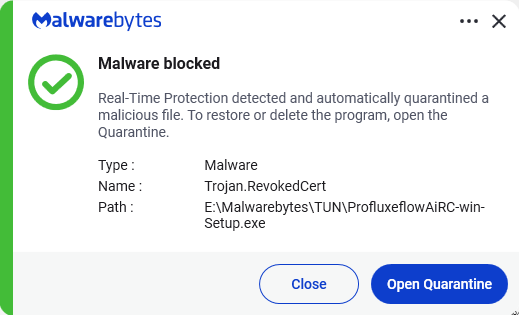
Malwarebytes detects Trojan.RevokedCert


We don’t just report on threats—we remove them

Cybersecurity risks should never spread beyond a headline. Keep threats off your devices by downloading Malwarebytes today.

❌