Last week, Anthropic pulled back the curtain on Claude Mythos Preview, an AI model so capable at finding and exploiting software vulnerabilities that the company decided it was too dangerous to release to the public. Instead, access has been restricted to roughly 50 organizations—Microsoft, Apple, Amazon Web Services, CrowdStrike and other vendors of critical infrastructure—under an initiative called Project Glasswing.
The announcement was accompanied by a barrage of hair-raising anecdotes: thousands of vulnerabilities uncovered across every major operating system and browser, including a 27-year-old bug in OpenBSD, a 16-year-old flaw in FFmpeg. Mythos was able to weaponize a set of vulnerabilities it found in the Firefox browser into 181 usable attacks; Anthropic’s previous flagship model could only achieve two.
This is, in many respects, exactly the kind of responsible disclosure that security researchers have long urged. And yet the public has been given remarkably little with which to evaluate Anthropic’s decision. We have been shown a highlight reel of spectacular successes. However, we can’t tell if we have a blockbuster until they let us see the whole movie.
For example, we don’t know how many times Mythos mistakenly flagged code as vulnerable. Anthropic said security contractors agreed with the AI’s severity rating 198 times, with an 89 per cent severity agreement. That’s impressive, but incomplete. Independent researchers examining similar models have found that AI that detects nearly every real bug also hallucinates plausible-sounding vulnerabilities in patched, correct code.
This matters. A model that autonomously finds and exploits hundreds of vulnerabilities with inhuman precision is a game changer, but a model that generates thousands of false alarms and non-working attacks still needs skilled and knowledgeable humans. Without knowing the rate of false alarms in Mythos’s unfiltered output, we cannot tell whether the examples showcased are representative.
There is a second, subtler problem. Large language models, including Mythos, perform best on inputs that resemble what they were trained on: widely used open-source projects, major browsers, the Linux kernel and popular web frameworks. Concentrating early access among the largest vendors of precisely this software is sensible; it lets them patch first, before adversaries catch up.
But the inverse is also true. Software outside the training distribution—industrial control systems, medical device firmware, bespoke financial infrastructure, regional banking software, older embedded systems—is exactly where out-of-the-box Mythos is likely least able to find or exploit bugs.
However, a sufficiently motivated attacker with domain expertise in one of these fields could nevertheless wield Mythos’s advanced reasoning capabilities as a force multiplier, probing systems that Anthropic’s own engineers lack the specialized knowledge to audit. The danger is not that Mythos fails in those domains; it is that Mythos may succeed for whoever brings the expertise.
Broader, structured access for academic researchers and domain specialists—cardiologists’ partners in medical device security, control-systems engineers, researchers in less prominent languages and ecosystems—would meaningfully reduce this asymmetry. Fifty companies, however well chosen, cannot substitute for the distributed expertise of the entire research community.
None of this is an indictment of Anthropic. By all appearances the company is trying to act responsibly, and its decision to hold the model back is evidence of seriousness.
But Anthropic is a private company and, in some ways, still a start-up. Yet it is making unilateral decisions about which pieces of our critical global infrastructure get defended first, and which must wait their turn.
It has finite staff, finite budget and finite expertise. It will miss things, and when the thing missed is in the software running a hospital or a power grid, the cost will be borne by people who never had a say.
The security problem is far greater than one company and one model. There’s no reason to believe that Mythos Preview is unique. (Not to be outdone, OpenAI announced that its new GPT-5.4-Cyber is so dangerous that the model also will not be released to the general public.) And it’s unclear how much of an advance these new models represent. The security company Aisle was able to replicate many of Anthropic’s published anecdotes using smaller, cheaper, public AI models.
Any decisions we make about whether and how to release these powerful models are more than one company’s responsibility. Ultimately, this will probably lead to regulation. That will be hard to get right and requires a long process of consultation and feedback.
In the short term, we need something simpler: greater transparency and information sharing with the broader community. This doesn’t necessarily mean making powerful models like Claude Mythos widely available. Rather, it means sharing as much data and information as possible, so that we can collectively make informed decisions.
We need globally co-ordinated frameworks for independent auditing, mandatory disclosure of aggregate performance metrics and funded access for academic and civil-society researchers.
This has implications for national security, personal safety and corporate competitiveness. Any technology that can find thousands of exploitable flaws in the systems we all depend on should not be governed solely by the internal judgment of its creators, however well intentioned.
Until that changes, each Mythos-class release will put the world at the edge of another precipice, without any visibility into whether there is a landing out of view just below, or whether this time the drop will be fatal. That is not a choice a for-profit corporation should be allowed to make in a democratic society. Nor should such a company be able to restrict the ability of society to make choices about its own security.
This essay was written with David Lie, and originally appeared in The Globe and Mail.
On March 4, 2026, Google and iVerify published reports about a highly sophisticated exploit kit targeting Apple iPhone devices. According to Google, the exploit kit was first discovered in targeted attacks conducted by a customer of an unnamed surveillance vendor. It was later used by other attackers in watering-hole attacks in Ukraine and in financially motivated attacks in China. Additionally, researchers discovered an instance with the debug version of the exploit kit, which revealed the internal names of the exploits and the framework name used by its developers — Coruna. Analysis of the kit showed that it relies on the exploitation of many previously patched vulnerabilities and also includes exploits for CVE-2023-32434 and CVE-2023-38606. These two vulnerabilities particularly caught our attention because they had been first discovered as zero-days used in Operation Triangulation.
Operation Triangulation is a complex mobile APT campaign targeting iOS devices. We discovered it while monitoring the network traffic of our own corporate Wi-Fi network. We noticed suspicious activity that originated from several iOS-based phones. Following the investigation, we learned that this campaign employed a sophisticated spyware implant and multiple zero-day exploits. The investigation lasted for over six months, during which we disclosed our findings in connection to the attack. Kaspersky GReAT experts also presented these findings at the 37th Chaos Communication Congress (37C3).
Although all the details of both CVE-2023-32434 and CVE-2023-38606 have long been publicly available, and other researchers have developed their own exploits without ever seeing the Triangulation code, we decided to closely investigate the exploits used in Coruna. Some of the exploit kit distribution links provided by Google remained active at the time the report was published, which allowed us to collect, decrypt, and analyze all components of Coruna.
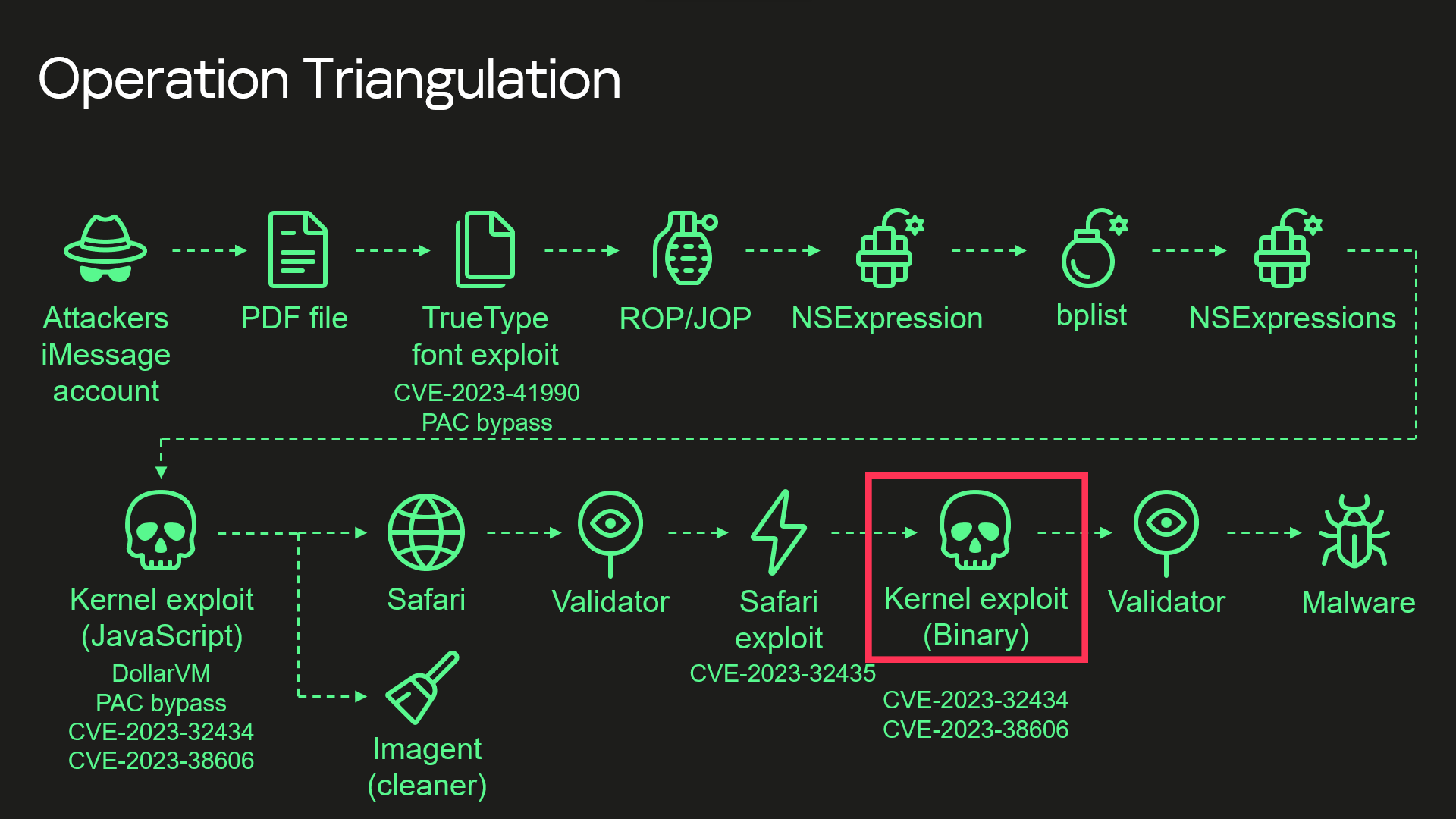
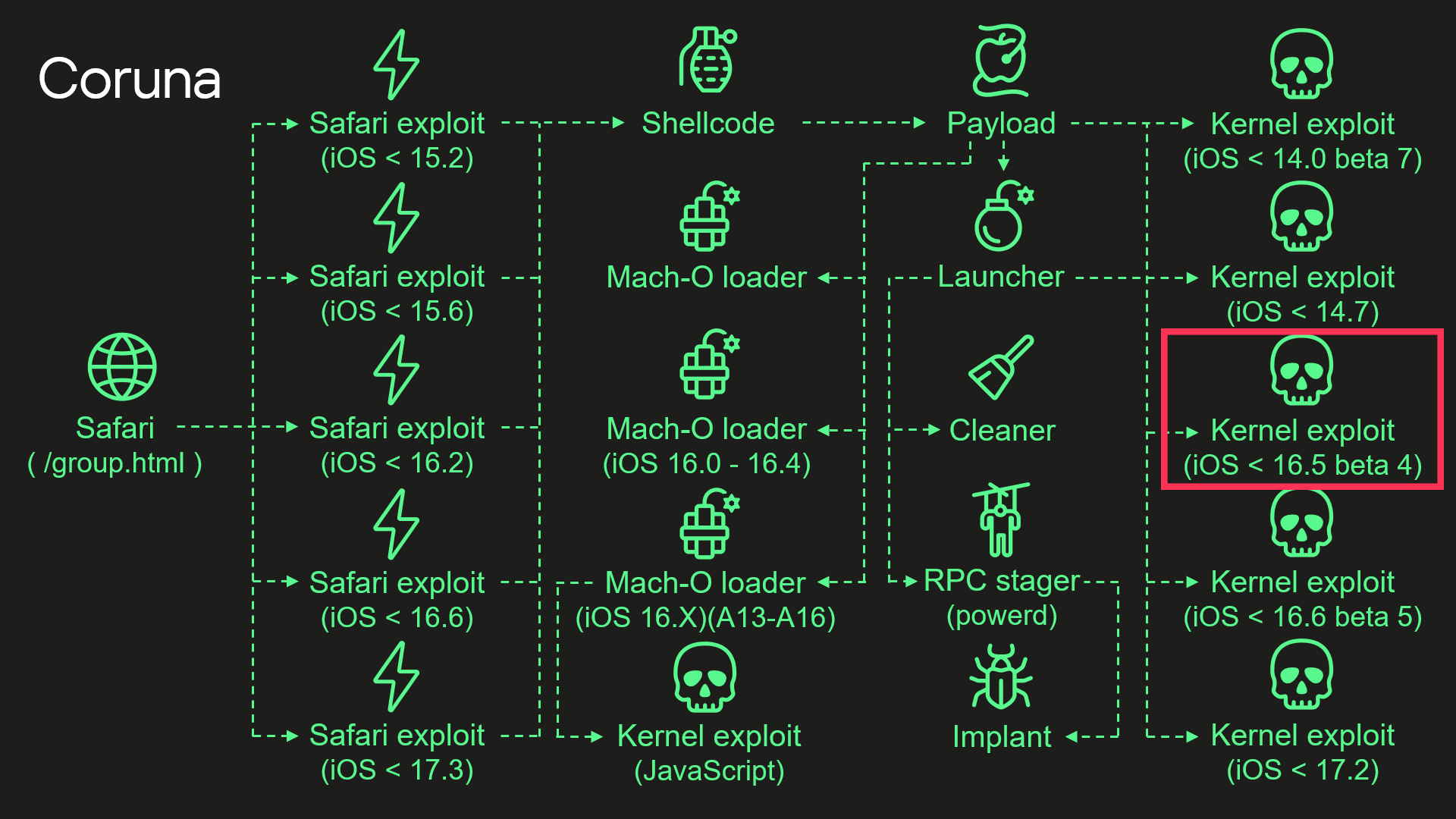
During our analysis, we discovered that the kernel exploit for CVE-2023-32434 and CVE-2023-38606 vulnerabilities used in Coruna, in fact, is an updated version of the same exploit that had been used in Operation Triangulation. The images below illustrate a high-level overview of the two attack chains. The exploit in question is highlighted with a red rectangle.
Attack chain of Operation Triangulation (simplified)
Attack chain of Coruna (simplified)
Moreover, we discovered that Coruna includes four additional kernel exploits that we had not seen used in Operation Triangulation, two of which were developed after the discovery of Operation Triangulation. All of these exploits are built on the same kernel exploitation framework and share common code. Code similarities from kernel exploits can also be found in other components of Coruna. These findings led us to conclude that this exploit kit was not patchworked but rather designed with a unified approach. We assume that it’s an updated version of the same exploitation framework that was used — at least to some extent — in Operation Triangulation.
Technical details
While we continue to investigate all exploits and vulnerabilities used by Coruna, this post provides a high-level overview of the exploit kit and attack chain.
Safari
Exploitation begins with a stager that fingerprints the browser and selects and executes appropriate remote code execution (RCE) and pointer authentication code (PAC) exploits depending on the browser version. It also contains a URL to an encrypted file with information about all available packages containing exploits and other components. The stager also includes a 256-bit key used to decrypt it. The URL and decryption key are passed to a payload embedded in PAC exploits.
Payload
The payload is responsible for initiating the exploitation of the kernel. After initialization, the payload first downloads a file with information about other available components. To extract it, the payload performs several steps processing multiple file formats.
First, the downloaded file is decrypted using the ChaCha20 stream cipher. Decryption yields a container with the magic number 0xBEDF00D, which stores LZMA-compressed data.
The file format used by the exploit kit to store compressed data
Offset
Field
0x00
Magic number (0xBEDF00D)
0x04
Decompressed data size
0x08
LZMA-compressed data
The decompressed data presents another container with the magic number 0xF00DBEEF. This file format is used in the exploit kit to store and retrieve files by their IDs.
The file format used by the exploit kit to store files
Offset
Field
0x00
Magic number (0xF00DBEEF)
0x04
Number of entries
0x08
Entry[0].File ID
0x0C
Entry[0].Status
0x10
Entry[0].File offset
0x14
Entry[0].File size
We provide a description of all possible File ID values below. At this stage, when the payload gathers information about all available file packages, this container holds only one file, and its File ID is 0x70000.
Finally, we get to the file with information about all available file packages. It starts with the magic value 0x12345678. The exploit kit uses this file format to obtain URLs and decryption keys for additional components that need to be downloaded.
The file format used by the exploit kit to store information about file packages
Offset
Field
0x00
Magic number (0x12345678)
0x04
Flags
0x08
Directory path
0x108
Number of entries
0x10C
Entry[0].Package ID
0x110
Entry[0].ChaCha20 key
0x130
Entry[0].File name
The components required for exploiting a targeted device are selected using the Package ID. Its high byte specifies the package type and required hardware. We’ve seen the following package types:
0xF2 – exploit for ARM64,
0xF3 – exploit for ARM64E,
0xA2 – Mach-O loader for ARM64,
0xA3 – Mach-O loader for ARM64E,
2 – implant for ARM64,
0xE2 – implant for ARM64E.
The payload code also supports additional package types, such as 0xF1, an exploit for older ARM devices that do not support 64-bit architecture. Interestingly, however, the files for such exploits are missing.
Other bytes of the Package ID define the supported firmware version and CPU generation.
Some of the observed Package IDs (those with unique content)
Package ID
Description
0xF3300000
Kernel exploit (iOS < 14.0 beta 7) and other components
0xF3400000
Kernel exploit (iOS < 14.7) and other components
0xF3700000
Kernel exploit (iOS < 16.5 beta 4) and other components
0xF3800000
Kernel exploit (iOS < 16.6 beta 5) and other components
0xF3900000
Kernel exploit (iOS < 17.2) and other components
0xA3030000
Mach-O loader (iOS 16.X) (A13 – A16)
0xA3050000
Mach-O loader (iOS 16.0 – 16.4)
The files inside these packages are also stored in encrypted and compressed 0xF00DBEEF containers, but this time compression is optional and is determined by the second bit in the Flags field. Different packages contain different sets of files. A description of all possible File IDs is given in the table below.
Observed File IDs
File ID
Description
0x10000
Implant
0x50000
Mach-O loader (default)
0x70000
List of additional components
0x70005
Launcher config
0x80000
Launcher in 0xF2/0xF3 packages, or Mach-O loader in 0xA2/0xA3
0x90000
Kernel exploit
0x90001
Kernel exploit (for Mach-O loader)
0xA0000
Logs cleaner
0xA0001
Mach-O loader component
0xA0002
Mach-O loader component
0xF0000
RPC stager
After downloading the necessary components, the payload begins executing kernel exploits, Mach-O loaders, and the malware launcher. The payload selects an appropriate Mach-O loader based on the firmware version, CPU, and presence of the iokit-open-service permission.
Kernel exploits
We analyzed all five kernel exploits from the kit and discovered that one of them is an updated version of the same exploit we discovered in Operation Triangulation. There are many small changes, but the most noticeable are as follows:
The code takes into account more values from XNU version strings, allowing for more accurate version checking.
Added a check for iOS 17.2. We assume that this was the latest version of iOS at the time of development (released in December 2023).
Added checks for newer Apple processors: A17, M3, M3 Pro, M3 Max (released in fall 2023).
Added a check for iOS version 16.5 beta 4. This version patched the exploit after our report to Apple.
Why does the exploit need to check for iOS 17.2 and newer CPUs if the targeted vulnerabilities were fixed in iOS 16.5 beta 4? The answer can be found by examining other exploits: they are all based on the same source code. The only difference is in the vulnerabilities they exploit, so these checks were added to support the newer exploits and appeared in the older version after recompilation.
Launcher
The launcher is responsible for orchestrating the post-exploitation activities. It also uses the kernel exploit and the interface it provides. However, since the exploit creates special kernel objects during its execution that provide the ability to read and write to kernel memory, the launcher simply reuses these objects without the need to trigger vulnerabilities and go through the entire exploitation path again. The launcher cleans up exploitation artifacts, retrieves the process name for injection from a config with the 0xDEADD00F magic number, injects a stager into the target process, uses it to execute itself, and launches the implant.
Conclusions
This case demonstrates once again the dangers associated with such malicious tools that lie in their potential wide usage. Originally developed for cyber-espionage purposes, this framework is now being used by cybercriminals of a broader kind, placing millions of users with unpatched devices at risk. Given its modular design and ease of reuse, we expect that other threat actors will begin incorporating it into their attacks. We strongly recommend that users install the latest security updates as soon as possible, if they have not already done so.

 Login
Login