As announced earlier this year, Let's Encrypt now issues IP address and six-day certificates to the general public. The Certbot team here at the Electronic Frontier Foundation has been working on two improvements to support these features: the --preferred-profile flag released last year in Certbot 4.0, and the --ip-address flag, new in Certbot 5.3. With these improvements together, you can now use Certbot to get those IP address certificates!
If you want to try getting an IP address certificate using Certbot, install version 5.4 or higher (for webroot support with IP addresses), and run this command:
This will request a non-trusted certificate from the Let's Encrypt staging server. Once you've got things working the way you want, run without the --staging flag to get a publicly trusted certificate.
This requests a certificate with Let's Encrypt's "shortlived" profile, which will be good for 6 days. This is a Let's Encrypt requirement for IP address certificates.
As of right now, Certbot only supports getting IP address certificates, not yet installing them in your web server. There's work to come on that front. In the meantime, edit your webserver configuration to load the newly issued certificate from /etc/letsencrypt/live/<ip address>/fullchain.pem and /etc/letsencrypt/live/<ip address>/privkey.pem.
The command line above uses Certbot's "webroot" mode, which places a challenge response file in a location where your already-running webserver can serve it. This is nice since you don't have to temporarily take down your server.
There are two other plugins that support IP address certificates today: --manual and --standalone. The manual plugin is like webroot, except Certbot pauses while you place the challenge response file manually (or runs a user-provided hook to place the file). The standalone plugin runs a simple web server that serves a challenge response. It has the advantage of being very easy to configure, but has the disadvantage that any running webserver on port 80 has to be temporarily taken down so Certbot can listen on that port. The nginx and apache plugins don't yet support IP addresses.
You should also be sure that Certbot is set up for automatic renewal. Most installation methods for Certbot set up automatic renewal for you. However, since the webserver-specific installers don't yet support IP address certificates, you'll have to set a --deploy-hook that tells your webserver to load the most up-to-date certificates from disk. You can provide this --deploy-hook through the certbot reconfigure command using the rest of the flags above.
We hope you enjoy using IP address certificates with Let's Encrypt and Certbot, and as always if you get stuck you can ask for help in the Let's Encrypt Community Forum.
A hacktivist group with links to Iran’s intelligence agencies is claiming responsibility for a data-wiping attack against Stryker, a global medical technology company based in Michigan. News reports out of Ireland, Stryker’s largest hub outside of the United States, said the company sent home more than 5,000 workers there today. Meanwhile, a voicemail message at Stryker’s main U.S. headquarters says the company is currently experiencing a building emergency.
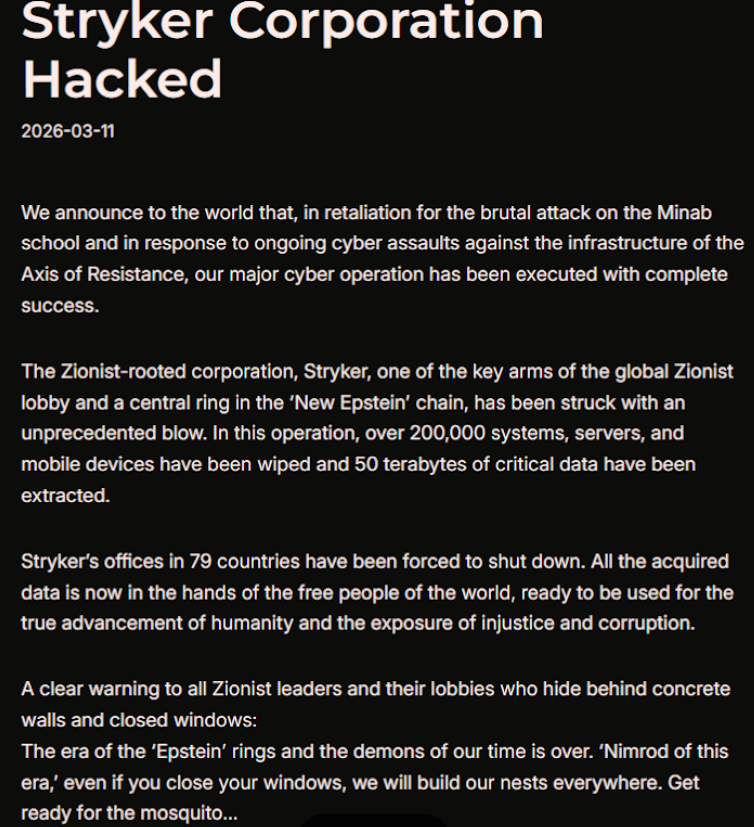
Based in Kalamazoo, Michigan, Stryker [NYSE:SYK] is a medical and surgical equipment maker that reported $25 billion in global sales last year. In a lengthy statement posted to Telegram, a hacktivist group known as Handala (a.k.a. Handala Hack Team) claimed that Stryker’s offices in 79 countries have been forced to shut down after the group erased data from more than 200,000 systems, servers and mobile devices.
A manifesto posted by the Iran-backed hacktivist group Handala, claiming a mass data-wiping attack against medical technology maker Stryker.
“All the acquired data is now in the hands of the free people of the world, ready to be used for the true advancement of humanity and the exposure of injustice and corruption,” a portion of the Handala statement reads.
The group said the wiper attack was in retaliation for a Feb. 28 missile strike that hit an Iranian school and killed at least 175 people, most of them children. The New York Timesreports today that an ongoing military investigation has determined the United States is responsible for the deadly Tomahawk missile strike.
Handala was one of several hacker groups recently profiled by Palo Alto Networks, which links it to Iran’s Ministry of Intelligence and Security (MOIS). Palo Alto says Handala surfaced in late 2023 and is assessed as one of several online personas maintained by Void Manticore, a MOIS-affiliated actor.
Stryker’s website says the company has 56,000 employees in 61 countries. A phone call placed Wednesday morning to the media line at Stryker’s Michigan headquarters sent this author to a voicemail message that stated, “We are currently experiencing a building emergency. Please try your call again later.”
A report Wednesday morning from the Irish Examiner said Stryker staff are now communicating via WhatsApp for any updates on when they can return to work. The story quoted an unnamed employee saying anything connected to the network is down, and that “anyone with Microsoft Outlook on their personal phones had their devices wiped.”
“Multiple sources have said that systems in the Cork headquarters have been ‘shut down’ and that Stryker devices held by employees have been wiped out,” the Examiner reported. “The login pages coming up on these devices have been defaced with the Handala logo.”
Wiper attacks usually involve malicious software designed to overwrite any existing data on infected devices. But a trusted source with knowledge of the attack who spoke on condition of anonymity told KrebsOnSecurity the perpetrators in this case appear to have used a Microsoft service called Microsoft Intune to issue a ‘remote wipe’ command against all connected devices.
Intune is a cloud-based solution built for IT teams to enforce security and data compliance policies, and it provides a single, web-based administrative console to monitor and control devices regardless of location. The Intune connection is supported by this Reddit discussion on the Stryker outage, where several users who claimed to be Stryker employees said they were told to uninstall Intune urgently.
Palo Alto says Handala’s hack-and-leak activity is primarily focused on Israel, with occasional targeting outside that scope when it serves a specific agenda. The security firm said Handala also has taken credit for recent attacks against fuel systems in Jordan and an Israeli energy exploration company.
“Recent observed activities are opportunistic and ‘quick and dirty,’ with a noticeable focus on supply-chain footholds (e.g., IT/service providers) to reach downstream victims, followed by ‘proof’ posts to amplify credibility and intimidate targets,” Palo Alto researchers wrote.
The Handala manifesto posted to Telegram referred to Stryker as a “Zionist-rooted corporation,” which may be a reference to the company’s 2019 acquisition of the Israeli company OrthoSpace.
Stryker is a major supplier of medical devices, and the ongoing attack is already affecting healthcare providers. One healthcare professional at a major university medical system in the United States told KrebsOnSecurity they are currently unable to order surgical supplies that they normally source through Stryker.
“This is a real-world supply chain attack,” the expert said, who asked to remain anonymous because they were not authorized to speak to the press. “Pretty much every hospital in the U.S. that performs surgeries uses their supplies.”
John Riggi, national advisor for the American Hospital Association (AHA), said the AHA is not aware of any supply-chain disruptions as of yet.
“We are aware of reports of the cyber attack against Stryker and are actively exchanging information with the hospital field and the federal government to understand the nature of the threat and assess any impact to hospital operations,” Riggi said in an email. “As of this time, we are not aware of any direct impacts or disruptions to U.S. hospitals as a result of this attack. That may change as hospitals evaluate services, technology and supply chain related to Stryker and if the duration of the attack extends.”
According to a March 11 memo from the state of Maryland’s Institute for Emergency Medical Services Systems, Stryker indicated that some of their computer systems have been impacted by a “global network disruption.” The memo indicates that in response to the attack, a number of hospitals have opted to disconnect from Stryker’s various online services, including LifeNet, which allows paramedics to transmit EKGs to emergency physicians so that heart attack patients can expedite their treatment when they arrive at the hospital.
“As a precaution, some hospitals have temporarily suspended their connection to Stryker systems, including LIFENET, while others have maintained the connection,” wrote Timothy Chizmar, the state’s EMS medical director. “The Maryland Medical Protocols for EMS requires ECG transmission for patients with acute coronary syndrome (or STEMI). However, if you are unable to transmit a 12 Lead ECG to a receiving hospital, you should initiate radio consultation and describe the findings on the ECG.”
This is a developing story. Updates will be noted with a timestamp.
Update, 2:54 p.m. ET: Added comment from Riggi and perspectives on this attack’s potential to turn into a supply-chain problem for the healthcare system.
Update, Mar. 12, 7:59 a.m. ET: Added information about the outage affecting Stryker’s online services.
Have you ever seen a really creepy targeted ad online? One that revealed just how much these companies know about your life? It's unsettling enough to see how much companies know about you—but now we have confirmation that the government is also tapping the advertising surveillance machine to get your data. We're explaining the dangers of targeted advertising and location tracking, and the latest in the fight for privacy and free speech online, with our EFFector newsletter.
Prefer to listen in? Big news: EFFector is now available on all major podcast platforms! In this episode we chat with EFF Staff Attorney Lena Cohen about how targeted advertising can reveal your location to federal law enforcement. You can find the episode and subscribe in your podcast player of choice:
Want to stay in the fight for privacy and free speech online? Sign up forEFF's EFFector newsletterfor updates, ways to take action, and new merch drops. You can also fuel the fight against online surveillance when yousupport EFF today!
Canada has a choice to make about its artificial intelligence future. The Carney administration is investing $2-billion over five years in its Sovereign AI Compute Strategy. Will any value generated by “sovereign AI” be captured in Canada, making a difference in the lives of Canadians, or is this just a passthrough to investment in American Big Tech?
Forcing the question is OpenAI, the company behind ChatGPT, which has been pushing an “OpenAI for Countries” initiative. It is not the only one eyeing its share of the $2-billion, but it appears to be the most aggressive. OpenAI’s top lobbyist in the region has met with Ottawa officials, including Artificial Intelligence Minister Evan Solomon.
All the while, OpenAI was less than open. The company had flagged the Tumbler Ridge, B.C., shooter’s ChatGPT interactions, which included gun-violence chats. Employees wanted to alert law enforcement but were rebuffed. Maybe there is a discussion to be had about users’ privacy. But even after the shooting, the OpenAI representative who met with the B.C. government said nothing.
When tech billionaires and corporations steer AI development, the resultant AI reflects their interests rather than those of the general public or ordinary consumers. Only after the meeting with the B.C. government did OpenAI alert law enforcement. Had it not been for the Wall Street Journal’s reporting, the public would not have known about this at all.
Moreover, OpenAI for Countries is explicitly described by the company as an initiative “in co-ordination with the U.S. government.” And it’s not just OpenAI: all the AI giants are for-profit American companies, operating in their private interests, and subject to United States law and increasingly bowing to U.S. President Donald Trump. Moving data centres into Canada under a proposal like OpenAI’s doesn’t change that. The current geopolitical reality means Canada should not be dependent on U.S. tech firms for essential services such as cloud computing and AI.
While there are Canadian AI companies, they remain for-profit enterprises, their interests not necessarily aligned with our collective good. The only real alternative is to be bold and invest in a wholly Canadian public AI: an AI model built and funded by Canada for Canadians, as public infrastructure. This would give Canadians access to the myriad of benefits from AI without having to depend on the U.S. or other countries. It would mean Canadian universities and public agencies building and operating AI models optimized not for global scale and corporate profit, but for practical use by Canadians.
Imagine AI embedded into health care, triaging radiology scans, flagging early cancer risks and assisting doctors with paperwork. Imagine an AI tutor trained on provincial curriculums, giving personalized coaching. Imagine systems that analyze job vacancies and sectoral and wage trends, then automatically match job seekers to government programs. Imagine using AI to optimize transit schedules, energy grids and zoning analysis. Imagine court processes, corporate decisions and customer service all sped up by AI.
We are already on our way to having AI become an inextricable part of society. To ensure stability and prosperity for this country, Canadian users and developers must be able to turn to AI models built, controlled, and operated publicly in Canada instead of building on corporate platforms, American or otherwise.
Switzerland has shown this to be possible. With funding from the federal government, a consortium of academic institutions—ETH Zurich, EPFL, and the Swiss National Supercomputing Centre—released the world’s most powerful and fully realized public AI model, Apertus, last September. Apertus leveraged renewable hydropower and existing Swiss scientific computing infrastructure. It also used no illegally pirated copyrighted material or poorly paid labour extracted from the Global South during training. The model’s performance stands at roughly a year or two behind the major corporate offerings, but that is more than adequate for the vast majority of applications. And it’s free for anyone to use and build on.
The significance of Apertus is more than technical. It demonstrates an alternative ownership structure for AI technology, one that allocates both decision-making authority and value to national public institutions rather than foreign corporations. This vision represents precisely the paradigm shift Canada should embrace: AI as public infrastructure, like systems for transportation, water, or electricity, rather than private commodity.
Apertus also demonstrates a far more sustainable economic framework for AI. Switzerland spent a tiny fraction of the billions of dollars that corporate AI labs invest annually, demonstrating that the frequent training runs with astronomical price tags pursued by tech companies are not actually necessary for practical AI development. They focused on making something broadly useful rather than bleeding edge—trying dubiously to create “superintelligence,” as with Silicon Valley—so they created a smaller model at much lower cost. Apertus’s training was at a scale (70 billion parameters) perhaps two orders of magnitude lower than the largest Big Tech offerings.
An ecosystem is now being developed on top of Apertus, using the model as a public good to power chatbots for free consumer use and to provide a development platform for companies prioritizing responsible AI use, and rigorous compliance with laws like the EU AI Act. Instead of routing queries from those users to Big Tech infrastructure, Apertus is deployed to data centres across national AI and computing initiatives of Switzerland, Australia, Germany, and Singapore and other partners.
The case for public AI rests on both democratic principles and practical benefits. Public AI systems can incorporate mechanisms for genuine public input and democratic oversight on critical ethical questions: how to handle copyrighted works in training data, how to mitigate bias, how to distribute access when demand outstrips capacity, and how to license use for sensitive applications like policing or medicine. Or how to handle a situation such as that of the Tumbler Ridge shooter. These decisions will profoundly shape society as AI becomes more pervasive, yet corporate AI makes them in secret.
By contrast, public AI developed by transparent, accountable agencies would allow democratic processes and political oversight to govern how these powerful systems function.
Canada already has many of the building blocks for public AI. The country has world-class AI research institutions, including the Vector Institute, Mila, and CIFAR, which pioneered much of the deep learning revolution. Canada’s $2-billion Sovereign AI Compute Strategy provides substantial funding.
What’s needed now is a reorientation away from viewing this as an opportunity to attract private capital, and toward a fully open public AI model.
This essay was written with Nathan E. Sanders, and originally appeared in The Globe and Mail.
Microsoft Corp. today pushed security updates to fix at least 77 vulnerabilities in its Windows operating systems and other software. There are no pressing “zero-day” flaws this month (compared to February’s five zero-day treat), but as usual some patches may deserve more rapid attention from organizations using Windows. Here are a few highlights from this month’s Patch Tuesday.
Image: Shutterstock, @nwz.
Two of the bugs Microsoft patched today were publicly disclosed previously. CVE-2026-21262 is a weakness that allows an attacker to elevate their privileges on SQL Server 2016 and later editions.
“This isn’t just any elevation of privilege vulnerability, either; the advisory notes that an authorized attacker can elevate privileges to sysadmin over a network,” Rapid7’s Adam Barnett said. “The CVSS v3 base score of 8.8 is just below the threshold for critical severity, since low-level privileges are required. It would be a courageous defender who shrugged and deferred the patches for this one.”
The other publicly disclosed flaw is CVE-2026-26127, a vulnerability in applications running on .NET. Barnett said the immediate impact of exploitation is likely limited to denial of service by triggering a crash, with the potential for other types of attacks during a service reboot.
It would hardly be a proper Patch Tuesday without at least one critical Microsoft Office exploit, and this month doesn’t disappoint. CVE-2026-26113 and CVE-2026-26110 are both remote code execution flaws that can be triggered just by viewing a booby-trapped message in the Preview Pane.
Satnam Narang at Tenable notes that just over half (55%) of all Patch Tuesday CVEs this month are privilege escalation bugs, and of those, a half dozen were rated “exploitation more likely” — across Windows Graphics Component, Windows Accessibility Infrastructure, Windows Kernel, Windows SMB Server and Winlogon. These include:
–CVE-2026-24291: Incorrect permission assignments within the Windows Accessibility Infrastructure to reach SYSTEM (CVSS 7.8)
–CVE-2026-24294: Improper authentication in the core SMB component (CVSS 7.8)
–CVE-2026-24289: High-severity memory corruption and race condition flaw (CVSS 7.8)
–CVE-2026-25187: Winlogon process weakness discovered by Google Project Zero (CVSS 7.8).
Ben McCarthy, lead cyber security engineer at Immersive, called attention to CVE-2026-21536, a critical remote code execution bug in a component called the Microsoft Devices Pricing Program. Microsoft has already resolved the issue on their end, and fixing it requires no action on the part of Windows users. But McCarthy says it’s notable as one of the first vulnerabilities identified by an AI agent and officially recognized with a CVE attributed to the Windows operating system. It was discovered by XBOW, a fully autonomous AI penetration testing agent.
XBOW has consistently ranked at or near the top of the Hacker One bug bounty leaderboard for the past year. McCarthy said CVE-2026-21536 demonstrates how AI agents can identify critical 9.8-rated vulnerabilities without access to source code.
“Although Microsoft has already patched and mitigated the vulnerability, it highlights a shift toward AI-driven discovery of complex vulnerabilities at increasing speed,” McCarthy said. “This development suggests AI-assisted vulnerability research will play a growing role in the security landscape.”
Microsoft earlier provided patches to address nine browser vulnerabilities, which are not included in the Patch Tuesday count above. In addition, Microsoft issued a crucial out-of-band (emergency) update on March 2 for Windows Server 2022 to address a certificate renewal issue with passwordless authentication technology Windows Hello for Business.
Separately, Adobe shipped updates to fix 80 vulnerabilities — some of them critical in severity — in a variety of products, including Acrobat and Adobe Commerce. Mozilla Firefox v. 148.0.2 resolves three high severity CVEs.
For a complete breakdown of all the patches Microsoft released today, check out the SANS Internet Storm Center’s Patch Tuesday post. Windows enterprise admins who wish to stay abreast of any news about problematic updates, AskWoody.com is always worth a visit. Please feel free to drop a comment below if you experience any issues apply this month’s patches.
Across three recent campaigns, Sophos X-Ops notes shifts in both lures and malware capabilities, as threat actors leveraging ClickFix techniques increasingly target macOS users with infostealers
Categories: Threat Research
Tags: MacOS, infostealer, clickfix, MacSync, Social engineering
The government should not help a religious institution to punish or deter members from inquiring about their faith. Yet, once again, the Watch Tower Bible and Tract Society is trying to use flimsy copyright claims to exploit the special legal tools available to copyright owners in order to unmask anonymous online speakers. And, once again, EFF has stepped in to urge the courts not to give Watch Tower’s attempts the force of law, with the help of local counsel Jonathan Phillips of Phillips & Bathke, P.C.
EFF’s client, J. Doe, is a member of the Jehovah’s Witnesses who became interested in the history of the organization’s public statements, and how they’ve changed over time. They created research tools to analyze those documents and ultimately created a website, JWS Library, allowing others to use those tools and verify their findings through an archive that included documents suppressed by the church. Doe and others discovered prophecies that failed to come true, erasure of a leader’s disgrace, increased calls for obedience and donations, and other insights about the Jehovah’s Witnesses’ practices. Doe also used machine translation on a foreign-language document to help the community understand what the church was saying to different audiences and also to help understand potential changes in the organization’s attitudes towards dissent.
Within the church, dissent or even asking questions has often been punished by labeling members as apostates and ostracizing—or “disfellowshipping”— them. As a result, Doe and others choose to speak anonymously to avoid retaliation that could cost them family, friend, and professional relationships.
There is no law against questioning the Jehovah’s Witnesses. Instead, Watch Tower argues that Doe’s activities constitute copyright infringement and seeks to use the special process provided in the Digital Millennium Copyright Act (DMCA) to unmask them. It sent DMCA subpoenas to Google and Cloudflare, seeking information that would help them uncover Doe’s identity.
The problem for Watch Tower is that Doe’s research and commentary are clear fair uses allowed under copyright law. The First Amendment does not permit the unmasking of anonymous speakers based on such weak claims. Indeed, the First Amendment protects anonymous speakers precisely because some would be deterred from speaking if they faced retribution for doing so.
EFF stands with those who question the claims of those in power and who share the tools and knowledge needed to do so. We urge the judges in the Southern District of New York to quash these improper subpoenas and not allow copyright to be used to suppress important, legitimate speech.
The AI security skills gap threatens enterprise AI investments. Learn where skills gaps exist across security teams and how hands-on training closes them.
Over the last decade or so, the tech industry has tried, and mostly failed, to make “smart glasses”—tech-infused glasses with cameras, AI, maps, displays, and more—a thing. But in the past year, products like Meta’s Ray-Ban Display Glasses and Oakley’s Meta Glasses have gone from a curious niche to the mainstream.
Before you strap a dashcam to your face and sprint out into the world filming everything and everyone in your life, there are some civil liberties and privacy concerns to consider before buying or using a pair.
Meta is the biggest company that makes these sorts of glasses and their partnerships with Ray-Ban and Oakely are the most popular options, so we’ll be mostly focusing on them here. Others, like models from Snapchat are similar in form but far less ubiquitous. But Meta won’t hold this space for long. Google’s already announced a partnership with Warby Parker for their “AI-powered smart glasses,” and there are rumors around a competing product from Apple.
With that, let’s dive into some of the considerations you should make before purchasing a pair.
If You’re Thinking About Buying Smart Glasses
You’re likely not the only one who can see (and hear) your footage
The photos and videos you record with most smartglasses will likely be stored online at some point in the process. On Meta’s offerings, unless you are livestreaming, media you capture when you press the camera button is kept on the glasses until you import them onto your phone, but media is imported automatically by default into the Meta AI mobile app, which is required to set up the glasses.
You can't use any AI features locally on the glasses. So anytime you use AI features, like when you say, “Hey Meta, start recording,” the footage is fed to Meta. You can use the glasses without the Meta AI app entirely, but considering you can’t easily download footage from the glasses to your phone without it, most people will likely use the app.
Some videos are fed to Meta for AI training, and we know at least in some cases that those videos go through human review. An investigation by Swedish newspapers found that workers were reviewing and annotating camera footage, which includes all sorts of sensitive videos, including nudity, sex, and going to the bathroom. Meta claimed to the BBC that this is in accordance with its terms of use, all in the name of AI training, which states:
In some cases, Meta will review your interactions with AIs, including the content of your conversations with or messages to AIs, and this review may be automated or manual (human).
This all means that Meta and their third-party contractors will have access to at least some of what you record, and it’s very hard as a user to know where footage goes, who will have access to it, and what they will do with it. When you save footage to your phone’s camera roll, which is where the Meta AI app stores content, that might also be sent to Apple or Google’s servers, depending on your settings. Employees at these companies can then possibly access that media, and it could be shared with law enforcement.
The recorded audio from conversations with Meta AI are also saved by default, and if you don’t like that, tough luck, unless you go in and manually delete them every time you say something.
Filming all the time is even more privacy invasive than you think
A common argument in favor of using the cameras in smartglasses is that phones and cameras can do this too, and it’s never been a problem.
But smartglasses are designed to resemble regular glasses, to the point where most reviewspoint out how friends didn’t notice that they had cameras embedded in them. They’re designed to be invisible to those being recorded—outside of a small indicator light when they’re recording video footage (that cheap hacks can disable)—whereas it is often obvious that a person is recording if they pull their phone out of their pocket and point it at someone else.
They’re designed to be invisible to those being recorded, outside of a small indicator light when they’re recording.
Moreover, constant recording of everything in public spaces can create all sorts of potential privacy problems, some more obvious than others. This is another way that cameras on glasses are different from cameras on phones: it is far easier to constantly record one’s whereabouts with the former than the latter. If you continuously record, maybe you just happen to catch someone entering their passcode or password onto their phone or computer at a coffee shop, or broadcast someone’s bank details when you’re standing in line at an ATM. That doesn’t even begin to get into when smartglasses are intentionally used forless socially responsible means. And some people may forget to turn off their smartglasses when they enter a private space like a bathroom.
And if you find yourself caught on someone’s camera, there’s not much you can do in recourse. If you do notice a stranger recording you, it’s up to you to intervene and ask not to be included in that footage, which can easily turn awkward or confrontational.
Our expectations of privacy shift when we’re in public, but bystanders in many cases will still have privacy interests. Public spaces are a place where you will be seen, but that shouldn’t mean it’s suddenly okay to catalog and identify everyone.
Consider the company’s track record and public statements
Meta, Google, Apple—perhaps one benefit of all the major tech companies entering this market is that we already have a good idea of how much they tend to respect the privacy of their users or the openness of their platforms. Spoiler, it’s often not much.
Meta has a longhistory of privacyinvasivetechnologies and practices. We’ve heard rumblings that Meta hopes to add face recognition to its smartglasses, preferably, “during a dynamic political environment where many civil society groups that we would expect to attack us would have their resources focused on other concerns.” Yikes. This is a monumentally bad idea that should be abandoned by Meta and any of its competitors considering a similar feature. But regardless of whether they launch this feature, it’s a pretty clear indication of where Meta wants these sorts of devices to go.
If You Have Smartglasses Already
Opt out of sharing with Meta where you can
You can disable a couple of the features where unnecessary data is sent to Meta. In the Meta AI app, under the device settings, there’s a privacy page where you can disable sharing additional data, and more importantly, turn off “Cloud media,” where your photos and videos are sent to Meta’s cloud for processing and temporary storage.
Decide your use-case and stick to it
These glasses can be useful for filming a variety of activities. We’ve seen fascinating scenes of tattoo artists doing their work (with client’s permission), and it doesn’t take a stretch of the imagination to see how people might use it to film extreme sports. Even on an everyday level, you might find them useful for capturing holidays, birthdays, and all sorts of other private occasions.
But if you buy these glasses for a specific, mostly private purpose, it is probably best to stick to that, instead of wearing them everywhere and recording everything you do.
Follow the rules of businesses and social expectations
You often have a right to record in public spaces, but that doesn’t mean other people will like it. Businesses, including restaurants and stores, may want nothing to do with continuous filming and may either post a sign asking you not to use smartglasses, or ask you to stop. This may reflect the preferences not just of the business owner, but the people around you. And don’t use glasses to record when you enter other people’s private spaces like bathrooms or changing rooms.
It’s also a good idea to check in with friends and family before tapping that record button at a social gathering. Some people may not be as comfortable with these glasses as they are with other recording equipment.
Consider blurring strangers if you’re going to upload video
Blurring video footage isn’t an easy task, but if you’re considering uploading footage from something like a protest, it may be worth the effort to do so (apps like Meta’s Edits simplify this process, as do some other video sites, like YouTube). Some people don’t want the government to see their faces at protests, and might be afraid to attend if other people are uploading their faces.
Some people don’t want the government to see their faces at protests, and might be afraid to attend if other people are uploading their faces.
It would be better if Meta leveraged its AI features to offer this sort of feature automatically, especially with livestreaming. It’s not that outlandish of a request, as it seems like the company tries to blur faces automatically in footage it captures for annotation, though it’s not always reliable. After all, Google began redacting faces in Street View years ago, following privacy concerns from groups like EFF.
Resist face recognition
Adding facial recognition technology to smartglasses would obliterate the privacy of everyone. We cannot let companies push face recognition into these glasses, and as a user, you should make your voice clear that this is not something you want.
Smartglasses don’t have to be used to decimate the privacy of anyone you encounter during the day. There are legitimate uses out there, but it’s up to those who use them to respect the social norms of the spaces they enter and the people they encounter.
The rapidly escalating conflict between Anthropic and the Pentagon, which started when the company refused to let the government use its technology to spy on Americans, has now gone to court. The Department of Defense retaliated by designating the company a “supply chain risk” (SCR). Now, Anthropic is asking courts to block the designation, arguing that the First Amendment does not permit the government to coerce a private actor to rewrite its code to serve government ends.
We agree.
As EFF, the Foundation for Individual Rights and Expression, and multiple other public interest organizations explained in a brief filed in support of Anthropic’s motion, the development and operation of large language models involve multiple expressive choices protected by the First Amendment. Requiring a company to rewrite its code to remove guardrails means compelling different expression, a clear constitutional violation. Further, the public record shows that the SCR designation is intended to punish the company both for pushing back and for its CEO’s public statements explaining that AI may supercharge surveillance practices that current law has proven ill-equipped to address.
As we also explain, the company’s concerns about how the government will use its technology are well-founded. The U.S. government has a long history of illegally surveilling its citizens without adequate judicial oversight based on questionable interpretations of its Constitutional and statutory obligations. The Department of Defense acquires vast troves of personal information from commercial entities, including individuals’ physical location, social media, and web browsing data.Other government agencies continue to collect and query vast quantities of Americans’ information, including by acquiring information from third party data brokers.
A growing body of social science research illustrates the chilling effects of these pervasive activities. Fearing retribution for unpopular views, dissenters stay silent. And AI only exacerbates the problem. AI can quickly analyze the government’s massive datasets or combine that information with data scraped off the internet, purchased through the commercial data broker market, or from local police surveillance devices and use all of that data to construct a comprehensive picture of a person’s life and infer sensitive details like their religious beliefs, medical conditions, political opinions, or even sex partners. For example, an agency could use AI to infer an individual’s association with a particular mosque based on data showing that they visited its website, followed its social media accounts, and were located near the mosque during religious services. AI can also deanonymize online speech by using public information to unmask anonymous users.
It is easy to conceive how an agency, a government employee with improper intent, or a malicious hacker could exploit these capabilities to monitor public discourse, preemptively squelch dissent, or persecute people from marginalized communities. Against this background and absent meaningful changes to the governing national security laws and judicial oversight structure, it is entirely reasonable for Anthropic—or any other company—to insist on its own guardrails.
Without action from Congress, the task of protecting your privacy has fallen in large part to Big Tech—something no one wants, including Big Tech. But if Congress won’t do it, companies like Anthropic must be allowed to step in, without facing retribution.
Countries around the world are becoming increasingly concerned about their dependencies on the US. If you’ve purchase US-made F-35 fighter jets, you are dependent on the US for software maintenance.
The Dutch Defense Secretary recently said that he could jailbreak the planes to accept third-party software.
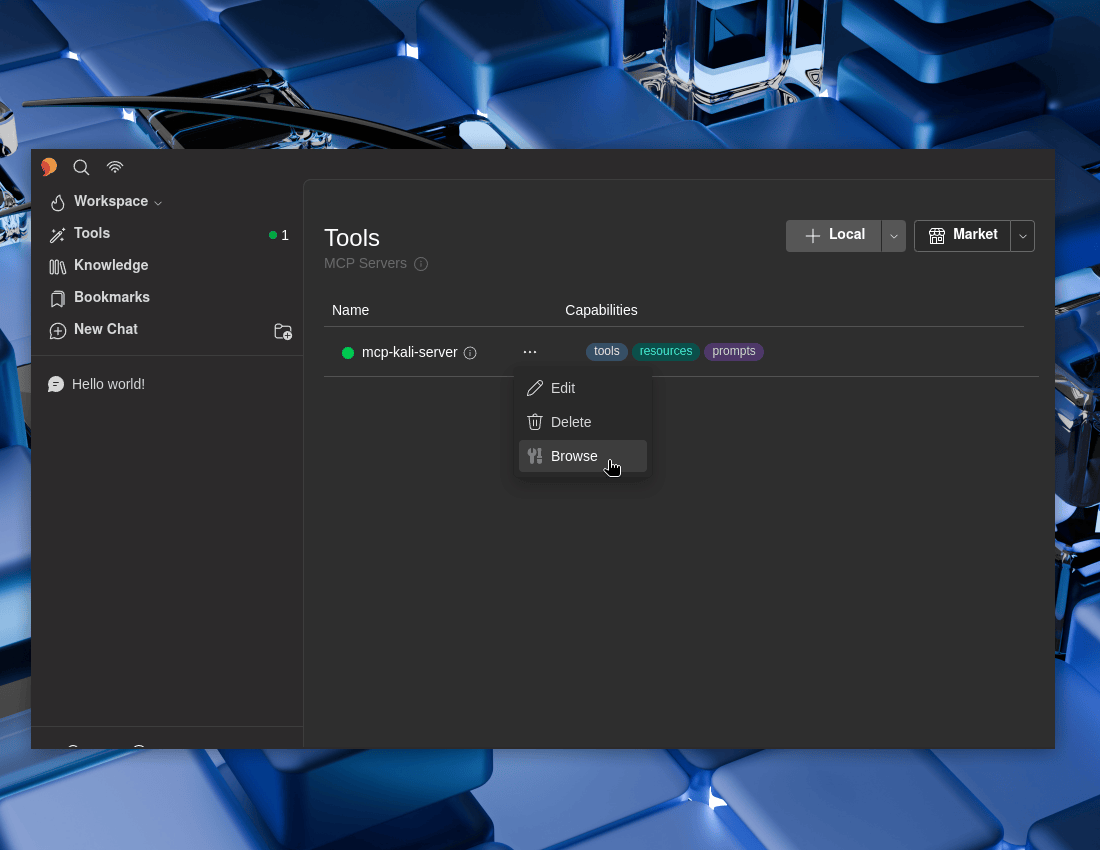
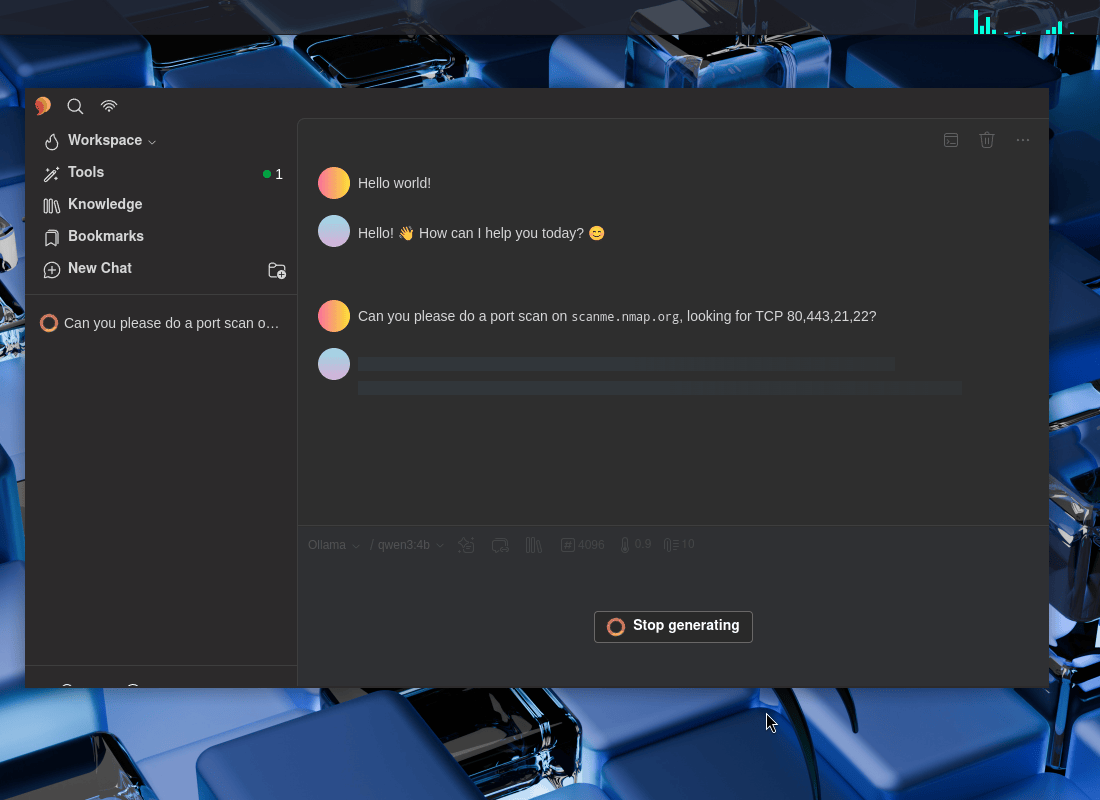
We are extending our LLM-driven Kali series, where natural language replaces manual command input. This time however, we are doing everything locally and offline. We are using our own hardware and not relying on any 3rd party services/SaaS.
Note: Local LLMs are hardware-hungry. The cost factor here is buying hardware and the running costs. If you have anything that you can re-use, great!
We will check that our hardware is ready by making sure “non-free” proprietary drivers are installed. The non-free option allows for CUDA support which the open-source, nouveau, drivers lack.
At the same time, make sure our Kernel and headers are at the latest version too:
$ sudo apt update
[...]
$
$ sudo apt install -y linux-image-$(dpkg --print-architecture) linux-headers-$(dpkg --print-architecture) nvidia-driver nvidia-smi
[...]
│ Conflicting nouveau kernel module loaded │
│ The free nouveau kernel module is currently loaded and conflicts with the non-free nvidia kernel module. │
│ The easiest way to fix this is to reboot the machine once the installation has finished. |
[...]
$
$ sudo reboot
Using a different GPU manufacture, such as AMD or Intel etc, is out of scope for this guide.
Testing
Once the box is back up and we are logged in again, we can do a quick check with nvidia-smi:
$ lspci -s 07:00.0 -v | grep Kernel
Kernel driver in use: nvidia
Kernel modules: nvidia
$
$ lsmod | grep '^nouveau'
$
$ lsmod | grep '^nvidia'
nvidia_drm 126976 2
nvidia_modeset 1605632 3 nvidia_drm
nvidia 60710912 29 nvidia_drm,nvidia_modeset
$
$ nvidia-smi
Tue Jan 27 14:33:31 2026
+-----------------------------------------------------------------------------------------+
| NVIDIA-SMI 550.163.01 Driver Version: 550.163.01 CUDA Version: 12.4 |
|-----------------------------------------+------------------------+----------------------+
| GPU Name Persistence-M | Bus-Id Disp.A | Volatile Uncorr. ECC |
| Fan Temp Perf Pwr:Usage/Cap | Memory-Usage | GPU-Util Compute M. |
| | | MIG M. |
|=========================================+========================+======================|
| 0 NVIDIA GeForce GTX 1060 6GB Off | 00000000:07:00.0 On | N/A |
| 0% 30C P8 6W / 120W | 25MiB / 6144MiB | 0% Default |
| | | N/A |
+-----------------------------------------+------------------------+----------------------+
+-----------------------------------------------------------------------------------------+
| Processes: |
| GPU GI CI PID Type Process name GPU Memory |
| ID ID Usage |
|=========================================================================================|
| 0 N/A N/A 969 G /usr/lib/xorg/Xorg 21MiB |
+-----------------------------------------------------------------------------------------+
$
Everything looks to be in order.
Ollama
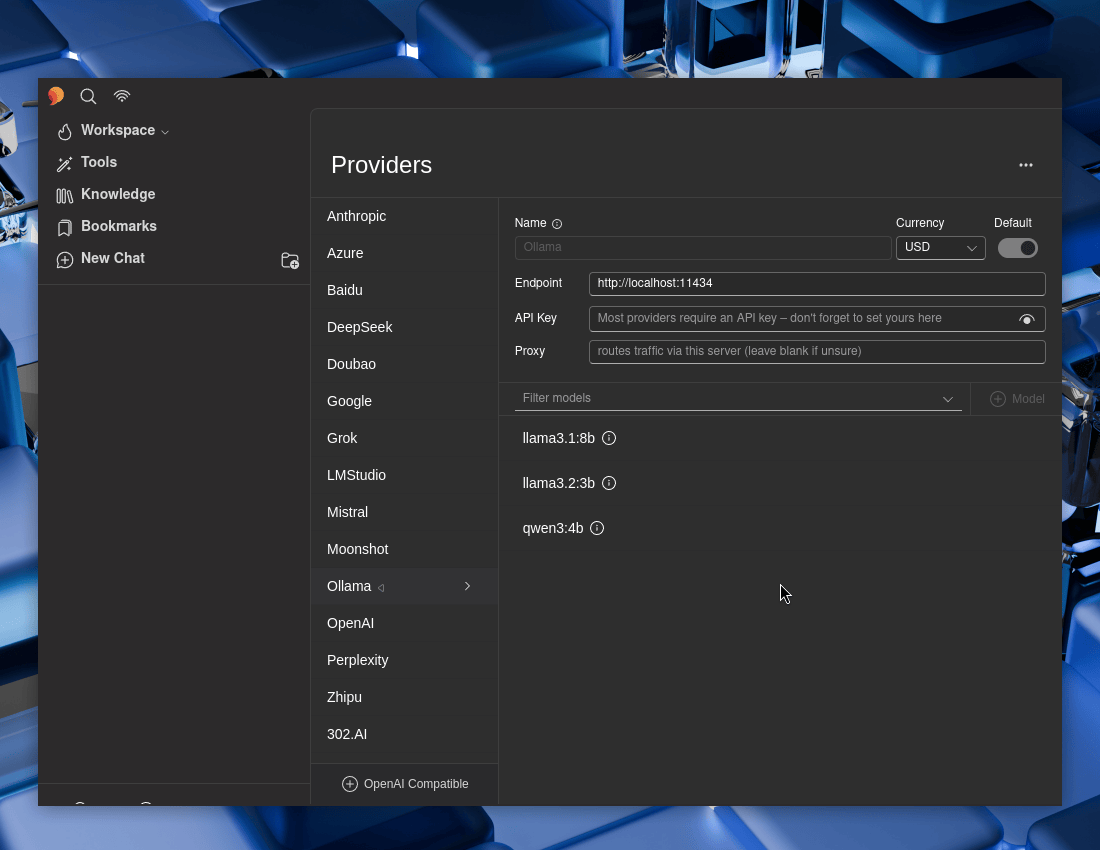
Next up, we need to install Ollama. Ollama will allow us to load our local LLM.
Ollama is a wrapper for llama.cpp. 5ire supports Ollama, but not llama.cpp.
If you do not want to-do curl|bash, see the manual method, or follow below for v0.15.2(latest at the time of writing, 2026-01-27):
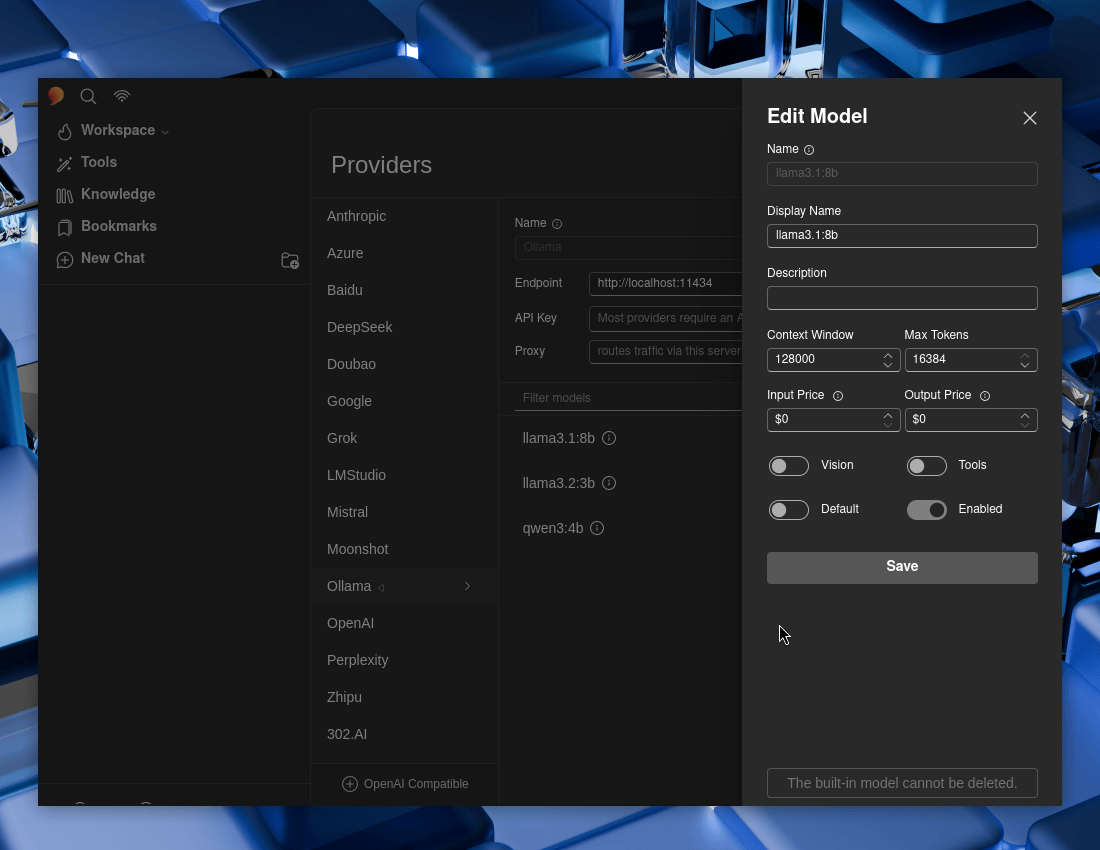
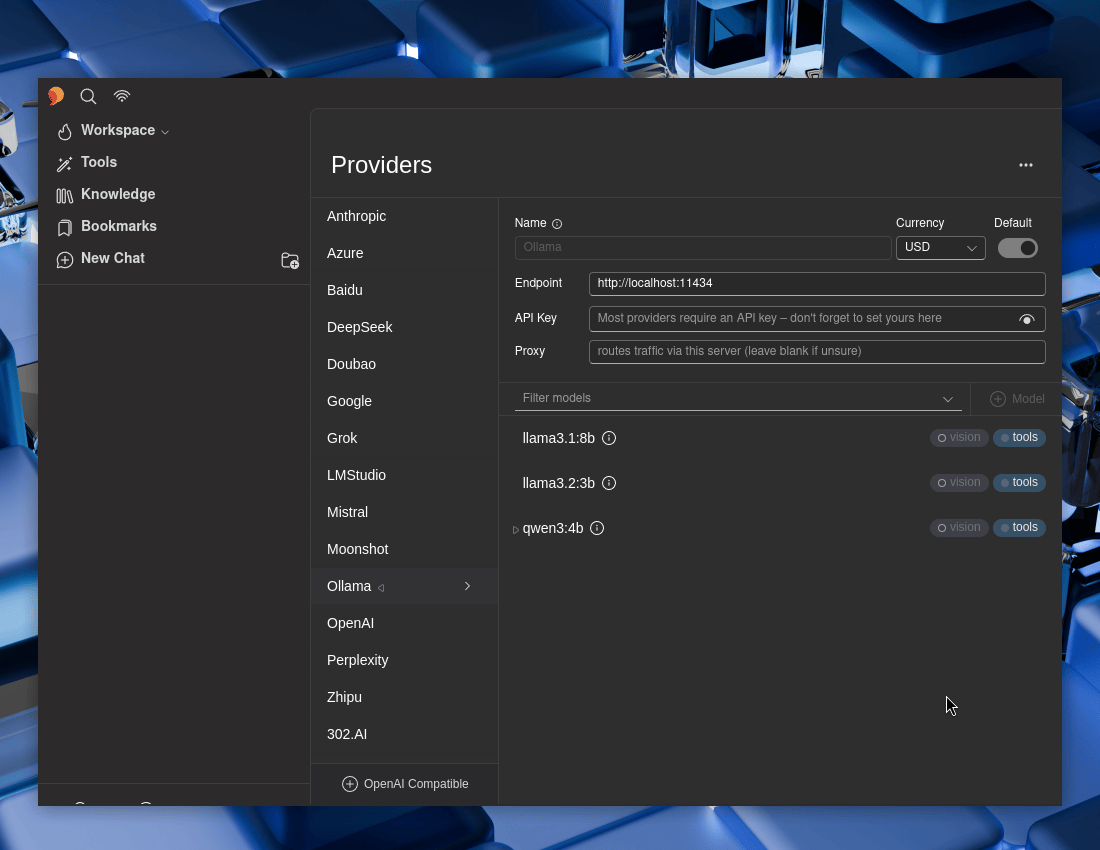
We need a model which has “Tools” support. We will explain later why this is important.
Your hardware will dictate how complex of a model you can run. The hardware we are using has 6GB of VRAM , so we will need a model size which requires less.
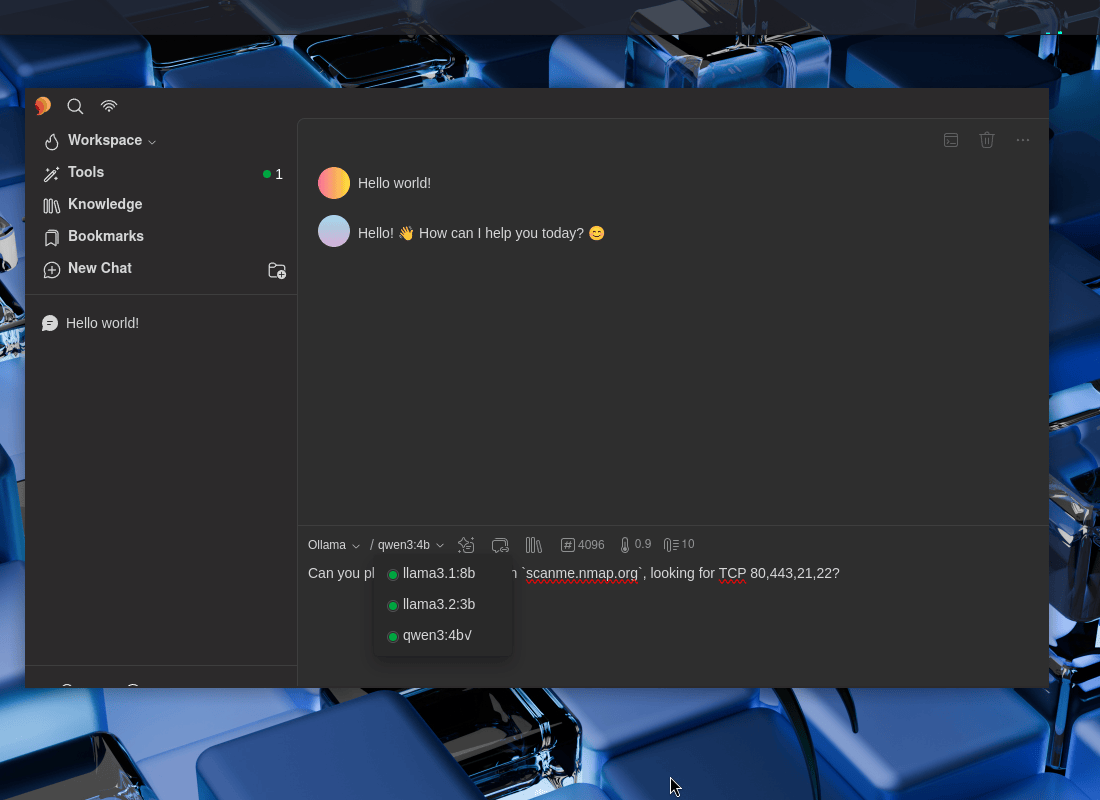
$ ollama list
NAME ID SIZE MODIFIED
llama3.1:8b 46e0c10c039e 4.9 GB 8 minutes ago
llama3.2:3b a80c4f17acd5 2.0 GB 29 minutes ago
qwen3:4b 359d7dd4bcda 2.5 GB 39 minutes ago
$
Testing
Let’s test that Ollama is working.
$ ollama run qwen3:4b
The first time we do this, it needs to load the model into memory. This may take a while depending on your hardware.
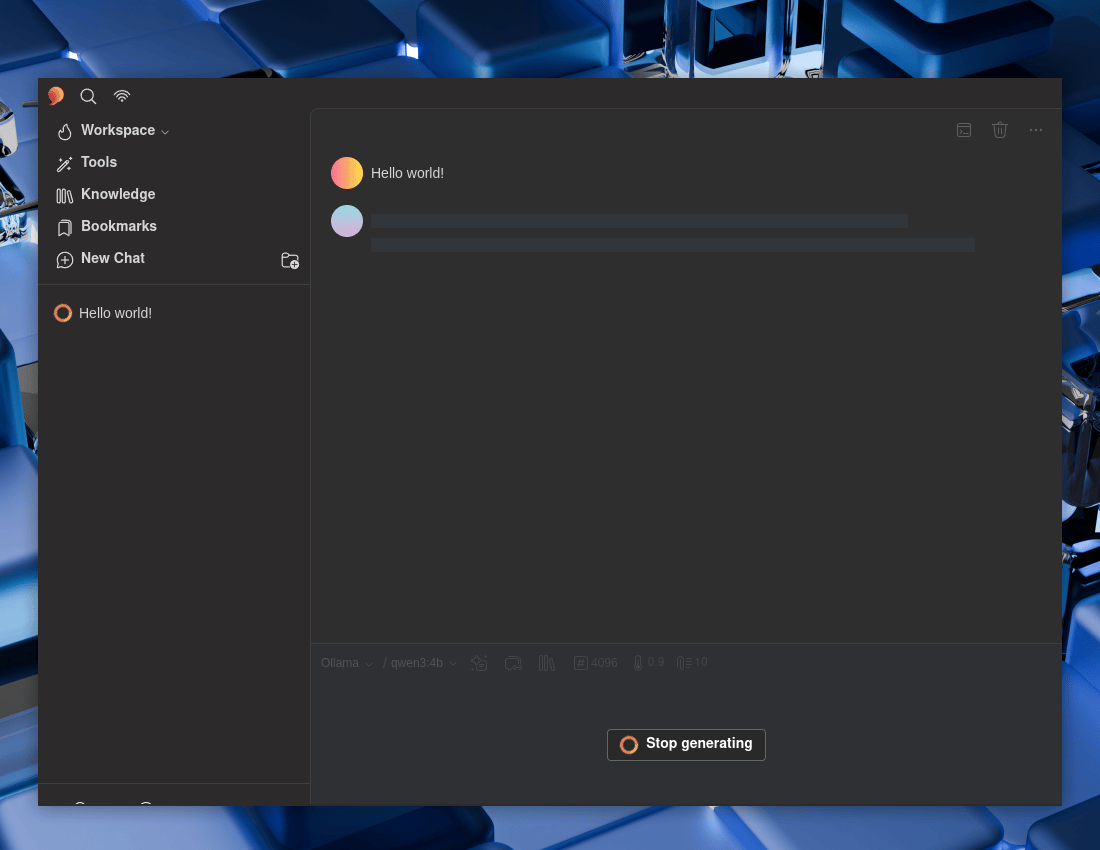
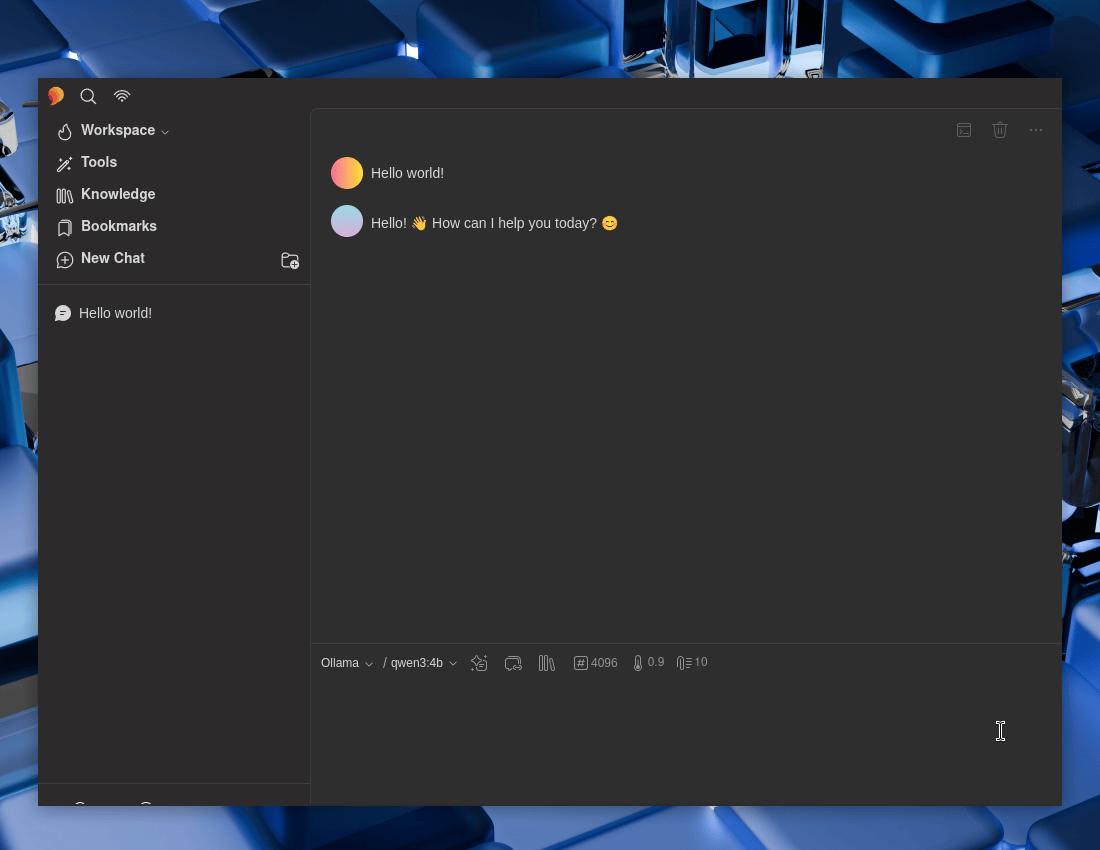
When the LLM has been loaded, we will get a prompt. Let’s just say “Hello world!”:
>>> Hello world!
Thinking...
Okay, the user said "Hello world!" and wants me to respond. Let me think about how to approach this. First, I should acknowledge their greeting. Since they used the classic "Hello World!" which is often
the first program in many programming languages, maybe I can relate that to my capabilities. I should make sure to keep the tone friendly and open for further conversation. Let me check if there's
anything specific they might need help with. Maybe they're just testing me or want to start a discussion. I'll keep the response simple and welcoming, inviting them to ask questions or share what they
need help with. Also, I should avoid any markdown and keep it natural. Alright, time to put that together.
...done thinking.
Hello! 😊 How can I assist you today? Whether you have questions, need help with something, or just want to chat, I'm here for you! What's on your mind?
>>> /exit
$
We can check Ollama status by doing:
$ ollama ps
NAME ID SIZE PROCESSOR CONTEXT UNTIL
qwen3:4b 359d7dd4bcda 3.5 GB 100% GPU 4096 4 minutes from now
$
Great, it appears that everything is working well here.
MCP Server (MCP Kali Server)
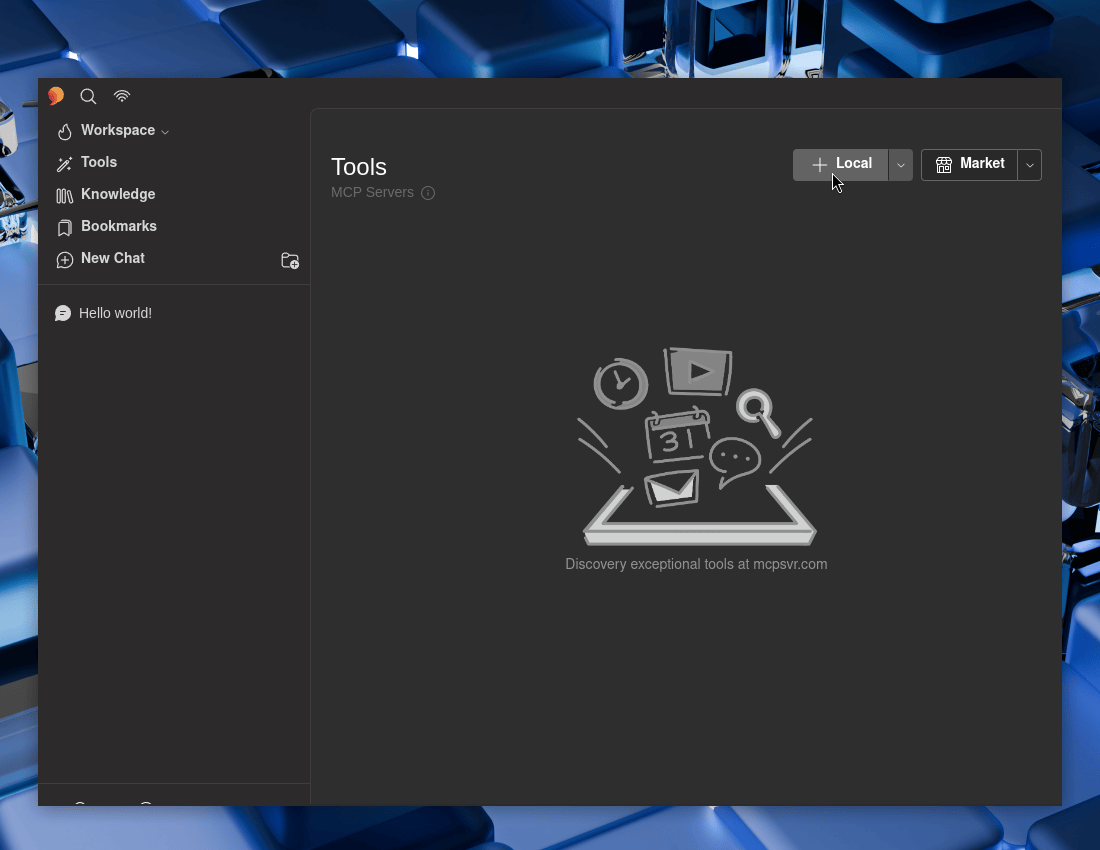
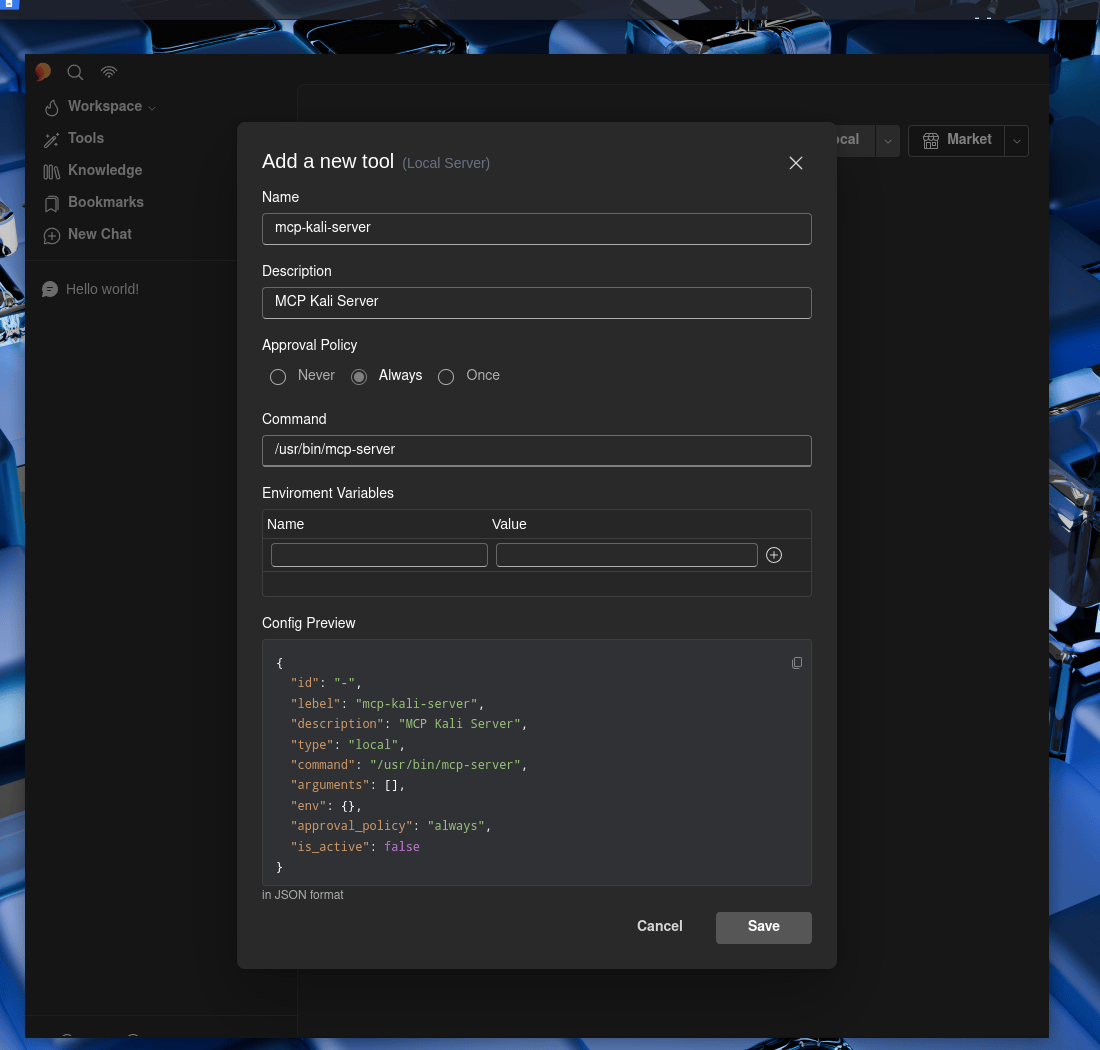
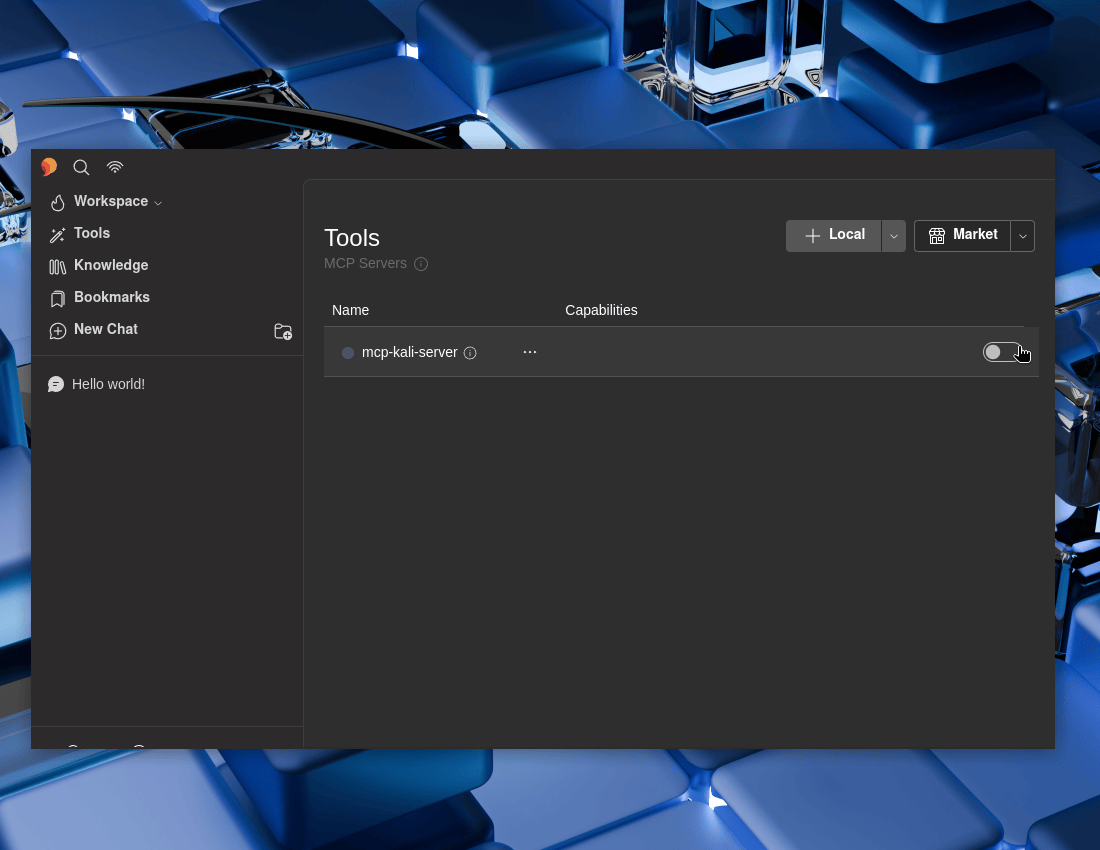
We will now need to install and run a MCP server.
For this guide, we did a fresh minimal installation of Kali, which means there isn’t any pre-installed tools.
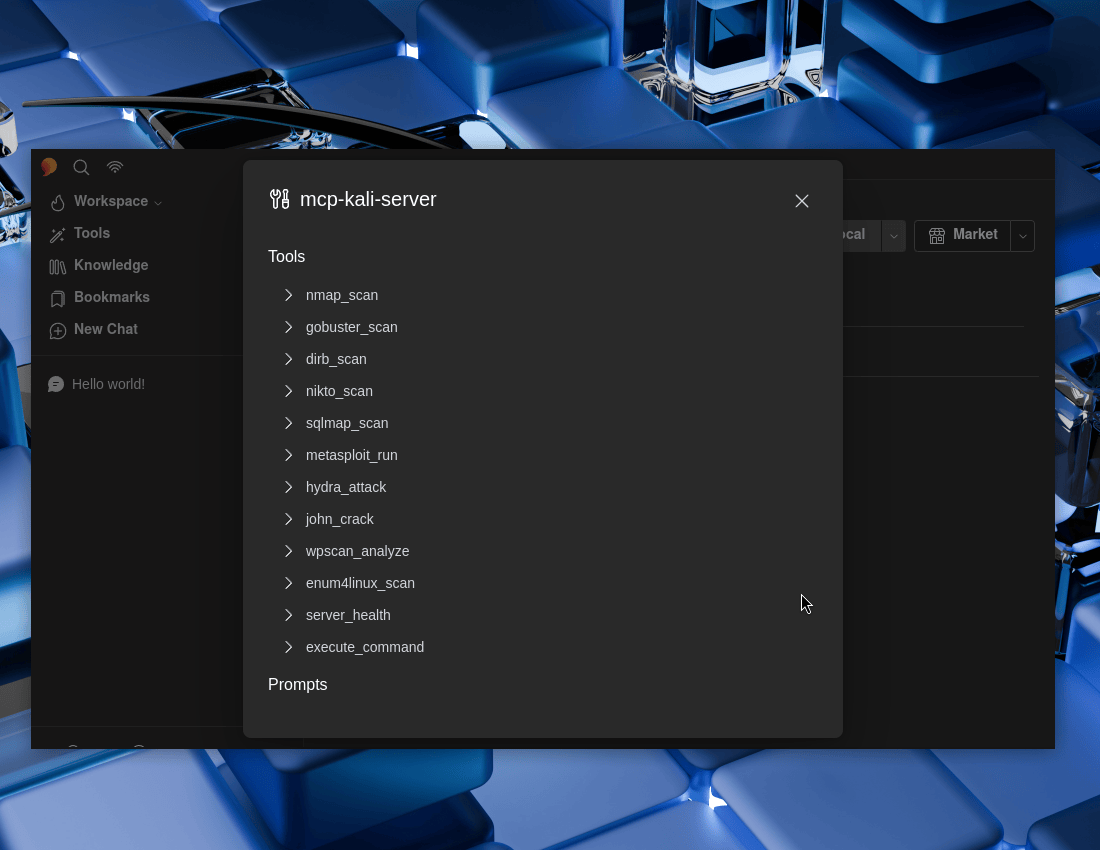
$ sudo apt install -y mcp-kali-server dirb gobuster nikto nmap enum4linux-ng hydra john metasploit-framework sqlmap wpscan wordlists
[...]
$
$ sudo gunzip -v /usr/share/wordlists/rockyou.txt.gz
/usr/share/wordlists/rockyou.txt.gz: 61.9% -- replaced with /usr/share/wordlists/rockyou.txt
$
$ kali-server-mcp
2026-01-27 15:54:01,339 [INFO] Starting Kali Linux Tools API Server on 127.0.0.1:5000
* Serving Flask app 'kali_server'
* Debug mode: off
2026-01-27 15:54:01,352 [INFO] WARNING: This is a development server. Do not use it in a production deployment. Use a production WSGI server instead.
* Running on http://127.0.0.1:5000
2026-01-27 15:54:01,352 [INFO] Press CTRL+C to quit
Long term, there are various different ways to have kali-server-mcp running in the background, such as using a tmux/screen session, or creating a systemd.unit, but that’s out of scope for this.
Testing
Let’s manually run mcp-server now:
$ mcp-server
2026-01-27 15:54:18,802 [INFO] Initialized Kali Tools Client connecting to http://localhost:5000
2026-01-27 15:54:18,811 [INFO] Successfully connected to Kali API server at http://localhost:5000
2026-01-27 15:54:18,811 [INFO] Server health status: healthy
2026-01-27 15:54:18,826 [INFO] Starting Kali MCP server
2026-01-27 15:54:18,804 [INFO] Executing command: which nmap
2026-01-27 15:54:18,806 [INFO] Executing command: which gobuster
2026-01-27 15:54:18,807 [INFO] Executing command: which dirb
2026-01-27 15:54:18,808 [INFO] Executing command: which nikto
2026-01-27 15:54:18,810 [INFO] 127.0.0.1 - - [27/Jan/2026 15:54:18] "GET /health HTTP/1.1" 200 -
Everything is looking good! No errors or warnings.
We can also see that kali-server-mcp has additional lines in its log. Good.
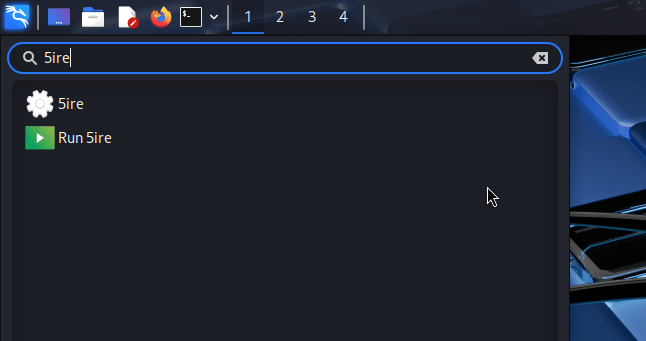
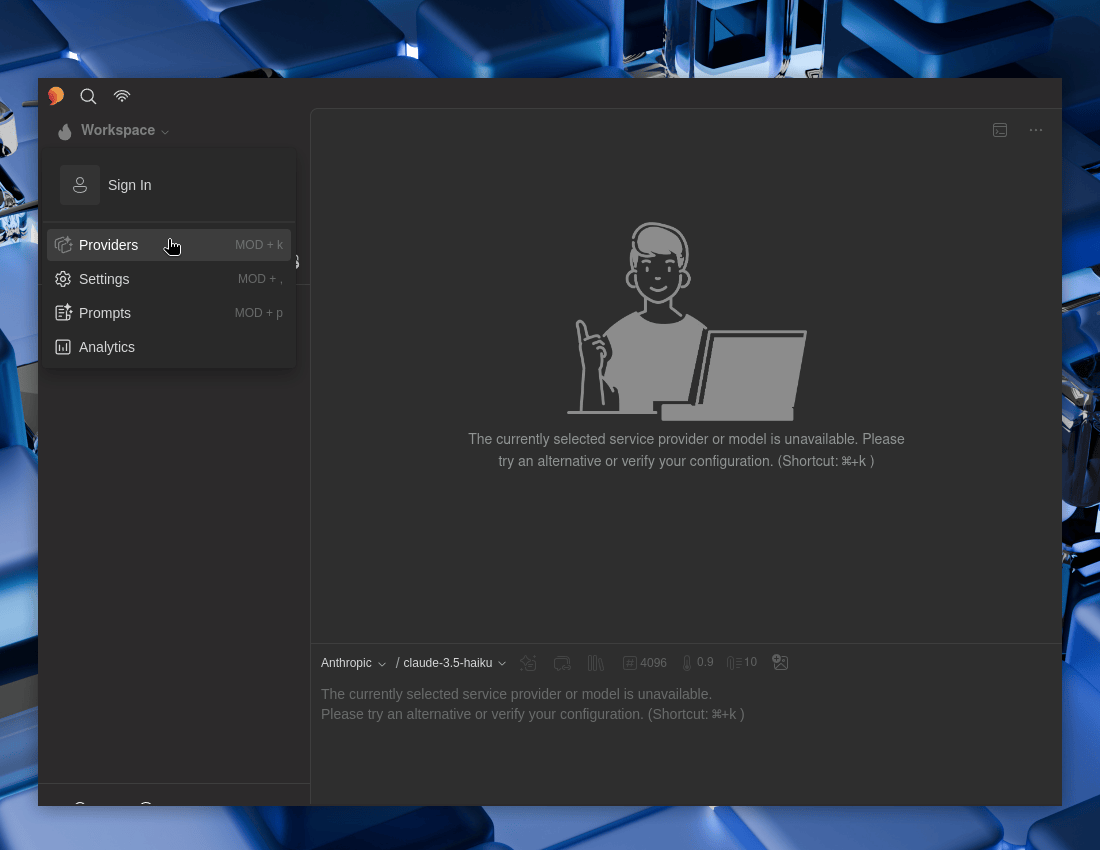
5ire
So we have a local LLM working, and a MCP.
Ollama doesn’t support MCP (yet?), so we need to use something that can take bridge the gap.
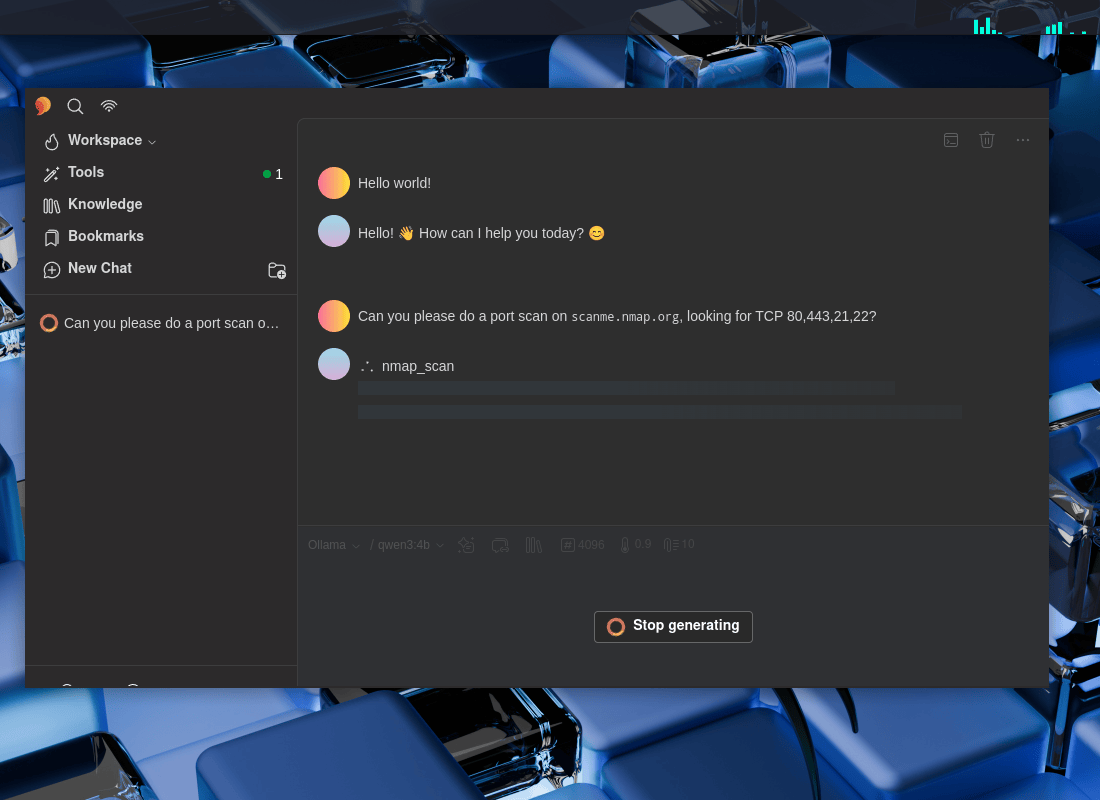
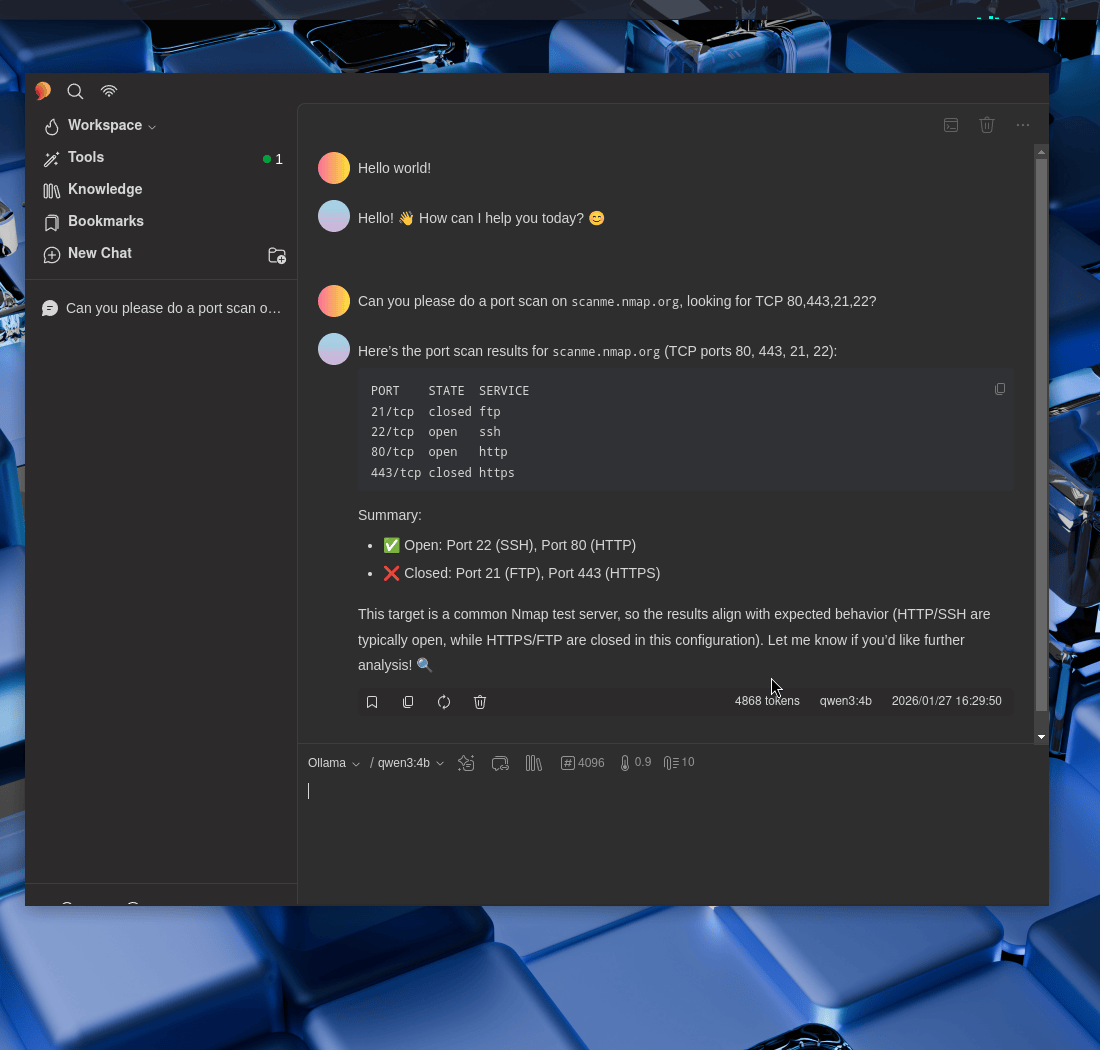
Enter 5ire - “A Sleek AI Assistant & MCP Client”.
Next, Download 5ire’s AppImage(5ire-0.15.3-x86_64.AppImage at the time of writing, 2026-01-27) and make a menu entry:
The SAFE act, introduced by Senators Mike Lee (R-UT) and Dick Durbin (D-IL), is the first of many likely proposals we will see to reauthorize Section 702 of the Foreign Intelligence Surveillance Act (FISA) Amendments Act of 2008—and while imperfect, it does propose a litany of real and much-needed reforms of Big Brother’s favorite surveillance authority.
The irresponsible 2024 reauthorization of the secretive mass surveillance authority Section 702 not only gave the government two more years of unconstitutional surveillance powers, it also made the policy much worse. But, now people who value privacy and the rule of law get another bite at the apple. With expiration for Section 702 looming in April 2026, we are starting to see the emergence of proposals for how to reauthorize the surveillance authority—including calls from inside the White House for a clean reauthorization that would keep the policy unchanged. EFF has always had a consistent policy: Section 702 should not be reauthorized absent major reforms that will keep this tactic of foreign surveillance from being used as a tool of mass domestic espionage.
What is Section 702?
Section 702 was intended to modernize foreign surveillance of the internet for national security purposes. It allows collection of foreign intelligence from non-Americans located outside the United States by requiring U.S.-based companies that handle online communications to hand over data to the government. As the law is written, the intelligence community (IC) cannot use Section 702 programs to target Americans, who are protected by the Fourth Amendment’s prohibition on unreasonable searches and seizures. But the law gives the intelligence community space to target foreign intelligence in ways that inherently and intentionally sweep in Americans’ communications.
We live in an increasingly globalized world where people are constantly in communication with people overseas. That means, while targeting foreigners outside the U.S. for “foreign intelligence Information” the IC routinely acquires the American side of those communications without a probable cause warrant. The collection of all that data from U.S telecommunications and internet providers results in the “incidental” capture of conversations involving a huge number of people in the United States.
But, this backdoor access to U.S. persons’ data isn’t “incidental.” Section 702 has become a routine part of the FBI’s law enforcement mission. In fact, the IC’s latest Annual Statistical Transparency Report documents the many ways the Federal Bureau of Investigation (FBI) uses Section 702 to spy on Americans without a warrant. The IC lobbied for Section 702 as a tool for national security outside the borders of the U.S., but it is apparent that the FBI uses it to conduct domestic, warrantless surveillance on Americans. In 2021 alone, the FBI conducted 3.4 million warrantless searches of US person’s 702 data.
The Good
Let’s start with the good things that this bill does. These are reforms EFF has been seeking for a long time and their implementation would mean a big improvement in the status quo of national security law.
First, the bill would partially close the loophole that allows the FBI and domestic law enforcement to dig through 702-collected data’s “incidental” collection of the U.S. side of communications. The FBI currently operates with a “finders keeper” mentality, meaning that because the data is pre-collected by another agency, the FBI believes it can operate with almost no constraints on using it for other purposes. The SAFE act would require a warrant before the FBI looked at the content of these collected communications. As we will get to later, this reform does not go nearly far enough because they can query to see what data on a person exists before getting a warrant, but it is certainly an improvement on the current system.
Second, the bill addresses the age-old problem of parallel construction. If you’re unfamiliar with this term, parallel construction is a method by which intelligence agencies or domestic law enforcement find out a piece of information about a subject through secret, even illegal or unconstitutional methods. Uninterested in revealing these methods, officers hide what actually happened by publicly offering an alternative route they could have used to find that information. So, for instance, if police want to hide the fact that they knew about a specific email because it was intercepted under the authority of Section 702, they might use another method, like a warranted request to a service provider, to create a more publicly-acceptable path to that information. To deal with this problem, the SAFE Act mandates that when the government seeks to use Section 702 evidence in court, it must disclosure the source of this evidence “without regard to any claim that the information or evidence…would inevitably have been discovered, or was subsequently reobtained through other means.”
Next, the bill proposes a policy that EFF and other groups have nonetheless been trying to get through Congress for over five years: ending the data broker loophole. As the system currently stands, data brokers who buy and sell your personal data collected from smartphone applications, among other sources, are able to sell that sensitive information, including a phone’s geolocation, to the law enforcement and intelligence agencies. That means that with a bit of money, police can buy the data (or buy access to services that purchase and map the data) that they would otherwise need a warrant to get. A bill that would close this loophole, the Fourth Amendment is Not For Sale Act passed through the House in 2024 but has yet to be voted on by the Senate. In the meantime, states have taken it upon themselves to close this loophole with Montana being the first state to pass similar legislation in May 2025. The SAFE Act proposes to partially fix the loophole at least as far as intelligence agencies are concerned. This fix could not come soon enough—especially since the Office of the Director of National Intelligence has signaled their willingness to create one big, streamlined, digital marketplacewhere the government can buy data from data brokers.
Another positive thing about the SAFE Act is that it creates an official statutory end to surveillance power that the government allowed to expire in 2020. In its heyday, the intelligence community used Section 215 of the Patriot Act to justify the mass collection of communication records like metadata from phone calls. Although this legal authority has lapsed, it has always been our fear that it will not sit dormant forever and could be reauthorized at any time. This new bill says that its dormant powers shall “cease to be in effect” within 180 of the SAFE Act being enacted.
What Needs to Change
The SAFE Act also attempts to clarify very important language that gauges the scope of the surveillance authority: who is obligated to turn over digital information to the U.S. government. Under Section 702, “electronic communication service providers” (ECSP) are on the hook for providing information, but the definition of that term has been in dispute and has changed over time—most recently when a FISA court opinion expanded the definition to include a category of “secret” ECSPs that have not been publicly disclosed. Unfortunately, this bill still leaves ambiguity in interpretation and an audit system without a clear directive for enforcing limitations on who is an ECSP or guaranteeing transparency.
As mentioned earlier, the SAFE Act introduces a warrant requirement for the FBI to read the contents of Americans’ communications that have been warrantlessly collected under Section 702. However, the law does not in its current form require the FBI to get a warrant before running searches identifying whether Americans have communications present in the database in the first place. Knowing this information is itself very revealing and the government should not be able to profit from circumventing the Fourth Amendment.
When Congress reauthorized Section 702 in 2014, they did so through a piece of policy called the Reforming Intelligence and Securing America Act (RISAA). This bill made 702 worse in several ways, one of the most severe being that it expanded the legal uses for the surveillance authority to include vetting immigrants. In an era when the United States government is rounding up immigrants, including people awaiting asylum hearings, and which U.S officials are continuously threatening to withhold admission to the United States from people whose politics does not align with the current administration, RISAA sets a dangerous precedent. Although RISAA is officially expiring in April, it would be helpful for any Section 702 reauthorization bill to explicitly prohibit the use of this authority for that reason.
Finally, in the same way that the SAFE Act statutorily ends the expired Section 215 of the Patriot Act, it should also impose an explicit end to “Abouts collection” a practice of collecting digital communications, not if their from suspected people, but if their are “about” specific topics. This practice has been discontinued, but still sits on the books, just waiting to be revamped.
We're celebrating the launch of Privacy's Defender, a new book byEFF Executive Director Cindy Cohn on Thursday, March 12—and we want you to join us! Cindy has tangled with the feds, fought for your data security, and argued before judges to protect our access to science and knowledge on the internet. In Privacy's Defender she asks: can we still have private conversations if we live our lives online?
Join the festivities for a live conversation betweenCindy Cohnand Annalee Newitzfollowed by a book signing with Cindy.
$20 General Admission for 1 $30 Discounted tickets for 2 $12.50 Student Ticket All proceeds benefit EFF's mission.
Want your own copy of Privacy's Defender? Save $10 when you preorder the book with your ticket purchase
WHEN: Thursday, March 12th, 2026 6:30 pm to 9:30 pm
WHERE: Ciel Creative Space Entrance located at: 940 Parker St, Berkeley, CA 94710
6:30 PM Doors Open 7:15 PM Program Begins
About the book
Throughout her career, Cindy Cohn has been driven by a fundamental question: Can we still have private conversations if we live our lives online? Privacy’s Defender chronicles her thirty-year battle to protect our right to digital privacy and shows just how central this right is to all our other rights, including our ability to organize and make change in the world.
Shattering the hypermasculine myth that our digital reality was solely the work of a handful of charismatic tech founders, the author weaves her own personal story with the history of Crypto Wars, FBI gag orders, and the post-9/11 surveillance state. She describes how she became a seasoned leader in the early digital rights movement, as well as how this work serendipitously helped her discover her birth parents and find her life partner. Along the way, she also details the development of the Electronic Frontier Foundation, which she grew from a ragtag group of lawyers and hackers into one of the most powerful digital rights organizations in the world.
Part memoir and part legal history for the general reader, the book is a compelling testament to just how hard-won the privacy rights we now enjoy as tech users are, but also how crucial these rights are in our efforts to combat authoritarianism, grow democracy, and strengthen other human rights.Learn about the Privacy's Defender book tour.
Parking
Street parking is available around the building.
Accessibility
The main event space is wheelchair accessible, on concrete. Lively music will be playing, and the speakers will be using a microphone, so louder volumes are expected. EFF is committed to improving accessibility for our events. If you will be attending in-person and need accommodation, or have accessibility questions prior to the event, please contact events@eff.org.
Food and Drink
Wine & Beer will be available for purchase.Cellarmaker Brewing Co., located next door to Ciel Space, will be serving food until 8:00 pm.
Cindy Cohn Cindy Cohn is the Executive Director of the Electronic Frontier Foundation. From 2000-2015 she served as EFF’s Legal Director as well as its General Counsel. Ms. Cohn first became involved with EFF in 1993, when EFF asked her to serve as the outside lead attorney in Bernstein v. Dept. of Justice, the successful First Amendment challenge to the U.S. export restrictions on cryptography.
Ms. Cohn has been named to TheNonProfitTimes 2020 Power & Influence TOP 50 list, honoring 2020's movers and shakers. In 2018, Forbes included Ms. Cohn as one of America's Top 50 Women in Tech. The National Law Journal named Ms. Cohn one of 100 most influential lawyers in America in 2013, noting: "[I]f Big Brother is watching, he better look out for Cindy Cohn." She was also named in 2006 for "rushing to the barricades wherever freedom and civil liberties are at stake online." In 2007 the National Law Journal named her one of the 50 most influential women lawyers in America. In 2010 the Intellectual Property Section of the State Bar of California awarded her its Intellectual Property Vanguard Award and in 2012 the Northern California Chapter of the Society of Professional Journalists awarded her the James Madison Freedom of Information Award.
Ms. Cohn is the author of the professional memoir, called Privacy's Defender to be published by MIT Press in March, 2026. She is also the co-host of EFF's award-winning podcast, How to Fix the Internet.
Annalee Newitz Annalee Newitz writes science fiction and nonfiction. They are the author of four novels: Automatic Noodle, The Terraformers, The Future of Another Timeline, and Autonomous, which won the Lambda Literary Award. As a science journalist, they are the author of Stories Are Weapons: Psychological Warfare and the American Mind, Four Lost Cities: A Secret History of the Urban Age and Scatter, Adapt and Remember: How Humans Will Survive a Mass Extinction, which was a finalist for the LA Times Book Prize in science. They are a writer for the New York Times and elsewhere, and have a monthly column in New Scientist. They have published in The Washington Post, Slate, Scientific American, Ars Technica, The New Yorker, and Technology Review, among others. They were the co-host of the Hugo Award-winning podcastOur Opinions Are Correct, and have contributed to the public radio shows Science Friday, On the Media, KQED Forum, and Here and Now. Previously, they were the founder of io9, and served as the editor-in-chief of Gizmodo.
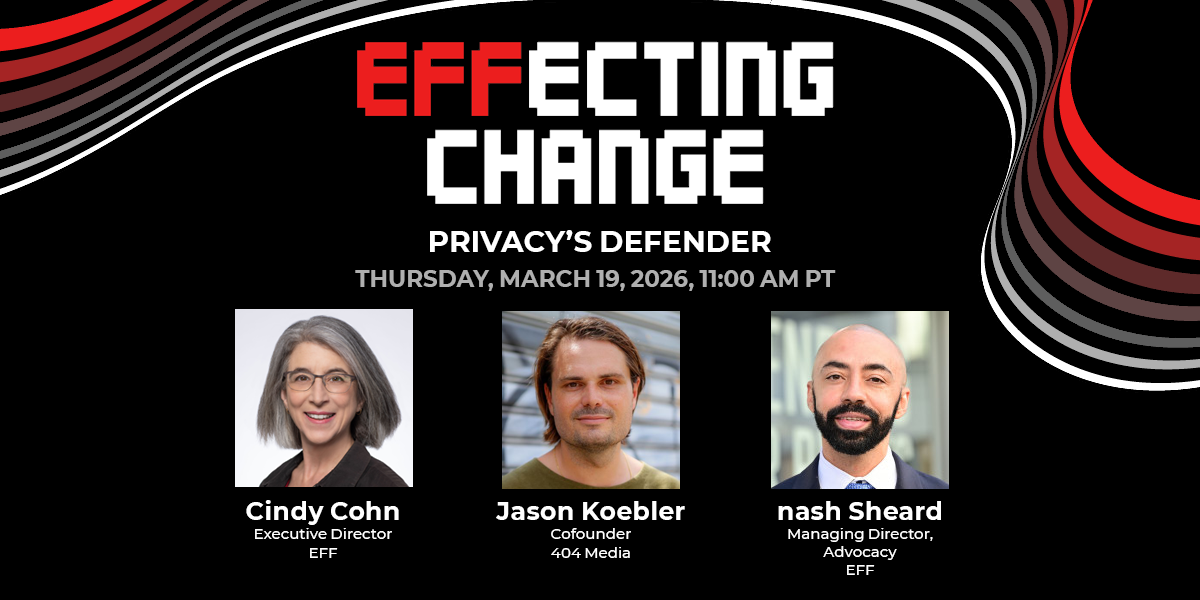
Join EFF Executive Director Cindy Cohn in conversation with 404 Media Cofounder Jason Koebler to discuss Privacy's Defender: My Thirty-Year Fight Against Digital Surveillance, Cindy’s personal story of standing up to the Justice Department, taking on the NSA, and tangling with the FBI to protect our right to digital privacy. The highly anticipated book asks the fundamental question: Can we still have private conversations if we live our lives online? Join the livestream for a live discussion followed by by Q&A.
EFFecting Change Livestream Series: Privacy's Defender Thursday, March 19th 11:00 AM - 12:00 PM Pacific This event is LIVE and FREE!
Accessibility
This event will be live-captioned and recorded. EFF is committed to improving accessibility for our events. If you have any accessibility questions regarding the event, please contactevents@eff.org.
Event Expectations
EFF is dedicated to a harassment-free experience for everyone, and all participants are encouraged to view our fullEvent Expectations.
Upcoming Events
Want to make sure you don’t miss our next livestream? Here’s a link to sign up for updates about this series:eff.org/ECUpdates. If you have a friend or colleague that might be interested, please join the fight for your digital rights by this link:eff.org/EFFectingChange. Thank you for helping EFF spread the word about privacy and free expression online.
Cindy Cohn Cindy Cohn is the Executive Director of the Electronic Frontier Foundation. From 2000-2015 she served as EFF’s Legal Director as well as its General Counsel. Ms. Cohn first became involved with EFF in 1993, when EFF asked her to serve as the outside lead attorney in Bernstein v. Dept. of Justice, the successful First Amendment challenge to the U.S. export restrictions on cryptography. Ms. Cohn has been named to TheNonProfitTimes 2020 Power & Influence TOP 50 list, honoring 2020's movers and shakers. In 2018, Forbes included Ms. Cohn as one of America's Top 50 Women in Tech. The National Law Journal named Ms. Cohn one of 100 most influential lawyers in America in 2013, noting: "[I]f Big Brother is watching, he better look out for Cindy Cohn." She was also named in 2006 for "rushing to the barricades wherever freedom and civil liberties are at stake online." In 2007 the National Law Journal named her one of the 50 most influential women lawyers in America. In 2010 the Intellectual Property Section of the State Bar of California awarded her its Intellectual Property Vanguard Award and in 2012 the Northern California Chapter of the Society of Professional Journalists awarded her the James Madison Freedom of Information Award.
Jason Koebler Jason Koebler is a cofounder of 404 Media, a journalist-owned investigative tech publication. He reports on surveillance and privacy, the ways that artificial intelligence is changing the internet, labor, and society, and consumer rights. Before 404 Media, he was the editor-in-chief of Motherboard, VICE's technology publication and an executive producer on Encounters, a Netflix documentary about the search for alien life.
Unlike previous Wi-Fi attacks, AirSnitch exploits core features in Layers 1 and 2 and the failure to bind and synchronize a client across these and higher layers, other nodes, and other network names such as SSIDs (Service Set Identifiers). This cross-layer identity desynchronization is the key driver of AirSnitch attacks.
The most powerful such attack is a full, bidirectional machine-in-the-middle (MitM) attack, meaning the attacker can view and modify data before it makes its way to the intended recipient. The attacker can be on the same SSID, a separate one, or even a separate network segment tied to the same AP. It works against small Wi-Fi networks in both homes and offices and large networks in enterprises.
With the ability to intercept all link-layer traffic (that is, the traffic as it passes between Layers 1 and 2), an attacker can perform other attacks on higher layers. The most dire consequence occurs when an Internet connection isn’t encrypted—something that Google recently estimated occurred when as much as 6 percent and 20 percent of pages loaded on Windows and Linux, respectively. In these cases, the attacker can view and modify all traffic in the clear and steal authentication cookies, passwords, payment card details, and any other sensitive data. Since many company intranets are sent in plaintext, traffic from them can also be intercepted.
Even when HTTPS is in place, an attacker can still intercept domain look-up traffic and use DNS cache poisoning to corrupt tables stored by the target’s operating system. The AirSnitch MitM also puts the attacker in the position to wage attacks against vulnerabilities that may not be patched. Attackers can also see the external IP addresses hosting webpages being visited and often correlate them with the precise URL.

 Login