Normal view

The NO FAKES Act Could Silence Satire, Commentary, And News

17 June 2026 at 22:33

The NO FAKES Act is supposed to target harmful AI-generated impersonations. But in reality, it will make it easier to suppress commentary, satire, and other lawful speech. That's why EFF has signed a letter urging the Senate Judiciary Committee not to advance the bill in its current form.

Take action

Tell Congress to Say No to NO FAKES

In the letter, EFF joins a coalition of civil society groups in pointing out that the bill would import many of the worst features of the DMCA notice-and-takedown system into an even broader range of online expression. Faced with a “heckler’s veto” over legal speech, platforms will have incentives to remove content first and ask questions later. 

The bill offers no protection for a platform’s judgment about an often difficult question—whether a particular piece of content is satire, parody, commentary, or news. Any platform that guesses wrong faces penalties of up to $750,000 per work. 

NO FAKES could also undermine the rights of the people it is supposed to protect. The new federal “likeness” right could be licensed or transferred to others, so individuals will lose control over the use of their own face and voice. That’s not theoretical—workers in the entertainment industry are routinely asked to sign broad contracts about the future use of their likenesses.

As the letter notes: 

A background actor who signs a release on set or an ordinary person who clicks through a platform's terms of service could end up with the right to their own face and voice in someone else's hands, for years, with federal enforcement behind it. 

EFF and the other signatories urge Congress to examine existing legal remedies and pursue narrowly tailored solutions to genuine harms. The last thing we need is a sweeping new intellectual property right that threatens free expression. 

In addition to EFF, the letter is signed by the Center for Democracy & Technology, the American Civil Liberties Union, Fight for the Future, Foundation for Individual Rights and Expression, the Organization for Transformative Works, Public Knowledge, the R Street Institute, The Future of Free Speech, and the Woodhull Freedom Foundation. Read the full letter here. 

Take action

Tell Congress to Say No to NO FAKES

Congress Just Rushed Through a Disastrous Copyright Office Overhaul

11 June 2026 at 00:54

In a voice vote earlier this week, the House of Representatives passed H.R. 6028, the “Legislative Branch Agencies Clarification Act.” The legislation is presented as a technical reorganization of some government agencies, but it’s much more than that. 

H.R. 6028 would fundamentally change the U.S. Copyright Office, and not in a good way. The bill removes the Library of Congress’ current supervisory role over the Copyright Office, transfers several powers directly to the Register of Copyrights, and makes the Register a presidential appointee, confirmed by the Senate. 

These changes would make an office that’s already hugely influential in copyright and tech policy much more political. EFF first explained why that’s a terrible idea when it came up nearly a decade ago. This bill, like the older one, weakens the few public-interest checks and balances that do exist.  We hope the Senate promptly rejects this bill. 

The Copyright Office Doesn’t Need More Politics—Or More Power

The Copyright Office's main responsibilities are administrative and advisory. It registers copyrights, maintains records, grows the Library of Congress’s collections, and provides expertise to Congress on copyright law. But over the past two decades, the Office has also become increasingly influential in copyright policy debates that affect free expression, libraries, educators, competition—and everyday internet users. Unfortunately, it has not been a neutral advocate. The office’s recent report on the role of AI severely bungled the issue of fair use, prioritizing private licensing market “solutions” over user rights. 

Going further back, the Copyright Office supported one of the most infamous anti-internet proposals of all time—the Stop Online Piracy Act (SOPA), a disastrous internet censorship proposal that sparked one of the largest online protests in history. The Office has repeatedly advanced positions that favored large entertainment-industry interests over the public interest.

The Office also plays a major role in the Digital Millennium Copyright Act (DMCA) Section 1201 rulemaking process, which determines when the public may lawfully bypass digital locks for activities such as security research, repair, preservation, or accessibility. EFF has used this process repeatedly to mitigate some of the worst harms of the DMCA. H.R. 6028 would move rulemaking authority over 1201 from the Librarian of Congress to the Register of Copyrights, further consolidating power within the Copyright Office itself.

The bill also makes the Register of Copyrights a presidential appointee confirmed by the Senate. Each administration will be pressured to pick nominees aligned with their own policy preferences, and the powerful copyright owning industries will invest even more heavily in lobbying to get their way, and influence the selection. This position should be focused on administrative ability and actual expertise, not lobbying and politics. 

The Copyright Office Should Stay Connected To The Library of Congress

H.R. 6028 would do more than change who appoints the Register of Copyrights. It would sever the Copyright Office from Library of Congress supervision and transfer many Librarian powers directly to the Register. 

The supervisory relationship exists for good reason, as the nation’s libraries have pointed out for years. The Library, while far from perfect, at least has the mission of preserving and providing access to knowledge. That should be an important public-interest counterweight in copyright debates. Congress has not explained how weakening the ties between the Library and the Copyright Office would serve the public better, or even seriously inquired about it. 

This Bill Was Rushed Through

Back in March, EFF joined Public Knowledge, the Center for Democracy and Technology, library organizations and tech groups, urging Congress not to fast-track this legislation. We told them changes to the Copyright Office will have major consequences for the “speech rights, educational opportunities, and creative freedoms of all Americans.” 

Yet Congress moved forward without any hearings on the bill, and without meaningful examination. H.R. 6028 creates a years-long separation of the Copyright Office from the Library of Congress, transfers significant legal authority, and restructures the appointment process for the nation’s top copyright official. Changes like that deserve hearings, debate, and public scrutiny. H.R. 6028 got none of that. 

The Senate Should Stop This Bill

Copyright law exists to serve the public and “promote the progress” of science and learning. The institutions that administer copyright law should do the same. 

H.R. 6028 would move the Copyright Office further away from that goal. Congress should be strengthening public-interest oversight of copyright policymaking, not looking for ways to concentrate more authority in a single presidentially appointed official. 

The Senate should reject H.R. 6028. The Copyright Office should serve the public—not presidential administrations, and not industry lobbyists. 

Cheers to the Winners of EFF’s 18th Annual Cyberlaw Trivia Night! 

8 June 2026 at 21:12

On a warm June evening in San Francisco, attorneys and other legally-minded friends of EFF gathered for our 18th Annual Cyberlaw Trivia Night, an annual test of tech-related legal knowledge, and the ability to remember some deeply obscure facts under pressure. 

Returning Quizmaster Kurt Opsahl once again guided competitors through six rounds of trivia covering everything from intellectual property and free speech to privacy, security, and artificial intelligence. Teams wrestled with questions about geofence warrants, AI copyright disputes, the SOPA/PIPA internet blackout, Section 230, and even a Senate hearing featuring a contestant who was herself present at cyberlaw trivia. 

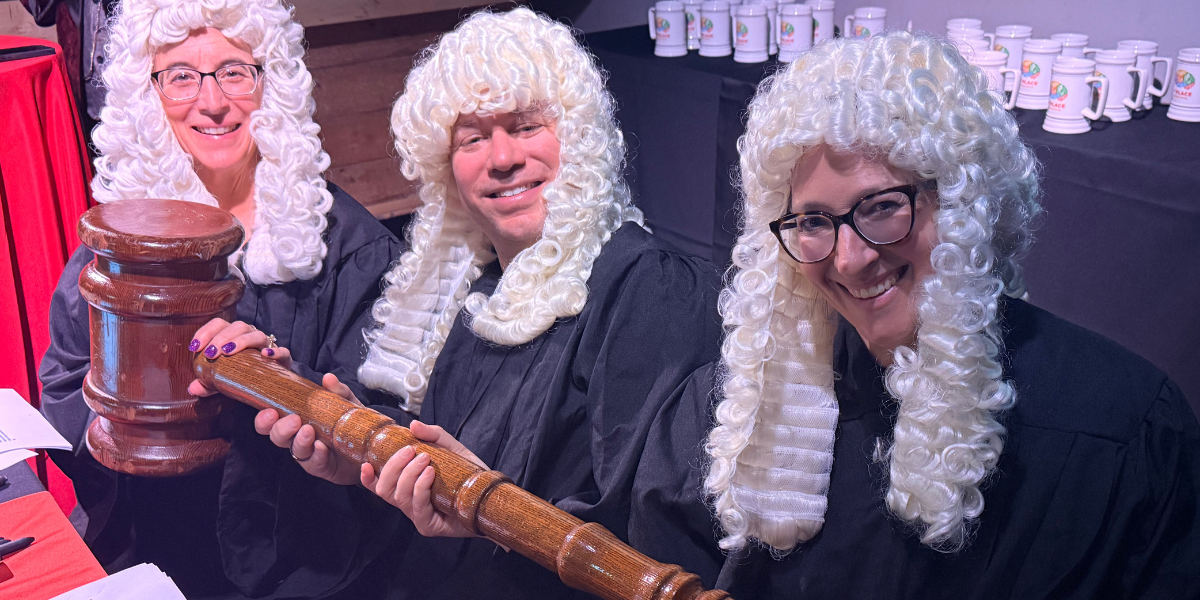
The judges’ table made it obvious that 2026 was a notable year. Weighing in on the toughest close calls were three folks with a deep history at our org: outgoing EFF Executive Director Cindy Cohn and new Executive Director Nicole Ozer both sat at as judges, joined by new cyberlaw judge Mike Masnick, founder of Techdirt and a recipient of an EFF Award in 2020

The food was hot, the drinks were cold, and the competition was fierce. Teams including Shady Docket, Byte Club, Flock U, This Is Why We Can't Have Nice Precedent, Nicky's Angels, and Betamaxxers battled through six rounds of challenging questions. 

When a question about Afroman's successful legal battle against Ohio sheriff's deputies came up, members of Byte Club offered to do more than name his most popular album: they offered to perform a rendition of “Lemon Pound Cake” (also the album name—tricky!) for the judges. This won no sway with the 3-judge Cyberlaw Judiciary, and the offer was politely declined. 

The teams racked their collective law-noggins about some of the details of recent legal battles over digital rights, and a round entitled “You Can Call Me AI.” After the IP round, which rewarded folks in the audience who could answer details about the server test, the trivia moved onto newsier questions, with questions about ICE apps, anti-ICE apps, recent defamation cases involving our sitting president, and the slogan of a mineral company that you might've heard on terrestrial radio anytime between the early aughts and this week. 

You don't have to wear a morning coat to win Supreme Court arguments, but knowing who did for 4 years might have helped you win the IP round. 

By the end of regulation play, the cyberlaw trivia competition was closer than we could have imagined. For the first time in Cyberlaw Trivia history, three teams finished tied for first place, sending the contest to two tiebreaker questions. 

The final question noted that Google had received more than 287,000 government information requests in the first half of 2025, and asked teams to estimate how many were received by OpenAI during the same period. Every team guessed over, but it was the victors, Shady Docket, who guessed the lowest: 260. (The real answer is 146.)

As Shady Docket team member Erin Simon explained after the win: "As much as we love EFF, what we love even more is crushing other trivia teams."

In second place were Nicky’s Angels. Rounding out the virtual podium in 3rd were the Betamaxxers, who jumped ahead early with a home-run run in the Free Speech round, getting every question correct. 

Each summer, EFF's Cyberlaw Trivia Night brings together the legal community that helps defend privacy, free expression, innovation, and digital rights. We want to especially thank this year Morrison Foerster, Fenwick, Wilson Sonsini, and Public Resource for supporting EFF's legal intern program.

Are you an attorney interested in defending civil liberties in the digital world? Consider joining EFF's Cooperating Attorneys list. This network helps EFF connect people to legal assistance when EFF is unable to provide direct assistance. 

Fighting for first place at EFF’s Cyberlaw Trivia Night helps us fight for your rights online! Sponsor one of our annual events and join the movement for digital privacy, free speech, and innovation. Please visit eff.org/thanks or contact tierney@eff.org for more information.

California’s AB 412 Still Demands Developers Do The Impossible

5 June 2026 at 00:56

California lawmakers are again considering A.B. 412, a bill that would require AI developers to identify and disclose copyrighted works used to train generative AI systems.

The problem this year is the same as last year: it’s practically impossible to comply with this law. The bill demands information that often does not exist, and cannot realistically be obtained. 

EFF submitted an opposition letter to the California Senate Privacy Committee explaining why we continue to believe A.B. 412 is simply unworkable. To the extent developers do follow this law, it will have the effect of locking in the power of the largest companies in AI. 

A Burden That Can’t Be Met

A.B. 412 sounds simple: just have AI developers create and keep a list of all the registered copyrighted works they use in AI training. 

That may seem straightforward. In practice, it’s anything but. 

There is no machine-readable “list” of copyrighted works at the U.S. Copyright Office. And many copyright holders can get a copyright without even depositing a publicly viewable sample of the work—for example, software companies may register copyright on proprietary code without revealing it to the public. 

And on the open internet, copyright information is often incomplete, unavailable, or impossible to verify. One image may be registered with the copyright office, while the next is licensed under a free Creative Commons license (like the images that EFF creates), and the next is public domain. A message forum user might post an original story, photograph, or poem without any indication of ownership or registration status. 

The bill effectively asks developers to continuously cross-reference massive batches of online data against a copyright system that simply wasn’t designed to do so. If California passes A.B. 412, its impact will go far beyond the large AI companies we read about in the headlines. 

Not Just Big Tech

Supporters often frame this bill as a way to help creative workers have some leverage against Big Tech, but the bill reaches much further than the big AI companies. 

Its definition of “developer” extends to anyone who makes a generative AI model available to Californians. That includes indie developers tinkering with an existing model, open-source initiatives, nonprofits, and other non-commercial efforts. Recent amendments added exemptions for universities and government entities, which is important, but that still leaves out a vast swathe of non-commercial tech work that’s done by people without full-time jobs in government or academia. 

Large companies will hire compliance teams and lawyers to navigate these requirements. Smaller organizations and independent developers usually can’t. The result will be fewer opportunities for startups and new entrants. Faced with this massive compliance burden, some won’t even try. 

Courts Are Already Deciding These Questions

The bill is premised on the idea that copyright owners currently don’t have good remedies if they’re mistreated by AI companies. That simply isn’t true. And the growing wave of federal court filings in this space prove it. Content companies that want to sue tech companies, large or small, have no problem doing so. Those courts are still working through important questions about fair use and transformative use. Some courts have already concluded that many AI training activities qualify as fair use. Others continue to evaluate the issue.

California lawmakers should not rush to impose new state regulation while those questions remain unresolved. This is why copyright is governed at the federal level: both creators and fair users benefit from a single set of nationwide rules. 

At this point, the bill remains a solution in search of a problem. Rights holders already have powerful tools to protect their interests under existing federal law. What this bill adds isn’t clarity or transparency, but a costly and essentially impossible compliance burden that will discourage small developers and researchers. 

California has been able to support both artistic creativity and tech innovation for decades now.  But A.B. 412 does not strike the right balance. 

If you are a California resident and interested in speaking out about this bill, you can find and contact your representatives through this website

Congress Narrowed the GUARD Act, But Serious Problems Remain

9 May 2026 at 01:24

Following criticism, lawmakers have narrowed the GUARD Act, a bill aimed at restricting minors’ access to certain AI systems. The earlier version could have applied broadly to nearly every AI-powered chatbot or search tool. The amended bill focuses more narrowly on so-called “AI companions”—conversational systems designed to simulate emotional or interpersonal interactions with users. 

That change does address some of the broadest concerns raised about the original proposal, though some questions about the bill’s reach remain. Bottom line: the revised bill still creates serious problems for privacy, online speech, and parental choice.

TAKE ACTION

Tell Congress: oppose the guard act

The new GUARD Act still requires companies offering AI companions to implement burdensome age-verification systems tied to users’ real-world identities. Even parents who specifically want their teenagers to use these systems would still face significant hurdles. A family might decide that a conversational AI tool helps an isolated teenager practice social interaction, or engage in harmless creative roleplay. A parent deployed in the military might set up a persistent AI storyteller for a younger child. Under the revised bill, those users could still face mandatory age checks tied to sensitive personal or financial information before they or their children can use these services.

The revised bill also leaves important definitions unclear while sharply increasing penalties for developers and companies that get those judgments wrong. Congress narrowed the GUARD Act. But it is still trying to solve a complicated social problem with vague legal standards, heavy liability, and privacy-invasive verification systems.

Intrusive Age-Verification Remains In The Bill

The revised GUARD Act still requires companies offering AI companions to verify that users are adults through a “reasonable age verification” system. The bill allows a broader set of verification methods than the earlier version, but they are still tied to a user’s real-world identity—such as financial records, or age-verified accounts for a mobile operating system or app store. 

That approach still raises serious privacy and access concerns. Millions of Americans do not have current government ID, accounts at major banks, or stable access to the kinds of digital identity systems the bill contemplates. Even for those who do, requiring identity-linked verification to access online speech tools creates real risks for privacy, anonymity, and data security. Many people are rightly creeped out by age-verification systems, and may simply forgo using these services rather than compromise their privacy and security.

The revised definition of “AI companion” is also narrower than before, but it’s unclear at the margins. The bill now focuses on systems that “engage in interactions involving emotional disclosures” from the user, or present a “persistent identity, persona or character.” 

EFF appreciates that the authors recognized that the prior definition could reach a variety of AI systems that are not chatbots, including internet search engines. But the narrowed definition could be read to also apply to a variety of chat tools that are not AI companions. For example, many modern online conversational systems increasingly recognize and respond to users’ emotions. Customer service systems, including completely human-powered ones that existed long before AI chatbots, have long been designed to recognize frustration and respond empathetically. As conversational AI becomes more emotionally responsive, a customer service chatbot’s efforts to empathize may sweep it within the bill’s definition. 

Bigger Penalties, Bigger Incentives To Restrict Access

The revised bill also sharply increases penalties. Instead of $100,000 per violation, companies—including small developers—can face fines of up to $250,000 per violation, enforced by both federal and state officials.

That kind of liability creates incentives to over-restrict access, especially for minors. Smaller developers, in particular, may decide it is safer to block younger users entirely, disable conversational features, or avoid developing certain tools at all, rather than risk severe penalties under vague standards.

The concerns driving this bill are real. Some AI systems have engaged in troubling interactions with vulnerable users, including minors. But the right answer to that is targeted enforcement against bad actors, and privacy laws that protect us all. The revised GUARD Act instead responds with a privacy-invasive system that burdens the right to speak, read, and interact online.

Congress did improve this bill, but EFF’s core speech, privacy, and security issues remain.

TAKE ACTION

Tell Congress: oppose the guard act

The GUARD Act Isn’t Targeting Dangerous AI—It’s Blocking Everyday Internet Use

28 April 2026 at 01:22

Lawmakers in Congress are moving quickly on the GUARD Act, an age-gating bill restricting minors’ access to a wide range of online tools, with a key vote expected this week. The proposal is framed as a response to alarming cases involving “AI companions” and vulnerable young users. But the text of the bill goes much further, and could require age gates even for search engines that use AI. 

TAKE ACTION

Tell Congress: oppose the guard act

If enacted, the GUARD Act won’t just target a narrow category of risky chatbots. It would require companies to verify the age of every user — then block anyone under 18 from interacting with a huge range of online systems. It would block minors from everyday online tools, undermine parental guidance, and force adults to sacrifice their privacy. In the process, it would require services to implement speech-restricting and privacy-invasive age-verification systems for everyone—not just kids. 

Under the GUARD Act’s broad definitions, a high school student could be barred from asking homework help tools questions about algebra problems. A teenager trying to return a product could be kicked out of a standard customer-service chat. 

The concerns behind this bill are serious. There have been troubling reports of AI systems engaging in harmful interactions with young users, including cases involving self-harm. Those risks deserve attention. But they call for targeted solutions, like better safeguards and enforcement against bad actors, not sweeping restrictions. The bill’s sponsors say they’re targeting worst-case scenarios — but the bill regulates everyday use. 

The GUARD Act’s Broad Definitions Reach Everyday Tools

The problem starts with how the bill defines an “AI chatbot.” It covers any system that generates responses that aren’t fully pre-written by the developer or operator. Such a broad definition sweeps in the basic functionality of all AI-powered tools. 

Then there’s the definition of an “AI companion,” which minors are banned from using entirely. An AI companion is any chatbot that produces human-like responses and is designed to “encourage or facilitate” interpersonal or emotional interaction. That may sound aimed at simulated “friends” or therapy chatbots. But in practice, it’s much fuzzier. 

Modern chatbots are designed to be conversational and helpful. A homework helper might say “good question” before walking a student through a problem. A customer service chatbot may respond empathetically to a complaint (“I’m sorry you’re having this problem.”) A general-purpose assistant might ask follow-up questions. All of these could be seen as facilitating “interpersonal” interaction — and triggering the GUARD Act. 

Faced with steep penalties and unclear boundaries, companies are unlikely to take chances on letting young people use their online tools. They’ll block minors entirely or strip their tools down to something less useful for everyone. The result isn’t a narrow safeguard—it’s a broad restriction on everyday online interactions.

Homework Question? Show ID And Call Your Parents

Start with a student getting help with homework. Under the GUARD Act, the service must verify the user’s age using more than a simple checkbox—it must rely on a “reasonable age verification” measure, which could require a government ID or a third-party age-checking system. If the system decides a user is under 18, the company must decide if its tool qualifies as an “AI Companion.” If there’s any risk it does, the safest move is to block access entirely. 

The same logic applies to everyday customer service. A teenager trying to fix an order issue gets routed to a chatbot, and the company faces a choice: build a full age-verification system for a routine interaction, or restrict access to avoid liability. Many will choose the latter.

This isn’t a narrow restriction aimed at a few risky products. It’s a compliance regime that pushes companies to block or limit any product that generates text for minors, across the board. 

ID Checks for Everyone

The GUARD Act doesn’t just affect minors. The bill takes a big step towards an internet that only works when users are willing to upload a valid ID or comply with other invasive age-verification schemes. Companies must verify the age of every user—not through a simple self-declaration, but through a “reasonable age verification” system tied to the individual. 

In practice, that means collecting sensitive personal information: government IDs, financial data, or biometric identifiers. Companies can outsource verification, but they remain legally responsible. And the law requires ongoing verification, so this isn’t a one-time check. Worse, studies consistently show that millions of people have outdated information on their IDs, such as an old address, or do not have government ID. Should services require ID, many folks without current or any ID will be shut out. 

And for those who do have compliant ID, turning over this information repeatedly creates obvious risks. Databases of sensitive identity information become targets for breaches. Anonymous or pseudonymous use of online tools becomes harder or impossible. 

To keep minors away from certain chatbots, the GUARD Act would require everyone to prove who they are just to use basic online tools. That’s a steep tradeoff. And it doesn’t actually address the specific harms the bill is supposed to solve.

Vague Definitions, Huge Penalties

The GUARD Act’s broad scope is enforced with steep penalties. Companies can face fines of up to $100,000 per violation, enforced by federal and state officials. At the same time, key terms like “AI companion” rely on vague concepts such as “emotional interaction.” That combination will lead to overblocking. Faced with legal uncertainty and serious liability, companies won’t parse small distinctions. They’ll restrict access, limit features, or block minors entirely.

That is the unfortunate result of the GUARD Act, even though the concerns animating it are worthy of fixing. But the GUARD Act’s broad terms will apply far beyond the concerning scenarios. 

In the end, that means a more restricted and more surveilled internet. Teenagers would lose access to tools they rely on for school and everyday tasks. Everyone else faces new barriers, including ID checks. Smaller developers, who aren’t able to absorb compliance costs and legal risk, would be pushed out, leaving the largest companies even more dominant. 

Young people — and all people — deserve protection from genuinely harmful products. But this bill doesn’t do that. It trades away privacy, access, and useful technology in exchange for a blunt system that misses the mark. 

Congress could act soon. Tell them to reject the GUARD Act. 

TAKE ACTION

Tell Congress: say no to mandatory online id checks

The Internet Still Works: SmugMug Powers Online Photography

27 April 2026 at 19:44

SmugMug is a family-owned photo hosting and e-commerce platform that helps professional photographers run their businesses online. Founded in 2002, the company provides tools for photographers to show their work, deliver client galleries, sell prints, and manage payments. 

In 2018, SmugMug purchased Flickr, the long-running photo-sharing community, which added tens of millions of active hobbyist photographers to the company’s user base. 

Ben MacAskill is President and COO of SmugMug’s parent company, Awesome, which he co-founded with his family. Awesome also includes the media network This Week in Photo and the nonprofit Flickr Foundation, which focuses on preserving publicly available photography. MacAskill has been an active voice in policy discussions around Section 230 and online platform regulation. He was interviewed by Joe Mullin, a policy analyst on EFF's Activism Team.

Joe Mullin:  How would you explain Section 230 to a SmugMug photographer who hasn't heard of it but relies on you to share their work, run their business.

Ben MacAskill: Section 230 allows us to run our business. We are a small, family run business. We don’t have the resources to police every single upload, every single comment, or every single engagement that happens on the site. 

That includes photographers who have comments on their sites. Anywhere there’s interaction online, Section 230 protects us. 

It doesn't absolve us of liability. We can't run rampant and do anything we want. It  just helps protect us and make it scalable so that we can run our business.

What would you have to change if Section 230 were eliminated or significantly narrowed? 

Honestly, there's a high chance that it would bankrupt platforms like ours. They're not wildly profitable. If Section 230 is done away with, we have to [check] content that goes online to make sure we’re not liable. That means policing tens of millions of uploads per day. 

That would kill the business of a lot of photographers. Can you imagine—you just got married, and you’re waiting for your wedding photos for a week or two because they’re in some moderation queue? 

If we don’t have legal protections, and we get one nefarious customer—if something goes sideways—then I’m liable for that. 

I don't, and can't possibly know, whether every single photo is appropriate or legal, as it's uploaded. We would literally have to moderate everything before it goes online. I don’t think any business can afford that, period. I guess you could have an offshore call-center type thing. Still, it would change the entire nature of the real-time internet. Imagine posting something to Instagram and having the platform say, “Cool, we’ll get back to you in 8 to 12 days.” 

What kind of content moderation do you do on SmugMug? 

If a user uploads something illegal, we will report them as soon as we find it. We're not protecting them. We don’t condone or allow illegal behavior. We work very closely with organizations, nonprofits and governmental agencies to detect CSAM—child exploitative material—and we report that to the National Center for Missing and Exploited Children. We will report users, we eliminate illegal content on our platforms—which is one reason we have such a low prevalence of that problem. 

But that does take effort and time to find, and there is currently no perfect solution. The tech solutions that exist can’t detect it at 100% accuracy, or anywhere close. And with tens of millions of uploads a day, going through them one by one is impossible. 

How do you think more generally about protecting user speech and creative expression? 

On SmugMug, we’re really focusing on professionals running their business. So we don’t have to [weigh in] on content too much. 

On Flickr, we are big proponents of expression and artistic creativity. Photographers have opinions! But we do draw the line at things like hate speech and harassment. We aggressively maintain a friendly platform. Our community guidelines are very specific, that you cannot harass other customers, you cannot upload stuff classified as hate speech, or threats, or anything along those lines. 

Those rules are generally policed by the community. We do have some text analysis tools, but when community members feel harassed or threatened, reports will come in. We’ll address them on a one-by-one basis and remove harassing material from our platform. 

Our ability to moderate is one of the things that makes Flickr what it is. If we lose the ability to enforce our own moderation rules—or have that legislated for us—then it changes the entire nature of the community. And not in a good way. Losing the ability to moderate would permanently and forever change what we've built.

What kind of complaints or takedown requests do you receive, and how do you handle it, both in the U.S. and abroad? 

Flickr is often referred to as the friendliest community online. You know, we're not dealing with a lot of hate. We're not dealing with a lot of threats. Under other frameworks, like the DMCA, we do takedowns on copyrighted material. 

We’re able to handle it with a fully internal team, and we have a great track record. But the user base and the content base is so large that, if we had to assume that those tens of millions of uploads a day are problematic, the burden would be extreme. 

We have a robust Trust and Safety Team, and we operate in every non-embargoed country on Earth. So we are subject to a lot of different laws and regulations: “likeness” rules and privacy rules in certain countries that don't exist here in the United States. Even state to state, there’s some varying laws. It’s a complicated framework, but we pay attention to it. 

The globe responds in much the same way that Section 230 is working. That is, we operate on reports and discovery, not on pre-screening everything. 

What do you think that policy makers most often misunderstand about how platforms like yours operate?

One misconception is that we are not beholden to any laws. That Section 230 absolves us of any responsibility and any liability, and we can just do whatever we want. They talk about it as “reining in tech companies,” or “holding tech companies accountable.” But I am accountable for the content on my platform. We’re not given this “get out of jail free” card. 

And I think they assume all platforms don’t really care about this, that anything that is done is done begrudgingly. But we’re very proactive about keeping a clean, polite, and friendly community. We are already very aggressively policing our platform. 

And even legal content gets moderated, because it might just not be appropriate for a particular community. 

We enforce our rules, and much the way that other private in-person businesses will enforce their rules. If you start screaming hateful things at patrons in a coffee shop, they’re going to throw you out. They want a quiet, chill vibe where people can sip their lattes. We’re doing the same sort of things. 

As an independent family owned company you’re in an ecosystem dominated by much larger platforms. How are these issues different for you as a smaller service? 

I think it's a much more existential threat for middle and small tech companies. It also shuts off the next generation of these platforms. The computer science student in a dorm room right now won't have the legal protections to launch, to even try to build something new. At least not here in the United States. 

The Internet Still Works: Reddit Empowers Community Moderation

20 April 2026 at 23:35

Section 230 helps make it possible for online communities to host user speech: from restaurant reviews, to fan fiction, to collaborative encyclopedias. But recent debates about the law often overlook how it works in practice. To mark its 30th anniversary, EFF is interviewing leaders of online platforms about how they handle complaints, moderate content, and protect their users’ ability to speak and share information. 

Reddit is one of the largest user-generated content platforms on the internet, built around thousands of independent communities known as subreddits. Some subreddits cover everyday interests, while others host discussions about specialized or controversial topics. These communities are created and moderated by volunteers, and the site’s decentralized model means that Reddit hosts a vast range of user speech without relying on centralized editorial control. 

Ben Lee is Chief Legal Officer at Reddit, where he oversees the company’s legal strategy and policy work on issues including content moderation and intermediary liability. Before joining Reddit, Lee held senior legal roles at other tech companies including Plaid, Twitter, and Google. At Reddit, he has been closely involved in litigation and policy debates surrounding Section 230, including cases addressing the legal risks faced by platforms and their users and moderators. He was interviewed by Joe Mullin, a policy analyst on EFF's Activism Team.

Joe Mullin: When we talk about user rights and Section 230, what rights are most at stake on a platform like Reddit? 

Ben Lee: Reddit, we often say, is the most human place on the internet. What’s often missing from the debate is that section 230 protects people—not platforms. 

It protects millions of everyday humans and volunteer moderators who participate in online communities. Without it, people could face lawsuits for voting down a post, enforcing community rules, or moderating a discussion. These are foundational activities on Reddit, and frankly, the whole internet.

If you had to describe section 230 to a regular Reddit user without naming the law, what would you say it does for them?

Section 230 protects your ability to participate in community moderation.

Even if all you are doing is up-voting or down-voting content, that’s participation. On Reddit, everyone is a content moderator, through voting. Up-voting determines the visibility of content. 

We believe, strongly, this is one of the only models to allow Reddit to scale. You make the community part of the moderation process. They’re invested in the community, making it better. 

How would user speech be affected if Section 230 were eliminated or weakened? 

We would undermine community self governance—the notion that humans can do content moderation, and take that responsibility for themselves. Whether you’re a small blog or big forum. I like to think of Reddit as composed of this federation of communities that range from the tiny to the humongous. That’s what the internet is! 

The legal risk would discourage people from moderating, or even speaking at all. The kind of speech we’re trying to protect is often critical of powerful people or entities. If a moderation decision leads to litigation from those powerful entities, that’s an expensive proposition to fight. 

Reddit relies on user-run communities and volunteer moderators. Can you walk me through how content moderation and legal complaints actually work in practice, and where section 230 comes into that? 

We have a tiered structure, like our federal system. Each community is like a state: it has its own rules, and enforces them. The vast majority of content moderation decisions are made by the communities, not by Reddit itself. 

Reddit is built on self-governing communities that are moderated by volunteers, supported by automated tools. Section 230 gives Reddit the freedom to experiment, and lets users shape healthy, interest-based spaces.

Section 230 is fundamental to protecting the moderators from a frivolous lawsuit. A screenwriting community might want to protect their community from scammy competitions—and then they get sued by that competition. 

Or a community wants to keep their conversation civil. And, for example, may not allow Star Trek characters to be called “soy boys,” and they enforce that. Then a person sues. 

I wish these were hypotheticals. But they were actual lawsuits. And we have them, routinely. 

What are policymakers missing about Section 230? 

The [moderation] decisions being criticized in court, are decisions to try to make the internet safer. In none of the cases that I mentioned is there a moderator saying, “I want to increase harmful content!” These are good-faith decisions about what makes the internet better. 

Section 230 is, at its core, protecting the ability for people to make those choices for their own communities. 

There's a price to be paid for not having a Section 230. And it will be paid by internet users—not the biggest platforms.

Some see 230 as a way to punish Big Tech. But removing it doesn't punish Big Tech—it makes them more powerful. It's startups, community driven platforms, and individual moderators who rely on Section 230 to compete and innovate. Weakening Section 230 will harm the open internet, and reduce the choice, diversity, and resilience of the internet. 

The big guys, they have armies of lawyers. They have the budget to withstand a flood of lawsuits. Weakening Section 230 just entrenches them. 

In Reddit’s amicus brief in the Gonzalez v. Google Supreme Court case, you point out that without Section 230, many moderation decisions wouldn’t be protected. The brief states: “A plaintiff might claim emotional distress from a truthful but hurtful post that gained prominence when a moderator highlighted it as a trending topic. Or, a plaintiff might claim interference with economic relations arising from an honest but very critical two-star restaurant review.” 

When you have situations where moderators get threats or litigation, what can you do? 

We have had cases where our own moderators got sued, along with us. In the “soy boy” case, we worked to help find pro bono counsel for the moderators. 

Someone posted “Wesley Crusher is a soy boy,” and it got removed. I'm enough of a Star Trek fan that I understand both the reference, and why the moderator decided—“hey, it's gone. I don't want this here.”

This would not violate our Reddit rules. But the community took it down under its own rules about being civil. It was just not a kind-hearted action, and the community had a right to decide. 

But the moderator got sued. We got sued, actually, because the poster disagreed with that moderation choice. Section 230 is what allowed us to win that case. 

These are just average people, implicated only because they moderated their own community. They are trying to do the right thing by their community. 

In cases where litigation happens, when does Section 230 come into play? 

Section 230 is usually one of the first things that's talked about in the case. It’s usually the most effective way of saying: if you believe someone who defamed you—please go to the person who has defamed you. If you’re looking to the moderator, or to Reddit itself, this is not a great way of getting the justice that you seek. 

Is there a different workflow internationally? 

There’s a very different workflow. We had a prominent case in France where a company was trying to sue moderators, and of course, we didn't have section 230 to protect them. So we had to do all sorts of other things to protect them. It got much more complicated. 

The breadth of content that's considered illegal in certain jurisdictions can be somewhat breathtaking. 

Our goal is always to preserve as much freedom of expression as possible for our community. In the U.S., we look at it through the lens of the First Amendment, and other aspects. Outside the U.S., we rely more on the lens of international human rights. 

How would you characterize legal demands around user content, the ones you see most often? 

They tend to be: somebody said something mean about me—take this down. Or someone says: you didn’t allow me to say something mean about someone or some entity. It completely runs the spectrum. 

One law that has already passed that weakens Section 230 is SESTA/FOSTA. From Reddit’s perspective, what changed after that? 

There's some communities we had to shut down, in particular, support communities. There was a cost. Every time Section 230 is narrowed, there’s a cost—some types of speech and communities have a harder time staying online. 

The cost may not seem high to some people, because those communities are not for them. But if they visited them, they’d see that these are actual people, interacting in a positive way. If it wasn’t positive, we have rules for that—but that’s a different question. 

Blocking the Internet Archive Won’t Stop AI, But It Will Erase the Web’s Historical Record

16 March 2026 at 20:26

Imagine a newspaper publisher announcing it will no longer allow libraries to keep copies of its paper. 

That’s effectively what’s begun happening online in the last few months. The Internet Archive—the world’s largest digital library—has preserved newspapers since it went online in the mid-1990s. The Archive’s mission is to preserve the web and make it accessible to the public. To that end, the organization operates the Wayback Machine, which now contains more than one trillion archived web pages and is used daily by journalists, researchers, and courts.

But in recent months The New York Times began blocking the Archive from crawling its website, using technical measures that go beyond the web’s traditional robots.txt rules. That risks cutting off a record that historians and journalists have relied on for decades. Other newspapers, including The Guardian, seem to be following suit. 

For nearly three decades, historians, journalists, and the public have relied on the Internet Archive to preserve news sites as they appeared online. Those archived pages are often the only reliable record of how stories were originally published. In many cases, articles get edited, changed, or removed—sometimes openly, sometimes not. The Internet Archive often becomes the only source for seeing those changes. When major publishers block the Archive’s crawlers, that historical record starts to disappear.

The Times says the move is driven by concerns about AI companies scraping news content. Publishers seek control over how their work is used, and several—including the Times—are now suing AI companies over whether training models on copyrighted material violates the law. There’s a strong case that such training is fair use

Whatever the outcome of those lawsuits, blocking nonprofit archivists is the wrong response. Organizations like the Internet Archive are not building commercial AI systems. They are preserving a record of our history. Turning off that preservation in an effort to control AI access could essentially torch decades of historical documentation over a fight that libraries like the Archive didn’t start, and didn’t ask for. 

If publishers shut the Archive out, they aren’t just limiting bots. They’re erasing the historical record. 

Archiving and Search Are Legal 

Making material searchable is a well-established fair use. Courts have long recognized it’s often impossible to build a searchable index without making copies of the underlying material. That’s why when Google copied entire books in order to make a searchable database, courts rightly recognized it as a clear fair use. The copying served a transformative purpose: enabling discovery, research, and new insights about creative works. 

The Internet Archive operates on the same principle. Just as physical libraries preserve newspapers for future readers, the Archive preserves the web’s historical record. Researchers and journalists rely on it every day. According to Archive staff, Wikipedia alone links to more than 2.6 million news articles preserved at the Archive, spanning 249 languages. And that’s only one example. Countless bloggers, researchers, and reporters depend on the Archive as a stable, authoritative record of what was published online.

The same legal principles that protect search engines must also protect archives and libraries. Even if courts place limits on AI training, the law protecting search and web archiving is already well established.

The Internet Archive has preserved the web’s historical record for nearly thirty years. If major publishers begin blocking that mission, future researchers may find that huge portions of that historical record have simply vanished. There are real disputes over AI training that must be resolved in courts. But sacrificing the public record to fight those battles would be a profound, and possibly irreversible, mistake. 

The Internet Still Works: Yelp Protects Consumer Reviews

9 February 2026 at 23:23

Section 230 helps make it possible for online communities to host user speech: from restaurant reviews, to fan fiction, to collaborative encyclopedias. But recent debates about the law often overlook how it works in practice. To mark its 30th anniversary, EFF is interviewing leaders of online platforms about how they handle complaints, moderate content, and protect their users’ ability to speak and share information.

Yelp hosts millions of reviews written by internet users about local businesses. Most reviews are positive, but over the years, some businesses have tried to pressure Yelp to remove negative reviews, including through legal threats. Since its founding more than two decades ago, Yelp has fought major legal battles to defend reviewers’ rights and preserve the legal protections that allow consumers to share honest feedback online.

Aaron Schur is General Counsel at Yelp. He joined the company in 2010 as one of its first lawyers and has led its litigation strategy for more than a decade, helping secure court decisions that strengthened legal protections for consumer speech. He was interviewed by Joe Mullin, a policy analyst on EFF's Activism Team. 

Joe Mullin: How would you describe Section 230 to a regular Yelp user who doesn’t know about the law?   

Aaron Schur: I'd say it is a simple rule that, generally speaking, when content is posted online, any liability for that content is with the person that created it, not the platform that is displaying it. That allows Yelp to show your review and keep it up if a business complains about it. It also means that we can develop ways to highlight the reviews we think are most helpful and reliable, and mitigate fake reviews in a way, without creating liability for Yelp, because we're allowed to host third party content.

The political debate around Section 230 often centers around the behavior of companies, especially large companies. But we rarely hear about users, even though the law also applies to users. What is the user story that is getting lost? 

Section 230 at heart protects users. It enables a diversity of platforms and content moderation practices—whether it's reviews on Yelp, videos on another platform, whatever it may be. 

Without Section 230, platforms would face heavy pressure to remove consumer speech when we’re threatened with legal action—and that harms users, directly. Their content gets removed. It also harms the greater number of users who would access that content. 

The focus on the biggest tech companies, I think, is understandable but misplaced when it comes to Section 230. We have tools that exist to go after dominant companies, both at the state and the federal level, and Congress could certainly consider competition-based laws—and has, over the last several years. 

Tell me about the editorial decisions that Yelp makes regarding the highlighting of reviews, and the weeding out of reviews that might be fake.  

Yelp is a platform where people share their experiences with local businesses, government agencies, and other entities. People come to Yelp, by the millions, to learn about these places.

With traffic like that come incentives for bad actors to game the system. Some unscrupulous businesses try to create fake reviews, or compensate people to write reviews, or ask family and friends to write reviews. Those reviews will be biased in a way that won’t be transparent. 

Yelp developed an automated system to highlight reviews we find most trustworthy and helpful. Other reviews may be placed in a “not recommended” section where they don’t affect a business’s overall rating, but they’re still visible. That helps us maintain a level playing field and keep user trust. 

Tell me about what your process around complaints around user reviews look like. 

We have a reporting function for reviews. Those reports get looked at by an actual human, who evaluates the review and looks at data about it to decide whether it violates our guidelines. 

We don't remove a review just because someone says it's “wrong,” because we can't litigate the facts in your review. If someone says “my pizza arrived cold,” and the restaurant says, no, the pizza was warm—Yelp is not in a position to adjudicate that dispute. 

That's where Section 230 comes in. It says Yelp doesn’t have to [decide who’s right]. 

What other types of moderation tools have you built? 

Any business, free of charge, can respond to a review, and that response appears directly below it. They can also message users privately. We know when businesses do this, it’s viewed positively by users.

We also have a consumer alert program, where members of the public can report businesses that may be compensating people for positive reviews—offering things like free desserts or discounted rent. In those cases, we can place an alert on the business’s page and link to the evidence we received. We also do this when businesses make certain types of legal threats against users.

It’s about transparency. If a business’s rating is inflated, because that business is threatening reviewers who rate less than five stars with a lawsuit, consumers have a right to know what’s happening. 

How are international complaints, where Section 230 doesn’t come into play, different? 

We have had a lot of matters in Europe, in particular in Germany. It’s a different system there—it’s notice-and-takedown. They have a line of cases that require review sites to basically provide proof that the person was a customer of the business. 

If a review was challenged, we would sometimes ask the user for documentation, like an invoice, which we would redact before providing it. Often, they would do that, in order to defend their own speech online. Which was surprising to me! But they wouldn’t always—which shows the benefit of Section 230. In the U.S., you don’t have this back-and-forth that a business can leverage to get content taken down. 

And invariably, the reviewer was a customer. The business was just using the system to try to take down speech. 

Yelp has been part of some of the most important legal cases around Section 230, and some of those didn’t exist when we spoke in 2012. What happened in the Hassel v. Bird case, and why was that important for online reviewers?

Hassel v. Bird was a case where a law firm got a default judgment against an alleged reviewer, and the court ordered Yelp to remove the review—even though Yelp had not been a party to the case. 

We refused, because the order violated Section 230, due process, and Yelp’s First Amendment rights as a publisher. But the trial court and the appeal court both ruled against us, allowing a side-stepping of Section 230. 

The California Supreme Court ultimately reversed those rulings, and recognized that plaintiffs cannot accomplish indirectly [by suing a user and then ordering a platform to remove content] what they could not accomplish directly by suing the platform itself.

We spoke to you in 2012, and the landscape has really changed. Section 230 is really under attack in a way that it wasn’t back then. From your vantage point at Yelp, what feels different about this moment? 

The biggest tech companies got even bigger, and even more powerful. That has made people distrustful and angry—rightfully so, in many cases. 

When you read about the attacks on 230, it’s really politicians calling out Big Tech. But what is never mentioned is little tech, or “middle tech,” which is how Yelp bills itself. If 230 is weakened or repealed, it’s really the biggest companies, the Googles of the world, that will be able to weather it better than smaller companies like Yelp. They have more financial resources. It won’t actually accomplish what the legislators are setting out to accomplish. It will have unintended consequences across the board. Not just for Yelp, but for smaller platforms. 

This interview was edited for length and clarity.

The Internet Still Works: Wikipedia Defends Its Editors

9 February 2026 at 22:53

Section 230 helps make it possible for online communities to host user speech: from restaurant reviews, to fan fiction, to collaborative encyclopedias. But recent debates about the law often overlook how it works in practice. To mark its 30th anniversary, EFF is interviewing leaders of online platforms about how they handle complaints, moderate content, and protect their users’ ability to speak and share information. 

A decade ago, Wikimedia Foundation, the nonprofit that operates Wikipedia, received 304 requests to alter or remove content over a two-year period, not including copyright complaints. In 2024 alone, it received 664 such takedown requests. Only four were granted. As complaints over user speech have grown, Wikimedia has expanded its legal team to defend the volunteer editors who write and maintain the encyclopedia. 

Jacob Rogers is Associate General Counsel at the Wikimedia Foundation. He leads the team that deals with legal complaints against Wikimedia content and its editors. Rogers also works to preserve the legal protections, including Section 230, that make a community-governed encyclopedia possible. 

Joe Mullin: What kind of content do you think would be most in danger if Section 230 was weakened? 

Jacob Rogers: When you're writing about a living person, if you get it wrong and it hurts their reputation, they will have a legal claim. So that is always a concentrated area of risk. It’s good to be careful, but  I think if there was a looser liability regime, people could get to be too careful—so careful they couldn’t write important public information. 

Current events and political history would also be in danger. Writing about images of Muhammad has been a flashpoint in different countries, because depictions are religiously sensitive and controversial in some contexts. There are different approaches to this in different languages. You might not think that writing about the history of art in your country 500 years ago would get you into trouble—but it could, if you’re in a particular country, and it’s a flash point. 

Writing about history and culture matters to people. And it can matter to governments, to religions, to movements, in a way that can cause people problems. That’s part of why protecting pseudonymity and their ability to work on these topics is so important. 

If you had to describe to a Wikipedia user what Section 230 does, how would you explain it to them? 

If there was nothing—no legal protection at all—I think we would not be able to run the website. There would be too many legal claims, and the potential damages of those claims could bankrupt the company. 

Section 230 protects the Wikimedia Foundation, and it allows us to defer to community editorial processes. We can let the user community make those editorial decisions, and figure things out as a group—like how to write biographies of living persons, and what sources are reliable. Wikipedia wouldn’t work if it had centralized decision making. 

What does a typical complaint look like, and how does the complaint process look? 

In some cases, someone is accused of a serious crime and there’s a debate about the sources. People accused of certain types of wrongdoing, or scams. There are debates about peoples’ politics, where someone is accused of being “far-right” or “far-left.” 

The first step is community dispute resolution. On the top page of every article on Wikipedia there’s a button at the top that translates to “talk.” If you click it, that gives you space to discuss how to write the article. When editors get into a fight about what to write, they should stop and discuss it with each other first. 

If page editors can’t resolve a dispute, third-party editors can come in, or ask for a broader discussion. If that doesn’t work, or there’s harassment, we have Wikipedia volunteer administrators, elected by their communities, who can intervene. They can ban people temporarily, to cool off. When necessary, they can ban users permanently. In serious cases, arbitration committees make final decisions. 

And these community dispute processes we’ve discussed are run by volunteers, no Wikimedia Foundation employees are involved? Where does Section 230 come into play?

That’s right. Section 230 helps us, because it lets disputes go through that community process. Sometimes someone’s edits get reversed, and they write an angry letter to the legal department. If we were liable for that, we would have the risk of expensive litigation every time someone got mad. Even if their claim is baseless, it’s hard to make a single filing in a U.S. court for less than $20,000. There’s a real “death by a thousand cuts” problem, if enough people filed litigation. 

Section 230 protects us from that, and allows for quick dismissal of invalid claims. 

When we're in the United States, then that's really the end of the matter. There’s no way to bypass the community with a lawsuit. 

How does dealing with those complaints work in the U.S.? And how is it different abroad? 

In the US, we have Section 230. We’re able to say, go through the community process, and try to be persuasive. We’ll make changes, if you make a good persuasive argument! But the Foundation isn’t going to come in and change it because you made a legal complaint. 

But in the EU, they don’t have Section 230 protections. Under the Digital Services Act, once someone claims your website hosts something illegal, they can go to court and get an injunction ordering us to take the content down. If we don’t want to follow that order, we have to defend the case in court. 

In one German case, the court essentially said, "Wikipedians didn’t do good enough journalism.” The court said the article’s sources aren’t strong enough. The editors used industry trade publications, and the court said they should have used something like German state media, or top newspapers in the country, not a “niche” publication. We disagreed with that. 

What’s the cost of having to go to court regularly to defend user speech? 

Because the Foundation is a mission-driven nonprofit, we can take on these defenses in a way that’s not always financially sensible, but is mission sensible. If you were focused on profit, you would grant a takedown. The cost of a takedown is maybe one hour of a staff member’s time. 

We can selectively take on cases to benefit the free knowledge mission, without bankrupting the company. To do litigation in the EU costs something on the order of $30,000 for one hearing, to a few hundred thousand dollars for a drawn-out case.

I don’t know what would happen if we had to do that in the United States. There would be a lot of uncertainty. One big unknown is—how many people are waiting in the wings for a better opportunity to use the legal system to force changes on Wikipedia? 

What does the community editing process get right that courts can get wrong? 

Sources. Wikipedia editors might cite a blog because they know the quality of its research. They know what's going into writing that. 

It can be easy sometimes for a court to look at something like that and say, well, this is just a blog, and it’s not backed by a university or institution, so we’re not going to rely on it. But that's actually probably a worse result. The editors who are making that consideration are often getting a more accurate picture of reality. 

Policymakers who want to limit or eliminate Section 230 often say their goal is to get harmful content off the internet, and fast. What do you think gets missed in the conversation about removing harmful content? 

One is: harmful to whom? Every time people talk about “super fast tech solutions,” I think they leave out academic and educational discussions. Everyone talks about how there’s a terrorism video, and it should come down. But there’s also news and academic commentary about that terrorism video. 

There are very few shared universal standards of harm around the world. Everyone in the world agrees, roughly speaking, on child protection, and child abuse images. But there’s wild disagreement about almost every other topic. 

If you do take down something to comply with the UK law, it’s global. And you’ll be taking away the rights of someone in the US or Australia or Canada to see that content. 

This interview was edited for length and clarity. EFF interviewed Wikimedia attorney Michelle Paulson about Section 230 in 2012.

Search Engines, AI, And The Long Fight Over Fair Use

24 January 2026 at 02:09

We're taking part in Copyright Week, a series of actions and discussions supporting key principles that should guide copyright policy. Every day this week, various groups are taking on different elements of copyright law and policy, and addressing what's at stake, and what we need to do to make sure that copyright promotes creativity and innovation.

Long before generative AI, copyright holders warned that new technologies for reading and analyzing information would destroy creativity. Internet search engines, they argued, were infringement machines—tools that copied copyrighted works at scale without permission. As they had with earlier information technologies like the photocopier and the VCR, copyright owners sued.

Courts disagreed. They recognized that copying works in order to understand, index, and locate information is a classic fair use—and a necessary condition for a free and open internet.

Today, the same argument is being recycled against AI. It’s whether copyright owners should be allowed to control how others analyze, reuse, and build on existing works.

Fair Use Protects Analysis—Even When It’s Automated

U.S. courts have long recognized that copying for purposes of analysis, indexing, and learning is a classic fair use. That principle didn’t originate with artificial intelligence. It doesn’t disappear just because the processes are performed by a machine.

Copying works in order to understand them, extract information from them, or make them searchable is transformative and lawful. That’s why search engines can index the web, libraries can make digital indexes, and researchers can analyze large collections of text and data without negotiating licenses from millions of rightsholders. These uses don’t substitute for the original works; they enable new forms of knowledge and expression.

Training AI models fits squarely within that tradition. An AI system learns by analyzing patterns across many works. The purpose of that copying is not to reproduce or replace the original texts, but to extract statistical relationships that allow the AI system to generate new outputs. That is the hallmark of a transformative use. 

Attacking AI training on copyright grounds misunderstands what’s at stake. If copyright law is expanded to require permission for analyzing or learning from existing works, the damage won’t be limited to generative AI tools. It could threaten long-standing practices in machine learning and text-and-data mining that underpin research in science, medicine, and technology. 

Researchers already rely on fair use to analyze massive datasets such as scientific literature. Requiring licenses for these uses would often be impractical or impossible, and it would advantage only the largest companies with the money to negotiate blanket deals. Fair use exists to prevent copyright from becoming a barrier to understanding the world. The law has protected learning before. It should continue to do so now, even when that learning is automated. 

A Road Forward For AI Training And Fair Use 

One court has already shown how these cases should be analyzed. In Bartz v. Anthropic, the court found that using copyrighted works to train an AI model is a highly transformative use. Training is a kind of studying how language works—not about reproducing or supplanting the original books. Any harm to the market for the original works was speculative. 

The court in Bartz rejected the idea that an AI model might infringe because, in some abstract sense, its output competes with existing works. While EFF disagrees with other parts of the decision, the court’s ruling on AI training and fair use offers a good approach. Courts should focus on whether training is transformative and non-substitutive, not on fear-based speculation about how a new tool could affect someone’s market share. 

AI Can Create Problems, But Expanding Copyright Is the Wrong Fix 

Workers’ concerns about automation and displacement are real and should not be ignored. But copyright is the wrong tool to address them. Managing economic transitions and protecting workers during turbulent times are core functions of government. Copyright law doesn’t help with those tasks in the slightest. Expanding copyright control over learning and analysis won’t stop new forms of worker automation—it never has. But it will distort copyright law and undermine free expression. 

Broad licensing mandates may also do harm by entrenching the current biggest incumbent companies. Only the largest tech firms can afford to negotiate massive licensing deals covering millions of works. Smaller developers, research teams, nonprofits, and open-source projects will all get locked out. Copyright expansion won’t restrain Big Tech—it will give it a new advantage.  

Fair Use Still Matters

Learning from prior work is foundational to free expression. Rightsholders cannot be allowed to control it. Courts have rejected that move before, and they should do so again.

Search, indexing, and analysis didn’t destroy creativity. Nor did the photocopier, nor the VCR. They expanded speech, access to knowledge, and participation in culture. Artificial intelligence raises hard new questions, but fair use remains the right starting point for thinking about training.

EFF Condemns FBI Search of Washington Post Reporter’s Home

17 January 2026 at 00:19

Government invasion of a reporter’s home, and seizure of journalistic materials, is exactly the kind of abuse of power the First Amendment is designed to prevent. It represents the most extreme form of press intimidation. 

Yet, that’s what happened on Wednesday morning to Washington Post reporter Hannah Natanson, when the FBI searched her Virginia home and took her phone, two laptops, and a Garmin watch. 

The Electronic Frontier Foundation has joined 30 other press freedom and civil liberties organizations in condemning the FBI’s actions against Natanson. The First Amendment exists precisely to prevent the government from using its powers to punish or deter reporting on matters of public interest—including coverage of leaked or sensitive information. Searches like this threaten not only journalists, but the public’s right to know what its government is doing.

In the statement published yesterday, we call on Congress: 

To exercise oversight of the DOJ by calling Attorney General Pam Bondi before Congress to answer questions about the FBI’s actions; 

To reintroduce and pass the PRESS Act, which would limit government surveillance of journalists, and its ability to compel journalists to reveal sources; 

To reform the 108-year-old Espionage Act so it can no longer be used to intimidate and attack journalists. 

And to pass a resolution confirming that the recording of law enforcement activity is protected by the First Amendment. 

We’re joined on this letter by Free Press Action, the American Civil Liberties Union, PEN America, the NewsGuild-CWA, the Society of Professional Journalists, the Committee to Protect Journalists, and many other press freedom and civil liberties groups.

Further Reading:

Congress Wants To Hand Your Parenting to Big Tech

16 January 2026 at 19:43

Lawmakers in Washington are once again focusing on kids, screens, and mental health. But according to Congress, Big Tech is somehow both the problem and the solution. The Senate Commerce Committee held a hearing today on “examining the effect of technology on America’s youth.” Witnesses warned about “addictive” online content, mental health, and kids spending too much time buried in screen. At the center of the debate is a bill from Sens. Ted Cruz (R-TX) and Brian Schatz (D-HI) called the Kids Off Social Media Act (KOSMA), which they say will protect children and “empower parents.” 

That’s a reasonable goal, especially at a time when many parents feel overwhelmed and nervous about how much time their kids spend on screens. But while the bill’s press release contains soothing language, KOSMA doesn’t actually give parents more control. 

Instead of respecting how most parents guide their kids towards healthy and educational content, KOSMA hands the control panel to Big Tech. That’s right—this bill would take power away from parents, and hand it over to the companies that lawmakers say are the problem.  

Kids Under 13 Are Already Banned From Social Media

One of the main promises of KOSMA is simple and dramatic: it would ban kids under 13 from social media. Based on the language of bill sponsors, one might think that’s a big change, and that today’s rules let kids wander freely into social media sites. But that’s not the case.   

Every major platform already draws the same line: kids under 13 cannot have an account. Facebook, Instagram, TikTok, X, YouTube, Snapchat, Discord, Spotify, and even blogging platforms like WordPress all say essentially the same thing—if you’re under 13, you’re not allowed. That age line has been there for many years, mostly because of how online services comply with a federal privacy law called COPPA

Of course, everyone knows many kids under 13 are on these sites anyways. The real question is how and why they get access. 

Most Social Media Use By Younger Kids Is Family-Mediated 

If lawmakers picture under-13 social media use as a bunch of kids lying about their age and sneaking onto apps behind their parents’ backs, they’ve got it wrong. Serious studies that have looked at this all find the opposite: most under-13 use is out in the open, with parents’ knowledge, and often with their direct help. 

A large national study published last year in Academic Pediatrics found that 63.8% of under-13s have a social media account, but only 5.4% of them said they were keeping one secret from their parents. That means roughly 90% of kids under 13 who are on social media aren’t hiding it at all. Their parents know. (For kids aged thirteen and over, the “secret account” number is almost as low, at 6.9%.) 

Earlier research in the U.S. found the same pattern. In a well-known study of Facebook use by 10-to-14-year-olds, researchers found that about 70% of parents said they actually helped create their child’s account, and between 82% and 95% knew the account existed. Again, this wasn’t kids sneaking around. It was families making a decision together.

A 2022 study by the UK’s media regulator Ofcom points in the same direction, finding that up to two-thirds of social media users below the age of thirteen had direct help from a parent or guardian getting onto the platform. 

The typical under-13 social media user is not a sneaky kid. It’s a family making a decision together. 

KOSMA Forces Platforms To Override Families 

This bill doesn’t just set an age rule. It creates a legal duty for platforms to police families.

Section 103(b) of the bill is blunt: if a platform knows a user is under 13, it “shall terminate any existing account or profile” belonging to that user. And “knows” doesn’t just mean someone admits their age. The bill defines knowledge to include what is “fairly implied on the basis of objective circumstances”—in other words, what a reasonable person would conclude from how the account is being used. The reality of how services would comply with KOSMA is clear: rather than risk liability for how they should have known a user was under 13, they will require all users to prove their age to ensure that they block anyone under 13. 

KOSMA contains no exceptions for parental consent, for family accounts, or for educational or supervised use. The vast majority of people policed by this bill won’t be kids sneaking around—it will be minors who are following their parents’ guidance, and the parents themselves. 

Imagine a child using their parent’s YouTube account to watch science videos about how a volcano works. If they were to leave a comment saying, “Cool video—I’ll show this to my 6th grade teacher!” and YouTube becomes aware of the comment, the platform now has clear signals that a child is using that account. It doesn’t matter whether the parent gave permission. Under KOSMA, the company is legally required to act. To avoid violating KOSMA, it would likely  lock, suspend, or terminate the account, or demand proof it belongs to an adult. That proof would likely mean asking for a scan of a government ID, biometric data, or some other form of intrusive verification, all to keep what is essentially a “family” account from being shut down.

Violations of KOSMA are enforced by the FTC and state attorneys general. That’s more than enough legal risk to make platforms err on the side of cutting people off.

Platforms have no way to remove “just the kid” from a shared account. Their tools are blunt: freeze it, verify it, or delete it. Which means that even when a parent has explicitly approved and supervised their child’s use, KOSMA forces Big Tech to override that family decision.

Your Family, Their Algorithms

KOSMA doesn’t appoint a neutral referee. Under the law, companies like Google (YouTube), Meta (Facebook and Instagram), TikTok, Spotify, X, and Discord will become the ones who decide whose account survives, whose account gets locked, who has to upload ID, and whose family loses access altogether. They won’t be doing this because they want to—but because Congress is threatening them with legal liability if they don’t. 

These companies don’t know your family or your rules. They only know what their algorithms infer. Under KOSMA, those inferences carry the force of law. Rather than parents or teachers, decisions about who can be online, and for what purpose, will be made by corporate compliance teams and automated detection systems. 

What Families Lose 

This debate isn’t really about TikTok trends or doomscrolling. It’s about all the ordinary, boring, parent-guided uses of the modern internet. It’s about a kid watching “How volcanoes work” on regular YouTube, instead of the stripped-down YouTube Kids. It’s about using a shared Spotify account to listen to music a parent already approves. It’s about piano lessons from a teacher who makes her living from YouTube ads.

These aren’t loopholes. They’re how parenting works in the digital age. Parents increasingly filter, supervise, and, usually, decide together with their kids. KOSMA will lead to more locked accounts, and more parents submitting to face scans and ID checks. It will also lead to more power concentrated in the hands of the companies Congress claims to distrust. 

What Can Be Done Instead

KOSMA also includes separate restrictions on how platforms can use algorithms for users aged 13 to 17. Those raise their own serious questions about speech, privacy, and how online services work, and need debate and scrutiny as well. But they don’t change the core problem here: this bill hands control over children’s online lives to Big Tech.

If Congress really wants to help families, it should start with something much simpler and much more effective: strong privacy protections for everyone. Limits on data collection, restrictions on behavioral tracking, and rules that apply to adults as well as kids would do far more to reduce harmful incentives than deputizing companies to guess how old your child is and shut them out.

But if lawmakers aren’t ready to do that, they should at least drop KOSMA and start over. A law that treats ordinary parenting as a compliance problem is not protecting families—it’s undermining them.

Parents don’t need Big Tech to replace them. They need laws that respect how families actually work.

Fighting to Keep Bad Patents in Check: 2025 in Review

26 December 2025 at 20:16

A functioning patent system depends on one basic principle: bad patents must be challengeable. In 2025, that principle was repeatedly tested—by Congress, by the U.S. Patent and Trademark Office (USPTO), and by a small number of large patent owners determined to weaken public challenges. 

Two damaging bills, PERA and PREVAIL, were reintroduced in Congress. At the same time, USPTO attempted a sweeping rollback of inter partes review (IPR), one of the most important mechanisms for challenging wrongly granted patents. 

EFF pushed back—on Capitol Hill, inside the Patent Office, and alongside thousands of supporters who made their voices impossible to ignore.

Congress Weighed Bills That Would Undo Core Safeguards

The Patent Eligibility Restoration Act, or PERA, would overturn the Supreme Court’s Alice and Myriad decisions—reviving patents on abstract software ideas, and even allowing patents on isolated human genes. PREVAIL, introduced by the same main sponsors in Congress, would seriously weaken the IPR process by raising the burden of proof, limiting who can file challenges, forcing petitioners to surrender court defenses, and giving patent owners new ways to rewrite their claims mid-review.

Together, these bills would have dismantled much of the progress made over the last decade. 

We reminded Congress that abstract software patents—like those we’ve seen on online photo contests, upselling prompts, matchmaking, and scavenger hunts—are exactly the kind of junk claims patent trolls use to threaten creators and small developers. We also pointed out that if PREVAIL had been law in 2013, EFF could not have brought the IPR that crushed the so-called “podcasting patent.” 

EFF’s supporters amplified our message, sending thousands of messages to Congress urging lawmakers to reject these bills. The result: neither bill advanced to the full committee. The effort to rewrite patent law behind closed doors stalled out once public debate caught up with it. 

Patent Office Shifts To An “Era of No”

Congress’ push from the outside was stymied, at least for now. Unfortunately, what may prove far more effective is the push from within by new USPTO leadership, which is working to dismantle systems and safeguards that protect the public from the worst patents.

Early in the year, the Patent Office signaled it would once again lean more heavily on procedural denials, reviving an approach that allowed patent challenges to be thrown out basically whenever there was an ongoing court case involving the same patent. But the most consequential move came later: a sweeping proposal unveiled in October that would make IPR nearly unusable for those who need it most.

2025 also marked a sharp practical shift inside the agency. Newly appointed USPTO Director John Squires took personal control of IPR institution decisions, and rejected all 34 of the first IPR petitions that came across his desk. As one leading patent blog put it, an “era of no” has been ushered in at the Patent Office. 

The October Rulemaking: Making Bad Patents Untouchable

The USPTO’s proposed rule changes would: 

  • Force defendants to surrender their court defenses if they use IPR—an intense burden for anyone actually facing a lawsuit. 
  • Make patents effectively unchallengeable after a single prior dispute, even if that challenge was limited, incomplete, or years out of date.
  • Block IPR entirely if a district court case is projected to move faster than the Patent Trial and Appeal Board (PTAB). 

These changes wouldn’t “balance” the system as USPTO claims—they would make bad patents effectively untouchable. Patent trolls and aggressive licensors would be insulated, while the public would face higher costs and fewer options to fight back. 

We sounded the alarm on these proposed rules and asked supporters to register their opposition. More than 4,000 of you did—thank you! Overall, more than 11,000 comments were submitted. An analysis of the comments shows that stakeholders and the public overwhelmingly oppose the proposal, with 97% of comments weighing in against it

In those comments, small business owners described being hit with vague patents they could never afford to fight in court. Developers and open-source contributors explained that IPR is often the only realistic check on bad software patents. Leading academics, patient-advocacy groups, and major tech-community institutions echoed the same point: you cannot issue hundreds of thousands of patents a year and then block one of the only mechanisms that corrects the mistakes.

The Linux Foundation warned that the rules “would effectively remove IPRs as a viable mechanism” for developers.

GitHub emphasized the increased risk and litigation cost for open-source communities.

Twenty-two patent law professors called the proposal unlawful and harmful to innovation.

Patients for Affordable Drugs detailed the real-world impact of striking invalid pharmaceutical patents, showing that drug prices can plummet once junk patents are removed.

Heading Into 2026

The USPTO now faces thousands of substantive comments. Whether the agency backs off or tries to push ahead, EFF will stay engaged. Congress may also revisit PERA, PREVAIL, or similar proposals next year. Some patent owners will continue to push for rules that shield low-quality patents from any meaningful review.

But 2025 proved something important: When people understand how patent abuse affects developers, small businesses, patients, and creators, they show up—and when they do, their actions can shape what happens next. 

This article is part of our Year in Review series. Read other articles about the fight for digital rights in 2025.

Politicians Rushed Through An Online Speech “Solution.” Victims Deserve Better.

24 December 2025 at 17:44

Earlier this year, both chambers of Congress passed the TAKE IT DOWN Act. This bill, while well-intentioned, gives powerful people a new legal tool to force online platforms to remove lawful speech that they simply don't like. 

The bill, sponsored by Senate Commerce Chair Ted Cruz (R-TX) and Rep. Maria Salazar (R-FL), sought to speed up the removal of troubling online content: non-consensual intimate imagery (NCII). The spread of NCII is a serious problem, as is digitally altered NCII, sometimes called “deepfakes.” That’s why 48 states have specific laws criminalizing the distribution of NCII, in addition to the long-existing defamation, harassment, and extortion statutes—all of which can be brought to bear against those who abuse NCII. Congress can and should protect victims of NCII by enforcing and improving these laws. 

Unfortunately, TAKE IT DOWN takes another approach: it creates an unneeded notice-and-takedown system that threatens free expression, user privacy, and due process, without meaningfully addressing the problem it seeks to solve. 

While Congress was still debating the bill, EFF, along with the Center for Democracy & Technology (CDT), Authors Guild, Demand Progress Action, Fight for the Future, Freedom of the Press Foundation, New America’s Open Technology Institute, Public Knowledge, Restore The Fourth, SIECUS: Sex Ed for Social Change, TechFreedom, and Woodhull Freedom Foundation, sent a letter to the Senate outlining our concerns with the proposal. 

First, TAKE IT DOWN’s removal provision applies to a much broader category of content—potentially any images involving intimate or sexual content—than the narrower NCII definitions found elsewhere in the law. We worry that bad-faith actors will use the law’s expansive definition to remove lawful speech that is not NCII and may not even contain sexual content. 

Worse, the law contains no protections against frivolous or bad-faith takedown requests. Lawful content—including satire, journalism, and political speech—could be wrongly censored. The law requires that apps and websites remove content within 48 hours or face significant legal risks. That ultra-tight deadline means that small apps or websites will have to comply so quickly to avoid legal risk, that they won’t be able to investigate or verify claims. 

Finally, there are no legal protections for providers when they believe a takedown request was sent in bad faith to target lawful speech. TAKE IT DOWN is a one-way censorship ratchet, and its fast timeline discourages providers from standing up for their users’ free speech rights. 

This new law could lead to the use of automated filters that tend to flag legal content, from commentary to news reporting. Communications providers that offer users end-to-end encrypted messaging, meanwhile, may be served with notices they simply cannot comply with, given the fact that these providers can’t view the contents of messages on their platforms. Platforms could respond by abandoning encryption entirely in order to be able to monitor content, turning private conversations into surveilled spaces.

We asked for several changes to protect legitimate speech that is not NCII, and to include common-sense safeguards for encryption. Thousands of EFF members joined us by writing similar messages to their Senators and Representatives. That resulted in several attempts to offer common-sense amendments during the Committee process. 

However, Congress passed the bill without those needed changes, and it was signed into law in May 2025. The main takedown provisions of the bill will take effect in 2026. We’ll be pushing online platforms to be transparent about the content they take down because of this law, and will be on the watch for takedowns that overreach and censor lawful speech. 

This article is part of our Year in Review series. Read other articles about the fight for digital rights in 2025.

Thousands Tell the Patent Office: Don’t Hide Bad Patents From Review

11 December 2025 at 22:17

A massive wave of public comments just told the U.S. Patent and Trademark Office (USPTO): don’t shut the public out of patent review.

EFF submitted its own formal comment opposing the USPTO’s proposed rules, and more than 4,000 supporters added their voices—an extraordinary response for a technical, fast-moving rulemaking. We comprised more than one-third of the 11,442 comments submitted. The message is unmistakable: the public wants a meaningful way to challenge bad patents, and the USPTO should not take that away.

The Public Doesn’t Want To Bury Patent Challenges

These thousands of submissions do more than express frustration. They demonstrate overwhelming public interest in preserving inter partes review (IPR), and undermine any broad claim that the USPTO’s proposal reflects public sentiment. 

Comments opposing the rulemaking include many small business owners who have been wrongly accused of patent infringement, by both patent trolls and patent-abusing competitors. They also include computer science experts, law professors, and everyday technology users who are simply tired of patent extortion—abusive assertions of low-quality patents—and the harm it inflicts on their work, their lives, and the broader U.S. economy. 

The USPTO exists to serve the public. The volume and clarity of this response make that expectation impossible to ignore.

EFF’s Comment To USPTO

In our filing, we explained that the proposed rules would make it significantly harder for the public to challenge weak patents. That undercuts the very purpose of IPR. The proposed rules would pressure defendants to give up core legal defenses, allow early or incomplete decisions to block all future challenges, and create new opportunities for patent owners to game timing and shut down PTAB review entirely.

Congress created IPR to allow the Patent Office to correct its own mistakes in a fair, fast, expert forum. These changes would take the system backward. 

A Broad Coalition Supports IPR

A wide range of groups told the USPTO the same thing: don’t cut off access to IPR.

Open Source and Developer Communities 

The Linux Foundation submitted comments and warned that the proposed rules “would effectively remove IPRs as a viable mechanism for challenges to patent validity,” harming open-source developers and the users that rely on them. Github wrote that the USPTO proposal would increase “litigation risk and costs for developers, startups, and open source projects.” And dozens of individual software developers described how bad patents have burdened their work. 

Patent Law Scholars

A group of 22 patent law professors from universities across the country said the proposed rule changes “would violate the law, increase the cost of innovation, and harm the quality of patents.” 

Patient Advocates

Patients for Affordable Drugs warned in their filing that IPR is critical for invalidating wrongly granted pharmaceutical patents. When such patents are invalidated, studies have shown “cardiovascular medications have fallen 97% in price, cancer drugs dropping 80-98%, and treatments for opioid addiction becom[e] 50% more affordable.” In addition, “these cases involved patents that had evaded meaningful scrutiny in district court.” 

Small Businesses 

Hundreds of small businesses weighed in with a consistent message: these proposed rules would hit them hardest. Owners and engineers described being targeted with vague or overbroad patents they cannot afford to litigate in court, explaining that IPR is often the only realistic way for a small firm to defend itself. The proposed rules would leave them with an impossible choice—pay a patent troll, or spend money they don’t have fighting in federal court. 

What Happens Next

The USPTO now has thousands of comments to review. It should listen. Public participation must be more than a box-checking exercise. It is central to how administrative rulemaking is supposed to work.

Congress created IPR so the public could help correct bad patents without spending millions of dollars in federal court. People across technical, academic, and patient-advocacy communities just reminded the agency why that matters. 

We hope the USPTO reconsiders these proposed rules. Whatever happens, EFF will remain engaged and continue fighting to preserve  the public’s ability to challenge bad patents. 

❌