Two critical PHP vulnerabilities (CVE-2026-109618 and CVE-2026-109619) can allow unauthenticated attackers to execute code on affected web servers. Both carry a CVSS v4.0 score of 9.2, and exploitation attempts are already being observed in the wild.
PHP has released the following fixed versions:
PHP branch Fixed version
PHP 8.5
8.5.12
PHP 8.4
8.4.27
PHP 8.3
8.3.36
PHP 8.2
8.2.35
If you manage your own server or VPS, install the appropriate update immediately.
Microsoft today issued updates to fix more than 1,400 security vulnerabilities in its Windows operating systems and other software. Today’s epic patch batch dwarfs September’s record of nearly 1,000 fixes, which was already about ten times the normal monthly patch load from Redmond.
Just one of the weaknesses patched this week is considered a “zero day,” or already exploited in the wild. CVE-2026-96951 is a security feature bypass in the Windows Shell that affects Windows 10 and 11 systems, as well as some Server versions.
Windows 10 users might be wondering if they can still expect security updates after this month. Microsoft had been slated to stop shipping updates for Windows 10 systems in October 2025, but ended up adding another year of free updates after considerable pushback. A few months ago, Microsoft quietly extended that support for another year (until October 2027).
At least 78 of the flaws fixed this month are rated “critical,” meaning they could be exploited with little or no action by the user, and most of those critical bugs allow an attacker to execute code of their choice on the vulnerable system.
While Microsoft said there are no signs anyone is exploiting it yet, a security feature bypass in the .NET Framework (CVE-2026-108398) was publicly disclosed prior to today, potentially giving attackers advance time to work out how to exploit the bug.
Satnam Narang at Tenable said the number of flaws fixed this month far surpasses the previous record-setting year 2020, when Microsoft patched 1,261 CVEs.
“We’ve now crossed the 4,000 CVE mark with two months left to go,” he said.
Microsoft credits large language models for the high volume of bug discovery, and presumably AI gets credit for many of the patches used to fix these flaw. Meanwhile, security experts have been warning that these unusually large patch volleys from Microsoft are placing extra strain on corporate security teams, which often have to test individual updates before deploying them across a network to ensure the fixes don’t cause problems for other software.
Tyler Reguly, associate director of security research and development at Fortra, notes that just 26 Microsoft vulnerabilities appeared in the “Known Exploited Vulnerabilities” (KEV) catalog maintained by the U.S. Cybersecurity & Infrastructure Security Agency (CISA) so far this year, and security teams would do well to prioritize patching those 26 vulnerabilities first.
“Security leaders should focus on exploitable risk, and ask whether their teams have the clarity, capacity and support to act,” Reguly said.
Which vulnerabilities deserve the most scrutiny in your organization? The folks at Cisco Talos have a useful roundup of the more noteworthy flaws that Microsoft fixed today, and of course the SANS Internet Storm Center has a reliable roundup that indexes vulnerabilities by severity, CVE number and affected software.
Over the last few days, Google issued several different Chrome updates.
On September 22, Google released a Stable Channel Update for Desktop. This is the most important one for desktop users. It brings Chrome to version 154.0.8037.57 for Linux and versions 154.0.8037.57/.58 for Windows and Mac. The update includes 108 security fixes including 11 rated Critical.
It will roll out over the coming days and weeks.
One day later, Google released Chrome 155 for Android, version 155.0.8059.16, to a small percentage of users. It may not be available on Google Play for everyone yet, but keep an eye out for it. Google says it includes stability and performance improvements.
On top of these, Chrome 155 is also available in the Beta channel. The Android release is an Early Stable rollout, meaning Google sends it to a small share of users first, to spot unexpected compatibility or reliability issues before expanding it to everyone. Beta is a separate prerelease version for people who want to try upcoming features roughly four to six weeks before Stable. It is relatively polished but can still contain bugs, so it is best suited to testing rather than everyday use.
How to update Chrome
The easiest option is to allow Chrome to update automatically. But you can end up lagging behind on updates if you never close your browser or if something goes wrong, such as an extension preventing the update.
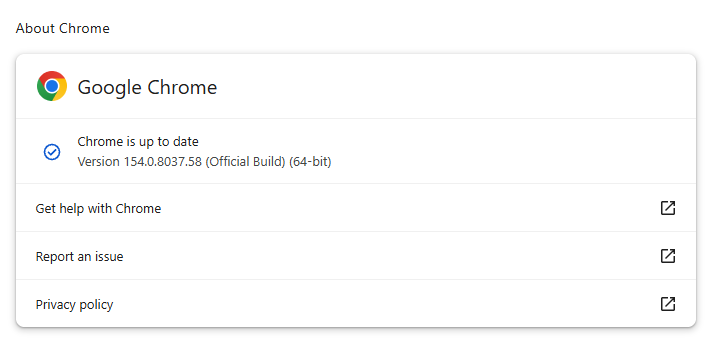
If you don’t want to wait for the rollout to reach you, manually updating is easy. open About Google Chrome from Chrome’s settings or Help menu. Chrome will check for updates. If one is available, click Relaunch to apply it.
Some of the desktop security fixes deserve a closer look.
Let’s start with CVE-2026-95350, a buffer overflow flaw in ANGLE, Chrome’s graphics-translation layer.
A buffer overflow is a bug in code that allows an attack to happen when a program puts more data into an area of memory than it can hold. Essentially, the attacker writes garbage data that fills up the memory, then writes code that overwrites existing code in adjoining memory, which later gets executed by the vulnerable process.
A crafted webpage could potentially trigger the flaw, which could lead to memory safety bugs, including browser crashes or possible code execution.
Another Critical buffer overflow bug in ANGLE is tracked as CVE-2026-95281. A malicious webpage could potentially reach vulnerable graphics-processing code, so the bug may enable serious impacts such as browser compromise, but Google has not provided exploitation details.
And then there is CVE-2026-95357, an out-of-bounds write in Chrome’s GPU component. This means a program could write data outside its intended area of memory.
The GPU component is the part of Chrome that handles how graphics work with your computer’s graphics processor.
Stop threats before they can do any harm.
Malwarebytes Browser Guard blocks phishing pages and malicious sites automatically. Free, one click to install. Add it to your browser →
Starting August 10, 2026, Sucuri will begin moving customer account logins to a new authentication platform designed to provide a stronger, more modern sign-in experience.
The rollout will happen gradually over the following few weeks, so not every account will transition at the same time.
For most users, there is nothing to do. Your password will remain the same, your current two-factor authentication setup will continue working, and existing bookmarks to the Sucuri dashboard login page will automatically redirect to the new sign-in page.

 Login