Threat actors are increasingly improving their tactics to make suspicious emails look like legitimate email notifications to potential victims, deploying techniques that impersonate internally sent emails from executive team members. While this technique is not new, the adoption of AI has enabled threat actors to improve their campaign templates and construct emails tailored to their recipients. Additionally, threat actors are incorporating multiple techniques within the same email to improve the overall narrative further.
In this blog, we will discuss a recent campaign observed using third-party email delivery infrastructure to send out over a million financial fraud scam emails that displayed multiple indicators consistent with the use of generative AI during email template creation. The threat actor impersonated CEOs of multiple target companies, attempting to convince accounts payable departments of the same companies to process an Automated Clearing House (ACH) payment of nearly $50,000. To add legitimacy, the actor included a forwarded email thread (and a fabricated invoice) between the impersonated CEO and ServiceNow (which was also being impersonated).
Attack chain overview
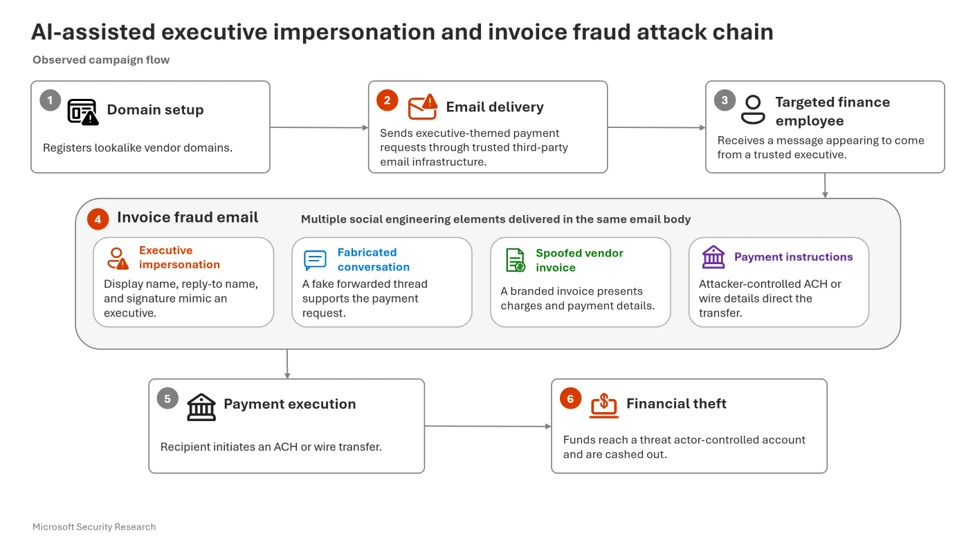
The campaign follows steps before and during the execution of the campaign: threat actors register impersonation domains, send executive-themed payment requests through trusted infrastructure, embed fabricated invoices and supporting conversations, and attempt to convince finance personnel to initiate ACH transfers.
Figure 1: Attack chain showing domain registration, executive impersonation, invoice fraud delivery, ACH payment execution, and financial theft.
Email Delivery
Between August 3 and 5, Microsoft detected a campaign consisting of more than a million emails targeting enterprise users. The attacker used multiple third-party email service accounts to send out the emails. A huge majority of these emails were sent to users in the United States (87.7% of the total campaign).
Figure 2. Campaign timeline.Figure 3. Industry distribution of targeted enterprises of this campaign with ‘IT services & business advisory’ along with ‘Consumer goods’ and others.
Unlike traditional invoice scams that rely on a single social engineering lure, this campaign layered executive impersonation, vendor branding, fabricated invoices, and supporting email conversations into a unified narrative intended to reduce recipient skepticism.
The threat actor impersonated executive team members (such as a CEO, CFO, President) of multiple targeted companies, attempting to convince accounts payable departments of the same companies to process an ACH payment of nearly $50,000. More specifically, the CEOs were impersonated in multiple places in the email such as in the sender display name, reply-to display name, and in the email signature. Email bodies contained a simple and direct “approval” of the “invoice below” as well as urged users to request a PDF version if they need it. Additionally, as mentioned earlier, the email signature contained certain details about the spoofed CEO such as name and email address.
Figure 4. Spoofed message from executive team member.
Important note: Throughout this campaign, threat actors impersonated legitimate organizations using attacker-controlled infrastructure, fabricated communications, and lookalike domains. Microsoft found no evidence that the legitimate organizations referenced in the lures, including ServiceNow, were compromised or involved in the activity. Rather, the campaign relied on fraudulent domains and content designed to mimic trusted brands and individuals.
The threat actor did not stop there. To add further legitimacy, directly below the CEO signature, the actor included “forwarded” content , specifically a professional looking but fabricated “ServiceNow Platform — Annual Subscription” invoice. The extremely detailed invoice contains various ServiceNow branding and logos. It has basic invoice details such as invoice number, issue and due dates, currency, amount due, payment method, and itemized line items. The payment method instructed is a bank transfer to accounts controlled by the threat actor. Microsoft observed the use of multiple financial institutions across samples, indicating that payment destinations may vary between targets. Certain parts of the invoice are personalized to the recipient. Specifically, the “BILLED TO” section has the recipient company name and executive name.
The invoice shown below is a threat actor-created impersonation and was not issued by ServiceNow.
Figure 5. Spoofed ServiceNow invoice.
Finally, directly below the fake invoice, two more “forwarded” emails are included which are essentially a short conversation between the two spoofed executives (the targeted company executive, and ServiceNow President). The two executives are seen discussing the ServiceNow purchase, implementation and handling of the invoice.
Figure 6. “Forwarded” replies thread within the email lacking usual headers.
From a defender point of view there are several indicators within the email indicating that the email and the “forwarded” thread are not genuine.
“From” headers from the spoofed thread lack any data headers like actual forwarded emails.
Suspicious language used in the spoofed thread such as “no need to copy me”.
Suspicious language in headers i.e display name not matching sender address, subjects using financial lure keywords like ‘due bill’, ‘ACH Parment’ etc.
Despite the sophistication of the generated content, several inconsistencies remained visible to defenders
In real email threads, the previous threads are normally tabbed or otherwise visually grouped, while the previous threads in this example were left aligned.
An additional inconsistency was observed where the targeted company’s CEO requested the recipient to send the invoice directly to victims and not CC the sender. However, in the most recent thread, the CEO stated that the invoice is approved and the invoice is sent from his address.
Domain registration
Before initiating the campaign, the threat actor registered several domains. A ‘ServiceNow’ lookalike domain service-nowinc[.]com was registered on July 31, shortly before the campaign activity was observed. This domain was used for the spoofed email address of ServiceNow President. It was also used in several places in the fabricated invoice such as in the contact email in case of any questions. The actor also registered another domain on the same day. The domain domainlify[.]net was used in the Reply-To email.
Figure 7. Account information linked with email of impersonated domain.
Generative AI usage
Microsoft observed several indicators consistent with AI-assisted template development. These included extensive HTML comments, structured section labeling, and highly uniform template construction. While these indicators suggest generative AI involvement, they do not independently establish the extent to which AI generated campaign content.
Examples:
Figure 8. Code snippet showing a verbose HTML comment describing a section (a characteristic commonly observed in AI-generated code).Figure 9. Another code snippet showing extensive comments on HTML style elements and sections.
Additionally, the use of ‘em dash’ (“—”) and banner ‘===========’ have also become other indicators associated with AI usage.
Figure 10. Another code example indicating AI usage. This example shows a verbose capitalized section header and yet more style elements excessively commented.
One possible indication of template-based generation is that invoice identifiers and narrative structure remained largely consistent across samples while organization-specific details changed between targets.
Mitigation and protection guidance
Microsoft provides layered protection against this type of executive-impersonation and invoice-fraud campaign. Properly configured email authentication, spoof protection, mail-flow connectors, and Microsoft Defender for Office 365 help identify and block suspicious messages before delivery; messages later determined to be malicious can be quarantined or removed through post-delivery remediation, including Zero-hour Auto Purge. Security teams can then use Microsoft Defender XDR and Security Copilot to investigate related alerts, affected users, and campaign indicators, coordinate response, and take remediation actions.
Together, these capabilities help reduce the likelihood that fraudulent payment requests reach finance personnel and support faster containment if a message is delivered.
To defend against social engineering campaigns involving executive impersonation, invoice fraud, and potentially AI-assisted content development, Microsoft recommends the following mitigations:
Configure automatic attack disruption in Microsoft Defender XDR. Automatic attack disruption is designed to contain attacks in progress, limit the impact on an organization’s assets, and provide more time for security teams to remediate the attack fully.
Enable Zero-hour auto purge (ZAP) in Office 365 to quarantine sent mail in response to newly acquired threat intelligence and retroactively neutralize malicious phishing, spam, or malware messages that have already been delivered to mailboxes.
Invest in advanced anti-phishing solutions that monitor and scan incoming emails and visited websites. For example, organizations can leverage web browsers like Microsoft Edge that automatically identify and block malicious websites, including those used in this phishing campaign, and solutions that detect and block malicious emails, links, and files.
These links provide information on how to properly configure mail flow with connectors:
Microsoft Defender customers can refer to the list of applicable detections below. Microsoft Defender coordinates detection, prevention, investigation, and response across endpoints, identities, email, and apps to provide integrated protection against attacks like the threat discussed in this blog.
Tactic
Observed activity
Microsoft Defender coverage
Financial Theft
Scam emails
Microsoft Defender for Office 365 – Invoice scams delivered detected as Spam and malicious categories. – Email messages marked malicious removed after delivery and spam moved to quarantine – Email messages removed after delivery – Messages retroactively removed through Zero-hour Auto Purge (ZAP).
Microsoft Security Copilot
Security Copilot customers can use the standalone experience to create their own prompts or run the following prebuilt promptbooks to automate incident response or investigation tasks related to this threat:
Incident investigation
Microsoft User analysis
Threat actor profile
Threat Intelligence 360 report based on MDTI article
Vulnerability impact assessment
Note that some promptbooks require access to plugins for Microsoft products such as Microsoft Defender XDR or Microsoft Sentinel.
Threat intelligence reports
Microsoft Defender XDR customers can use Threat Analytics reports in the Defender portal (requires license for at least one Defender XDR product) to get the most up-to-date information about the malicious activity and techniques discussed in this blog. These reports provide the intelligence, protection information, and recommended actions to prevent, mitigate, or respond to associated threats found in customer environments.
MITRE ATT&CK Techniques observed
This threat has exhibited use of the following attack techniques. For standard industry documentation about these techniques, refer to the MITRE ATT&CK framework.
Reconnaissance
T1591 – Gather Victim Organization Information Threat actors collect publicly available information about target organizations, executives, finance personnel, vendors, and business relationships to build convincing invoice-fraud narratives.
T1598 – Phishing for Information Information gathered from victims and public sources is used to craft highly targeted business email compromise (BEC) lures.
T1036 – Masquerading Attackers disguise emails, domains, invoices, and business correspondence as legitimate communications.
T1656 – Impersonation Executives, vendors, and trusted business entities are impersonated to establish credibility and influence payment decisions.
Impact
T1657 – Financial Theft Victims are deceived into transferring funds to attacker-controlled financial accounts through fraudulent invoice payment requests.
To hear stories and insights from the Microsoft Threat Intelligence community about the ever-evolving threat landscape, listen to the Microsoft Threat Intelligence podcast.
Review our documentation to learn more about our real-time protection capabilities and see how to enable them within your organization.
Every wave of technology excitement creates a new opportunity for cyberattackers, and AI is no exception. Microsoft Threat Intelligence has published research showing a growing set of campaigns that impersonate popular AI platforms and tools, including ChatGPT, Microsoft Copilot, DeepSeek, and Claude.1 The goal is to make phishing, search-driven malware campaigns, and malvertising—which is malicious advertising that uses online ads to lure users to harmful sites, downloads, or redirect chains—more convincing. A ChatGPT-themed phishing campaign sent up to 100,000 emails in a single day, tricking users into updating their ChatGPT Plus payment information and stealing personal and credit card data. These campaigns do not represent a compromise of the AI services being referenced. They represent something more familiar—cyberattackers doing what they have always done: borrowing trust. Right now, AI brands can carry significant trust and curiosity, making them attractive themes for cyberattackers to exploit.
Understanding why this trend matters and what it means for security teams is critical to shaping a modern protection strategy. The tactics are the same ones cyberattackers have always refined: urgency, curiosity, and impersonation of something familiar to lower a user’s guard. What has changed is the wrapper. A message about a new model release, a policy update from a familiar AI assistant, or a plugin that promises to make the workday easier is today’s version of the fake invoice or the shipping notification. AI-themed lures deserve attention not because they are a passing trend tied to one product cycle, but because AI remains a genuine source of excitement and urgency for employees and consumers alike, and cyberattackers are exploiting the human instinct to explore what is new, useful, or urgent.
The attack pattern is evolving
Microsoft’s research team recently observed several AI brand campaigns including:
A ChatGPT-themed phishing kit built to harvest credit card data.
A Claude-themed campaign that harvested credentials and access tokens through adversary-in-the-middle (AiTM) techniques.
Malvertising for a fake AI Windows plugin that delivered the Vidar stealer.
Fraudulent DeepSeek installers distributed through GitHub.
In one case, an initial access broker tracked as Storm-3075 used AI-themed malvertising to distribute payloads for multiple downstream actors, a sign of how quickly this tactic is being commoditized across the criminal ecosystem.
Figure 1. Snippet of the top portion of the email impersonating ChatGPT and enticing users to click on the link.
What ties these campaigns together is not sophistication in the traditional sense. It is patience and precision in exploiting a moment. Threat actors are capitalizing on anticipated launches and emerging trends, layering multi-stage redirection chains and disposable infrastructure to slip past both users and defenses. That has real implications for security leaders: it means these incidents cannot be evaluated one surface at a time. A single AI-themed lure can begin as an email, become a malicious link, trigger a suspicious download, and end as an identity or endpoint compromise. Organizations that assess each of those as an isolated event are always a step behind. Organizations that connect them see the full shape of the cyberattack, often early enough to stop it.
Turning AI lures into dead ends with Microsoft Defender
In practice, protection starts before the user ever engages with the lure. Microsoft Defender’s anti-phishing policies can help detect spoofing and impersonation attempts, including user and domain impersonation, first-contact messages, mailbox intelligence signals, and other suspicious sender characteristics. For an AI-themed lure, that might look like a fake “Copilot policy update,” a spoofed support notice, or a lookalike domain designed to make a credential collection page feel legitimate.
If the campaign relies on links, Defender’s Safe Links provides URL scanning and detonation during mail flow, plus time-of-click verification when a user selects a link in email, Microsoft Teams, or supported Microsoft 365 apps. That is important when cyberattackers use redirect chains, delayed activation, or links that appear benign at delivery but later resolve to phishing infrastructure, fake sign-in pages, or malicious downloads.
For campaigns that use fake installers, malicious downloads, or weaponized attachments, Safe Attachments adds another layer by detonating attachments in a virtual environment before delivery when policies are configured. For example, if a message promotes a “new AI plugin” but includes a harmful attachment, Safe Attachments can analyze the file for malware, ransomware, or phishing behavior before it reaches the user. If a cyberthreat is identified after delivery, Defender’s post-delivery filtering capabilities help remove malicious content from mailboxes and reduce the window of exposure.
Figure 2. Simplified Defender email detection stack with pre-delivery and post-delivery protections.
Protect against multi-stage attacks with attack disruption
But AI-powered attacks don’t stop at email. Their objective is to gain the highest level of access possible, using compromised accounts as a foothold to move across identities, devices, and data. When a cyberattack moves beyond the inbox, Defender helps connect the evidence. Signals from email and collaboration tools, endpoints, identities, and software as a service (SaaS) apps are correlated into an attack story so analysts can see whether the same lure led to a clicked link, a downloaded payload, risky sign-in behavior, or endpoint activity.
As cyberattackers expand beyond email to gain broader access across the environment, Defender moves from detection to disruption. For multi-stage, multi-domain attacks like business email compromise or AiTM, Defender’s powerful, built-in response capability, attack disruption, will contain the compromised asset during the attack to prevent further lateral movement while security teams investigate and remediate. Attack disruption contains more than 81,000 compromised user accounts monthly and is now disrupting more than 45,000 AiTM attacks each month.
Figure 3. Recent attack disruption statistics. (Source: Internal Microsoft Research, September 2026)
In a recent case study, Defender disrupted a business email compromise attack within four minutes of the initial activity (Figure 4). While response times may vary by scenario, this case shows the impact of attack disruption on a real cyberthreat. The cyberattacker used a convincing document-sharing lure to trick a user to start a legitimate Microsoft device code sign-in flow, which avoided traditional credential theft techniques. Defender recognized the resulting device code authentication and follow-on activity as suspicious, correlated signals across identity and email telemetry, and disrupted the attack within four minutes before the attacker could establish persistence, create inbox rules, or execute payroll fraud.
Figure 4. Business email compromise attack through OAuth device code phishing.
The takeaway
AI brands are the new bait, but the underlying lesson is bigger than any single campaign. As cyberattackers continue to exploit the momentum around AI, organizations should expect social engineering to become more targeted, more believable, and more difficult to evaluate in isolation.
The answer is not to treat every new lure as a brand-new category of risk. It is to build a protection model that makes trust harder to exploit across the full attack chain. Microsoft Defender helps organizations do that by connecting prevention, detection, investigation, and response across the attack path, so AI-themed lures are harder to deliver, harder to trust, and harder to turn into broader compromise.
To learn more about Microsoft Security solutions, visit our website. Bookmark the Security blog to keep up with our expert coverage on security matters. Also, follow us on LinkedIn (Microsoft Security) and X (@MSFTSecurity) for the latest news and updates on cybersecurity.
Microsoft Security Research is tracking active cloud-based intrusions spanning multiple accounts in which unusual sign-ins were followed by threat actor-added authentication methods, high-volume Microsoft Graph activity, SharePoint and OneDrive downloads, and email collection through REST APIs. Microsoft Security Research assesses that this sequence is consistent with automated collection from compromised cloud identities using proxy-associated infrastructure, the activity has been observed since May 2026.
The activity begins with identity-focused social engineering and impersonation infrastructure, proceeds through authentication persistence and cloud reconnaissance, and is followed by targeted data access and activity consistent with data collection and potential exfiltration. Domains, IP addresses, and hosting providers can change quickly, but the recurring sequence of identity compromise, persistence, reconnaissance, content discovery, and exfiltration provides a more durable basis for investigation. Defenders should investigate this sequence across identity, Microsoft Graph, SharePoint, OneDrive, and Exchange signals, then revoke sessions and remove unauthorized authentication methods for confirmed compromises.
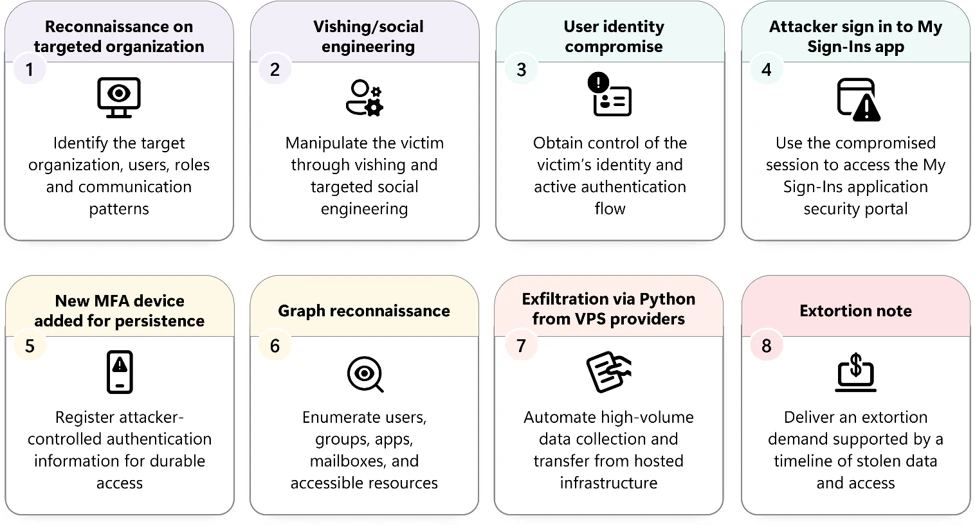
Attack chain overview
Figure 1. Observed attack sequence showing identity compromise through social engineering, MFA persistence, Microsoft Graph reconnaissance, and cloud data collection/exfiltration.
Step 1-2 : Initial access: Passkey and SSO lures
The attack often begins with a seemingly routine call or message on a user’s personal phone number from someone claiming to be from the organization’s IT helpdesk. The caller creates a sense of urgency, explaining that a passkey, multifactor authentication (MFA), or single sign-on (SSO) configuration must be updated immediately to avoid disruption. Employees are directed to a website that closely resembles a legitimate Microsoft sign-in experience and may receive the link through SMS messages sent directly to their personal mobile phones.
Despite the frequent use of passkey-themed lures, passkey enrollment is often not the actor’s true objective. Instead, the passkey narrative serves as a convincing pretext to guide victims through adversary-in-the-middle (AiTM) phishing or device-code authentication flows. In AiTM scenarios, the actor captures credentials and session tokens; in device code attacks, the victim unknowingly authorizes access on the actor’s behalf. This initial interaction may leave very little forensic evidence. If the victim opens the phishing link on a personal mobile device that is not onboarded to Microsoft Defender for Endpoint, the related activity may be absent from endpoint telemetry.
In many investigations, the employee’s recollection of a phone call or text message becomes the earliest and sometimes the only evidence explaining how the compromise began. As a result, investigators must often reconstruct the attack by connecting these reports with subsequent sign-ins, device code authentication events, token activity, and authentication method changes.
Reconnaissance on targeted organization
The actor appears to invest heavily in pre-attack research, likely gathering information about employees and organizational structure from public sources such as social networking and professional profiling platforms.
Reusable domains, personalized targeting
In a smaller number of cases, actors take advantage of already compromised accounts to expand their reach. Using a trusted employee identity, they send similar passkey-themed messages through Microsoft Teams, making the request appear legitimate and significantly increasing the likelihood of engagement. To support these operations, the actors rapidly deploy convincing phishing infrastructure built around themes such as passkeys, SSO enrollment, account activation, and identity verification.
A commonly observed technique involves registering generic domains and embedding the target organization’s name as a subdomain, creating URLs that appear familiar at first glance. Multiple domains may be created for the same organization, allowing the actor to rotate infrastructure as needed. These domains are often registered with Nicenic registrar (observed in previous extortion campaigns) and operational within hours, giving defenders little opportunity to identify and block the infrastructure before employees encounter it. Registration alone should not be interpreted as evidence of registrar involvement in the activity. For example, company-name.integratedsso[.]com and company-name.secure-passkey[.]com illustrate how the same company name can appear under different actor-controlled domains.
Together, the phone-based social engineering, personalized targeting, trusted internal messaging, and rapidly changing phishing infrastructure form the opening chapter of a highly coordinated intrusion designed to blend technical deception with human trust.
The actor creates domains following the pattern companyname[.]maliciousdomain[.]com to impersonate organization-specific authentication portals. Including the victim organization’s name in the URL helps establish credibility and can persuade users to proceed with authentication. Example: contoso[.]add-passkey[.]com.
In one investigated attack sequence, the activity began with an anomalous sign-in to Microsoft OfficeHome application from an unmanaged device, possibly attacker-owned. Once MFA was completed, the actor began accessing identity portals such as My Sign-Ins and enterprise application stores such as My Apps. Sign-in artifacts, including user-agent patterns, indicated possible AiTM phishing.
Using the same session, the actor further accessed several management applications, including Microsoft Approval Management, which is used for identity and approval-related services. SharePoint Online and OneDrive were used to enumerate sensitive files, primarily through the Graph API. The investigation revealed that the actor’s sessions persisted for approximately one hour while enumerating sensitive files and internal applications.
Passkey lure leads to device code phishing
In another investigated attack sequence, the actor was observed using the device code flow to compromise the session token after the passkey lure. In device code phishing, the user is persuaded to enter a code on the legitimate Microsoft authentication page. This approval issues a token to an attacker-controlled client, which can then access permitted resources without stealing a browser cookie. Following the device code flow, the actor successfully replayed the compromised token, effectively bypassing MFA and conducting enumeration and further attack progression.
Reusing the same credentials after an earlier compromise
The third attack pattern involved the actor signing in with compromised credentials, with MFA approved using a previously registered PhoneAppOTP method. This suggests that the attacker had registered the authenticator app days before launching the campaign. Once the sign in was successful, the actor followed the same reconnaissance pattern observed in other attack sequences. This activity was primarily carried out using an automated system developed with Node.js and Microsoft Graph.
To illustrate how the activity unfolded over time, the following timeline summarizes the key events identified during the investigation.
Time, UTC
Application or resource
What happened and why it matters
T+0min
OfficeHome
Sign-in from an unmanaged context received error 50074, requiring secondary authentication / Multifactor authentication (MFA).
T+1min
OfficeHome
MFA completed (AiTM with non-phishing resistant MFA) followed by error 50140 for the keep-me-signed-in interruption.
T+1min
OfficeHome
Authentication succeeded, establishing the session used for subsequent access.
T+2min
My Apps
The session enumerated applications assigned to the compromised identity.
T+2min
My Profile
Organizational profile information was accessed.
T+3min
Microsoft Approval Management
Identity and approval-related services were accessed. This could expose approval workflows available to the identity.
T+3min
Microsoft Account Controls V2
Account and authentication management interfaces were accessed.
T+4min
My SignIns
Sign-in and security information was accessed through Microsoft Graph using the same source context, session, Chrome user agent, and browser ID as the OfficeHome authentication.
T+10min
OCaaS
The organizational application catalogue was loaded through My Apps. In this sequence, OCaaS supports application discovery rather than appearing as an isolated background event.
T+11 – T+50min
SharePoint Online
The session requested access to organizational sites and document resources. The sign-in events do not prove that a document was opened or downloaded.
T+11 – T+50min
Outlook Web
Mailbox-related services were accessed, creating an opportunity for mailbox and business-context reconnaissance.
T+12min
Windows App – Web
The session entered the Azure Virtual Desktop authentication flow. A desktop or remote workspace launch was not confirmed.
T+14min
Internal virtual application and desktop portal
Authentication succeeded to the internal virtual application and desktop portal. This could expose published applications and virtual desktops assigned to the identity, although no internal virtual application and desktop portal resource launch was confirmed.
T+15min
OwaDownloadAttachments
Outlook successfully requested the attachment download resource. This is more consequential than generic mailbox access, but the sign-in telemetry does not prove that an attachment was downloaded.
T+16min
M365ChatClient
Microsoft 365 collaboration, Teams, and search services were accessed.
T+16min
Internal business workflow application
Authentication succeeded to another internal business workflow application.
Step 5 : New MFA device for persistence
Following initial access, the actor’s first objective was to transform a temporary compromise into a persistent foothold. Rather than relying solely on stolen credentials, the actor enrolled an MFA method under their control, typically by registering a new phone number, authenticator application, or software-based one-time password (OTP) token. This effectively inserted an actor-controlled factor into the victim’s identity, allowing future authentication challenges to be satisfied without the user’s involvement.
By registering an actor-controlled MFA method, the threat actor ensured that future authentication challenges could be satisfied using a factor they controlled. While MFA enrollment alone does not survive a complete credential and session reset, it provides a durable persistence mechanism when combined with stolen tokens, unrevoked sessions, or subsequent access to valid credentials. As a result, actors frequently establish MFA persistence early in the intrusion to increase the likelihood of maintaining long-term access to the compromised identity.
Phone or authenticator device addition
Detects a newly registered MFA device with a populated device token. The query compares the previous and updated authentication method values and returns newly added device records.
CloudAppEvents
 | where ActionType == "Update user."
 | where tostring(RawEventData.ResultStatus) == "Success"
 | where RawEventData has_any ("StrongAuthenticationPhoneAppDetail", "StrongAuthenticationUserDetails")
 | extend AccountObjectId = extract(@"User_([a-f0-9\-]+)", 1, tostring(RawEventData.Target))
 | where isnotempty(AccountObjectId)
 | mvexpand ModifiedProp = RawEventData.ModifiedProperties
 | where tostring(ModifiedProp.Name) in ("StrongAuthenticationPhoneAppDetail", "StrongAuthenticationUserDetails")
 | extend OldValue = tostring(ModifiedProp.OldValue),
          NewValue = tostring(ModifiedProp.NewValue)
 | extend OldDeviceCount = countof(OldValue, @"""Id"""),
          NewDeviceCount = countof(NewValue, @"""Id""")
 | where NewDeviceCount > OldDeviceCount
Software token addition
Below is a real-world example of attacker controlled Software token added to the user’s identity with Update user operation. This is added as a second NewValue entry containing the device name NO_DEVICE, device token NO_DEVICE_TOKEN, and the SoftwareTokenActivated device tag.
Once MFA persistence was established, the actor initiated an extensive internal reconnaissance phase using Microsoft Graph to inventory users, groups, permissions, resources, and accessible content across the tenant with the compromised identity. The actor deliberately rotated infrastructure throughout the attack lifecycle, with separate IP addresses often used for authentication, reconnaissance, and exfiltration activities. As a result, piecing together the full intrusion required correlating activity across multiple stages rather than relying on individual network indicators.
The attack underscores a critical detection challenge: Microsoft Graph abuse rarely appears suspicious when viewed through a single API call. Requests to endpoints such as /users, /groups, or /sites are commonplace in enterprise environments. However, when the same identity, application, or access token systematically traverses multiple tenant resources, evaluates privilege and authentication settings, and subsequently accesses mail, files, attachments, or document content, those actions collectively form a clear reconnaissance-to-exfiltration chain. This attack serves as a strong example of why Graph activity must be assessed holistically, with emphasis on behavioral progression and cross-event correlation rather than individual API requests in isolation.
Graph reconnaissance pattern matrix initiated by the actor
Recon pattern
Graph URI examples
What it reveals
Why it matters
Tenant profile
/organization, /subscribedSkus, /licenseDetails
Identifies the tenant, verified domains, licenses, and enabled services.
Useful setup activity; stronger when followed by user, role, or repository discovery.
Directory enumeration
/users, /groups, /members, /transitiveMembers
Builds a map of identities, groups, and effective membership.
Can identify targets, privileged users, and sensitive collaboration groups.
Locates sites, document libraries, folders, and files.
Often converts broad tenant reconnaissance into a collection-ready file map.
Mailbox discovery
/messages, /mailFolders, /attachments
Enumerates messages, folders, and attachment metadata.
Supports intelligence collection, business email compromise (BEC), and targeted attachment retrieval.
Automation and pagination
$top, $skip, $skiptoken, $count, /delta, /search
Walks large result sets or repeatedly searches repositories.
Raises confidence when combined with broad discovery or sensitive endpoints.
Content collection
/content, message or attachment retrieval, large ResponseSize
Retrieves the underlying data after discovery.
Strongest indicator that reconnaissance has progressed into collection.
Hunt for broad Graph reconnaissance in one session
Find identities or applications touching several reconnaissance categories from the same IP within 30 minutes.
let Lookback = 24h; [MI25.1][IM25.2]
GraphAPIAuditEvents
| where Timestamp > ago(Lookback)
| where toint(ResponseStatusCode) between (200 .. 299)
| extend Uri = tolower(RequestUri),
        ActorId = coalesce(AccountObjectId,
                           ServicePrincipalId, ApplicationId),
        Path = tostring(split(tolower(RequestUri), "?")[0])
| extend ReconType = case(
   Uri has "/organization" or Uri has "/subscribedskus", "Tenant",
   Uri has "/users" or Uri has "/groups", "Directory",
   Uri has "/directoryroles" or Uri has "/rolemanagement", "Privilege",
   Uri has "/applications" or Uri has "/serviceprincipals"
       or Uri has "/oauth2permissiongrants", "Application",
   Uri has "/sites" or Uri has "/drive", "Repository",
   Uri has "/messages" or Uri has "/mailfolders", "Mailbox",
   "Other")
| where ReconType != "Other" and isnotempty(ActorId)
| summarize Requests=count(), Categories=dcount(ReconType),
           DistinctPaths=dcount(Path),
           ReconTypes=make_set(ReconType, 10),
           SampleUris=make_set(RequestUri, 10)
   by ActorId, IpAddress, ApplicationId, bin(Timestamp, 30m)
| where Requests >= 10 and Categories >= 3 and DistinctPaths >= 6
| order by Categories desc, Requests desc
Hunt for privilege, MFA, application, and consent discovery
Highlight sensitive control-plane reconnaissance that can expose persistence or escalation opportunities.
GraphAPIAuditEvents
| where Timestamp > ago(24h)
| where toint(ResponseStatusCode) between (200 .. 299)
| extend Uri = tolower(RequestUri),
         ActorId = coalesce(AccountObjectId,
                            ServicePrincipalId, ApplicationId)
| where Uri has_any ("/directoryroles", "/rolemanagement",
                     "/authentication/methods", "/applications",
                     "/serviceprincipals", "/oauth2permissiongrants",
                     "/approleassign")
| summarize Requests=count(), DistinctPaths=dcount(tostring(split(Uri, "?")[0])),
            ScopesSeen=make_set(Scopes, 10),
            SampleUris=make_set(RequestUri, 12)
    by ActorId, IpAddress, ApplicationId, bin(Timestamp, 30m)
| where Requests >= 4 and DistinctPaths >= 2
| order by Requests desc
Hunt for SharePoint and OneDrive repository discovery
Detect search, child traversal, delta queries, and paging used to map file repositories.
GraphAPIAuditEvents
| where Timestamp > ago(24h)
| where toint(ResponseStatusCode) between (200 .. 299)
| extend Uri = tolower(RequestUri),
         ActorId = coalesce(AccountObjectId,
                            ServicePrincipalId, ApplicationId),
         Path = tostring(split(tolower(RequestUri), "?")[0])
| where Uri has_any ("/sites", "/drives", "/drive/")
| where Uri has_any ("/search", "/children", "/delta",
                     "$skiptoken", "%24skiptoken", "$top", "%24top")
| summarize Requests=count(), DistinctPaths=dcount(Path),
            SampleUris=make_set(RequestUri, 12)
    by ActorId, IpAddress, ApplicationId, bin(Timestamp, 20m)
| where Requests >= 8 and DistinctPaths >= 4
| order by Requests desc
Hunt for mailbox and attachment reconnaissance
Find concentrated enumeration of messages, mail folders, and attachments.
GraphAPIAuditEvents
| where Timestamp > ago(24h)
| where toint(ResponseStatusCode) between (200 .. 299)
| extend Uri = tolower(RequestUri),
         ActorId = coalesce(AccountObjectId,
                            ServicePrincipalId, ApplicationId),
         Path = tostring(split(tolower(RequestUri), "?")[0])
| where Uri has_any ("/messages", "/mailfolders", "/attachments")
| summarize Requests=count(),
            DistinctPaths=dcount(Path),
            MessageRequests=countif(Uri has "/messages"),
            AttachmentRequests=countif(Uri has "/attachments"),
            TotalResponseBytes=sum(coalesce(ResponseSize, 0)),
            SampleUris=make_set(RequestUri, 12)
    by ActorId, IpAddress, ApplicationId, bin(Timestamp, 30m)
| where (Requests >= 8 and DistinctPaths >= 4) or AttachmentRequests >= 3
| order by AttachmentRequests desc, Requests desc
Step 7-8 : High-volume cloud data collection and suspected exfiltration
Following reconnaissance, the actor transitioned into large-scale data collection across Microsoft 365 workloads using the compromised identities. Microsoft observed high-volume access and download activity targeting Microsoft SharePoint Online and Microsoft OneDrive for Business, with some intrusions extending into Microsoft Exchange Online through REST API-based access to email content. Across SharePoint and OneDrive, the activity generated significant volumes of FileAccessed and FileDownloaded events, indicating systematic retrieval of cloud-hosted documents and organizational data.
The activity frequently exhibited characteristics of automation rather than interactive user behavior. In several cases, Microsoft observed the python-httpx user agent associated with high-volume SharePoint and OneDrive access patterns. However, the user agent alone should not be treated as malicious. Instead, such activity should be evaluated in the broader context of data volume, affected identities, source infrastructure, prior reconnaissance activity, and evidence of identity compromise.
Unlike rapid smash-and-grab operations, data exfiltration was typically measured and sustained, often spanning several hours to multiple days depending on the volume of files and email content available to the compromised user. The actors generally maintained a controlled pace of collection, with fewer than 1,000 files or emails accessed within any one-hour period, likely helping the activity blend with normal enterprise usage while enabling the gradual extraction of large amounts of sensitive data over time.
Hunt for exfiltration through Exchange Online
Exfiltration of data through REST API using Microsoft Office or One Outlook Web
CloudAppEvents
| where isempty(AccountObjectId)
| where ApplicationId == '20893'
| where AccountDisplayName in ("One Outlook Web", "9199bf20-a13f-4107-85dc-02114787ef48", "d3590ed6-52b3-4102-aeff-aad2292ab01c")
| where isnotempty(IPAddress)
| extend AccountObjectId = tostring(RawEventData.TokenObjectId)
| summarize ExchangeRestEventCount=count() by IPAddress, AccountObjectId, bin(Timestamp,1h)
| where ExchangeRestEventCount >= 500
Hunt for exfiltration through Microsoft SharePoint Online, OneDrive for Business
Exfiltration of data through python-httpx user agent
CloudAppEvents
| where ApplicationId == "20892" or ApplicationId == "15600"
| where ActionType in ("FileDownloaded", "FileAccessed", "SyncDownloadedFull")
| where isnotempty(AccountObjectId)
| where isnotempty(IPAddress)
| where isnotempty(UserAgent)
| where UncommonForUser has_any("ISP","UserAgent")
| where UserAgent has 'python-httpx'
| project Timestamp, AccountObjectId, IPAddress, ISP, UserAgent
| summarize FilesAccessedLastWindow = count() by AccountObjectId, IPAddress, ISP, UserAgent, bin(Timestamp,2h)
| where FilesAccessedLastWindow >=100
Hunt for anomalous high-volume exfiltration
Exfiltration of data through anonymous proxy
CloudAppEvents
| where ApplicationId in (20892, 20893, 15600)
| where ActionType in~ ("FileDownloaded", "FileAccessed", "FilePreviewed")
| where IsAnonymousProxy == true
| where UserAgent !has "ODMTADemand"
| extend FileSizeBytes = coalesce(tolong(RawEventData.FileSizeBytes), 0)
| summarize
    FileSizeBytes = sum(FileSizeBytes),
    FirstSeen = min(Timestamp),
    LastSeen = max(Timestamp),
    EventCount = count(),
    ActionTypes = make_set(ActionType),
    Applications = make_set(Application)
    by AccountObjectId, IPAddress,
       TimeBucket = bin(Timestamp, 2h), UserAgent, ISP
| extend FileSizeGB =
    round(FileSizeBytes / 1024.0 / 1024.0 / 1024.0, 2)
| where FileSizeGB >= 5 or EventCount >= 1000
| order by EventCount desc
Attribution
Microsoft Threat Intelligence assesses that the initial access activity observed in this campaign is used by a range of threat actors, including Storm-3121, Storm-3032, and others. Storm-3121 conducts initial access activity leading to ShinyHunters and Falcon extortion. Storm-3032 represents a set of actors that splintered from the BlackFile group and now operate under the Helix extortion banner. That being said, Microsoft Defender has detection coverage for the known tactics, techniques and procedures from Storm-3121, Storm-3032 and other operators in the same ecosystem.
Mitigation and protection guidance
Microsoft recommends that organizations investigate identity and cloud-workload signals as a connected sequence, with priority given to unusual sign-ins followed bys authentication method enrollment, Microsoft Graph reconnaissance, token issuance, and abnormal SaaS download or mailbox activity.
Investigate
Review newly registered authentication methods and devices for users with risky or unusual sign-ins and remove unauthorized methods after validating the user.
Investigate high-volume or programmatic Microsoft Graph activity involving directory enumeration, role discovery, service principal discovery, SharePoint, OneDrive, or sensitivity-label discovery.
Correlate SharePoint and OneDrive download anomalies, Exchange REST activity, and mailbox or attachment searches with identity and authentication events.
Contain and remediate
Revoke active sessions and refresh tokens for confirmed compromised identities, reset credentials, remove attacker-registered authentication methods, remove attacker created mailbox rules, and require secure re-registration of authentication methods.
Reduce future risk
Do not treat an IP or domain match as conclusive on its own. Validate workload behavior, affected identities, persistence events, and data access volume.
Enforce phishing-resistant MFA (FIDO2/passkeys, Windows Hello for Business) via Conditional Access
Enforce Conditional Access that requires a managed, compliant device for Exchange, SharePoint, and Graph-privileged apps
Enforce strict conditional access controls for security info registration, including setting required sign-in frequency to always (require a new interactive auth), requiring managed devices and/or named locations, and requiring phish-resistant MFA as a required authentication strength, and in a separate policy blocking security info registration with a high sign-in risk condition
Enforce risk-based access policies for risky sign-ins and risky users – remediate elevated risk with phishing-resistant MFA or secure password change, and block access at the highest risk levels.
Train users against voice and email phishing that targets MFA and passkey enrollment. Provide a verified channel to report unsolicited authentication requests.
Block the device code and authentication transfer flows via Conditional Access, except where an explicit business need exists.
Restrict user consent for applications, require admin approval, and regularly review service principals holding high-privilege Graph permissions such as Mail.Read, Files.Read.All, and Directory.Read.All.
Limit access from unmanaged devices to web-only sessions without download or sync, and disable anonymous sharing links in SharePoint and OneDrive.
Enable Microsoft Graph activity logs and mailbox auditing, and alert on anomalous enumeration, authentication-method registration, and high-volume file or mail access.
Educational training: Verify user identity through a rigorous process before performing any helpdesk-initiated credential or MFA reset, and alert on every such reset.
Microsoft Defender XDR detections
Microsoft Defender XDR customers can refer to the list of applicable detections below. Microsoft Defender XDR coordinates detection, prevention, investigation, and response across endpoints, identities, email, and apps to provide integrated protection against attacks like the threat discussed in this blog.
Customers with provisioned access can also use Microsoft Security Copilot in Microsoft Defender to investigate and respond to incidents, hunt for threats, and protect their organization with relevant threat intelligence.
Tactic
Observed activity
Microsoft XDR Defender coverage
Credential Access
Unusual cloud activity from a tracked potentially malicious IP
Microsoft Defender for Cloud – A storage account was accessed from a suspicious IP address.
Microsoft Defender for Identity – Malicious registration of a device with strong MFA. – Malicious registration of an attacker controlled MFA device. – Suspicious registration of a new Authenticator MFA method. – Malicious registration of a new Authenticator MFA method. – Suspicious registration of a new Phone MFA method. – Malicious registration of a new Phone MFA method – Malicious registration of a new Email MFA method.
Microsoft Defender XDR – Malicious sign in from an IP address associated with recognized attacker infrastructure.
Discovery
Graph API reconnaissance activity
Microsoft Defender for Identity – Suspicious Entra Graph API query observed.
Exfiltration
Data exfiltration activity
Microsoft Defender for Cloud – Unusual number of blobs extracted from a storage blob container. – Unusual amount of data extracted from a storage file share. – Unusual number of files extracted from a storage file share. – Unusual amount of data extracted from a sensitive blob container. – Unusual number of blobs extracted from a sensitive blob container. – Unusual amount of data extracted from a sensitive storage file share. – Unusual number of files extracted from a sensitive storage file share. – Sensitive data was exfiltrated from a publicly exposed blob container.
Microsoft Defender XDR – Automated mass SharePoint/OneDrive file access via python-httpx.
Microsoft Security Copilot
Security Copilot customers can use the standalone experience to create their own prompts or run the following prebuilt promptbooks to investigate activity associated with this intrusion pattern:
Incident investigation – Generates investigation summaries and helps analysts understand incidents involving compromised identities, suspicious sign-ins, persistence activity, and cloud-based data access.
Microsoft User analysis– Analyses user accounts, sign-in activity, authentication events, risk indicators, and related identity signals that may help identify compromised accounts.
Customers can also use Microsoft Security Copilot together with Microsoft Threat Intelligence to investigate indicators, threat activity, and related intelligence associated with suspicious sign-ins, Microsoft Graph reconnaissance, and cloud data exfiltration activity.
Note that some promptbooks require access to plugins for Microsoft products such as Microsoft Defender XDR or Microsoft Sentinel.
Threat intelligence reports
Microsoft customers can use the following reports in Microsoft products to get the most up-to-date information about the threat actor, malicious activity, and techniques discussed in this blog. These reports provide intelligence, protection information, and recommended actions to prevent, mitigate, or respond to associated threats found in customer environments.
T1087.004 Account Discovery: Cloud Account | The threat actor uses Microsoft Graph to enumerate tenant users and identities, including information useful for identifying high-value identities and privileged accounts.
T1069.003 Permission Groups Discovery: Cloud Groups | Microsoft Graph reconnaissance enumerates group memberships and directory roles, allowing the threat actor to understand privilege relationships and identify potentially valuable identities.
Collection
T1530 Data from Cloud Storage | The actor searches and accesses SharePoint and OneDrive content and performs high-volume file access/download activity to collect targeted cloud-hosted information.
T1114 Email Collection | Mailboxes, messages, and attachments are searched for material of interest and email is collected through REST APIs.
T1213 Data from Information Repositories | The actor searches enterprise cloud repositories, including SharePoint content and other organizational cloud data, to identify information of value for collection.
Exfiltration
T1567 Exfiltration Over Web Service | The campaign performs high-volume cloud data access and uses automated Python-based activity for rapid collection and exfiltration.
Advanced hunting queries
Additional advanced hunting query for Graph reconnaissance:
Hunt for automated pagination, delta, and search behavior
Identify actors walking large Graph result sets or repeatedly querying for data.
GraphAPIAuditEvents
| where Timestamp > ago(24h)
| where toint(ResponseStatusCode) between (200 .. 299)
| extend Uri = tolower(RequestUri),
         ActorId = coalesce(AccountObjectId,
                            ServicePrincipalId, ApplicationId),
         Path = tostring(split(tolower(RequestUri), "?")[0])
| where Uri has_any ("$top", "%24top", "$skip", "%24skip",
                     "$skiptoken", "%24skiptoken", "$count",
                     "%24count", "/delta", "/search")
| summarize AutomatedRequests=count(), DistinctPaths=dcount(Path),
            SampleUris=make_set(RequestUri, 12)
    by ActorId, IpAddress, ApplicationId, bin(Timestamp, 15m)
| where AutomatedRequests >= 8 and DistinctPaths >= 4
| order by AutomatedRequests desc
Hunt for reconnaissance progressing to content collection
Prioritize sessions where broad discovery and content retrieval occur together.
GraphAPIAuditEvents
| where Timestamp > ago(24h)
| where toint(ResponseStatusCode) between (200 .. 299)
| extend Uri = tolower(RequestUri),
         ActorId = coalesce(AccountObjectId,
                            ServicePrincipalId, ApplicationId)
| extend ActivityType = case(
    Uri has "/content" or Uri has "/attachments", "ContentCollection",
    Uri has "/users" or Uri has "/groups", "DirectoryRecon",
    Uri has "/directoryroles" or Uri has "/rolemanagement"
        or Uri has "/authentication/methods", "PrivilegeRecon",
    Uri has "/applications" or Uri has "/serviceprincipals", "ApplicationRecon",
    Uri has "/sites" or Uri has "/drives" or Uri has "/drive/", "RepositoryRecon",
    Uri has "/messages" or Uri has "/mailfolders", "MailboxRecon",
    "Other")
| where ActivityType != "Other"
| summarize DiscoveryFirst=minif(Timestamp, ActivityType != "ContentCollection"),
            CollectionFirst=minif(Timestamp, ActivityType == "ContentCollection"),
            DiscoveryCategories=dcountif(ActivityType, ActivityType != "ContentCollection"),
            ContentRequests=countif(ActivityType == "ContentCollection"),
            TotalResponseBytes=sum(coalesce(ResponseSize, 0)),
            SampleUris=make_set(RequestUri, 15)
    by ActorId, IpAddress, ApplicationId, bin(Timestamp, 1h)
| where isnotnull(DiscoveryFirst) and isnotnull(CollectionFirst)
| where CollectionFirst >= DiscoveryFirst
    and DiscoveryCategories >= 2 and ContentRequests >= 1
| order by CollectionFirst desc
Hunt for exfiltration through Microsoft Graph
Prioritize sessions where broad discovery and content retrieval occur together.
GraphAPIAuditEvents
| where Timestamp > ago(24h)
| where toint(ResponseStatusCode) between (200 .. 299)
| extend Uri = tolower(RequestUri),
         ActorId = coalesce(AccountObjectId,
                            ServicePrincipalId, ApplicationId)
| extend ActivityType = case(
    Uri has "/content" or Uri has "/attachments", "ContentCollection",
    Uri has "/users" or Uri has "/groups", "DirectoryRecon",
    Uri has "/directoryroles" or Uri has "/rolemanagement"
        or Uri has "/authentication/methods", "PrivilegeRecon",
    Uri has "/applications" or Uri has "/serviceprincipals", "ApplicationRecon",
    Uri has "/sites" or Uri has "/drives" or Uri has "/drive/", "RepositoryRecon",
    Uri has "/messages" or Uri has "/mailfolders", "MailboxRecon",
    "Other")
| where ActivityType != "Other"
| summarize DiscoveryFirst=minif(Timestamp, ActivityType != "ContentCollection"),
            CollectionFirst=minif(Timestamp, ActivityType == "ContentCollection"),
            DiscoveryCategories=dcountif(ActivityType, ActivityType != "ContentCollection"),
            ContentRequests=countif(ActivityType == "ContentCollection"),
            TotalResponseBytes=sum(coalesce(ResponseSize, 0)),
            SampleUris=make_set(RequestUri, 15)
    by ActorId, IpAddress, ApplicationId, bin(Timestamp, 1h)
| where isnotnull(DiscoveryFirst) and isnotnull(CollectionFirst)
| where CollectionFirst >= DiscoveryFirst
    and DiscoveryCategories >= 2 and ContentRequests >= 1
| order by CollectionFirst desc
To hear stories and insights from the Microsoft Threat Intelligence community about the ever-evolving threat landscape, listen to the Microsoft Threat Intelligence podcast.
Review our documentation to learn more about our real-time protection capabilities and see how to enable them within your organization.
Microsoft researchers observed a high-volume phishing campaign using invisible Unicode tag characters, a technique popularized in AI prompt injection research as ASCII Smuggling. Instead of using these characters to hide instructions from people while exposing them to AI models, the attacker used them to split financial lure words such as ‘funding’ to prevent email filters from parsing them.
The finding emerged from Microsoft Defender for Office 365 prompt injection protection research, showing how AI-era evasion techniques can surface in traditional phishing campaigns. In Microsoft telemetry, hits on a hunting signature designed to detect ASCII-smuggling increased sharply beginning February 9, 2026, and remained elevated on weekdays for approximately three months. Microsoft Defender for Office 365 telemetry showed that the majority of messages were flagged by layered protections rather than by reliance on a single Unicode-specific signal.
What is ASCII smuggling?
“ASCII smuggling” refers to the use of invisible or non-rendering Unicode characters to hide content inside text that looks normal. The most abused range is the Unicode Tags block, U+E0000 to U+E007F. This block contains a shadow copy of the printable ASCII characters (for example, U+E0041 mirrors ‘A’, U+E0061 mirrors ‘a’). The block was originally intended for language tagging and is now largely deprecated.
The important property for an attacker is this: most of these code points are not rendered by typical fonts and user interfaces. A string can therefore carry a message that is not readable to a human but will be processed by any language model or other software that receives a copy of the email content.
Why the AI-security world made it famous
Over the past year, ASCII smuggling became a recurring technique in the prompt injection and cross-prompt injection (XPIA) literature. The attack pattern is straightforward:
An attacker hides instructions inside invisible tag characters embedded in a web page, document, email, or other content.
A human (and many user interfaces) sees nothing unusual.
An AI assistant that ingests the raw text does “see” the hidden characters, decodes them as text, and may be induced to follow threat actor-controlled instructions, potentially including data exposure or unauthorized actions depending on the assistant’s permissions and safeguards.
Because this technique cleanly demonstrates the gap between what the human sees and what the model reads, it appeared frequently in AI red-teaming write-ups, conference talks, and tooling throughout 2025. That attention put a spotlight on the U+E0000-U+E007F range.
Because tag characters are invisible to humans but exist at the text-processing level, the same property that makes them useful for smuggling instructions into a model also makes them useful for obfuscating keywords before a detector evaluates them. The intent is inverted, but the mechanism is similar and a user’s suspicions are not raised.
Writing a practical ASCII-smuggling signature
As part of work on Microsoft Defender for Office 365 prompt injection protection, we built hunting logic for email-borne XPIA and prompt obfuscation patterns: content that looks harmless to users but may carry hidden instructions for an AI system that ingests the raw message. The same hunt designed to identify prompt injection risk in email became the starting point for this phishing-evasion discovery.
One practical way to hunt for ASCII smuggling is to look for messages carrying characters from the Unicode tags block (U+E0000-U+E007F), the hallmark of attempts to hide instructions from, or for, an AI model. That broad signature is a useful starting point, but it needs enough Unicode context to avoid mistaking legitimate tag-character sequences for abuse.
The first version simply flagged any code point in that range, which proved too blunt. It kept firing on a small subset of perfectly legitimate messages – which, on inspection, all contained one of three subdivision flag emojis: the flags of England, Scotland, and Wales – because those emojis are encoded using tag characters.
After those exclusions, remaining hits were mostly benign artifacts from email-security gateways, mailbox providers, and security or AI researchers forwarding or testing messages that contained tag characters. This provided a good baseline where any spikes would indicate abuse of this technique by attackers.
Figure 1. The three subdivision flag emojis – England, Scotland, and Wales – that tripped the naive signature. Each is encoded as a sequence of invisible Unicode tag characters (U+E0000-U+E007F).
Figure 2. The Wales flag emoji pasted into the ASCII Smuggler tool from Embrace The Red. What renders as a single flag is actually a base flag code point (U+1F3F4) followed by an invisible tag-character sequence spelling gbwls (U+E0067 U+E0062 U+E0077 U+E006C U+E0073) and a terminating tag (U+E007F) – the same U+E0000-U+E007F range the signature watches for.
What we observed: ASCII smuggling repurposed for phishing
New activity emerges in telemetry
The tuned ASCII-smuggling signature began as an AI-security hunt for hidden prompt injection content in email. Instead, it surfaced finance-themed phishing messages using the same Unicode range for filter evasion.
On February 9, 2026, signature hits increased sharply. The following chart reflects Microsoft Defender for Office 365 telemetry for the hunting signature over the measured period:
Figure 3. Daily hits on the ASCII smuggling signature, a week before and after onset. Volume holds at a low-thousands baseline through February 8, jumps roughly two orders of magnitude on February 9, peaks at over 2.3 million messages on February 11, and dips sharply on Sunday February 15 before rebounding.
The day before onset (February 8) the signature fired on roughly 21,000 messages; the next day it fired on more than 1.3 million. Most of the emails can be formed into a cluster of roughly 150 finance-themed sender domains.
Observed over three months with a weekly rhythm
Continuing to track the clustered sender domains forward in time, we measured messages matching the activity described every day. The high-volume phase persisted for roughly three months after February 9 and dropped sharply after May 15, 2026. These dates bound the observed use of the specific technique in our telemetry, not the broader campaign, which started earlier without it and continued without it.
Figure 4. Daily Unicode-tag signature hits on finance-themed sender domains, log scale, measured every day from February 9 through June 18, 2026. The deep recurring drops are weekend pauses in the observed signature matches; the decline after May 15 marks the end of the high-volume phase matching this exact activity, followed by a low residual.
Two characteristics stand out:
A strict weekly cadence. The campaign ran hard on weekdays and went almost completely silent every weekend. Sundays’ volume collapsed to a near-zero and then back to full volume the next day. This on/off pattern is typical of scheduled bulk-sending infrastructure.
A long, gradual decline. After an intense first phase, with weekday volumes of 1 to 2.37 million messages, peaking on February 26, the numbers stepped down slowly to roughly 80% less per weekday by late March. The high-volume usage of the technique dropped sharply after May 15, with lower residual activity through mid-June and occasional smaller spikes.
After identifying the activity through this technique-specific signal, we connected it to a broader ActiveCampaign-delivered SBA-themed phishing campaign that Fortra had documented earlier. That earlier reporting indicates the campaign predated the adoption of Unicode tag characters; our analysis focuses on the period and messages in which this method was present, not the full lifetime of the broader campaign.
Not instruction smuggling, but filter evasion
Observed obfuscation pattern
When we looked at a sampling of the flagged messages, the surprise was there were no smuggled instructions to an AI assistant. Instead, the invisible tag characters were inserted inside common financial keywords, splitting them apart so that a literal signature or keyword match would fail.
Figure 5. Example of a finance-themed phishing email promoting business funding and credit-line offers.Figure 6. A second example of a finance-themed phishing email advertising business funding and line-of-credit offers. Similar messages in the campaign inserted invisible Unicode tag characters into financial lure terms to help evade detection.
For example, a finance lure term that appeared normal to the recipient could be transmitted with an invisible tag character in the middle:
funding
became:
fun⟨U+E0020⟩ding
Figure 7. Example of the HTML source of a phishing email from the observed campaign. The yellow rectangles highlight invisible Unicode tag characters.
Here, ⟨U+E0020⟩ represents the invisible Unicode TAG SPACE inserted between letters. In the messages we examined, the campaign did not encode a hidden ASCII message in the tag block; it used a single invisible tag character as a separator sprinkled inside high-signal words. Strictly speaking, this is invisible-character insertion using a code point from the ASCII-smuggling tag block, rather than full message smuggling.
Why it can affect detection
To a recipient, and to parsing pipelines that drop or normalize these characters, the word still reads as funding. To a detector matching the literal string funding, or a regex that does not account for interleaved invisible code points, the byte sequence no longer contains the contiguous keyword. Whether real-world detectors behave that way depends on their normalization step, which is examined below.
The bigger prize for the attacker, though, is not preventing the literal string matches; it is the ML- and NLP-based models that increasingly drive modern spam and phishing classification. Unless a filtering system takes a picture of a message and does OCR extraction over the visual image, it may miss this type of attack. A standard email classifier may not reason over whole words exactly as a human sees them; for efficiency, they can first split text into tokens or sub-word pieces. A clean lure term such as funding may be represented as a familiar token or a familiar sequence of sub-tokens. Insert an invisible U+E0020 into the middle, however, and the tokenizer may no longer see that same familiar unit. It might split the text into fun, an unexpected tag character, and ding; it might emit rare or unknown sub-tokens; or, if normalization runs first, it simply removes the U+E0020 character, leaving funding.
Why it can help defenders
There is also a defensive opportunity. Since this kind of manipulation appears so seldom in normal traffic, its presence becomes a high-confidence signal. A technique meant to make messages look more benign to ML models can instead give defenders a low-false-positive indicator to detect on.
What is known and what is new
Inserting invisible or look-alike characters to break keyword and signature matching is a long-standing evasion technique used in spam and phishing: defenders have for years seen zero-width spaces (U+200B), zero-width non-joiners, the no-break space (U+00A0), soft hyphens, and homoglyph substitutions used to fracture words so naive string matchers fail.
What is new is the specific characters and scale of the campaign:
The character choice. Instead of the usual zero-width space or NBSP, this campaign reached for the Unicode Tags block. That block went from forgotten to famous over the past year because of AI security research into ASCII smuggling and prompt injections.
The scale and discipline. At its peak in Microsoft telemetry, the campaign generated multi-million message daily volume.
A possible detection blind spot. Because the Unicode Tags block is less commonly abused than zero-width spaces or NBSP, defenders should verify that normalization and tokenization pipelines handle tag characters consistently.
Financially themed sending domains
The campaign ran on hundreds of disposable, finance-themed sender domains with lures that resembled business loan, line-of-credit, and advance-funding phishing patterns often associated with fraud or credential-harvesting funnels. This pattern accounted for roughly 96% of the volume flagged by the hunting signature. The signature also fired on other domains, but those were unrelated senders – chiefly email-security gateways and personal mailbox providers – not part of the campaign.
A partial sample of sender domains counts from February 9, 2026 alone illustrates both the naming pattern and the per-domain volume:
Sender domain
Hits (Feb 9, 2026)
guardiangrowthfunding[.]com
30,442
digitalcapitalboost[.]com
27,021
thebusinessloanexpress[.]com
25,048
yourlocfunding[.]com
24,482
advancefundingboost[.]com
24,053
guardiancapitalway[.]com
23,921
harboradvancefunding[.]com
23,595
unitedfundingwave[.]com
23,269
directcapitalboost[.]com
22,875
onlinedirectfinance[.]com
21,195
catalystcapitalharbor[.]com
21,130
rocketboostfunding[.]com
20,908
digitalrushcapital[.]com
20,796
guardianloccapital[.]com
20,781
guardianlocchoice[.]com
20,553
ourbusinessloans[.]com
20,444
directcapitalpulse[.]com
19,767
catalystboostfunding[.]com
19,519
elevatecapitalrush[.]com
19,395
fundingexpresscapital[.]com
18,695
Table 1. Top 20 (by signature hits) of the 148 finance-themed campaign sender domains seen on February 9, 2026, illustrating the naming convention and per-domain volume.
Every domain is just a recombination of the same small vocabulary. The 20 domains above are built from only 28 word-tokens:
advance · boost · business · capital · catalyst · choice · digital · direct · elevate · express · finance · funding · growth · guardian · harbor · loan · loans · loc · online · our · pulse · rocket · rush · the · united · wave · way · your
Sent through a legitimate email-marketing platform
The finance-themed domains in Table 1 are the brand (header / P2) domains the recipient sees, but the actual mail was relayed through infrastructure associated with the legitimate email-marketing platform ActiveCampaign. The platform, which is used widely for marketing, rewrites every outbound link in the message body to route through its own click-tracking domains (acemlnd[.]com and activehosted[.]com), so the URLs the recipient clicks do not point at the brand domain at all – they look like:
Most of the flagged messages carried links associated with the platform’s tracking domains rather than direct links that point directly to the sender-branded domains. The envelope (P1) senders were platform subdomains of the form em-<id>.<brand-domain>.
ActiveCampaign response
Before we published this information, we shared our findings with ActiveCampaign to help them with this abuse, and they wanted us to share the following statement on their work to detect it:
“We appreciate Microsoft’s research and welcome collaboration with the security community to combat this activity. We take abuse, fraud, and security extremely seriously. We tested the specific technique described in this research against our content-moderation systems: messages containing invisible Unicode characters receive the same moderation verdicts as their unobfuscated equivalents, and heavy use of the technique is itself treated as a suspicious signal. We continually invest in improving our detection and prevention capabilities, including expanding our use of AI and machine learning to identify abusive sending behavior earlier in the account lifecycle.”— ActiveCampaign spokesperson
As with any shared sending service, attacker abuse of customer accounts or workflows can complicate reputation-based filtering. By originating from a reputable marketing platform with established IP reputation and authentication, the activity may appear more similar to legitimate marketing traffic and can complicate reputation-based filtering.
Most observed volume also originated from cloud-hosting ranges consistent with the platform’s outbound infrastructure, with the vast majority coming froma single network block, 173.236.20[.]0/24. This indicator helped us cluster the campaign more precisely but note that this is a legitimate segment that belongs to the abused service, and not an IOC on its own.
Identifying the campaign
Content and infrastructure remained consistent for a long time span, providing an effective way to easily fingerprint this phase of the campaign:
Unicode content (primary). Invisible Unicode tag characters in the range U+E0000-U+E007F – specifically U+E0020 – spliced inside keywords. Legitimate mail rarely ever carries these code points: the one routine exception, the England/Scotland/Wales flag emojis, is easily excluded.
Lure and brand pattern. Sender (header / P2) domains assembled from a small finance vocabulary – capital, fund/funding, loan, loc, lend, finance, business, express, growth, solutions, choice, hedge, pillar – recombined into fresh, disposable domains and rotated.
Envelope (P1) pattern. The bulk of mail is relayed through a single email-marketing platform, recognizable by envelope shape rather than any one name:
per-account subdomains shaped em-<digits>.<brand-domain> (regex em-\d+\.), where a small set of reused account numbers fans out across hundreds of brand domains; and
the platform’s shared sending pool, shaped acems<N>[.]com and emsd<N>[.]com (e.g. emsd4[.]com, s9.acems10[.]com). Across the measured activity, ~98.5% of messages matched this envelope pattern, and ~99.8% matched the envelope pattern or the platform’s tracking-URL pattern (below).
Tracking-URL pattern. Click/tracking links on the platform’s domains activehosted[.]com and acemlnd[.]com.
Sending-origin pattern. The bulk of daily volume – about 92% across two measured weeks – originated from a single /24 network block, 173.236.20[.]0/24.
For a high-precision rule, look for the Unicode content pattern combined with the finance-brand pattern, using the sender infrastructure patterns as corroboration.
However, this is just a phase in a long-running broader campaign, that keeps adapting and evolving. The campaign was observed months earlier following a different set of behaviors and continued even after the usage of the specific technique was dropped. During these shifts in behavior, one signature may no longer describe the campaign, while another still matches.
Is there a detection gap?
The potential gap for mail-defense pipelines is whether Unicode tag characters are normalized or flagged before content detections run. In Defender, our filter stack can take a picture of message contents, extract visible text through OCR, and run analysis over that extracted text to avoid these types of tricks. Implementations vary, so defenders should test how these characters are handled in their own pipelines. For MDO protection, over 99% of messages were flagged by layers that did not depend on catching the tag characters directly, including sender, IP, URL and domain reputations, ML spam/phishing classification, brand-impersonation detection, authentication checks and more.
Emerging techniques don’t stay in one domain
ASCII smuggling earned its reputation as an AI attack, hiding instructions from people while leaving them visible to models. This campaign shows the same technique being repurposed for a different objective: obscuring phishing content from detection systems while remaining readable to the intended target.
The broader lesson is that security techniques rarely stay confined to a single domain. As AI-era attack methods become better understood, threat actors may adapt them for use in more traditional threats such as phishing and spam. This case illustrates how techniques that emerge in AI security research can quickly cross over into established attack ecosystems, reinforcing the need for defenders to view emerging threats through a cross-domain lens.
Mitigation and protection guidance
The core defensive principle is simple: normalize before you match. Any content that will be evaluated by keyword, signature, or regex logic should first have invisible and non-rendering Unicode code points stripped or folded, so that splicing them into a word no longer defeats the match.
Recommended controls
Strip or normalize Unicode tag characters (U+E0000-U+E007F) – and other zero-width / invisible code points – from email subject and body text before applying spam and phishing content signatures.
Treat the presence of tag-block characters as a strong anomaly signal. Outside known legitimate tag-sequence uses such as certain subdivision flag emojis, these code points are rare in ordinary mail and can be a high-value anomaly signal.
Look for the behavioral fingerprint. The observed activity had a distinctive shape: bulk volume from churning, finance-themed disposable domains, on a strict weekday-on / weekend-off schedule. A sudden spike of tag-block characters concentrated on finance-themed senders, switching on and off weekly, is a high-confidence campaign indicator.
Apply the same normalization upstream of AI ingestion. The same control that defeats this evasion also reduces XPIA / ASCII-smuggling exposure for AI assistants that ingest email content.
Microsoft protections
Microsoft Defender for Office 365 has heuristic detections in place to flag these the tactics employed in this type of campaign. The detection that first surfaced the spike continues to flag messages carrying Unicode tag-block characters, and the financially themed sending domains are being tracked and blocked as they rotate. Microsoft uses layered email protections, including standard and OCR content analysis, sender and domain reputation, URL detonation and reputation, bulk-mail detection, and anti-phishing models, to reduce reliance on any single signal that an attacker can try to evade.
Microsoft Defender for Office 365 prompt injection protection further helps protect against emails that contain prompt injection attempts, including cases where invisible characters are used to hide instructions from users while exposing them to AI systems. The same normalization and detection principles that reduce ASCII-smuggling-based prompt injection risk also help blunt this email-borne reuse of the technique for phishing evasion. Investments in AI security and traditional email security increasingly reinforce one another.
Coverage depends on product licensing, configuration, and telemetry.
Advanced hunting
These queries run against the EmailEvents Advanced Hunting table (and EmailUrlInfo for URL joins). They hunt the campaign by its infrastructure fingerprint – the finance-vocabulary brand senders and the marketing-platform envelope shape – rather than by the invisible tag characters, as the mail body is not exposed through the table’s columns. These queries are starting points and may require environment-specific tuning. The proactive defense is implemented with multiple layers of the enterprise mail-filtering pipeline.
1. Infrastructure pattern – finance-vocabulary senders relayed with the campaign’s envelope shape. Combines the brand-domain pattern (a header sender built from three or more adjacent finance/brand keywords, e.g. digital+capital+boost) with the envelope (MAIL FROM) shape em-<digits> / acems<digits> / emsd<digits> – the durable fingerprint that held across the entire period we measured.
// Finance/brand vocabulary the operator recombines into disposable domains.
let kwds = @"(capital|fund|hedge|express|solutions|choice|lend|growth|loan|loc|finance|business|pillar|advance|boost|catalyst|digital|direct|elevate|guardian|harbor|online|pulse|rocket|rush|united|wave|way|surge|swift|elite)";
EmailEvents
| where Timestamp > ago(30d)
| where EmailDirection == "Inbound"
// Header sender domain made of 3 or more adjacent finance/brand tokens.
| where SenderFromDomain matches regex strcat("(?i)", kwds, kwds, kwds)
// Envelope (MAIL FROM) shape: em-[digits] | acems[digits] | emsd[digits].
| where SenderMailFromDomain matches regex @"(?i)(em-|acems|emsd)\d"
| sort by Timestamp desc
For extra corroboration you can scope to the single dominant /24 that carried the bulk of this campaign’s volume, 173.236.20[.]0/24, by adding | where ipv4_is_in_range(SenderIPv4, “173.236.20.0/24”). Like the tracking URLs, that network block is shared platform space (it also carries unrelated legitimate newsletters), so use it to scope, never as a standalone filter.
2. Pivot on the platform tracking URLs. Start from the click/tracking links and join back to the mail events. Useful for scoping, but treat it as corroboration, not a verdict: the tracking domains activehosted[.]com and acemlnd[.]com are shared by every legitimate customer of the same marketing platform, so the URL on its own is not a malicious indicator. The finance-brand filter is what keeps this on the campaign; drop it only if you deliberately want a wider search.
let kwds = @"(capital|fund|hedge|express|solutions|choice|lend|growth|loan|loc|finance|business|pillar|advance|boost|catalyst|digital|direct|elevate|guardian|harbor|online|pulse|rocket|rush|united|wave|way|surge|swift|elite)";
EmailEvents
| where Timestamp > ago(30d)
| where EmailDirection == "Inbound"
| where SenderFromDomain matches regex strcat("(?i)", kwds, kwds, kwds)
| join kind=inner (
    EmailUrlInfo
    | where Timestamp > ago(30d)
    | where UrlDomain endswith "activehosted.com" or UrlDomain endswith "acemlnd.com"
    | distinct NetworkMessageId
  ) on NetworkMessageId
| sort by Timestamp desc
3. Filter for prompt injection detection in emails
The feature used in the query below is available for Microsoft Defender for Office 365 Plan 2 or Microsoft 365 E5 customers.
EmailEvents
| where DetectionMethods has "Prompt Injection Protection"
MITRE ATT&CK techniques observed
This campaign exhibits the following MITRE ATT&CK® techniques. The table includes MITRE ATT&CK for phishing/evasion behavior and MITRE ATLAS for the AI-security technique class related to prompt obfuscation.
Invisible Unicode tag characters (U+E0000-U+E007F) spliced into high-signal keywords to break signature and keyword matching and alter downstream tokenization.
Bulk-registered, rotating sender domains used by the campaign. See representative sample in Table 1.
Envelope (P1) sender shaped em-<digits>.<brand> or shared pool acems<N>[.]com / emsd<N>[.]com
Infrastructure pattern
Reputation-laundering relay through a legitimate email-marketing platform
Sending IPv4 block 173.236.20[.]0/24
Infrastructure (IPv4)
Single /24 that carried ~92% of the measured activity volume; legitimate shared email-marketing-platform egress space – a strong scoping/corroboration signal, not a standalone block indicator
To hear stories and insights from the Microsoft Threat Intelligence community about the ever-evolving threat landscape, listen to the Microsoft Threat Intelligence podcast.
Review our documentation to learn more about our real-time protection capabilities and see how to enable them within your organization.

 Login