With AWS Payment Cryptography, your payment processing applications can use payment hardware security modules (HSMs) that are PCI PIN Transaction Security (PTS) HSM certified and fully managed by AWS, with PCI PIN-compliant key management. This attestation gives you the flexibility to deploy your regulated workloads with reduced compliance overhead.
The PCI PIN compliance report package for AWS Payment Cryptography includes two key components:
PCI PIN Attestation of Compliance (AOC) – demonstrating that AWS Payment Cryptography was successfully validated against the PCI PIN standard with zero findings
PCI PIN Responsibility Summary – provides guidance to help AWS customers understand their responsibilities in developing and operating a highly secure environment for handling PIN-based transactions
AWS was evaluated by Coalfire, a third-party Qualified Security Assessor (QSA). Customers can access the PCI PIN Attestation of Compliance (AOC) and PCI PIN Responsibility Summary reports through AWS Artifact.
To learn more about our PCI programs and other compliance and security programs, visit the AWS Compliance Programs page. As always, we value your feedback and questions; reach out to the AWS Compliance team through the Compliance Support page.
If you have feedback about this post, submit comments in the Comments section below. If you have questions about this post, contact AWS Support.
Amazon Web Services (AWS) is pleased to announce a successful completion of the 2025 Cloud Computing Compliance Criteria Catalogue (C5) attestation cycle with 183 services in scope. This alignment with C5 requirements demonstrates our ongoing commitment to adhere to the heightened expectations for cloud service providers. AWS customers in Germany and across Europe can run their applications in the AWS Regions that are in scope of the C5 report with the assurance that AWS aligns with C5 criteria.
The C5 attestation scheme is backed by the German government and was introduced by the Federal Office for Information Security (BSI) in 2016. AWS has adhered to the C5 requirements since their inception. C5 helps organizations demonstrate operational security against common cybersecurity threats when using cloud services.
Independent third-party auditors evaluated AWS for the period of October 1, 2024, through September 30, 2025. The C5 report illustrates the compliance status of AWS for both the basic and additional criteria of C5. Customers can download the C5 report through AWS Artifact, a self-service portal for on-demand access to AWS compliance reports. Sign in to AWS Artifact in the AWS Management Console or learn more at Getting Started with AWS Artifact.
AWS has added the following five services to the current C5 scope:
The following AWS Regions are in scope of the 2025 C5 attestation: Europe (Frankfurt), Europe (Ireland), Europe (London), Europe (Milan), Europe (Paris), Europe (Stockholm), Europe (Spain), Europe (Zurich), and Asia Pacific (Singapore). For up-to-date information, see the C5 page of our AWS Services in Scope by Compliance Program.
Security and compliance is a shared responsibility between AWS and the customer. When customers move their computer systems and data to the cloud, security responsibilities are shared between the customer and the cloud service provider. For more information, see the AWS Shared Security Responsibility Model.
To learn more about our compliance and security programs, see AWS Compliance Programs. As always, we value your feedback and questions; reach out to the AWS Compliance team through the Contact Us page.
Reach out to your AWS account team if you have questions or feedback about the C5 report. If you have feedback about this post, submit comments in the Comments section below.
AI agents, whether developed in Microsoft Copilot Studio or on alternative platforms, are becoming a powerful means for organizations to create custom solutions designed to enhance productivity and automate organizational processes by seamlessly integrating with internal data and systems.
From a security research perspective, this shift introduces a fundamental change in the threat landscape. As Microsoft Defender researchers evaluate how agents behave under adversarial pressure, one risk stands out: once deployed, agents can access sensitive data and execute privileged actions based on natural language input alone. If an threat actor can influence how an agent plans or sequences those actions, the result may be unintended behavior that operates entirely within the agent’s allowed permissions, which makes it difficult to detect using traditional controls.
To address this, it is important to have a mechanism for verifying and controlling agent behavior during runtime, not just at build time.
By inspecting agent behavior as it executes, defenders can evaluate whether individual actions align with intended use and policy. In Microsoft Copilot Studio, this is supported through real-time protection during tool invocation, where Microsoft Defender performs security checks that determine whether each action should be allowed or blocked before execution. This approach provides security teams with runtime oversight into agent behavior while preserving the flexibility that makes agents valuable.
In this article, we examine three scenarios inspired by observed and emerging AI attack techniques, where threat actors attempt to manipulate agent tool invocation to produce unsafe outcomes, often without the agent creator’s awareness. For each scenario, we show how webhook-based runtime checks, implemented through Defender integration with Copilot Studio, can detect and stop these risky actions in real time, giving security teams the observability and control needed to deploy agents with confidence.
Topics, tools, and knowledge sources: How AI agents execute actions and why attackers target them
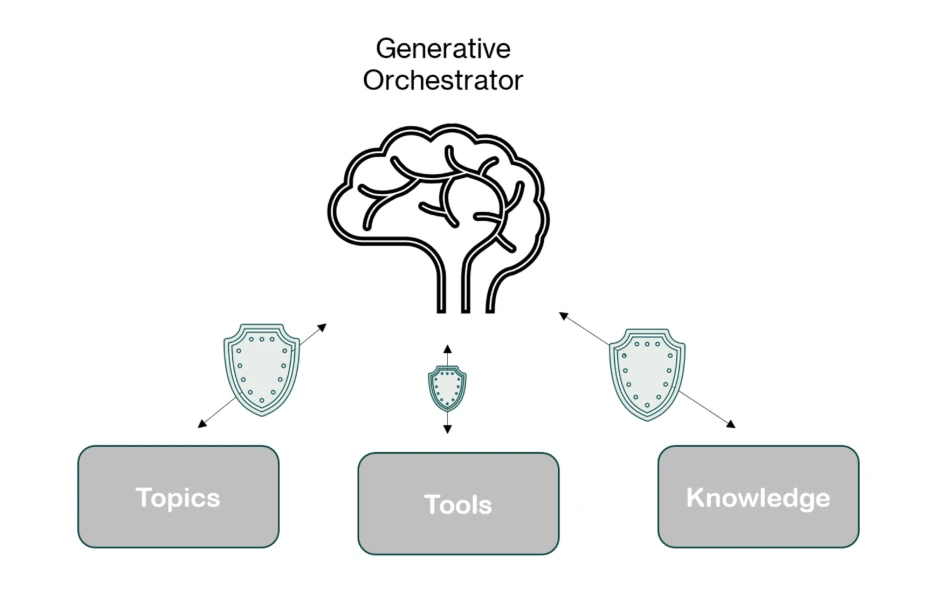
Figure 1: A visual representation of the 3 elements Copilot Studio agents relies on to respond to user prompts.
Microsoft Copilot Studio agents are composed of multiple components that work together to interpret input, plan actions, and execute tasks. From a security perspective, these same components (topics, tools, and knowledge sources) also define the agent’s effective attack surface. Understanding how they interact is essential to recognizing how attackers may attempt to influence agent behavior, particularly in environments that rely on generative orchestration to chain actions at runtime. Because these components determine how the agent responds to user prompts and autonomous triggers, crafted input becomes a primary vector for steering the agent toward unintended or unsafe execution paths.
When using generative orchestration, each user input or trigger can cause the orchestrator to dynamically build and execute a multi-step plan, leveraging all three components to deliver accurate and context-aware results.
Topics are modular conversation flows triggered by specific user phrases. Each topic is made up of nodes that guide the conversation step-by-step, and can include actions, questions, or conditions.
Tools are the capabilities the copilot can call during a conversation, such as connector actions, AI builder models, or generative answers. These can be embedded within topics or executed independently, giving the agent flexibility in how it handles requests.
Knowledge sources enhance generative answers by grounding them in reliable enterprise content. When configured, they allow the copilot to access information from Power Platform, Dynamics 365, websites, and other external systems, ensuring responses are accurate and contextually relevant. Read more about Microsoft Copilot Studio agents here.
Understanding and mitigating potential risks with real-time protection in Microsoft Defender
In the model above, the agent’s capabilities are effectively equivalent to code execution in the environment. When a tool is invoked, it can perform real-world actions, read or write data, send emails, update records, or trigger workflows – just like executing a command inside a sandbox where the sandbox is a set of all the agent’s capabilities. This means that if an attacker can influence the agent’s plan, they can indirectly cause the execution of unintended operations within the sandbox. From a security lens:
The risk is that the agent’s orchestrator depends on natural language input to determine which tools to use and how to use them. This creates exposure to prompt injection and reprogramming failures, where malicious prompts, embedded instructions, or crafted documents can manipulate the decision-making process.
The exploit occurs when these manipulated instructions lead the agent to perform unauthorized tool use, such as exfiltrating data, carrying out unintended actions, or accessing sensitive resources, without directly compromising the underlying systems.
Because of this, Microsoft Defender treats every tool invocation as a high-value, high-risk event,and monitors it in real time. Before any tool, topic, or knowledge action is executed, the Copilot Studio generative orchestrator initiates a webhook call to Defender. This call transmits all relevant context for the planned invocation including the current component’s parameters, outputs from previous steps in the orchestration chain, user context, and other metadata.
Defender analyzes this information, evaluating both the intent and destination of every action, and decides in real time whether to allow or block the action, providing precise runtime control without requiring any changes to the agent’s internal orchestration logic.
By viewing tools as privileged execution points and inspecting them with the same rigor we apply to traditional code execution, we can give organizations the confidence to deploy agents at scale – without opening the door to exploitation.
Below are three realistic scenarios where our webhook-based security checks step in to protect against unsafe actions.
Malicious instruction injection in an event-triggered workflow
Consider the following business scenario: a finance agent is tasked with generating invoice records and responding to finance-related inquiries regarding the company. The agent is configured to automatically process all messages sent to invoice@contoso.commailbox using an event trigger. The agent uses the generative orchestrator, which enables it to dynamically combine tools, topics, and knowledge in a single execution plan.
In this setup:
Trigger: An incoming email to invoice@contoso.com starts the workflow.
Tool: The CRM connector is used to create or update a record with extracted payment details.
Tool: The email sending tool sends confirmation back to the sender.
Knowledge: A company-provided finance policy file was uploaded to the agent so it can answer questions about payment terms, refund procedures, and invoice handling rules.
The instructions that were given to the agent are for the agent to only handle invoice data and basic finance-related FAQs, but because generative orchestration can freely chain together tools, topics, and knowledge, its plan can adapt or bypassed based on the content of the incoming email in certain conditions.
A malicious external sender could craft an email that appears to contain invoice data but also includes hidden instructions telling the agent to search for unrelated sensitive information from its knowledge base and send it to the attacker’s mailbox. Without safeguards, the orchestrator could interpret this as a valid request and insert a knowledgesearch step into its multi-component plan, followed by an email sent to the attacker’s address with the results.
Before the knowledge component is invoked, MCS sends a webhook request to our security product containing:
The target action (knowledge search).
Search query parameters derived from the orchestrator’s plan.
Outputs from previous orchestration steps.
Context from the triggering email.
Agent Runtime Protection analyzes the request and blocks the invocation before it executes, ensuring that the agent’s knowledgebase is never queried with the attacker’s input.
This action is logged in the Activity History, where administrators can see that the invocation was blocked, along with an error message indicating that the threat-detection controls intervened:
In addition, an XDR informational alert will be triggered in the security portal to keep the security team aware of potential attacks (even though this specific attack was blocked):
Prompt injection via shared document leading to malicious email exfiltration attempt
Consider that an organizational agent is connected to the company’s cloud-based SharePoint environment, which stores internal documents. The agent’s purpose is to retrieve documents, summarize their content, extract action items, and send these to relevant recipients.
To perform these tasks, the agent uses:
Tool A – to access SharePoint files within a site (using the signed-in user’s identity)
A malicious insider edits a SharePoint document that they have permission to, inserting crafted instructions intended to manipulate the organizational agent’s behavior.
When the crafted file is processed, the agent is tricked into locating and reading the contents of a sensitive file, transactions.pdf, stored on a different SharePoint file the attacker cannot directly access but that the connector (and thus the agent) is permitted to access. The agent then attempts to send the file’s contents via email to an attacker-controlled domain.
At the point of invoking the email-sending tool, Microsoft Threat Intelligence detects that the activity may be malicious and blocks the email, preventing data exfiltration.
Capability reconnaissance attempt on agent
A publicly accessible support chatbot is embedded on the company’s website without requiring user authentication. The chatbot is configured with a knowledge base that includes customer information and points of contact.
An attacker interacts with the chatbot using a series of carefully crafted and sophisticated prompts to probe and enumerate its internal capabilities. This reconnaissance aims to discover available tools and potential actions the agent can perform, with the goal of exploiting them in later interactions.
After the attacker identifies the knowledge sources accessible to the agent, they can extract all information from those sources, including potentially sensitive customer data and internal contact details, causing it to perform unintended actions.
Microsoft Defender detects these probing attempts and acts to block any subsequent tool invocations that were triggered as a direct result, preventing the attacker from leveraging the discovered capabilities to access or exfiltrate sensitive data.
Final words
Securing Microsoft Copilot Studio agents during runtime is critical to maintaining trust, protecting sensitive data, and ensuring compliance in real-world deployments. As demonstrated through the above scenarios, even the most sophisticated generative orchestrations can be exploited if tool invocations are not carefully monitored and controlled.
Defender’s webhook-based runtime inspection combined with advanced threat intelligence, organizations gain a powerful safeguard that can detect and block malicious or unintended actions as they happen, without disrupting legitimate workflows or requiring intrusive changes to agent logic (see more details at the ‘Learn more’ section below).
This approach provides a flexible and scalable security layer that evolves alongside emerging attack techniques and enables confident adoption of AI-powered agents across diverse enterprise use cases.
As you build and deploy your own Microsoft Copilot Studio agents, incorporating real-time webhook security checks will be an essential step in delivering safe, reliable, and responsible AI experiences.
This research is provided by Microsoft Defender Security Research with contributions from Dor Edry, Uri Oren.
Learn more
Review our documentation to learn more about our real-time protection capabilities and see how to enable them within your organization.
People are actively complaining that their mailboxes and queues are being flooded by emails coming from the Zendesk instances of trusted companies like Discord, Riot Games, Dropbox, and many others.
Zendesk is a customer service and support software platform that helps companies manage customer communication. It supports tickets, live chat, email, phone, and communication through social media.
Some people complained about receiving over 1,000 such emails. The strange thing ais that so far there are no reports of malicious links, tech support scam numbers, or any type of phishing in these emails.
The abusers are able to send waves of emails from these systems because Zendesk allows them to create fake support tickets with email addresses that do not belong to them. The system sends a confirmation mail to the provided email address if the affected company has not restricted ticket submission to verified users.
In a December advisory, Zendesk warned about this method, which they called relay spam. In essence it’s an example of attackers abusing a legitimate automated part of a process. We have seen similar attacks before, but they always served a clear purpose for the attacker, whereas this one doesn’t.
Even though some of the titles in use definitely are of a clickbait nature. Some examples:
FREE DISCORD NITRO!!
TAKE DOWN ORDER NOW FROM CD Projekt
TAKE DOWN NOW ORDER FROM Israel FOR Square Enix
DONATION FOR State Of Tennessee CONFIRMED
LEGAL NOTICE FROM State Of Louisiana FOR Electronic
IMPORTANT LAW ENFORCEMENT NOTIFICATION FROM DISCORD FROM Peru
Thank you for your purchase!
Binance Sign-in attempt from Romania
LEGAL DEMAND from Take-Two interactive
So, this could be someone testing the system, but it just as well might be someone who enjoys disrupting the system and creating disruption. Maybe they have an axe to grind with Zendesk. Or they’re looking for a way to send attachments with the emails.
Either way, Zendesk told BleepingComputer that they introduced new safety features on their end to detect and stop this type of spam in the future. But companies are advised to restrict the users that can submit tickets and the titles submitters can give to the tickets.
Stay vigilant
In the emails we have seen the links in the tickets are legitimate and point to the affected company’s ticket system. And the only part of the emails the attackers should be able to manipulate is the title and subject of the ticket.
But although everyone involved tells us just to ignore the emails, it is never wrong to handle them with an appropriate amount of distrust.
Delete or archive the emails without interacting.
Do not click on the links if you have not submitted the ticket or call any telephone number mentioned in the ticket. Reach out through verified channels.
Ignore any actions advised in the parts of the email the ticket submitter can control.
We don’t just report on threats – we help protect your social media
Cyber security is often framed as a problem for enterprises, governments, and seasoned professionals. But by the time organizations begin searching for talent, the damage has often already been done. Threat actors don’t wait for workforce pipelines to catch up and our approach to cyber security education shouldn’t either. Today’s digital threats target schools, hospitals, municipalities, and small businesses just as aggressively as large enterprises. Ransomware attacks shut down classrooms. Phishing campaigns exploit young users as easily as experienced employees. Yet cyber security education is still treated as a late-stage specialization, introduced only when individuals enter the workforce or pursue […]
AI is transforming how organizations operate and how they approach security. In this new era of agentic AI, every interaction, digital or human, must be built on trust. As businesses modernize, they’re not just adopting AI tools, they’re rearchitecting their digital foundations. And that means security can’t be an afterthought. It must be woven in from the beginning into every layer of the stack—ubiquitous, ambient, and autonomous—just like the AI it protects.
In this blog, we spotlight three global organizations that are leading the way. Each is taking a proactive, platform-first approach to security—moving beyond fragmented defenses and embedding protection across identity, data, devices, and cloud infrastructure. Their stories show that when security is deeply integrated from the start, it becomes a strategic enabler of resilience, agility, and innovation. And by choosing Microsoft Security, these customers are securing the foundation of their AI transformation from end to end.
Why security transformation matters to decision makers
Security is a board-level priority. The following customer stories show how strategic investments in security platforms can drive cost savings, operational efficiency, and business agility, not just risk reduction. Read on to learn how Ford, Icertis, and TriNet transformed their operations with support from Microsoft.
Ford builds trust across global operations
In the automotive industry, a single cyberattack can ripple across numerous aspects of the business. Ford recognized that rising ransomware and targeted cyberattacks demanded a different approach. The company made a deliberate shift away from fragmented, custom-built security tools toward a unified Microsoft security platform, adopting a Zero Trust approach and prioritizing security embedded into every layer of its hybrid environment—from endpoints to data centers and cloud infrastructure.
Partnering with Microsoft, Ford deployed Microsoft Defender, Microsoft Sentinel, Microsoft Purview, and Microsoft Entra to strengthen defenses, centralize threat detection, and enforce data governance. AI-powered telemetry and automation improved visibility and accelerated incident response, while compliance certifications supported global scaling. By building a security-first culture and leveraging Microsoft’s integrated stack, Ford reduced vulnerabilities, simplified operations, and positioned itself for secure growth across markets.
Icertis cuts security operations center (SOC) incidents by 50%
As a global leader in contract intelligence, Icertis introduced generative AI to transform enterprise contracting, launching applications built on Microsoft Azure OpenAI and its Vera platform. These innovations brought new security challenges, including prompt injection risks and compliance demands across more than 300 Azure subscriptions. To address these, Icertis adopted Microsoft Defender for Cloud for AI posture management, threat detection, and regulatory alignment, ensuring sensitive contract data remains protected.
By integrating Microsoft Security solutions—Defender for Cloud, Microsoft Sentinel, Purview, Entra, and Microsoft Security Copilot—Icertis strengthened governance and accelerated incident response. AI-powered automation reduced alert triage time by up to 80%, cut mean time to resolution to 25 minutes, and lowered incident volume by 50%. With Zero Trust principles and embedded security practices, Icertis scales innovation securely while maintaining compliance, setting a new standard for trust in AI-powered contracting.
Read the full customer story to learn how Icertis secures sensitive contract data, accelerates AI innovation, and achieves measurable risk reduction with Microsoft’s unified security platform.
TriNet moves to Microsoft 365 E5, achieves annual savings in security spend
Facing growing complexity from multiple point solutions, TriNet sought to reduce operational overhead and strengthen its security posture. The company’s leadership recognized that consolidating tools could improve visibility, reduce risk, and align security with its broader digital strategy. After evaluating providers, TriNet chose Microsoft 365 E5 for its integrated security platform, delivering advanced threat protection, identity management, and compliance capabilities.
By adopting Microsoft Defender XDR, Purview, Entra, Microsoft Sentinel, and Microsoft 365 Copilot, TriNet unified security across endpoints, cloud apps, and data governance. Automation and centralized monitoring reduced alert fatigue, accelerated incident response, and improved Secure Score. The platform blocked a spear phishing attempt targeting executives, demonstrating the value of Zero Trust and advanced safeguards. With cost savings from tool consolidation and improved efficiency, TriNet is building a secure foundation for future innovation.
Read the full customer story to see how TriNet consolidated its security stack with Microsoft 365 E5, reduced complexity, and strengthened defenses against advanced threats.
How to plan, adopt, and operationalize a Microsoft Security strategy
Ford, Icertis, and TriNet each began their transformation by assessing legacy systems and identifying gaps that created complexity and risk. Ford faced fragmented tools across a global manufacturing footprint, Icertis needed to secure sensitive contract data while adopting generative AI, and TriNet aimed to reduce operational complexity caused by managing multiple point solutions, seeking a more streamlined and integrated approach. These assessments revealed the need for a unified, risk-based strategy to simplify operations and strengthen protection.
Building on Zero Trust and deploying integrated solutions
All three organizations aligned on Zero Trust principles as the foundation for modernization. They consolidated security into Microsoft’s integrated platform, deploying Defender for endpoint and cloud protection, Microsoft Sentinel for centralized monitoring, Purview for data governance, Entra for identity management, and Security Copilot for AI-powered insights. This phased rollout allowed each company to embed security into daily operations while reducing manual processes and improving visibility.
Measuring impact and sharing best practices
The results were tangible: Ford accelerated threat detection and governance across its hybrid environment, Icertis cut incident volume by 50% and reduced triage time by 80%, and TriNet improved Secure Score while achieving cost savings through tool consolidation. Automation and AI-powered workflows delivered faster response times and reduced complexity. Each organization now shares learnings internally and with industry peers—whether through executive briefings, training programs, or participation in cybersecurity forums—helping set new standards for resilience and innovation.
Working towards a more secure future
The future of enterprise security is being redefined by AI, by innovation, and by the bold choices organizations make today. Modernization, automation, and collaboration are no longer optional—they’re foundational. As AI reshapes how we work, build, and protect, security must evolve in lockstep: not as an add-on, but as a fabric woven through every layer of the enterprise.
These customer stories show us that building a security-first approach isn’t just possible; it’s imperative. From cloud-native disruptors to global institutions modernizing complex environments, leading organizations are showing what’s possible when security and AI move together. By unifying their tools, automating what once was manual, and using AI to stay ahead of emerging cyberthreats, they’re not just protecting today, they’re securing the future and shaping what comes next.
To learn more about Microsoft Security solutions, visit our website. Bookmark the Security blog to keep up with our expert coverage on security matters. Also, follow us on LinkedIn (Microsoft Security) and X (@MSFTSecurity) for the latest news and updates on cybersecurity.
As cyberthreats become faster, harder to detect, and more sophisticated, organizations must focus on building resilience—strengthening their ability to prevent, withstand, and recover from cybersecurity incidents. Resilience can mean the difference between containing an incident with minimal disruption and becoming the next headline.
For more than a decade, Microsoft Incident Response has been at the forefront of the world’s most complex cyberattacks, helping organizations investigate, contain, and recover from incidents. That real-world experience also informs our proactive services, which help organizations improve readiness before an incident occurs. To further help organizations before, during, and after a cyber incident, we’re excited to introduce new proactive incident response services designed to help organizations build resilience and minimize disruption.
Microsoft Incident Response
Strengthen your security with intelligence-driven incident response from Microsoft.
Delivered by the same experts who handle real-world crises, Microsoft proactive services equip security teams with insights and skills to be informed, resilient, and ready—because the best response is one you never need to make.
Incident response plan development: We assist organizations in developing their own incident response plan, using lessons from real-world incidents.
Major event support: We provide dedicated teams during critical events—such as corporate conferences or sporting events—actively monitoring emerging cyberthreats and acting instantly to prevent incidents and interruptions.
Cyber range:Microsoft Incident Response delivers simulations that provide high-fidelity, hands-on experience in a controlled environment. Security teams engage directly with threat actor tactics, using Microsoft security tools to detect, investigate, and contain cyberthreats in real time. This immersive approach builds confidence, muscle memory, and validates playbooks before an actual incident occurs using tools customers already own.
Advisory:We offer one-on-one, customized engagements, offering strategic recommendations, industry-specific consulting, and expert guidance informed by current threat actor activity and the latest incident response engagements. These services provide on-demand access to Microsoft Incident Response and cybersecurity experts, empowering leadership and technical teams to make informed decisions that reduce risk and accelerate resilience.
Mergers and acquisitions compromise assessment:Microsoft Incident Response offers a targeted compromise assessment performed during or around a merger, acquisition, or divestiture to determine whether the organization being acquired—or the environment being integrated—has been previously or is currently compromised by threat actors.
Building on a strong proactive foundation
These new services build on Microsoft Incident Response’s established proactive offerings, which are trusted by organizations of all sizes and across industries.
Our popular compromise assessment delivers deep forensic investigations to identify indicators of compromise (IOCs), threat actor activity, and vulnerabilities hidden in your environment. This service includes advanced threat hunting and forensic examination, providing actionable recommendations to harden your security posture.
Identity assessment offers a targeted evaluation of the identity control plane, pinpointing weaknesses in authentication and access policies. By addressing these gaps early, organizations reduce exposure to credential-based attacks and help ensure identity systems remain resilient against evolving cyberthreats.
Identity hardening works with organizations to deploy policies and configurations that block unauthorized access and strengthen authentication mechanisms. Engineers provide proven containment and recovery strategies to secure the identity control plane.
Tabletop exercises go beyond theory by immersing leadership, legal, and technical teams in realistic scenarios involving an incident. These sessions expose gaps in defenses and response plans, sharpen decision-making under pressure, and foster alignment on regulatory obligations and executive communications.
Make resilience your strongest defense
Incident response isn’t just about reacting to incidents—it’s giving organizations the confidence and capabilities needed to prevent them. Microsoft Incident Response helps customers move from security uncertainty to clarity and readiness with expert-led preparation, gap detection, defense hardening, and tailored threat insights. By investing in proactive services, you reduce risk, accelerate recovery, and strengthen your security posture before threats strike. Don’t wait for an incident to test your resilience—invest in proactive defense today.
To learn more about Microsoft Security solutions, visit our website. Bookmark the Security blog to keep up with our expert coverage on security matters. Also, follow us on LinkedIn (Microsoft Security) and X (@MSFTSecurity) for the latest news and updates on cybersecurity.
Between 2024 and 2026, Flashpoint analysts have observed the financial sector as a top target of threat actors, with 406 publicly disclosed victims falling prey to ransomware attacks alone—representing seven percent of all ransomware victim listings during that period.
However, ransomware is just one piece of the complex threat actor puzzle. The financial sector is also grappling with threats stemming from sophisticated Advanced Persistent Threat (APT) groups, the risks associated with third-party compromises, the illicit trade in initial access credentials, the ever-present danger of insider threats, and the emerging challenge of deepfake and impersonation fraud.
Why Finance?
The financial sector has long been one of the most attractive targets for threat actors, consistently ranking among the most targeted industries globally.
These institutions manage massive volumes of sensitive data—from high-value financial transactions and confidential customer information to vast sums of capital, making them especially lucrative for threat actors seeking financial gain. Additionally, the urgency and criticality of financial operations increases the chances that victim organizations will succumb to extortion and ransom demands.
Even beyond direct financial incentives, the financial sector remains an attractive target due to its deep interconnectivity with other industries.This means that malicious actors may simply target financial institutions to gain information about another target organization, as a single data breach can have far-reaching and cascading consequences for involved partners and third parties.
The Threat Actors Targeting the Financial Sector
To understand the complexities of the financial threat landscape, organizations need a comprehensive understanding of the key players involved. The following threat actors represent some of the most prominent and active groups targeting the financial sector between April 2024 and April 2025:
Active since March 2023, Akira has demonstrated increasingly sophisticated tactics and has targeted a significant number of victims across various sectors. Between April 2024 and April 2025, they targeted 34 organizations within the financial sector. Evidence suggests a potential link to the defunct Conti ransomware group. Akira commonly gains initial access through compromised credentials, Virtual Private Network (VPN) vulnerabilities, and Remote Desktop Protocol (RDP). They employ a double extortion model, exfiltrating data before encryption.
LockBit Ransomware
A long-standing and highly prolific RaaS group operating since at least September 2019, LockBit continued to be a major threat to the financial sector, claiming 29 publicly disclosed victims between April 2024 and April 2025. LockBit utilizes various initial access methods, including phishing, exploitation of known vulnerabilities, and compromised remote services.
Most notably, in June 2024, LockBit claimed it gained access to the US Federal Reserve, stating that they exfiltrated 33 TB of data. However, Flashpoint analysts found that the data posted on the Federal Reserve listing appears to belong to another victim, Evolve Bank & Trust.
FIN7
This financially motivated threat actor group, originating from Eastern Europe and active since at least 2015, focuses on stealing payment card data. They employ social engineering tactics and create elaborate infrastructure to achieve their goals, reportedly generating over $1 billion USD in revenue between 2015 and 2021. Their targets within the financial sector include interbank transfer systems (SWIFT, SAP), ATM infrastructure, and point-of-sale (POS) terminals. Initial access is often gained through phishing and exploiting public-facing applications.
Scattering Spider
Emerging in 2022, Scattered Spider has quickly become known for its rapid exploitation of compromised environments, particularly targeting financial services, cryptocurrency services, and more. They are notorious for using SMS phishing and fake Okta single sign-on pages to steal credentials and move laterally within networks. Their primary motivation is financial gain.
Lazarus Group
This advanced persistent threat (APT) group, backed by the North Korean government, has demonstrated a broad range of targets, including cryptocurrency exchanges and financial institutions. Their campaigns are driven by financial profit, cyberespionage, and sabotage. Lazarus Group employs sophisticated spear-phishing emails, malware disguised in image files, and watering-hole attacks to gain initial access.
Top Attack Vectors Facing the Financial Sector
Between April 2024 and April 2025, our analysts observed 6,406 posts pertaining to financial sector access listings within Flashpoint’s forum collections. How are these prolific threat actor groups gaining a foothold into financial data and systems? Examining Flashpoint intelligence, malicious actors are capitalizing on third-party compromises, initial access brokers, insider threats, amongst other attack vectors:
Third-Party Compromise
Ransomware attacks targeting third-party vendors can have a direct and significant impact on financial institutions through data exposure and compromised credentials. The Clop ransomware gang’s exploitation of the MOVEit vulnerability in December 2024 serves as a stark reminder of this risk.
Initial Access Brokers (IABs)
Initial Access Brokers specialize in gaining initial access to networks and selling these access credentials to other threat groups, including ransomware operators. Their tactics include phishing, the use of information-stealing malware, and exploiting RDP credentials, posing a significant risk to financial entities. Between April 2024 and April 2025, analysts observed 6,406 posts pertaining to financial sector access listings within Flashpoint’s forum collections.
Insider Threat
Malicious insiders, whether recruited or acting independently, can provide direct access to sensitive data and systems within financial institutions. Telegram has emerged as a prominent platform for advertising and recruiting insider services targeting the financial sector.
Deepfake and Impersonation
The increasing sophistication and accessibility of AI tools are enabling new forms of fraud. Deepfakes can bypass traditional security measures by creating convincing audio and video impersonations. While still evolving, this threat vector, along with other impersonation tactics like BEC and vishing, presents a growing concern for the financial sector. Within the past year, analysts observed 1,238 posts across fraud-related Telegram channels discussing impersonation of individuals working for financial institutions.
Defend Against Financial Threats Using Flashpoint
The financial sector remains a high-value target, facing a persistent and evolving array of threats. Understanding the tactics, techniques, and procedures (TTPs) of these top threat actors, as well as the broader threat landscape, is crucial for financial institutions to develop and implement effective security strategies.
Flashpoint is proud to offer a dedicated threat intelligence solution for banks and financial institutions. Our platform combines comprehensive data collection, AI-powered analysis, and expert human insight to deliver actionable intelligence, safeguarding your critical assets and operations. Request a demo today to see how our intelligence can empower your security team.

 Login
Login