Login
CrowdStrike Delivers the Next Evolution of the Agentic SOC
2 September 2026 at 06:00

Cross-environment attacks demand a new approach to security operations. Learn how Unit 42 Managed XSIAM helps SOC teams investigate complete attack paths.
The post Inside the Modern SOC: Defending the Cross-Environment Pivot appeared first on Unit 42.

We continue tracking the activity of Toy Ghouls (also known as Bearlyfy, Laboo.boo, and Feral Wolf), a financially motivated group that has been targeting Russian organizations since 2025. The attackers initially relied exclusively on tools pulled from public GitHub repositories along with leaked Babuk and LockBit ransomware builders, later shifting to their own custom ransomware, GenieLocker. In early July 2026, we observed the group using a custom backdoor for the first time.
We identified two versions of this backdoor: one uses the HiveMQ MQTT broker as its C2 server, while the other relies on the Element messenger. Both versions include “bird” in their names:
This post examines how the backdoor is delivered to target systems, how it establishes persistence, and how it communicates with its C2 server.
In this campaign, the attackers use Windows Remote Management (WinRM) to deliver the backdoors and their configuration files to compromised systems. The group relies on open-source tools such as Evil-WinRM and WinRM-fs to do this.
The backdoor can both run within an interactive command-line session and establish persistence as a Windows service, using the --install or install option, depending on the backdoor version. The --service (or service) option is not available by default and is instead used as an argument for the installed Windows service.
Other launch options are listed in the backdoor’s help output:
C:\cplsupport.exe -h
Bird Agent - MQTT server monitor
Usage: cplsupport.exe [OPTIONS]

Options:
-c, --config <CONFIG> Path to config.toml config file
--install Install as a system service
--uninstall Uninstall the system service
--seal Encrypt sensitive config fields in-place using a machine-bound key
-h, --help Print help
-V, --version Print version
HiveMQ version backdoor help output
In the Element version, the backdoor help output looks as follows:
C:\wtass.exe -h
Matrix monitoring agent

Usage: wtass.exe [OPTIONS] [COMMAND]

Commands:
  install    Register this agent with the Matrix homeserver and panel
  uninstall  Remove this agent's service and credentials
  service    Run as a Windows service (internal)
  help       Print this message or the help of the given subcommand(s)

Options:
  -c, --config <CONFIG>
  -h, --help             Print help
  -V, --version          Print version
Element version backdoor help output
By default, the backdoor looks for a config.toml configuration file in the directory where the executable was launched, then falls back to %PROGRAMDATA%\SynapseAgent\config.toml (Element version) or %PROGRAMDATA%\cplsupport\config.toml (HiveMQ version). If no configuration file is found in either location, the full path can be specified using the -c (--config) option.
The backdoor accepts both unencrypted configuration files and files with partially encrypted sections. In the first case, once the backdoor is launched, it reads the file and partially encrypts it using the seal() function (the --seal option in the HiveMQ version), applying the ChaCha20-Poly1305 algorithm with a key derived from the value of the HKLM\Software\Microsoft\Cryptography\MachineGuid registry key. This means that after the backdoor’s first run, the configuration file becomes bound to that specific machine. On subsequent runs, the configuration is decrypted automatically. If the input configuration was already partially encrypted, it is likewise decrypted automatically.
If the configuration cannot be decrypted, the backdoor stops running.
Encrypted configuration files look as follows:
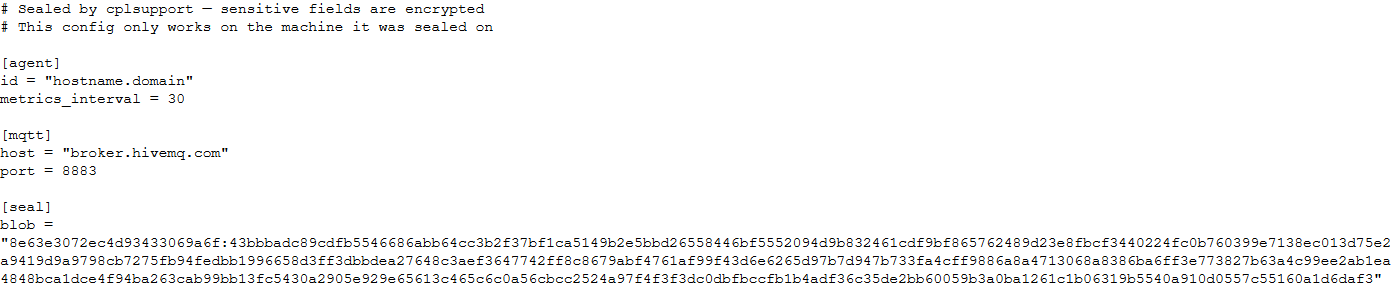
Encrypted backdoor configuration file, HiveMQ version
The encrypted portion of the HiveMQ version’s configuration contains the following parameters:
agent_privkey: the agent’s private keychannel_id: the channel identifier used to communicate with the brokerserver_pubkey: the server’s public key
Decrypted blob field in the HiveMQ version’s configuration
In the Element version, the configuration file is deleted immediately after the first run, and the relevant parameters are instead written to the HKLM\Software\synapse\Config\SealedConfig registry key. On subsequent runs, the backdoor checks the registry for its configuration first.
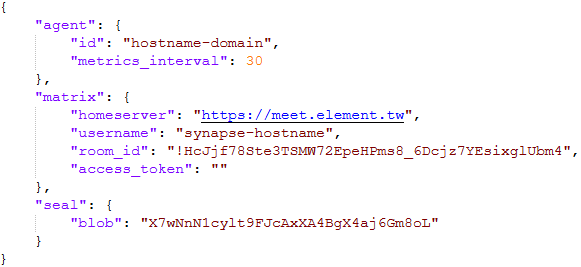
Decrypted Element version configuration file, retrieved from the registry
The Element version’s configuration specifies the address of an Element server controlled by the attackers, a room identifier, and an access_token used to access that room. If this parameter is left empty, the backdoor prompts for the password interactively during installation. After successfully creating a session, the backdoor saves the received token to the blob field.
At startup, both backdoor versions send a GET request to http://ip-api.com/json to determine the system’s public IP address and country of origin.
The first version uses the public HiveMQ MQTT broker (broker.hivemq.com) as its C2 server. The free tier of this broker supports up to 100 concurrent connections and up to 10 GB of traffic per month. The attackers set up their own cluster and used it both to collect telemetry from compromised systems and to send commands to the backdoor.
-NonInteractive -NoProfile -Command parameters.For the second backdoor version, the attackers set up their own Element server running on the Matrix protocol, meet.element[.]tw, as the C2 server. On this server, they created a room used to receive messages containing device information and to send commands for execution on the compromised system. The communication flow is as follows:
m.bird.status message containing the system’s status. This message format is identical to that used in the HiveMQ version.m.bird.metrics message. Field names are slightly different from those in the first version:
{cpu_percent_x100":float,"mem_used_bytes":int,"mem_total_bytes":int,"disk_used_bytes":int,"disk_total_bytes":int,"load_1m_x100":float,"load_5m_x100":float,"load_15m_x100":float,"uptime_secs":int,"hostname":"hostname.domain","timestamp":unix_timestamp}.config:set_interval (accepting values from 5 to 3600 seconds). The new value is saved to the HKLM\Software\SynapseAgent\metrics_interval registry key.cmd:. Based on data extracted from Element’s SQLite databases on the compromised system, we were able to identify the account name the attackers used to send commands: panel-bot.m.bird.cmd_response message. This message format mirrors the one used in the HiveMQ version.We have been tracking Toy Ghouls’ activity for quite some time. We previously found that the group had expanded its arsenal with a custom ransomware strain, GenieLocker, and we have now discovered that it has also developed a backdoor capable of giving it full control over an infected device. The new tools use unconventional channels to communicate with their C2 server: the HiveMQ MQTT broker and the Matrix-based Element messenger. This shift away from publicly available open-source projects toward custom-built tools suggests that Toy Ghouls is working to make its attacks more sophisticated and to evade detection for longer.
Kaspersky security solution verdicts:
File names and MD5 hashes:
Registry keys:
Service names:
Domain names:
Identity-based attacks drive 90% of incidents. Learn how modern attackers exploit identities and what SOC leaders can do to respond.
The post Inside the Modern SOC: The Identity Front Door appeared first on Unit 42.
Amazon Web Services (AWS) is pleased to announce that the Summer 2026 System and Organization Controls (SOC) 1 report is now available. The reports cover 185 services over the 12-month period from July 1, 2025–June 30, 2026, giving customers a full year of assurance. These reports demonstrate our continuous commitment to adhering to the heightened expectations of cloud service providers.
Customers can download the Summer 2026 SOC 1 report through AWS Artifact, a self-service portal for on-demand access to AWS compliance reports. Sign in to AWS Artifact in the AWS Management Console, or learn more at Getting Started with AWS Artifact.
AWS strives to continuously bring services into the scope of its compliance programs to help customers meet their architectural and regulatory needs. You can view the current list of services in scope on our Services in Scope page. As an AWS customer, you can reach out to your AWS account team if you have any questions or feedback about SOC compliance.
To learn more about AWS compliance and security programs, see AWS Compliance Programs.
Leveraging legitimate software is one of cybercriminals’ tactics of choice, with remote management tools ranking among their top tools. A recent example involves the remote administration utility ScreenConnect. It’s designed for IT support teams to troubleshoot systems and configure software seamlessly in the background. However, when weaponized by threat actors, ScreenConnect becomes a versatile attack vehicle used to harvest data, deploy malware, and move laterally across corporate networks.
During a recent incident detected by Kaspersky Managed Detection and Response, our experts identified an attempt to use ScreenConnect in an attack. This allowed a detailed study of how attackers used this application in a large-scale malware distribution campaign. The following breakdown illustrates the mechanics of ScreenConnect-assisted attacks, and outlines key strategies to defend your organization against them.
In the campaign analyzed by our experts, the attackers bundled ScreenConnect with legitimate free business software. They established a network of phishing websites to spoof popular tools, including OBS Studio, DS4Windows, DNS Jumper, Glary Utilities, Bandizip, Process Hacker, and others.
These rogue websites featured high-quality designs that could be taken for the official pages, making them highly convincing to unsuspecting users. Once the victim clicks the download button for the software, an archive is downloaded to their computer that contains additional files alongside the requested application:
Launching the renamed file disguised as the app installer triggers DLL sideloading of a malicious library. This library silently runs the ScreenConnect installation without restarting the system, while using the standard Windows installer to set up the software the user originally tried to install.
The attackers used search engine optimization techniques to drive traffic to their fake websites. As a result, these malicious pages appeared at the top of search results for certain free software utilities on major search engines.
Our experts discovered over 90 domain names translated into more than 10 different languages. While most of these websites targeted English, Russian, and Chinese speakers, several domains catered to German, French, Spanish, Arabic, and other regional audiences.
A detailed analysis of the IP addresses and associated spoofed domains is available in our technical research article on Securelist, along with full indicators of compromise.
In this campaign, attackers leveraged ScreenConnect to generate and execute malicious scripts on victim machines. These scripts served several key functions: they created exclusions for specific drives, directories, and processes within Windows Defender, disabled the User Account Control (UAC) security mechanism, and delivered and deployed AsyncRAT – a remote access Trojan.
To maintain persistence, the scripts configured a Windows scheduled task to run the malicious code at preset intervals. AsyncRAT then established a connection with the attackers’ command-and-control server to receive further instructions.
The primary objective of this campaign appears to be gaining unauthorized access to enterprise systems, likely to then resell it on cybercrime marketplaces.
Although ScreenConnect in and of itself is a legitimate tool, its presence poses a security risk to corporate environments. Consequently, Kaspersky security solutions detect this application as not-a-virus:HEUR:RemoteAdmin.MSIL.ConnectWise.gen.
Security teams should implement the following controls:
As noted previously, this campaign was originally detected through the Kaspersky Managed Detection and Response service, which can be employed to protect against such threats.


by Dan “Haircutfish” Rearden | haircutfish.com | Guest Author Working in the SOC can be a grind. Whether triaging alerts, escalating to clients, or just trying to understand why users […]
The post Report As You Go: Maintaining Good Documentation for SOC Analysts appeared first on Black Hills Information Security, Inc..

Security Operations Centers (SOCs) serve as a critical line of defense against today's constantly evolving cybersecurity threats. At the heart of these teams are SOC analysts, who monitor, detect, and respond around the clock to potential attacks.
The post The Life of a SOC Analyst: Responsibilities, Challenges, and Strategies for Success appeared first on Black Hills Information Security, Inc..
The conversation around AI-powered threats has focused heavily on the attacker side. What models can do, what vulnerabilities they can find, how fast they can chain exploits together. But the more important question for security practitioners is simpler and harder. Is your detection posture ready for what’s already happening?
AI has lowered the barrier to entry for sophisticated attacks. Threat actors don’t need to be experts to leverage LLMs for obfuscation, exploit development, or chaining attack steps that previously required deep manual skill. The speed and volume of attacks is increasing as a result. Detection engineering is part of how defenders respond. And most organizations are further behind than they realize, especially because many detection engineering programs live in their own siloed “ivory tower”, detached from the realities of what SOC analysts are handling.
At Intezer, AI-powered detection engineering runs as part of a closed loop with automated, forensic triage and investigation. Every alert investigated across the environment feeds new signal back into detection logic, so coverage improves continuously instead of drifting between quarterly tuning cycles. Detection working in concert with triage and investigation is what a fully optimized security environment looks like against AI-powered attackers.
In this article, we’ll focus on how to improve detection engineering practices in general.
The fundamental problem is that most detection programs were built for a world where attack volume was bounded by attacker expertise. That constraint is being removed. LLM-augmented attacks can move faster, produce more permutations, and adapt more readily to your environment than traditional campaigns. A detection posture built on static indicators and periodic tuning cycles can’t keep up.
There are three places this shows up in practice.
First, most organizations are only covering technique-level MITRE ATT&CK mappings, not sub-techniques. When you claim T1059 is covered because you have a rule for T1059.001, you’re exposing yourself to real risk hiding beneath that coverage number. Sub-techniques carry distinct behaviors that may exist in your environment and go completely undetected. High-level coverage scores look good in reports and obscure what’s actually happening. The risk lives at the sub-technique level.
Second, IOC-based detections are becoming a liability at scale. IP addresses, file hashes, domains are valuable in incident response but brittle as primary detection logic. Their half-life is short, adversaries burn them readily, and maintaining a large list of active IOCs creates noise without proportionate signal. Organizations that lead with IOCs end up toggling rules on and off constantly, adding friction without improving coverage. The maintenance cost compounds without a meaningful security return.
Third, telemetry that looks healthy often isn’t. A Windows Event ID 4688 without command-line logging enabled is an example. You’re paying to ingest it, it shows up in your coverage maps, but it provides no actionable data when something fires. Unmapped or broken telemetry creates the appearance of coverage where none actually exists. Before you write a new rule, validate that the data it depends on actually contains what you think it does.
Behavioral detections are built around what attackers do across a campaign, not what artifacts they happened to leave behind in a specific incident. Techniques, sequences, tool patterns, execution chains persist across campaigns, across threat actors, and even across malware families. A behavioral detection written well today has a much longer useful life than any IOC-based rule.
The shift to behavioral detection isn’t just a philosophy, it requires specific changes to how rules are built and maintained.
Score-based detection logic is one of the most underused approaches in enterprise SIEMs. If you’re running Splunk, Sumo Logic, or Cortex XDR, score-based rules let you assign weighted values to individual signals and alert when combinations cross a threshold. Individual signals that are weak in isolation, a process executing from an unusual path, a network connection to an uncommon destination, a scheduled task created outside business hours, become meaningful together. Noise goes down. True positive rate goes up. And the system stays tunable as your environment changes.
Permutation testing is the other discipline most detection programs skip. LLMs make it straightforward to generate attack variants at volume. Defenders should be doing the same before releasing rules. If a detection rule only catches one specific implementation of a technique, an attacker using a slightly different toolchain or execution order will evade it. Testing rules against a range of permutations before production deployment closes gaps that post-deployment tuning will miss.
The traditional cycle, write a rule, deploy it, wait for something to fire, tune reactively when it generates too many false positives, is too slow for the current threat environment. By the time you’ve finished tuning a rule for last quarter’s threat, new attack patterns are already in the wild.
The cycle needs to compress at every stage. Prototype rules should be tested in isolated environments before they reach production. Sandboxes and virtual machines can be spun up quickly in the same pipeline as rule development, giving you a controlled validation environment. Rules that are tuned before deployment don’t flood the SOC on their first day, and analysts who aren’t buried in false positives from new rules are analysts who can actually investigate real threats.
Continuous monitoring closes the loop. Every alert that fires, every verdict and every outcome feeds information back into the detection posture. Which rules are generating signal? Which ones are generating noise? Where are the coverage gaps that no existing rule addresses? Without this feedback loop, detection engineering becomes a periodic exercise rather than a continuously improving system.
A well integrated feedback loop investigates every single alert a detection creates, resolves false positives from critically important detections while continuously tuning the behavioral model to secure your organization and security detection pipeline.
Coverage benchmarks help set realistic expectations and give teams a concrete target. Based on what we see across enterprise environments:
Anything above 70% is usually inflated. Scores at this level typically reflect mapping sprawl across multiple MITRE versions, technique-level claims that obscure sub-technique gaps, or rules that are mapped but broken. Validate the underlying data before trusting the number.
The goal isn’t 100% coverage. That number isn’t achievable or meaningful. The goal is systematic, maintainable coverage of the techniques most relevant to your environment and your crown jewels, with the sub-technique depth to catch how those techniques are actually executed.
Mythos focused attention on a specific capability and that is autonomous chaining of exploit steps that previously required human guidance at each stage. A skilled researcher can still walk an LLM through finding a vulnerability, reaching exploit code, and overtaking an instruction pointer, but that process requires human direction at each transition. What makes autonomous chaining meaningful is that it removes the human from the loop on the attacker side.
The detection engineering response isn’t a new category of rule. It’s the same disciplines applied with more rigor and at higher speed. Attackers using LLMs are still executing against endpoints, still writing to disk or running in memory, still making network connections, still creating processes. The behaviors are recognizable. What changes is the volume of variants and the speed at which new campaigns emerge.
Score-based logic handles volume well because it doesn’t require a rule per variant. Permutation testing handles new variants better than reactive tuning because gaps are found before deployment rather than after. Behavioral coverage handles campaign evolution better than IOC maintenance because the underlying techniques persist even as the tooling changes.
This is where an integrated model matters most. AI-powered detection engineering delivers the most value when it doesn’t operate in isolation, and at Intezer it runs on the same loop as automated triage and investigation. The platform investigates 100% of alerts across endpoint, identity, cloud, network, and SIEM, and every verdict feeds directly back into detection, surfacing noisy rules, broken telemetry, and coverage gaps as they happen rather than at the next review. Detection, triage, and investigation reinforcing one another is what produces a fully optimized security environment, one that keeps pace as attacker AI accelerates.
The organizations that fare best against AI-powered threats will be the ones that already had a functioning detection engineering program, one built on behavioral logic, continuous feedback, and validated telemetry, before the threat landscape changed. Catching up under pressure is possible, but it’s harder and slower than building the discipline now.
The attacker’s AI is getting faster. The detection engineering cycle should be too.
Learn more about Intezer’s AI-powered detection engineering.
The post Detection engineering in the AI era appeared first on Intezer.
Intezer already investigates 100% of your alerts and escalates fewer than 2% of them for human review. That part is handled.
The work does not stop there, though. Every SOC has its own routines wrapped around the investigation itself. The incident reports written in a particular format, the closure notes, the shift handoffs, the rules that decide who picks up which case. When we looked at how teams actually use AI Chat, our in-product investigation agent, more than a third of those conversations turned out to be the same repetitive tasks asked again and again. The same summaries. The same reports. The same closure notes.
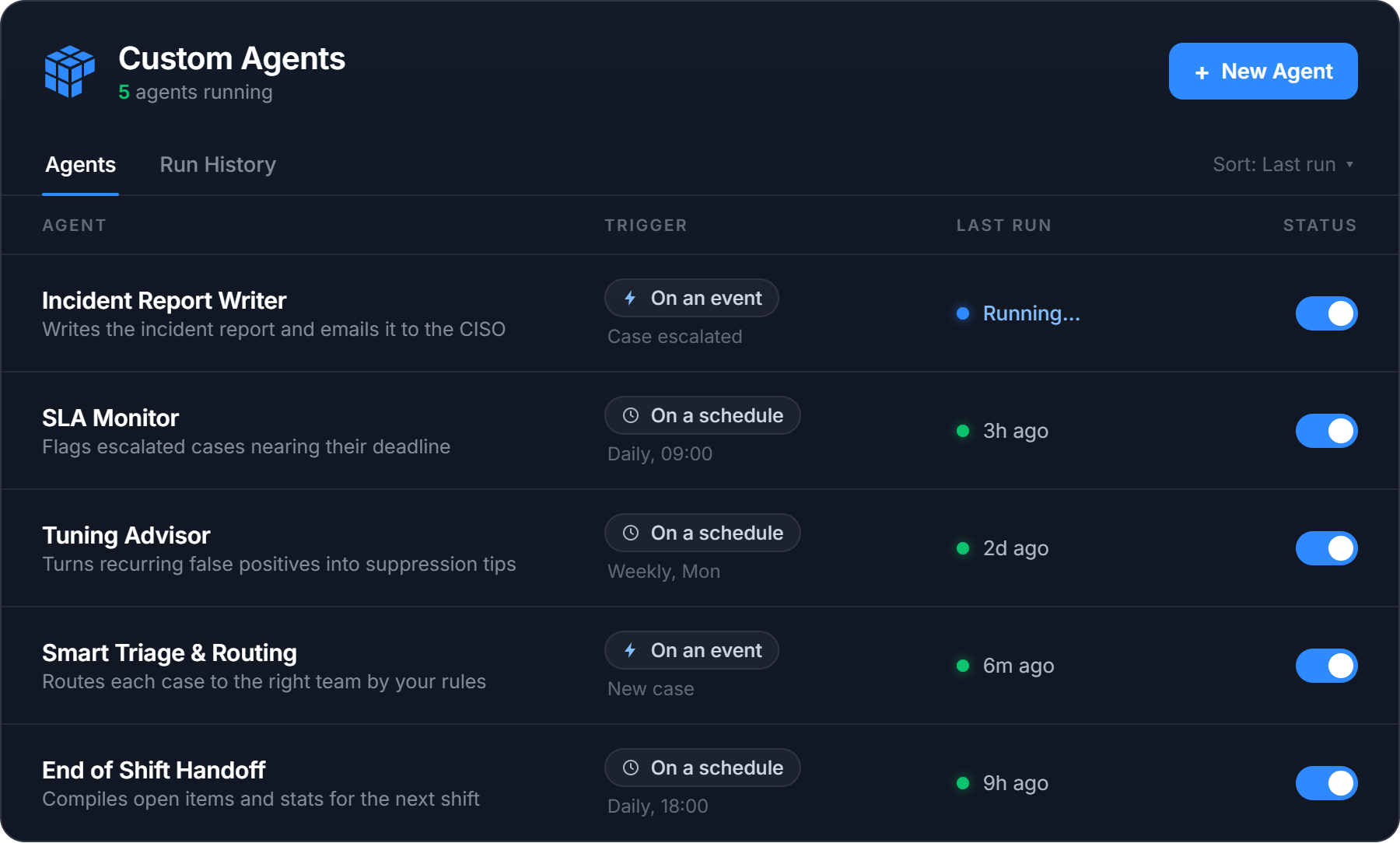
Intezer’s AI SOC already runs agents around the clock to triage, investigate, and respond to your alerts on their own. Custom Agents is the next step. Now you can shape how that AI SOC works for your team. Add your own agents and automations on top of the ones Intezer runs out of the box, take more of the manual work off your analysts, and tailor the whole thing to the way your team actually operates.
Intezer ships with a set of agents and automations that handle triage, investigation, and response from day one. Custom Agents lets you build your own on top of them.
An agent is made up of three components:
You describe what you want done in plain language, choose when it should run, and pick what it can touch. It then runs on its own inside your Intezer environment, on the same engine that powers our investigation Agent (Chat).
1. Tell it what to do, in plain language. Write the instructions the way you would brief a new analyst. “Every morning, review the open case queue, close the clear false positives per our playbook, and leave a handoff note on the rest.” That is an agent.
2. Choose when it runs. Three trigger types cover most workflows:
3. Give it the right tools. Agents work across your whole stack which includes Intezer’s built-in toolset plus the SIEM, EDR, and identity tools you have already connected, including CrowdStrike, SentinelOne, Splunk, Microsoft Sentinel, and Entra ID. They do more than summarize. They take action by updating, commenting on, closing cases, and emailing a finished report to your team.
Take an Incident Report Writer agent illustrated above. We deliberately never shipped a single “Generate report” button, because no two teams want the same report. One team wants an executive summary up top, another wants the full timeline, another has a compliance format it has to match. So instead of a button, you put your format into the agent’s instructions, and it writes every report that way, every time.
The agent triggers on every escalated case an analyst has confirmed as a real threat. It reads the case, writes the report in your format, and emails it to your team’s inbox. The analyst makes the call. The paperwork writes itself.
That’s one agent. The point of Custom Agents is that you decide what they are.
Security teams do not trust black boxes, and they are right not to. Custom Agents is built so you can see and control everything an agent does.
This is how everything at Intezer works. AI executes, humans supervise. Custom Agents lets you decide what it executes.
We opened Custom Agents to a small group of alpha customers, and the best part has been watching what they build. Alongside the Incident Report Writer above, a few of the agents already running in production:
We are on a mission to build the AI SOC the industry has been promised but never delivered. One that does the work and earns the trust to do it. It runs autonomously, around the clock. It works alongside the people who supervise it, not over their heads. And it is never a black box. You can always open it up, question what it did, and change how it behaves.
Custom Agents is central to that vision. Triage, investigation, and response come built in. Everything particular to how your team operates, you build yourself. Because the strongest security teams have always run on their own playbooks, their own logic, and their own standards, and an AI SOC should be no different. It should not ship the same to everyone. No two SOCs are the same, and no two should be.
That is the point of Custom Agents. You decide what they are.
Custom Agents is available now in beta to Intezer customers, and it is free during the beta period. This is the moment to build, test, and tell us what you want it to do next.
See what your SOC could hand off. Book a demo.
If you are already an Intezer customer, you will find it under Custom Agents in the top menu.
The post Introducing Custom Agents: Automate your SOC, your way appeared first on Intezer.

We're all petrified about missing a critical event or misclassifying an alert, but when we're talking about incident response (IR), there are often hundreds if not thousands of alerts to parse through. It's easy to get caught up with one alert because it feels "too hot" or maybe not spend enough time looking into something that initially seems "too cold."
The post Finding the “Goldilocks” Zone: A Practical Approach to Alert Triage appeared first on Black Hills Information Security, Inc..
Attackers can move from access to exfiltration in 72 minutes. Learn how modern SOC teams close the speed gap with Unit 42's AI-driven automation, threat hunting, MDR and Managed XSIAM.
The post Inside the Modern SOC: The 72-Minute Race appeared first on Unit 42.
Amazon Web Services (AWS) is pleased to announce that the Spring 2026 System and Organization Controls (SOC) 1, 2, and 3 reports are now available. The reports cover 188 services over the 12-month period from April 1, 2025–March 31, 2026, giving customers a full year of assurance. These reports demonstrate our continuous commitment to adhering to the heightened expectations of cloud service providers.
Customers can download the Spring 2026 SOC 1 and 2 reports through AWS Artifact, a self-service portal for on-demand access to AWS compliance reports. Sign in to AWS Artifact in the AWS Management Console, or learn more at Getting Started with AWS Artifact. The SOC 3 report can be found on the AWS SOC Compliance Page and AWS Artifact.
AWS strives to continuously bring services into the scope of its compliance programs to help customers meet their architectural and regulatory needs. You can view the current list of services in scope on our Services in Scope page. As an AWS customer, you can reach out to your AWS account team if you have any questions or feedback about SOC compliance.
To learn more about AWS compliance and security programs, see AWS Compliance Programs.
If you have feedback about this post, submit comments in the Comments section below.
ANTISOC uses a mix of techniques from traditional penetration tests like red teams, cloud, web applications, externals, internals, and, of course, social engineering. We combine this mix of techniques with a wide-open scope, with the goal of going beyond what a typical pentest can discover.
The post Bad Habits: An ANTISOC Operation appeared first on Black Hills Information Security, Inc..