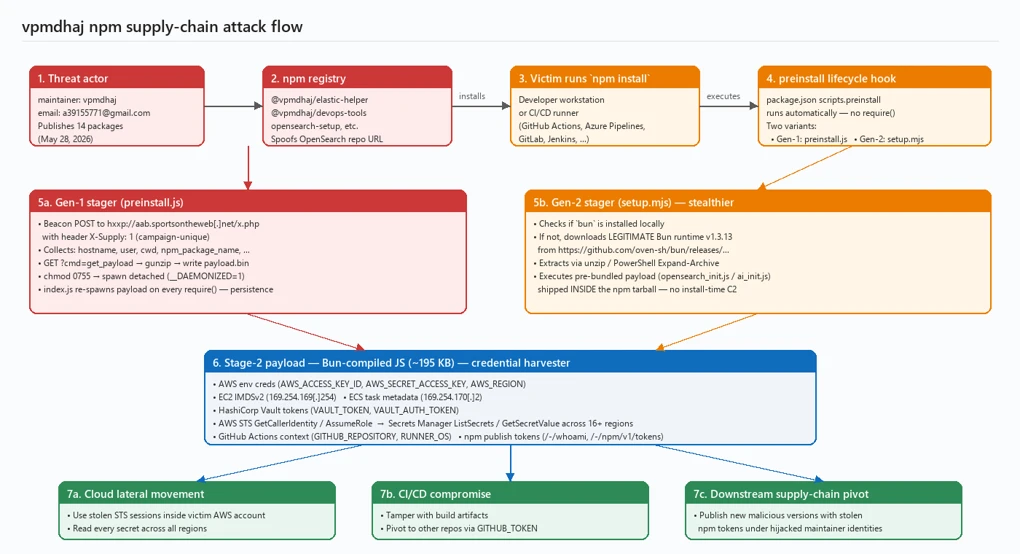
Microsoft has identified an active supply chain attack targeting the npm package ecosystem. On May 28, 2026, a single threat actor operating under the newly created maintainer alias vpmdhaj (a39155771@gmail[.]com) published 14 malicious packages within a four-hour window. The packages typosquat well-known OpenSearch, ElasticSearch, DevOps, and environment-configuration libraries, and several spoof the upstream OpenSearch project’s repository URL in their package.json to appear legitimate. Once installed, the packages harvest AWS credentials, HashiCorp Vault tokens, and CI/CD pipeline secrets from the host environment.
All packages in the cluster ship the same install-time stager and the same Bun-compiled second-stage payload – a ~195 KB credential harvester purpose-built for cloud and CI/CD environments. The payload runs silently during npm install and targets credentials across Amazon Web Services, HashiCorp Vault, GitHub Actions, and the npm registry itself, enabling both cloud lateral movement and downstream supply-chain pivoting through stolen npm publish tokens. Based on our investigation and feedback to the npm team these repos and users were taken down.
Key capabilities observed in the campaign include automatic execution via npm lifecycle hooks, two distinct stager generations (an HTTP-C2 variant and a stealthier variant that abuses the legitimate Bun runtime distribution), AWS Instance Metadata Service (IMDSv2) and ECS task-role theft, AWS Secrets Manager enumeration across 16+ regions, HashiCorp Vault token harvesting, and theft of npm publish tokens for follow-on supply-chain attacks.
Attack chain overview
The vpmdhaj cluster spans 14 scoped and unscoped packages that all mimic the @opensearch / @elastic ecosystem. The attack proceeds through:
Publication of 14 typosquat packages under a single actor identity
Automatic payload execution through a preinstall hook during npm install
Execution chain (Gen-2): node -> setup.mjs -> download legitimate Bun runtime -> run bundled stage-2
Cloud credential theft (AWS IMDS, ECS metadata, Vault, Secrets Manager) and npm publish-token theft for downstream supply-chain pivot
Figure 1. vpmdhaj npm supply chain attack flow.
The lure: typosquats and spoofed metadata
The actor adopted three social-engineering techniques designed to drive installs by mistake or trust transference. First, lookalike naming – names such as opensearch-setup, opensearch-setup-tool, opensearch-config-utility, elastic-opensearch-helper, search-engine-setup, and env-config-manager mimic well-known cluster-management and configuration libraries. Second, spoofed upstream metadata – every unscoped package sets its package.json homepage, repository, and bugs fields to the legitimate github.com/opensearch-project/opensearch-js project. Third, inflated version numbers – releases jump straight to 1.0.7265, 1.0.9108, or 2.1.9201 to suggest a long, mature release history.
Figure 2. npm.js package page for @vpmdhaj/elastic-helper showing the inflated 1.0.7269 version and the spoofed OpenSearch repository link.
Execution: npm lifecycle hook abuse
Every package in the cluster declares an automatic install-time hook in package.json. The malicious code executes the moment a victim runs npm install – no require() from victim code is needed. Two stager variants were observed:
Gen-1 (versions <= 1.0.7265): install, preinstall, and postinstall hooks all invoke preinstall.js / index.js
Gen-2 (versions >= 1.0.7266): a single preinstall hook invokes setup.mjs (newer, stealthier loader)
Figure 3. The malicious package.json. A single preinstall hook is enough to gain code execution on every npm install.
Gen-1 stager: HTTP C2 beacon and payload drop
preinstall.js collects rich host context – hostname, platform, arch, Node version, USER/USERNAME, cwd, INIT_CWD, npm_package_name, npm_package_version – base64-encodes the JSON, and POSTs it to the actor’s C2 with a campaign-unique header X-Supply: 1. The same C2 endpoint then serves a gunzip-compressed second-stage binary, which is written to payload.bin in the package install directory, chmod 0755’d, and spawned detached.
Figure 4. Stage-1 C2 beacon. The X-Supply: 1 header is a high-confidence detection signal in proxy logs.Figure 5. Stage-2 download, decompression, +x, and detached spawn. __DAEMONIZED=1 lets the payload distinguish itself from npm.
The package’s index.js re-launches the same payload.bin on every subsequent require() of the module – a quiet persistence mechanism that survives across CI build stages and developer rebuild loops. The module also exports a benign-looking object falsely identifying itself as @opensearch/setup.
Figure 6. Persistence shim. The malicious module exports benign-looking metadata and silently re-spawns the payload every time it is require()’d.
Gen-2 stager: abusing the legitimate Bun runtime as a loader
In newer versions, the actor replaced the noisy HTTP-C2 design with a stealthier loader that eliminates the install-time C2 round-trip entirely. setup.mjs (a) checks whether bun is already present on the host; (b) if not, downloads the legitimate Bun runtime v1.3.13 from github.com/oven-sh/bun/releases for the correct platform/arch (Linux x64/musl/aarch64, macOS x64/arm64, Windows x64/arm64); (c) extracts the ZIP using unzip, PowerShell Expand-Archive, or a hand-rolled ZIP parser; and (d) executes the pre-bundled second-stage payload (opensearch_init.js or ai_init.js) that ships inside the npm tarball.
This design reduces visibility for defenders that primarily monitor unusual outbound traffic during package installation.
Figure 7. Gen-2 loader. The actor abuses a legitimate GitHub Release of the Bun runtime to execute a pre-bundled payload that ships inside the npm tarball.
Credential theft
The second-stage binary is a single-file Bun-compiled JavaScript binary of approximately 195 KB, purpose-built for cloud and CI/CD secret theft. Static review of the bundle identifies routines that target secrets across five platforms:
AWS: queries EC2 Instance Metadata Service v2 (169.254.169[.]254), Elastic Container Service task metadata (169.254.170[.]2), reads AWS env credentials, calls STS GetCallerIdentity / AssumeRole, and enumerates Secrets Manager (ListSecrets / GetSecretValue) across 16+ regions with a bundled SigV4 signer.
HashiCorp Vault: reads VAULT_TOKEN and VAULT_AUTH_TOKEN environment variables.
npm: validates tokens through /-/whoami and enumerates publish access through /-/npm/v1/tokens.
GitHub Actions: collects GITHUB_REPOSITORY and RUNNER_OS context to identify build environments for prioritized exploitation.
CI/CD environment: respects __DAEMONIZED=1 to avoid re-entry, and explicitly resets CI=false to mislead build-aware code paths.
Figure 8. String evidence from the Bun-compiled stage-2 payload. The same binary is dropped by both Gen-1 and Gen-2 stagers.
Impact and blast radius
Stolen AWS STS sessions and Secrets Manager material enable cloud lateral movement and data theft.
Stolen npm publish tokens enable downstream supply-chain pivoting – pushing malicious updates to packages owned by hijacked maintainer identities, expanding the campaign beyond the initial 14 packages.
All 14 packages target the OpenSearch / ElasticSearch ecosystem keywords, suggesting the actor likely chose a developer audience to have AWS and Elastic cloud credentials in their environments.
Mitigation and protection guidance
Microsoft recommends the following mitigations to reduce the impact of this threat:
Identify systems that installed or built affected package versions on or after May 28, 2026.
Pin known-good package versions where possible and avoid automatic dependency upgrades until validation is complete.
Disable pre- and post-installation script execution by running npm install with –ignore-scripts (or setting npm config set ignore-scripts true globally). Apply equivalent settings for pnpm and yarn.
Rotate AWS IAM/STS, HashiCorp Vault, npm publish, and GitHub Actions tokens that may have been exposed to affected runners or developer workstations.
Block egress to aab.sportsontheweb[.]net at proxy, firewall, and DNS layers. Alert on any HTTP request carrying the header X-Supply: 1.
Hunt CloudTrail for anomalous sts:GetCallerIdentity rapidly followed by sts:AssumeRole, and for secretsmanager:ListSecrets or GetSecretValue in cross-region succession from build infrastructure or developer IP space.
Audit CI/CD logs for unexpected outbound network connections, Bun runtime downloads from GitHub Releases by Node.js processes, and detached child processes spawned with __DAEMONIZED=1.
Review npm package lockfiles (package-lock.json, yarn.lock, pnpm-lock.yaml), build logs, and artifact provenance for evidence of compromised package versions.
Enable cloud-delivered protection in Microsoft Defender Antivirus or equivalent antivirus protection.
Use Microsoft Defender XDR to investigate suspicious activity across endpoints, identities, cloud apps, and developer environments.
Use Microsoft Defender Vulnerability Management to search for the affected packages across your estate.
How Microsoft Defender helps
Microsoft Defender Antivirus detects and blocks the malicious components on access. During reproduction in our analysis environment, setup.mjs was automatically quarantined the moment the tarball was extracted to disk.
Figure 9. Microsoft Defender auto-quarantine of setup.mjs at extract time.
Microsoft Defender XDR Detections
Microsoft Defender XDR customers can refer to the list of applicable detections below. Microsoft Defender XDR coordinates detection, prevention, investigation, and response across endpoints, identities, email, and apps to provide integrated protection against attacks like the threat discussed in this blog.
Tactic
Observed activity
Microsoft Defender coverage
Initial Access / Execution
Suspicious script execution during npm install or package lifecycle activity
Microsoft Defender Antivirus -Trojan:JS/ShaiWorm -Trojan:JS/ObfusNpmJs -Backdoor:JS/SupplyChain
Microsoft Defender for Endpoint – Suspicious usage of Bun runtime – Suspicious installation of Bun runtime – Suspicious Node.js process behavior
Microsoft Defender XDR – Suspicious file creation in temporary directory by node.exe – Suspicious Bun execution from Node.js process
Credential Access
Potential harvesting of AWS, Vault, GitHub Actions, and npm tokens from CI/CD runners
Microsoft Defender for Endpoint – Credential access attempt – Suspicious cloud credential access by npm-cached binary – AWS Instance Metadata Service access from suspicious process
Microsoft Defender for Cloud – Possible IMDS abuse from container workload – Anomalous Secrets Manager enumeration across regions
Command and Control
Outbound HTTP beacon with X-Supply: 1 header to attacker-controlled C2
Microsoft Defender for Endpoint – Connection to a custom network indicator (aab.sportsontheweb[.]net) – Suspicious outbound HTTP from npm install context
Persistence
Re-spawn of payload.bin on every require() of compromised package
Microsoft Defender for Endpoint – Detached child process spawned by node.exe with __DAEMONIZED=1
Advanced hunting
The following sample queries let you search for a week’s worth of events. To explore up to 30 days of raw data, go to the Advanced Hunting page > Query tab, and update the time range to Last 30 days.
Hunt for suspicious npm lifecycle script execution involving vpmdhaj packages.
DeviceFileEvents
| where Timestamp > ago(7d)
| where FileName =~ "payload.bin"
| where FolderPath has "node_modules"
| project Timestamp, DeviceName, FolderPath, FileName,
          InitiatingProcessFileName, InitiatingProcessCommandLine, AccountName
Hunt for detached payload execution with the campaign environment marker.
DeviceProcessEvents
| where Timestamp > ago(7d)
| where ProcessCommandLine has "__DAEMONIZED=1"
   or InitiatingProcessCommandLine has "__DAEMONIZED=1"
| project Timestamp, DeviceName, FileName, ProcessCommandLine,
          InitiatingProcessFileName, InitiatingProcessCommandLine
Hunt for Gen-2 loader: Bun runtime download from GitHub Releases by Node.js.
DeviceNetworkEvents
| where Timestamp > ago(7d)
| where InitiatingProcessFileName in~ ("node.exe", "node")
| where RemoteUrl has "github.com/oven-sh/bun/releases/download"
| project Timestamp, DeviceName, RemoteUrl, RemoteIP,
          InitiatingProcessFileName, InitiatingProcessCommandLine, AccountName
Hunt for C2 beacon to attacker infrastructure.
DeviceNetworkEvents
| where Timestamp > ago(30d)
| where RemoteUrl has "aab.sportsontheweb.net"
   or RemoteUrl has "sportsontheweb.net"
| project Timestamp, DeviceName, RemoteUrl, RemoteIP,
          InitiatingProcessFileName, InitiatingProcessCommandLine, AccountName
Hunt for AWS IMDS / ECS metadata access from Node.js processes.
DeviceNetworkEvents
| where Timestamp > ago(7d)
| where InitiatingProcessFileName in~ ("node.exe", "node", "bun.exe", "bun")
| where RemoteIP in ("169.254.169.254", "169.254.170.2")
| project Timestamp, DeviceName, RemoteIP, RemoteUrl,
          InitiatingProcessFileName, InitiatingProcessCommandLine, AccountName
Indicators of Compromise (IOC)
Affected npm packages – all published by maintainer vpmdhaj on 2026-05-28:
To hear stories and insights from the Microsoft Threat Intelligence community about the ever-evolving threat landscape, listen to the Microsoft Threat Intelligence podcast.
Review our documentation to learn more about our real-time protection capabilities and see how to enable them within your organization.
Palo Alto Networks Unit 42 and AWS Announce Expanded Collaboration, Launching No-Cost Retainer for AWS Security Incident Response available in AWS Marketplace
Speed is everything in today’s security landscape. From Unit 42®’s frontline experience responding to more than 500 incidents last year, we've seen that in nearly one in five incidents, attackers go from initial compromise to data exfiltration in less than an hour. It leaves almost no time to react.
The challenge is compounded by the distributed nature of the modern IT environment; cyberattacks are rarely confined to one location. In fact, 70 percent of incidents now span three or more attack surfaces, from endpoints and networks to multiple cloud environments. This complexity increases vulnerabilities, which is a key reason why 86 percent of major incidents disrupt business operations.
When a breach moves at this speed and crosses complex silos, an enterprise has two immediate, critical needs:
Rapid, integrated expertise to contain the threat at its source within the cloud.
Holistic, end-to-end investigation to determine the full scope of the attack, tracing the attacker's path wherever it leads, across all systems and environments.
The No-Cost Unit 42 IR Retainer Available on AWS Marketplace
Recognizing customers need a faster, more comprehensive incident response strategy in the cloud, Palo Alto Networks Unit 42 is expanding our partnership with Amazon Web Services (AWS) Security Incident Response service. The collaboration introduces a no-cost Unit 42 Incident Response Retainer, which is now available to qualified customers in AWS Marketplace. Our value-added offer provides qualified customers with rapid access to Unit 42’s world-class investigative expertise and dramatically minimizes the critical time between an alert and full containment.
For qualified customers, here's what the no-cost Unit 42 Incident Response Retainer offers:
250 hours of initial Unit 42 Incident Response services at no cost.
A 2-hour response time agreement for incident response.
24/7/365 access to the Unit 42 Incident Response team.
As an AWS Security Incident Response Service Ready partner, this collaboration is designed to deliver seamless, end-to-end incident response and proactive security services. By combining Unit 42’s deep experience in managing complex, legally privileged investigations with the rapid engagement of AWS Security Incident Response, organizations can resolve critical incidents faster and more comprehensively.
Unit 42 also offers preferred pricing to AWS Security Incident Response customers for proactive services through paid retainer offerings, also available in AWS Marketplace.
Hart Rossman, Vice President of Global Services Security, AWS:
When cyberattacks move at cloud speed, customers need immediate access to comprehensive expertise. By integrating Unit 42's end-to-end investigative capabilities with AWS Security Incident Response, we're delivering a unified response that helps customers contain threats faster and minimize business disruption. The no-cost retainer ensures they can activate the full scope of resources they need within minutes, not hours.
Effective response to a cloud breach demands deep technical skill and the ability to manage complexity under pressure. Unit 42 excels at managing high-stakes incidents. By coupling our expertise with AWS Security Incident Response’s capabilities to prepare, respond and recover from security incidents, Unit 42 offers customers a unified defense. Streamlining the entire process, from initial alert to final resolution, allows organizations to get back to business faster and limit operational disruption.
A Unified Front Against Complex Cloud Incidents
The collaboration is designed to solve a critical customer problem: Reduce the time and complexity of responding to incidents that span both AWS resources and the broader enterprise.
The combined offering delivers three key benefits, providing customers with a holistic and agile defense strategy:
Comprehensive Investigation: Unit 42’s expertise enables an investigation across multiple environments, including endpoints, networks and other enterprise data sources, complementing AWS’s incident response technologies and expertise.
Rapid, 24/7 Access to Experts: AWS Security Incident Response provides direct, 24/7 access to the AWS Customer Incident Response Team (CIRT), capable of engaging within minutes. Unit 42 is skilled at serving in the incident command role, coordinating efforts among internal stakeholders, other forensic and recovery vendors, as well as legal counsel.
Response Readiness with No-Cost Retainer: The offering removes the typical administrative and procurement overhead of incident response engagements. The added value ensures qualified customers can activate the full resources of Unit 42 instantly, often at the direction of counsel.
Availability
The Unit 42 Incident Response and proactive service offerings are available in AWS Marketplace today. More information on the partnership will be shared during AWS re:Invent 2025 (December 1-5, 2025).
Kent Ickler & Jordan Drysdale // BHIS Webcast and Podcast This post accompanies BHIS’s webcast recorded on August 7, 2018, Active Directory Best Practices to Frustrate Attackers, which you can view below. […]
Jordan Drysdale//* In this blog, we are assuming that we have obtained an access key, a secret key and maybe a .pem key from a network user who left these […]
Jordan Drysdale// Full disclosure and tl;dr: The NCC Group has developed an amazing toolkit for analyzing your AWS infrastructure against Amazon’s best practices guidelines. Start here: https://github.com/nccgroup/Scout2 Then, access your […]
Brian Fehrman // In a previous post, titled PowerShell without PowerShell, we showed you how you can bypass Application Whitelisting Software (AWS), PowerShell restrictions/monitoring, and Command Prompt restrictions. In some […]
Lawrence Hoffman // Hey, I’m back! Vacation was great. I spent part of last week on an Island so I was unable to scratch the keep-up-with-the-media itch. Now that I’m […]

 Login
Login