❌

Normal view

Fast Track ISM-ready cloud environments and IRAP Assessments with Landing Zone Accelerator on AWS

25 August 2026 at 23:53

This post announces the availability of a new independent assessment report available on AWS Artifact analyzing how Landing Zone Accelerator on AWS (LZA) can automatically deploy multi-account environments in Amazon Web Services (AWS) with Australian Government Information Security Manual (ISM) security controls coverage at scale. The report includes findings from an independent third-party analysis conducted by AWS Partner gwi.digital. In addition to the report, we talk about ISM compliance applicability to LZA and a new testing mechanism for measuring configuration drift, which together can provide Australian customers with a documented and validated foundation to accelerate IRAP assessment readiness.

Background

Australian organizations in public sector, defense, and critical infrastructure agencies must build cloud environments that meet (ISM requirements. The ISM defines 1,081 security control requirements across 22 guideline chapters. Demonstrating compliance is central to achieving an IRAP assessment outcome, but assessments typically require months of preparation, evidence gathering, and testing.

In October 2025, we introduced the LZA Universal Configuration and LZA Compliance Workbook. LZA provisions a multi-account security architecture that automates the deployment of nearly 200 security controls based on AWS Well-Architected pillars and AWS security best practices. The LZA Compliance Workbook, available on AWS Artifact, documents how the Universal Configuration (UC) maps to technical security requirements from 17 global compliance frameworks, with more being added. LZA is an ideal solution for customers with security and compliance obligationsβ€”both existing and anticipatedβ€”because the guardrails it deploys are applied automatically to new accounts as environments grow.

What’s in the report

To see how LZA can help customers in Australia we teamed up with AWS Partner gwi.digital to run LZA as a customer would. gwi.digital is a consultancy partner specializing in cybersecurity and governance, risk, and compliance (GRC) and has deep experience in IRAP assessments and the ISM framework. The team conducted an independent analysis and evaluation of LZA UC against 1,081 ISM controls. The assessment was conducted in a greenfield AWS environment hosted in the ap-southeast-2 (Sydney) AWS Region, positioned within Phase 2 of the ASD Cloud Security Assessment and Authorization Framework and focused on cloud consumers building on already-authorized AWS services. It builds on existing AWS IRAP foundations: Underlying AWS services were most recently independently assessed at the PROTECTED level by CyberCX last year. While this report does not constitute an official IRAP authorization, certification, or accreditation, it provides a professional evaluation of evidence based on what LZA delivers out of the box (and what it does not), so organizations can make informed decisions.

What the assessment found

Of the 1,081 ISM controls, 256 are within the addressable scope of LZA and include the technical infrastructure controls that a solution like LZA can meaningfully address. Of those 256, LZA achieves Full or Partial coverage for 234 (91%). The remaining 825 controls are outside the scope of LZA: physical security, personnel, organizational governance, and classification-level exclusions. A key contribution for the assessment was analysis of the shared responsibility model that goes beyond the traditional AWS/customer binary. It considers a three-tier viewβ€”AWS (provided), LZA (enabled), and Customer (responsibility)β€”and further categorizes the 825 out-of-scope controls into subcategories so customers can quickly determine which controls require their attention compared to which are already addressed at the infrastructure level. By combining automated deployment, ISM-specific compliance mappings, independent validation, and continuous evidence generation, Australian customers can reduce IRAP assessment timelines while achieving more reliable compliance outcomes.

Note: Results are based on the configuration as-provisioned based on the LZA version and during the time of this assessment. Results may vary depending on customer implementation and configuration choices.

Continuous validation with CATS

Confirming controls are implemented and operating effectively across your environment is complex and often lacks complete coverage. To simplify testing your LZA deployment, we developed the Controls Acceptance Testing Suite (CATS). CATS is an automated compliance validation engine that runs purpose-built tests against the security configuration baseline deployed by LZA UC. For the ISM assessment, CATS executed over 3,600 individual tests across six AWS accounts, evaluating account structure, identity and access, network configuration, logging, encryption, and backup. For Australian customers, CATS enables:

  • Automated evidence generation: Machine-readable results may replace weeks of manual evidence collection
  • ISM-enriched reporting: gwi-digital developed a conversion script that maps CATS output to ISM control references, enabling auditors to interpret results from an ISM perspective
  • OSCAL export: Results in Open Security Controls Assessment Language (OSCAL) format for interoperability with assessment tools
  • Continuous drift detection: Repeatable execution identifies when configurations deviate from the validated baseline between assessment cycles

Note: CATS availability is limited and currently accessible only through AWS Professional Services as a private beta solution and may be subject to change. Availability, features, and pricing are subject to change without notice. Contact your AWS account representative or reach out to a member of the LZA team for questions about CATS, or to provide feedback on the LZA ISM report.

ISM-optimized configuration

Through the assessment, gwi-digital identified configuration adjustments that elevate specific control ratings from Partial to Full, with minimal effort; for example, increasing the default password length from 14 to 15 characters or adjusting log retention to align with Australian Federal Disposal Authority standards. These recommendations have been communicated to the LZA UC team for inclusion in a future ISM-specific guidance section in LZA GitHub documentation.

Getting started

In addition to the LZA ISM report, you can also find the LZA Compliance Workbook available on AWS Artifact. It maps related ISM requirement identifiers to security implementation statements, giving you a starting point from which you can customize and enhance your compliance documentation for your unique use cases after deploying LZA.

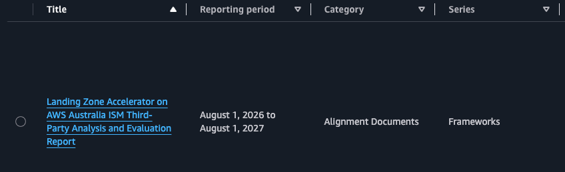
  1. Sign in to your AWS account and then download the LZA Australia ISM Third-Party Analysis and Evaluation Report and LZA Compliance Workbook from AWS Artifact.
    Figure 1: LZA report and workbook in AWS Artifact

    Figure 1: LZA report and workbook in AWS Artifact

  2. Visit the LZA Universal Configuration GitHub repository to review and download the latest configuration baseline.
  3. Use the LZA Implementation Guide to see use cases, review pre-deployment considerations and then follow deployment steps.
  4. Set-up a security compliance chat agent. Consider creating a knowledge base with Amazon Bedrock using the LZA Compliance Workbook, LZA Implementation Guide, web crawlers to the LZA GitHub, and your custom resources to set up your own chat agent.

If you have questions, contact a gwi.digitalexpert, AWS LZA team member, or your AWS account representative.

Conclusion

The combination of ISM mappings in the LZA Compliance Workbook, the gwi-digital analysis report, and CATS evidence gives Australian customers a head start on IRAP assessments.

  • Weeks saved on scoping: Pre-determined control applicability significantly reduces upfront scoping effort
  • Documentation ready: Implementation statements and control requirement alignment reduce the documentation burden
  • Independent assurance: A third-party report that customers and their assessors can reference directly
  • Continuous evidence: CATS generates repeatable security evidence between assessment cycles, replacing periodic manual audits with ongoing assurance

Acknowledgements

The Landing Zone Accelerator team would like to thank Baden Hughes, Henrik Melkonyan, Iain Lindsay-German, and Ian Roderick from gwi.digital for their professionalism and expertise in performing an incredibly thorough assessment, helping us to make LZA better for customers, and for their contributions to this blog post.

If you have feedback about this post, submit comments in the Comments section below.


Kevin Donohue

Kevin Donohue

Kevin is a Senior Security Compliance Engineer at AWS, where he builds solutions and resources to help AWS customers achieve their security and compliance goals. Prior to joining the Landing Zone Accelerator team in AWS Professional Services in 2024, Kevin began his tenure with AWS Security in 2019 specializing in FedRAMP compliance and the shared responsibility model.

Dan Friebe

Dan Friebe

Dan is a Senior Solutions Architect at AWS, helping customers design and build secure cloud solutions. With over a decade of AWS experience and 16+ years supporting public sector missions, he has spent 8 years delivering solutions for customers and enabling partners to deliver at scale. He’s passionate about removing friction between compliance and innovation, helping customers move faster without compromising security.

Dave Connell

Dave Connell

Dave Connell is a Senior Software Development Engineer within AWS Professional Services. He has spent the last 7 years building software to secure and scale AWS usage, enabling builders to delight customers and deliver business value through excellent software in the cloud. Dave is passionate about enabling delivery of predictable, safe and valuable customer outcomes by empowering the builder.

2026 Phase 1a IRAP report is now available on AWS Artifact for Australian customers

28 July 2026 at 19:16

Amazon Web Services (AWS) is excited to announce that the latest version of Information Security Registered Assessors Program (IRAP) report (Phase 1a – full assessment) is now available through AWS Artifact. An independent Australian Signals Directorate (ASD) certified IRAP assessor completed the IRAP assessment of AWS in June 2026.

The new IRAP report includes four additional AWS services that are now assessed at the PROTECTED level under IRAP. This brings the total number of services assessed at the PROTECTED level to 167.

The four newly assessed services are:

For the full list of services, see the IRAP tab on the AWS Services in Scope by Compliance Program page.

We have developed an IRAP documentation pack to help our Australian customers and their partners plan, architect, and assess risk for their workloads when they use AWS cloud services.

We developed this pack in accordance with the Australian Cyber Security Centre (ACSC) Cloud Security Guidance and Cloud Assessment and Authorisation framework, which addresses guidance within the Australian Government’s Information Security Manual (ISM, September 2025 version), the Department of Home Affairs’ Protective Security Policy Framework (PSPF), and the Digital Transformation Agency’s Secure Cloud Strategy.

The IRAP pack on AWS Artifact also includes newly updated versions of the AWS Consumer Guide and the whitepaper Reference Architectures for ISM PROTECTED Workloads in the AWS Cloud.

Reach out to your AWS representatives to let us know which additional services you want to see in scope for upcoming IRAP assessments. We strive to bring more services into scope at the PROTECTED level under IRAP to support your requirements.


Patrick Chang

Patrick Chang

Patrick is the APJ Audit Specialist based in Sydney. He leads security audits, certifications, and compliance programs across the APJ region. Patrick is a technology risk and audit professional with around two decades of experience and is passionate about delivering assurance programs that build trust with customers and provide them assurance on cloud security.

2025 exposed the risks we ignored while rushing AI

30 December 2025 at 11:02

This blog is part of a series where we highlight new or fast-evolving threats in the consumer security landscape. This one looks at how the rapid rise of Artificial Intelligence (AI) is putting users at risk.

In 2025 we saw an ever-accelerating race between AI providers to push out new features. We also saw manufacturers bolt AI onto products simply because it sounded exciting. In many cases, it really shouldn’t have.

Agentic browsers

Agentic or AI browsers that can act autonomously to execute tasks introduced a new set of vulnerabilitiesβ€”especially to prompt injection attacks. With great AI power comes great responsibility, and risk. If you’re thinking about using an AI browser, it’s worth slowing down and considering the security and privacy implications first. Even experienced AI providers like OpenAI (the makers of ChatGPT) were unable to keep their agentic browser Atlas secure. By pasting a specially crafted link into the Omnibox, attackers were able to trick Atlas into treating a URL input as a trusted command.

Mimicry

The popularity of AI chatbots created the perfect opportunity for scammers to distribute malicious apps. Even if the AI engine itself worked perfectly, attackers have another way in: fake interfaces. According to BleepingComputer, scammers are already creating spoofed AI sidebars that look identical to real ones from browsers like OpenAI’s Atlas and Perplexity’s Comet. These fake sidebars mimic the real interface, making them almost impossible to spot.

Misconfiguration

And then there’s this special category of using AI in products because it sounds cooler with AI or you can ask for more money from buyers.

Toys

We saw a plush teddy bear promising β€œwarmth, fun, and a little extra curiosity” that was taken off the market after researcher found its built-in AI responding with sexual content and advice about weapons. Conversations escalated from innocent to sexual within minutes. The bear didn’t just respond to explicit prompts, which would have been more or less understandable. Researchers said it introduced graphic sexual concepts on its own, including BDSM-related topics, explained β€œknots for beginners,” and referenced roleplay scenarios involving children and adults.

Misinterpretation

Sometimes we rely on AI systems too much and forget that they hallucinate. As in the case where a school’s AI system mistook a boy’s empty Doritos bag for a gun and triggered a full-blown police response. Multiple police cars arrived with officers drawing their weapons, all because of a false alarm.

Data breaches

Alongside all this comes a surge in privacy concerns. Some issues stem from the data used to train AI models; others come from mishandled chat logs. Two AI companion apps recently exposed private conversations because users weren’t clearly warned that certain settings would result in their conversations becoming searchable or result in targeted advertising.

So, what should we do?

We’ve said it before and we’ll probably say it again:Β  We keep pushing the limits of what AI can do faster than we can make it safe. As long as we keep chasing the newest features, companies will keep releasing new integrations, whether they’re safe or not.

As consumers, the best thing we can do is stay informed about new developments and the risks that come with them. Ask yourself: Do I really need this? What am I trusting AI with? What’s the potential downside? Sometimes it’s worth doing things the slower, safer way.


We don’t just report on privacyβ€”we offer you the option to use it.

Privacy risks should never spread beyond a headline. Keep your online privacy yours by usingΒ Malwarebytes Privacy VPN.

Nmap Cheatsheet

By: BHIS
6 August 2025 at 17:00

Nmap is a powerful open-source tool commonly used by system/network administrators and security professionals to perform network discovery, security auditing, and basic vulnerability assessment.

The post Nmap Cheatsheet appeared first on Black Hills Information Security, Inc..

Vulnerability Scanning with NmapΒ 

Nmap, also known as Network Mapper, is a commonly used network scanning tool. As penetration testers, Nmap is a tool we use daily that is indispensable for verifying configurations and identifying potential vulnerabilities.

The post Vulnerability Scanning with NmapΒ  appeared first on Black Hills Information Security, Inc..

Tap Into Your Valuable DNS Data

Joff Thyer // The Domain Name System (DNS) is the single most important protocol on the Internet. The distributed architecture of DNS name servers and resolvers has resulted in a […]

The post Tap Into Your Valuable DNS Data appeared first on Black Hills Information Security, Inc..

WEBCAST: Blue Team-Apalooza

By: BHIS
15 November 2018 at 17:57

Kent Ickler & Jordan Drysdale // Preface We had a sysadmin and security professional β€œAA” meeting on November 8, 2018. We met and discussed things that seem to be painfully […]

The post WEBCAST: Blue Team-Apalooza appeared first on Black Hills Information Security, Inc..

WEBCAST: There and Back Again – A Pathfinder’s Tale

By: BHIS
19 December 2017 at 17:22

Matthew Toussain// Portswigger’s Burpsuite has become the tool of choice for web application penetration testers. OWASP’s Zed Attack Proxy (ZAP) not only fights in the same weight class but also […]

The post WEBCAST: There and Back Again – A Pathfinder’s Tale appeared first on Black Hills Information Security, Inc..

AppleTV & nmap -sV

By: BHIS
11 October 2016 at 16:21

BBKing // So I’m working the other day, and my wife asks me why the TV is on. I don’t know. I didn’t turn it on. But it’s near my […]

The post AppleTV & nmap -sV appeared first on Black Hills Information Security, Inc..

Are you Snoopable?!

Rick Wisser // All right, you’ve taken all the precautions related to your network. You have lockout controls in place, you use awesome password policies (20 characters with uppercase, lowercase, […]

The post Are you Snoopable?! appeared first on Black Hills Information Security, Inc..

❌