❌

Reading view

Quickpost: Banana Equivalent Dose

From the Banana equivalent dose article in Wikipedia:

The major natural source of radioactivity in plant tissue is potassium: 0.0117% of the naturally occurring potassium is the unstable isotope potassium-40. This isotope decays with a half-life of about 1.25 billion years (4Γ—1016 seconds), and therefore the radioactivity of natural potassium is about 31 becquerel/gram (Bq/g), meaning that, in one gram of the element, about 31 atoms will decay every second. … Since a typical banana contains about half a gram of potassium, it will have an activity of roughly 15 Bq. Although the amount in a single banana is small in environmental and medical terms, the radioactivity from a truckload of bananas is capable of causing a false alarm when passed through a Radiation Portal Monitor used to detect possible smuggling of nuclear material at U.S. ports

Of course, when I read this, I wanted to measure bananas with my meters.
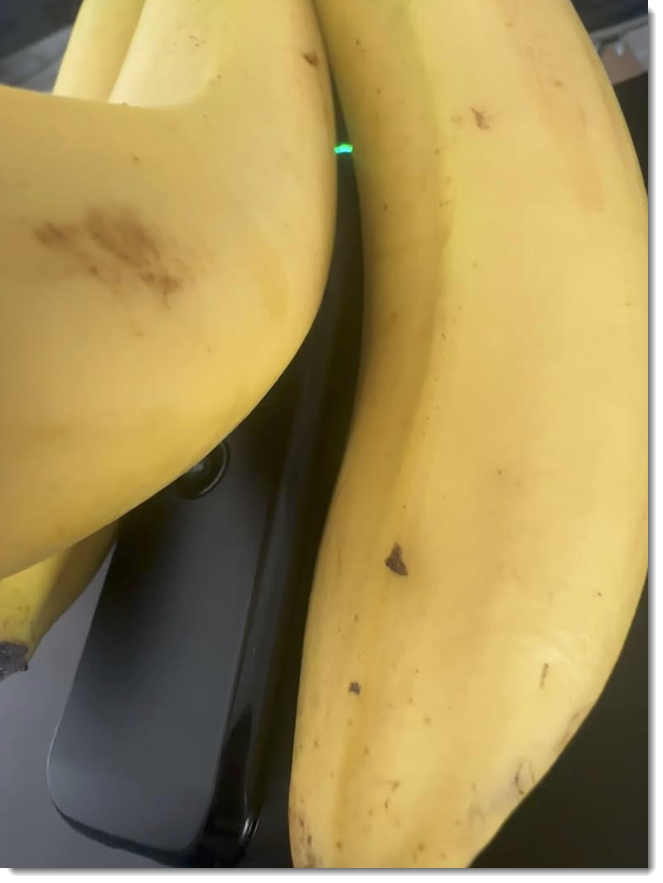
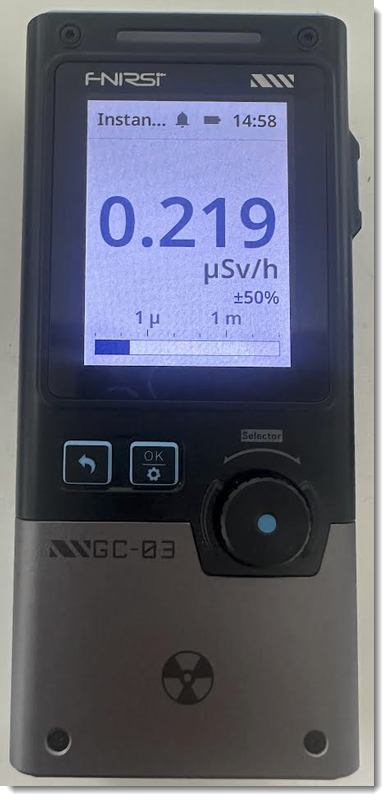
When looking at instant measurements (CPS and Β΅Sv/h), I noticed no increase.

And the spectrum measured with my Radiacode 103 over 24 hours showed a minuscule little bump.
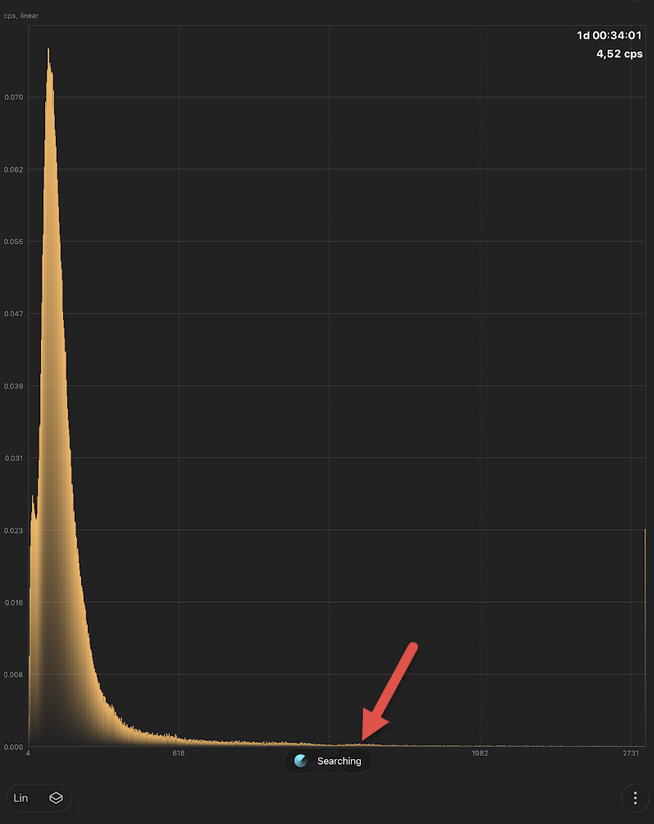
It’s almost not noticeable in this spectrum, but when switching from log to linear, it stands out better:
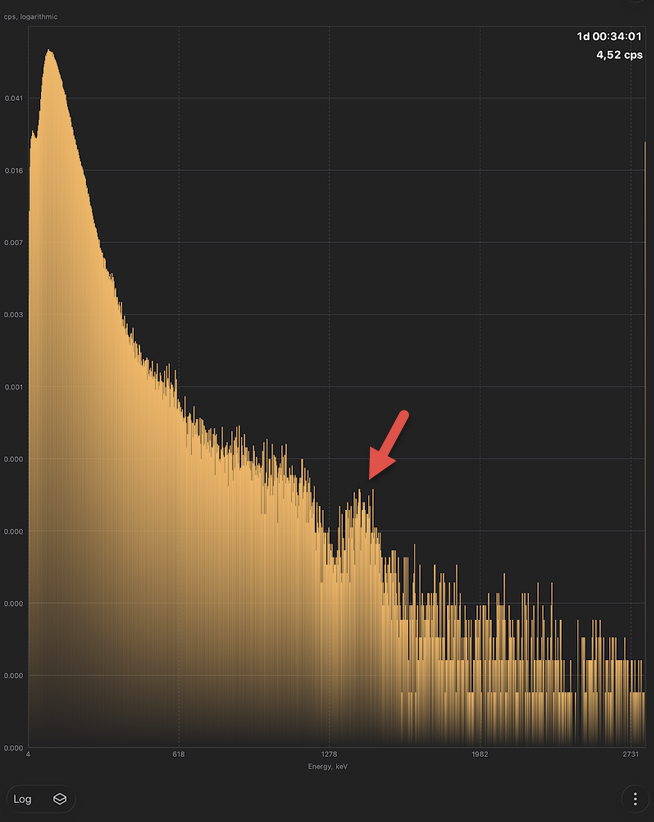
This bump is around 1460 keV, which corresponds to potassium 40:
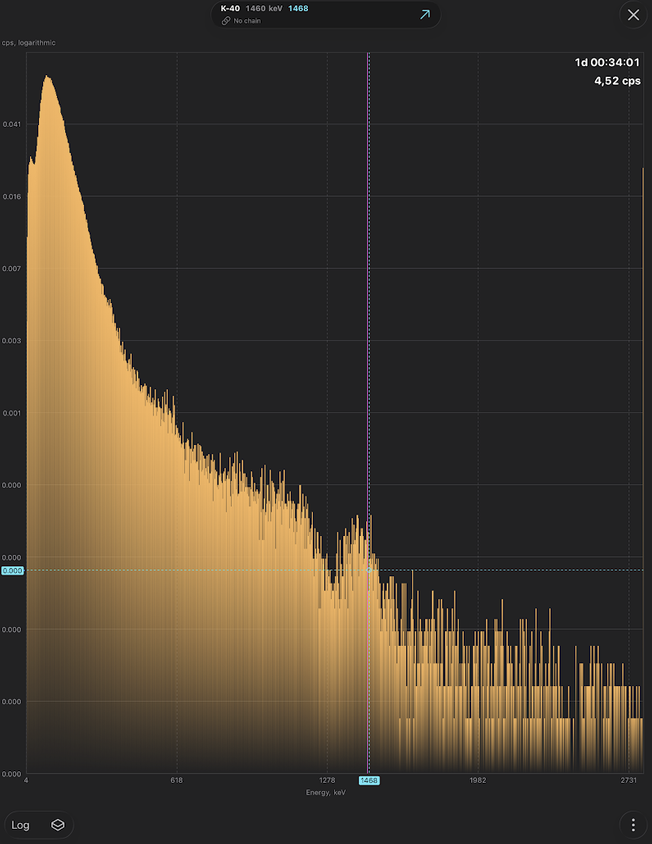
But it turns out that this bump is most likely not caused by potassium in the bananas, because it also shows up in a spectrum I measured of the background radiation, away from the bananas:
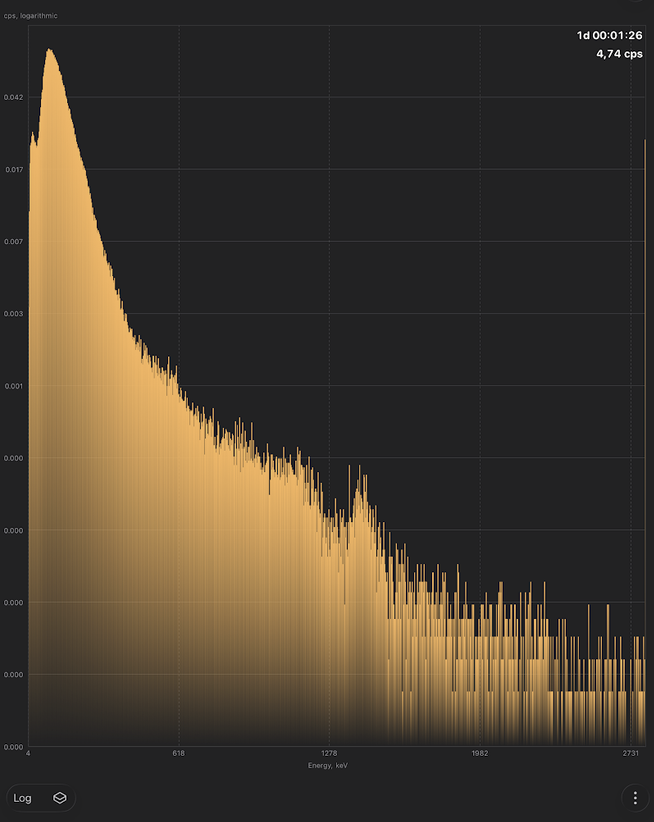
Although this spectrum is measured at the same location as the banana measurement was done, it was measured 24 hours later, so there is no absolute guarantee that the background radiation was the same at that time.

But I do know that my meter can pick up radiation from potassium 40. Here is a spectrum over 5 hours that I took with my meter stuck in low-sodium salt. In this salt, the sodium in sodium chloride has been replaced by potassium. Thus the concentration of potassium 40 is much higher than in bananas.
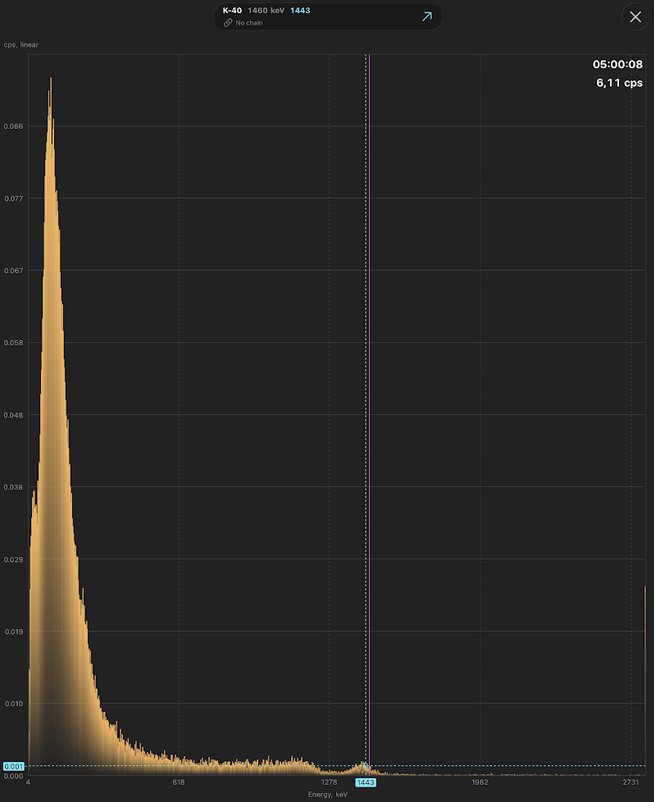
Here you can see a little bump that doesn’t show up in the background radiation spectrum.


Quickpost info

  •  

Quickpost: Rad Pro

While researching the inner workings of Geiger-MΓΌller counters, I stumbled upon Rad Pro.

It’s an open-source project developing firmware for cheap GM meters.

You get yourself a GM meter and replace its firmware with Rad Pro.

For some meters (like FNIRSI), it’s as simple as mounting the meter as a USB storage device and copying the Rad Pro firmware to it. Others (like Bosean) require a programmer.


Quickpost info

  •  

Quickpost: Ghost USB-C

You’ve probably encountered devices that are powered via a USB-C connector, but that don’t work when you connect them to a USB-C charger or powerbank. They only work with a USB-A to USB-C cable, not with a USB-C to USB-C cable.

I used to encounter such devices regularly a couple of years ago, but far less nowadays. Until we went on holiday this summer, and my wife used a small portable fan. She connected it to her USB-C charger, and it didn’t work. So I fixed this with a USB-A to USB-C cable plugged into a charger with USB-A connector.

But this got me thinking: surely, there must be a small USB-C adapter that solves this problem? The problem occurs because in the USB-C standard, a power source doesn’t put 5 Volts on VBUS, until it detects there is a device connected that requires power. It detects the presence of such a device because of current flowing between the CC pins and GND. This happens because the device has resistors between the CC lines and GND. And some devices, like this fan, lack these resistors, and thus no power is present on VBUS. While with USB-A, there is always power on VBUS, whether a device is connected or not.

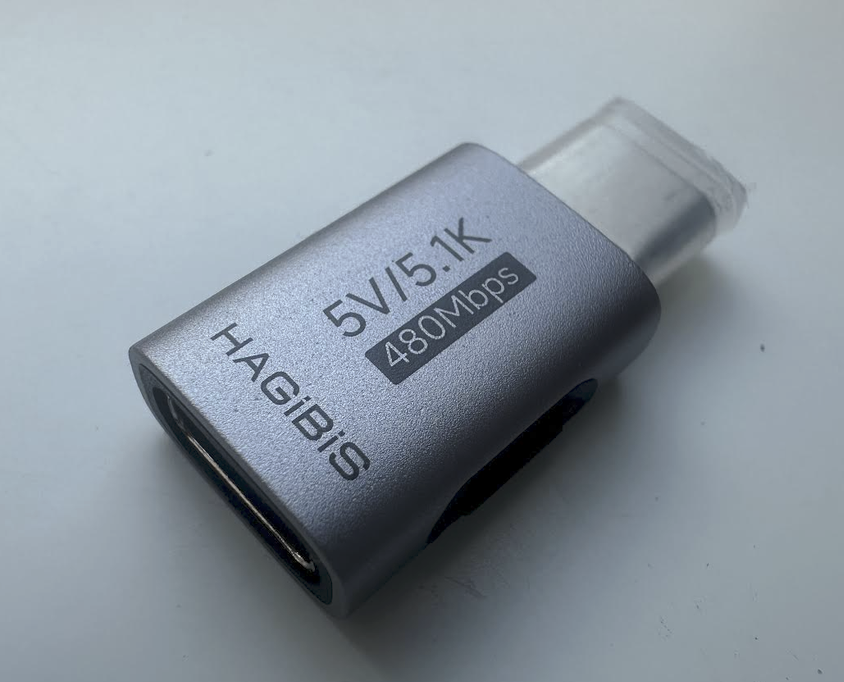
I did find such an adapter:

I has a female and male USB-C connector, and it contains two 5.1 kΞ© resistors, one between line CC1 and GND, and the other between line CC2 and GND. This instructs the power source to deliver 5V between the VBUS lines and GND.

The result is that with this adapter, I can power these non-compliant devices with a classic USB-C power source and a classic USB-C cable.

With USB-A, it is clear from the difference in physical connectors, which device is a power source and which device is a power sink. With USB-C, that physical difference is gone. Both connectors on a USB-C cable are physically identical. Furthermore, with USB-C, the same device can adopt the role of a power source or the role of a power sink. For example, a laptop can be charged via its USB-C port (power sink role), and the same laptop can charge your phone via the same USB-C port (not simultaneously, of course). That’s the power source role.

Thus, with USB-C, a device must announce that it requires power before it receives power from a device that can act as a power source. And this fan doesn’t do this.

Be sure to only use this adapter between a power source and a power sink that is not compliant. If you would use this adapter to connect two power sources together, both power sources would energize the VBUS lines and one of the power sources would start to sink power. Power sources are not designed to sink power. Although this adapter turns a non-compliant device into a compliant device, the adapter itself is non-compliant.


Quickpost info

  •  
❌