❌

Reading view

Yoba Malware Abuses Signed ChatGPT and Claude Binaries to Target AI Users

As interest in new AI tools accelerates, cybercriminals are finding ways to exploit the trust surrounding them. Check Point Research (CPR) has uncovered Yoba, a malware campaign using fake GitHub projects impersonating supposed ChatGPT and Claude desktop applications, while abusing legitimate, signed OpenAI and Anthropic executables to help load malware. The campaign shows how the rush to access new AI tools is creating opportunities for social engineering, even when the AI platforms themselves have not been compromised. Key Findings Attackers used fake GitHub projects impersonating supposed ChatGPT and Claude desktop applications to distribute Yoba malware. Legitimate, signed OpenAI and Anthropic […]

The post Yoba Malware Abuses Signed ChatGPT and Claude Binaries to Target AI Users appeared first on Check Point Blog.

  •  

Three Gartner Reports. One Emerging Direction for Exposure Management.

In a short period, Check Point has appeared across three new Gartner research publications examining autonomous remediation, exposure assessment, and the future of preemptive cybersecurity. These three reports ask very different questions. But how do they connect? One examines how organizations can trust autonomous remediation. Another looks at the growing exposure management market and the increasing importance of exploitability. The third looks further ahead at the technologies Gartner believes will shape preemptive cybersecurity. Taken together, the reports capture a broader change already underway across the industry. Exposure management is expanding from identifying risk toward understanding exploitability and enabling action. Exploitability […]

The post Three Gartner Reports. One Emerging Direction for Exposure Management. appeared first on Check Point Blog.

  •  

Infostealers Are Targeting AI: What Aokigahara Infostealer Reveals About the New Developer Attack Surface

AI assistants have quickly become part of everyday work, particularly for developers. Tools such as ChatGPT, Claude, Cursor and GitHub Copilot increasingly sit alongside source code, cloud environments and other sensitive business resources, making the credentials and sessions connected to these tools increasingly important to protect. New research from Check Point Research (CPR) into the Aokigahara infostealer shows how attackers are adapting to this shift. The malware specifically collects authentication files, session data and configuration files associated with popular AI applications and development tools. The significance goes beyond gaining access to an AI account. If stolen credentials or session tokens […]

The post Infostealers Are Targeting AI: What Aokigahara Infostealer Reveals About the New Developer Attack Surface appeared first on Check Point Blog.

  •  

PHP2Shell: Log4Shell at AI Speed β€” A CISO’s Perspective

Redefining CISO Contract Blog Banner

When the PHP2Shell vulnerabilities became public, my thoughts went back to Log4Shell.Β  Five years ago, Log4Shell showed how difficult it can be to respond to a critical vulnerability in software used across countless applications and services. PHP2Shell presents a similar challenge. The technical details are different, but the need to quickly understand where you’re exposed and take action is very familiar.Β  I believe we should expect more incidents like this. AI is making it possible to discover vulnerabilities in widely used software at a speed and scale we haven’t seen before. As these capabilities become more accessible, we are likely […]

The post PHP2Shell: Log4Shell at AI Speed β€” A CISO’s Perspective appeared first on Check Point Blog.

  •  

PHP2Shell Update: One in ten organizations impacted as Europe bears the brunt

Two critical vulnerabilities in PHP, the programming language behind a large share of the world’s websites, online stores and internet services, are being actively targeted. Since details of CVE-2026-109618 and CVE-2026-109619, known as PHP2Shell, leaked ahead of planned disclosure, 10% of organisations worldwide have been impacted (β€œimpacted” means exploitation attempts, we have no way of knowing if the attack has been successful), according to Check Point Research. Hourly activity peaks at midnight, when fewer security teams are watching. Government institutions in the Netherlands and Finland have taken some of their websites offline as a precaution. What PHP2Shell is and why […]

The post PHP2Shell Update: One in ten organizations impacted as Europe bears the brunt appeared first on Check Point Blog.

  •  

Custom Guardrails: The AI Rules No Vendor Can Write for You

Key takeaways Only 14 percent of organizations say they have formal GenAI policies that are actively enforced and audited, according to Check Point’s 2026 Cloud Security Report. β†’The costliest AI mistakes break rules no vendor ships. Air Canada was held liable for a refund its chatbot promised and the airline never offered β†’The usual fixes fall short. Models can be argued out of system prompts, keyword lists miss meaning, and US-centric DLP lists miss the data your regulators protect β†’Custom guardrails turn a sentence into an enforced rule. Describe it, test it in under five minutes, and run it on […]

The post Custom Guardrails: The AI Rules No Vendor Can Write for You appeared first on Check Point Blog.

  •  

Advancing Agentic AI Security with Palo Alto Networks and NVIDIA

AI is moving from answering questions to taking action. Agents can use tools, access enterprise data, and carry out work across systems on our behalf or autonomously. This creates opportunities for businesses to move faster, but it also changes what security must protect. An agent’s identity, the authority it carries, and the actions it takes all become security decisions.

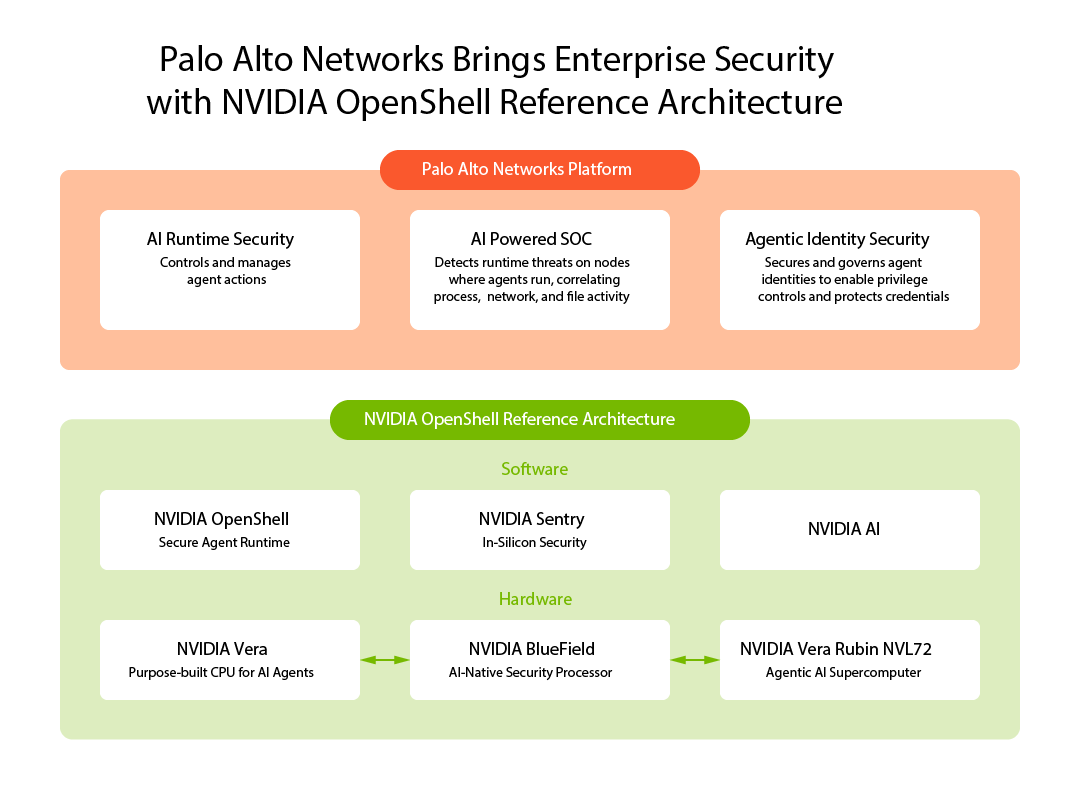
As enterprises put agents into production, they need controls that keep pace without hindering the work those agents are designed to do. Palo Alto Networks is working with NVIDIA to advance this goal across five connected areas in support of the NVIDIA OpenShell Reference Architecture for safe AI agents: an AI gateway on NVIDIA Vera CPU systems; runtime protection on NVIDIA BlueField DPUs; agent identity governance on NVIDIA Sentry; AI factory visibility through an AI-driven, agentic security operations center (SOC); and partner services that help customers implement a secure architecture.

Palo Alto Networks AI Runtime Security Extends Protection Across the AI Factory and Edge

Until now, the AI factory conversation has centered primarily on compute capacity and token generation. But as autonomous agents execute higher-stakes workloads, runtime security has become just as essential. Agents can be steered past their guardrails, and a compromised host cannot be trusted to accurately report what occurred. To be effective, security teams require visibility and enforcement that operate independently of the host environment.

Palo Alto Networks AI Runtime Security on NVIDIA BlueField DPUs isolates security processing in a dedicated infrastructure domain. Because BlueField sits in the path between agents and the models, data, and services they access, security policies are enforced in silicon β€” beyond the reach of a compromised host. This capability safeguards both GPU-accelerated AI workloads and CPU-based agent runtimes and is now generally available across AI factory and industrial edge deployments. Offloading security from the host node delivers two critical benefits: increased token throughput and stronger runtime protection across the entire AI factory.

Deployment at scale must be manageable. Our work with Spectro Cloud manages the deployment and operation of AI Runtime Security on BlueField DPUs, enabling consistent management across the AI factory infrastructure β€” from the data center to distributed edge environments.Β 

Idira Governs the Identity Behind Every Agent Action

Runtime protection answers what an agent is doing. Identity governance helps determine whether it is authorized to do it.

An agent may act for a person, a team, or an autonomous business process, often requiring access to multiple tools and data sources across the organization. Granting an agent broad, persistent access creates risk, while making access too restrictive limits its usefulness. To achieve the optimal balance of control and agent access, Palo Alto Networks is advancing an integration between agentic identity security and NVIDIA Sentry on BlueField β€” bringing identity and delegated authority closer to where agent interactions are governed.

The goal is to give each agent a verifiable identity, grant access appropriate to its task, and make its actions attributable. Once available, this solution will deliver zero-trust protection and tamper-resistant auditing for agents by moving the security controls β€” including identity β€” to the NVIDIA Bluefield DPU, separate from the host operating system. This addresses an immediate business need β€” enabling enterprises to scale agent deployments while retaining control over whose authority agents use and which resources they can reach.

Bringing AI Factory Signals into Cortex

Security teams need visibility into activity across the infrastructure that runs AI agents. Palo Alto Networks has announced an integration of Cortex XSIAM with NVIDIA DOCA Argus, which monitors host activity from BlueField’s independent trust domain. This provides security operations teams with runtime signals that do not rely on an agent installed on the host being monitored.

By bringing those signals together with network, cloud, and identity data in an AI-driven SOC, security teams can investigate AI infrastructure in the context of the broader enterprise. Palo Alto Networks is continuing to develop this foundation to support broader fleet visibility and more comprehensive response workflows β€” enabling security teams to identify unusual activity and act with greater confidence as AI deployments grow.

AI agents run within the NVIDIA OpenShell secure runtime, operated directly on the NVIDIA Vera CPU within the NVIDIA OpenShell Platform. Security observability is completely offloaded to the NVIDIA BlueField DPU. Operating out-of-band, NVIDIA Sentry, built on DOCA Argus, provides real-time memory and network inspection to detect threats without slowing AI inference. When malicious events or policy violations occur, DOCA Argus streams high-fidelity alerts directly to Palo Alto Networks Cortex XSIAM, where they can be automatically correlated and surfaced for rapid threat response.Β 

Turning Secure AI Factory Designs into Deployments

Customers need more than an architecture diagram to bring an AI factory into production. They need a practical path to design, validate, and operate security across compute, networking, applications, and the SOC.

Palo Alto Networks is working with strategic vendors , including Deloitte and World Wide Technology (WWT), to help customers plan and deploy secure NVIDIA AI factories. Deloitte’s Silicon-to-Service (S2S) offering, combined with its Secure AI Foundations, helps organizations implement AI use cases on NVIDIA AI infrastructure through validated architectures and managed services. By building security into the full AI factory stack, Deloitte helps clients balance performance, safety, and cost as they scale from pilot to production.Β Β 

WWT’s AI Proving Ground allows customers to evaluate and test an integrated stack before committing to production deployment.These engagements can help enterprises move from individual security components to a repeatable approach tailored to their environments and requirements.

Building Confidence into the Next Phase of Agentic AI

The value of agentic AI depends on an enterprise’s ability to give agents useful access while maintaining control over their actions. This requires runtime protection, governed identities, independent visibility, and a unified way to manage controls across the enterprise.Β 

Palo Alto Networks delivers comprehensive security across every layer of the AI factory through a unified platform. In collaboration with NVIDIA, we support the NVIDIA OpenShell Reference Architecture for enterprise governance, isolation, and security.Β  Together, we deliver the continuous protection needed to move safely from AI agent pilots to full-scale enterprise production.

To learn more about the general availability of AI Runtime Security on the BlueField DPU, read our blog, Palo Alto Networks Announces Support for NVIDIA Enterprise AI Factory.Β 

The post Advancing Agentic AI Security with Palo Alto Networks and NVIDIA appeared first on Palo Alto Networks Blog.

  •  

Introducing Unit 42 Managed Agentic Endpoint Security

AI agents and AI-enabled tools are fundamentally changing how work gets done. From coding assistants to Model Context Protocol (MCP) servers, autonomous tools now access sensitive data, execute commands, and modify local workflows directly from the endpoint. Traditional endpoint security models fail to offer the visibility or governance required to manage these autonomous actions.

The security gap is already significant. Only 6% of organizations have an advanced AI security strategy. And the fastest attacks can move from initial access to data exfiltration in just 72 minutes, according to the 2026 Unit 42 Global Incident Response Report. As AI adoption grows, teams need context to prioritize risk and experts ready to respond so the business can continue adopting AI with confidence.

Today, we are announcing Unit 42 Managed Agentic Endpoint Security (Managed AES). We built the service on Cortex AES, our AI-native endpoint security platform that provides visibility, contextual risk intelligence and protection for AI agents and artifacts. Managed AES adds 24/7 Unit 42 expertise to help organizations put those capabilities into action. Backed by Unit 42 threat intelligence, our experts provide AI governance, threat hunting, investigation and response, and AI-related cyber hygiene. They apply human judgment to turn contextual intelligence into policy recommendations and prioritized actions as the environment evolves.

Continuous Expert Defense for the AI Environment

Managed AES brings continuous Unit 42 expertise to four areas of AI endpoint security.

  • Govern AI Adoption with Greater Confidence
    AI adoption often moves faster than security teams can assess it. Our experts help identify AI tools and associated risks, evaluate exposure and recommend improvements to policies and controls. Security leaders gain a clearer view of AI use across their environment.
  • Hunt for Emerging and Zero-Day Threats
    AI-related threats can emerge before they trigger a known alert. Our threat hunters use frontline threat intelligence and Cortex AES signals to proactively hunt across the customer’s AI environment. They evaluate findings, recommend action and refine policies and correlation rules to strengthen protection over time.
  • Investigate and Respond 24/7
    Our analysts continuously monitor activity, investigate suspicious behavior and take permitted actions on the customer’s behalf to contain AI-related threats. Security teams gain specialized support to understand what happened, determine the potential impact and prioritize next steps.
  • Continuously Strengthen AI-Related Cyber Hygiene
    Unit 42 assesses the customer’s AI security posture as adoption evolves. AI Security Posture Reports identify policy and control improvements, while Threat Impact Reports detail threats, potential impact, response actions taken and recommended next steps. These insights help teams prioritize improvements.

Expert Protection Across Your AES Environment

Organizations can choose the Cortex AES deployment model that best fits their environment while receiving the same 24/7 Unit 42 expertise.

  • Managed AES with Standalone Cortex AES
    Organizations can deploy Cortex AES alongside their existing endpoint security solution for AI-native visibility, contextual risk intelligence, governance and protection for AI agents and AI-enabled tools. Managed AES adds Unit 42 experts who help customers act on that visibility and risk intelligence.
  • Managed AES with Cortex XDR One
    Cortex XDR One brings together Cortex AES and Cortex XDR into a single sensor and console experience. It combines endpoint detection and response with AI-native security for AI agents and artifacts. Unit 42 experts provide 24/7 governance, threat hunting, investigation and response across the entire endpoint attack surface.

Securely Scale AI Adoption

Unit 42 Managed AES helps security teams understand how AI is being used, address risk before it escalates and respond quickly when threats emerge. By combining Cortex AES context with frontline threat intelligence and expert analysis, Managed AES helps businesses adopt AI with confidence.

Register for our upcoming webinar, The Next Era of Endpoint Security, to learn how Cortex AES and Unit 42 experts help your team govern AI risks, strengthen visibility and protect the agentic endpoint.

The post Introducing Unit 42 Managed Agentic Endpoint Security appeared first on Palo Alto Networks Blog.

  •  
❌